 Скачать презентацию The JLab 12 Ge V Upgrade Antje Bruell
88eebfda9aec33c91d8d0c8c7c63fe5f.ppt
- Количество слайдов: 40



The JLab 12 Ge. V Upgrade Antje Bruell, JLab Pac. Spin 2007, Vancouver, Canada • Upgrade of accelerator and experimental equipment • Highlights of the physics program @ 12 Ge. V • Highlights of spin dependent measurements @ 12 Ge. V • Timelines and schedule
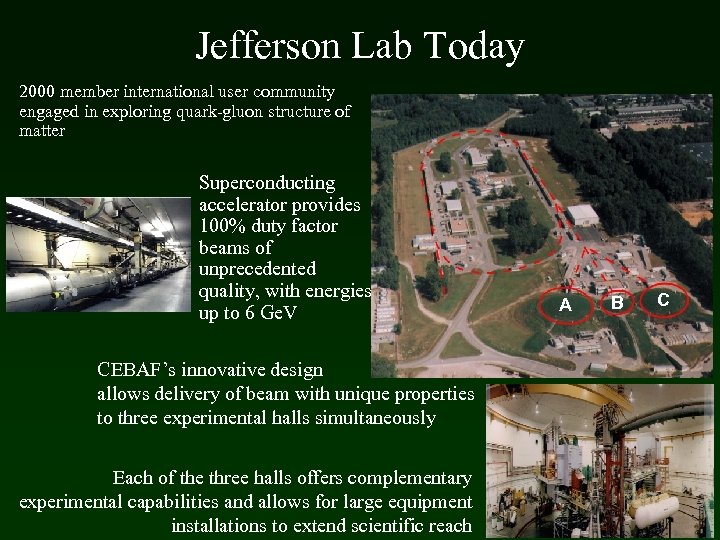
Jefferson Lab Today 2000 member international user community engaged in exploring quark-gluon structure of matter Superconducting accelerator provides 100% duty factor beams of unprecedented quality, with energies up to 6 Ge. V CEBAF’s innovative design allows delivery of beam with unique properties to three experimental halls simultaneously Each of the three halls offers complementary experimental capabilities and allows for large equipment installations to extend scientific reach A B C
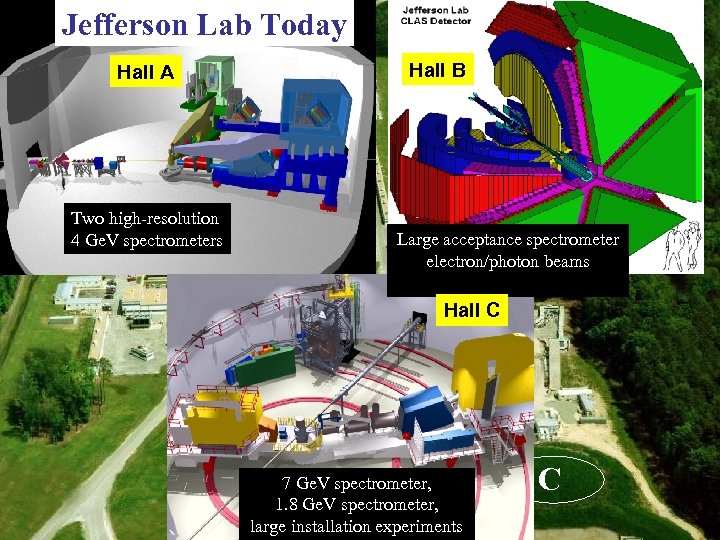
Jefferson Lab Today Hall B Hall A Two high-resolution 4 Ge. V spectrometers Large acceptance spectrometer electron/photon beams Hall C A B 7 Ge. V spectrometer, 1. 8 Ge. V spectrometer, large installation experiments C
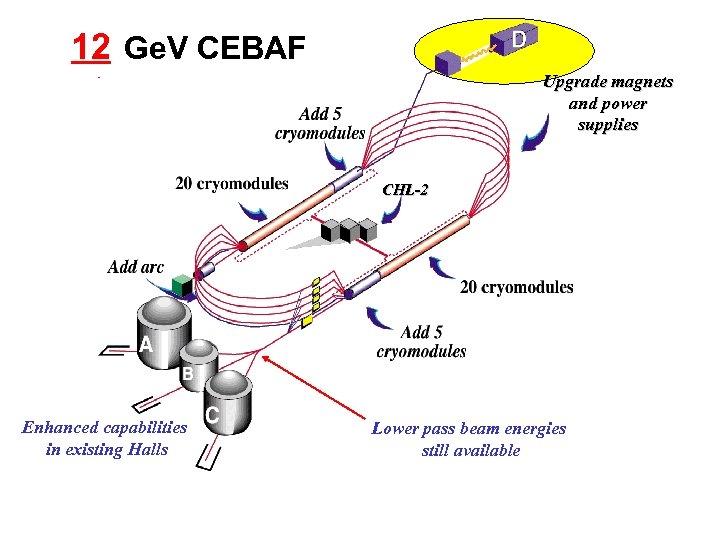
6 11 Ge. V CEBAF 12 Upgrade magnets and power supplies CHL-2 Enhanced capabilities in existing Halls Lower pass beam energies still available
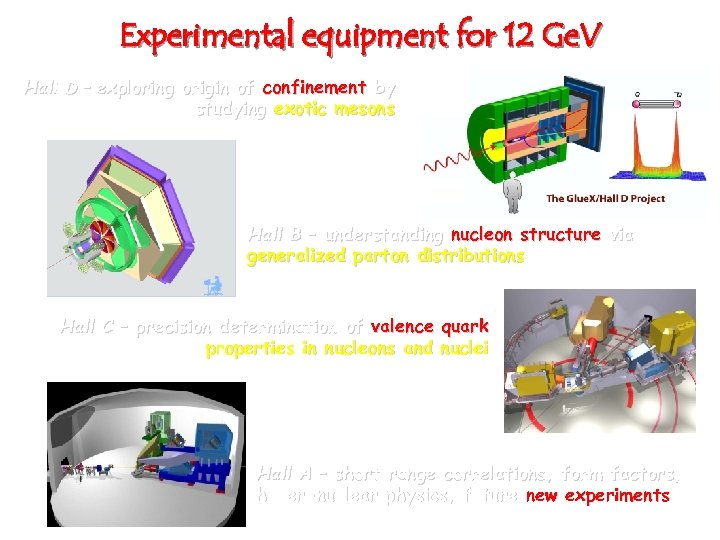
Experimental equipment for 12 Ge. V Hall D – exploring origin of confinement by studying exotic mesons Hall B – understanding nucleon structure via generalized parton distributions Hall C – precision determination of valence quark properties in nucleons and nuclei Hall A – short range correlations, form factors, hyper-nuclear physics, future new experiments
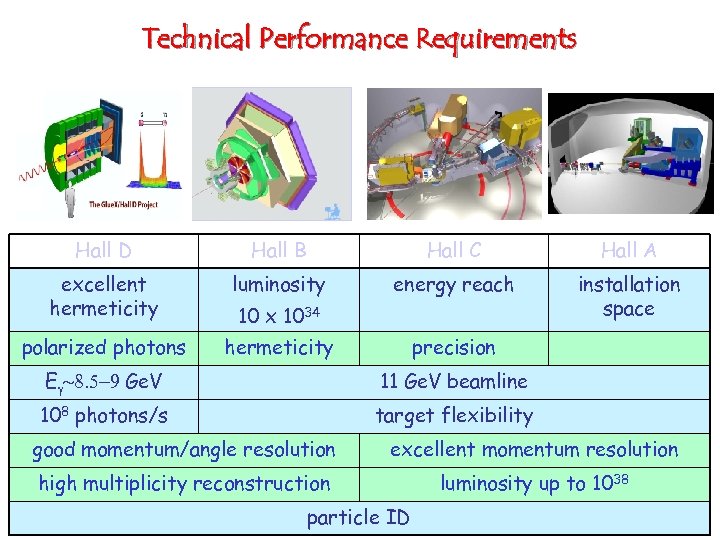
Technical Performance Requirements Hall D Hall B Hall C Hall A excellent hermeticity luminosity energy reach installation space polarized photons hermeticity 10 x 1034 precision E ~8. 5 -9 Ge. V 11 Ge. V beamline 108 photons/s target flexibility good momentum/angle resolution excellent momentum resolution high multiplicity reconstruction luminosity up to 1038 particle ID
Physics Experimental Equipment total project cost: $ 310 M
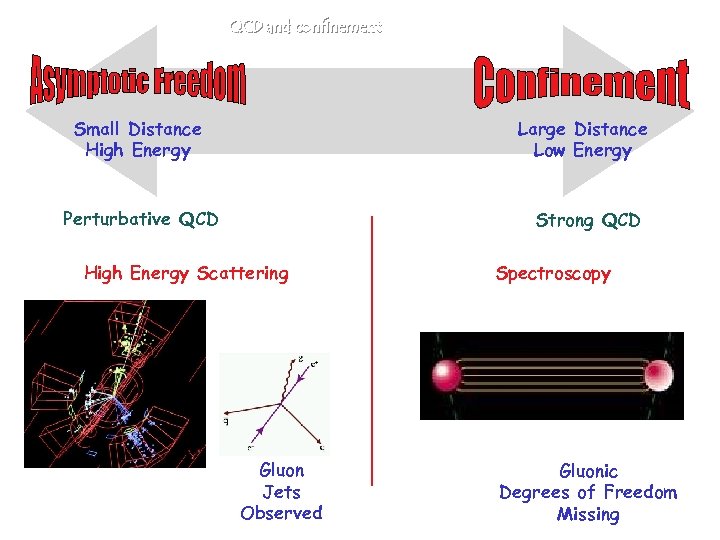
QCD and confinement Small Distance High Energy Large Distance Low Energy Perturbative QCD Strong QCD High Energy Scattering Gluon Jets Observed Spectroscopy Gluonic Degrees of Freedom Missing
Gluonic Excitations • predicted by QCD • crucial for understanding confinement • quantum numbers of the excited gluonic fields couple to those of the quarks to produce mesons with exotic quantum numbers • mass spectra calculated by lattice QCD possibility for experimental search From G. Bali
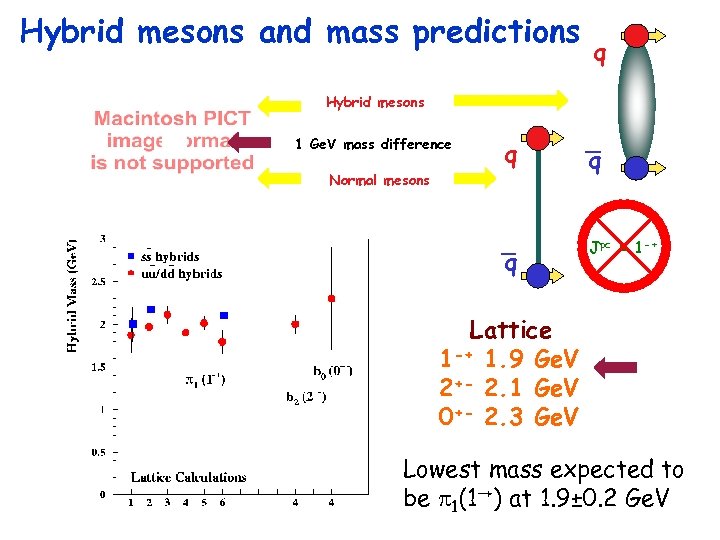
Hybrid mesons and mass predictions q Hybrid mesons 1 Ge. V mass difference q Normal mesons q q Jpc = 1 -+ Lattice 1 -+ 1. 9 Ge. V 2+- 2. 1 Ge. V 0+- 2. 3 Ge. V Lowest mass expected to be p 1(1−+) at 1. 9± 0. 2 Ge. V
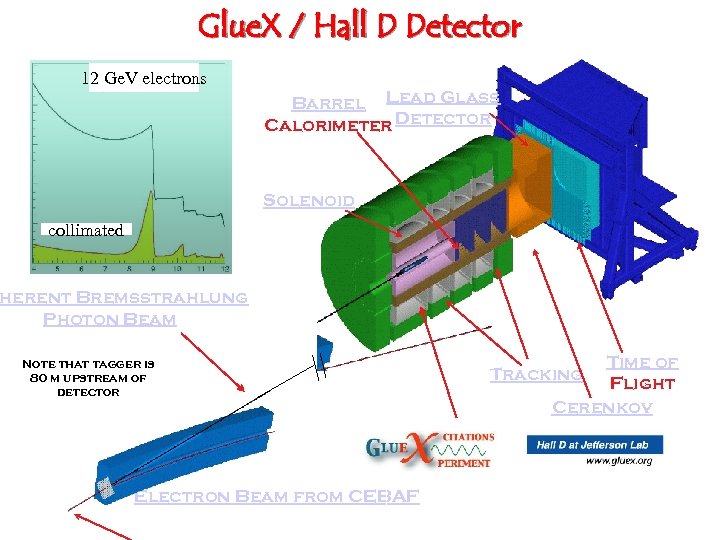
Glue. X / Hall D Detector 12 Ge. V electrons Barrel Lead Glass Calorimeter Detector Solenoid collimated herent Bremsstrahlung Photon Beam Note that tagger is 80 m upstream of detector Electron Beam from CEBAF Time of Tracking Flight Cerenkov Counter Target
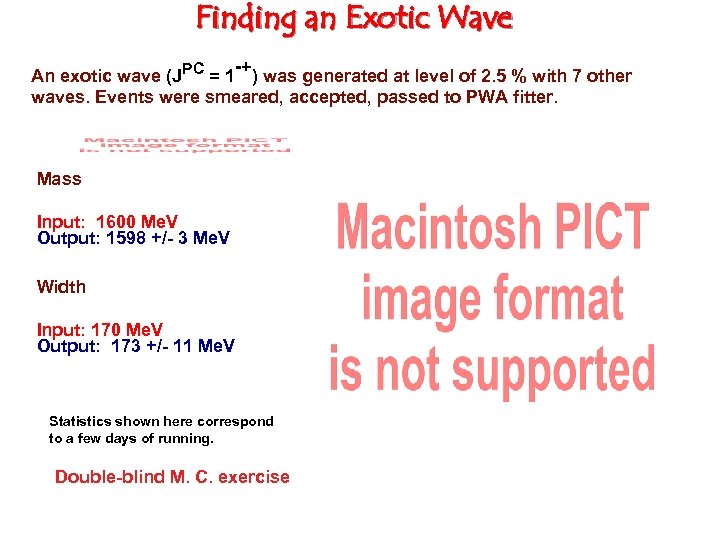
Finding an Exotic Wave An exotic wave (JPC = 1 -+) was generated at level of 2. 5 % with 7 other waves. Events were smeared, accepted, passed to PWA fitter. Mass Input: 1600 Me. V Output: 1598 +/- 3 Me. V Width Input: 170 Me. V Output: 173 +/- 11 Me. V Statistics shown here correspond to a few days of running. Double-blind M. C. exercise
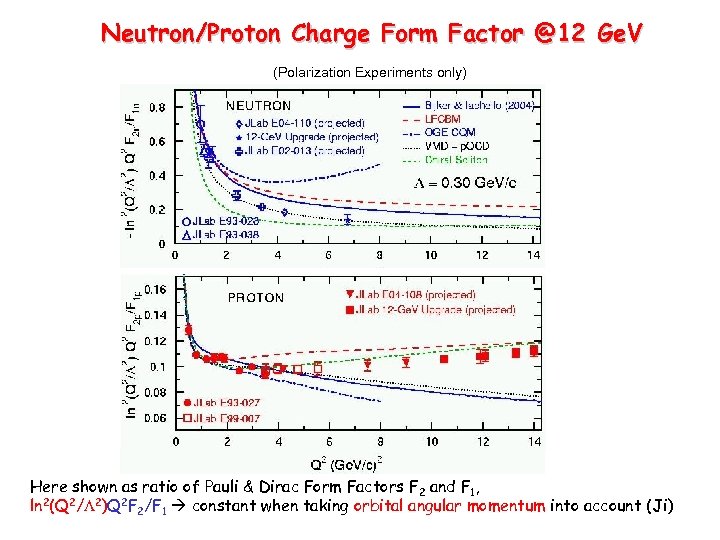
Neutron/Proton Charge Form Factor @12 Ge. V (Polarization Experiments only) Here shown as ratio of Pauli & Dirac Form Factors F 2 and F 1, ln 2(Q 2/L 2)Q 2 F 2/F 1 constant when taking orbital angular momentum into account (Ji)
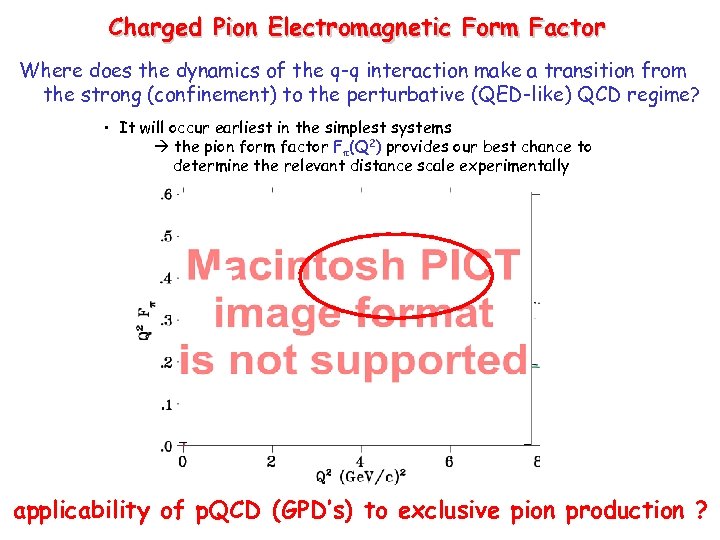
Charged Pion Electromagnetic Form Factor Where does the dynamics of the q-q interaction make a transition from the strong (confinement) to the perturbative (QED-like) QCD regime? • It will occur earliest in the simplest systems the pion form factor Fp(Q 2) provides our best chance to determine the relevant distance scale experimentally applicability of p. QCD (GPD’s) to exclusive pion production ?
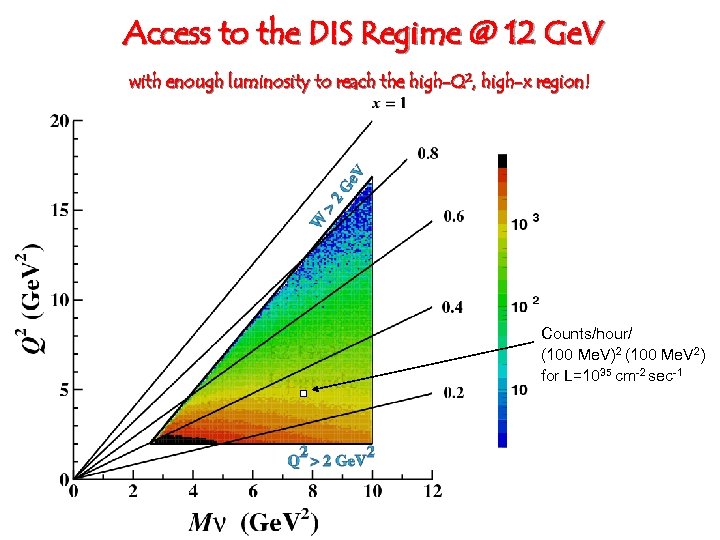
Access to the DIS Regime @ 12 Ge. V with enough luminosity to reach the high-Q 2, high-x region! Counts/hour/ (100 Me. V)2 (100 Me. V 2) for L=1035 cm-2 sec-1
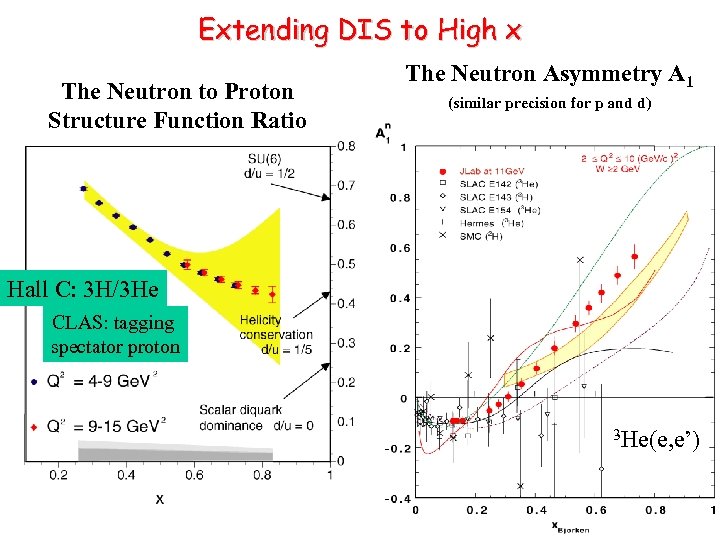
Extending DIS to High x The Neutron to Proton Structure Function Ratio The Neutron Asymmetry A 1 (similar precision for p and d) Hall C: 3 H/3 He CLAS: tagging spectator proton 12 Ge. V will access the valence quark regime (x > 0. 3) 3 He(e, e’)
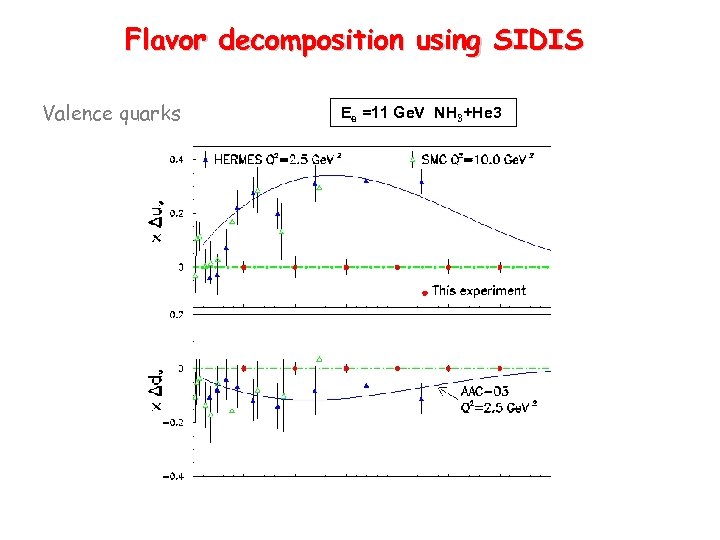
Flavor decomposition using SIDIS Valence quarks Ee =11 Ge. V NH 3+He 3
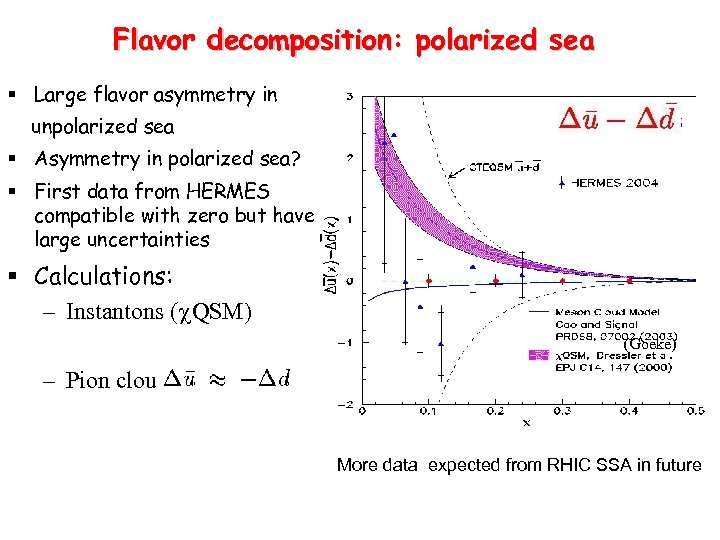
Flavor decomposition: polarized sea § Large flavor asymmetry in unpolarized sea § Asymmetry in polarized sea? § First data from HERMES compatible with zero but have large uncertainties § Calculations: – Instantons ( QSM) (Goeke) – Pion cloud models ? More data expected from RHIC SSA in future
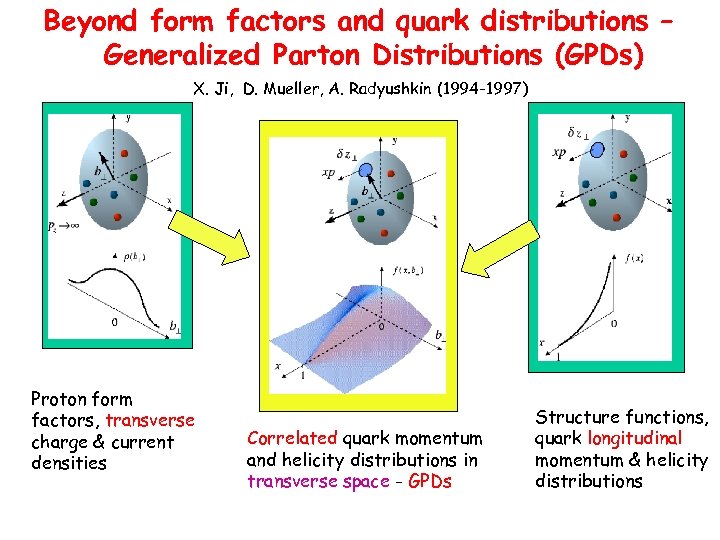
Beyond form factors and quark distributions – Generalized Parton Distributions (GPDs) X. Ji, D. Mueller, A. Radyushkin (1994 -1997) Proton form factors, transverse charge & current densities Correlated quark momentum and helicity distributions in transverse space - GPDs Structure functions, quark longitudinal momentum & helicity distributions
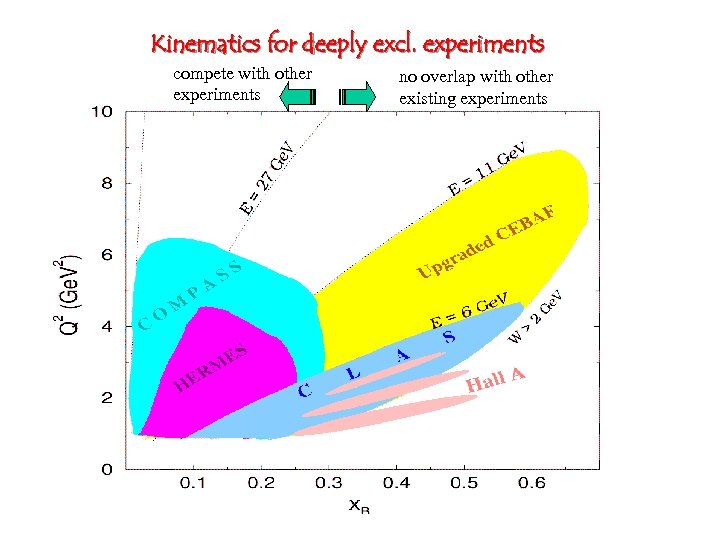
Kinematics for deeply excl. experiments compete with other experiments no overlap with other existing experiments
DVCS: Single Spin. Asymmetry DVCS Single-Spin Asymmetry Q 2 = 5. 4 Ge. V 2 x = 0. 35 -t = 0. 3 Ge. V 2 CLAS experiment E 0 = 11 Ge. V Pe = 80% L = 1035 cm-2 s-1 Run time: 2000 hrs Many x, Q 2 and t values measured simultanously !
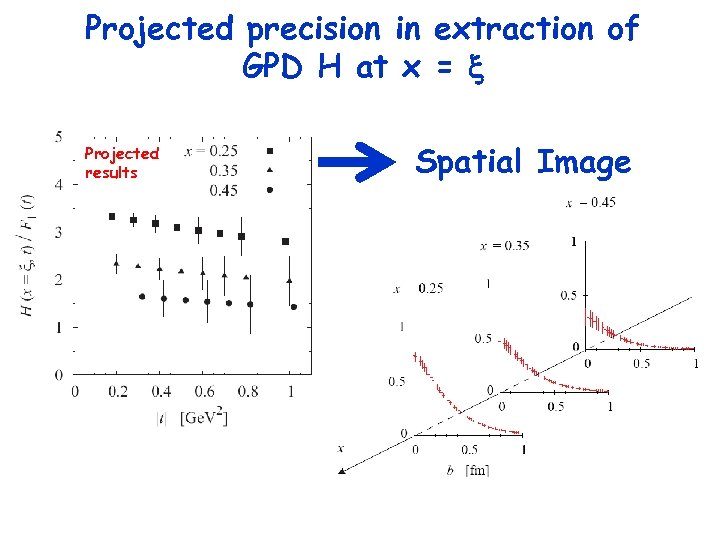
Projected precision in extraction of GPD H at x = x Projected results Spatial Image
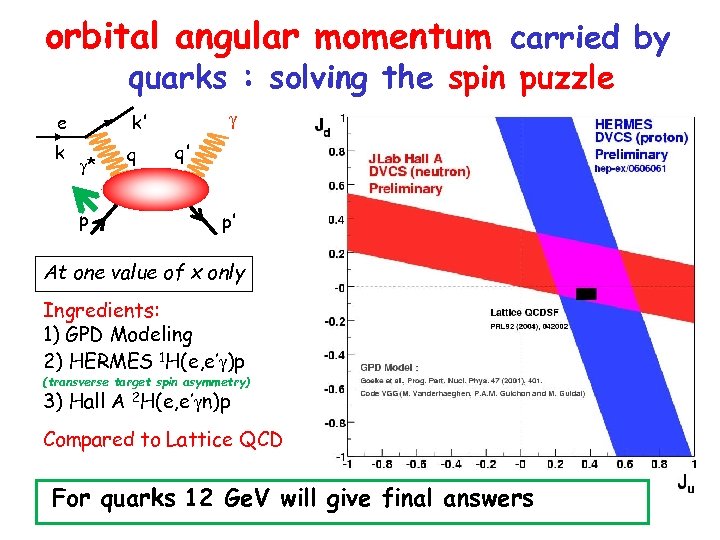
orbital angular momentum carried by quarks : solving the spin puzzle e k k' * p q q' p' At one value of x only Ingredients: 1) GPD Modeling 2) HERMES 1 H(e, e’ )p (transverse target spin asymmetry) 3) Hall A 2 H(e, e’ n)p Compared to Lattice QCD For quarks 12 Ge. V will give final answers
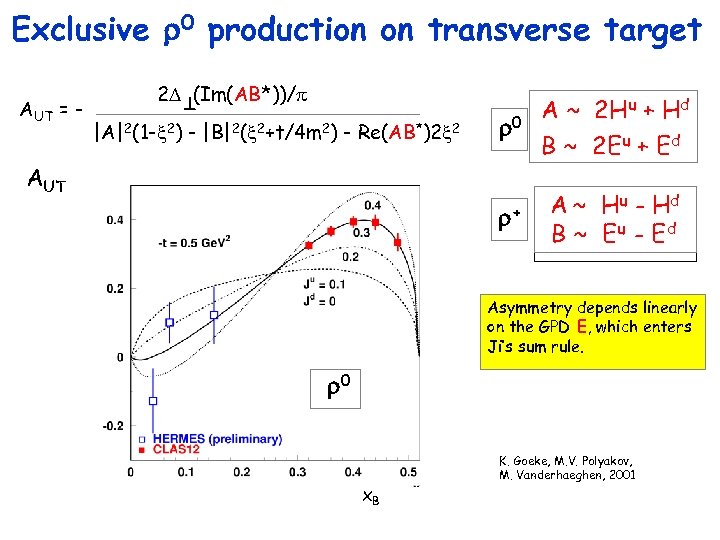
Exclusive r 0 production on transverse target T AUT = - 2 D (Im(AB*))/p |A|2(1 -x 2) - |B|2(x 2+t/4 m 2) - Re(AB*)2 x 2 r 0 AUT r+ A ~ 2 Hu + Hd B ~ 2 Eu + Ed A ~ Hu - Hd B ~ E u - Ed Asymmetry depends linearly on the GPD E, which enters Ji’s sum rule. r 0 x. B K. Goeke, M. V. Polyakov, M. Vanderhaeghen, 2001
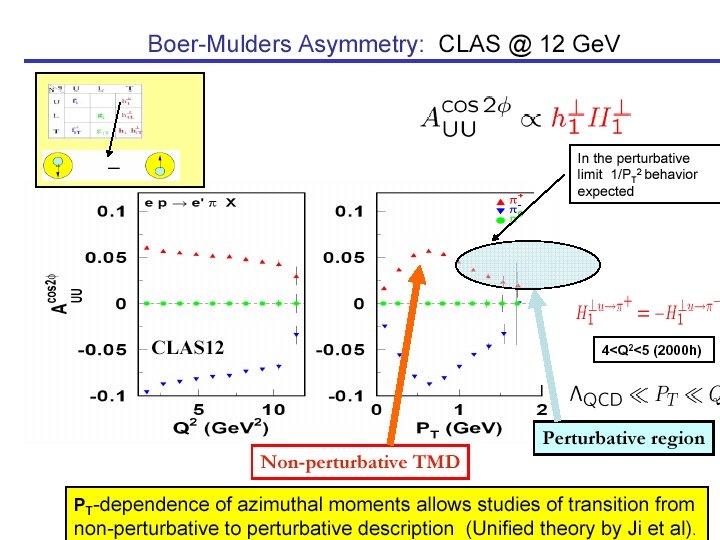
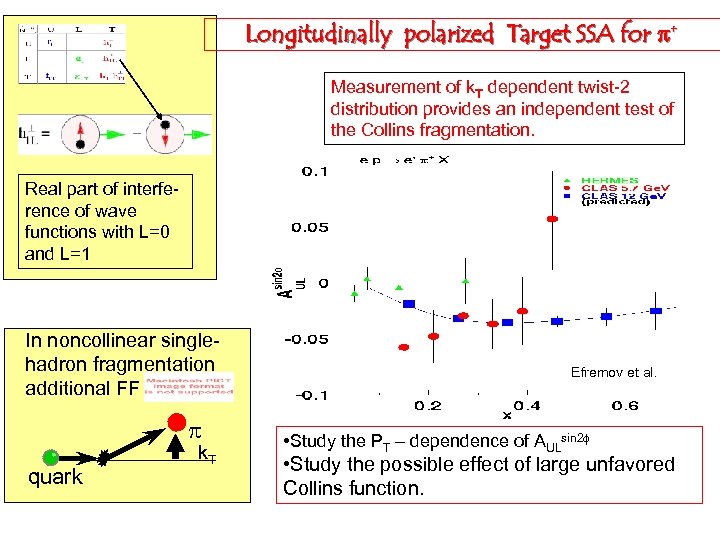
Longitudinally polarized Target SSA for p+ Measurement of k. T dependent twist-2 distribution provides an independent test of the Collins fragmentation. Real part of interference of wave functions with L=0 and L=1 In noncollinear singlehadron fragmentation additional FF H 1(z, k. T) p quark k. T Efremov et al. • Study the PT – dependence of AULsin 2 f • Study the possible effect of large unfavored Collins function.
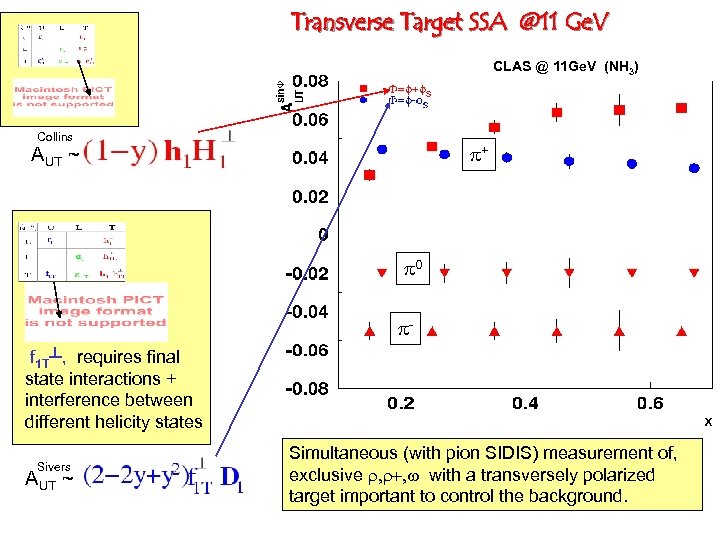
Transverse Target SSA @11 Ge. V CLAS @ 11 Ge. V (NH 3) Collins p+ AUT ~ p 0 pf 1 T┴, requires final state interactions + interference between different helicity states Sivers AUT ~ Simultaneous (with pion SIDIS) measurement of, exclusive r, r+, w with a transversely polarized target important to control the background.
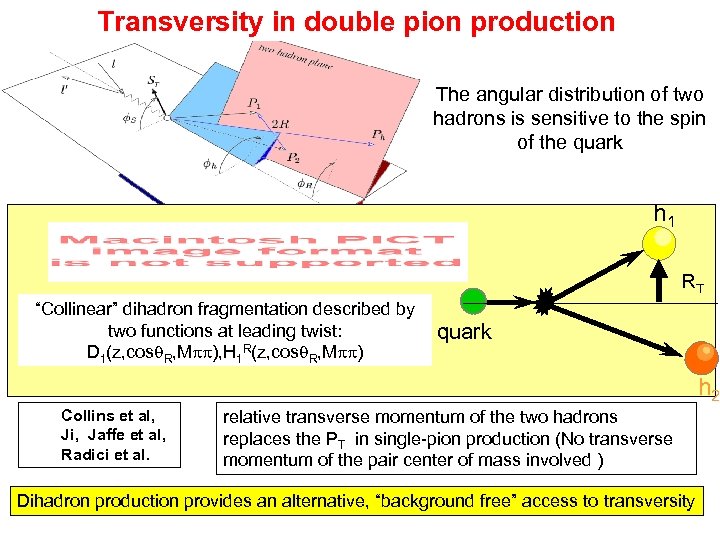
Transversity in double pion production The angular distribution of two hadrons is sensitive to the spin of the quark h 1 RT “Collinear” dihadron fragmentation described by two functions at leading twist: D 1(z, cosq. R, Mpp), H 1 R(z, cosq. R, Mpp) quark h 2 Collins et al, Ji, Jaffe et al, Radici et al. relative transverse momentum of the two hadrons replaces the PT in single-pion production (No transverse momentum of the pair center of mass involved ) Dihadron production provides an alternative, “background free” access to transversity
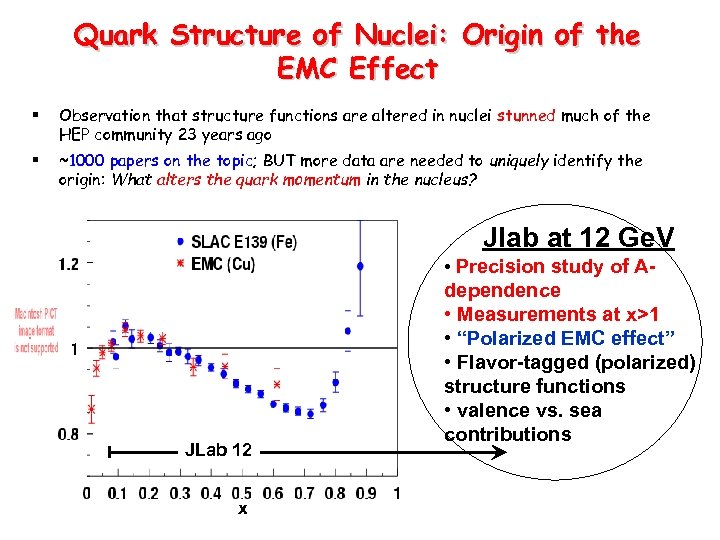
Quark Structure of Nuclei: Origin of the EMC Effect § Observation that structure functions are altered in nuclei stunned much of the HEP community 23 years ago § ~1000 papers on the topic; BUT more data are needed to uniquely identify the origin: What alters the quark momentum in the nucleus? Jlab at 12 Ge. V • Precision study of A- JLab 12 x dependence • Measurements at x>1 • “Polarized EMC effect” • Flavor-tagged (polarized) structure functions • valence vs. sea contributions
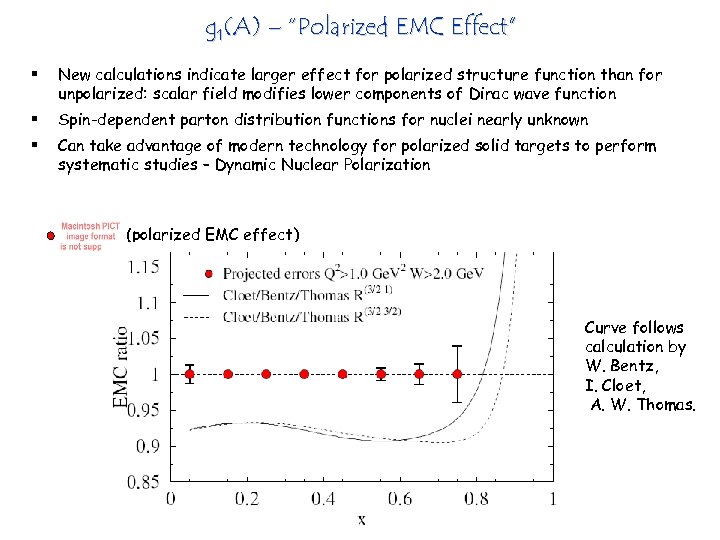
g 1(A) – “Polarized EMC Effect” § New calculations indicate larger effect for polarized structure function than for unpolarized: scalar field modifies lower components of Dirac wave function § Spin-dependent parton distribution functions for nuclei nearly unknown § Can take advantage of modern technology for polarized solid targets to perform systematic studies – Dynamic Nuclear Polarization (polarized EMC effect) Curve follows calculation by W. Bentz, I. Cloet, A. W. Thomas.
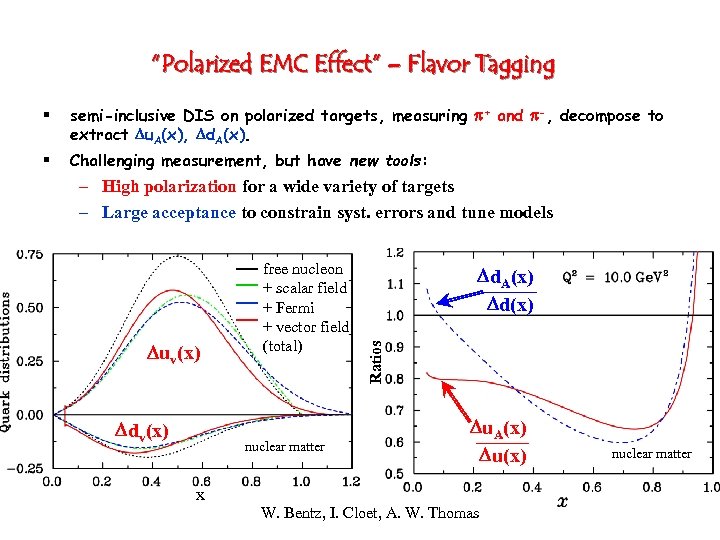
“Polarized EMC Effect” – Flavor Tagging § semi-inclusive DIS on polarized targets, measuring p+ and p-, decompose to extract Du. A(x), Dd. A(x). § Challenging measurement, but have new tools: – High polarization for a wide variety of targets – Large acceptance to constrain syst. errors and tune models Ddv(x) nuclear matter Dd. A(x) Dd(x) Ratios Duv(x) free nucleon + scalar field + Fermi + vector field (total) Du. A(x) Du(x) x W. Bentz, I. Cloet, A. W. Thomas nuclear matter
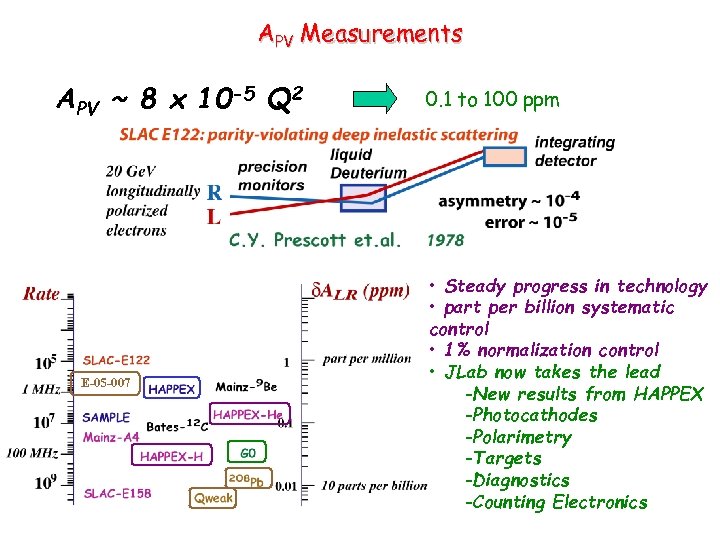
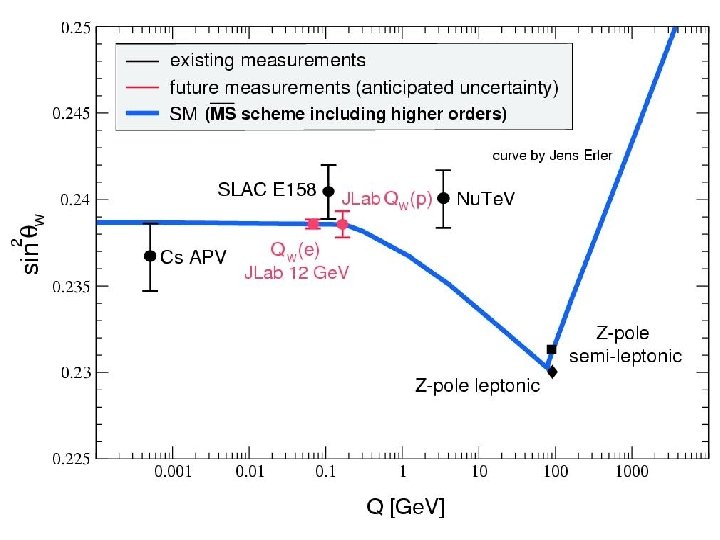
APV Measurements APV ~ 8 x 10 -5 Q 2 E-05 -007 0. 1 to 100 ppm • Steady progress in technology • part per billion systematic control • 1% normalization control • JLab now takes the lead -New results from HAPPEX -Photocathodes -Polarimetry -Targets -Diagnostics -Counting Electronics
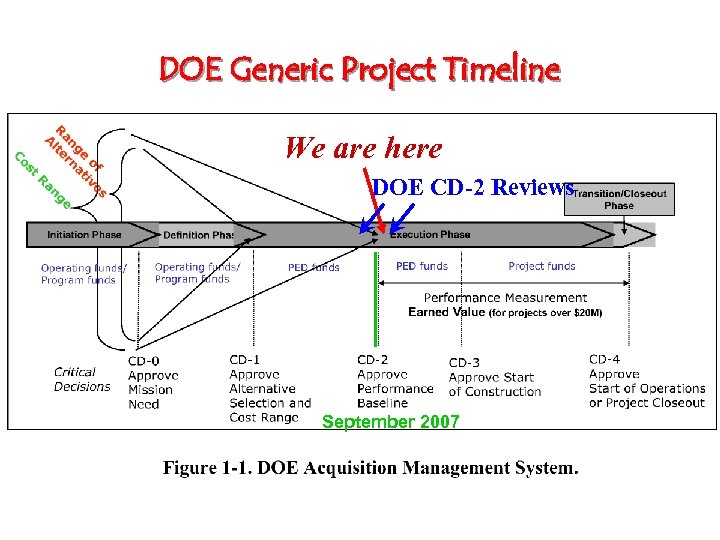
DOE Generic Project Timeline We are here DOE CD-2 Reviews September 2007
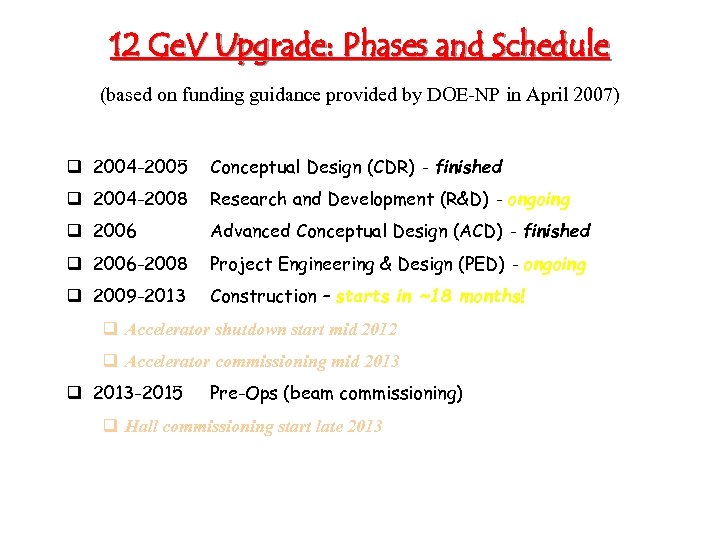
12 Ge. V Upgrade: Phases and Schedule (based on funding guidance provided by DOE-NP in April 2007) q 2004 -2005 Conceptual Design (CDR) - finished q 2004 -2008 Research and Development (R&D) - ongoing q 2006 Advanced Conceptual Design (ACD) - finished q 2006 -2008 Project Engineering & Design (PED) - ongoing q 2009 -2013 Construction – starts in ~18 months! q Accelerator shutdown start mid 2012 q Accelerator commissioning mid 2013 q 2013 -2015 Pre-Ops (beam commissioning) q Hall commissioning start late 2013
Summary The Jlab 12 Ge. V Upgrade will increase the energy of CEBAF, provide very high luminosities and will thus allow to measure with unprecedented precision: • the high x behaviour of (un)polarised structure functions • the spin and flavour decomposition in the valence region • pion and nucleon form factors at high Q 2 • single spin asymmetries and kt dependent effects • deep exclusive processes in multi-differential form • nuclear effects in (semi)-inclusive scattering • search for hybrid states • parity violating asymmetries as a test of the standard model The ideal laboratory for valence quark physics !

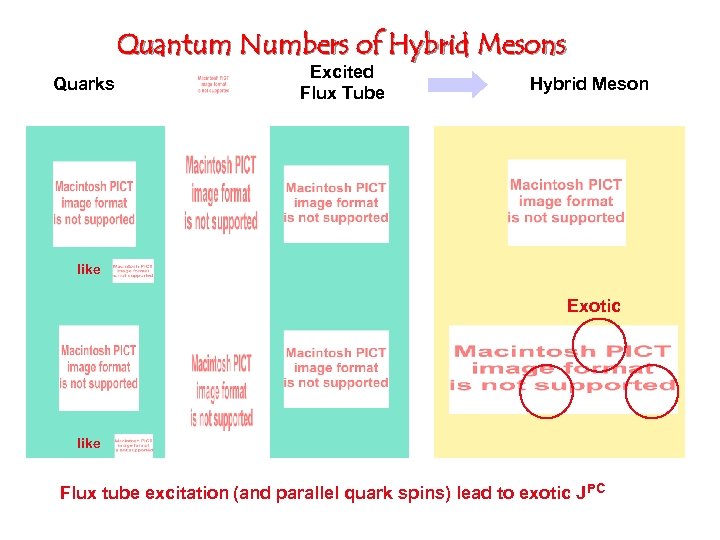
Quantum Numbers of Hybrid Mesons Quarks Excited Flux Tube Hybrid Meson like Exotic like Flux tube excitation (and parallel quark spins) lead to exotic J PC
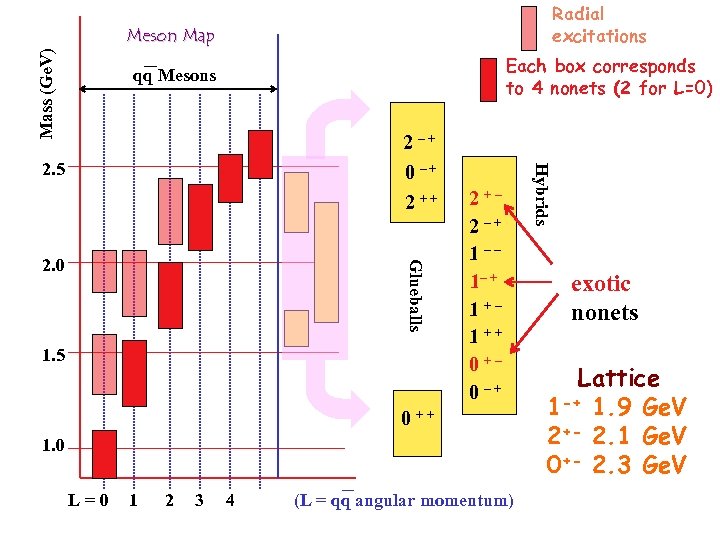
Radial excitations Mass (Ge. V) Meson Map Each box corresponds to 4 nonets (2 for L=0) qq Mesons 2 –+ 0 –+ 2 ++ Glueballs 2. 0 1. 5 2 +– 2 –+ 1 –– 1– + 1 +– 1 ++ 0 +– 0 –+ 0 ++ 1. 0 L=0 1 2 3 4 (L = qq angular momentum) Hybrids 2. 5 exotic nonets Lattice 1 -+ 1. 9 Ge. V 2+- 2. 1 Ge. V 0+- 2. 3 Ge. V
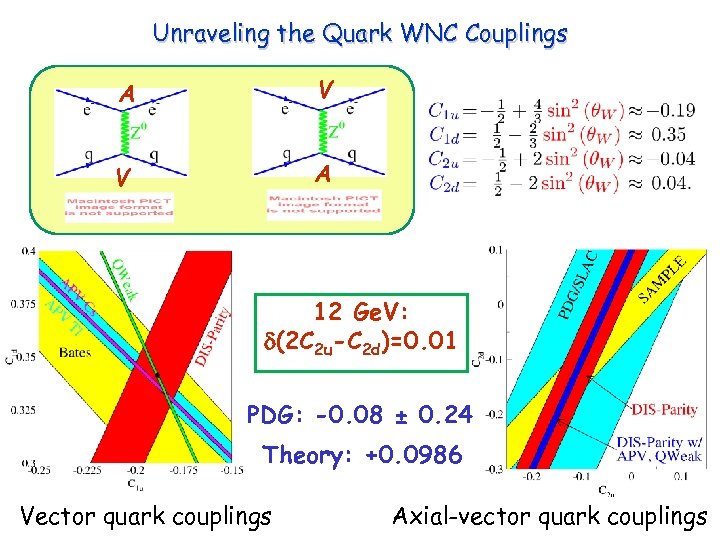
Unraveling the Quark WNC Couplings A V V A 12 Ge. V: (2 C 2 u-C 2 d)=0. 01 PDG: -0. 08 ± 0. 24 Theory: +0. 0986 Vector quark couplings Axial-vector quark couplings
Скачать презентацию The JLab 12 Ge V Upgrade Antje Bruell
88eebfda9aec33c91d8d0c8c7c63fe5f.ppt