


 Скачать презентацию The Irradiated ISM of Active Galaxies HCN HCO
758b6e01b1cf2e0f6b9486bd0346af8b.ppt
- Количество слайдов: 23
 The Irradiated ISM of Active Galaxies: HCN, HCO+, HNC and a few others Marco Spaans (Kapteyn) Rowin Meijerink (Berkeley), Frank Israel (Leiden), Susanne Aalto (Onsala) Edo Loenen (Kapteyn), Juan Pablo Pérez Beaupuits (Kapteyn), Willem Baan (ASTRON), Floris van der Tak (SRON) Bad Honnef 2007
 Context - Radiative Feedback: `Any process where photons impact the properties of molecular gas from which stars form´ - PDRs (FUV) and XDRs (X-ray): `The energy of the photons matters’ - Wavelength: FIR/mm lines dust absorption not an issue Bad Honnef 2007
 PDRs: 6 < E < 13. 6 e. V Heating: Photo-electric emission from grains and cosmic rays n Cooling: Fine-structure lines like [OI] 63, 145; [CII] 158 μm and emission by H 2, CO, H 2 O n 10 e. V photon penetrates 0. 5 mag of dust n Bad Honnef 2007
 XDRs: E > 1 ke. V Heating: X-ray photo-ionization --> fast electrons; H and H 2 vib excitation; UV emission (Ly α, Lyman-Werner) n Cooling: [Fe. II] 1. 26, 1. 64; [OI] 63; [CII] 158; [Si. II] 35 μm; thermal H 2 vib; gas-dust n 1 ke. V photon penetrates 1022 cm-2 of NH n Bad Honnef 2007
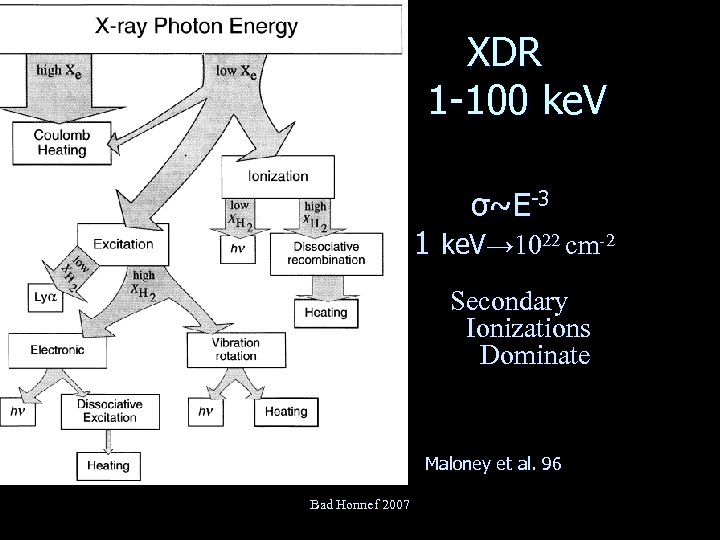 XDR 1 -100 ke. V σ~E-3 1 ke. V→ 1022 cm-2 Secondary Ionizations Dominate Maloney et al. 96 Bad Honnef 2007
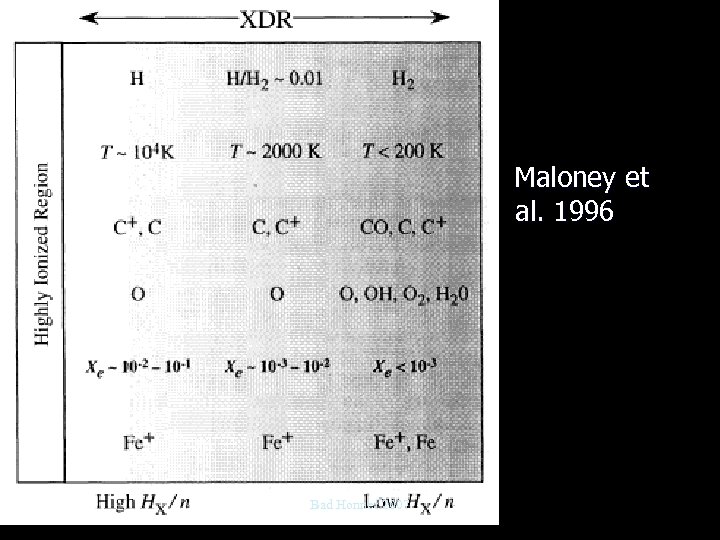 n Bad Honnef 2007 Maloney et al. 1996
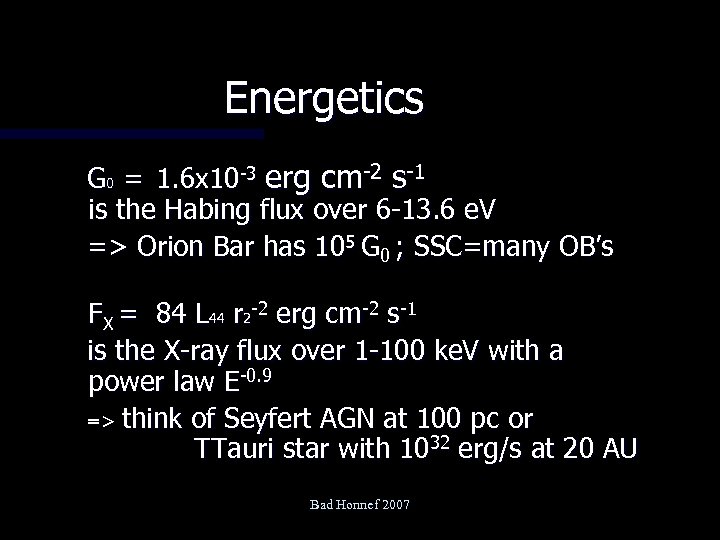 Energetics G 0 = 1. 6 x 10 -3 erg cm-2 s-1 is the Habing flux over 6 -13. 6 e. V => Orion Bar has 105 G 0 ; SSC=many OB’s FX = 84 L 44 r 2 -2 erg cm-2 s-1 is the X-ray flux over 1 -100 ke. V with a power law E-0. 9 => think of Seyfert AGN at 100 pc or TTauri star with 1032 erg/s at 20 AU Bad Honnef 2007
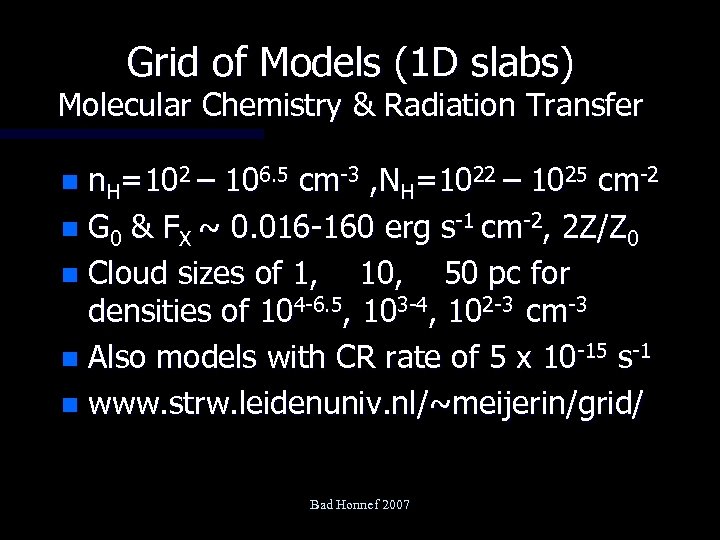 Grid of Models (1 D slabs) Molecular Chemistry & Radiation Transfer n. H=102 – 106. 5 cm-3 , NH=1022 – 1025 cm-2 n G 0 & FX ~ 0. 016 -160 erg s-1 cm-2, 2 Z/Z 0 n Cloud sizes of 1, 10, 50 pc for densities of 104 -6. 5, 103 -4, 102 -3 cm-3 n Also models with CR rate of 5 x 10 -15 s-1 n www. strw. leidenuniv. nl/~meijerin/grid/ n Bad Honnef 2007
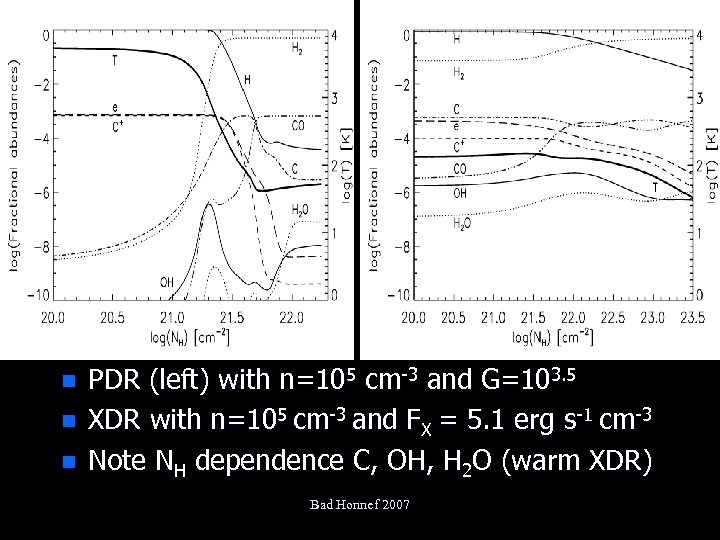 n n n PDR (left) with n=105 cm-3 and G=103. 5 XDR with n=105 cm-3 and FX = 5. 1 erg s-1 cm-3 Note NH dependence C, OH, H 2 O (warm XDR) Bad Honnef 2007
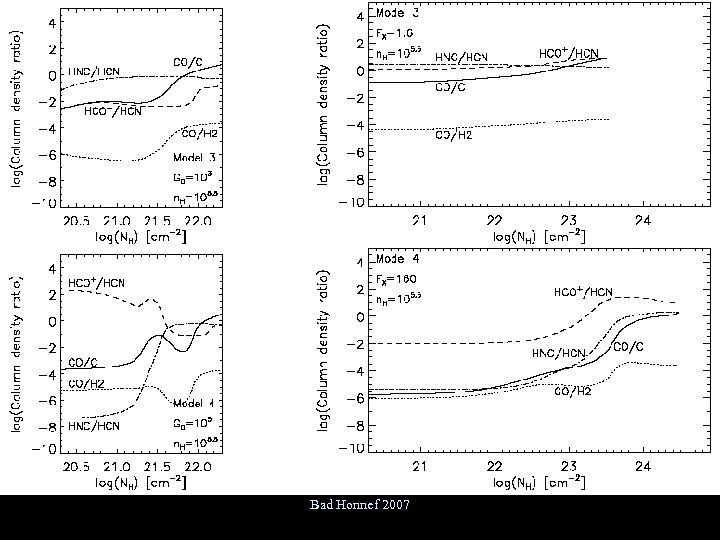
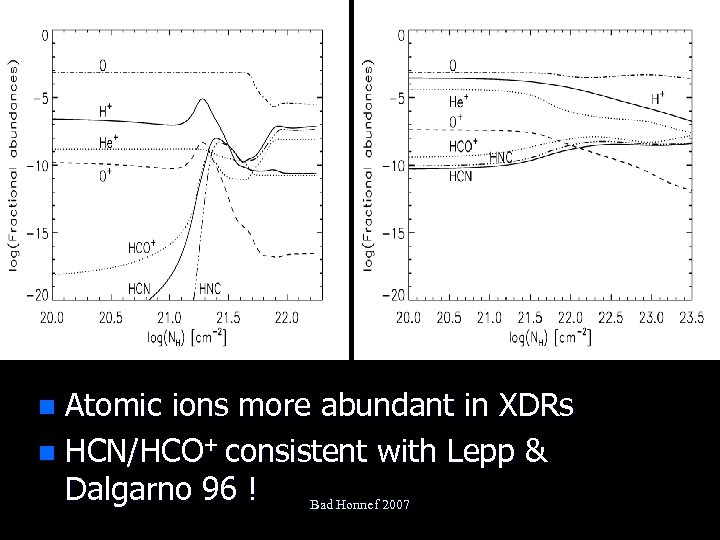 Atomic ions more abundant in XDRs n HCN/HCO+ consistent with Lepp & Dalgarno 96 ! Bad Honnef 2007 n
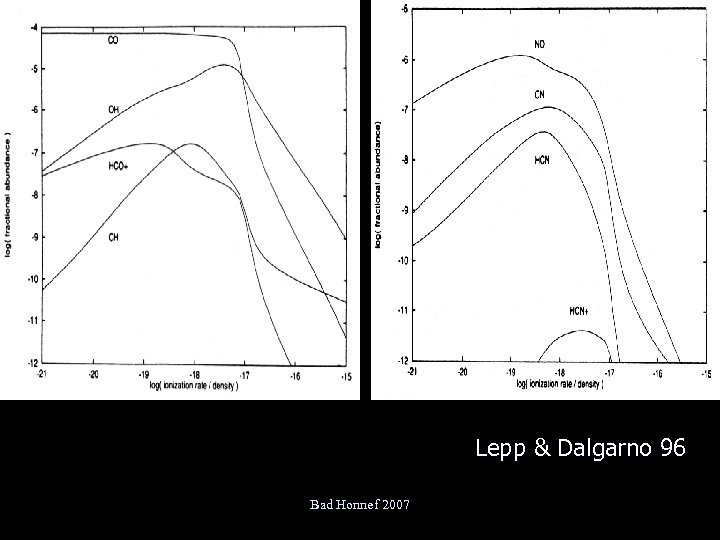 Lepp & Dalgarno 96 Bad Honnef 2007
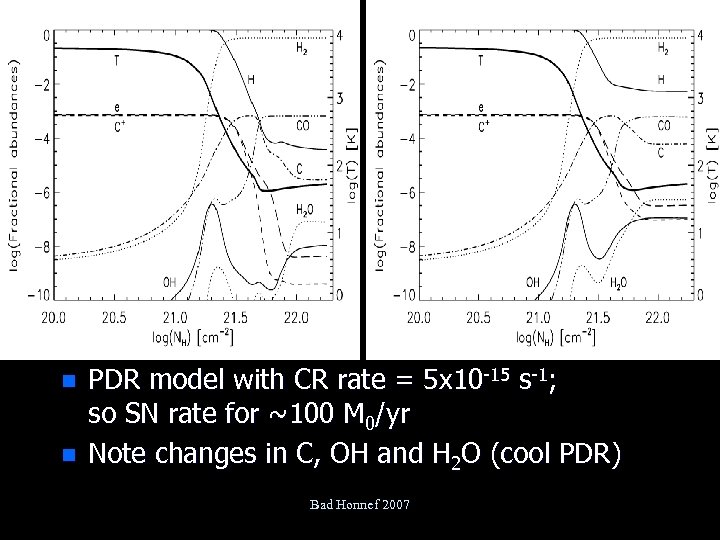 n n PDR model with CR rate = 5 x 10 -15 s-1; so SN rate for ~100 M 0/yr Note changes in C, OH and H 2 O (cool PDR) Bad Honnef 2007
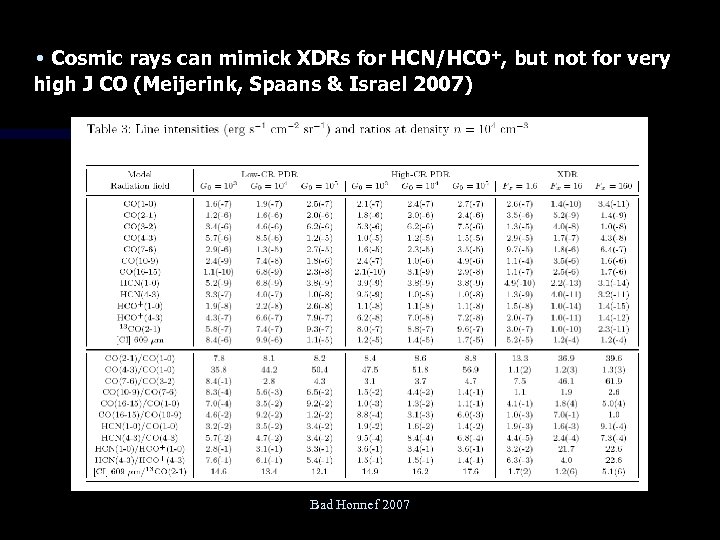
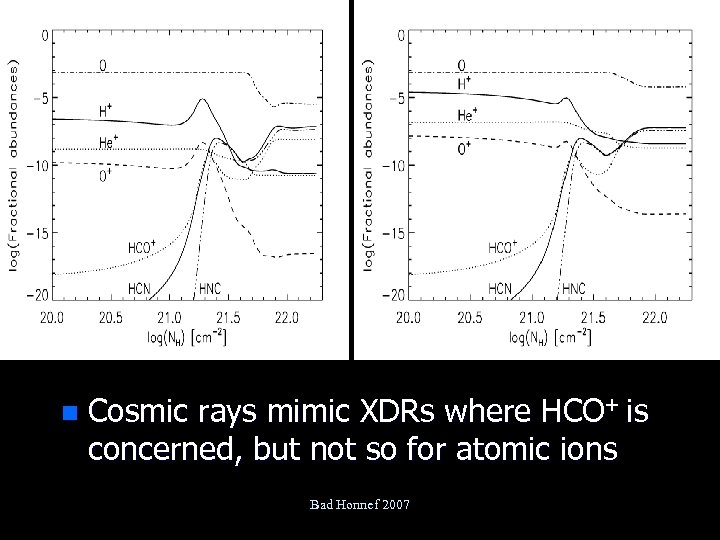 n Cosmic rays mimic XDRs where HCO+ is concerned, but not so for atomic ions Bad Honnef 2007
 Bad Honnef 2007
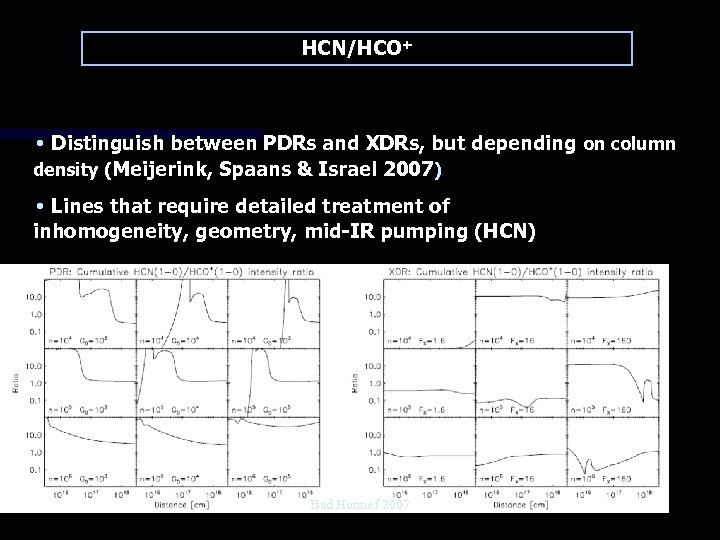 HCN/HCO+ • Distinguish between PDRs and XDRs, but depending on column density (Meijerink, Spaans & Israel 2007) • Lines that require detailed treatment of inhomogeneity, geometry, mid-IR pumping (HCN) Bad Honnef 2007
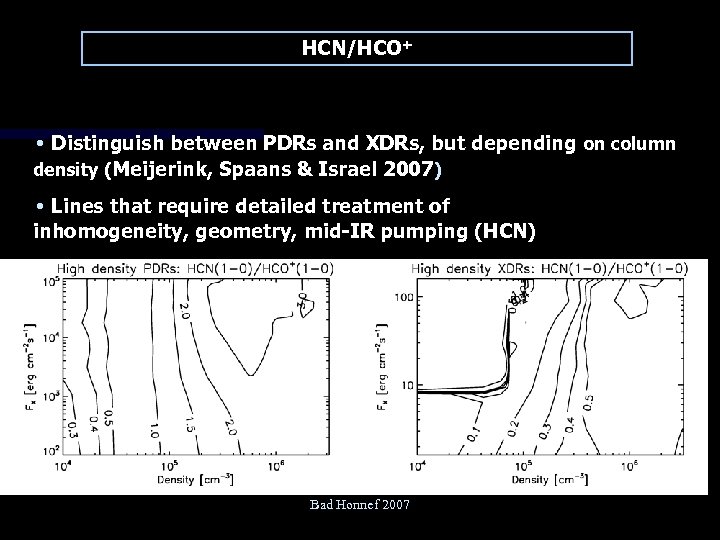 HCN/HCO+ • Distinguish between PDRs and XDRs, but depending on column density (Meijerink, Spaans & Israel 2007) • Lines that require detailed treatment of inhomogeneity, geometry, mid-IR pumping (HCN) Bad Honnef 2007
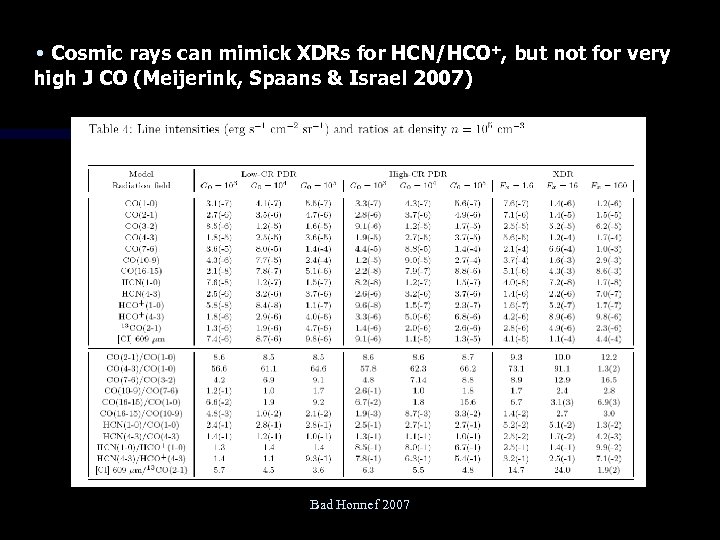 • Cosmic rays can mimick XDRs for HCN/HCO+, but not for very high J CO (Meijerink, Spaans & Israel 2007) Bad Honnef 2007
 • Cosmic rays can mimick XDRs for HCN/HCO+, but not for very high J CO (Meijerink, Spaans & Israel 2007) Bad Honnef 2007
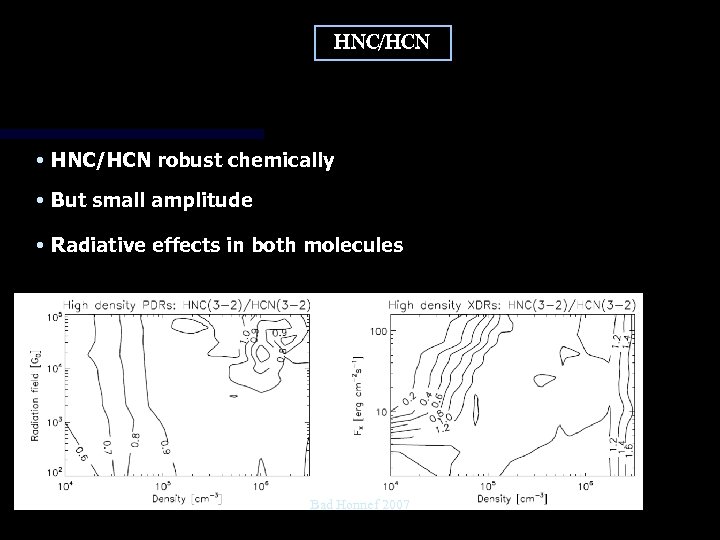 HNC/HCN • HNC/HCN robust chemically • But small amplitude • Radiative effects in both molecules Bad Honnef 2007
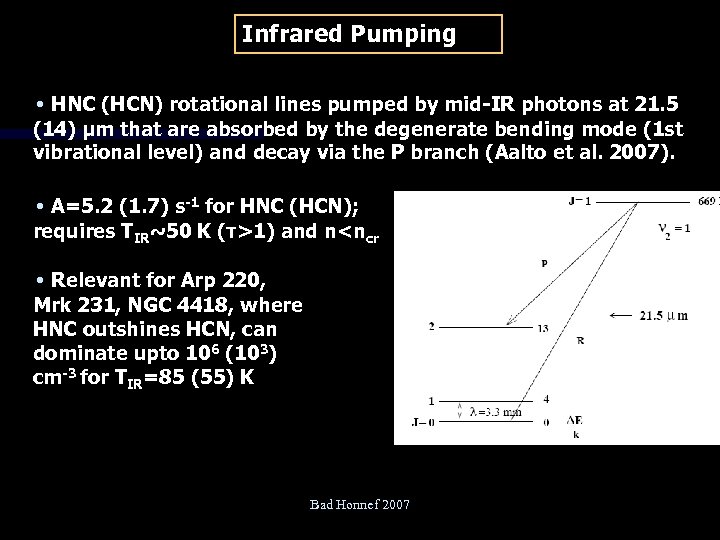 Infrared Pumping • HNC (HCN) rotational lines pumped by mid-IR photons at 21. 5 (14) μm that are absorbed by the degenerate bending mode (1 st vibrational level) and decay via the P branch (Aalto et al. 2007). • A=5. 2 (1. 7) s-1 for HNC (HCN); requires TIR~50 K (τ>1) and n
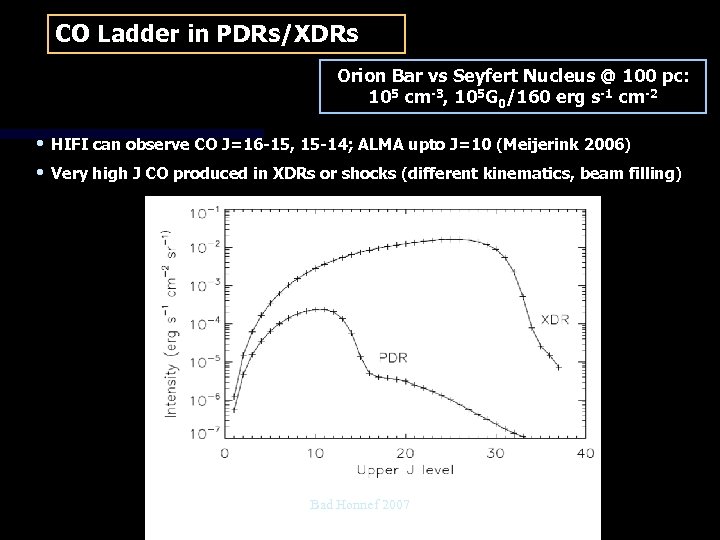 CO Ladder in PDRs/XDRs Orion Bar vs Seyfert Nucleus @ 100 pc: 105 cm-3, 105 G 0/160 erg s-1 cm-2 • HIFI can observe CO J=16 -15, 15 -14; ALMA upto J=10 (Meijerink 2006) • Very high J CO produced in XDRs or shocks (different kinematics, beam filling) Bad Honnef 2007
 Summary HCO+/HCN and HNC/HCN are XDR vs PDR diagnostics, same for high-J CO; CN, NO, HOC+, HCO, CH+ n Cosmic rays matter and lead to lower high/low J CO ratios (not XDR-like) and higher HCO+/HCN ratios (XDR-like) n Bad Honnef 2007
 Posters Juan Pablo Pérez Beaupuits: HCN and HNC emission from Seyferts like NGC 1068 and 3079 n Edo Loenen: (U)LIRG sample and turbulent heating/shock effects on HCN n Bad Honnef 2007