


 Скачать презентацию The Irony of Democracy 17 th edition CHAPTER
722aa032f7a0a9b6530dcb85d5ed2c1b.ppt
- Количество слайдов: 42
 The Irony of Democracy 17 th edition CHAPTER 14 THE UNITED STATES AS GLOBAL ELITE
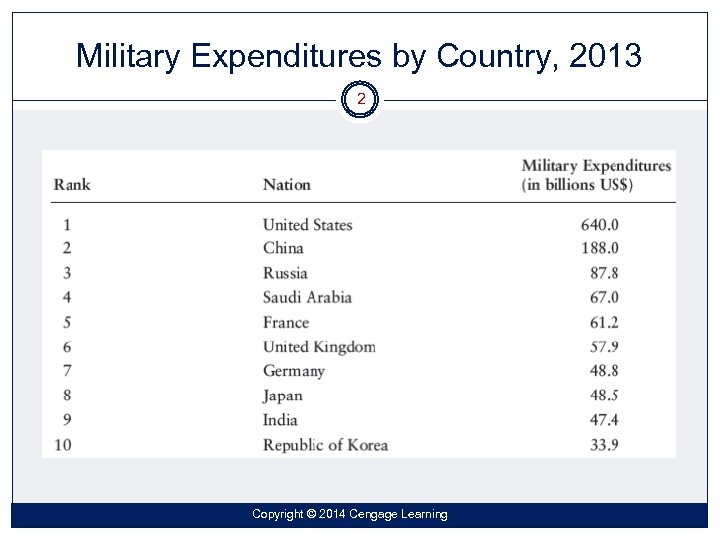 Military Expenditures by Country, 2013 2 Copyright © 2014 Cengage Learning
 Approaches to Foreign Relations in the U. S. 3 Idealism Assumes the U. S. has a moral duty to spread democracy, human rights, religious freedom, freedom of the press, and economic freedom. “Wilsonianism” Human rights are universal. Copyright © 2014 Cengage Learning
 Approaches to Foreign Relations in the U. S. 4 Realism The country should act abroad only to protect a clearly defined national interest, whether economic or security-related. The elite struggle for power is universal, international politics is a struggle among global elites. Copyright © 2014 Cengage Learning
 War as Politics 5 Military elites Forces should be used to protect vital national interests, have clear objectives, have the support of Congress, and be deployed as a last resort. Political elites War is a continuation of politics by other means Economic interests Require physical security and diplomatic efforts often depend on the express or implied threat of military force. Copyright © 2014 Cengage Learning
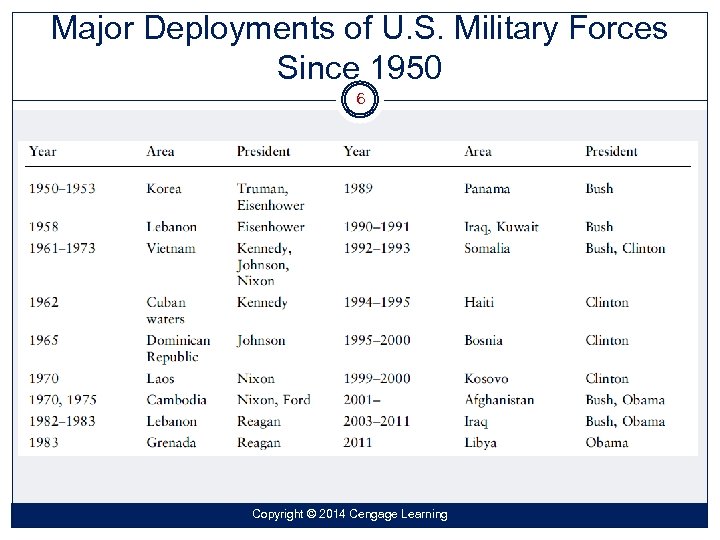 Major Deployments of U. S. Military Forces Since 1950 6 Copyright © 2014 Cengage Learning
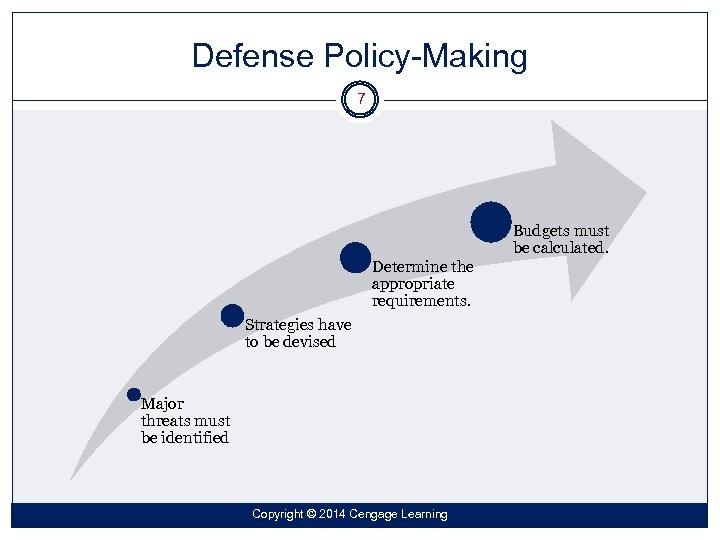 Defense Policy-Making 7 Budgets must be calculated. Determine the appropriate requirements. Strategies have to be devised Major threats must be identified Copyright © 2014 Cengage Learning
 War as Politics 8 Defense Policy-Making Assessment of threats Creation of strategies Calculation of the budget Organizing the Nation’s Defenses Chain of commands extends from: The president Secretary of defense The chief of the Joint Chiefs of Staffs Various regional commands Copyright © 2014 Cengage Learning
 War as Politics 9 Current Forces and Missions U. S. has about 1. 4 million men and women in uniform. U. S. military forces are currently deployed in more than 120 countries. Largest are South Korea and Afghanistan. U. S. forces are trained for combat, peacekeeping, and nation-building missions. Combat units, transport, and support services are inadequate to deal with more than a single major regional conflict. Copyright © 2014 Cengage Learning
 The U. S. in the International Security System 10 The United Nations Security Council The primary goals of the United Nations are peace and human rights. The Security Council holds the only real power. Ability of the UNSC to take military action against aggressors has been the basis of U. S. actions in Korea, Kuwait, Iraq, and Afghanistan. 15 members, five with extraordinary veto powers: China, Russia, Great Britain, France, and the United States Copyright © 2014 Cengage Learning
 NATO 11 NATO The U. S. , Canada, Britain, and most other democracies joined in the North Atlantic Treaty Organization during WWII. In response to Soviet aggression during World War II. An attack on one would be considered an attack on all. Joint military command established. Copyright © 2014 Cengage Learning
 NATO 12 The Collapse of Communism Direct result of Soviet President Mikhail Gorbachev’s renouncing the use of military force that had kept Eastern Europe’s communist governments in power. Resulted in a quick decline of conflicts around the world. Copyright © 2014 Cengage Learning
 NATO 13 NATO and the Balkan Conflicts NATO intervened in Yugoslavia to halt the genocide against Bosnian Muslims. The U. S. eventually provided about one-third of the troops deployed as peacekeepers. Second Balkan genocide led by Slobodan Miloševic prompted a NATO air campaign against Serbian targets, ending the aggression. Copyright © 2014 Cengage Learning
 NATO 14 NATO in Afghanistan Only time NATO alliance was called to respond to an attack on a member after 2001 terrorist attack in the U. S. After military victory over Al Qaeda and its Taliban ally, the U. S. turned over command of its military forces in Afghanistan to NATO in 2003. NATO created an International Security Assistance Force. Copyright © 2014 Cengage Learning
 NATO 15 NATO Over Libya UN resolutions called for protection for Libyan citizens against dictator Muammar Gaddafi. Air mission under U. S. general. Copyright © 2014 Cengage Learning
 Security Threats to the U. S. 16 Nuclear Threats to Security Only 9 nations have nuclear weapons. The U. S. came first in 1945, and remains the only country to have used them in war. Soviet Union, Britain, France, China by 1964 Most nations signed the Nuclear Non. Proliferation Treaty, but 4 nuclear nations have not: India, Pakistan, North Korea, and Israel Copyright © 2014 Cengage Learning
 Security Threats to the U. S. 17 Deterrence and Arms Reduction Policy of deterrence is based on the idea that rational elites in other countries can be dissuaded from launching by the threat of a devastating retaliatory strike. 1972 SALT agreement between Nixon and Brezhnev START treaty made by Reagan and Gorbachev START II treaty made by George W. Bush and Vladimir Putin Copyright © 2014 Cengage Learning
 Security Threats to the U. S. 18 Deterrence and Arms Reduction Today’s nuclear threats come from “nondeterrable” sources. Rogue nations led by an irrational elite or terrorist groups. North Korea and Iran has ignored orders from UN to stop developing nuclear weapons International Atomic Energy Agency Copyright © 2014 Cengage Learning
 Security Threats to the U. S. 19 Antiballistic Missile Defenses Ronald Reagan’s Strategic Defense Initiative Dubbed “Star Wars” George W. Bush withdrew from provisions of the Salt I treaty of 1972 in order to set up a missile defense system for Europe. President Obama abandoned plans to build bases in Poland the Czech Republic in 2009. Copyright © 2014 Cengage Learning
 Security Threats to the U. S. 20 Nuclear Terrorism Greatest security threat to the U. S. Al Qaeda has been interested in acquiring nuclear weapons. North Korea sold nuclear technology to Libya and Syria. Iran is a major state sponsor of terrorism. Copyright © 2014 Cengage Learning
 The Terrorist Threat 21 Mass Response to the War on Terrorism The masses initial response was national pride and confidence in national leadership. Since 9/11 almost 2 million U. S. adults have volunteered to serve their country, sent to Afghanistan or Iraq. Trust in government rose, presidential approval ratings reached dramatic highs, and support for military action was overwhelming. Trust in government and support diminished in time. Copyright © 2014 Cengage Learning
 The Terrorist Threat 22 Elite Response to Terrorism: Domestic Law Elites typically respond with repressive measures. 1996 Antiterrorism and Effective Death Penalty Act USA PATRIOT Act of 2001 Copyright © 2014 Cengage Learning
 The Terrorist Threat 23 The War on Terrorism In the Global War on Terrorism, the U. S. would prefer to battle terrorists on their own turf. New emphasis on nonconventional forces and tactics to meet asymmetrical threats, created new conditions for the use of military force. Copyright © 2014 Cengage Learning
 The Terrorist Threat 24 Intelligence Gathering and the War on Terror Global intelligence gathering under the DNI The Terrorist Finance Tracking Program analyzes the Society for Worldwide Interbank Financial Telecommunication database. Key in helping capture Al Qaeda mastermind of 2002 terror attacks in Bali. ECHELON, a signals intelligence network shared by several nations monitors most global communications. Copyright © 2014 Cengage Learning
 The Terrorist Threat 25 Afghanistan: “Operation Enduring Freedom” October 7, 2001, U. S. aircraft attacked Al Qaeda bases in Afghanistan. Widespread international support. By April 2002, Al Qaeda and Taliban forces had been destroyed or scattered into small groups Bin 2009 Laden killed in Pakistan 2011 troop surge Copyright © 2014 Cengage Learning
 The Terrorist Threat 26 Enemy Combatants Traditionally, prisoners of war are not entitled to rights under the U. S. Constitution, but must be treated humanely under the Geneva Convention. Al Qaeda fighters do not meet the traditional definition of soldier, so are classified differently. 2004, the Supreme Court held that enemy combatants captured on the battlefield and imprisoned are entitled to constitutional rights, including habeas corpus. Congress granted Bush the power to establish special military tribunals to try detainees. Copyright © 2014 Cengage Learning
 The Terrorist Threat 27 Drone Warfare Unmanned drones locate and attack targets. Civilian casualties Aided by Pakistani military Copyright © 2014 Cengage Learning
 The War in Iraq 28 “Operation Iraqi Freedom” In 1991 Saddam Hussein agreed to U. N. conditions, including destruction of all chemical and biological weapons and efforts to acquire nuclear weapons. Iraqi Liberation Act Iraq violated a dozen U. N. Resolutions, finally allowed inspectors to return in 2002. March 2003, the U. S. and Great Britain launched air strikes and a ground offensive. Copyright © 2014 Cengage Learning
 The War in Iraq 29 “Operation Iraqi Freedom” Purposes for “Operation Iraqi Freedom” provided by President Bush included: Eliminating Iraq’s weapons of mass destruction Ensuring Hussein would not harbor or assist terrorists Effecting regime change for Iraq to free Iraqis from his oppressive rule Bringing democracy to Iraq Elites and mass opinion in western Europe generally opposed military action. Copyright © 2014 Cengage Learning
 The War in Iraq 30 The Occupation of Iraq Two prominent errors initially were dismissal of the entire Iraqi Army and of virtually all Iraqi managers and technicians who had been members of the Baath ruling party. Iraq held its first nationwide election in fifty years in 2003. The U. S. officially turned over sovereignty in 2004, continuing its military presence through a “status of forces agreement. ” Copyright © 2014 Cengage Learning
 The War in Iraq 31 The Occupation of Iraq U. S. forces suffered a gruesome toll. By 2011, over 4, 400 troops had been killed, tens of thousands wounded. In 2007, President Bush added about 30, 000 U. S. troops. 2010 democratic elections 2011 U. S. forces withdrew The Cyber Threat Copyright © 2014 Cengage Learning
 The Global Economic Elite 32 The United States and Global Trade The U. S. exports about 10% of the value of its GDP and imports about 15%. Two of the first banks to collapse due to the U. S. mortgage meltdown were in Germany and Britain. Global elite–leaders of the world’s largest banks and industrial corporations whose economic power challenges national sovereignty. The U. S. has written the rules on international trade since the 1940 s. Copyright © 2014 Cengage Learning
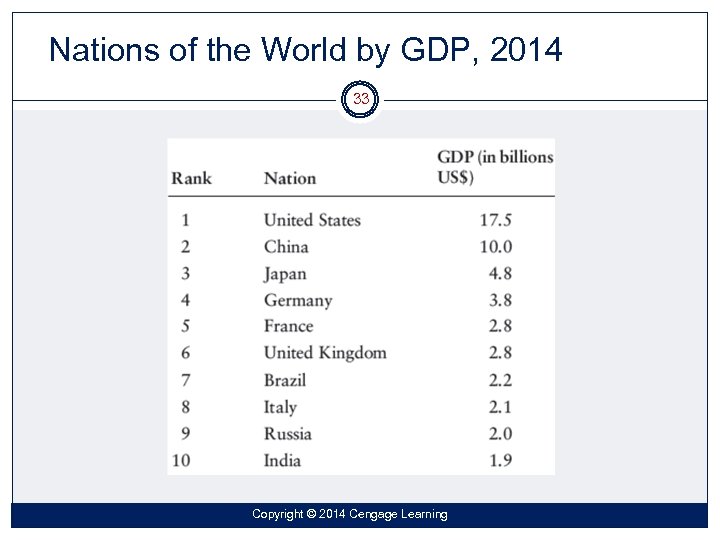 Nations of the World by GDP, 2014 33 Copyright © 2014 Cengage Learning
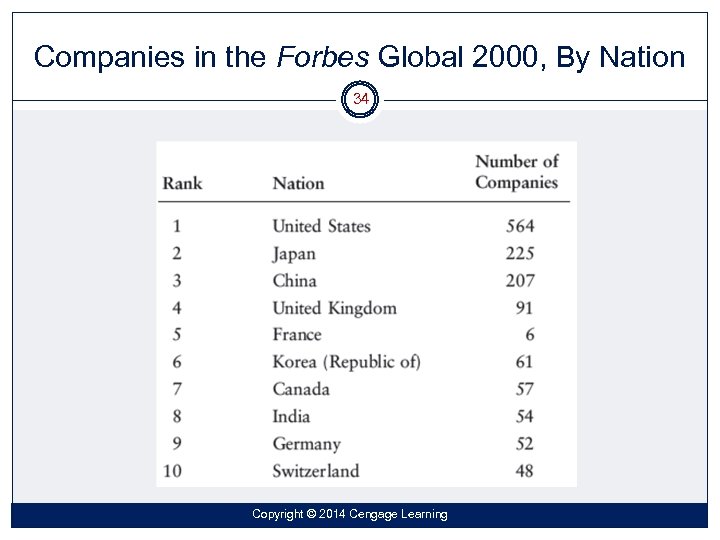 Companies in the Forbes Global 2000, By Nation 34 Copyright © 2014 Cengage Learning
 The Global Economic Elite 35 U. S. Economic Weaknesses Continued high levels of borrowing by the U. S. government, state and local governments, businesses and consumers Government financial obligations to Social Security and Medicare Copyright © 2014 Cengage Learning
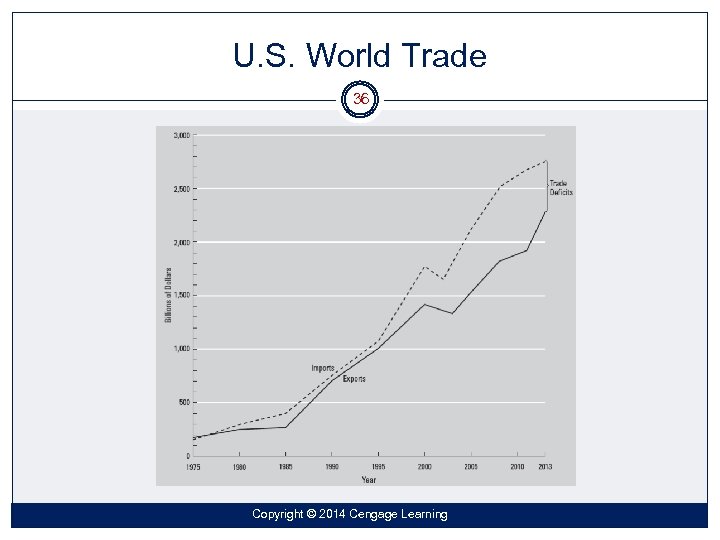 U. S. World Trade 36 Copyright © 2014 Cengage Learning
 The Global Economic Elite 37 International Trade Institutions U. S. market is the largest and most open Lower tariffs Weakest economies are those without global trade Copyright © 2014 Cengage Learning
 The Global Economic Elite 38 The World Trade Organization GATT World Trade Organization (WTO) The International Monetary Fund (IMF) Organization of 186 nations that promotes trade and economic growth. Run by a Board of Governors, though major action requires a vote by membership. Copyright © 2014 Cengage Learning
 The Global Economic Elite 39 The World Bank Provides capital to developing nations to assist in economic development and poverty reduction. Headquartered in D. C. , works closely with the IMF International Bank for Reconstruction and Development International Development Association Copyright © 2014 Cengage Learning
 Globalization and Democracy 40 Nations with a tiny elite and a huge mass of poor are unlikely to democratize. A mass made up of mostly a middle class is required for a stable, participatory political system. U. S. popular culture dominates global markets for entertainment, higher education. Globalization of corporate power is moving economic elites further from the masses. Copyright © 2014 Cengage Learning
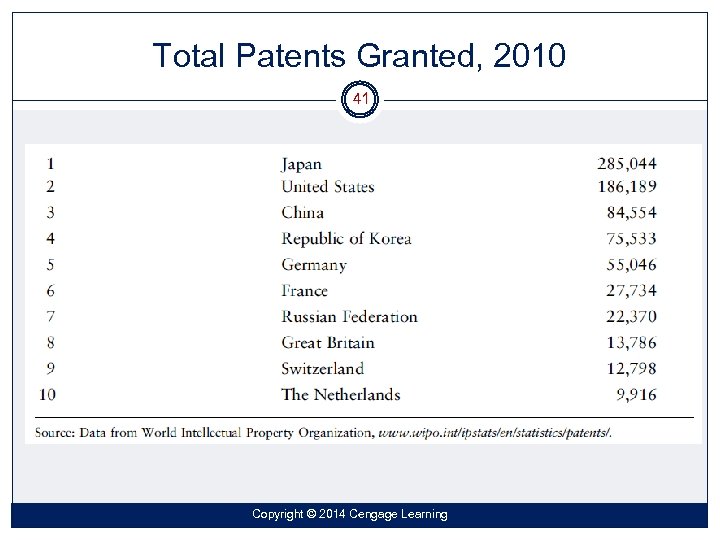 Total Patents Granted, 2010 41 Copyright © 2014 Cengage Learning
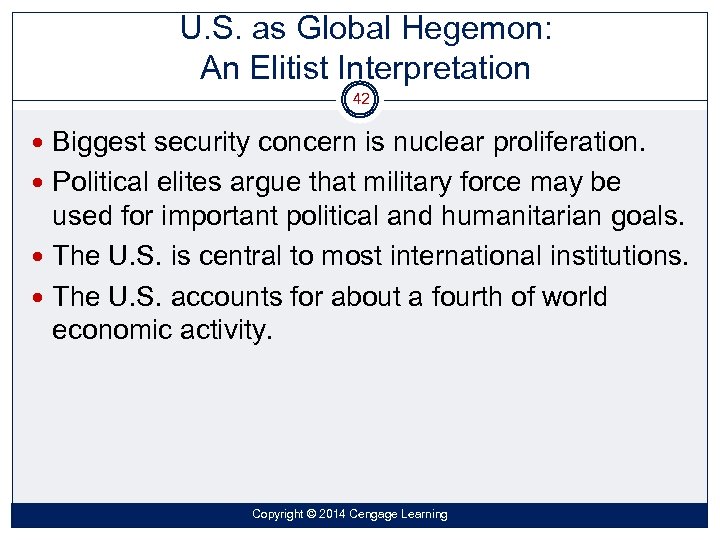 U. S. as Global Hegemon: An Elitist Interpretation 42 Biggest security concern is nuclear proliferation. Political elites argue that military force may be used for important political and humanitarian goals. The U. S. is central to most international institutions. The U. S. accounts for about a fourth of world economic activity. Copyright © 2014 Cengage Learning