


 Скачать презентацию The Iron Horse Wins 1830 1830 13 miles
7f40068eb07522fe6ab61f13f6c66390.ppt
- Количество слайдов: 82

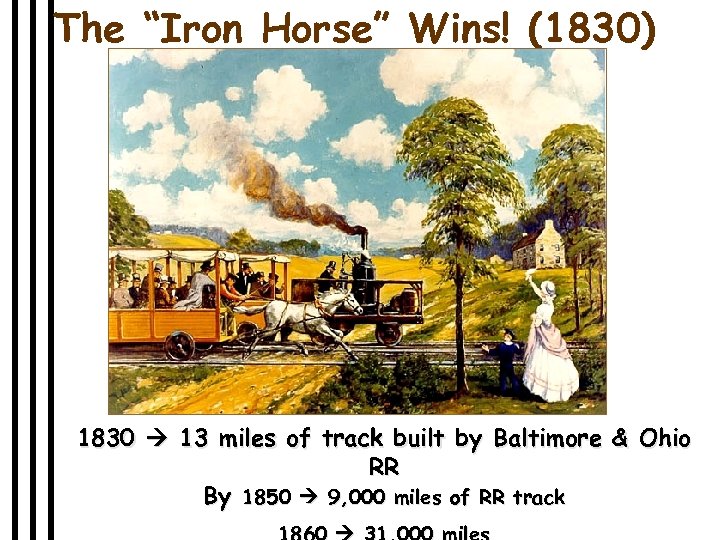 The “Iron Horse” Wins! (1830) 1830 13 miles of track built by Baltimore & Ohio RR By 1850 9, 000 miles of RR track
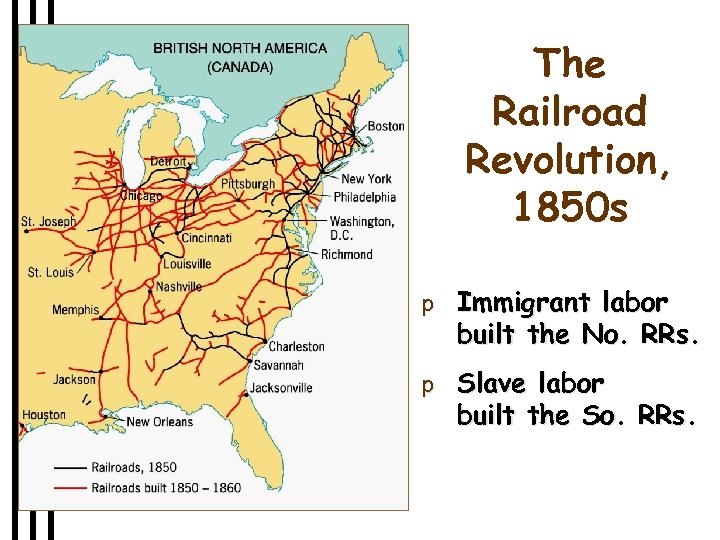 The Railroad Revolution, 1850 s p Immigrant labor built the No. RRs. p Slave labor built the So. RRs.

 Resourcefulness & Experimentation p Americans were willing to try anything. p They were first copiers, then innovators. 1800 41 patents were approved. 1860 4, 357 patents were approved.
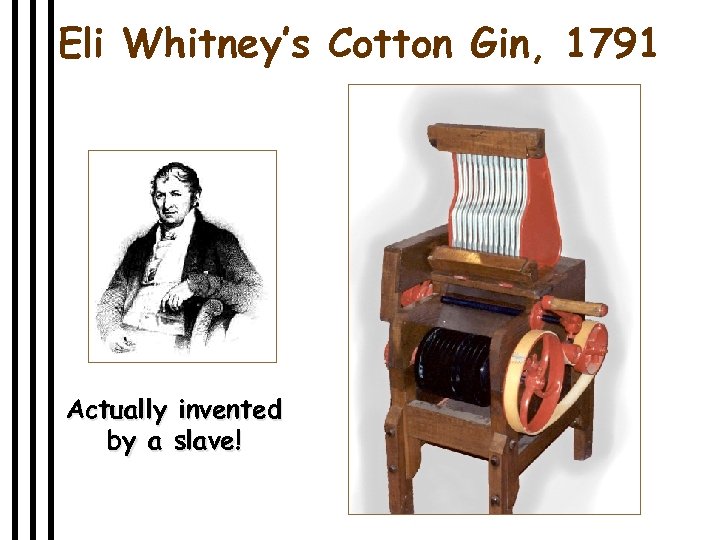 Eli Whitney’s Cotton Gin, 1791 Actually invented by a slave!
 Eli Whitney’s Gun Factory Interchangeable Parts Rifle
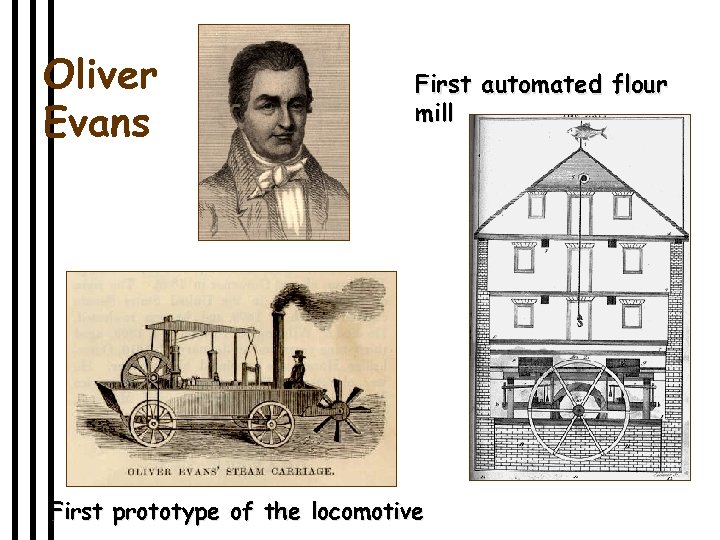 Oliver Evans First automated flour mill First prototype of the locomotive
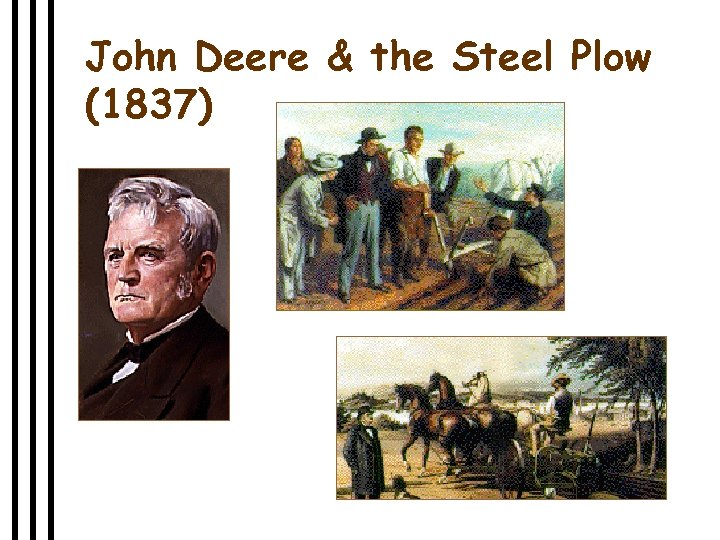 John Deere & the Steel Plow (1837)
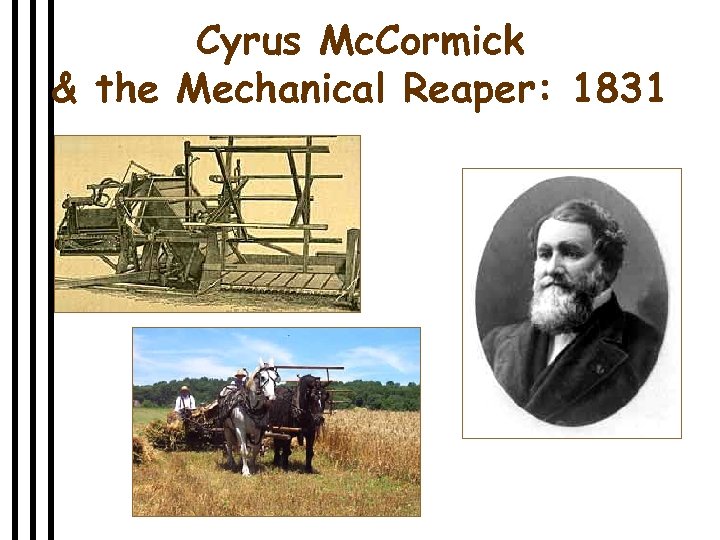 Cyrus Mc. Cormick & the Mechanical Reaper: 1831
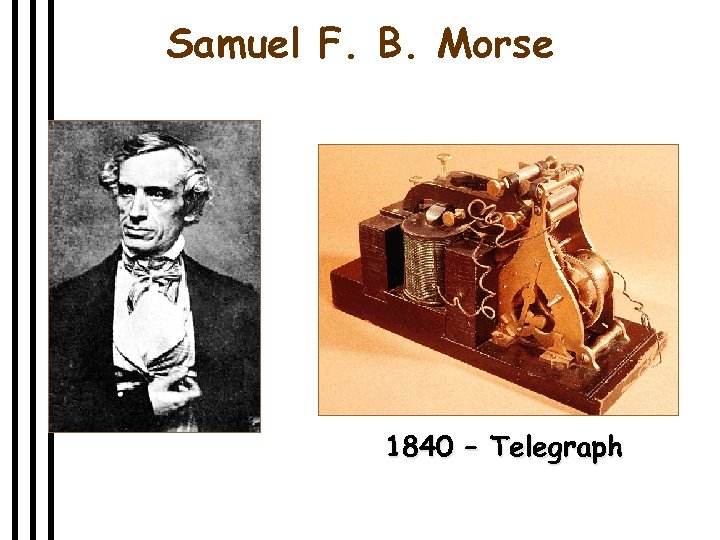 Samuel F. B. Morse 1840 – Telegraph
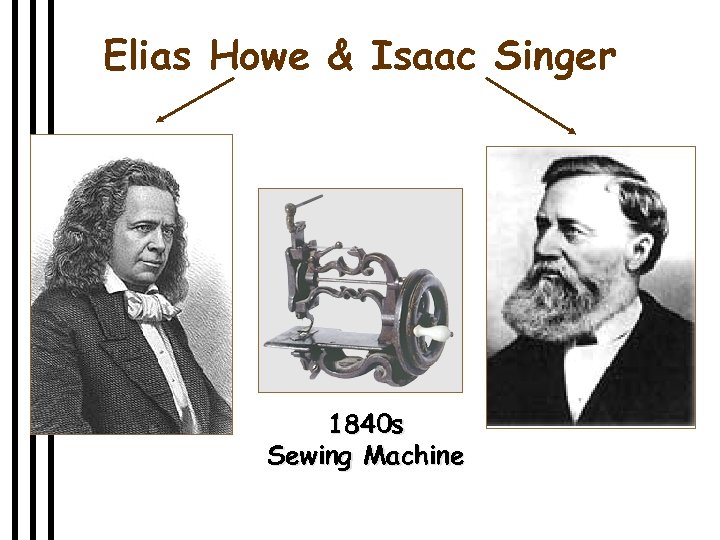 Elias Howe & Isaac Singer 1840 s Sewing Machine
 The “American Dream” z They all regarded material advance as the natural fruit of being an American & proof of the country’s virtue and promise. A German visitor in the 1840 s, Friedrich List, observed: Anything new is quickly introduced here, including all of the latest inventions. There is no clinging to old ways. The moment an American hears the word “invention, ” he pricks up his ears.
 Distribution of Wealth v v During the American Revolution, 45% of all wealth was in the top 10% of the population. 1845 Boston top 4% owned over 65% of the wealth. 1860 Philadelphia top 1% owned over 50% of the wealth. The gap between rich and poor was widening!
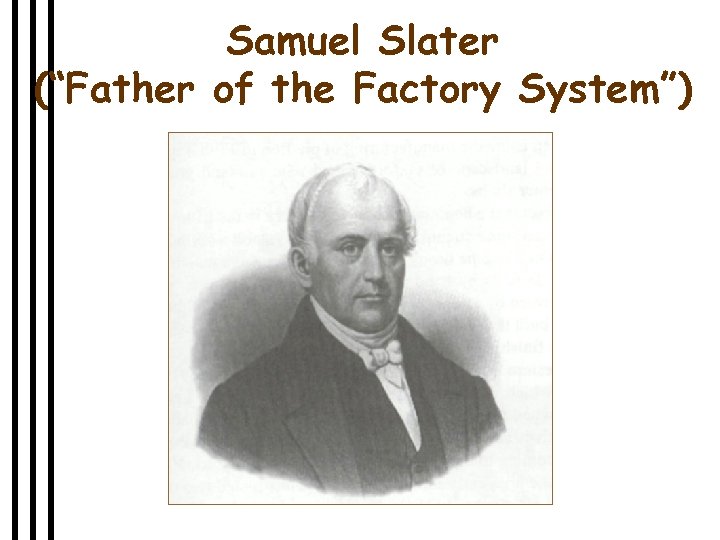 Samuel Slater (“Father of the Factory System”)
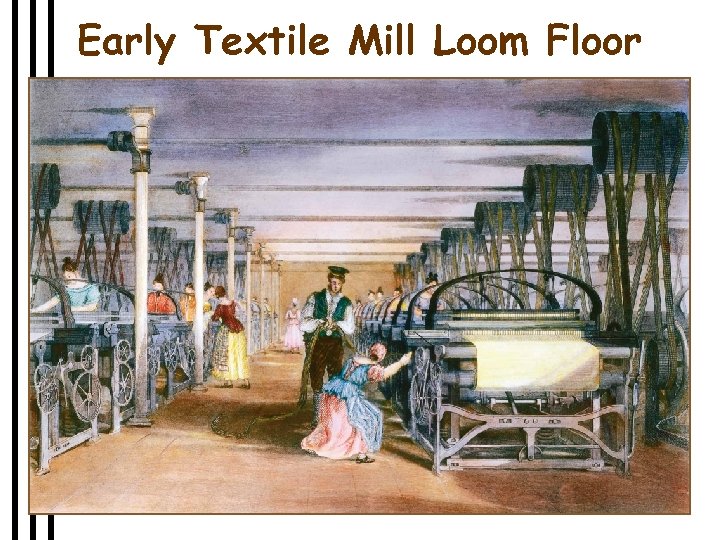 Early Textile Mill Loom Floor
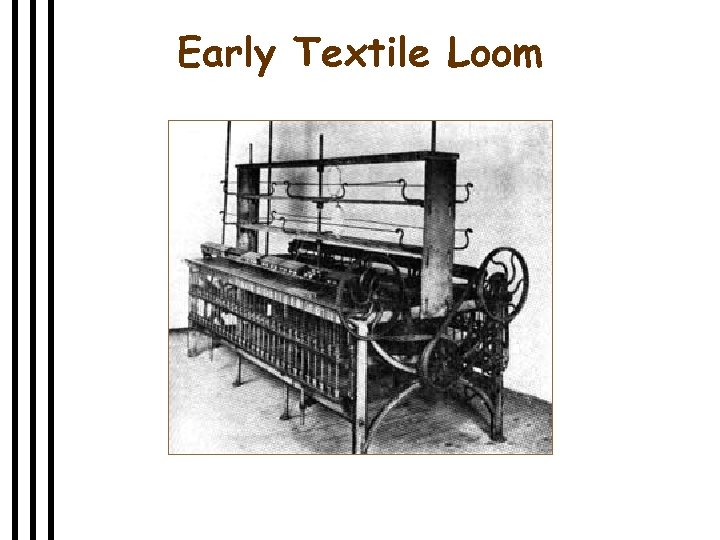 Early Textile Loom
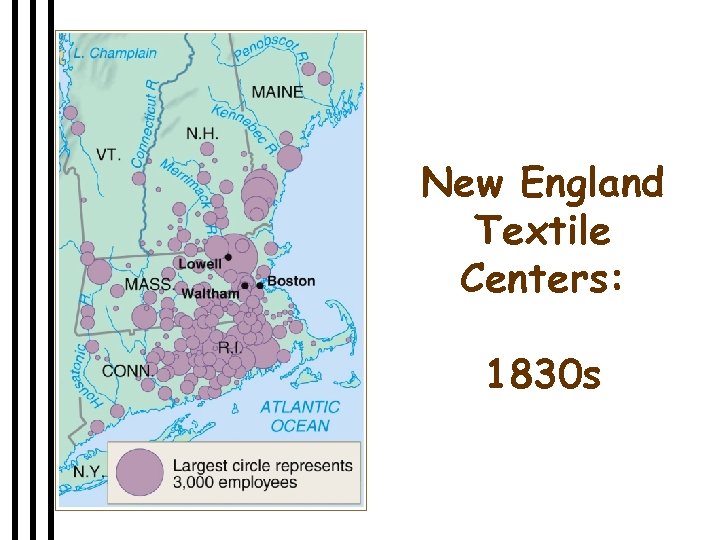 New England Textile Centers: 1830 s
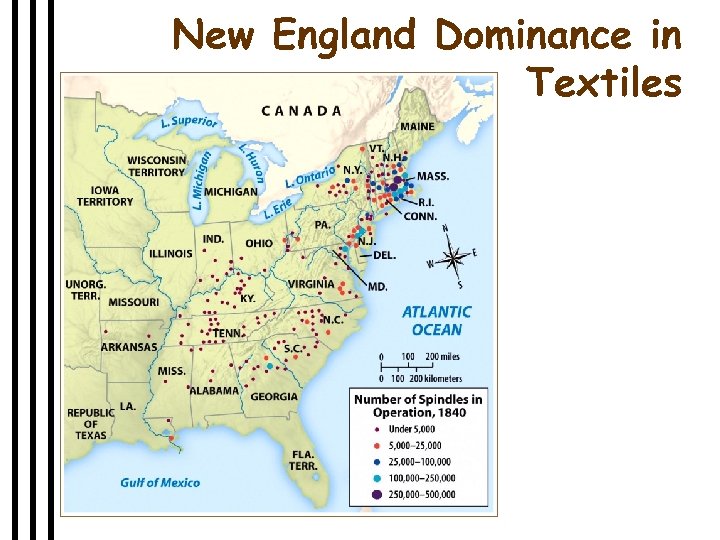 New England Dominance in Textiles
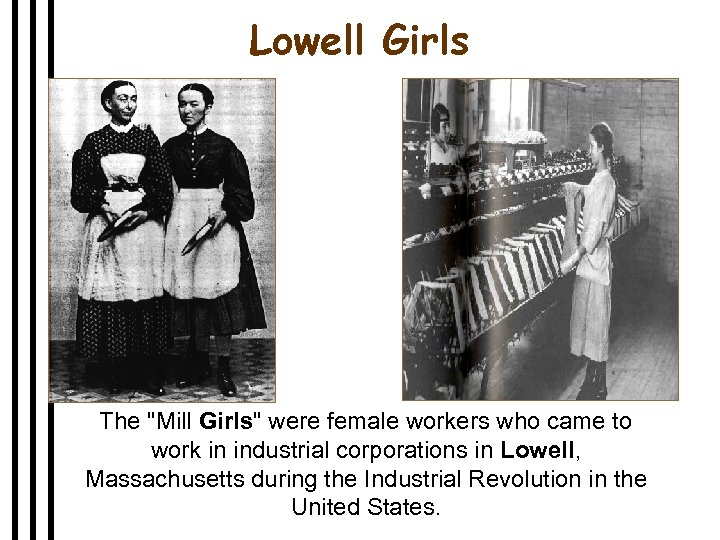 Lowell Girls The "Mill Girls" were female workers who came to work in industrial corporations in Lowell, Massachusetts during the Industrial Revolution in the United States.
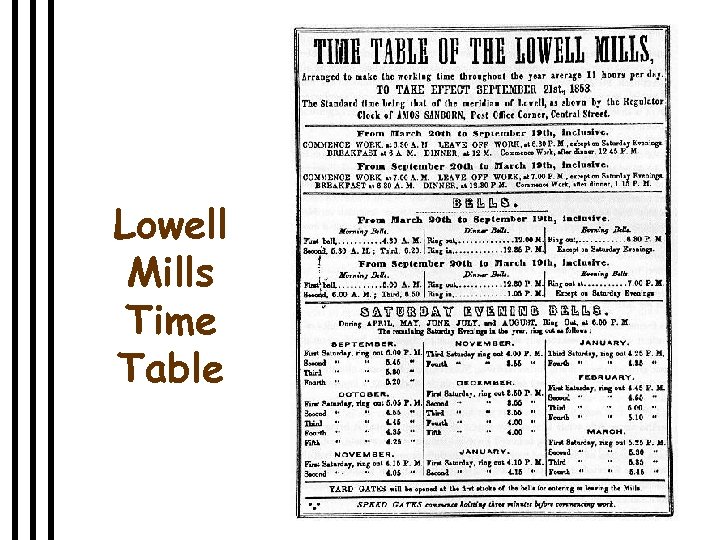 Lowell Mills Time Table
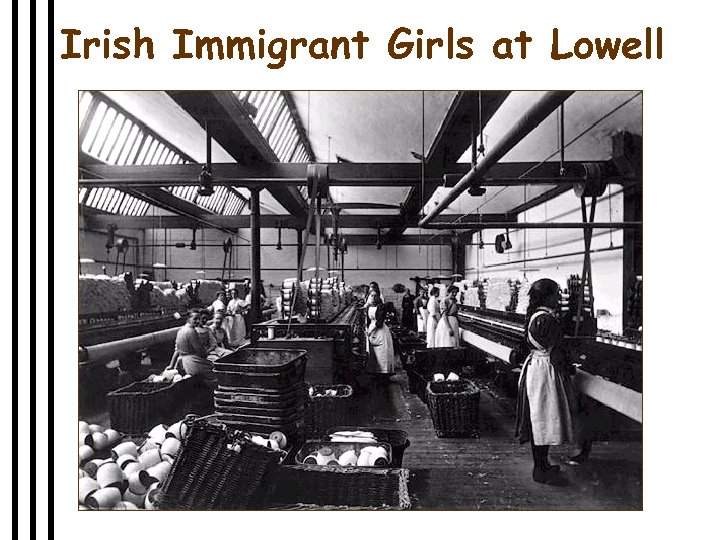 Irish Immigrant Girls at Lowell
 Regional Specialization EAST Industrial SOUTH Cotton & Slavery WEST The Nation’s “Breadbasket”
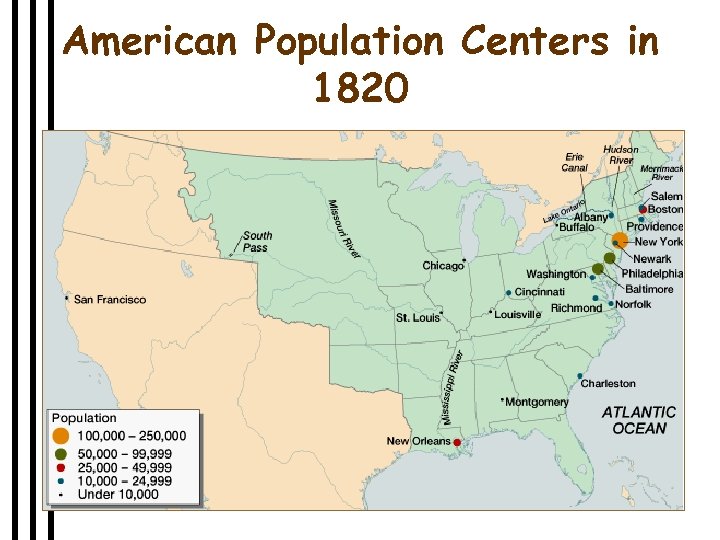 American Population Centers in 1820
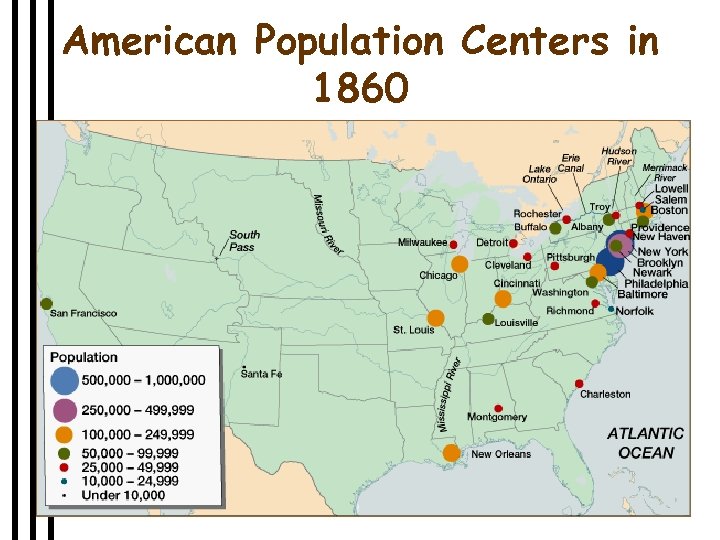 American Population Centers in 1860
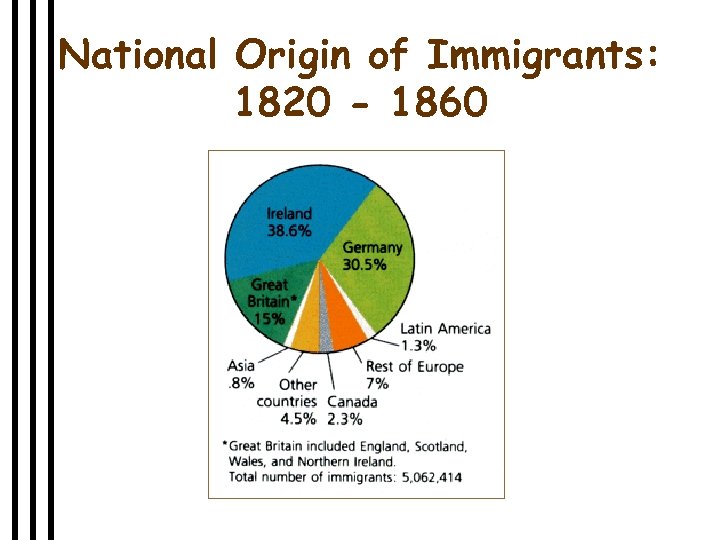 National Origin of Immigrants: 1820 - 1860
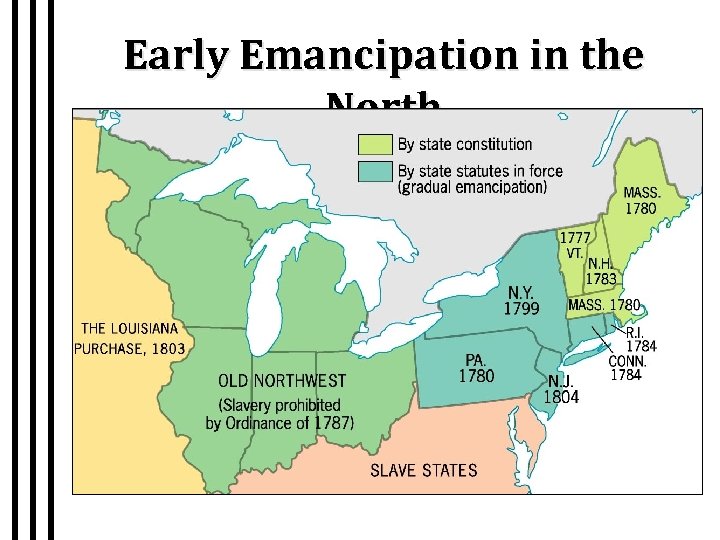 Early Emancipation in the North
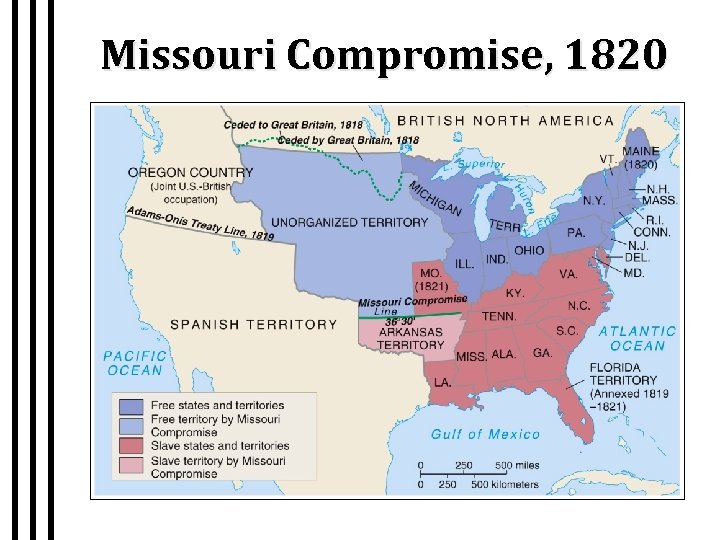 Missouri Compromise, 1820
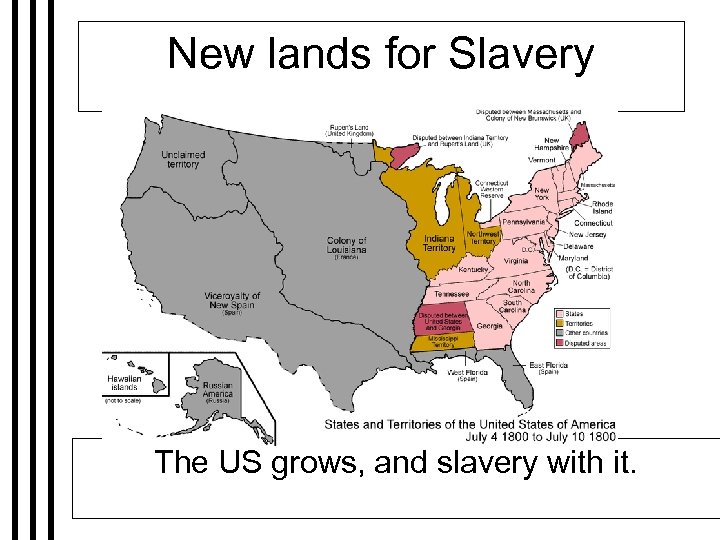 New lands for Slavery The US grows, and slavery with it.
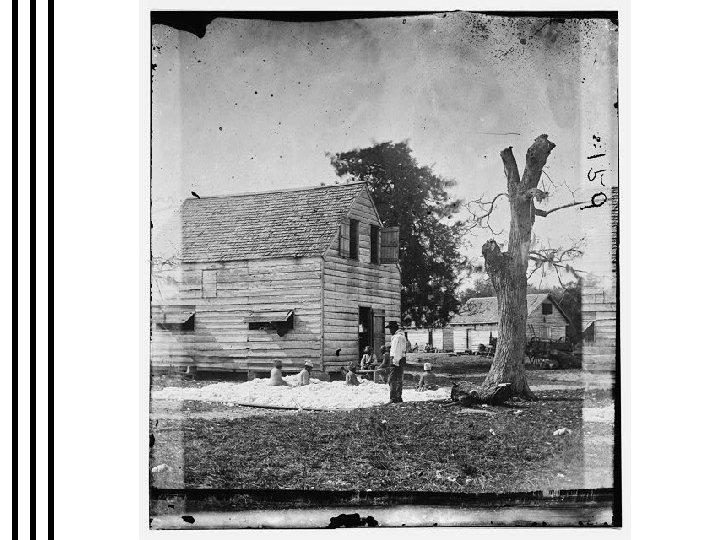
 Characteristics of the Antebellum South 1. Primarily agrarian. 2. Economic power shifted from the “upper South” to the “lower South. ” 3. “Cotton Is King!” * 1860 5 mil. bales a yr. (57% of total US exports). 4. Very slow development of industrialization. 5. Basic financial system. 6. Inadequate transportation system.
![Southern Society (1850) 6, 000 “Slavocracy” [plantation owners] The “Plain Folk” [white yeoman farmers]](https://present5.com/presentation/7f40068eb07522fe6ab61f13f6c66390/image-32.jpg "Southern Society (1850) 6, 000 “Slavocracy” [plantation owners] The “Plain Folk” [white yeoman farmers]") Southern Society (1850) 6, 000 “Slavocracy” [plantation owners] The “Plain Folk” [white yeoman farmers] Black Freemen 250, 000 Black Slaves 3, 200, 000 Total US Population 23, 000 [9, 250, 000 in the South = 40%]
Southern Society (1850) 6, 000 “Slavocracy” [plantation owners] The “Plain Folk” [white yeoman farmers] Black Freemen 250, 000 Black Slaves 3, 200, 000 Total US Population 23, 000 [9, 250, 000 in the South = 40%]
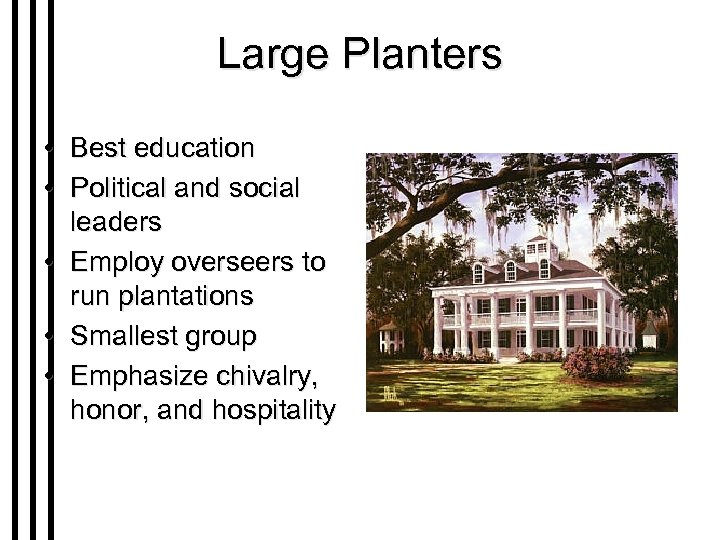 Large Planters • Best education • Political and social leaders • Employ overseers to run plantations • Smallest group • Emphasize chivalry, honor, and hospitality
 Small Planters • Many more than large planters, but still a relatively small social group • Some political power • Generally do not employ overseers • Aspire to rise to the class of large planters, but the expense of slaves generally prevents this
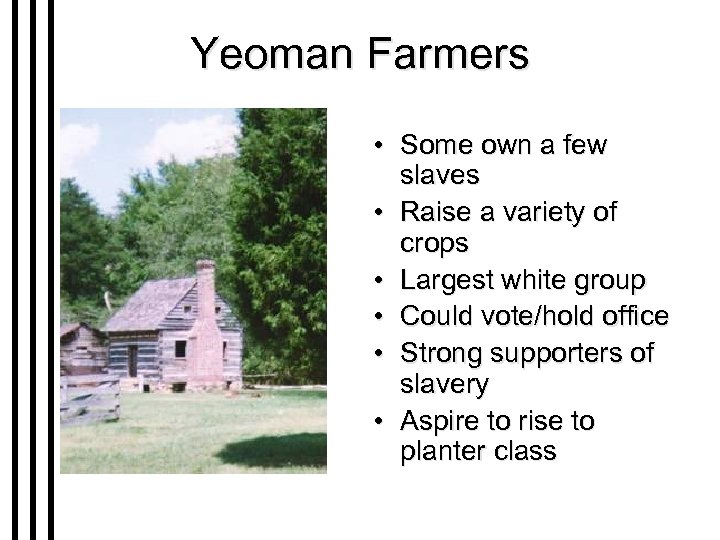 Yeoman Farmers • Some own a few slaves • Raise a variety of crops • Largest white group • Could vote/hold office • Strong supporters of slavery • Aspire to rise to planter class
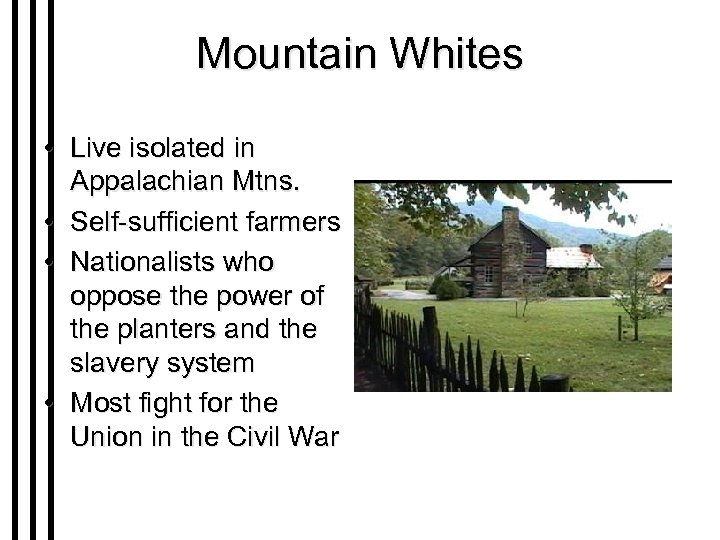 Mountain Whites • Live isolated in Appalachian Mtns. • Self-sufficient farmers • Nationalists who oppose the power of the planters and the slavery system • Most fight for the Union in the Civil War
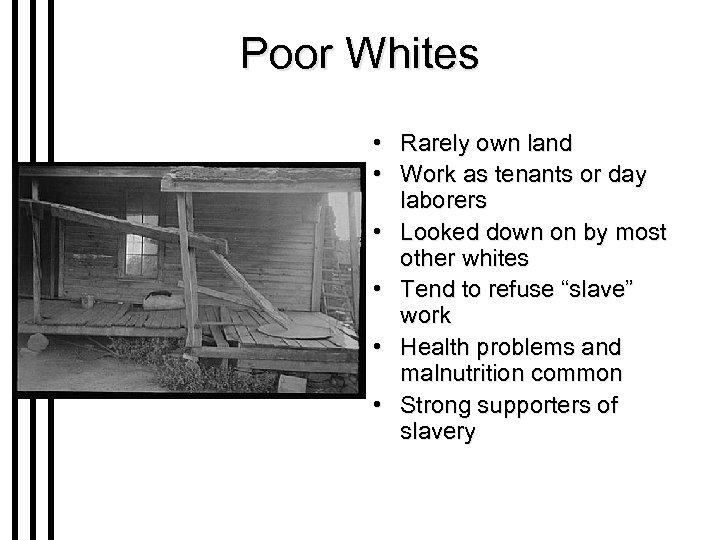 Poor Whites • Rarely own land • Work as tenants or day laborers • Looked down on by most other whites • Tend to refuse “slave” work • Health problems and malnutrition common • Strong supporters of slavery
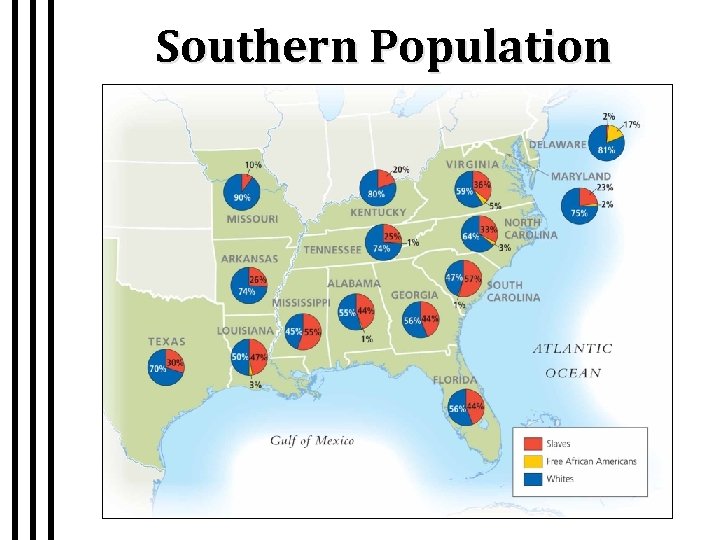 Southern Population
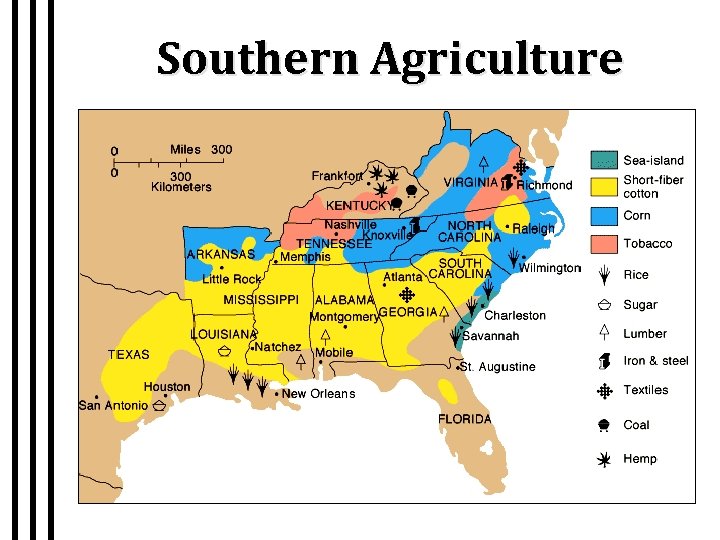 Southern Agriculture
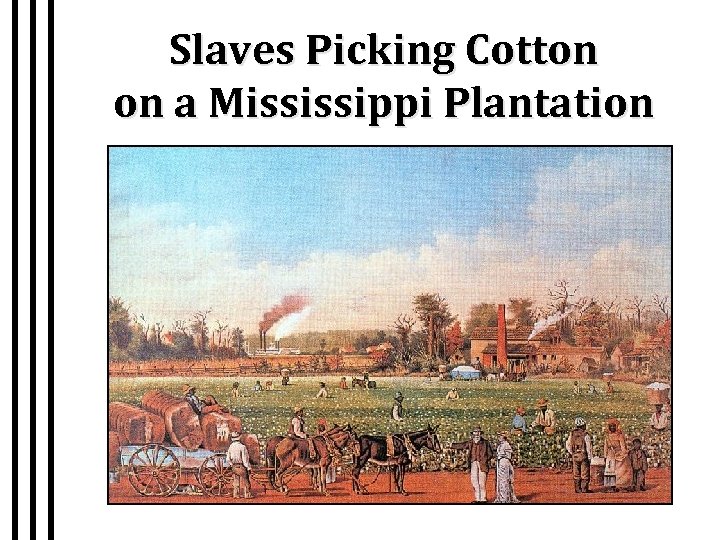 Slaves Picking Cotton on a Mississippi Plantation
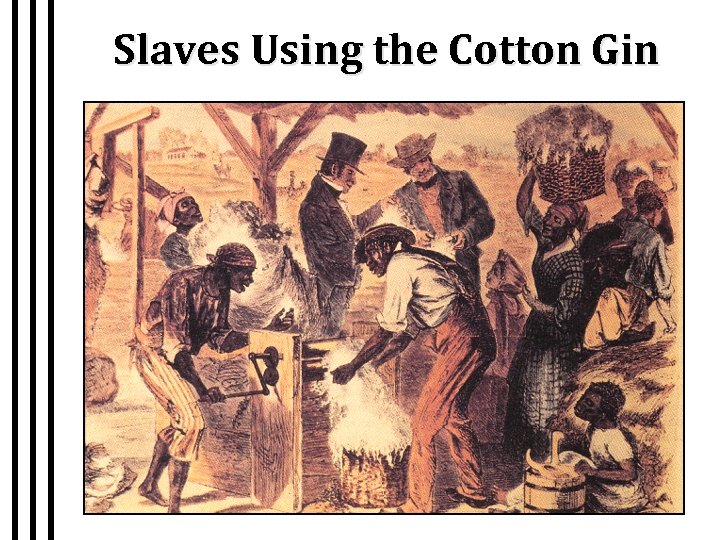 Slaves Using the Cotton Gin
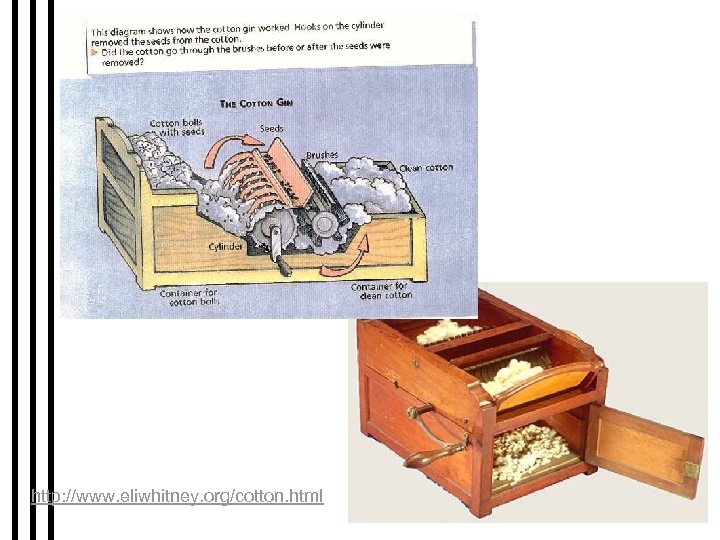 http: //www. eliwhitney. org/cotton. html
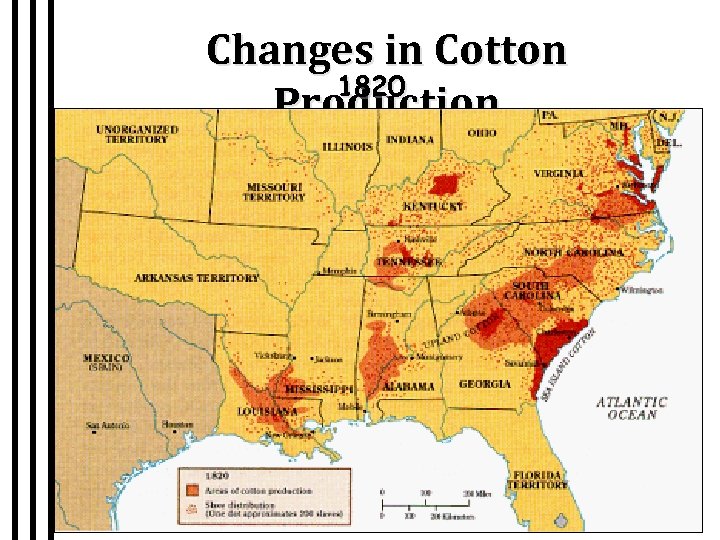 Changes in Cotton 1820 Production
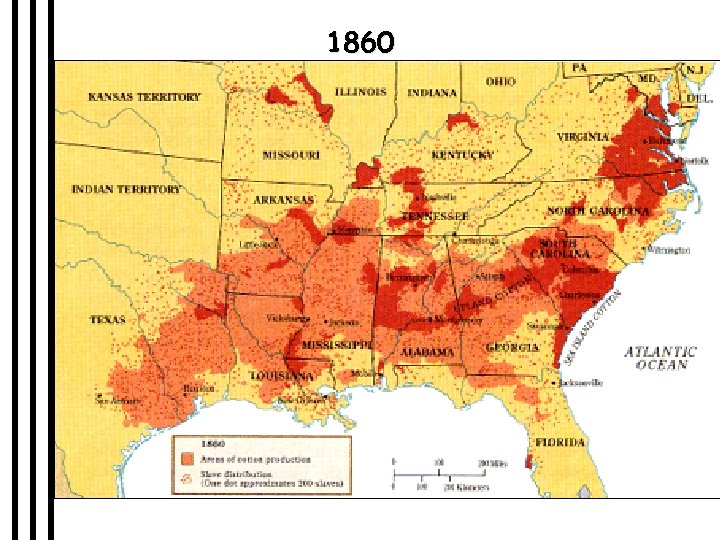 1860
1860
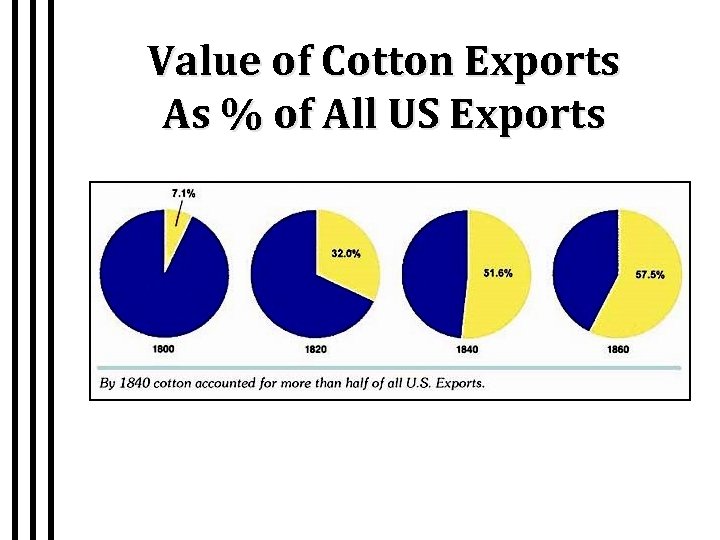 Value of Cotton Exports As % of All US Exports
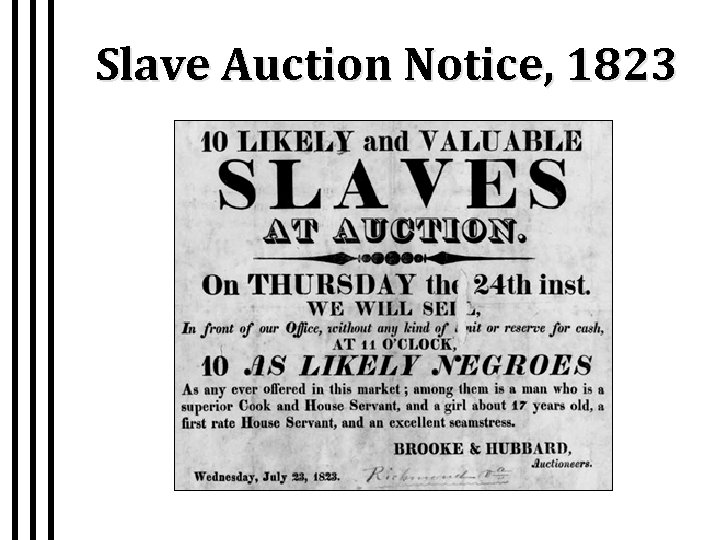 Slave Auction Notice, 1823
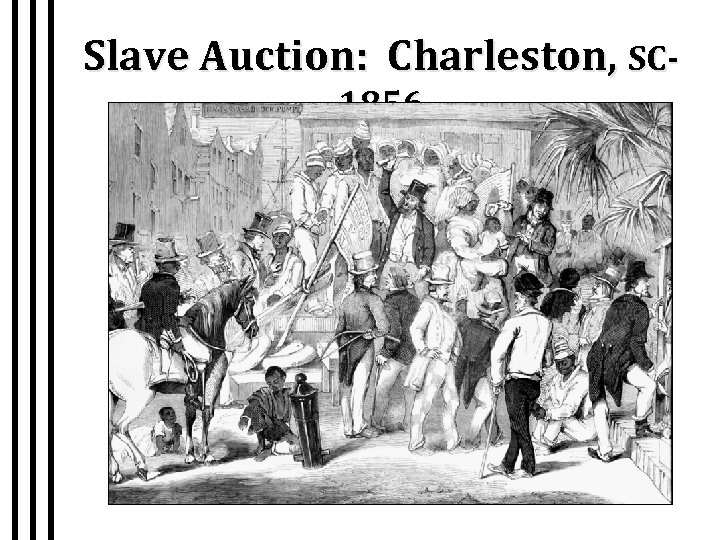 Slave Auction: Charleston, SC 1856
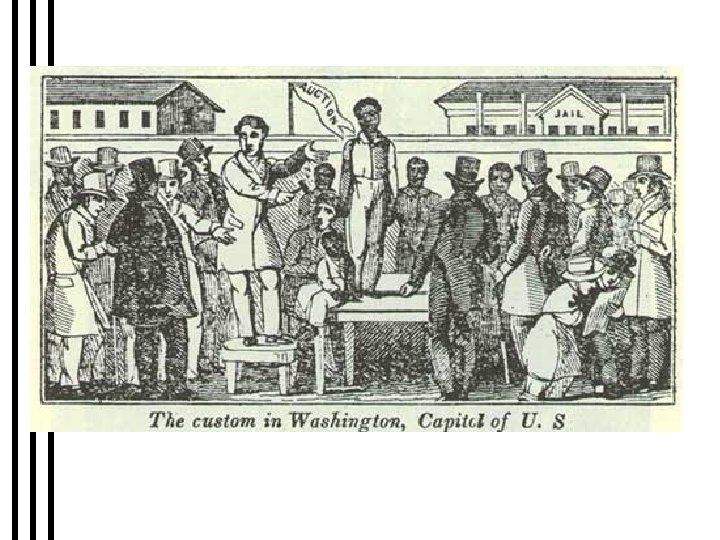
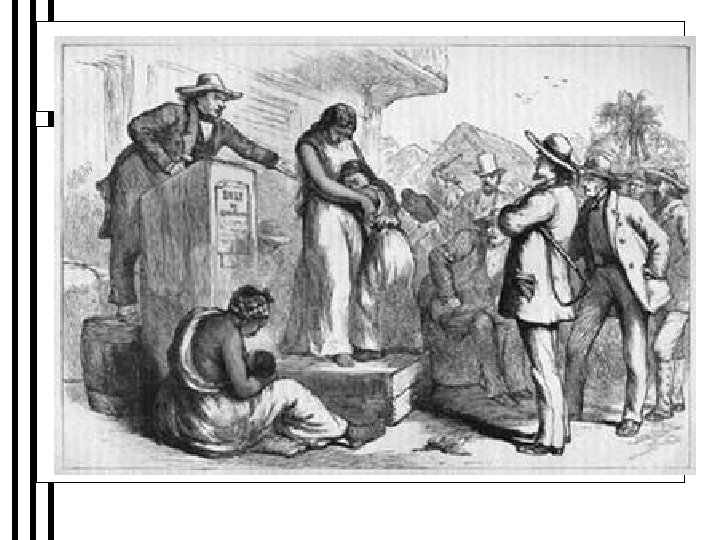
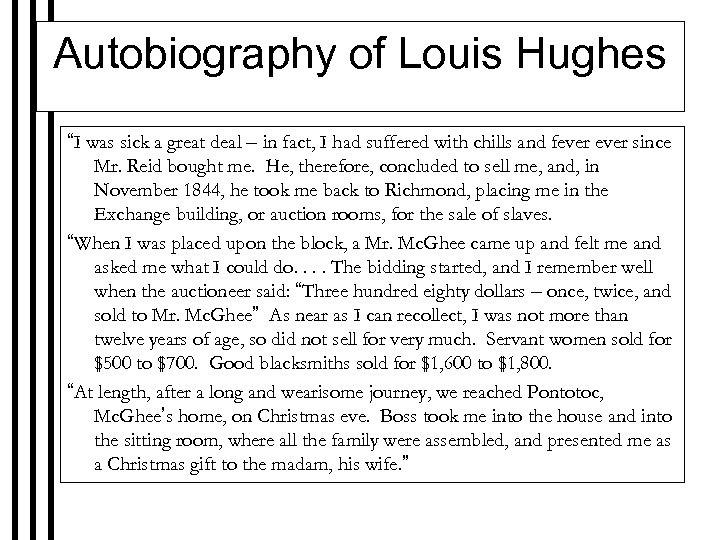 Autobiography of Louis Hughes “I was sick a great deal – in fact, I had suffered with chills and fever since Mr. Reid bought me. He, therefore, concluded to sell me, and, in November 1844, he took me back to Richmond, placing me in the Exchange building, or auction rooms, for the sale of slaves. “When I was placed upon the block, a Mr. Mc. Ghee came up and felt me and asked me what I could do. . The bidding started, and I remember well when the auctioneer said: “Three hundred eighty dollars – once, twice, and sold to Mr. Mc. Ghee” As near as I can recollect, I was not more than twelve years of age, so did not sell for very much. Servant women sold for $500 to $700. Good blacksmiths sold for $1, 600 to $1, 800. “At length, after a long and wearisome journey, we reached Pontotoc, Mc. Ghee’s home, on Christmas eve. Boss took me into the house and into the sitting room, where all the family were assembled, and presented me as a Christmas gift to the madam, his wife. ”
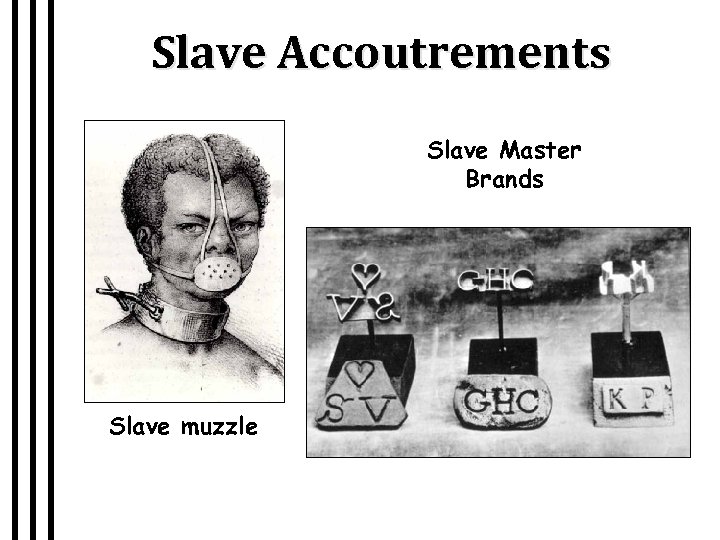 Slave Accoutrements Slave Master Brands Slave muzzle
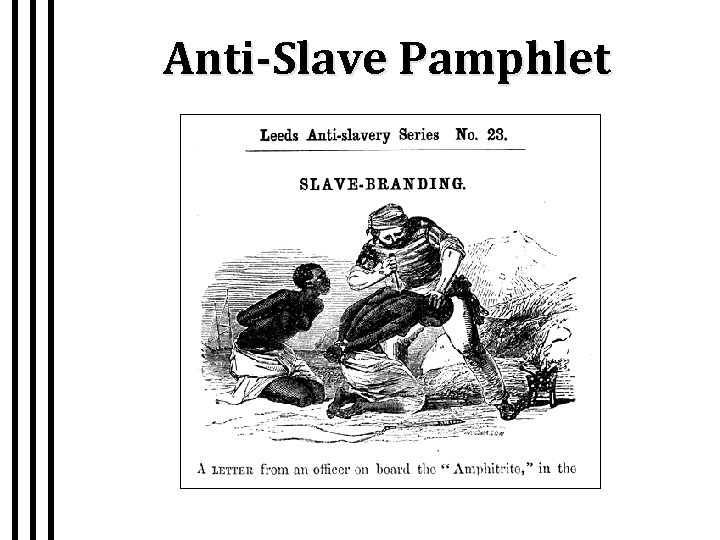 Anti-Slave Pamphlet
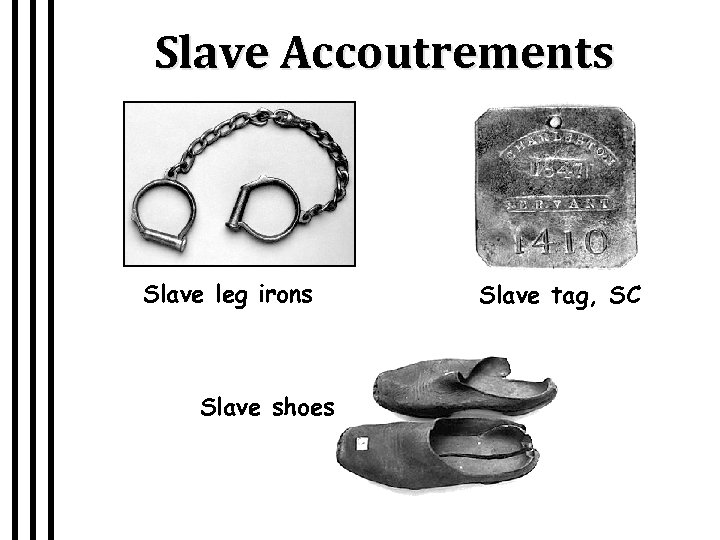 Slave Accoutrements Slave leg irons Slave shoes Slave tag, SC
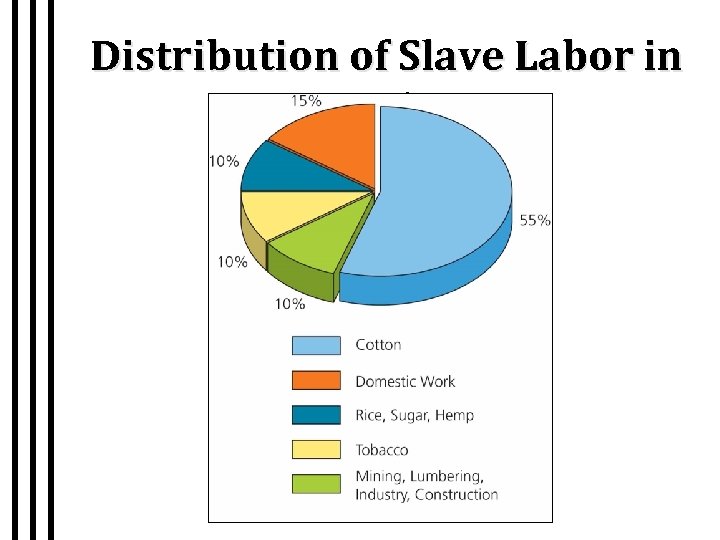 Distribution of Slave Labor in 1850
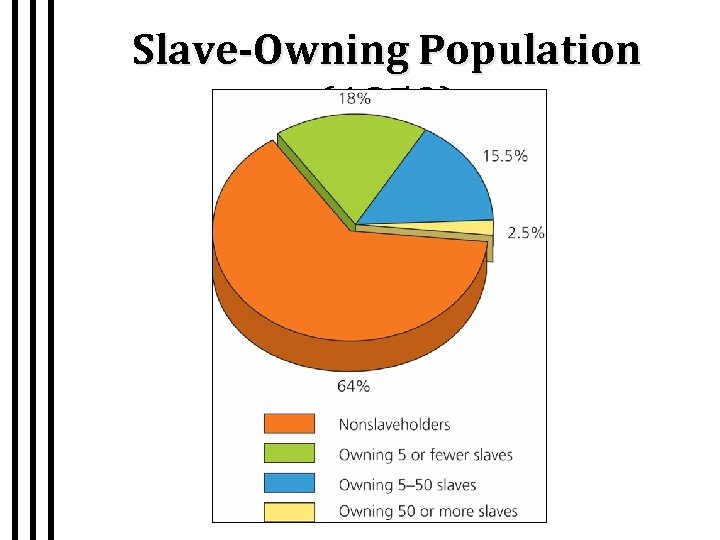 Slave-Owning Population (1850)
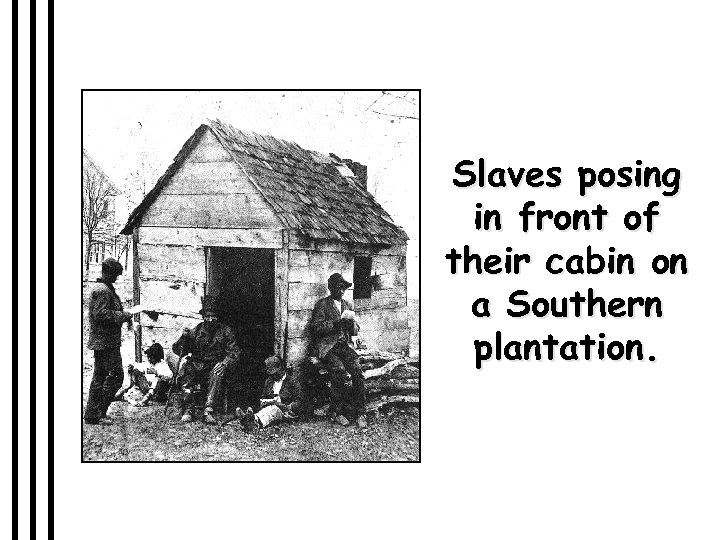 Slaves posing in front of their cabin on a Southern plantation.
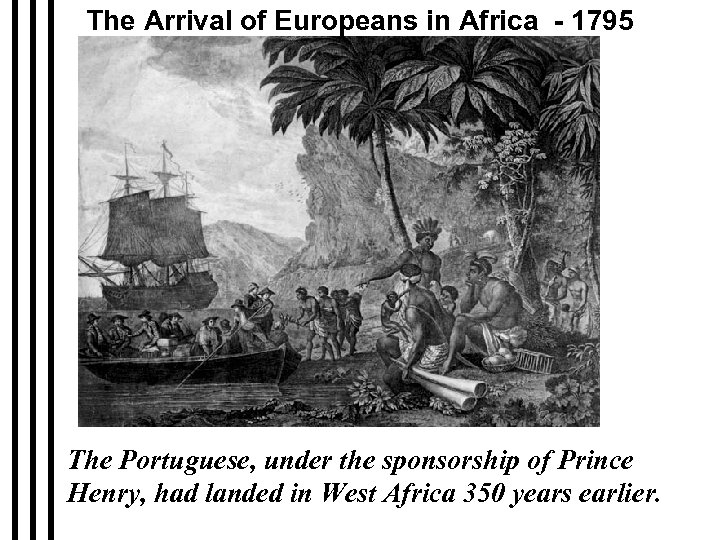 The Arrival of Europeans in Africa - 1795 The Portuguese, under the sponsorship of Prince Henry, had landed in West Africa 350 years earlier.
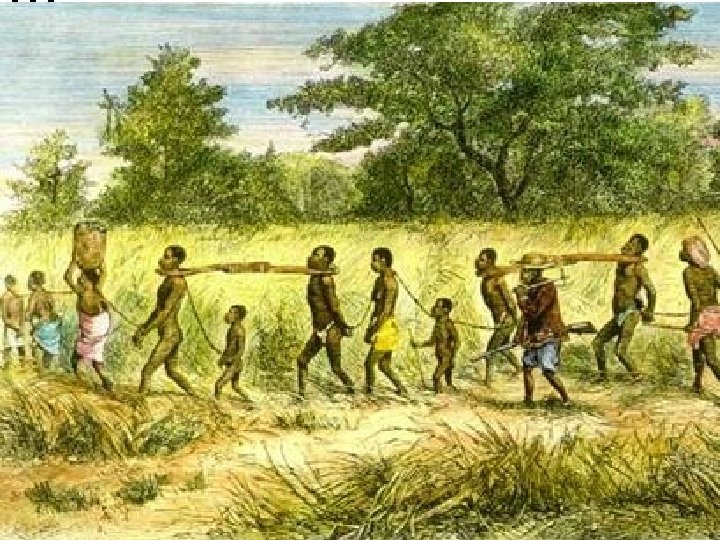
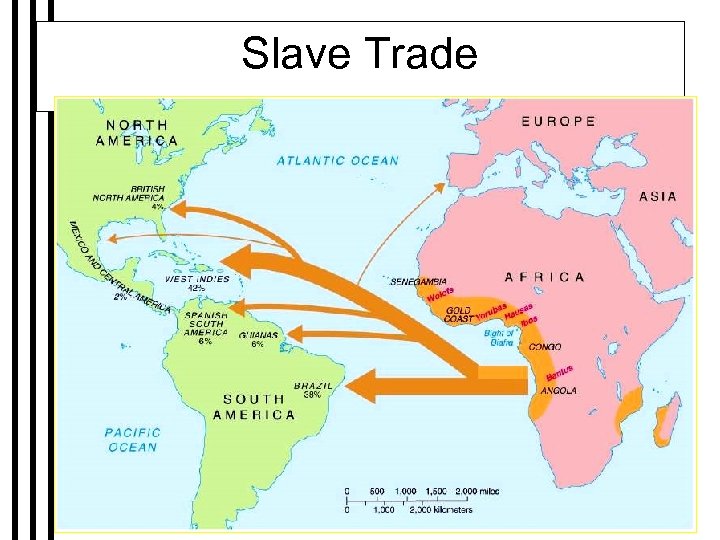 Slave Trade
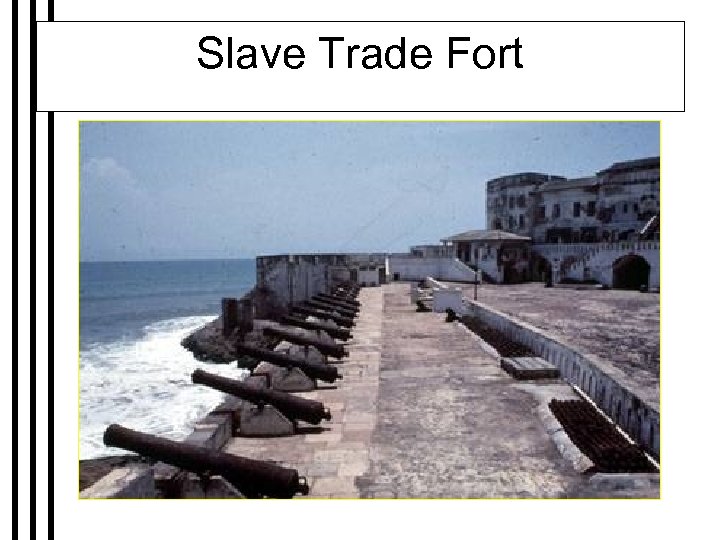 Slave Trade Fort
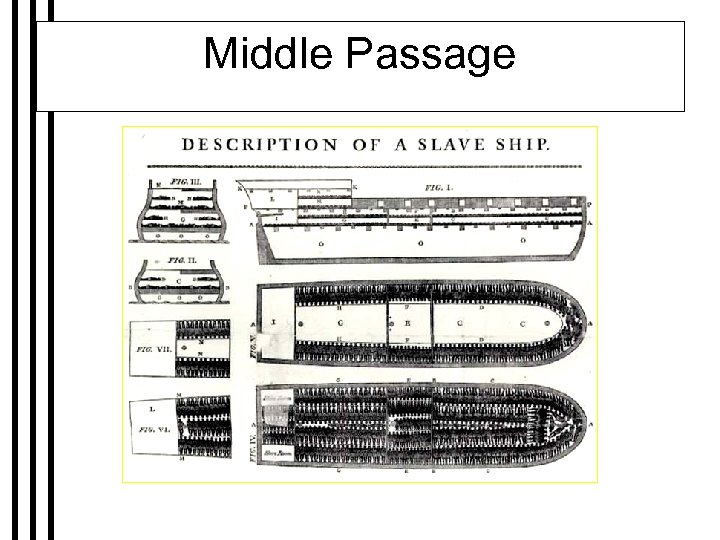 Middle Passage
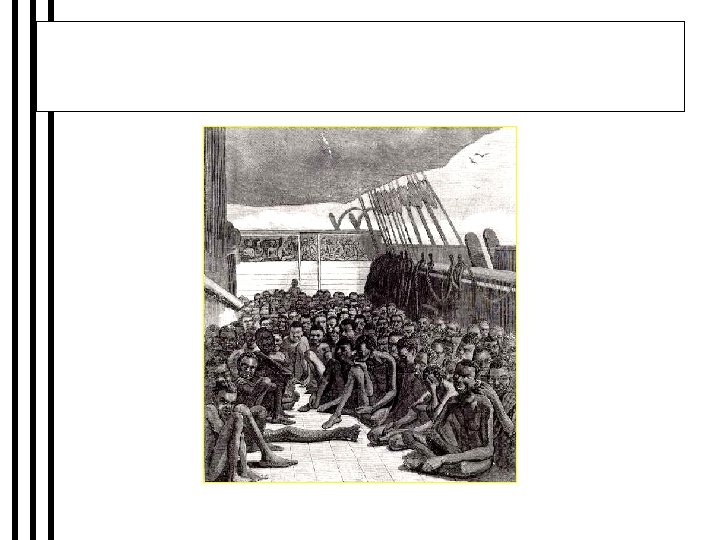
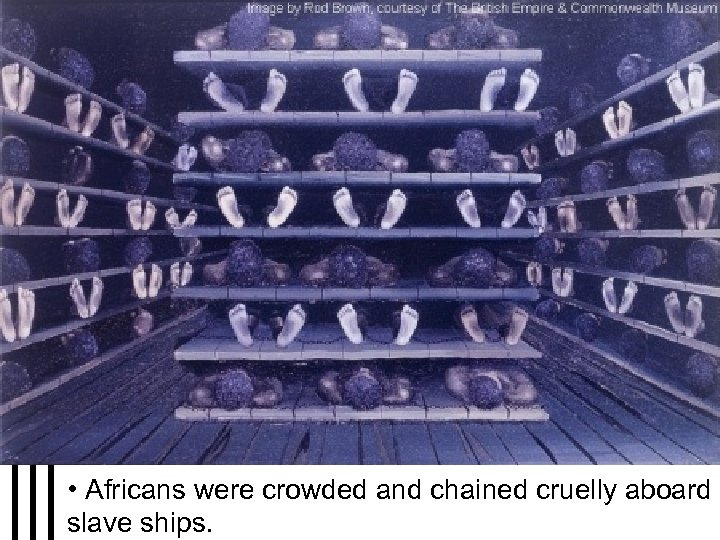 • Africans were crowded and chained cruelly aboard slave ships.
 ". . . the excessive heat was not the only thing that rendered their situation intolerable. The deck, that is the floor of their rooms, was so covered with the blood and mucus which had proceeded from them in consequence of the flux, that it resembled a slaughterhouse. " Taken from Alexander Falconbridge, a surgeon aboard slave ships and later the governor of a British colony for freed slaves in Sierra Leone.
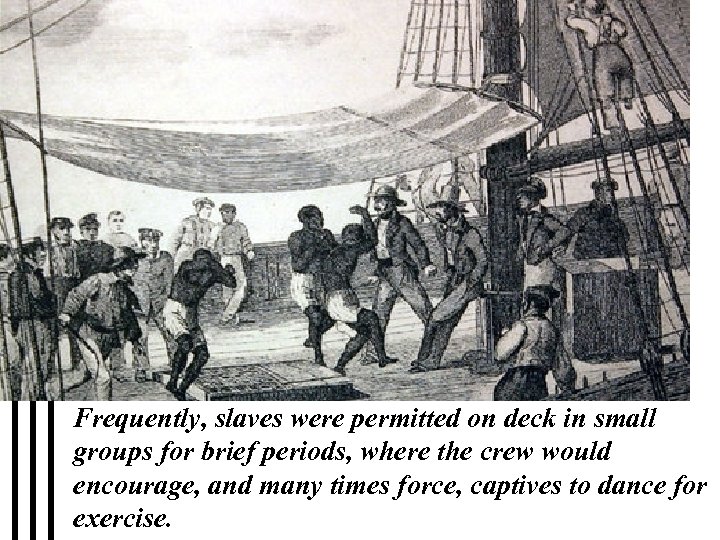 Frequently, slaves were permitted on deck in small groups for brief periods, where the crew would encourage, and many times force, captives to dance for exercise.
 "Exercise being deemed necessary for the preservation of their health they are sometimes obliged to dance when the weather will permit their coming on deck. If they go about it reluctantly or do not move with agility, they are flogged…” Taken from Alexander Falconbridge, An Account of the Slave Trade on the Coast of Africa.
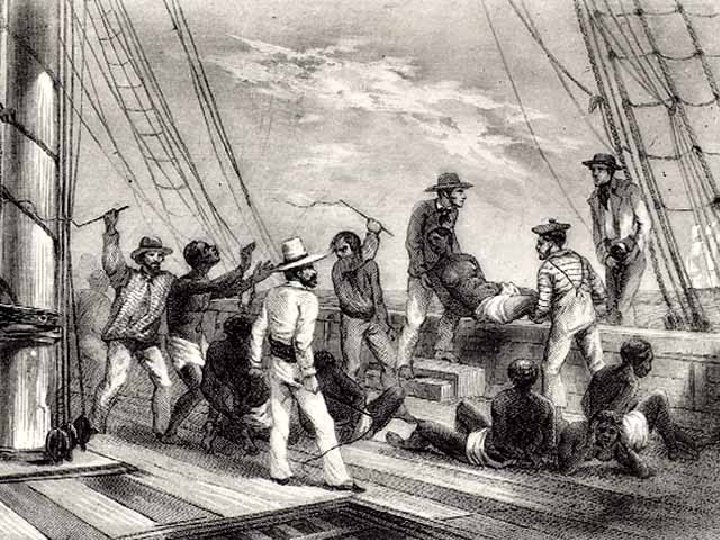
 Heading for Jamaica in 1781, the ship Zong was nearing the end of its voyage. It had been twelve weeks since it had sailed from the west African coast with its cargo of 417 slaves. Water was running out. Then, compounding the problem, there was an outbreak of disease. The ship's captain, reasoning that the slaves were going to die anyway, made a decision. In order to reduce the owner's losses he would throw overboard the slaves thought to be too sick to recover. The voyage was insured, but the insurance would not pay for sick slaves or even those killed by illness. However, it would cover slaves lost through drowning. The captain gave the order; 54 Africans were chained together, then thrown overboard. Another 78 were drowned over the next two days. By the time the ship had reached the Caribbean, 132 persons had been murdered.
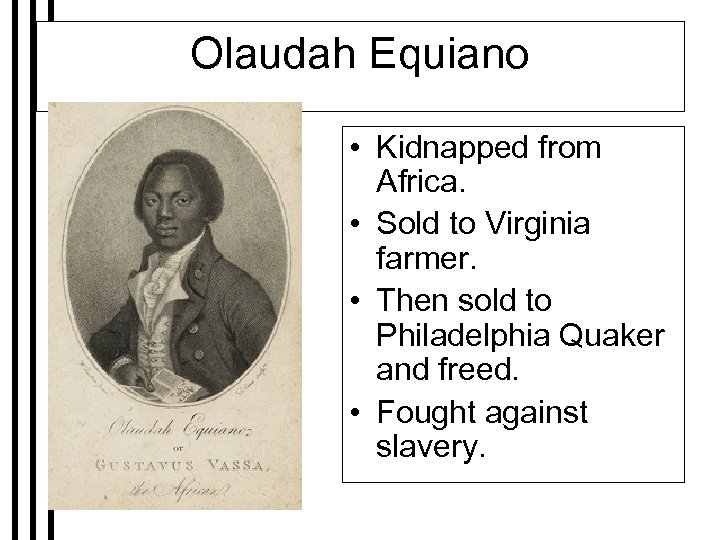 Olaudah Equiano • Kidnapped from Africa. • Sold to Virginia farmer. • Then sold to Philadelphia Quaker and freed. • Fought against slavery.
 "I was soon put down under the decks, and there I received such a salutation in my nostrils as I had never experienced in my life: so that, with the loathsomeness of the stench, and crying together, I became so sick and low that I was not able to eat, nor had I the least desire to taste anything. I now wished for the last friend, death, to relieve me; but soon, to my grief, two of the white men offered me eatables; and on my refusing to eat, one of them held me fast by the hands and laid me across I think the windlass, and tied my feet, while the other flogged me severely. ” - Olaudah Equiano, giving the first eyewitness account of life on a ship from a slave's point of view.
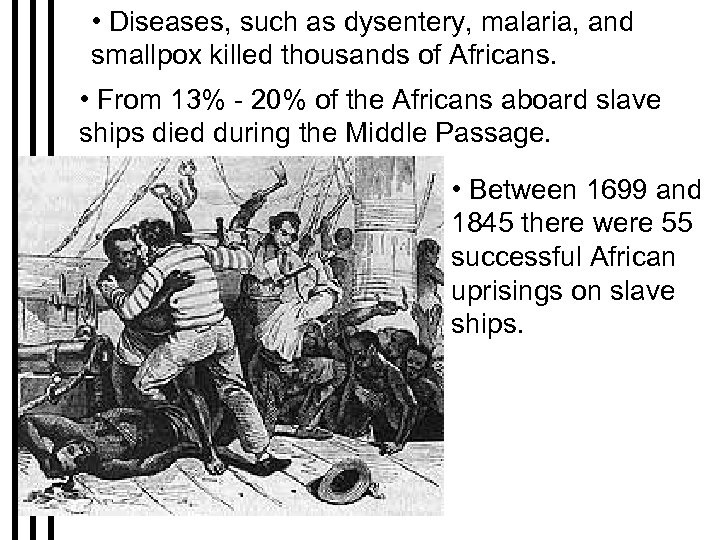 • Diseases, such as dysentery, malaria, and smallpox killed thousands of Africans. • From 13% - 20% of the Africans aboard slave ships died during the Middle Passage. • Between 1699 and 1845 there were 55 successful African uprisings on slave ships.
 US Laws Regarding Slavery 1. U. S. Constitution: * 3/5’s compromise * fugitive slave clause 2. 1793 Fugitive Slave Act. 3. 1850 stronger Fugitive Slave Act.
 Southern Slavery-> An abnormality? 1. 1780 s: 1 antislavery society created in Phila. st 2. By 1804: slavery eliminated from last northern state. 3. 1807: the legal termination of the slave trade, enforced by the Royal Navy. 4. 1820 s: newly indep. Republics of Central & So. America declared their slaves free. 5. 1833: slavery abolished throughout the British Empire. 6. 1844: slavery abolished in the Fr. colonies. 7. 1861: the serfs of Russia were emancipated.
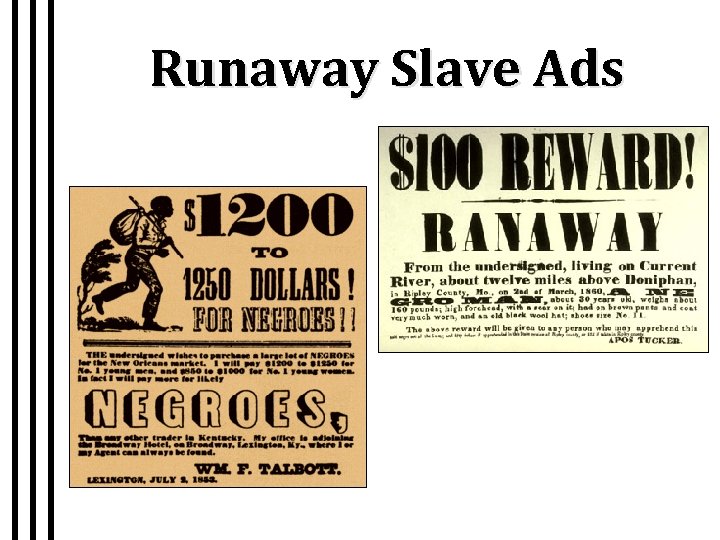 Runaway Slave Ads
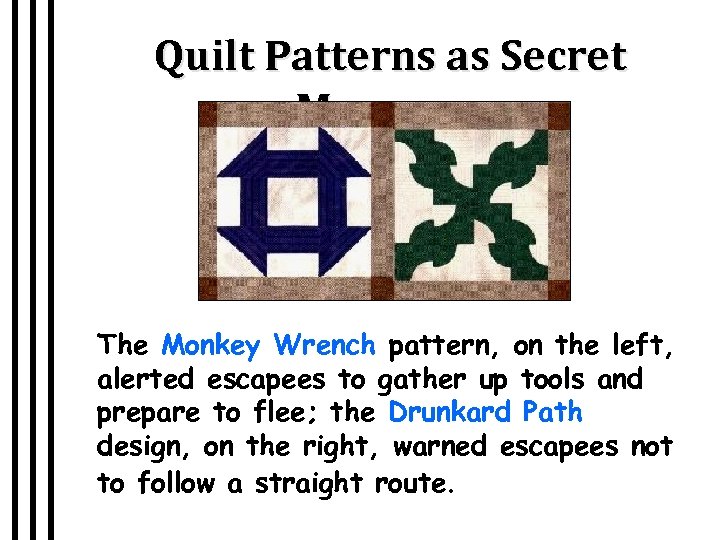 Quilt Patterns as Secret Messages The Monkey Wrench pattern, on the left, alerted escapees to gather up tools and prepare to flee; the Drunkard Path design, on the right, warned escapees not to follow a straight route.
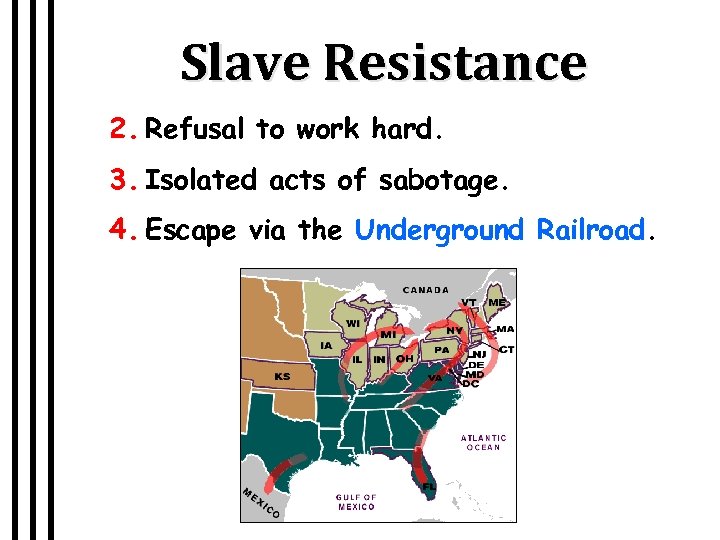 Slave Resistance 2. Refusal to work hard. 3. Isolated acts of sabotage. 4. Escape via the Underground Railroad.
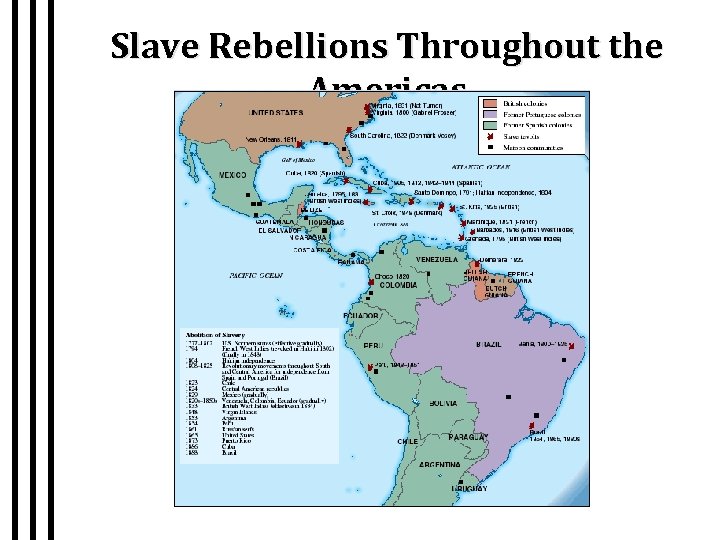 Slave Rebellions Throughout the Americas
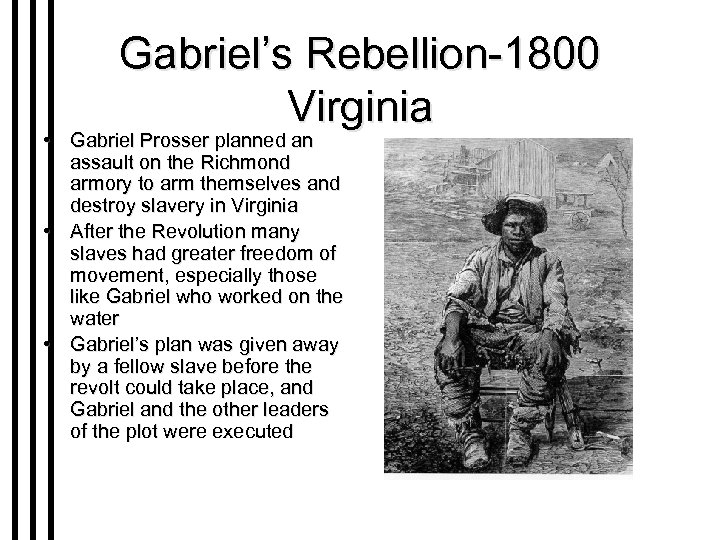 Gabriel’s Rebellion-1800 Virginia • Gabriel Prosser planned an assault on the Richmond armory to arm themselves and destroy slavery in Virginia • After the Revolution many slaves had greater freedom of movement, especially those like Gabriel who worked on the water • Gabriel’s plan was given away by a fellow slave before the revolt could take place, and Gabriel and the other leaders of the plot were executed
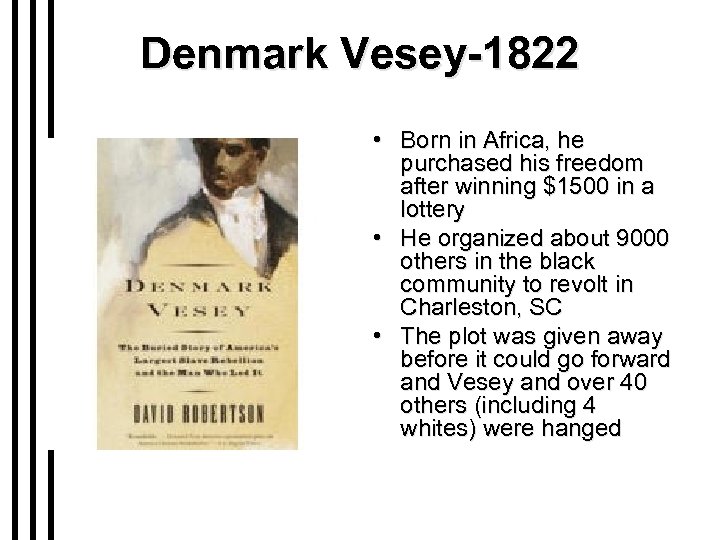 Denmark Vesey-1822 • Born in Africa, he purchased his freedom after winning $1500 in a lottery • He organized about 9000 others in the black community to revolt in Charleston, SC • The plot was given away before it could go forward and Vesey and over 40 others (including 4 whites) were hanged
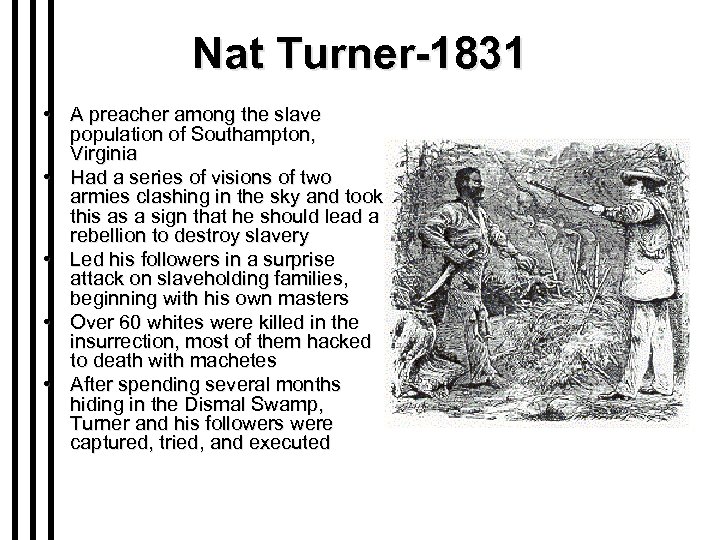 Nat Turner-1831 • A preacher among the slave population of Southampton, Virginia • Had a series of visions of two armies clashing in the sky and took this as a sign that he should lead a rebellion to destroy slavery • Led his followers in a surprise attack on slaveholding families, beginning with his own masters • Over 60 whites were killed in the insurrection, most of them hacked to death with machetes • After spending several months hiding in the Dismal Swamp, Turner and his followers were captured, tried, and executed
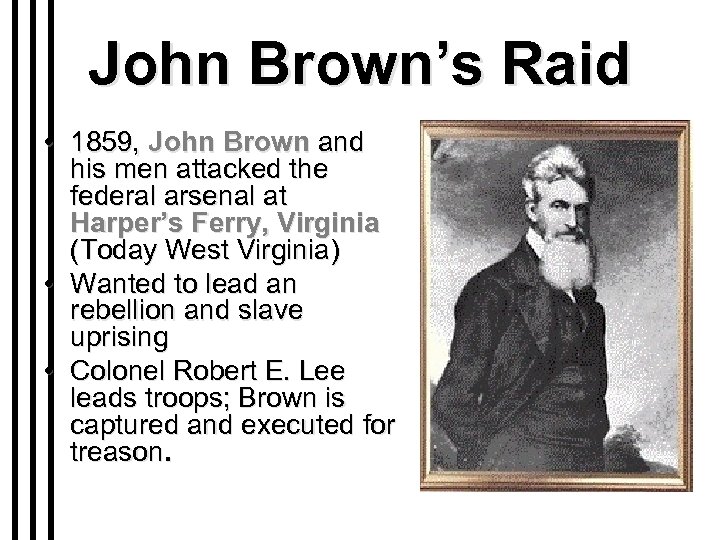 John Brown’s Raid • 1859, John Brown and his men attacked the federal arsenal at Harper’s Ferry, Virginia (Today West Virginia) • Wanted to lead an rebellion and slave uprising • Colonel Robert E. Lee leads troops; Brown is captured and executed for treason.
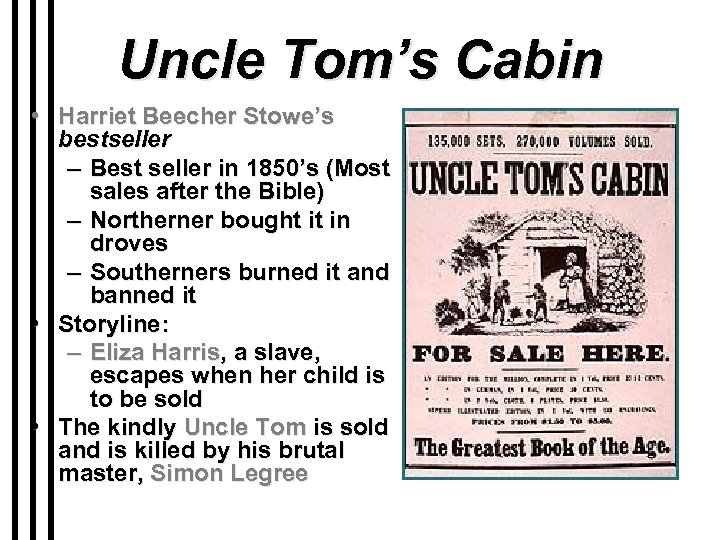 Uncle Tom’s Cabin • Harriet Beecher Stowe’s bestseller – Best seller in 1850’s (Most sales after the Bible) – Northerner bought it in droves – Southerners burned it and banned it • Storyline: – Eliza Harris, a slave, escapes when her child is to be sold • The kindly Uncle Tom is sold and is killed by his brutal master, Simon Legree