


 Скачать презентацию The Irish Experience David O Donovan Director Investment Promotion
fb03004bafbca61b9337b67cbd8834f0.ppt
- Количество слайдов: 40
 The Irish Experience David O’Donovan Director Investment Promotion Agency Development International Seminar, San Salvador January 10, 2011 www. communique. ie
 Six Themes I. III. IV. V. VI. Brief Facts Irish Economic Transformation Success Factors Current Irish Crisis Public-Private Alliance Conclusion
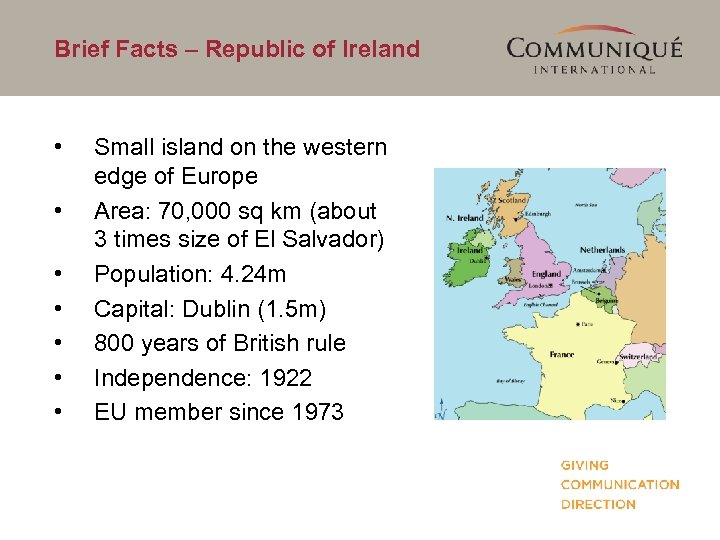 Brief Facts – Republic of Ireland • • Small island on the western edge of Europe Area: 70, 000 sq km (about 3 times size of El Salvador) Population: 4. 24 m Capital: Dublin (1. 5 m) 800 years of British rule Independence: 1922 EU member since 1973
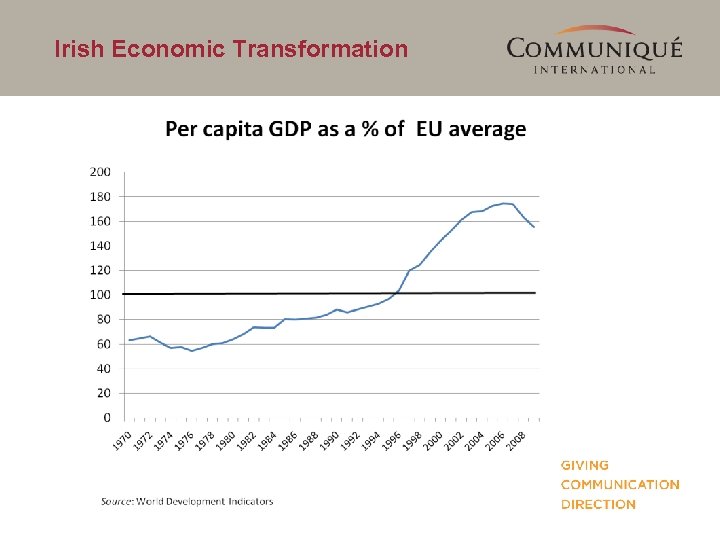
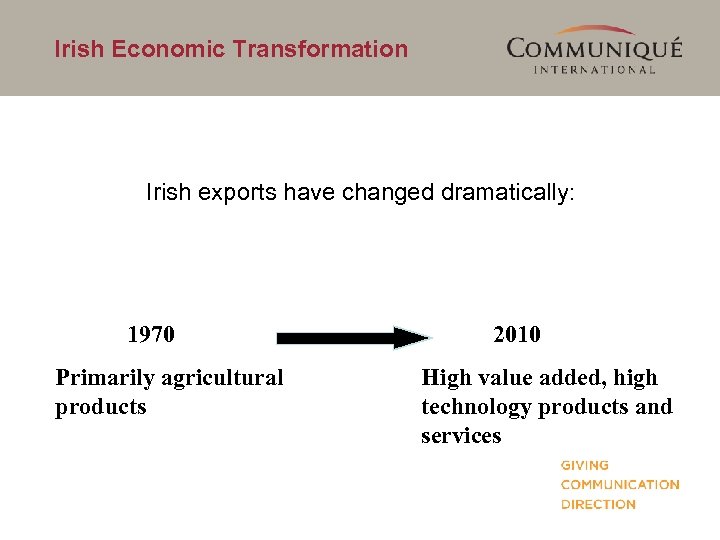
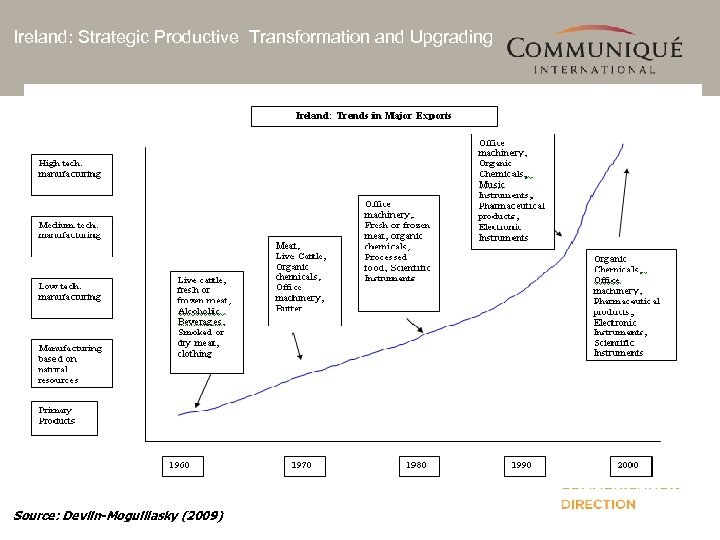
 Irish Economic Transformation From poor to rich in one generation: • 1970 – one of the poorest countries in Europe with GDP per capita of US$3, 000 • Today Ireland, despite current financial crisis, is still one of the richest countries in the world • GDP: US$224 billion • Per Capita: US$52, 000 • Population has risen 50% to 4. 24 million – from 2. 8 million in 1961
 Irish Economic Transformation
 Irish Economic Transformation Irish exports have changed dramatically: 1970 Primarily agricultural products 2010 High value added, high technology products and services
 Ireland: Strategic Productive Transformation and Upgrading Source: Devlin-Moguillasky (2009)
 Success Factors Major factors underpinning rapid growth: • • • NATIONAL CONSENSUS/SOCIAL PARTNERSHIP PPA BODIES FOR SPECIFIC FUNCTIONS LOW TAXES AGGRESSIVE CAMPAIGN FOR FDI MASSIVE INVESTMENT IN EDUCATION
 Current Irish Crisis But what about the current severe economic crisis in Ireland which resulted in the recent ‘bailout’ by the IMF and EU in an € 85 billion rescue package? …. .
 Current Irish Crisis Partly, as a result of phenomenal growth: • Ireland over-invested in construction and property development • Fuelled by massive and cheap borrowing by Irish banks • Huge property bubble burst in 2008 • Government bailed out Irish banks to prevent collapse • Result is massive public debt • Government forced to raise € 15 billion over next 4 years in reduced expenditure and increased taxes to reduce deficit
 Current Irish Crisis But also, institutional failure to anticipate crisis: • Culture of ‘light-touch’ regulation meant Central Bank/Financial Regulator failed to spot build-up of excessive borrowing by Irish banks • Public-Private Alliance bodies failed to recognize shift from investment/export led economy to property construction led economy • Both the general public and policy makers ‘blinded’ by phenomenal rises in incomes
 Public-Private Alliance Role played by Public-Private Alliance bodies…
 Public-Private Alliance Based on Public-Private Alliance at two levels: 1. National Level (Economic and Social Policy) 2. Sectoral/Thematic Level (Competitiveness and Industrial Policy)
 Public-Private Alliance Public policy model adapted by Ireland was that of a ‘networked development state’: • Different from more bureaucratic and authoritarian development models adapted by Asian ‘tiger’ economies • As a small, liberal European democracy Ireland could not adopt a centralized authority model like the Asian countries • Irish state interventions operate through networks of public agencies and advisory councils all with strong private sector involvement
 1. PPA at National Level (Economic and Social Policy) • Policy failures from 1930’s led to state of national crisis by 1960’s • Severity of crisis brought recognition of need for Public. Private Alliance and National Consensus • New direction for economic and industrial policy agreed • Evidence-based approach adopted
 1. PPA at National Level (Economic and Social Policy) New Direction Adopted (1970 s onwards): • Trade opening and expansion of market access • Private sector investment-led growth, not government sector growth • Private sector with strong state encouragement/support to be the engine of growth
 1. PPA at National Level (Economic and Social Policy) • Cornerstone underpinning rapid Irish economic growth • Government, employers, labour, farmers, academia and NGO sectors – all had voice in developing strategies • Under the umbrella of the National Economic and Social Council (NESC) since early 1970 s • Chaired by Head of Prime Minister’s Department
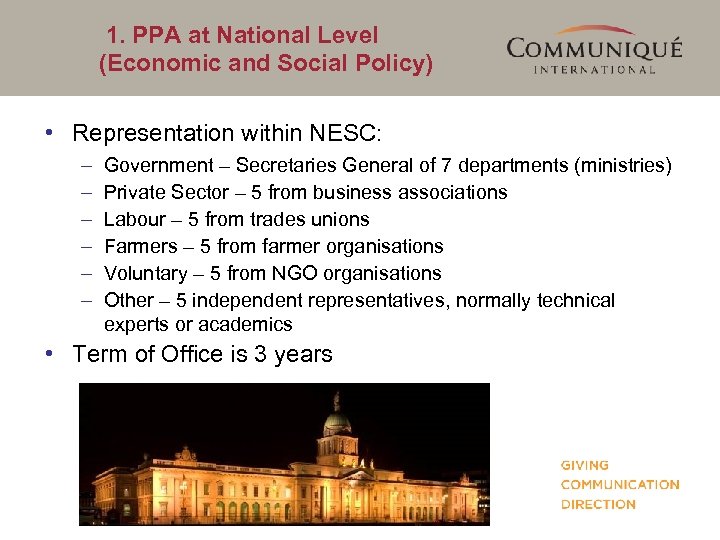 1. PPA at National Level (Economic and Social Policy) • Representation within NESC: – – – Government – Secretaries General of 7 departments (ministries) Private Sector – 5 from business associations Labour – 5 from trades unions Farmers – 5 from farmer organisations Voluntary – 5 from NGO organisations Other – 5 independent representatives, normally technical experts or academics • Term of Office is 3 years
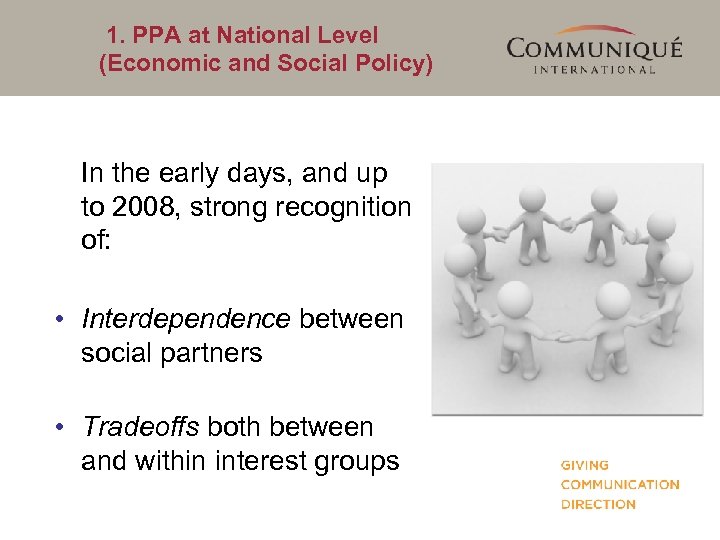 1. PPA at National Level (Economic and Social Policy) In the early days, and up to 2008, strong recognition of: • Interdependence between social partners • Tradeoffs both between and within interest groups
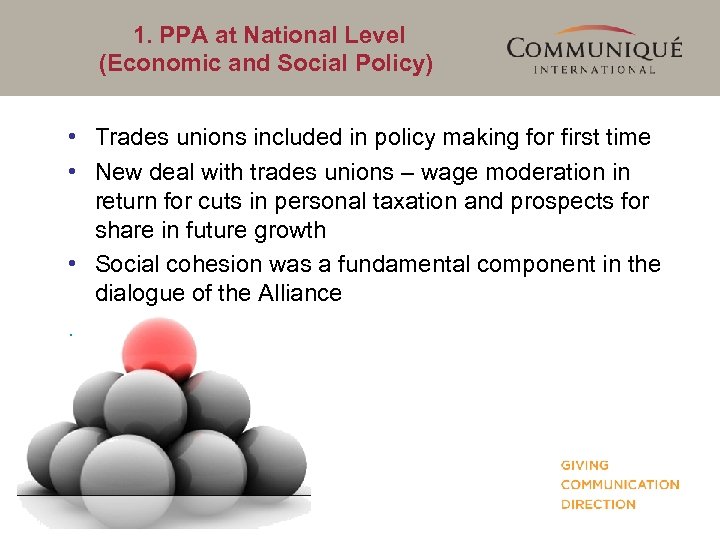 1. PPA at National Level (Economic and Social Policy) • Trades unions included in policy making for first time • New deal with trades unions – wage moderation in return for cuts in personal taxation and prospects for share in future growth • Social cohesion was a fundamental component in the dialogue of the Alliance.
 1. PPA at National Level (Economic and Social Policy) • Private setting to facilitate frank discussion • Representative but manageable number of private participants (25) • Political relevance by meeting once a month for half day or more and presence of PM office • Dialogue oriented to fact-based problem solving with support of neutral technical secretariat • Representatives exclude themselves when discussion is on a topic where there may be a conflict of interest • 3 -year public report of Alliance conclusions and periodic publishing of Secretariat studies
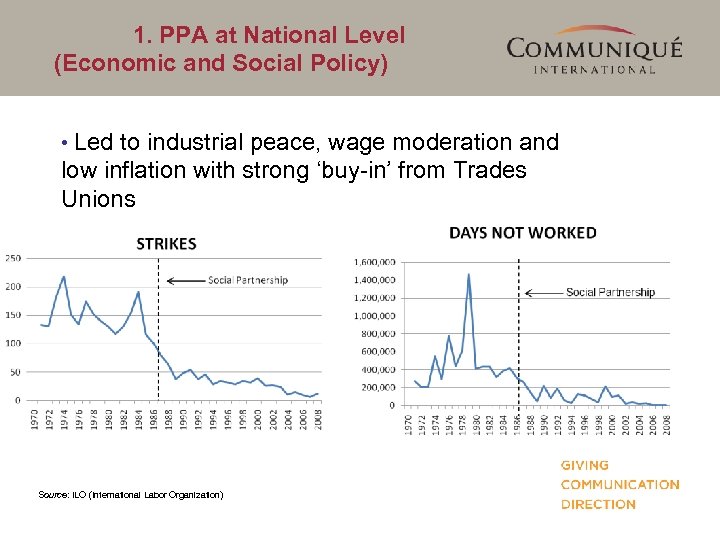 1. PPA at National Level (Economic and Social Policy) • Led to industrial peace, wage moderation and low inflation with strong ‘buy-in’ from Trades Unions Source: ILO (International Labor Organization)
 1. PPA at National Level (Economic and Social Policy) But, unfortunately: • Current financial crisis has put intolerable strain on public-private alliance model • Government implementing major cutbacks in expenditure and increases in taxation • Public service staff reductions and pay-freeze for 4 years • Trades Unions strongly objecting to plans • Result – collapse of PPA at National Level in area of economic and social policy
 Public-Private Alliance 2. Public-Private Alliance at Sectoral/Thematic Level (Competitiveness and Industrial Policy)….
 2. PPA at Sectoral/Thematic Level Competitiveness and Industrial Policy • Combination of government departments, state agencies and advisory councils • Each with its own specialist function • All well funded by government with focused operational budgets
 2. PPA at Sectoral/Thematic Level Competitiveness and Industrial Policy • Boards contain both public and private members • Cross-board memberships for CEOs to help coordinate industrial policy support programs • Professional, permanent public staff who do not change with changes of government • High degree of operational autonomy for public executing agencies
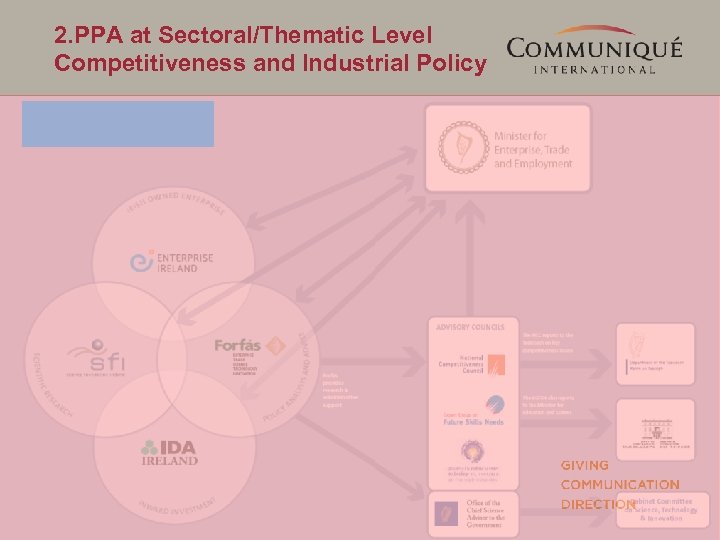 2. PPA at Sectoral/Thematic Level Competitiveness and Industrial Policy
 2. PPA Sectoral/Thematic Level Competitiveness and Industrial Policy National Competitiveness Council (NCC) has 16 Members: • • Government 4 Private Sector 8 Trades Unions 2 Academia 2
 2. PPA Sectoral/Thematic Level Competitiveness and Industrial Policy • Secretariat and professional research facilities provided by Forfas, the State Strategic Planning Agency for Ministry of Enterprise, Trade and Employment • Reports directly to Prime Minister of the day
 Strengths At National Level (Economic and Social Policy) • NESC represented all the social partners and its reports were highly influential • NESC argued for a ‘developmental welfare state’ • Good economic development and better social development not opposed to each other but not guaranteed to occur together • Argued successfully for better coordination between economic and social policy
 Strengths At National Level (Economic and Social Policy) • Led to eight national wage agreements over two decades • Facilitated Ireland’s long term development strategy – heavy investment in education, attraction of inward investment and full European integration
 Strengths At Sectoral/Thematic Level (Competitiveness and Industrial Policy) • National Competitive Council (NCC) reports also highly influential in setting the agenda for improvements in Ireland’s competitiveness • Forfas (strategic planning agency for DETE) reports focused effectively on institutional capacity for the drive for inward investment (IDA), building indigenous industry (Enterprise Ireland) and research capability (Science Foundation Ireland) • These bodies operate with a high degree of specialization and are well connected and coordinated with each other
 Weaknesses • PPA bodies at National Level (NESC) and Sectoral/Thematic Level (Forfas and NCC) developed parallel but weakly connected analyses and policy recommendations • Crisis of 2008 -2010 exposed significant weaknesses in Ireland’s overall policy approach
 Weaknesses Major weaknesses seen to be: • Political • Institutional • Regulatory
 Weaknesses Political: • Divergence between political decision making and policy analysis in the institutons • Led to policy capture by influential actors from construction and banking closely aligned to governing party • Won excessive tax incentives for construction further boosting a boom already under way and created illusion – mistaking asset inflation for real wealth creation • Led to loss of previous developmental focus
 Weaknesses Institutional: • Trades Unions saw the creation of the National Competitiveness Council as favouring the business agenda • Regarded it as giving employers a separate and stronger institutional channel of policy influence with the Government • Probably was a mistake to create the NCC outside the institutional structure of the NESC as it “balkanized” the social dialogue • Major divergence between wage bargaining in the public sector (highly centralized) and private sector (localized)
 Weaknesses Regulatory: • Complete failure of the Irish Central Bank and Financial Regulator to see the build-up of massive and excessive borrowing by Irish banks that fuelled the property boom • Tragedy is that complacency at the macro/financial level and in the Alliance created a crisis that undermined a very successful strategic industrial policy for productive transformation at the sectoral level
 Conclusion • Ireland enjoyed phenomenal growth and success in the period 1970 to 2008 • Some lessons can be learned from that – what made it work so well • But our success blinded us to problems building up which resulted in the current economic crisis • Lessons can be learned from that too • Nevertheless the economy still exhibits many sectoral strengths in manufacturing, particularly high tech
 Conclusion • The debate about the causes of the crisis and our future development rages on in Ireland • For those interested some interesting websites containing these debates are: • www. progressive-economy. ie • www. irisheconomy. ie
 THANK YOU!