 Скачать презентацию The Irish Economic Update Continuing Very Robust
ea21fbbbb2ec1c50beedd0dc6b29f782.ppt
- Количество слайдов: 17



The Irish Economic Update – Continuing Very Robust Growth February 2016 Oliver Mangan Chief Economist AIB April 2013 aibeconomicresearch. com 1
Irish recovery gains very strong momentum § § § Irish economy boomed from 1993 to 2007 with GDP up by over 250% – Celtic Tiger § GDP in 2009 still over 25% higher than in 2001, highlighting that the economic crash came after a very strong period of growth, unlike in other countries § Ireland tackled its problems aggressively in the public finances, banking sector and property market. Imbalances in economy unwind – housing, debt levels, competitiveness, Bo. P § § § § Ireland focused on generating growth via its large export base as the route to recovery Very severe recession in Ireland in 2008 -2009. GDP fell by 8% and GNP down 10% Collapse in construction activity and banking system, severe fiscal tightening, high unemployment. Ireland entered a 3 year EU/IMF assistance programme from 2010 -2013 Domestic economy recovering strongly, led by rebound in investment and retail spending GDP rose by 5. 2% in 2014 after 1. 4% in 2013. (GDP growth averaged 1% in 2010 -12) Very strong 2015 with GDP growth averaging 7% over first three quarters of year Strong jobs growth. Unemployment rate falls from 15% in 2012 to below 9% by end 2015 Budget deficit has declined at quicker than expected pace. Surplus now in sight. Economy now on very strong growth path. GDP could grow by 4 -5% p. a. in next few years 2
Very strong data across the economy § § § § GDP growth averages 7% year-on-year in first three quarters of 2015 Strong export growth in 2015, averages 13. 3% yoy to end Q 3 Good Mfg PMI data in 2015 – averages around 55 level during the year Industrial production rose strongly in 2015, including indigenous sectors Very robust Services PMI data in 2015 - hit near 10 -year high of 63. 6 in November Housing market improves, while commercial property market recovering strongly Housing output rising slowly from low base. Completions rise by around 14% to 2015 Consumer confidence reaches 10 -year high at end of 2015 Core retail sales (ex motor trade) up by 6. 2% in 2015 Car sales increased by 30% in 2015, maintaining 2014’s strong growth rate Employment up for 12 consecutive quarters. Rose by 3% yoy in Q 2 and Q 3 2015 Live Register continues to fall. Jobless rate below 9%, down from a 15. 1% peak in 2012 Exchequer deficit virtually eliminated in 2015. Gov budget deficits falls to 1. 5% of GDP Very large Bo. P again in 2015, forecast at around 4% of GDP 3
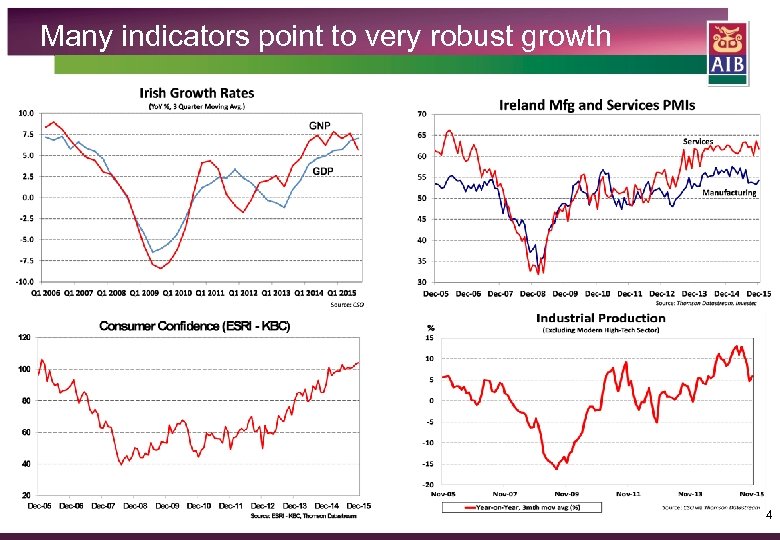
Many indicators point to very robust growth 4
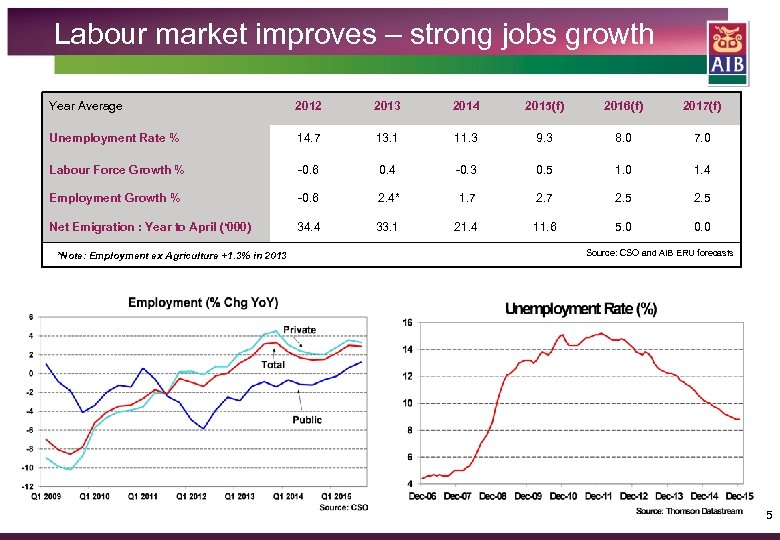
Labour market improves – strong jobs growth Year Average 2012 2013 2014 2015(f) 2016(f) 2017(f) Unemployment Rate % 14. 7 13. 1 11. 3 9. 3 8. 0 7. 0 Labour Force Growth % -0. 6 0. 4 -0. 3 0. 5 1. 0 1. 4 Employment Growth % -0. 6 2. 4* 1. 7 2. 5 Net Emigration : Year to April (‘ 000) 34. 4 33. 1 21. 4 11. 6 5. 0 0. 0 *Note: Employment ex Agriculture +1. 3% in 2013 Source: CSO and AIB ERU forecasts 5
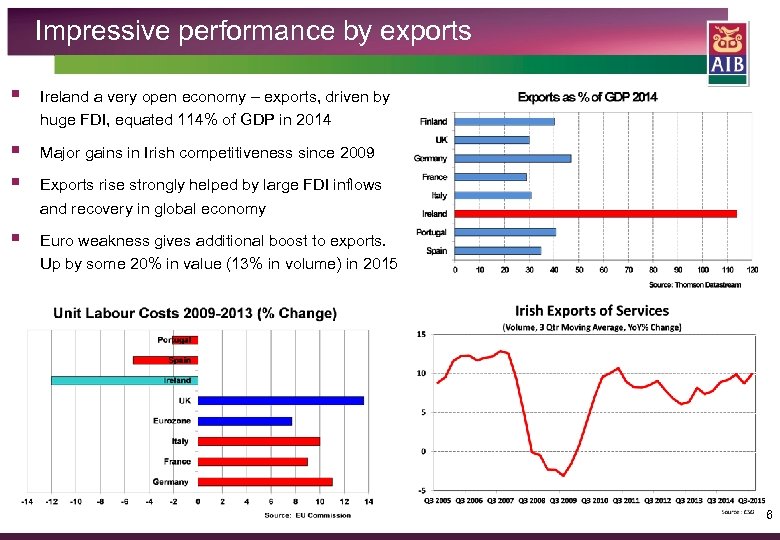
Impressive performance by exports § Ireland a very open economy – exports, driven by huge FDI, equated 114% of GDP in 2014 § § Major gains in Irish competitiveness since 2009 § Euro weakness gives additional boost to exports. Up by some 20% in value (13% in volume) in 2015 Exports rise strongly helped by large FDI inflows and recovery in global economy 6
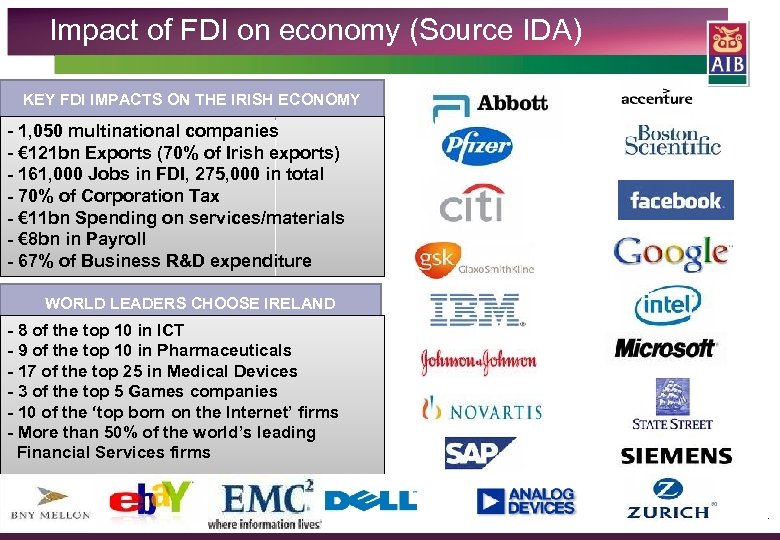
Impact of FDI on economy (Source IDA) KEY FDI IMPACTS ON THE IRISH ECONOMY - 1, 050 multinational companies - € 121 bn Exports (70% of Irish exports) - 161, 000 Jobs in FDI, 275, 000 in total - 70% of Corporation Tax - € 11 bn Spending on services/materials - € 8 bn in Payroll - 67% of Business R&D expenditure WORLD LEADERS CHOOSE IRELAND - 8 of the top 10 in ICT - 9 of the top 10 in Pharmaceuticals - 17 of the top 25 in Medical Devices - 3 of the top 5 Games companies - 10 of the ‘top born on the Internet’ firms - More than 50% of the world’s leading Financial Services firms 7
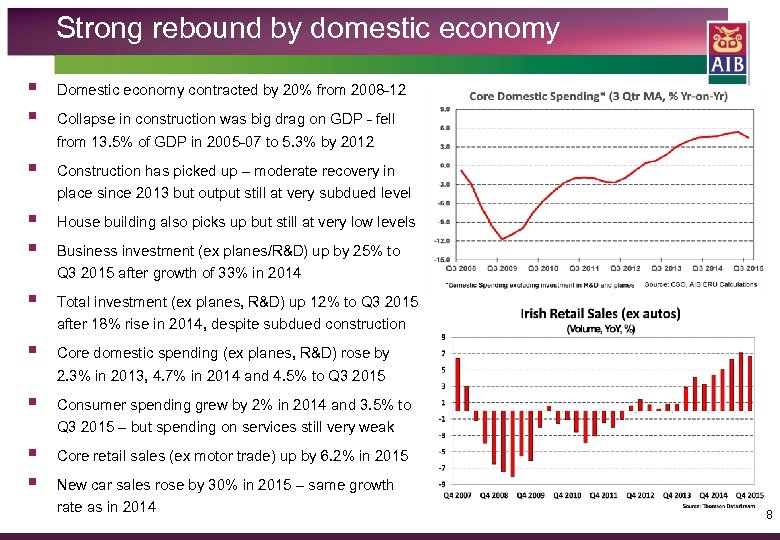
Strong rebound by domestic economy § § § § § Domestic economy contracted by 20% from 2008 -12 Collapse in construction was big drag on GDP - fell from 13. 5% of GDP in 2005 -07 to 5. 3% by 2012 Construction has picked up – moderate recovery in place since 2013 but output still at very subdued level House building also picks up but still at very low levels Business investment (ex planes/R&D) up by 25% to Q 3 2015 after growth of 33% in 2014 Total investment (ex planes, R&D) up 12% to Q 3 2015 after 18% rise in 2014, despite subdued construction Core domestic spending (ex planes, R&D) rose by 2. 3% in 2013, 4. 7% in 2014 and 4. 5% to Q 3 2015 Consumer spending grew by 2% in 2014 and 3. 5% to Q 3 2015 – but spending on services still very weak Core retail sales (ex motor trade) up by 6. 2% in 2015 New car sales rose by 30% in 2015 – same growth rate as in 2014 8
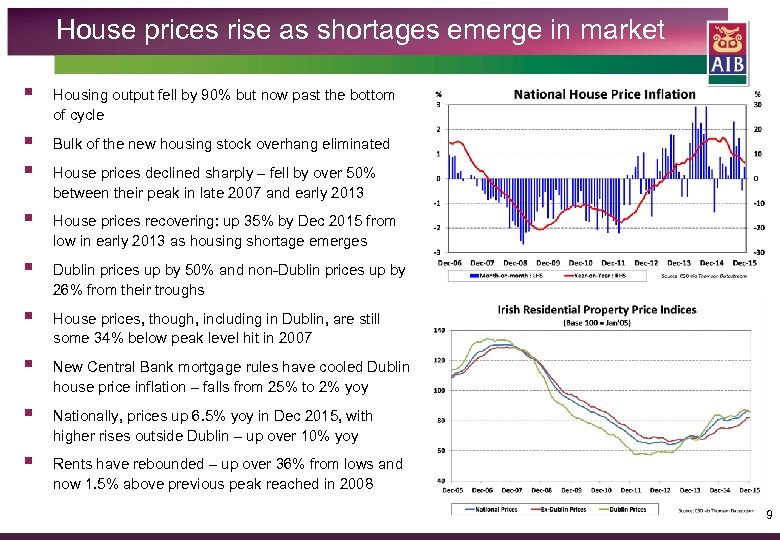
House prices rise as shortages emerge in market § § § § § Housing output fell by 90% but now past the bottom of cycle Bulk of the new housing stock overhang eliminated House prices declined sharply – fell by over 50% between their peak in late 2007 and early 2013 House prices recovering: up 35% by Dec 2015 from low in early 2013 as housing shortage emerges Dublin prices up by 50% and non-Dublin prices up by 26% from their troughs House prices, though, including in Dublin, are still some 34% below peak level hit in 2007 New Central Bank mortgage rules have cooled Dublin house price inflation – falls from 25% to 2% yoy Nationally, prices up 6. 5% yoy in Dec 2015, with higher rises outside Dublin – up over 10% yoy Rents have rebounded – up over 36% from lows and now 1. 5% above previous peak reached in 2008 9
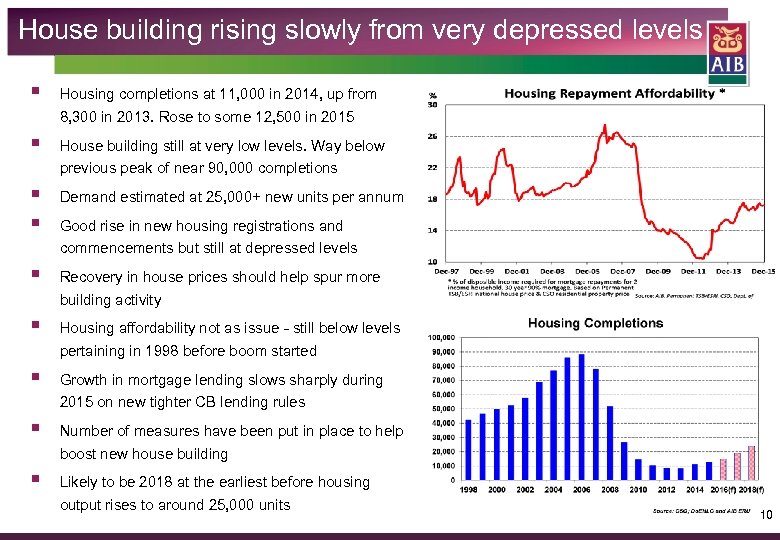
House building rising slowly from very depressed levels § § § Housing completions at 11, 000 in 2014, up from 8, 300 in 2013. Rose to some 12, 500 in 2015 House building still at very low levels. Way below previous peak of near 90, 000 completions Demand estimated at 25, 000+ new units per annum Good rise in new housing registrations and commencements but still at depressed levels Recovery in house prices should help spur more building activity Housing affordability not as issue - still below levels pertaining in 1998 before boom started § § § Growth in mortgage lending slows sharply during 2015 on new tighter CB lending rules Number of measures have been put in place to help boost new house building Likely to be 2018 at the earliest before housing output rises to around 25, 000 units 10
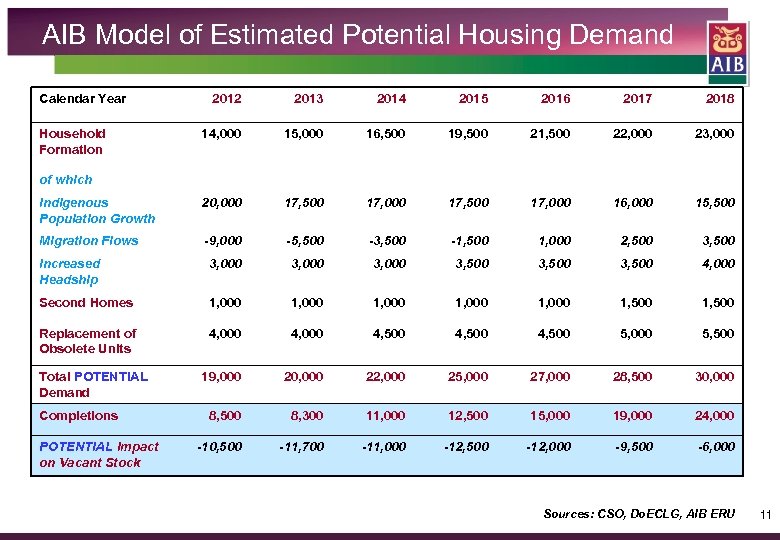
AIB Model of Estimated Potential Housing Demand Calendar Year 2012 2013 2014 2015 2016 2017 2018 14, 000 15, 000 16, 500 19, 500 21, 500 22, 000 23, 000 Indigenous Population Growth 20, 000 17, 500 17, 000 16, 000 15, 500 Migration Flows -9, 000 -5, 500 -3, 500 -1, 500 1, 000 2, 500 3, 500 Increased Headship 3, 000 3, 500 4, 000 Second Homes 1, 000 1, 000 1, 500 Replacement of Obsolete Units 4, 000 4, 500 5, 000 5, 500 19, 000 20, 000 22, 000 25, 000 27, 000 28, 500 30, 000 8, 500 8, 300 11, 000 12, 500 15, 000 19, 000 24, 000 -10, 500 -11, 700 -11, 000 -12, 500 -12, 000 -9, 500 -6, 000 Household Formation of which Total POTENTIAL Demand Completions POTENTIAL Impact on Vacant Stock Sources: CSO, Do. ECLG, AIB ERU 11
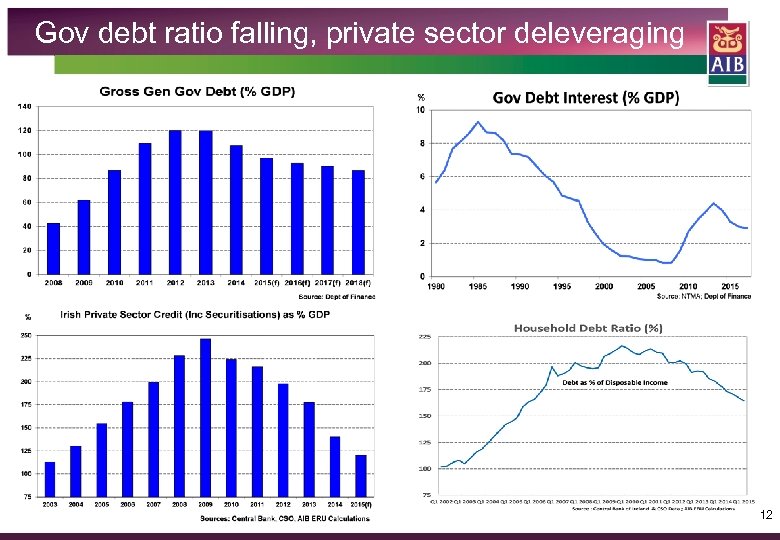
Gov debt ratio falling, private sector deleveraging 12
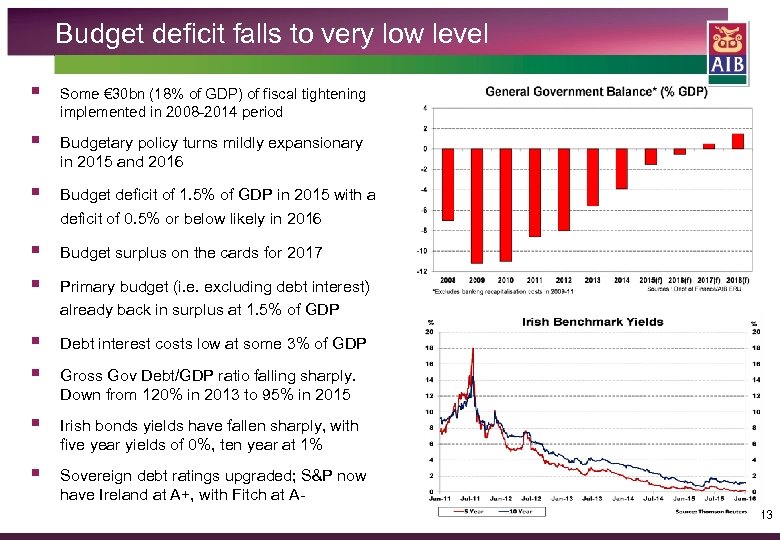
Budget deficit falls to very low level § Some € 30 bn (18% of GDP) of fiscal tightening implemented in 2008 -2014 period § Budgetary policy turns mildly expansionary in 2015 and 2016 § Budget deficit of 1. 5% of GDP in 2015 with a deficit of 0. 5% or below likely in 2016 § § Budget surplus on the cards for 2017 § § Debt interest costs low at some 3% of GDP § Irish bonds yields have fallen sharply, with five year yields of 0%, ten year at 1% § Sovereign debt ratings upgraded; S&P now have Ireland at A+, with Fitch at A- Primary budget (i. e. excluding debt interest) already back in surplus at 1. 5% of GDP Gross Gov Debt/GDP ratio falling sharply. Down from 120% in 2013 to 95% in 2015 13
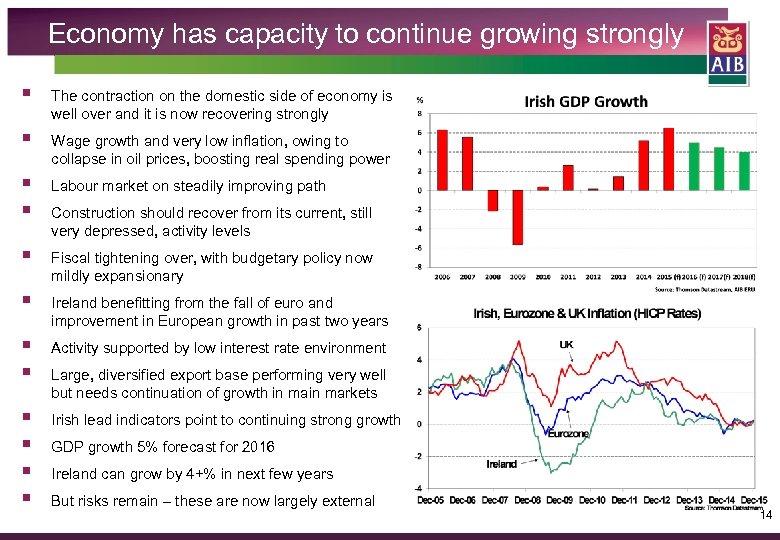
Economy has capacity to continue growing strongly § The contraction on the domestic side of economy is well over and it is now recovering strongly § Wage growth and very low inflation, owing to collapse in oil prices, boosting real spending power § § Labour market on steadily improving path § Fiscal tightening over, with budgetary policy now mildly expansionary § Ireland benefitting from the fall of euro and improvement in European growth in past two years § § Activity supported by low interest rate environment § § Irish lead indicators point to continuing strong growth Construction should recover from its current, still very depressed, activity levels Large, diversified export base performing very well but needs continuation of growth in markets GDP growth 5% forecast for 2016 Ireland can grow by 4+% in next few years But risks remain – these are now largely external 14
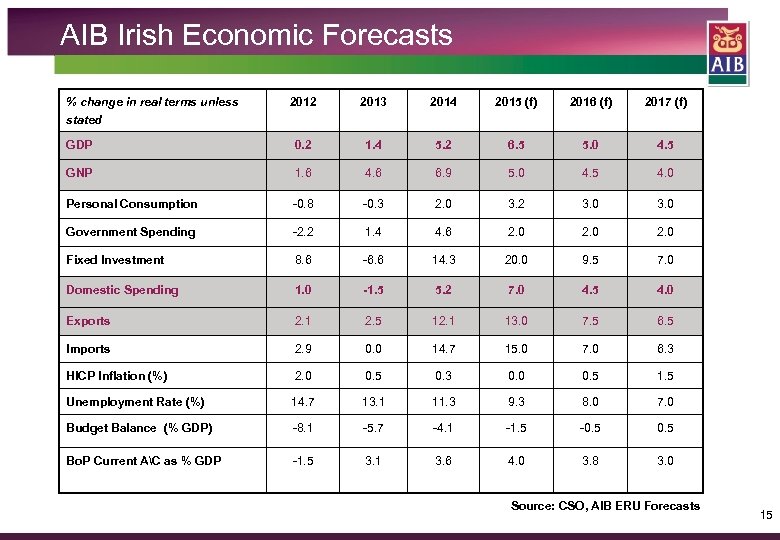
AIB Irish Economic Forecasts % change in real terms unless stated 2012 2013 2014 2015 (f) 2016 (f) 2017 (f) GDP 0. 2 1. 4 5. 2 6. 5 5. 0 4. 5 GNP 1. 6 4. 6 6. 9 5. 0 4. 5 4. 0 Personal Consumption -0. 8 -0. 3 2. 0 3. 2 3. 0 Government Spending -2. 2 1. 4 4. 6 2. 0 Fixed Investment 8. 6 -6. 6 14. 3 20. 0 9. 5 7. 0 Domestic Spending 1. 0 -1. 5 5. 2 7. 0 4. 5 4. 0 Exports 2. 1 2. 5 12. 1 13. 0 7. 5 6. 5 Imports 2. 9 0. 0 14. 7 15. 0 7. 0 6. 3 HICP Inflation (%) 2. 0 0. 5 0. 3 0. 0 0. 5 1. 5 Unemployment Rate (%) 14. 7 13. 1 11. 3 9. 3 8. 0 7. 0 Budget Balance (% GDP) -8. 1 -5. 7 -4. 1 -1. 5 -0. 5 Bo. P Current AC as % GDP -1. 5 3. 1 3. 6 4. 0 3. 8 3. 0 Source: CSO, AIB ERU Forecasts 15
Brexit would pose big risks for UK and Ireland § Referenda are unpredictable and sentiment can change quickly. Most polls show a small majority in favour of remaining in EU - the lead has narrowed. Referendum poll likely this year § May not get much of a free trade agreement between UK & EU post a Brexit. UK would have to adhere to EU rules, pay EU budget contribution to get full access to EU markets § § § Likely to take two years for a country to leave the EU. No UK veto over exit terms. § § § Brexit would have serious implications for Ireland given close economic and trade links Exports account for around 30% of UK GDP with the EU taking 44% of these UK is the biggest recipient of FDI in the EU. Around half comes from EU, 30% from US Most studies show significant falls in UK GDP from Brexit on trade/FDI effects Economic models may underestimate impact of Brexit on UK. Do not allow for uncertainty. Generally assume some trade agreement. What are the migration, productivity costs? Higher trading costs from more admin, differing trade rules, possible customs posts/duties Agri sector, energy, retailing, financial sector would be hit by Brexit. FDI might benefit Would there be restrictions on freedom of movement, passport controls, a North/South impact Watch for impact on currency also. Sterling already weakening on Brexit concerns 16
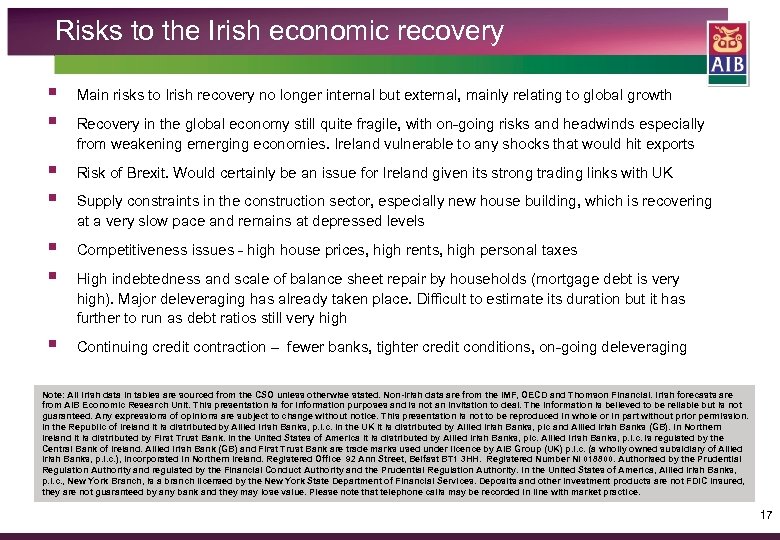
Risks to the Irish economic recovery § § Main risks to Irish recovery no longer internal but external, mainly relating to global growth § § Risk of Brexit. Would certainly be an issue for Ireland given its strong trading links with UK § § Competitiveness issues - high house prices, high rents, high personal taxes § Continuing credit contraction – fewer banks, tighter credit conditions, on-going deleveraging Recovery in the global economy still quite fragile, with on-going risks and headwinds especially from weakening emerging economies. Ireland vulnerable to any shocks that would hit exports Supply constraints in the construction sector, especially new house building, which is recovering at a very slow pace and remains at depressed levels High indebtedness and scale of balance sheet repair by households (mortgage debt is very high). Major deleveraging has already taken place. Difficult to estimate its duration but it has further to run as debt ratios still very high Note: All Irish data in tables are sourced from the CSO unless otherwise stated. Non-Irish data are from the IMF, OECD and Thomson Financial. Irish forecasts are from AIB Economic Research Unit. This presentation is for information purposes and is not an invitation to deal. The information is believed to be reliable but is not guaranteed. Any expressions of opinions are subject to change without notice. This presentation is not to be reproduced in whole or in part without prior permission. In the Republic of Ireland it is distributed by Allied Irish Banks, p. l. c. In the UK it is distributed by Allied Irish Banks, plc and Allied Irish Banks (GB). In Northern Ireland it is distributed by First Trust Bank. In the United States of America it is distributed by Allied Irish Banks, plc. Allied Irish Banks, p. l. c. is regulated by the Central Bank of Ireland. Allied Irish Bank (GB) and First Trust Bank are trade marks used under licence by AIB Group (UK) p. l. c. (a wholly owned subsidiary of Allied Irish Banks, p. l. c. ), incorporated in Northern Ireland. Registered Office 92 Ann Street, Belfast BT 1 3 HH. Registered Number NI 018800. Authorised by the Prudential Regulation Authority and regulated by the Financial Conduct Authority and the Prudential Regulation Authority. In the United States of America, Allied Irish Banks, p. l. c. , New York Branch, is a branch licensed by the New York State Department of Financial Services. Deposits and other investment products are not FDIC insured, they are not guaranteed by any bank and they may lose value. Please note that telephone calls may be recorded in line with market practice. 17
Скачать презентацию The Irish Economic Update Continuing Very Robust
ea21fbbbb2ec1c50beedd0dc6b29f782.ppt