


 Скачать презентацию The introduction of GPGPU and some implementations on
8c79dd768436c725d32724b0afa88e64.ppt
- Количество слайдов: 23
 The introduction of GPGPU and some implementations on model checking Zhimin Wu Nanyang Technological University, Singapore
 Outline • What is GPGPU • The Architecture and Features of latest NVIDIA Kepler GK 110 • The reference to current researches on the implementation of GPGPU in model checking • Brief introduction of my current work
 General-purpose computing on graphics processing units • the utilization of a graphic processing units (GPU), which typically handles computation only for computer graphic, to perform computation in applications traditionally handled by the central processing unit (CPU) • CPU: ILP and TLP GPU: DLP • High Parallelism, High Memory Bandwidth, High computational Power • Compute Framework: CUDA
 Kepler GK 110 Chip Designed for performance and power efficiency 7. 1 billion transistors Over 1 TFlop of double precision throughput 3 x performance per watt of Fermi New features in Kepler GK 110: • Dynamic Parallelism • Hyper-Q with GK 110 Grid Management Unit (GMU) • NVIDIA GPUDirect™ RDMA (United State Space)
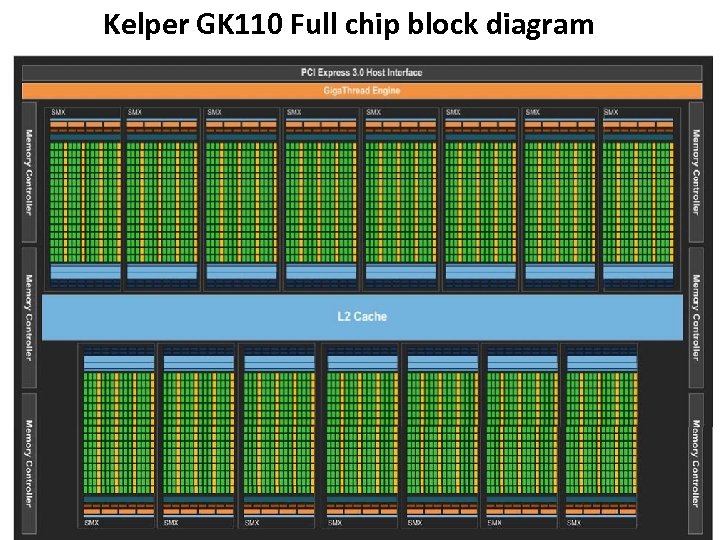 Kelper GK 110 Full chip block diagram
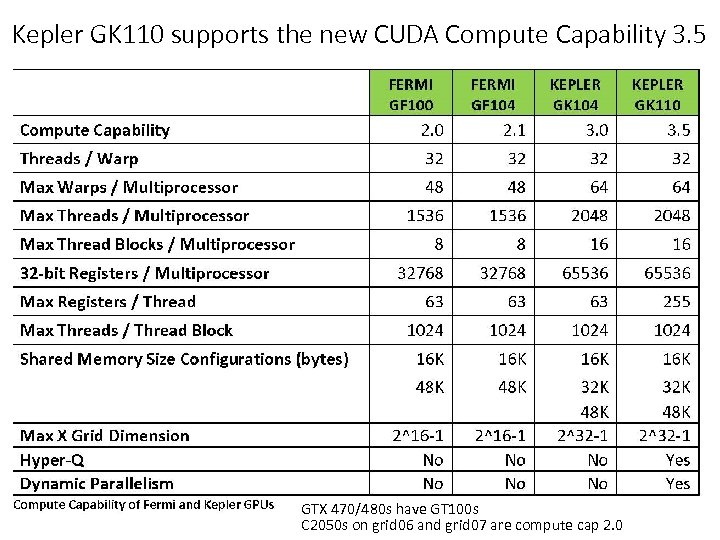 Kepler GK 110 supports the new CUDA Compute Capability 3. 5 GTX 470/480 s have GT 100 s C 2050 s on grid 06 and grid 07 are compute cap 2. 0
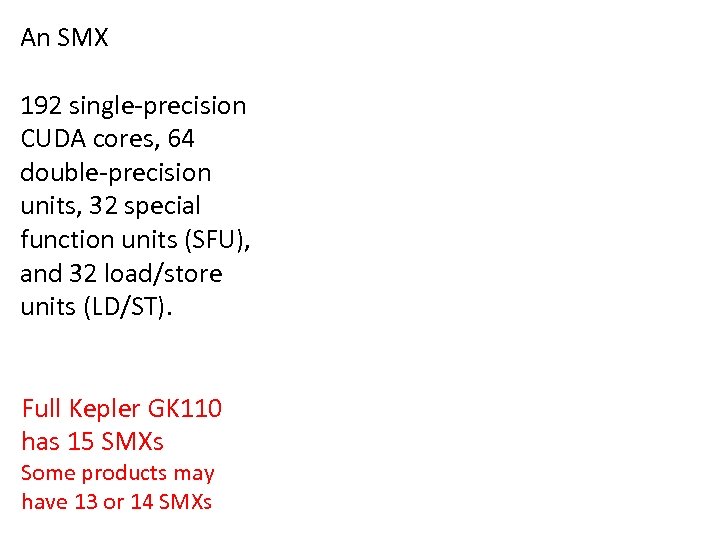 An SMX 192 single‐precision CUDA cores, 64 double‐precision units, 32 special function units (SFU), and 32 load/store units (LD/ST). Full Kepler GK 110 has 15 SMXs Some products may have 13 or 14 SMXs
 Quad Warp Scheduler The SMX schedules threads in groups of 32 parallel threads called warps. Each SMX features four warp schedulers and eight instruction dispatch units, allowing four warps to be issued and executed concurrently. (128 threads) Kepler GK 110 allows double precision instructions to be paired with other instructions.
 One Warp Scheduler Unit
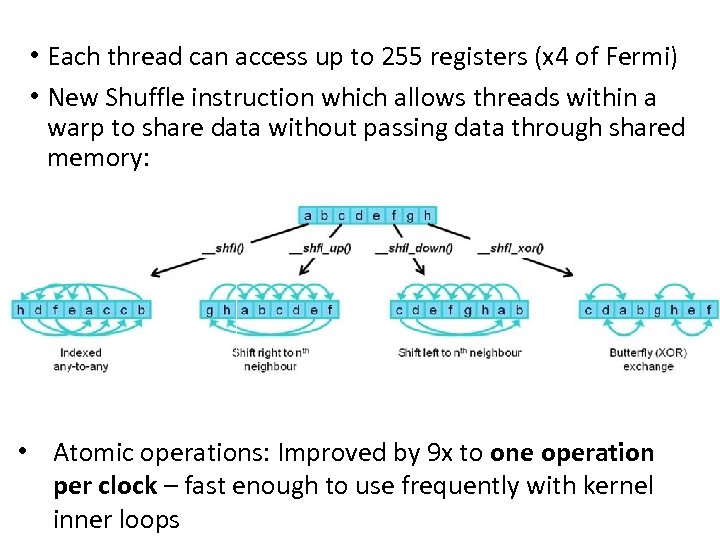 • Each thread can access up to 255 registers (x 4 of Fermi) • New Shuffle instruction which allows threads within a warp to share data without passing data through shared memory: • Atomic operations: Improved by 9 x to one operation per clock – fast enough to use frequently with kernel inner loops
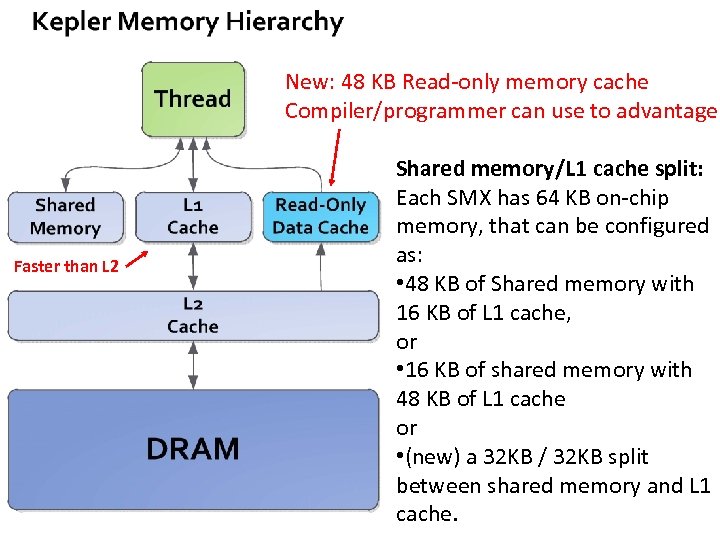 New: 48 KB Read‐only memory cache Compiler/programmer can use to advantage Faster than L 2 Shared memory/L 1 cache split: Each SMX has 64 KB on‐chip memory, that can be configured as: • 48 KB of Shared memory with 16 KB of L 1 cache, or • 16 KB of shared memory with 48 KB of L 1 cache or • (new) a 32 KB / 32 KB split between shared memory and L 1 cache.
 Dynamic Parallelism • Fermi could only launch one kernel at a time on a single device. Kernel had to complete before calling for another GPU task. • “In Kepler GK 110 any kernel can launch another kernel, and can create the necessary streams, events and manage the dependencies needed to process additional work without the need for host CPU interaction. ” • “. . makes it easier for developers to create and optimize recursive and data‐dependent execution patterns, and allows more of a program to be run directly on GPU. ”
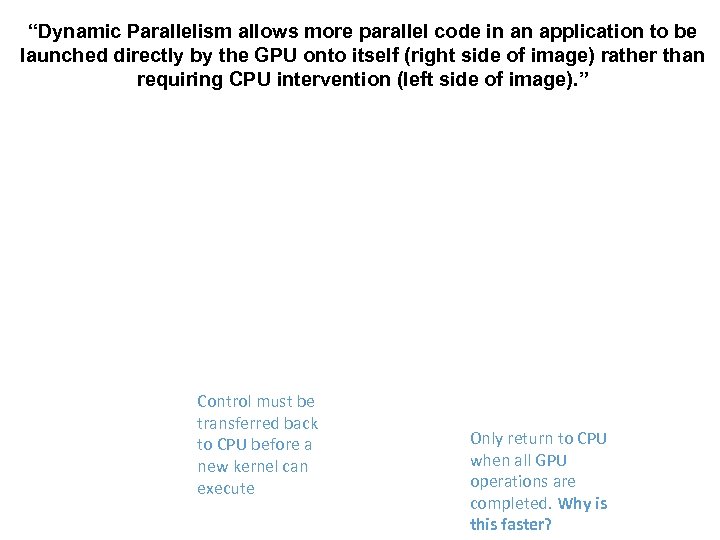 “Dynamic Parallelism allows more parallel code in an application to be launched directly by the GPU onto itself (right side of image) rather than requiring CPU intervention (left side of image). ” Control must be transferred back to CPU before a new kernel can execute Only return to CPU when all GPU operations are completed. Why is this faster?
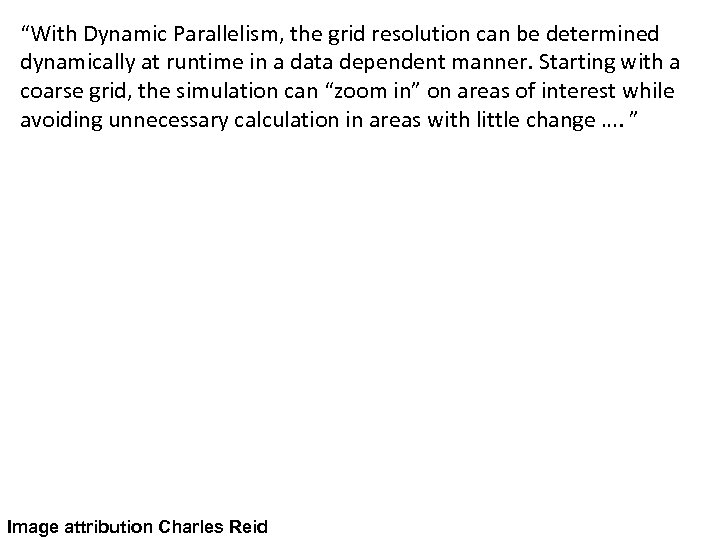 “With Dynamic Parallelism, the grid resolution can be determined dynamically at runtime in a data dependent manner. Starting with a coarse grid, the simulation can “zoom in” on areas of interest while avoiding unnecessary calculation in areas with little change …. ” Image attribution Charles Reid
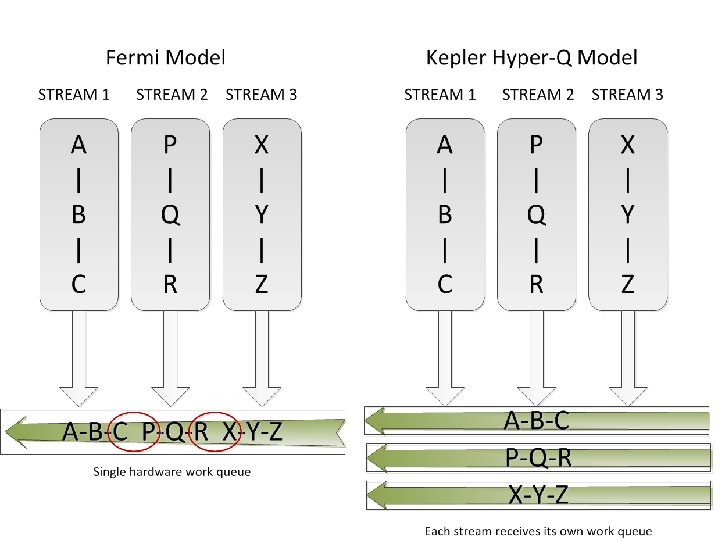
 Hyper‐Q “The Fermi architecture supported 16‐way concurrency of kernel launches from separate streams, but ultimately the streams were all multiplexed into the same hardware work queue. ” “Kepler GK 110 … Hyper‐Q increases the total number of connections (work queues) … by allowing 32 simultaneous, hardware‐managed connections. . ” “… allows connections from multiple CUDA streams, from multiple Message Passing Interface (MPI) processes, or even from multiple threads within a process. Applications that previously encountered false serialization across tasks, thereby limiting GPU utilization, can see up to a 32 x performance increase without changing any existing code. ”
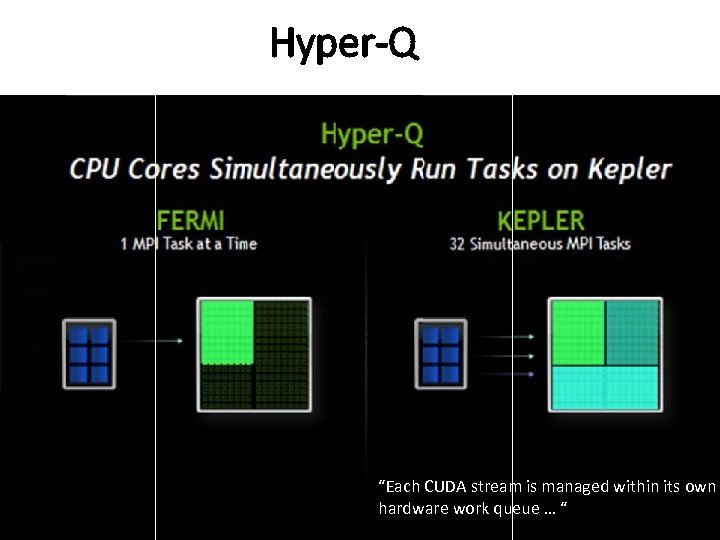 Hyper‐Q “Each CUDA stream is managed within its own hardware work queue … “
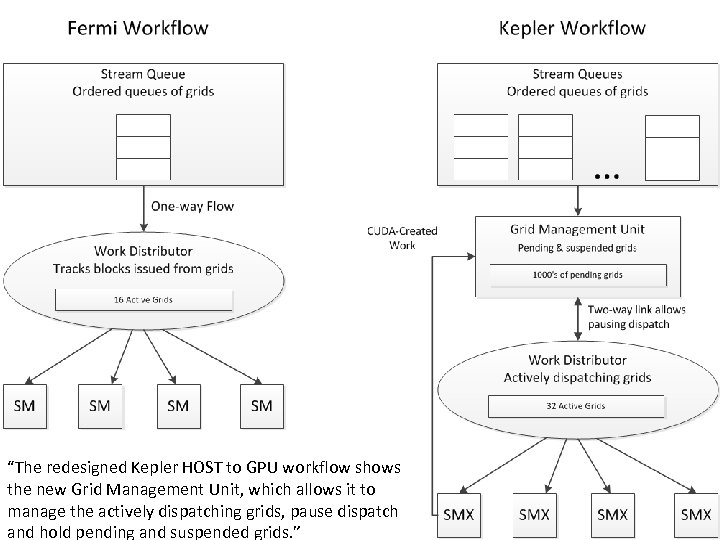 “The redesigned Kepler HOST to GPU workflow shows the new Grid Management Unit, which allows it to manage the actively dispatching grids, pause dispatch and hold pending and suspended grids. ”
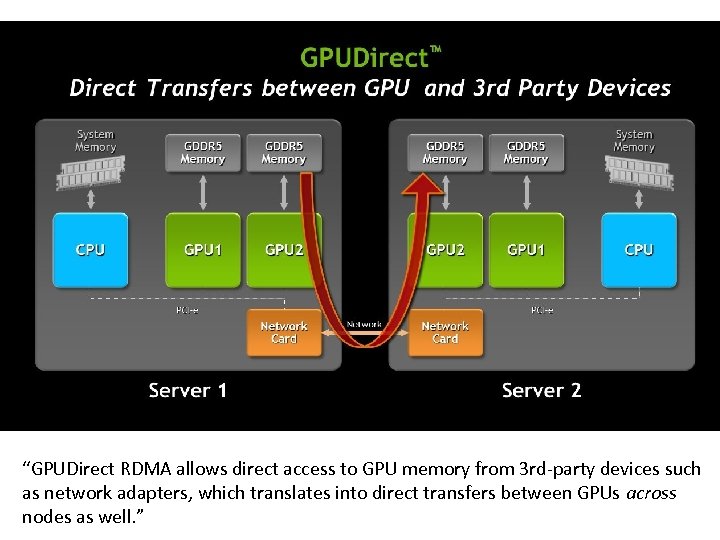 “GPUDirect RDMA allows direct access to GPU memory from 3 rd‐party devices such as network adapters, which translates into direct transfers between GPUs across nodes as well. ”
 The implementation of GPGPU in Model Checking 1. LTL Model Checking: ØJ. Barnat, P. Bauch, L. Brim, and M. Ceska. Computing strongly connected components in parallel on cuda. In IPDPS 2011, pages 544– 555. IEEE, 2011. ØJ. Barnat, P. Bauch, L. Brim, and. M. Ceska. Designing fast LTL model checking algorithms for many‐core GPUs. Journal of Parallel and Distributed Computing, 72(9): 1083– 1097, 2012. ØEdelkamp, Stefan and Sulewski, Damian. Efficient Explicit‐state Model Checking on General Purpose Graphics Processors. In SPIN, pages 106– 123. Springer, 2010. 2. Probilistic Model : ØD. Bosnacki, S. Edelkamp, D. Sulewski, and A. Wijs. Parallel probabilistic model checking on general purpose graphics processors. International Journal on Software Tools for Technology Transfer, 13(1): 21– 35, 2011. ØA. J. Wijs and D. Bosnacki. Improving GPU sparse matrix‐vector multiplication for probabilistic model checking. In Model Checking Software, pages 98– 116. Springer, 2012. 3. State Space Exploration ØS. Edelkamp and D. Sulewski. Parallel state space search on the gpu. In Proceedings of the International Symposium on Combinatorial Search, 2009. ØWijs, Anton and Bosnacki, Dragan. GPUexplore: Many‐Core On‐the‐Fly State Space Exploration Using GPUs. In TACAS, pages 233– 247. Springer, 2014
 My current work Implementation of GPU in BFS‐related Model Checking Problems: 1. Dynamic Counterexample Generation without CPU involvement State Space: Known Abstract: Strongly Connected Component (SCC) based searching is one of the popular LTL model checking algorithms. When the SCCs are huge, the counterexample generation process can be time consuming, especially when dealing with fairness assumptions. In this work, we propose a GPU accelerated counterexample generation algorithm, which improves the performance by paralleling the Breadth First Search (BFS) used in the counterexample generation. BFS work is irregular, which means it is hard to allocate resources and may suffer from im‐balance load. We make use of the features of latest CUDA Compute Architecture‐NVIDIA Kepler GK 110 to achieve the dynamic parallelism and memory hierarchy handle the irregular searching pattern in BFS. We build dynamic queue management, task scheduler and path recording such that the counterexample generation process can be completely taken by GPU without involving CPU. We have implemented the proposed approach in PAT model checker. Our experiments show that our approach is effective and scalable.
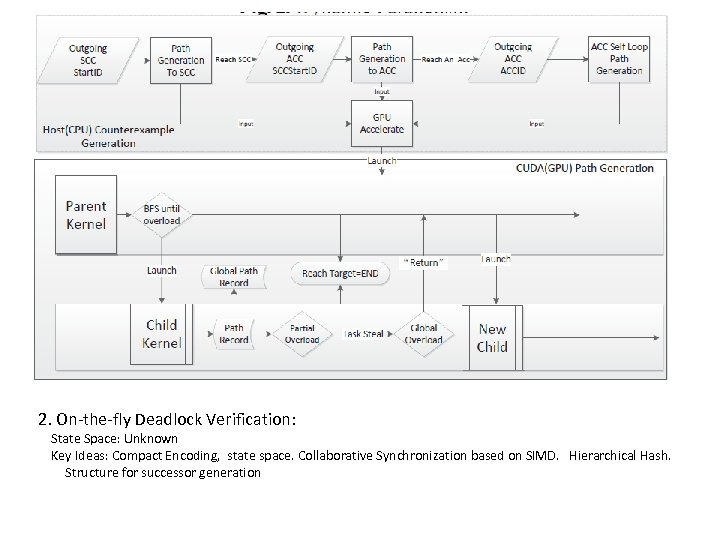 2. On‐the‐fly Deadlock Verification: State Space: Unknown Key Ideas: Compact Encoding, state space. Collaborative Synchronization based on SIMD. Hierarchical Hash. Structure for successor generation
 Thank you