 Скачать презентацию The Internet Real-Time Laboratory IRT http www cs
3582adacf5127fb401dc2e2cf04eefce.ppt
- Количество слайдов: 26



The Internet Real-Time Laboratory (IRT) http: //www. cs. columbia. edu/IRT Prof. Henning Schulzrinne Dept. of Computer Science Columbia University New York, NY January 2006
Networking research at Columbia University n n n Columbia Networking Research Center both Electrical Engineering & Computer Science Department 13 faculty – one of the largest networking research groups in the US about 40 Ph. D students spanning optical networks and wireless channels to operating systems, security and applications theory (performance analysis) to systems (software, protocols) Steve Bellovin Keren Bergman Ed Coffman Predrag Jelenkovic Angelos Keromytis Aurel Lazar Nick Maxemchuk Vishal Misra Jason Nieh Dan Rubenstein Henning Schulzrinne Xiaodong Wang Yechiam Yemini
Laboratory overview n n Dept. of Computer Science: 35 faculty IRT lab staff: n n n 1 post-doc, 3 researchers 10 Ph. D students 7 MS GRAs visitors (Ericsson, Fujitsu, Mitsubishi, Nokia, U. Coimbra, U. Rome, NTT, …) China, Finland, Greece, India, Japan, Portugal, Spain, Sweden, US, Taiwan ~10 MS and undergraduate project students
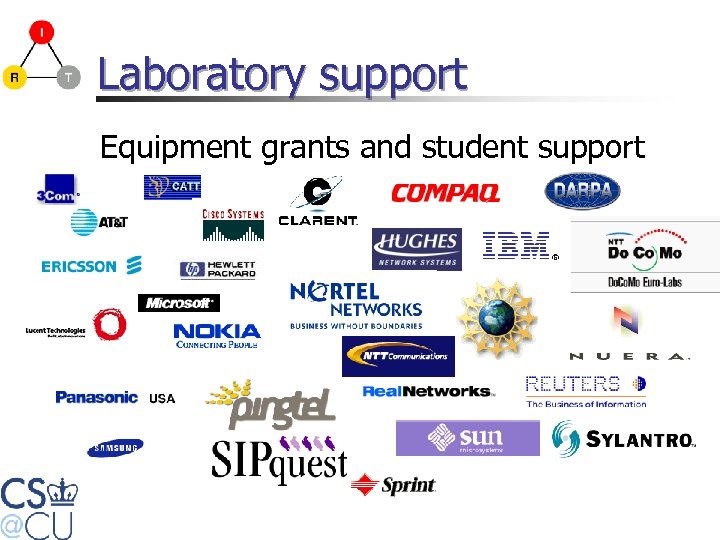
Laboratory support Equipment grants and student support
Overall IRT lab goals n n n Reliable, flexible and programmable communication infrastructure for Internetbased collaboration applications Systematic evaluation by analysis and simulation Demonstrate capability via prototypes Contribute protocols to standardization (IETF) Convert prototypes into products and opensource software Train students at all levels in current Internet research and engineering
IRT research topics n Internet telephony and multimedia n n n n n CINEMA – Vo. IP/multimedia and collaboration system Qo. S measurements network application reliability performance and server architecture APIs for SIP IM and presence systems ubiquitous computing using SIP application sharing P 2 P SIP systems emergency services (“ 911”) SIP security n n n reputation systems, spam firewalls service creation languages n n CPL LESS n Mobile and wireless systems n n n n 802. 11 handoff acceleration 802. 11 Vo. IP performance improvements SIP-based terminal mobility personal, service and session mobility Peer-to-peer messaging 7 DS Service and event discovery (Glo. Serv) Generic signaling protocols (GIMPS) for Qo. S, NAT/FW, … Autonomic computing n n service discovery m. SLP automated server pooling Dot. Slash
IRT and standards n PI and researchers active in IETF since 1992: n n n RTP – lead author RTSP – lead author SIP – original design & core team n n n SIP mobility rich presence privacy and geo-services emergency calling SLP – extensions for scalability GIST – network signaling protocol
Graduated Ph. D students n n n n n Internet telephony services, GSM interoperation (J. Lennox) Qo. S and reliability measurements (W. Jiang) Federated CDNs (L. Amini) Pricing for Qo. S, LDAP performance (X. Wang) Multicast Qo. S fairness & signaling (P. Mendes) Internet telephony topics (J. Rosenberg) Mobile peer-to-peer systems (M. Papadopouli) Scalable resource reservation (P. Pan) Vo. IP service creation (J. Lennox)
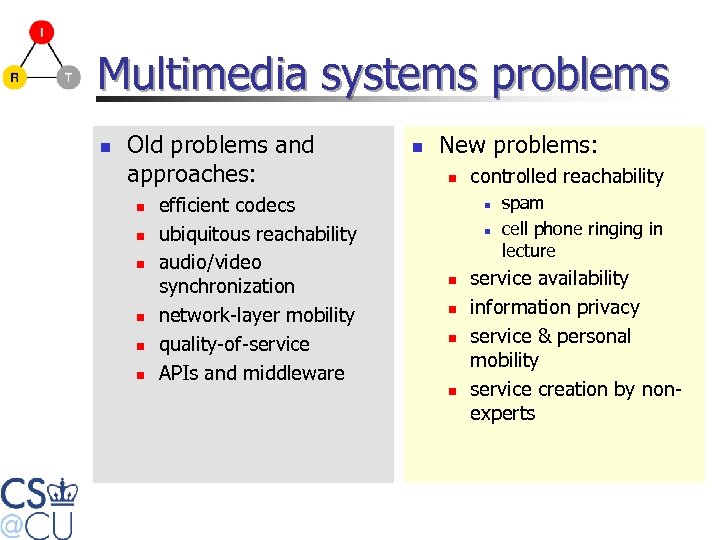
Multimedia systems problems n Old problems and approaches: n n n efficient codecs ubiquitous reachability audio/video synchronization network-layer mobility quality-of-service APIs and middleware n New problems: n controlled reachability n n n spam cell phone ringing in lecture service availability information privacy service & personal mobility service creation by nonexperts
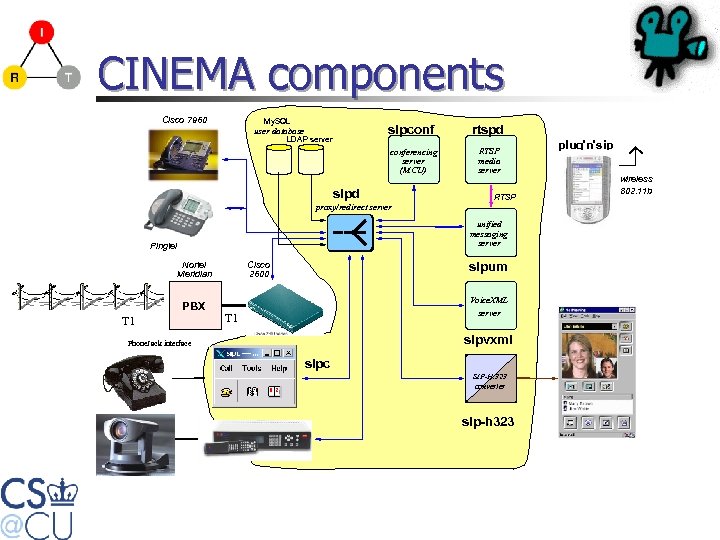
CINEMA components Cisco 7960 My. SQL sipconf user database LDAP server conferencing server (MCU) sipd proxy/redirect server rtspd RTSP media server RTSP unified messaging server Pingtel Nortel Meridian PBX T 1 sipum Cisco 2600 T 1 Voice. XML server SIP sipvxml Phone. Jack interface sipc SIP-H. 323 converter sip-h 323 plug'n'sip wireless 802. 11 b
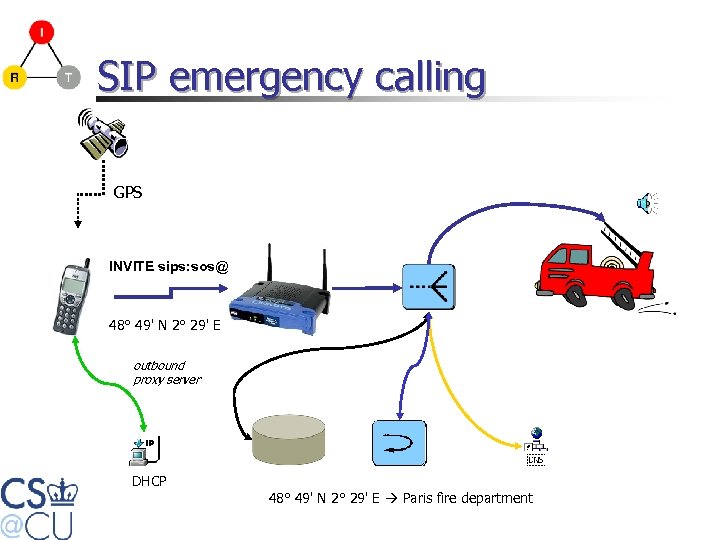
SIP emergency calling GPS INVITE sips: sos@ 48° 49' N 2° 29' E outbound proxy server DHCP 48° 49' N 2° 29' E Paris fire department
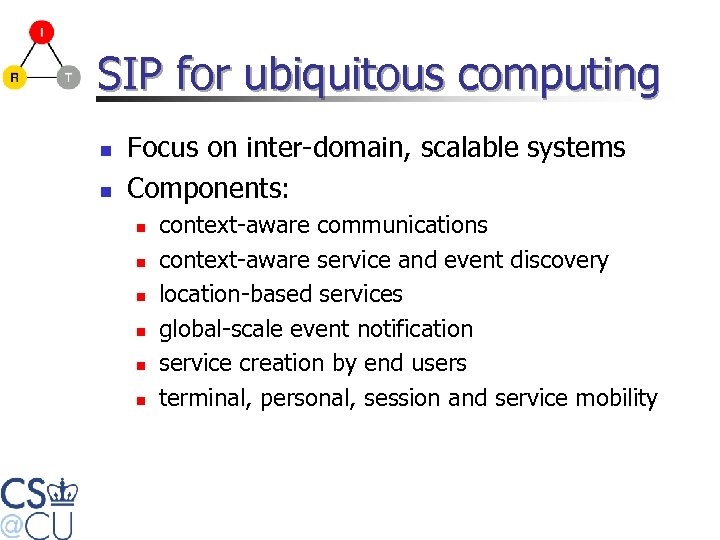
SIP for ubiquitous computing n n Focus on inter-domain, scalable systems Components: n n n context-aware communications context-aware service and event discovery location-based services global-scale event notification service creation by end users terminal, personal, session and service mobility
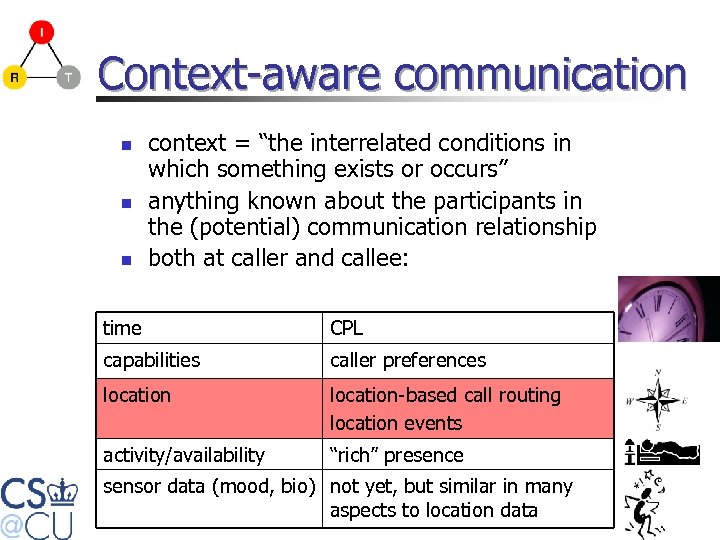
Context-aware communication n context = “the interrelated conditions in which something exists or occurs” anything known about the participants in the (potential) communication relationship both at caller and callee: time CPL capabilities caller preferences location-based call routing location events activity/availability “rich” presence sensor data (mood, bio) not yet, but similar in many aspects to location data
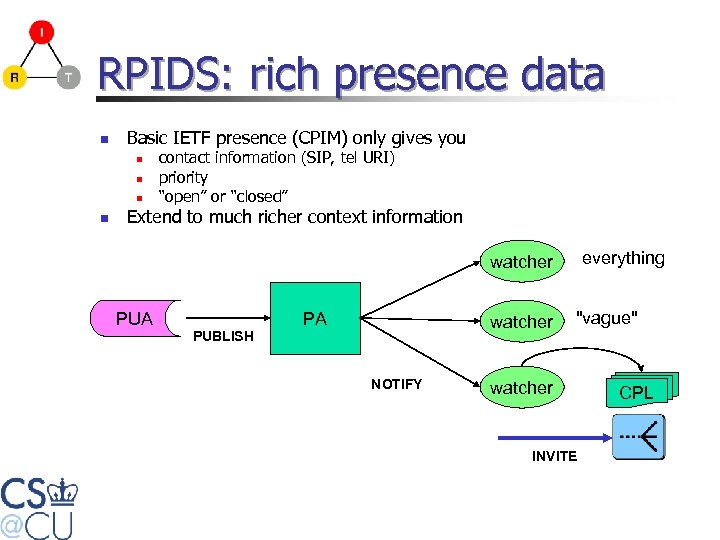
RPIDS: rich presence data n Basic IETF presence (CPIM) only gives you n n contact information (SIP, tel URI) priority “open” or “closed” Extend to much richer context information everything watcher PUA PA watcher PUBLISH NOTIFY "vague" watcher INVITE CPL
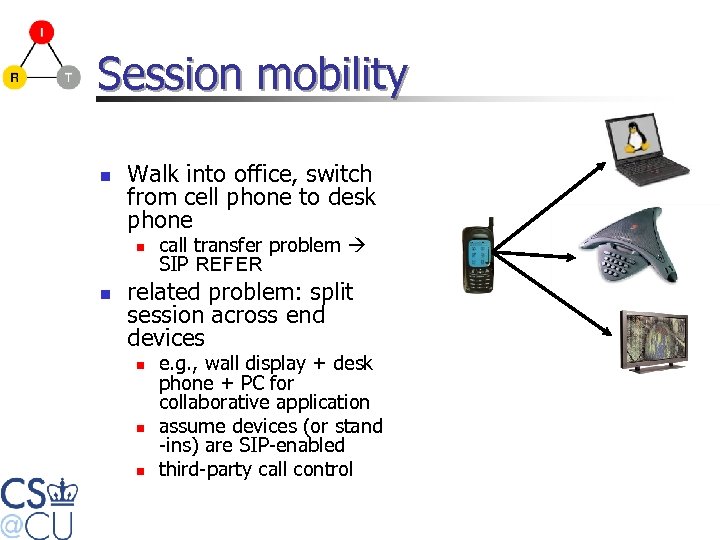
Session mobility n Walk into office, switch from cell phone to desk phone n n call transfer problem SIP REFER related problem: split session across end devices n n n e. g. , wall display + desk phone + PC for collaborative application assume devices (or stand -ins) are SIP-enabled third-party call control
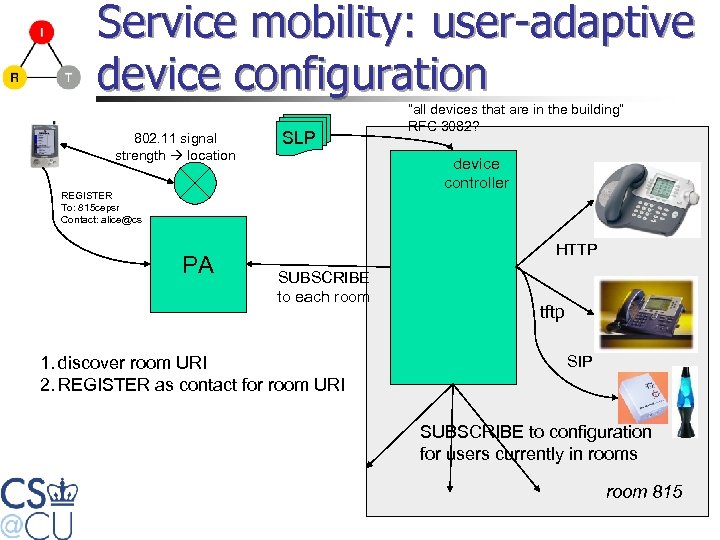
Service mobility: user-adaptive device configuration 802. 11 signal strength location SLP device controller REGISTER To: 815 cepsr Contact: alice@cs PA “all devices that are in the building” RFC 3082? HTTP SUBSCRIBE to each room 1. discover room URI 2. REGISTER as contact for room URI tftp SIP SUBSCRIBE to configuration for users currently in rooms room 815
Location-based services n Presence-based approach: n n n UA publishes location to presence agent (PA) becomes part of general user context other users (human and machines) subscribe to context n n call handling and direction location-based anycast (“anybody in the room”) location-based service directory Languages for location-based services n n n building on experience with our XML-based service creation languages CPL for user-location services LESS for end system services
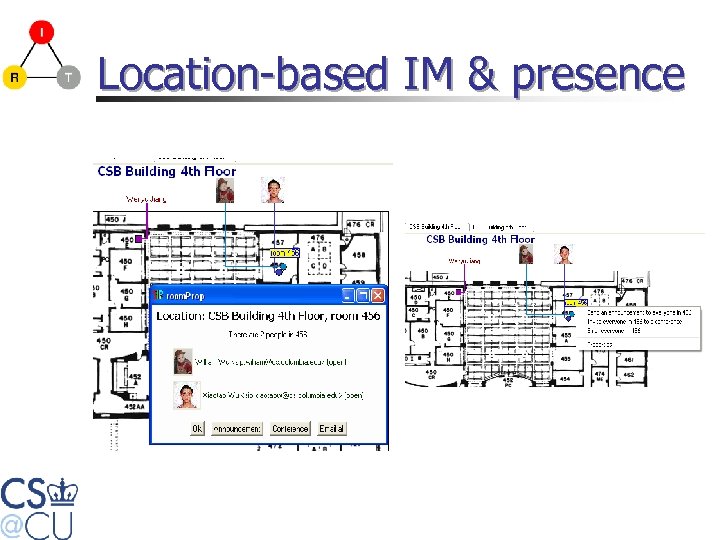
Location-based IM & presence
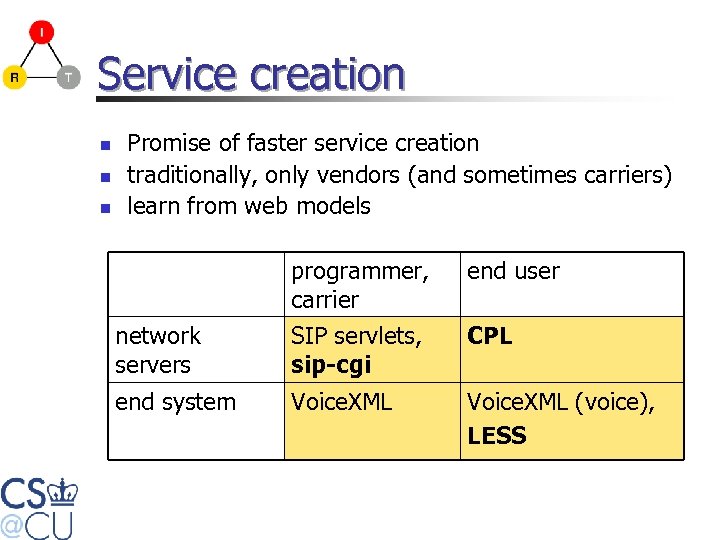
Service creation n Promise of faster service creation traditionally, only vendors (and sometimes carriers) learn from web models programmer, carrier end user network servers SIP servlets, sip-cgi CPL end system Voice. XML (voice), LESS
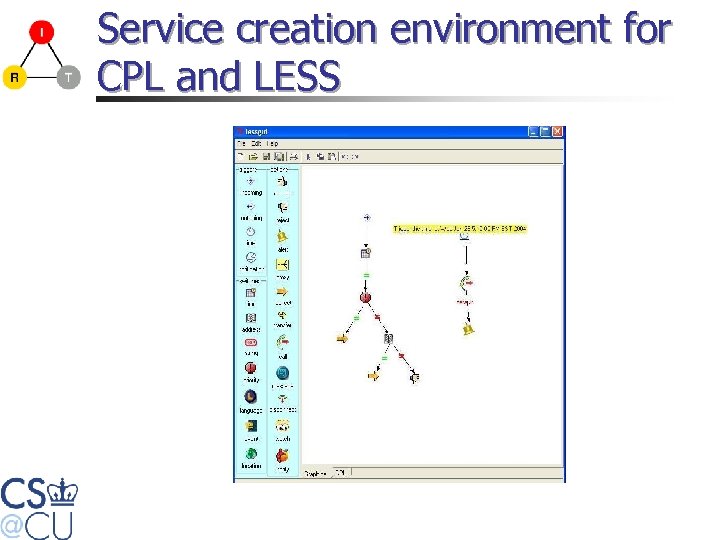
Service creation environment for CPL and LESS
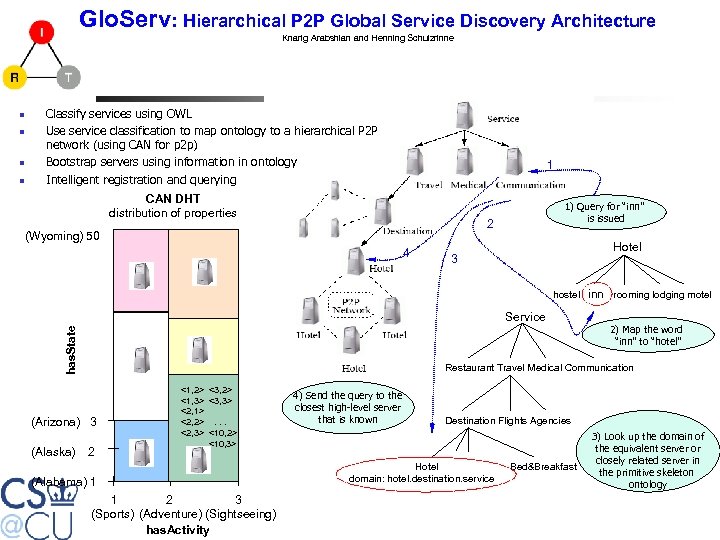
Glo. Serv: Hierarchical P 2 P Global Service Discovery Architecture Knarig Arabshian and Henning Schulzrinne n n n Classify services using OWL Use service classification to map ontology to a hierarchical P 2 P network (using CAN for p 2 p) Bootstrap servers using information in ontology Intelligent registration and querying 1 CAN DHT distribution of properties 1) Query for “inn” is issued 2 (Wyoming) 50 4 Hotel 3 hostel Service has. State n 2) Map the word “inn” to “hotel” Restaurant Travel Medical Communication (Arizona) 3 (Alaska) inn rooming lodging motel 2 <1, 2> <3, 2> <1, 3> <3, 3> <2, 1> <2, 2>. . . <2, 3> <10, 2> <10, 3> (Alabama) 1 1 2 3 (Sports) (Adventure) (Sightseeing) has. Activity 4) Send the query to the closest high-level server that is known Destination Flights Agencies Hotel domain: hotel. destination. service Bed&Breakfast 3) Look up the domain of the equivalent server or closely related server in the primitive skeleton ontology
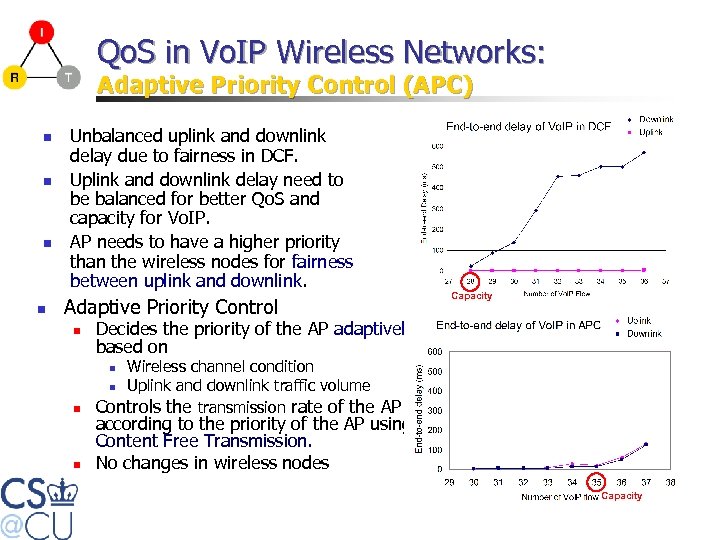
Qo. S in Vo. IP Wireless Networks: Adaptive Priority Control (APC) n n Unbalanced uplink and downlink delay due to fairness in DCF. Uplink and downlink delay need to be balanced for better Qo. S and capacity for Vo. IP. AP needs to have a higher priority than the wireless nodes for fairness between uplink and downlink. Adaptive Priority Control n Capacity Decides the priority of the AP adaptively based on Wireless channel condition n Uplink and downlink traffic volume Controls the transmission rate of the AP n n n according to the priority of the AP using Content Free Transmission. No changes in wireless nodes Capacity
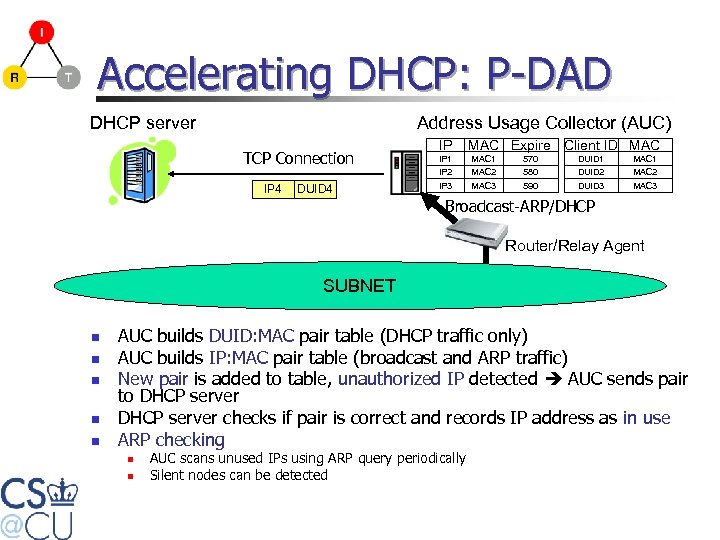
Accelerating DHCP: P-DAD DHCP server Address Usage Collector (AUC) TCP Connection IP 4 DUID 4 IP MAC Expire Client ID MAC IP 1 IP 2 MAC 1 MAC 2 570 580 IP 3 MAC 3 590 DUID 1 DUID 2 DUID 3 MAC 1 MAC 2 MAC 3 Broadcast-ARP/DHCP Router/Relay Agent SUBNET n n n AUC builds DUID: MAC pair table (DHCP traffic only) AUC builds IP: MAC pair table (broadcast and ARP traffic) New pair is added to table, unauthorized IP detected AUC sends pair to DHCP server checks if pair is correct and records IP address as in use ARP checking n n AUC scans unused IPs using ARP query periodically Silent nodes can be detected
Ad-hoc wireless infrastructure
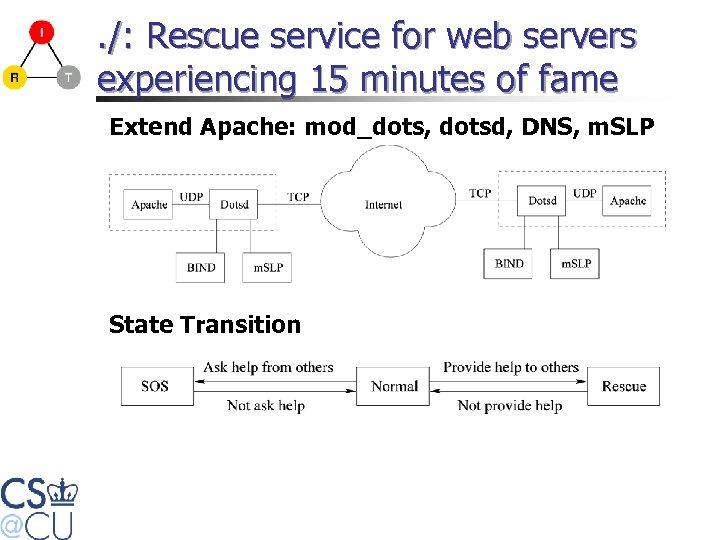
. /: Rescue service for web servers experiencing 15 minutes of fame Extend Apache: mod_dots, dotsd, DNS, m. SLP State Transition
Conclusion n Other topics: n n Focus on Internet multimedia services n n Skype analysis, Qo. S signaling, Qo. S for voice-over 802. 11 fixed & mobile applications Vo. IP – protocols, presence, location-based services, service creation, p 2 p networks Qo. S in networks Protocols, prototypes, performance evaluation
Скачать презентацию The Internet Real-Time Laboratory IRT http www cs
3582adacf5127fb401dc2e2cf04eefce.ppt