


 Скачать презентацию The Internet Protocol IP Part 2 IPv 6
735d4ffa60484cf9c3822b4b418066ea.ppt
- Количество слайдов: 73
 The Internet Protocol (IP) Part 2: IPv 6 Jean-Yves Le Boudec Fall 2009 1
 Contents 1. IPv 6 2. NATs 3. Interworking IPv 4 / IPv 6 4. Routing Implications 5. Recap Some slides come from: ipv 6 -g 6 -tutorial. pdf by Mohsen. Souissi@nic. fr Some slides come from: RIPE 40 Meeting by Florent. Parent@viagenie. qc. ca 2
 1. IPv 6 The current IP is IPv 4. IPv 6 is the next version of IP Why a new version ? IPv 4 address space is too small (32 bits). It will be exhausted some day. IP over cellular, UMTS What does IPv 6 do ? Redefine packet format with a larger address: 128 bits Otherwise essentially the same as IPv 4, but with minor improvements on header format Facilitate hardware implementation – not seen in this module We now review how the IPv 6 addresses are made and what new facilities this allows Why IPv 6 and not IPv 5 ? Because the version number 5 is already used by an experimental Protocol called ST 2, used to provide quality of service for example in military networks. 3
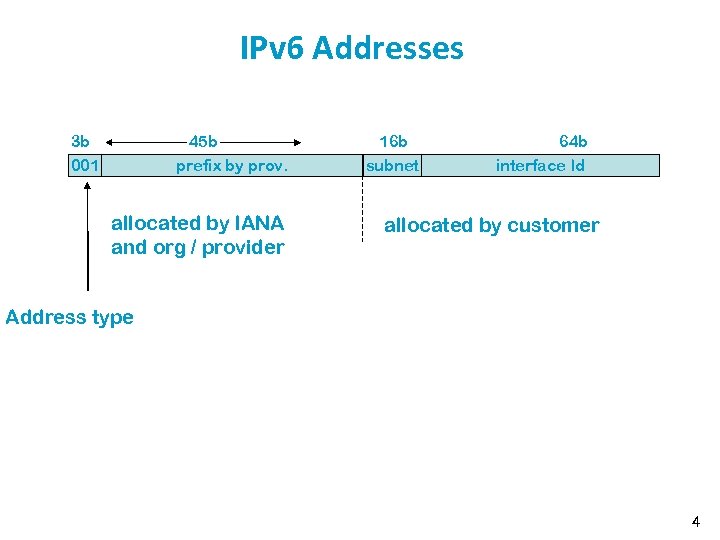 IPv 6 Addresses 3 b 45 b 001 prefix by prov. allocated by IANA and org / provider 16 b subnet 64 b interface Id allocated by customer Address type 4
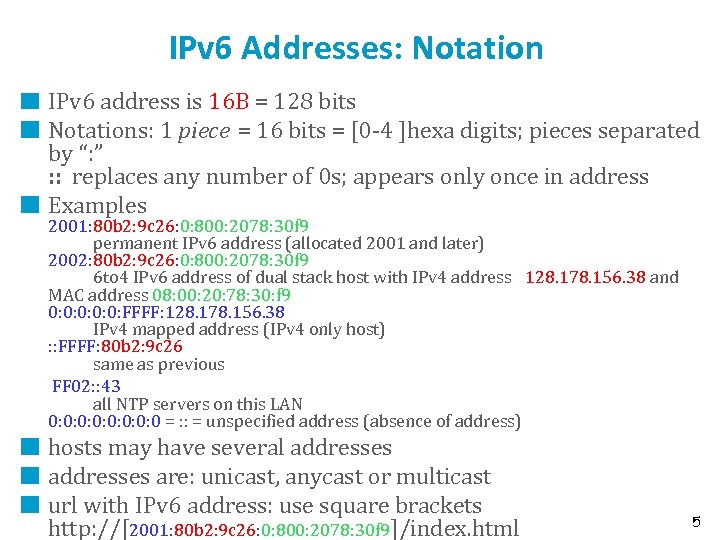 IPv 6 Addresses: Notation IPv 6 address is 16 B = 128 bits Notations: 1 piece = 16 bits = [0 -4 ]hexa digits; pieces separated by “: ” : : replaces any number of 0 s; appears only once in address Examples 2001: 80 b 2: 9 c 26: 0: 800: 2078: 30 f 9 permanent IPv 6 address (allocated 2001 and later) 2002: 80 b 2: 9 c 26: 0: 800: 2078: 30 f 9 6 to 4 IPv 6 address of dual stack host with IPv 4 address 128. 178. 156. 38 and MAC address 08: 00: 20: 78: 30: f 9 0: 0: 0: FFFF: 128. 178. 156. 38 IPv 4 mapped address (IPv 4 only host) : : FFFF: 80 b 2: 9 c 26 same as previous FF 02: : 43 all NTP servers on this LAN 0: 0: 0 = : : = unspecified address (absence of address) hosts may have several addresses are: unicast, anycast or multicast url with IPv 6 address: use square brackets http: //[2001: 80 b 2: 9 c 26: 0: 800: 2078: 30 f 9]/index. html 5
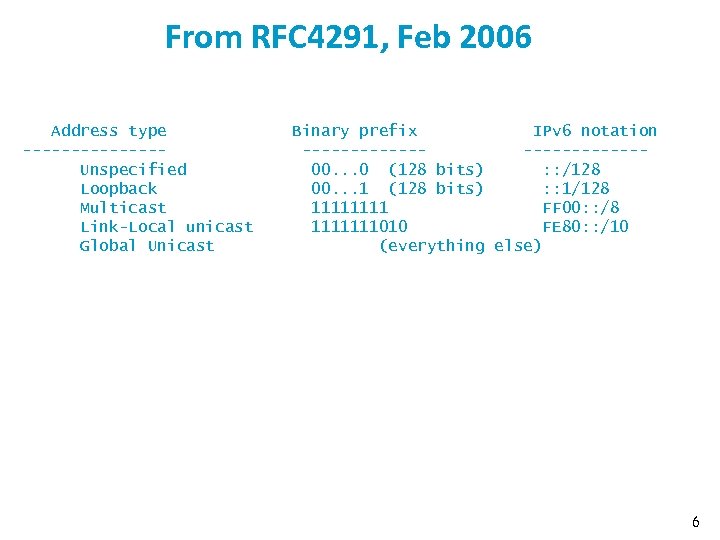 From RFC 4291, Feb 2006 Address type -------Unspecified Loopback Multicast Link-Local unicast Global Unicast Binary prefix IPv 6 notation ------------00. . . 0 (128 bits) : : /128 00. . . 1 (128 bits) : : 1/128 1111 FF 00: : /8 1111111010 FE 80: : /10 (everything else) 6
![INTERNET PROTOCOL VERSION 6 ADDRESS SPACE (IANA) [last updated 27 February 2006] IPv 6](https://present5.com/presentation/735d4ffa60484cf9c3822b4b418066ea/image-7.jpg "INTERNET PROTOCOL VERSION 6 ADDRESS SPACE (IANA) [last updated 27 February 2006] IPv 6") INTERNET PROTOCOL VERSION 6 ADDRESS SPACE (IANA) [last updated 27 February 2006] IPv 6 Prefix Allocation Reference Note ---------------0000: : /8 Reserved by IETF [RFC 3513] [1] [5] 0100: : /8 Reserved by IETF [RFC 3513] 0200: : /7 Reserved by IETF [RFC 4048] [2] 0400: : /6 Reserved by IETF [RFC 3513] 0800: : /5 Reserved by IETF [RFC 3513] 1000: : /4 Reserved by IETF [RFC 3513] 2000: : /3 Global Unicast [RFC 3513] [3] 4000: : /3 Reserved by IETF [RFC 3513] 6000: : /3 Reserved by IETF [RFC 3513] 8000: : /3 Reserved by IETF [RFC 3513] A 000: : /3 Reserved by IETF [RFC 3513] C 000: : /3 Reserved by IETF [RFC 3513] E 000: : /4 Reserved by IETF [RFC 3513] F 000: : /5 Reserved by IETF [RFC 3513] F 800: : /6 Reserved by IETF [RFC 3513] FC 00: : /7 Unique Local Unicast [RFC 4193] FE 00: : /9 Reserved by IETF [RFC 3513] FE 80: : /10 Link Local Unicast [RFC 3513] FEC 0: : /10 Reserved by IETF [RFC 3879] [4] FF 00: : /8 Multicast [RFC 3513] [0] The IPv 6 address management function was formally delegated to IANA in December 1995 [RFC 1881]. [1] The "unspecified address", the "loopback address", and the IPv 6 Addresses with Embedded IPv 4 Addresses are assigned out of the 0000: : /8 address block. [2] 0200: : /7 was previously defined as an OSI NSAP-mapped prefix set [RFC-gray-rfc 1888 bis-03. txt]. This definition has been deprecated as of December 2004 [RFC 4048]. [3] The IPv 6 Unicast space encompasses the entire IPv 6 address range with the exception of FF 00: : /8. [RFC 3513] IANA unicast address assignments are currently limited to the IPv 6 unicast address range of 2000: : /3. IANA assignments from this block are registered in the IANA registry: iana-ipv 6 -unicast-address-assignments. [4] FEC 0: : /10 was previously defined as a Site-Local scoped address prefix. This definition has been deprecated as of September 2004 [RFC 3879]. [5] 0000: : /96 was previously defined as the "IPv 4 -compatible IPv 6 address" prefix. This definition has been deprecated by [RFC 4291]. 7
INTERNET PROTOCOL VERSION 6 ADDRESS SPACE (IANA) [last updated 27 February 2006] IPv 6 Prefix Allocation Reference Note ---------------0000: : /8 Reserved by IETF [RFC 3513] [1] [5] 0100: : /8 Reserved by IETF [RFC 3513] 0200: : /7 Reserved by IETF [RFC 4048] [2] 0400: : /6 Reserved by IETF [RFC 3513] 0800: : /5 Reserved by IETF [RFC 3513] 1000: : /4 Reserved by IETF [RFC 3513] 2000: : /3 Global Unicast [RFC 3513] [3] 4000: : /3 Reserved by IETF [RFC 3513] 6000: : /3 Reserved by IETF [RFC 3513] 8000: : /3 Reserved by IETF [RFC 3513] A 000: : /3 Reserved by IETF [RFC 3513] C 000: : /3 Reserved by IETF [RFC 3513] E 000: : /4 Reserved by IETF [RFC 3513] F 000: : /5 Reserved by IETF [RFC 3513] F 800: : /6 Reserved by IETF [RFC 3513] FC 00: : /7 Unique Local Unicast [RFC 4193] FE 00: : /9 Reserved by IETF [RFC 3513] FE 80: : /10 Link Local Unicast [RFC 3513] FEC 0: : /10 Reserved by IETF [RFC 3879] [4] FF 00: : /8 Multicast [RFC 3513] [0] The IPv 6 address management function was formally delegated to IANA in December 1995 [RFC 1881]. [1] The "unspecified address", the "loopback address", and the IPv 6 Addresses with Embedded IPv 4 Addresses are assigned out of the 0000: : /8 address block. [2] 0200: : /7 was previously defined as an OSI NSAP-mapped prefix set [RFC-gray-rfc 1888 bis-03. txt]. This definition has been deprecated as of December 2004 [RFC 4048]. [3] The IPv 6 Unicast space encompasses the entire IPv 6 address range with the exception of FF 00: : /8. [RFC 3513] IANA unicast address assignments are currently limited to the IPv 6 unicast address range of 2000: : /3. IANA assignments from this block are registered in the IANA registry: iana-ipv 6 -unicast-address-assignments. [4] FEC 0: : /10 was previously defined as a Site-Local scoped address prefix. This definition has been deprecated as of September 2004 [RFC 3879]. [5] 0000: : /96 was previously defined as the "IPv 4 -compatible IPv 6 address" prefix. This definition has been deprecated by [RFC 4291]. 7
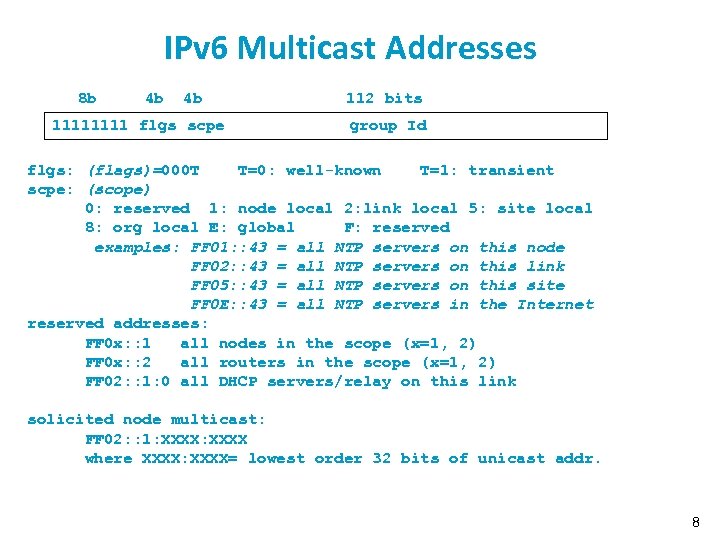 IPv 6 Multicast Addresses 8 b 4 b 4 b 1111 flgs scpe 112 bits group Id flgs: (flags)=000 T T=0: well-known T=1: transient scpe: (scope) 0: reserved 1: node local 2: link local 5: site local 8: org local E: global F: reserved examples: FF 01: : 43 = all NTP servers on this node FF 02: : 43 = all NTP servers on this link FF 05: : 43 = all NTP servers on this site FF 0 E: : 43 = all NTP servers in the Internet reserved addresses: FF 0 x: : 1 all nodes in the scope (x=1, 2) FF 0 x: : 2 all routers in the scope (x=1, 2) FF 02: : 1: 0 all DHCP servers/relay on this link solicited node multicast: FF 02: : 1: XXXX where XXXX: XXXX= lowest order 32 bits of unicast addr. 8
 The New Address Format Allows Plug and Play Automatic assignment of addresses in hosts is possible, using MAC address This is called “stateless” autoconfiguration The next slide shows how it works: 1. 2. Host creates a link local unicast address from its MAC address (cannot be used outside a LAN, but can be used to reach a router). Validity of address is verified by sending a packet to a special multicast address that only nodes with the same MAC address can have. Host asks for a router present and gets a prefix. 9
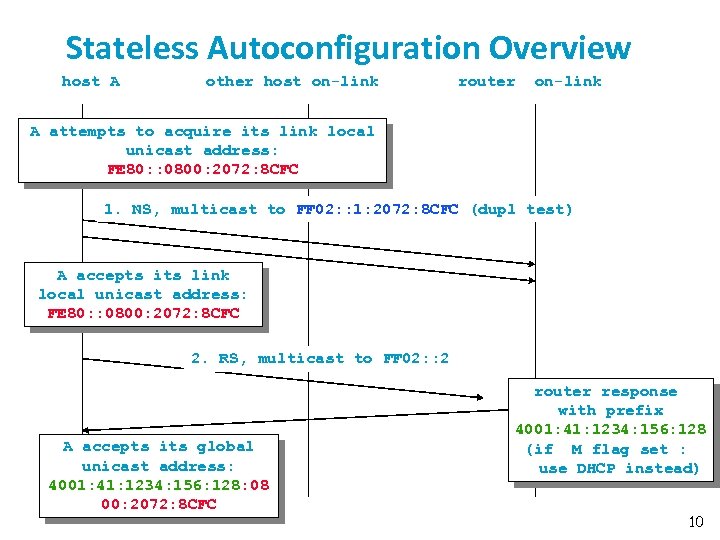 Stateless Autoconfiguration Overview host A other host on-link router on-link A attempts to acquire its link local unicast address: FE 80: : 0800: 2072: 8 CFC 1. NS, multicast to FF 02: : 1: 2072: 8 CFC (dupl test) A accepts its link local unicast address: FE 80: : 0800: 2072: 8 CFC 2. RS, multicast to FF 02: : 2 A accepts its global unicast address: 4001: 41: 1234: 156: 128: 08 00: 2072: 8 CFC router response with prefix 4001: 41: 1234: 156: 128 (if M flag set : use DHCP instead) 10
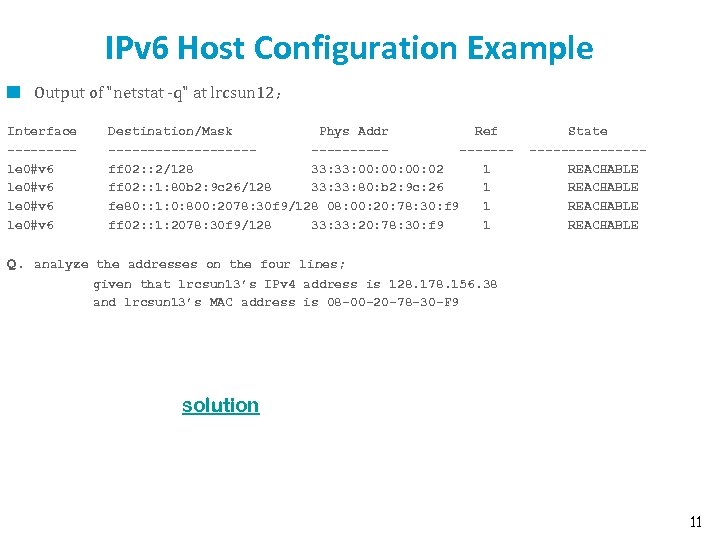 IPv 6 Host Configuration Example Output of "netstat -q" at lrcsun 12; Interface ----le 0#v 6 Destination/Mask Phys Addr Ref -----------------ff 02: : 2/128 33: 00: 00: 02 1 ff 02: : 1: 80 b 2: 9 c 26/128 33: 80: b 2: 9 c: 26 1 fe 80: : 1: 0: 800: 2078: 30 f 9/128 08: 00: 20: 78: 30: f 9 1 ff 02: : 1: 2078: 30 f 9/128 33: 20: 78: 30: f 9 1 State -------REACHABLE Q. analyze the addresses on the four lines; given that lrcsun 13’s IPv 4 address is 128. 178. 156. 38 and lrcsun 13’s MAC address is 08 -00 -20 -78 -30 -F 9 solution 11
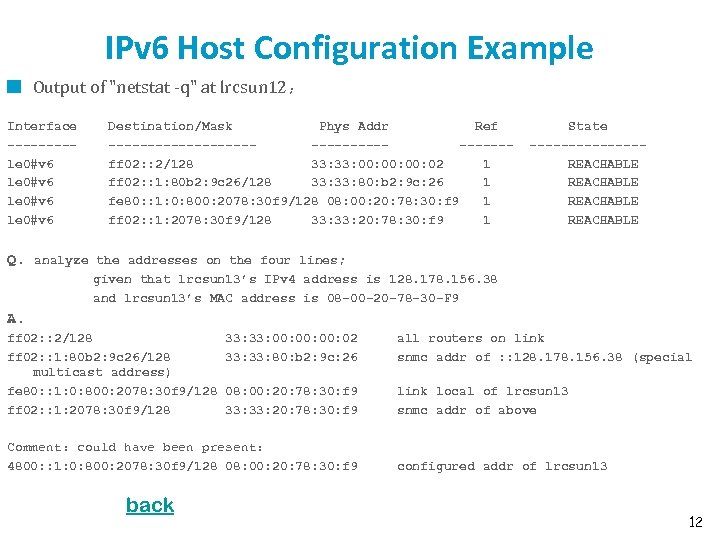 IPv 6 Host Configuration Example Output of "netstat -q" at lrcsun 12; Interface ----le 0#v 6 Destination/Mask Phys Addr Ref -----------------ff 02: : 2/128 33: 00: 00: 02 1 ff 02: : 1: 80 b 2: 9 c 26/128 33: 80: b 2: 9 c: 26 1 fe 80: : 1: 0: 800: 2078: 30 f 9/128 08: 00: 20: 78: 30: f 9 1 ff 02: : 1: 2078: 30 f 9/128 33: 20: 78: 30: f 9 1 State -------REACHABLE Q. analyze the addresses on the four lines; given that lrcsun 13’s IPv 4 address is 128. 178. 156. 38 and lrcsun 13’s MAC address is 08 -00 -20 -78 -30 -F 9 A. ff 02: : 2/128 ff 02: : 1: 80 b 2: 9 c 26/128 multicast address) fe 80: : 1: 0: 800: 2078: 30 f 9/128 ff 02: : 1: 2078: 30 f 9/128 33: 00: 00: 02 33: 80: b 2: 9 c: 26 all routers on link snmc addr of : : 128. 178. 156. 38 (special 08: 00: 20: 78: 30: f 9 33: 20: 78: 30: f 9 link local of lrcsun 13 snmc addr of above Comment: could have been present: 4800: : 1: 0: 800: 2078: 30 f 9/128 08: 00: 20: 78: 30: f 9 back configured addr of lrcsun 13 12
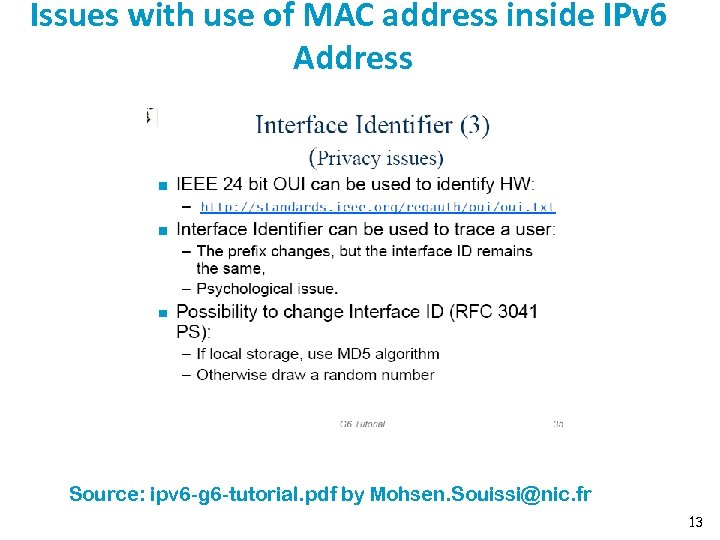 Issues with use of MAC address inside IPv 6 Address Source: ipv 6 -g 6 -tutorial. pdf by Mohsen. Souissi@nic. fr 13
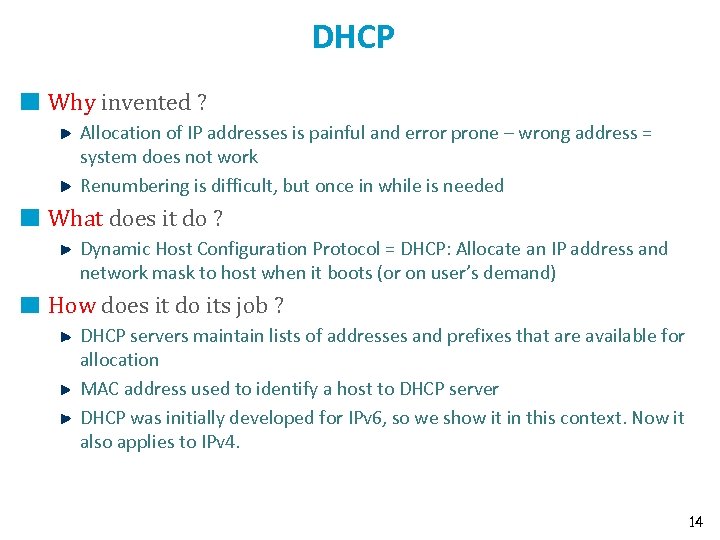 DHCP Why invented ? Allocation of IP addresses is painful and error prone – wrong address = system does not work Renumbering is difficult, but once in while is needed What does it do ? Dynamic Host Configuration Protocol = DHCP: Allocate an IP address and network mask to host when it boots (or on user’s demand) How does it do its job ? DHCP servers maintain lists of addresses and prefixes that are available for allocation MAC address used to identify a host to DHCP server DHCP was initially developed for IPv 6, so we show it in this context. Now it also applies to IPv 4. 14
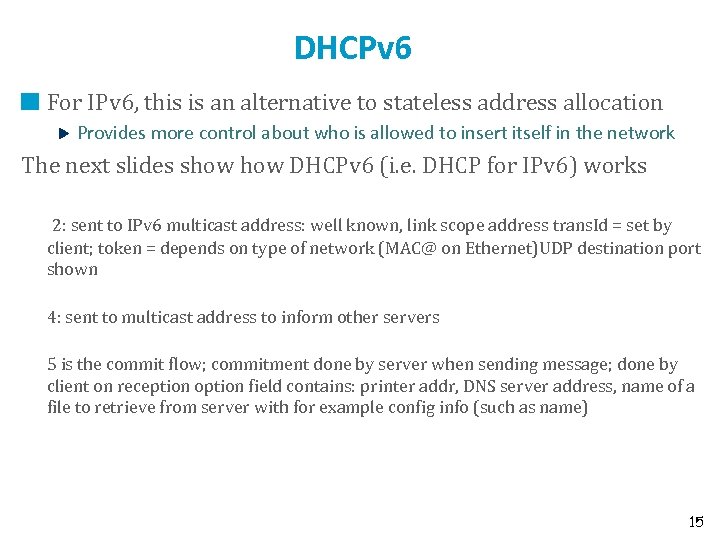 DHCPv 6 For IPv 6, this is an alternative to stateless address allocation Provides more control about who is allowed to insert itself in the network The next slides show DHCPv 6 (i. e. DHCP for IPv 6) works 2: sent to IPv 6 multicast address: well known, link scope address trans. Id = set by client; token = depends on type of network (MAC@ on Ethernet)UDP destination port shown 4: sent to multicast address to inform other servers 5 is the commit flow; commitment done by server when sending message; done by client on reception option field contains: printer addr, DNS server address, name of a file to retrieve from server with for example config info (such as name) 15
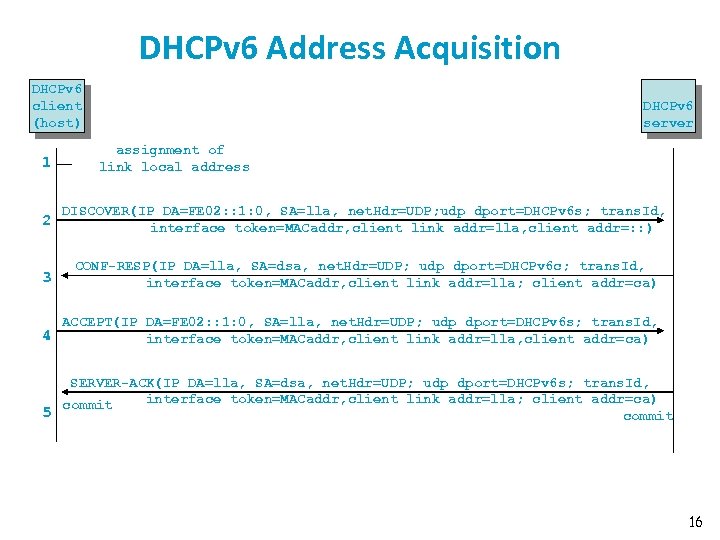 DHCPv 6 Address Acquisition DHCPv 6 client (host) 1 DHCPv 6 server assignment of link local address 2 DISCOVER(IP DA=FE 02: : 1: 0, SA=lla, net. Hdr=UDP; udp dport=DHCPv 6 s; trans. Id, interface token=MACaddr, client link addr=lla, client addr=: : ) 3 CONF-RESP(IP DA=lla, SA=dsa, net. Hdr=UDP; udp dport=DHCPv 6 c; trans. Id, interface token=MACaddr, client link addr=lla; client addr=ca) ACCEPT(IP DA=FE 02: : 1: 0, SA=lla, net. Hdr=UDP; udp dport=DHCPv 6 s; trans. Id, 4 interface token=MACaddr, client link addr=lla, client addr=ca) SERVER-ACK(IP DA=lla, SA=dsa, net. Hdr=UDP; udp dport=DHCPv 6 s; trans. Id, interface token=MACaddr, client link addr=lla; client addr=ca) commit 5 commit 16
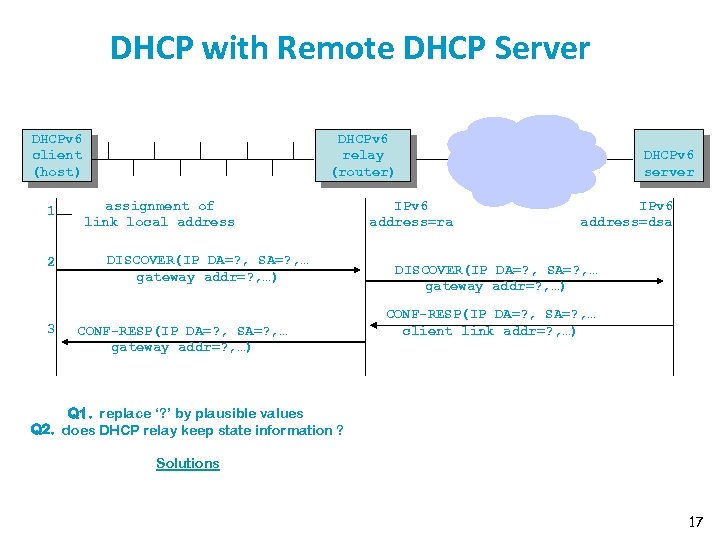 DHCP with Remote DHCP Server DHCPv 6 client (host) 1 2 3 DHCPv 6 relay (router) assignment of link local address DISCOVER(IP DA=? , SA=? , … gateway addr=? , …) CONF-RESP(IP DA=? , SA=? , … gateway addr=? , …) IPv 6 address=ra DHCPv 6 server IPv 6 address=dsa DISCOVER(IP DA=? , SA=? , … gateway addr=? , …) CONF-RESP(IP DA=? , SA=? , … client link addr=? , …) Q 1. replace ‘? ’ by plausible values Q 2. does DHCP relay keep state information ? Solutions 17
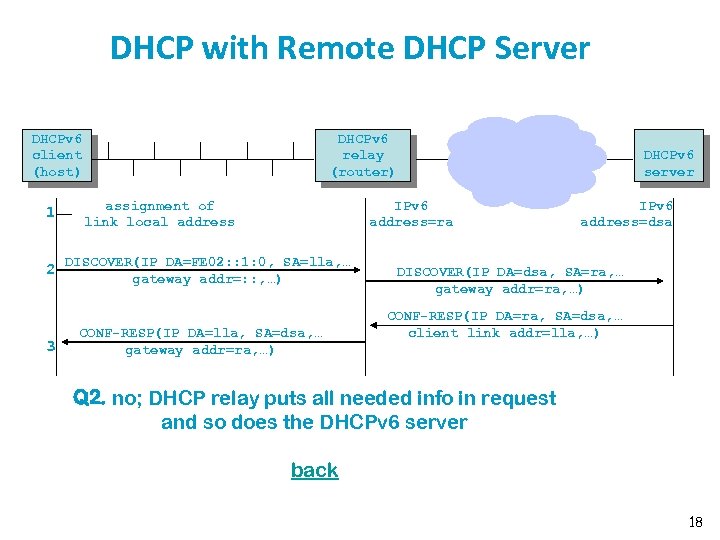 DHCP with Remote DHCP Server DHCPv 6 client (host) 1 2 3 DHCPv 6 relay (router) assignment of link local address IPv 6 address=ra DISCOVER(IP DA=FE 02: : 1: 0, SA=lla, … gateway addr=: : , …) CONF-RESP(IP DA=lla, SA=dsa, … gateway addr=ra, …) DHCPv 6 server IPv 6 address=dsa DISCOVER(IP DA=dsa, SA=ra, … gateway addr=ra, …) CONF-RESP(IP DA=ra, SA=dsa, … client link addr=lla, …) Q 2. no; DHCP relay puts all needed info in request and so does the DHCPv 6 server back 18
 DHCP for IPv 4 Originally, DHCP was intended for IPv 6 Q: How would one map the concepts of DHCP used with IPv 6 to IPv 4 ? Q: is DHCP relay a router function ? Q: should the DHCP server be colocated on router or not ? solution 19
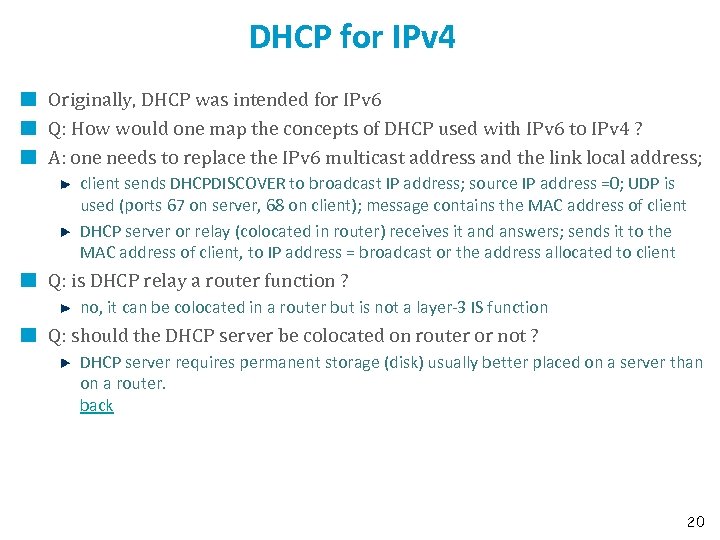 DHCP for IPv 4 Originally, DHCP was intended for IPv 6 Q: How would one map the concepts of DHCP used with IPv 6 to IPv 4 ? A: one needs to replace the IPv 6 multicast address and the link local address; client sends DHCPDISCOVER to broadcast IP address; source IP address =0; UDP is used (ports 67 on server, 68 on client); message contains the MAC address of client DHCP server or relay (colocated in router) receives it and answers; sends it to the MAC address of client, to IP address = broadcast or the address allocated to client Q: is DHCP relay a router function ? no, it can be colocated in a router but is not a layer-3 IS function Q: should the DHCP server be colocated on router or not ? DHCP server requires permanent storage (disk) usually better placed on a server than on a router. back 20
 Functions Developped for IPv 6 Retrofitted to IPv 4 Example: DHCP Other functions such as quality of service, mobility, security are now supported equally well by IPv 6 and IPv 4. Example: can you do stateless address allocation in IPv 4 as in IPv 6 ? Q. Explain how you would do it using private IP addresses instead of link local unicast address. solution 21
 Functions Developed for IPv 6 Can Often be Retrofitted to IPv 4 Example: DHCP Other functions such as quality of service, mobility, security are now supported equally well by IPv 6 and IPv 4. Example: can you do stateless address allocation in IPv 4 as in IPv 6 ? Q. Explain how you would do it using private IP addresses instead of link local unicast address. A. 1. when booting, host uses 192. 168. x. y where x and y are drawn at random. An ARP packet is broadcast to resolve this address to check if it is use. If not, host keeps this address. However, this works only for hosts on the same LAN, and the address obtained in this way is private, so we need for example a Network Address Translator between this host and the rest of the internet. So we have an example where IPv 6 brings more (the IPv 6 address allocated in this way is globally unique and is valid worldwide). back 22
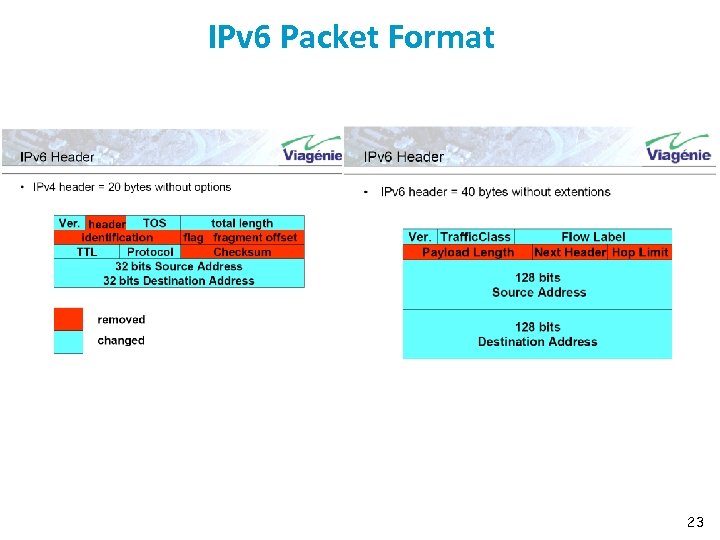 IPv 6 Packet Format 23
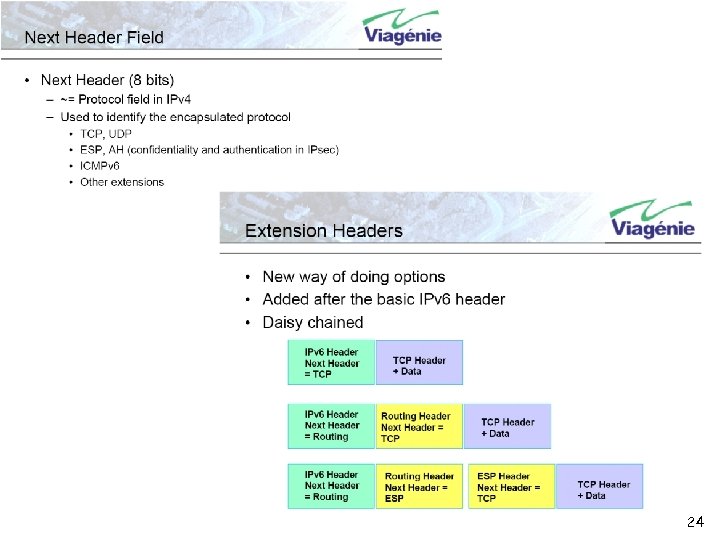 24
24
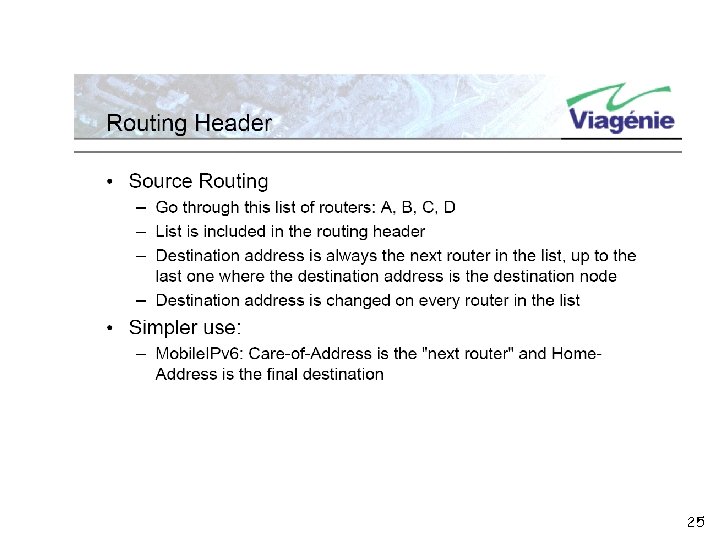 25
25
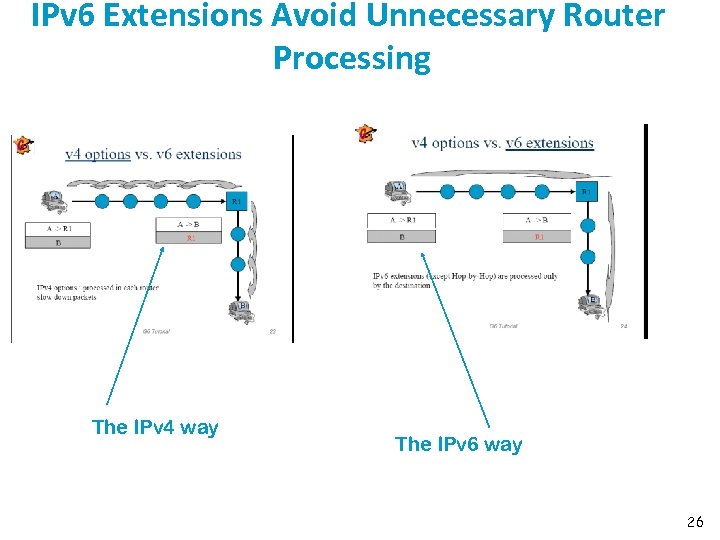 IPv 6 Extensions Avoid Unnecessary Router Processing The IPv 4 way The IPv 6 way 26
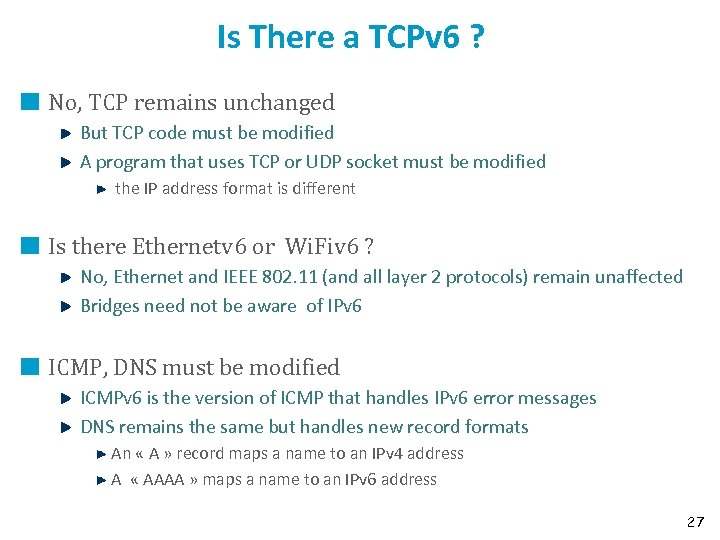 Is There a TCPv 6 ? No, TCP remains unchanged But TCP code must be modified A program that uses TCP or UDP socket must be modified the IP address format is different Is there Ethernetv 6 or Wi. Fiv 6 ? No, Ethernet and IEEE 802. 11 (and all layer 2 protocols) remain unaffected Bridges need not be aware of IPv 6 ICMP, DNS must be modified ICMPv 6 is the version of ICMP that handles IPv 6 error messages DNS remains the same but handles new record formats An « A » record maps a name to an IPv 4 address A « AAAA » maps a name to an IPv 6 address 27
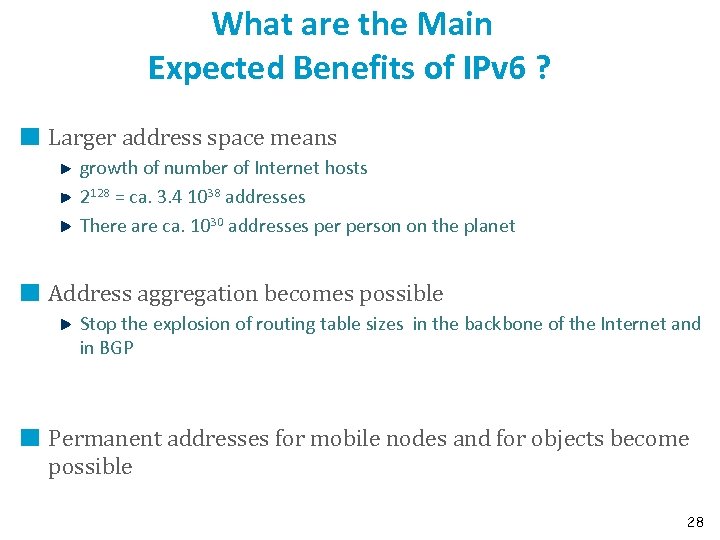 What are the Main Expected Benefits of IPv 6 ? Larger address space means growth of number of Internet hosts 2128 = ca. 3. 4 1038 addresses There are ca. 1030 addresses person on the planet Address aggregation becomes possible Stop the explosion of routing table sizes in the backbone of the Internet and in BGP Permanent addresses for mobile nodes and for objects become possible 28
 IPv 6, Section 2 NATS 29
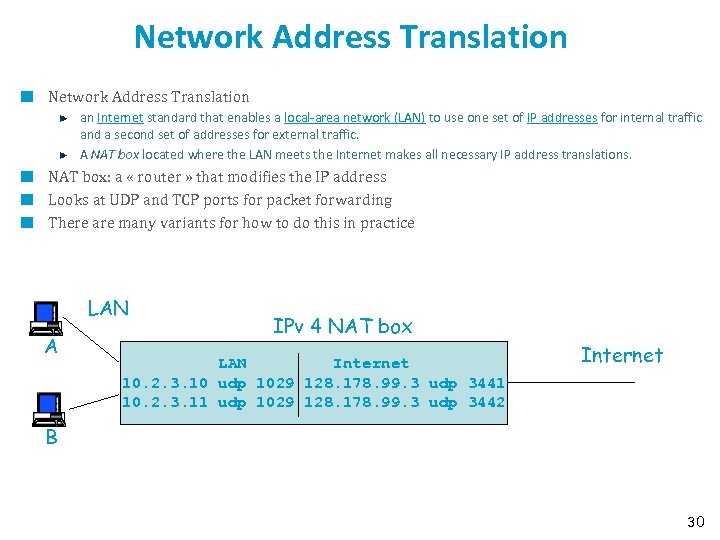 Network Address Translation an Internet standard that enables a local-area network (LAN) to use one set of IP addresses for internal traffic and a second set of addresses for external traffic. A NAT box located where the LAN meets the Internet makes all necessary IP address translations. NAT box: a « router » that modifies the IP address Looks at UDP and TCP ports for packet forwarding There are many variants for how to do this in practice LAN A IPv 4 NAT box LAN Internet 10. 2. 3. 10 udp 1029 128. 178. 99. 3 udp 3441 10. 2. 3. 11 udp 1029 128. 178. 99. 3 udp 3442 Internet B 30
 NAT Q 1: what fields are modified by a NAT in a packet (a) coming from the LAN side ? (b) from the WAN side ? Q 2: compare the lookup function that a NAT performs with that of a standard router solution 31
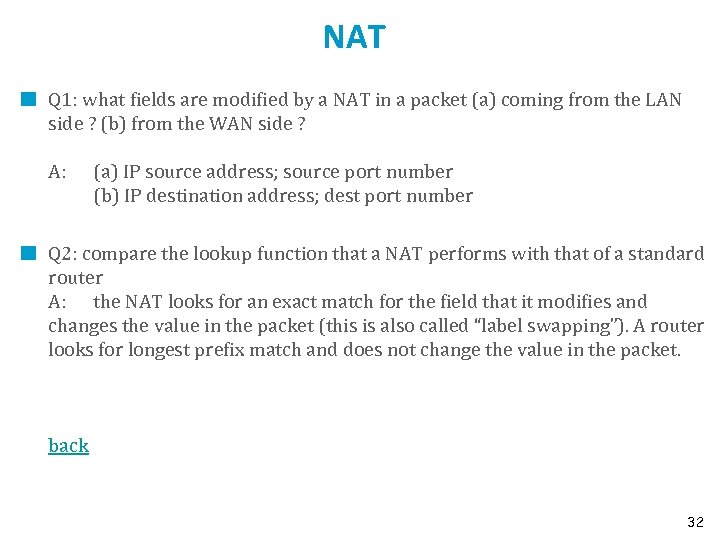 NAT Q 1: what fields are modified by a NAT in a packet (a) coming from the LAN side ? (b) from the WAN side ? A: (a) IP source address; source port number (b) IP destination address; dest port number Q 2: compare the lookup function that a NAT performs with that of a standard router A: the NAT looks for an exact match for the field that it modifies and changes the value in the packet (this is also called “label swapping”). A router looks for longest prefix match and does not change the value in the packet. back 32
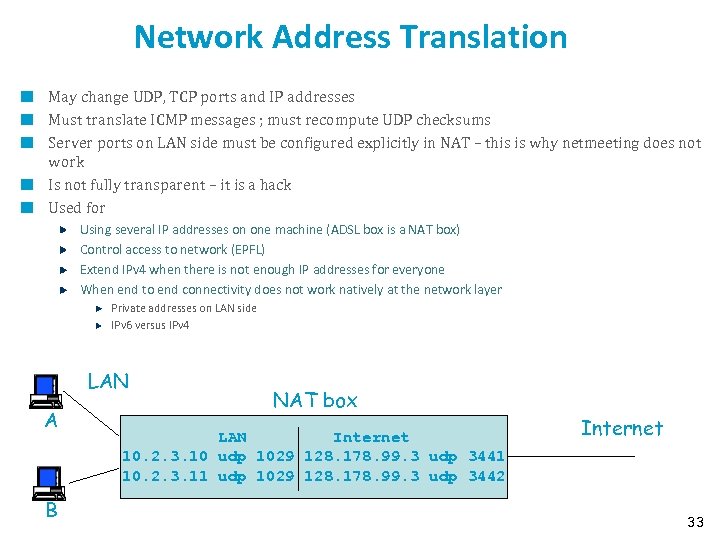 Network Address Translation May change UDP, TCP ports and IP addresses Must translate ICMP messages ; must recompute UDP checksums Server ports on LAN side must be configured explicitly in NAT – this is why netmeeting does not work Is not fully transparent – it is a hack Used for Using several IP addresses on one machine (ADSL box is a NAT box) Control access to network (EPFL) Extend IPv 4 when there is not enough IP addresses for everyone When end to end connectivity does not work natively at the network layer Private addresses on LAN side IPv 6 versus IPv 4 LAN A B NAT box LAN Internet 10. 2. 3. 10 udp 1029 128. 178. 99. 3 udp 3441 10. 2. 3. 11 udp 1029 128. 178. 99. 3 udp 3442 Internet 33
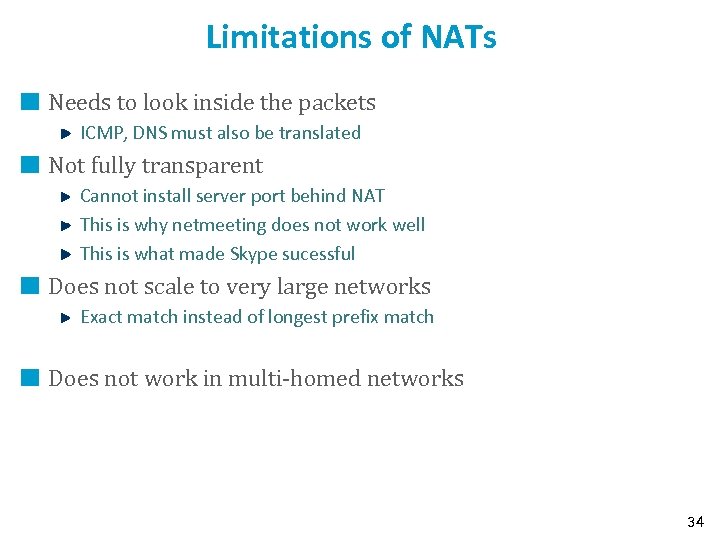 Limitations of NATs Needs to look inside the packets ICMP, DNS must also be translated Not fully transparent Cannot install server port behind NAT This is why netmeeting does not work well This is what made Skype sucessful Does not scale to very large networks Exact match instead of longest prefix match Does not work in multi-homed networks 34
 IPv 6, Section 3 INTERWORKING IPV 4/IPV 6 A. What is the problem ? B. Ingredients C. Solutions for like to like D. Solutions for interworking 35
 Quiz Q. What is the greatest challenge (in communication systems) to come during B. Obama’s term as President of the United States ? A. Migration to IPv 6 36
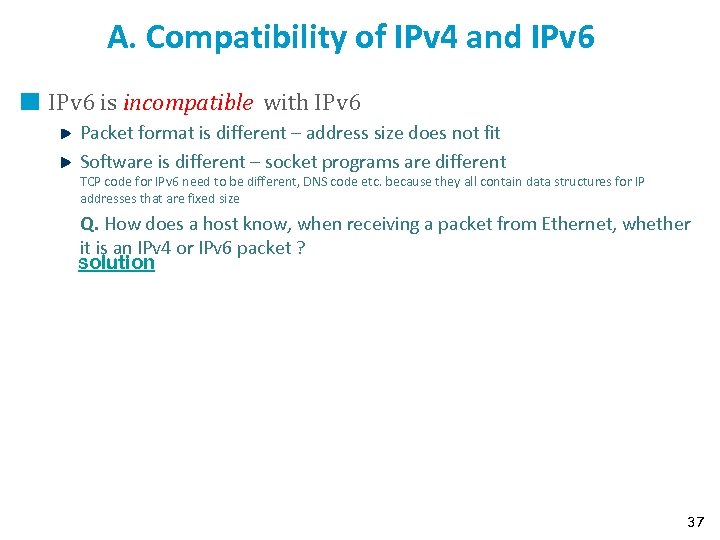 A. Compatibility of IPv 4 and IPv 6 is incompatible with IPv 6 Packet format is different – address size does not fit Software is different – socket programs are different TCP code for IPv 6 need to be different, DNS code etc. because they all contain data structures for IP addresses that are fixed size Q. How does a host know, when receiving a packet from Ethernet, whether it is an IPv 4 or IPv 6 packet ? solution 37
 Compatibility of IPv 4 and IPv 6 is incompatible with IPv 6 Packet format is different – address size does not fit Software is different – socket programs are different TCP code for IPv 6 need to be different, DNS code etc. because they all contain data structures for IP addresses that are fixed size Q. How does a host know, when receiving a packet from Ethernet, whether it is an IPv 4 or IPv 6 packet ? A. The protocol type in the Ethernet header is different back 38
 Deployment of IPv 6 is implemented in Unix, Windows, Cisco but… is not deployed. Why ? Q. Give possible explanations. solution 39
 Deployment of IPv 6 is implemented in Unix, Windows, Cisco but… is not deployed. Why ? Q. Give possible explanations. A. 1. IPv 6 is incompatible, so a smooth deployment is not easy. If I install IPv 6 in my PC and remove IPv 4, I cannot access the existing base of IPv 4 services. 2. Address space exhaustion is not critical in the US, which is the main source of product development. This is because many networks use network address translation or HTTP proxies that allow one to use private addresses for hosts. 3. The benefit of introducing IPv 6 is for others (those who do not have enough addresses). There is no incentive for a company to move to IPv 6 (but there are many associated costs). So the move to IPv 6 is likely to occur under pressure of serious problems – it is like moving to green power sources… back 40
 What is the problem ? IPv 6 is a new, incompatible version of IPv 4 Transition to IPv 6 will occur A complex and painful process An experimental IPv 6 Internet existed parallel to the commercial Internet; called the “ 6 bone” Used addresses 3 FFE/16 Now extinct The IPv 6 Internet uses addresses 2001/16 Assumed to be globally fully connected Exists parallel to, and connected to, IPv 4 internet, We will review the main mechanisms The scenarios are multiple, there are several solutions to the same problem 41
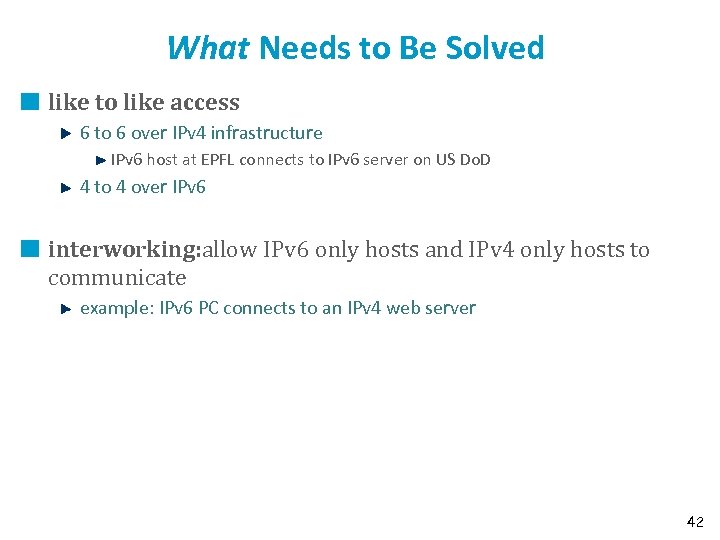 What Needs to Be Solved like to like access 6 to 6 over IPv 4 infrastructure IPv 6 host at EPFL connects to IPv 6 server on US Do. D 4 to 4 over IPv 6 interworking: allow IPv 6 only hosts and IPv 4 only hosts to communicate example: IPv 6 PC connects to an IPv 4 web server 42
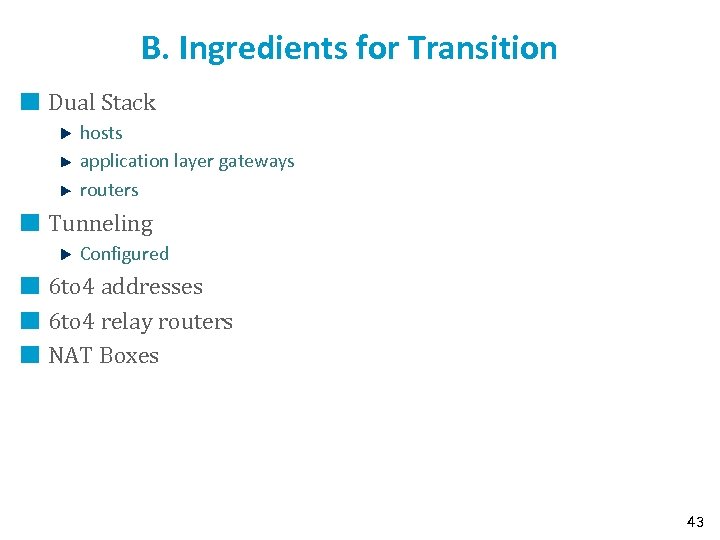 B. Ingredients for Transition Dual Stack hosts application layer gateways routers Tunneling Configured 6 to 4 addresses 6 to 4 relay routers NAT Boxes 43
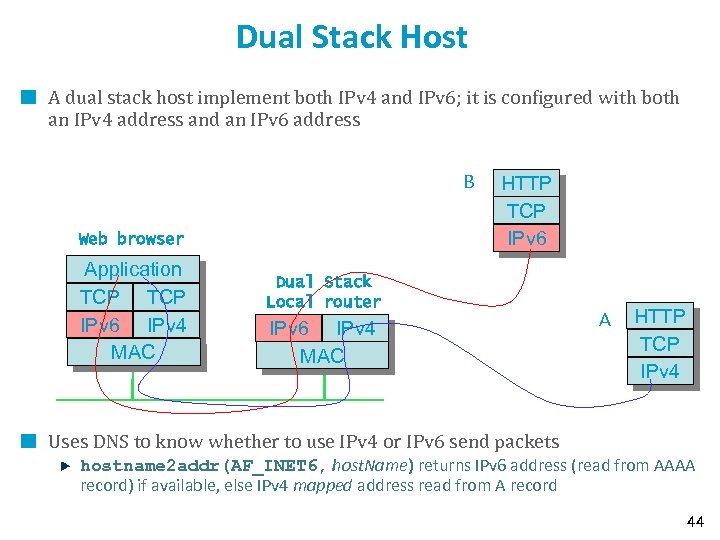 Dual Stack Host A dual stack host implement both IPv 4 and IPv 6; it is configured with both an IPv 4 address and an IPv 6 address B Web browser Application TCP IPv 6 IPv 4 MAC HTTP TCP IPv 6 Dual Stack Local router IPv 6 IPv 4 MAC A HTTP TCP IPv 4 Uses DNS to know whether to use IPv 4 or IPv 6 send packets hostname 2 addr(AF_INET 6, host. Name) returns IPv 6 address (read from AAAA record) if available, else IPv 4 mapped address read from A record 44
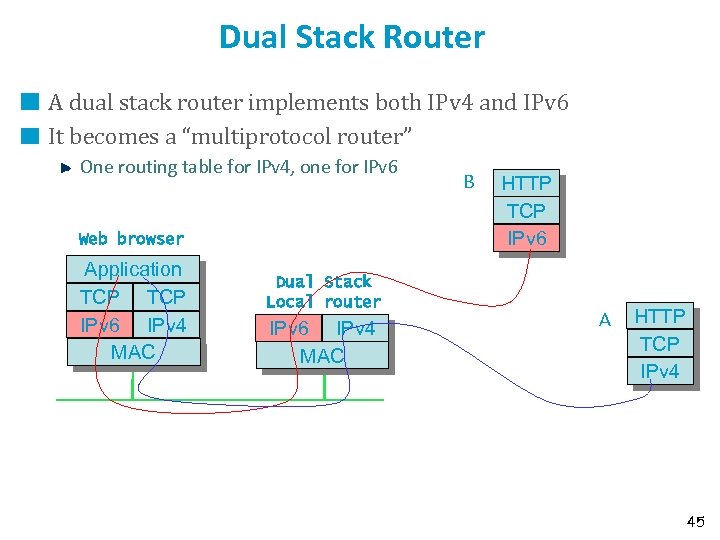 Dual Stack Router A dual stack router implements both IPv 4 and IPv 6 It becomes a “multiprotocol router” One routing table for IPv 4, one for IPv 6 Web browser Application TCP IPv 6 IPv 4 MAC Dual Stack Local router IPv 6 IPv 4 MAC B HTTP TCP IPv 6 A HTTP TCP IPv 4 45
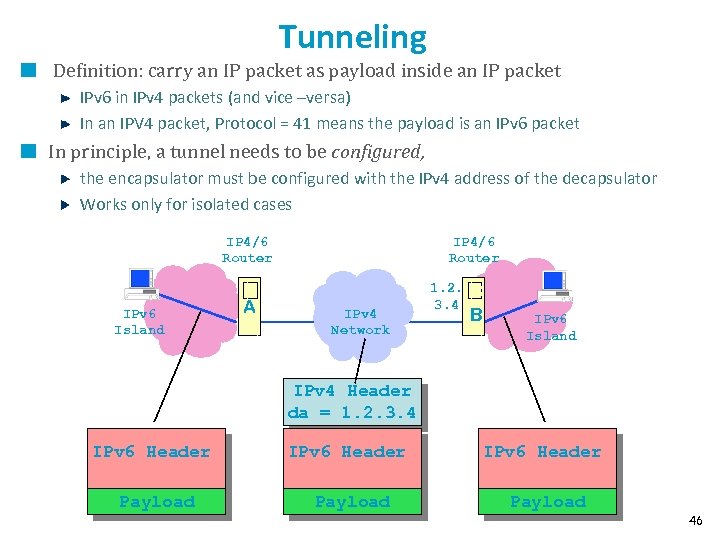 Tunneling Definition: carry an IP packet as payload inside an IP packet IPv 6 in IPv 4 packets (and vice –versa) In an IPV 4 packet, Protocol = 41 means the payload is an IPv 6 packet In principle, a tunnel needs to be configured, the encapsulator must be configured with the IPv 4 address of the decapsulator Works only for isolated cases IP 4/6 Router IPv 6 Island A IP 4/6 Router IPv 4 Network 1. 2. 3. 4 B IPv 6 Island IPv 4 Header da = 1. 2. 3. 4 IPv 6 Header Payload 46
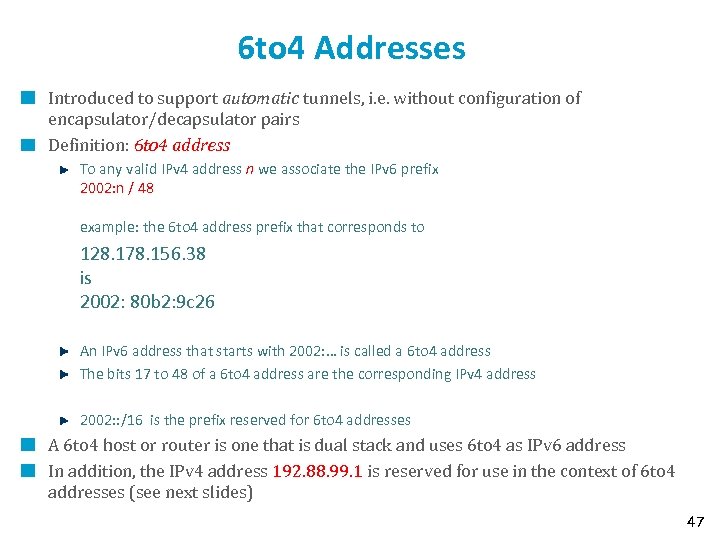 6 to 4 Addresses Introduced to support automatic tunnels, i. e. without configuration of encapsulator/decapsulator pairs Definition: 6 to 4 address To any valid IPv 4 address n we associate the IPv 6 prefix 2002: n / 48 example: the 6 to 4 address prefix that corresponds to 128. 178. 156. 38 is 2002: 80 b 2: 9 c 26 An IPv 6 address that starts with 2002: … is called a 6 to 4 address The bits 17 to 48 of a 6 to 4 address are the corresponding IPv 4 address 2002: : /16 is the prefix reserved for 6 to 4 addresses A 6 to 4 host or router is one that is dual stack and uses 6 to 4 as IPv 6 address In addition, the IPv 4 address 192. 88. 99. 1 is reserved for use in the context of 6 to 4 addresses (see next slides) 47
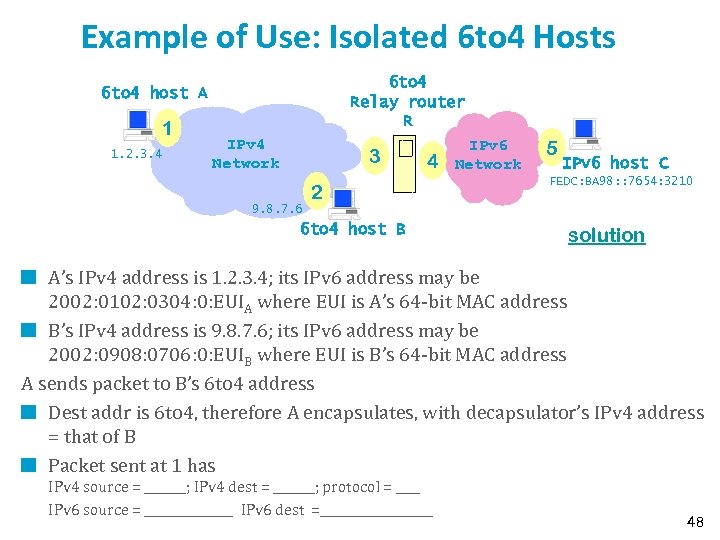 Example of Use: Isolated 6 to 4 Hosts 6 to 4 Relay router R 6 to 4 host A 1 1. 2. 3. 4 IPv 4 Network 3 4 2 IPv 6 Network 5 IPv 6 host C FEDC: BA 98: : 7654: 3210 9. 8. 7. 6 6 to 4 host B solution A’s IPv 4 address is 1. 2. 3. 4; its IPv 6 address may be 2002: 0102: 0304: 0: EUIA where EUI is A’s 64 -bit MAC address B’s IPv 4 address is 9. 8. 7. 6; its IPv 6 address may be 2002: 0908: 0706: 0: EUIB where EUI is B’s 64 -bit MAC address A sends packet to B’s 6 to 4 address Dest addr is 6 to 4, therefore A encapsulates, with decapsulator’s IPv 4 address = that of B Packet sent at 1 has IPv 4 source = _______; IPv 4 dest = _______; protocol = ____ IPv 6 source = ________ IPv 6 dest =__________ 48
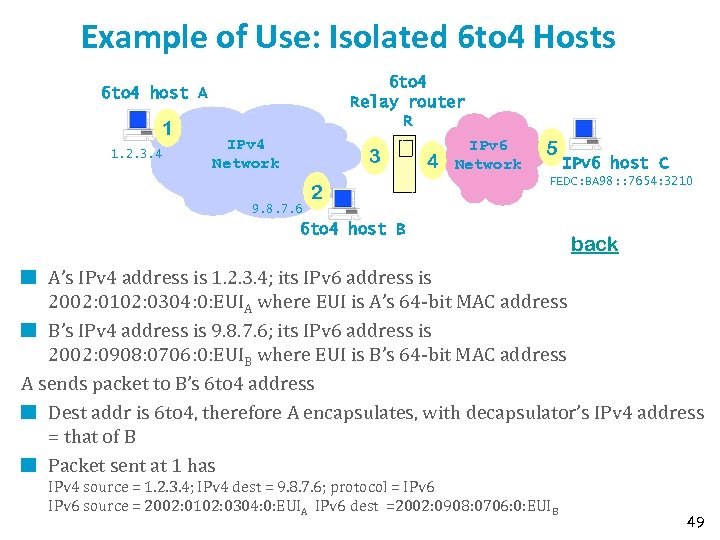 Example of Use: Isolated 6 to 4 Hosts 6 to 4 Relay router R 6 to 4 host A 1 1. 2. 3. 4 IPv 4 Network 3 2 4 IPv 6 Network 5 IPv 6 host C FEDC: BA 98: : 7654: 3210 9. 8. 7. 6 6 to 4 host B back A’s IPv 4 address is 1. 2. 3. 4; its IPv 6 address is 2002: 0102: 0304: 0: EUIA where EUI is A’s 64 -bit MAC address B’s IPv 4 address is 9. 8. 7. 6; its IPv 6 address is 2002: 0908: 0706: 0: EUIB where EUI is B’s 64 -bit MAC address A sends packet to B’s 6 to 4 address Dest addr is 6 to 4, therefore A encapsulates, with decapsulator’s IPv 4 address = that of B Packet sent at 1 has IPv 4 source = 1. 2. 3. 4; IPv 4 dest = 9. 8. 7. 6; protocol = IPv 6 source = 2002: 0102: 0304: 0: EUIA IPv 6 dest =2002: 0908: 0706: 0: EUIB 49
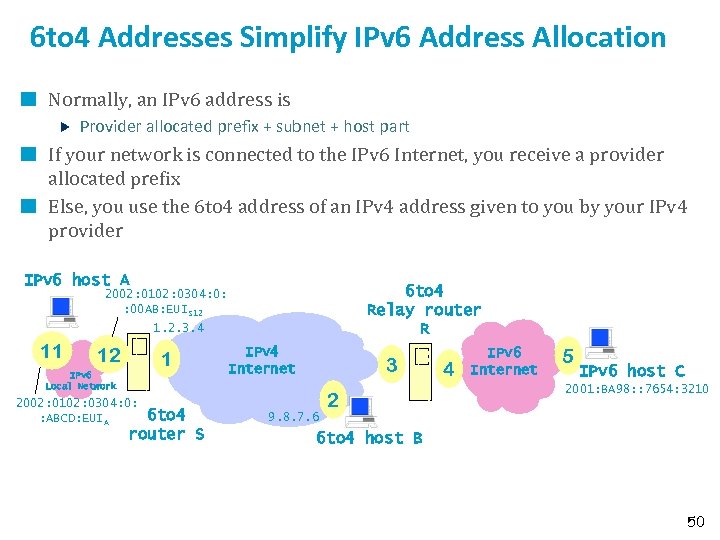 6 to 4 Addresses Simplify IPv 6 Address Allocation Normally, an IPv 6 address is Provider allocated prefix + subnet + host part If your network is connected to the IPv 6 Internet, you receive a provider allocated prefix Else, you use the 6 to 4 address of an IPv 4 address given to you by your IPv 4 provider IPv 6 host A 6 to 4 Relay router R 2002: 0102: 0304: 0: : 00 AB: EUIS 12 1. 2. 3. 4 11 12 1 IPv 6 Local Network 2002: 0102: 0304: 0: : ABCD: EUIA 6 to 4 router S IPv 4 Internet 3 2 4 IPv 6 Internet 5 IPv 6 host C 2001: BA 98: : 7654: 3210 9. 8. 7. 6 6 to 4 host B 50
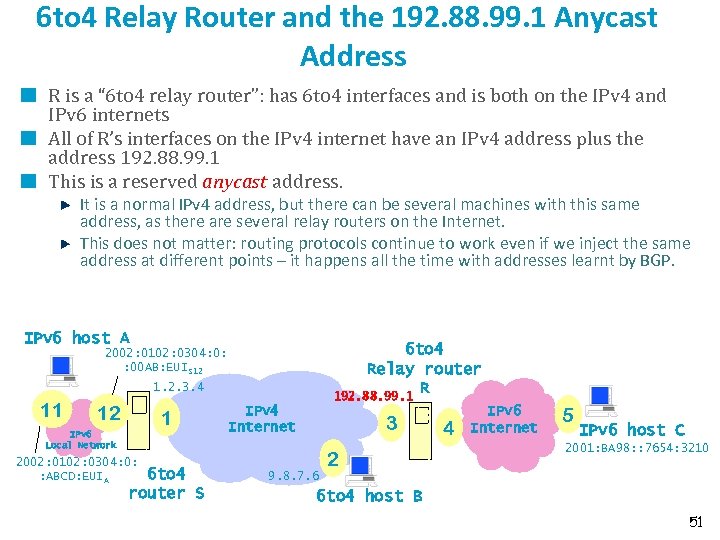 6 to 4 Relay Router and the 192. 88. 99. 1 Anycast Address R is a “ 6 to 4 relay router”: has 6 to 4 interfaces and is both on the IPv 4 and IPv 6 internets All of R’s interfaces on the IPv 4 internet have an IPv 4 address plus the address 192. 88. 99. 1 This is a reserved anycast address. It is a normal IPv 4 address, but there can be several machines with this same address, as there are several relay routers on the Internet. This does not matter: routing protocols continue to work even if we inject the same address at different points – it happens all the time with addresses learnt by BGP. IPv 6 host A 6 to 4 Relay router R 192. 88. 99. 1 2002: 0102: 0304: 0: : 00 AB: EUIS 12 1. 2. 3. 4 11 12 1 IPv 6 Local Network 2002: 0102: 0304: 0: : ABCD: EUIA 6 to 4 router S IPv 4 Internet 3 2 4 IPv 6 Internet 5 IPv 6 host C 2001: BA 98: : 7654: 3210 9. 8. 7. 6 6 to 4 host B 51
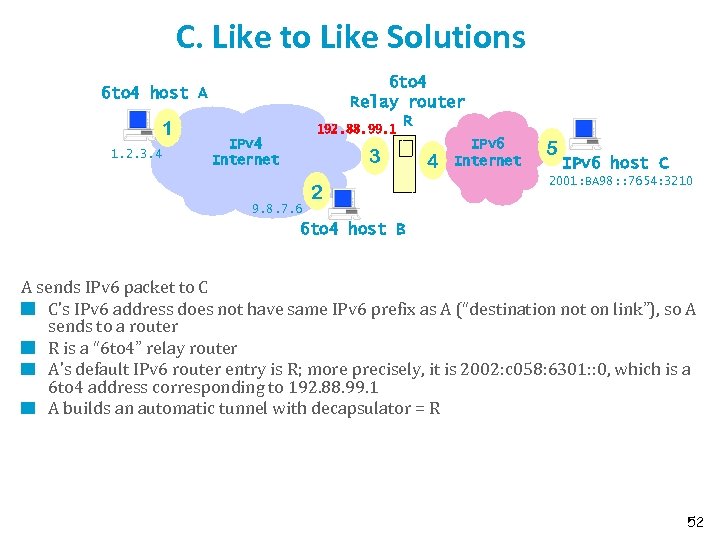 C. Like to Like Solutions 6 to 4 Relay router R 192. 88. 99. 1 6 to 4 host A 1 1. 2. 3. 4 IPv 4 Internet 3 2 4 IPv 6 Internet 5 IPv 6 host C 2001: BA 98: : 7654: 3210 9. 8. 7. 6 6 to 4 host B A sends IPv 6 packet to C C’s IPv 6 address does not have same IPv 6 prefix as A (“destination not on link”), so A sends to a router R is a “ 6 to 4” relay router A’s default IPv 6 router entry is R; more precisely, it is 2002: c 058: 6301: : 0, which is a 6 to 4 address corresponding to 192. 88. 99. 1 A builds an automatic tunnel with decapsulator = R 52
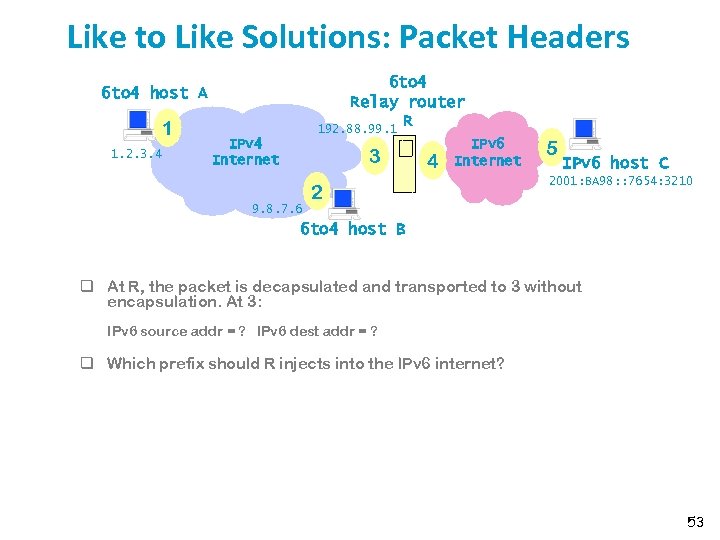 Like to Like Solutions: Packet Headers 6 to 4 Relay router R 192. 88. 99. 1 6 to 4 host A 1 1. 2. 3. 4 IPv 4 Internet 3 4 IPv 6 Internet 2 5 IPv 6 host C 2001: BA 98: : 7654: 3210 9. 8. 7. 6 6 to 4 host B q At R, the packet is decapsulated and transported to 3 without encapsulation. At 3: IPv 6 source addr = ? IPv 6 dest addr = ? q Which prefix should R injects into the IPv 6 internet? 53
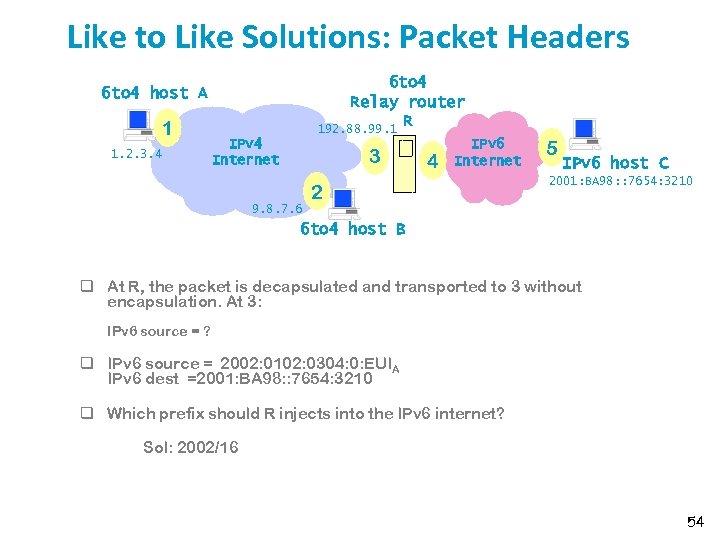 Like to Like Solutions: Packet Headers 6 to 4 Relay router R 192. 88. 99. 1 6 to 4 host A 1 1. 2. 3. 4 IPv 4 Internet 3 4 IPv 6 Internet 2 5 IPv 6 host C 2001: BA 98: : 7654: 3210 9. 8. 7. 6 6 to 4 host B q At R, the packet is decapsulated and transported to 3 without encapsulation. At 3: IPv 6 source = ? q IPv 6 source = 2002: 0102: 0304: 0: EUIA IPv 6 dest =2001: BA 98: : 7654: 3210 q Which prefix should R injects into the IPv 6 internet? Sol: 2002/16 54
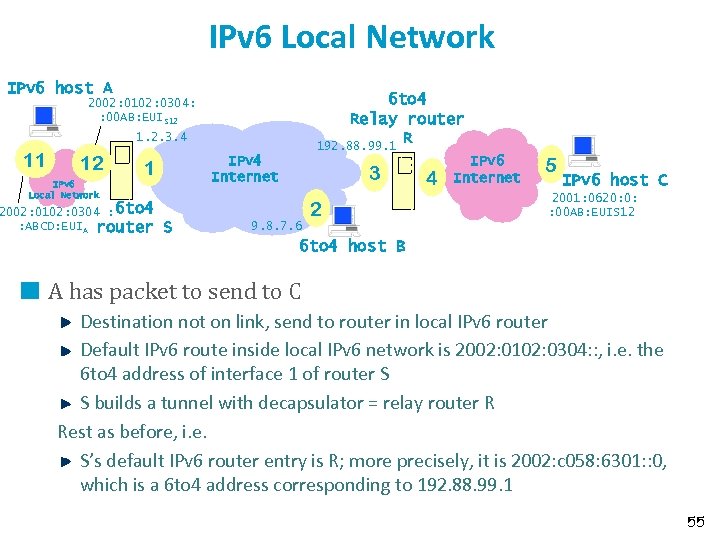 IPv 6 Local Network IPv 6 host A 6 to 4 Relay router R 192. 88. 99. 1 2002: 0102: 0304: : 00 AB: EUIS 12 1. 2. 3. 4 11 12 IPv 4 Internet 1 IPv 6 Local Network 2002: 0102: 0304 : 6 to 4 : ABCD: EUIA router 3 2 S 4 IPv 6 Internet 5 IPv 6 host C 2001: 0620: 0: : 00 AB: EUIS 12 9. 8. 7. 6 6 to 4 host B A has packet to send to C Destination not on link, send to router in local IPv 6 router Default IPv 6 route inside local IPv 6 network is 2002: 0102: 0304: : , i. e. the 6 to 4 address of interface 1 of router S S builds a tunnel with decapsulator = relay router R Rest as before, i. e. S’s default IPv 6 router entry is R; more precisely, it is 2002: c 058: 6301: : 0, which is a 6 to 4 address corresponding to 192. 88. 99. 1 55
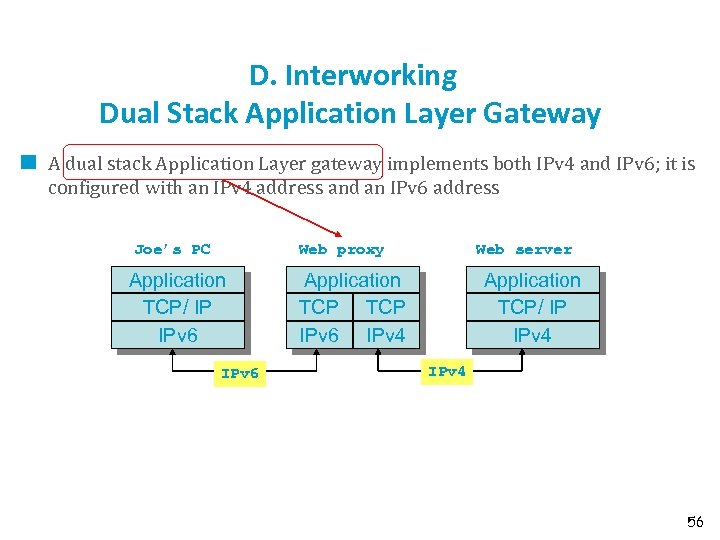 D. Interworking Dual Stack Application Layer Gateway A dual stack Application Layer gateway implements both IPv 4 and IPv 6; it is configured with an IPv 4 address and an IPv 6 address Joe’s PC Web proxy Application TCP/ IP IPv 6 Web server Application TCP IPv 6 IPv 4 Application TCP/ IP IPv 4 56
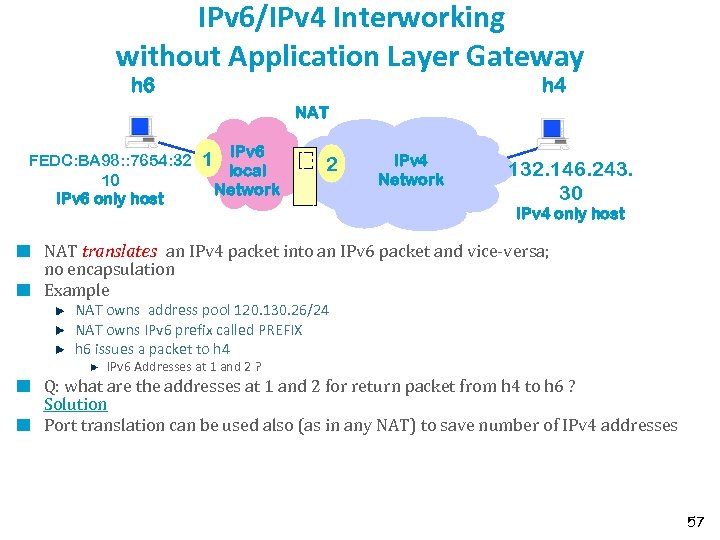 IPv 6/IPv 4 Interworking without Application Layer Gateway h 6 h 4 NAT FEDC: BA 98: : 7654: 32 10 IPv 6 only host 1 IPv 6 local Network 2 IPv 4 Network 132. 146. 243. 30 IPv 4 only host NAT translates an IPv 4 packet into an IPv 6 packet and vice-versa; no encapsulation Example NAT owns address pool 120. 130. 26/24 NAT owns IPv 6 prefix called PREFIX h 6 issues a packet to h 4 IPv 6 Addresses at 1 and 2 ? Q: what are the addresses at 1 and 2 for return packet from h 4 to h 6 ? Solution Port translation can be used also (as in any NAT) to save number of IPv 4 addresses 57
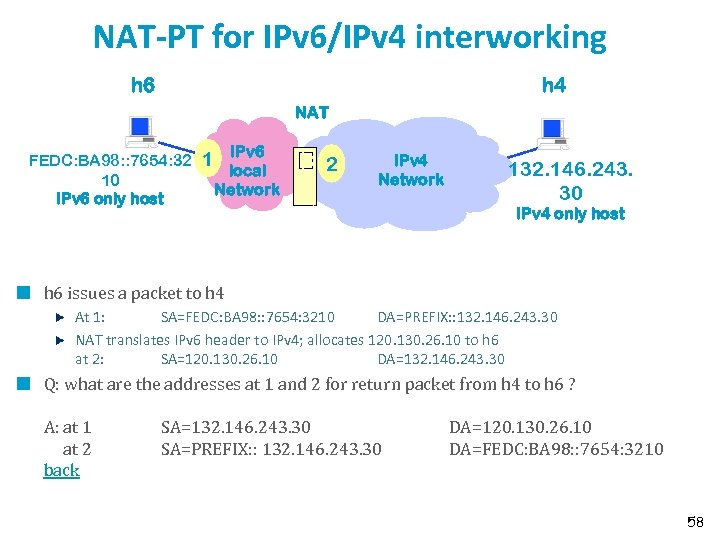 NAT-PT for IPv 6/IPv 4 interworking h 6 h 4 NAT FEDC: BA 98: : 7654: 32 10 IPv 6 only host 1 IPv 6 local Network 2 IPv 4 Network 132. 146. 243. 30 IPv 4 only host h 6 issues a packet to h 4 At 1: SA=FEDC: BA 98: : 7654: 3210 DA=PREFIX: : 132. 146. 243. 30 NAT translates IPv 6 header to IPv 4; allocates 120. 130. 26. 10 to h 6 at 2: SA=120. 130. 26. 10 DA=132. 146. 243. 30 Q: what are the addresses at 1 and 2 for return packet from h 4 to h 6 ? A: at 1 at 2 back SA=132. 146. 243. 30 SA=PREFIX: : 132. 146. 243. 30 DA=120. 130. 26. 10 DA=FEDC: BA 98: : 7654: 3210 58
 Limitations of NAT solutions Requires DNS interworking NAT needs to intercept DNS queries Is not transparent to all applications NAT must know where IP addresses are used by applications and modify them (as with ftp) 59
 IPv 6 Section 4 ROUTING IMPLICATIONS 60
 Ships in the Night There is an IPv 4 Internet and an IPv 6 internet But… most routers will become dual stack IPv 4/IPv 6 i. e. the IPv 4 Internet and IPv 6 Internet share much of the same infrastructure Common practice is to separate the routing processes (“ships in the night”) One routing protocol and routing process for IPv 4 (e. g. OSPFv 2) and one for IPv 6 (e. g. OSPFv 3) An integrated protocol is possible (IS-IS) but is considerd risky 61
 Avoid Injecting IPv 4 Routes into IPv 6 Q: give an example where IPv 4 addresses could be injected into the IPv 6 internet. Q: is this not the same as separating the routing processes ? 62
 Avoid Injecting IPv 4 Routes into IPv 6 Q: give an example where IPv 4 addresses could be injected into the IPv 6 internet. A: 6 to 4 addresses are valid IPv 6 addresses derived from valid IPv 4 addresses. A 6 to 4 relay router could either inject for example 2002: 80 b 2: 9 c 26/48 or only 2002/16. In the former case, IPv 4 addresses are injected into the IPv 6 internet. This should be avoided. Q: is this not the same as separating the routing processes ? A: no. Injection means that IPv 6 routing tables contain information that comes from the IPv 4 internet. Current practice is to avoid injecting IPv 4 routes into IPv 6 in order to keep the benefits of aggregation in IPv 6 (keep IPv 6 routing tables small) 63
 IPv 6 Section 5 RECAP 64
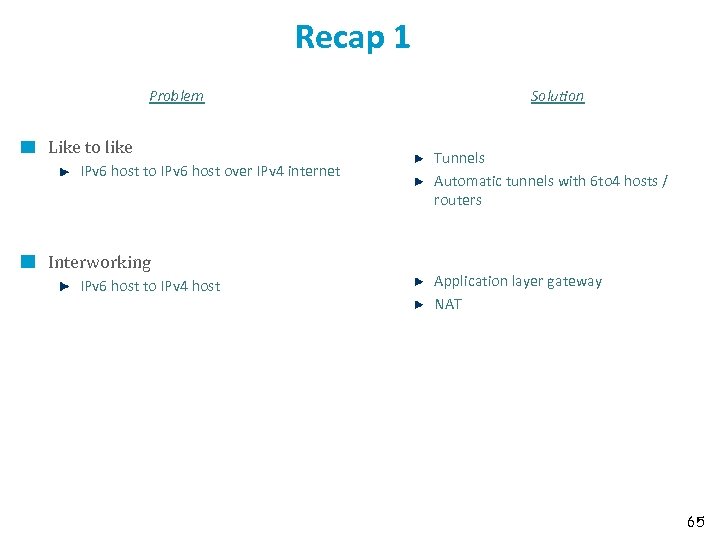 Recap 1 Problem Like to like IPv 6 host to IPv 6 host over IPv 4 internet Interworking IPv 6 host to IPv 4 host Solution Tunnels Automatic tunnels with 6 to 4 hosts / routers Application layer gateway NAT 65
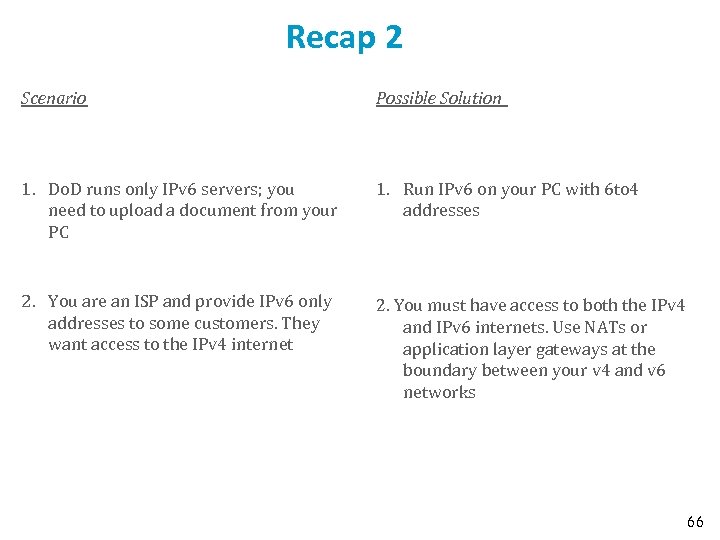 Recap 2 Scenario Possible Solution 1. Do. D runs only IPv 6 servers; you need to upload a document from your PC 1. Run IPv 6 on your PC with 6 to 4 addresses 2. You are an ISP and provide IPv 6 only addresses to some customers. They want access to the IPv 4 internet 2. You must have access to both the IPv 4 and IPv 6 internets. Use NATs or application layer gateways at the boundary between your v 4 and v 6 networks 66
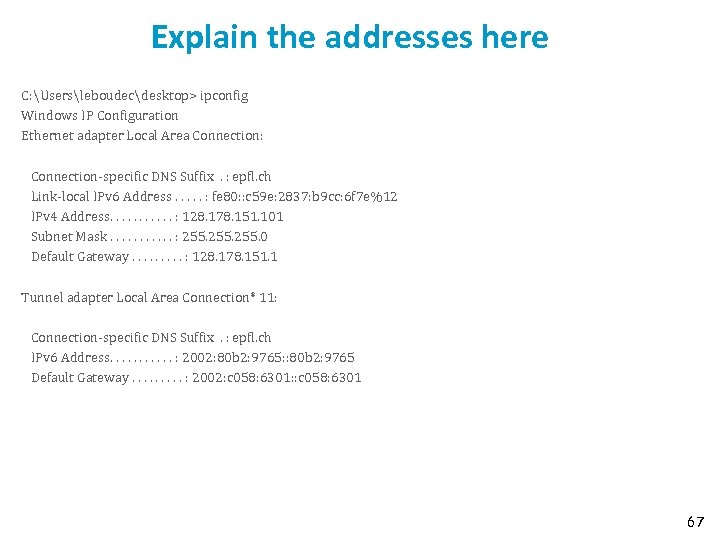 Explain the addresses here C: Usersleboudecdesktop> ipconfig Windows IP Configuration Ethernet adapter Local Area Connection: Connection-specific DNS Suffix . : epfl. ch Link-local IPv 6 Address. . . : fe 80: : c 59 e: 2837: b 9 cc: 6 f 7 e%12 IPv 4 Address. . . : 128. 178. 151. 101 Subnet Mask. . . : 255. 0 Default Gateway. . : 128. 178. 151. 1 Tunnel adapter Local Area Connection* 11: Connection-specific DNS Suffix . : epfl. ch IPv 6 Address. . . : 2002: 80 b 2: 9765: : 80 b 2: 9765 Default Gateway. . : 2002: c 058: 6301: : c 058: 6301 67
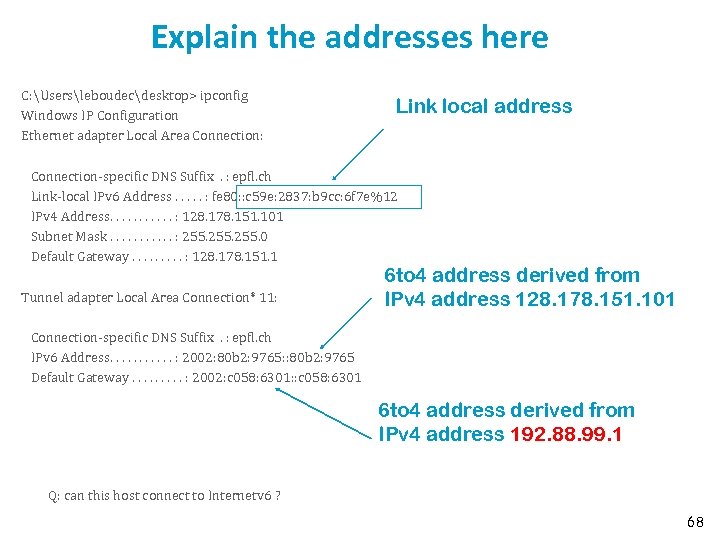 Explain the addresses here C: Usersleboudecdesktop> ipconfig Windows IP Configuration Ethernet adapter Local Area Connection: Link local address Connection-specific DNS Suffix . : epfl. ch Link-local IPv 6 Address. . . : fe 80: : c 59 e: 2837: b 9 cc: 6 f 7 e%12 IPv 4 Address. . . : 128. 178. 151. 101 Subnet Mask. . . : 255. 0 Default Gateway. . : 128. 178. 151. 1 Tunnel adapter Local Area Connection* 11: 6 to 4 address derived from IPv 4 address 128. 178. 151. 101 Connection-specific DNS Suffix . : epfl. ch IPv 6 Address. . . : 2002: 80 b 2: 9765: : 80 b 2: 9765 Default Gateway. . : 2002: c 058: 6301: : c 058: 6301 6 to 4 address derived from IPv 4 address 192. 88. 99. 1 Q: can this host connect to Internetv 6 ? 68
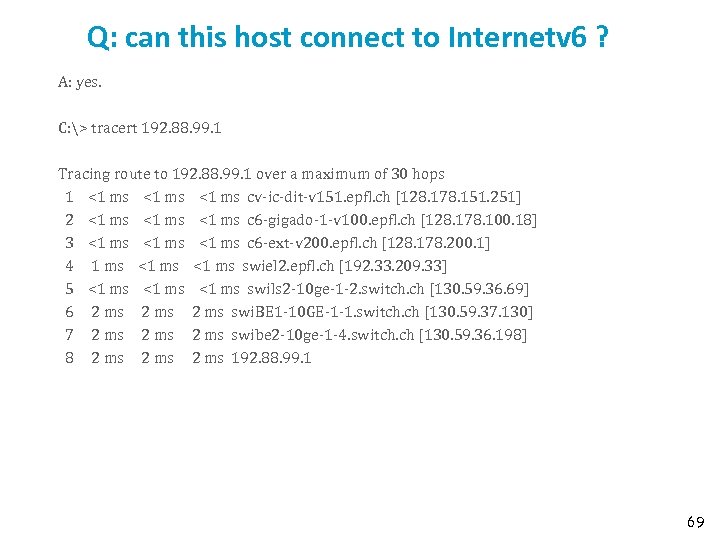 Q: can this host connect to Internetv 6 ? A: yes. C: > tracert 192. 88. 99. 1 Tracing route to 192. 88. 99. 1 over a maximum of 30 hops 1 <1 ms cv-ic-dit-v 151. epfl. ch [128. 178. 151. 251] 2 <1 ms c 6 -gigado-1 -v 100. epfl. ch [128. 178. 100. 18] 3 <1 ms c 6 -ext-v 200. epfl. ch [128. 178. 200. 1] 4 1 ms <1 ms swiel 2. epfl. ch [192. 33. 209. 33] 5 <1 ms swils 2 -10 ge-1 -2. switch. ch [130. 59. 36. 69] 6 2 ms swi. BE 1 -10 GE-1 -1. switch. ch [130. 59. 37. 130] 7 2 ms swibe 2 -10 ge-1 -4. switch. ch [130. 59. 36. 198] 8 2 ms 192. 88. 99. 1 69
 Problems solved by Interworking at Application Layer Q. Review the problems posed by the deployment of IPv 6 and discuss whether this dual stack approach solves them. 70
 Problems solved by Interworking at Application Layer Q. Review the problems posed by the deployment of IPv 6 and discuss whether this dual stack approach solves them. A. 1. PCs deployed with only IPv 6 addresses (IPv 4 address exhaustion). They can access the IPv 6 services directly. For services provided by IPv 4 servers, they have no access, except if the server is dual stack. This is OK for email, as the PC connects to its local server, which we assume runs both IPv 6 and IPv 4. In contrast, web access requires something else: web proxies that run both IPv 6 and IPv 4. 2. This solution does not solve the problem of interconnecting IPv 6 devices over a network of IPv 4 only routers, and vice-versa. 71
 Conclusions IPv 6 is IP with a larger address space Is incompatible with IPv 6 Co-existence with IPv 4 will involve Dual stack gateways or NATs for interworking Tunnels, 6 to 4 addresses and 6 to 4 routers for like to like 72
 To Know More IETF (www. ietf. org) working group “v 6 ops” http: //www. 6 diss. org/ 73