


 Скачать презентацию The International Linear Collider Physics Detector Accelerator R
a8abe7360d1b9948891f4be24d9e6a7a.ppt
- Количество слайдов: 56
 The International Linear Collider Physics Detector Accelerator R. -D. Heuer (Univ. Hamburg) Maria Laach, September 2005
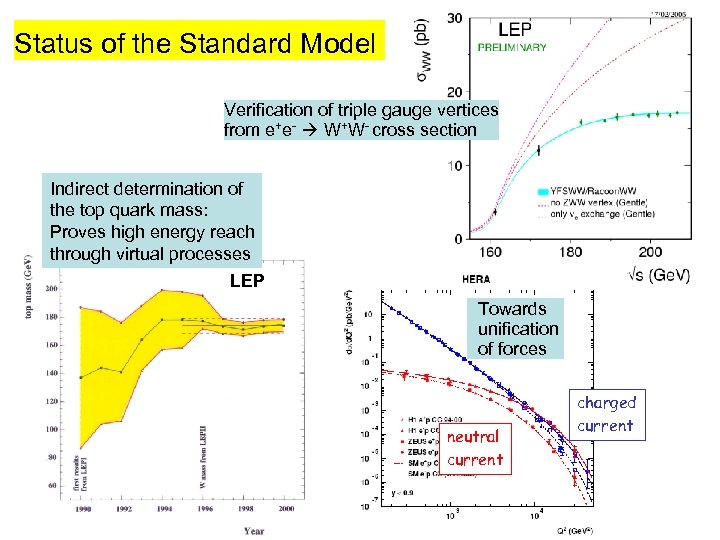 Status of the Standard Model Verification of triple gauge vertices from e+e- W+W- cross section Indirect determination of the top quark mass: Proves high energy reach through virtual processes LEP Towards unification of forces neutral current charged current
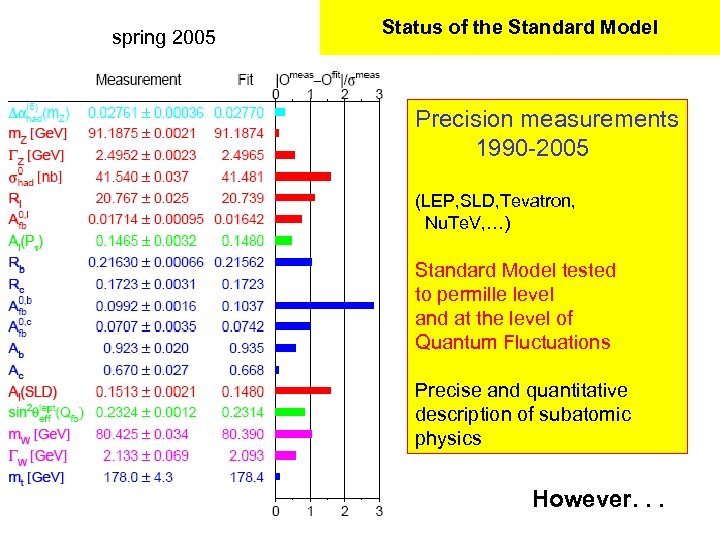 spring 2005 Status of the Standard Model Precision measurements 1990 -2005 (LEP, SLD, Tevatron, Nu. Te. V, …) Standard Model tested to permille level and at the level of Quantum Fluctuations Precise and quantitative description of subatomic physics However. . .
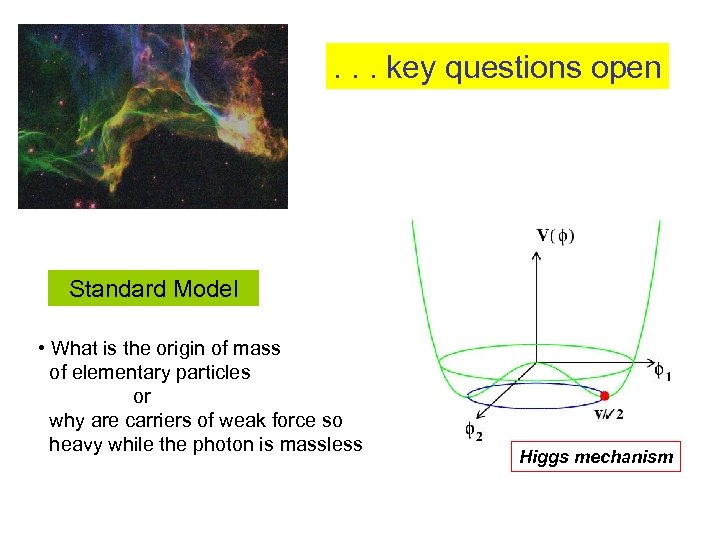 . . . key questions open Standard Model • What is the origin of mass of elementary particles or why are carriers of weak force so heavy while the photon is massless Higgs mechanism
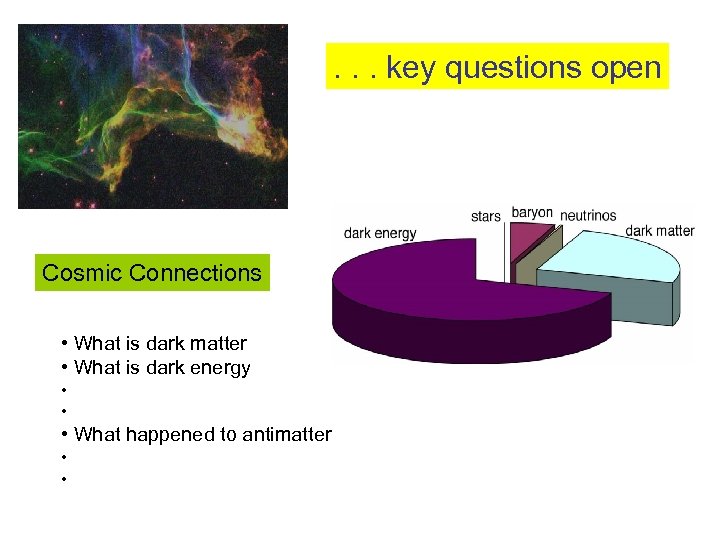 . . . key questions open Cosmic Connections • What is dark matter • What is dark energy • • • What happened to antimatter • •
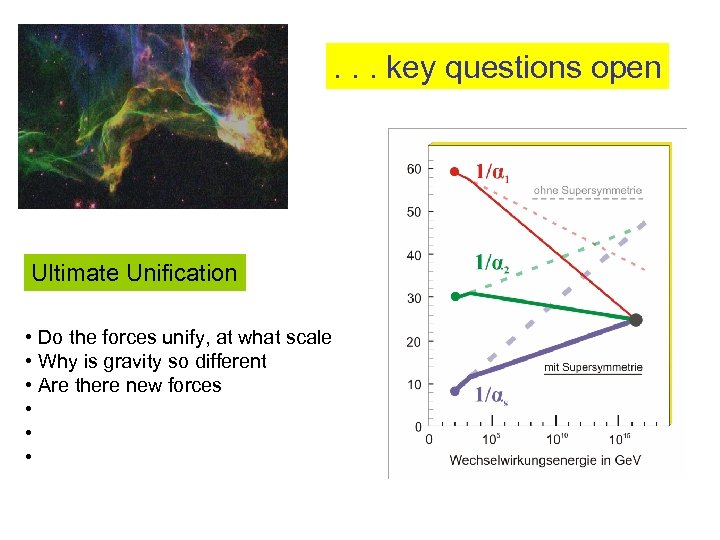 . . . key questions open Open key questions Ultimate Unification • Do the forces unify, at what scale • Why is gravity so different • Are there new forces • • •
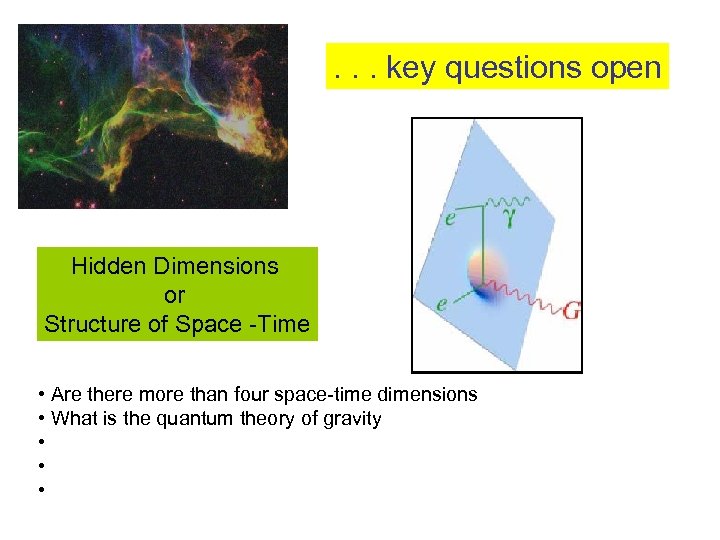 . Open key questions. . key questions open Hidden Dimensions or Structure of Space -Time • Are there more than four space-time dimensions • What is the quantum theory of gravity • • •
 The next steps at the energy frontier There are two distinct and complementary strategies for gaining new understanding of matter, space and time at future particle accelerators HIGH ENERGY direct discovery of new phenomena i. e. accelerators operating at the energy scale of the new particle HIGH PRECISION interference of new physics at high energies through the precision measurement of phenomena at lower scales Both strategies have worked well together → much more complete understanding than from either one alone prime example: LEP / Tevatron
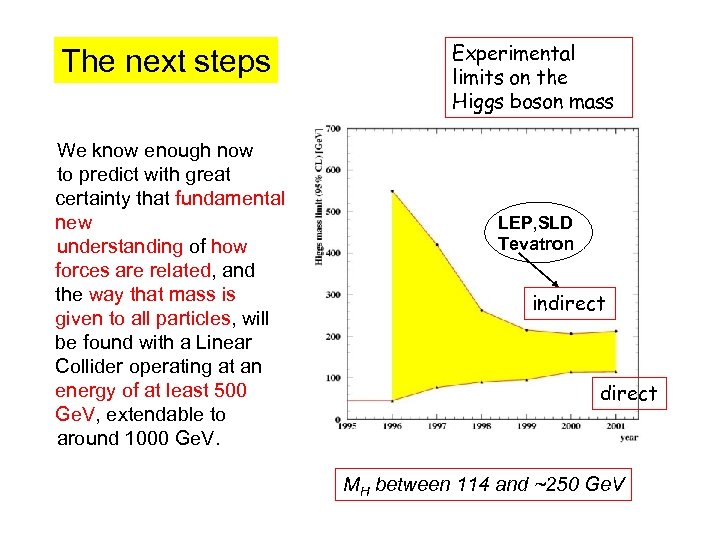 The next steps We know enough now to predict with great certainty that fundamental new understanding of how forces are related, and the way that mass is given to all particles, will be found with a Linear Collider operating at an energy of at least 500 Ge. V, extendable to around 1000 Ge. V. Experimental limits on the Higgs boson mass LEP, SLD Tevatron indirect MH between 114 and ~250 Ge. V
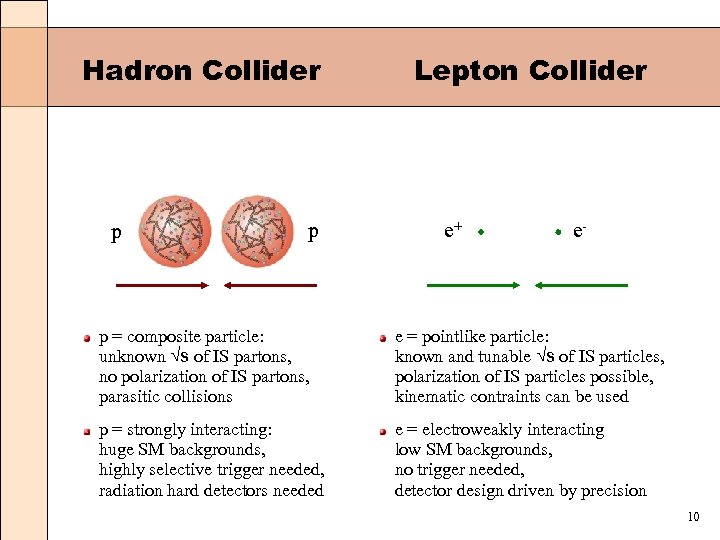 Hadron Collider p p Lepton Collider e+ e- p = composite particle: unknown s of IS partons, no polarization of IS partons, parasitic collisions e = pointlike particle: known and tunable s of IS particles, polarization of IS particles possible, kinematic contraints can be used p = strongly interacting: huge SM backgrounds, highly selective trigger needed, radiation hard detectors needed e = electroweakly interacting low SM backgrounds, no trigger needed, detector design driven by precision 10
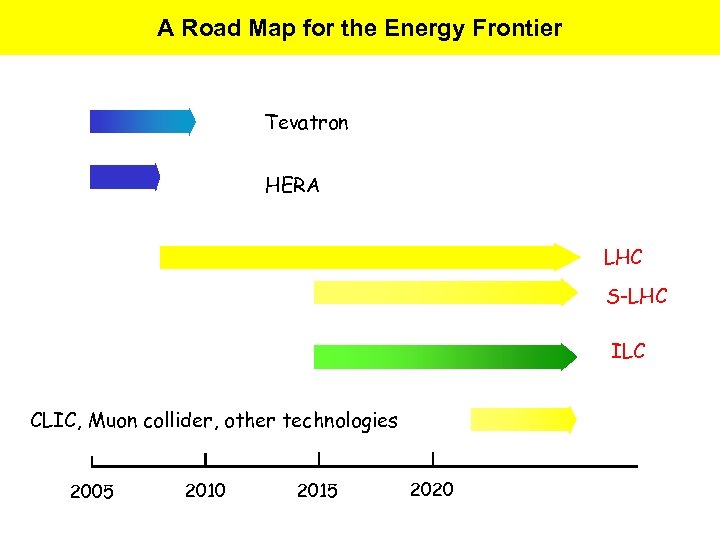 A Road Map for the Energy Frontier Tevatron HERA LHC S-LHC ILC CLIC, Muon collider, other technologies 2005 2010 2015 2020
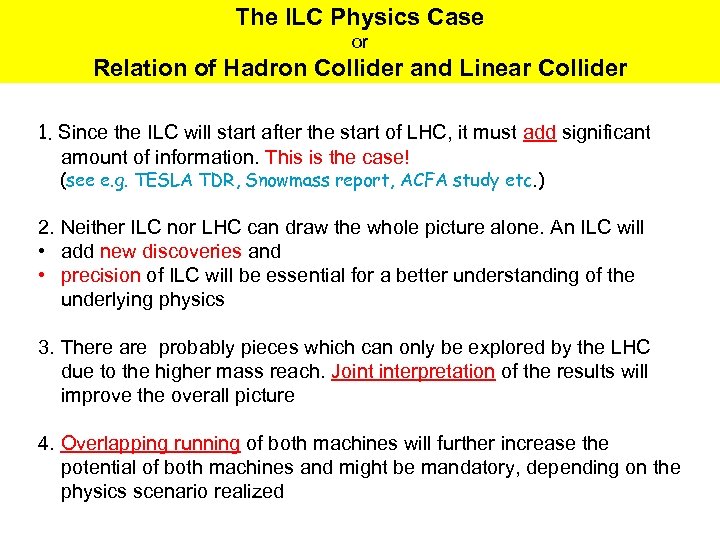 The ILC Physics Case or Relation of Hadron Collider and Linear Collider 1. Since the ILC will start after the start of LHC, it must add significant amount of information. This is the case! (see e. g. TESLA TDR, Snowmass report, ACFA study etc. ) 2. Neither ILC nor LHC can draw the whole picture alone. An ILC will • add new discoveries and • precision of ILC will be essential for a better understanding of the underlying physics 3. There are probably pieces which can only be explored by the LHC due to the higher mass reach. Joint interpretation of the results will improve the overall picture 4. Overlapping running of both machines will further increase the potential of both machines and might be mandatory, depending on the physics scenario realized
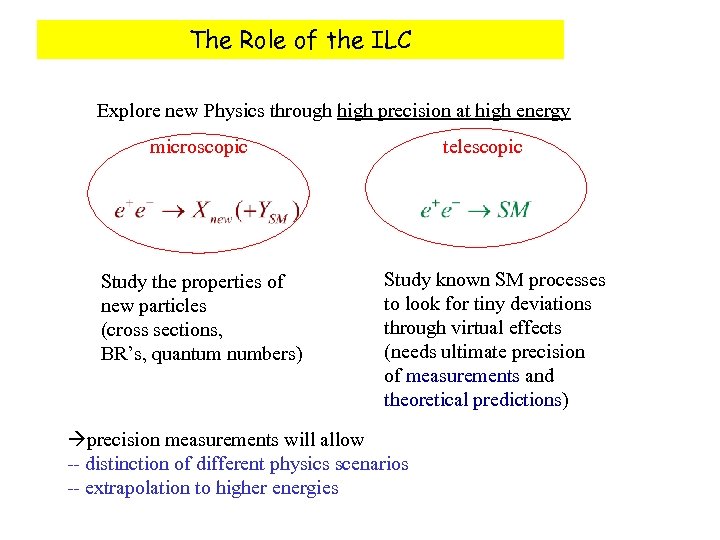 The Role of the ILC Explore new Physics through high precision at high energy microscopic Study the properties of new particles (cross sections, BR’s, quantum numbers) telescopic Study known SM processes to look for tiny deviations through virtual effects (needs ultimate precision of measurements and theoretical predictions) precision measurements will allow -- distinction of different physics scenarios -- extrapolation to higher energies
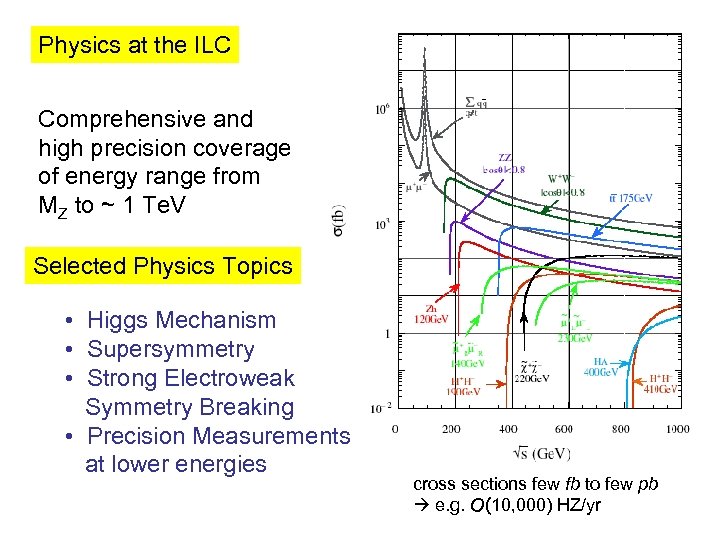 Physics at the ILC Comprehensive and high precision coverage of energy range from MZ to ~ 1 Te. V Selected Physics Topics • Higgs Mechanism • Supersymmetry • Strong Electroweak Symmetry Breaking • Precision Measurements at lower energies cross sections few fb to few pb e. g. O(10, 000) HZ/yr
 Standard Model (SM): Gauge theory Problem: Gauge invariance only possible for massless gauge bosons Introducing mass terms in the SM Lagrangian “by hand” violates SU(2)x. U(1) gauge symmetry SM solution: introduction of a scalar background field (Higgs-field) = Dynamical generation of mass terms Analogy: Supra conductivity 15
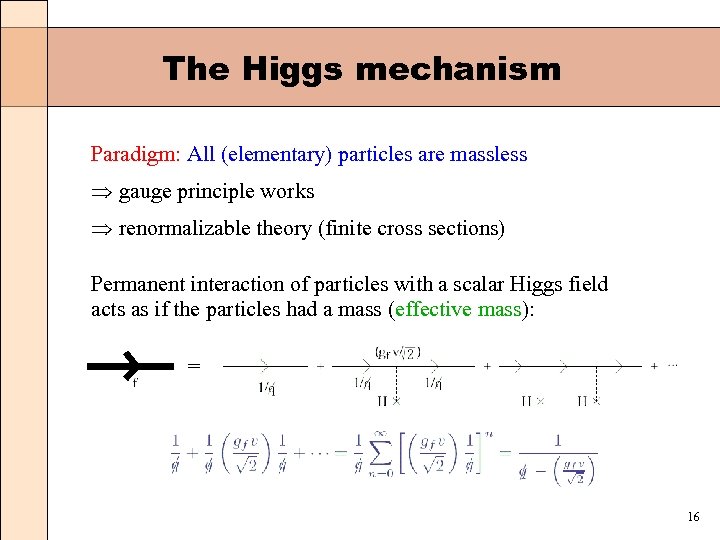 The Higgs mechanism Paradigm: All (elementary) particles are massless gauge principle works renormalizable theory (finite cross sections) Permanent interaction of particles with a scalar Higgs field acts as if the particles had a mass (effective mass): = 16



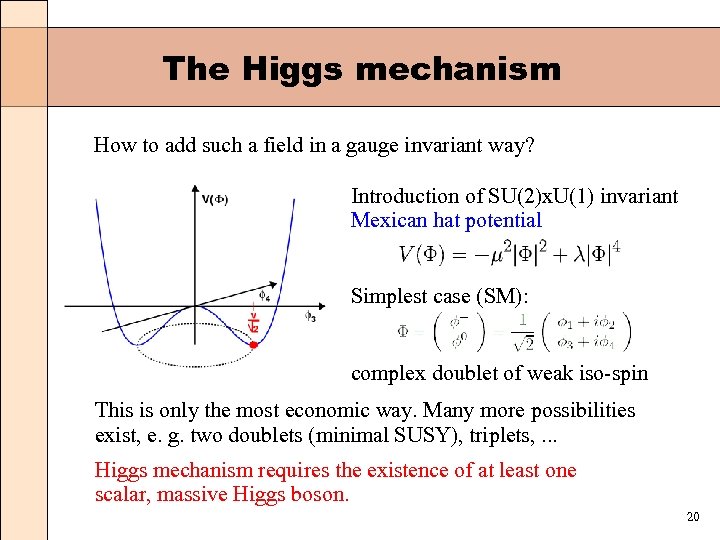 The Higgs mechanism How to add such a field in a gauge invariant way? Introduction of SU(2)x. U(1) invariant Mexican hat potential Simplest case (SM): complex doublet of weak iso-spin This is only the most economic way. Many more possibilities exist, e. g. two doublets (minimal SUSY), triplets, . . . Higgs mechanism requires the existence of at least one scalar, massive Higgs boson. 20


 Tasks at the ILC Establishing the Higgs mechanism as being responsible for EW symmetry breaking requires more than discovering one or more Higgs bosons and measuring its/their mass(es). Precision measurements must comprise: Mass Total width Quantum numbers JCP (Spin, CP even? ) Higgs-fermion couplings ( mass? ) Higgs-gauge-boson couplings (W/Z masses) Higgs self-coupling (spontaneous symmetry breaking) Precision should be sufficient to distinguish between different models (e. g. SM/MSSM, effects from XD, . . . ) 23
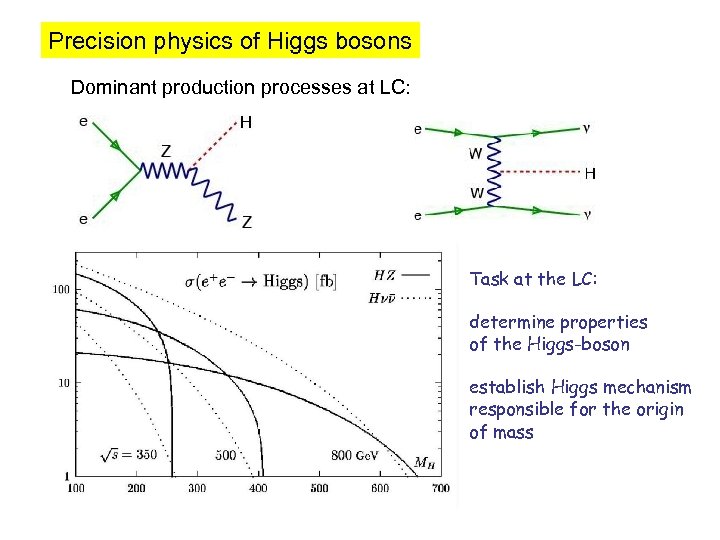 Precision physics of Higgs bosons Dominant production processes at LC: Task at the LC: determine properties of the Higgs-boson establish Higgs mechanism responsible for the origin of mass
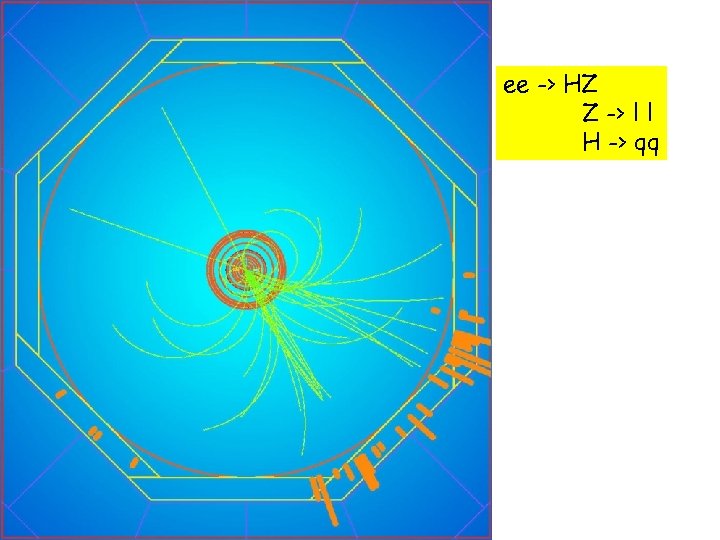
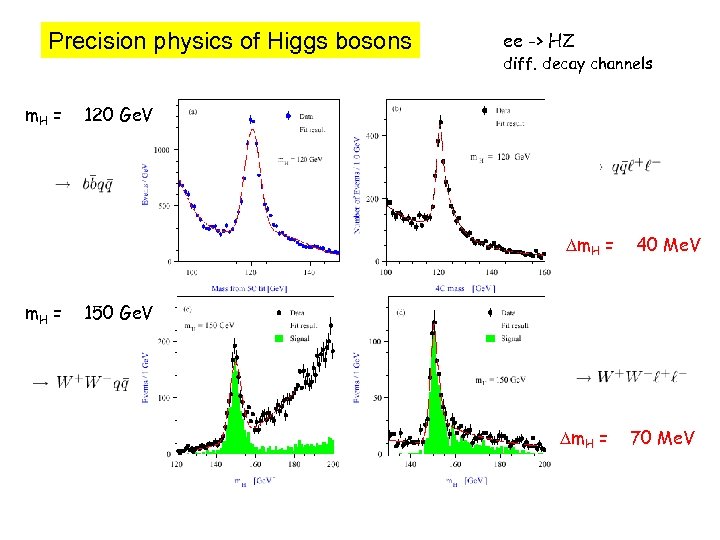
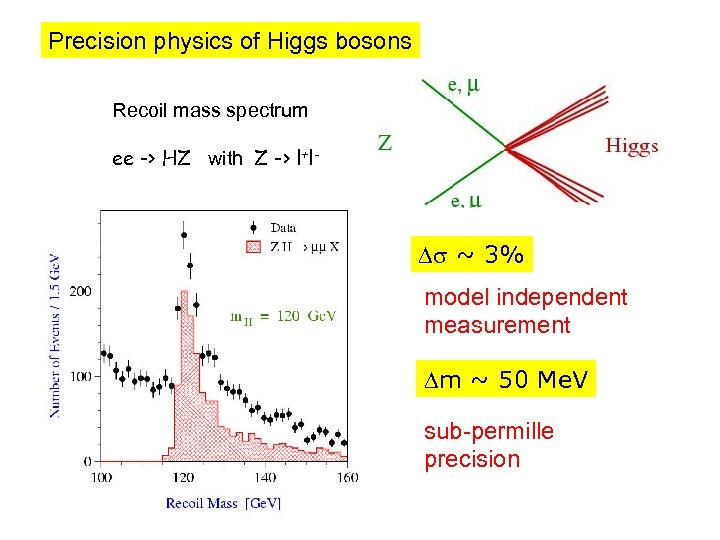 Precision physics of Higgs bosons Recoil mass spectrum ee -> HZ with Z -> l+l- Ds ~ 3% model independent measurement Dm ~ 50 Me. V sub-permille precision
 ee -> HZ Z -> l l H -> qq
 Precision physics of Higgs bosons m. H = ee -> HZ diff. decay channels 120 Ge. V Dm. H = 40 Me. V 150 Ge. V Dm. H = 70 Me. V
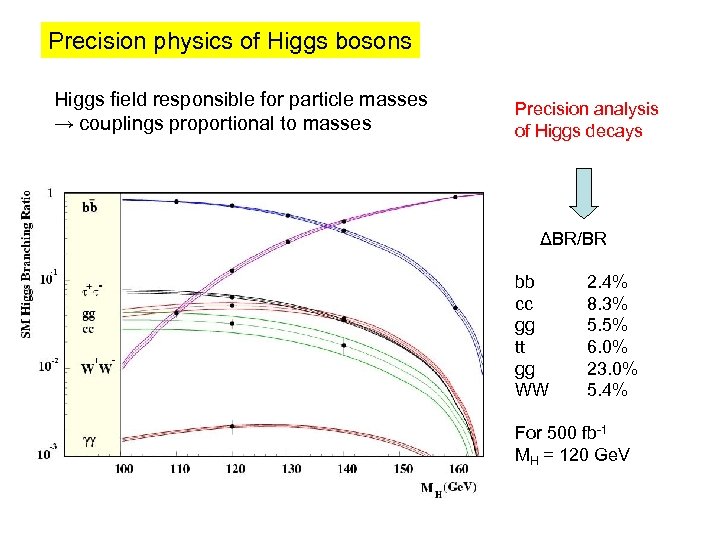 Precision physics of Higgs bosons Higgs field responsible for particle masses → couplings proportional to masses Precision analysis of Higgs decays ΔBR/BR bb cc gg tt gg WW 2. 4% 8. 3% 5. 5% 6. 0% 23. 0% 5. 4% For 500 fb-1 MH = 120 Ge. V
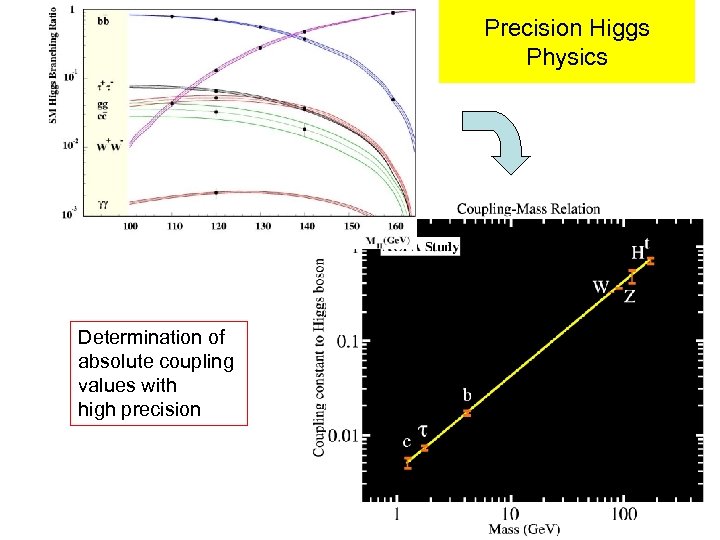 Precision Higgs Physics Determination of absolute coupling values with high precision
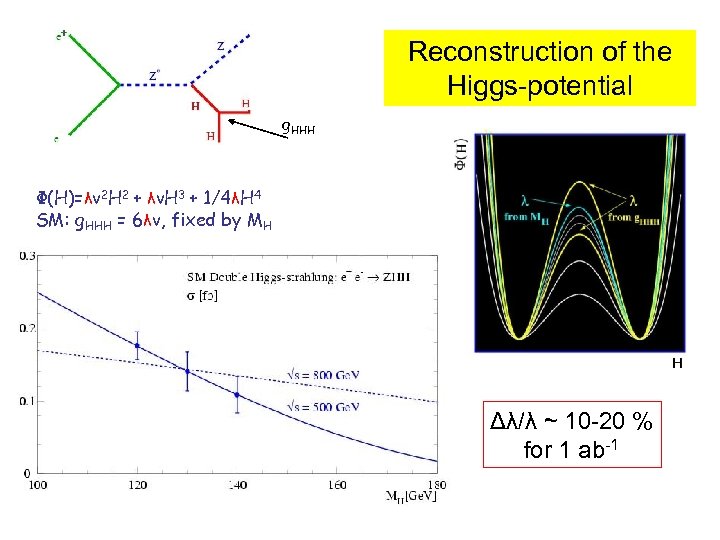 Reconstruction of the Higgs-potential g. HHH Φ(H)=λv 2 H 2 + λv. H 3 + 1/4λH 4 SM: g. HHH = 6λv, fixed by MH Δλ/λ ~ 10 -20 % for 1 ab-1
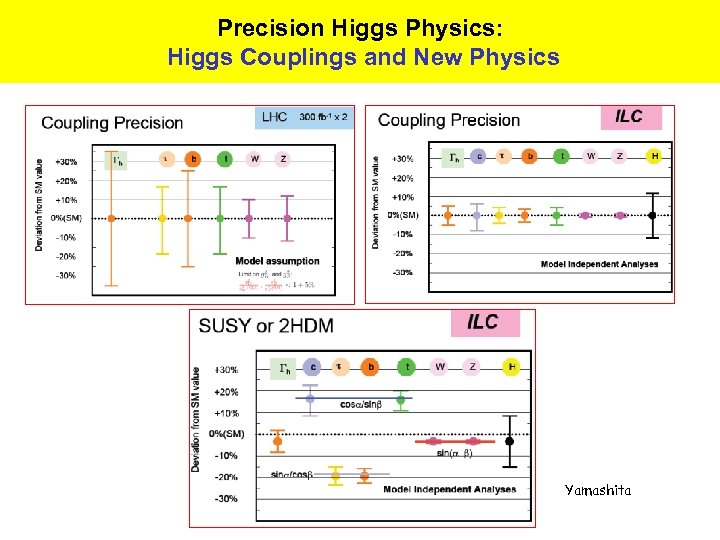 Precision Higgs Physics: Higgs Couplings and New Physics Yamashita
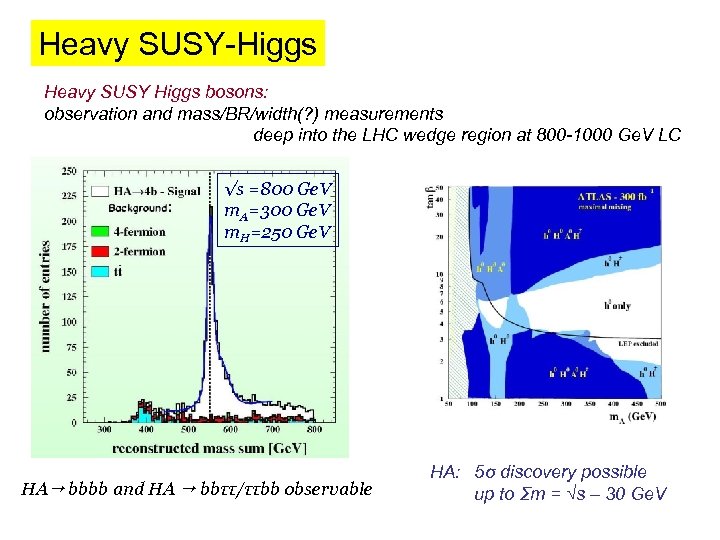 Heavy SUSY-Higgs Heavy SUSY Higgs bosons: observation and mass/BR/width(? ) measurements deep into the LHC wedge region at 800 -1000 Ge. V LC √s =800 Ge. V m. A=300 Ge. V m. H=250 Ge. V HA bbbb and HA bbττ/ττbb observable HA: 5σ discovery possible up to Σm = √s – 30 Ge. V
 Precision physics of Higgs bosons Conclusion precision measurements at the ILC together with the results from LHC are crucial to establish the Higgs mechanism responsible for the origin of mass and for revealing the character of the Higgs boson if the electroweak symmetry is broken in a more complicated way then foreseen in the Standard Model the LC measurements strongly constrain the alternative model
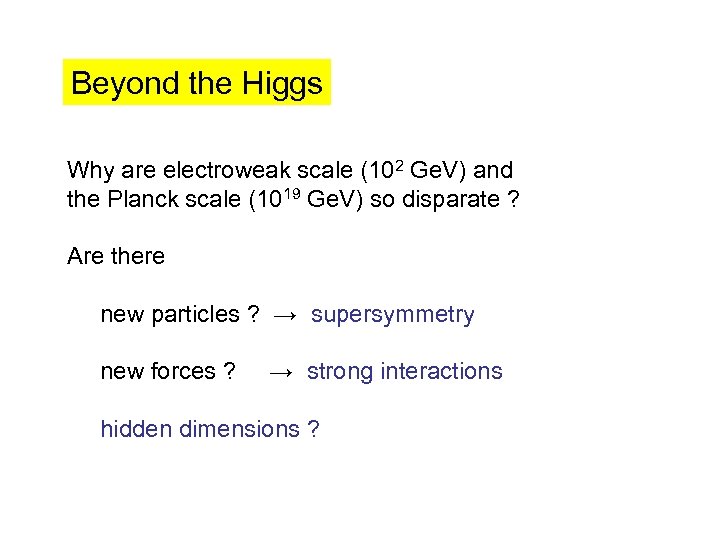 Beyond the Higgs Why are electroweak scale (102 Ge. V) and the Planck scale (1019 Ge. V) so disparate ? Are there new particles ? → supersymmetry new forces ? → strong interactions hidden dimensions ?
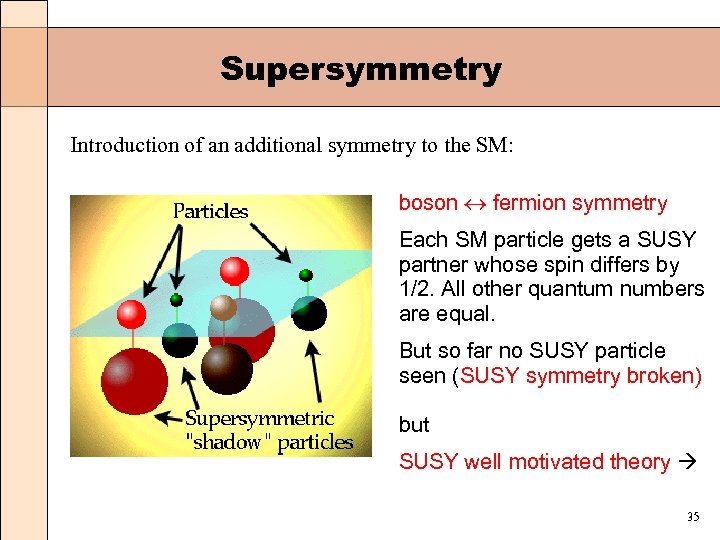 Supersymmetry Introduction of an additional symmetry to the SM: boson fermion symmetry Each SM particle gets a SUSY partner whose spin differs by 1/2. All other quantum numbers are equal. But so far no SUSY particle seen (SUSY symmetry broken) but SUSY well motivated theory 35
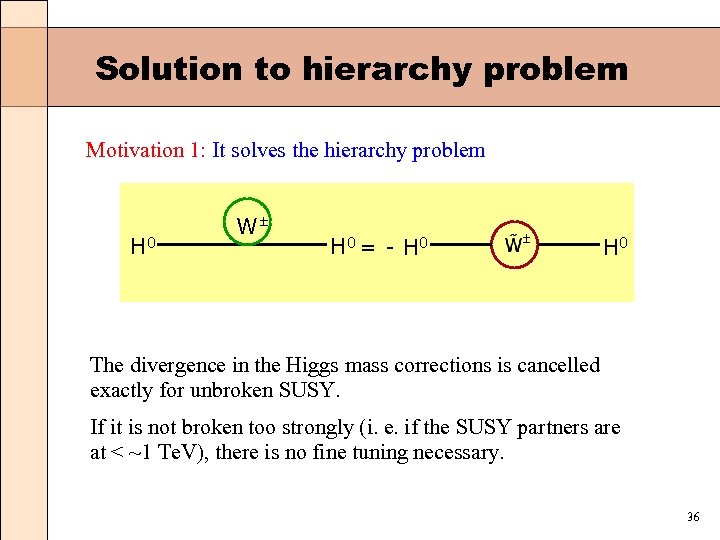 Solution to hierarchy problem Motivation 1: It solves the hierarchy problem H 0 W± H 0 = - H 0 The divergence in the Higgs mass corrections is cancelled exactly for unbroken SUSY. If it is not broken too strongly (i. e. if the SUSY partners are at < ~1 Te. V), there is no fine tuning necessary. 36
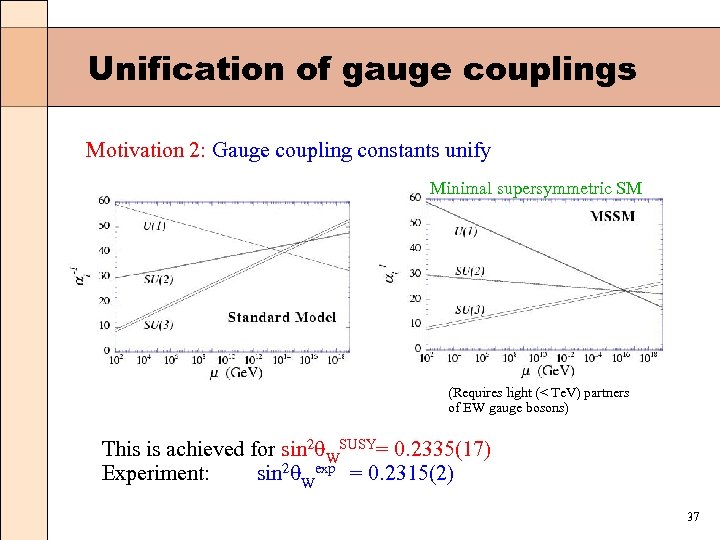 Unification of gauge couplings Motivation 2: Gauge coupling constants unify Minimal supersymmetric SM (Requires light (< Te. V) partners of EW gauge bosons) This is achieved for sin 2 q. WSUSY= 0. 2335(17) Experiment: sin 2 q. Wexp = 0. 2315(2) 37
 More good reasons. . . Motivation 3: Provides cold dark matter candidate If lightest SUSY particle is stable, it is an excellent dark matter candidate Motivation 4: Link to gravity SUSY offers theoretical link to incorporate gravity. Most string models are supersymmetric. Motivation 5: Predicts light Higgs boson SUSY predicts a light (< 135 Ge. V) Higgs boson as favored by EW precision data. 38
 Supersymmetry ● best motivated extension of SM grand unification – connection to gravity – light Higgs – sin 2ΘW dark matter candidate – …. ● mass spectrum depends on the unknown breaking scheme ● LC task for SUSY reconstruction of kinematically accessible sparticle spectrum i. e. measure sparticle properties (masses, Xsections, spin-parity) extract fundamental parameters (mass parameters, mixings, couplings) at the weak scale extrapolate to GUT scale using RGEs determine underlying supersymmetric model
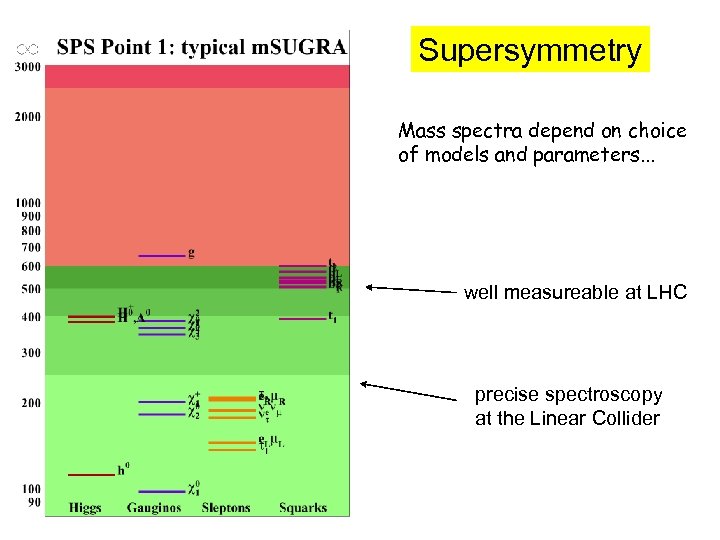 Supersymmetry Mass spectra depend on choice of models and parameters. . . well measureable at LHC precise spectroscopy at the Linear Collider
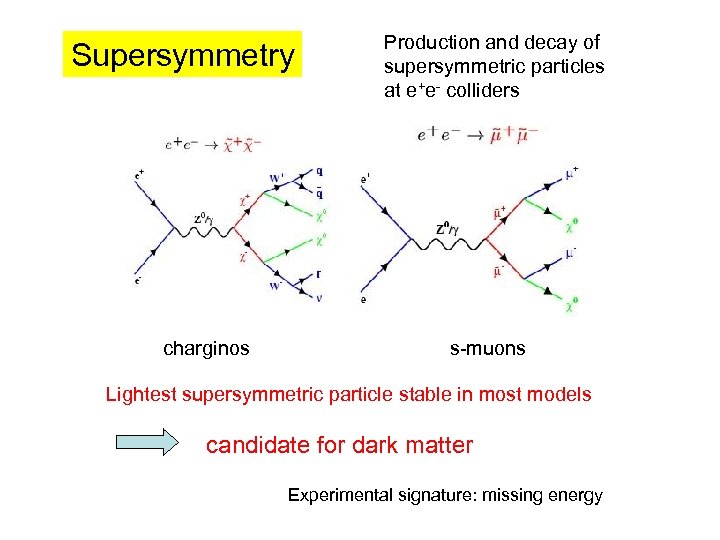 Supersymmetry charginos Production and decay of supersymmetric particles at e+e- colliders s-muons Lightest supersymmetric particle stable in most models candidate for dark matter Experimental signature: missing energy
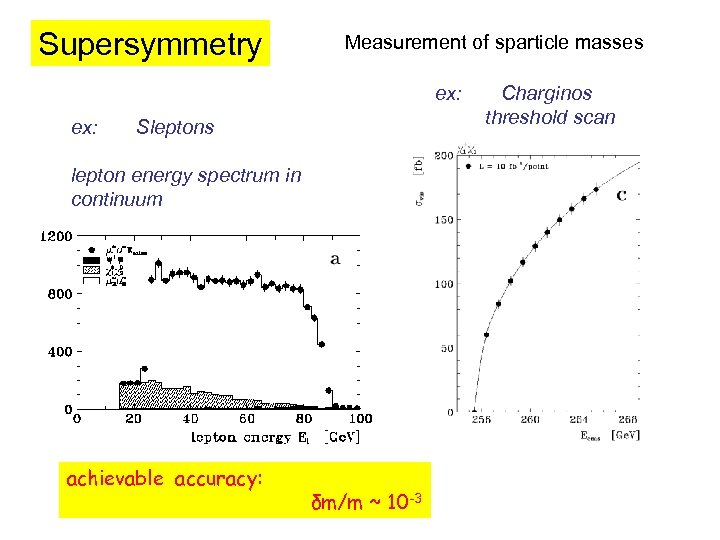 Supersymmetry Measurement of sparticle masses ex: Sleptons lepton energy spectrum in continuum achievable accuracy: δm/m ~ 10 -3 Charginos threshold scan
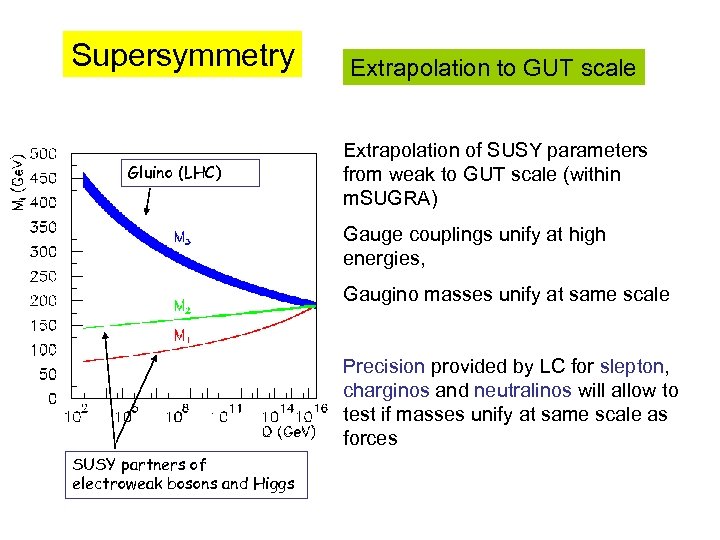 Supersymmetry Gluino (LHC) Extrapolation to GUT scale Extrapolation of SUSY parameters from weak to GUT scale (within m. SUGRA) Gauge couplings unify at high energies, Gaugino masses unify at same scale Precision provided by LC for slepton, charginos and neutralinos will allow to test if masses unify at same scale as forces SUSY partners of electroweak bosons and Higgs
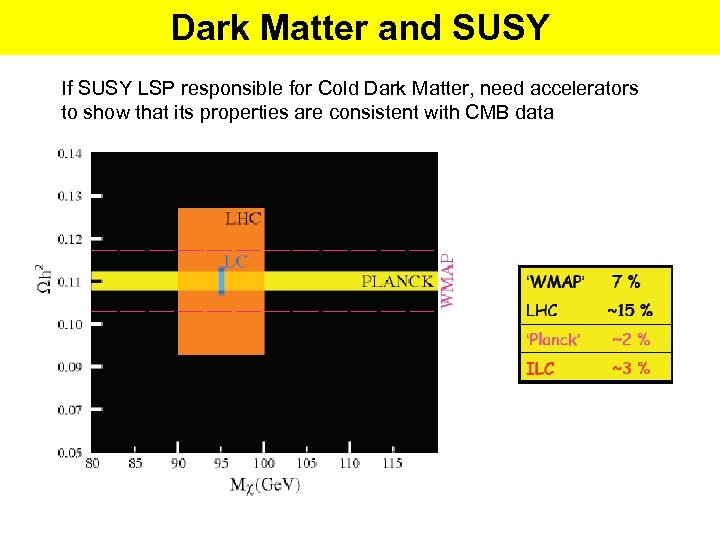 Dark Matter and SUSY If SUSY LSP responsible for Cold Dark Matter, need accelerators to show that its properties are consistent with CMB data
 Supersymmetry Conclusions The Linear Collider will be a unique tool for high precision measurements ● model independent determination of SUSY parameters ● determination of SUSY breaking mechanism ● extrapolation to GUT scale possible but what if ……
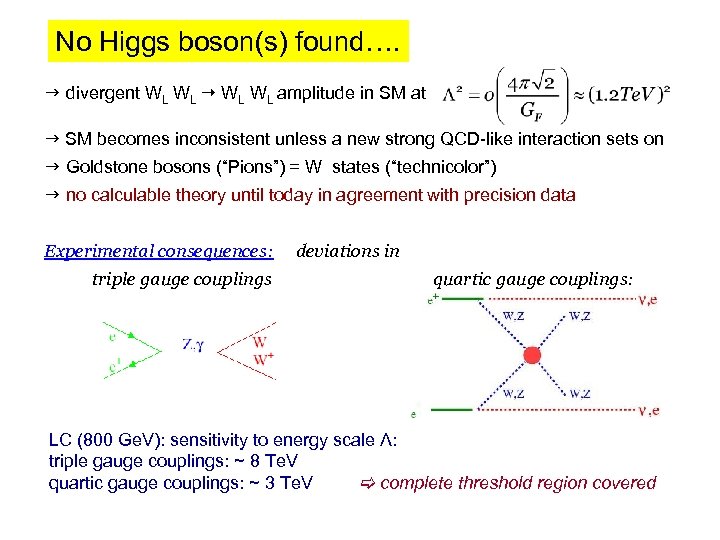 No Higgs boson(s) found…. g divergent WL WL amplitude in SM at g SM becomes inconsistent unless a new strong QCD-like interaction sets on g Goldstone bosons (“Pions”) = W states (“technicolor”) g no calculable theory until today in agreement with precision data Experimental consequences: triple gauge couplings deviations in quartic gauge couplings: LC (800 Ge. V): sensitivity to energy scale Λ: triple gauge couplings: ~ 8 Te. V quartic gauge couplings: ~ 3 Te. V complete threshold region covered
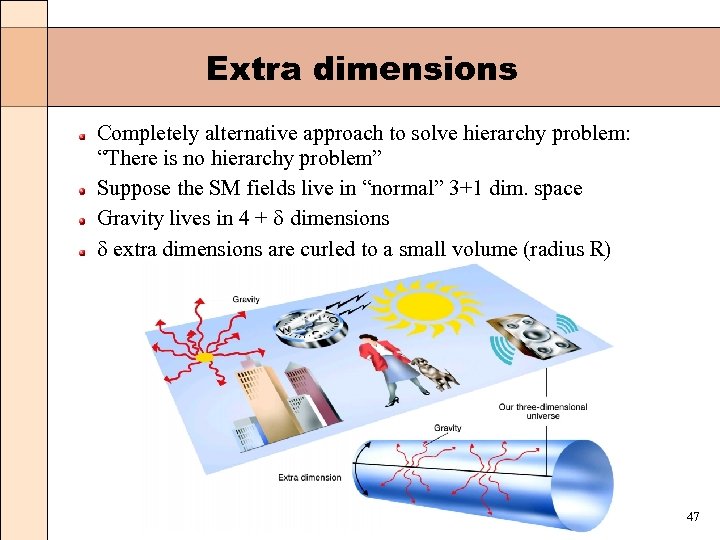 Extra dimensions Completely alternative approach to solve hierarchy problem: “There is no hierarchy problem” Suppose the SM fields live in “normal” 3+1 dim. space Gravity lives in 4 + dimensions extra dimensions are curled to a small volume (radius R) 47
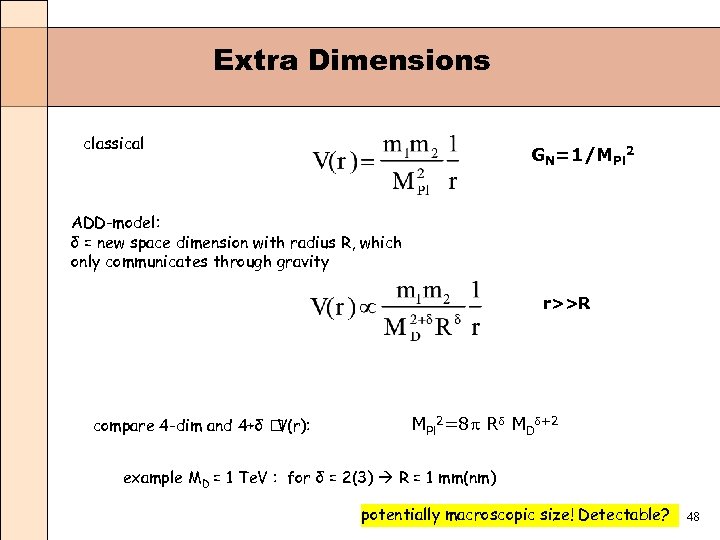 Extra Dimensions classical GN=1/MPl 2 ADD-model: δ = new space dimension with radius R, which only communicates through gravity r>>R compare 4 -dim and 4+δ V(r): MPl 2=8 R MD +2 example MD = 1 Te. V : for δ = 2(3) R = 1 mm(nm) potentially macroscopic size! Detectable? 48
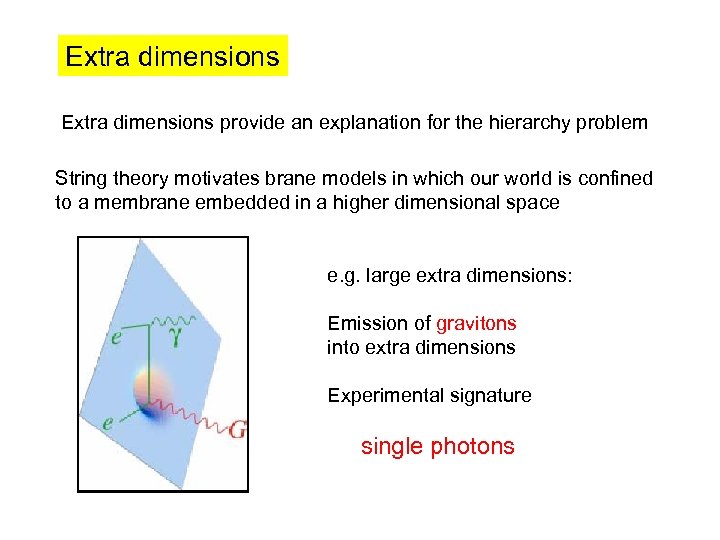 Extra dimensions provide an explanation for the hierarchy problem String theory motivates brane models in which our world is confined to a membrane embedded in a higher dimensional space e. g. large extra dimensions: Emission of gravitons into extra dimensions Experimental signature single photons
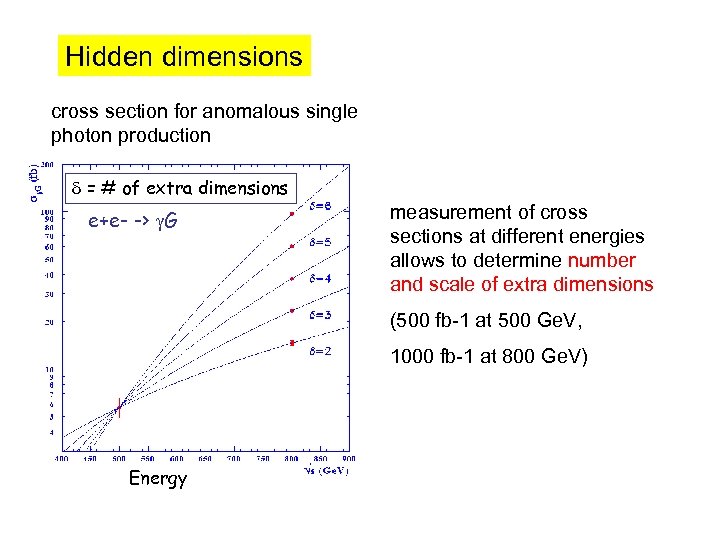 Hidden dimensions cross section for anomalous single photon production = # of extra dimensions e+e- -> g. G measurement of cross sections at different energies allows to determine number and scale of extra dimensions (500 fb-1 at 500 Ge. V, 1000 fb-1 at 800 Ge. V) Energy
 Precision measurements of SM processes 52
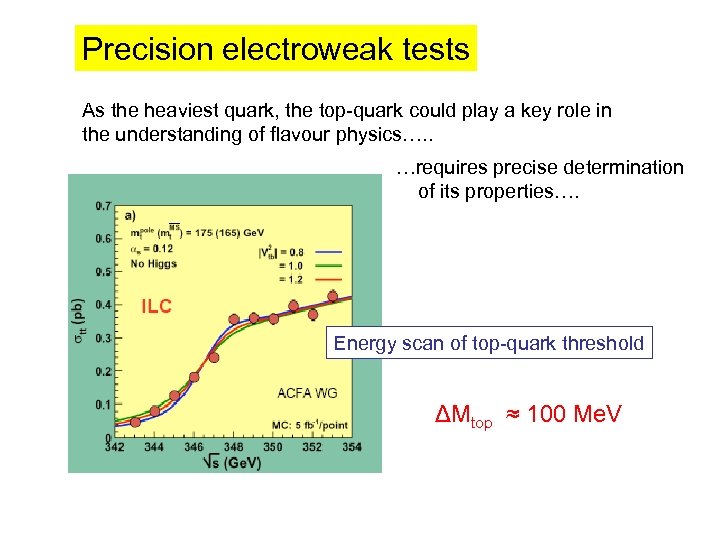 Precision electroweak tests As the heaviest quark, the top-quark could play a key role in the understanding of flavour physics…. . …requires precise determination of its properties…. Energy scan of top-quark threshold ΔMtop ≈ 100 Me. V
 Precision electroweak tests high luminosity running at the Z-pole Giga Z (109 Z/year) ≈ 1000 x “LEP” in 3 months with e- and e+ polarisation ΔsinΘW = 0. 000013 together with ΔMW = 7 Me. V (threshold scan) And ΔMtop = 100 Me. V
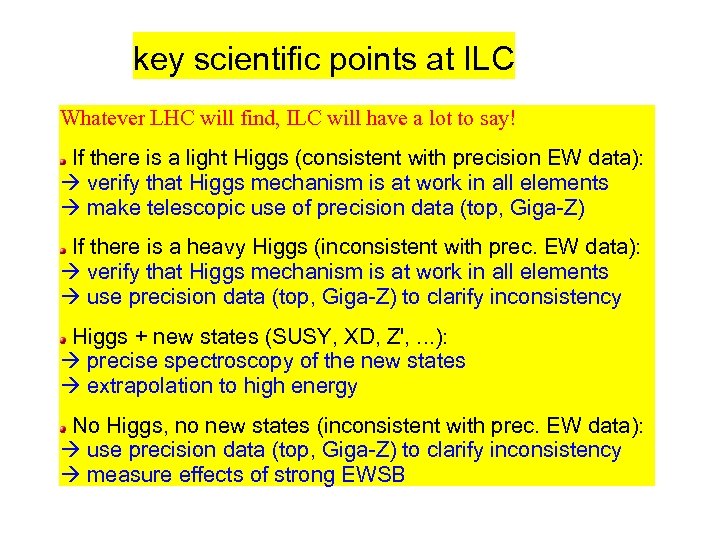 key scientific points at ILC Whatever LHC will find, ILC will have a lot to say! If there is a light Higgs (consistent with precision EW data): verify that Higgs mechanism is at work in all elements make telescopic use of precision data (top, Giga-Z) If there is a heavy Higgs (inconsistent with prec. EW data): verify that Higgs mechanism is at work in all elements use precision data (top, Giga-Z) to clarify inconsistency Higgs + new states (SUSY, XD, Z', . . . ): precise spectroscopy of the new states extrapolation to high energy No Higgs, no new states (inconsistent with prec. EW data): use precision data (top, Giga-Z) to clarify inconsistency measure effects of strong EWSB
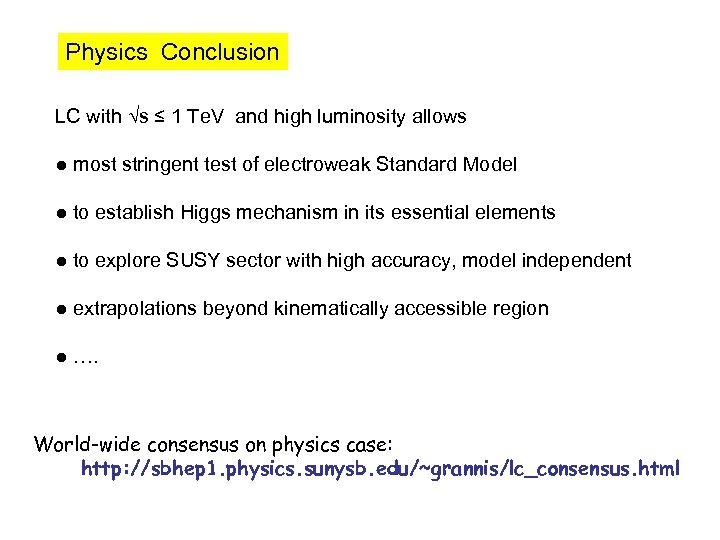 Physics Conclusion LC with √s ≤ 1 Te. V and high luminosity allows ● most stringent test of electroweak Standard Model ● to establish Higgs mechanism in its essential elements ● to explore SUSY sector with high accuracy, model independent ● extrapolations beyond kinematically accessible region ● …. World-wide consensus on physics case: http: //sbhep 1. physics. sunysb. edu/~grannis/lc_consensus. html
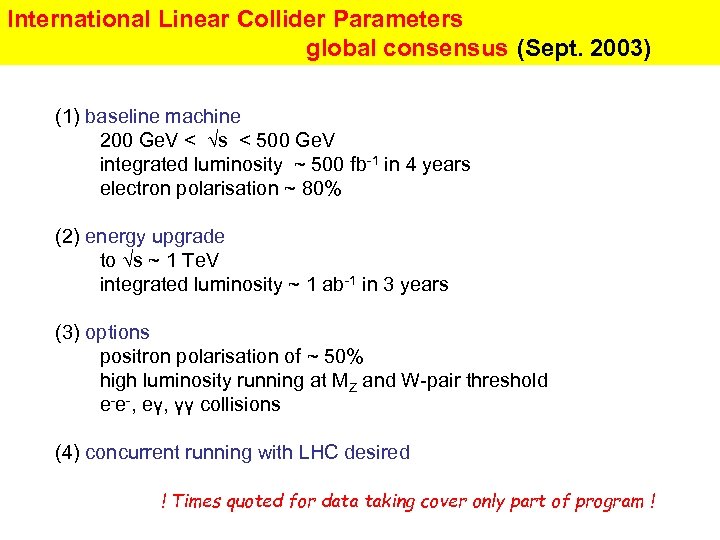 International Linear Collider Parameters global consensus (Sept. 2003) (1) baseline machine 200 Ge. V < √s < 500 Ge. V integrated luminosity ~ 500 fb-1 in 4 years electron polarisation ~ 80% (2) energy upgrade to √s ~ 1 Te. V integrated luminosity ~ 1 ab-1 in 3 years (3) options positron polarisation of ~ 50% high luminosity running at MZ and W-pair threshold e-e-, eγ, γγ collisions (4) concurrent running with LHC desired ! Times quoted for data taking cover only part of program !