 Скачать презентацию The International Legal Environment of Business Chapter 16
373f35817870f84fbbf75c0f4504010d.ppt
- Количество слайдов: 32



The International Legal Environment of Business Chapter 16
U. S. Immigration Policy • Current laws: consider family issues as criteria for allowing immigrants to enter U. S. • Under consideration: focus more on “merit” • Should Congress change the criteria? • Should we deport illegal aliens? If so, should we base decisions on family concerns or merit?
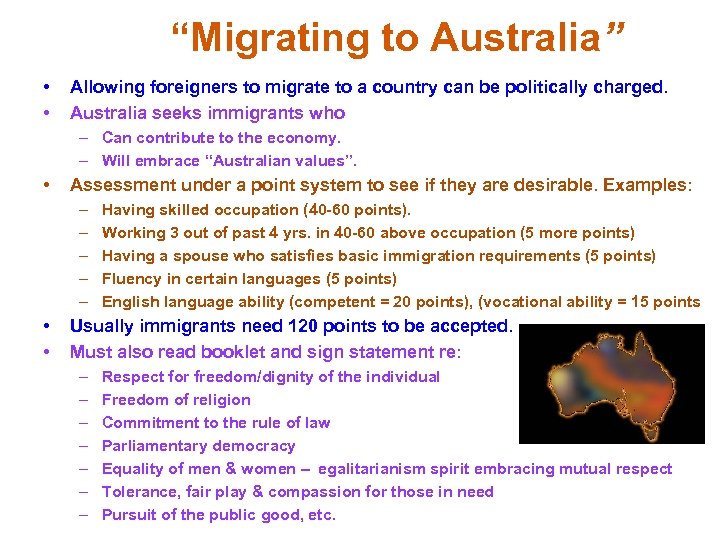
“Migrating to Australia” • • Allowing foreigners to migrate to a country can be politically charged. Australia seeks immigrants who – Can contribute to the economy. – Will embrace “Australian values”. • Assessment under a point system to see if they are desirable. Examples: – – – • • Having skilled occupation (40 -60 points). Working 3 out of past 4 yrs. in 40 -60 above occupation (5 more points) Having a spouse who satisfies basic immigration requirements (5 points) Fluency in certain languages (5 points) English language ability (competent = 20 points), (vocational ability = 15 points Usually immigrants need 120 points to be accepted. Must also read booklet and sign statement re: – – – – Respect for freedom/dignity of the individual Freedom of religion Commitment to the rule of law Parliamentary democracy Equality of men & women – egalitarianism spirit embracing mutual respect Tolerance, fair play & compassion for those in need Pursuit of the public good, etc.
International Issues • • International Law and Business International Trade Agreements U. S. Import Policy Business Structures in Foreign Markets • Foreign Corrupt Practices Act • International Contracts • International Dispute Resolution
The International Business Environment • Includes all business transactions that involve entities from two or more countries – Movement of goods across countries – Movement of services across countries – Issues regarding capital – Issues regarding personnel of multinational enterprises
Risks of International Business Transactions • • Financial Political Regulatory All stem from differences in – – – Currencies Language Customs Legal systems Social philosophies Government policies
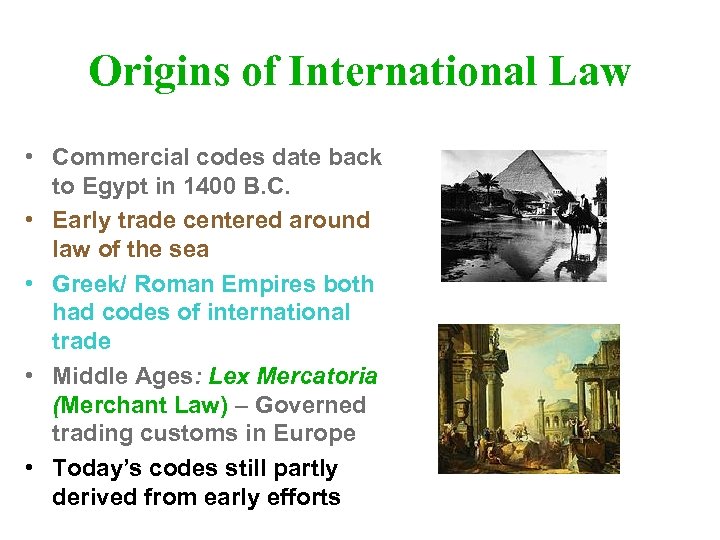
Origins of International Law • Commercial codes date back to Egypt in 1400 B. C. • Early trade centered around law of the sea • Greek/ Roman Empires both had codes of international trade • Middle Ages: Lex Mercatoria (Merchant Law) – Governed trading customs in Europe • Today’s codes still partly derived from early efforts
Sources of International Law • Individual countries create their own laws • Trade agreements between countries • Worldwide/regional organizations, i. e. – United Nations – European Union (EU) • No universal international court system for resolving international conflicts of businesses • Difficult to enforce decisions and contracts • See Exhibit 16. 1: Selected Organizations Affecting the International Legal Environment
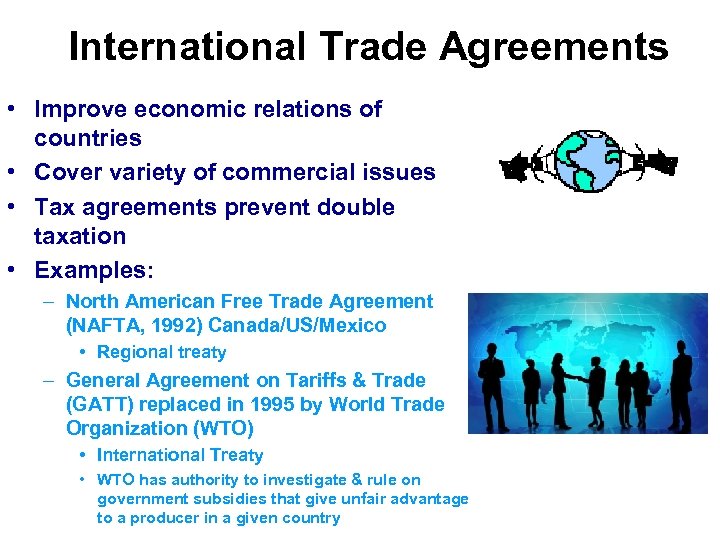
International Trade Agreements • Improve economic relations of countries • Cover variety of commercial issues • Tax agreements prevent double taxation • Examples: – North American Free Trade Agreement (NAFTA, 1992) Canada/US/Mexico • Regional treaty – General Agreement on Tariffs & Trade (GATT) replaced in 1995 by World Trade Organization (WTO) • International Treaty • WTO has authority to investigate & rule on government subsidies that give unfair advantage to a producer in a given country
WTO: Brazil/US cotton subsidies • 2002: Brazil filed complaint: U. S. cotton subsidies too generous; made it difficult for Brazil to compete • WTO’s 2004 report: subsidies improper • 2007: Compliance panel affirmed report • 2009: WTO “final” judgment authorizing Brazil to impose trade sanctions on US • 2010: Brazil announces tariffs on goods sold from US to Brazil
U. S. Import Policy (Limits on Imports – To Protect Domestic Interests) (Taxes on Imports) • Tariffs (duties) – Taxes imposed by a government on imported goods – specific tariffs: fixed duties on products – ad valorem tariffs: % of price of product See Issue Spotter: “Starting an Import Business” • Harmonized Tariff Schedules – standardized, worldwide classification of goods for customs officials – Harmonized Tariff Schedule of the United States (HTSUS) – Each country uses same codes • Bans on Certain Products – i. e. weapons, illegal products, narcotics, national security concerns, products made from endangered species
United States v. Mead Corporation • • Mead imported “day planner” calendars. Under the tariff (HTSUS) – general heading for “registers, account books, notebooks. . . and similar articles”. – Under subheading 4820. 10 “diaries, notebooks and address books” subject to 4. 0% tariff. – Another subheading was for “other” items NOT subject to a tariff. • • “Other” heading applied to planners until 1993. Customs changed classification to “diaries” and applied 4% tariff. Mead protested, but Customs did not change. Mead sued in Court of International Trade (CIT). Court granted summary judgment for Customs. Mead appealed to Court of Appeals for Federal Circuit. It reversed. Held classification by Customs do not get high level of deference to some regulations because Customs can change classification without formal notice-and-rule process that occurs for most substantive regulations. Also held planners were not “diaries”, as those defined as bound volumes. Planner was a three-ring binder, so should be classified as “other” and no tariff. Customs appealed. (Continued)
United States v. Mead Corporation, cont. • U. S. Supreme Court HELD: Judgment vacated and remanded for further proceedings. • Court of Appeals for Federal Circuit ought have looked at these issues: • Notice-and-comment procedures seen by Customs only when “changing in practice” to – produce a tariff increase or – in the imposition of a restriction/prohibition, or – when Customs Headquarters determines matter is important to “interest of domestic industry”. • Classification rulings are best treated like “interpretations contained in policy statement, agency manuals and enforcement guidelines”. • Customs can bring the benefit of specialized experience to bear on the subtle question in this case.
“Fair Trade!” • • • Autos and their parts are produced around the world. Countries work to protect domestic markets. Ford passenger vans are produce at Ford plant in Turkey. Shipped to Baltimore. There workers remove the non-driver seats and replace side windows with steel walls. That converts vans from passenger vans into cargo vans. Why do this? Tariff on “delivery vans” is high. Tariff on “passenger vans” is low. Cheaper to bring passenger vans and refit to be delivery vans. Tariff under which this is done was created in 1963 to protect U. S. van makers from cheap foreign imports.
Import Controls • • • In U. S. – Dept. of Commerce through International Trade Administration (ITA) & International Trade Commission (ITC). Some imports are prohibited for safety or environmental reasons. Antidumping Orders: Charging a lower price in an export market than in a home market. Antidumping duty is determined by comparing market price in home market vs. price charge in U. S. When item is imported, then duty is applied to product. Duties on Governmental Subsidies: Tariff applied to offset subsidies provided by foreign governments to their industries that lower prices of products imported into the U. S. Duty applied is = to foreign governmental subsidy. (Purpose: To assist U. S. products to be competitive in the U. S. market) (countervailing duties). Foreign Trade Zones: Goods imported without paying tariffs. Goods then processed. Duties assessed upon leaving zone. Duty Free Ports: No duties or tariffs assessed on products, i. e. Hong Kong.
Export Promotion and Restrictions (To Reduce U. S. Trade Deficit) • Federal/State governments – Commerce Department helps promote exports through ITA activities. – Commerce Control List will specify controls, if export allowed, and licensing required for exporting an item. • Export Restrictions: if goods, for instance: – – Injure domestic industry Jeopardize national security Conflict w/ national policy (i. e. goods to support terrorist activities) Arms Export Control acted implemented through International Traffic in Arms Regulations imposes restrictions on exports of weapons and technology that can be used as weapons. • Commodity Control List (Department of Commerce) – List of goods subject to restricted licenses – If item is not on Export Administration Regulations list, then not subject to special control. • Application to Reexported U. S. Goods – Commerce licensing requirements apply – Goods that U. S. may not want imported from country #1 exported into country #2 (favored country); then reexported from country #2 into country #3, i. e. U. S. (May violate U. S. licensing regulations)
“I Make Sure Other People Obey the Law” • Lorraine Henderson was Boston-area port director for Customs & Border Protection. • Supervised 220 employees. • Paid more than $132, 000 a year. • She was convicted of felony in 2010 for hiring illegal immigrants to clean her house over several years. • According to court documents she instructed on illegal cleaning lady (who was wearing a bug), “You have to be careful, ’cause they (her agency) will deport you. ”
Penalty Provisions for Violation of Commerce’s Licensing Provisions • Include criminal and civil penalties • Can also have administrative sanctions • If an exporter “knowingly” violates the Export Administration Act, there can be fines up to $50, 000 per violation. • Person who “willfully” violates the Act, can be fined more and receive up to 20 years in prison, with a possible suspension or revocation of a business’s authority to export.
Foreign Manufacturing • Franchise Agreement • Wholly Owned Subsidiary – Business owns the facilities – some countries limit % of ownership • Joint Venture – Sharing ownership with foreign partners • Licensing Agreement – Licensor grants licensee access to patents and technologies – Franchisor grants franchisee the rights to sell products or services, i. e. Mc. Donald’s, Hertz • Contract Manufacturing – Contract made for production of products • Issues to Consider – – Labor expenses Shipping costs Raw material costs Avoid restrictions/tariffs – Pirating of technology
U. S. : The Foreign Corrupt Practices Act (FCPA) 1977 F F Punishment of payer of bribe to foreign officials “Corrupt” person displays reckless or conscious disregard for consequences of one’s actions Accounting provisions require practices to track transactions Payer knows payment will go to public official – “Any reasonable person would have realized” • Requirement: Keeping accounts. Internal controls. Need paper trail. F F – “Consciously chose not to ask about what he/she had reason to believe would be discovered” – “Simple negligence” or “mere foolishness” exception “Routine governmental action” exception: “facilitating or expediting payment. . . the purpose of which is to expedite or secure the performance of a “routine governmental action. ” (i. e. visas, providing basic utilities, transportation services, etc. – small amount and very limited usage) In 2006 Congress ratified the UN Convention Against Corruption to bring international cooperation to corruption enforcement practices.
Punishments Under FCPA F F Individuals: Maximum of $100, 000 & 5 years in jail Corporation: Up to $2, 000/violation Exception: Department of Justice “pre-deal interpretation” Watch: “Slush funds” or “salaries, commissions or fees” disproportionate to service provided
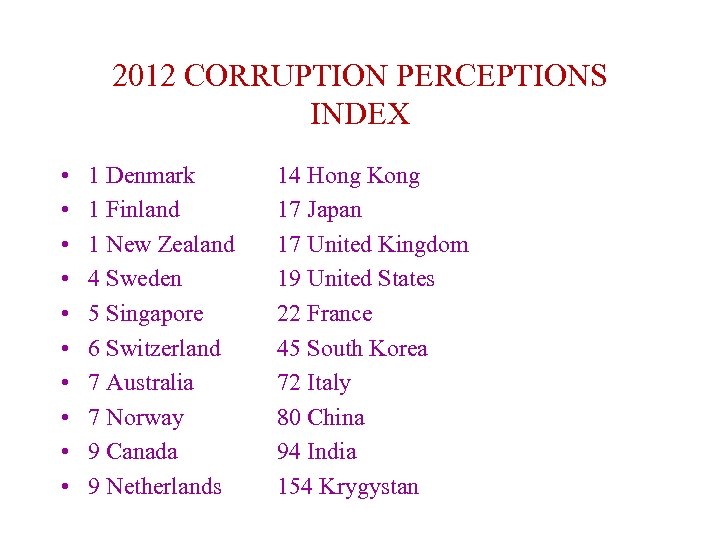
2012 CORRUPTION PERCEPTIONS INDEX • • • 1 Denmark 1 Finland 1 New Zealand 4 Sweden 5 Singapore 6 Switzerland 7 Australia 7 Norway 9 Canada 9 Netherlands 14 Hong Kong 17 Japan 17 United Kingdom 19 United States 22 France 45 South Korea 72 Italy 80 China 94 India 154 Krygystan
“All Corruption Is Not Created Equal” • Under U. S. law, any foreigner suspected of corruption cannot get a visa to enter the country. • Need not be a conviction for corruption. • Just good evidence of it. • Department of Justice has a large file on the son of the very long-time corrupt president of Equatorial Guinea. • Son is granted a visa by Department of State so that he can enjoy his $35 million estate in Malibu whenever he wishes. • Observers contend : Different policy toward visitor my be due to the large oil reserves contained in that poverty-stricken country.
United States v. King • Owl Securities and Investments (OSI) of Kansas City was raising funds for large land development in Costa Rica • FBI investigated King, one of OSI’s largest investors • Kingsley (OSI executive) and other executives tape recorded conversations • King convicted of planning a bribe to a senior Costa Rican official for rights to develop land • Fined $60, 000 and sentenced 30 months in prison under the FCPA • Appealed to U. S. Court of Appeals
United States v. King • HELD: Affirmed. Ample evidence to support jury’s conviction • Tape recordings; “I think we could pay the top people enough, that the rest of the people won’t bother us any. That’s what I’m hoping this million and a half dollars does. I’m hoping it pays for enough top people. ” • Knowingly participated in, approved of and acted to further conspiracy to offer the bribe • Six witnesses over 5 -day period and other exhibits supported jury’s conviction • Guilty of conspiracy and violations of FCPA
International Contracts • Cultural Aspects – Language, attitudes toward relationships different in different countries • Payment Clauses & Exchange Rates • Choice of Language Clause • Force Majeure Clauses • Choice-of-Law Clauses – Selection of Which Laws Apply • Forum Selection Clause – Selection of Court See Exhibit 16. 5: Major Clauses Used in Many International Contracts
Key Clauses in International Contracts (see Exhibit 16. 5) • • Payment Choice of language Force Majeure Forum selection/choice of law
Financial Aspects of International Contracts • Exchange Markets • Use of Letters of Credit: Assurance by bank of buyer to pay seller upon receipt of documents that prove goods were shipped and contract was fulfilled – Revocable or Irrevocable • Transfer Pricing – Multinational firm sells goods from division located in one county to a division in the U. S. – Must determine price, but because it is within the firm, there is no “market price” to use – Firm creates an artificial price – Practice called transfer pricing – IRS guidelines as to what it considers “reasonable” for taxing purposes • Different countries exchange controls – can affect decision where to locate assets • Repatriation of Profits
Loss of Investment (Political Upheavals, Unstable Monetary Systems, Changes in Laws) • Nationalization: Gov’t “nationalizes” entire industry, including foreign investment – Gov’t may pay less than value – i. e. Iran, Russia, Saudi Arabia, Venezuela and England • Expropriation: Taking foreign property in accordance with international law • Confiscation: Taking is unlawful • Insuring Against Risk of Loss – Short-term private insurers – Major insurers (i. e. Lloyds of London) – Gov’t agencies (i. e. Overseas Private Investment Corporation [OPIC]) insures investors who invest in less developed countries
International Dispute Resolution • Litigation – Differs within countries – Complication of evidence, witnesses and documents – Judicial system may be different from country to country – Some courts more influenced by political pressures – Not enforceable outside of country – Treaties/Conventions may assist potential parties – Contract clauses assist courts in enforcement of claims – Usually need “minimum contacts” for jurisdiction • International Court of Justice (ICJ) – Only nations have standing - not individuals – Nations may make claims on behalf of persons – No mandatory compliance requirement – UN Security Council must enforce • Arbitration: 3 rd neutral party decides outcome, which is binding • Mediation: 3 rd neutral party “suggests” outcome, which is not binding
Doctrine of Sovereign Immunity and Doctrine of Act of State • Act of State – Court gives up right of jurisdiction over foreign country or representative – Court will bar compensation because the acts were by a foreign government or representative • Sovereign Immunity – Bar to compensation by foreign investors – Immunity to foreign representative or country – One country must respect the independence of other countries and their representatives – In U. S. : Foreign Sovereign Immunities Act : countries not immune from jurisdiction; commercial property may be levied upon
Your take-away from today’s class
Скачать презентацию The International Legal Environment of Business Chapter 16
373f35817870f84fbbf75c0f4504010d.ppt