 Скачать презентацию The Internal Auditing Handbook 2 nd Edition IAH
c482c9fe553901ec7d1b1414f646050a.ppt
- Количество слайдов: 60



The Internal Auditing Handbook 2 nd Edition (IAH 2 e) © K H Spencer Pickett 2003 Specially prepared for John Wiley and Sons Ltd Slide 01 On-Line Internal Audit Resource
The Wiley IA On-Line Resource Please complete the following tasks: 1. Work through this on-line presentation of highlights from Chapter One of the IAH 2 e. 2. Read Chapter One. 3. Attempt the quiz for Chapter One (see other parts of the on-line resource. Slide 02 4. You may then fill out the Certificate of Completion.
A MESSAGE FROM THE TOP The Chief Internal Auditor supports the development of new auditors so that they understand the audit role and the new risk-based context of internal audit work Slide 03
THE INTERNAL AUDITING HANDBOOK CHAPTER ONE : Introduction We will be taking a short journey of 60 slides as part of your induction training based on highlights from the above mentioned book Slide 04 This should take around two hours to complete
THE ON-LINE SESSION OBJECTIVES To take new and less experienced auditors through the development of the profession of internal auditing over the years Slide 05
THIS ON-LINE SESSION COVERS: • The IA Handbook 2 e Chapters • The new look internal auditor • The IIA Definition & Standards • Development of Internal Audit • Key Issues And a few simple exercises Slide 06 IIA = Institute of Internal Auditors
The IA Handbook 2 e Chapters: One – Introduction (dealt with here) Two - Corporate governance Three - Managing risk Four - Internal controls Five - The internal audit role Six - Professionalism Seven - The audit approach Eight - Setting an audit strategy Nine - Audit field work Slide 07 Ten - Meeting the challenge
OUR THEME There really are “new look” internal auditors who carry the weight of a heightened expectation from society on their shoulders. Auditors no longer spend their time looking down at detailed working schedules in cramped offices before preparing a comprehensive report on low level problems that they have found for junior operational managers. They now spend much more time presenting “big picture” assurances to top executives after having considered high level risks that need to be Slide 08 managed properly.
What Are We? Please consider each component of the formal definition of internal auditing in the next slide Slide 09
Understand the internal audit role Internal auditing is an independent, objective assurance and consulting activity designed to add value and improve an organisation’s operations. It helps an organisation accomplish its objectives by bringing a systematic, disciplined approach to evaluate and improve the effectiveness of risk management, control and governance processes (*) Formal definition from the Institute of Internal Auditors (IIA) Slide 10
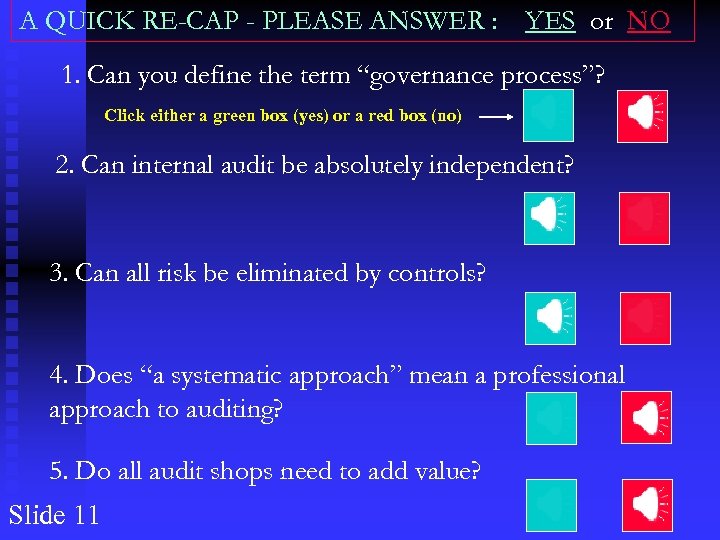
A QUICK RE-CAP - PLEASE ANSWER : YES or NO 1. Can you define the term “governance process”? Click either a green box (yes) or a red box (no) 2. Can internal audit be absolutely independent? 3. Can all risk be eliminated by controls? 4. Does “a systematic approach” mean a professional approach to auditing? 5. Do all audit shops need to add value? Slide 11
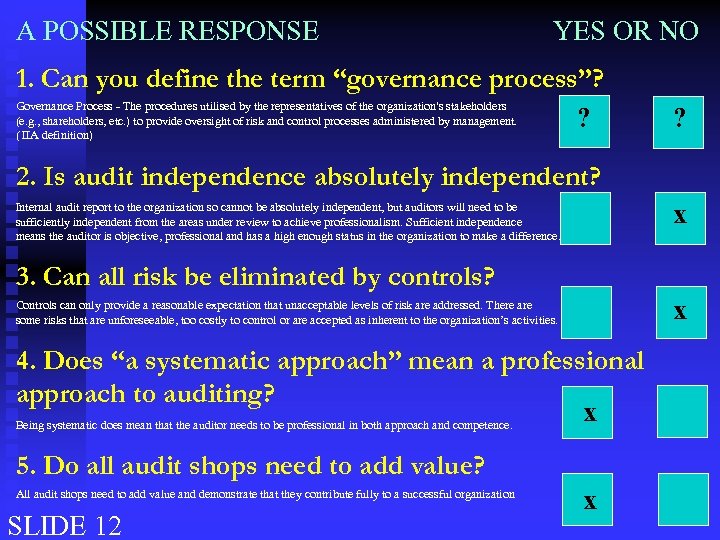
A POSSIBLE RESPONSE YES OR NO 1. Can you define the term “governance process”? Governance Process - The procedures utilised by the representatives of the organization's stakeholders (e. g. , shareholders, etc. ) to provide oversight of risk and control processes administered by management. ? ( IIA definition) ? 2. Is audit independence absolutely independent? x Internal audit report to the organization so cannot be absolutely independent, but auditors will need to be sufficiently independent from the areas under review to achieve professionalism. Sufficient independence means the auditor is objective, professional and has a high enough status in the organization to make a difference. 3. Can all risk be eliminated by controls? x Controls can only provide a reasonable expectation that unacceptable levels of risk are addressed. There are some risks that are unforeseeable, too costly to control or are accepted as inherent to the organization’s activities. 4. Does “a systematic approach” mean a professional approach to auditing? x Being systematic does mean that the auditor needs to be professional in both approach and competence. 5. Do all audit shops need to add value? All audit shops need to add value and demonstrate that they contribute fully to a successful organization SLIDE 12 x
WEARING TWO HATS? Assurance Services – An objective examination of evidence for the purpose of providing an independent assessment on risk management, control, or governance processes for the organization. Examples may include financial, performance, compliance, system security, and due diligence engagements. Consulting Services – The range of services, beyond internal audit’s assurance services, provided to assist management in meeting its objectives. The nature and scope of work are agreed upon with the client. Examples include facilitation, process design, training, and advisory services. Slide 13
Professionalism Code of Ethics – How good auditors behave Attribute Standards - what a good audit shop looks like Performance Standards - what a good audit process looks like Implementation Standards - relating to specific audit contexts such as assurance, consulting, information systems and fraud work Practice Advisories - more detailed guidance Slide 14 The above are found in later chapters of the IAH 2 e
Institute of Internal Auditors Attribute Standards 1000 - Purpose, Authority and Responsibility 1100 - Independence and Objectivity 1200 – Professional Proficiency and Due Professional Care 1300 - Quality Assurance and Improvement Program Slide 15
Institute of Internal Auditors Performance Standards 2000 - Managing the IA Activity 2100 - Nature of Work 2200 - Engagement Planning 2300 - Performing the Engagement 2400 - Communicating Results 2500 - Monitoring Progress 2600 - Management’s Acceptance of Risk Slide 16
PROFESSIONALISM – CODE OF ETHICS Integrity: The integrity of internal auditors establishes trust and thus provides the basis for reliance on their judgment. Objectivity: Internal auditors exhibit the highest level of professional objectivity in gathering, evaluating, and communicating information about the activity or process being examined. Confidentiality: Internal auditors respect the value and ownership of information they receive and do not disclose information without appropriate authority unless there is a legal or professional obligation to do so. Competency: Internal auditors apply the knowledge, skills, and experience needed in the performance of internal auditing services. Slide 17
Development of IA Internal audit is now a developed profession. An individual employed in internal audit ten years ago would find an unrecognisable situation in terms of the audit role, services provided, and approach. For a full appreciation of internal auditing, it is necessary to trace these developments and extend trends into the future. Slide 18
Development of IA: 1. Extension of external audit 2. Internal check 3. Probity Work 4. Non financial systems 5. Chief Auditors 6. Audit Committee 7. Professionalism Slide 19 Let’s take each one in turn
Development of Internal Auditing 1. Extension of external audit: Internal audit developed as an extension of the external audit role in testing the reliability of accounting records that contribute to published financial statements. Internal audit was based on a detailed program of testing of accounting data. Where this model predominates, there can be little real development in the professionalism of the internal audit function. It would be possible to disband internal audit by simply increasing the level of testing in the external auditor’s plans. Unfortunately there are still organisations whose main justification for rescourcing an internal audit service is to reduce the external audit fee. Slide 20
Development of Internal Auditing 2. Internal check: The testing role progressed to cover non-financial areas, and this equates the internal audit function to a form of internal check. Vast numbers of transactions were double-checked to provide assurances that they were correct and properly authorised by laid-down procedures. The infamous “audit stamp” reigned supreme indicating that a document was deemed correct and above board. Internal control was seen as internal check and management was presented with audit reports listing the sometimes huge number of errors found by internal audit. Slide 21
Development of Internal Auditing 3. Probity Work: Probity work arrived next as an adaptation of checking accounting records where the auditors would arrive unannounced at various locations and local offices, and perform a detailed series of tests according to a preconceived audit program. Audit consisted mainly of checking; with the probity visits tending to centre on cash income, stocks, purchases, petty cash, stamps, revenue contracts and other minor accounting functions - as an inspection on behalf of management. The fundamental components of the control systems above local-office level fell outside the scope of audit work that was centered on low-level, detailed checking. Slide 22
Development of Internal Auditing 4. Non financial systems: The shift in low-level checking arose when audit acquired a degree of separation from the accounting function with internal audit sections being purposely established. This allowed a level of audit management to develop which in turn raised the status of the audit function away from a complement of junior staff completing standardised audit programs. The ability to define an audit’s terms of reference stimulated the move towards greater professionalism, giving rise to the model of audit as a separate entity. Likewise, the ability to stand outside basic financial procedures allowed freedom to tackle more significant problems. Slide 23
Development of Internal Auditing 5. Chief Auditors: Another thrust towards a high profile, professional audit department was provided through employing chief internal auditors (or chief audit executives) with high organisational status. They could meet with all levels of senior management and represent the audit function. This tended to coincide with the removal of audit from the finance function. The audit department as a separate high profile entity encourages career auditors, able to develop within the function. This is as well as employing people who are able to use this audit experience as part of their managerial career development. The current position in many large organisations establishes a firm framework from which the audit function may continue to develop the professional status that is the mark of an accepted discipline. Slide 24
Development of Internal Auditing 6. Audit Committee: Audit committees bring about the concept of the audit function reporting to the highest levels and this had a positive impact on perceived status. Securing the attention of the board, chief executive, managing director, nonexecutive directors and senior management also provides an avenue for high level audit work able to tackle the most sensitive corporate issues. This is far removed from the early role of checking the stock and petty cash. Internal audit was now poised to enter all key parts of an organisation. Slide 25
Development of Internal Auditing 7. Professionalism: The Institute of Internal Auditors has some history going back over 50 years. Brink’s Modern Internal Auditing has outlined the development of the IIA; In 1942, IIA was launched. Its first membership was started in New York City, with Chicago soon to follow. The IIA was formed by people who were given the title internal auditor by their organizations and wanted to both share experiences and gain knowledge with others in this new professional field. A profession was born that has undergone many changes over subsequent years. Slide 26
What Does This Mean? REFLECT: Why do you think many audit shops have moved out of the accounts department and now operate as separate internal audit departments? Slide 27 Write down five main reasons why this happened
Development of Internal Auditing Services The developmental process outlined above highlights the way the function has progressed in assuming a higher profile and a greater degree of professionalism. The type of audit service has changed to reflect these new expectations and these developments over the last twenty years may likewise be traced as: 1. Internal check procedures 2. Transactions based approach 3. Statistical sampling 4. Probity based work 5. Spot checks 6. Risk analysis 7. Systems based approach 8. Operational audit 9. Management audit 10. Risk based approach Slide 28 Let’s take each one in turn
Development of Audit Services 1. Internal check procedures: Internal audit was seen as an integral component of the internal checking procedures designed to double-check accounting transactions. The idea was to re-check as many items as possible so as to provide this continuous audit. One might imagine an audit manager giving staff an instruction that “your job is to check all the book entries” on an ongoing basis. Slide 29
Development of Audit Services 2. Transactions based approach: The transactions approach came next, where a continuous programme of tests was used to isolate errors or frauds. This checking function became streamlined so that a detailed programme of tests was built up over time to be applied at each audit visit. This systematic approach is readily controlled so that one might have expected the auditor to complete hundreds of checks over a week long period during the course of completing this pre-determined audit programme. Slide 30
Development of Audit Services 3. Statistical sampling: Statistical sampling was later applied to reduce the level of testing along with a move away from examining all available documents or book entries. A scientific approach was used whereby the results from a sample could be extrapolated to the entire population in a defendable manner. The problem is that one is still adopting the external audit stance which seeks to give an accept or reject decision as the final product. Like the sophisticated computer interrogation now used in audit work, this is an example of how a new technique is limited by a refusal to move away from traditional audit objectives. Slide 31
Development of Audit Services 4. Probity based work: Probity based work developed next, again featuring the transaction approach where anything untoward was investigated. The probity approach is based on audit being the unseen force that sees and hears all that goes on in the organisation. Instead of double-checking accounting records and indicating those that should be corrected, the probity approach allowed the Chief Accountant to check on financial propriety across the organisation. The auditor would represent the Director of Finance by visiting all major units and carrying out these audit test programmes. Slide 32
Development of Audit Services 5. Spot checks: It was then possible to reduce the level of probity visits by making unannounced spot checks so that the audit deterrent (the possibility of being audited) would reduce the risk of irregularity. Larger organisations may have hundreds of decentralised locations that would have been visited each year by the auditor. This service depends on employing large teams of junior auditors who would undertake these regular visits. As management started to assume more responsibility for their operations, the audit service turned increasingly to selective as opposed to periodic visits. Rather than a guaranteed visit each year, one sought compliance with procedure by threatening the possibility of a visit. Slide 33
Development of Audit Services 6. Risk analysis: The transaction/probity approach could be restricted by applying a form of risk analysis to the defined audit areas so that only high-risk ones would be visited. There are many well-known risk formulae that are designed to target audit resources to specific areas based around relevant factors. Each unit might then be ranked so that the highrisk ones would be visited first and/or using greater resources. Risk analysis used in conjunction with statistical sampling and automated interrogation gives the impression that internal auditing is carried out wholly scientifically, although this approach is steeped in the dated version of internal auditing. Slide 34
Development of Audit Services 7. Systems based approach: Then came a move away from the regime of management by fear to a more helpful service. Systems based audits (SBA) are used to advise management on the types of controls they should be using. Testing is directed more at the controls than to highlight errors for their own sake. The problems found during audit visits will ultimately be linked to the way management controls their activities. This new-found responsibility moves managers away from relying on the programmed audit visit to solve all ills. Systems of control become the key words that management adopts when seeking efficiency and effectiveness, and formed the focus of the audit service. Slide 35
Development of Audit Services 8. Operational audit: Attention to operational areas outside the financial arena provided an opportunity to perform work not done by the external auditor. The concepts of economy, efficiency and effectiveness were built into models that evaluated the value for money implications of an area under review. Looking for savings based on greater efficiencies became a clear part of the audit role. Purpose built value for money teams were set up to seek out all identifiable savings. The worst-case scenario came true in many organisations where these teams had to be resourced from the savings they identified. It is one thing to recommend a whole series of savings but another to actually achieve them. Slide 36
Development of Audit Services 9. Management audit: Management audit moves up a level to address control issues arising from managing an activity. It involves an appreciation of the finer points relating to the various managerial processes that move the organisation towards its objectives. This comes closer to the final goal of internal audit where it is deemed capable of reviewing all important areas within the organisation by adopting a wide interpretation of systems of control. The ability to understand evaluate complicated systems of managerial and operational controls allows audit to assume wide scope. This is relevant where controls are seen in a wider context as all those measures necessary to ensure that objectives are achieved. Slide 37
Development of Audit Services 10. Risk based approach: Many internal audit shops have now moved into risk based auditing where the audit service is driven by the way the organisation perceives and managed risk. Rather than start with set controls and whether they are being applied throughout the organisation properly, the audit process starts with understanding the risks that need to be addressed by these systems of internal control. Much of the control solution hinges on the control environment in place and whether a suitable control framework has been developed and adopted by the organisation. Internal audit can then provide formal assurances regarding these controls. Moreover, many internal audit shops have also adopted a consulting role, where advice and support is provided to management. Slide 38
What Does This Mean? REFLECT: Why do you think many audit shops have moved towards a risk based approach to their audit work? Slide 39 Write down five main reasons why this happened
Key Issues in the Development of IA 1. Contracting out Internal Audit 2. Globalisation 3. Quality Management 4. The Compliance role 5. Independence 6. The Expectations Gap 7. Legislation 8. Corporate Governance, Risk Management and Internal Control Slide 40 Let’s take each one in turn
Key Issues in the Development of IA 1. Contracting out Internal Audit: All internal auditing departments are under threat. In the private sector, where internal audit is generally not mandatory, the in-house unit may be deleted, downsized or replaced by an inspectorate, quality assurance or operational review service. This is equally so in financial services where the compliance role may not necessarily be carried out by internal audit. The public sector is in the front line, facing external competition like an army preparing for war. . . All CAEs should have a number of key issues uppermost in their minds including: • A formal strategy for meeting competition from internal and/or external sources. • The audit budget and current charge-out rates for each auditor and how these figures compare to other departments. • The pricing strategy Slide 41
Key Issues in the Development of IA 2. Globalisation: The big picture of internal auditing must include that it is a discipline universally applicable throughout the world. There is no formal requirement that all CAEs be qualified apart from organisational job specifications. There is no worldwide concept of an internal auditor able to practice in any country. There is however, a move to spread professional auditing practice from the developed world to the less developed. The Institute of Internal Auditors is the only body established solely for the promotion of internal auditing. Slide 42
Key Issues in the Development of IA 3. Quality Management: The current interest in total quality management (TQM) is derived from a desire to secure excellence in service/product delivery. This allows a top downwards review of existing practices. Internal auditors are well versed in the principles and practice of management which is examined in IIA examinations. Slide 43
Key Issues in the Development of IA 4. The Compliance role There is some debate on the role of internal audit in compliance with procedure. The technical view argues we have moved away from detailed checking as the profession developed. One may now audit corporate systems of importance to the entire welfare of the organisation. However, there are organisations such as banks and retail companies, that make great play of compliance checks and have a need for an audit service that management knows and understands. Aspirations to professionalism may have to take second place to getting permanent business and guaranteeing one’s future welfare. Slide 44
Key Issues in the Development of IA 5. Independence: Much has been written on independence and it is no longer treated as an esoteric entity that is either held on to, or given up through greed or ignorance. A response to the threat of external competition from the big accountancy firms was that they could not be independent. This argument is insufficient. Independence is perceived more practically as the basic ability to do a good job. It is therefore possible to offer consultancy services in addition to traditional audits, recognising this new-found realism. How far this concept can be extended is a matter for informed judgement and debate. Slide 45
Key Issues in the Development of IA 6. The Expectations Gap: Audit services will have to be properly marketed which is essentially based on defining and meeting client needs. This feature poses no problem as long as clients know what to expect from their internal auditors. It does however become a concern when this is not the case, and there is a clear gap in what is expected and what is provided. Management may want internal auditors to: • Check on junior staff on a regular basis. • Investigate fraud and irregularity and present cases to the police and/or internal disciplinaries. • Draft procedures where these are lacking and so on Slide 46
Key Issues in the Development of IA 7. Legislation: This is an important component in the development of internal auditing: • It may alter the audit role by providing additional work. • It may bring into the frame, competitors for the current audit contract. • It may impact the status of internal auditing, e. g. any moves towards mandatory audit committees or for that matter, mandatory internal audit. Slide 47
Key Issues in the Development of IA 8. Corporate Governance, Risk Management and Internal Control: As suggested by the new definition of internal auditing. these three concepts now form the framework for the design and provision of the internal audit service. This is why the next three chapters deal with these topics. Slide 48
What Does This Mean? REFLECT: If there is an expectation from some managers that auditors will perform basic checks on their staff and systems, how can auditors best manage these expectations? Slide 49 Write down five main strategies for managing these expectations
Professionalism is the cornerstone of modern internal auditing. Slide 50 Now for a quick recap
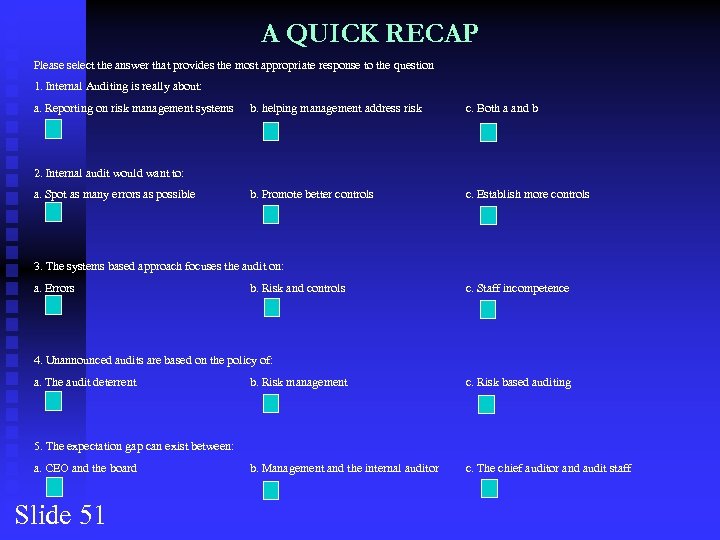
A QUICK RECAP Please select the answer that provides the most appropriate response to the question 1. Internal Auditing is really about: a. Reporting on risk management systems b. helping management address risk c. Both a and b b. Promote better controls c. Establish more controls 2. Internal audit would want to: a. Spot as many errors as possible 3. The systems based approach focuses the audit on: a. Errors b. Risk and controls c. Staff incompetence 4. Unannounced audits are based on the policy of: a. The audit deterrent b. Risk management c. Risk based auditing b. Management and the internal auditor c. The chief auditor and audit staff 5. The expectation gap can exist between: a. CEO and the board Slide 51
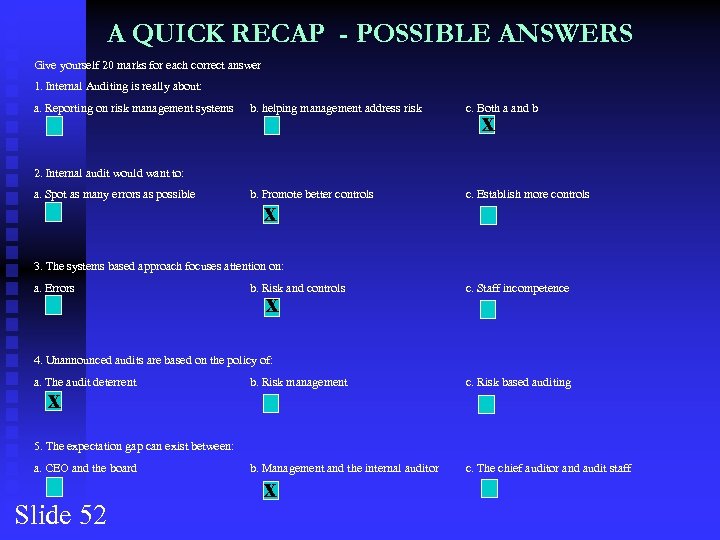
A QUICK RECAP - POSSIBLE ANSWERS Give yourself 20 marks for each correct answer 1. Internal Auditing is really about: a. Reporting on risk management systems b. helping management address risk c. Both a and b b. Promote better controls c. Establish more controls x 2. Internal audit would want to: a. Spot as many errors as possible x 3. The systems based approach focuses attention on: a. Errors b. Risk and controls x c. Staff incompetence 4. Unannounced audits are based on the policy of: a. The audit deterrent x b. Risk management c. Risk based auditing b. Management and the internal auditor c. The chief auditor and audit staff 5. The expectation gap can exist between: a. CEO and the board Slide 52 x
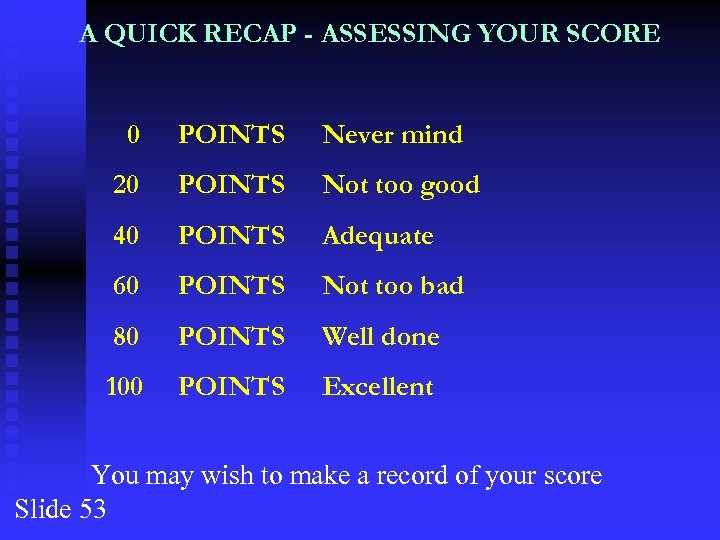
A QUICK RECAP - ASSESSING YOUR SCORE 0 POINTS Never mind 20 POINTS Not too good 40 POINTS Adequate 60 POINTS Not too bad 80 POINTS Well done 100 POINTS Excellent You may wish to make a record of your score Slide 53
Why Study The Past? The past forms a foundation for the future. This is true for internal audit and we have suffered our full share of poor reputations. Recent developments tend to be based on the concept of lifting the audit profile to deal with complicated specialist high profile areas/issues. This brings prestige but also the need to meet high expectations. It can only be achieved where the audit function is actively implementing a strategy with clear steps for enhancing professionalism. The ability to offer a wide range of services whilst still retaining a formal methodology steeped in professionalism, will be the feature of the new internal audit department. Slide 54
A Range of Services It will be necessary to market the audit service for those managers who still hold the old fashioned view of the profession as a ticking and checking function. Taking responsibility for reviewing parts of the risk management system is another strong possibility that is hard to resist. So long as a two-tier system with basic low-level audits, and contrasting complicated reviews does not result in an imbalance, then this service differentiation will be one solution. Slide 55
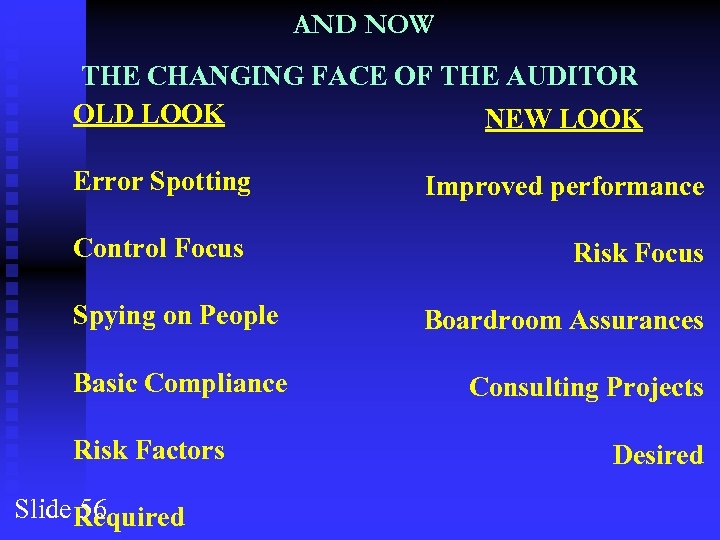
AND NOW THE CHANGING FACE OF THE AUDITOR OLD LOOK NEW LOOK Error Spotting Improved performance Control Focus Risk Focus Spying on People Basic Compliance Risk Factors Slide Required 56 Boardroom Assurances Consulting Projects Desired
What Does This Mean? REFLECT: Are many audit shops that have been developing the “New look Auditor” in contrast to the old styles of internal auditing? Write down five advantages of developing new look auditors and five main challenges that may Slide 57 arise as a result
Conclusions The client may demand the basic fraud/probity work that falls within the expectation frame where managers wish gaps in control to be closed in a way that will not form a criticism of their role. This is in contrast to the systems approach that seeks to locate responsibility for risk management at management’s doorstep. The chief audit executive (CAE) of the future will need the ability to balance these two major and sometimes conflicting considerations. Internal auditors are now consultants, reviewers, advisors, risk co-ordinators and investigators. But we are still called “internal auditors” Slide 58
THIS ON-LINE SESSION COVERED • The IA Handbook Chapters • The new look internal auditor • The IIA Definition & Standards • Development of Internal Audit • Key Issues Slide 59
WHAT NEXT? REFLECT: Understanding the context of internal auditing is the key to success Now read Chapter One of the Handbook and have a go at scoring over 50% on the Quiz questions for Slide 60 Chapter One (see the on-line resource)
Скачать презентацию The Internal Auditing Handbook 2 nd Edition IAH
c482c9fe553901ec7d1b1414f646050a.ppt