


 Скачать презентацию The Intercensal Population Estimates and Projections Program Signe
2bbf0248456bd0448ae0b24ef8ac505b.ppt
- Количество слайдов: 35
 The Intercensal Population Estimates and Projections Program Signe I. Wetrogan Assistant Chief for Population Estimates and Projections Presented to Metropolitan Washington Council of Governments Washington, DC June 7, 2005
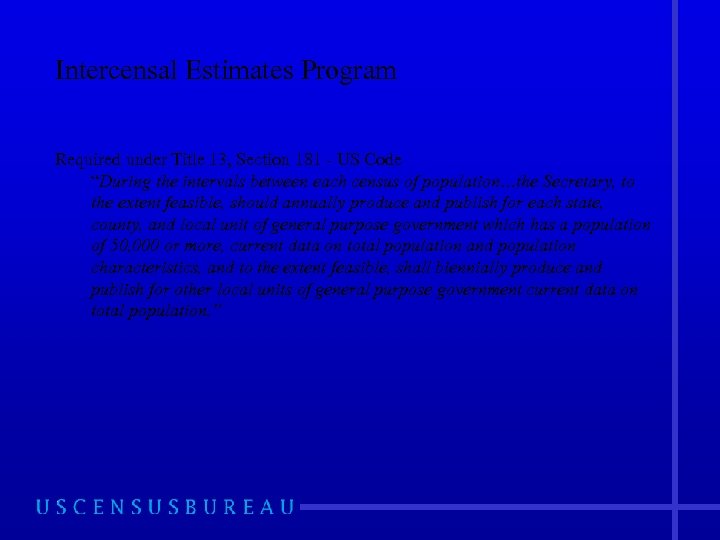 Intercensal Estimates Program Required under Title 13, Section 181 - US Code “During the intervals between each census of population…the Secretary, to the extent feasible, should annually produce and publish for each state, county, and local unit of general purpose government which has a population of 50, 000 or more, current data on total population and population characteristics, and to the extent feasible, shall biennially produce and publish for other local units of general purpose government current data on total population. ”
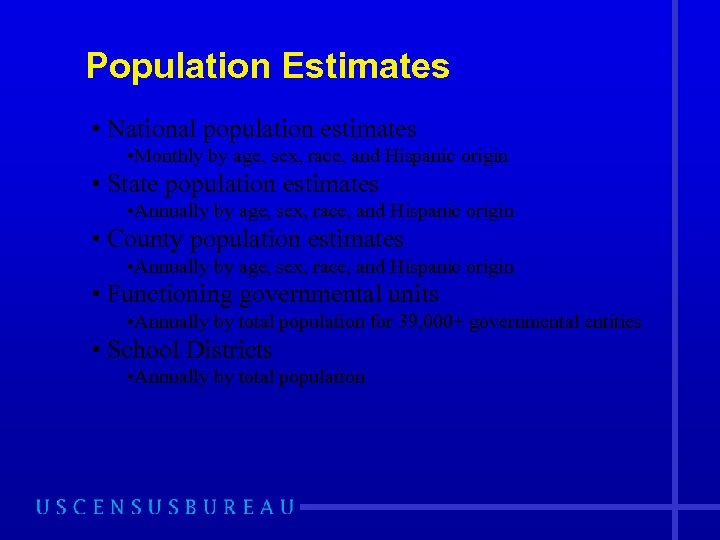 Population Estimates • National population estimates • Monthly by age, sex, race, and Hispanic origin • State population estimates • Annually by age, sex, race, and Hispanic origin • County population estimates • Annually by age, sex, race, and Hispanic origin • Functioning governmental units • Annually by total population for 39, 000+ governmental entities • School Districts • Annually by total population
 Housing Unit Estimates • State Estimates of Housing Units • Annually • County Estimates of Housing Units • Annually
 Population Projections • National Projections Current Interim projections – age, sex, selected race/Hispanic Origin groups Periodically prepared • State Projections Current interim projections – age and sex Periodically prepared
 Uses of Population Estimates • Allocation of over $200 billion in federal funds annually • Controls for federal surveys • Current Population Survey • American Community Survey • Denominators for statistical rates • Birth and death rates • Per capita income • Number of Senate clerk hires • Program planning • Location of public and private services
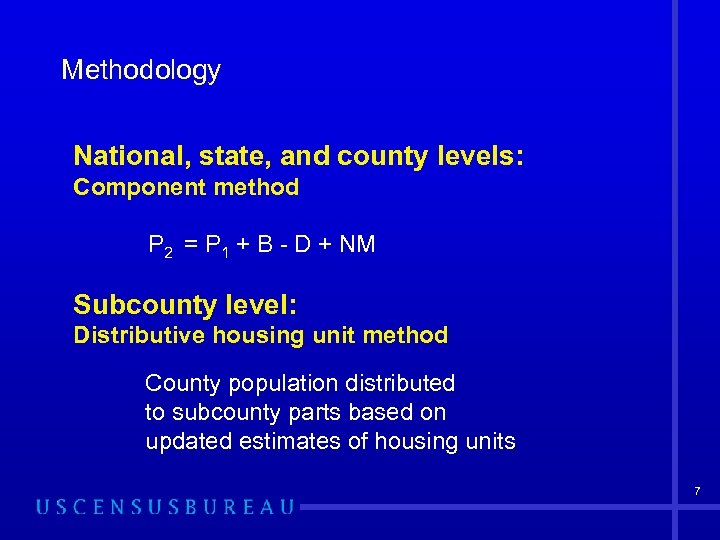 Methodology National, state, and county levels: Component method P 2 = P 1 + B - D + NM Subcounty level: Distributive housing unit method County population distributed to subcounty parts based on updated estimates of housing units 7
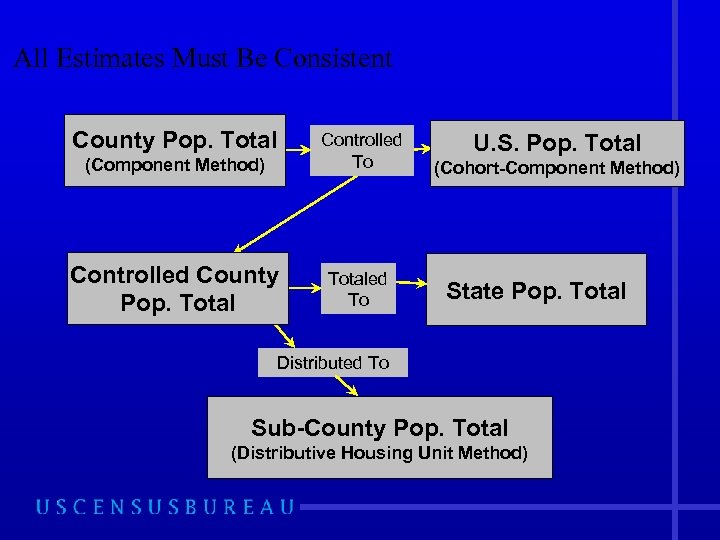 All Estimates Must Be Consistent County Pop. Total (Component Method) Controlled To Controlled County Pop. Totaled To U. S. Pop. Total (Cohort-Component Method) State Pop. Total Distributed To Sub-County Pop. Total (Distributive Housing Unit Method)
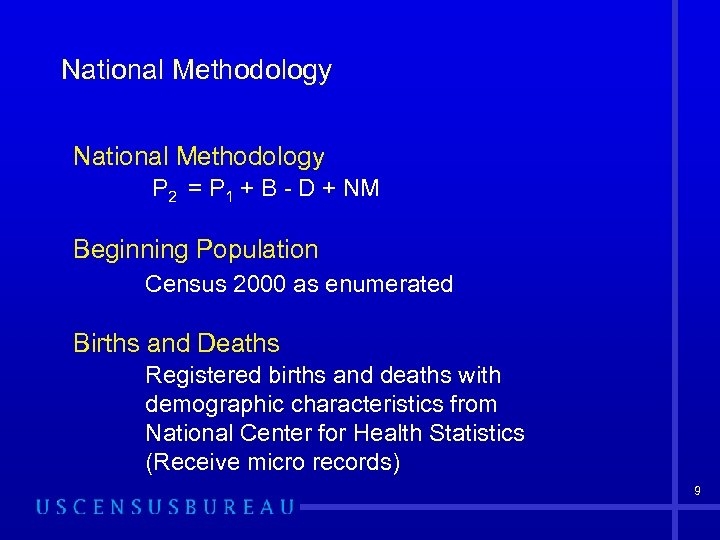 National Methodology P 2 = P 1 + B - D + NM Beginning Population Census 2000 as enumerated Births and Deaths Registered births and deaths with demographic characteristics from National Center for Health Statistics (Receive micro records) 9
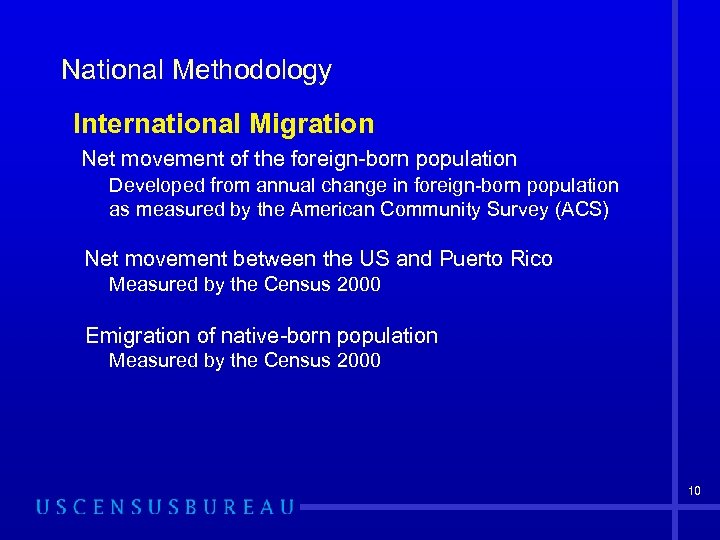 National Methodology International Migration Net movement of the foreign-born population Developed from annual change in foreign-born population as measured by the American Community Survey (ACS) Net movement between the US and Puerto Rico Measured by the Census 2000 Emigration of native-born population Measured by the Census 2000 10
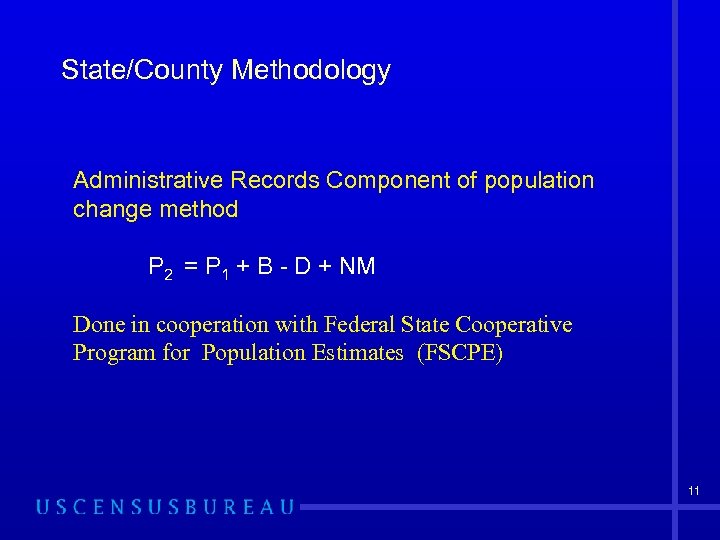 State/County Methodology Administrative Records Component of population change method P 2 = P 1 + B - D + NM Done in cooperation with Federal State Cooperative Program for Population Estimates (FSCPE) 11
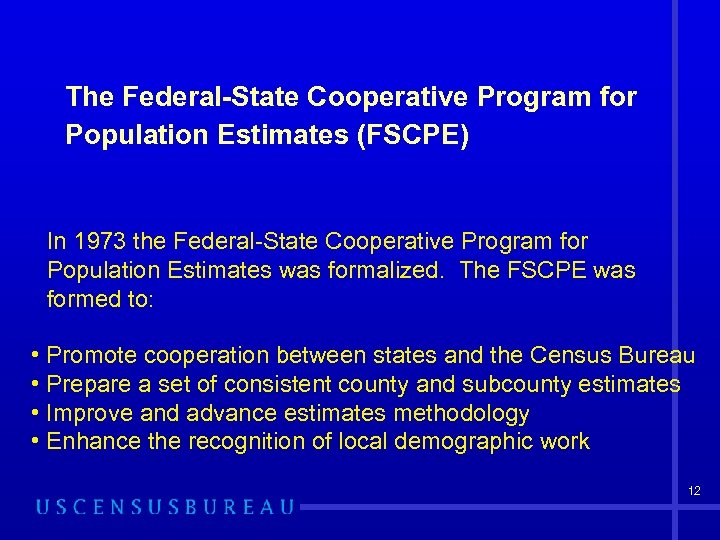 The Federal-State Cooperative Program for Population Estimates (FSCPE) In 1973 the Federal-State Cooperative Program for Population Estimates was formalized. The FSCPE was formed to: • Promote cooperation between states and the Census Bureau • Prepare a set of consistent county and subcounty estimates • Improve and advance estimates methodology • Enhance the recognition of local demographic work 12
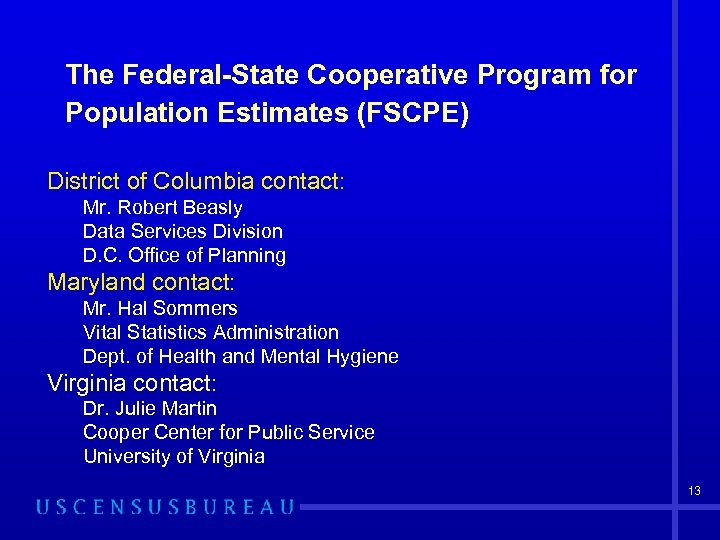 The Federal-State Cooperative Program for Population Estimates (FSCPE) District of Columbia contact: Mr. Robert Beasly Data Services Division D. C. Office of Planning Maryland contact: Mr. Hal Sommers Vital Statistics Administration Dept. of Health and Mental Hygiene Virginia contact: Dr. Julie Martin Cooper Center for Public Service University of Virginia 13
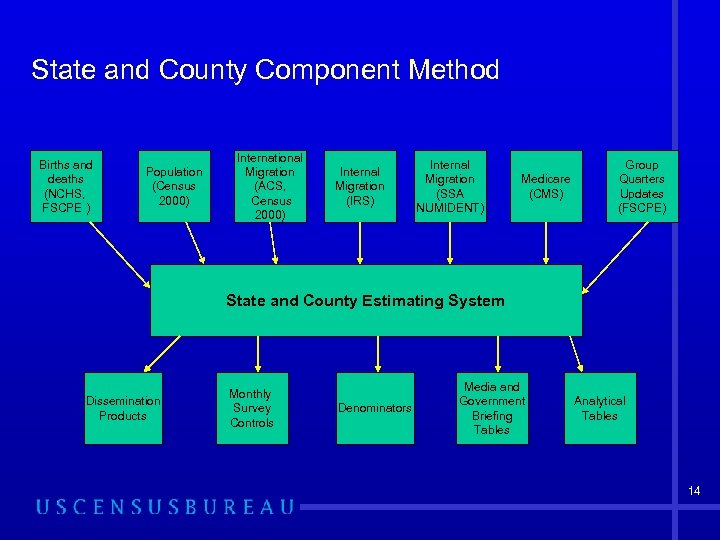 State and County Component Method Births and deaths (NCHS, FSCPE ) Population (Census 2000) International Migration (ACS, Census 2000) Internal Migration (IRS) Internal Migration (SSA NUMIDENT) Medicare (CMS) Group Quarters Updates (FSCPE) State and County Estimating System Dissemination Products Monthly Survey Controls Denominators Media and Government Briefing Tables Analytical Tables 14
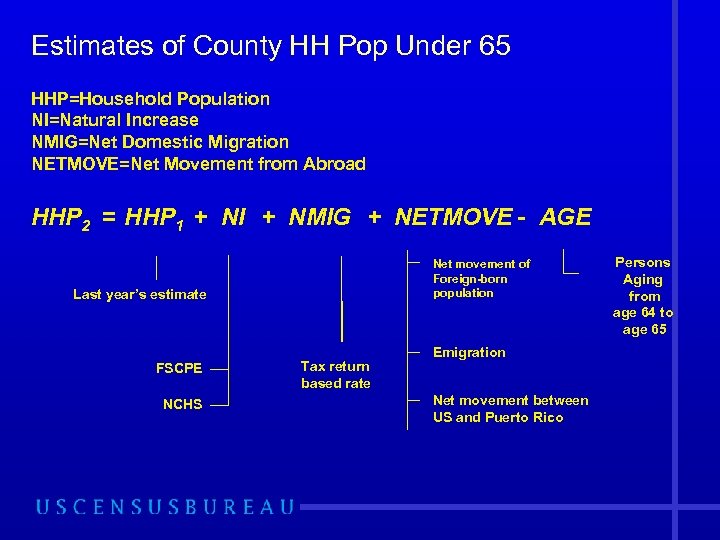 Estimates of County HH Pop Under 65 HHP=Household Population NI=Natural Increase NMIG=Net Domestic Migration NETMOVE=Net Movement from Abroad HHP 2 = HHP 1 + NI + NMIG + NETMOVE - AGE Net movement of Foreign-born population Last year’s estimate FSCPE NCHS Tax return based rate Emigration Net movement between US and Puerto Rico Persons Aging from age 64 to age 65
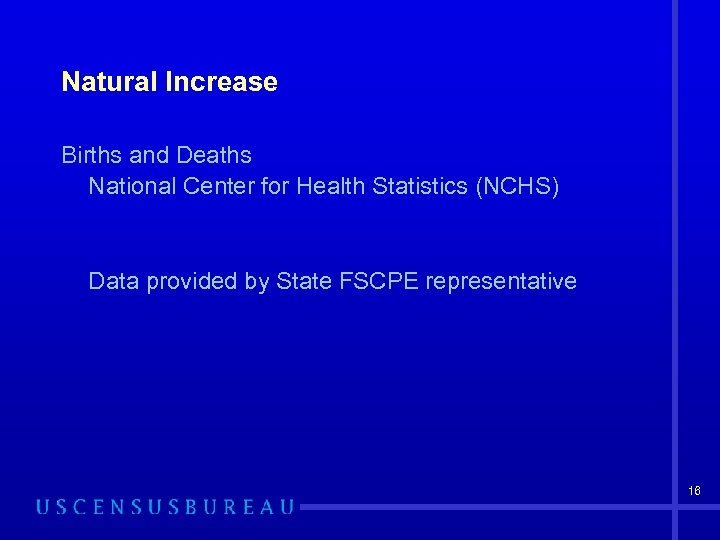 Natural Increase Births and Deaths National Center for Health Statistics (NCHS) Data provided by State FSCPE representative 16
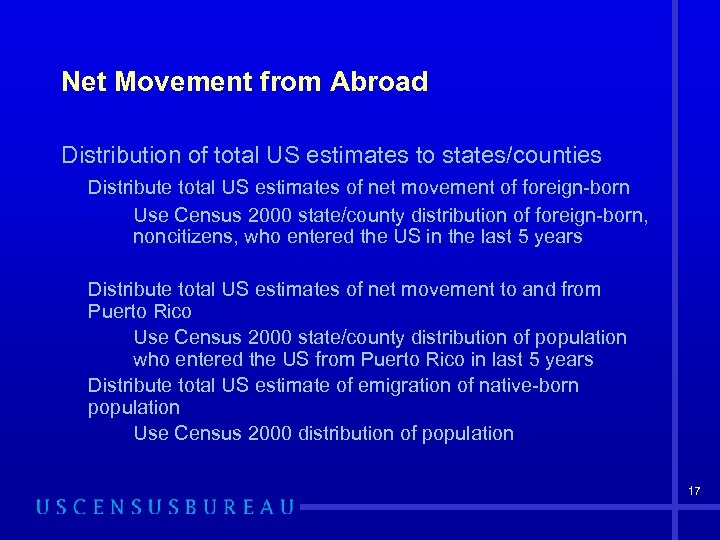 Net Movement from Abroad Distribution of total US estimates to states/counties Distribute total US estimates of net movement of foreign-born Use Census 2000 state/county distribution of foreign-born, noncitizens, who entered the US in the last 5 years Distribute total US estimates of net movement to and from Puerto Rico Use Census 2000 state/county distribution of population who entered the US from Puerto Rico in last 5 years Distribute total US estimate of emigration of native-born population Use Census 2000 distribution of population 17
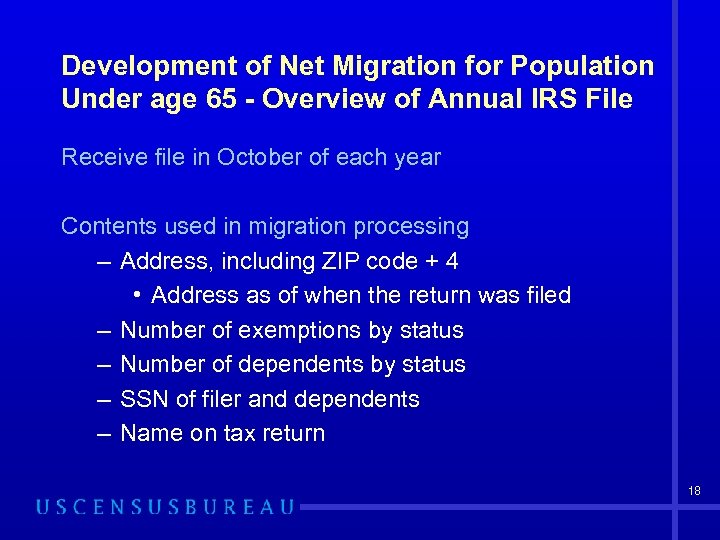 Development of Net Migration for Population Under age 65 - Overview of Annual IRS File Receive file in October of each year Contents used in migration processing – Address, including ZIP code + 4 • Address as of when the return was filed – Number of exemptions by status – Number of dependents by status – SSN of filer and dependents – Name on tax return 18
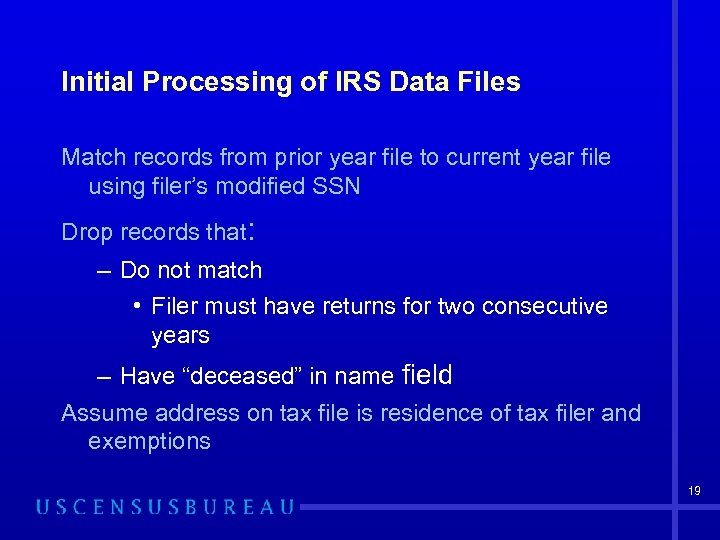 Initial Processing of IRS Data Files Match records from prior year file to current year file using filer’s modified SSN Drop records that: – Do not match • Filer must have returns for two consecutive years – Have “deceased” in name field Assume address on tax file is residence of tax filer and exemptions 19
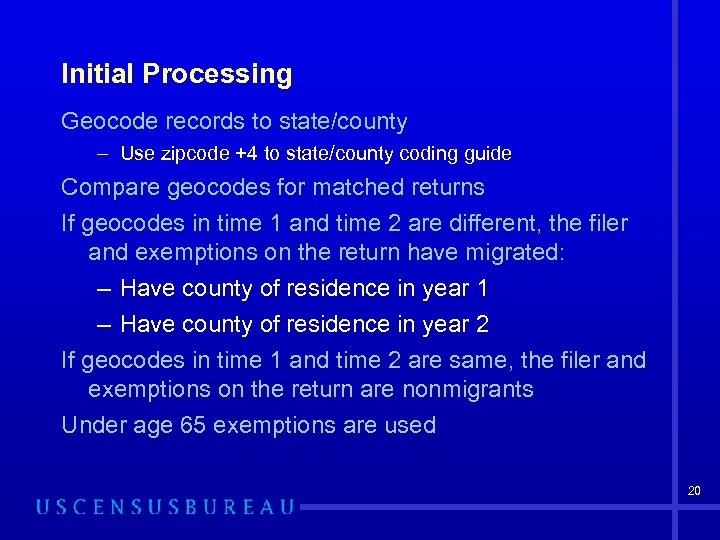 Initial Processing Geocode records to state/county – Use zipcode +4 to state/county coding guide Compare geocodes for matched returns If geocodes in time 1 and time 2 are different, the filer and exemptions on the return have migrated: – Have county of residence in year 1 – Have county of residence in year 2 If geocodes in time 1 and time 2 are same, the filer and exemptions on the return are nonmigrants Under age 65 exemptions are used 20
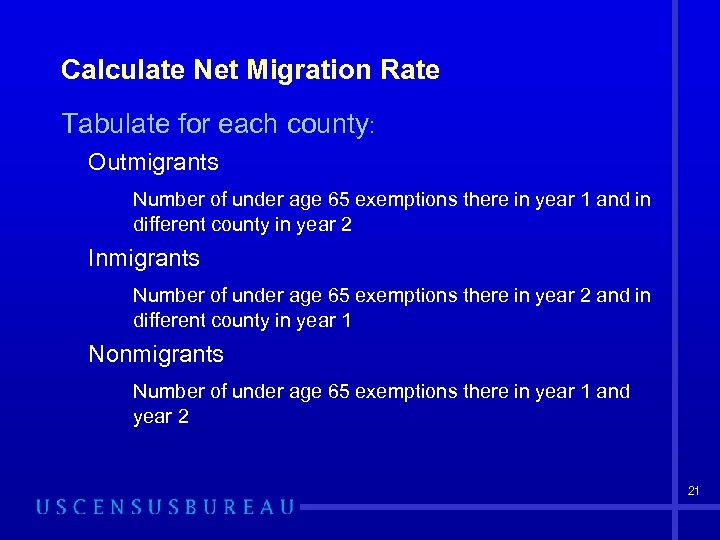 Calculate Net Migration Rate Tabulate for each county: Outmigrants Number of under age 65 exemptions there in year 1 and in different county in year 2 Inmigrants Number of under age 65 exemptions there in year 2 and in different county in year 1 Nonmigrants Number of under age 65 exemptions there in year 1 and year 2 21
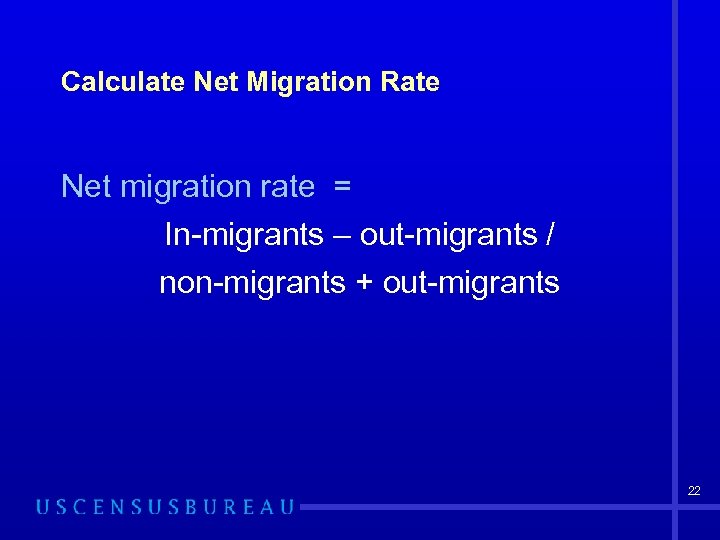 Calculate Net Migration Rate Net migration rate = In-migrants – out-migrants / non-migrants + out-migrants 22
 IRS Data Confidentiality Title 26 – protects the confidentiality of IRS data – No individual record data can be released – Any publicly released data must go through suppression – SSNs are modified – Internal access to IRS is severely restricted 23
 Develop Internal Migration Estimates for the Household Population The net migration rate (derived from IRS data) is then applied to the household population under age 65 This results in an estimate of net internal migration for the population under age 65 Similar estimates are developed for the population over age 65 derived from Medicare data 24
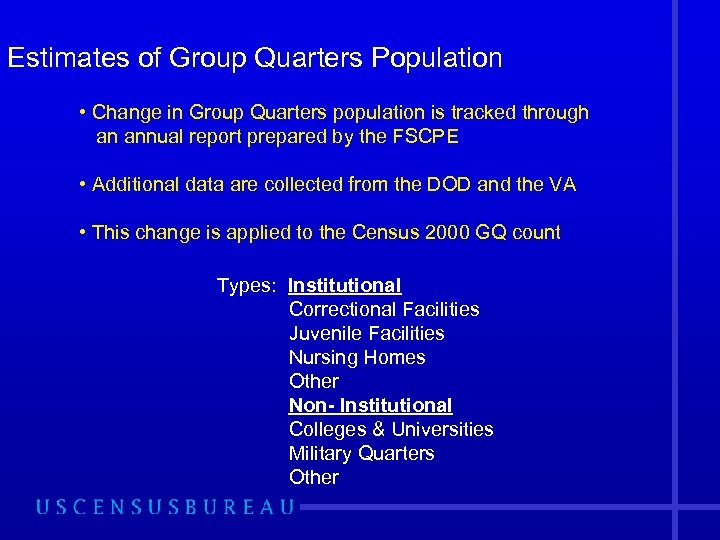 Estimates of Group Quarters Population • Change in Group Quarters population is tracked through an annual report prepared by the FSCPE • Additional data are collected from the DOD and the VA • This change is applied to the Census 2000 GQ count Types: Institutional Correctional Facilities Juvenile Facilities Nursing Homes Other Non- Institutional Colleges & Universities Military Quarters Other
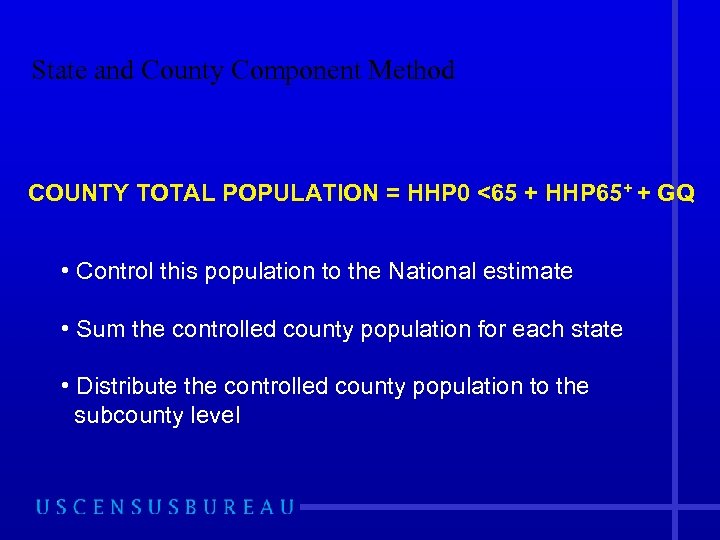 State and County Component Method COUNTY TOTAL POPULATION = HHP 0 <65 + HHP 65+ + GQ • Control this population to the National estimate • Sum the controlled county population for each state • Distribute the controlled county population to the subcounty level
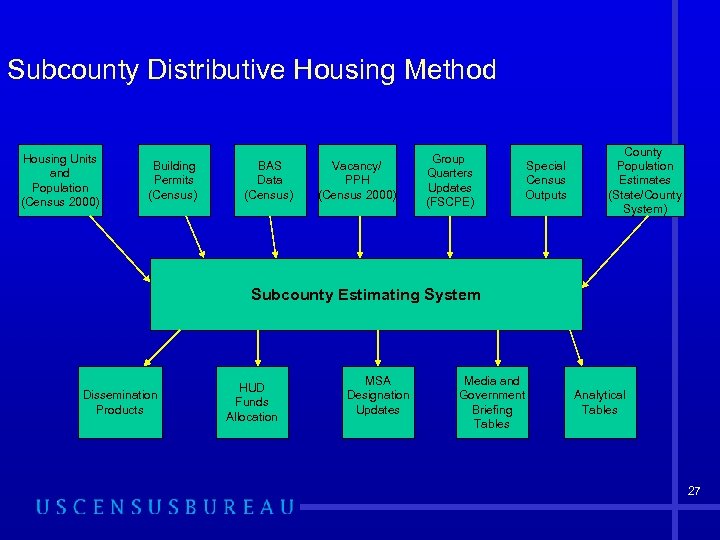 Subcounty Distributive Housing Method Housing Units and Population (Census 2000) Building Permits (Census) BAS Data (Census) Vacancy/ PPH (Census 2000) Group Quarters Updates (FSCPE) Special Census Outputs County Population Estimates (State/County System) Subcounty Estimating System Dissemination Products HUD Funds Allocation MSA Designation Updates Media and Government Briefing Tables Analytical Tables 27
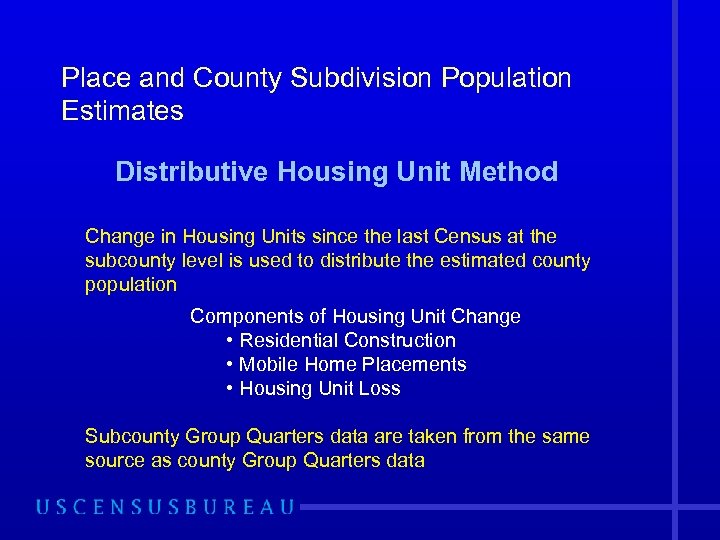 Place and County Subdivision Population Estimates Distributive Housing Unit Method Change in Housing Units since the last Census at the subcounty level is used to distribute the estimated county population Components of Housing Unit Change • Residential Construction • Mobile Home Placements • Housing Unit Loss Subcounty Group Quarters data are taken from the same source as county Group Quarters data
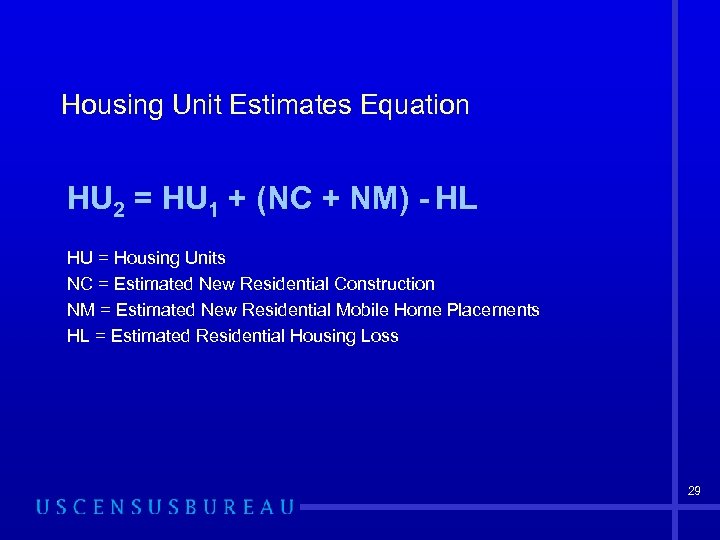 Housing Unit Estimates Equation HU 2 = HU 1 + (NC + NM) - HL HU = Housing Units NC = Estimated New Residential Construction NM = Estimated New Residential Mobile Home Placements HL = Estimated Residential Housing Loss 29
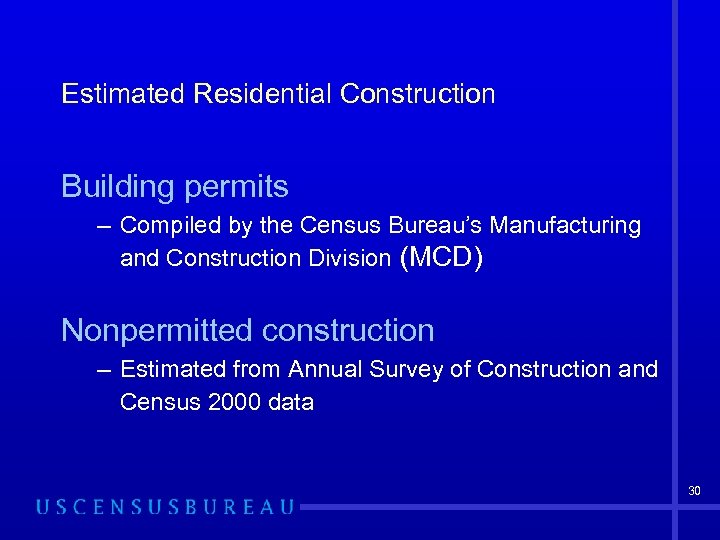 Estimated Residential Construction Building permits – Compiled by the Census Bureau’s Manufacturing and Construction Division (MCD) Nonpermitted construction – Estimated from Annual Survey of Construction and Census 2000 data 30
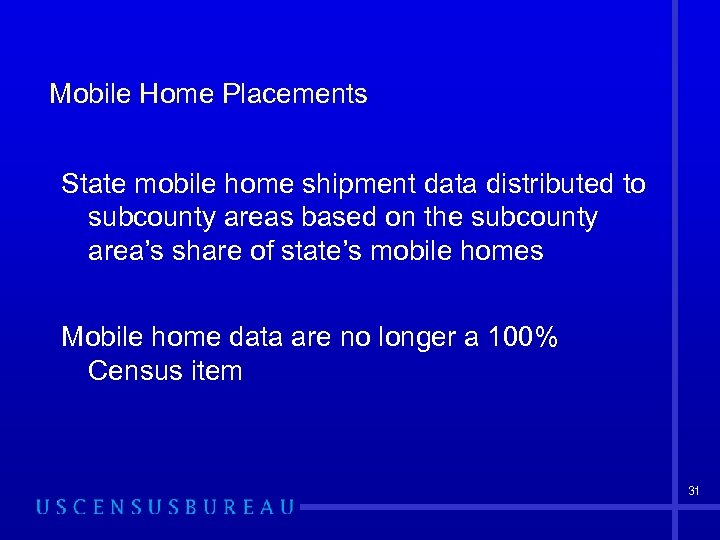 Mobile Home Placements State mobile home shipment data distributed to subcounty areas based on the subcounty area’s share of state’s mobile homes Mobile home data are no longer a 100% Census item 31
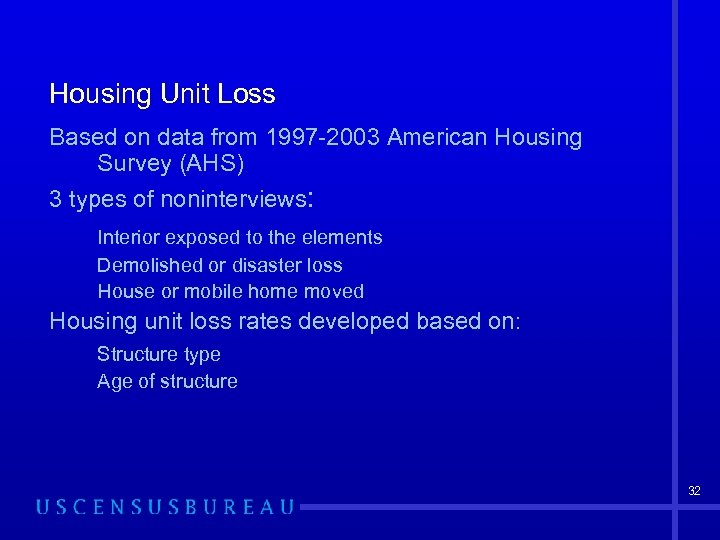 Housing Unit Loss Based on data from 1997 -2003 American Housing Survey (AHS) 3 types of noninterviews: Interior exposed to the elements Demolished or disaster loss House or mobile home moved Housing unit loss rates developed based on: Structure type Age of structure 32
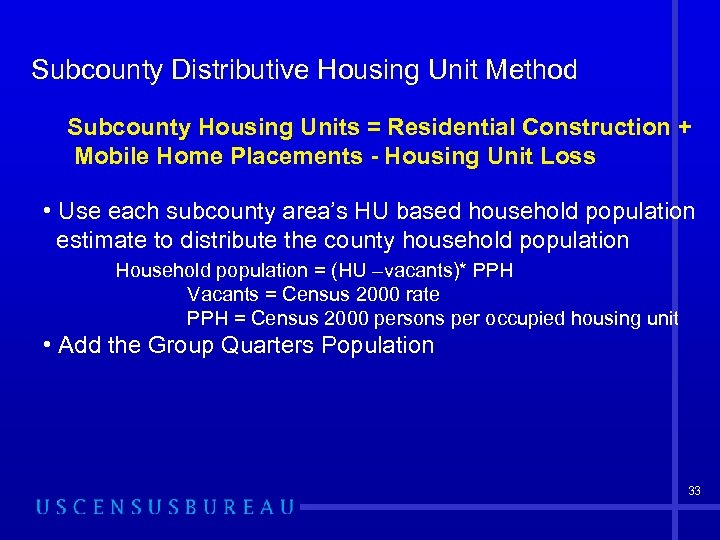 Subcounty Distributive Housing Unit Method Subcounty Housing Units = Residential Construction + Mobile Home Placements - Housing Unit Loss • Use each subcounty area’s HU based household population estimate to distribute the county household population Household population = (HU –vacants)* PPH Vacants = Census 2000 rate PPH = Census 2000 persons per occupied housing unit • Add the Group Quarters Population 33
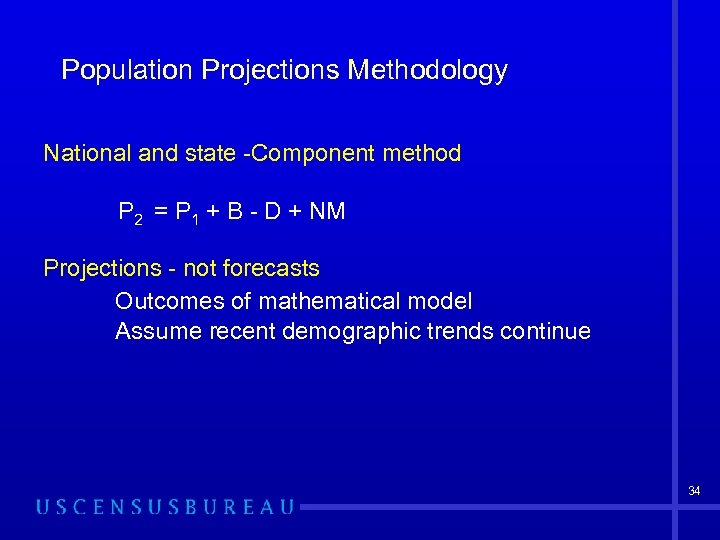 Population Projections Methodology National and state -Component method P 2 = P 1 + B - D + NM Projections - not forecasts Outcomes of mathematical model Assume recent demographic trends continue 34
 Further Information Population Estimates Web Site http: //www. census. gov/popest/estimates. php Population Projections Web Site http: //www. census. gov/population/www/projections/popproj. html Signe Wetrogan Assistant Chief for Population Estimates and Projections Signe. I. Wetrogan@census. gov (301) 763 -2093