 Скачать презентацию The Insurance Intermediary s Guide to Pollution Mold Bacteria Exclusions
b05f5fcf5bb3008705acd9d4ad63a823.ppt
- Количество слайдов: 91



The Insurance Intermediary’s Guide to Pollution/Mold/ Bacteria Exclusions And Environmental Insurance How To Add Value and Improve Customer Service September 23, 2013 Presented By: David Dybdahl, CPCU, ARM, MBA American Risk Management Resources Network, LLC 1 -877 -735 -0800 www. armr. net
Background On American Risk Management Resources Network, LLC. • A national wholesale insurance brokerage firm • Risk management & insurance consultants • Expert witnesses and support in over $700 million of disputed environmental insurance claims • Specialists in environmental insurance • We are contributing authors to the chapters on environmental insurance in: – – – 2 Charted Property and Casualty Underwriter (CPCU) Associate in Risk Management (ARM) IRMI Practical Risk Management, The IICRC S 520 Professional Mold Remediation Standards and Guidelines The IICRC S 500 Professional Water Restoration Standards and Guidelines. © 2012 ARMR. Network, LLC
The Educational Goals For Today • Understand the underlying risk and insurance issues relating to pollution, fungus/mold/bacteria exclusions. • Understand how water in effect became a excluded “pollutant” in property and liability insurance policies. • Understand how to help clients manage these risks. • Develop an efficient working protocol to address these newly uninsured loss exposures. • Prevent professional errors and omissions losses for insurance agents and brokers. © 2012 ARMR. Network, LLC
Statutory Environmental Loss Exposures The Basics • Environmental protection laws create loss exposures for clean up costs and damages to natural resources. • Regulations are geared towards Hazardous Materials that may damage human health and the environment. • Liability can attach to your status, not just your actions. • Liability can be acquired by successors. • Liability can follow the title to land. • Liability follows waste streams from cradle to grave. • It is strict liability, that applies jointly and severally. • Statutory environmental liability cannot be transferred by contract and lasts forever once acquired. 4 © 2012 ARMR. Network, LLC
Environmental Liability- Common Law The Basics Negligence Trespass Nuisance Strict Liability for ultra hazardous activity Fungus/mold /bacteria exclusions were game changers. These materials are not regulated under environmental protection laws. • Water/bacteria can create environmental loss exposures that are now uninsured in both property and liability insurance polices. • • • © 2012 ARMR. Network, LLC
Pollution Exclusions The Basics • Bar insurance recoveries on liability and property insurance policies. • Have never been limited to “Hazardous Waste”. • Essentially apply to losses associated with “contamination”. • Excluded “contaminates” can vary state to state by case law. (Foodborne illness is excluded as a pollutant in WI) • Nobody knows exactly how a pollution exclusion will apply to a loss before the loss event happens. • Always plan for the broadest application of pollution exclusions in property and liability insurance program designs. 6 © 2012 ARMR. Network, LLC
Pollution Exclusions - General Liability Insurance The Basics • Pollution exclusions have been General Liability insurance policies for 40+ Years. – 1973, only sudden and accidental pollution is covered in the Comprehensive General Liability insurance policy. – 1986 the “Absolute Pollution Exclusion” is added to the Commercial General Liability insurance policy; • The coverage give back for sudden and accidental pollution is eliminated • Specific coverage give backs for defined causes of pollution • The Total Pollution Exclusion endorsement is created © 2010 ARMR. Network, LLC
Pollution Exclusions In Property Policies The Basics • Property policies use the same ISO definition of a “pollutant” as the liability policy. • Only pollutants arising from a otherwise covered causes of loss are insured. (Loss arising from Insured Perils) • The property policy provides a sublimit of coverage for pollution rather than a full exclusion. • Beware of the pollution sublimit being wholly inadequate. (less than 10% of the average mold loss is covered by the typical commercial property insurance mold sublimit) © 2012 ARMR. Network, LLC
Fungus/Mold/Bacteria Exclusions The Basics • Mold exclusions as a cause of loss have been around for 75+ years in property insurance policies. 1943 – Around 2005 Fungi and Bacteria exclusion endorsements with an anti-concurrent causation clause strait out of a property insurance policy were added to all virtually liability insurance polices. – Variations of these exclusions were also added to homeowners package policies and to some insurance agents professional liability policies. – Property polices were given a sublimit for mold damages. • These exclusions were introduced faster and on a broader scale than any cause of loss exclusion in the history of insurance. (and nobody reacted) © 2012 ARMR. Network, LLC
Environmental Insurance The Basics • Environmental Insurance fills the insurance coverage gaps created by various forms of pollution exclusions in property and liability insurance policies. • Over 140 different environmental insurance policy forms are available. • There are no industry standards for environmental policy forms and there is great variation between them. • Environmental Insurance is available for everything from a single underground storage tank to a nuclear bomb plant clean-up contractor’s operations. 10 © 2012 ARMR. Network, LLC
Modern Trends In Environmental Risk Management • Water damages need to be managed with the same tools as Hazardous Materials. • Food poisoning and other bacteria related causes of loss need to be managed as environmental risks. • Between 2005 and 2007 the US imported enough contaminated drywall to finish 200, 000 homes. • Lead paint now has its own set of regulations. • Insurance agents and brokers are being sued at increasing frequency for: – Leaving their clients uninsured for “environmental” losses, – Selling the wrong environmental insurance policies. © 2012 ARMR. Network, LLC
It Is Important To Know A “Pollutant” When You See One • The case of Blue Fungus Death and the fish kill. • You sometimes never know what a “pollutant” is or what it can do until after a loss. • This case example is an actual loss involving a “pollutant” I am calling Blue Fungus Death today. • If you can guess the true identity of the Blue Fungus Death in this test tube; You will win a free sample of Blue Fungus Death to take home or use today! 12 © 2012 ARMR. Network, LLC
Fact Sheet • All the information I am providing about the blue material in the test tube is fact. • Blue Fungus Death, (A stage name) fits the EPA’S definition of a hazardous material. (reactive, corrosive, toxic or flammable) • Blue Fungus Death is a fungus produced toxin. • Weaponized Blue Fungus Death is known to kill humans, plants and animals. • Blue Fungus Death has killed someone within 5 miles of where we are today. 13 © 2012 ARMR. Network, LLC
Fact Sheet • The Blue Fungus Death in this test tube has been weaponized up to a concentration of 505, 000 parts per million. • Blue Fungus Death has killed fish at 1 part per million. • The material in the test tube really is Blue Fungus Death, but I have altered the color to make it more difficult for you to identify it. • The toxin itself is actually a clear liquid. 14 © 2012 ARMR. Network, LLC
Fact Sheet • Blue Fungus Death is federally regulated. • Blue Fungus Death is not regulated by the EPA. • Blue Fungus Death is produced in only one place on earth. 15 © 2012 ARMR. Network, LLC
Fact Sheet • Blue Fungus Death is weaponized in a process similar to gasoline refining. • Unlike gasoline, which floats on water, Blue Fungus Death is water-soluble. • Gasoline sells for $3. 80/gallon, Blue Fungus Death sells for about $70/gallon. • The weaponized version of Blue Fungus Death is sold as a “Product” at concentrations of 400, 000 and 505, 000 parts per million. • You can buy Blue Fungus Death over the counter, but it is not blue. 16 © 2012 ARMR. Network, LLC
The Blue Fungus Death Fish Kill • May 9, 2000 - As a result of a fire at the only processing facility on earth, runoff containing Blue Fungus Death reached a river. • This river supports barge traffic. • May 11, 2000 - Blue Fungus Death at concentrations of about 1 part per million of the river volume of water, set off a record setting fish kill in 66 miles of river. • Fish were killed from shore to shore, surface to bottom. 17 © 2012 ARMR. Network, LLC
Now To Win The Free Take Home Sample Guess The True Identity Of Blue Fungus Death 1. But first proof that the material in the test tube really is a hazardous material. (Do not try this demonstration at home) 2. What is the true identity of the blue material in the test tube? 18 © 2012 ARMR. Network, LLC
And Now The Rest Of The Story • This loss really did occur in the Kentucky river. • The fish died as a result of an algae bloom caused by the alcohol, not the alcohol itself. • The fish exposed to the alcohol were happy fish. • The decomposing algae used up all the oxygen in the water. • Without oxygen the fish died days after the spill. 19 © 2012 ARMR. Network, LLC
The Loss From An Insurance Prospective • How does the pollution exclusion in the GL policy apply to the loss? The Blue Fungus Death was still at the insured premises, it was not a “product”. The Pollution exclusion (f. ) in the Commercial General Liability policy always applies to a premises loss. • Are natural resource damages considered property damage? Not really. • Is a Clean Water Act violation considered property damage? Not really. • Are the dead fish in the river covered by the debris removal section in the property policy? Maybe, it was an ensuing loss from a covered peril, lighting. 20 © 2012 ARMR. Network, LLC
Past Lessons Learned On Environmental Risks • In sufficient quantities, any material can have unanticipated environmental impacts. • Environmental damages do not follow standard insurance policy definitions of loss. • The effects of pollution exclusions cannot be accurately forecasted pre-loss. • Ignoring pollution exclusions can lead to major uninsured losses; – Chinese drywall is a $30, 000, 000 mortgage devaluation problem for the banks. – This can all be attributed to poor insurance requirements on borrowers. 21 © 2012 ARMR. Network, LLC
Environmental Insurance • Is a powerful risk management tool. • Policies can insure everything from a single gasoline storage tank (UST) to a nuclear bomb plant clean up. • Environmental insurance polices are geared to environmental regulations for clean up in addition to common law liability. • There are no accepted industry standards on environmental insurance policy forms. • Sell the wrong environmental insurance policy form = No Coverage At All 22 © 2012 ARMR. Network, LLC
Basic Environmental Insurance Products • Site specific- Environmental Impairment Liability – Sold as Pollution Legal Liability, Site Pollution Liability, Pollution And Legal Liability and many other brand names. – Insures specified sites and can include products pollution liability, non owned disposal sites, transportation, UST’s • Contractors Environmental Liability – Sold as Contractors Pollution Liability and other brand names – Insures losses from described operations, can include non owned disposal sites, transportation and office/yard exposures • Professional Liability • Hybrids combine GL, Pollution , Professional and Products Pollution liability coverage parts. 23 © 2012 ARMR. Network, LLC
Environmental Impairment Liability Insurance • Site specific insurance for owned and leased property. • Covers third party claims for Bodily Injury, Property Damage, and Defense Costs. • Covers first party Clean Up Costs of “Pollutants”. • Can cover extra expense, business interruption, loss of rents, non owned waste disposal sites, transportation. • This is the preferred policy form to insure fungus/mold /bacteria risks in buildings. • Specially modified versions of this insurance is now needed to comply with insurance specifications requiring “All Risk” property insurance on loans. 24 © 2012 ARMR. Network, LLC
Contractors Environmental Liability Insurance • Insures Bodily Injury, Property Damage, Clean Up and Defense, from a release of “Pollutants”, arising from the insured’s described operations: – Appropriate for general contractors, home builders, remediation contractors, roofers, plumbers, trades, fire & water restoration……. • For mold exposures beware of exclusions for “Your Work”, “Impaired Property” “Subcontractors” and “Claims Arising From Materials Supplied By The Insured”. • CPL should not to be confused with job site pollution coverage buy backs on the GL policy. 25 © 2012 ARMR. Network, LLC
The Basic’s - Who Needs What Type Of Environmental Insurance • EIL is needed by all owners of commercial property, the only limiting factor is minimum premium. Apartments, condos, hotels, resorts, schools, shopping malls, office buildings, ware houses, farms, oil wells, all forms of wasted disposal operations, mines, pipe lines, utilities… • Contractors Environmental Liability is needed by every contactor in the US that can be associated with a water loss or a contamination loss. • Insurance advisors need to keep the notion of “hazardous waste” out of their thinking when advising on environmental loss exposures and insurance. Look for “contamination” loss exposures. 26 © 2012 ARMR. Network, LLC
Next - A Users Guide To Pollution Exclusions • Pollution exclusions in both property and liability insurance policies drive the need for various forms of environmental insurance Please Be back in 10 minutes for more fun with insurance! © 2012 ARMR. Network, LLC
A Users Guide to Pollution Exclusions • Liability Insurance – Absolute Pollution exclusion (f. ) in the CGL - Leaves coverage for products/completed operations on the CGL policy. – Total Pollution exclusion - Eliminates the products and completed operations cover in the off-the-shelf GL policy. – Beware of Pollution “related” loss exclusions– may exclude otherwise covered losses if part of the loss is related to the excluded cause. – A insurance agent errors and omissions loss arising from an uninsured legionnaires disease wrongful death claim could be related to bacteria because legionella bacteria is the proximate cause of Legionnaires Disease. 28 © 2012 ARMR. Network, LLC
Pollution Exclusion (f. ) In The CGL Policy 1986 • Applies to a release of pollutants from the premise and operations of the insured with these give backs – – – Heating equipment 1997 Cooling an dehumidification equipment 2004 Owners as additional insureds 1998 Hostile Fire 1986 Vapors introduced by a contactor 1998 • Insurance does not apply to sites that handle waste. • Insurance does not apply to contractors that clean up pollutants or to the waste streams of the insured. • By default exclusion (f. ) does not apply to Products and Completed Operations © 2012 ARMR. Network, LLC
Total Pollution Exclusions In Commercial General Liability Policies • A common endorsement on General Liability Insurance policies. • These endorsements eliminate the handful of exceptions to the “Absolute” pollution exclusion (f. ) in the CGL. • Products and Completed Operations coverage for a loss caused by “Pollutants” which was not excluded by the “Absolute” pollution exclusion (f. ) is totally eliminated from the CGL. © 2012 ARMR. Network, LLC
Pollution Exclusions In Property Insurance Policies • Usually provides a token sublimit of coverage • Still need a covered cause of loss to trigger the policy • Debris removal coverage is on premise only – remember the rafts of dead fish from the Blue Fungus Death loss. • Property policies use the same words to define a “Pollutant” that the CGL policy uses. • Once a material is determined in a state court to be a “pollutant”, both the liability and property insurance policies in the state are affected. 31 © 2012 ARMR. Network, LLC
Practical Advice On Pollution Exclusions • “Absolute” is slang, the actual exclusion (f. ) does not contain the word “absolute”. • The “Total Pollution Exclusion” sometimes but not always contains the word “total” in the title of the endorsement. • Beware: – Avoid counseling on what claim scenario will not fall under pollution exclusions called “Absolute” and “Total”, – Plan on the exclusions always barring coverage for “contamination” losses, – Be pleasantly surprised when they don’t, – Avoid having your E&O in the line when they do apply to a loss. © 2012 ARMR. Network, LLC
Current Trends On Pollution Fungus/Mold/Bacteria Insurance Coverage • Insurance coverage is systematically being stripped away for specified pollutants and case law. • The Environmental Insurance Market has expanded from 3 sellers of products to over 40. • 2003 ISO introduced an entire new set of exclusions for mold and bacteria in virtually all forms of insurance. • Category 3 water related losses are now excluded. • Between 2005 and 2007 the US imported enough contaminated drywall to contaminate 200, 000 homes. • The Standard Of Care for insurance producers in understanding environmental insurance is increasing. © 2010 ARMR. Network, LLC
“Toxic Mold” As A Pollutant - Today Main Street USA Needs Environmental Insurance • Mold claims exploded onto the insurance scene in 2001. • With estimated mold losses in 2002 equaling all the losses incurred from the peril fire, insurers universally excluded mold related losses beginning in 2003. • Fungus/Mold/Bacteria exclusions are “Total” pollution exclusions on steroids because of the anti concurrent causation language in the exclusion. • Today there unprecedented gaps in insurance coverage for water losses that are “related to” fungus/mold/bacteria/Category 3 water in any sequence to the loss. 34 © 2012 ARMR. Network, LLC
Really Important Things To Know About Fungus, Mold and Bacteria • They are omni present on the planet earth. • Excessive moisture on drywall leads to mold growth on the drywall within 72 hours at room temperature – every time. • All water in a drain pipe is classified as Category 3 Water – Category 1 water is drinking water – Category 2 water is contaminated maybe with bacteria – Category 3 water is grossly contaminated with bacteria • All water in a drain pipe is Category 3 water • Flood water is Category 3 water, so are tidal surges by definition. • We are all lucky the claims adjusters apparently don’t know about the definitions of Cat 2 and Cat 3 water. 35 © 2012 ARMR. Network, LLC
A Mini Lesson On Mold Ecology • Think of mold as a micro plant, it has seeds (spores), roots and a stem. Like all plants it needs food. • Paper and wood products are great mold food sources. • Drywall is perfect mold food. • Microscopic mold spores (seeds) are everywhere. • All it takes to set off mold growth in a building is: 1. 2. 3. 4. 5. 36 Moisture Temperature, room temperature is perfect. Time, 36 hours is enough. Food, paper faced dry wall is the perfect mold food. The mold spores were already there. © 2012 ARMR. Network, LLC
A Mini Lesson On Mold Damages • 90% of mold losses are for damage to property. • Without an active immune system mold decomposes flesh very quickly. • “Toxic Mold” Bodily Injury damages from a direct cause is very difficult to prove today due to the rules of evidence in court. • Mold damages did not disappear along with the insurance. • There actually more “mold “ contractors today than there were in 2003, everyday they go to work. 37 © 2012 ARMR. Network, LLC
How Water Became A Excluded Pollutant • Water or elevated levels of moisture = mold growth on drywall in as little as 36 hours @ room temperature – This is not a mater of debate • The threatened existence of any species or quantity of mold/fungus triggers the exclusion. • The “Mold” exclusion applies to bacteria contamination too! • Some Cat 2 water and all Cat 3 water damages are excluded by the CGL policy at the moment the contaminated water causes or threatens to cause Bodily Injury or Property Damage. 38 © 2012 ARMR. Network, LLC
Fungus/Mold/Bacteria Exclusions And Coverage • Universal fungus/mold/bacteria exclusions have increased the historical need for environmental insurance by 100 fold. • Beware of the you can’t be in the remediation business effects of this exclusion in CGL policies. • Almost all insurance buyers today are ignorantly and needlessly uninsured for this loss exposure. • Affordable fungus/mold/bacteria coverage solutions for commercial insurance buyers are readily available in the environmental insurance market. 39 © 2012 ARMR. Network, LLC
Historical Coverage Limitations For Mold In Property Insurance Policies • Wear and tear, gradual deterioration, corrosion, rust, rot, mold, inherent vice, latent defect, insects, rodents, birds and other animals are not covered as a proximate cause of loss. 1943 • However these losses would be covered if they ensued after a covered loss under the policy. • Pollution as a cause of loss is also excluded, unless the release results from specified perils • Example - Drywall off-gassing is not a covered cause of loss and is also a excluded pollutant. 40 © 2012 ARMR. Network, LLC
The Definition Of Pollutant In A Property Insurance Policy “Pollutants” means any solid, liquid, gaseous or thermal irritant or contaminant, including smoke, vapor, soot, fumes, acids, alkalis, chemicals and waste. Waste includes materials to be recycled, reconditioned or reclaimed. • Does mold fall into this definition? Not so well, that is why a separate exclusion for mold was added. • Chinese drywall off gases hydrogen sulfide which combines with humidity to create sulfuric acid. Acid is specifically a “pollutant”. 41 © 2012 ARMR. Network, LLC
Mold “Related Claims” Exclusions In Property Policies • Now built into ISO based property insurance policies. • Apply to Fungus, Mold, Bacteria and Category 3 water. • Override traditional pollution and mold exclusions to eliminate consequential loss and efficient proximate cause of loss theories for coverage. • This is an exclusionary/sublimit endorsement that caps recoverable insurance to a token sublimit, $10, 000. • The average mold clean up in a commercial building is $250, 000, but can reach tens of millions of $$$$$. 42 © 2012 ARMR. Network, LLC
The Coverage Provided By Commercial General Liability Insurance Insuring Agreement • Pay those sums that the insured becomes legally obligated to pay for Bodily Injury & Property Damage. • Also provides for Defense Costs as part of a “Loss” which is broader coverage than the BI and PD coverage. • The CGL policy may defend a “Loss” that ends up not being a covered claim. • If the CGL policy has an exclusion that applies specifically to a “Loss”, then there is no Defense coverage for the reported claim. 43 © 2012 ARMR. Network, LLC
The Definition of Pollutants In The General Liability Policy Pollutants means any solid, liquid, gaseous or thermal irritant or contaminant, including smoke, vapor, soot, fumes, acids, alkalis, chemicals and waste, Waste Includes materials to be recycled, reconditioned or reclaimed. • Same Definition used in Property insurance. • Does mold fall into this definition? Not very well, that is why ISO added a separate fungus/mold/bacteria related loss exclusion. 44 © 2012 ARMR. Network, LLC
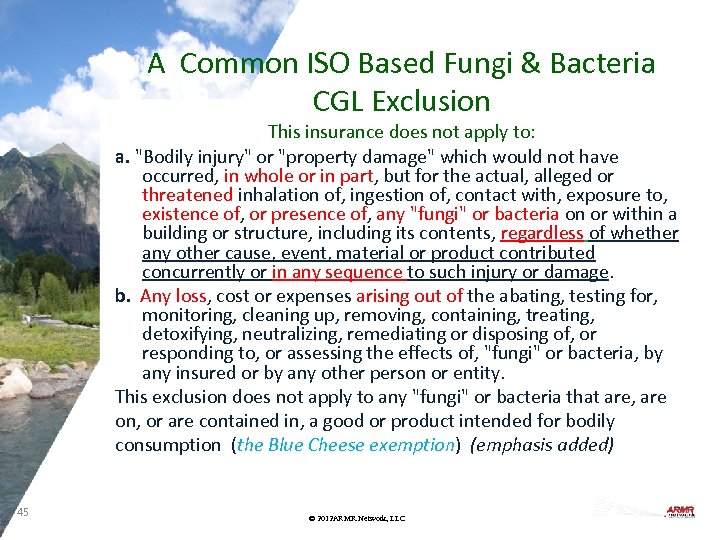
A Common ISO Based Fungi & Bacteria CGL Exclusion This insurance does not apply to: a. "Bodily injury" or "property damage" which would not have occurred, in whole or in part, but for the actual, alleged or threatened inhalation of, ingestion of, contact with, exposure to, existence of, or presence of, any "fungi" or bacteria on or within a building or structure, including its contents, regardless of whether any other cause, event, material or product contributed concurrently or in any sequence to such injury or damage. b. Any loss, cost or expenses arising out of the abating, testing for, monitoring, cleaning up, removing, containing, treating, detoxifying, neutralizing, remediating or disposing of, or responding to, or assessing the effects of, "fungi" or bacteria, by any insured or by any other person or entity. This exclusion does not apply to any "fungi" or bacteria that are, are on, or are contained in, a good or product intended for bodily consumption (the Blue Cheese exemption) (emphasis added) 45 © 2012 ARMR. Network, LLC
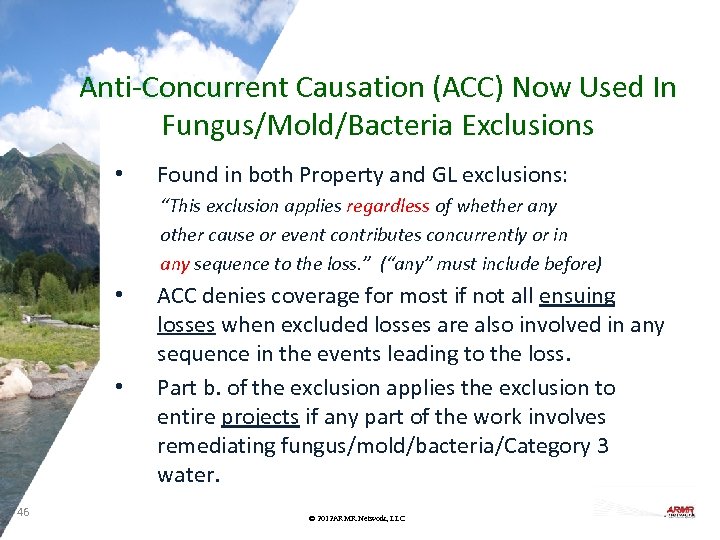
Anti-Concurrent Causation (ACC) Now Used In Fungus/Mold/Bacteria Exclusions • Found in both Property and GL exclusions: “This exclusion applies regardless of whether any other cause or event contributes concurrently or in any sequence to the loss. ” (“any” must include before) • • 46 ACC denies coverage for most if not all ensuing losses when excluded losses are also involved in any sequence in the events leading to the loss. Part b. of the exclusion applies the exclusion to entire projects if any part of the work involves remediating fungus/mold/bacteria/Category 3 water. © 2012 ARMR. Network, LLC
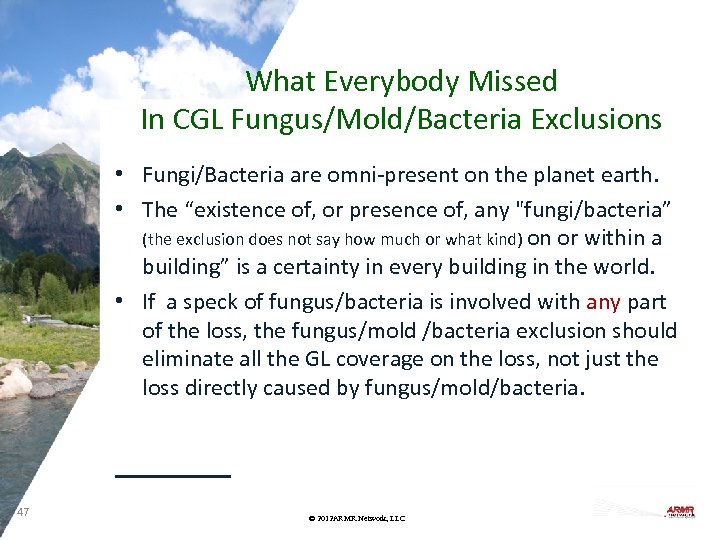
What Everybody Missed In CGL Fungus/Mold/Bacteria Exclusions • Fungi/Bacteria are omni-present on the planet earth. • The “existence of, or presence of, any "fungi/bacteria” (the exclusion does not say how much or what kind) on or within a building” is a certainty in every building in the world. • If a speck of fungus/bacteria is involved with any part of the loss, the fungus/mold /bacteria exclusion should eliminate all the GL coverage on the loss, not just the loss directly caused by fungus/mold/bacteria. 47 © 2012 ARMR. Network, LLC
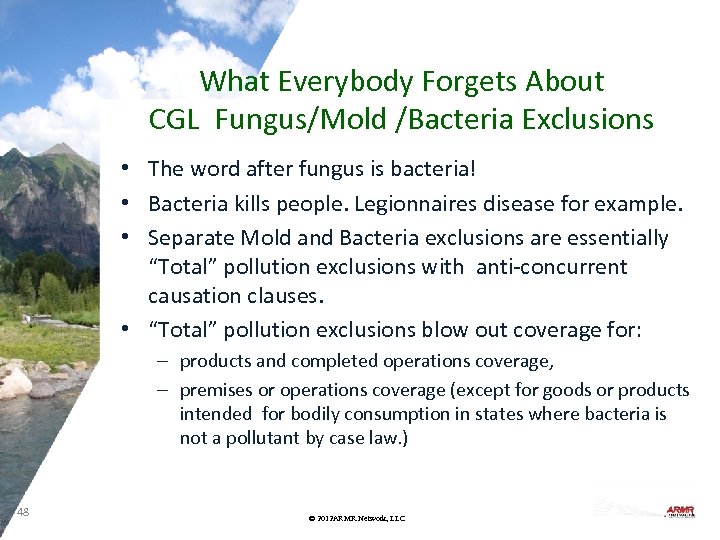
What Everybody Forgets About CGL Fungus/Mold /Bacteria Exclusions • The word after fungus is bacteria! • Bacteria kills people. Legionnaires disease for example. • Separate Mold and Bacteria exclusions are essentially “Total” pollution exclusions with anti-concurrent causation clauses. • “Total” pollution exclusions blow out coverage for: – products and completed operations coverage, – premises or operations coverage (except for goods or products intended for bodily consumption in states where bacteria is not a pollutant by case law. ) 48 © 2012 ARMR. Network, LLC
Beware Of The Double Whammy Pollution + Fungus/Mold /Bacteria Exclusions • Bacteria contamination is considered a “Pollutant” by case law in property and liability insurance policies in at least CA, MN, WI and IN. • Food borne illness is caused by bacteria. • There is no exemption for “bodily consumption” in a CGL Pollution exclusion f. or in a Total Pollution exclusion endorsement. • Food services firms in WI have been uninsured for food poisoning liability since 2004 due to case law on the definition of a “pollutant” in a property policy. LANDSHIRE FAST FOODS OF MILWAUKEE, INC. , D/B/A GRANIYY'S HOMESTYLE F'OODS, PLAINTIFF- APPELLANT, EMPLOYERS MUTUAL CASUALTY COMPANY, DEFENDANT 2004 © 2012 ARMR. Network, LLC
Insuring Foodborne Illness Liability In Wisconsin, Minnesota, California, Indiana • For restaurants, school cafeterias, food services firms…… – The GL Absolute Pollution Exclusion (f. ) apples to premises claims. – These risks need a specially adapted EIL policy. • For farmers and food processors – Exclusion (f. ) on the CGL does not apply to products. – Beware of a Total Pollution Exclusion which would eliminate products pollution coverage in the CGL. – Offer a specially adapted EIL policy to play it safe. © 2012 ARMR. Network, LLC
The You Cannot Be In The Business Fungus/Mold /Bacteria Exclusion • Because of the ACC clause, policyholders have no GL coverage for claims arising from responding to or assessing the effects mold or bacteria. • Nobody knows with certainty what the words “regardless and in any way” in the exclusion might mean. • This provision if taken to its literal conclusion is a “you cannot be in the business” exclusion for any job or part of that is related to fungus/mold/bacteria remediation. – Risks affected include fire and water damage restoration contractors, janitorial, cleaning, sewer contractors, remodeling, plumbers rooters 51 © 2012 ARMR. Network, LLC
The Irresolvable GL Coverage Flaw For Mold And Bacteria Related Work • The GL policy kicks out “Any cost arising out of responding to, or assessing the effects of, "fungi" or bacteria, by any insured”; the site job becomes excluded. • Even if a separate fungus/mold/bacteria CEL policy is purchased, it only pays for damages caused by the release of defined “pollutants”. • The only way to fix this onerous GL coverage gap is to eliminate section b. of the fungi/bacteria GL exclusion in a combined GL/CEL/Professional Liability policy. 52 © 2012 ARMR. Network, LLC
And More Negative Effects Arising From Fungus/Mold/Bacteria Exclusions • Building owners are exposed to fungus/mold/ bacteria/Category 3 water related losses and nearly all parties are uninsured today. • Building owners are uninsured for damages caused by contractors (the contractors are uninsured too). • Building owners and their lenders need to add intelligent environmental insurance requirements to their contracts. • Building owners also need their own EIL policies. 53 © 2012 ARMR. Network, LLC
Case Study - Mold Exclusions In Effect Property Insurance • A windstorm breaks $100, 000 of windows in a hotel. Wind driven rain enters the building. Unable to dry the building within three days mold grows throughout the building. – Remediation takes 6 months and costs, $500, 000. – All contents need to be replaced, $500, 000. – Business interruption, $500, 000. 54 © 2012 ARMR. Network, LLC
Property Insurance Coverage • Traditional Mold Exclusion – The proximate cause of the loss was wind driven rain. – Mold was an ensuing damage from a covered peril • Therefore the entire loss $1, 600, 000 is covered © 2010 ARMR. Network, LLC • Mold Related Claims Exclusion – The glass may be covered – The other damage was caused by or contributed to by mold; it is excluded or sublimited • Therefore only $100, 000 of glass + mold sublimit is covered • What will the owner and lender think of this settlement? All Risk?
Actual 2007 Remodeling Mold Claim Owners and Contractors • A plumber installs defective toilet wax o-rings during the remodeling of 200 apartments. – ½ leaked, causing “pollution” and mold/Cat 3 related losses. – Each leak causes $100, 000 of damages. – The “All Risk” Property carrier of the property owner denies the pollutant/mold/Category 3 water related loss. – The GC and Plumber had the same exclusions on their GL. – The EIL/mold/bacteria policy on the owner should pay $4, 000. – The owner is short $6, 000 plus legal expenses. 56 © 2012 ARMR. Network, LLC
The Needed Insurance Coverage For The Remodeling Contactors • The General Contractor and the Plumber needed specially modified Contractors Environmental Liability insurance with fungus/mold/bacteria coverage. • Both were unnecessarily uninsured for the loss. • Both are looking at their share of a $10, 000 loss. • Their allocated CEL premiums would have been below $2000 each for this job. • It is almost certain their insurance broker never, explained the effects of the fungus/mold/bacteria exclusions to the remodeling GC or plumber. 57 © 2012 ARMR. Network, LLC
How To Work With Environmental Insurance Products • In the next section we cover; – How to select the right environmental insurance policy. – Avoiding insurance agent/broker professional liability losses. – A time efficient working protocol for environmental insurance. Please be back in 10 minutes for more fun with pollution insurance! © 2012 ARMR. Network, LLC
Obtaining Environmental Coverage In Commercial Accounts • Fungus/Mold/Bacteria Exclusions = Pollution Exclusions • A broad range of coverage solutions were invented years ago in the environmental insurance market. • Beware of non standardized environmental policy forms, illusionary coverage and inherently defective environmental insurance coverage if a bad match of policy form to the client’s need is made. • Illusionary coverage is created when a exclusion is so broad it overrides all potential insured damages, (example Damage To Your Work exclusions on CEL sold to a water remediator) 59 © 2012 ARMR. Network, LLC
How To Insure Against Pollution/ Mold/Bacteria/Category 3 water Losses • Does the client need to insure a property or a negligent act? (The basic EIL vs. CPL decision) • Make sure the policy specifically addresses fungus/mold/bacteria as a covered loss if there is a water intrusion risk. • Specialized expertise in environmental insurance and insured clean up standards will be required to evaluate coverage. • The are no government regulations on mold or bacteria clean up. 60 © 2012 ARMR. Network, LLC
General Rules To Follow In Evaluating Environmental Insurance • Never assume environmental insurance policies are created equal. • Environmental insurance policies can never be compared on premium and deductible alone. • Does the environmental insurance policy fill the coverage gaps in the insurance program of the insurance buyer? • Is the proposed policy fit for the purpose for which it is intended? • Beware environmental insurance polices were not originally designed for indoor use. © 2012 ARMR. Network, LLC
Environmental Insurance To Cover Pollution, Fungus/Mold/Bacteria Losses • Basic environmental insurance policy forms: – Contractors Environmental Liability, insures a negligent operation. – Environmental Impairment Liability insures a site on a nofault basis. This policy can fill the pollution, fungus/mold/bacteria coverage gaps in a property policy in addition to the CGL. 62 © 2012 ARMR. Network, LLC
State Of The Insurance Market Contractors Environmental Liability • Minimum Premium $3500/ with Mold/Bacteria coverage that works, $1500 for one that doesn’t. • Minimum SIR $2, 500 • Typical rates for $1, 000 limits – – Fire water damage restoration 1/10 of 1% HVAC 1/10 of 1% Mold Remediator 1/5 of 1% of revenue General Contractor 1/10 of 1% of revenue • Similar rates for CPL covering Chinese drywall remediators 63 © 2012 ARMR. Network, LLC
State of the Art General Contractors - Gap Filler Policy • One policy fills the coverage fills the gap in the GL for pollution, fungus/mold/bacteria and professional loss exposures • The need for this coverage is easy to establish – GCs have significant uninsured professional, pollution & fungus/mold/bacteria/water damage risks now – Have the customer read their exclusions to establish need • Premium = usually 1/10 th of 1% gross receipts • $12, 000 Minimum Premium • Every GC needs one of these policies today 64 © 2012 ARMR. Network, LLC
State of the Art Combined GL/CEL/Professional Policies • • • 65 A must have for any company performing environmental, mold and bacteria clean up work, fire & water restoration, asbestos remediation, etc. Because of the ACC provision in fungus/mold/bacteria exclusions, the GL kicks out coverage for the job related to these materials. CEL only insures damages from pollutants. If a package policy for the class is unavailable: try to get the GL and CEL in the same insurance company to avoid the “its not my job man” claims adjusting problem between these two coverage forms. © 2012 ARMR. Network, LLC
State Of The Insurance Market EIL • Minimum Premium about $4, 000 • Over $200, 000 in Market Capacity • Typical pricing for $1, 000 limit – – – 66 Landfill, $10, 000 Waste Lagoon $7, 000 Newer underground storage tanks $800/tank Bulk Oil Storage $8, 000 per million gallon tank Apartment units for mold $70/unit, minimum premium $6, 000 Hotel $6, 000 © 2012 ARMR. Network, LLC
Environmental Impairment Liability For Building Owners & Developers • Site Specific Pollution Insurance • Covers third party claims for BI, PD, Defense Costs plus first party clean up. • Fixes coverage gaps in GL and Property policies created by mold/bacteria exclusions. • Complies with insurance specifications for All Risk property coverage. (In every loan covenant in the US requires this) • Claims arising from operations of a contractor are covered for the owner, but not the contractor. • Every commercial building and condo needs this insurance. 67 © 2010 ARMR. Network, LLC
Insuring Mold In Personal Lines • Look for mold buy backs and coverage extensions in homeowners forms. • Some insurers offer considerably more sub limits than others. • Mono-line mold coverage in homeowners policies is generally not available. • A mono line insurance product to insure homes for Chinese drywall pollutants is available from ARMR. Net. 68 © 2012 ARMR. Network, LLC
Risk Management Advice For Insurance Advisors • How to avoid “failure to advise and offer insurance” professional errors and omissions liability loss exposures. – Tell every customer they need environmental coverage, there is no down side in doing this. • There is a big down side to ignoring the effects of pollution exclusions in your customer base. • Get professional help, do not work in this coverage line without it. • Work smart to save time. © 2012 ARMR. Network, LLC
Risk Management Advice For Insurance Advisors • How to create a bullet proof defense for E&O claims against the agent/broker/advisor for uninsured environmental losses. • Solution: Make sure clients understand their environmental loss exposure and are given the documented option to purchase appropriate environmental insurance coverage. Caution: Obtaining environmental insurance quotes on each account is not recommended from an working efficiency standpoint. 70 © 2012 ARMR. Network, LLC
Common Denominators In Most Broker E&O Cases Based On Coverage Defects 1. The customer does not remember why they bought the cheap policy. 2. The customer may acknowledge that they were advised of an exclusion; but will always say they did not understand the exclusion when they are facing a big uninsured loss. 3. The agent/broker would have made more money by selling the good insurance. 71 © 2012 ARMR. Network, LLC
Tips For Surviving And Thriving With Pollution/Fungus/Mold/Bacteria Exclusions • Explain the environmental loss exposures to the customer. • Point out the exclusions and discuss their effect. • Offer appropriate environmental insurance coverage. • Utilize premium indications to save time. • Use subject matter expert resources to help with this process. • Never waste time on completing insurance applications for an unqualified buyer. 72 © 2012 ARMR. Network, LLC
Avoid The Agent/Broker E&0 Traps With Project Specific CEL Policies • CEL policies are typically written for a policy period equal to the term of construction. • To have a covered claim both the pollution event and the resulting damage must take place within the policy period. • Only claims otherwise covered during the policy period apply to the Extended Reporting Period. (ERP) • Therefore there is no completed operations coverage within a ERP on a pollution insurance policy. • Buying Occurrence based CEL does not automatically provide completed operations coverage. 73 © 2012 ARMR. Network, LLC
More Broker E&O Traps With Project Specific CEL • Beware: a fault based CEL policy does not fix the pollution and mold coverage gap in the property policy. • As a general rule never sell CEL to protect an owner, EIL is the preferred policy choice. • If the project suffers a first party mold loss and turns to the contractor for payment, the CEL policy the owner indirectly paid for will do what? …. Defend the contactor from having to pay the owner a dime! • If you are representing the owner this is a good way to get sued for malpractice. 74 © 2012 ARMR. Network, LLC
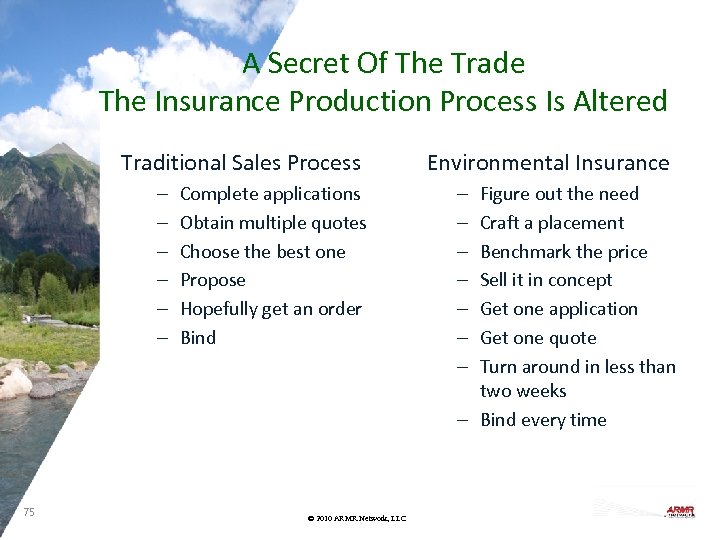
A Secret Of The Trade The Insurance Production Process Is Altered Traditional Sales Process – – – 75 Complete applications Obtain multiple quotes Choose the best one Propose Hopefully get an order Bind © 2010 ARMR. Network, LLC Environmental Insurance Figure out the need Craft a placement Benchmark the price Sell it in concept Get one application Get one quote Turn around in less than two weeks – Bind every time – – – –
A Perspective On Environmental Insurance Placements • When environmental insurance policies are sold, coverage mistakes are very common. • Before issuing insurance certificates be sure to obtain the actual insurance requirements in the contracts of your client and carefully compare the coverage's in the policy to the requirements. • A ARMR audit of 22 in force insurance programs for GL/CEL policies revealed a 100% failure rate against a relatively simple, easy to comply with insurance specification. • All 22 accounts had bogus certificates filed with the ARMR client. 76 © 2012 ARMR. Network, LLC
The Insurance Brokers Dilemma • Brokers can be liable for a clients unintentionally uninsured losses (You must offer the coverage) • The standard of care for agents/brokers varies by state. • The E&O loss exposure of the insurance brokers on 4 environmental placements with litigated coverage disputes exceeded $300, 000. • If you are a insurance generalist selling environmental insurance policies and are not being sued for defective coverage in this product line…. you have not written enough of it…. see the top of this slide 77 © 2012 ARMR. Network, LLC
The Solution To The Dammed If You Do and Dammed If You Don’t Scenario • Never solely rely on a underwriter for advice. (there are no accredited standardized training courses for environmental insurance underwriting) • Never trust a generalist wholesaler for advice (If you could not learn the subject matter where would they? Maybe they worked as an environmental underwriter…. See above) • The $200 million+ E&O loss exposure of the insurance brokers was created by allowing generalists to place and service just 4 pollution policies… they did not use their subject matter experts in their environmental resource units at the brokerage firms. 78 © 2012 ARMR. Network, LLC
Why Specialized Environmental Insurance Resources Are Necessary • All environmental insurance policies refer to environmental laws in their insuring agreements. • Environmental Laws are greater in length than the entire tax code in the US. • There are over 140 different manuscript environmental insurance policies for sale, there are thousands of endorsements for these. • Without subject matter expertise it is impossible to effectively match the customers need to the coverage. • There is no place for underwriters or insurance brokers to learn about environmental risk management. 79 © 2012 ARMR. Network, LLC
How To Insure Against Pollution, Fungus, Mold, Bacteria, Drywall • Some buy backs on GL policies – the Swiss cheese approach, it is full of holes, but cheap. – Always offer these options because they are better than nothing. – Beware; do not sell these GL extensions as CEL insurance. • Environmental insurance is a better solution. • Policy must include fungus/mold/bacteria as a defined pollutant to have coverage for these contaminants. 80 © 2012 ARMR. Network, LLC
A Wake Up Call For Insurance Agents/Brokers • What does a plumber’s completed work do that might cause damage? • Remember – excessive moisture on drywall = mold – all water damages from a drain pipe are now effectively excluded in the General Liability policy. ( Cat 3 water) • What completed operations coverage is left on a plumber’s GL policy today? • What does a roofers completed operations do that can cause damage? • Many other classes of business are similarly affected. 81 © 2012 ARMR. Network, LLC
Hot Topics and Opportunities • Fungus/ Mold/Bacteria exclusions dramatically increase the need for various forms of environmental insurance policies. • These exclusions effectively make some water losses a excluded “pollutant” event. • Technical insurance expertise is much more important than it once was in this line of coverage. • The hard insurance market is creating opportunities to write new business. 82 © 2012 ARMR. Network, LLC
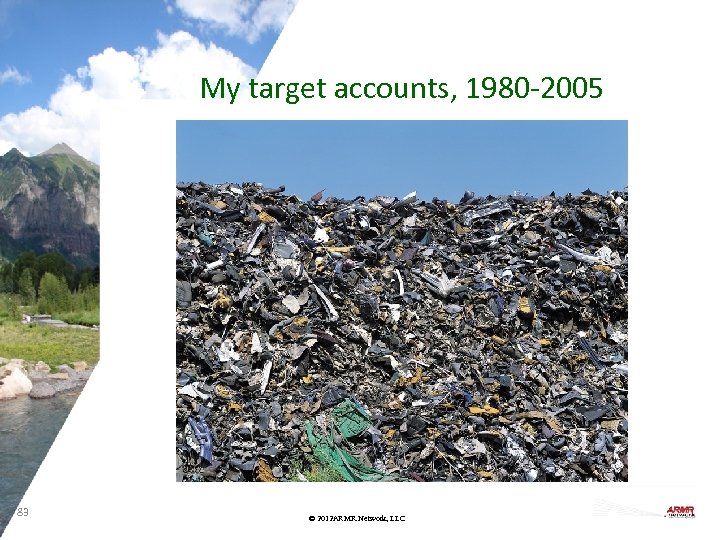
My target accounts, 1980 -2005 83 © 2012 ARMR. Network, LLC
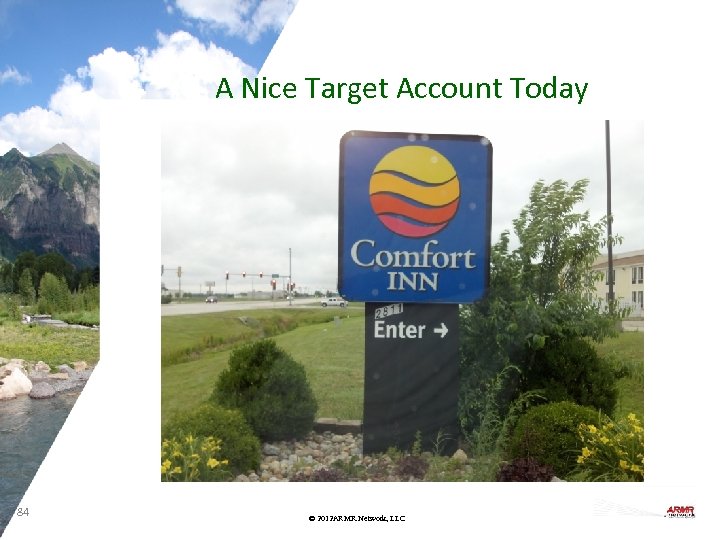
A Nice Target Account Today 84 © 2012 ARMR. Network, LLC
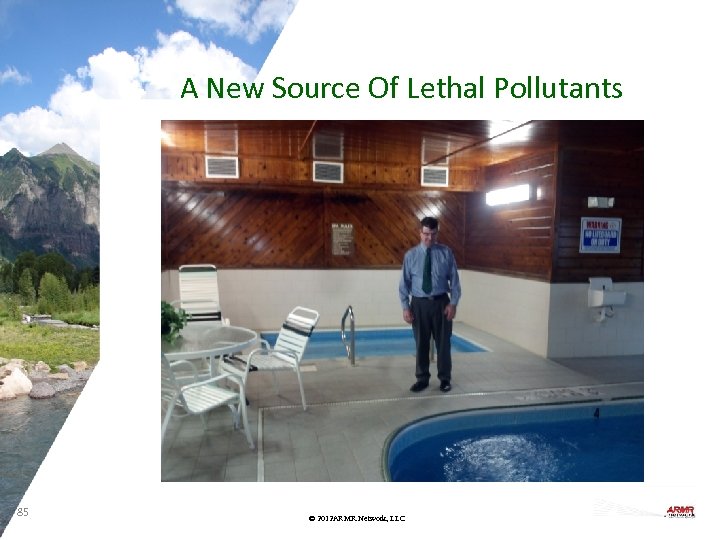
A New Source Of Lethal Pollutants 85 © 2012 ARMR. Network, LLC
Why Hotels Need Environmental Insurance Marjorie Braucher and Bonnie E. Leiser alleged that the swimming pool and hot tub at the Comfort Inn of Lincoln, Ill. , d/b/a Best Western of Lincoln, Ill. , were infested with Legionella bacteria. Marjorie’s daughter died from legionnaires disease. The lawsuit brought by the family against the hotel was for causing the wrongful death of their daughter. (AMCO Insurance Co. v. Swagat Group LLC, d/b/a Comfort Inn of Lincoln, et al. , No. 07 -3330, C. D. Ill. , Springfield Div. ; 2010 U. S. Dist. LEXIS 4770; See 2/19/09, Page 4). 86 © 2012 ARMR. Network, LLC
Illinois Case Law On Bacteria Caused Losses “Both a general liability policy and an umbrella policy exclude coverage for bacteria-related liability, an Illinois federal judge found Jan. 21, granting an insurer's motion for summary judgment seeking a declaration that it had no duty to defend its insured hotel owners and operators against underlying claims that guests contracted Legionnaire's disease from the hotel. ” Translation - there is no liability insurance protection at all on the GL policy in Illinois for losses associated with bacteria due to the fungus/ mold/bacteria exclusion endorsement. In CA, MN, WI and IN there would be no coverage because bacteria is a “pollutant” in the ISO standard General Liability and Property insurance by case law. 87 © 2012 ARMR. Network, LLC
And Now The Rest Of The Story • The GL and Umbrella Policies sold in 2005 had the new ISO based Fungus/Bacteria exclusion endorsement. • The policies in 2004 did not have this new exclusion endorsement. • In 2011 the hotel owner sued the insurance agent who sold the restrictive policy in 2005 for malpractice. – Failure to advise about the fungus/bacteria exclusion – Failure to offer coverage • Environmental insurance with bacteria as a pollutant was not available in 2005. (a viable defense for the broker) • But is coverage has been very available since 2009. 88 © 2012 ARMR. Network, LLC
Property Environmental Risk Management PERM – The State of the Art • The PERM insurance product combines water intrusion loss control with modified Environmental Impairment Liability Insurance. • The loss control is provided by IICRC certified water remediation contractors free of cost to the property owner. • Preplaced emergency response drying agreements – – Accelerates response times for drying Prevents mold from growing avoid the exclusions Maintains full property insurance limits in a Cat 1 water loss Reduces the cost of environmental insurance by half © 2012 ARMR. Network, LLC
Conclusion • Coverage solutions for pollution exclusions lie in specially adapted environmental insurance product lines. • Fungus/Mold/Bacteria exclusions are pollution exclusions on steroids. Beware of the ACC clause. • New exclusions for contaminated drywall are coming. • Chinese drywall is just another example of why every firm needs environmental insurance to fill coverage gaps created by pollution exclusions. 90 © 2012 ARMR. Network, LLC
Environmental Risk Management In Practice • Find subject matter expert resources to help you navigate through the environmental risks on each account. • Big I Markets provides access to the full spectrum of environmental insurance products through ARMR. Net. • Do not ignore the material changes that have been made to the underlying insurance coverage’s in your book of business. Thank you for the opportunity to make this presentation today 91 © 2012 ARMR. Network, LLC
Скачать презентацию The Insurance Intermediary s Guide to Pollution Mold Bacteria Exclusions
b05f5fcf5bb3008705acd9d4ad63a823.ppt