 Скачать презентацию THE INSIDE STORY OF BLOOD TRANSFUSION DR MOHAMED
9787e5d6f56aaeb4b36c87cb1d64f1fb.ppt
- Количество слайдов: 72



THE INSIDE STORY OF BLOOD TRANSFUSION DR. MOHAMED BILAL DELVI ASSISTANT PROFESSOR DEPT OF ANAESTHESIA COLLEGE OF MEDICINE KSU.
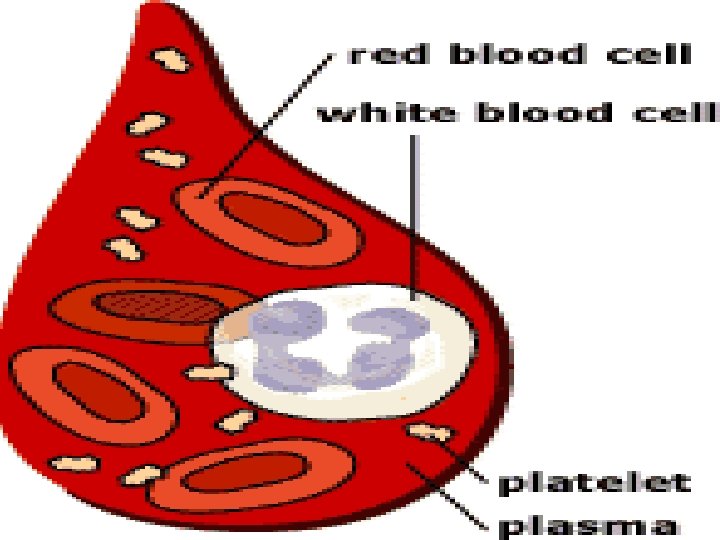
What is blood? n A highly specialised circulating tissue which has several types of cells suspended in a liquid medium called plasma. n Origins from Greek ‘haima’ n Blood is a life sustaining fluid
n Blood is an amazing fluid! n Keeps us warm n Provides nutrients for cells, tissues and organs n Removes waste products from various sites
Blood components n Packed red cells n Platelets n Fresh Frozen Plasma n Frozen plasma n Cryoprecipitate n Albumin n Immunoglobulins
INDICATIONS FOR BLOOD TRANSFUSION n Massive blood loss n Different types of anaemia n Haemophilia & other clotting factor deficiency n Cancer patients n For surgeries
HISTORICAL ASPECTS * 15 th century- unsuccessful attempts. n 1666 - dog to dog transfusion n 1667 -animal to human n 1818 - human to human n 1901 - major breakthrough- discovery of A, B, O groups.
HISTORICAL ASPECTS n 1907 - cross matching n 1914 - anticoagulant discovered n 1936 - first blood bank n 1939/40 - Rh factor discovery n 1950 - plastic blood containers.
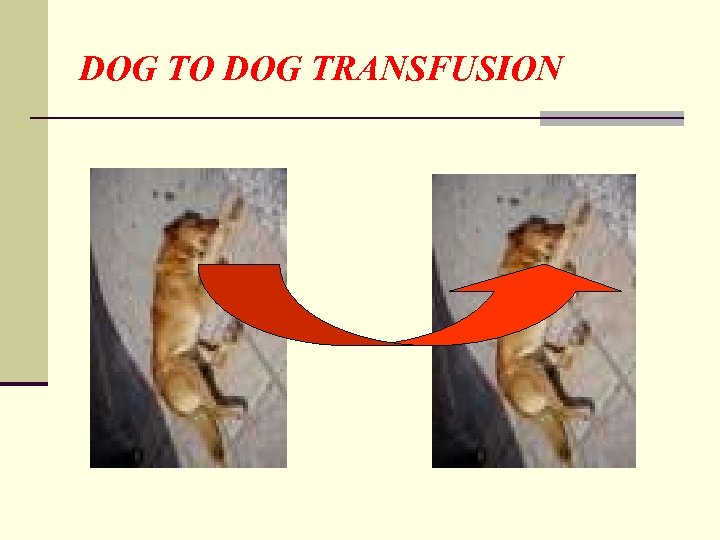
DOG TO DOG TRANSFUSION
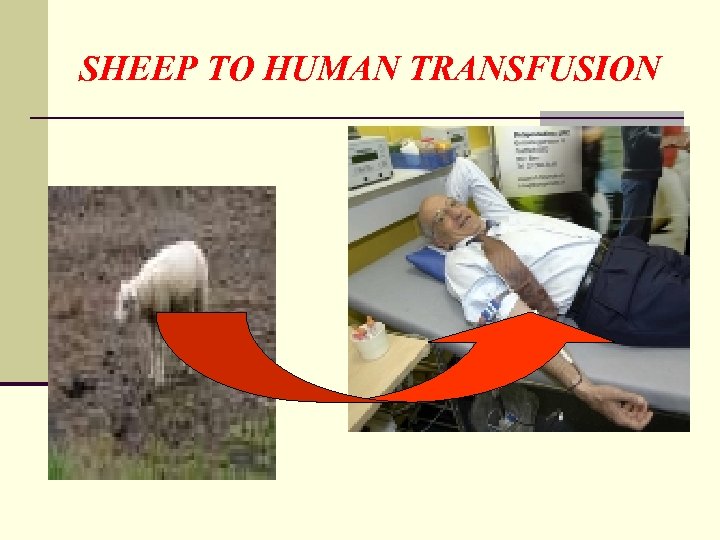
SHEEP TO HUMAN TRANSFUSION
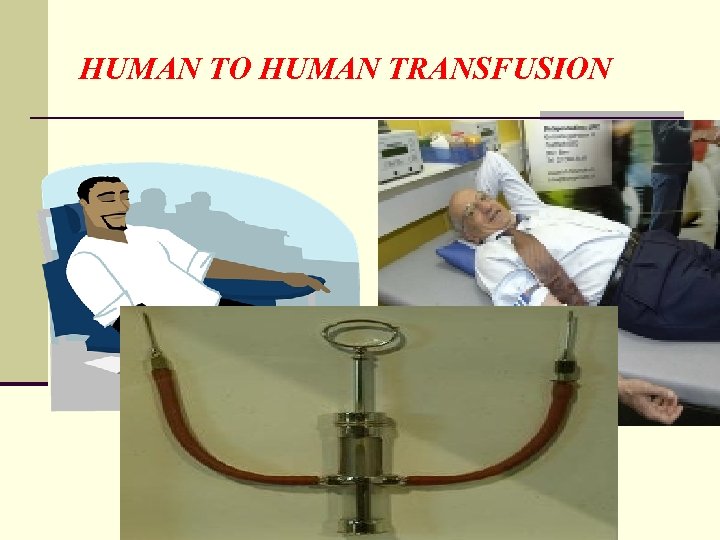
HUMAN TO HUMAN TRANSFUSION
Theoretical Yield of components n 1 unit of blood theoretically gives n 1 unit FFP n 1 unit PRBC’s n 1 single donor unit cryoprecipitate, single donor unit platelets n Plasma for Ig and albumin
BLOOD GROUP SYSTEMS n ABO System Most studied & important n Rh system n Lewis n Kell n Duffy from clinical point of view.
BLOOD GROUP SYSTEMS n MNSs n Lutheran n P n Ii n kid
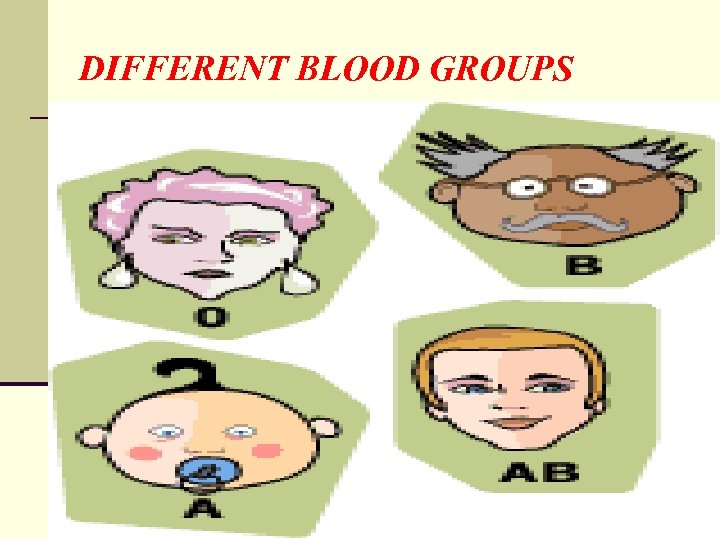
DIFFERENT BLOOD GROUPS
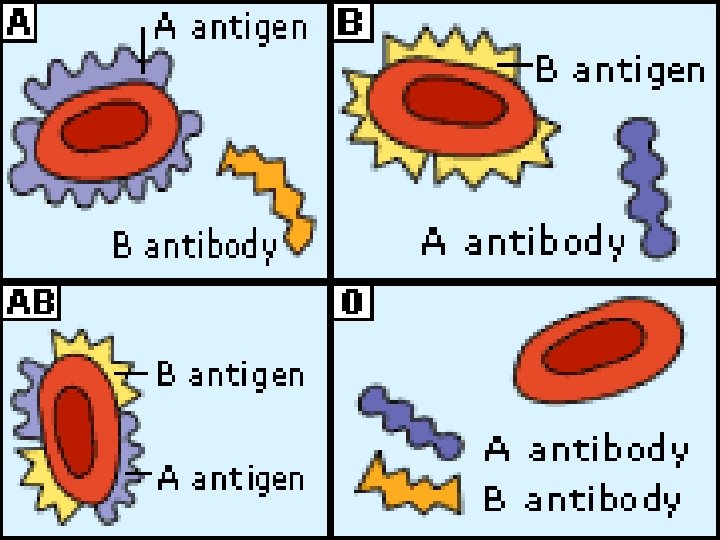
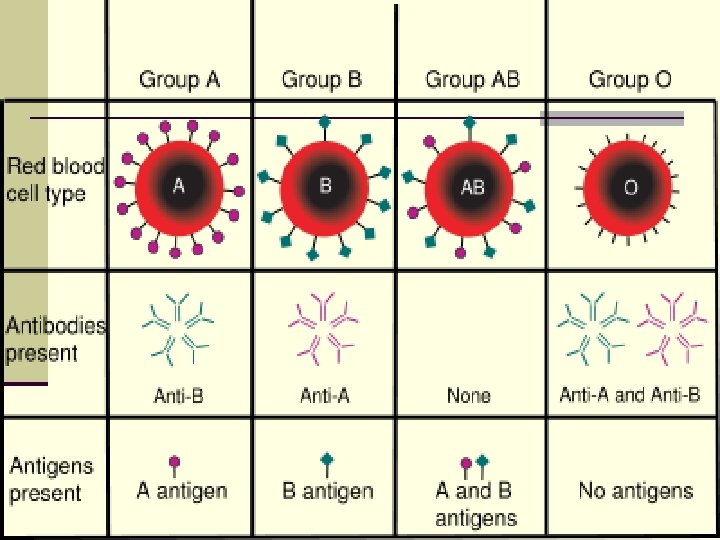
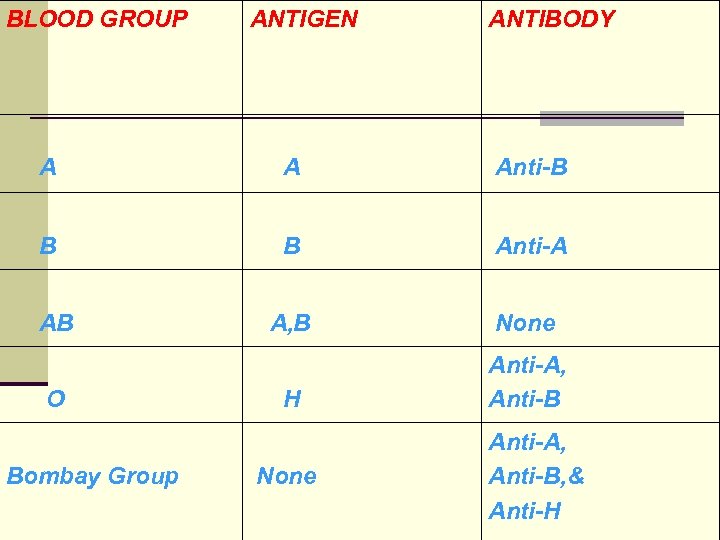
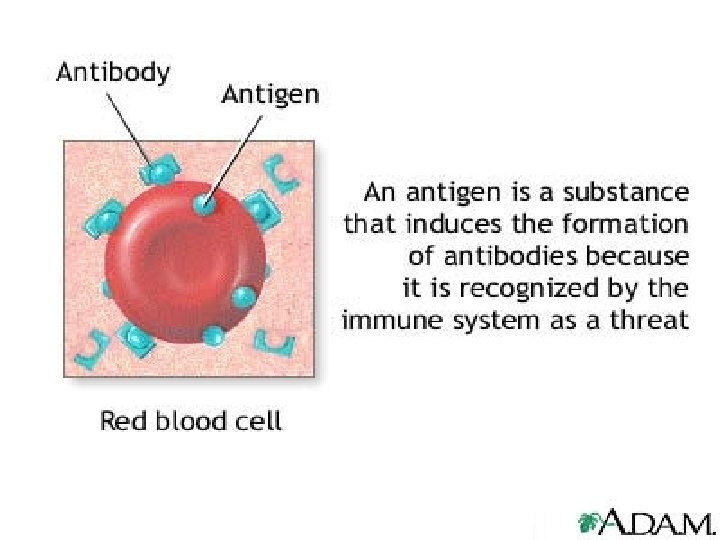
BLOOD GROUP ANTIGEN ANTIBODY A A Anti-B B B Anti-A A, B None H Anti-A, Anti-B AB O Bombay Group None Anti-A, Anti-B, & Anti-H

RHESUS MONKEYS
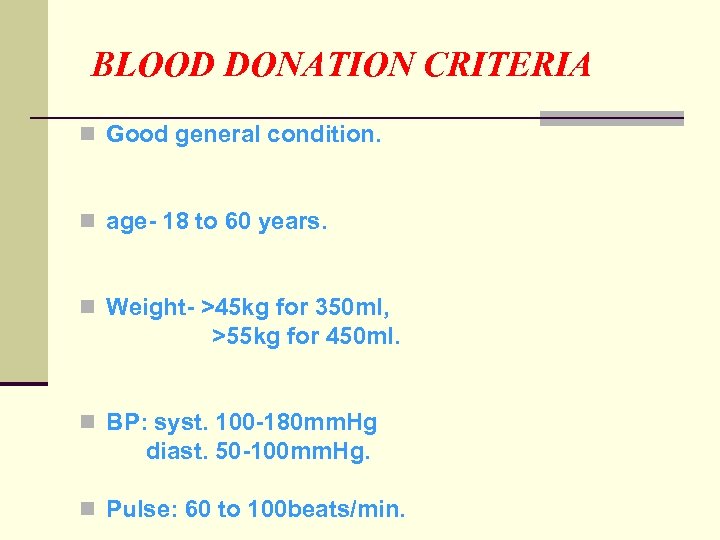
BLOOD DONATION CRITERIA n Good general condition. n age- 18 to 60 years. n Weight- >45 kg for 350 ml, >55 kg for 450 ml. n BP: syst. 100 -180 mm. Hg diast. 50 -100 mm. Hg. n Pulse: 60 to 100 beats/min.
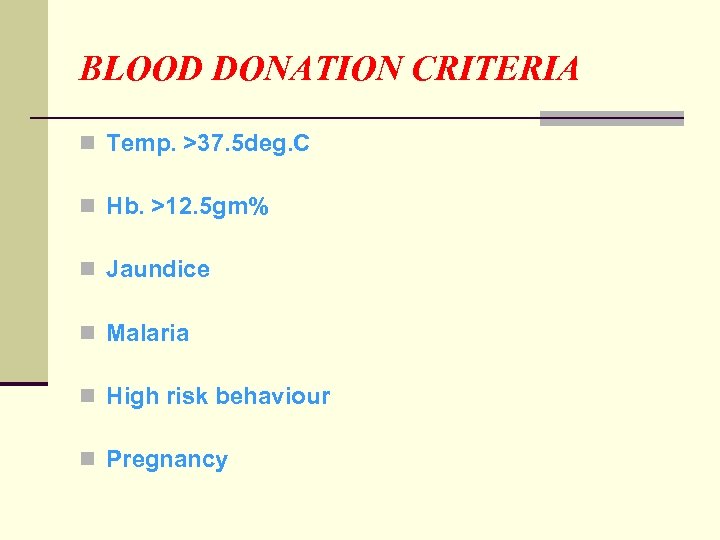
BLOOD DONATION CRITERIA n Temp. >37. 5 deg. C n Hb. >12. 5 gm% n Jaundice n Malaria n High risk behaviour n Pregnancy
BLOOD DONATION CRITERIA n Surgeries n Last blood donation n Tattooing n Chronic diseases n Last blood transfusion
INSTRUCTIONS TO DONOR AFTER DONATION n More fluids than usual. n Do not remain hungry. n Do not smoke for 1 hour. n Remove bandage after 6 hours. n If bleeding from puncture site, apply pressure. n If feeling faint/dizzy, lie down.
MISCONCEPTIONS/ REASONS FOR NOT DONATING BLOOD n Fear of contracting some disease n I do not have enough blood/ I will become weak. n I am too old n I am too busy.
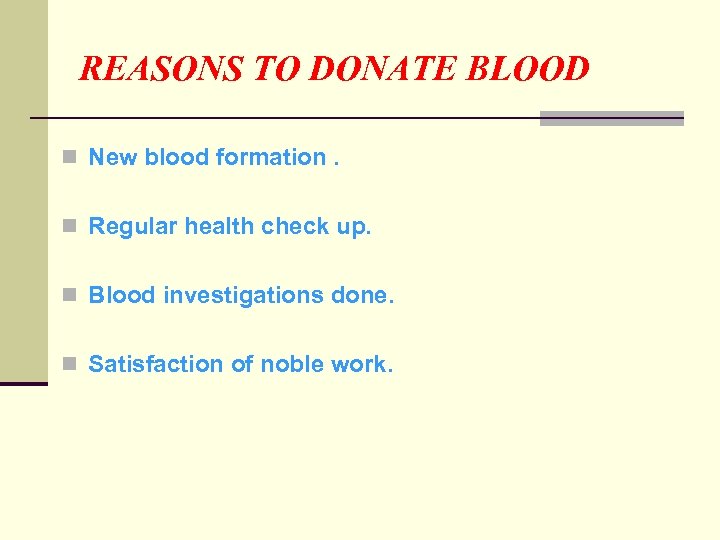
REASONS TO DONATE BLOOD n New blood formation. n Regular health check up. n Blood investigations done. n Satisfaction of noble work.
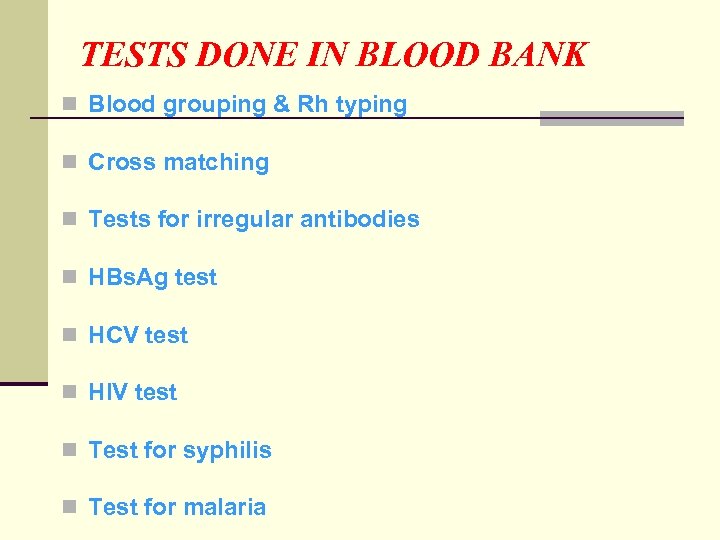
TESTS DONE IN BLOOD BANK n Blood grouping & Rh typing n Cross matching n Tests for irregular antibodies n HBs. Ag test n HCV test n HIV test n Test for syphilis n Test for malaria

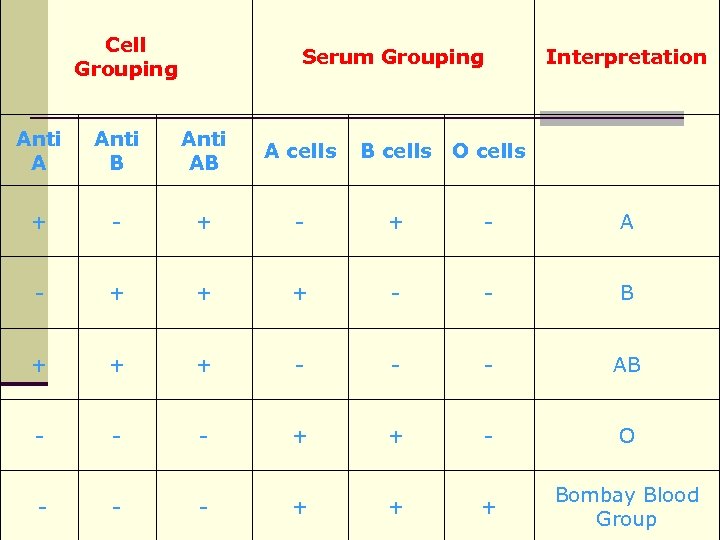
Cell Grouping Serum Grouping Interpretation Anti A Anti B Anti AB A cells + - + - A - + + + - - B + + + - - - AB - - - + + - O - - - + + + Bombay Blood Group B cells O cells
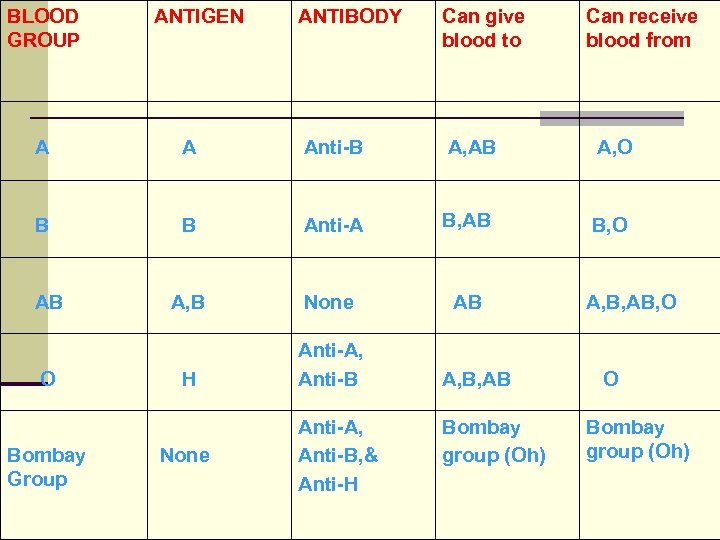
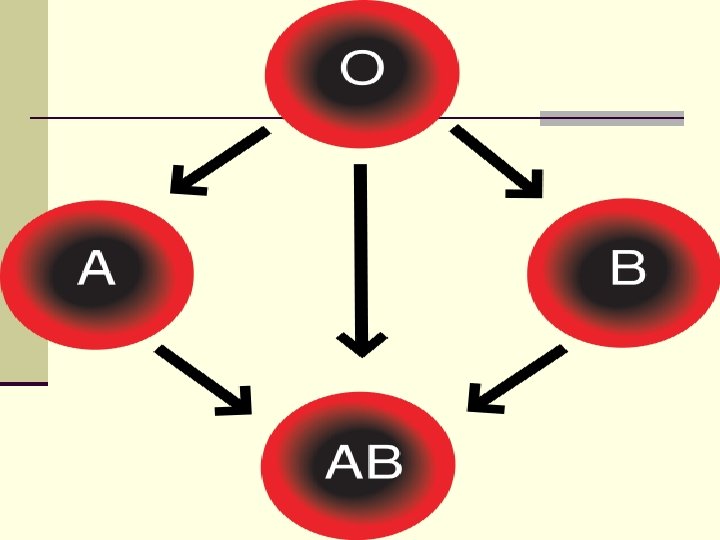
BLOOD GROUP ANTIGEN ANTIBODY Can give blood to Can receive blood from A A Anti-B A, AB A, O B B Anti-A B, AB B, O A, B None AB H Anti-A, Anti-B AB O Bombay Group None Anti-A, Anti-B, & Anti-H A, B, AB Bombay group (Oh) A, B, AB, O O Bombay group (Oh)
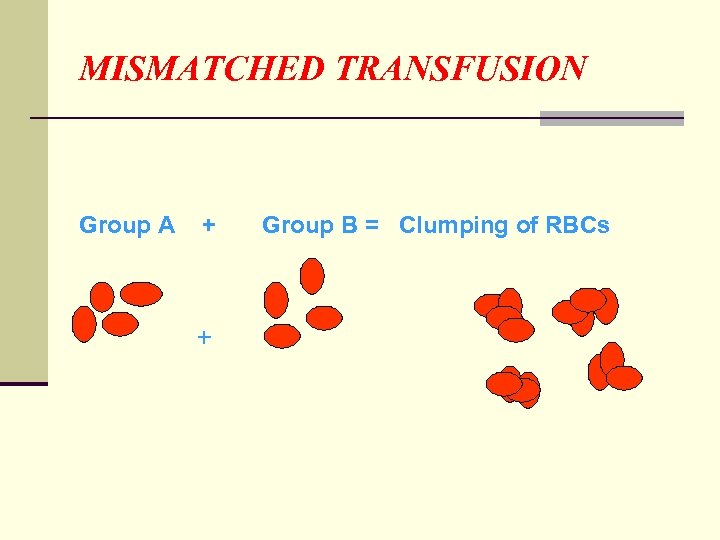
MISMATCHED TRANSFUSION Group A + + Group B = Clumping of RBCs
AUTOLOGOUS DONATION n Self help is the best help. n Planned gynaecological, orthopedic, plastic general surgeries n Individuals with rare blood groups/ irregular antibodies/ infectious disease positive.
AUTOLOGOUS DONATION Advantages n Safest blood. n Easy availability n No risk of TTDs n Best option in patients with irregular antibodies, rare blood groups, infectious disease positive. n Blood scarcity can be reduced to some extent.
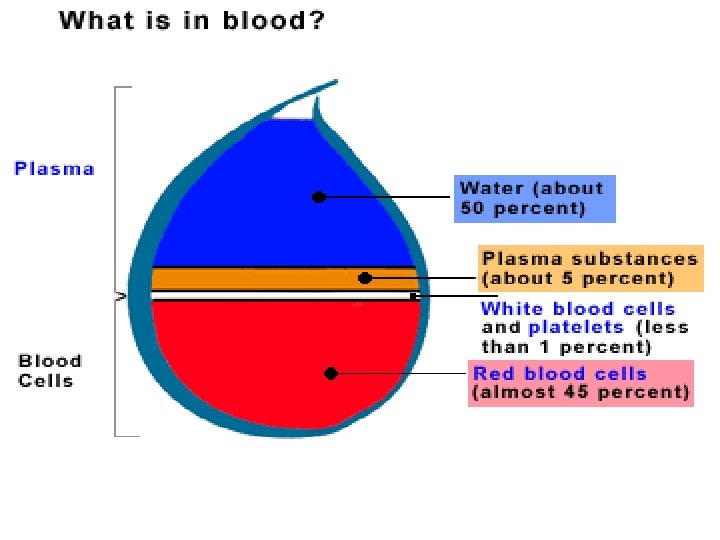
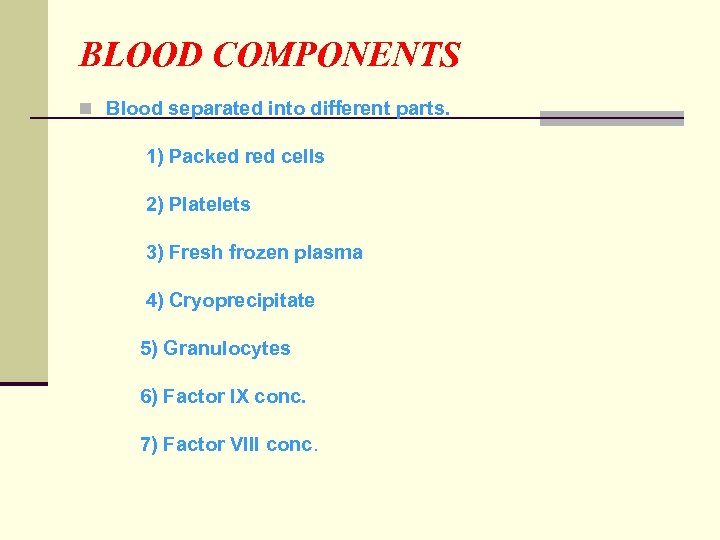
BLOOD COMPONENTS n Blood separated into different parts. 1) Packed red cells 2) Platelets 3) Fresh frozen plasma 4) Cryoprecipitate 5) Granulocytes 6) Factor IX conc. 7) Factor VIII conc.
COMPONENTS Advantages n Overload avoided. n Better patient management. n Greater shelf life than whole blood. n Blood shortage can be overcome.
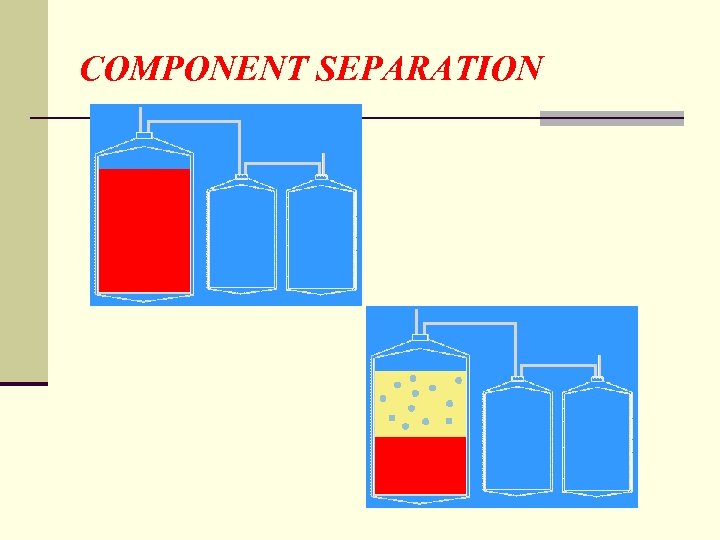
COMPONENT SEPARATION
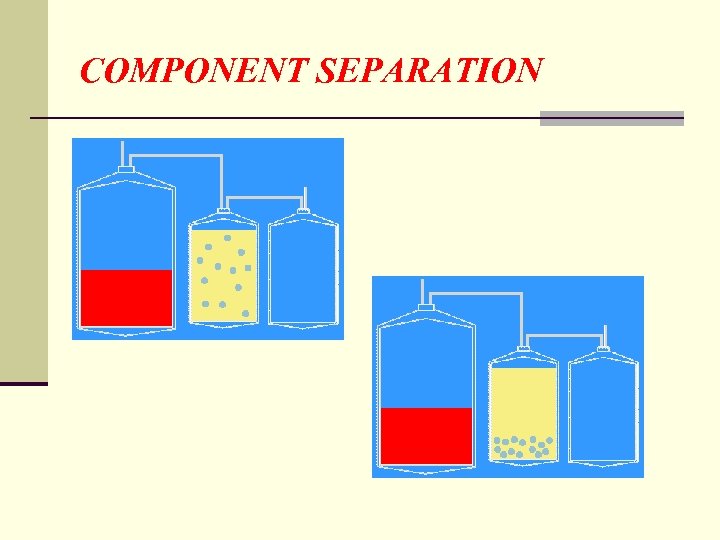
COMPONENT SEPARATION
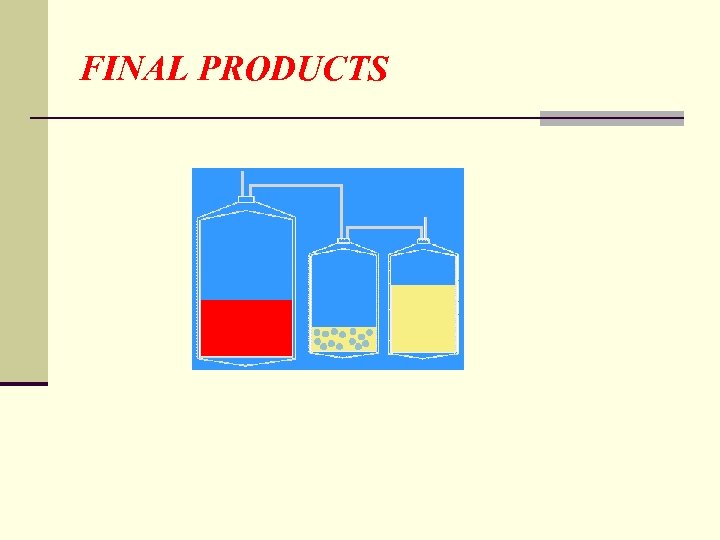
FINAL PRODUCTS
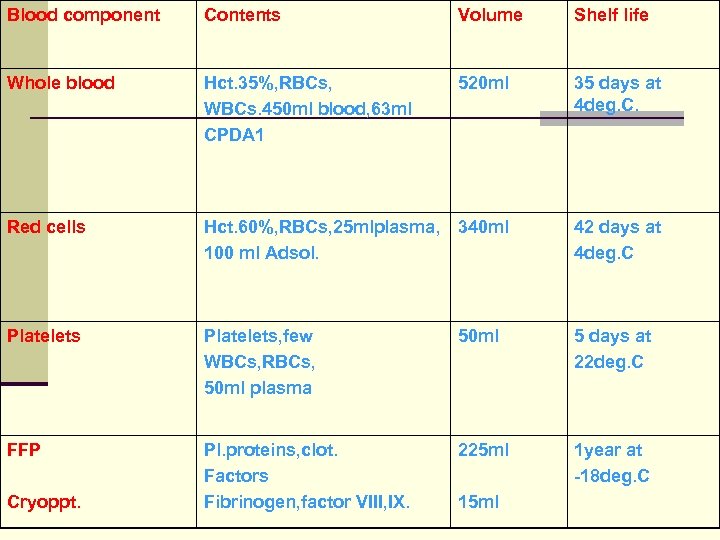
Blood component Contents Volume Shelf life Whole blood Hct. 35%, RBCs, WBCs. 450 ml blood, 63 ml CPDA 1 520 ml 35 days at 4 deg. C. Red cells Hct. 60%, RBCs, 25 mlplasma, 340 ml 100 ml Adsol. 42 days at 4 deg. C Platelets, few WBCs, RBCs, 50 ml plasma 50 ml 5 days at 22 deg. C FFP Pl. proteins, clot. Factors Fibrinogen, factor VIII, IX. 225 ml 1 year at -18 deg. C Cryoppt. 15 ml
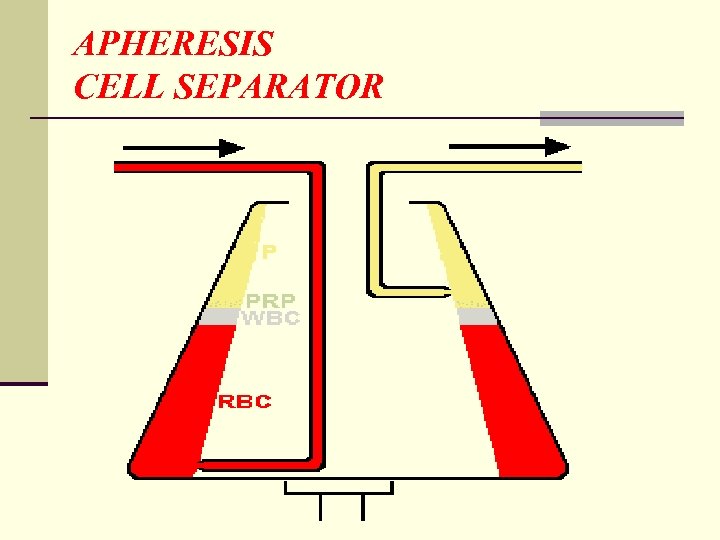
APHERESIS CELL SEPARATOR
APHERESIS n Plasmapheresis: plasma is removed. n Plateletapheresis: platelets are removed. n Leukapheresis: leucocytes are removed.
The rational use of blood and blood products
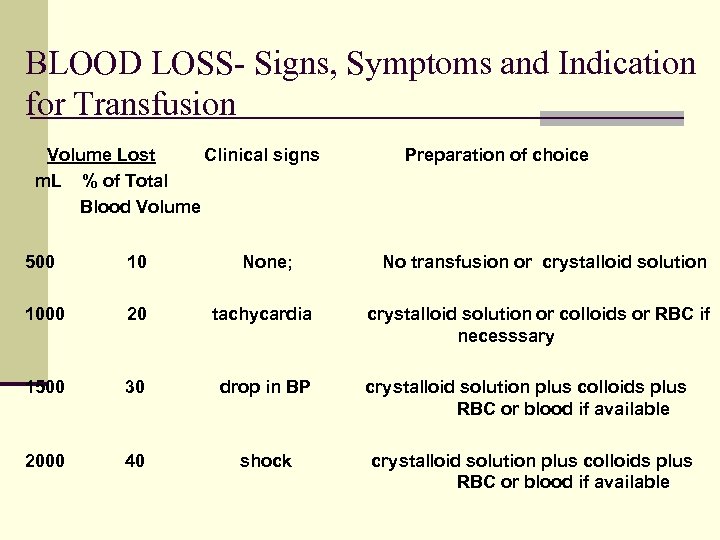
BLOOD LOSS- Signs, Symptoms and Indication for Transfusion Volume Lost Clinical signs m. L % of Total Blood Volume 500 10 None; 1000 20 tachycardia 1500 30 drop in BP 2000 40 shock Preparation of choice No transfusion or crystalloid solution or colloids or RBC if necesssary crystalloid solution plus colloids plus RBC or blood if available
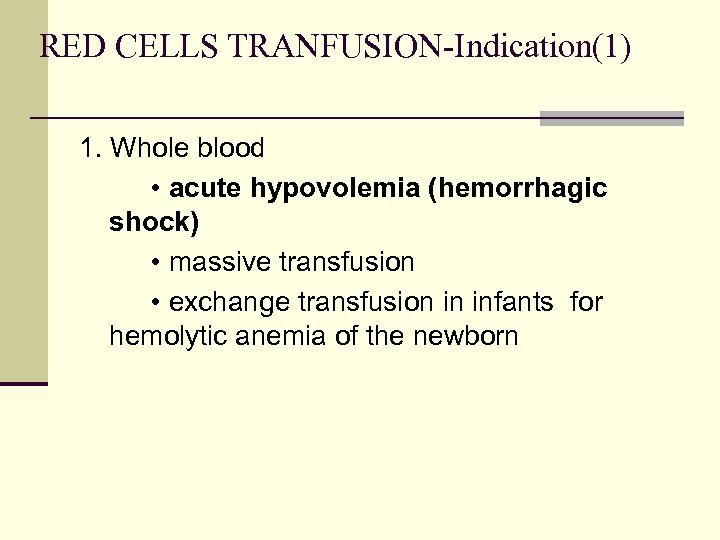
RED CELLS TRANFUSION-Indication(1) 1. Whole blood • acute hypovolemia (hemorrhagic shock) • massive transfusion • exchange transfusion in infants for hemolytic anemia of the newborn
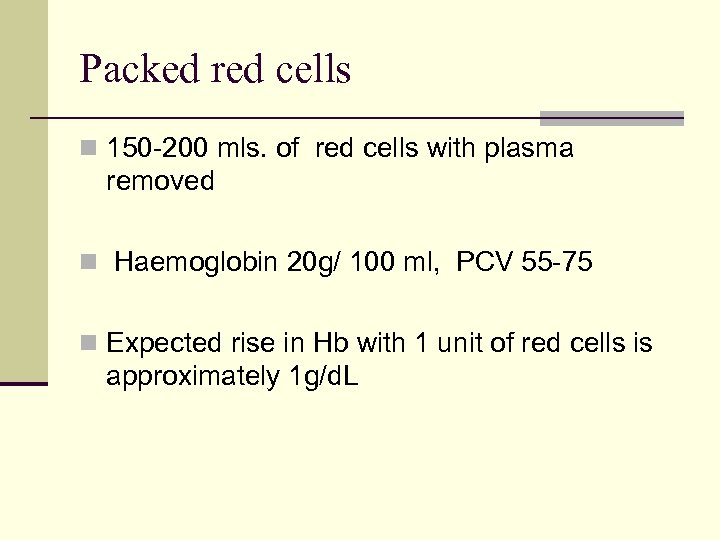
Packed red cells n 150 -200 mls. of red cells with plasma removed n Haemoglobin 20 g/ 100 ml, PCV 55 -75 n Expected rise in Hb with 1 unit of red cells is approximately 1 g/d. L
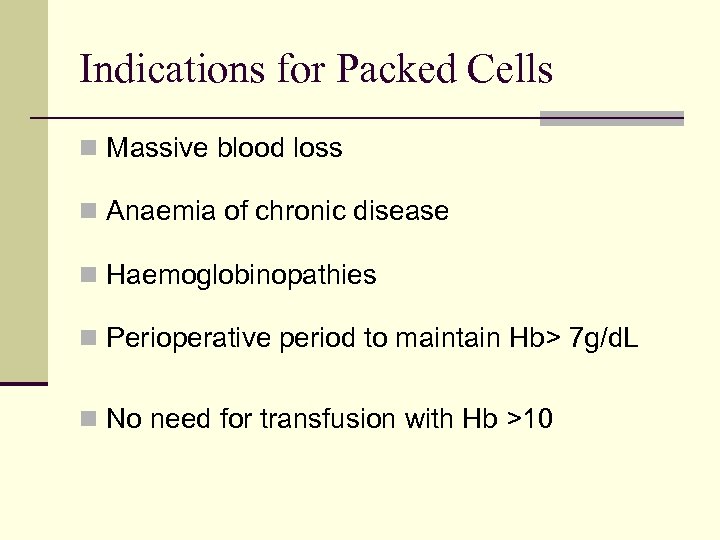
Indications for Packed Cells n Massive blood loss n Anaemia of chronic disease n Haemoglobinopathies n Perioperative period to maintain Hb> 7 g/d. L n No need for transfusion with Hb >10
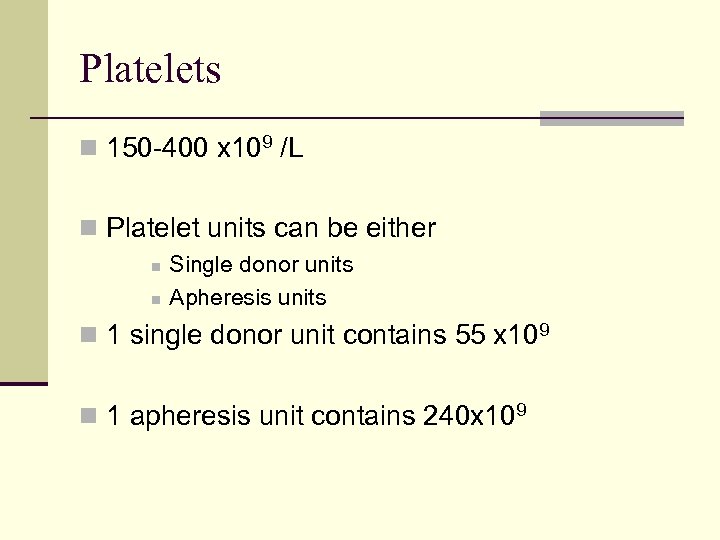
Platelets n 150 -400 x 109 /L n Platelet units can be either n n Single donor units Apheresis units n 1 single donor unit contains 55 x 109 n 1 apheresis unit contains 240 x 109
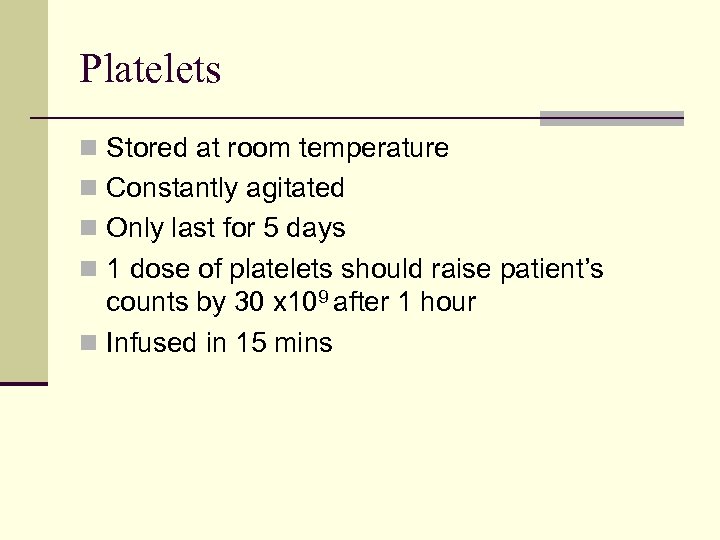
Platelets n Stored at room temperature n Constantly agitated n Only last for 5 days n 1 dose of platelets should raise patient’s counts by 30 x 109 after 1 hour n Infused in 15 mins
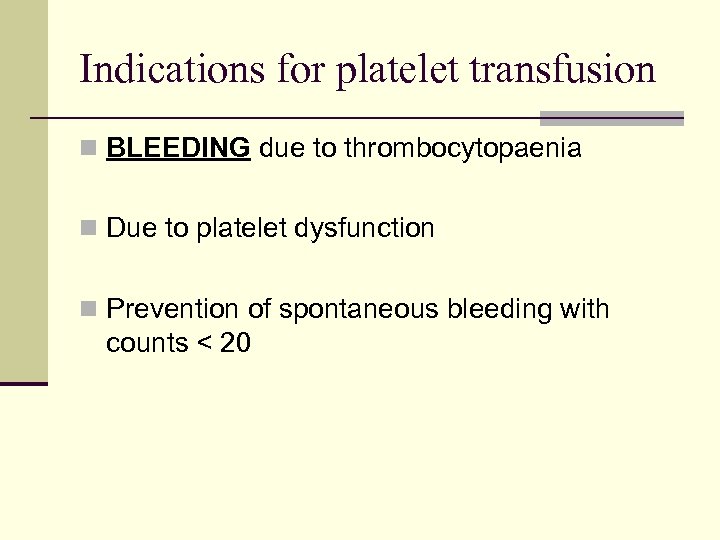
Indications for platelet transfusion n BLEEDING due to thrombocytopaenia n Due to platelet dysfunction n Prevention of spontaneous bleeding with counts < 20
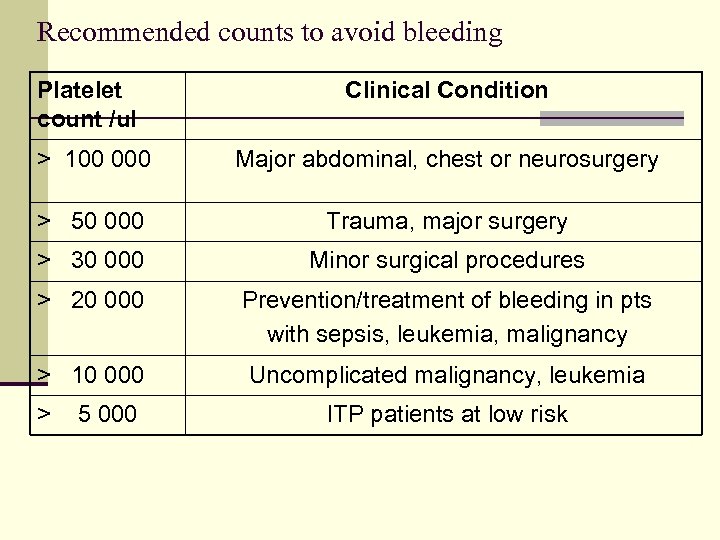
Recommended counts to avoid bleeding Platelet count /ul Clinical Condition > 100 000 Major abdominal, chest or neurosurgery > 50 000 Trauma, major surgery > 30 000 Minor surgical procedures > 20 000 Prevention/treatment of bleeding in pts with sepsis, leukemia, malignancy > 10 000 Uncomplicated malignancy, leukemia > 5 000 ITP patients at low risk
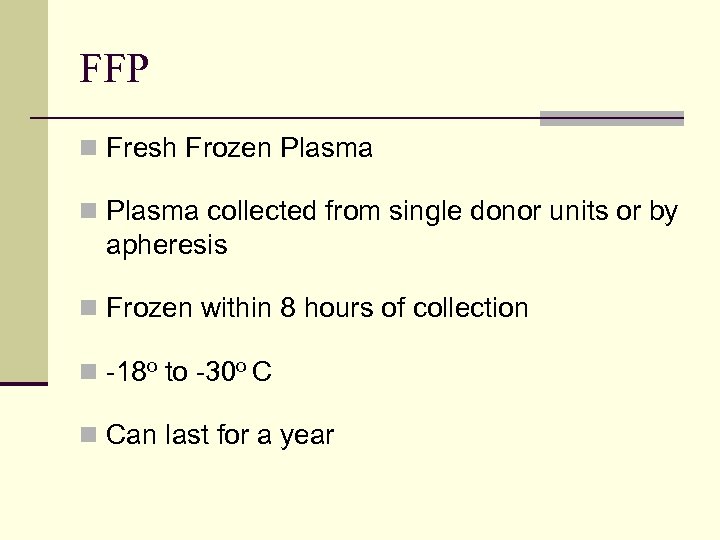
FFP n Fresh Frozen Plasma collected from single donor units or by apheresis n Frozen within 8 hours of collection n -18 o to -30 o C n Can last for a year
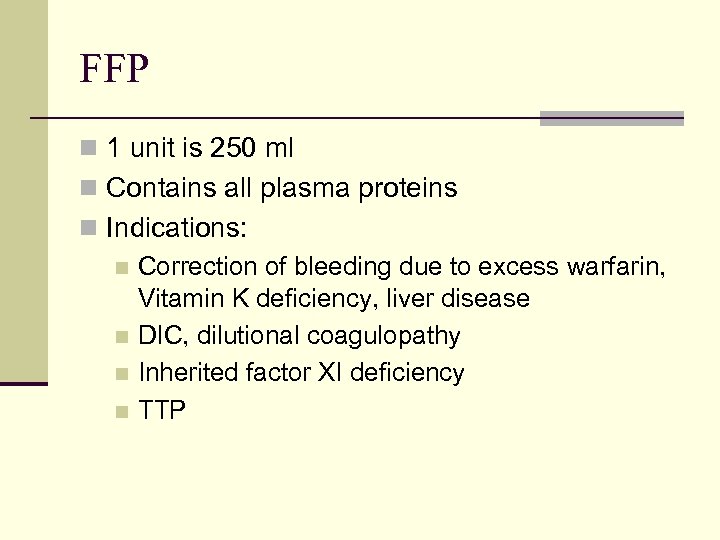
FFP n 1 unit is 250 ml n Contains all plasma proteins n Indications: n Correction of bleeding due to excess warfarin, Vitamin K deficiency, liver disease n DIC, dilutional coagulopathy n Inherited factor XI deficiency n TTP
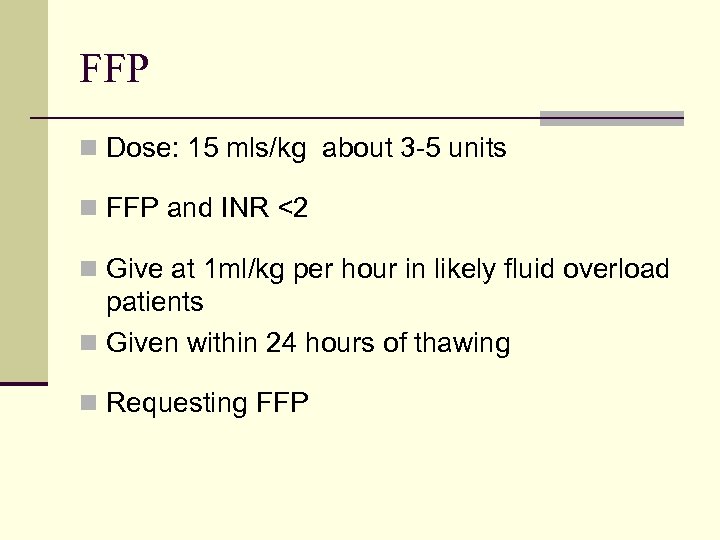
FFP n Dose: 15 mls/kg about 3 -5 units n FFP and INR <2 n Give at 1 ml/kg per hour in likely fluid overload patients n Given within 24 hours of thawing n Requesting FFP
Frozen Plasma frozen within 24 hours of collection n Maintains level of plasma proteins except factor VIII n Same indications as FFP
Cryoprecipitate n FFP thawed at 4 o. C and centrifuged n Cryoprecipitate is the by-product n Contains Fibrinogen, Factor VIII, Factor XIII, von Willebrand’s Factor
Cryoprecipitate n No longer indicated for Hemophilia* n Source of Fibrinogen in acquired coagulopathies as in DIC; platelet dysfunction in uremia n Indicated for bleeding in v. WD, Factor XIII deficiency
Cryoprecipitate n Infused as quickly as possible n Give within 6 hours of thawing n 10 -15 mls; usually 10 units pooled n 10 bags contain approx. 2 gm of fibrinogen and should raise fibrinogen level to 70 mg/d. L

Almost there!!!!!!!
Appropriateness of transfusion n May be life-saving n May have acute or delayed complications n Puts patient at risk unnecessarily n ‘ The transfusion of safe blood products to treat any condition leading to significant morbidity or mortality, that cannot be managed by any other means’.
Inappropriateness of transfusion n Giving blood products for conditions that can otherwise be treated e. g. anaemia n Using blood products when other fluids work just as well n Blood is often unnecessarily given to raise a patient’s haemoglobin level before surgery or to allow earlier discharge from hospital. These are rarely valid reasons for transfusion.
Inappropriateness of Transfusion n Patients’ transfusion requirements can often be minimized by good anaesthetic and surgical management. n Blood not needed exposes patient unnecessarily n Blood is an expensive, scarce resource. Unnecessary transfusions may cause a shortage of blood products for patients in real need.

Problems faced n Too few donors n Lack of equipment n Insufficient products n Insufficient reagent n Infectious disease testing
Recommendations n Increase public awareness about need for blood and hence the number of voluntary donors n Continue to encourage relatives to donate for patients* n Increase the number of mobile clinics n Extend the opening hours for blood collecting
Recommendations n Management of stocks of blood and blood products n Maintenance and replacement of equipment n On-going training of Haematology Lab Staff n Better management of reagents for- infectious disease testing, antigens etc. n Improved record keeping n Move to electronic record keeping
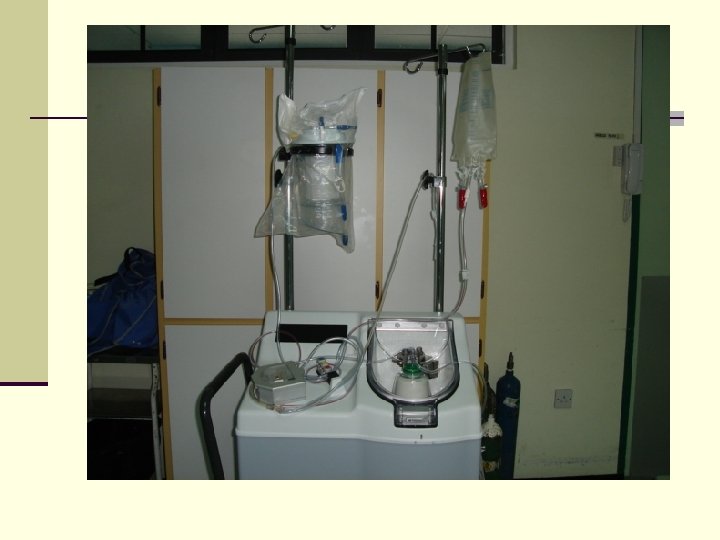
Recommendations n View to reduce the need for allogeneic transfusions n Autologous transfusions n Blood saving devices in OR n Acute normovolemic haemodilution n Oxygen carrying compounds
Bibliography n Uptodate. com n British Transfusion guidelines 2007 n Clinical use of blood, WHO n MJA: Tuckfield et al. , Reduction of inappropriate use of blood products n n n by prospective monitoring of blood forms Transfusion practice: Palo et al. , Population based audit of fresh frozen plasma transfusion practices Vox Sanguinis: Titlestead et al. , Monitoring transfusion practices at two university hospitals Transfusion: Schramm et al. , Influencing blood usage in Germany Transfusion: Healy et al. , Effect of Fresh Frozen Plasma on Prothrombin Time in patients with mild coagulation abnormalities Transfusion: Sullivan et al. , Blood collection and transfusion in the USA in 2001 Transfusion: Triulzi, The art of plasma transfusion therapy
 Скачать презентацию THE INSIDE STORY OF BLOOD TRANSFUSION DR MOHAMED
9787e5d6f56aaeb4b36c87cb1d64f1fb.ppt