


 Скачать презентацию The Influence of Monetary and Fiscal Policy on
Chapter 32.ppt
- Количество слайдов: 50
 The Influence of Monetary and Fiscal Policy on Aggregate Demand Chapter 32 Copyright © 2001 by Harcourt, Inc. All rights reserved. Requests for permission to make copies of any part of the work should be mailed to: Permissions Department, Harcourt College Publishers, 6277 Sea Harbor Drive, Orlando, Florida 32887 -6777.
 Aggregate Demand u Many factors influence aggregate demand besides monetary and fiscal policy. u In particular, desired spending by households and business firms determines the overall demand for goods and services. Harcourt, Inc. items and derived items copyright © 2001 by Harcourt, Inc.
 Aggregate Demand u When desired spending changes, aggregate demand shifts, causing short -run fluctuations in output and employment. u Monetary and fiscal policy are sometimes used to offset those shifts and stabilize the economy. Harcourt, Inc. items and derived items copyright © 2001 by Harcourt, Inc.
 How Monetary Policy Influences Aggregate Demand u. The aggregate demand curve slopes downward for three reasons: u The wealth effect u The interest-rate effect u The exchange-rate effect Harcourt, Inc. items and derived items copyright © 2001 by Harcourt, Inc.
 How Monetary Policy Influences Aggregate Demand For the U. S. economy, the most important reason for the downward slope of the aggregate-demand curve is the interest-rate effect. Harcourt, Inc. items and derived items copyright © 2001 by Harcourt, Inc.
 The Theory of Liquidity Preference u Keynes developed theory of liquidity preference in order to explain what factors determine the economy’s interest rate. u According to theory, the interest rate adjusts to balance the supply and demand for money. Harcourt, Inc. items and derived items copyright © 2001 by Harcourt, Inc.
 Money Supply u. The money supply is controlled by the Fed through: u Open-market operations u Changing the reserve requirements u Changing the discount rate Harcourt, Inc. items and derived items copyright © 2001 by Harcourt, Inc.
 Money Supply u Because it is fixed by the Fed, the quantity of money supplied does not depend on the interest rate. u The fixed money supply is represented by a vertical supply curve. Harcourt, Inc. items and derived items copyright © 2001 by Harcourt, Inc.
 Money Demand u Money demand is determined by several factors. u According to theory of liquidity preference, one of the most important factors is the interest rate. Harcourt, Inc. items and derived items copyright © 2001 by Harcourt, Inc.
 Money Demand People choose to hold money instead of other assets that offer higher rates of return because money can be used to buy goods and services. Harcourt, Inc. items and derived items copyright © 2001 by Harcourt, Inc.
 Money Demand u The opportunity cost of holding money is the interest that could be earned on interest-earning assets. u An increase in the interest rate raises the opportunity cost of holding money. u As a result, the quantity of money demanded is reduced. Harcourt, Inc. items and derived items copyright © 2001 by Harcourt, Inc.
 Equilibrium in the Money Market u. According to theory of liquidity preference: u The interest rate adjusts to balance the supply and demand for money. u There is one interest rate, called the equilibrium interest rate, at which the quantity of money demanded equals the quantity of money supplied. Harcourt, Inc. items and derived items copyright © 2001 by Harcourt, Inc.
 Equilibrium in the Money Market Assume the following about the economy: u The price level is stuck at some level. u For any given price level, the interest rate adjusts to balance the supply and demand for money. u The level of output responds to the aggregate demand for goods and services. Harcourt, Inc. items and derived items copyright © 2001 by Harcourt, Inc.
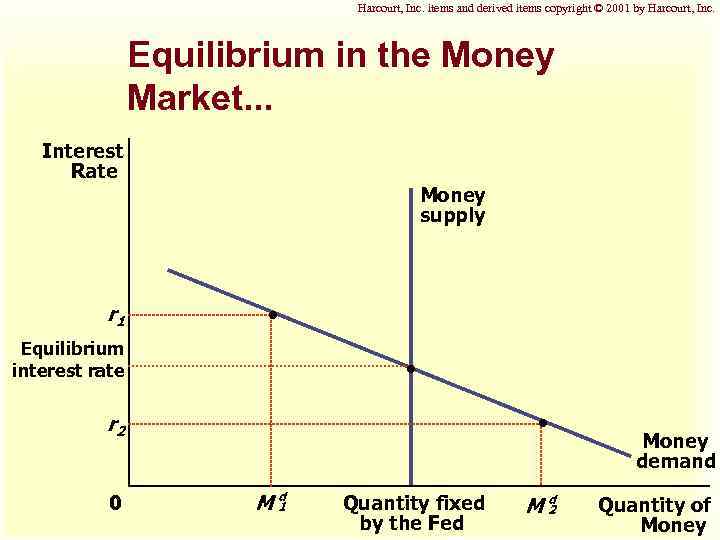 Harcourt, Inc. items and derived items copyright © 2001 by Harcourt, Inc. Equilibrium in the Money Market. . . Interest Rate Money supply r 1 Equilibrium interest rate r 2 0 Money demand d M 1 Quantity fixed by the Fed d M 2 Quantity of Money
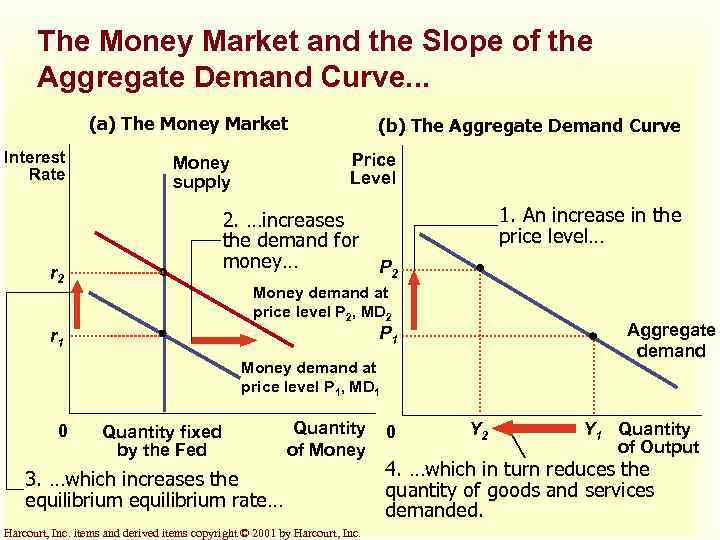
 The Downward Slope of the Aggregate Demand Curve u The price level is one determinant of the quantity of money demanded. u A higher price level increases the quantity of money demanded for any given interest rate. u Higher money demand leads to a higher interest rate. u The quantity of goods and services demanded falls. Harcourt, Inc. items and derived items copyright © 2001 by Harcourt, Inc.
 The Downward Slope of the Aggregate Demand Curve The end result of this analysis is a negative relationship between the price level and the quantity of goods and services demanded. Harcourt, Inc. items and derived items copyright © 2001 by Harcourt, Inc.
 The Money Market and the Slope of the Aggregate Demand Curve. . . (a) The Money Market Interest Rate (b) The Aggregate Demand Curve Price Level Money supply 2. …increases the demand for money… r 2 1. An increase in the price level… P 2 Money demand at price level P 2, MD 2 Aggregate demand P 1 r 1 Money demand at price level P 1, MD 1 0 Quantity fixed by the Fed Quantity of Money 3. …which increases the equilibrium rate… Harcourt, Inc. items and derived items copyright © 2001 by Harcourt, Inc. 0 Y 2 Y 1 Quantity of Output 4. …which in turn reduces the quantity of goods and services demanded.
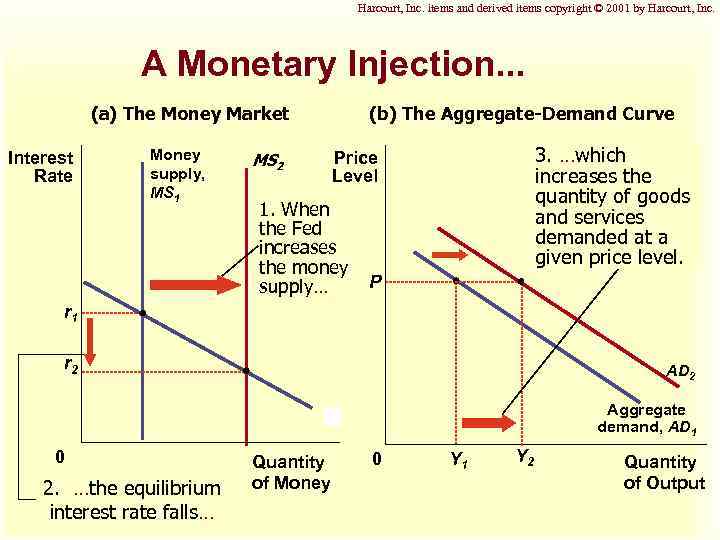
 Changes in the Money Supply u The Fed can shift the aggregate demand curve when it changes monetary policy. u An increase in the money supply shifts the money supply curve to the right. u Without a change in the money demand curve, the interest rate falls. u Falling interest rates increase the quantity of goods and services demanded. Harcourt, Inc. items and derived items copyright © 2001 by Harcourt, Inc.
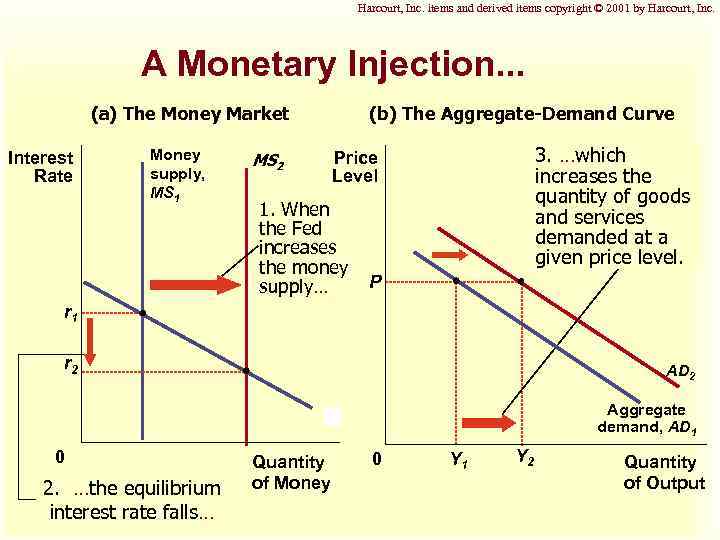 Harcourt, Inc. items and derived items copyright © 2001 by Harcourt, Inc. A Monetary Injection. . . (a) The Money Market Interest Rate Money supply, MS 1 MS 2 (b) The Aggregate-Demand Curve 3. …which increases the quantity of goods and services demanded at a given price level. Price Level 1. When the Fed increases the money supply… P r 1 r 2 AD 2 Aggregate demand, AD 1 0 2. …the equilibrium interest rate falls… Quantity of Money 0 Y 1 Y 2 Quantity of Output
 Changes in the Money Supply u When the Fed increases the money supply, it lowers the interest rate and increases the quantity of goods and services demanded at any given price level, shifting aggregate-demand to the right. u When the Fed contracts the money supply, it raises the interest rate and reduces the quantity of goods and services demanded at any given price level, shifting aggregate-demand to the left. Harcourt, Inc. items and derived items copyright © 2001 by Harcourt, Inc.
 The Role of Interest-Rate Targets in Fed Policy u. Monetary policy can be described either in terms of the money supply or in terms of the interest rate. u. Changes in monetary policy can be viewed either in terms of a changing target for the interest rate or in terms of a change in the money supply. u. A target for the federal funds rate affects the money market equilibrium, which influences aggregate demand. Harcourt, Inc. items and derived items copyright © 2001 by Harcourt, Inc.
 How Fiscal Policy Influences Aggregate Demand u. Fiscal policy refers to the government’s choices regarding the overall level of government purchases or taxes. u. Fiscal policy influences saving, investment, and growth in the long run. u. In the short run, fiscal policy primarily affects the aggregate demand. Harcourt, Inc. items and derived items copyright © 2001 by Harcourt, Inc.
 Changes in Government Purchases u When policymakers change the money supply or taxes, the effect on aggregate demand is indirect – through the spending decisions of firms or households. u When the government alters its own purchases of goods or services, it shifts the aggregate-demand curve directly. Harcourt, Inc. items and derived items copyright © 2001 by Harcourt, Inc.
 Changes in Government Purchases u. There are two macroeconomic effects from the change in government purchases: u. The multiplier effect u. The crowding-out effect Harcourt, Inc. items and derived items copyright © 2001 by Harcourt, Inc.
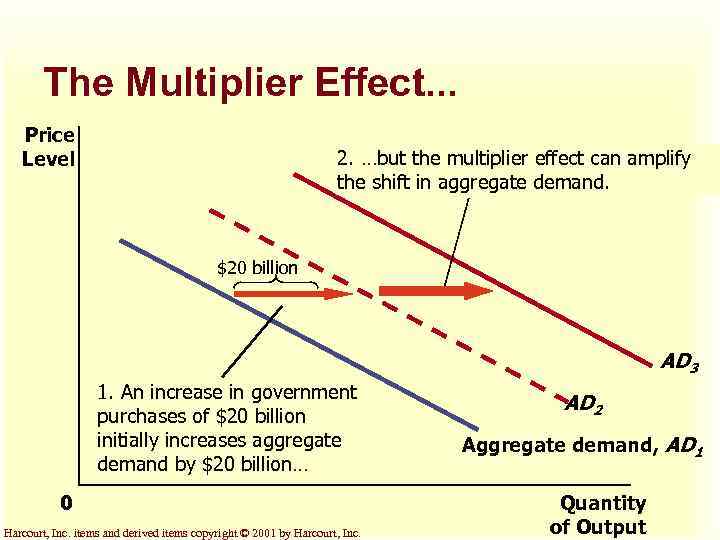
 The Multiplier Effect u Government purchases are said to have a multiplier effect on aggregate demand. u Each dollar spent by the government can raise the aggregate demand for goods and services by more than a dollar. Harcourt, Inc. items and derived items copyright © 2001 by Harcourt, Inc.
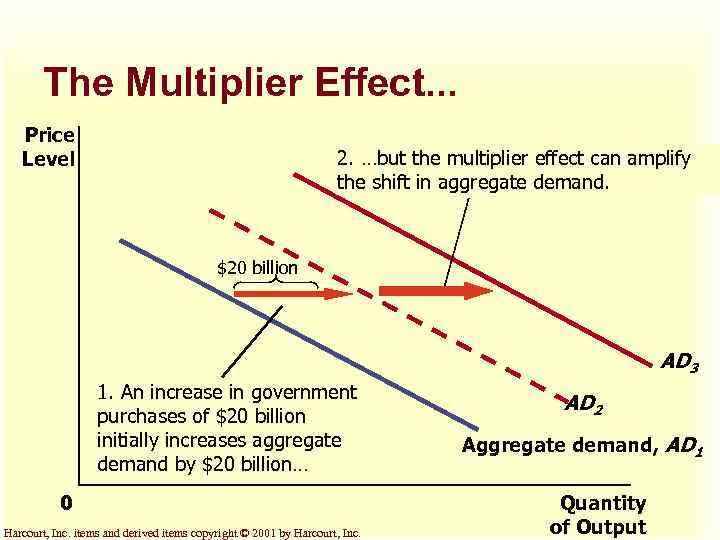 The Multiplier Effect. . . Price Level 2. …but the multiplier effect can amplify the shift in aggregate demand. $20 billion AD 3 1. An increase in government purchases of $20 billion initially increases aggregate demand by $20 billion… 0 Harcourt, Inc. items and derived items copyright © 2001 by Harcourt, Inc. AD 2 Aggregate demand, AD 1 Quantity of Output
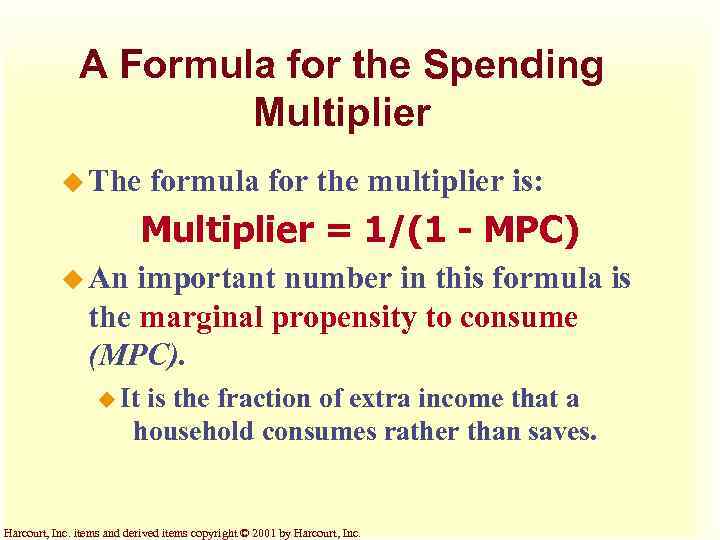 A Formula for the Spending Multiplier u The formula for the multiplier is: Multiplier = 1/(1 - MPC) u An important number in this formula is the marginal propensity to consume (MPC). u It is the fraction of extra income that a household consumes rather than saves. Harcourt, Inc. items and derived items copyright © 2001 by Harcourt, Inc.
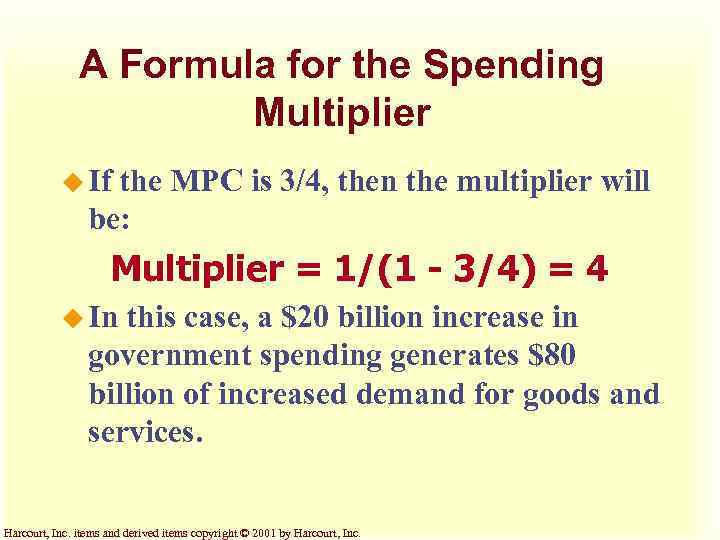 A Formula for the Spending Multiplier u If the MPC is 3/4, then the multiplier will be: Multiplier = 1/(1 - 3/4) = 4 u In this case, a $20 billion increase in government spending generates $80 billion of increased demand for goods and services. Harcourt, Inc. items and derived items copyright © 2001 by Harcourt, Inc.
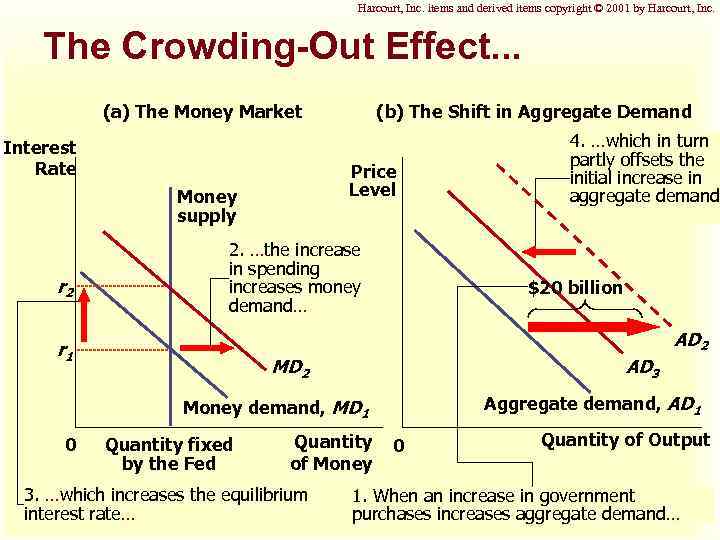
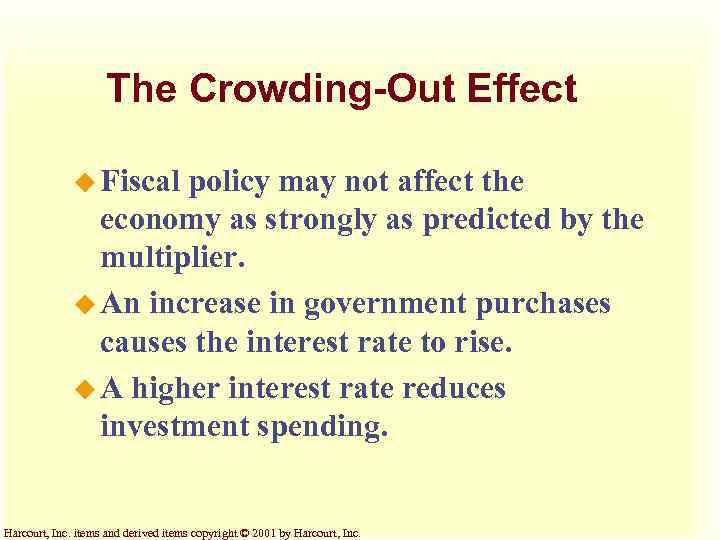 The Crowding-Out Effect u Fiscal policy may not affect the economy as strongly as predicted by the multiplier. u An increase in government purchases causes the interest rate to rise. u A higher interest rate reduces investment spending. Harcourt, Inc. items and derived items copyright © 2001 by Harcourt, Inc.
 The Crowding-Out Effect u. This reduction in demand that results when a fiscal expansion raises the interest rate is called the crowding-out effect. u. The crowding-out effect tends to dampen the effects of fiscal policy on aggregate demand. Harcourt, Inc. items and derived items copyright © 2001 by Harcourt, Inc.
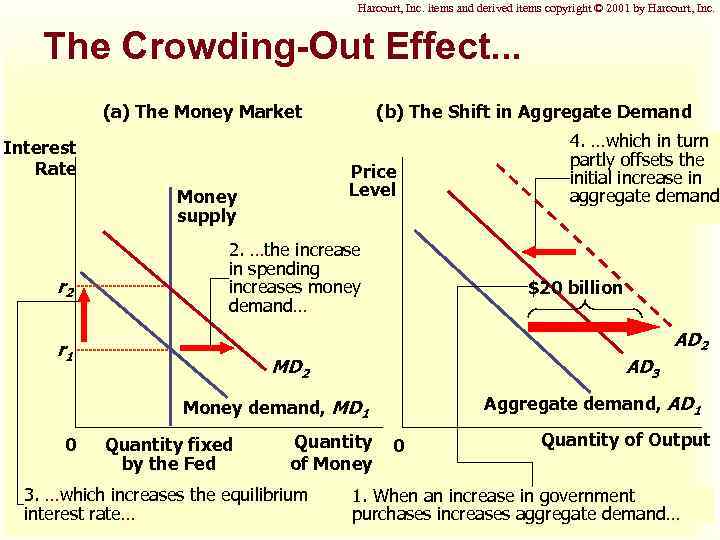 Harcourt, Inc. items and derived items copyright © 2001 by Harcourt, Inc. The Crowding-Out Effect. . . (a) The Money Market Interest Rate Price Level Money supply r 2 (b) The Shift in Aggregate Demand 2. …the increase in spending increases money demand… $20 billion AD 2 r 1 MD 2 AD 3 Aggregate demand, AD 1 Money demand, MD 1 0 4. …which in turn partly offsets the initial increase in aggregate demand. Quantity fixed by the Fed Quantity of Money 3. …which increases the equilibrium interest rate… 0 Quantity of Output 1. When an increase in government purchases increases aggregate demand…
 The Crowding-Out Effect When the government increases its purchases by $20 billion, the aggregate demand for goods and services could rise by more or less than $20 billion, depending on whether the multiplier effect or the crowding-out effect is larger. Harcourt, Inc. items and derived items copyright © 2001 by Harcourt, Inc.
 Changes in Taxes u When the government cuts personal income taxes, it increases households’ take-home pay. u Households save some of this additional income. u Households also spend some of it on consumer goods. u Increased household spending shifts the aggregate-demand curve to the right. Harcourt, Inc. items and derived items copyright © 2001 by Harcourt, Inc.
 Changes in Taxes u. The size of the shift in aggregate demand resulting from a tax change is affected by the multiplier and crowding-out effects. u. It is also determined by the households’ perceptions about the permanency of the tax change. Harcourt, Inc. items and derived items copyright © 2001 by Harcourt, Inc.
 Using Policy to Stabilize the Economy Economic stabilization has been an explicit goal of U. S. policy since the Employment Act of 1946. Harcourt, Inc. items and derived items copyright © 2001 by Harcourt, Inc.
 The Case for Active Stabilization Policy The Employment Act has two implications: u The government should avoid being the cause of economic fluctuations. u The government should respond to changes in the private economy in order to stabilize aggregate demand. Harcourt, Inc. items and derived items copyright © 2001 by Harcourt, Inc.
 The Case Against Active Stabilization Policy u Some economists argue that monetary and fiscal policy destabilizes the economy. u Monetary and fiscal policy affect the economy with a substantial lag. u They suggest the economy should be left to deal with the short-run fluctuations on its own. Harcourt, Inc. items and derived items copyright © 2001 by Harcourt, Inc.
 Automatic Stabilizers u. Automatic stabilizers are changes in fiscal policy that stimulate aggregate demand when the economy goes into a recession without policymakers having to take any deliberate action. u. Automatic stabilizers include the tax system and some forms of government spending. Harcourt, Inc. items and derived items copyright © 2001 by Harcourt, Inc.
 Summary u Keynes proposed theory of liquidity preference to explain determinants of the interest rate. u According to this theory, the interest rate adjusts to balance the supply and demand for money. Harcourt, Inc. items and derived items copyright © 2001 by Harcourt, Inc.
 Summary u An increase in the price level raises money demand increases the interest rate. u A higher interest rate reduces investment and, thereby, the quantity of goods and services demanded. u The downward-sloping aggregate-demand curve expresses this negative relationship between the price-level and the quantity demanded. Harcourt, Inc. items and derived items copyright © 2001 by Harcourt, Inc.
 Summary u Policymakers can influence aggregate demand with monetary policy. u An increase in the money supply will ultimately lead to the aggregate-demand curve shifting to the right. u A decrease in the money supply will ultimately lead to the aggregate-demand curve shifting to the left. Harcourt, Inc. items and derived items copyright © 2001 by Harcourt, Inc.
 Summary u Policymakers can influence aggregate demand with fiscal policy. u An increase in government purchases or a cut in taxes shifts the aggregate-demand curve to the right. u A decrease in government purchases or an increase in taxes shifts the aggregatedemand curve to the left. Harcourt, Inc. items and derived items copyright © 2001 by Harcourt, Inc.
 Summary u When the government alters spending or taxes, the resulting shift in aggregate demand can be larger or smaller than the fiscal change. u The multiplier effect tends to amplify the effects of fiscal policy on aggregate demand. u The crowding-out effect tends to dampen the effects of fiscal policy on aggregate demand. Harcourt, Inc. items and derived items copyright © 2001 by Harcourt, Inc.
 Summary u Because monetary and fiscal policy can influence aggregate demand, the government sometimes uses these policy instruments in an attempt to stabilize the economy. u Economists disagree about how active the government should be in this effort. u Policy advocates say that if the government does not respond the result will be undesirable fluctuations. u Critics argue that attempts at stabilization often turn out destabilizing. Harcourt, Inc. items and derived items copyright © 2001 by Harcourt, Inc.
 Graphical Review Harcourt, Inc. items and derived items copyright © 2001 by Harcourt, Inc.
 Harcourt, Inc. items and derived items copyright © 2001 by Harcourt, Inc. Equilibrium in the Money Market. . . Interest Rate Money supply r 1 Equilibrium interest rate r 2 0 Money demand d M 1 Quantity fixed by the Fed d M 2 Quantity of Money
 The Money Market and the Slope of the Aggregate Demand Curve. . . (a) The Money Market Interest Rate (b) The Aggregate Demand Curve Price Level Money supply 2. …increases the demand for money… r 2 1. An increase in the price level… P 2 Money demand at price level P 2, MD 2 Aggregate demand P 1 r 1 Money demand at price level P 1, MD 1 0 Quantity fixed by the Fed Quantity of Money 3. …which increases the equilibrium rate… Harcourt, Inc. items and derived items copyright © 2001 by Harcourt, Inc. 0 Y 2 Y 1 Quantity of Output 4. …which in turn reduces the quantity of goods and services demanded.
 Harcourt, Inc. items and derived items copyright © 2001 by Harcourt, Inc. A Monetary Injection. . . (a) The Money Market Interest Rate Money supply, MS 1 MS 2 (b) The Aggregate-Demand Curve 3. …which increases the quantity of goods and services demanded at a given price level. Price Level 1. When the Fed increases the money supply… P r 1 r 2 AD 2 Aggregate demand, AD 1 0 2. …the equilibrium interest rate falls… Quantity of Money 0 Y 1 Y 2 Quantity of Output
 The Multiplier Effect. . . Price Level 2. …but the multiplier effect can amplify the shift in aggregate demand. $20 billion AD 3 1. An increase in government purchases of $20 billion initially increases aggregate demand by $20 billion… 0 Harcourt, Inc. items and derived items copyright © 2001 by Harcourt, Inc. AD 2 Aggregate demand, AD 1 Quantity of Output
 Harcourt, Inc. items and derived items copyright © 2001 by Harcourt, Inc. The Crowding-Out Effect. . . (a) The Money Market Interest Rate Price Level Money supply r 2 (b) The Shift in Aggregate Demand 2. …the increase in spending increases money demand… $20 billion AD 2 r 1 MD 2 AD 3 Aggregate demand, AD 1 Money demand, MD 1 0 4. …which in turn partly offsets the initial increase in aggregate demand. Quantity fixed by the Fed Quantity of Money 3. …which increases the equilibrium interest rate… 0 Quantity of Output 1. When an increase in government purchases increases aggregate demand…