


 Скачать презентацию The In-game Economics of Ultima Online Description and
3deeec6cf9c336c2330a5ebdb4347134.ppt
- Количество слайдов: 50
 The In-game Economics of Ultima Online Description and Analysis Zachary Booth Simpson www. mine-control. com/zack CGDC 2000
 Who am I? l l Previously Director of Technology at Origin, Titanic Entertainment I was not a UO team member I am not an economist Consultant for Origin in 1998 -1999, studied UO economics
 Acknowledgments l Members of the UO team, especially: – – l Raph Koster Rich Vogel Starr Long Damion Schubert Economic consultants: – Andrew Stivers (U. Texas) – Timothy O’Neill Dang (U. Arizona) • cregtog 8@barriodevo. org – Prof. James Galbraith (U. Texas)
 What is this talk? l Brief description of the economy l An analysis of how the economy evolved – Harp on things that went wrong – Not enough time to get into solutions, sorry! l An occasional interlude for Economics 101
 What this talk is NOT l l Not a “how-much-is-it-going-to-cost-me-tobuild-my-UO-clone talk” Not a debate over how fun UO is – Although that is ultimately more important l Not about UO characters sold on e. Bay – No matter how much Mary Margaret begs! : )
 What is “economics”? l l Not the study of money; not finance. A set of tools developed to analyze how people behave when allowed to trade. – people behave however that damn well please no matter what the math says. l “Tools are not bricks”
 Right tool? l l Be careful: people don’t necessarily behave the same in a game, some tools may not apply. I highly encourage you read up! – Politicized topic = bias & bad science – I like the economists who still treat the subject as psychology and not as calculus. – J. K. Galbraith and P. Krugman are both very readable.
 What is an economy? l Any system that involves people exchanging goods and services Does not imply currency or prices l Ideal economy is meeting everyone’s needs l – Even the one’s they didn’t know they had. l l Ergo: hard to say if an economic state is “good”. Maybe it’s easier to say if it is bad. . .
 Bad Economy Symptoms Part I l Minimal person-to-person interaction & dependence, especially between advanced player and newbies. – Advanced player give newbies high-powered items because they have more than they need. – Advanced players discard items that a newbie would love because it isn’t worth their time to find someone to give it to.
 Bad Economy Symptoms Part II l Supply is unpredictable – Players hoard items, reducing availability – They litter the world with unwanted junk – They lose interest in the game because there’s nothing left to acquire. – Prices fluctuate wildly or become inflationary l Demand is unpredictable – Players can’t find buyers for the items they’ve been encouraged to produce – Player manufacturers create unwanted junk
 Bad Economy Symptoms Part III l “Tragedy of the commons” rules the public spaces – The principle that something that is a lot good for me and a little bit bad for everyone else will inevitably be exploited until it is all bad for everyone. – Classic example: grazing sheep in the town commons
 Semantic Nit-picking l l A “virtual economy” is the simulation of an economy. UO is not a virtual economy; it is a real economy involving the exchange of virtual goods and services.
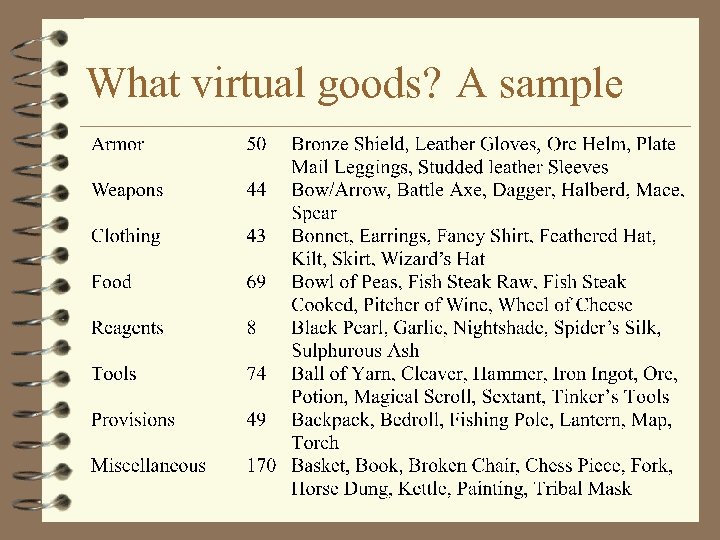 What virtual goods? A sample
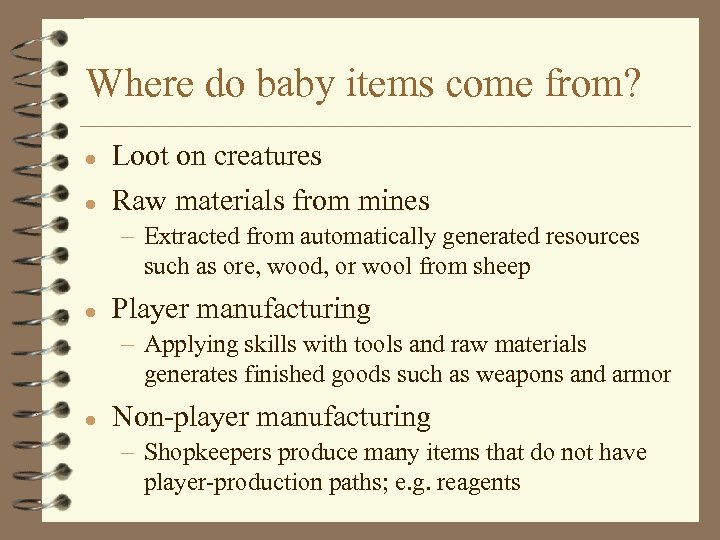 Where do baby items come from? l Loot on creatures l Raw materials from mines – Extracted from automatically generated resources such as ore, wood, or wool from sheep l Player manufacturing – Applying skills with tools and raw materials generates finished goods such as weapons and armor l Non-player manufacturing – Shopkeepers produce many items that do not have player-production paths; e. g. reagents
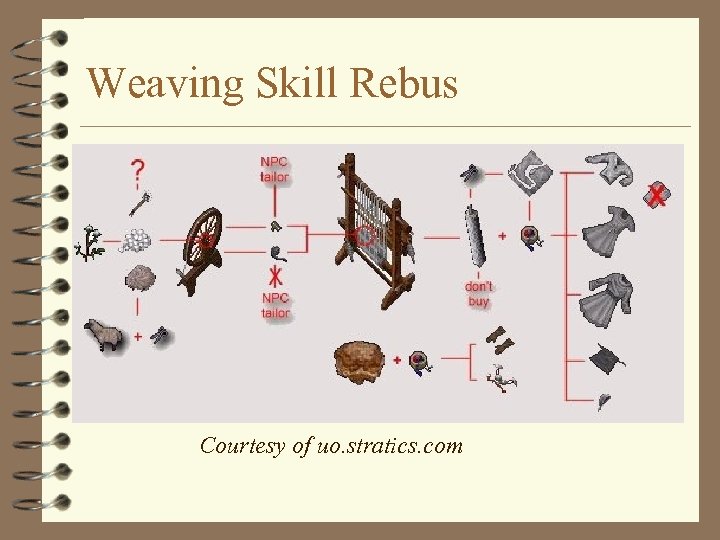 Weaving Skill Rebus Courtesy of uo. stratics. com
 Problem I Over-Production The Failure of the “Improve-through-doing” System
 Practice Makes Perfect l Player skills improve through use l Unused skills degrade – Hard to become a jack-of-all-trades
 Incentives To Produce l Market demand – “Hey Mr. Tailor, can you make me a shirt? ” l Making now improves quality and price later – “Can’t talk, making shirts!” l The sheer fun of it – “I built a fort out of fur boots!” l Cheating with macros – “When I wake up tomorrow, my character will be a rocket-scientist!”
 The Result: Oversupply l l l UO’s “practice makes perfect” rules create incentives to over-produce certain goods. The market in basic items is saturated and thus prices are extraordinarily low. Producers get upset at the low price but keep manufacturing anyway. – Like Texas Oil Producers and DRAM chip fabs – Tragedy of the commons
 Oversupply: so what? l Unlike the real-world, more stuff is very bad: – Servers slow down – Backups get bigger and therefore less frequent – Black-holes
 Econ 101: Shifted Supply Curves l l Non-market incentives push the supply curve right. Demand curve hasn’t changed so the price drops.
 Problem II Broke Shopkeepers The Failure of the NPC Shopkeepers
 The Shopkeeper Failure l l l Shopkeepers intended to supply the unmanufacturable as well as solve transience AI was a complicated analysis of market forces Important: NPCs are part of a “virtual economy” that is attached to the “real” economy. – It’s really weird
 To subsidize or not? l NPC shopkeepers subsidize production to encourage character development – Like Dad at a lemonade stand l l Shopkeeper cash-flow AI reasonably refused to buy junk already in over-supply Players report this as a bug -- expect a free ride – Used to single player games – Not everyone wants to be an entrepreneur
 But, before we punt NPCs. . . l The shopkeepers have no cash, therefore give them something to sell that players want – Extra advantage of removing gold from hyperinflated economy due to counterfeiting l Difficult to invent lots of new things – “New improved BLUE armor, a lot like silver armor, but its blue!” l Players upset by unfair competition – “Hey, how come the NPCs get to sell blue armor but I don’t? This sucks!”
 OK, punt. l l l Designers gave-in, eliminated shopkeeper profit-motive AI Shopkeepers now subsidize up to X units of junk per hour. Inflating the gold supply, but at least newbie characters are developing.
 Black Markets l l Reagents most valuable commodity distributed exclusively by NPC shopkeepers Speculators with bots and “Mafia” cornered the market in reagents and inflated the price Amused a minority, outraged the majority Eventually fixed itself as everyone got into it – No barrier to entry
 Econ 101. Soviet Retail l Soviet Union had non-market incentives to produce – Soviet stores filled with useless items that no one wanted l Shortages and huge lines formed for the what people did want because trading was inefficient / illegal – Subsidies and rationing common l Black markets
 Problem III Inflationary Gold, Depleted Resources The Failure of the Closed Economy. A Study of Macroeconomics.
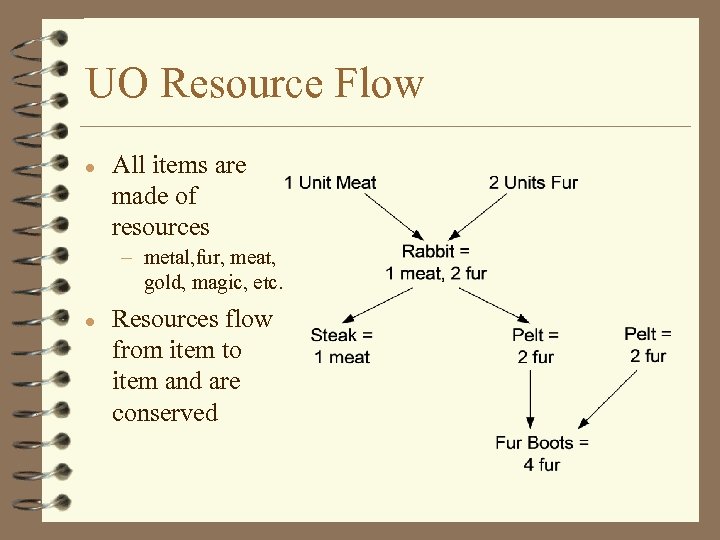 UO Resource Flow l All items are made of resources – metal, fur, meat, gold, magic, etc. l Resources flow from item to item and are conserved
 Original UO Resource Flow l l Each “world” initialized with X meat, Y fur, Z gold, etc. in a “bank” Resources flow into world items from bank Items decay, break, sold, etc. flowing out of world back into bank Resources are conserved and thus no inflation!
 Original Flow
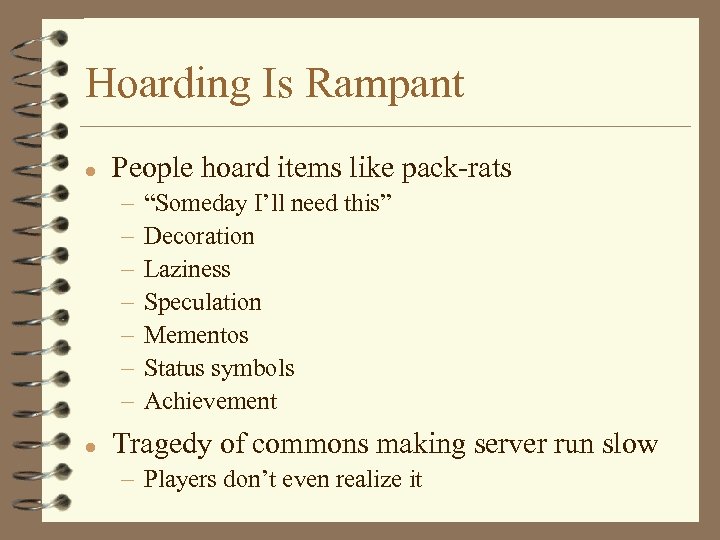 Hoarding Is Rampant l People hoard items like pack-rats – – – – l “Someday I’ll need this” Decoration Laziness Speculation Mementos Status symbols Achievement Tragedy of commons making server run slow – Players don’t even realize it
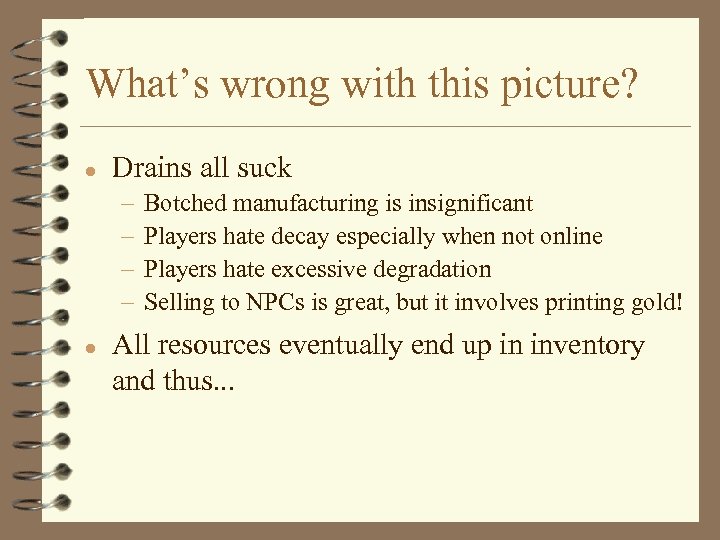 What’s wrong with this picture? l Drains all suck – – l Botched manufacturing is insignificant Players hate decay especially when not online Players hate excessive degradation Selling to NPCs is great, but it involves printing gold! All resources eventually end up in inventory and thus. . .
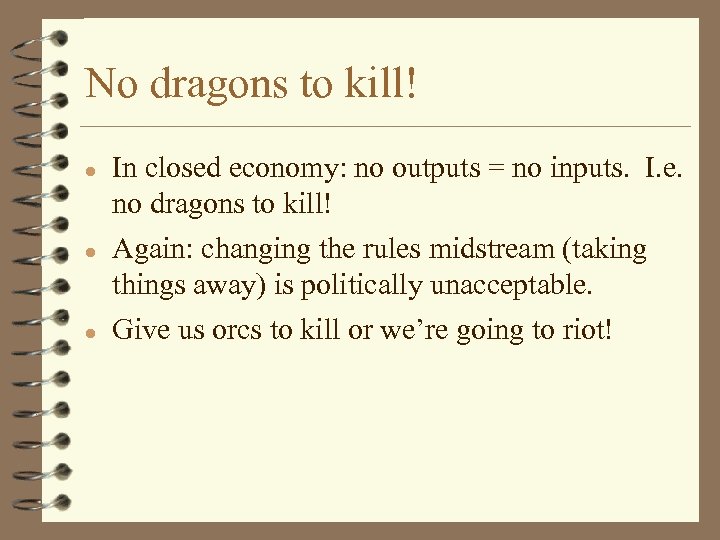 No dragons to kill! l l l In closed economy: no outputs = no inputs. I. e. no dragons to kill! Again: changing the rules midstream (taking things away) is politically unacceptable. Give us orcs to kill or we’re going to riot!
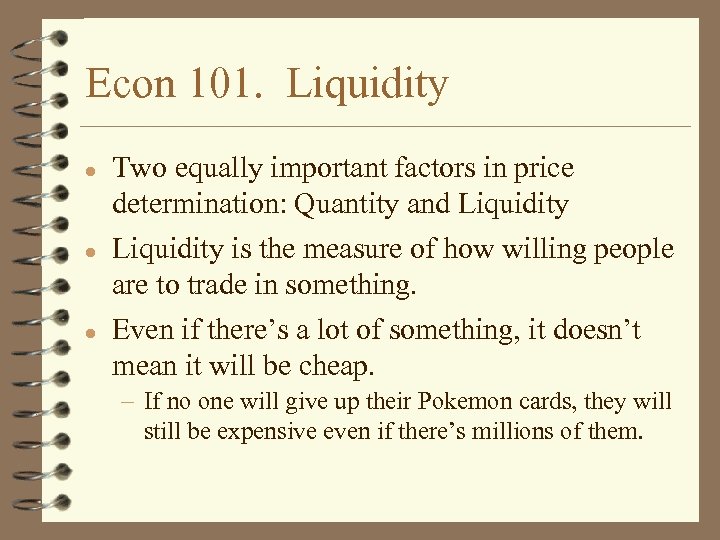 Econ 101. Liquidity l l l Two equally important factors in price determination: Quantity and Liquidity is the measure of how willing people are to trade in something. Even if there’s a lot of something, it doesn’t mean it will be cheap. – If no one will give up their Pokemon cards, they will still be expensive even if there’s millions of them.
 Econ 101. Liquidity of Currency l Liquidity of currency matters too – Currency is just another kind of commodity l Inflation – If it is created in excess, it becomes worthless and inflation sets in, i. e. prices rise. l Deflation – When people hoard currency as savings, they make it more scarce and prices or production will fall – (Baby-sitter co-op analogy)
 Let it rain! l l The concept of closed economy was unsustainable without new drains Lots of drains proposed, none were politically acceptable/effective in the short term – Taxes, Real-estate Maintenance Fees, Natural Disasters, Lotteries, Consumables, Indulgences, Recycle bins, Capital depreciation l To hell with it: disconnect the drain and pour in the resources – abandon the closed-economy; reduce player bitching
 New Flow
 So Now It’s Inflationary l The servers are filling up l The backups are getting bigger Prices are rising l But at least there’s dragons to kill! l
 Problem IV Counterfeiting
 Counterfeiting l Hacker’s Law: – Developers are out-manned by hackers; hackers have more time and great communication – Therefore, exploits will always be found faster than fixes can be made. l An obscure server fault allowed cloning of gold and reagents. – Fixed after a few days l “Wrecked the experiment”
 Effects of Counterfeiting l People didn’t stop playing – Maybe the economy isn’t so important after all l Anything players wanted from NPCs, they could have. – They didn’t really want anything, except reagents which were also counterfeited.
 Effects of Counterfeiting (cont. ) l The worlds where there was early counterfeiting have a higher “standard of living” – Players don’t seem to care, they want challenges and relative wealth l Not like the real world at all! – People don’t move to Mexico because the US is too rich!
 Lessons Learned A Massively Abbreviated Summary
 Lessons Learned Part I l Hoarding is rampant. – Failure of closed economy. l The economy must maintain liquidity; tying input flow rate to the output flow was a bad idea because hoarding froze the input making the game uninteresting. – Failure of closed economy.
 Lessons Learned Part II l Over emphasis on the macro-economy and under emphasis on the micro-economy made setting prices on NPC goods difficult and inefficient – Failure of NPC Shopkeeper economy l Institutions and opportunities for player-toplayer trade need to be thought out and provided but not overly designed – Failure of the NPC Shopkeeper economy
 Lessons Learned Part III l Some design elements had unintended economic consequences. Economic motivations and incentives need to be considered on all design elements – E. g. vendors used as storage containers l Incentives to overproduce resulted in oversupply and devalued prices – Side-effect of improve-by-doing system
 Lessons Learned Part IV l Players expect to make a profit for their labor if it is encouraged through game mechanics. – Side effect of the improve-by-doing system l The economy is not the game – Counterfeiting
 Thanks for coming! Article reprinted in proceedings (with unreadable graphs) Original on www. mine-control. com/zack