


 Скачать презентацию The importance of perceived price fairness for paid
3d030fb1d0e1cf07aca9522e8ba2a144.ppt
- Количество слайдов: 25
 The importance of perceived price fairness for paid content strategies Thesis Media Management University of Mainz Prof. Dr. Nienstedt
 Inhalt 1 | Relevance and scientific background 2 | Hypothesis and Methods 3 | Fieldwork and Sample composition 4 | Results 5 | Implications for research & practice 2
 1 | Relevance of price fairness perceptions within paid content strategies § The market for online advertising is dominated by google, facebook & co. Classical media companies doesn´t play an important role. § Thus, media companies aren´t able to generate enough revenue to sell their content online for free. § More and more media companies are forced to follow paid content strategies, freemium or metered models are most common. § But the price 0, - for news and journalistic content in the web was learned for years by the customers. § Changing an existing transaction to the worse for one party often leads to perceived unfairness (within pricing, it´s called price fairness). § An unfair price leads to significant lower willingness to pay, purchase likelihood and higher possibility for negative word of mouth. 06. März 2014 | Johannes Gutenberg Universität Mainz 3
 1 | central research question How important is perceived price fairness for paid content strategies? 06. März 2014 | Johannes Gutenberg Universität Mainz 4
 1 | Basic theories of price fairness research The theoretic backround of price fairness is § The Prospect Theory (Kahneman, Tversky 1979), § The Equity Theory (Adams 1963, 1965; Homans 1961), § The Dual Entitlement Principle (Kahneman et. al 1986 a, 1986 b) § And focussed on consequences of Price(un-)fairness, theory of cognitive dissonance (Festinger 1957, 1978). 06. März 2014 | Johannes Gutenberg Universität Mainz 5
 1 | Basic theories of price fairness research - definition This leads to following key-topics for definition: § Price Fairness is individual, influenced by cognitions and emotions. § Price Fairness is based on experience and expectations. § Price fairness perceptions lead to an intentional component, for example product purchase, buying at another suppliere or negative wordof-mouth. § Dual Entitlement is very important to differentiate price fairness from prospect theory. § All these key aspects lead to a multi-variate and processual operationalization of price fairness. Diller, 2008, p. 165 f 06. März 2014 | Johannes Gutenberg Universität Mainz 6
 1 | Basic theories of price fairness research Several new areas remain after screening of price fairness literature § Price Fairness wasn´t analysed within the first implementation of a price (starting Price: 0, - EUR) yet. § Price Fairness wasn´t analysed for media content yet. § Price Fairness mainly was analysed via experimental designs. Thus, only a small number of determinants of price fairness could be analysed at the same time within the sample. But price fairness is a complex, multi attributive Construct. § Due to these design limitations, most of the studies focussed only on determinants, consequences or influence factors, but not as a holistic approach. 06. März 2014 | Johannes Gutenberg Universität Mainz 7
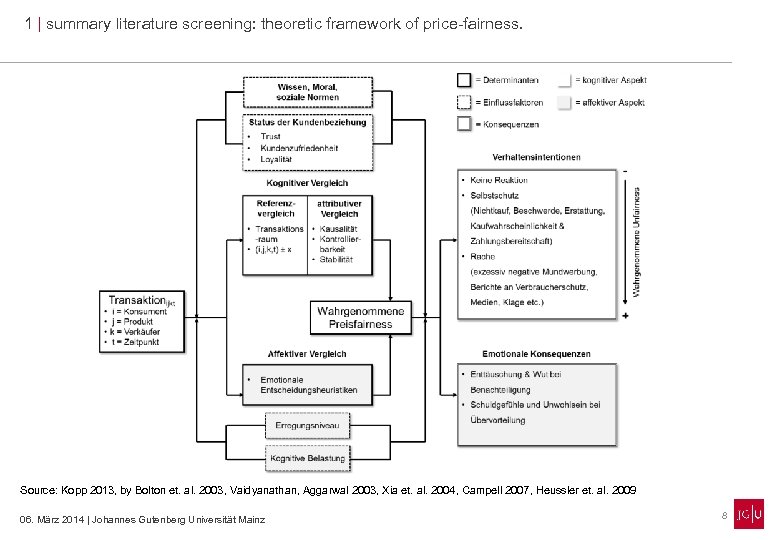 1 | summary literature screening: theoretic framework of price-fairness. Source: Kopp 2013, by Bolton et. al. 2003, Vaidyanathan, Aggarwal 2003, Xia et. al. 2004, Campell 2007, Heussler et. al. 2009 06. März 2014 | Johannes Gutenberg Universität Mainz 8
 Inhalt 1 | Relevance and scientific background 2 | Hypothesis and Methods 3 | Fieldwork and Sample composition 4 | Results 5 | Implications for research & practice 9
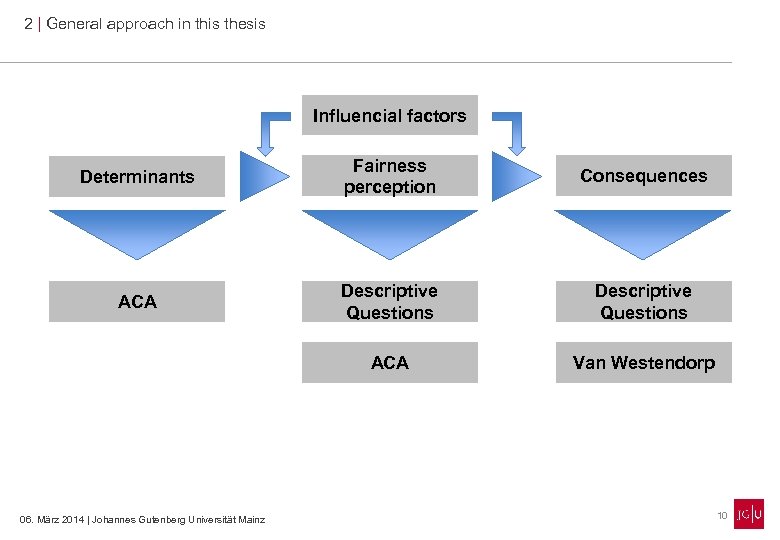 2 | General approach in this thesis Influencial factors Determinants Fairness perception Consequences ACA Descriptive Questions ACA Van Westendorp 06. März 2014 | Johannes Gutenberg Universität Mainz 10
 2 | Based on literature screening, a granular hypothesis plan was designed as basis for a conjoint analytic model. Hypothesis for determinants of price fairness § Overall, 21 hypothesis regarding determinants of price fairness, § reflecting 6 attributes and overall 25 levels of an ACA: § Timing of price implementation in comparison to competition § Focus of future investments § Motive of price implementation § type and level of existing information regarding price implementation § Target groups for price discounts § Payment model § Level of advertising within paid content § The general fairness rating was derived from calibration section of classic ACA. 06. März 2014 | Johannes Gutenberg Universität Mainz 11
 2 | Based on literature screening, a granular hypothesis plan was designed as basis for a conjoint analytic model. Hypothesis for influencial factors on price fairness evaluation process § Overall, 10 hypothesis regarding influencial factors on evaluation process. § Reflecting these influence factors: § social demographics (sex, age, income) § User-media-relationship (NMB) § General Internet usage § Involvement and knowledge regarding internet § Benefit-Segmentation (exploratory approach to find existing fairness segments via cluster analysis) 06. März 2014 | Johannes Gutenberg Universität Mainz 12
 2 | Based on literature screening, a granular hypothesis plan was designed as basis for a conjoint analytic model. Hypothesis for consequences of price fairness § Overall, 7 hypothesis regarding consequences of price fairness. § Main aspects: willingness-to-pay and purchase likelihood, derived from price sensitivity meter („van Westendorp“) and Martin-Rayner. Interpolation. § Other consequences, derived from likert scale questions: § Reduced likelihood of lead generation (test accounts, reading of free articles etc. ) § Intention to switch to competition § Negative or positive word-of-mouth § Feelings of disappointment in case of negative fairness perception 06. März 2014 | Johannes Gutenberg Universität Mainz 13
 2 | Based on literature screening, a granular hypothesis plan was designed as basis for a conjoint analytic model. Hypothesis for influencial factors on consequences of price fairness § Overall, 8 hypothesis regarding influencial factors on consequences. § Reflecting the same influencial factors as for determinants. § Derived from linear modelling (tests for main effects and interation effects) 06. März 2014 | Johannes Gutenberg Universität Mainz 14
 Inhalt 1 | Relevance and scientific background 2 | Hypothesis and Methods 3 | Fieldwork and Sample composition 4 | Results 5 | Implications for research & practice 15
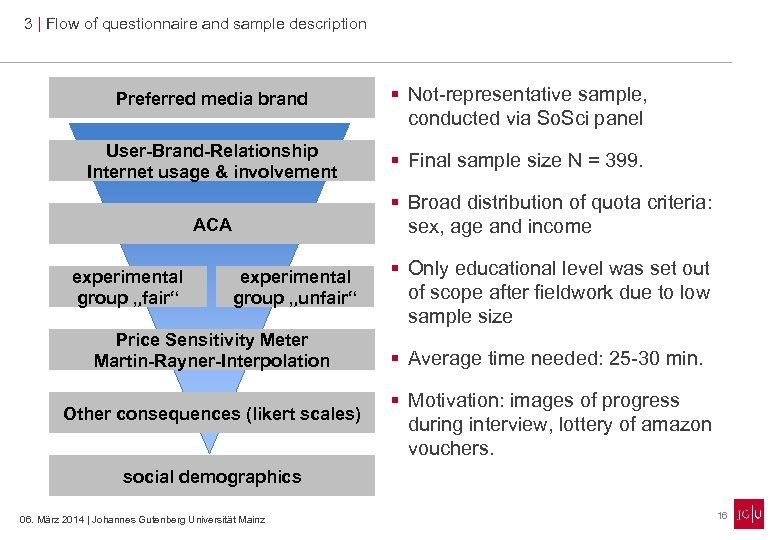 3 | Flow of questionnaire and sample description Preferred media brand § Not-representative sample, conducted via So. Sci panel User-Brand-Relationship Internet usage & involvement § Final sample size N = 399. § Broad distribution of quota criteria: sex, age and income ACA experimental group „fair“ experimental group „unfair“ Price Sensitivity Meter Martin-Rayner-Interpolation Other consequences (likert scales) § Only educational level was set out of scope after fieldwork due to low sample size § Average time needed: 25 -30 min. § Motivation: images of progress during interview, lottery of amazon vouchers. social demographics 06. März 2014 | Johannes Gutenberg Universität Mainz 16
 Inhalt 1 | Relevance and scientific background 2 | Hypothesis and Methods 3 | Fieldwork and Sample composition 4 | Results 5 | Implications for research & practice 17
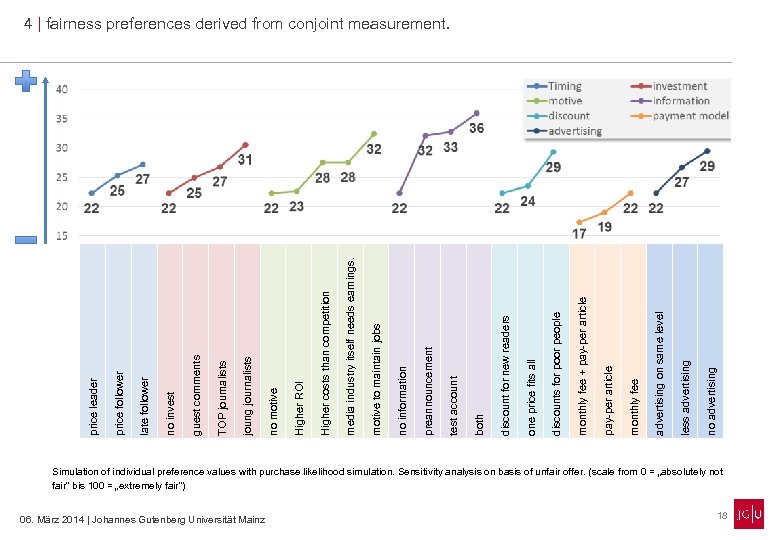 06. März 2014 | Johannes Gutenberg Universität Mainz no advertising less advertising on same level monthly fee pay-per article monthly fee + pay-per article discounts for poor people one price fits all discount for new readers both test account preannouncement no information motive to maintain jobs media industry itself needs earnings. Higher costs than competition Higher ROI no motive joung journalists TOP journalists guest comments no invest late follower price leader 4 | fairness preferences derived from conjoint measurement. Simulation of individual preference values with purchase likelihood simulation. Sensitivity analysis on basis of unfair offer. (scale from 0 = „absolutely not fair“ bis 100 = „extremely fair“) 18
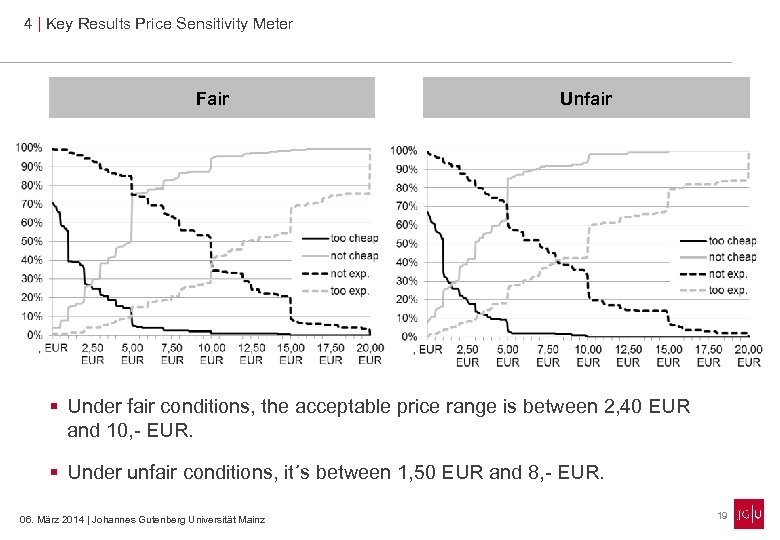 4 | Key Results Price Sensitivity Meter Fair Unfair § Under fair conditions, the acceptable price range is between 2, 40 EUR and 10, - EUR. § Under unfair conditions, it´s between 1, 50 EUR and 8, - EUR. 06. März 2014 | Johannes Gutenberg Universität Mainz 19
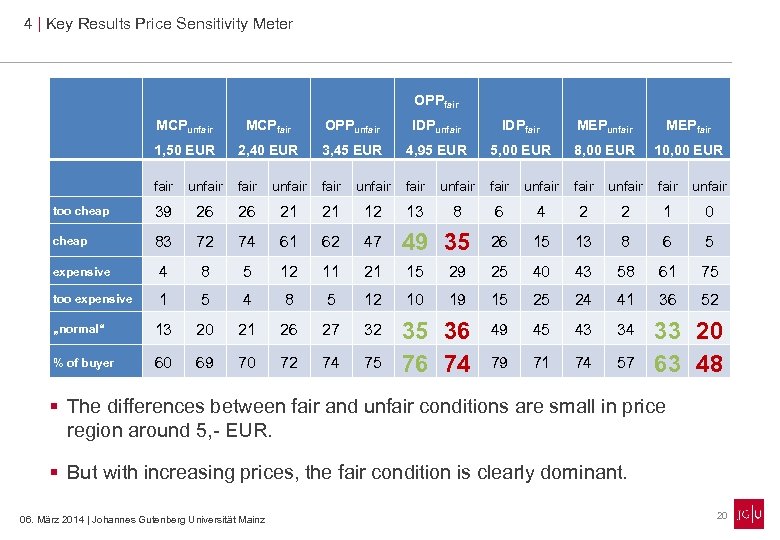 4 | Key Results Price Sensitivity Meter OPPfair MCPunfair MCPfair OPPunfair IDPfair MEPunfair MEPfair 1, 50 EUR 2, 40 EUR 3, 45 EUR 4, 95 EUR 5, 00 EUR 8, 00 EUR 10, 00 EUR fair unfair fair unfair too cheap 39 26 26 21 21 12 13 8 6 4 2 2 1 0 cheap 83 72 74 61 62 47 49 35 26 15 13 8 6 5 expensive 4 8 5 12 11 21 15 29 25 40 43 58 61 75 too expensive 1 5 4 8 5 12 10 19 15 25 24 41 36 52 „normal“ 13 20 21 26 27 32 49 45 43 34 % of buyer 60 69 70 72 74 75 35 36 76 74 79 71 74 57 33 20 63 48 § The differences between fair and unfair conditions are small in price region around 5, - EUR. § But with increasing prices, the fair condition is clearly dominant. 06. März 2014 | Johannes Gutenberg Universität Mainz 20
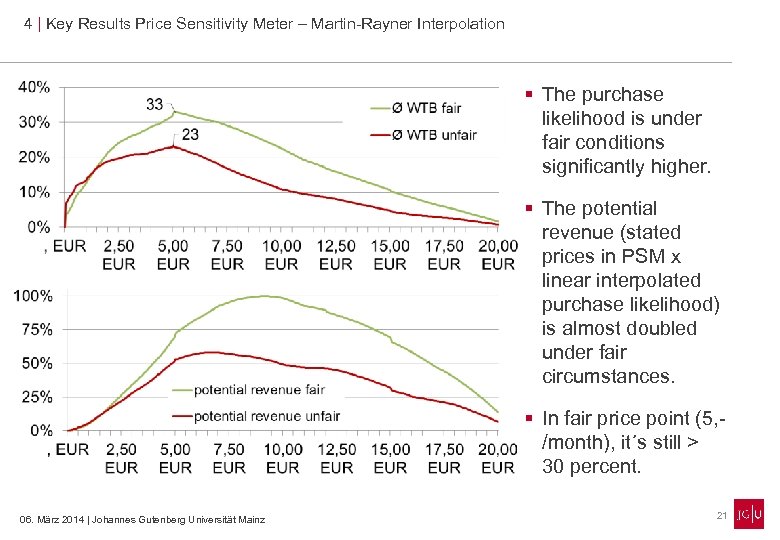 4 | Key Results Price Sensitivity Meter – Martin-Rayner Interpolation § The purchase likelihood is under fair conditions significantly higher. § The potential revenue (stated prices in PSM x linear interpolated purchase likelihood) is almost doubled under fair circumstances. § In fair price point (5, /month), it´s still > 30 percent. 06. März 2014 | Johannes Gutenberg Universität Mainz 21
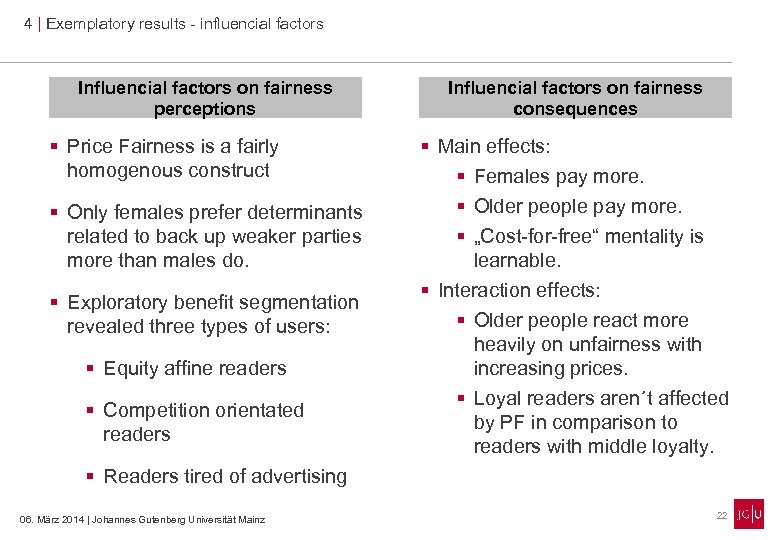 4 | Exemplatory results - influencial factors Influencial factors on fairness perceptions § Price Fairness is a fairly homogenous construct § Only females prefer determinants related to back up weaker parties more than males do. § Exploratory benefit segmentation revealed three types of users: § Equity affine readers § Competition orientated readers Influencial factors on fairness consequences § Main effects: § Females pay more. § Older people pay more. § „Cost-for-free“ mentality is learnable. § Interaction effects: § Older people react more heavily on unfairness with increasing prices. § Loyal readers aren´t affected by PF in comparison to readers with middle loyalty. § Readers tired of advertising 06. März 2014 | Johannes Gutenberg Universität Mainz 22
 Inhalt 1 | Relevance and scientific background 2 | Hypothesis and Methods 3 | Fieldwork and Sample composition 4 | Results 5 | Implications for research & practice 23
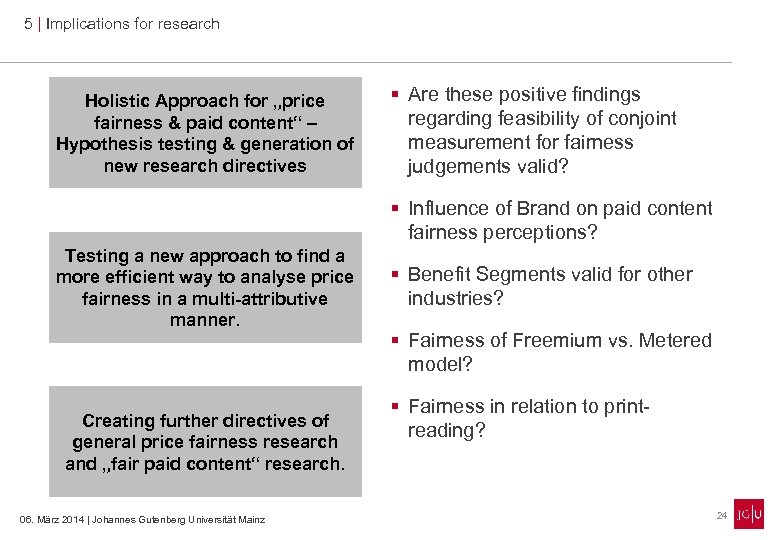 5 | Implications for research Holistic Approach for „price fairness & paid content“ – Hypothesis testing & generation of new research directives § Are these positive findings regarding feasibility of conjoint measurement for fairness judgements valid? § Influence of Brand on paid content fairness perceptions? Testing a new approach to find a more efficient way to analyse price fairness in a multi-attributive manner. Creating further directives of general price fairness research and „fair paid content“ research. 06. März 2014 | Johannes Gutenberg Universität Mainz § Benefit Segments valid for other industries? § Fairness of Freemium vs. Metered model? § Fairness in relation to printreading? 24
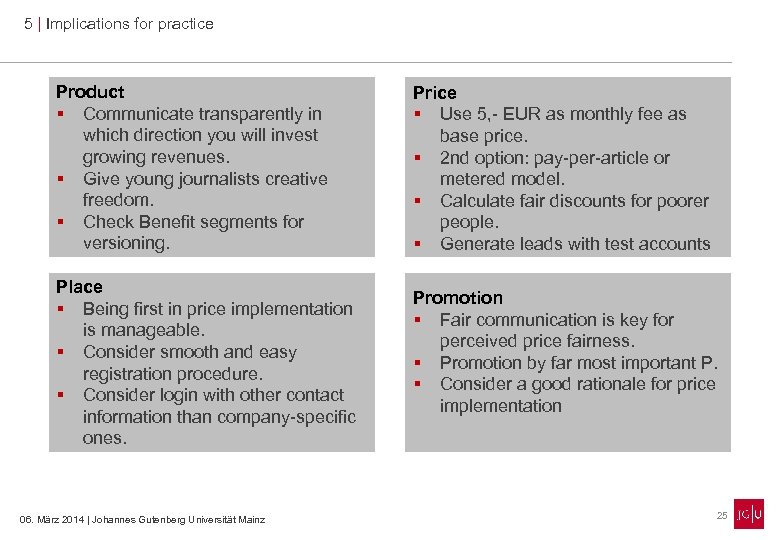 5 | Implications for practice Product § Communicate transparently in which direction you will invest growing revenues. § Give young journalists creative freedom. § Check Benefit segments for versioning. Place § Being first in price implementation is manageable. § Consider smooth and easy registration procedure. § Consider login with other contact information than company-specific ones. 06. März 2014 | Johannes Gutenberg Universität Mainz Price § Use 5, - EUR as monthly fee as base price. § 2 nd option: pay-per-article or metered model. § Calculate fair discounts for poorer people. § Generate leads with test accounts Promotion § Fair communication is key for perceived price fairness. § Promotion by far most important P. § Consider a good rationale for price implementation 25