


 Скачать презентацию The Implications of Trans-Pacific Partnership A Preliminary CGE
5585017ff088440179b29e77cd00f1e2.ppt
- Количество слайдов: 35
 The Implications of Trans-Pacific Partnership: A Preliminary CGE Assessment (Preliminary, not for quotation) Peter A. Petri, Michael Plummer and Fan Zhai (Brandies University, OECD, China Investment Corporation) International Conference on “Globalization Trends and Cycles: The Asian Experience” January 12 -13, 2011, Kuala Lumpur Slide 1
 I. Context of the study* • Shift of economic gravity to Asia • Proliferation of regional and bilateral agreements with limited participation by the United States • Compelling logic of TPP – Addresses changing global economic environment – Provides new model for U. S. economic partnerships – Potentially covers majority of US trade * These slides report on work in progress. The study is scheduled to be completed in spring 2011. Slide 2
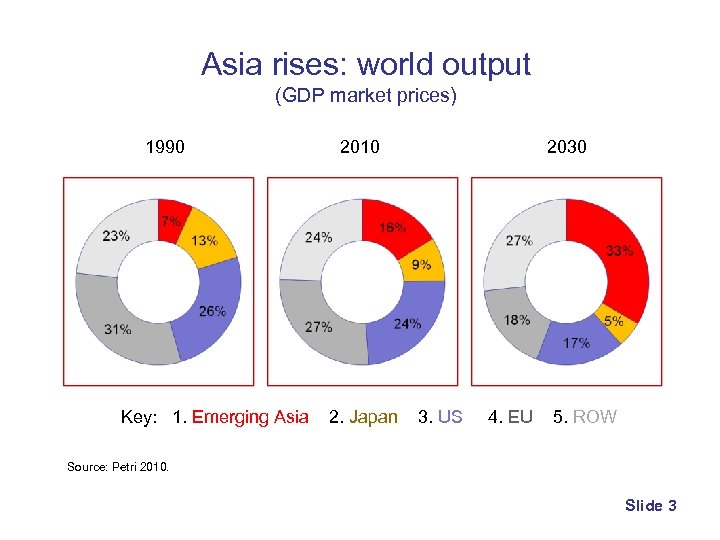 Asia rises: world output (GDP market prices) 1990 2010 2030 Key: 1. Emerging Asia 2. Japan 3. US 4. EU 5. ROW Source: Petri 2010. Slide 3
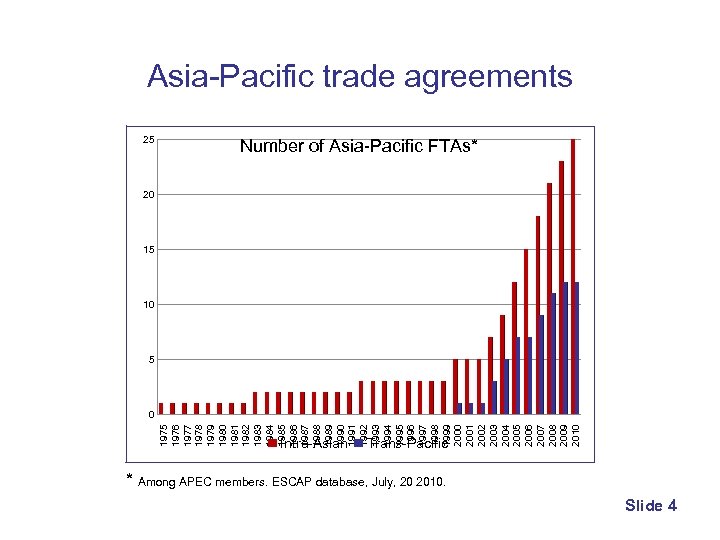 Asia-Pacific trade agreements 25 Number of Asia-Pacific FTAs* 20 15 10 5 1976 1977 1978 1979 1980 1981 1982 1983 1984 1985 1986 1987 1988 1989 1990 1991 1992 1993 1994 1995 1996 1997 1998 1999 2000 2001 2002 2003 2004 2005 2006 2007 2008 2009 2010 0 Intra-Asian Trans-Pacific * Among APEC members. ESCAP database, July, 20 2010. Slide 4
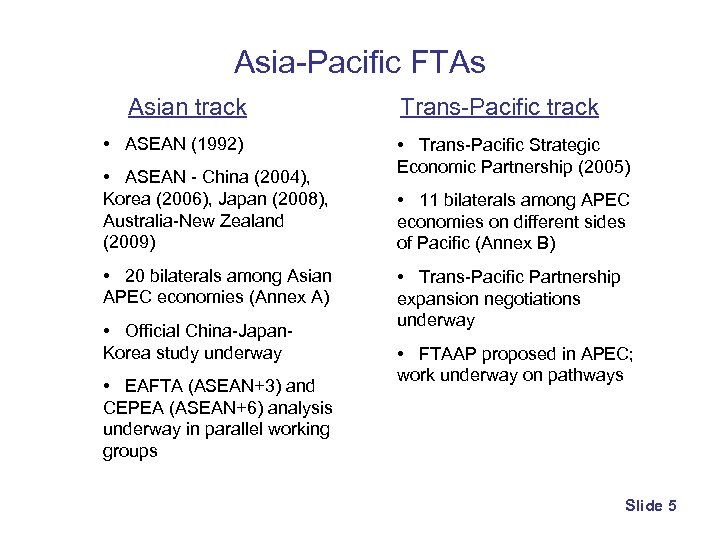 Asia-Pacific FTAs Asian track Trans-Pacific track • ASEAN (1992) • ASEAN - China (2004), Korea (2006), Japan (2008), Australia-New Zealand (2009) • 20 bilaterals among Asian APEC economies (Annex A) • Official China-Japan. Korea study underway • EAFTA (ASEAN+3) and CEPEA (ASEAN+6) analysis underway in parallel working groups • Trans-Pacific Strategic Economic Partnership (2005) • 11 bilaterals among APEC economies on different sides of Pacific (Annex B) • Trans-Pacific Partnership expansion negotiations underway • FTAAP proposed in APEC; work underway on pathways Slide 5
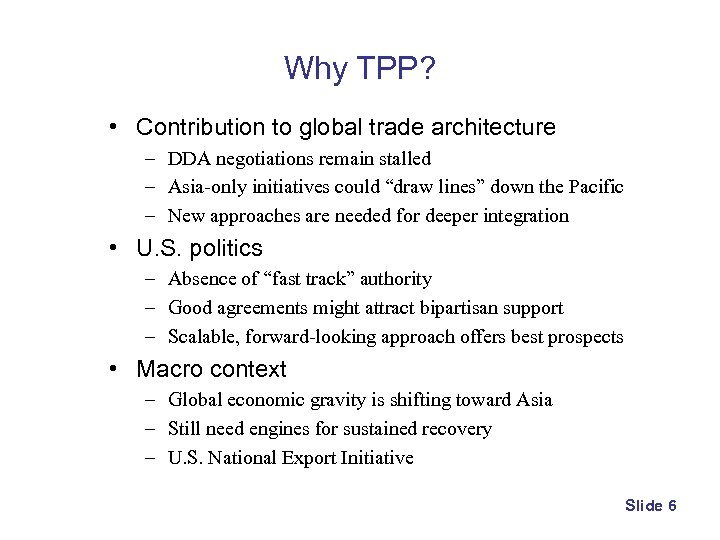 Why TPP? • Contribution to global trade architecture – DDA negotiations remain stalled – Asia-only initiatives could “draw lines” down the Pacific – New approaches are needed for deeper integration • U. S. politics – Absence of “fast track” authority – Good agreements might attract bipartisan support – Scalable, forward-looking approach offers best prospects • Macro context – Global economic gravity is shifting toward Asia – Still need engines for sustained recovery – U. S. National Export Initiative Slide 6
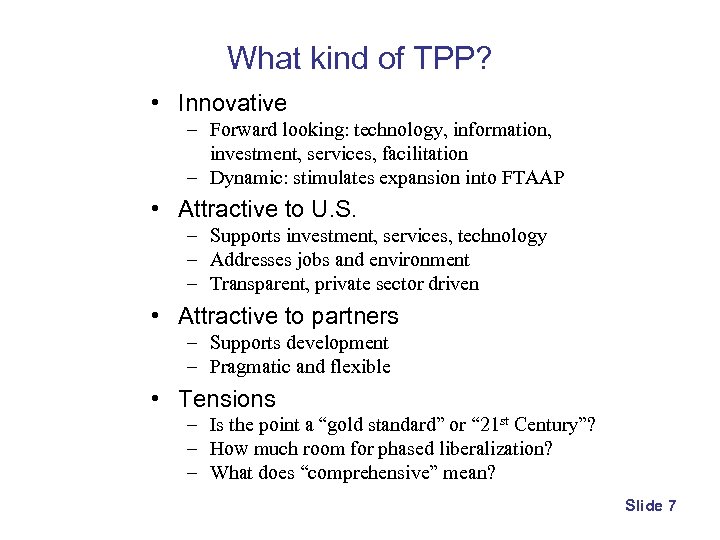 What kind of TPP? • Innovative – Forward looking: technology, information, investment, services, facilitation – Dynamic: stimulates expansion into FTAAP • Attractive to U. S. – Supports investment, services, technology – Addresses jobs and environment – Transparent, private sector driven • Attractive to partners – Supports development – Pragmatic and flexible • Tensions – Is the point a “gold standard” or “ 21 st Century”? – How much room for phased liberalization? – What does “comprehensive” mean? Slide 7
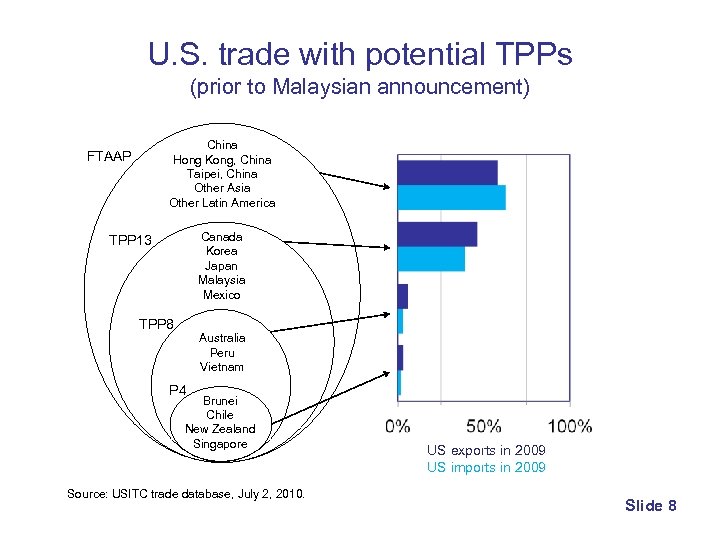 U. S. trade with potential TPPs (prior to Malaysian announcement) China Hong Kong, China Taipei, China Other Asia Other Latin America FTAAP Canada Korea Japan Malaysia Mexico TPP 13 TPP 8 Australia Peru Vietnam P 4 Brunei Chile New Zealand Singapore Source: USITC trade database, July 2, 2010. US exports in 2009 US imports in 2009 Slide 8
 II. Design of the study • Explores dynamic path of agreements • Estimates implications for economies joining at different points on the dynamic path • Incorporates broad economic effects, including tariff elimination, service liberalization, trade facilitation, and investment Slide 9
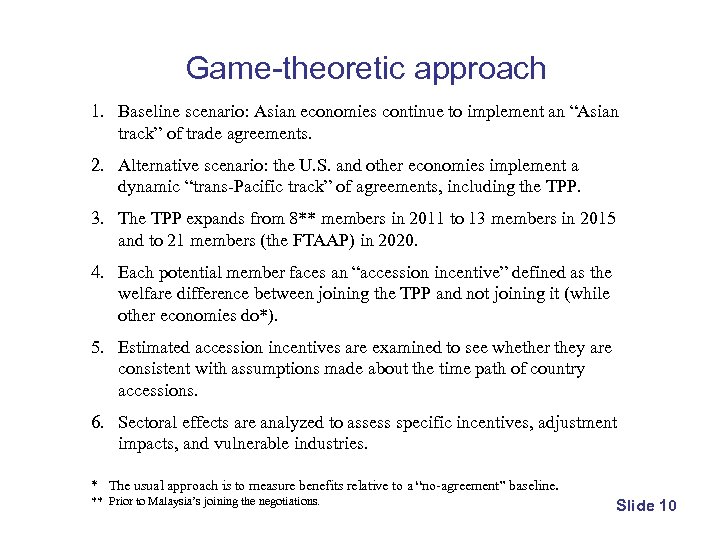 Game-theoretic approach 1. Baseline scenario: Asian economies continue to implement an “Asian track” of trade agreements. 2. Alternative scenario: the U. S. and other economies implement a dynamic “trans-Pacific track” of agreements, including the TPP. 3. The TPP expands from 8** members in 2011 to 13 members in 2015 and to 21 members (the FTAAP) in 2020. 4. Each potential member faces an “accession incentive” defined as the welfare difference between joining the TPP and not joining it (while other economies do*). 5. Estimated accession incentives are examined to see whether they are consistent with assumptions made about the time path of country accessions. 6. Sectoral effects are analyzed to assess specific incentives, adjustment impacts, and vulnerable industries. * The usual approach is to measure benefits relative to a “no-agreement” baseline. ** Prior to Malaysia’s joining the negotiations. Slide 10
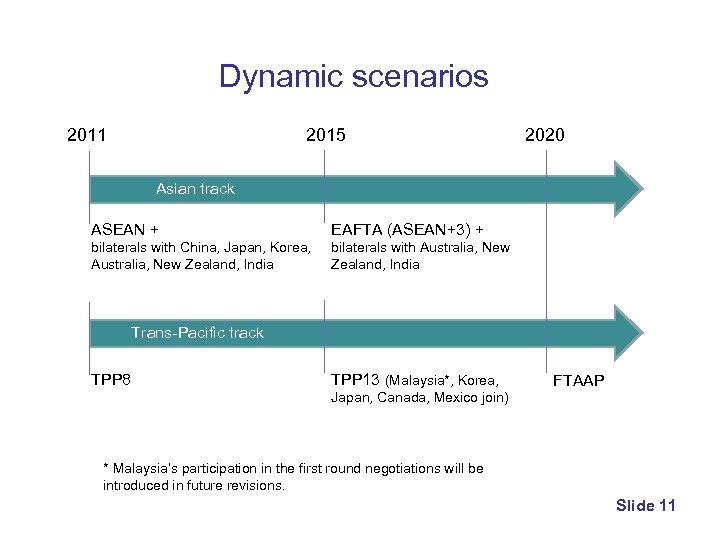 Dynamic scenarios 2015 2011 2020 Asian track ASEAN + EAFTA (ASEAN+3) + bilaterals with China, Japan, Korea, Australia, New Zealand, India bilaterals with Australia, New Zealand, India Trans-Pacific track TPP 8 TPP 13 (Malaysia*, Korea, FTAAP Japan, Canada, Mexico join) * Malaysia’s participation in the first round negotiations will be introduced in future revisions. Slide 11
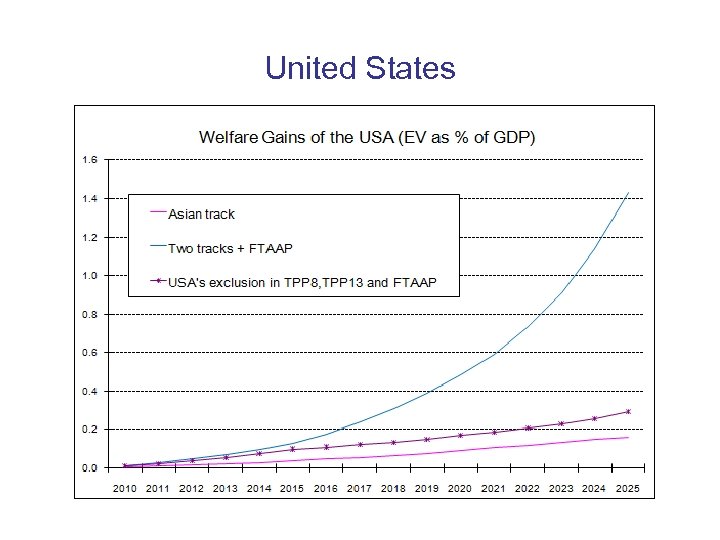
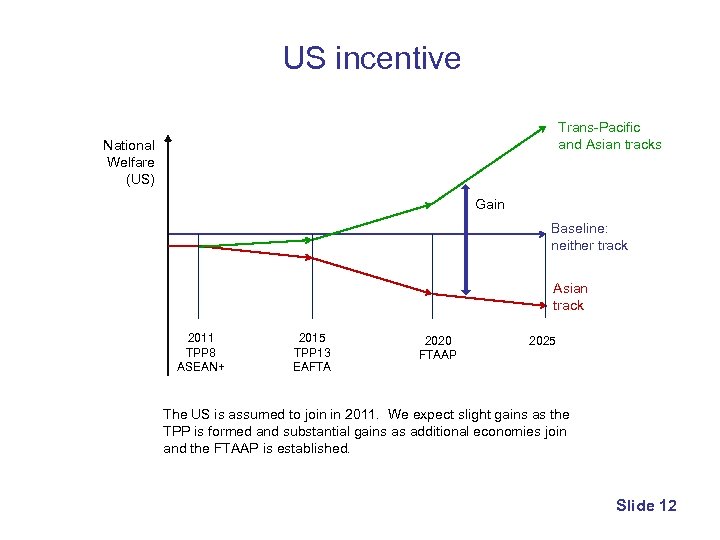 US incentive Trans-Pacific and Asian tracks National Welfare (US) Gain Baseline: neither track Asian track 2011 TPP 8 ASEAN+ 2015 TPP 13 EAFTA 2020 FTAAP 2025 The US is assumed to join in 2011. We expect slight gains as the TPP is formed and substantial gains as additional economies join and the FTAAP is established. Slide 12
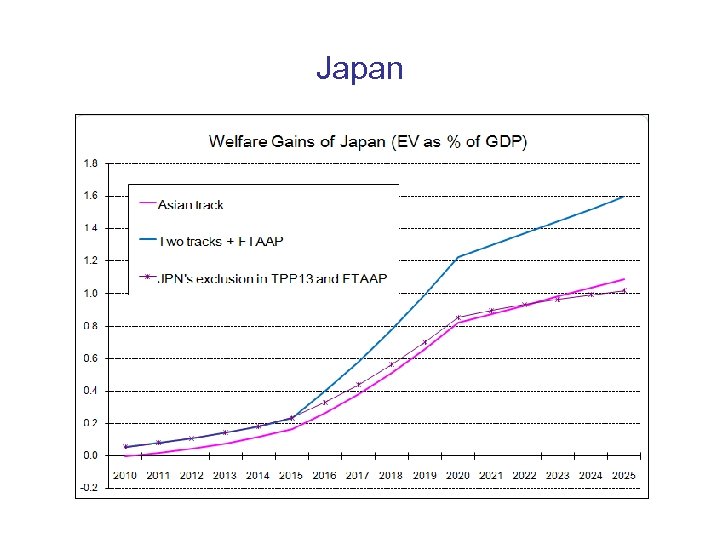
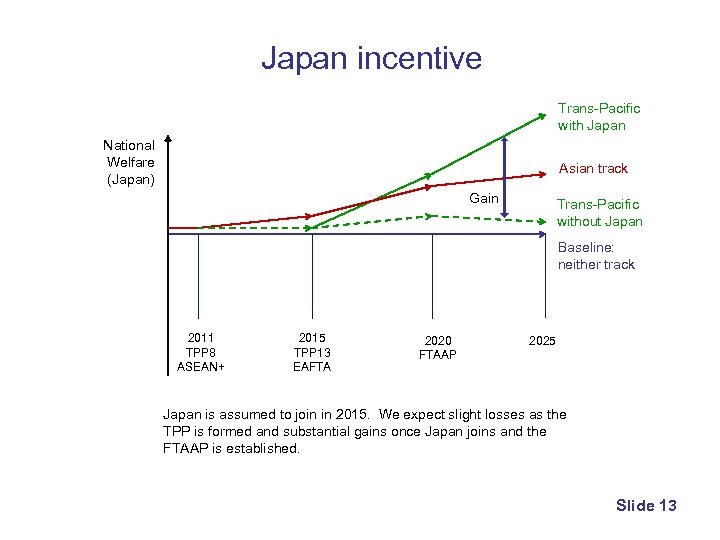 Japan incentive Trans-Pacific with Japan National Welfare (Japan) Asian track Gain Trans-Pacific without Japan Baseline: neither track 2011 TPP 8 ASEAN+ 2015 TPP 13 EAFTA 2020 FTAAP 2025 Japan is assumed to join in 2015. We expect slight losses as the TPP is formed and substantial gains once Japan joins and the FTAAP is established. Slide 13
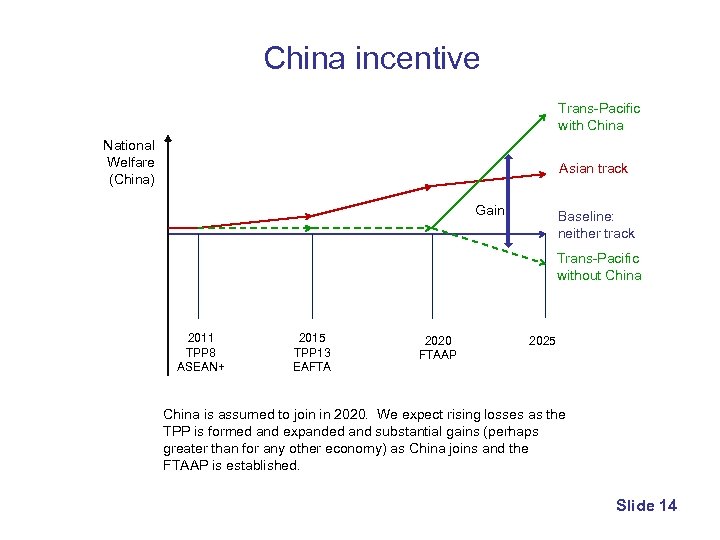 China incentive Trans-Pacific with China National Welfare (China) Asian track Gain Baseline: neither track Trans-Pacific without China 2011 TPP 8 ASEAN+ 2015 TPP 13 EAFTA 2020 FTAAP 2025 China is assumed to join in 2020. We expect rising losses as the TPP is formed and expanded and substantial gains (perhaps greater than for any other economy) as China joins and the FTAAP is established. Slide 14
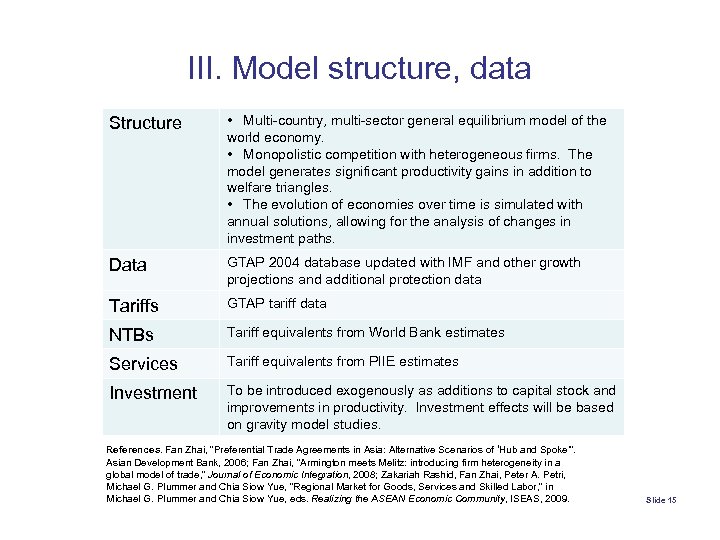 III. Model structure, data Structure • Multi-country, multi-sector general equilibrium model of the world economy. • Monopolistic competition with heterogeneous firms. The model generates significant productivity gains in addition to welfare triangles. • The evolution of economies over time is simulated with annual solutions, allowing for the analysis of changes in investment paths. Data GTAP 2004 database updated with IMF and other growth projections and additional protection data Tariffs GTAP tariff data NTBs Tariff equivalents from World Bank estimates Services Tariff equivalents from PIIE estimates Investment To be introduced exogenously as additions to capital stock and improvements in productivity. Investment effects will be based on gravity model studies. References. Fan Zhai, “Preferential Trade Agreements in Asia: Alternative Scenarios of ‘Hub and Spoke’”. Asian Development Bank, 2006; Fan Zhai, “Armington meets Melitz: introducing firm heterogeneity in a global model of trade, ” Journal of Economic Integration, 2008; Zakariah Rashid, Fan Zhai, Peter A. Petri, Michael G. Plummer and Chia Siow Yue, “Regional Market for Goods, Services and Skilled Labor, ” in Michael G. Plummer and Chia Siow Yue, eds. Realizing the ASEAN Economic Community, ISEAS, 2009. Slide 15
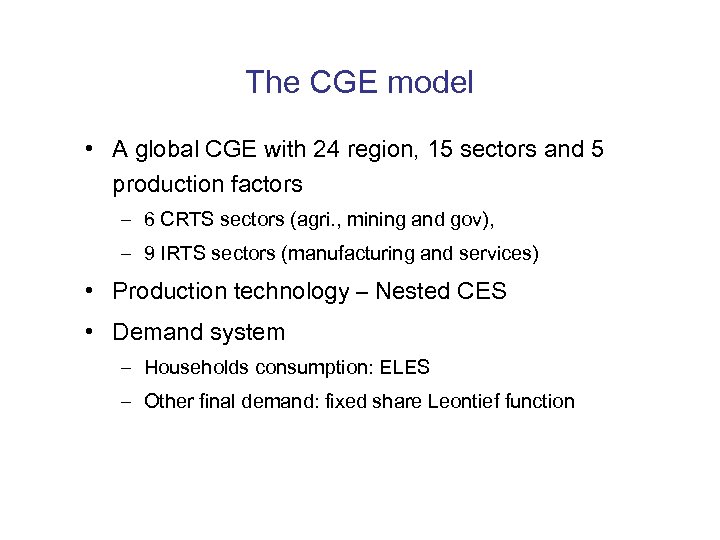 The CGE model • A global CGE with 24 region, 15 sectors and 5 production factors – 6 CRTS sectors (agri. , mining and gov), – 9 IRTS sectors (manufacturing and services) • Production technology – Nested CES • Demand system – Households consumption: ELES – Other final demand: fixed share Leontief function
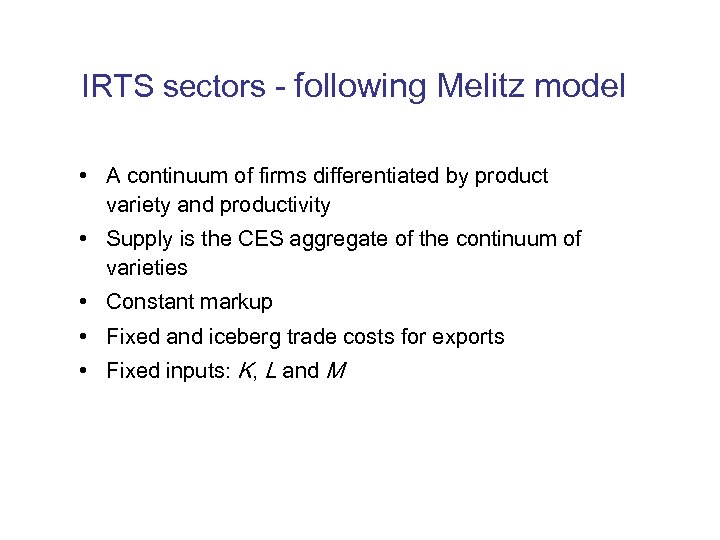 IRTS sectors - following Melitz model • A continuum of firms differentiated by product variety and productivity • Supply is the CES aggregate of the continuum of varieties • Constant markup • Fixed and iceberg trade costs for exports • Fixed inputs: K, L and M
 Firm Heterogeneity • Productivity is drawn from a random Pareto distribution • Cut-off productivity
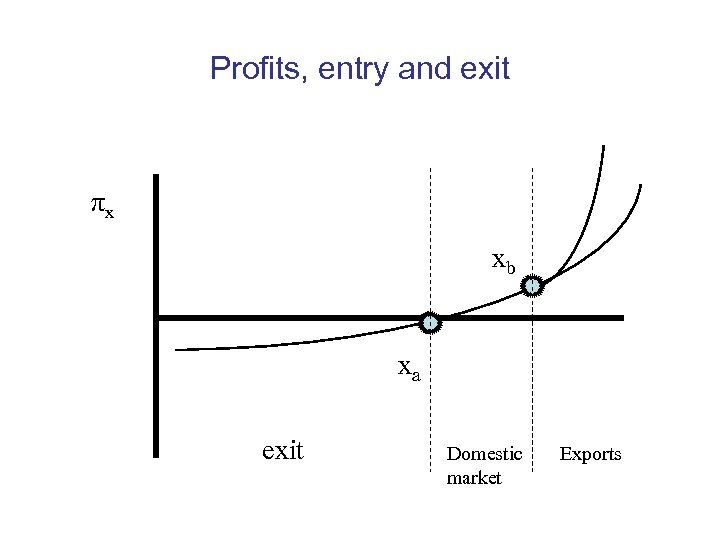 Profits, entry and exit πx xb xa exit Domestic market Exports
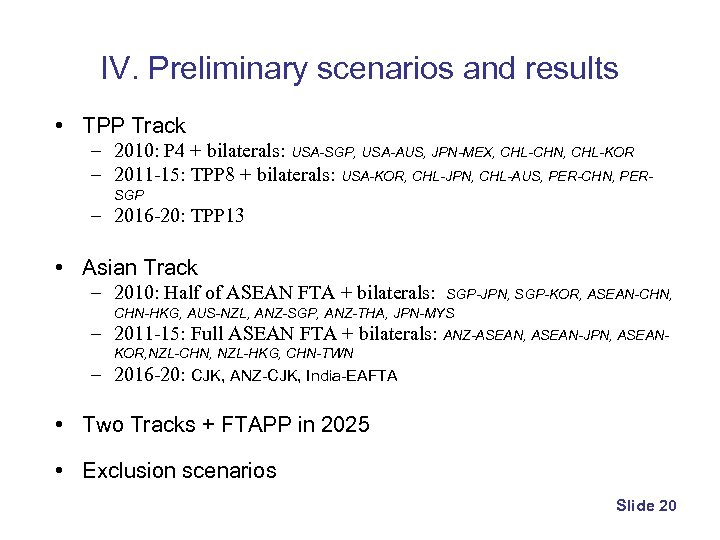 IV. Preliminary scenarios and results • TPP Track – 2010: P 4 + bilaterals: USA-SGP, USA-AUS, JPN-MEX, CHL-CHN, CHL-KOR – 2011 -15: TPP 8 + bilaterals: USA-KOR, CHL-JPN, CHL-AUS, PER-CHN, PERSGP – 2016 -20: TPP 13 • Asian Track – 2010: Half of ASEAN FTA + bilaterals: SGP-JPN, SGP-KOR, ASEAN-CHN, CHN-HKG, AUS-NZL, ANZ-SGP, ANZ-THA, JPN-MYS – 2011 -15: Full ASEAN FTA + bilaterals: ANZ-ASEAN, ASEAN-JPN, ASEANKOR, NZL-CHN, NZL-HKG, CHN-TWN – 2016 -20: CJK, ANZ-CJK, India-EAFTA • Two Tracks + FTAPP in 2025 • Exclusion scenarios Slide 20
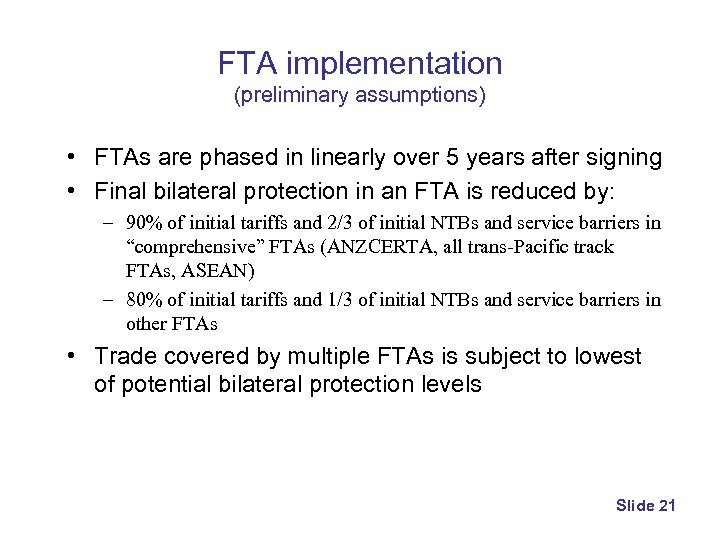 FTA implementation (preliminary assumptions) • FTAs are phased in linearly over 5 years after signing • Final bilateral protection in an FTA is reduced by: – 90% of initial tariffs and 2/3 of initial NTBs and service barriers in “comprehensive” FTAs (ANZCERTA, all trans-Pacific track FTAs, ASEAN) – 80% of initial tariffs and 1/3 of initial NTBs and service barriers in other FTAs • Trade covered by multiple FTAs is subject to lowest of potential bilateral protection levels Slide 21
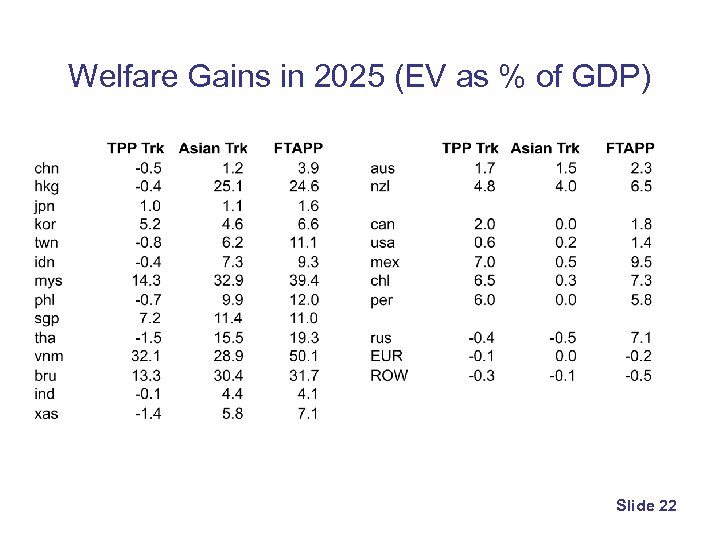 Welfare Gains in 2025 (EV as % of GDP) Slide 22
 United States
 Japan
Japan
 Vietnam
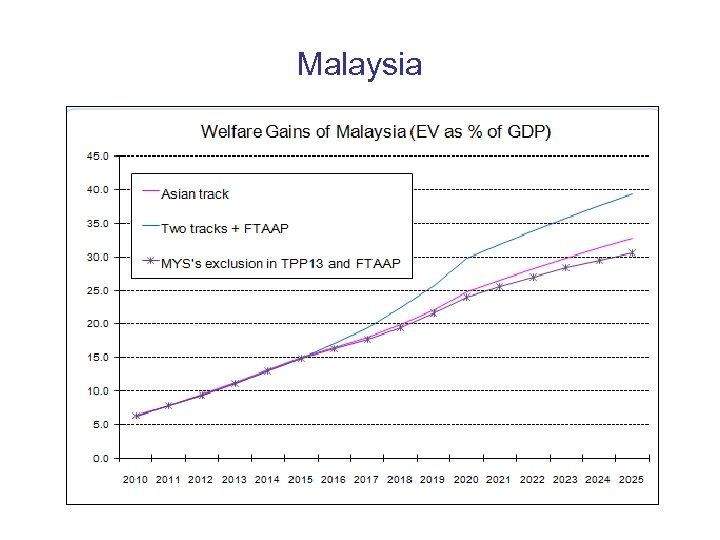 Malaysia
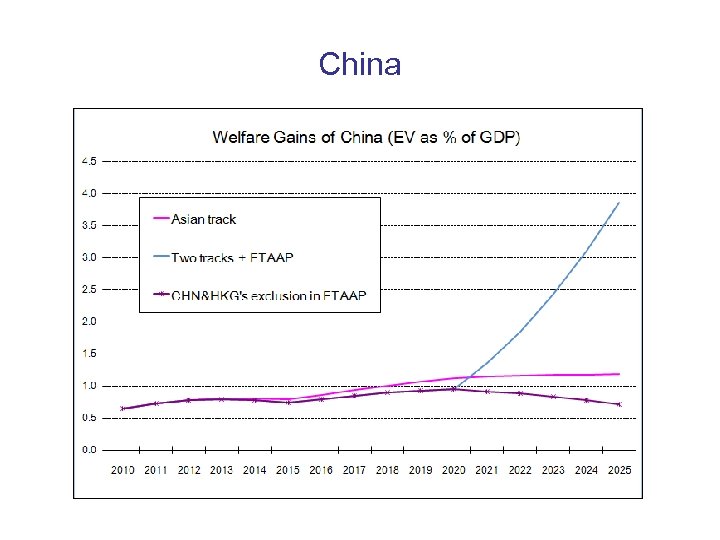 China
China
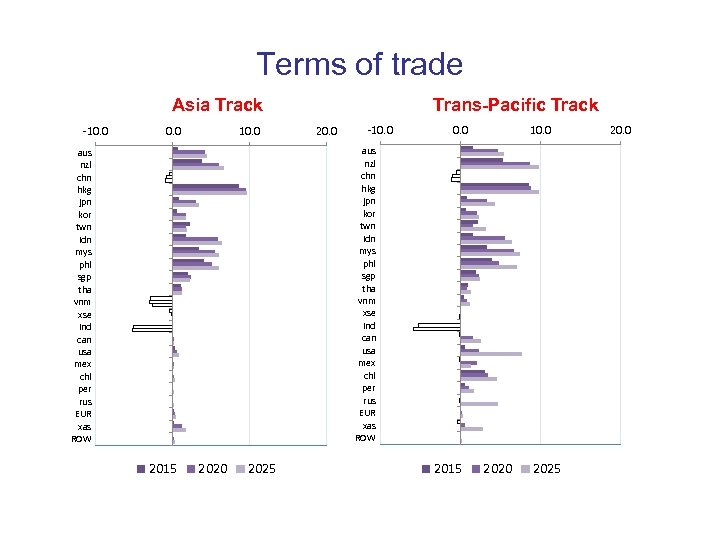 Terms of trade Asia Track -10. 0 Trans-Pacific Track 20. 0 -10. 0 aus nzl chn hkg jpn kor twn idn mys phl sgp tha vnm xse ind can usa mex chl per rus EUR xas ROW 2015 2020 2025 20. 0
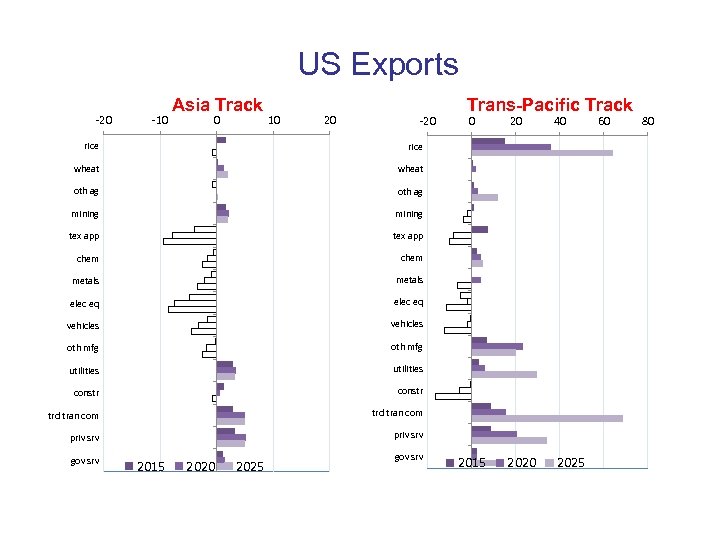 US Exports -20 -10 Asia Track 0 10 20 -20 rice chem metals elec eq vehicles oth mfg utilities constr trd tran com priv srv 2025 tex app chem 2020 mining tex app 40 oth ag mining 20 wheat oth ag 0 rice wheat Trans-Pacific Track priv srv gov srv 2015 2020 2025 gov srv 2015 60 80
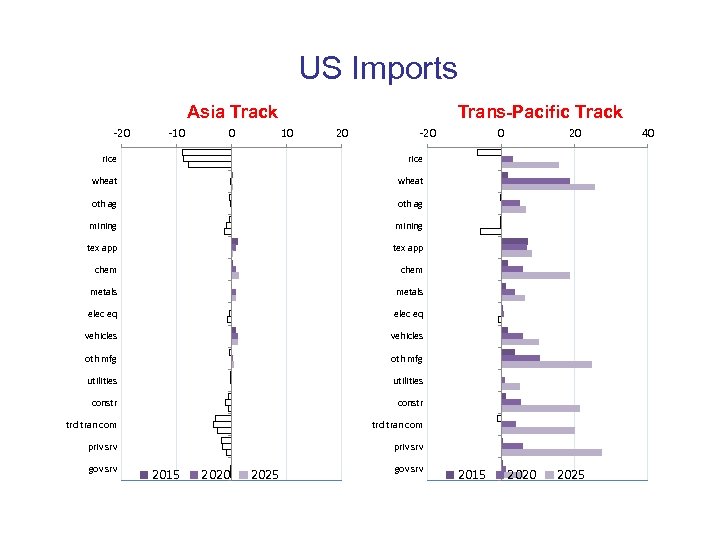 US Imports Asia Track -20 -10 0 Trans-Pacific Track 10 20 -20 rice wheat oth ag mining tex app chem metals elec eq vehicles oth mfg utilities constr trd tran com priv srv 20 rice wheat 0 priv srv gov srv 2015 2020 2025 40
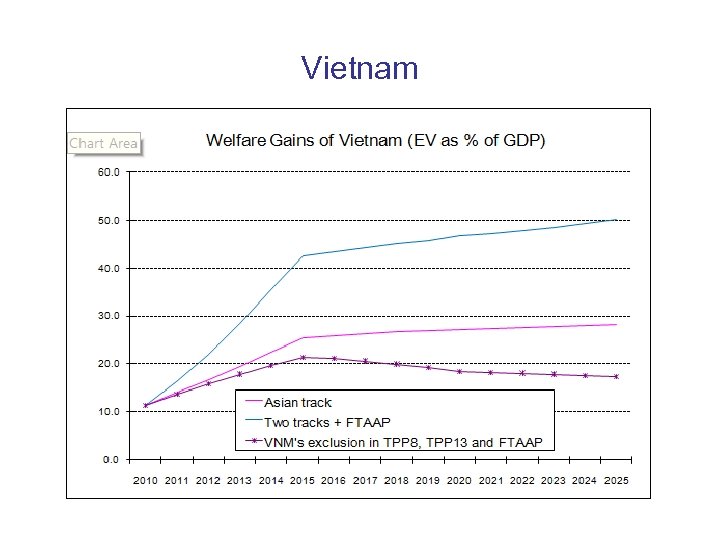
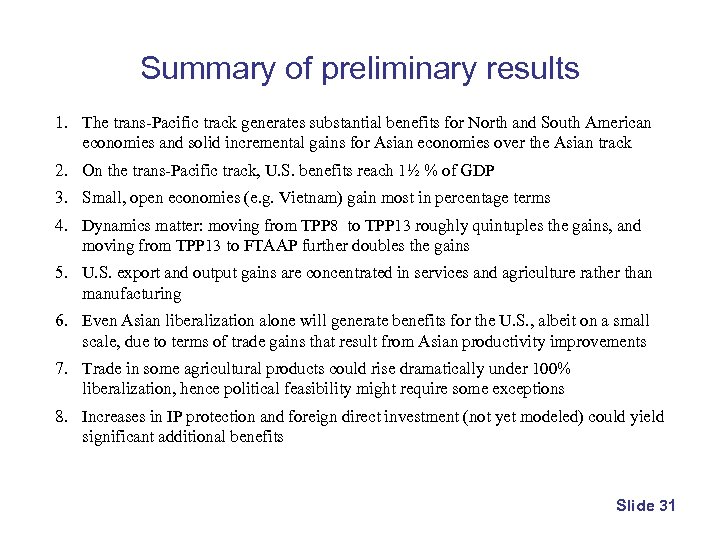 Summary of preliminary results 1. The trans-Pacific track generates substantial benefits for North and South American economies and solid incremental gains for Asian economies over the Asian track 2. On the trans-Pacific track, U. S. benefits reach 1½ % of GDP 3. Small, open economies (e. g. Vietnam) gain most in percentage terms 4. Dynamics matter: moving from TPP 8 to TPP 13 roughly quintuples the gains, and moving from TPP 13 to FTAAP further doubles the gains 5. U. S. export and output gains are concentrated in services and agriculture rather than manufacturing 6. Even Asian liberalization alone will generate benefits for the U. S. , albeit on a small scale, due to terms of trade gains that result from Asian productivity improvements 7. Trade in some agricultural products could rise dramatically under 100% liberalization, hence political feasibility might require some exceptions 8. Increases in IP protection and foreign direct investment (not yet modeled) could yield significant additional benefits Slide 31
 Annexes A. Intra-Asian agreements B. Trans-Pacific agreements C. Region classification Slide 32
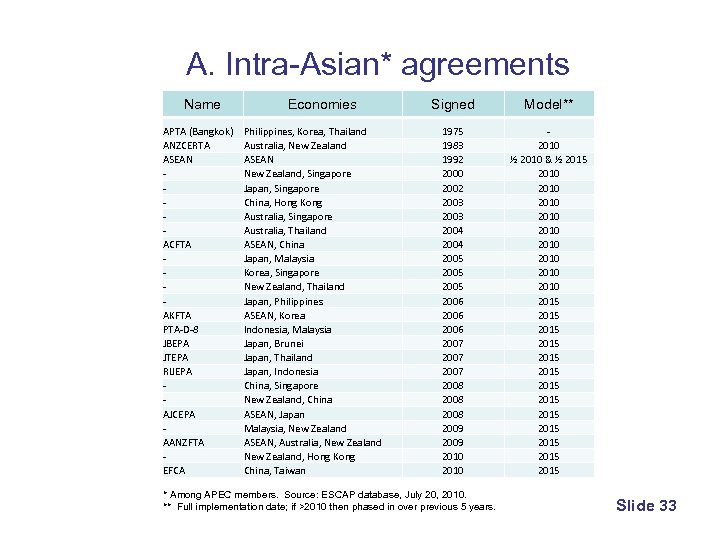 A. Intra-Asian* agreements Name APTA (Bangkok) ANZCERTA ASEAN ACFTA AKFTA PTA-D-8 JBEPA JTEPA RIJEPA AJCEPA AANZFTA EFCA Economies Philippines, Korea, Thailand Australia, New Zealand ASEAN New Zealand, Singapore Japan, Singapore China, Hong Kong Australia, Singapore Australia, Thailand ASEAN, China Japan, Malaysia Korea, Singapore New Zealand, Thailand Japan, Philippines ASEAN, Korea Indonesia, Malaysia Japan, Brunei Japan, Thailand Japan, Indonesia China, Singapore New Zealand, China ASEAN, Japan Malaysia, New Zealand ASEAN, Australia, New Zealand, Hong Kong China, Taiwan Signed Model** 1975 1983 1992 2000 2002 2003 2004 2005 2006 2007 2008 2009 2010 ½ 2010 & ½ 2015 2010 2010 2010 2015 2015 2015 2015 * Among APEC members. Source: ESCAP database, July 20, 2010. ** Full implementation date; if >2010 then phased in over previous 5 years. Slide 33
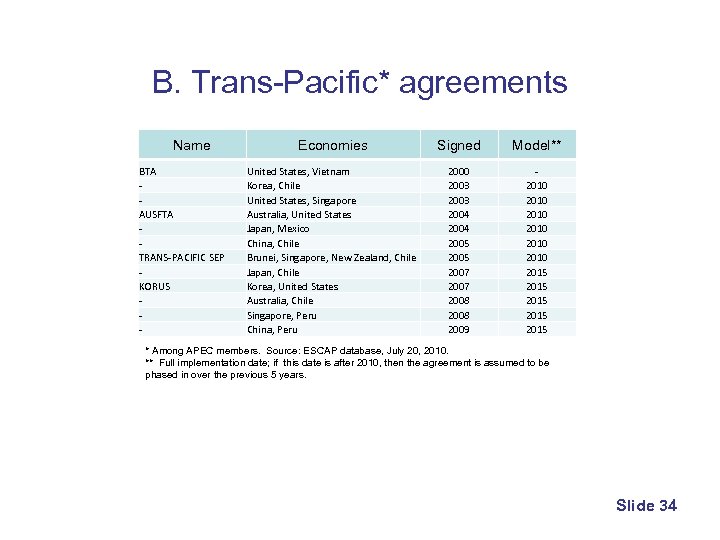 B. Trans-Pacific* agreements Name BTA AUSFTA TRANS-PACIFIC SEP KORUS - Economies Signed Model** United States, Vietnam Korea, Chile United States, Singapore Australia, United States Japan, Mexico China, Chile Brunei, Singapore, New Zealand, Chile Japan, Chile Korea, United States Australia, Chile Singapore, Peru China, Peru 2000 2003 2004 2005 2007 2008 2009 2010 2010 2015 2015 * Among APEC members. Source: ESCAP database, July 20, 2010. ** Full implementation date; if this date is after 2010, then the agreement is assumed to be phased in over the previous 5 years. Slide 34
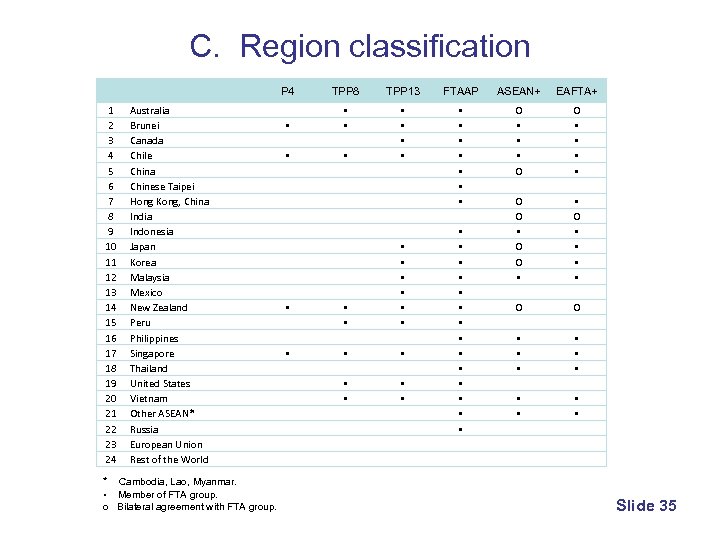 C. Region classification P 4 1 2 3 4 5 6 7 8 9 10 11 12 13 14 15 16 17 18 19 20 21 22 23 24 Australia Brunei Canada Chile China Chinese Taipei Hong Kong, China India Indonesia Japan Korea Malaysia Mexico New Zealand Peru Philippines Singapore Thailand United States Vietnam Other ASEAN* Russia European Union Rest of the World TPP 8 TPP 13 FTAAP ASEAN+ EAFTA+ • • • • O • • • O O • • O • • O O • • • • • • • • • • * Cambodia, Lao, Myanmar. • Member of FTA group. o Bilateral agreement with FTA group. Slide 35