


 Скачать презентацию The Implications of International Financial Reporting Standards IFRS
fee2ac34390dd88f379cc2370c6fff36.ppt
- Количество слайдов: 87
 The Implications of International Financial Reporting Standards (IFRS) on Investment Funds © 2006 Ernst & Young All Rights Reserved. Ernst & Young is a registered trademark. June 6, 2006
 Agenda A. Background & Framework B. Executive Summary of IFRS Issues Affecting Investment Funds C. Specific IFRS affecting Investment Funds D. Impact of IFRS on the work of the auditor E. Relationship between the auditor and the investment fund regulator
 A. Background & Framework
 EU Regulation adopted by EU Parliament on 7 June 2002: Who? What? Consolidated annual accounts When? 3 All European companies listed on a stock exchange Financial periods commencing 1 January 2005 (including at a minimum comparatives for 2004)
 IFRS Required for Investment Funds? • IFRS is obligatory when listed & only when consolidated accounts are required, however – Member states have the option to permit/oblige application of IFRS – Requirements of supervisors of stock exchanges – Local standard setters are gradually implementing IFRS – More and more funds apply IFRS – IFRS are becoming an indication for quality of reporting – Supervisors/regulators are investigating the impact on regulations and reporting requirements 4
 IFRS Framework • IFRS comprise International Accounting Standards, International Financial Reporting Standards and associated pronouncements and interpretations issued by the International Accounting Standards Board (IASB) 5
 IFRS Framework (cont’d) • IFRS represent a comprehensive set of standards setting rigid disclosure requirements and accounting rules • Significant development over past 5/10 years • More widely accepted and now endorsed by the European Union • Judgment based • GAAP convergence – IASB/FASB • Limited industry specific guidance promulgated by IASB • Complex measurement and disclosure requirements for financial instruments 6
 Terminology • IAS – International Accounting Standard • IFRS – International Financial Reporting Standard • ISA – International Standard on Auditing 7
 B. Executive Summary of IFRS Issues Affecting Investment Funds
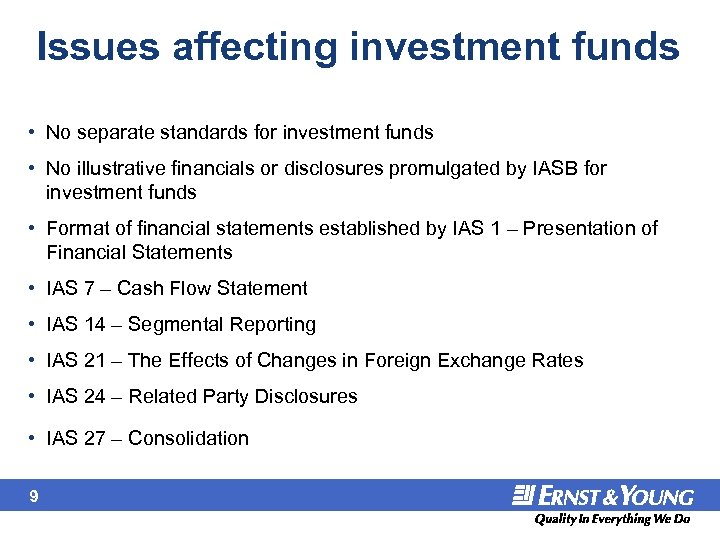 Issues affecting investment funds • No separate standards for investment funds • No illustrative financials or disclosures promulgated by IASB for investment funds • Format of financial statements established by IAS 1 – Presentation of Financial Statements • IAS 7 – Cash Flow Statement • IAS 14 – Segmental Reporting • IAS 21 – The Effects of Changes in Foreign Exchange Rates • IAS 24 – Related Party Disclosures • IAS 27 – Consolidation 9
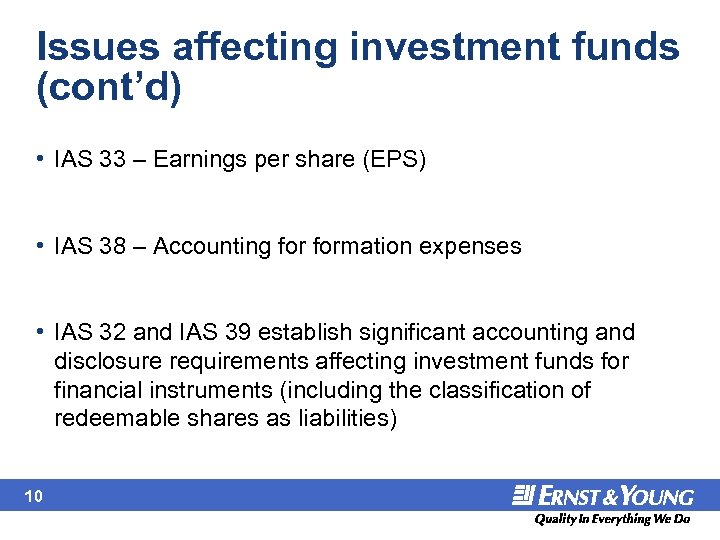 Issues affecting investment funds (cont’d) • IAS 33 – Earnings per share (EPS) • IAS 38 – Accounting formation expenses • IAS 32 and IAS 39 establish significant accounting and disclosure requirements affecting investment funds for financial instruments (including the classification of redeemable shares as liabilities) 10
 C. Specific IFRS affecting Investment Funds
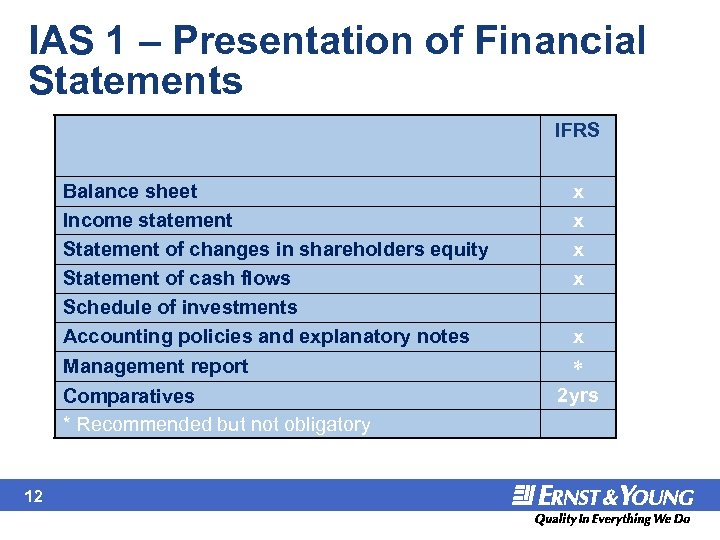 IAS 1 – Presentation of Financial Statements IFRS Balance sheet Income statement Statement of changes in shareholders equity Statement of cash flows Schedule of investments Accounting policies and explanatory notes Management report Comparatives * Recommended but not obligatory 12 x x * x 2 yrs
 IAS 7 - Cash Flow Statement IFRS • IAS 7: Cash flows from operating, investing and financing activities – strict classification requirements set out in IAS 7 • Currently no exemptions available 13
 IAS 7 - Cash Flow Statement - Issue • Lack of exemption inconsistent with other GAAPs (US, UK and Canadian) • Does not provide additional meaningful information 14
 IAS 14 – Segmental Reporting • Segmental reporting is required for entities whose equity or debt is publicly traded • Business and geographical segments • Primary and secondary reporting formats 15
 IAS 14 – Segmental Reporting - Issue • Current market practice is to disclose portfolio positions in line with the investment policy as per the fund’s prospectus • May be impossible to define a common classification of business and geographical segments to be accepted in various countries since no generally accepted standards 16
 IAS 21 – The Effects of Changes in Foreign Exchange Rates • Financial statements should be reported in the functional currency of the investment fund • This represents the currency of the primary economic environment in which the entity operates • Consider the currency in which financing is generated and the currency from which gains and losses from investment activities are retained/distributed 17
 IAS 21 – The Effects of Changes in Foreign Exchange Rates – cont’d • For most investment funds, the functional currency will be based on the currency in which the capital of the fund is designated • Exceptions may arise where majority of assets denominated in another specific currency with no hedging • Consider the currency in which the return is being provided to investors • If functional currency differs from the local currency disclose this and the reason why 18
 IAS 24 - Related Party Disclosures • A party is related to an entity if: It controls, is controlled by or is under common control with the entity It has an interest in the entity that gives it significant influence over the entity It has joint control over the entity The party is an associate of the entity The party is a joint venture in which the entity is a venturer 19
 IAS 24 - Related Party Disclosures (cont’d) • The party is a member of the key management personnel of the entity The partner is a close member of the family of any of the above The party is an entity controlled, jointly controlled or significantly influenced by a key member of management personnel or their close family The party is a post-employment benefit plan for the benefit of the employees of the entity 20
 IAS 24 - Related Party Disclosures (cont’d) • Generally an administrator or custodian would not be considered a related party • However, if an employee of the administrator or custodian was a director or key member of management of the fund, then they would become related parties • Key member of management is defined as having the authority and responsibility for planning, directing and controlling the activities of the fund • Disclosure of administration and custody arrangements, fees and balances may be considered desirable if considered key contractual arrangements 21
 IAS 27 - Consolidation • If ‘Control’ exists, then consolidate • IAS 27. 13 A: A subsidiary is not excluded from consolidation simply because the investor is a venture capital organization, mutual fund, unit trust or similar entity • Key question for Investment Funds: Does control exist? 22
 IAS 27 - Consolidation (cont’d) • Control is presumed to exist when the parent owns, directly or indirectly through subsidiaries, more than half of the voting power of an entity unless, in exceptional circumstances, it can be clearly demonstrated that such ownership does not constitute control 23
 IAS 27 - Consolidation (cont’d) • Control also exists even when the parent owns half or less of the voting power of an entity when there is – Power over more than half of the voting rights or power to govern the financial and operating policies by virtue of an agreement with other investors – Power to appoint or remove the majority of the members of the board of directors or equivalent governing body and control of the entity is by that board or body; or – Power to cast the majority of votes at meetings of the board of directors or equivalent governing body and control of the entity is by that board or body 24
 IAS 27 - Consolidation (cont’d) • It is not possible to give a general interpretation of consolidation requirements for investment funds. The actual situation has to be taken into account. Relevant elements are - 25 What are the rights attached to the ordinary shares (changing the articles of association, change the investment policy, replace the fund manager, determine the dividend policy, change the cost structure)
 IAS 27 - Consolidation (cont’d) – What are the rights attached to the preference shares (and who owns these shares) – Do specific provisions exist regarding the share in the revenues and expenses of the fund, have certain minimum return guarantees been issued to the investors 26
 IAS 27 - Consolidation - Umbrella Funds • No specific requirements regarding umbrella funds included in IFRS • The fact of being a ‘standard’ umbrella fund does in itself not lead to a consolidation requirement • Therefore, being an umbrella fund does not automatically lead to the application of IFRS • If a Fund has a subsidiary, for example Indian Tax subsidiary, etc, there may be a need to consolidate, therefore IFRS may apply 27
 IAS 27 – Consolidation (cont’d) - Issues • No equivalent to US GAAP Master-Feeder accounting framework for investment funds • Feeder must fully consolidate a master fund in which it holds the majority of the voting shares unless it can demonstrate that it does not have control • Expected to be rare that feeder will have voting control but can demonstrate that it does not have control 28
 IAS 27 – Consolidation (cont’d) - Issues • Feeder that does not have voting control is not required to consolidate unless it has the ability to control by contractual agreement • Certain stock exchanges require such contractual agreements, therefore most listed feeder funds will need to consolidate master funds under IFRS 29
 IAS 33 – Earnings per share • Earnings per share should be disclosed by funds whose ordinary or potentially ordinary shares are publicly traded • Presented on face of Income Statement (even if negative) • Basic EPS – profit/loss attributable to ordinary shareholders divided by weighted average number of ordinary shares outstanding during the period • Diluted EPS – profit/loss adjusted for effects of all dilutive potential ordinary shares 30
 IAS 33 – Earnings per share - Issue • Disclosure of EPS not consistent with other GAAPs (US, UK) • May completely change the manner in which performance of a fund is measured • Does not provide investors with meaningful information thus it does not enhance presentation and transparency 31
 IAS 38 – Intangible Assets • Formation costs should be expensed as incurred 32
 Financial Instruments – IAS 32 & IAS 39 1. SCOPE OF IAS 32 & IAS 39 2. CLASSIFICATION AND MEASUREMENT 3. DISCLOSURES 33
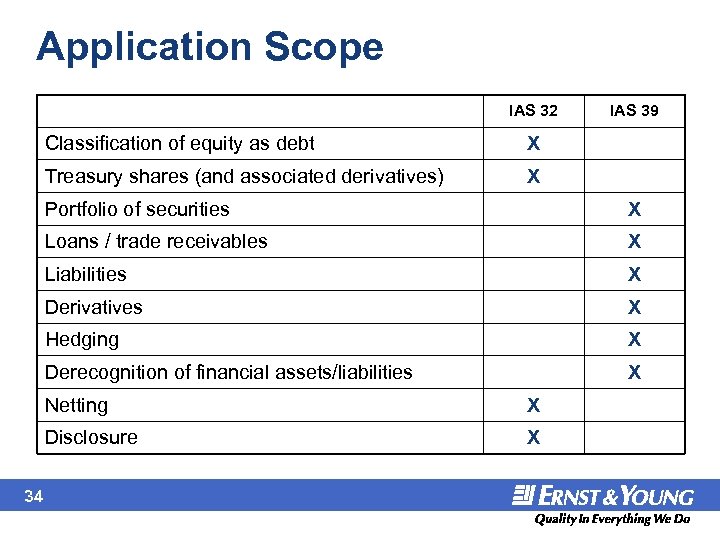 Application Scope IAS 32 Classification of equity as debt X Treasury shares (and associated derivatives) IAS 39 X Portfolio of securities X Loans / trade receivables X Liabilities X Derivatives X Hedging X Derecognition of financial assets/liabilities X Netting Disclosure 34 X X
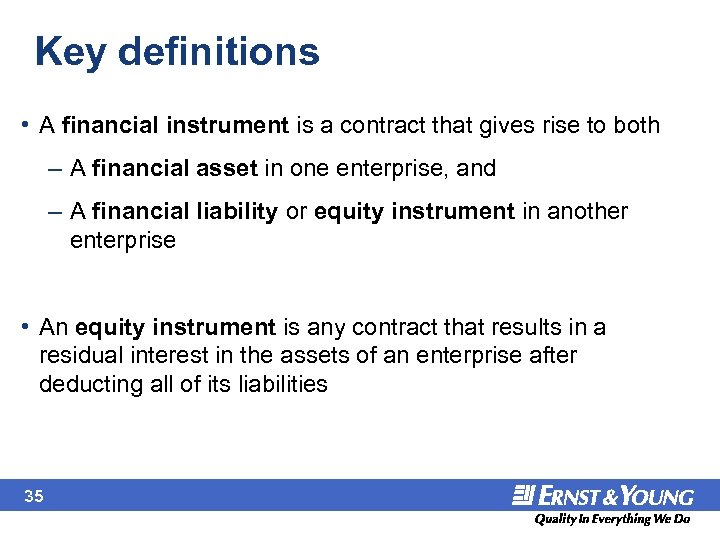 Key definitions • A financial instrument is a contract that gives rise to both – A financial asset in one enterprise, and – A financial liability or equity instrument in another enterprise • An equity instrument is any contract that results in a residual interest in the assets of an enterprise after deducting all of its liabilities 35
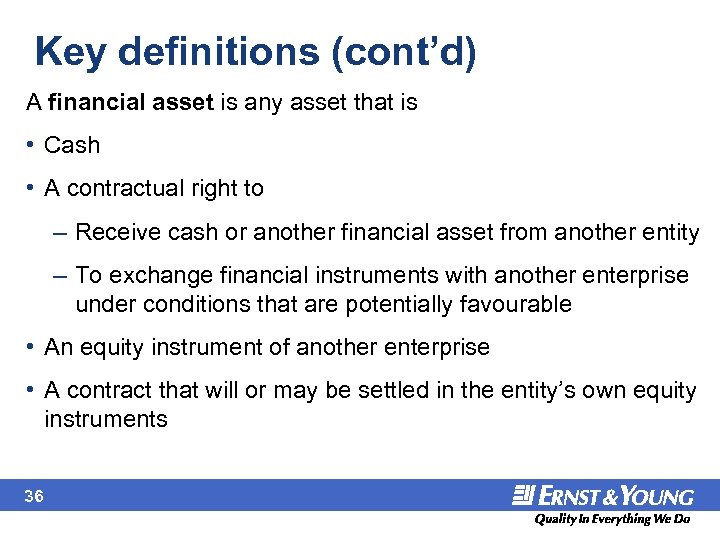 Key definitions (cont’d) A financial asset is any asset that is • Cash • A contractual right to – Receive cash or another financial asset from another entity – To exchange financial instruments with another enterprise under conditions that are potentially favourable • An equity instrument of another enterprise • A contract that will or may be settled in the entity’s own equity instruments 36
 Key definitions (cont’d) A financial liability is any liability that is a contractual obligation • To deliver cash or another financial asset, or • To exchange financial instruments with another enterprise under conditions that are potentially unfavourable • A contract that will or may be settled in the entity’s own equity instruments 37
 Key definitions (cont’d) • Financial instruments issued by the enterprise should be classified as liabilities or equity instruments according to their substance – This depends on whether the instrument contains any of the elements of a liability as defined in the standard • Where the instrument contains both liability and equity components, they should be classified and accounted for separately – Interest, dividends, losses and gains should be classified in the P&L consistently with the balance sheet treatment 38
 Key definitions (cont’d) A derivative is a financial instrument • Whose value changes in response to the change in a specified interest rate, security price, commodity price, foreign exchange rate or similar variable (sometimes called the ‘underlying’) • That requires little or no initial net investment, and • That is settled at a future date 39
 Financial Instruments 1. SCOPE OF THE NEW STANDARDS 2. CLASSIFICATION AND MEASUREMENT 3. DISCLOSURES 40
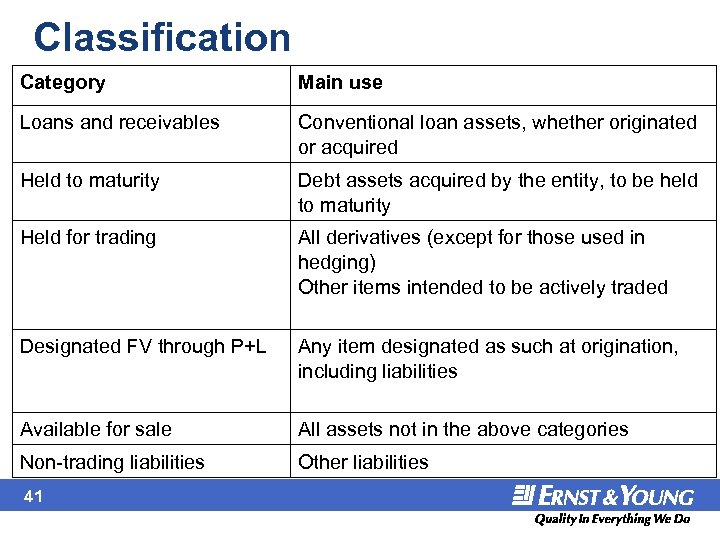 Classification Category Main use Loans and receivables Conventional loan assets, whether originated or acquired Held to maturity Debt assets acquired by the entity, to be held to maturity Held for trading All derivatives (except for those used in hedging) Other items intended to be actively traded Designated FV through P+L Any item designated as such at origination, including liabilities Available for sale All assets not in the above categories Non-trading liabilities Other liabilities 41
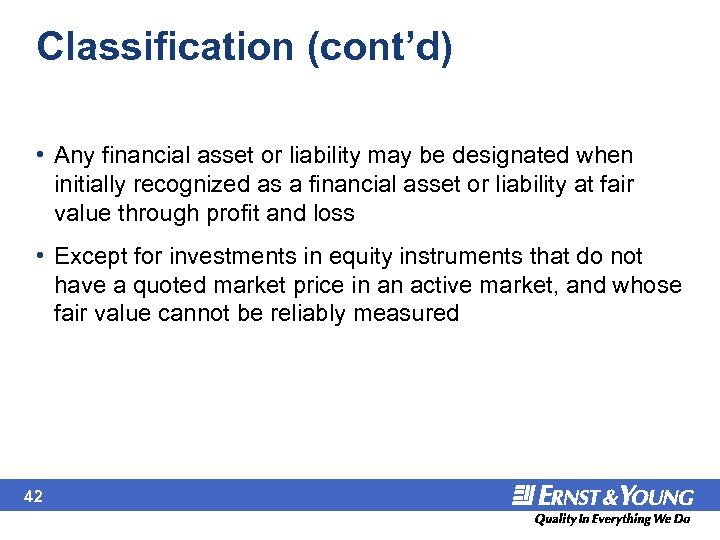 Classification (cont’d) • Any financial asset or liability may be designated when initially recognized as a financial asset or liability at fair value through profit and loss • Except for investments in equity instruments that do not have a quoted market price in an active market, and whose fair value cannot be reliably measured 42
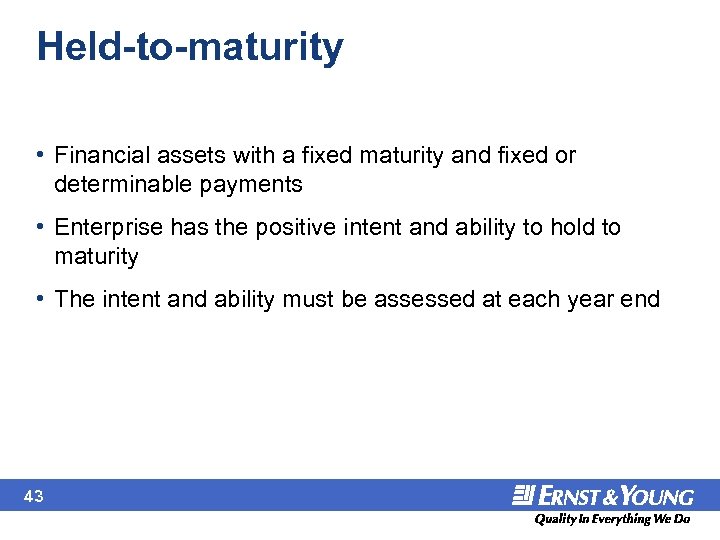 Held-to-maturity • Financial assets with a fixed maturity and fixed or determinable payments • Enterprise has the positive intent and ability to hold to maturity • The intent and ability must be assessed at each year end 43
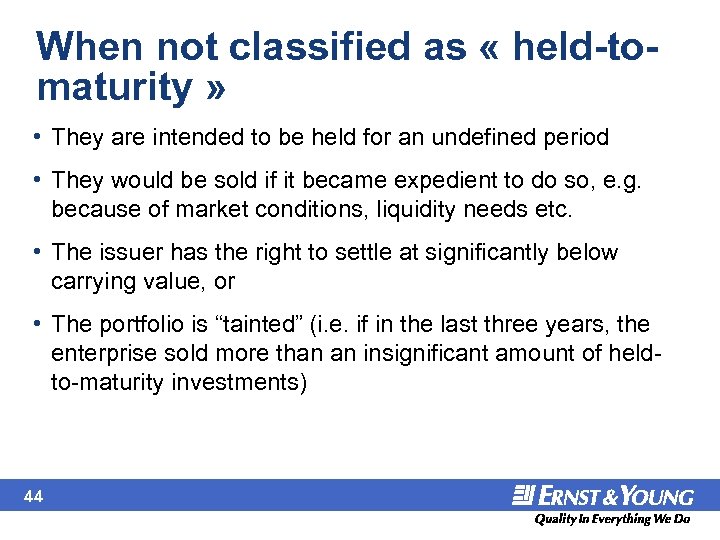 When not classified as « held-tomaturity » • They are intended to be held for an undefined period • They would be sold if it became expedient to do so, e. g. because of market conditions, liquidity needs etc. • The issuer has the right to settle at significantly below carrying value, or • The portfolio is “tainted” (i. e. if in the last three years, the enterprise sold more than an insignificant amount of heldto-maturity investments) 44
 Held-to-maturity (cont’d) • Held to maturity financial instruments are carried at amortized cost, using the effective interest method • If it no longer becomes appropriate to classify an investment as held-to-maturity, re-measure to fair value 45
 Available-for-sale • These are financial assets that do not fall under any other classification • They are measured at fair value, unless fair value cannot be reliably measured 46
 Loans and receivables • Created by the enterprise by providing money, goods or services directly to a debtor • Excludes any originated for trading purposes • Includes any participations and syndicated loans funded on origination • Loans acquired after origination are classified as trading, held-to-maturity or available for sale • Loans and receivables are measured at amortized cost, less provision for impairment 47
 Accounting for gains and losses • Financial asset or financial liability at fair value through profit and loss: (un)realized gains and losses recorded in the income statement • Available-for-sale: realized gains and losses in the income statement. Unrealized gains and losses directly in reserves • Impairment losses on available-for-sale investments always included in the income statement 48
 Initial Measurement • All financial assets and liabilities are initially measured at fair value • Plus, in the case of financial assets and liabilities not at fair value through profit or loss – Transaction costs that are directly attributable to the acquisition or issue of the financial asset or financial liability • IAS 18 - certain financial service fees are an integral part of the effective interest rate of a financial instrument 49
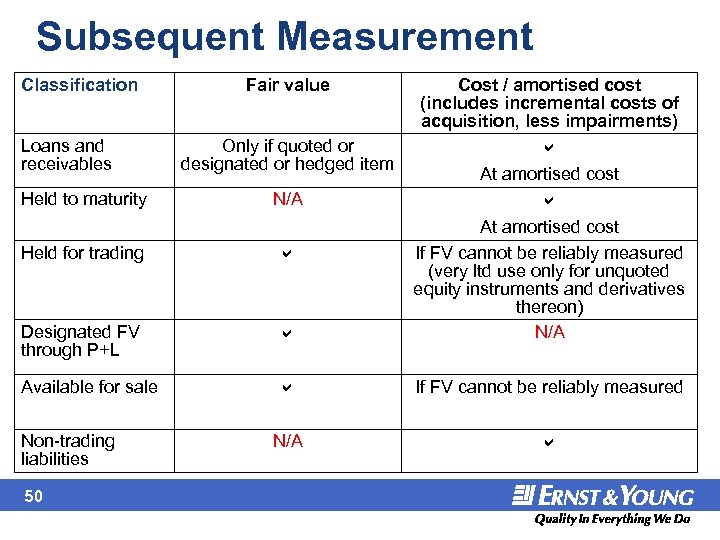 Subsequent Measurement Classification Loans and receivables Held to maturity Fair value Only if quoted or designated or hedged item N/A Cost / amortised cost (includes incremental costs of acquisition, less impairments) At amortised cost Held for trading Designated FV through P+L At amortised cost If FV cannot be reliably measured (very ltd use only for unquoted equity instruments and derivatives thereon) N/A Available for sale If FV cannot be reliably measured N/A Non-trading liabilities 50
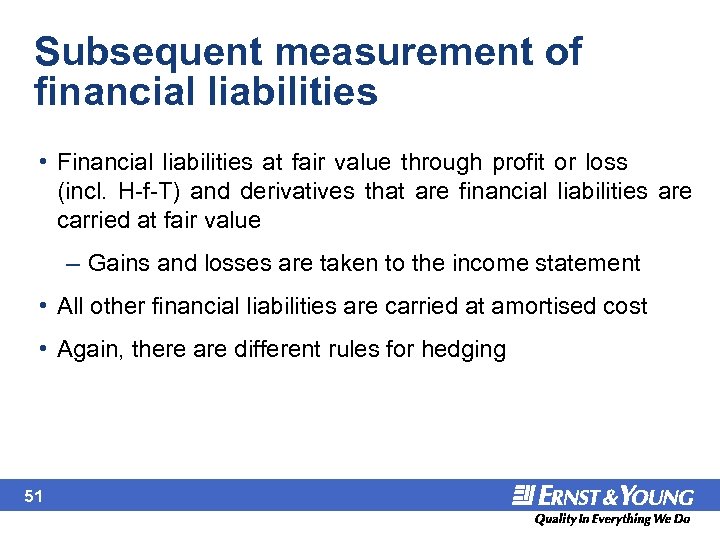 Subsequent measurement of financial liabilities • Financial liabilities at fair value through profit or loss (incl. H-f-T) and derivatives that are financial liabilities are carried at fair value – Gains and losses are taken to the income statement • All other financial liabilities are carried at amortised cost • Again, there are different rules for hedging 51
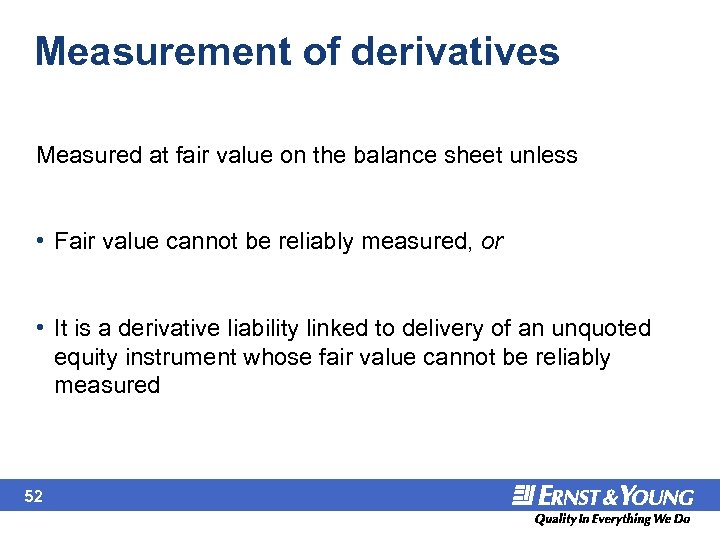 Measurement of derivatives Measured at fair value on the balance sheet unless • Fair value cannot be reliably measured, or • It is a derivative liability linked to delivery of an unquoted equity instrument whose fair value cannot be reliably measured 52
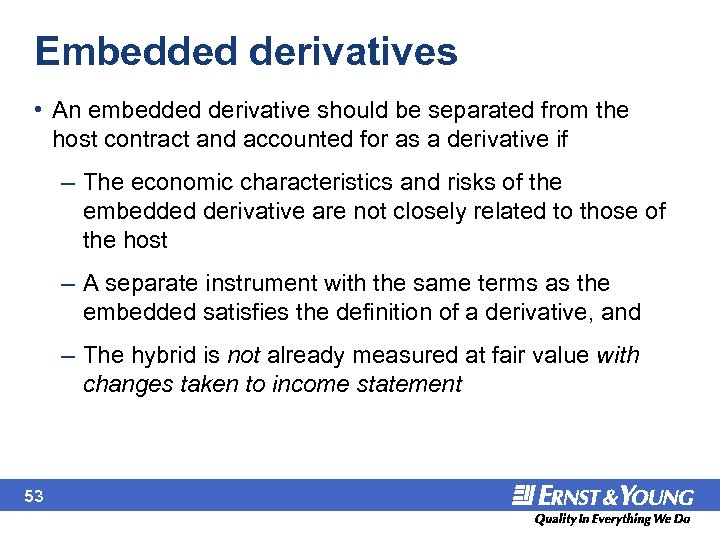 Embedded derivatives • An embedded derivative should be separated from the host contract and accounted for as a derivative if – The economic characteristics and risks of the embedded derivative are not closely related to those of the host – A separate instrument with the same terms as the embedded satisfies the definition of a derivative, and – The hybrid is not already measured at fair value with changes taken to income statement 53
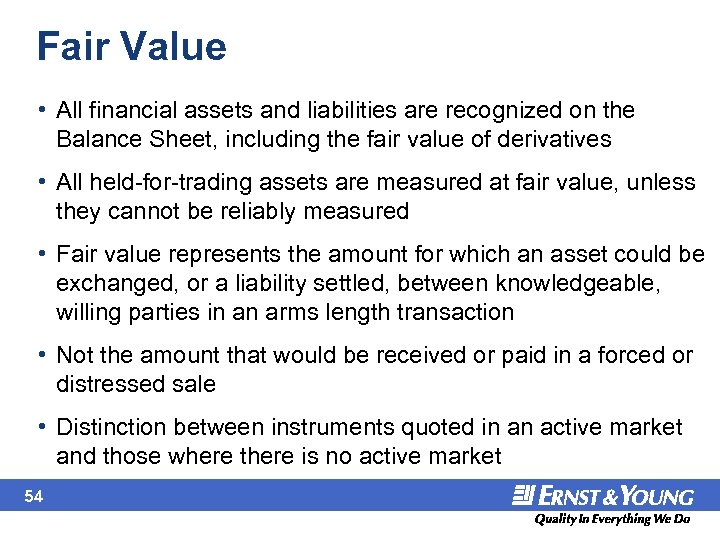 Fair Value • All financial assets and liabilities are recognized on the Balance Sheet, including the fair value of derivatives • All held-for-trading assets are measured at fair value, unless they cannot be reliably measured • Fair value represents the amount for which an asset could be exchanged, or a liability settled, between knowledgeable, willing parties in an arms length transaction • Not the amount that would be received or paid in a forced or distressed sale • Distinction between instruments quoted in an active market and those where there is no active market 54
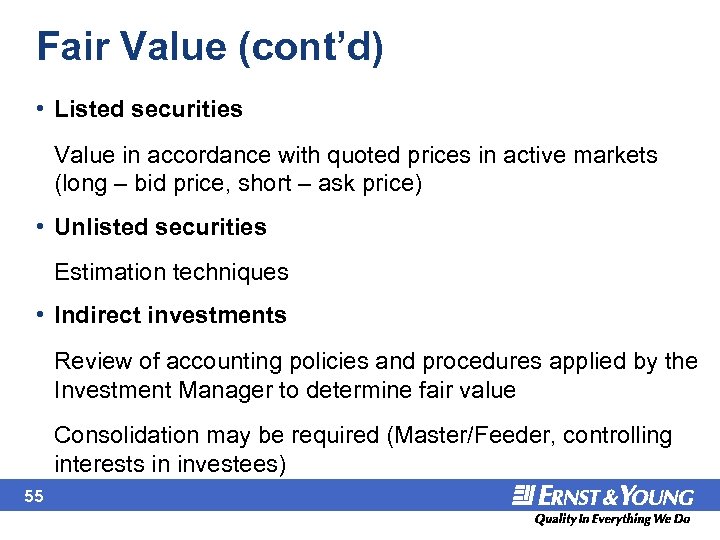 Fair Value (cont’d) • Listed securities Value in accordance with quoted prices in active markets (long – bid price, short – ask price) • Unlisted securities Estimation techniques • Indirect investments Review of accounting policies and procedures applied by the Investment Manager to determine fair value Consolidation may be required (Master/Feeder, controlling interests in investees) 55
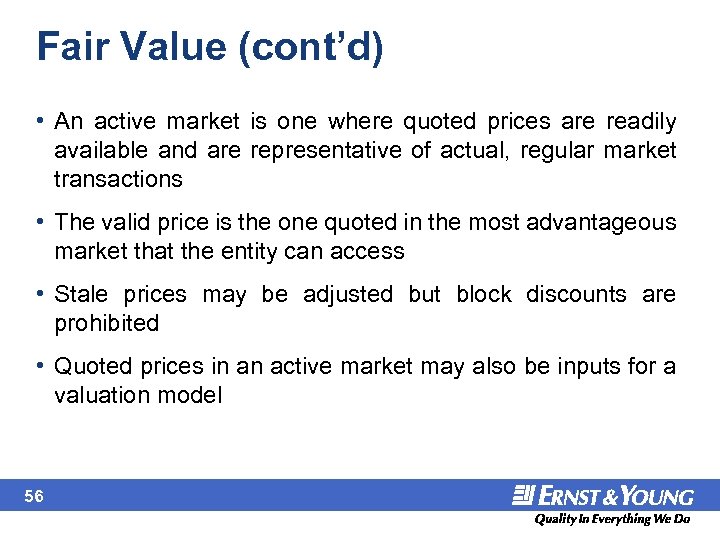 Fair Value (cont’d) • An active market is one where quoted prices are readily available and are representative of actual, regular market transactions • The valid price is the one quoted in the most advantageous market that the entity can access • Stale prices may be adjusted but block discounts are prohibited • Quoted prices in an active market may also be inputs for a valuation model 56
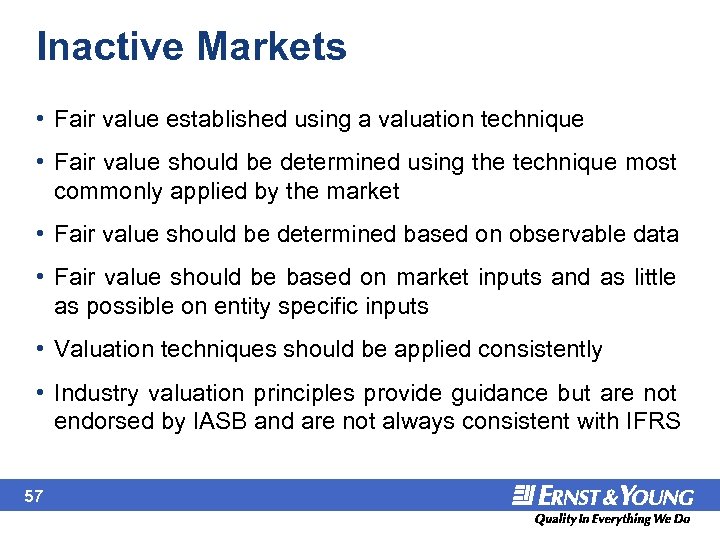 Inactive Markets • Fair value established using a valuation technique • Fair value should be determined using the technique most commonly applied by the market • Fair value should be determined based on observable data • Fair value should be based on market inputs and as little as possible on entity specific inputs • Valuation techniques should be applied consistently • Industry valuation principles provide guidance but are not endorsed by IASB and are not always consistent with IFRS 57
 Fair Value - Issues • Valuation using bid prices does not necessarily provide a better indication of the fair value • Bid/ask pricing may lead to confusion if current market practice is mid-market/last sales price • Best practice in the US is to use the last quoted sales price with the bid and mid-market price being methods also acceptable • Difference between the ‘offering document’ NAV and reporting NAV – how do you account for the difference? • Industry solution – accept mid-market/last sales price as fair valuation methods? 58
 Financial Instruments 1. SCOPE OF THE NEW STANDARDS 2. CLASSIFICATION AND MEASUREMENT 3. DISCLOSURES 59
 Financial Instruments: Disclosure & Presentation • Main issues: – Treatment of shareholders’ interests in funds – Risk management disclosures 60
 Financial Instruments: Disclosure & Presentation (cont’d) • Under IAS 32 (revised) a financial liability is a contractual obligation to deliver cash or another financial asset to another entity • IAS 32 also designates puttable instruments as financial liabilities • Shares redeemable at the option of the holder meet the definition of a financial liability 61
 Financial Instruments: Disclosure & Presentation (cont’d) • Redeemable shares issued by open ended funds are therefore now classified as liabilities • IAS 32 permits a balance sheet format to be presented for funds which excludes shareholders equity classified as liabilities 62
 Financial Instruments: Disclosure & Presentation (cont’d) - Issues • Financial statements may be difficult to understand interpret • IFRS inconsistent with UK, US and Canadian GAAPs • What happens to the Statement of Changes in Equity and Earnings per share? 63
 Financial Instruments: Disclosure & Presentation (cont’d) Risk management disclosures: • Aim: – Enhance understanding – Assist in assessing amounts, timing and uncertainty of future cash flows – Risk management policies and hedging activities 64
 Financial Instruments: Disclosure & Presentation (cont’d) • IAS 32 and IAS 39 require disclosure of risk exposures, their impact on the fund actions taken to mitigate - Market price risk - Interest rate risk - Credit risk - Liquidity risk - Currency risk 65
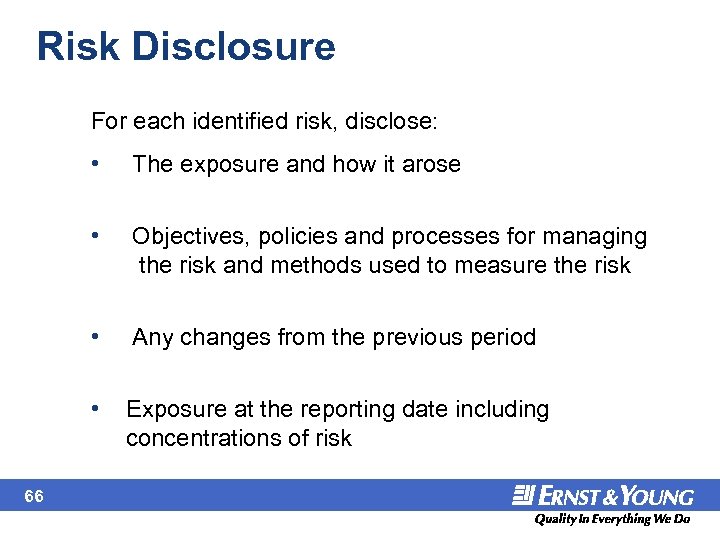 Risk Disclosure For each identified risk, disclose: • • Objectives, policies and processes for managing the risk and methods used to measure the risk • Any changes from the previous period • 66 The exposure and how it arose Exposure at the reporting date including concentrations of risk
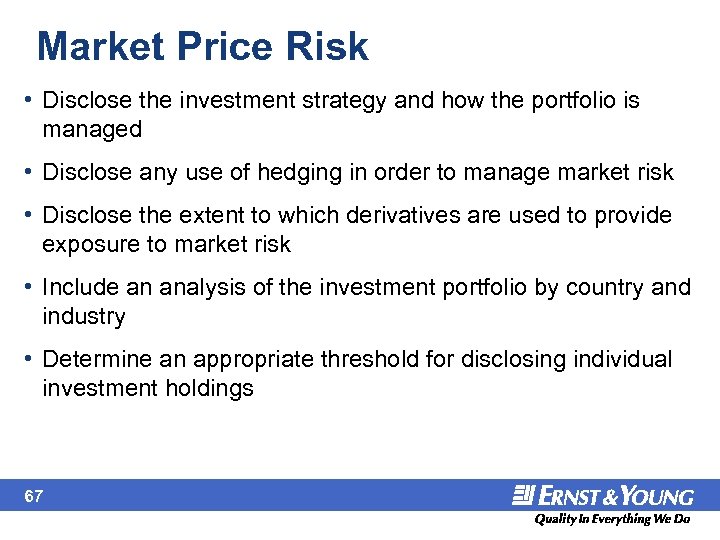 Market Price Risk • Disclose the investment strategy and how the portfolio is managed • Disclose any use of hedging in order to manage market risk • Disclose the extent to which derivatives are used to provide exposure to market risk • Include an analysis of the investment portfolio by country and industry • Determine an appropriate threshold for disclosing individual investment holdings 67
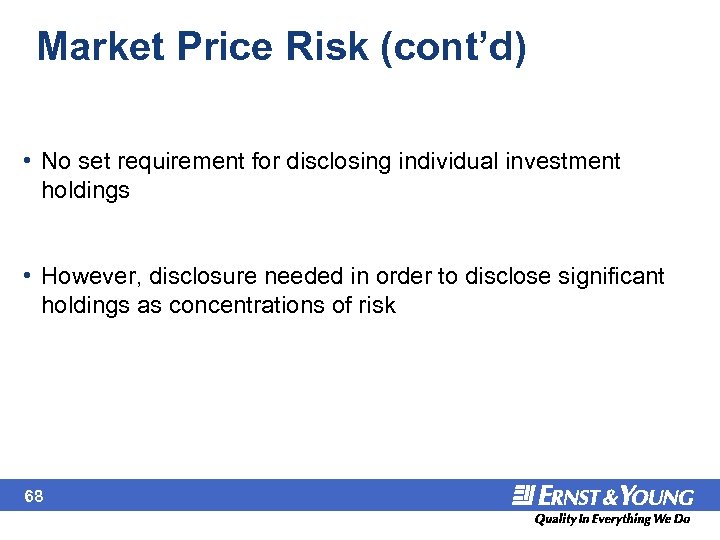 Market Price Risk (cont’d) • No set requirement for disclosing individual investment holdings • However, disclosure needed in order to disclose significant holdings as concentrations of risk 68
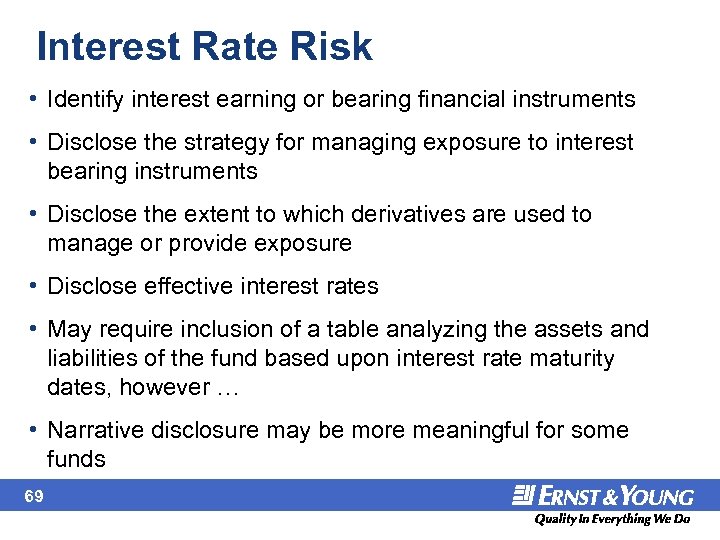 Interest Rate Risk • Identify interest earning or bearing financial instruments • Disclose the strategy for managing exposure to interest bearing instruments • Disclose the extent to which derivatives are used to manage or provide exposure • Disclose effective interest rates • May require inclusion of a table analyzing the assets and liabilities of the fund based upon interest rate maturity dates, however … • Narrative disclosure may be more meaningful for some funds 69
 Credit Risk • Disclose concentrations of exposure to credit risk and the strategy for managing exposures • Disclose any concentrations of credit risk exposure 70
 Liquidity Risk • Disclose the liquidity of financial instruments held • Disclose the strategy for investing in non-marketable investments • Identify the level of exposure to illiquid investments • A Fund of Fund should disclose the frequency of redemptions permitted by investee funds • Disclose any lock up periods/restrictions on disposal 71
 Currency Risk • Disclose the exposure to other currencies • Disclose the currency management strategy • Disclose the use of forward foreign exchange contracts or other derivatives to manage currency exposures • Include a currency exposure table analyzing the assets and liabilities of the fund based on the underlying currency exposures • If exposures not material, narrative disclosure is sufficient 72
 IFRS 7 • IFRS 7 re-iterates the risk disclosure requirements under IAS 32 and IAS 39 • New requirement to disclose sensitivity analysis for each identified market risk at the reporting date • Show effect of reasonably possible changes in relevant risk variables • Disclose methods and assumptions used in preparing sensitivity analysis and any changes from previous period • Disclose if sensitivity analysis in unrepresentative of inherent risk 73
 IFRS 7 (cont’d) • IFRS 7 effective for periods beginning on or after January 1, 2007 • Early application is encouraged • IFRS 7 re-iterates the risk disclosure requirements under IAS 32 and IAS 39 • New requirement to disclose sensitivity analysis for each identified market risk at the reporting date • Show effect of reasonably possible changes in relevant risk variables 74
 IFRS 7 (cont’d) • Disclose methods and assumptions used in preparing sensitivity analysis and any changes from previous period • Disclose if sensitivity analysis in unrepresentative of inherent risk • IFRS 7 effective for periods beginning on or after January 1, 2007 • Early application is encouraged 75
 Legal Reserves • In certain jurisdictions, there are statutory requirements to provide for certain reserves and provisions • Such reserves and provisions are not permitted under IFRS unless they separately meet the definition as liabilities 76
 IFRS 1 – First Time Adoption • Final standard published June 19, 2003 • Effective date – Periods beginning on or after 1 January 2004 • Scope: IFRS 1 applies when an entity adopts IFRS for the first time by an explicit and unreserved statement of compliance with IFRS 77
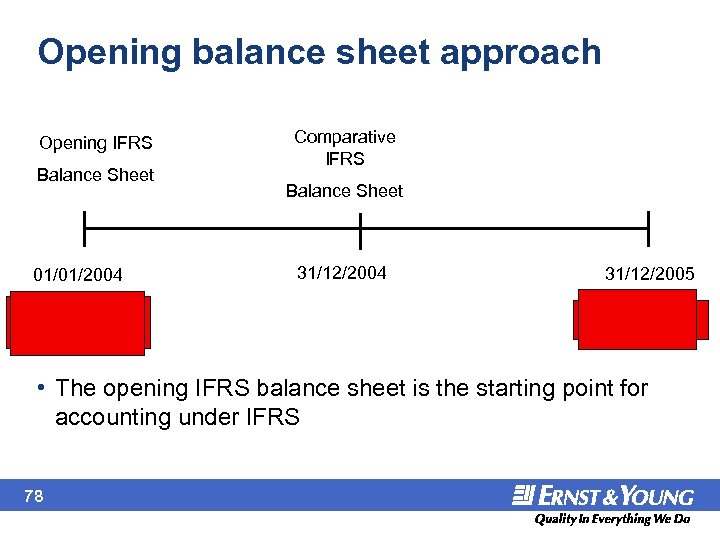 Opening balance sheet approach Opening IFRS Balance Sheet 01/01/2004 Date of transition to IFRS Comparative IFRS Balance Sheet 31/12/2004 31/12/2005 Reporting Date • The opening IFRS balance sheet is the starting point for accounting under IFRS 78
 Reconciliations • Three balance sheet reconciliations: – Closing local GAAP 31 December 2003 b/s and Opening IFRS 1 January 2004 b/s excluding IAS 39 – Closing local GAAP 31 December 2004 b/s and Opening IFRS 1 January 2005 b/s – Closing IFRS 31 December 2004 b/s excluding IAS 39 and Opening IFRS 1 January 2005 b/s including IAS 39 79
 D. Impact of IFRS on the work of the auditor
 Impact of IFRS on the work of the auditor Key considerations: • Communication to clients of the requirements, time and resources needed to prepare IFRS footnotes and disclosures • Additional clauses inserted into the audit engagement letter and management representation letter 81
 Impact of IFRS on the work of the auditor (cont’d) Disclosures and footnotes: • Significant time required for current year disclosure and preparation of comparative information if not previously provided • Additional time required for review of first time adoption reconciliations (IFRS 1) • Disclosure checklists need to be completed • Independent IFRS technical review 82
 E. Relationship between the auditor and the investment fund regulator
 Relationship between the auditor and the investment fund regulator • Member state local regulator • Member state fund association • EFAMA (European Fund and Asset Management Association) membership and expert group comprises ‘Big Four’ auditing firms 84
 Relationship between the auditor and the investment fund regulator – (cont’d) • EFAMA working group • Objective: • To analyse the implication of a potential application of IFRS to European investment funds, in particular with respect to information benefits to the final retail investor • Output: • discussion paper (draft) on IFRS for investment funds in European Union (March 2006) 85
 E&Y Luxembourg Contacts: Olivier Lemaire, Partner Phone: + 352 42 22 33 8356 Email: olivier. lemaire@lu. ey. com Kerry Nichol, Senior Manager Phone : + 352 42 22 33 8975 Email : kerry-jane. nichol@lu. ey. com 86