


 Скачать презентацию The impact of sociotherapy on the everyday life
10ad7cb940c55ea87b126041c40059cf.ppt
- Количество слайдов: 15
 The impact of sociotherapy on the everyday life of genocide survivors and perpetrators in Rwanda: Quality assurance through participatory action research Sarabwe Emmanuel in cooperation with Theoneste Rutayisire, Angela Jansen, Annemiek Richters IRCT 10 th International Symposium – Delivering on the promise of the right to rehabilitation Session: Survivor perspectives on rehabilitation Mexico 05 -12 -2016
 The flow of the presentation The Rwandan (post-)genocide context Community based sociotherapy in Rwanda Monitoring its outcomes and impact through participatory action research Selection of preliminary findings of quantitative study Two case studies (qualitative study) Conclusion
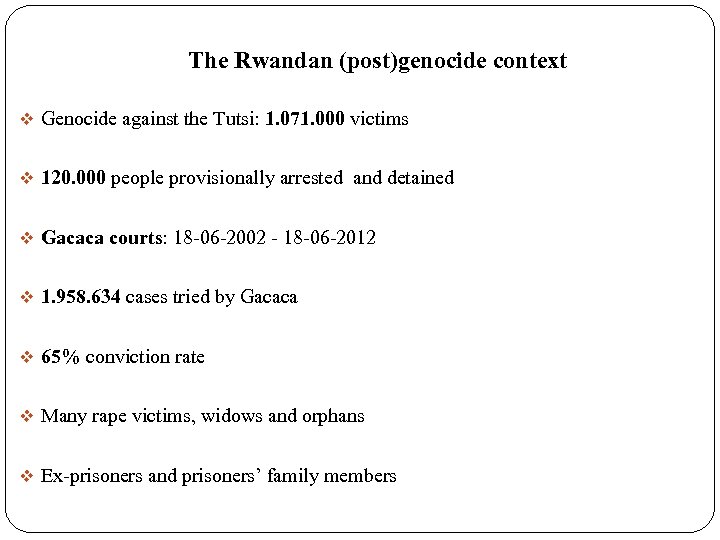 The Rwandan (post)genocide context v Genocide against the Tutsi: 1. 071. 000 victims v 120. 000 people provisionally arrested and detained v Gacaca courts: 18 -06 -2002 - 18 -06 -2012 v 1. 958. 634 cases tried by Gacaca v 65% conviction rate v Many rape victims, widows and orphans v Ex-prisoners and prisoners’ family members
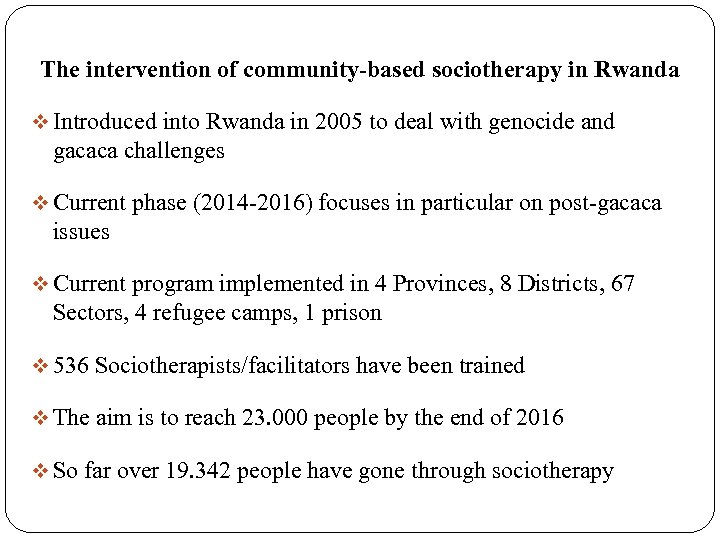 The intervention of community-based sociotherapy in Rwanda v Introduced into Rwanda in 2005 to deal with genocide and gacaca challenges v Current phase (2014 -2016) focuses in particular on post-gacaca issues v Current program implemented in 4 Provinces, 8 Districts, 67 Sectors, 4 refugee camps, 1 prison v 536 Sociotherapists/facilitators have been trained v The aim is to reach 23. 000 people by the end of 2016 v So far over 19. 342 people have gone through sociotherapy
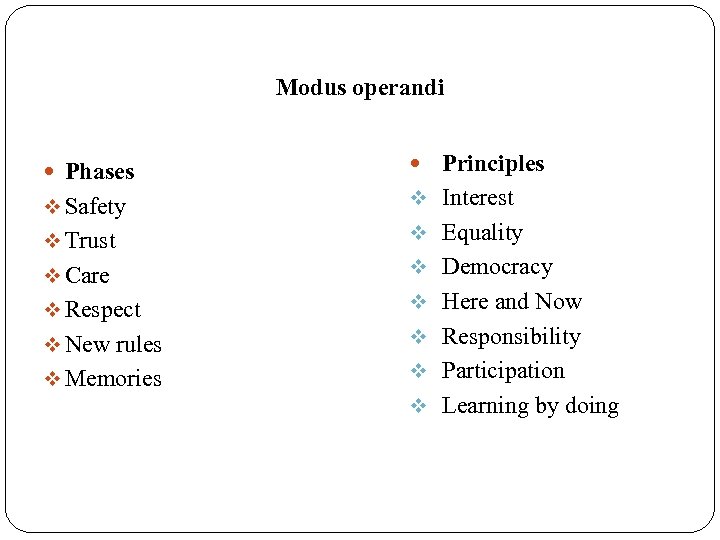 Modus operandi Phases v Safety v v Trust v v Care v v Respect v v New rules v v Memories v v Principles Interest Equality Democracy Here and Now Responsibility Participation Learning by doing
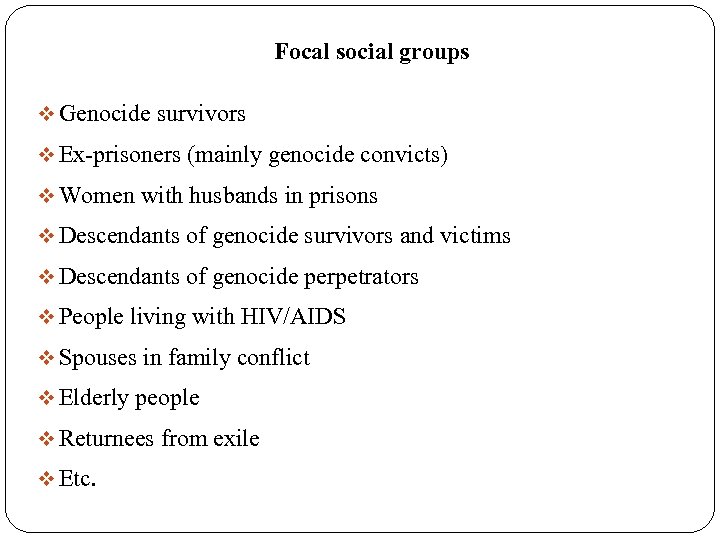 Focal social groups v Genocide survivors v Ex-prisoners (mainly genocide convicts) v Women with husbands in prisons v Descendants of genocide survivors and victims v Descendants of genocide perpetrators v People living with HIV/AIDS v Spouses in family conflict v Elderly people v Returnees from exile v Etc.
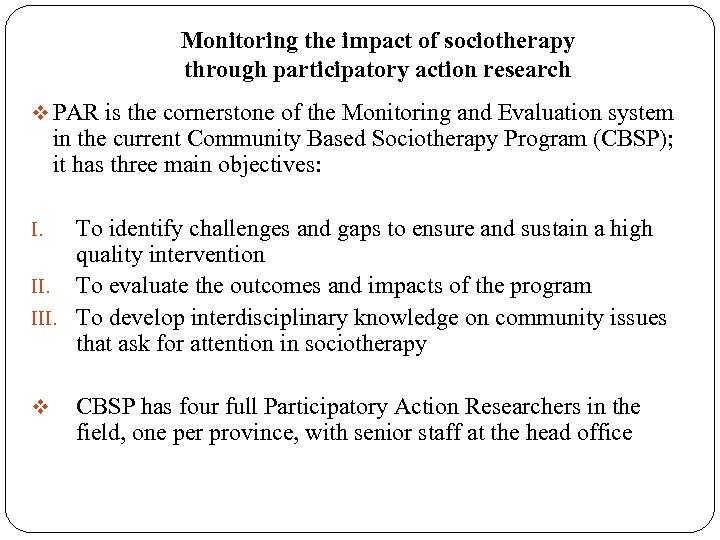 Monitoring the impact of sociotherapy through participatory action research v PAR is the cornerstone of the Monitoring and Evaluation system in the current Community Based Sociotherapy Program (CBSP); it has three main objectives: To identify challenges and gaps to ensure and sustain a high quality intervention II. To evaluate the outcomes and impacts of the program III. To develop interdisciplinary knowledge on community issues that ask for attention in sociotherapy I. v CBSP has four full Participatory Action Researchers in the field, one per province, with senior staff at the head office
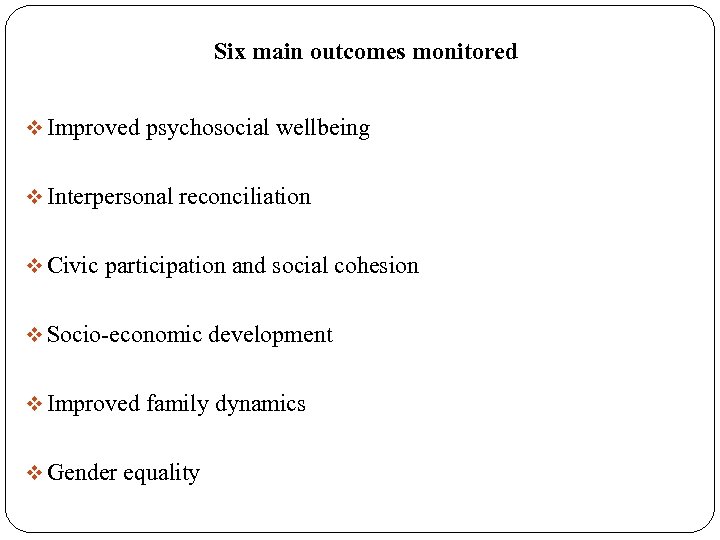 Six main outcomes monitored v Improved psychosocial wellbeing v Interpersonal reconciliation v Civic participation and social cohesion v Socio-economic development v Improved family dynamics v Gender equality
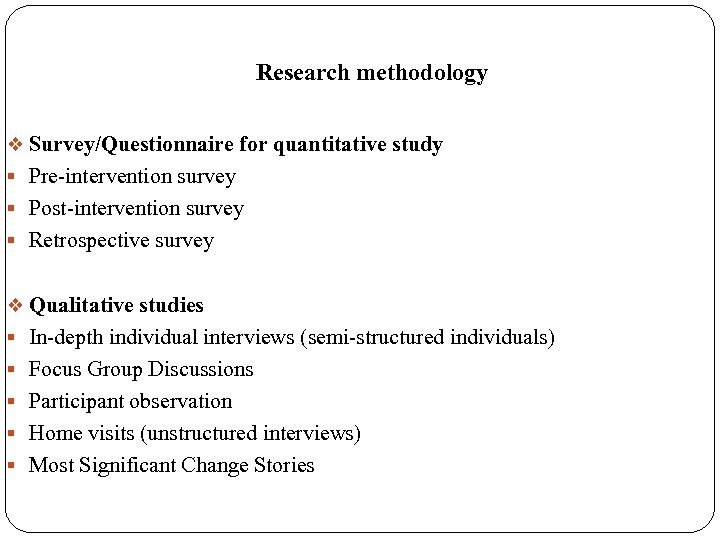 Research methodology v Survey/Questionnaire for quantitative study § Pre-intervention survey § Post-intervention survey § Retrospective survey v Qualitative studies § In-depth individual interviews (semi-structured individuals) § Focus Group Discussions § Participant observation § Home visits (unstructured interviews) § Most Significant Change Stories
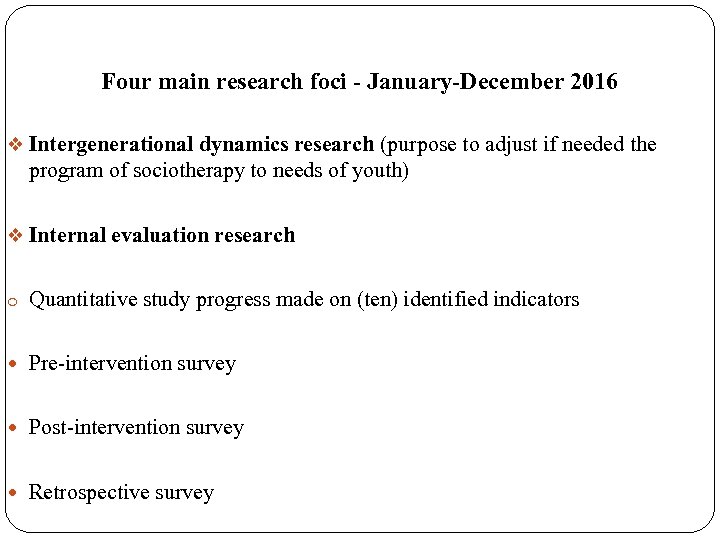 Four main research foci - January-December 2016 v Intergenerational dynamics research (purpose to adjust if needed the program of sociotherapy to needs of youth) v Internal evaluation research o Quantitative study progress made on (ten) identified indicators Pre-intervention survey Post-intervention survey Retrospective survey
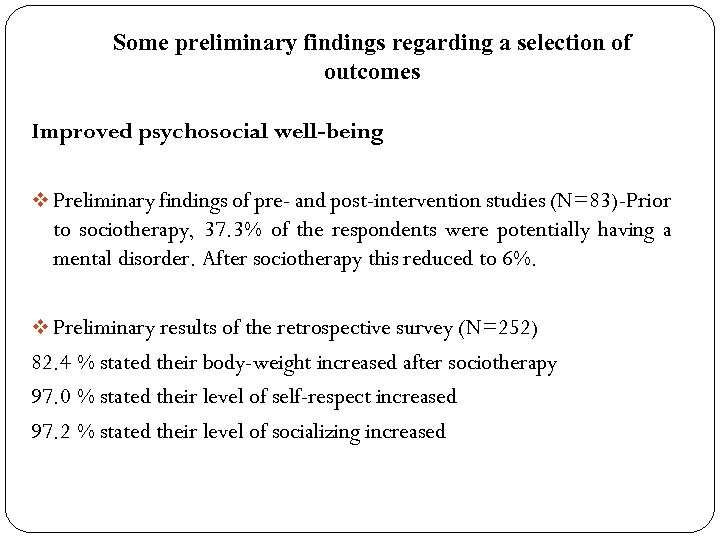 Some preliminary findings regarding a selection of outcomes Improved psychosocial well-being v Preliminary findings of pre- and post-intervention studies (N=83)-Prior to sociotherapy, 37. 3% of the respondents were potentially having a mental disorder. After sociotherapy this reduced to 6%. v Preliminary results of the retrospective survey (N=252) 82. 4 % stated their body-weight increased after sociotherapy 97. 0 % stated their level of self-respect increased 97. 2 % stated their level of socializing increased
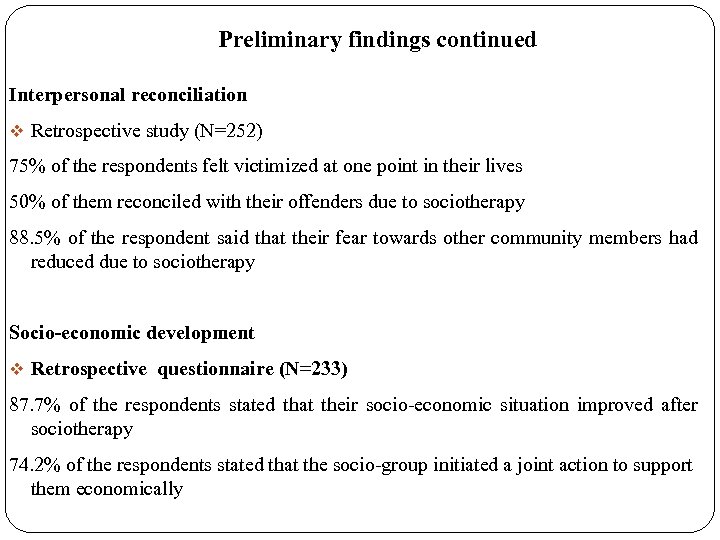 Preliminary findings continued Interpersonal reconciliation v Retrospective study (N=252) 75% of the respondents felt victimized at one point in their lives 50% of them reconciled with their offenders due to sociotherapy 88. 5% of the respondent said that their fear towards other community members had reduced due to sociotherapy Socio-economic development v Retrospective questionnaire (N=233) 87. 7% of the respondents stated that their socio-economic situation improved after sociotherapy 74. 2% of the respondents stated that the socio-group initiated a joint action to support them economically
 Case study ex-prisoner The Case of Munanira Middle-aged man, married with 5 children, spent 7 years in prison. He confessed his crimes and was tried by Gacaca courts While in prison always afraid of being executed the next day Angry at any one who was not imprisoned After his release he hardly left home Bad dreams about the time he was in the band of killers - Fear After sociotherapy Kimenyi was elected the president of the association his sociotherapy group had started (the vice-president is a genocide survivor) His bad dreams stopped Regained his autonomy- using “I” instead of “we” He is now a member of the village committee A successful businessman - got the starting capital from the association.
 Case study of a genocide survivor “I survived genocide with only one of my four children. During the genocide I was raped which left me with a fistula resulting in infertility. This brought severe conflict with my husband from which I suffered in addition to the shame and depression due to my war life experience. I did not leave the house because I knew that even all the children in my community knew that I was raped and lived with a fistula. Coming in sociotherapy, I met genocide perpetrators. At first it was inconceivable that I could sit with them. However, we reconciled. One day in a sociotherapy session, a participant whose daughter was asked by my son to marry him revealed that he was the among people who had beaten me during the genocide. This was difficult to bear but due to sociotherapy I accepted the marriage of my son. My husband also needs to be cured, but I know how to live in peace with him due to what I myself benefited from in sociotherapy. ”
 Conclusion Living in the same neighbourhood is difficult for both survivors and perpetrators Reconciliation is not only benefiting perpetrators but also survivors What affects people is not only what they experienced during the violence but also the everyday life in the aftermath of the violence Healing from the wounds of the traumatic past is a prerequisite for socio-economic development. The descendants of survivors as well as perpetrators suffer from the experiences of their parents Bringing survivors and perpetrators together is difficult but possible. Both as well as their families and community benefit from it.