


 Скачать презентацию THE IMPACT OF SECTORAL SEGREGATION ON EARNING DIFFERENTIAL
c0e9de58aeeb0ebb167386299347e090.ppt
- Количество слайдов: 11
 THE IMPACT OF SECTORAL SEGREGATION ON EARNING DIFFERENTIAL BETWEEN NATIVES AND IMMIGRANTS IN RUSSIA Polyakova E. , Smirnykh L. HSE Department of Applied Economics, Moscow Higher School of Economics , Moscow, www. hse. ru
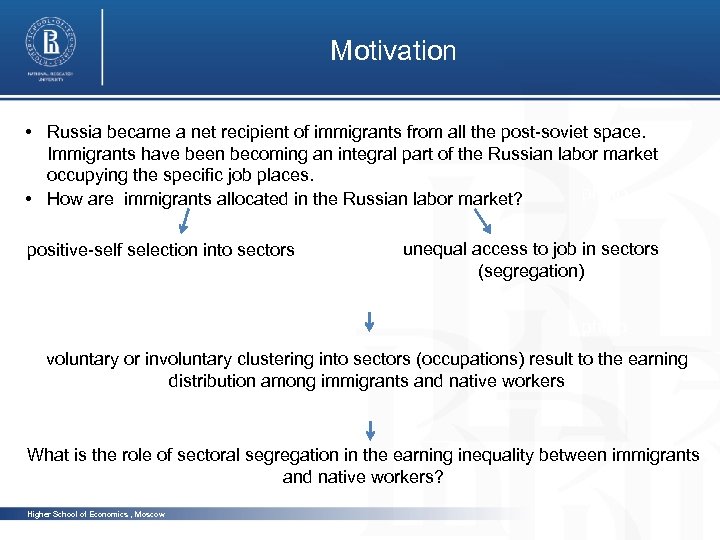 Motivation • Russia became a net recipient of immigrants from all the post-soviet space. Immigrants have been becoming an integral part of the Russian labor market occupying the specific job places. photo • How are immigrants allocated in the Russian labor market? positive-self selection into sectors unequal access to job in sectors (segregation) photo voluntary or involuntary clustering into sectors (occupations) result to the earning distribution among immigrants and native workers What is the role of sectoral segregation in the earning inequality between immigrants photo and native workers? Higher School of Economics , Moscow
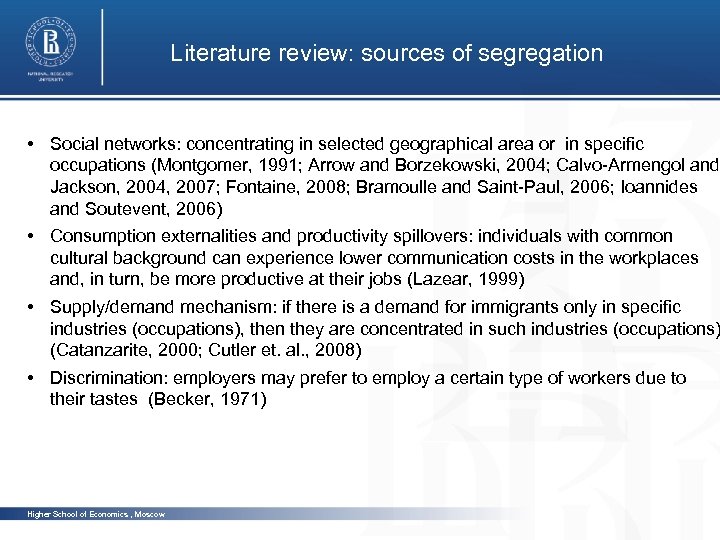 Literature review: sources of segregation • Social networks: concentrating in selected geographical area or in specific photo occupations (Montgomer, 1991; Arrow and Borzekowski, 2004; Calvo-Armengol and Jackson, 2004, 2007; Fontaine, 2008; Bramoulle and Saint-Paul, 2006; Ioannides and Soutevent, 2006) • Consumption externalities and productivity spillovers: individuals with common photo cultural background can experience lower communication costs in the workplaces and, in turn, be more productive at their jobs (Lazear, 1999) • Supply/demand mechanism: if there is a demand for immigrants only in specific industries (occupations), then they are concentrated in such industries (occupations) photo (Catanzarite, 2000; Cutler et. al. , 2008) • Discrimination: employers may prefer to employ a certain type of workers due to their tastes (Becker, 1971) photo Higher School of Economics , Moscow
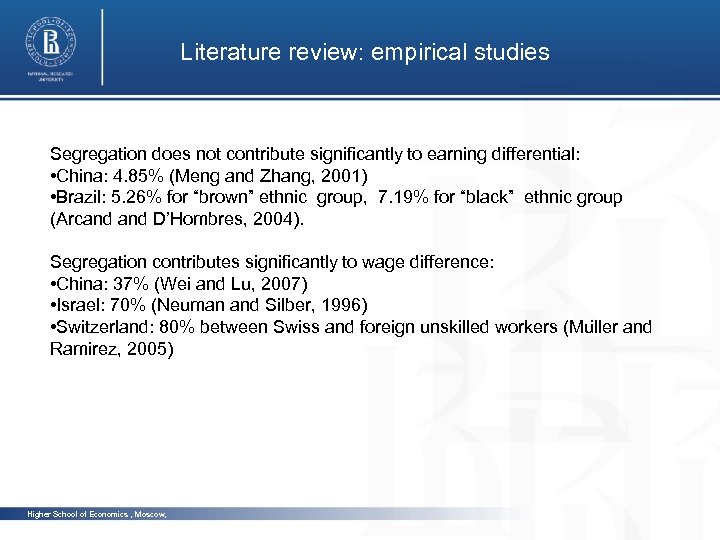 Literature review: empirical studies photo Segregation does not contribute significantly to earning differential: • China: 4. 85% (Meng and Zhang, 2001) • Brazil: 5. 26% for “brown” ethnic group, 7. 19% for “black” ethnic group (Arcand D’Hombres, 2004). photo Segregation contributes significantly to wage difference: • China: 37% (Wei and Lu, 2007) • Israel: 70% (Neuman and Silber, 1996) • Switzerland: 80% between Swiss and foreign unskilled workers (Mu ller and photo Ramirez, 2005) photo Higher School of Economics , Moscow,
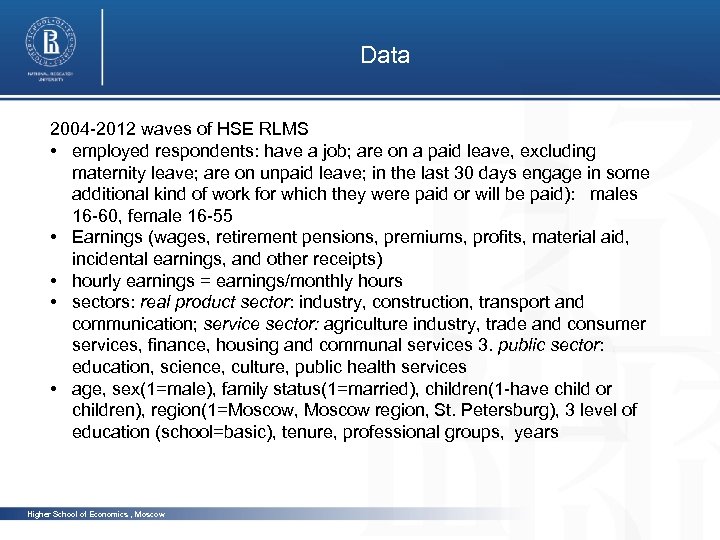 Data 2004 -2012 waves of HSE RLMS • employed respondents: have a job; are on a paid leave, excluding photo maternity leave; are on unpaid leave; in the last 30 days engage in some additional kind of work for which they were paid or will be paid): males 16 -60, female 16 -55 • Earnings (wages, retirement pensions, premiums, profits, material aid, photo incidental earnings, and other receipts) • hourly earnings = earnings/monthly hours • sectors: real product sector: industry, construction, transport and communication; service sector: agriculture industry, trade and consumer photo services, finance, housing and communal services 3. public sector: education, science, culture, public health services • age, sex(1=male), family status(1=married), children(1 -have child or children), region(1=Moscow, Moscow region, St. Petersburg), 3 level of education (school=basic), tenure, professional groups, years photo Higher School of Economics , Moscow
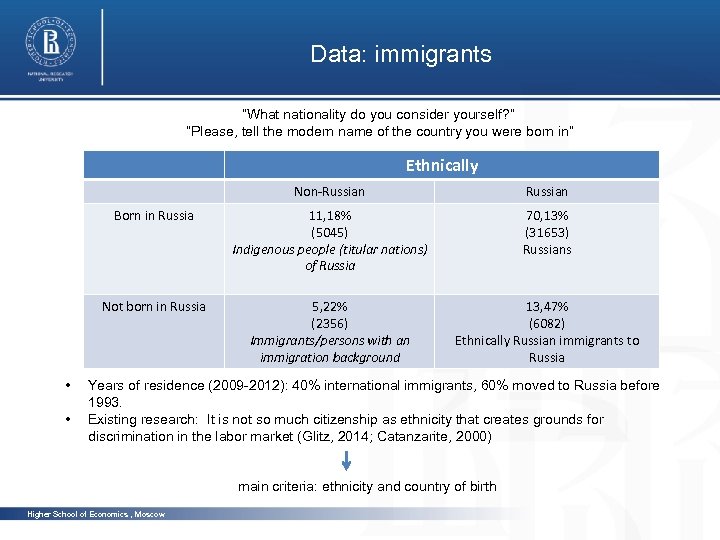 Data: immigrants “What nationality do you consider yourself? ” “Please, tell the modern name of the country you were born in” photo Ethnically Non-Russian Born in Russia 11, 18% (5045) Indigenous people (titular nations) of Russia 70, 13% (31653) Russians Not born in Russia 5, 22% (2356) Immigrants/persons with an immigration background 13, 47% (6082) Ethnically Russian immigrants to Russia photo • Years of residence (2009 -2012): 40% international immigrants, 60% moved to Russia before 1993. • Existing research: It is not so much citizenship as ethnicity that creates grounds for discrimination in the labor market (Glitz, 2014; Catanzarite, 2000) photo main criteria: ethnicity and country of birth Higher School of Economics , Moscow
 Method Brown decomposition (Brown et al. 1980; Wei and Lu, 2007; Meng and Zhang, 2001; Neuman and Silber, 1996). photo 1 stage: we assume that the following multinomial logit model determines the individual sector choice with bootstrapped standard error: photo k-=r(native), m(immigrant); j – sector indicator; - probability that individual n is working in the j-sector; N-sample size; J – total number of sectors by n=1, …, N; j=1, …, J; Z- vector of sociodemographic characteristics, - coefficients of variables 2 stage: extended Mincerian earning equation with inverse Mills ratio form the first stage (mlogit) - Inverse Mills Ratio, k=r(native, m(migrant), J – total number of sectors, j=1, …, J; X- vector of socio-demographic characteristics: 3 stage: extended two-fold earnings decomposition (Brown et. Al. 1980) photo Higher School of Economics , Moscow i- explained the results of differences in sociodemographic characteristics; ii-the unexplained wage differential due to differences in the coefficients of the estimated resident and migrant wage equations; iii-the explained between-sector-occupation wage differential due to differences in qualifications in an sector group-; iv-the unexplained wage differential due to differences in the structures of occupational attainment
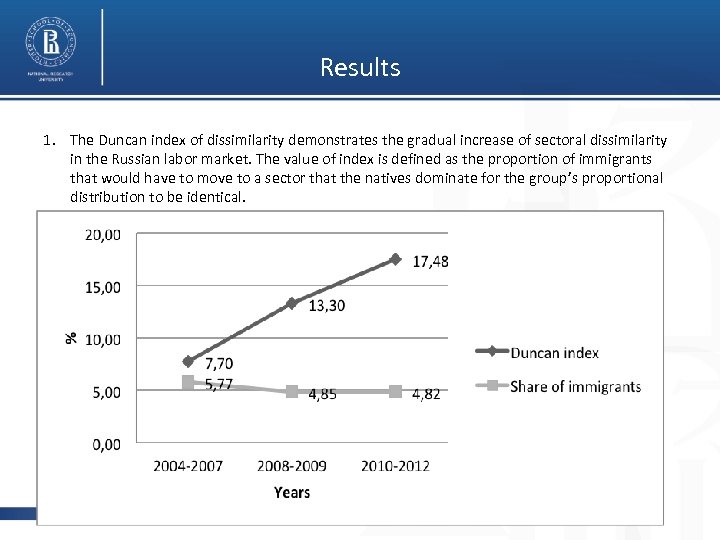 Results 1. The Duncan index of dissimilarity demonstrates the gradual increase of sectoral dissimilarity in the Russian labor market. The value of index is defined as the proportion of immigrants that would have to move to a sector that the natives dominate for the group’s proportional distribution to be identical.
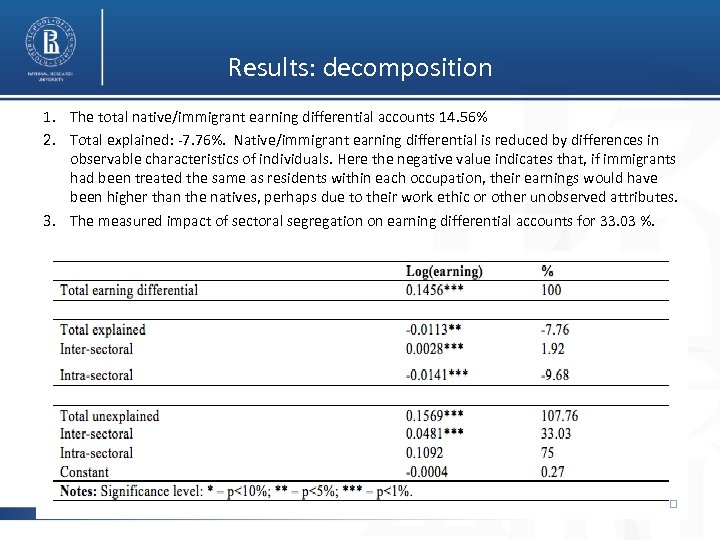 Results: decomposition 1. The total native/immigrant earning differential accounts 14. 56% 2. Total explained: -7. 76%. Native/immigrant earning differential is reduced by differences in observable characteristics of individuals. Here the negative value indicates that, if immigrants had been treated the same as residents within each occupation, their earnings would have been higher than the natives, perhaps due to their work ethic or other unobserved attributes. 3. The measured impact of sectoral segregation on earning differential accounts for 33. 03 %.
 Conclusion 1. Findings fit into the picture of previous studies (Wei and Lu, 2007: Neuman and Silber, 1996) 2. There is a low labor mobility between groups that leads to sectoral segregation and segmentation on the Russian labor market cannot be considered as a homogeneous. Market forces do not eliminate the differences between the two groups of workers. 3. Immigrants earn lower wages not only due the difference in human capital level, but also due to ethnic sectoral segregation and unequal employment chances compared to native workers.
 Thank you for your attention. Questions? 20, Myasnitskaya str. , Moscow, Russia, 101000 Tel. : +7 (495) 628 -8829, Fax: +7 (495) 628 -7931 www. hse. ru