


 Скачать презентацию The Impact of Current Levels of Migration March
9d0a565f51e81e7722644f21a667cc52.ppt
- Количество слайдов: 19
 The Impact of Current Levels of Migration March 2015
 The UK Population Today The UK population in mid-2013 was 64. 1 million. The latest statistics show that net migration is currently 298, 000 per year (Year Ending September 2014). This means that 298, 000 more came to the UK for a year or more than left the country. This level is almost 5 times average net migration during the 1990 s.
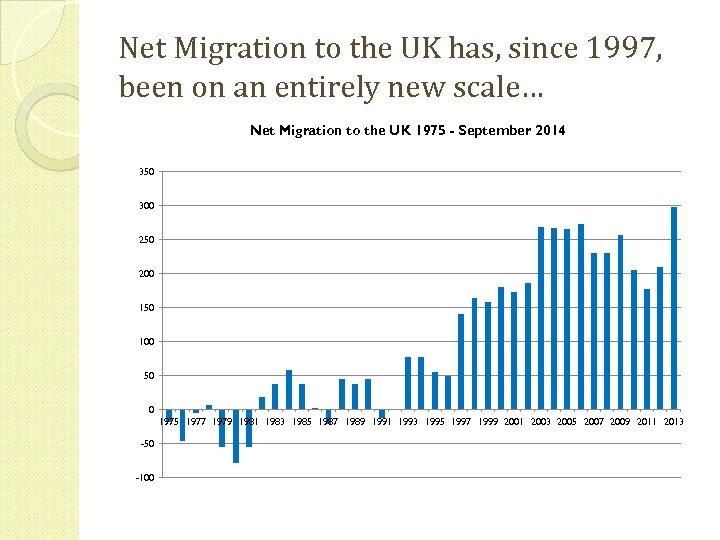 Net Migration to the UK has, since 1997, been on an entirely new scale… Net Migration to the UK 1975 - September 2014 350 300 250 200 150 100 50 0 1975 1977 1979 1981 1983 1985 1987 1989 1991 1993 1995 1997 1999 2001 2003 2005 2007 2009 2011 2013 -50 -100
 Population Projections – The Official Impact of Immigration on the UK Population According to the 2012 -based official population projections the UK population will reach 70 million by mid-2027 and 80 million around 2063. Of this increase, the ONS claim that 60% will be the result of future migrants and their future children. These projections are based on net migration of 165, 000 a year. However, average net migration over the last 10 years has been 240, 000. If net migration is allowed to continue at the present level (298, 000 a year) the UK population will reach 70 million in around 2023.
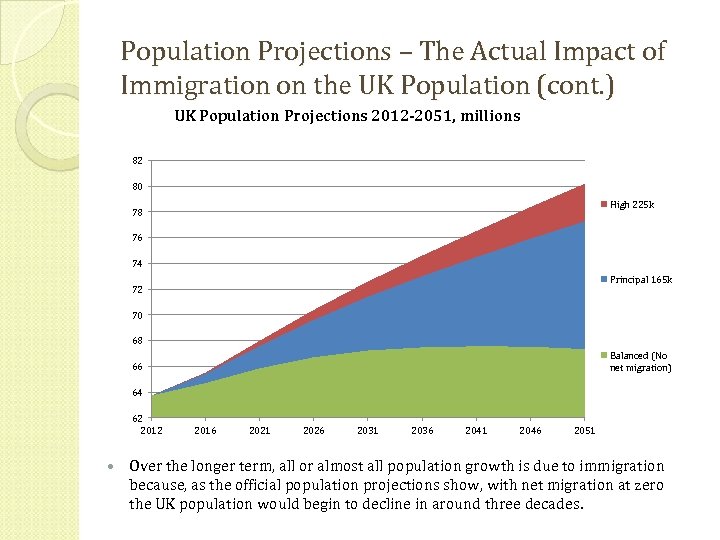 Population Projections – The Actual Impact of Immigration on the UK Population (cont. ) UK Population Projections 2012 -2051, millions 82 80 High 225 k 78 76 74 Principal 165 k 72 70 68 Balanced (No net migration) 66 64 62 2016 2021 2026 2031 2036 2041 2046 2051 Over the longer term, all or almost all population growth is due to immigration because, as the official population projections show, with net migration at zero the UK population would begin to decline in around three decades.
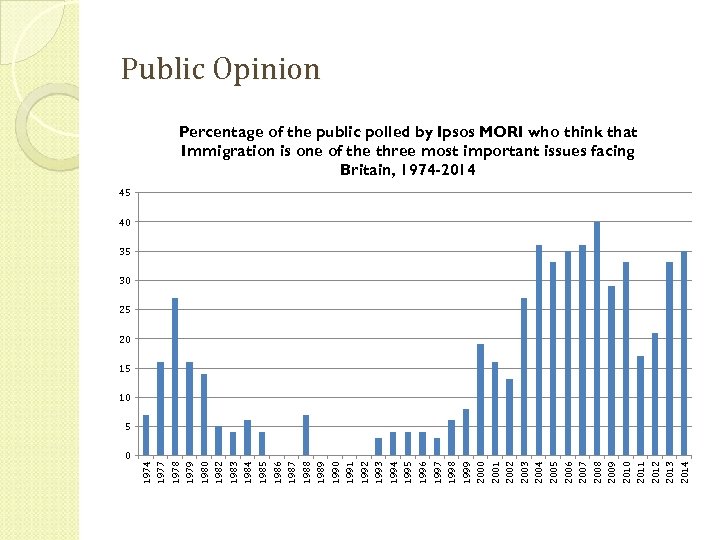 Public Opinion Percentage of the public polled by Ipsos MORI who think that Immigration is one of the three most important issues facing Britain, 1974 -2014 45 40 35 30 25 20 15 10 0 1974 1977 1978 1979 1980 1982 1983 1984 1985 1986 1987 1988 1989 1990 1991 1992 1993 1994 1995 1996 1997 1998 1999 2000 2001 2002 2003 2004 2005 2006 2007 2008 2009 2010 2011 2012 2013 2014 5
 Public Opinion (cont. ) 77% think that the number of immigrants coming to Britain should be reduced, 56% by a lot 79% of people in England believe that England is overcrowded, 37% saying it is very overcrowded. 79% believe that the UK population is too high. 76% believe that immigration has placed too much pressure on public services such as health, transport and education.
 Where do net migrants come from? Traditionally most net migration to the UK has been from outside the European Union however this has been declining over the last few years. Meanwhile EU migration has been increasing and is now almost at a similar level. There has always been a net outflow of British citizens which in recent years has averaged around 50, 000 a year.
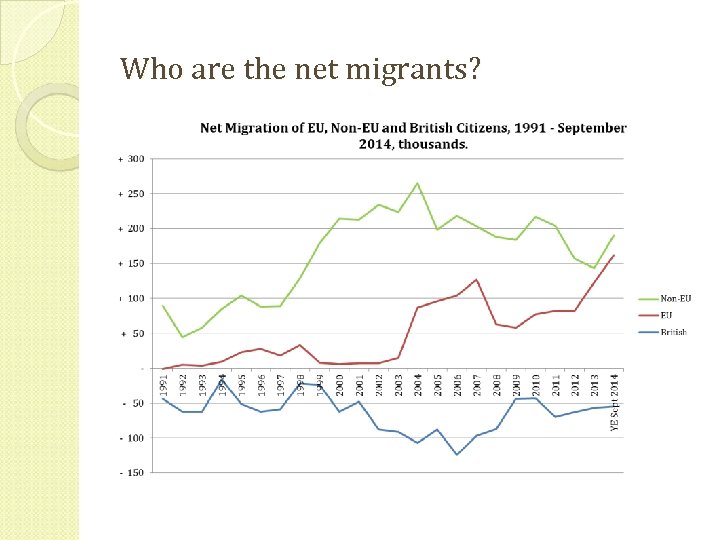 Who are the net migrants?
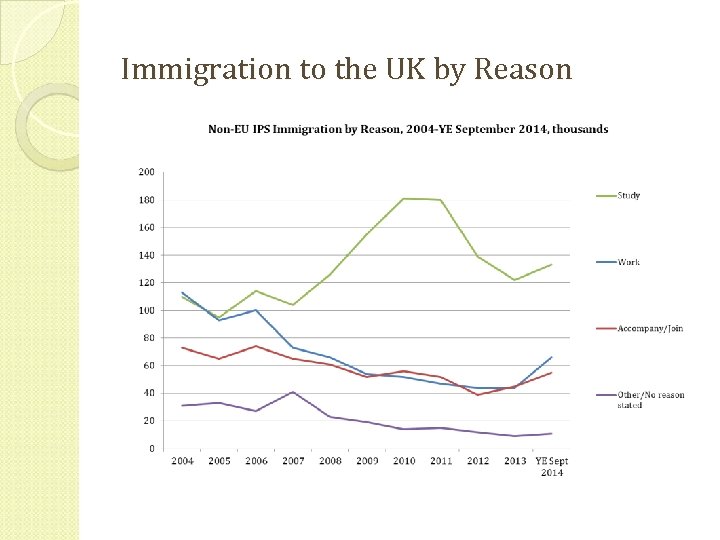 Immigration to the UK by Reason
 Immigration to the UK by Reason (cont. ) Students are the largest category of migrants. Their number increased sharply in 2008 due to changes to the immigration system. A sharp fall in recent years is due to a crackdown on abuse, largely in the Further Education sector. University applications have increased by 17% since 2010. Work migration fell in 2007 largely due to the recession and is now capped at 20, 700. The cap is yet to bite although this will change as the economy continues to grow. Family migration has fallen in recent years because the rules surrounding spouse migration were tightened. Fewer workers also brought fewer dependants and only above graduate level students studying for a year or more can bring their dependants with them.
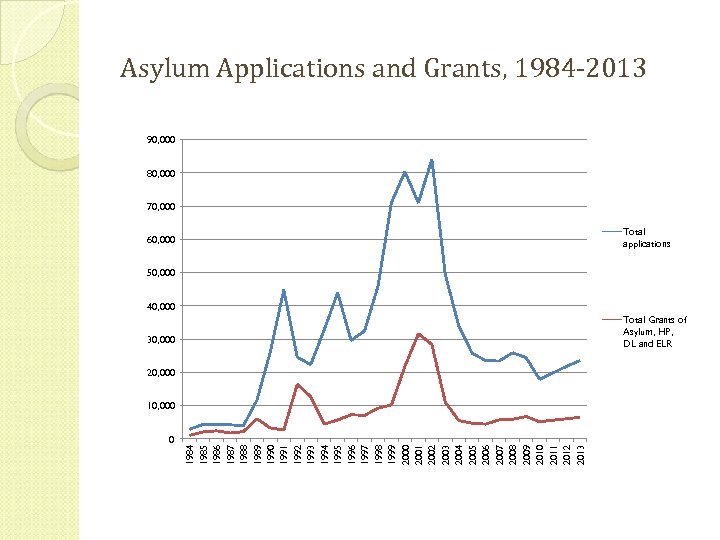 Asylum Applications and Grants, 1984 -2013 90, 000 80, 000 70, 000 Total applications 60, 000 50, 000 40, 000 Total Grants of Asylum, HP, DL and ELR 30, 000 20, 000 1984 1985 1986 1987 1988 1989 1990 1991 1992 1993 1994 1995 1996 1997 1998 1999 2000 2001 2002 2003 2004 2005 2006 2007 2008 2009 2010 2011 2012 2013 0
 Asylum Applications for asylum have been averaging around 20, 000 per year which is only 10% of net migration, although there was a slight increase in 2013. 60% of asylum applicants are found to not have a claim, even after an appeal hearing. 50% of applicants claim asylum only after detection.
 Implications of Net Migration on the present scale… Large scale net migration is increasing the population rapidly, placing additional demands on local infrastructure, housing and public services. The rate of population growth is not matched by an expansion of these amenities and services meaning that there is increased competition for more scarce resources. Large scale low skilled migration reduces the wages of those at the lower end of the scale while increases the wages of those at the top.
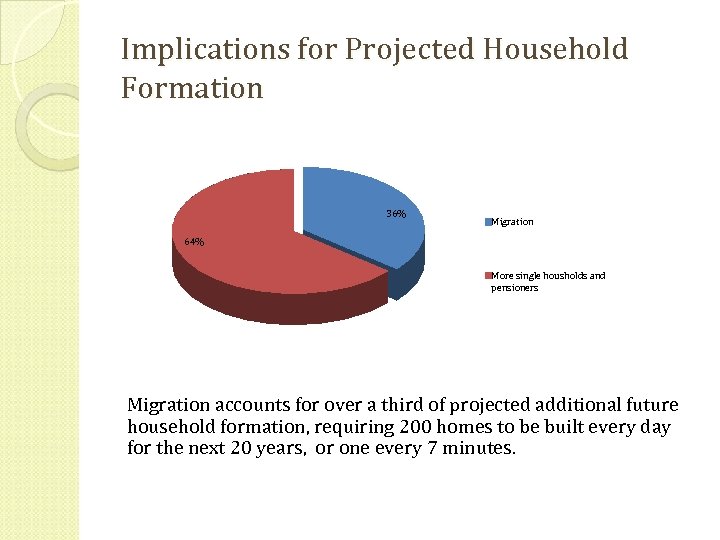 Implications for Projected Household Formation 36% Migration 64% More single housholds and pensioners Migration accounts for over a third of projected additional future household formation, requiring 200 homes to be built every day for the next 20 years, or one every 7 minutes.
 Migration Policy Net migration must eventually be brought down to the low tens of thousands if the population is to be stabilised. Non-EU net migration has fallen by around 30% since its height in 2004 and is now around 190, 000 a year. Further reductions are needed. EU migration has risen sharply in recent years to 160, 000 a year. Effective measures achieved through a renegotiation are essential if EU migration is to be brought under control.
 What can continue… Free movement of genuine students who leave at the end of their studies. Adequate scope for key workers from overseas to fill skills gaps while British workers are trained. Refuge for genuine asylum seekers.
 A properly managed immigration system… Balances the need for a competitive economy with the costs of a rapidly growing population. Should provide, as the House of Lords Economic Affairs Committee recommended, a “reasoned target range for net immigration” to which net migration policies could be adjusted. Reduces pressure on the environment, NHS, schools and transport. Encourages British industry and commerce to train British workers. Improves the prospects for integrating newcomers into society. Reduces the drain of talented and educated people from the developing who need their skills more than we do.
 Sources and References Population Estimates – ONS Actual Contribution of Immigration to Population Growth, Migration Watch UK, URL: http: //www. migrationwatchuk. co. uk/briefing-paper/15. 3 Household Formation – English Housing Survey 2008 Population Projections – ONS Public Opinion – Ipsos MORI Immigration Statistics – ONS Migration Statistics Quarterly Reports Asylum Applications and Grants – Home Office Statistics Visa Statistics – Home Office Statistics PQ on Asylum Claims, - Frank Field, Hansard, 15 October 2013, c 642 W. Opinion Poll URLs: http: //migrationwatchuk. com/excel/yougov-071111. xls, http: //populationmatters. org/2011/population-matters-news/people-uk-populationhigh/? php. My. Admin=e 11 b 8 b 687 c 20198 d 9 ad 050 fbb 1 aa 7 f 2 f, http: //www. slideshare. net/Ipsos. MORI/ipsos-global-dvisor-22 -attitudes-to-immigrationjuly-2011 , http: //www. bsa-31. natcen. ac. uk/read-thereport/immigration/introduction. aspx