Скачать презентацию The Impact of Clinical Prompts on Prenatal Care
bc681dbcad32551b53f26b71d4a9cf61.ppt
- Количество слайдов: 20
 The Impact of Clinical Prompts on Prenatal Care at Two Family Medicine Teaching Clinics Maggie Riley, MD Academic Fellow University of Michigan Dept of Family Medicine
 Goals of Research n To determine how well FM physicians meet the standards for prenatal care n To assess whether a clinical intervention can improve compliance to prenatal care standards n To improve prenatal care provided at our teaching clinics
 Factors when considering a clinical intervention n Impact on existing clinical system n Ease of implementation n Ease of provider/staff use n Cost of intervention n Long-term utility of intervention n Effectiveness of intervention
 Utility of Clinical Prompts n Improve quality of patient care n Track chronic disease management n Track health maintenance screening n Increase provider efficiency n Useful for pay-for-performance evaluations
 Clinical Prompts “The Utility of an Evidence-Based Lecture and Clinical Prompt as Methods to Improve Quality of Care in Colorectal Cancer Screening” n Assessed screening rate at baseline, after evidence-based lecture, and after instituting point-of-care clinical prompt Seres KA, et al. Am J of Gastroenterol 2007; 102: 1 -6
 Colorectal Clinical Prompts n Significantly improved attempts at screening as compared to baseline (39. 6% vs. 67. 6%, p<0. 0001) n Significantly increased ordering of colon imaging (24 vs. 46%, p<0. 0001) n Prompts are superior to lecture n Low cost intervention
 Clinical Prompts n Clinfo. Tracker = Clinical Reminder System (CRS) n Provides up to date information regarding needed preventive and disease management services at the point of care
 Research Population n Pregnant females of any age seen at University of MI Ypsilanti or Chelsea FM clinic for their prenatal care n Both sites are teaching clinics and have varying patient demographics
 Research Methods n Implement prompts through Clinfo. Tracker n Compare pre- to post-intervention percent adherence during a four month time period (Nov to March ‘ 06 -07 and ‘ 07 -08) n Determine if study site or level of experience impact adherence to those standards
 Prompts Generated Prenatal labs (RPR, rubella, Hep. Bs. Ag, T&S, CBC, pap, GC/CT, HIV, urine culture) n Offer genetic testing (cystic fibrosis, Tay. Sachs, hemoglobinopathies) n First trimester screen (11 to 14 weeks) n Quad screen or MSAFP (15 to 20 6/7 weeks) n Influenza vaccine (if pregnant during flu season) n Consider fetal survey n
 Prompts Generated n One-hour glucose tolerance test n 3 rd Trimester Antibody Screen and Rho. Gam – Rh Negative patients ONLY n 2 nd/3 rd trimester CBC n Consider Repeat GC/CT Screen in High Risk Populations n GBS culture n Antenatal testing
 Compliance to Standard n Result documented within EMR n Patient declined test and decline documented n Test documented as ordered n Patient not a candidate for the test
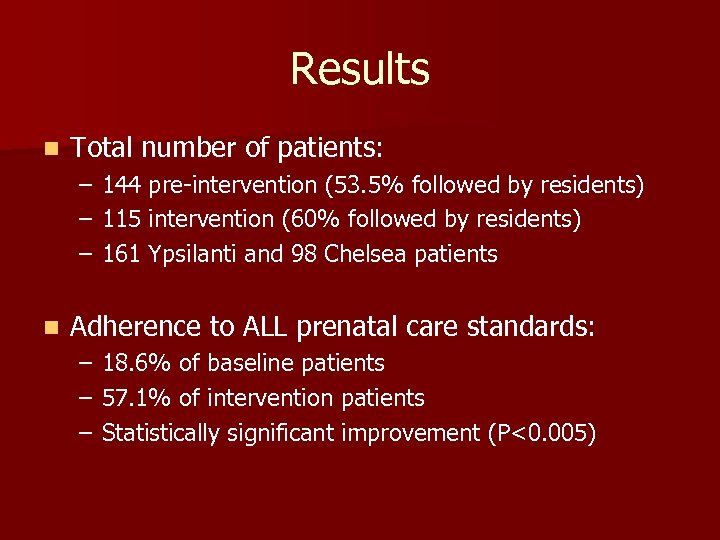 Results n Total number of patients: – – – n 144 pre-intervention (53. 5% followed by residents) 115 intervention (60% followed by residents) 161 Ypsilanti and 98 Chelsea patients Adherence to ALL prenatal care standards: – – – 18. 6% of baseline patients 57. 1% of intervention patients Statistically significant improvement (P<0. 005)
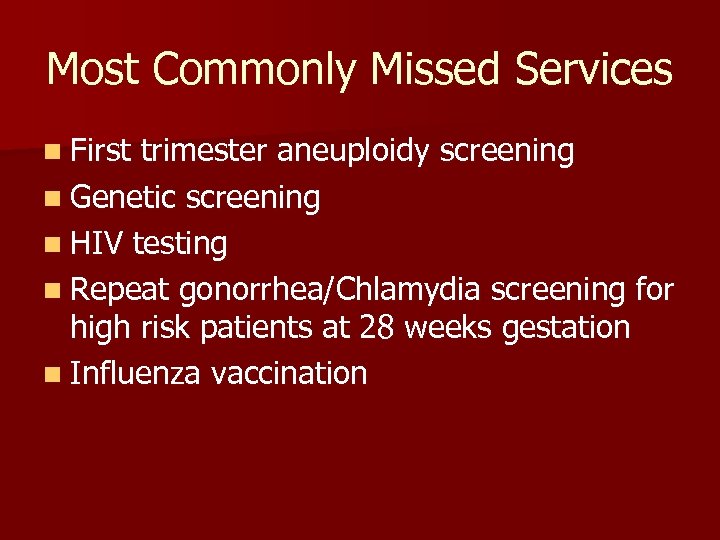 Most Commonly Missed Services n First trimester aneuploidy screening n Genetic screening n HIV testing n Repeat gonorrhea/Chlamydia screening for high risk patients at 28 weeks gestation n Influenza vaccination
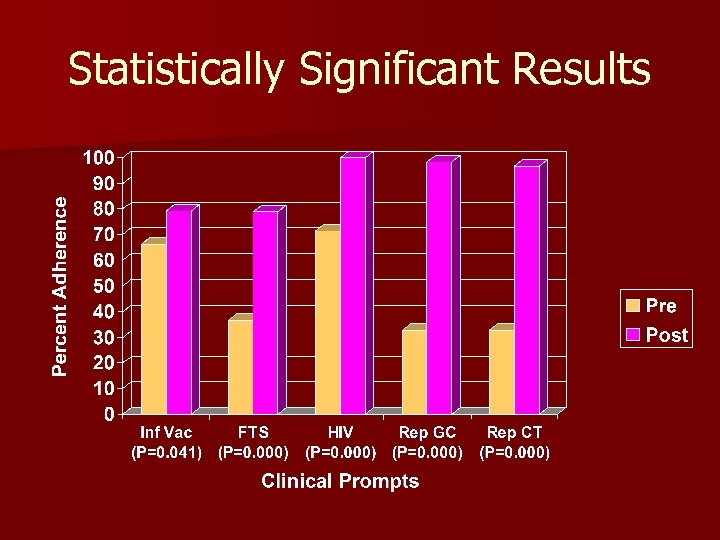 Statistically Significant Results
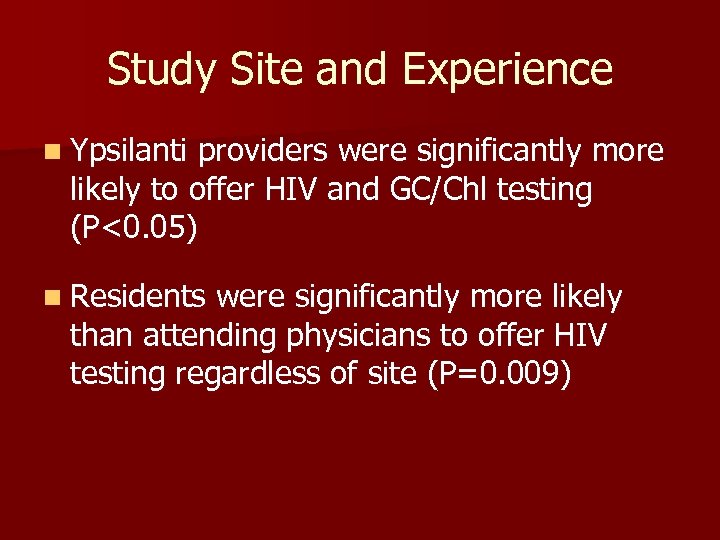 Study Site and Experience n Ypsilanti providers were significantly more likely to offer HIV and GC/Chl testing (P<0. 05) n Residents were significantly more likely than attending physicians to offer HIV testing regardless of site (P=0. 009)
 Conclusions n Adherence to prenatal care standards by FM providers at baseline was low n Overall, level of experience and study site did not impact adherence to standards n Intervention significantly improved adherence to early screening for genetic abnormalities, STI screening, and influenza vaccination
 Conclusions n Results support the use of automated prenatal care reminders as an effective way to aid FM physicians in meeting prenatal care standards n Further research should assess the effect of prenatal reminders on efficiency, cost, and perinatal outcomes
 References 1) Seres KA, Kirkpatrick AC, Tierney WM. The Utility of an Evidence-Based Lecture and Clinical Prompt as Methods to Improve Quality of Care in Colorectal Cancer Screening. Am J of Gastroenterol 2007; 102: 1 -6. n 2) Zoschnick LB, Brackbill EL, Green LA, Van Harrison R, Shumacher RE. University of Michigan Prenatal Care Guideline. Updated 6/2006. Available at: http: //www. med. umich. edu/1 info/fhp/practicegu ides/newpnc/pnc 2006. pdf n