


 Скачать презентацию The Impact of Alcohol Privatization on Alcohol Use
b09dbd042644753f926f63cb5e6db0d9.ppt
- Количество слайдов: 30
 The Impact of Alcohol Privatization on Alcohol Use and Related Harms: Lessons from British Columbia Tim Stockwell Centre for Addictions Research of BC and Prevention Research Center, CA Webinar presented to Nova Scotia Atlantic Collaborative on Injury Prevention, April 4, 2011
 Alcohol is a major risk factor for disease and injury Alcohol use contributes causally to 7% of all cancers, 4% of coronary disease, 26% of neuropsychiatric conditions, 81% of liver cirrhosis and 23% of injuries in North America (Rehm et al, 2009, The Lancet) 2
 Government alcohol monopolies n n n Remain in Norway, Sweden, Finland, Iceland, Faroe Islands reporting to Health Minister All but one Canadian province - Alberta Partial privatisation in BC and Quebec 19 control US jurisdictions with partial control of retail distribution, mostly wine and/or spirits BC is interesting: recent and rapid rise in private stores (40%) and 10% drop in government stores between 2003 -2008
 Relic of Prohibition or modern public health strategy? Greater opportunities to restrict: n Outlet density n Sales to underage and intoxicated n High strength products n Trading hours n Promotions Plus maintain prices to reflect alcohol content and cost of living e. g. minimum prices
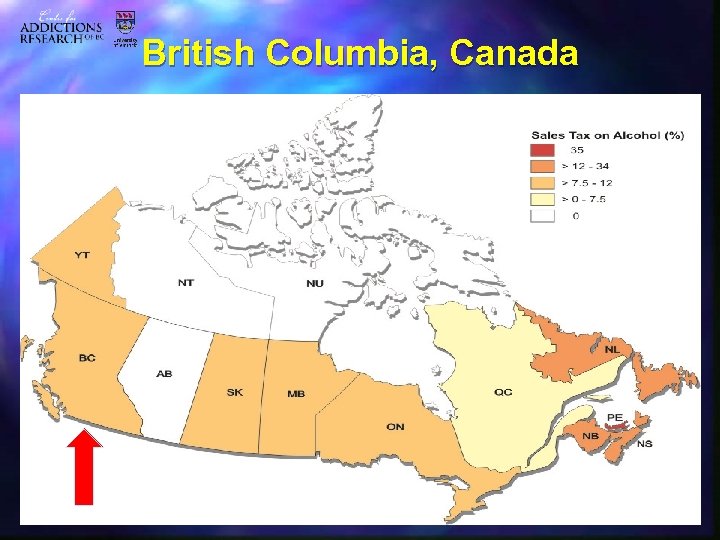 British Columbia, Canada
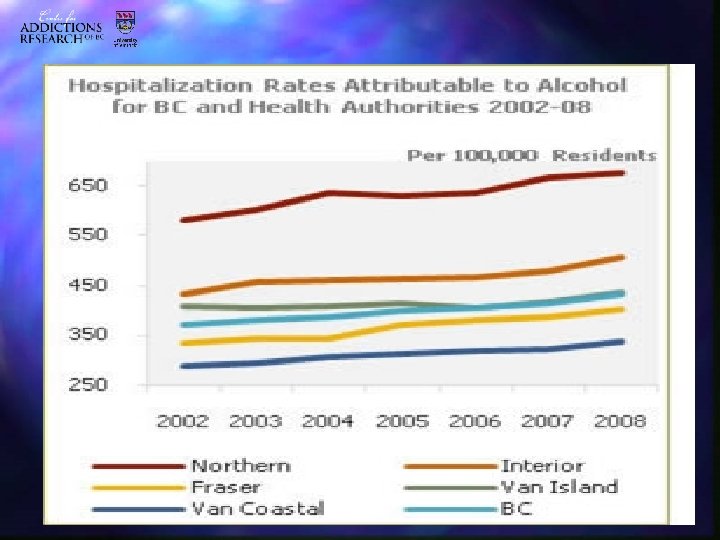
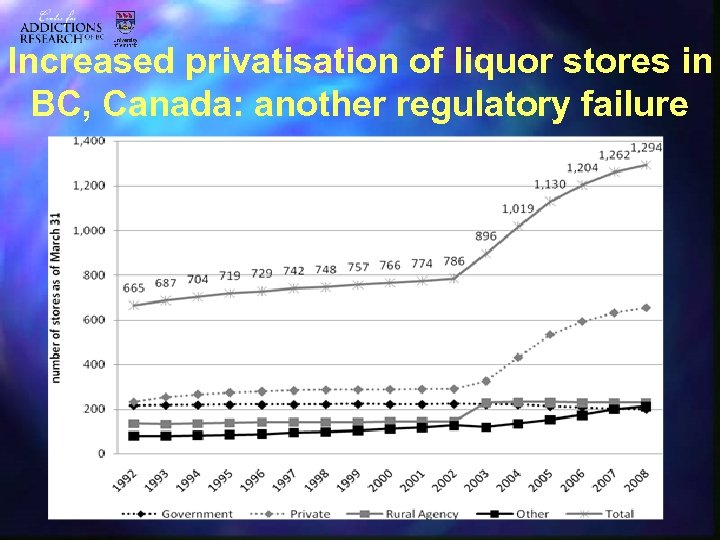 Increased privatisation of liquor stores in BC, Canada: another regulatory failure
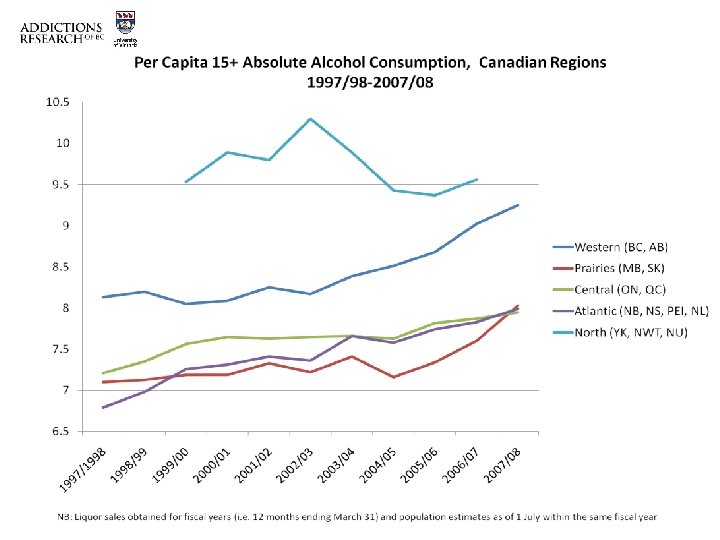
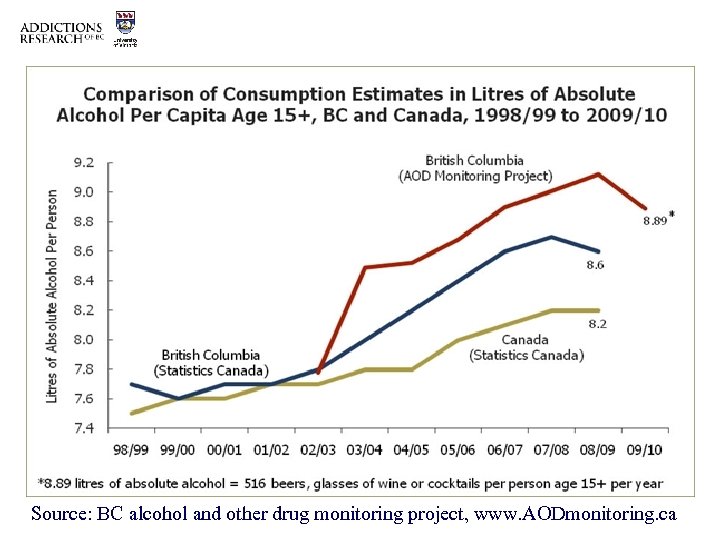 Last Updated: 25 January 2011 Source: BC alcohol and other drug monitoring project, www. AODmonitoring. ca
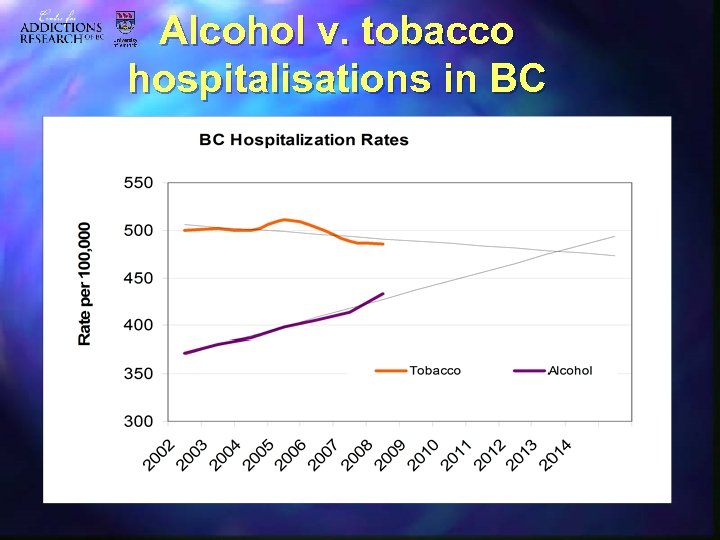 Alcohol v. tobacco hospitalisations in BC
 Objectives n n To explore the relationship between local changes in the number of different types of liquor outlets in BC and in (i) alcohol consumption (ii) alcoholcaused deaths. To test two hypotheses: (i) greater overall outlet density increased sales and harm (ii) a larger percentage of privately owned stores increased sales and harm – at the local level.
 References Stockwell, T. , Zhao, J. , Macdonald, S. et al (2009) Changes in per capita alcohol sales during the partial privatisation of British Columbia’s retail alcohol monopoly 2003 -2008: A multilevel local area analysis. Addiction, 104(11), 1827 -1836. Stockwell, T. , Zhao, J. , Macdonald, S. et al (2011) Impact on alcoholrelated mortality of a rapid rise in the density of private liquor outlets in British Columbia: A local area multi-level analysis. Addiction, online Jan ’ 11. Stockwell, T. , Vallance, K. , Martin, G. , Macdonald, S. , Ivsins, A. , Chow, C. , Greer, A. , Zhao, J. , Duff, C. , Lucas, P. , Marsh, D. , Michelow, W. & Treno, A. (2010) The price of getting high, stoned and drunk in BC: A comparison of minimum prices for alcohol and other psychoactive substances. CARBC Statistical Bulletin #7, Victoria, British Columbia: University of Victoria.
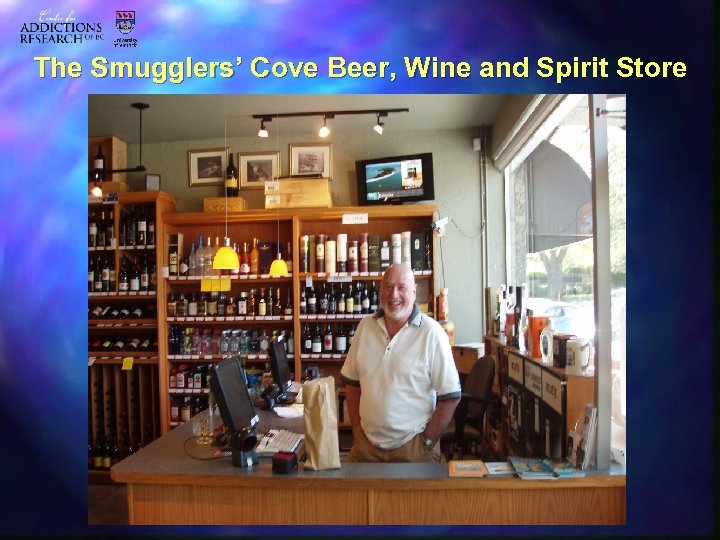 The Smugglers’ Cove Beer, Wine and Spirit Store
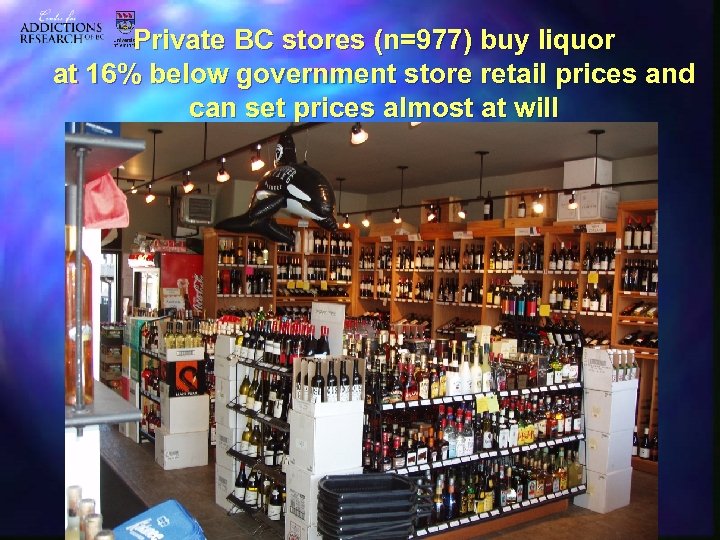 Private BC stores (n=977) buy liquor at 16% below government store retail prices and can set prices almost at will
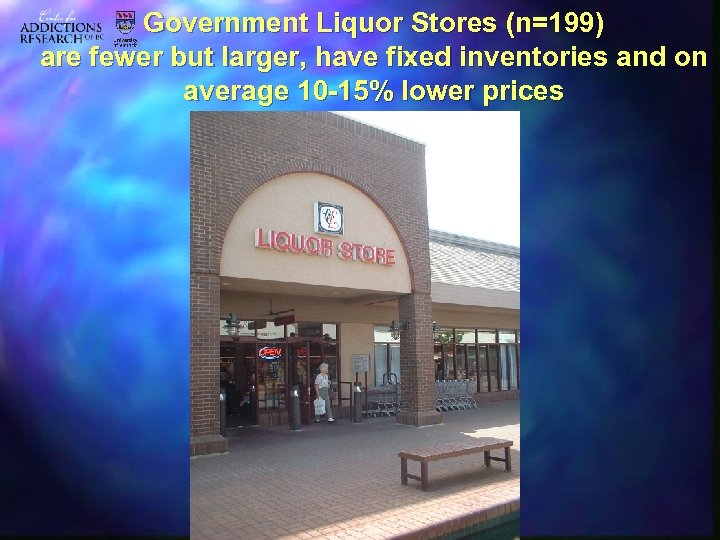 Government Liquor Stores (n=199) are fewer but larger, have fixed inventories and on average 10 -15% lower prices
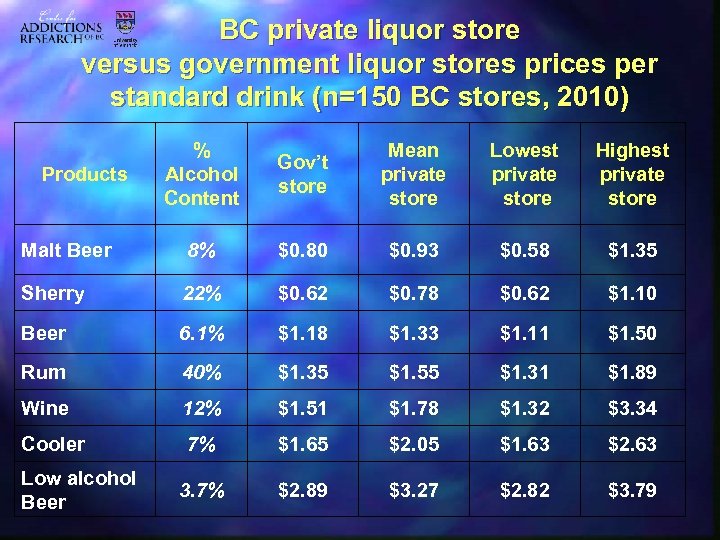 BC private liquor store versus government liquor stores prices per standard drink (n=150 BC stores, 2010) % Alcohol Content Gov’t store Mean private store Lowest private store Highest private store Malt Beer 8% $0. 80 $0. 93 $0. 58 $1. 35 Sherry 22% $0. 62 $0. 78 $0. 62 $1. 10 Beer 6. 1% $1. 18 $1. 33 $1. 11 $1. 50 Rum 40% $1. 35 $1. 55 $1. 31 $1. 89 Wine 12% $1. 51 $1. 78 $1. 32 $3. 34 Cooler 7% $1. 65 $2. 05 $1. 63 $2. 63 3. 7% $2. 89 $3. 27 $2. 82 $3. 79 Products Low alcohol Beer
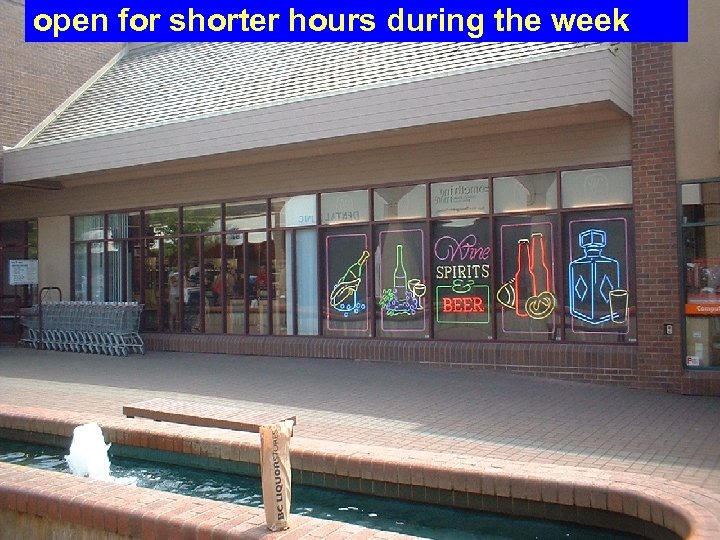 open for shorter hours during the week
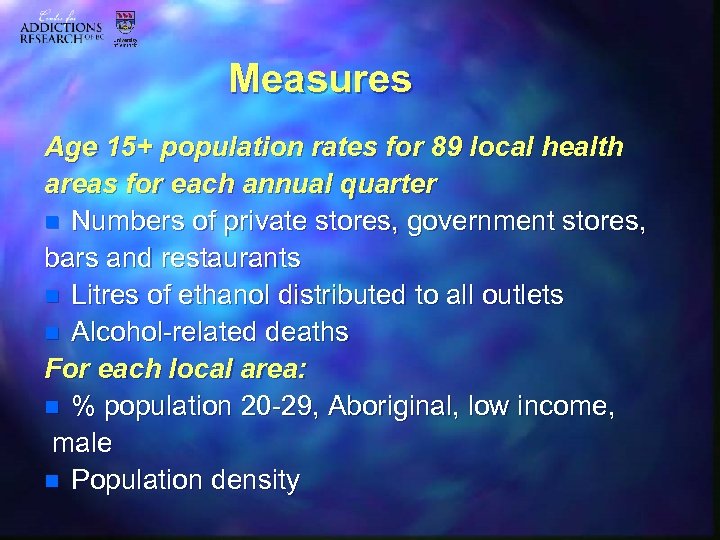 Measures Age 15+ population rates for 89 local health areas for each annual quarter n Numbers of private stores, government stores, bars and restaurants n Litres of ethanol distributed to all outlets n Alcohol-related deaths For each local area: n % population 20 -29, Aboriginal, low income, male n Population density
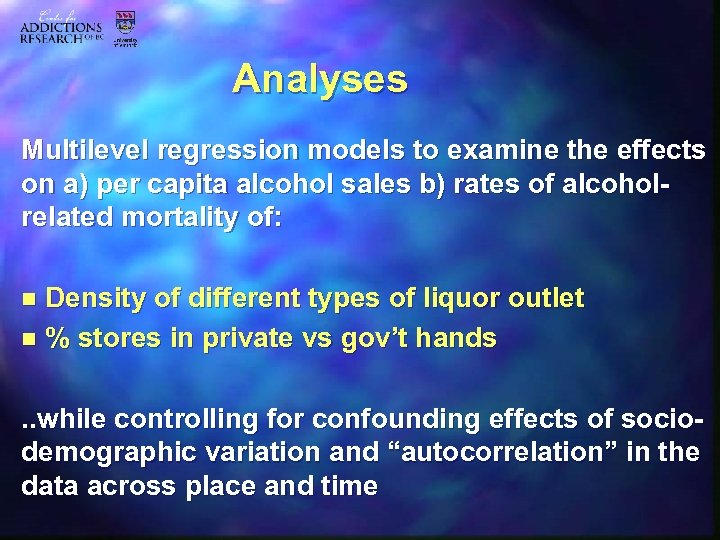 Analyses Multilevel regression models to examine the effects on a) per capita alcohol sales b) rates of alcoholrelated mortality of: Density of different types of liquor outlet n % stores in private vs gov’t hands n . . while controlling for confounding effects of sociodemographic variation and “autocorrelation” in the data across place and time
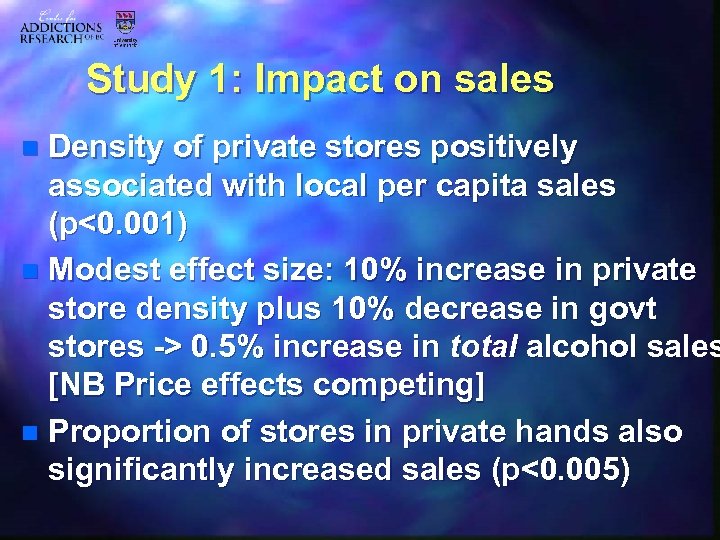 Study 1: Impact on sales Density of private stores positively associated with local per capita sales (p<0. 001) n Modest effect size: 10% increase in private store density plus 10% decrease in govt stores -> 0. 5% increase in total alcohol sales [NB Price effects competing] n Proportion of stores in private hands also significantly increased sales (p<0. 005) n
 Study 2: Impact on deaths Density of private stores positively associated with local rates of alcoholrelated death (p<0. 01) n Effect size: 10% increase in private store density -> 1. 6% increase in alcohol-related deaths – or approximately 120 extra deaths over the study period n Proportion of stores in private hand also significantly increased sales (p<0. 05) n
 Cautious conclusions Recent alcohol consumption increases and partial privatisation have coincided in BC n There was much variation across 89 local areas studied When controlling for economic and demographic differences: n Density of liquor stores significantly predicted local changes in per capita consumption and rates of alcohol related mortality n The % of liquor stores in private hands also significantly predicted local consumption and rates of alcohol-related death n
 A complication? n n Industry funded a criticism from academics at George Mason University, Virginia Pointed out that overall rate of alcohol-related mortality as reported in our paper had reduced They were right – but this is probably due to a) economic recession at the end of the time series b) an under reporting problem that particularly effects most recent years…. and is specific to ACUTE harm The results remain significant despite this contrary bias and should be more significant when it is corrected
 Remaining questions: next study n n n Can we separate out the competing effects of price and outlet density in this unusual natural experiment? Can we be more specific than “total alcoholrelated mortality” and e. g. explore effects more sensitive to chronic versus harm? To be addressed in a new collaborative investigation between the Prevention Research Center, USA and CARBC which will explore impacts on rates of alcohol-related hospitalisations as well as deaths
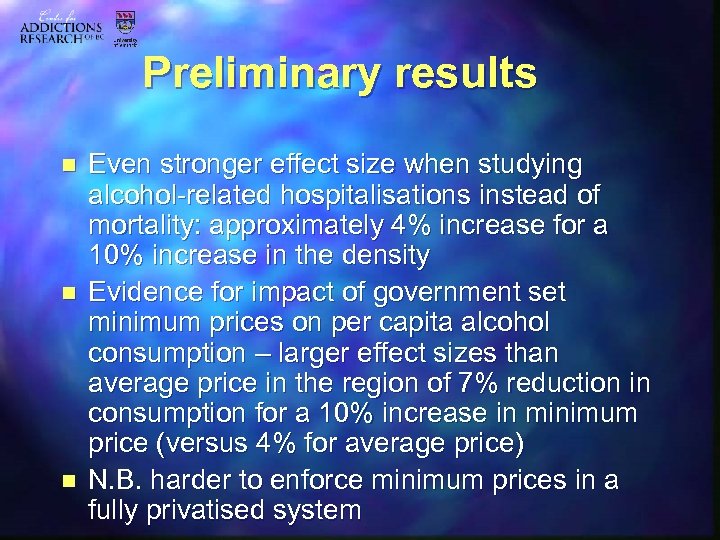 Preliminary results n n n Even stronger effect size when studying alcohol-related hospitalisations instead of mortality: approximately 4% increase for a 10% increase in the density Evidence for impact of government set minimum prices on per capita alcohol consumption – larger effect sizes than average price in the region of 7% reduction in consumption for a 10% increase in minimum price (versus 4% for average price) N. B. harder to enforce minimum prices in a fully privatised system
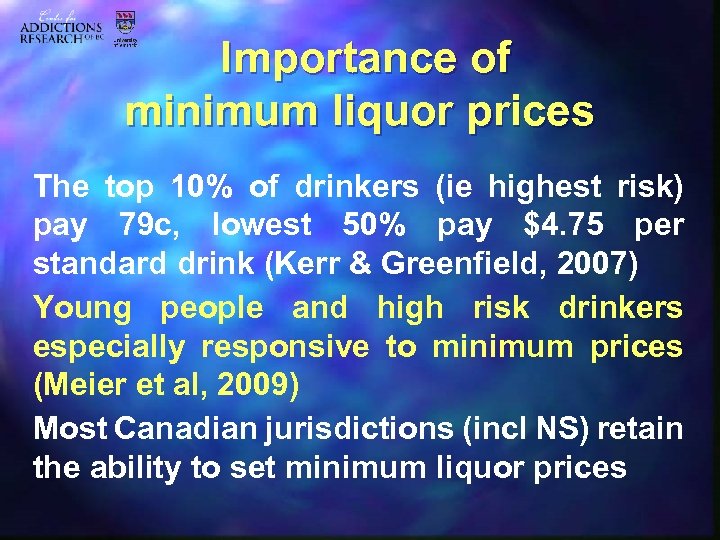 Importance of minimum liquor prices The top 10% of drinkers (ie highest risk) pay 79 c, lowest 50% pay $4. 75 per standard drink (Kerr & Greenfield, 2007) Young people and high risk drinkers especially responsive to minimum prices (Meier et al, 2009) Most Canadian jurisdictions (incl NS) retain the ability to set minimum liquor prices
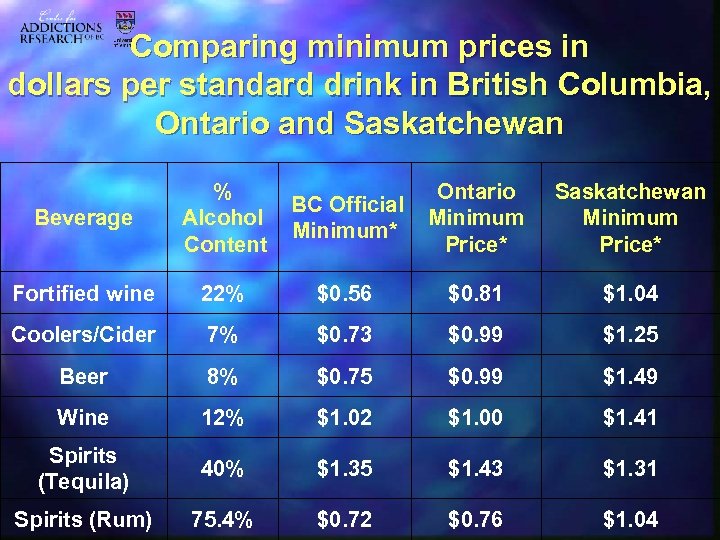 Comparing minimum prices in dollars per standard drink in British Columbia, Ontario and Saskatchewan Beverage % Alcohol Content BC Official Minimum* Ontario Minimum Price* Saskatchewan Minimum Price* Fortified wine 22% $0. 56 $0. 81 $1. 04 Coolers/Cider 7% $0. 73 $0. 99 $1. 25 Beer 8% $0. 75 $0. 99 $1. 49 Wine 12% $1. 02 $1. 00 $1. 41 Spirits (Tequila) 40% $1. 35 $1. 43 $1. 31 Spirits (Rum) 75. 4% $0. 72 $0. 76 $1. 04
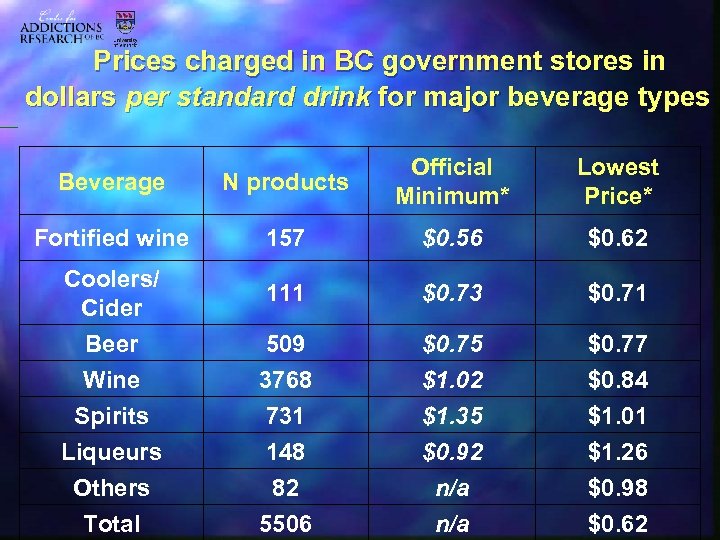 Prices charged in BC government stores in dollars per standard drink for major beverage types Beverage N products Official Minimum* Lowest Price* Fortified wine 157 $0. 56 $0. 62 Coolers/ Cider 111 $0. 73 $0. 71 Beer Wine Spirits Liqueurs Others Total 509 3768 731 148 82 5506 $0. 75 $1. 02 $1. 35 $0. 92 n/a $0. 77 $0. 84 $1. 01 $1. 26 $0. 98 $0. 62
 Conclusions Privatising the liquor market in Canada stimulates consumption and increases rates of harm Government alcohol monopolies provide ideal mechanisms for implementing affective alcohol policies around youth access, outlet density, pricing and hours of service and should be retained Further research is underway to more fully document impacts on different kinds of harm i. e. acute versus chronic
 THANK YOU! Thank you!