 Скачать презентацию The IMF Trade-Related Technical Assistance and Institution Building
9537c5f279c1997f6e20cfceb418bb17.ppt
- Количество слайдов: 14



The IMF Trade-Related Technical Assistance and Institution Building WCO Conference Johannesburg, South Africa April 4, 2007 Jean-Paul Bodin, Chief Revenue Administration IMF’s Fiscal Affairs Department
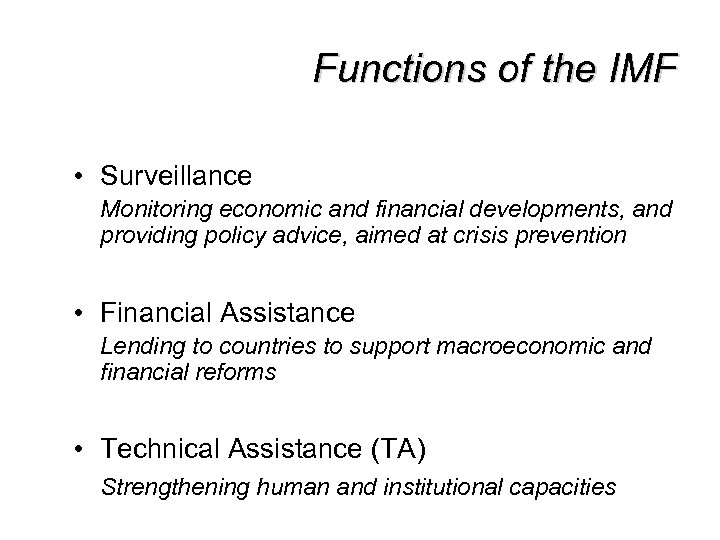
Functions of the IMF • Surveillance Monitoring economic and financial developments, and providing policy advice, aimed at crisis prevention • Financial Assistance Lending to countries to support macroeconomic and financial reforms • Technical Assistance (TA) Strengthening human and institutional capacities
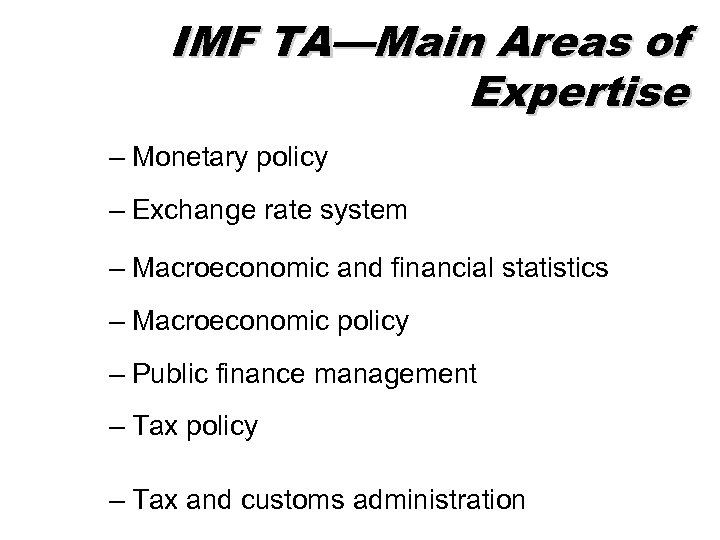
IMF TA—Main Areas of Expertise – Monetary policy – Exchange rate system – Macroeconomic and financial statistics – Macroeconomic policy – Public finance management – Tax policy – Tax and customs administration
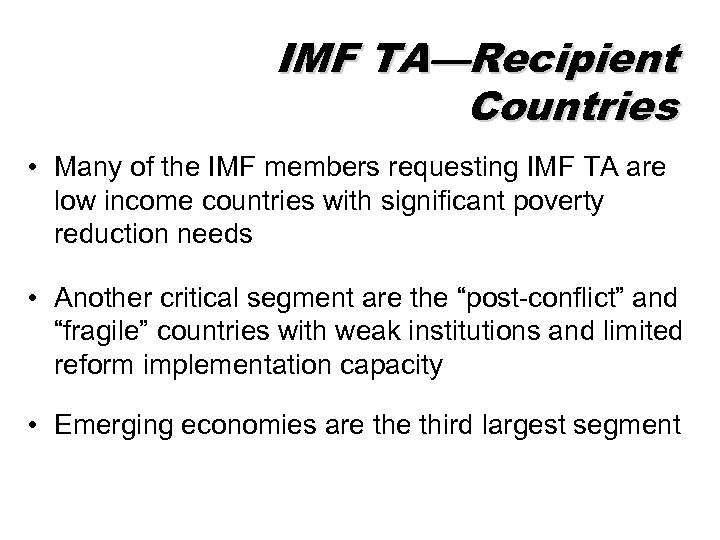
IMF TA—Recipient Countries • Many of the IMF members requesting IMF TA are low income countries with significant poverty reduction needs • Another critical segment are the “post-conflict” and “fragile” countries with weak institutions and limited reform implementation capacity • Emerging economies are third largest segment
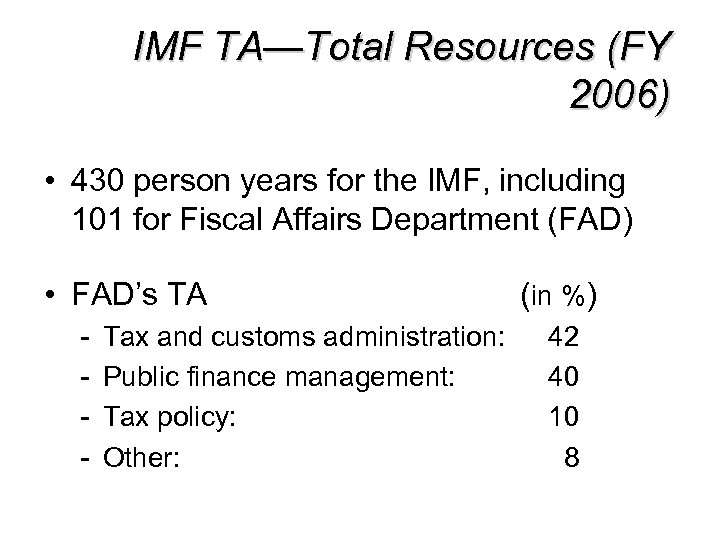
IMF TA—Total Resources (FY 2006) • 430 person years for the IMF, including 101 for Fiscal Affairs Department (FAD) • FAD’s TA - Tax and customs administration: Public finance management: Tax policy: Other: (in %) 42 40 10 8
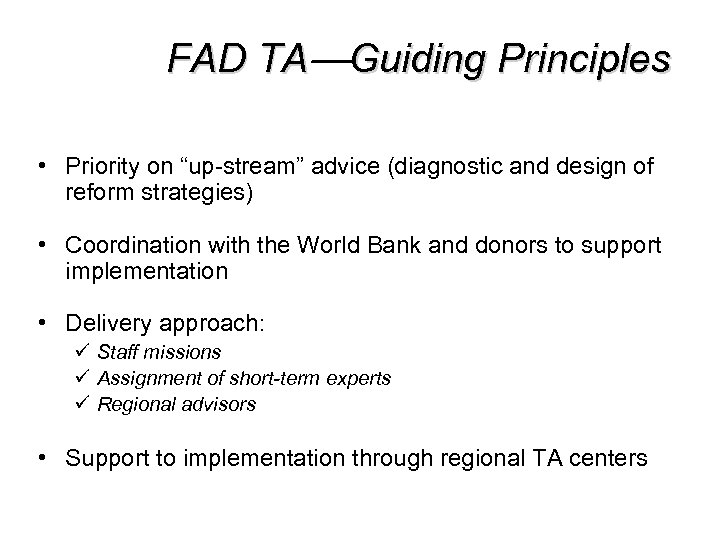
FAD TA—Guiding Principles • Priority on “up-stream” advice (diagnostic and design of reform strategies) • Coordination with the World Bank and donors to support implementation • Delivery approach: ü Staff missions ü Assignment of short-term experts ü Regional advisors • Support to implementation through regional TA centers
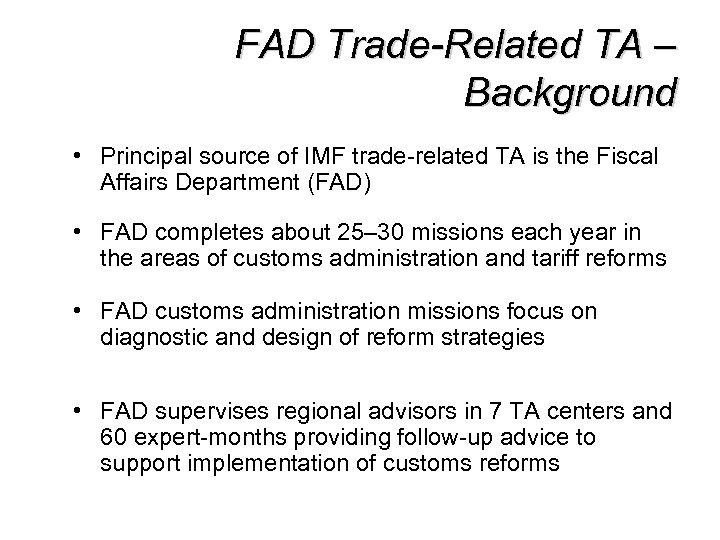
FAD Trade-Related TA – Background • Principal source of IMF trade-related TA is the Fiscal Affairs Department (FAD) • FAD completes about 25– 30 missions each year in the areas of customs administration and tariff reforms • FAD customs administration missions focus on diagnostic and design of reform strategies • FAD supervises regional advisors in 7 TA centers and 60 expert-months providing follow-up advice to support implementation of customs reforms
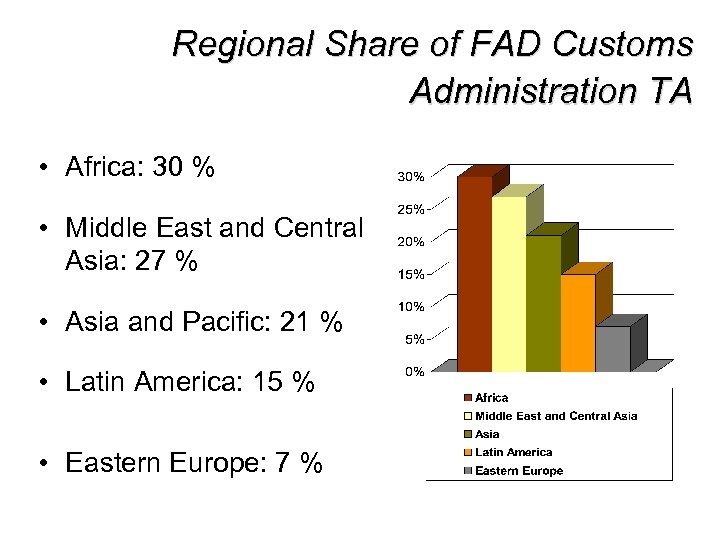
Regional Share of FAD Customs Administration TA • Africa: 30 % • Middle East and Central Asia: 27 % • Asia and Pacific: 21 % • Latin America: 15 % • Eastern Europe: 7 %
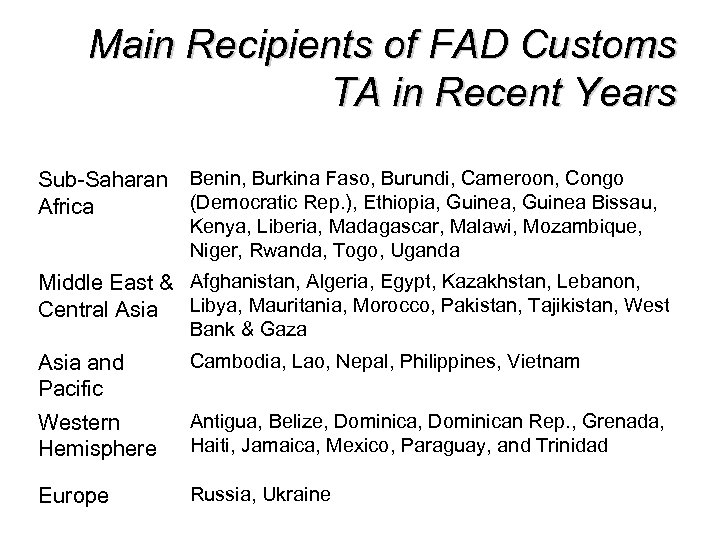
Main Recipients of FAD Customs TA in Recent Years Sub-Saharan Benin, Burkina Faso, Burundi, Cameroon, Congo (Democratic Rep. ), Ethiopia, Guinea Bissau, Africa Kenya, Liberia, Madagascar, Malawi, Mozambique, Niger, Rwanda, Togo, Uganda Middle East & Afghanistan, Algeria, Egypt, Kazakhstan, Lebanon, Central Asia Libya, Mauritania, Morocco, Pakistan, Tajikistan, West Bank & Gaza Asia and Pacific Cambodia, Lao, Nepal, Philippines, Vietnam Western Hemisphere Antigua, Belize, Dominican Rep. , Grenada, Haiti, Jamaica, Mexico, Paraguay, and Trinidad Europe Russia, Ukraine
Focus of FAD Customs Administration TA • Balancing revenue compliance objectives with trade facilitation and economic development… • Through development of comprehensive customs reform strategies targeting revenue efficiency and… • Incorporating international standards and best practices to support trade facilitation and liberalization… • In the context of IMF-supported economic and financial reform programs
Main topics addressed by recent FAD customs administration missions • Design customs administration modernization strategies • Recommend simple, fully automated clearance procedures • Develop revenue control programs based on risk assessment, with selective checks, and effective post release audits as the center piece • Improve core business operations, including import valuation, exemption monitoring • Review organizational structure and human resource management (including ethics, training programs, . . . )
Coordination of IMF TA with the Bank and other TA providers • For many years, there has been a strong coordination of FAD and the Bank customs work in many countries (Kazakhstan, Turkey, Russia, Cambodia. . . ) • FAD has also worked closely with other providers of customs TA (e. g. , the EU, France, UK-DFID, and USAID in Africa) • Recently, FAD has also been involved in the meetings of the Negotiating Group on Trade Facilitation and coordination has been enhanced to identify the capacity gap for implementation of any new WTO-TF provisions
Coordination of IMF TA with the Bank and Other TA Providers— Perspectives • FAD will continue to support customs reforms in developing and transition countries through its programs of strategic and follow-up missions in coordination with other donors • In low-income and post-conflict countries, FAD work will be closely coordinated with the IMF’s regional TA centers to support implementation of customs reforms

Thank you
Скачать презентацию The IMF Trade-Related Technical Assistance and Institution Building
9537c5f279c1997f6e20cfceb418bb17.ppt