 Скачать презентацию The ILC Global Design Effort Barry Barish SPC
7f38635775bfc9642c6f0684d3b1a7aa.ppt
- Количество слайдов: 59



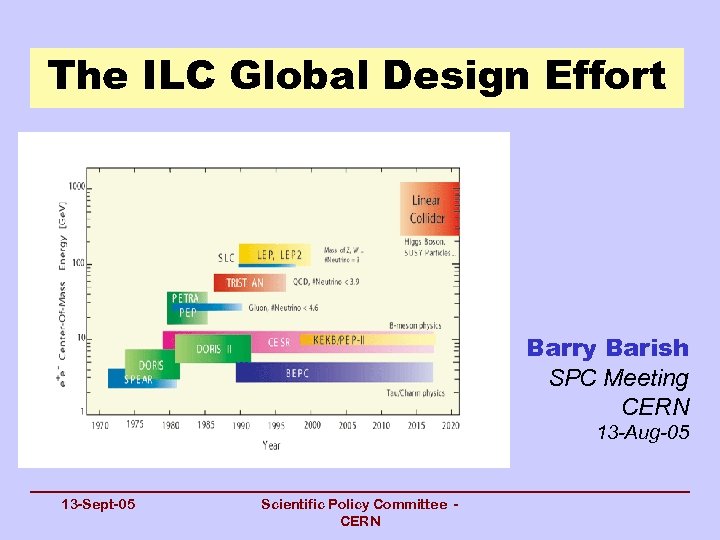
The ILC Global Design Effort Barry Barish SPC Meeting CERN 13 -Aug-05 13 -Sept-05 Scientific Policy Committee CERN
Why a Te. V Scale e+e- Accelerator? • Two parallel developments over the past few years (the science & the technology) – The precision information from LEP and other data have pointed to a low mass Higgs; Understanding electroweak symmetry breaking, whether supersymmetry or an alternative, will require precision measurements. – There are strong arguments for the complementarity between a ~0. 5 -1. 0 Te. V LC and the LHC science. 13 -Sept-05 Scientific Policy Committee - CERN 2
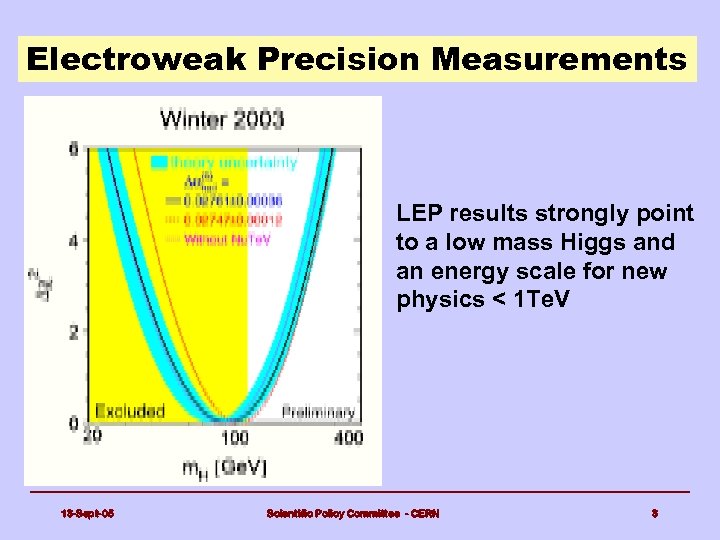
Electroweak Precision Measurements LEP results strongly point to a low mass Higgs and an energy scale for new physics < 1 Te. V 13 -Sept-05 Scientific Policy Committee - CERN 3
Why a Te. V Scale e+e- Accelerator? • Two parallel developments over the past few years (the science & the technology) – The precision information from LEP and other data have pointed to a low mass Higgs; Understanding electroweak symmetry breaking, whether supersymmetry or an alternative, will require precision measurements. – There are strong arguments for the complementarity between a ~0. 5 -1. 0 Te. V LC and the LHC science. 13 -Sept-05 Scientific Policy Committee - CERN 4
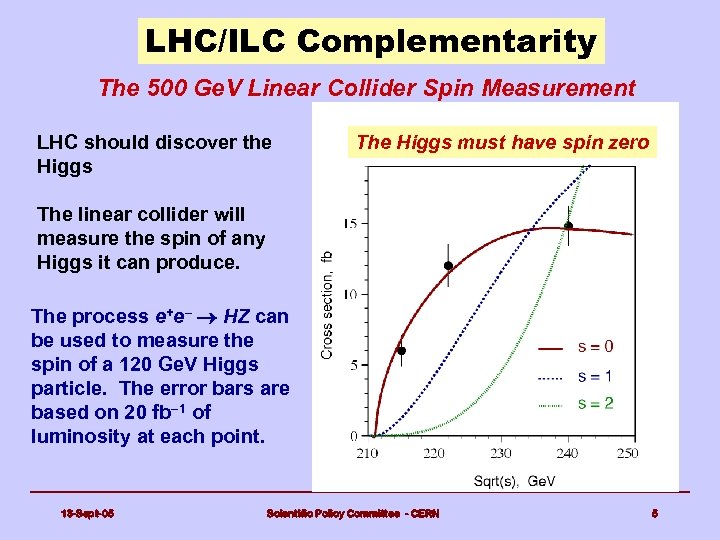
LHC/ILC Complementarity The 500 Ge. V Linear Collider Spin Measurement LHC should discover the Higgs The Higgs must have spin zero The linear collider will measure the spin of any Higgs it can produce. The process e+e– HZ can be used to measure the spin of a 120 Ge. V Higgs particle. The error bars are based on 20 fb– 1 of luminosity at each point. 13 -Sept-05 Scientific Policy Committee - CERN 5
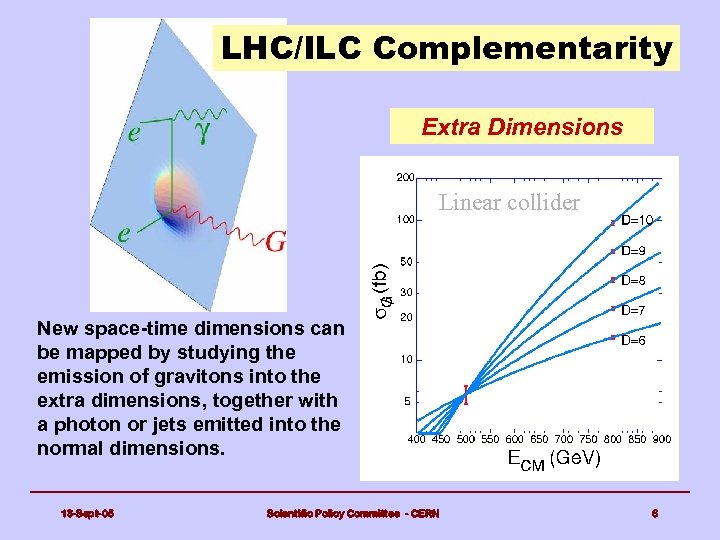
LHC/ILC Complementarity Extra Dimensions Linear collider New space-time dimensions can be mapped by studying the emission of gravitons into the extra dimensions, together with a photon or jets emitted into the normal dimensions. 13 -Sept-05 Scientific Policy Committee - CERN 6
Why a Te. V Scale e+e- Accelerator? • Two parallel developments over the past few years (the science & the technology) – Two alternate designs -- “warm” and “cold” had come to the stage where the show stoppers had been eliminated and the concepts were well understood. – A major step toward a new international machine requires uniting behind one technology, and then make a unified global design based on the recommended technology. 13 -Sept-05 Scientific Policy Committee - CERN 7
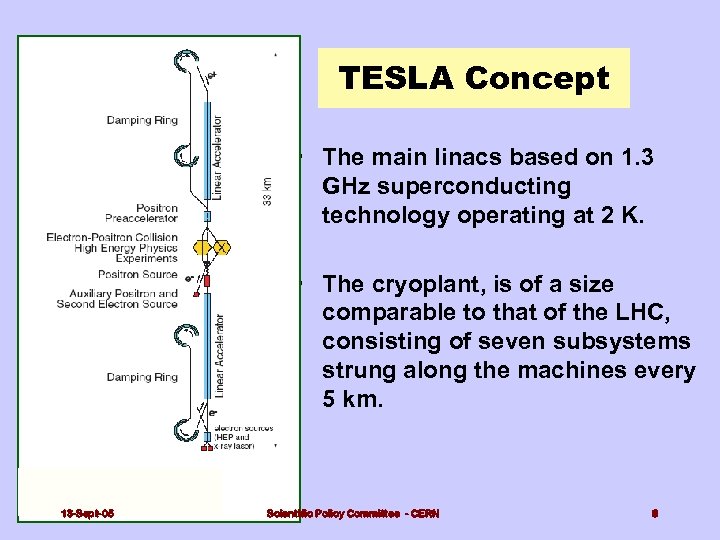
TESLA Concept • The main linacs based on 1. 3 GHz superconducting technology operating at 2 K. • The cryoplant, is of a size comparable to that of the LHC, consisting of seven subsystems strung along the machines every 5 km. 13 -Sept-05 Scientific Policy Committee - CERN 8
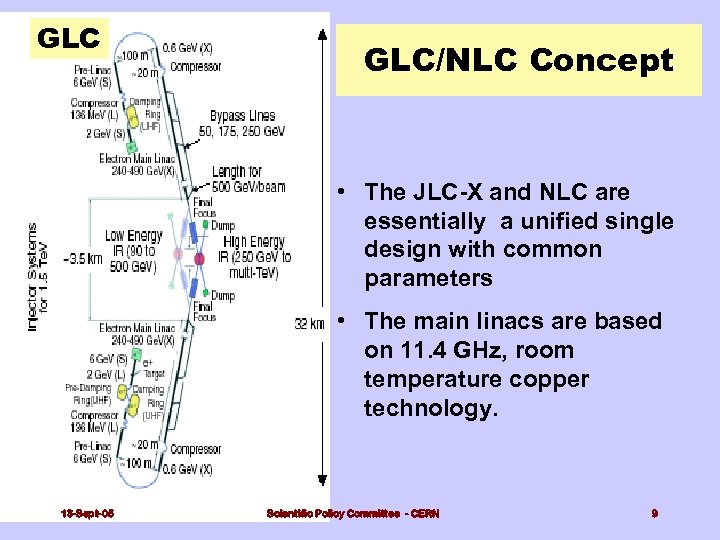
GLC GLC/NLC Concept • The JLC-X and NLC are essentially a unified single design with common parameters • The main linacs are based on 11. 4 GHz, room temperature copper technology. 13 -Sept-05 Scientific Policy Committee - CERN 9
Which Technology to Choose? – Two alternate designs -- “warm” and “cold” had come to the stage where the show stoppers had been eliminated and the concepts were well understood. – A major step toward a new international machine requires uniting behind one technology, and then make a unified global design based on the recommended technology. 13 -Sept-05 Scientific Policy Committee - CERN 10
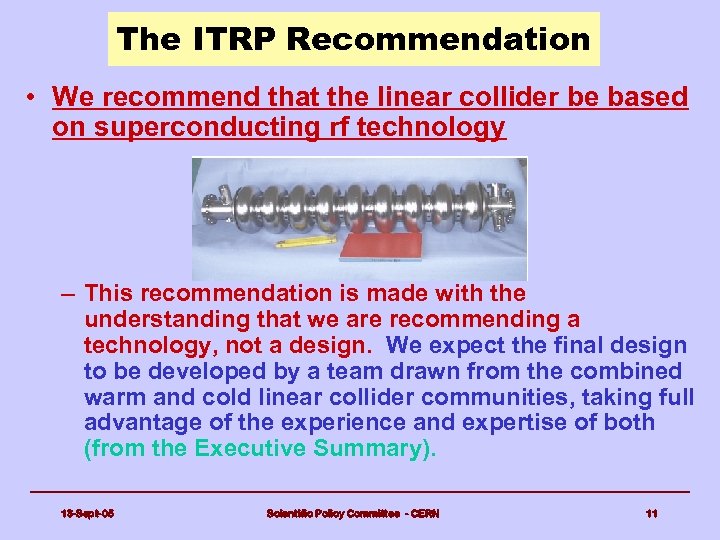
The ITRP Recommendation • We recommend that the linear collider be based on superconducting rf technology – This recommendation is made with the understanding that we are recommending a technology, not a design. We expect the final design to be developed by a team drawn from the combined warm and cold linear collider communities, taking full advantage of the experience and expertise of both (from the Executive Summary). 13 -Sept-05 Scientific Policy Committee - CERN 11
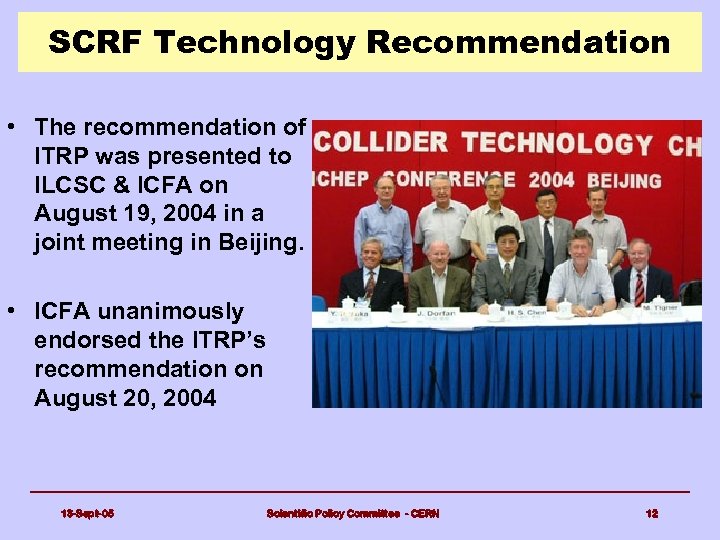
SCRF Technology Recommendation • The recommendation of ITRP was presented to ILCSC & ICFA on August 19, 2004 in a joint meeting in Beijing. • ICFA unanimously endorsed the ITRP’s recommendation on August 20, 2004 13 -Sept-05 Scientific Policy Committee - CERN 12
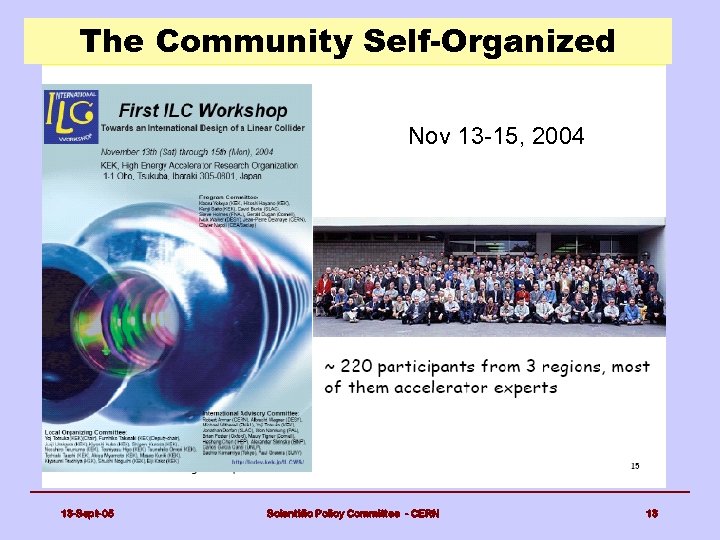
The Community Self-Organized Nov 13 -15, 2004 13 -Sept-05 Scientific Policy Committee - CERN 13
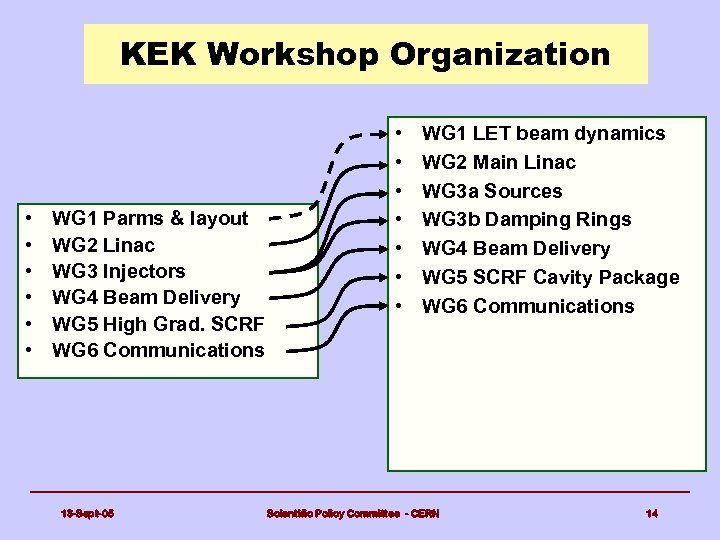
KEK Workshop Organization Birth of the GDE and Preparation for Snowmass • • • WG 1 Parms & layout WG 2 Linac WG 3 Injectors WG 4 Beam Delivery WG 5 High Grad. SCRF WG 6 Communications 13 -Sept-05 • • WG 1 LET beam dynamics WG 2 Main Linac WG 3 a Sources WG 3 b Damping Rings WG 4 Beam Delivery WG 5 SCRF Cavity Package WG 6 Communications Scientific Policy Committee - CERN 14
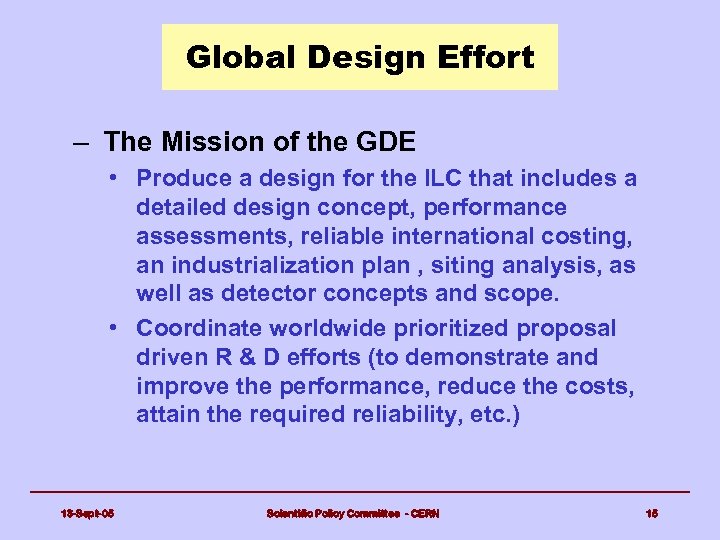
Global Design Effort – The Mission of the GDE • Produce a design for the ILC that includes a detailed design concept, performance assessments, reliable international costing, an industrialization plan , siting analysis, as well as detector concepts and scope. • Coordinate worldwide prioritized proposal driven R & D efforts (to demonstrate and improve the performance, reduce the costs, attain the required reliability, etc. ) 13 -Sept-05 Scientific Policy Committee - CERN 15
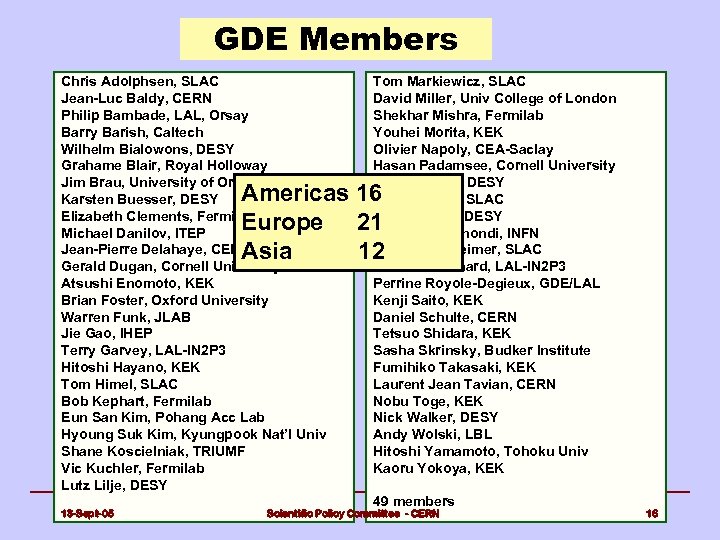
GDE Members Chris Adolphsen, SLAC Jean-Luc Baldy, CERN Philip Bambade, LAL, Orsay Barry Barish, Caltech Wilhelm Bialowons, DESY Grahame Blair, Royal Holloway Jim Brau, University of Oregon Karsten Buesser, DESY Elizabeth Clements, Fermilab Michael Danilov, ITEP Jean-Pierre Delahaye, CERN, Gerald Dugan, Cornell University Atsushi Enomoto, KEK Brian Foster, Oxford University Warren Funk, JLAB Jie Gao, IHEP Terry Garvey, LAL-IN 2 P 3 Hitoshi Hayano, KEK Tom Himel, SLAC Bob Kephart, Fermilab Eun San Kim, Pohang Acc Lab Hyoung Suk Kim, Kyungpook Nat’l Univ Shane Koscielniak, TRIUMF Vic Kuchler, Fermilab Lutz Lilje, DESY Tom Markiewicz, SLAC David Miller, Univ College of London Shekhar Mishra, Fermilab Youhei Morita, KEK Olivier Napoly, CEA-Saclay Hasan Padamsee, Cornell University Carlo Pagani, DESY Nan Phinney, SLAC Dieter Proch, DESY Pantaleo Raimondi, INFN Tor Raubenheimer, SLAC Francois Richard, LAL-IN 2 P 3 Perrine Royole-Degieux, GDE/LAL Kenji Saito, KEK Daniel Schulte, CERN Tetsuo Shidara, KEK Sasha Skrinsky, Budker Institute Fumihiko Takasaki, KEK Laurent Jean Tavian, CERN Nobu Toge, KEK Nick Walker, DESY Andy Wolski, LBL Hitoshi Yamamoto, Tohoku Univ Kaoru Yokoya, KEK Americas 16 Europe 21 Asia 12 13 -Sept-05 49 members Scientific Policy Committee - CERN 16
Participation in Snowmass 670 Scientists attended two week workshop at Snowmass 13 -Sept-05 Scientific Policy Committee - CERN 17
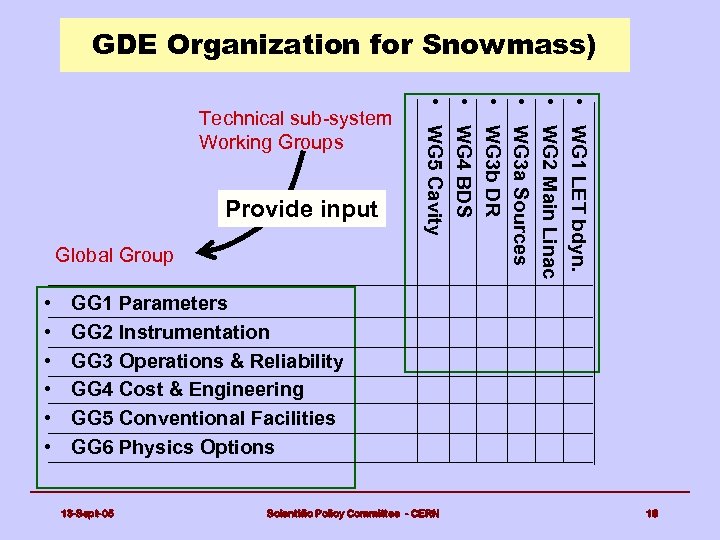
GDE Organization for Snowmass) • • • Provide input Global Group • • • WG 1 LET bdyn. WG 2 Main Linac WG 3 a Sources WG 3 b DR WG 4 BDS WG 5 Cavity Technical sub-system Working Groups GG 1 Parameters GG 2 Instrumentation GG 3 Operations & Reliability GG 4 Cost & Engineering GG 5 Conventional Facilities GG 6 Physics Options 13 -Sept-05 Scientific Policy Committee - CERN 18
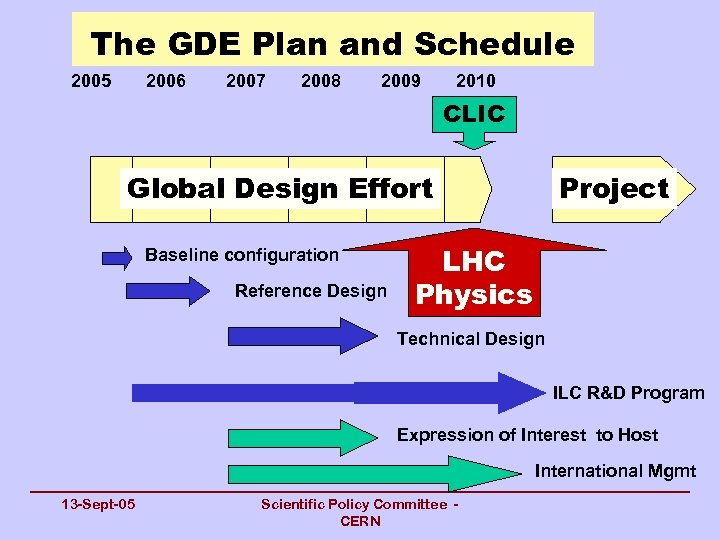
The GDE Plan and Schedule 2005 2006 2007 2008 2009 2010 CLIC Global Design Effort Baseline configuration Reference Design Project LHC Physics Technical Design ILC R&D Program Expression of Interest to Host International Mgmt 13 -Sept-05 Scientific Policy Committee CERN
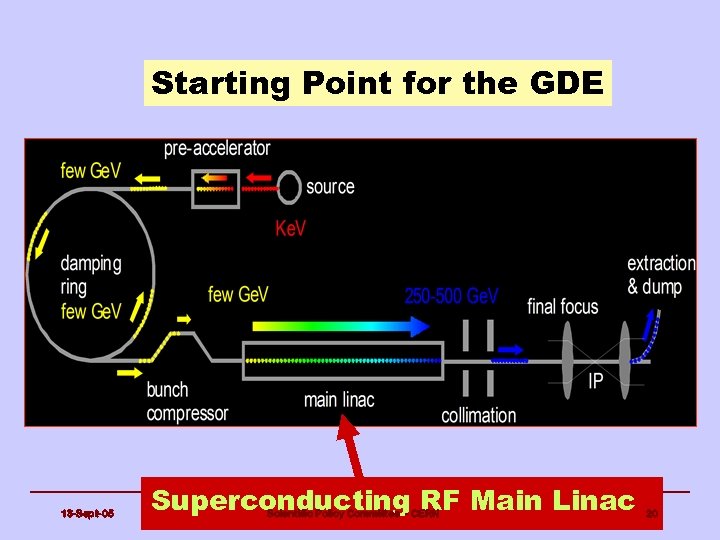
Starting Point for the GDE 13 -Sept-05 Superconducting RF Main Linac Scientific Policy Committee - CERN 20
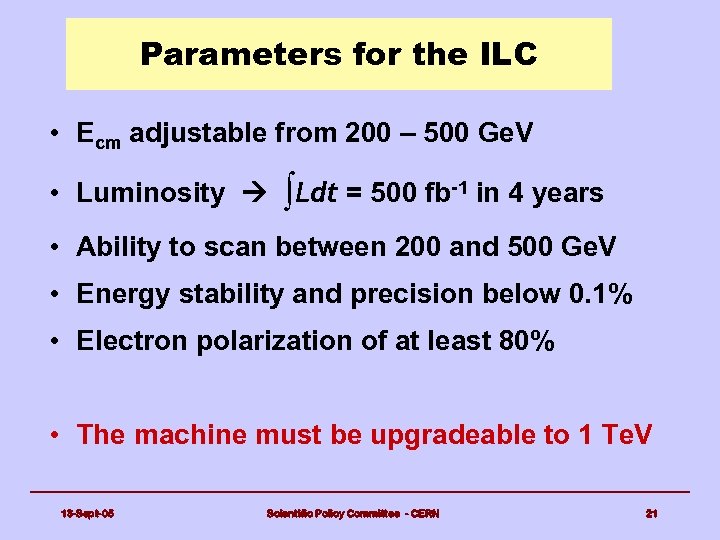
Parameters for the ILC • Ecm adjustable from 200 – 500 Ge. V • Luminosity ∫Ldt = 500 fb-1 in 4 years • Ability to scan between 200 and 500 Ge. V • Energy stability and precision below 0. 1% • Electron polarization of at least 80% • The machine must be upgradeable to 1 Te. V 13 -Sept-05 Scientific Policy Committee - CERN 21
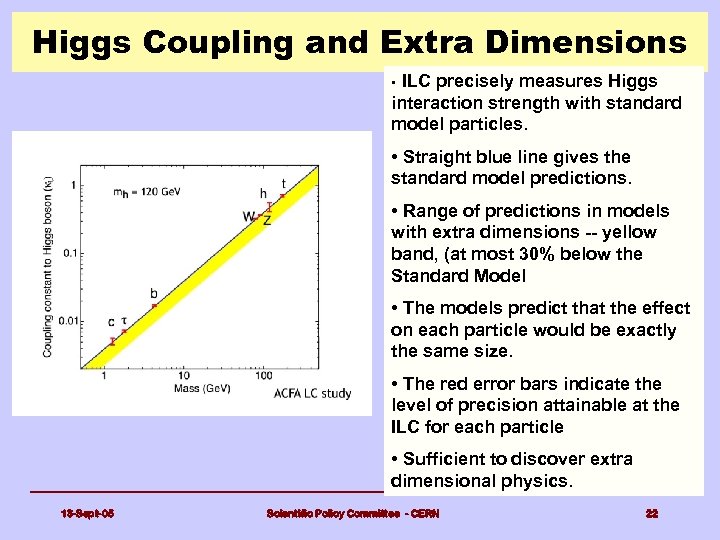
Higgs Coupling and Extra Dimensions ILC precisely measures Higgs interaction strength with standard model particles. • • Straight blue line gives the standard model predictions. • Range of predictions in models with extra dimensions -- yellow band, (at most 30% below the Standard Model • The models predict that the effect on each particle would be exactly the same size. • The red error bars indicate the level of precision attainable at the ILC for each particle • Sufficient to discover extra dimensional physics. 13 -Sept-05 Scientific Policy Committee - CERN 22
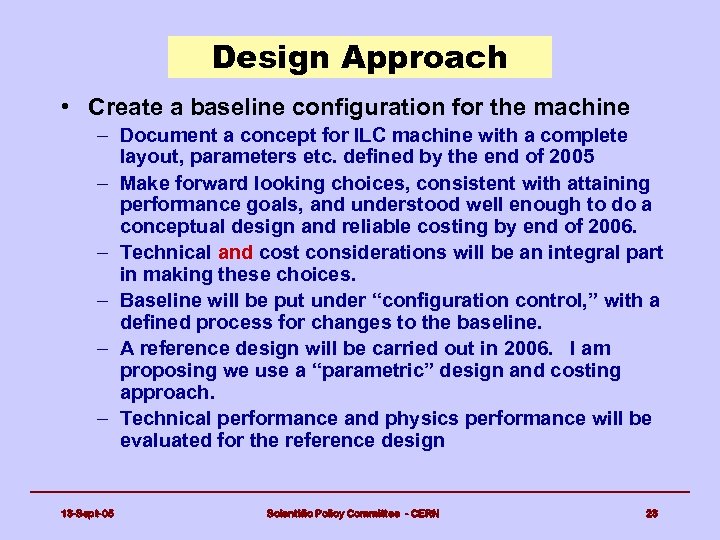
Design Approach • Create a baseline configuration for the machine – Document a concept for ILC machine with a complete layout, parameters etc. defined by the end of 2005 – Make forward looking choices, consistent with attaining performance goals, and understood well enough to do a conceptual design and reliable costing by end of 2006. – Technical and cost considerations will be an integral part in making these choices. – Baseline will be put under “configuration control, ” with a defined process for changes to the baseline. – A reference design will be carried out in 2006. I am proposing we use a “parametric” design and costing approach. – Technical performance and physics performance will be evaluated for the reference design 13 -Sept-05 Scientific Policy Committee - CERN 23
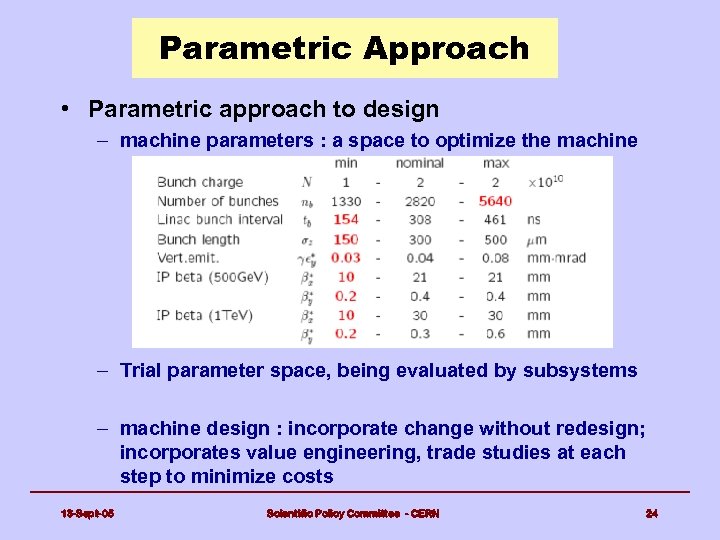
Parametric Approach • Parametric approach to design – machine parameters : a space to optimize the machine – Trial parameter space, being evaluated by subsystems – machine design : incorporate change without redesign; incorporates value engineering, trade studies at each step to minimize costs 13 -Sept-05 Scientific Policy Committee - CERN 24
Approach to ILC R&D Program • Proposal-driven R&D in support of the baseline design. – Technical developments, demonstration experiments, industrialization, etc. • Proposal-driven R&D in support of alternatives to the baseline – Proposals for potential improvements to the baseline, resources required, time scale, etc. • Develop a prioritized DETECTOR R&D program aimed at technical developments needed to reach combined design performance goals 13 -Sept-05 Scientific Policy Committee - CERN 25
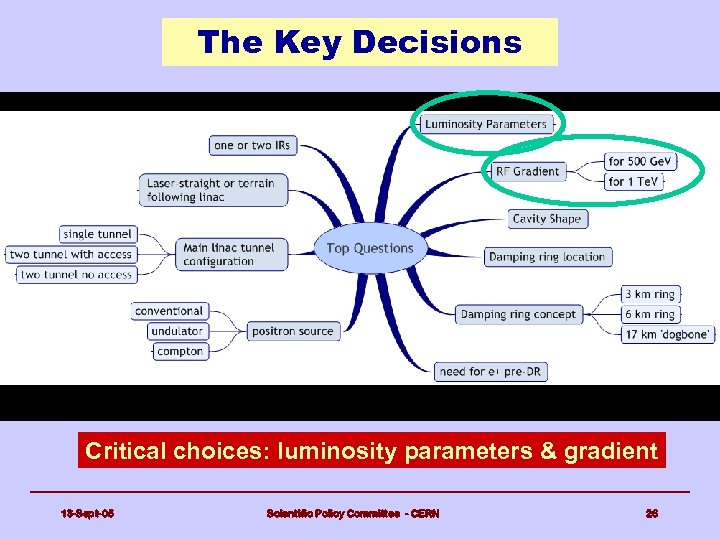
The Key Decisions Critical choices: luminosity parameters & gradient 13 -Sept-05 Scientific Policy Committee - CERN 26
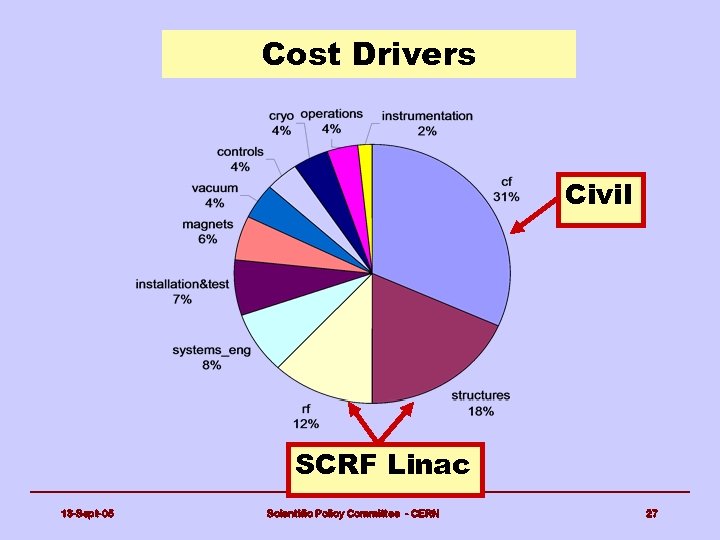
Cost Drivers Civil SCRF Linac 13 -Sept-05 Scientific Policy Committee - CERN 27
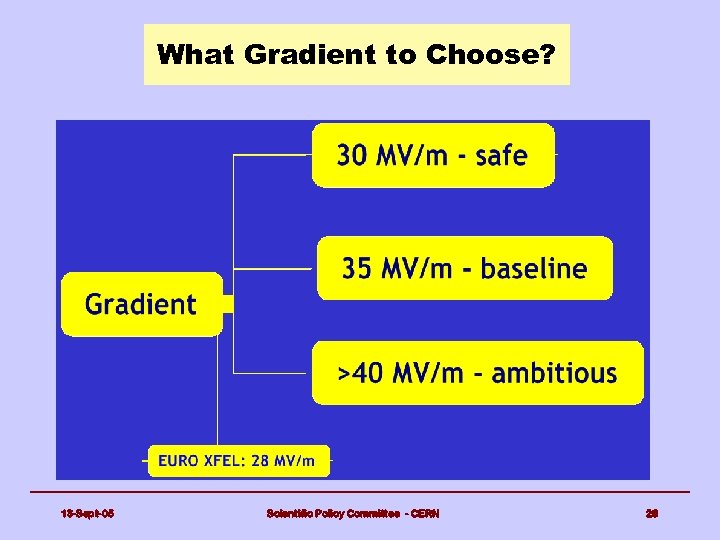
What Gradient to Choose? 13 -Sept-05 Scientific Policy Committee - CERN 28
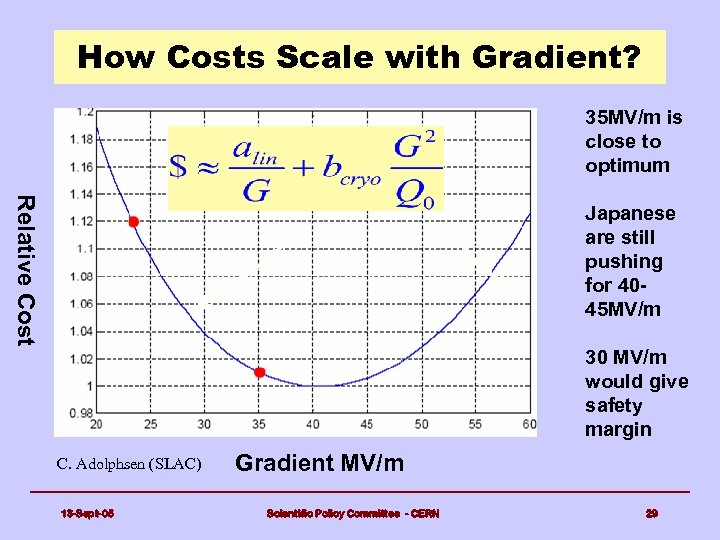
How Costs Scale with Gradient? 35 MV/m is close to optimum Relative Cost Japanese are still pushing for 4045 MV/m 30 MV/m would give safety margin C. Adolphsen (SLAC) 13 -Sept-05 Gradient MV/m Scientific Policy Committee - CERN 29
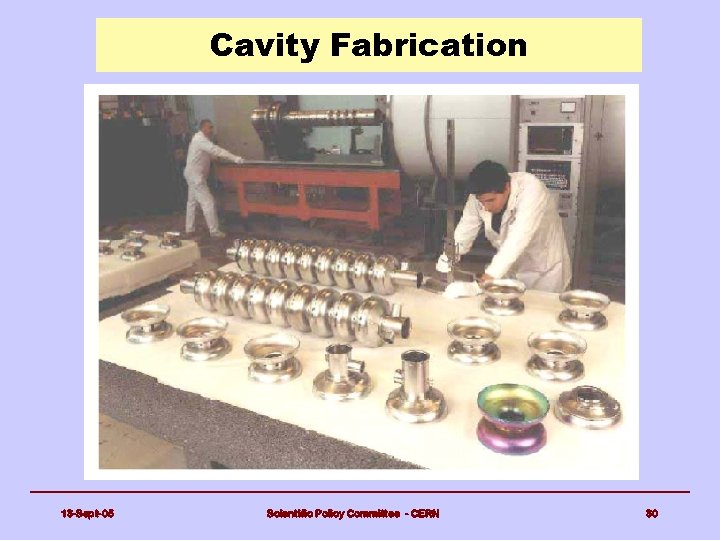
Cavity Fabrication 13 -Sept-05 Scientific Policy Committee - CERN 30
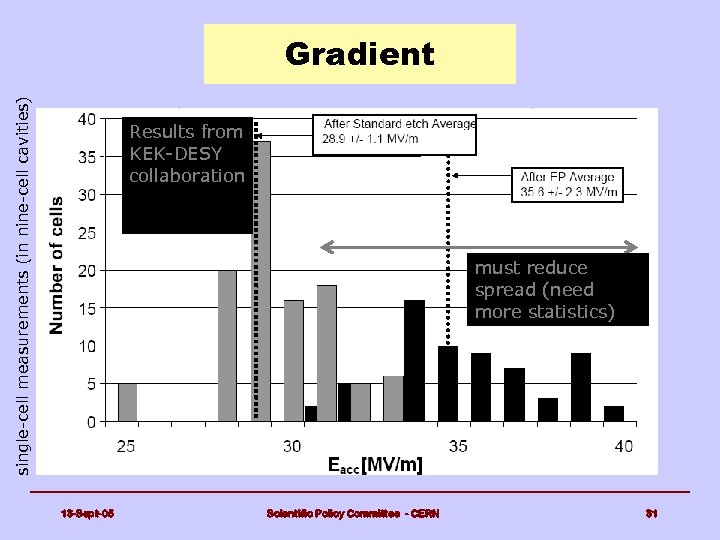
single-cell measurements (in nine-cell cavities) Gradient Results from KEK-DESY collaboration must reduce spread (need more statistics) 13 -Sept-05 Scientific Policy Committee - CERN 31
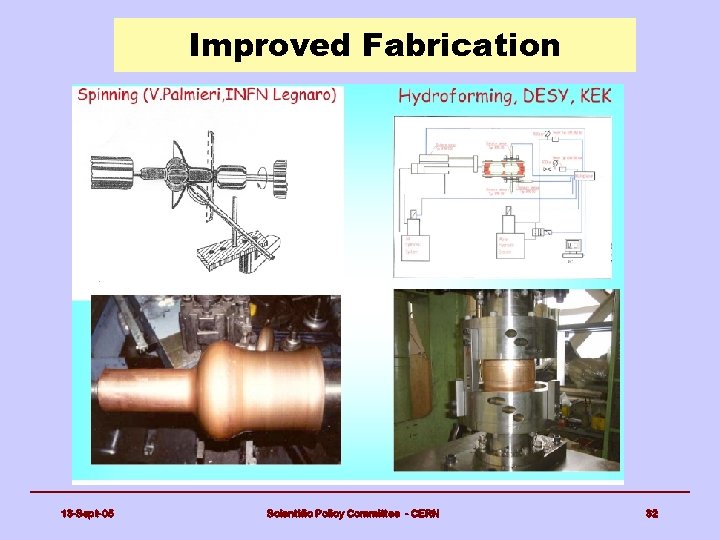
Improved Fabrication 13 -Sept-05 Scientific Policy Committee - CERN 32
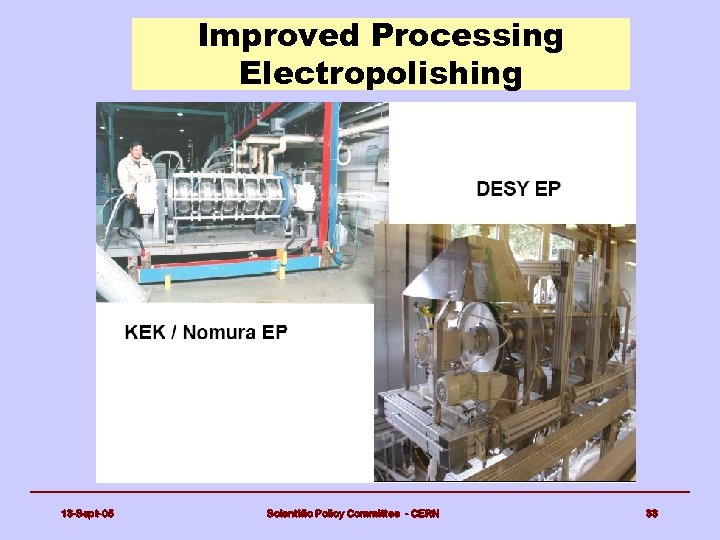
Improved Processing Electropolishing 13 -Sept-05 Scientific Policy Committee - CERN 33
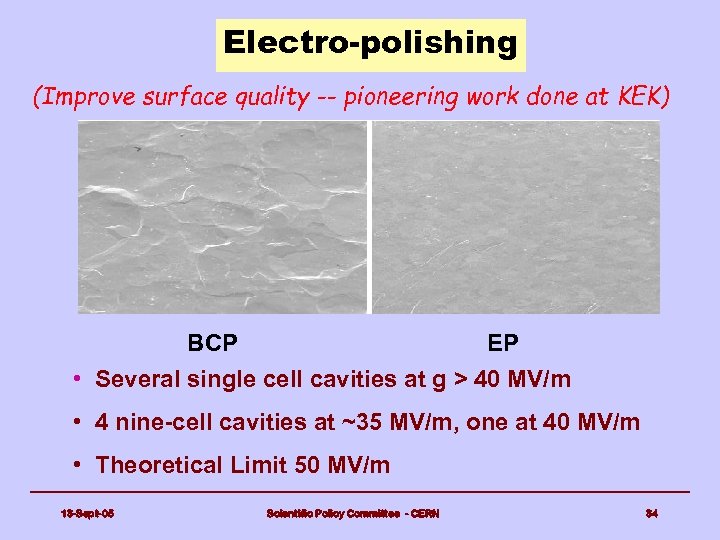
Electro-polishing (Improve surface quality -- pioneering work done at KEK) BCP EP • Several single cell cavities at g > 40 MV/m • 4 nine-cell cavities at ~35 MV/m, one at 40 MV/m • Theoretical Limit 50 MV/m 13 -Sept-05 Scientific Policy Committee - CERN 34
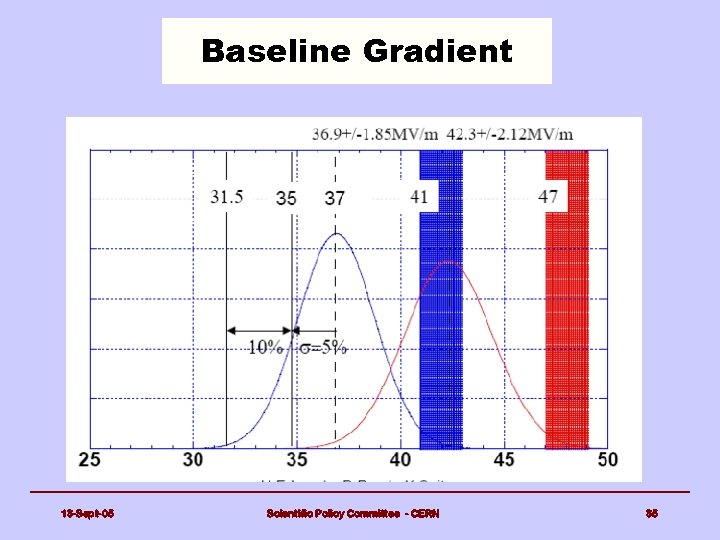
Baseline Gradient 13 -Sept-05 Scientific Policy Committee - CERN 35
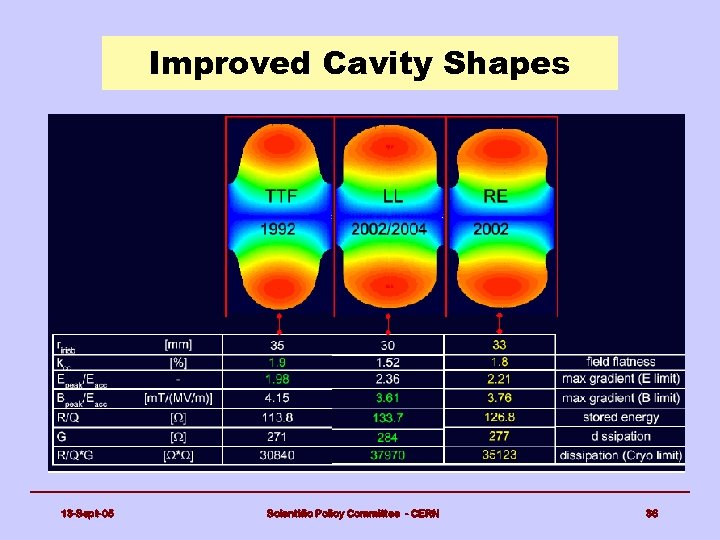
Improved Cavity Shapes 13 -Sept-05 Scientific Policy Committee - CERN 36
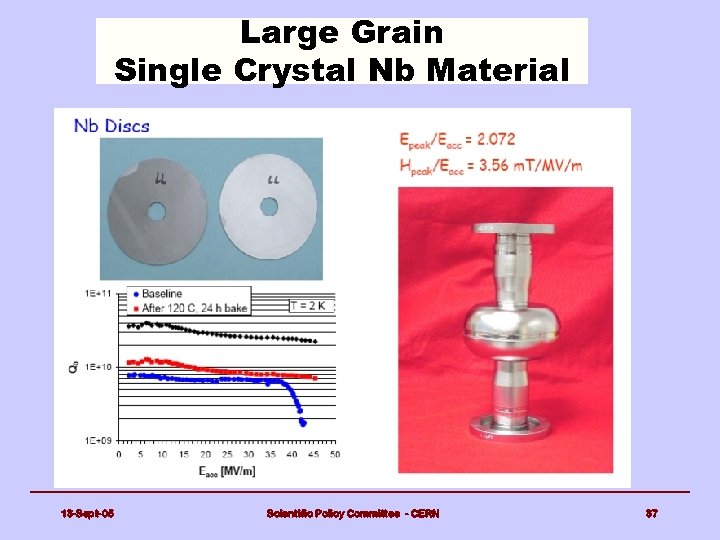
Large Grain Single Crystal Nb Material 13 -Sept-05 Scientific Policy Committee - CERN 37
ILC Siting and Civil Construction • The design is intimately tied to the features of the site – 1 tunnels or 2 tunnels? – Deep or shallow? – Laser straight linac or follow earth’s curvature in segments? • GDE ILC Design will be done to samples sites in the three regions – North American sample site will be near Fermilab – Japan choosing between three final sites – Europe sample sites --- CERN and DESY 13 -Sept-05 Scientific Policy Committee - CERN 38
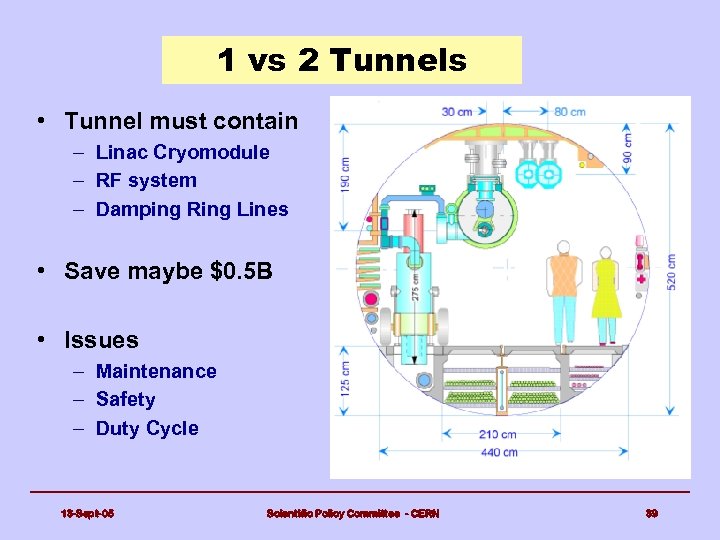
1 vs 2 Tunnels • Tunnel must contain – Linac Cryomodule – RF system – Damping Ring Lines • Save maybe $0. 5 B • Issues – Maintenance – Safety – Duty Cycle 13 -Sept-05 Scientific Policy Committee - CERN 39
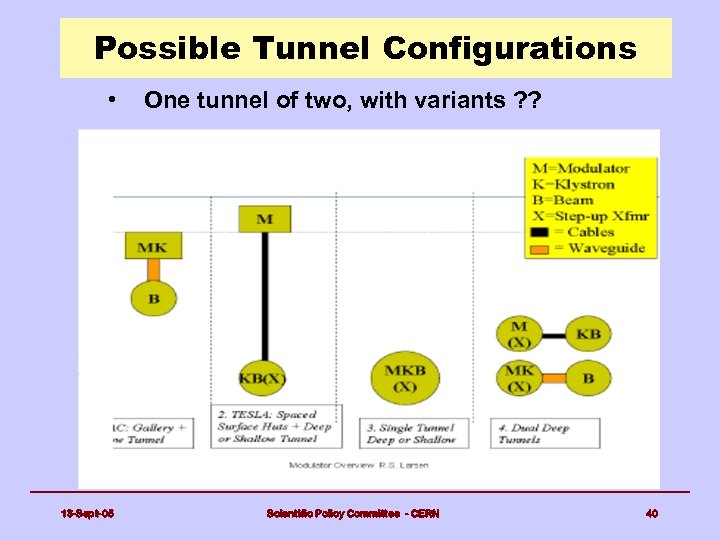
Possible Tunnel Configurations • 13 -Sept-05 One tunnel of two, with variants ? ? Scientific Policy Committee - CERN 40
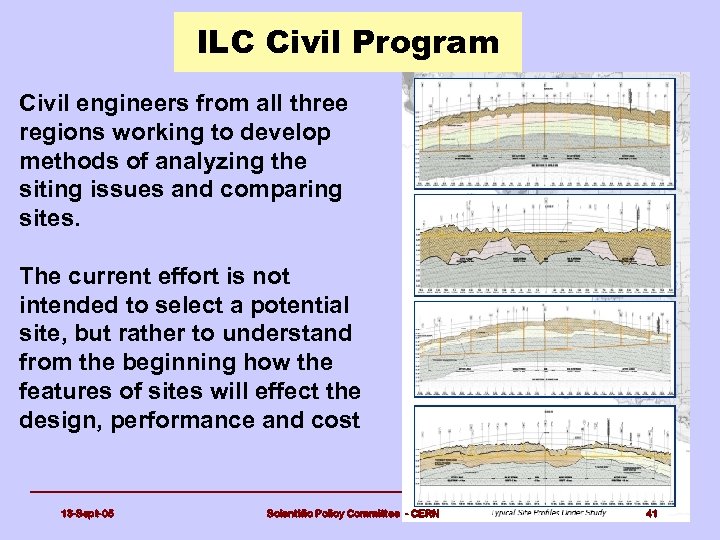
ILC Civil Program Civil engineers from all three regions working to develop methods of analyzing the siting issues and comparing sites. The current effort is not intended to select a potential site, but rather to understand from the beginning how the features of sites will effect the design, performance and cost 13 -Sept-05 Scientific Policy Committee - CERN 41
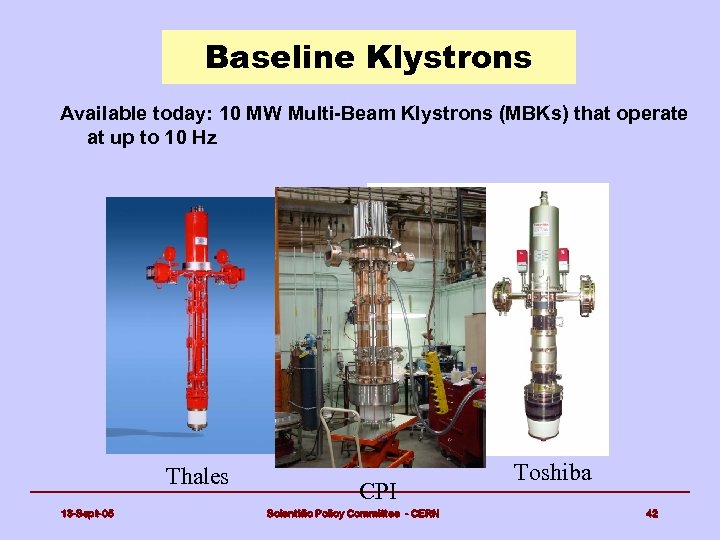
Baseline Klystrons Available today: 10 MW Multi-Beam Klystrons (MBKs) that operate at up to 10 Hz Thales 13 -Sept-05 CPI Scientific Policy Committee - CERN Toshiba 42
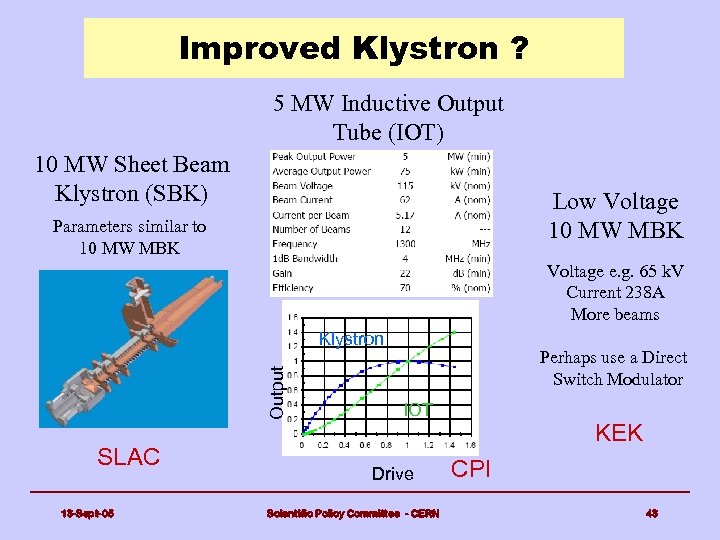
Improved Klystron ? 5 MW Inductive Output Tube (IOT) 10 MW Sheet Beam Klystron (SBK) Low Voltage 10 MW MBK Parameters similar to 10 MW MBK Voltage e. g. 65 k. V Current 238 A More beams Output Klystron SLAC 13 -Sept-05 Perhaps use a Direct Switch Modulator IOT Drive Scientific Policy Committee - CERN KEK CPI 43
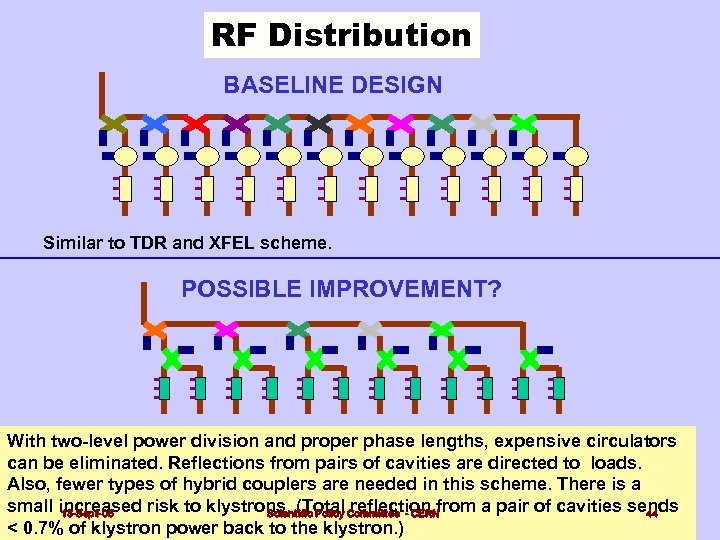
RF Distribution BASELINE DESIGN Similar to TDR and XFEL scheme. POSSIBLE IMPROVEMENT? With two-level power division and proper phase lengths, expensive circulators can be eliminated. Reflections from pairs of cavities are directed to loads. Also, fewer types of hybrid couplers are needed in this scheme. There is a small increased risk to klystrons. (Total Committee - CERN reflection from a pair of cavities sends 13 -Sept-05 Scientific Policy 44 < 0. 7% of klystron power back to the klystron. )
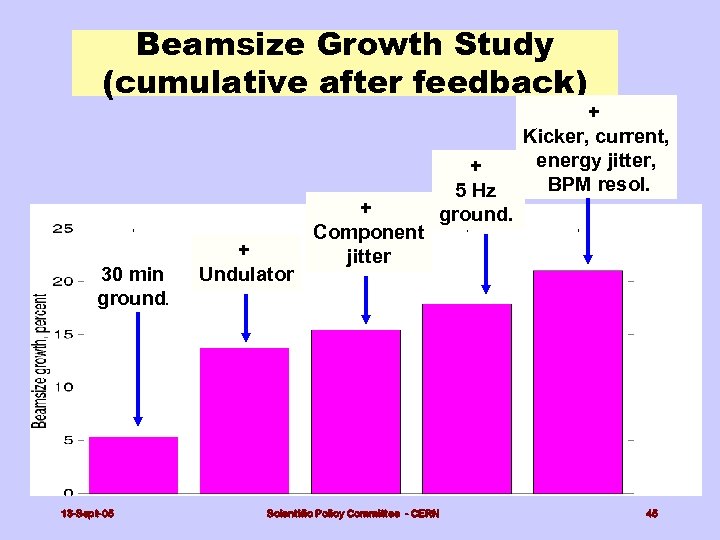
Beamsize Growth Study (cumulative after feedback) 30 min ground. 13 -Sept-05 + Undulator + Component jitter + 5 Hz ground. Scientific Policy Committee - CERN + Kicker, current, energy jitter, BPM resol. 45
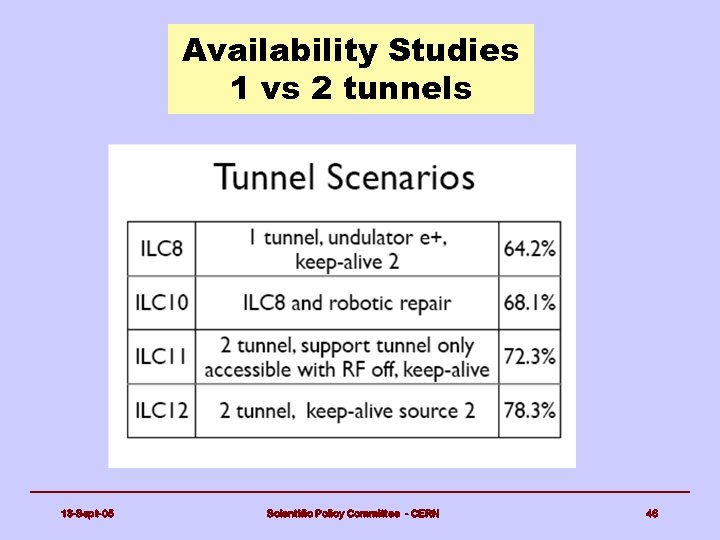
Availability Studies 1 vs 2 tunnels 13 -Sept-05 Scientific Policy Committee - CERN 46
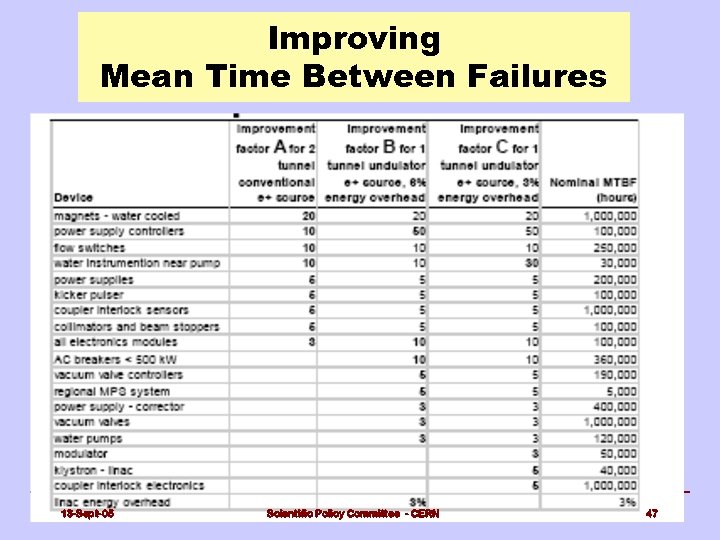
Improving Mean Time Between Failures 13 -Sept-05 Scientific Policy Committee - CERN 47
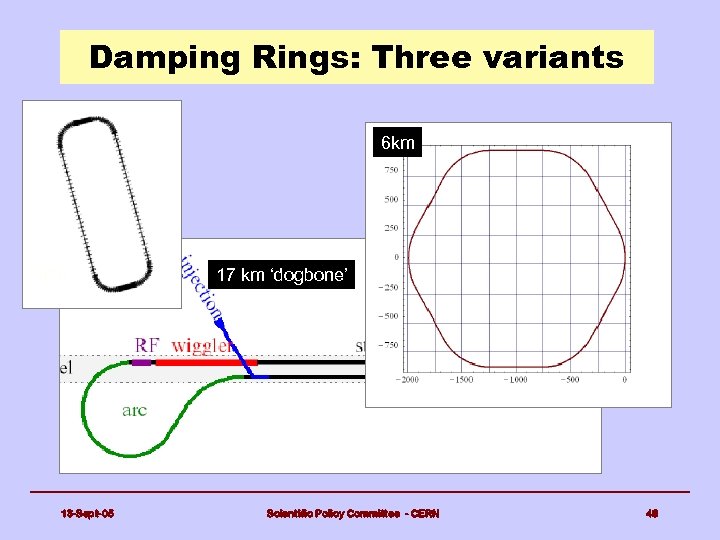
Damping Rings: Three variants 6 km 3 km 13 -Sept-05 17 km ‘dogbone’ Scientific Policy Committee - CERN 48
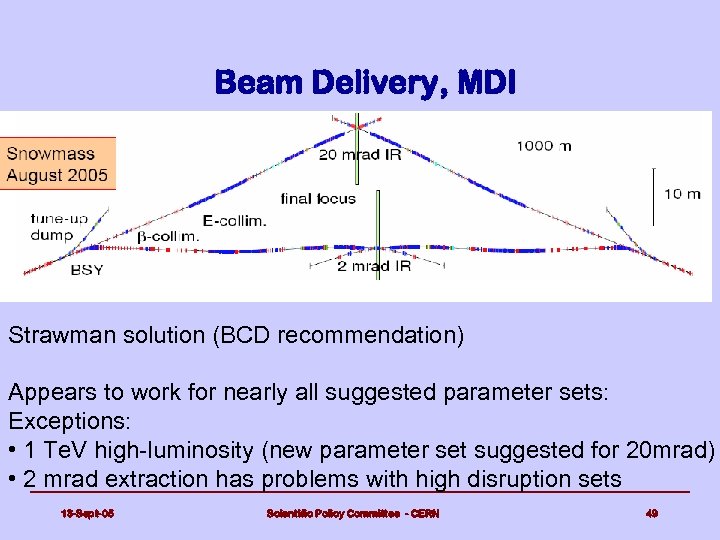
Beam Delivery, MDI Strawman solution (BCD recommendation) Appears to work for nearly all suggested parameter sets: Exceptions: • 1 Te. V high-luminosity (new parameter set suggested for 20 mrad) • 2 mrad extraction has problems with high disruption sets 13 -Sept-05 Scientific Policy Committee - CERN 49
Industrial Studies • Industrial studies in three regions are essential. – – – Important to understand industrial costs Important to examine potential cost reductions Need to think about what studies are needed and when Focus on the cost drivers for ILC, important for cost estimate Focus on places where there is technical risk to the project goals ILC need a point-of-contact and a plan for industrial studies 2 nd ILC Industrial Forum Meeting is scheduled to be held at Fermilab Sept. 21 st and 22 nd, 2005. 13 -Sept-05 Scientific Policy Committee - CERN 50
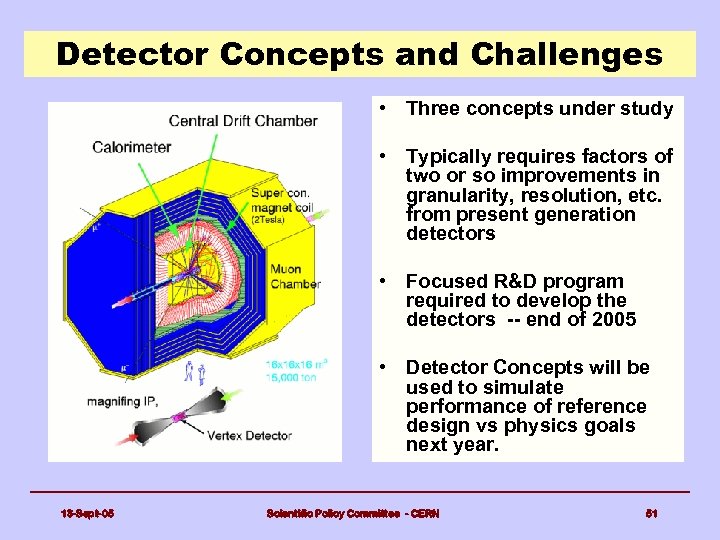
Detector Concepts and Challenges • Three concepts under study • Typically requires factors of two or so improvements in granularity, resolution, etc. from present generation detectors • Focused R&D program required to develop the detectors -- end of 2005 • Detector Concepts will be used to simulate performance of reference design vs physics goals next year. 13 -Sept-05 Scientific Policy Committee - CERN 51
Accelerator Physics Challenges • Develop High Gradient Superconducting RF systems – Requires efficient RF systems, capable of accelerating high power beams (~MW) with small beam spots(~nm). • Achieving nm scale beam spots – Requires generating high intensity beams of electrons and positrons – Damping the beams to ultra-low emittance in damping rings – Transporting the beams to the collision point without significant emittance growth or uncontrolled beam jitter – Cleanly dumping the used beams. • Reaching Luminosity Requirements – Designs satisfy the luminosity goals in simulations – A number of challenging problems in accelerator physics and technology must be solved, however. 13 -Sept-05 Scientific Policy Committee - CERN 52
Creating an International Project • Several Studies and Plans for ILC – OECD (Organization for Economic Cooperation and Development) • “A template for Establishing, Funding and Managing an International Scientific Research Project Based on an Agreement Between Governments and Institutions” – Features a template that covers all aspects of creating agreements for an international collaboration, in particular formal agreements, funding arrangements, central structure and using existing institutions 13 -Sept-05 Scientific Policy Committee - CERN 53
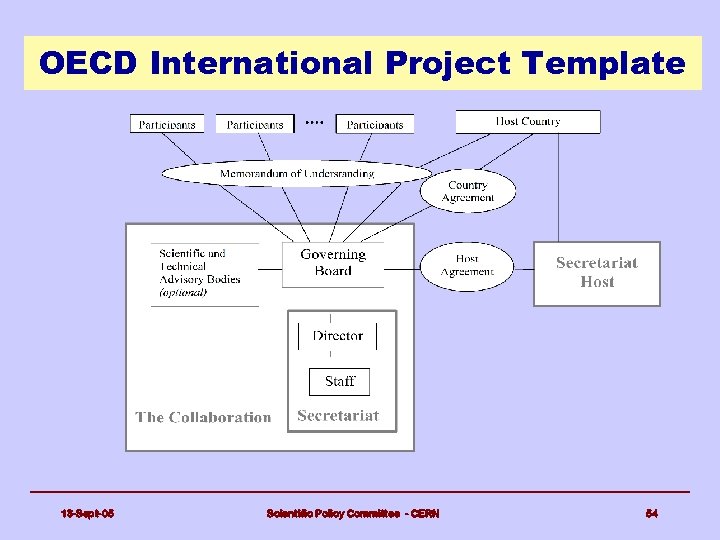
OECD International Project Template 13 -Sept-05 Scientific Policy Committee - CERN 54
Creating an International Project • Several Studies and Plans for ILC – TESLA proposed plan for Project Organization • “Organization and Management of an International Collaboration on the TESLA Linear Collider” – Features a “Global Accelerator Network”, which is basically a collaboration between institutions where as much as possible the participation is treated as an extension of the laboratory programs and even the accelerator is to be run locally from the collaborating laboratories. 13 -Sept-05 Scientific Policy Committee - CERN 55
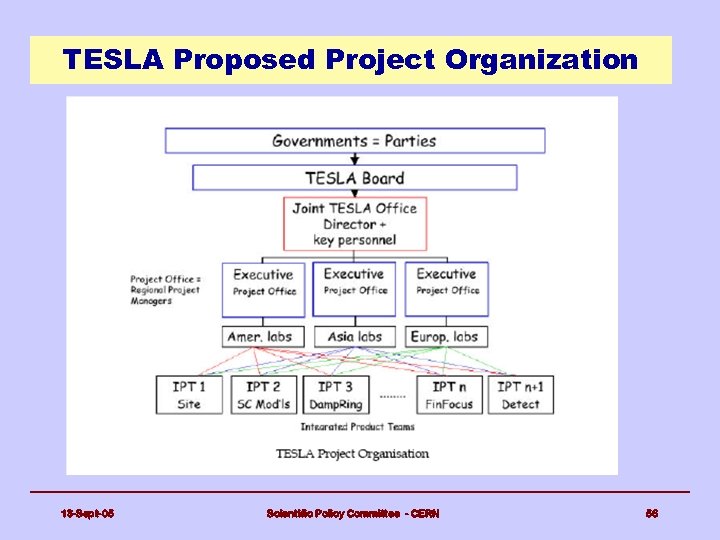
TESLA Proposed Project Organization 13 -Sept-05 Scientific Policy Committee - CERN 56
Creating an International Project • Several Studies and Plans for ILC – ECFA EUROPEAN COMMITTEE FOR FUTURE ACCELERATORS subcomittee EUROPEAN LINEAR COLLIDER STEERING GROUP • “Report of the Sub-group on Organizational Matters” – Features a detailed breakdown of top level governance and project management, how they relate to each other. It is based on regional organizations; mostly in-kind contributions; shared central management, oversight, responsibility. It is concerned with Europe and how to do it within European Labs (CERN) and structures 13 -Sept-05 Scientific Policy Committee - CERN 57
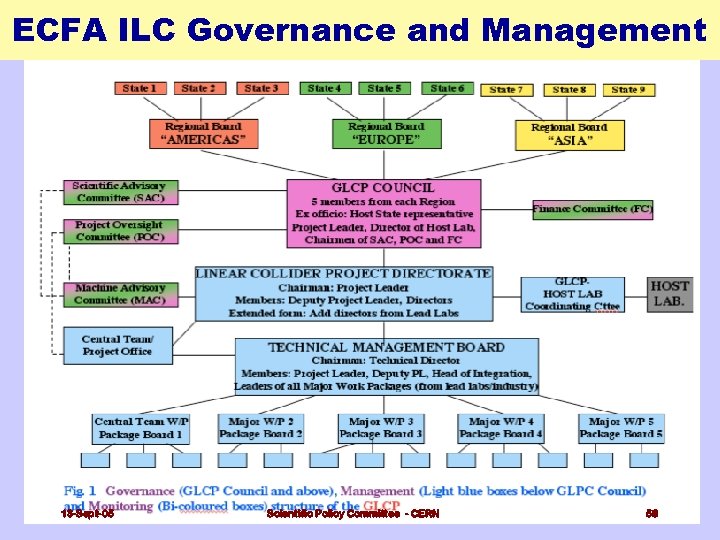
ECFA ILC Governance and Management 13 -Sept-05 Scientific Policy Committee - CERN 58
Conclusions Remarkable progress in the past two years toward realizing an international linear collider: important R&D on accelerator systems definition of parameters for physics choice of technology start the global design effort funding agencies are engaged v Many major hurdles remain before the ILC becomes a reality (funding, site, international organization, and most importantly, a technical design and construction plan) v The time scale for ILC project readiness is consistent with early results from LHC and CLIC feasability studies. 13 -Sept-05 Scientific Policy Committee - CERN 59
Скачать презентацию The ILC Global Design Effort Barry Barish SPC
7f38635775bfc9642c6f0684d3b1a7aa.ppt