


 Скачать презентацию The IEEE Teacher In-Service Program in Shenzhen 7
3f63f1e99e614b859d0c1c8dcf16fef3.ppt
- Количество слайдов: 78
 +The IEEE Teacher In-Service Program in Shenzhen 7 -8 July 2009 WELCOME!
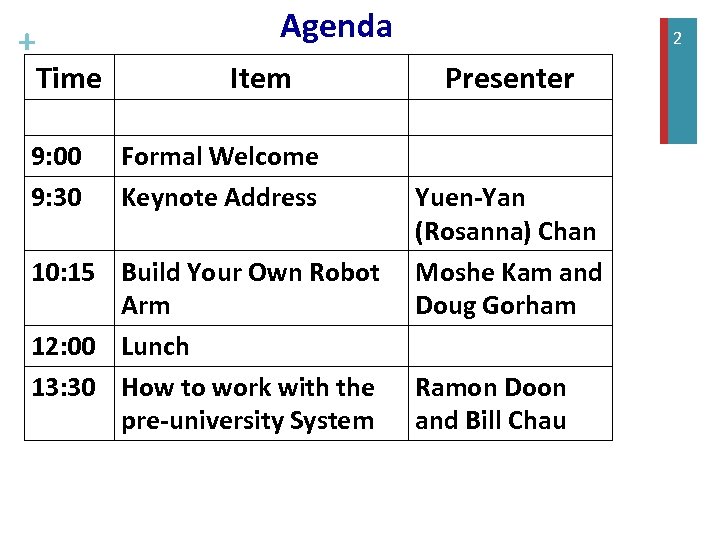 + Agenda Time 9: 00 9: 30 Item Formal Welcome Keynote Address 10: 15 Build Your Own Robot Arm 12: 00 Lunch 13: 30 How to work with the pre-university System 2 Presenter Yuen-Yan (Rosanna) Chan Moshe Kam and Doug Gorham Ramon Doon and Bill Chau
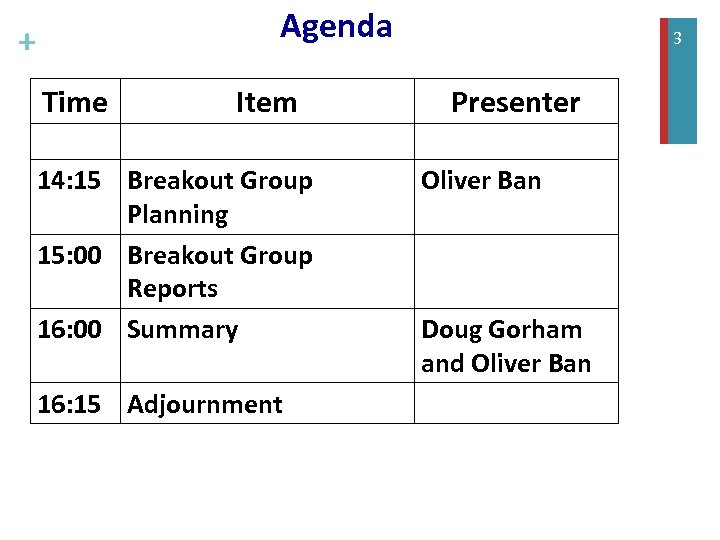 Agenda + Time Item 14: 15 Breakout Group Planning 15: 00 Breakout Group Reports 16: 00 Summary 16: 15 Adjournment 3 Presenter Oliver Ban Doug Gorham and Oliver Ban
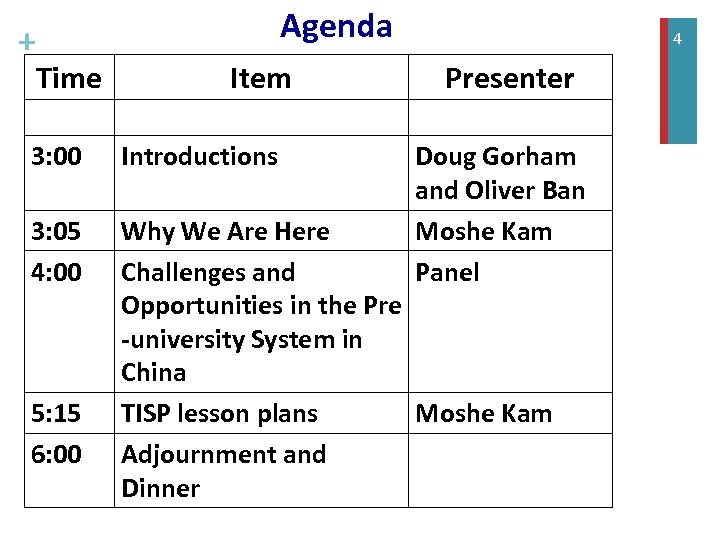 + Agenda Time Item 4 Presenter 3: 00 Introductions 3: 05 4: 00 Why We Are Here Challenges and Opportunities in the Pre -university System in China TISP lesson plans Moshe Kam Adjournment and Dinner 5: 15 6: 00 Doug Gorham and Oliver Ban Moshe Kam Panel
 + Teacher In Service Program in China Why Are We Here? Introduction by Moshe Kam IEEE Educational Activities July 2009
 + Speaker: Moshe Kam n 6 Department Head of Electrical and Computer Engineering, Drexel University, Philadelphia, Pennsylvania, USA n IEEE Volunteer for approximately 30 years n Served IEEE as Vice President for Educational Activities and as Region Director n Currently chairs… n the New Initiatives Committee n the Global Accreditation Committee
 + Outline 7 7 n Our Organization: IEEE n IEEE’s Educational Activities n Why and how is IEEE interested in promoting engineering in the preuniversity education system in China? n What do we plan to do in this workshop? n What are the long term benefits and expectations?
 + Our Organization – IEEE n An international professional association dedicated to theory and practice of electrical, electronics, communications and computer engineering n as well as computer science, the allied branches of engineering, and related arts and sciences n. Established 125 years ago n. Operating in 150 countries 8
 + Our Organization – IEEE n. Has approximately 380, 000 members n The largest technical professional association in the world n $350 M annual budget n Headquarter in New York City, NY, USA n. Employs approximately 1000 staff members 9
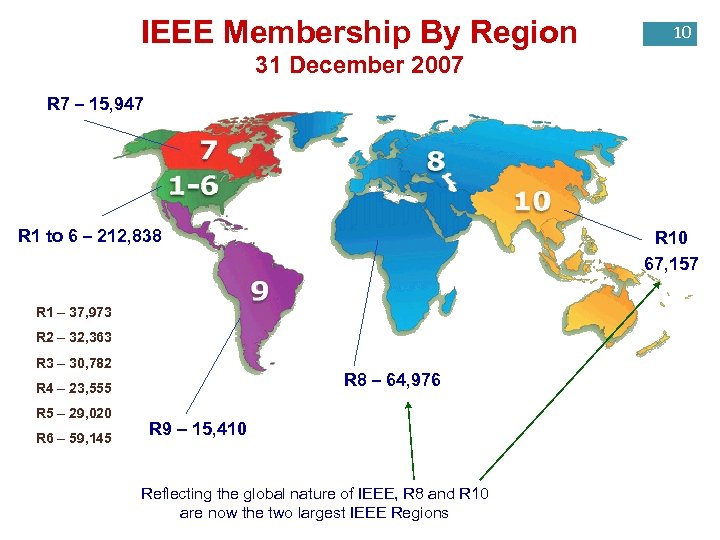 IEEE Membership By Region 10 31 December 2007 R 7 – 15, 947 R 1 to 6 – 212, 838 R 10 67, 157 R 1 – 37, 973 R 2 – 32, 363 R 3 – 30, 782 R 8 – 64, 976 R 4 – 23, 555 R 5 – 29, 020 R 6 – 59, 145 R 9 – 15, 410 Reflecting the global nature of IEEE, R 8 and R 10 are now the two largest IEEE Regions
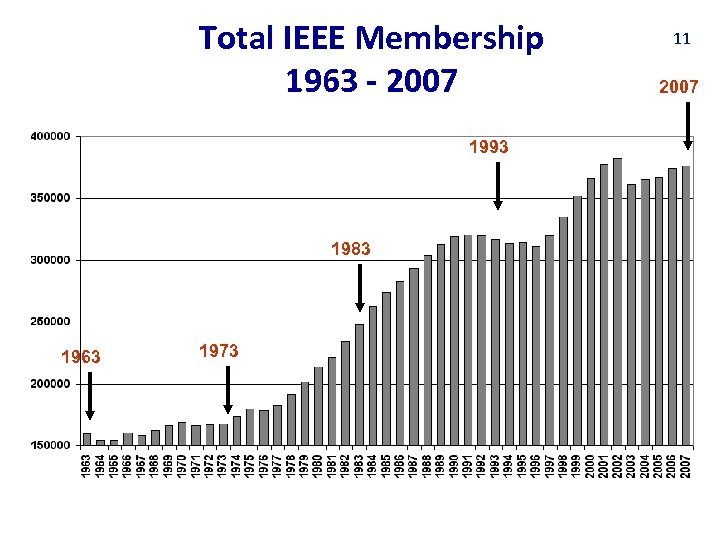 Total IEEE Membership 1963 - 2007 1993 1983 1963 1973 11 2007
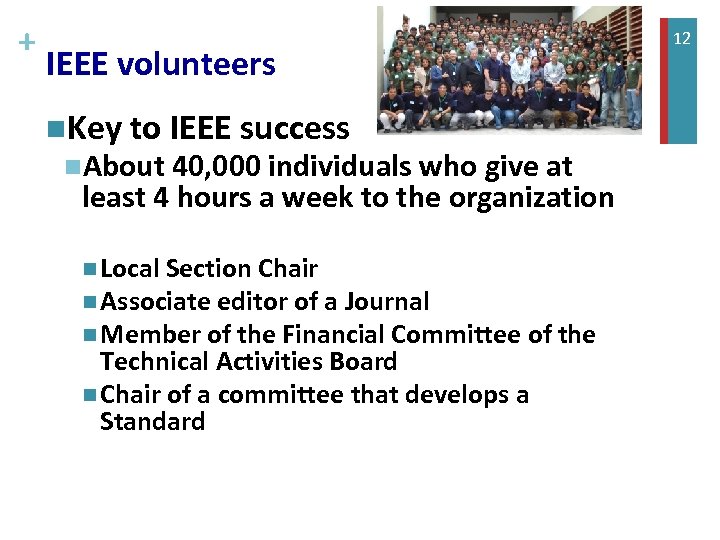 + IEEE volunteers n. Key to IEEE success n. About 40, 000 individuals who give at least 4 hours a week to the organization n Local Section Chair n Associate editor of a Journal n Member of the Financial Committee of the Technical Activities Board n Chair of a committee that develops a Standard 12
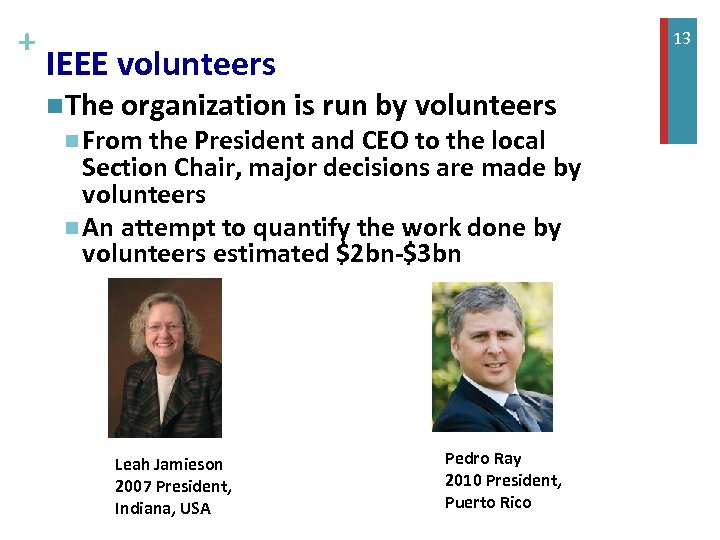 + 13 IEEE volunteers n. The organization is run by volunteers n From the President and CEO to the local Section Chair, major decisions are made by volunteers n An attempt to quantify the work done by volunteers estimated $2 bn-$3 bn Leah Jamieson 2007 President, Indiana, USA Pedro Ray 2010 President, Puerto Rico
 + IEEE’s principal activities (1) n Organizing community the professional n. Based on geographic distribution and areas of interest n Publishing technical and scientific literature on the State of the Art n Organizing conferences on relevant technical and scientific matters 14
 + IEEE’s principal activities (2) n Developing technical standards n Approximately 900 standards at present n. Developing educational activities for professionals and for the public n Including students and teachers in the pre- university system n Improving understanding of engineering technology and computing by the public n Recognizing the leaders of the profession n Awards and membership grades 15
 + What are we trying to do… n…advance global prosperity by n. Fostering technological innovation n. Enabling members' careers n. Promoting community worldwide n for the benefit of humanity and the profession 16
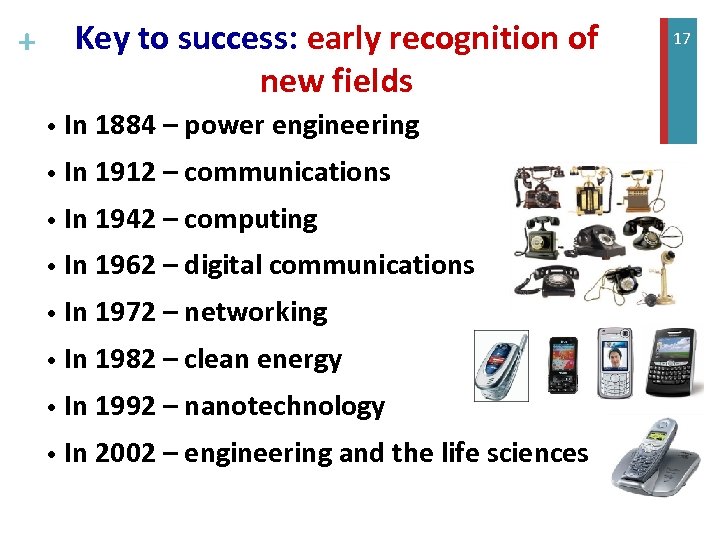 + Key to success: early recognition of new fields • In 1884 – power engineering • In 1912 – communications • In 1942 – computing • In 1962 – digital communications • In 1972 – networking • In 1982 – clean energy • In 1992 – nanotechnology • In 2002 – engineering and the life sciences 17
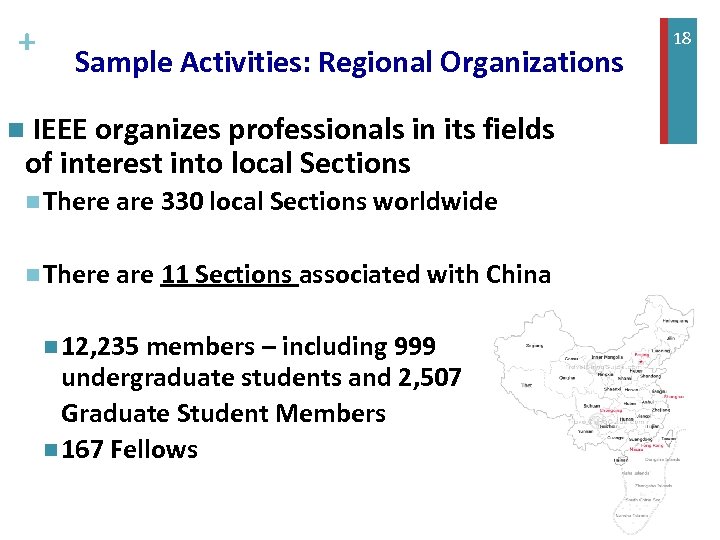 + Sample Activities: Regional Organizations n IEEE organizes professionals in its fields of interest into local Sections n There are 330 local Sections worldwide n There are 11 Sections associated with China n 12, 235 members – including 999 undergraduate students and 2, 507 Graduate Student Members n 167 Fellows 18
 + Highest participation in societies in China n. IEEE Computer Society n. IEEE Communication Society n. IEEE Power and Energy Society 19
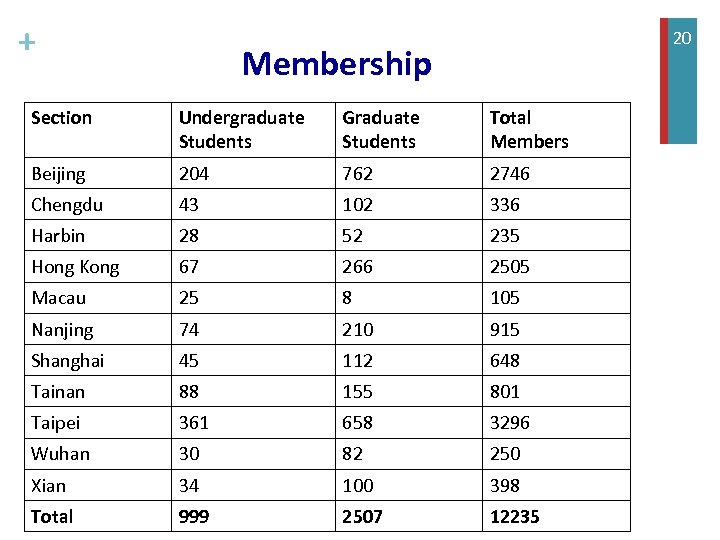 + 20 Membership Section Undergraduate Students Graduate Students Total Members Beijing 204 762 2746 Chengdu 43 102 336 Harbin 28 52 235 Hong Kong 67 266 2505 Macau 25 8 105 Nanjing 74 210 915 Shanghai 45 112 648 Tainan 88 155 801 Taipei 361 658 3296 Wuhan 30 82 250 Xian 34 100 398 Total 999 2507 12235
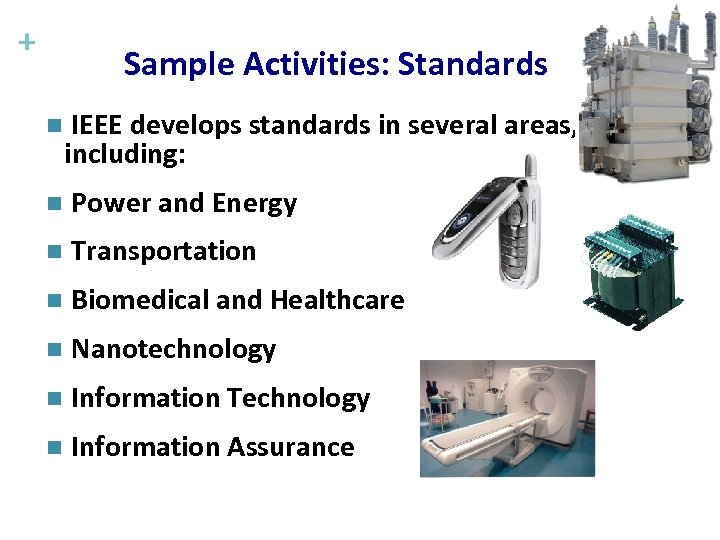 + Sample Activities: Standards n IEEE develops standards in several areas, including: n Power and Energy n Transportation n Biomedical and Healthcare n Nanotechnology n Information Technology n Information Assurance 21
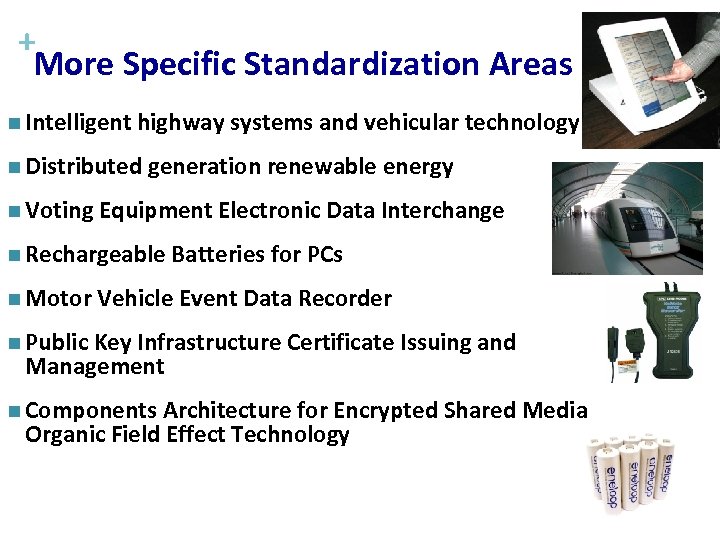 + More Specific Standardization Areas n Intelligent highway systems and vehicular technology n Distributed generation renewable energy n Voting Equipment Electronic Data Interchange n Rechargeable Batteries for PCs n Motor Vehicle Event Data Recorder n Public Key Infrastructure Certificate Issuing and Management n Components Architecture for Encrypted Shared Media Organic Field Effect Technology 22
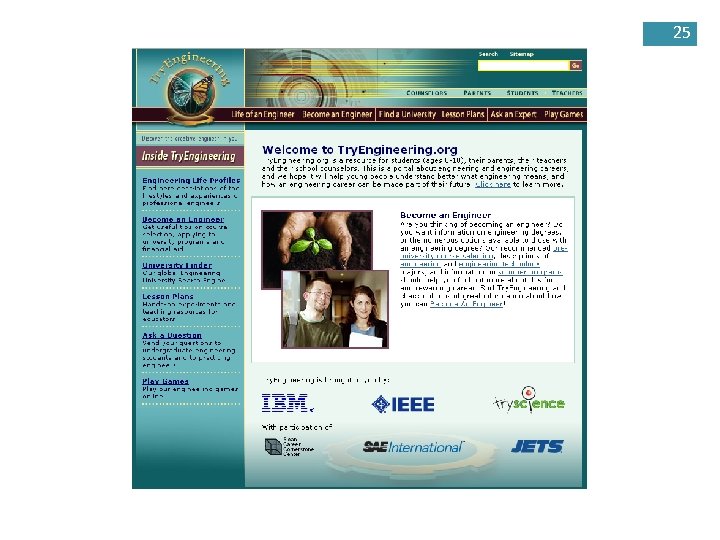
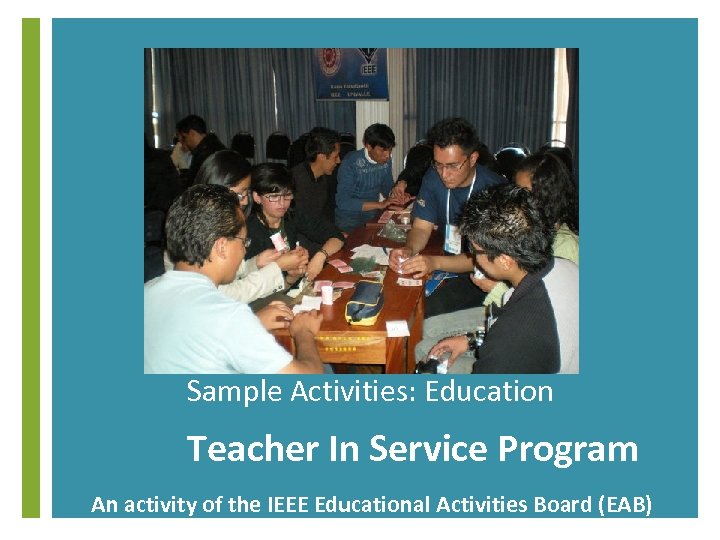
 + Sample Activities: Education Try. Engineering. org An activity of the IEEE Educational Activities Board (EAB)
 24
24
 25
25
 26
26
 27
27
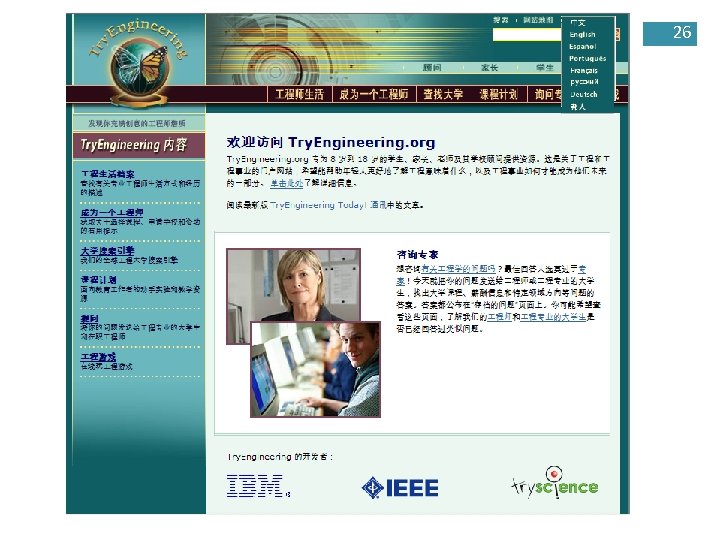
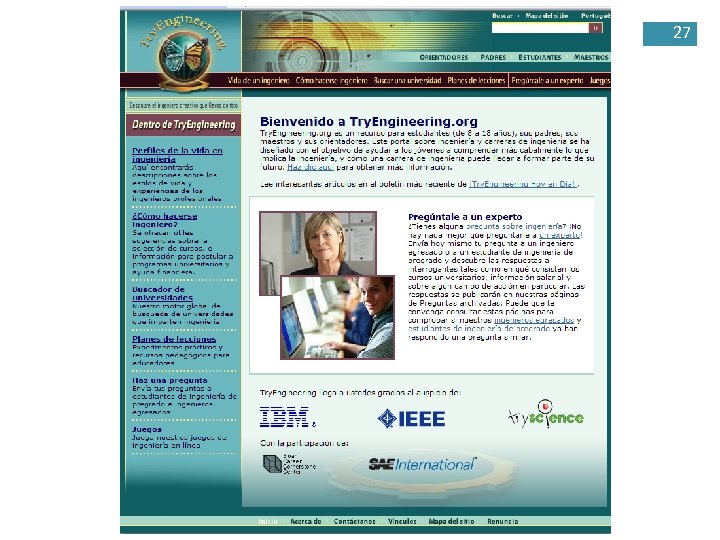
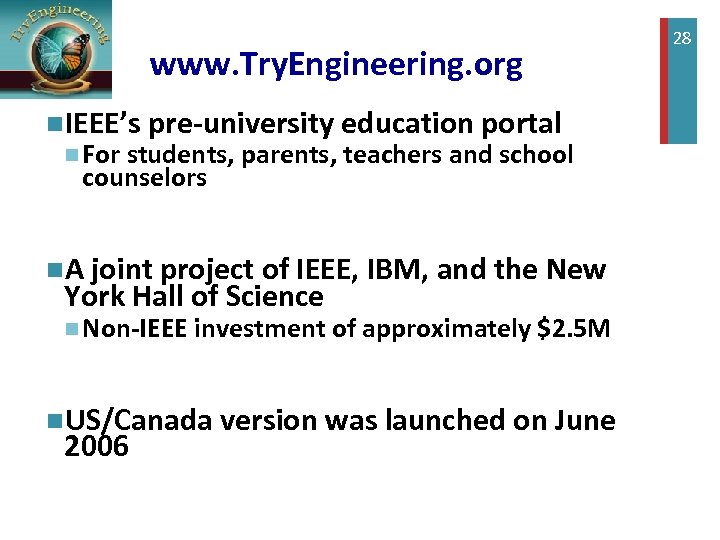 + www. Try. Engineering. org n. IEEE’s pre-university education portal n For students, parents, teachers and school counselors n. A joint project of IEEE, IBM, and the New York Hall of Science n Non-IEEE investment of approximately $2. 5 M n. US/Canada version was launched on June 2006 28
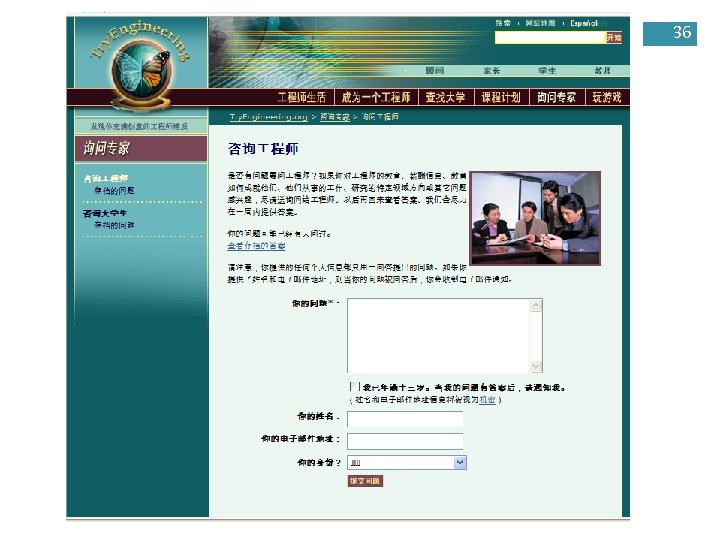
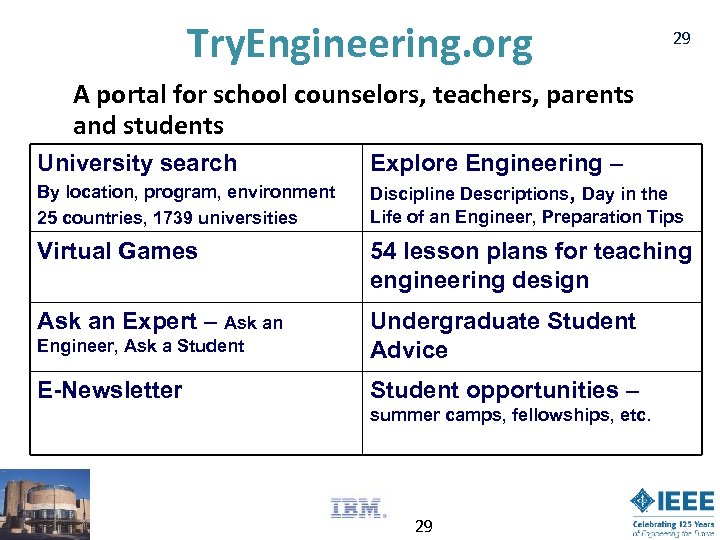 Try. Engineering. org 29 A portal for school counselors, teachers, parents and students University search By location, program, environment 25 countries, 1739 universities Explore Engineering – Discipline Descriptions, Day in the Life of an Engineer, Preparation Tips Virtual Games 54 lesson plans for teaching engineering design Ask an Expert – Ask an Engineer, Ask a Student Undergraduate Student Advice E-Newsletter Student opportunities – summer camps, fellowships, etc. 29
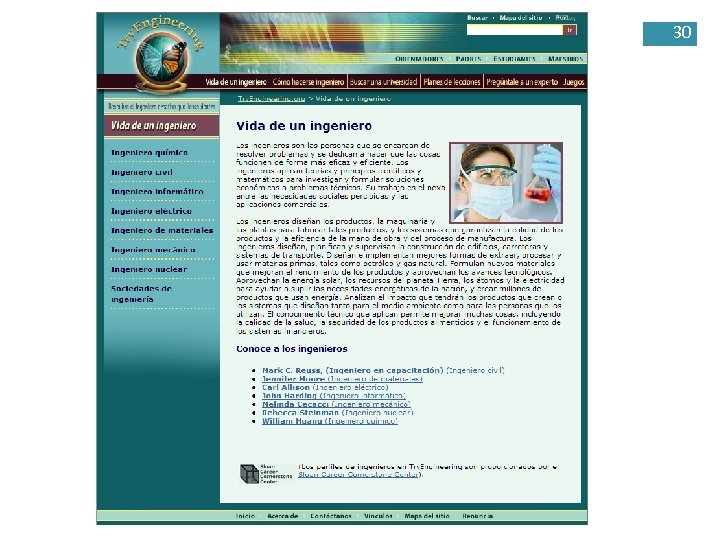 30
30
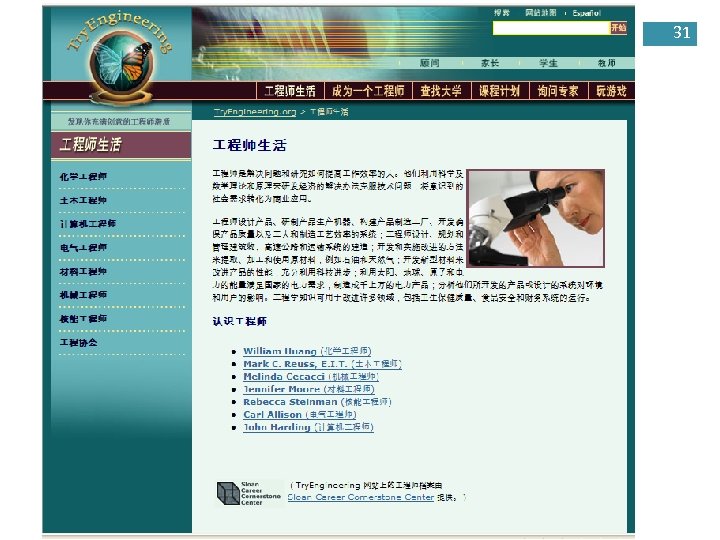 31
31
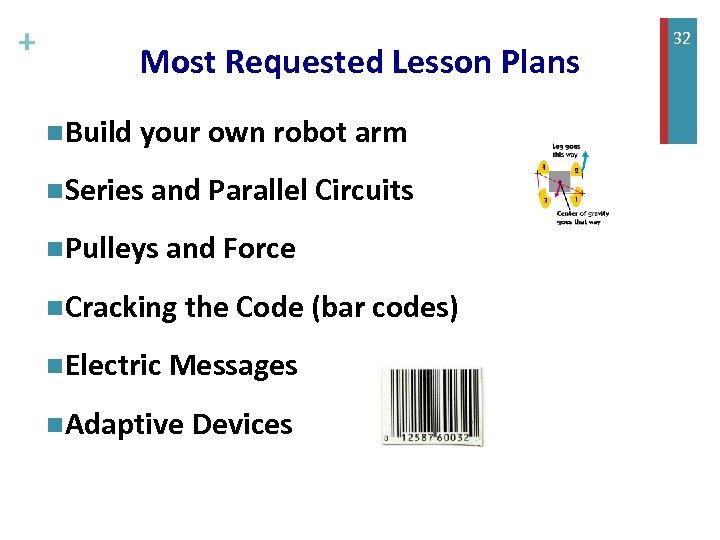 + Most Requested Lesson Plans n. Build your own robot arm n. Series and Parallel Circuits n. Pulleys and Force n. Cracking the Code (bar codes) n. Electric Messages n. Adaptive Devices 32
 + University Searches: 25 Countries n Argentina n Mexico n Australia n New Zealand n Austria n Pakistan n Belgium n Portugal n Brazil Russia n Canada n n France n Singapore n Germany n South Africa n India n Switzerland n Ireland n Taiwan n Japan n Turkey n Korea n United Kingdom n Malaysia n United States 33 33
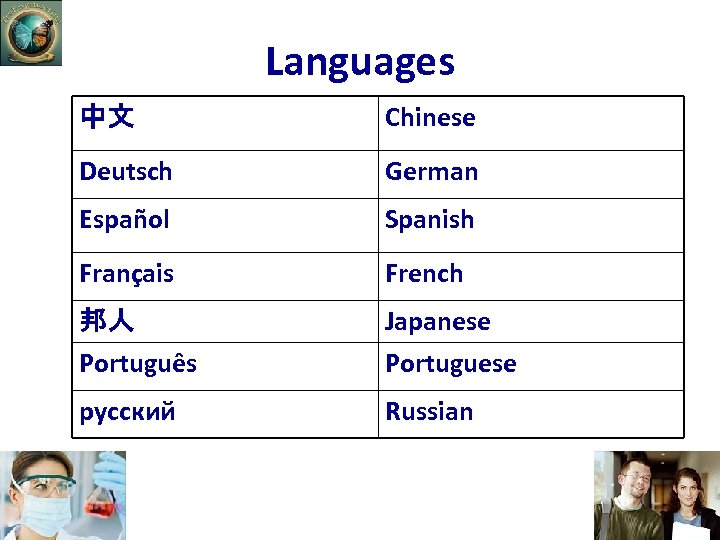 Languages 中文 Chinese Deutsch German Español Spanish Français French 邦人 Português Japanese Portuguese русский Russian
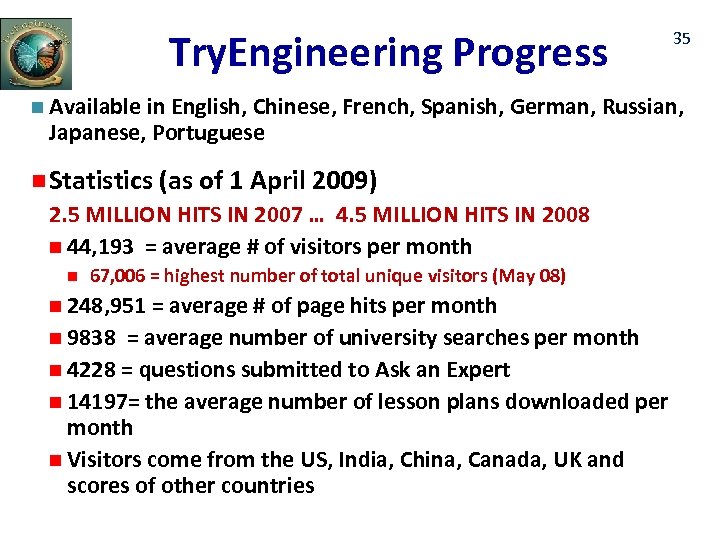 Try. Engineering Progress 35 n Available in English, Chinese, French, Spanish, German, Russian, Japanese, Portuguese n Statistics (as of 1 April 2009) 2. 5 MILLION HITS IN 2007 … 4. 5 MILLION HITS IN 2008 n 44, 193 = average # of visitors per month n 67, 006 = highest number of total unique visitors (May 08) n 248, 951 = average # of page hits per month n 9838 = average number of university searches per month n 4228 = questions submitted to Ask an Expert n 14197= the average number of lesson plans downloaded per month n Visitors come from the US, India, China, Canada, UK and scores of other countries
 36
36
 + Sample Activities: Education Teacher In Service Program An activity of the IEEE Educational Activities Board (EAB)
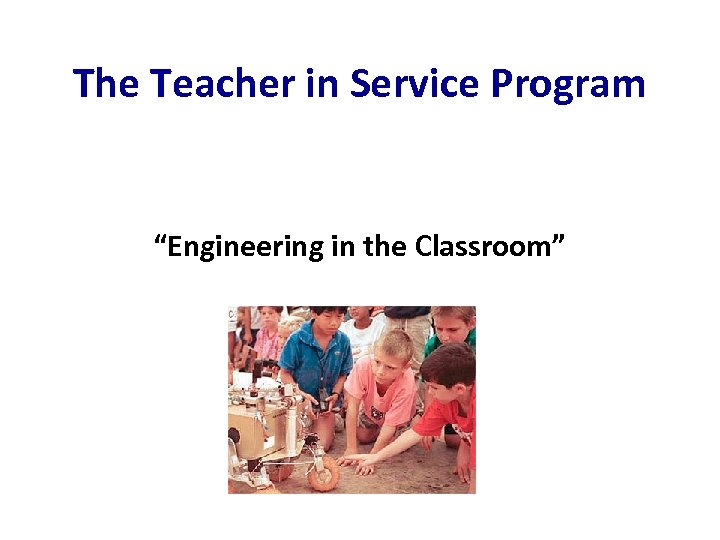
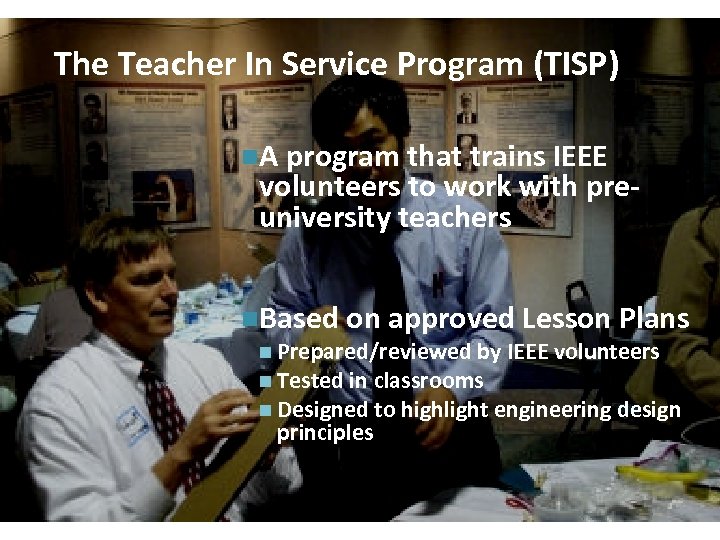 + The Teacher In Service Program (TISP) 38 n. A program that trains IEEE volunteers to work with preuniversity teachers n. Based on approved Lesson Plans n Prepared/reviewed by IEEE volunteers n Tested in classrooms n Designed to highlight engineering design principles
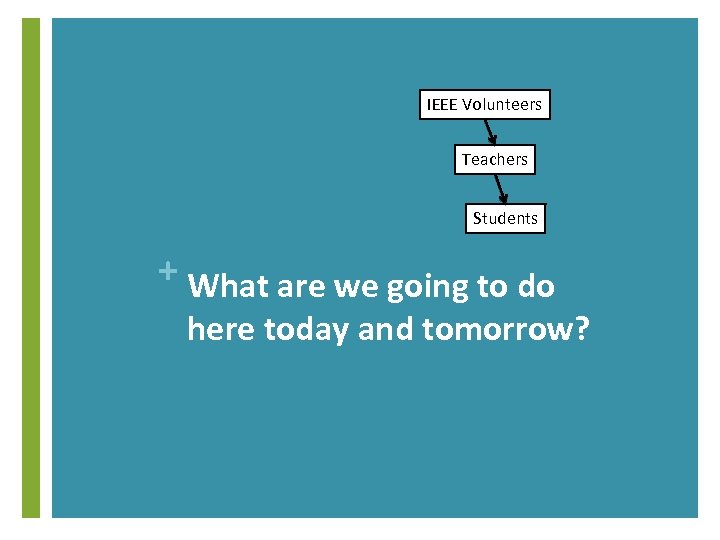
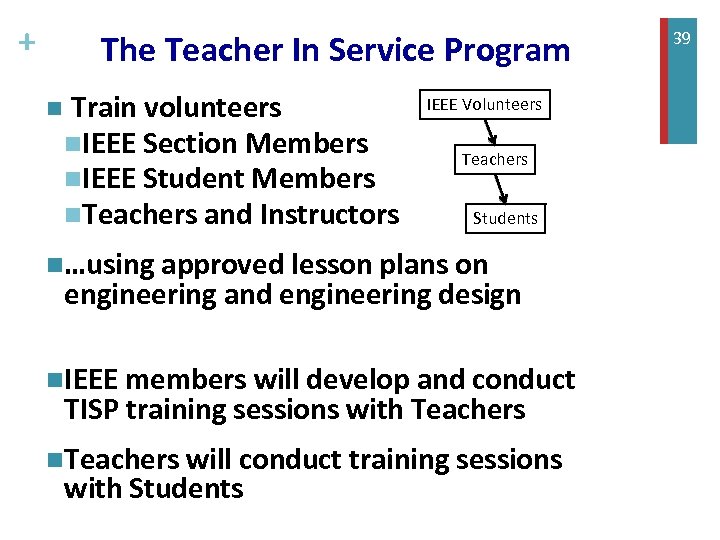 + The Teacher In Service Program n Train volunteers n. IEEE Section Members n. IEEE Student Members n. Teachers and Instructors IEEE Volunteers Teachers Students n…using approved lesson plans on engineering and engineering design n. IEEE members will develop and conduct TISP training sessions with Teachers n. Teachers will conduct training sessions with Students 39
 + Our Overall TISP Goals n. Empower IEEE Section “champions” to develop collaborations with local pre-university education community to promote applied learning n. Enhance the level of technological literacy of pre-university educators n. Encourage pre-university students to pursue technical careers, including engineering 40
 + Our Overall TISP Goals n. Increase the general level of technological literacy of pre-university students n. Increase the level of understanding of the needs of educators among the engineering community n. Identify ways that engineers can assist schools and school systems 41
 + Why TISP in China? Why is China of Interest to IEEE Educational Activities?
 + OECD PISA Program n. OECD = Organization for Economic Cooperation and Development n Established 1961 n 30 Countries n Budget: Euro 303 M n n. PISA = Programme for International Student Assessment 43
 + Objectives of PISA Review of OECD Statistics (PISA 2006) n Are students well prepared for future challenges? n Can they analyze, reason and communicate effectively? n Do they have the capacity to continue learning throughout life? n Surveys of 15 -year-olds in the principal industrialized countries. n Every three years, it assesses how far students near the end of compulsory education have acquired some of the knowledge and skills essential for full participation in society 44 44
 + Review of OECD Statistics (PISA 2006) n. To the extent that PISA tests were given in China the results were very good. n. The analytical abilities of students from China in PISA tests were significantly higher than average. Source: PISA 2006 45 45
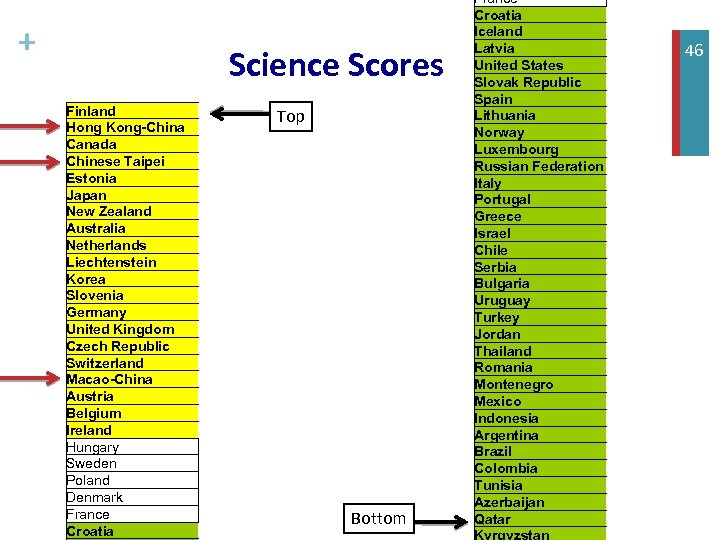 + Science Scores Finland Hong Kong-China Canada Chinese Taipei Estonia Japan New Zealand Australia Netherlands Liechtenstein Korea Slovenia Germany United Kingdom Czech Republic Switzerland Macao-China Austria Belgium Ireland Hungary Sweden Poland Denmark France Croatia Top Bottom France Croatia Iceland Latvia United States Slovak Republic Spain Lithuania Norway Luxembourg Russian Federation Italy Portugal Greece Israel Chile Serbia Bulgaria Uruguay Turkey Jordan Thailand Romania Montenegro Mexico Indonesia Argentina Brazil Colombia Tunisia Azerbaijan Qatar 46 46
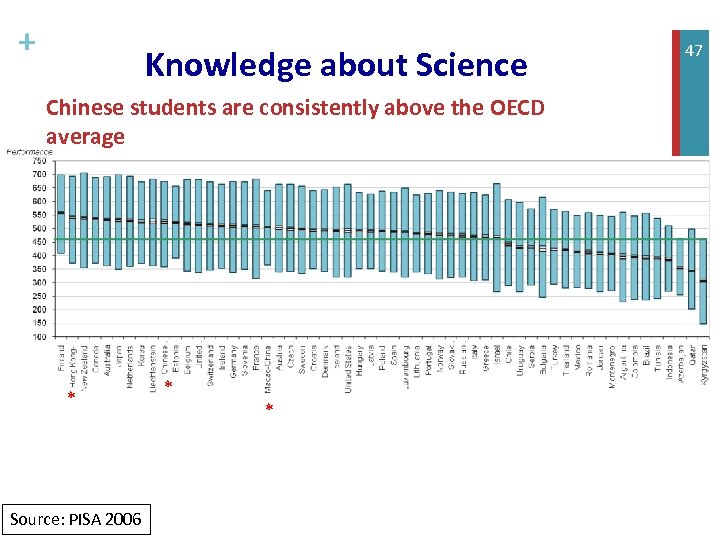 + Knowledge about Science Chinese students are consistently above the OECD average * Source: PISA 2006 * * 47 47
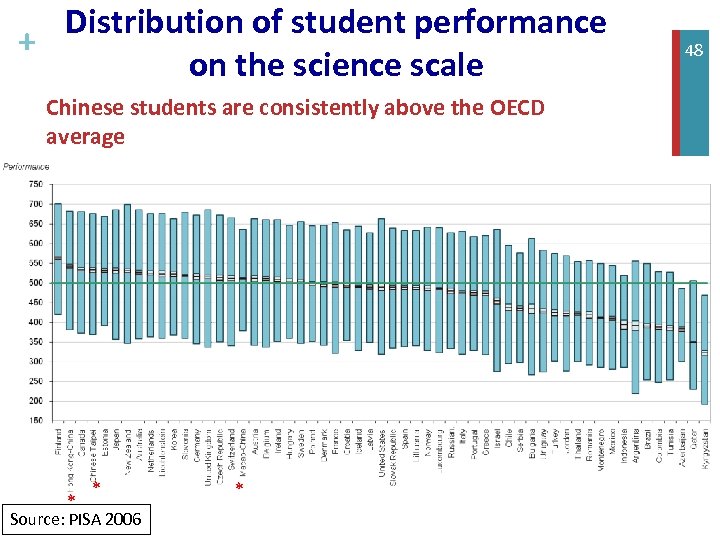 Distribution of student performance + on the science scale Chinese students are consistently above the OECD average * * Source: PISA 2006 * 48 48
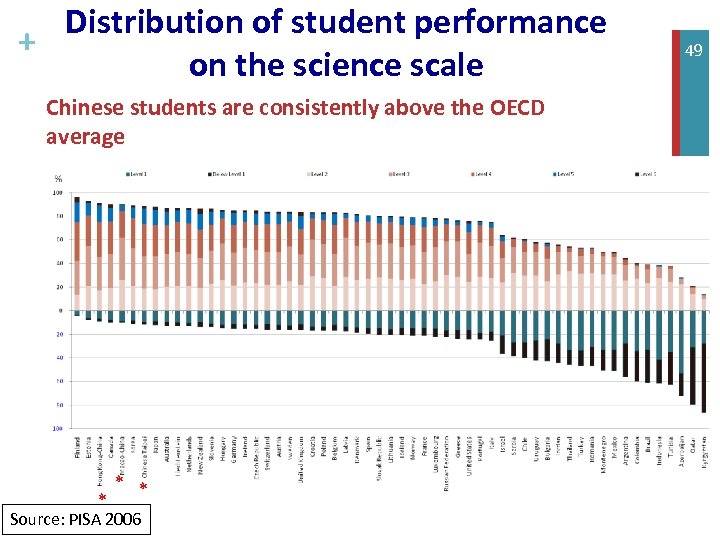 Distribution of student performance + on the science scale Chinese students are consistently above the OECD average * * * Source: PISA 2006 49 49
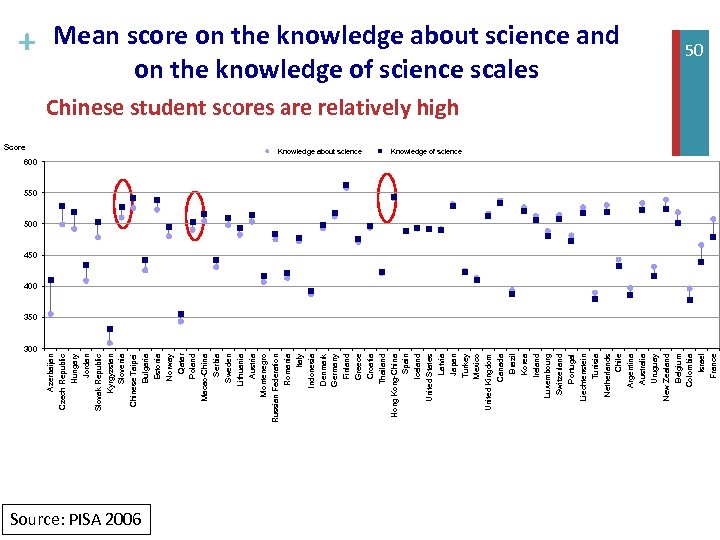 Azerbaijan Czech Republic Hungary Jordan Slovak Republic Kyrgyzstan Slovenia Chinese Taipei Bulgaria Estonia Norway Qatar Poland Macao-China Serbia Sweden Lithuania Austria Montenegro Russian Federation Romania Italy Indonesia Denmark Germany Finland Greece Croatia Thailand Hong Kong-China Spain Iceland United States Latvia Japan Turkey Mexico United Kingdom Canada Brazil Korea Ireland Luxembourg Switzerland Portugal Liechtenstein Tunisia Netherlands Chile Argentina Australia Uruguay New Zealand Belgium Colombia Israel France + Mean score on the knowledge about science and on the knowledge of science scales Score Knowledge about science Source: PISA 2006 50 50 Chinese student scores are relatively high 600 Knowledge of science 550 500 450 400 350 300
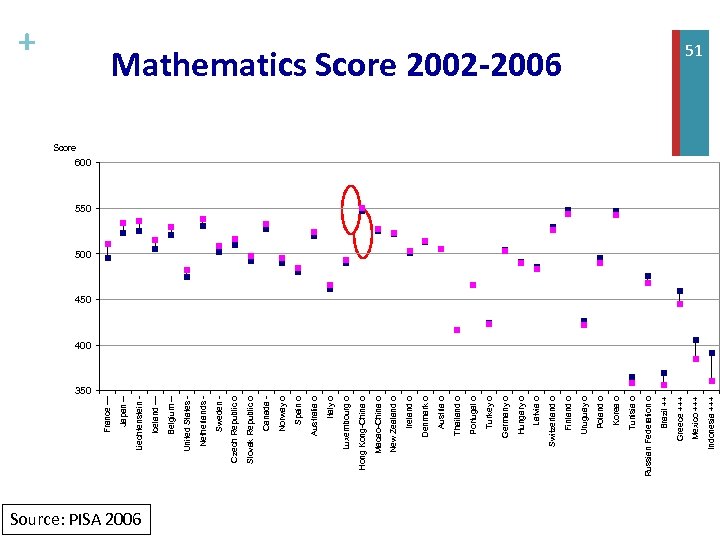 350 Source: PISA 2006 Indonesia +++ Mexico +++ Mathematics Score 2002 -2006 Greece +++ Brazil ++ Russian Federation o Tunisia o Korea o Poland o Uruguay o Finland o Switzerland o Latvia o Hungary o Germany o Turkey o Portugal o Thailand o Austria o Denmark o Ireland o New Zealand o Macao-China o Hong Kong-China o Luxembourg o Italy o Australia o Spain o Norway o Canada - Slovak Republic o Czech Republic o Sweden - Netherlands - United States - Belgium -- Iceland --- Liechtenstein - Japan -- France --- + 51 51 Score 600 550 500 450 400
 + Areas where improvement is called for Based on IEEE analysis, available literature, and conversations with colleagues in China n. Hands-on experience for students n. Experimentation n. Research n. Innovation 52 52
 The Objective is to provide hands-on experience + Where students from China may benefit is in… n More physical experiments n To complement analytical studies and replace computer simulations n Direct experience in n Emphasis on building and testing of models innovation and individual research n Analysis of results from experiments and feedback into design and testing of new alternatives n Direct experience with costs constraints on materials and 53 53
 IEEE Volunteers Teachers Students + What are we going to do here today and tomorrow?
 The Teacher in Service Program “Engineering in the Classroom”
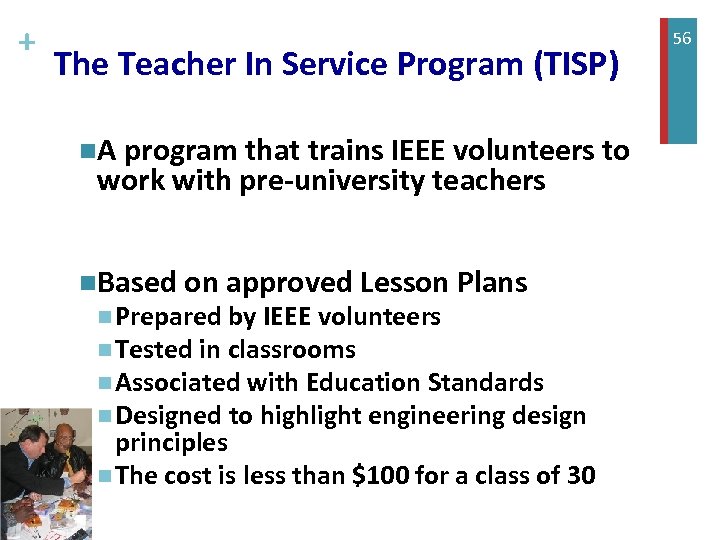 + The Teacher In Service Program (TISP) n. A program that trains IEEE volunteers to work with pre-university teachers n. Based on approved Lesson Plans n Prepared by IEEE volunteers n Tested in classrooms n Associated with Education Standards n Designed to highlight engineering design principles n The cost is less than $100 for a class of 30 56
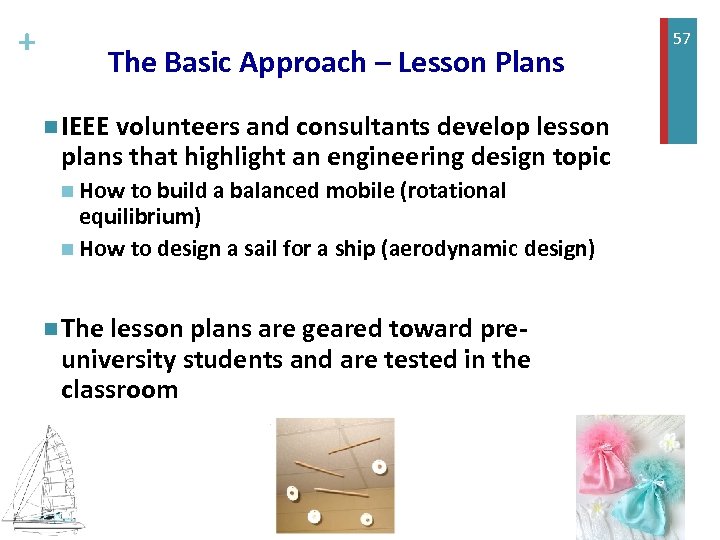 + The Basic Approach – Lesson Plans n IEEE volunteers and consultants develop lesson plans that highlight an engineering design topic n How to build a balanced mobile (rotational equilibrium) n How to design a sail for a ship (aerodynamic design) n The lesson plans are geared toward pre- university students and are tested in the classroom 57
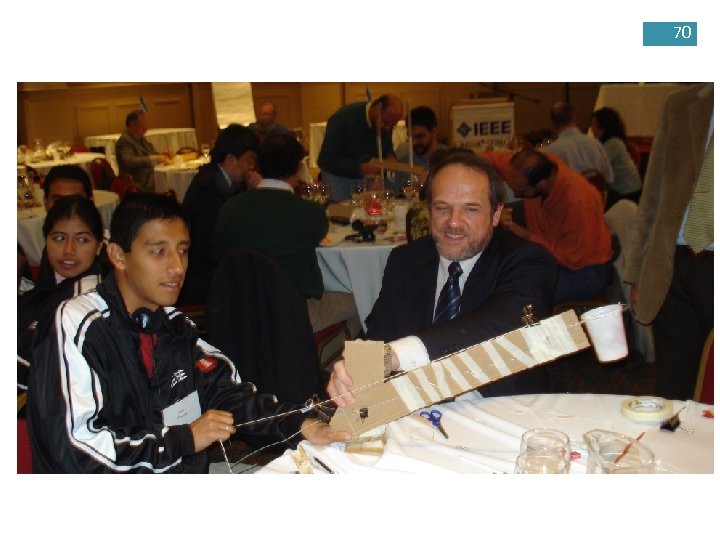
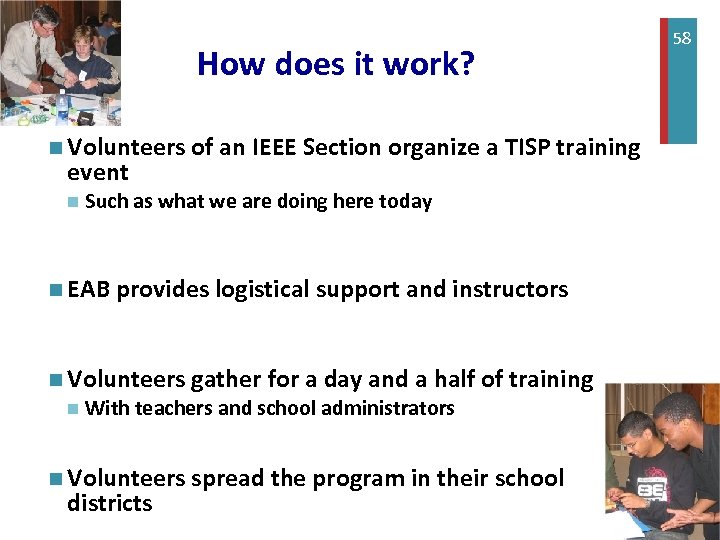 + How does it work? n Volunteers of an IEEE Section organize a TISP training event n Such as what we are doing here today n EAB provides logistical support and instructors n Volunteers gather for a day and a half of training n With teachers and school administrators n Volunteers spread the program in their school districts 58
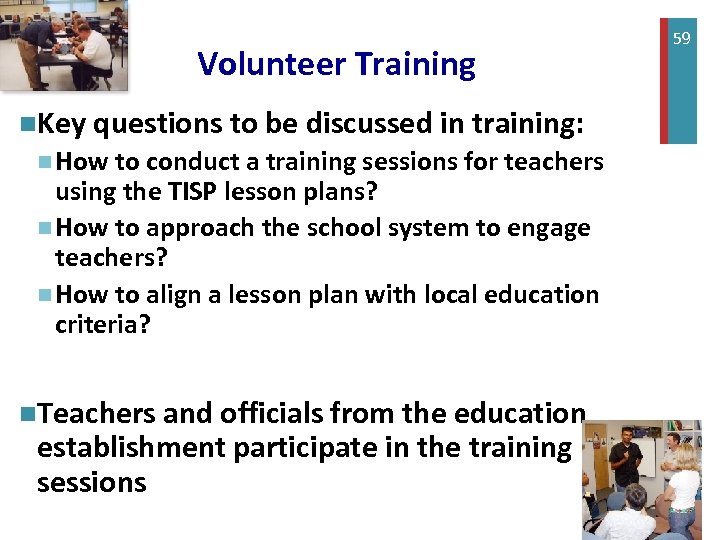 + Volunteer Training n. Key questions to be discussed in training: n How to conduct a training sessions for teachers using the TISP lesson plans? n How to approach the school system to engage teachers? n How to align a lesson plan with local education criteria? n. Teachers and officials from the education establishment participate in the training sessions 59
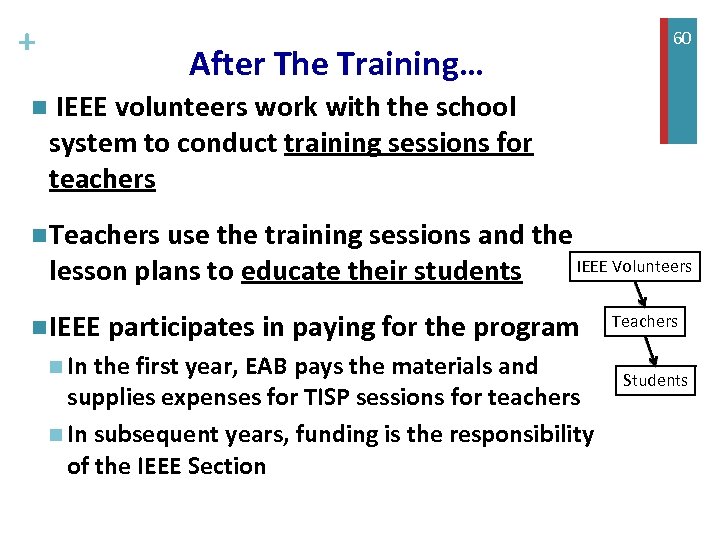 + n 60 After The Training… IEEE volunteers work with the school system to conduct training sessions for teachers n Teachers use the training sessions and the lesson plans to educate their students IEEE Volunteers n IEEE participates in paying for the program n In the first year, EAB pays the materials and supplies expenses for TISP sessions for teachers n In subsequent years, funding is the responsibility of the IEEE Section Teachers Students
 + Lesson plans n. The lesson plans are organized in two versions n. For the teacher n. For the student n. The lesson plans need to be aligned with educational standards 61
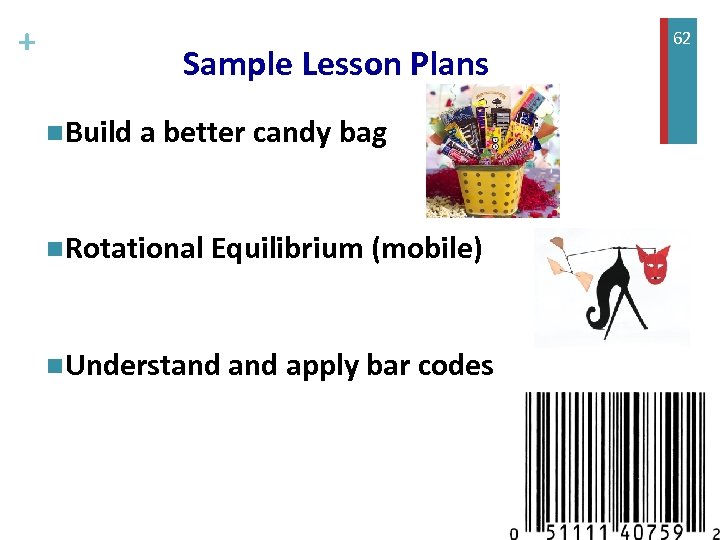 + Sample Lesson Plans n. Build a better candy bag n. Rotational Equilibrium (mobile) n. Understand apply bar codes 62
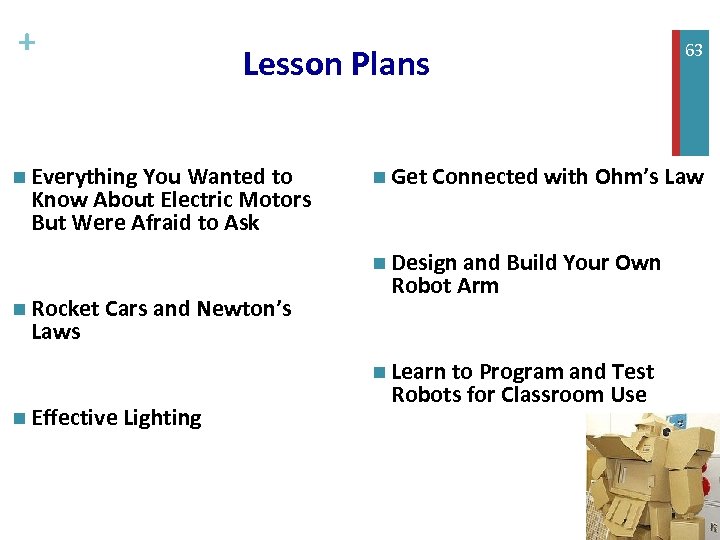 + Lesson Plans n Everything You Wanted to Know About Electric Motors But Were Afraid to Ask n Get Connected with Ohm’s Law n Design and Build Your Own n Rocket Cars and Newton’s Robot Arm Laws n Learn to Program and Test n Effective Lighting 63 63 Robots for Classroom Use
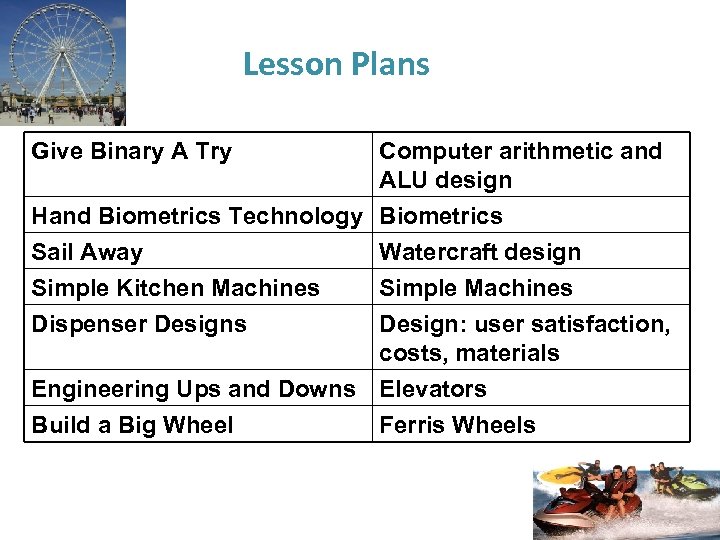 Lesson Plans Give Binary A Try Computer arithmetic and ALU design Hand Biometrics Technology Biometrics Sail Away Watercraft design Simple Kitchen Machines Dispenser Designs Simple Machines Design: user satisfaction, costs, materials Engineering Ups and Downs Elevators Build a Big Wheel Ferris Wheels
 + Lesson Plans n Sort it Out n Engineering Air Traffic n Sticky Engineering n Pipeline Challenge n Infrared Investigations n Ship the Chip n Hull Engineering n Move That Lighthouse! n Engineered Sports n A Question of Balance n Engineered Memory n Program Your Own Game n Wind Tunnel Testing 65 65
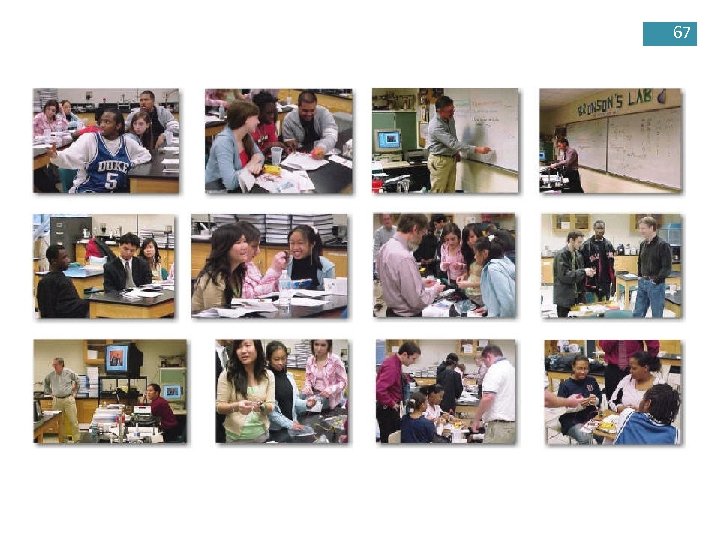
 + Teacher In-Service Program Presentations n. To date, over 120 TISP presentations have been conducted by IEEE volunteers n. TISP presentations have reached over 3000 pre-university educators n This reach represents more than students each academic year 316, 000 66
 67
67
 + n Boston n Indianapolis n Putrajaya, Malaysia n Cape Town 2006 -2007 n Piura, Peru n Rio de Janeiro n Baltimore n Dallas 68 68
 + 2008 -2009 n Shenzhen n Los Angeles n Montreal n San Francisco n Montevideo n Cordoba (Argentina) n Guayaquil, Ecuador n Port of Spain n San Juan, PR 69 69
 70
70
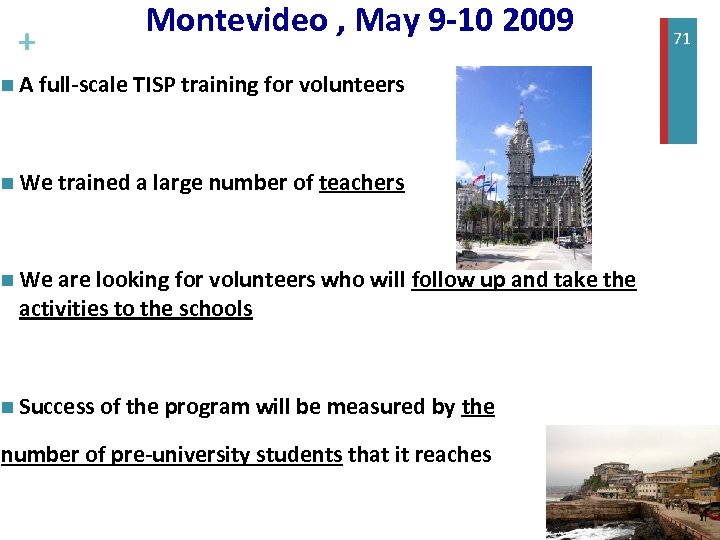 + Montevideo , May 9 -10 2009 n A full-scale TISP training for volunteers n We trained a large number of teachers n We are looking for volunteers who will activities to the schools follow up and take the n Success of the program will be measured by the number of pre-university students that it reaches 71
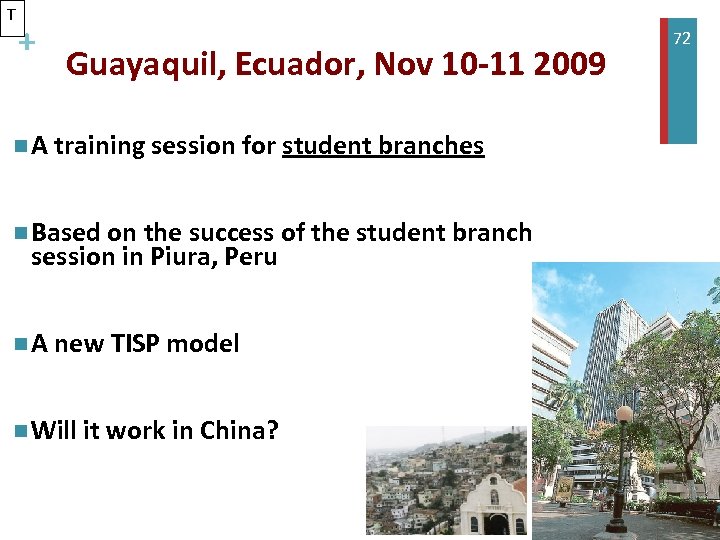 T + Guayaquil, Ecuador, Nov 10 -11 2009 n A training session for student branches n Based on the success of the student branch session in Piura, Peru n A new TISP model n Will it work in China? 72
 + What are we going to do here? n Demonstrate one (1) lesson plan: n“Build your own robot arm” n Discuss trends in pre-university education n Consider how to develop and use the TISP in China n Have Fun! 73
 + Who is in the audience? n Teachers from the Pre-university system n. University-level educators and decision makers n. IEEE members, volunteers , staff n. Government officials and decision makers 74
 + Expectations from IEEE Volunteers n Organize TISP sessions with pre-university teachers in your locale n Communicate with EAB for information exchange and funding n Organize a task force within the IEEE China Section structure to make TISP a permanent program in China n In cooperation with universities and the government n Arrange for budgeting through Region 10, and the IEEE Boards (MGAB, EAB) 75
 + Expectations from Teachers n. Use the TISP approach in your classroom n. Work with the IEEE local Sections to organize TISP training sessions for teachers n. Report to the Section what lessons have been learnt from the program n. Indicate what lesson plans were or were not successful, and what additional lesson plans would be required 76
 Our Overall TISP Goals + n Empower IEEE Section “champions” to develop collaborations with local pre-university education community to promote applied learning n Enhance the level of technological literacy of pre- university educators n Encourage pre-university students to pursue technical careers, including engineering n Increase the general level of technological literacy of pre- university students n Increase the level of understanding of the needs of educators among the engineering community n Identify ways that engineers can assist schools and school systems 77
 + Questions or Comments? 78