


 Скачать презентацию The IEEE 802 16 Wireless MAN Standard for
dace2a1d1afdacffa3aa13538fb13ba5.ppt
- Количество слайдов: 58
 The IEEE 802. 16 Wireless. MAN™ Standard for Broadband Wireless Metropolitan Area Networks Document Number: IEEE C 802. 16 -02/10 Date Submitted: 2002 -07 -24 Source: Roger Marks Venue: none Base Document: none Purpose: To inform the Working Group concerning an address on IEEE 802. 16 given by the Working Group Chair. Notice: This document has been prepared to assist IEEE 802. 16. It is offered as a basis for discussion and is not binding on the contributing individual(s) or organization(s). The material in this document is subject to change in form and content after further study. The contributor(s) reserve(s) the right to add, amend or withdraw material contained herein. Release: The contributor grants a free, irrevocable license to the IEEE to incorporate text contained in this contribution, and any modifications thereof, in the creation of an IEEE Standards publication; to copyright in the IEEE’s name any IEEE Standards publication even though it may include portions of this contribution; and at the IEEE’s sole discretion to permit others to reproduce in whole or in part the resulting IEEE Standards publication. The contributor also acknowledges and accepts that this contribution may be made public by IEEE 802. 16 Patent Policy: The contributor is familiar with the IEEE 802. 16 Patent Policy and Procedures (Version 1. 0)
 The IEEE 802. 16 Wireless. MAN™ Standard for Broadband Wireless Metropolitan Area Networks http: //Wireless. MAN. org Roger B. Marks National Institute of Standards and Technology (U. S. ) Chair, IEEE 802. 16 Working Group
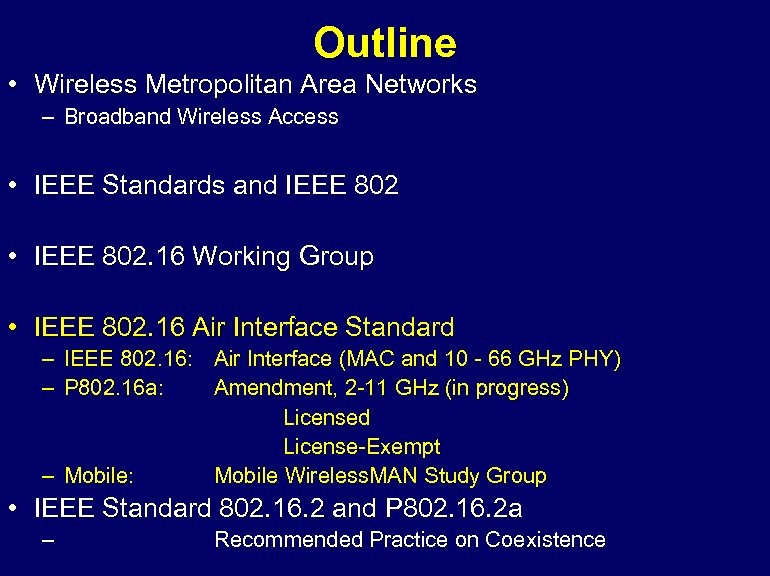 Outline • Wireless Metropolitan Area Networks – Broadband Wireless Access • IEEE Standards and IEEE 802 • IEEE 802. 16 Working Group • IEEE 802. 16 Air Interface Standard – IEEE 802. 16: Air Interface (MAC and 10 - 66 GHz PHY) – P 802. 16 a: Amendment, 2 -11 GHz (in progress) Licensed License-Exempt – Mobile: Mobile Wireless. MAN Study Group • IEEE Standard 802. 16. 2 and P 802. 16. 2 a – Recommended Practice on Coexistence
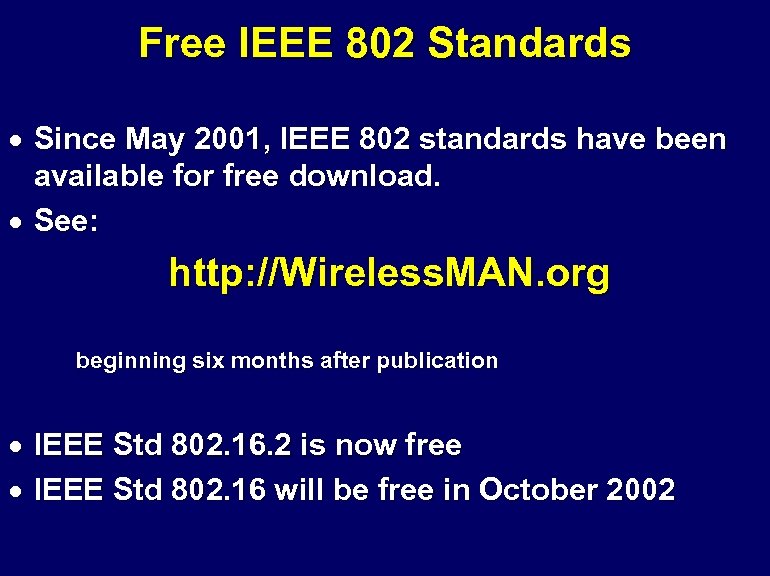 Free IEEE 802 Standards · Since May 2001, IEEE 802 standards have been available for free download. · See: http: //Wireless. MAN. org beginning six months after publication · IEEE Std 802. 16. 2 is now free · IEEE Std 802. 16 will be free in October 2002
 IEEE Standard 802. 16: Tutorial IEEE Communications Magazine, June 2002 (available on 802. 16 web site)
 Broadband Access to Buildings • The “Last Mile” –Fast local connection to network • Business and residential customers want it –Data –Voice –Video distribution –Real-time videoconferencing –etc. • High-capacity cable/fiber to every user is expensive –Construction costs do not follow Moore’s Law
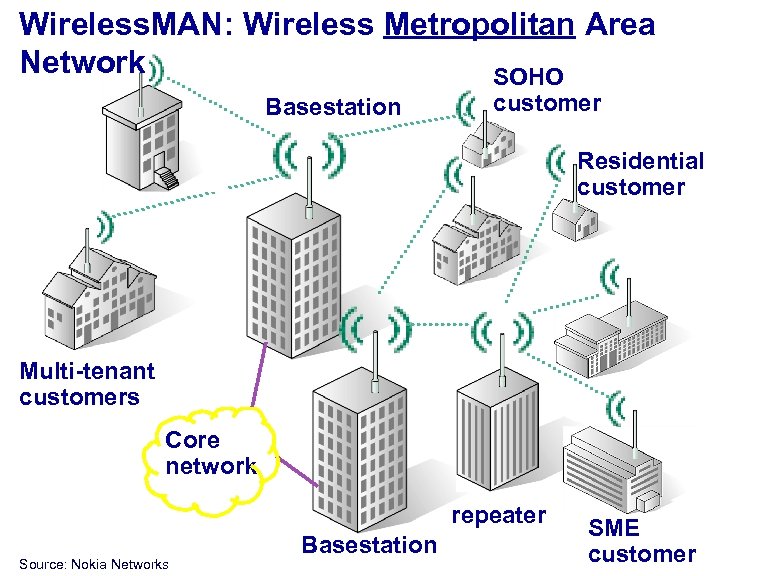 Wireless. MAN: Wireless Metropolitan Area Network SOHO Basestation customer Residential customer Multi-tenant customers Core network repeater Source: Nokia Networks Basestation SME customer
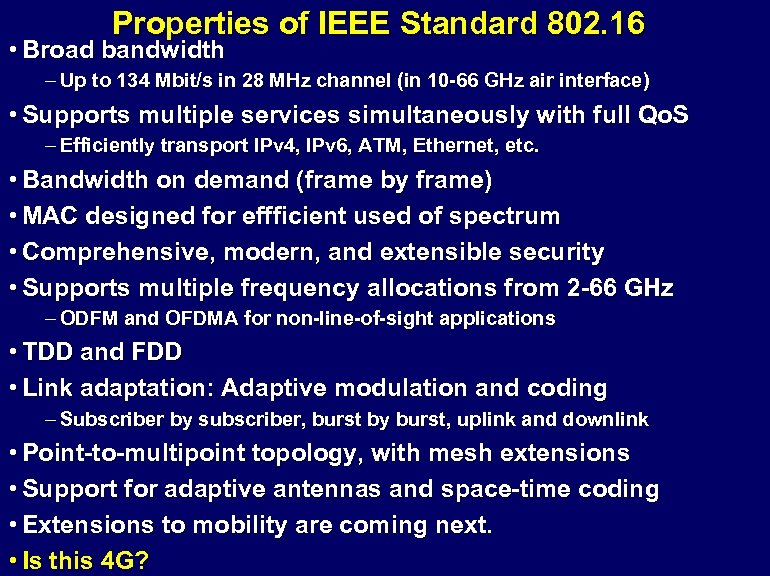 Properties of IEEE Standard 802. 16 • Broad bandwidth – Up to 134 Mbit/s in 28 MHz channel (in 10 -66 GHz air interface) • Supports multiple services simultaneously with full Qo. S – Efficiently transport IPv 4, IPv 6, ATM, Ethernet, etc. • Bandwidth on demand (frame by frame) • MAC designed for effficient used of spectrum • Comprehensive, modern, and extensible security • Supports multiple frequency allocations from 2 -66 GHz – ODFM and OFDMA for non-line-of-sight applications • TDD and FDD • Link adaptation: Adaptive modulation and coding – Subscriber by subscriber, burst by burst, uplink and downlink • Point-to-multipoint topology, with mesh extensions • Support for adaptive antennas and space-time coding • Extensions to mobility are coming next. • Is this 4 G?
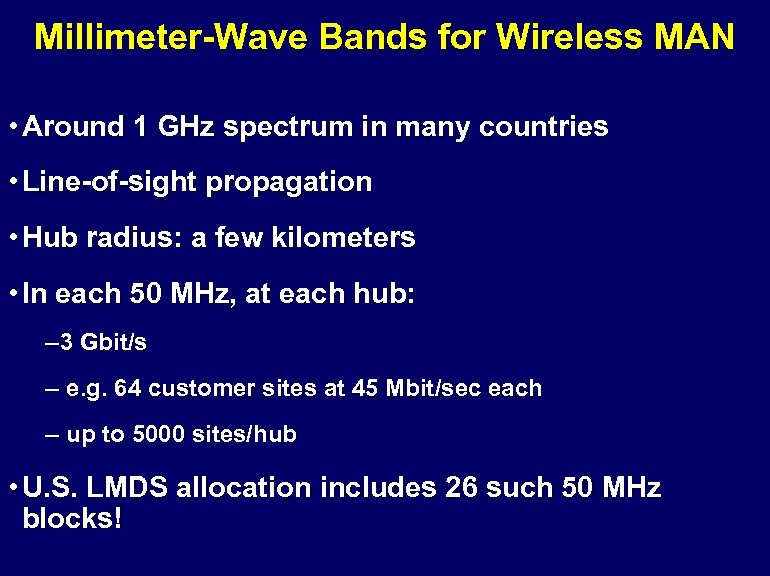 Millimeter-Wave Bands for Wireless MAN • Around 1 GHz spectrum in many countries • Line-of-sight propagation • Hub radius: a few kilometers • In each 50 MHz, at each hub: – 3 Gbit/s – e. g. 64 customer sites at 45 Mbit/sec each – up to 5000 sites/hub • U. S. LMDS allocation includes 26 such 50 MHz blocks!
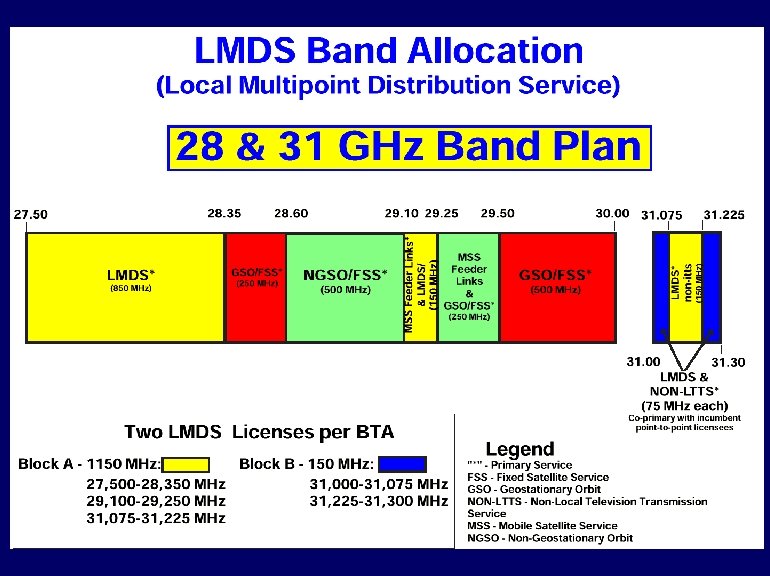
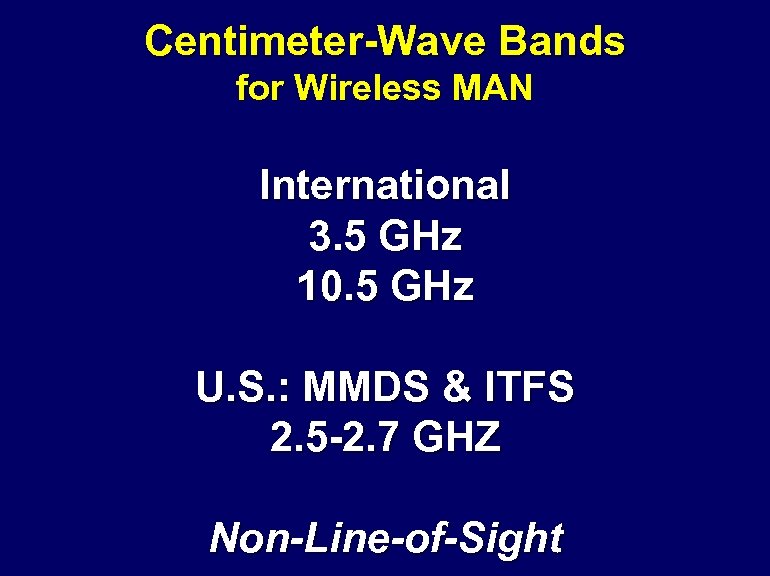 Centimeter-Wave Bands for Wireless MAN International 3. 5 GHz 10. 5 GHz U. S. : MMDS & ITFS 2. 5 -2. 7 GHZ Non-Line-of-Sight
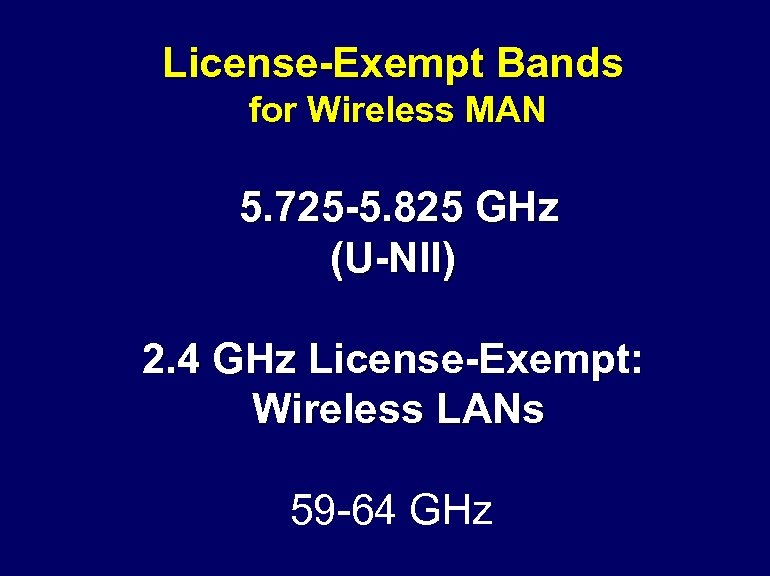 License-Exempt Bands for Wireless MAN 5. 725 -5. 825 GHz (U-NII) 2. 4 GHz License-Exempt: Wireless LANs 59 -64 GHz
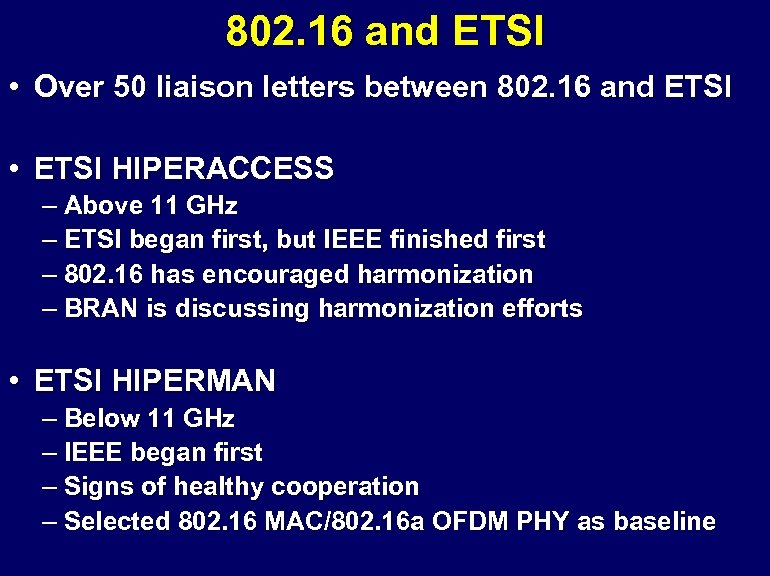 802. 16 and ETSI • Over 50 liaison letters between 802. 16 and ETSI • ETSI HIPERACCESS – Above 11 GHz – ETSI began first, but IEEE finished first – 802. 16 has encouraged harmonization – BRAN is discussing harmonization efforts • ETSI HIPERMAN – Below 11 GHz – IEEE began first – Signs of healthy cooperation – Selected 802. 16 MAC/802. 16 a OFDM PHY as baseline
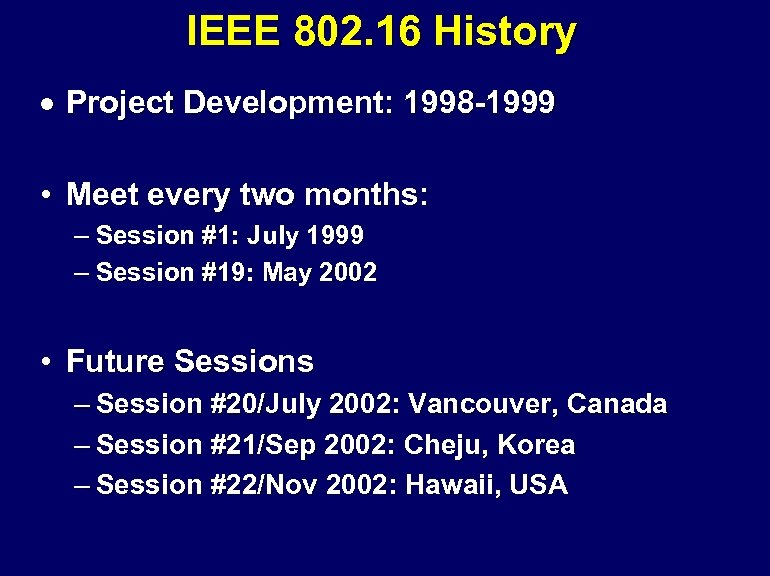 IEEE 802. 16 History · Project Development: 1998 -1999 • Meet every two months: – Session #1: July 1999 – Session #19: May 2002 • Future Sessions – Session #20/July 2002: Vancouver, Canada – Session #21/Sep 2002: Cheju, Korea – Session #22/Nov 2002: Hawaii, USA
![IEEE ® 802 The LAN/MAN Standards Committee [sponsor: IEEE Computer Society] Wired: – 802.](https://present5.com/presentation/dace2a1d1afdacffa3aa13538fb13ba5/image-15.jpg "IEEE ® 802 The LAN/MAN Standards Committee [sponsor: IEEE Computer Society] Wired: – 802.") IEEE ® 802 The LAN/MAN Standards Committee [sponsor: IEEE Computer Society] Wired: – 802. 3 (Ethernet) {10 Gbit/s approved in June 2002} – 802. 17 (Resilient Packet Ring) Wireless: – 802. 11: Wireless LAN • Local Area Networks – 802. 15: Wireless PAN • Personal Area Networks {e. g. , Bluetooth=IEEE 802. 15. 1} – 802. 16: Wireless. MANTM • Metropolitan Area Networks – [co-sponsor: IEEE Microwave Theory and Techniques Society]
IEEE ® 802 The LAN/MAN Standards Committee [sponsor: IEEE Computer Society] Wired: – 802. 3 (Ethernet) {10 Gbit/s approved in June 2002} – 802. 17 (Resilient Packet Ring) Wireless: – 802. 11: Wireless LAN • Local Area Networks – 802. 15: Wireless PAN • Personal Area Networks {e. g. , Bluetooth=IEEE 802. 15. 1} – 802. 16: Wireless. MANTM • Metropolitan Area Networks – [co-sponsor: IEEE Microwave Theory and Techniques Society]
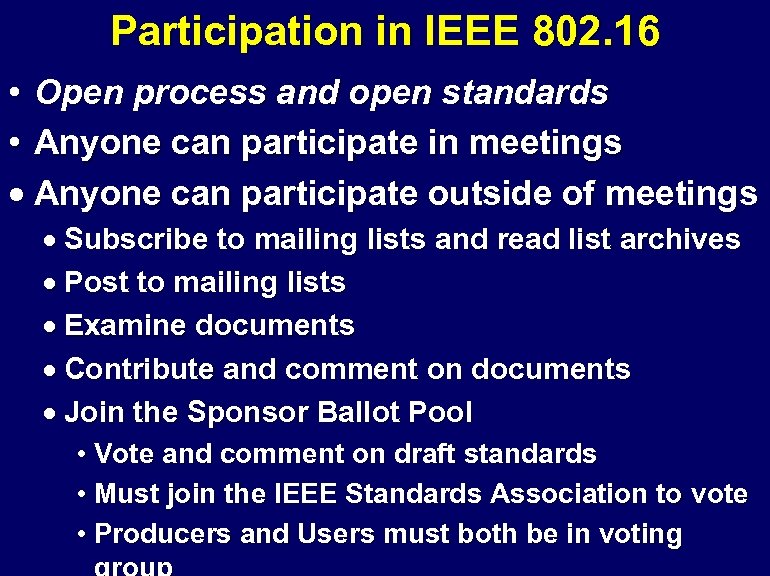 Participation in IEEE 802. 16 • Open process and open standards • Anyone can participate in meetings · Anyone can participate outside of meetings · Subscribe to mailing lists and read list archives · Post to mailing lists · Examine documents · Contribute and comment on documents · Join the Sponsor Ballot Pool • Vote and comment on draft standards • Must join the IEEE Standards Association to vote • Producers and Users must both be in voting
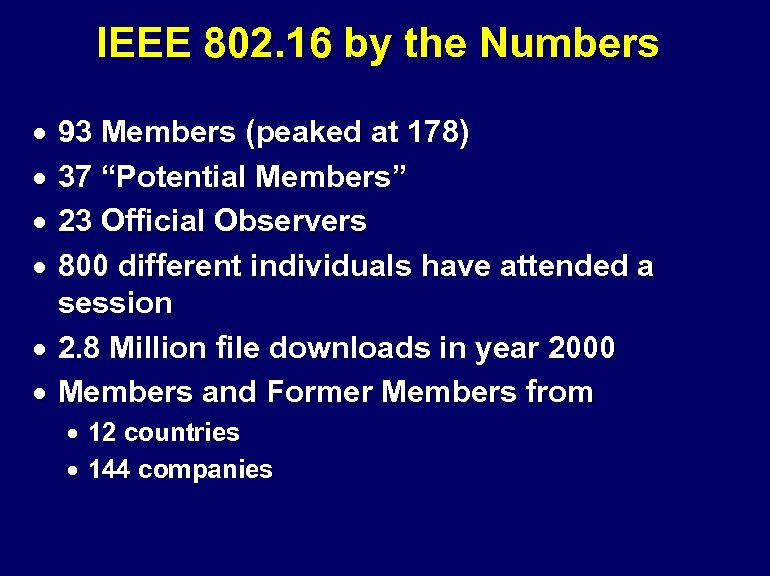 IEEE 802. 16 by the Numbers · · 93 Members (peaked at 178) 37 “Potential Members” 23 Official Observers 800 different individuals have attended a session · 2. 8 Million file downloads in year 2000 · Members and Former Members from · 12 countries · 144 companies
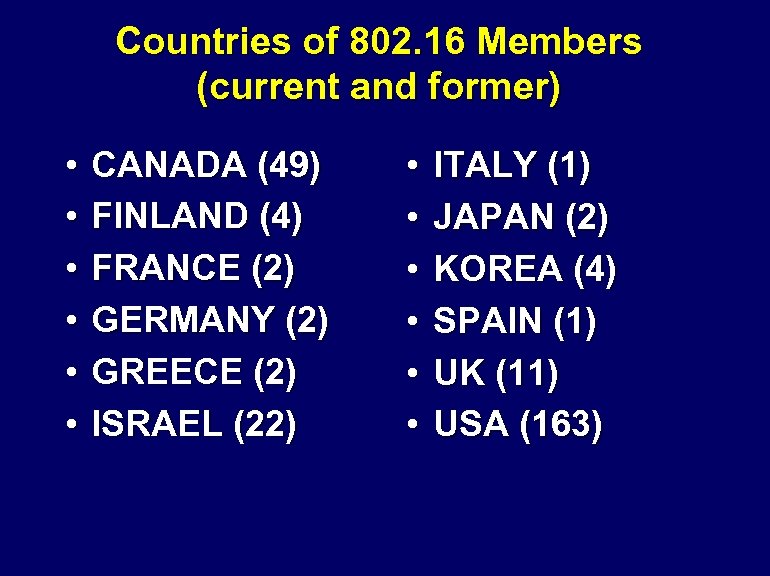 Countries of 802. 16 Members (current and former) • • • CANADA (49) FINLAND (4) FRANCE (2) GERMANY (2) GREECE (2) ISRAEL (22) • • • ITALY (1) JAPAN (2) KOREA (4) SPAIN (1) UK (11) USA (163)
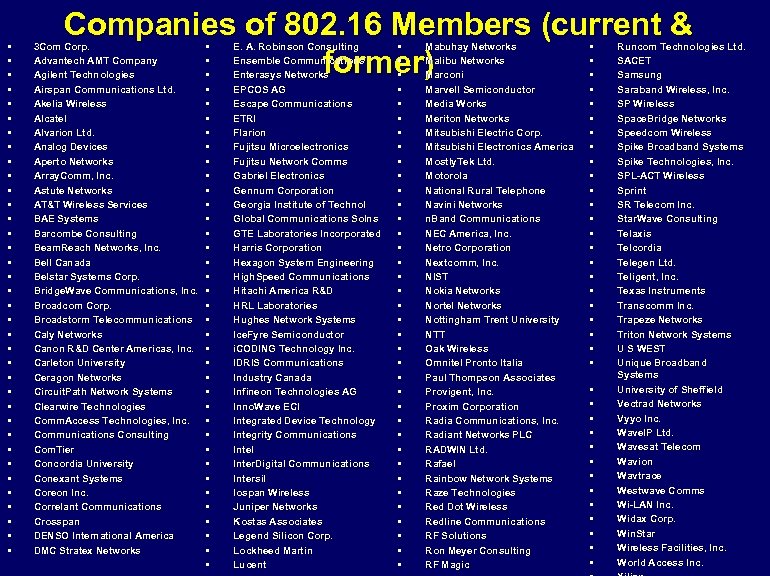 • • • • • • • • • Companies of 802. 16 Members (current & former) 3 Com Corp. Advantech AMT Company Agilent Technologies Airspan Communications Ltd. Akelia Wireless Alcatel Alvarion Ltd. Analog Devices Aperto Networks Array. Comm, Inc. Astute Networks AT&T Wireless Services BAE Systems Barcombe Consulting Beam. Reach Networks, Inc. Bell Canada Belstar Systems Corp. Bridge. Wave Communications, Inc. Broadcom Corp. Broadstorm Telecommunications Caly Networks Canon R&D Center Americas, Inc. Carleton University Ceragon Networks Circuit. Path Network Systems Clearwire Technologies Comm. Access Technologies, Inc. Communications Consulting Com. Tier Concordia University Conexant Systems Coreon Inc. Correlant Communications Crosspan DENSO International America DMC Stratex Networks • • • • • • • • • • E. A. Robinson Consulting Ensemble Communications Enterasys Networks EPCOS AG Escape Communications ETRI Flarion Fujitsu Microelectronics Fujitsu Network Comms Gabriel Electronics Gennum Corporation Georgia Institute of Technol Global Communications Solns GTE Laboratories Incorporated Harris Corporation Hexagon System Engineering High. Speed Communications Hitachi America R&D HRL Laboratories Hughes Network Systems Ice. Fyre Semiconductor i. CODING Technology Inc. IDRIS Communications Industry Canada Infineon Technologies AG Inno. Wave ECI Integrated Device Technology Integrity Communications Intel Inter. Digital Communications Intersil Iospan Wireless Juniper Networks Kostas Associates Legend Silicon Corp. Lockheed Martin Lucent • • • • • • • • • • Mabuhay Networks Malibu Networks Marconi Marvell Semiconductor Media Works Meriton Networks Mitsubishi Electric Corp. Mitsubishi Electronics America Mostly. Tek Ltd. Motorola National Rural Telephone Navini Networks n. Band Communications NEC America, Inc. Netro Corporation Nextcomm, Inc. NIST Nokia Networks Nortel Networks Nottingham Trent University NTT Oak Wireless Omnitel Pronto Italia Paul Thompson Associates Provigent, Inc. Proxim Corporation Radia Communications, Inc. Radiant Networks PLC RADWIN Ltd. Rafael Rainbow Network Systems Raze Technologies Red Dot Wireless Redline Communications RF Solutions Ron Meyer Consulting RF Magic • • • • • • • • • Runcom Technologies Ltd. SACET Samsung Saraband Wireless, Inc. SP Wireless Space. Bridge Networks Speedcom Wireless Spike Broadband Systems Spike Technologies, Inc. SPL-ACT Wireless Sprint SR Telecom Inc. Star. Wave Consulting Telaxis Telcordia Telegen Ltd. Teligent, Inc. Texas Instruments Transcomm Inc. Trapeze Networks Triton Network Systems U S WEST Unique Broadband Systems University of Sheffield Vectrad Networks Vyyo Inc. Wave. IP Ltd. Wavesat Telecom Wavion Wavtrace Westwave Comms Wi-LAN Inc. Widax Corp. Win. Star Wireless Facilities, Inc. World Access Inc.
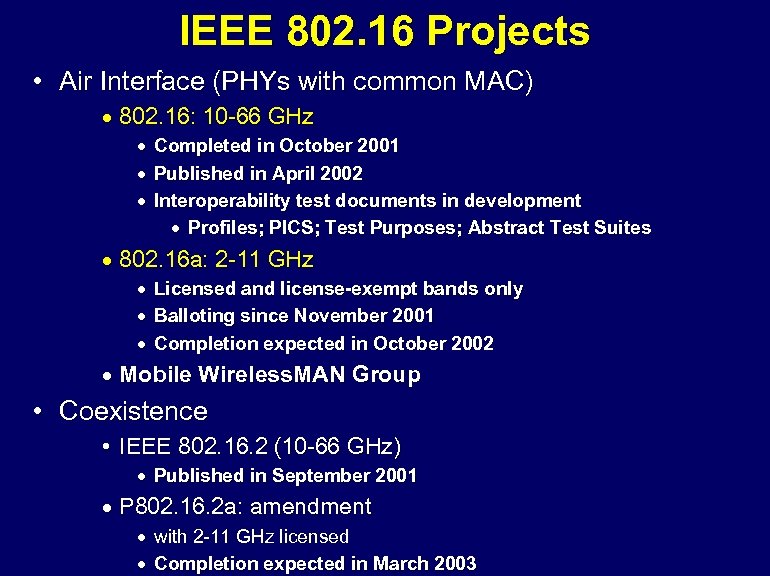 IEEE 802. 16 Projects • Air Interface (PHYs with common MAC) · 802. 16: 10 -66 GHz · · · Completed in October 2001 Published in April 2002 Interoperability test documents in development · Profiles; PICS; Test Purposes; Abstract Test Suites · 802. 16 a: 2 -11 GHz · Licensed and license-exempt bands only · Balloting since November 2001 · Completion expected in October 2002 · Mobile Wireless. MAN Group • Coexistence • IEEE 802. 16. 2 (10 -66 GHz) · Published in September 2001 · P 802. 16. 2 a: amendment · with 2 -11 GHz licensed · Completion expected in March 2003
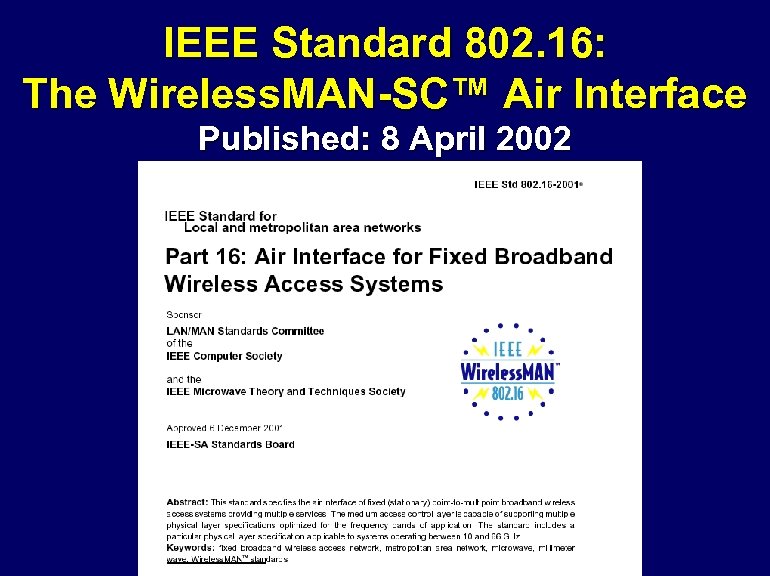 IEEE Standard 802. 16: The Wireless. MAN-SC™ Air Interface Published: 8 April 2002
 Point-to-Multipoint Wireless MAN: not a LAN • Base Station (BS) connected to public networks • BS serves Subscriber Stations (SSs) – SS typically serves a building (business or residence) – provide SS with first-mile access to public networks • Compared to a Wireless LAN: – Multimedia Qo. S, not only contention-based – Many more users – Much higher data rates – Much longer distances
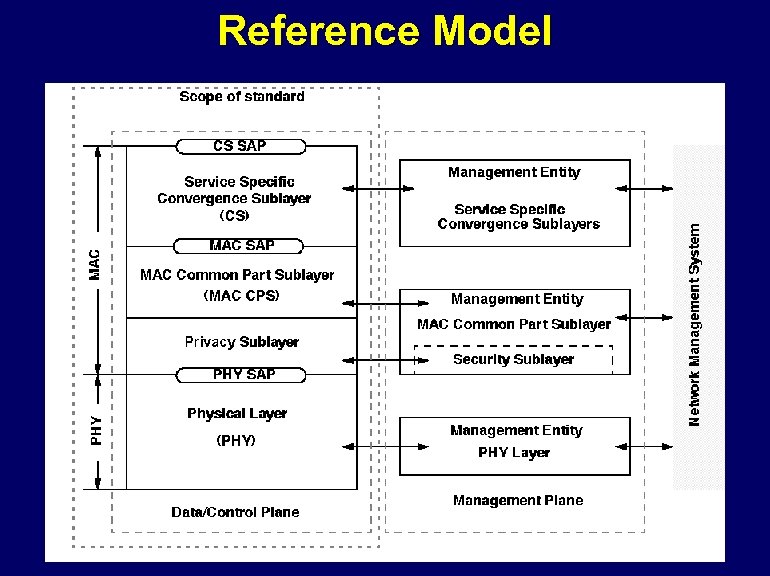 Reference Model
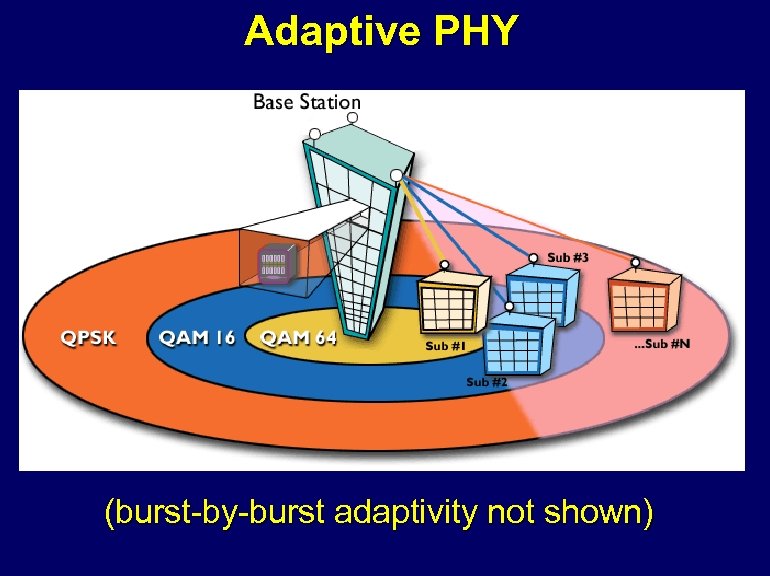 Adaptive PHY (burst-by-burst adaptivity not shown)
 Modulation • Single Carrier QAM, Gray coded – QPSK – 16 QAM • Mandatory for Downlink, Optional for Uplink – 64 QAM • Optional for both Downlink & Uplink • Preambles based on 16 symbol CAZAC sequences
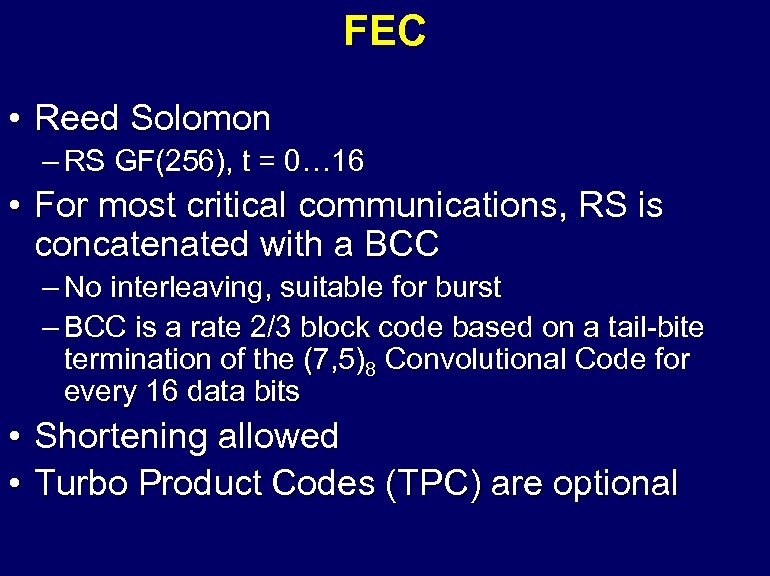 FEC • Reed Solomon – RS GF(256), t = 0… 16 • For most critical communications, RS is concatenated with a BCC – No interleaving, suitable for burst – BCC is a rate 2/3 block code based on a tail-bite termination of the (7, 5)8 Convolutional Code for every 16 data bits • • Shortening allowed Turbo Product Codes (TPC) are optional
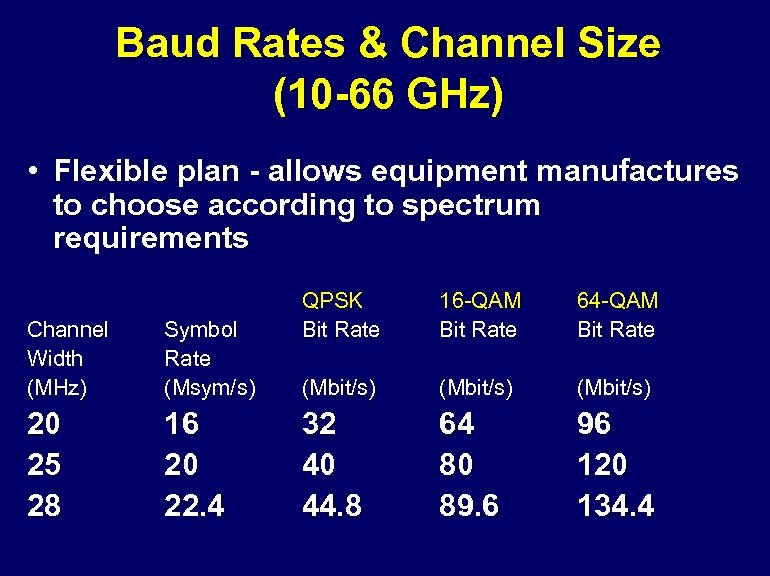 Baud Rates & Channel Size (10 -66 GHz) • Flexible plan - allows equipment manufactures to choose according to spectrum requirements Channel Width (MHz) Symbol Rate (Msym/s) 20 25 28 16 20 22. 4 QPSK Bit Rate 16 -QAM Bit Rate 64 -QAM Bit Rate (Mbit/s) 32 40 44. 8 64 80 89. 6 96 120 134. 4
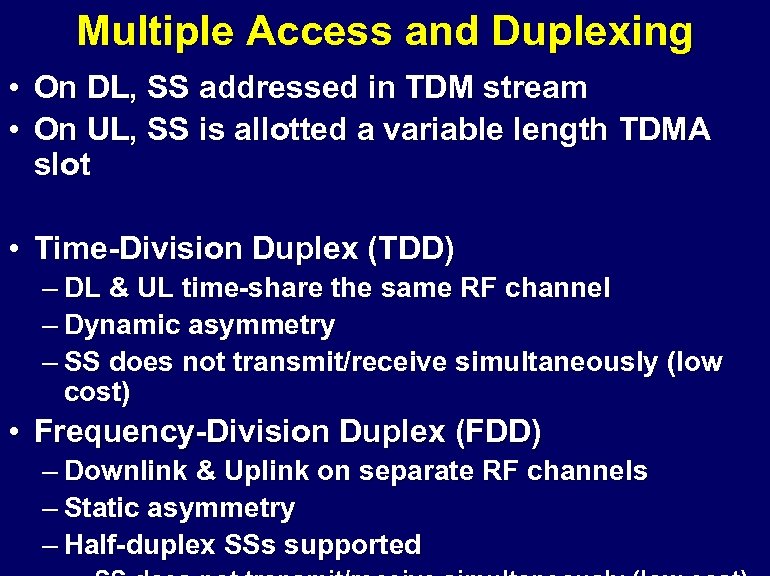 Multiple Access and Duplexing • On DL, SS addressed in TDM stream • On UL, SS is allotted a variable length TDMA slot • Time-Division Duplex (TDD) – DL & UL time-share the same RF channel – Dynamic asymmetry – SS does not transmit/receive simultaneously (low cost) • Frequency-Division Duplex (FDD) – Downlink & Uplink on separate RF channels – Static asymmetry – Half-duplex SSs supported
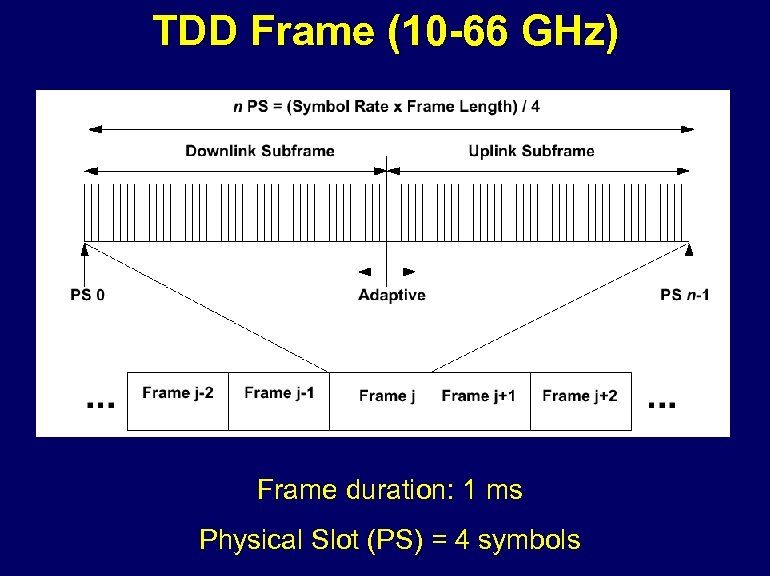 TDD Frame (10 -66 GHz) Frame duration: 1 ms Physical Slot (PS) = 4 symbols
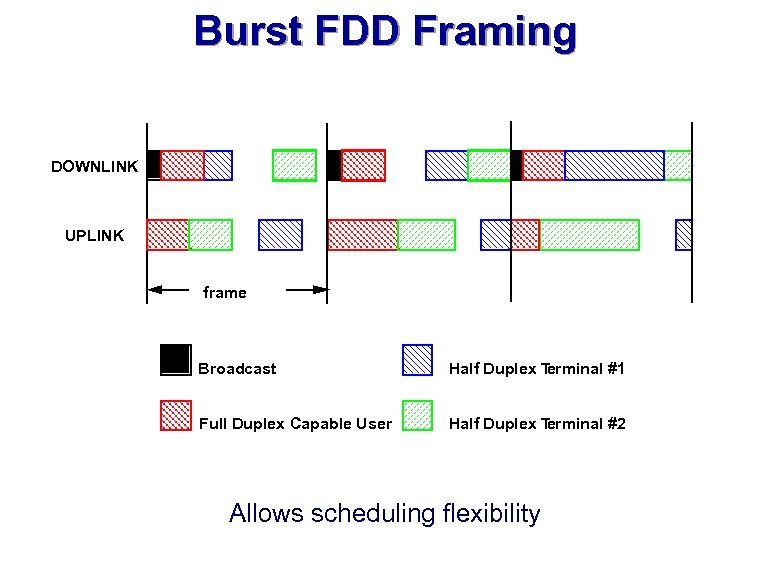 Burst FDD Framing DOWNLINK UPLINK frame Broadcast Half Duplex T erminal #1 Full Duplex Capable User Half Duplex T erminal #2 Allows scheduling flexibility
 Adaptive Burst Profiles • Burst profile – Modulation and FEC • Dynamically assigned according to link conditions – Burst by burst, per subscriber station – Trade-off capacity vs. robustness in real time • Roughly doubled capacity for the same cell area • Burst profile for downlink broadcast channel is well-known and robust – Other burst profiles can be configured “on the fly” – SS capabilities recognized at registration
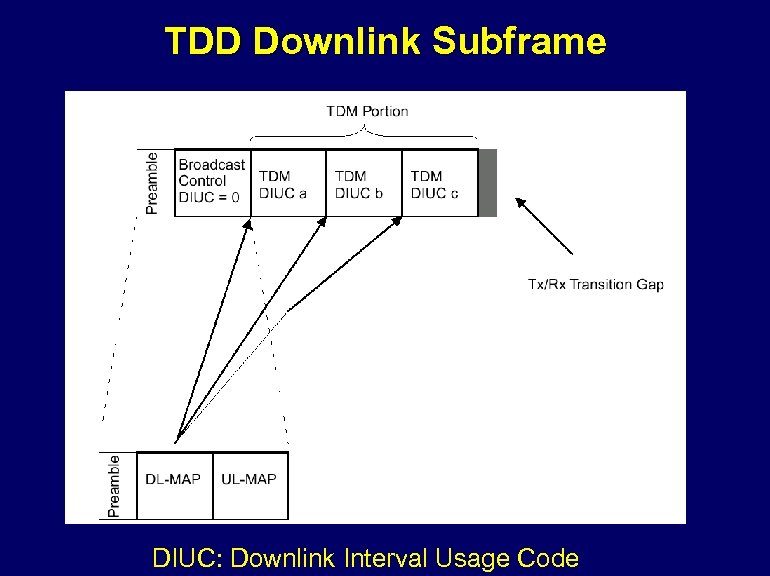 TDD Downlink Subframe DIUC: Downlink Interval Usage Code
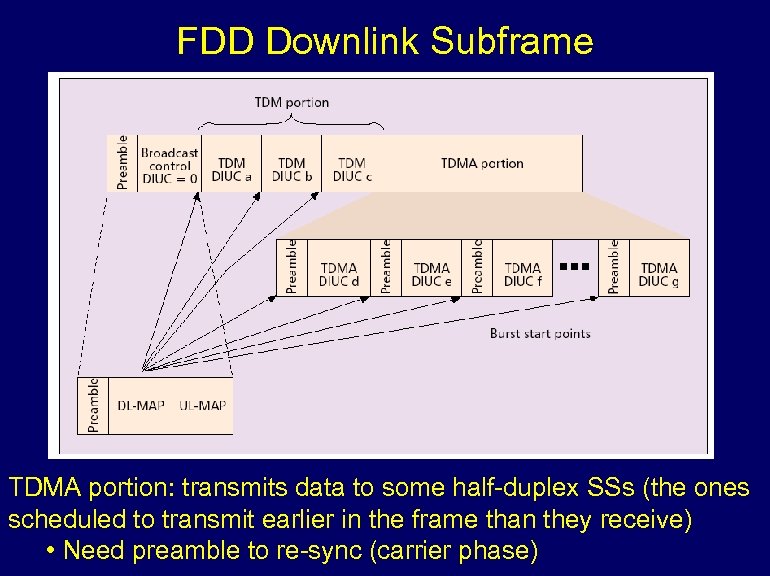 FDD Downlink Subframe TDMA portion: transmits data to some half-duplex SSs (the ones scheduled to transmit earlier in the frame than they receive) • Need preamble to re-sync (carrier phase)
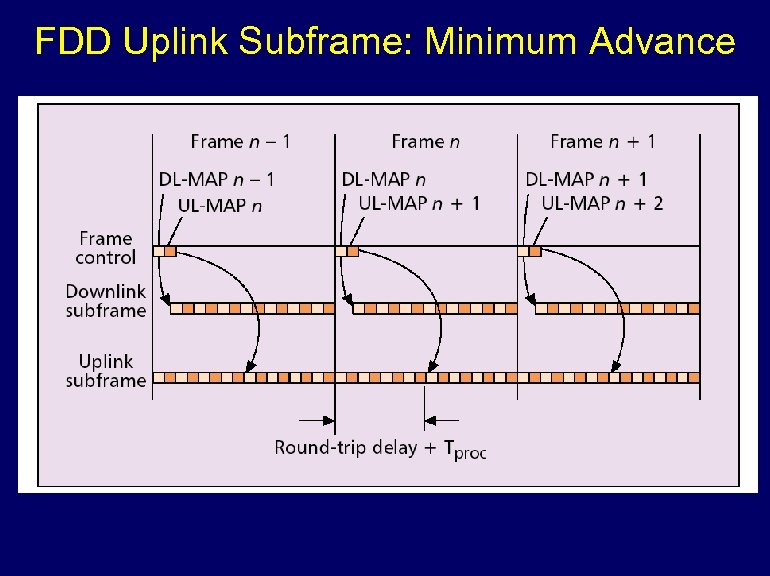 FDD Uplink Subframe: Minimum Advance
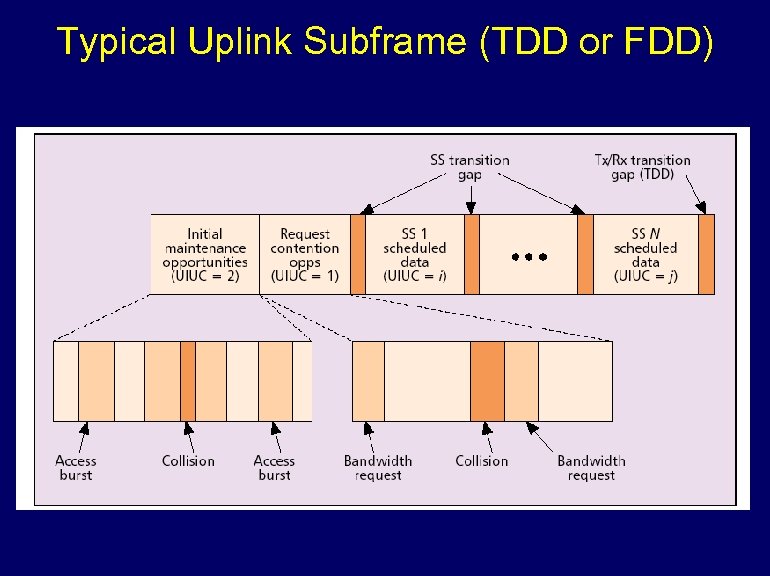 Typical Uplink Subframe (TDD or FDD)
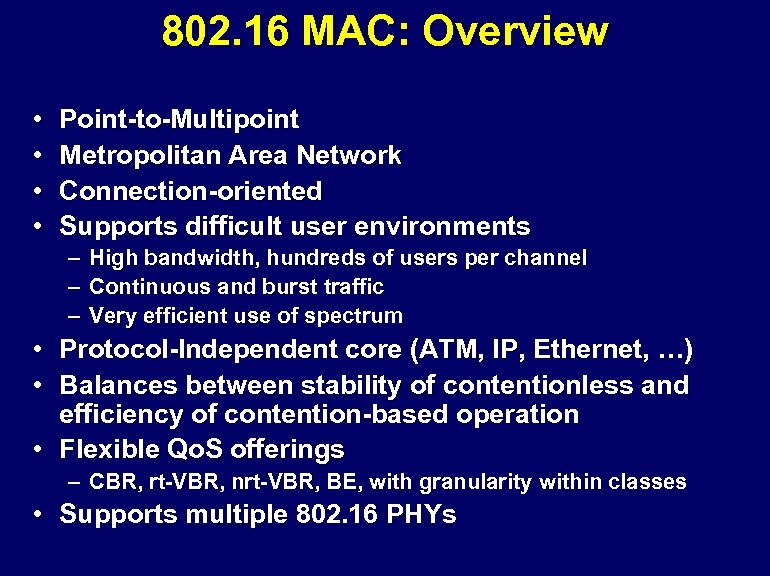 802. 16 MAC: Overview • • Point-to-Multipoint Metropolitan Area Network Connection-oriented Supports difficult user environments – – – High bandwidth, hundreds of users per channel Continuous and burst traffic Very efficient use of spectrum • Protocol-Independent core (ATM, IP, Ethernet, …) • Balances between stability of contentionless and efficiency of contention-based operation • Flexible Qo. S offerings – CBR, rt-VBR, nrt-VBR, BE, with granularity within classes • Supports multiple 802. 16 PHYs
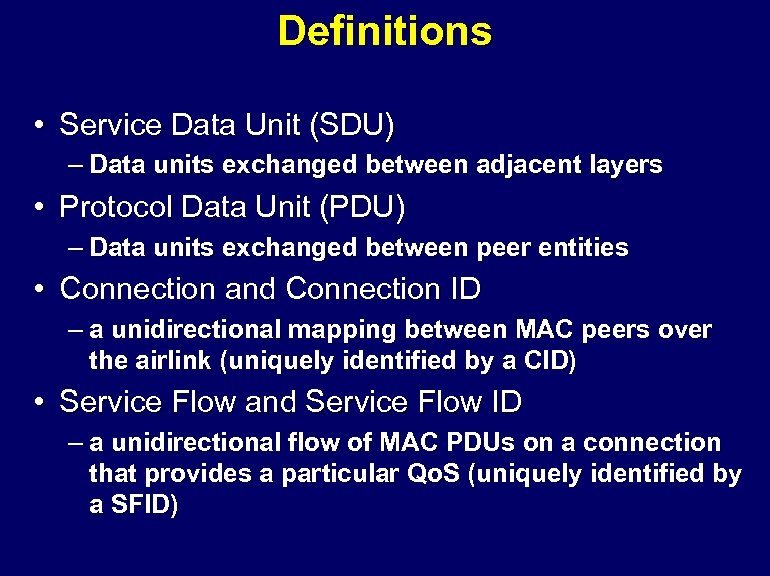 Definitions • Service Data Unit (SDU) – Data units exchanged between adjacent layers • Protocol Data Unit (PDU) – Data units exchanged between peer entities • Connection and Connection ID – a unidirectional mapping between MAC peers over the airlink (uniquely identified by a CID) • Service Flow and Service Flow ID – a unidirectional flow of MAC PDUs on a connection that provides a particular Qo. S (uniquely identified by a SFID)
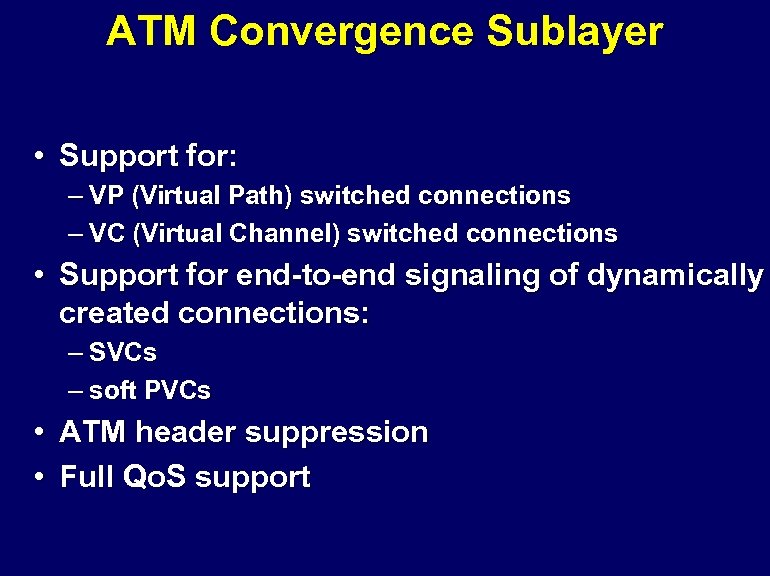 ATM Convergence Sublayer • Support for: – VP (Virtual Path) switched connections – VC (Virtual Channel) switched connections • Support for end-to-end signaling of dynamically created connections: – SVCs – soft PVCs • ATM header suppression • Full Qo. S support
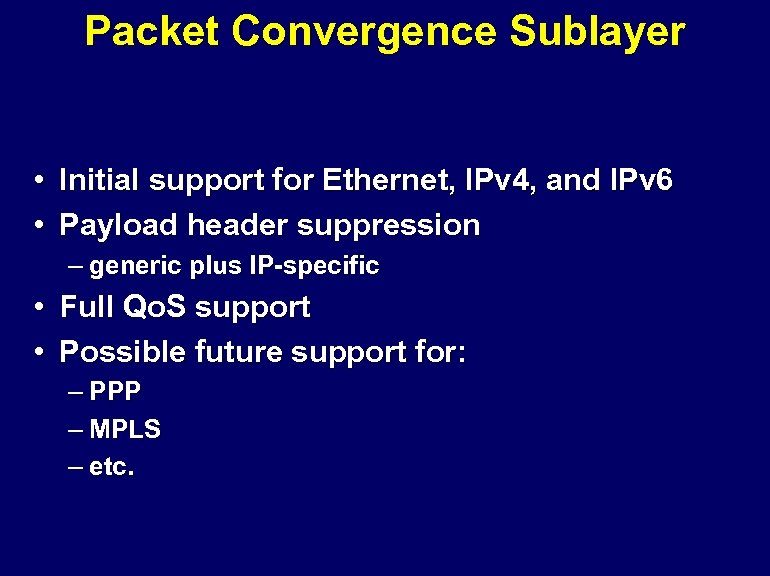 Packet Convergence Sublayer • Initial support for Ethernet, IPv 4, and IPv 6 • Payload header suppression – generic plus IP-specific • Full Qo. S support • Possible future support for: – PPP – MPLS – etc.
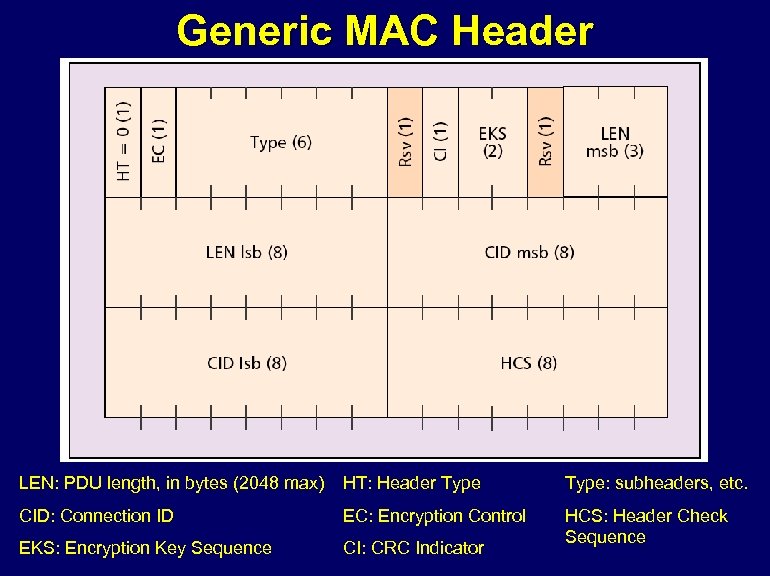 Generic MAC Header LEN: PDU length, in bytes (2048 max) HT: Header Type: subheaders, etc. CID: Connection ID EC: Encryption Control EKS: Encryption Key Sequence CI: CRC Indicator HCS: Header Check Sequence
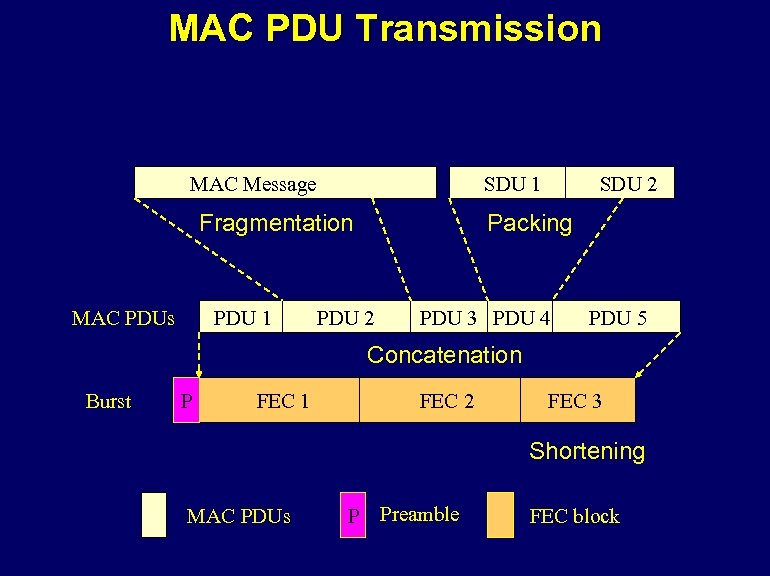 MAC PDU Transmission MAC Message SDU 1 Fragmentation MAC PDUs PDU 1 SDU 2 Packing PDU 2 PDU 3 PDU 4 PDU 5 Concatenation Burst P FEC 1 FEC 2 FEC 3 Shortening MAC PDUs P Preamble FEC block
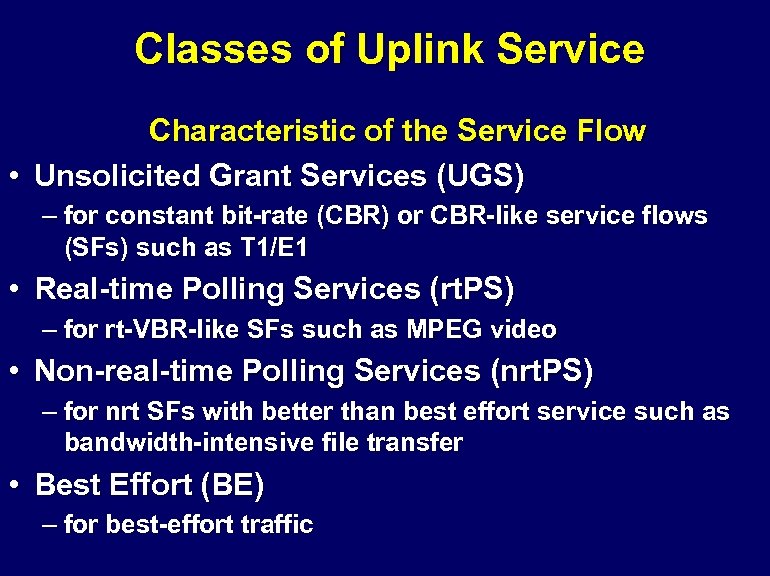 Classes of Uplink Service Characteristic of the Service Flow • Unsolicited Grant Services (UGS) – for constant bit-rate (CBR) or CBR-like service flows (SFs) such as T 1/E 1 • Real-time Polling Services (rt. PS) – for rt-VBR-like SFs such as MPEG video • Non-real-time Polling Services (nrt. PS) – for nrt SFs with better than best effort service such as bandwidth-intensive file transfer • Best Effort (BE) – for best-effort traffic
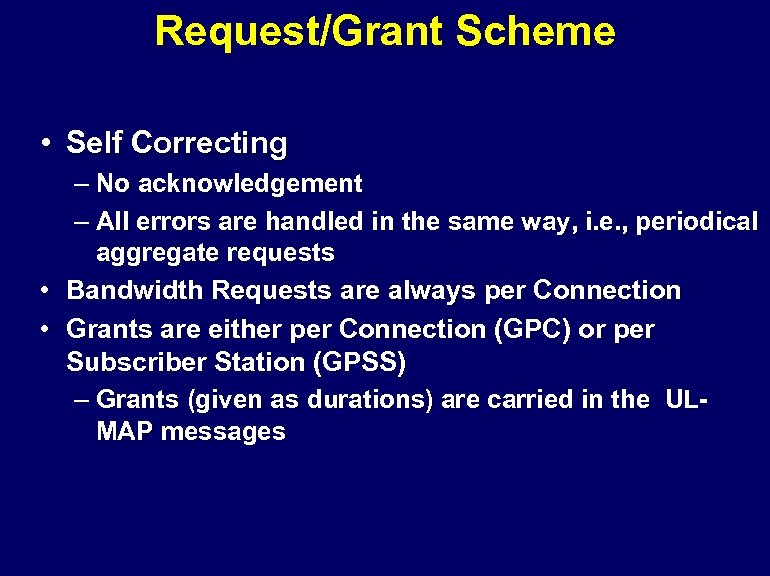 Request/Grant Scheme • Self Correcting – No acknowledgement – All errors are handled in the same way, i. e. , periodical aggregate requests • Bandwidth Requests are always per Connection • Grants are either per Connection (GPC) or per Subscriber Station (GPSS) – Grants (given as durations) are carried in the ULMAP messages
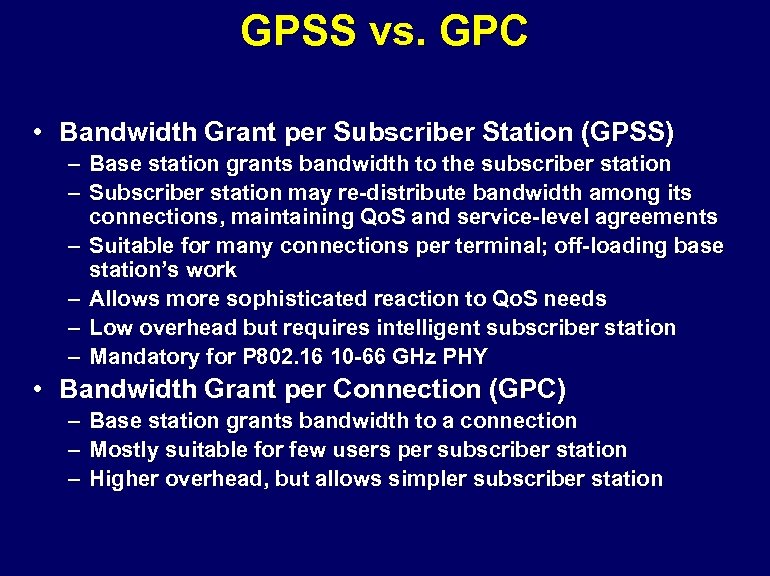 GPSS vs. GPC • Bandwidth Grant per Subscriber Station (GPSS) – Base station grants bandwidth to the subscriber station – Subscriber station may re-distribute bandwidth among its connections, maintaining Qo. S and service-level agreements – Suitable for many connections per terminal; off-loading base station’s work – Allows more sophisticated reaction to Qo. S needs – Low overhead but requires intelligent subscriber station – Mandatory for P 802. 16 10 -66 GHz PHY • Bandwidth Grant per Connection (GPC) – Base station grants bandwidth to a connection – Mostly suitable for few users per subscriber station – Higher overhead, but allows simpler subscriber station
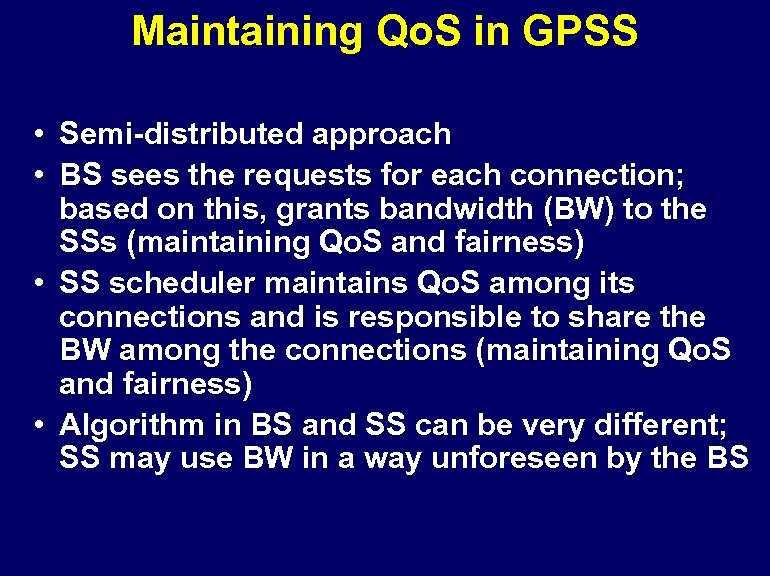 Maintaining Qo. S in GPSS • Semi-distributed approach • BS sees the requests for each connection; based on this, grants bandwidth (BW) to the SSs (maintaining Qo. S and fairness) • SS scheduler maintains Qo. S among its connections and is responsible to share the BW among the connections (maintaining Qo. S and fairness) • Algorithm in BS and SS can be very different; SS may use BW in a way unforeseen by the BS
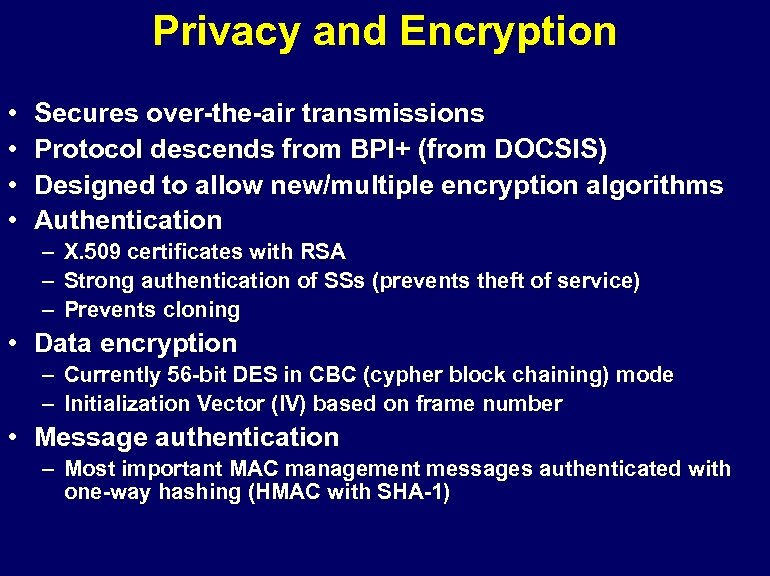 Privacy and Encryption • • Secures over-the-air transmissions Protocol descends from BPI+ (from DOCSIS) Designed to allow new/multiple encryption algorithms Authentication – – – X. 509 certificates with RSA Strong authentication of SSs (prevents theft of service) Prevents cloning • Data encryption – Currently 56 -bit DES in CBC (cypher block chaining) mode – Initialization Vector (IV) based on frame number • Message authentication – Most important MAC management messages authenticated with one-way hashing (HMAC with SHA-1)
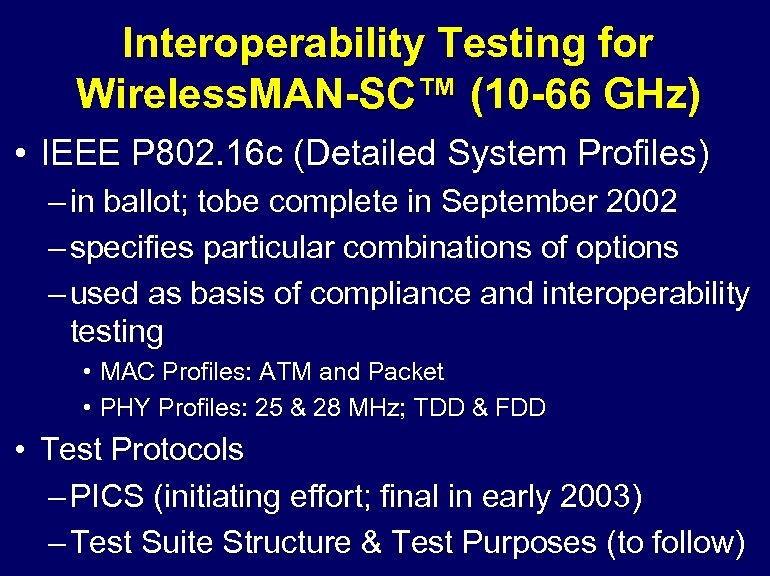 Interoperability Testing for Wireless. MAN-SC™ (10 -66 GHz) • IEEE P 802. 16 c (Detailed System Profiles) – in ballot; tobe complete in September 2002 – specifies particular combinations of options – used as basis of compliance and interoperability testing • MAC Profiles: ATM and Packet • PHY Profiles: 25 & 28 MHz; TDD & FDD • Test Protocols – PICS (initiating effort; final in early 2003) – Test Suite Structure & Test Purposes (to follow)
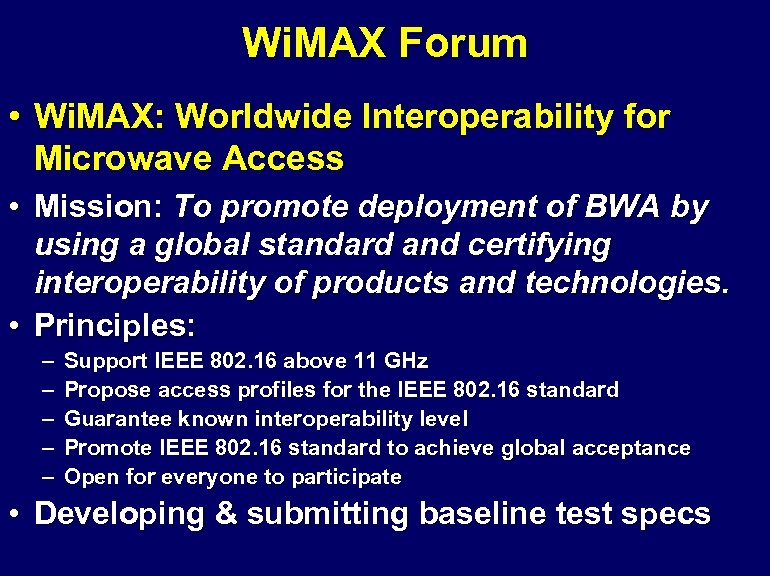 Wi. MAX Forum • Wi. MAX: Worldwide Interoperability for Microwave Access • Mission: To promote deployment of BWA by using a global standard and certifying interoperability of products and technologies. • Principles: – – – Support IEEE 802. 16 above 11 GHz Propose access profiles for the IEEE 802. 16 standard Guarantee known interoperability level Promote IEEE 802. 16 standard to achieve global acceptance Open for everyone to participate • Developing & submitting baseline test specs
 Amendment Project IEEE P 802. 16 a Medium Access Control Modifications and Additional Physical Layer Specifications for 2 -11 GHz
 IEEE P 802. 16 a Status • In ballot since November 2001 – currently balloting Draft 4 – expect completion of final draft in October 2002
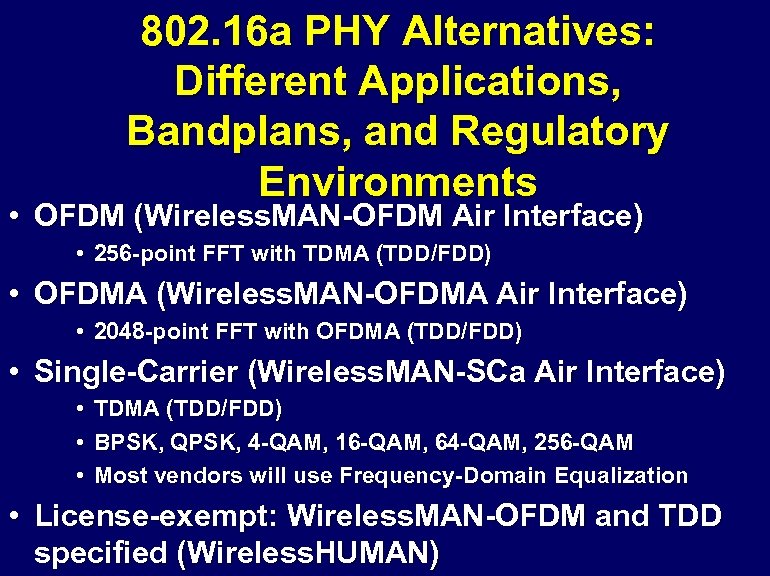 802. 16 a PHY Alternatives: Different Applications, Bandplans, and Regulatory Environments • OFDM (Wireless. MAN-OFDM Air Interface) • 256 -point FFT with TDMA (TDD/FDD) • OFDMA (Wireless. MAN-OFDMA Air Interface) • 2048 -point FFT with OFDMA (TDD/FDD) • Single-Carrier (Wireless. MAN-SCa Air Interface) • TDMA (TDD/FDD) • BPSK, QPSK, 4 -QAM, 16 -QAM, 64 -QAM, 256 -QAM • Most vendors will use Frequency-Domain Equalization • License-exempt: Wireless. MAN-OFDM and TDD specified (Wireless. HUMAN)
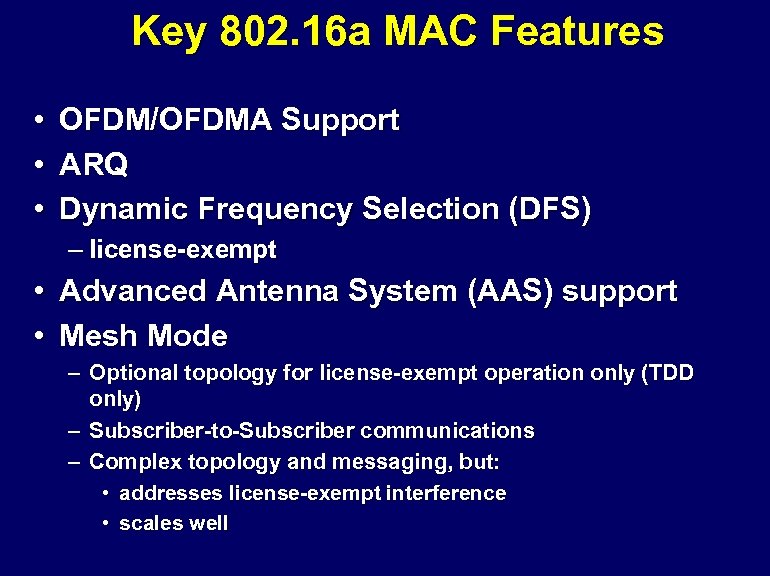 Key 802. 16 a MAC Features • • • OFDM/OFDMA Support ARQ Dynamic Frequency Selection (DFS) – license-exempt • Advanced Antenna System (AAS) support • Mesh Mode – Optional topology for license-exempt operation only (TDD only) – Subscriber-to-Subscriber communications – Complex topology and messaging, but: • addresses license-exempt interference • scales well
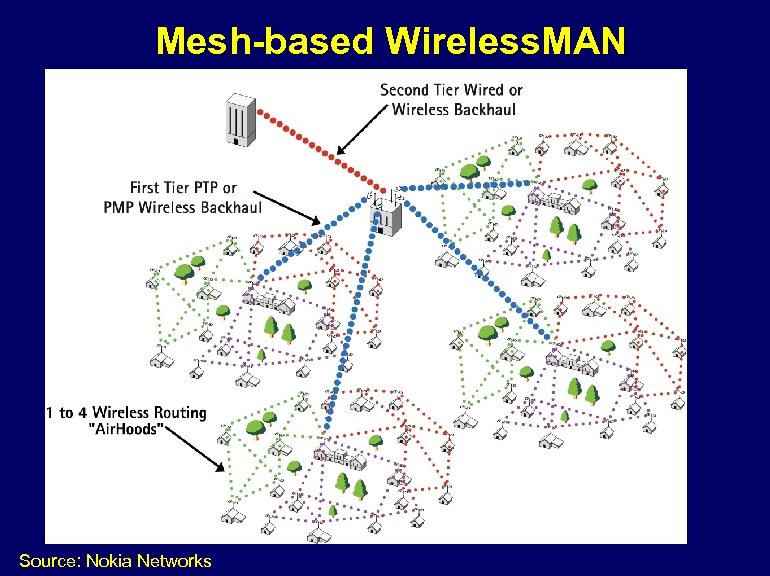 Mesh-based Wireless. MAN Source: Nokia Networks
 Mobililty Enhancements • March 2002: 802. 16 Working Group formed Mobile Broadband Wireless Access Study Group (Mark Klerer, Chair) • July 2002: – 802. 16 (with affirmation of IEEE 802) established a Study Group on Mobile Wireless. MAN to investigate mobility enhancements to 802. 16 – IEEE 802 chartered an Executive Committee Study Group on Mobile Broadband Wireless Access (Mark Klerer, Chair); could lead to a new, separate project for mobile BWA at vehicular speeds
 What’s Next ? • Complete 2 -11 GHz work • Enhance 10 -66 GHz spec – Interoperability test protocols • 802. 16 c (profiles) is in ballot • PICS and test protocols coming soon • New enhancements – Mobility, repeaters, etc. • Build a basis for 4 G wireless
 802. 16 Summary • The IEEE 802. 16 Wireless. MAN Air Interface, addresses worldwide needs • The outcome is due to successful cooperation between industry worldwide. • The 802. 16 MAC is flexible and powerful enough to support PHY variants in any spectrum allocation. • The 802. 16 Air Interface provides great opportunities for vendor differentiation, at both the base station and subscriber station, without compromising interoperability. • Expansion to 2 -11 GHz will soon be complete. • Interoperability tests are coming.
 Conclusion IEEE 802. 16 standards are: • open in development and application • addressed at worldwide markets • engineered as optimized technical solutions • moving toward interoperability assurance • being enhanced for expanded opportunities I thank you for your interest in IEEE 802. 16 and welcome your participation in the development or use of IEEE 802. 16 standards.
 IEEE 802. 16 Resources IEEE 802. 16 Working Group on Broadband Wireless Access info, documents, tutorials, email lists, etc: http: //Wireless. MAN. org