 Скачать презентацию The idea of Robot Soccer 3 Robot
b82821645f9fd608ca243041abb7684a.ppt
- Количество слайдов: 141



The idea of Robot Soccer
3. Robot Soccer and Similar Tasks • Robot Soccer Competition – – Robo. Cup FIRA Remote controlled systems Autonomous robots • Clustering
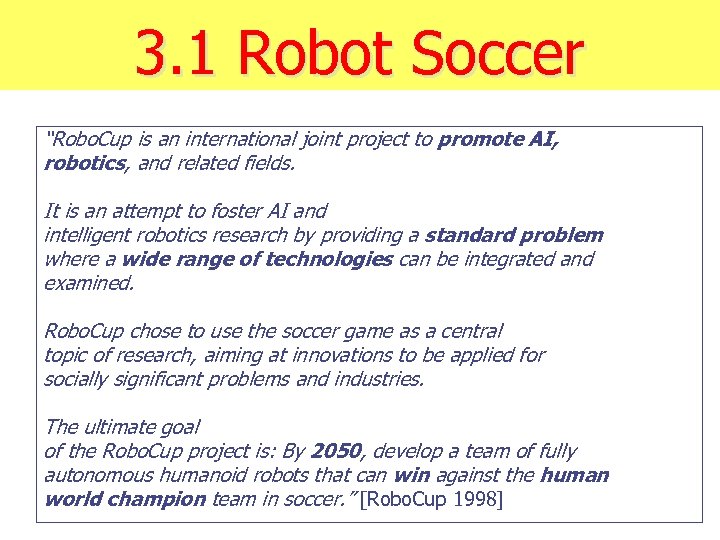
3. 1 Robot Soccer “Robo. Cup is an international joint project to promote AI, robotics, and related fields. It is an attempt to foster AI and intelligent robotics research by providing a standard problem where a wide range of technologies can be integrated and examined. Robo. Cup chose to use the soccer game as a central topic of research, aiming at innovations to be applied for socially significant problems and industries. The ultimate goal of the Robo. Cup project is: By 2050, develop a team of fully autonomous humanoid robots that can win against the human world champion team in soccer. ” [Robo. Cup 1998]
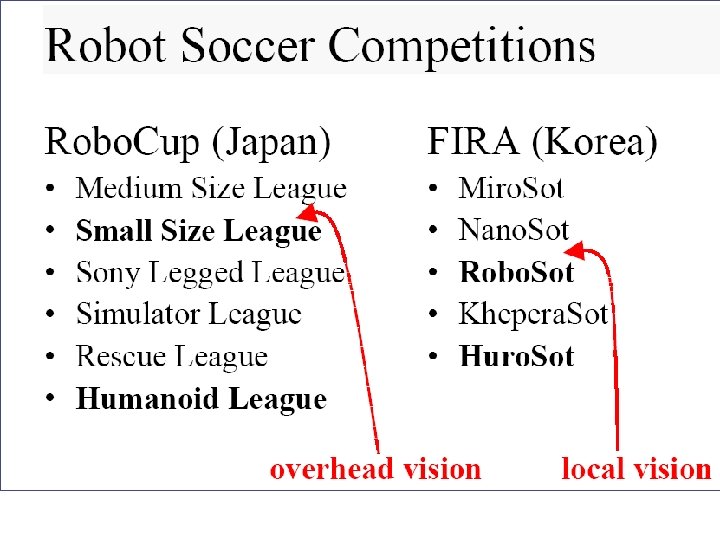
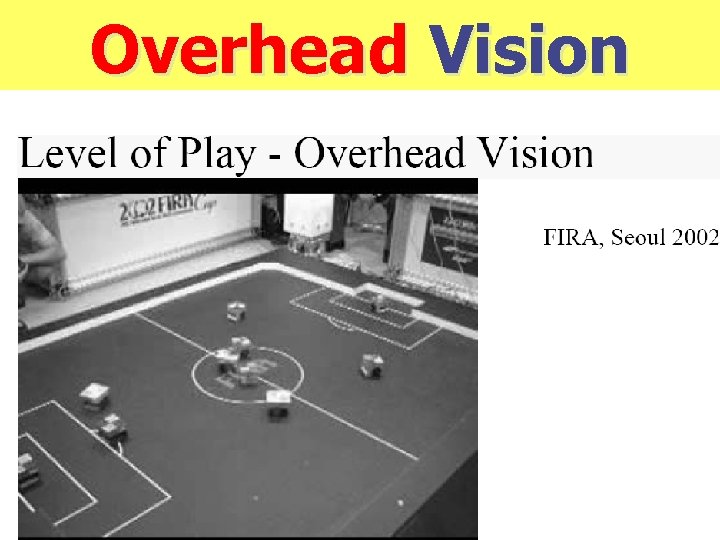
Overhead Vision
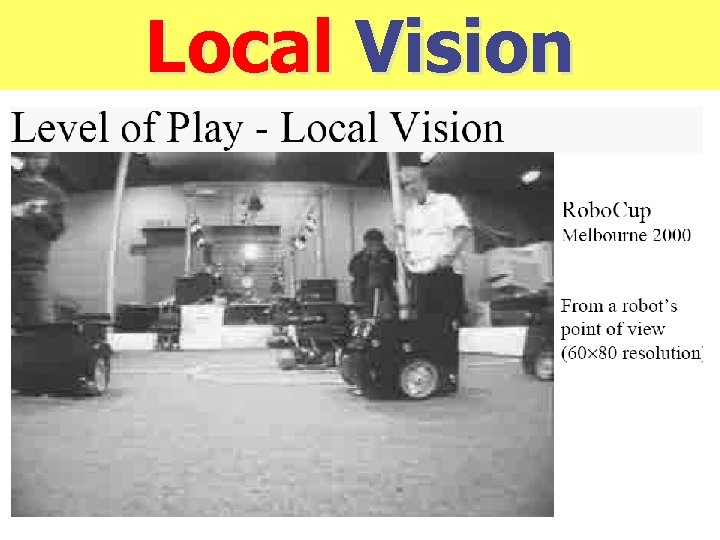
Local Vision
Design Criteria • Controller Hardware: Enable on-board image processing – – Interface to digital camera Incorporate graphics LCD Incorporate user buttons Wireless communication between robots • Sensors: Allow variety of additional sensors: – Shaft encoders – Infra-red distance measurement sensors – Compass module • Software: Flexibility to accommodate for different robot equipment – Operating system Ro. BIOS – Hardware description table HDT
What is AI? Research in AI includes: n n design of intelligent machines formalization of the notions of intelligence and rational behavior understanding mechanisms of intelligence interaction of humans and intelligent machines.
Objectives of AI Engineering : costruct intelligent machines Scientific : understand what is intelligence.
Can a robot do these? Understand? Simulate its environment? Act rationally? Collaborate and compete? Display emotions? A bold claim: A team of Robots will beat the FIFA World Cup champions by 2050!
Robo. Cup - Aim ”pushing the state-of-the-art” ”By mid-21 st century, a team of fully autonomous humanoid robot soccer players shall win the soccer game, comply with the official rule of the FIFA, against the winner of the most recent World Cup. TO BOLDLY GO WHERE MAN HAS GONE BEFORE (cf. Star Trek) Formalised Testbed
Do you really believe that a team of Robots could beat the FIFA World Cup champions by 2050? By all accounts this may sound overly ambitious. In fact, if you compare this goal to other ground breaking achievements it is not ambitious at all. The Wright brothers' first airplane was launched and 50 years later man landed on the moon. Even more recently Deep Blue the computer programmed to play chess, played chess grand master Garry Kasparov and won -- roughly 50 years after the deployment of the first computer. It's a long time. Think what has happened since 1950.
Power of AI Is the following AI? In 1997 a computer, Deep Blue, won a chess match with world champion Kasparov. n n n Accident? IBM paid Kasparov to loose? Brute force with no intelligence? So, what is intelligence?
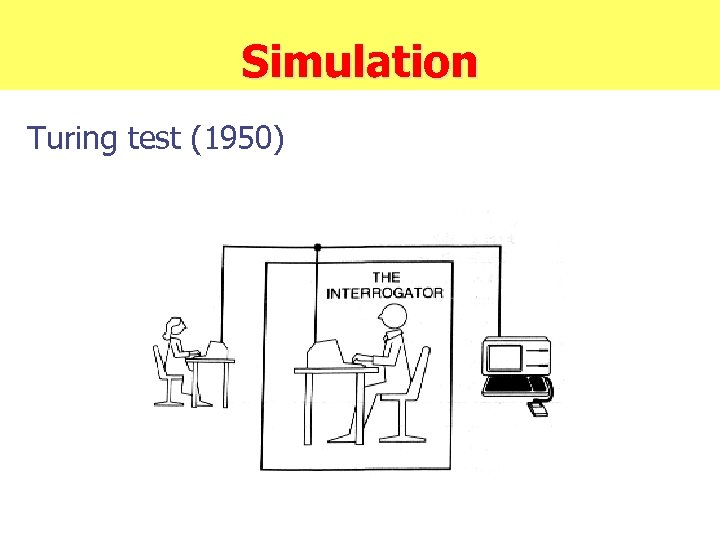
Simulation Turing test (1950)
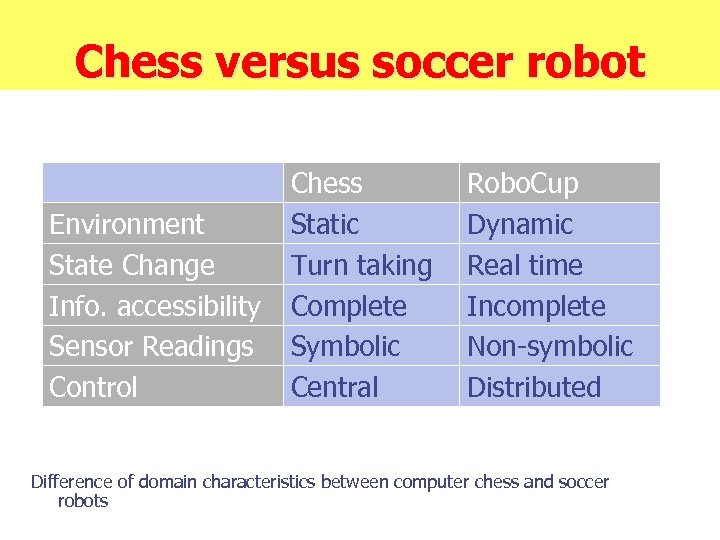
Chess versus soccer robot Environment State Change Info. accessibility Sensor Readings Control Chess Static Turn taking Complete Symbolic Central Robo. Cup Dynamic Real time Incomplete Non-symbolic Distributed Difference of domain characteristics between computer chess and soccer robots
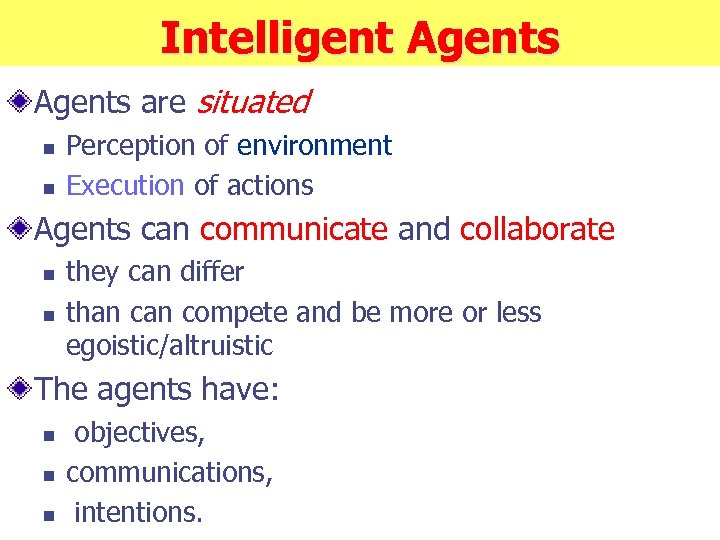
Intelligent Agents are situated n n Perception of environment Execution of actions Agents can communicate and collaborate n n they can differ than compete and be more or less egoistic/altruistic The agents have: n n n objectives, communications, intentions.
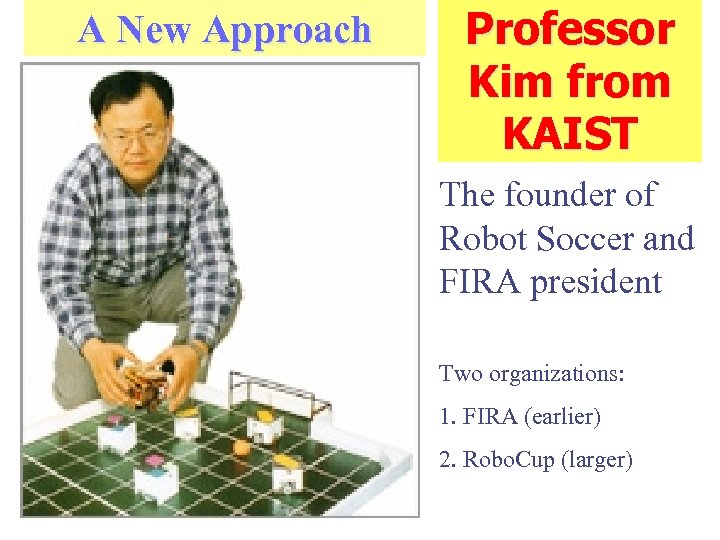
A New Approach Professor Kim from KAIST The founder of Robot Soccer and FIRA president Two organizations: 1. FIRA (earlier) 2. Robo. Cup (larger)
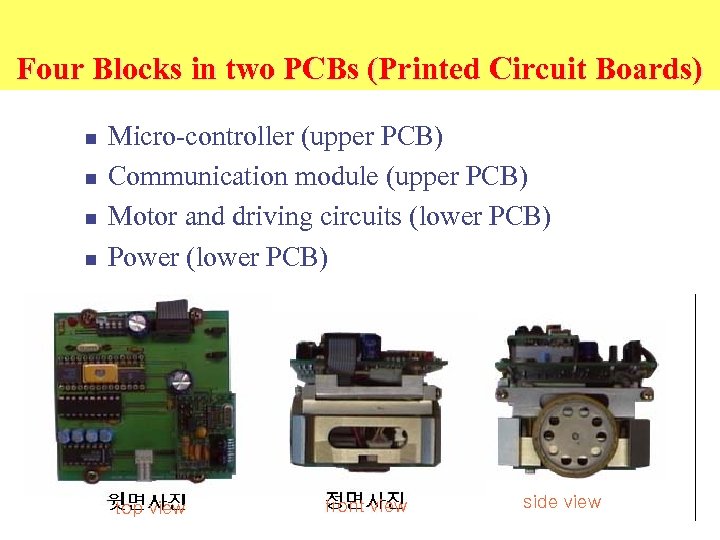
Four Blocks in two PCBs (Printed Circuit Boards) n n Micro-controller (upper PCB) Communication module (upper PCB) Motor and driving circuits (lower PCB) Power (lower PCB) top view front view side view
Importance of Robot Soccer Communication Cooperation Coordination Learning Competence Real Time Robot Soccer Evolution Computer simulations Wheeled brainless robots Wheeled autonomous robots Legged autonomous robots
![Robot Soccer Purpose Ø“The number one goal of [robot soccer] is not winning or](https://present5.com/presentation/b82821645f9fd608ca243041abb7684a/image-22.jpg "Robot Soccer Purpose Ø“The number one goal of [robot soccer] is not winning or")
Robot Soccer Purpose Ø“The number one goal of [robot soccer] is not winning or losing, but accumulating diverse technology. ” Ø - Mr. Dao (Senior VP of Sony Corporation).
Robot Soccer Competitions
Robot Soccer? Robot Soccer competitions proposed to help collaborate and evaluate various approaches: Software, hardware, electronics, sensors, motors, theories. Difficult problem, challenge for top universities and industries
FIRA & Robo. Cup History Category
Integrating various technologies Autonomous agents Collaboration of agents Strategy acquisition Real-time information processing Mobile robotics and robot vision Hardware and software technologies

FIRA
Index Introduction FIRA & Robocup n n History Category Discussion Issues PSU soccer robot projects
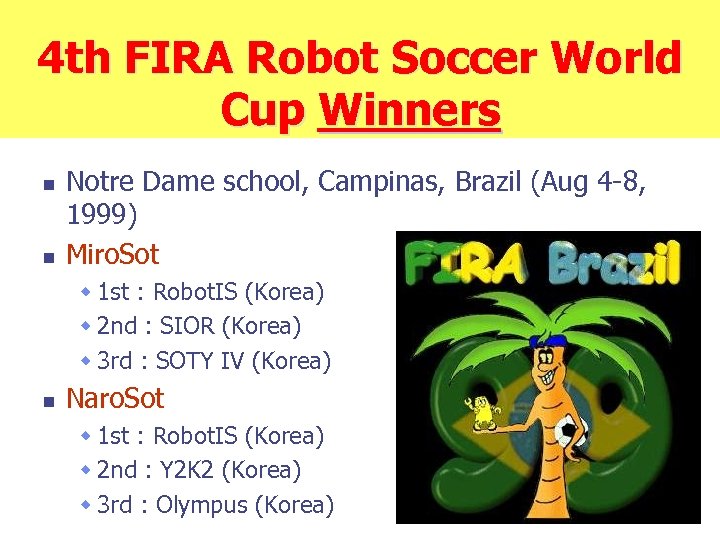
4 th FIRA Robot Soccer World Cup Winners n n Notre Dame school, Campinas, Brazil (Aug 4 -8, 1999) Miro. Sot w 1 st : Robot. IS (Korea) w 2 nd : SIOR (Korea) w 3 rd : SOTY IV (Korea) n Naro. Sot w 1 st : Robot. IS (Korea) w 2 nd : Y 2 K 2 (Korea) w 3 rd : Olympus (Korea)
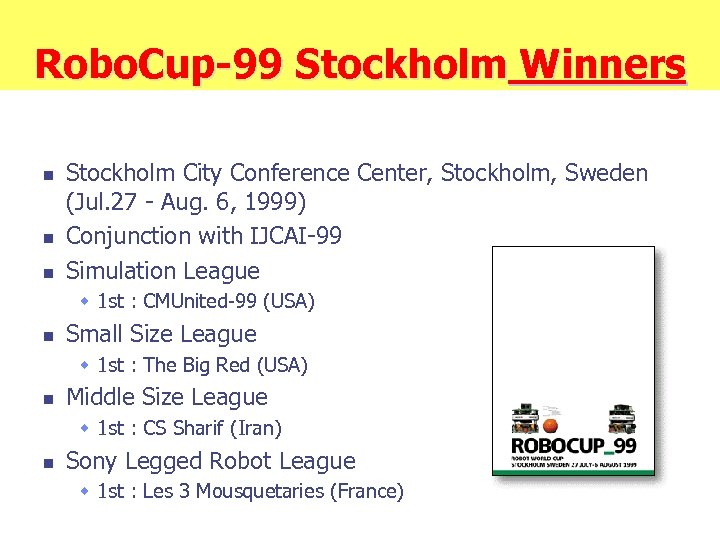
Robo. Cup-99 Stockholm Winners n n n Stockholm City Conference Center, Stockholm, Sweden (Jul. 27 - Aug. 6, 1999) Conjunction with IJCAI-99 Simulation League w 1 st : CMUnited-99 (USA) n Small Size League w 1 st : The Big Red (USA) n Middle Size League w 1 st : CS Sharif (Iran) n Sony Legged Robot League w 1 st : Les 3 Mousquetaries (France)
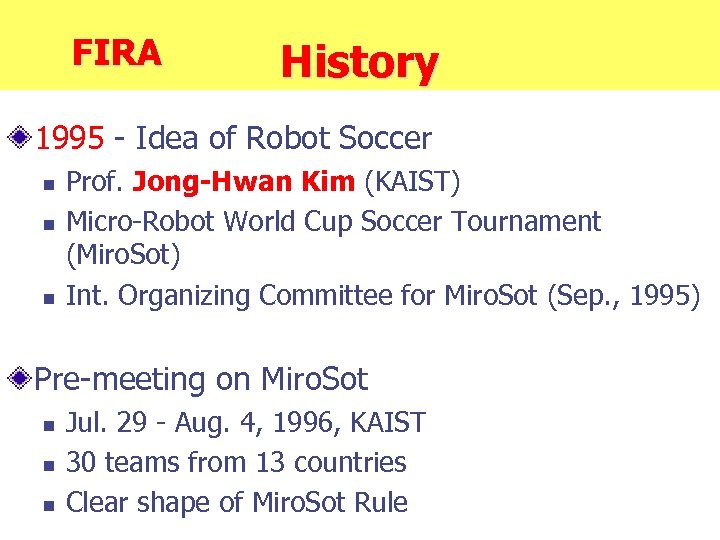
FIRA History 1995 - Idea of Robot Soccer n n n Prof. Jong-Hwan Kim (KAIST) Micro-Robot World Cup Soccer Tournament (Miro. Sot) Int. Organizing Committee for Miro. Sot (Sep. , 1995) Pre-meeting on Miro. Sot n n n Jul. 29 - Aug. 4, 1996, KAIST 30 teams from 13 countries Clear shape of Miro. Sot Rule
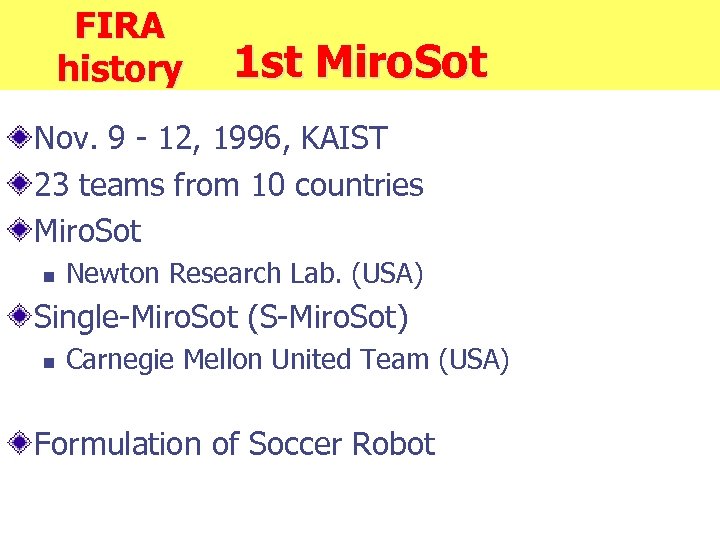
FIRA history 1 st Miro. Sot Nov. 9 - 12, 1996, KAIST 23 teams from 10 countries Miro. Sot n Newton Research Lab. (USA) Single-Miro. Sot (S-Miro. Sot) n Carnegie Mellon United Team (USA) Formulation of Soccer Robot
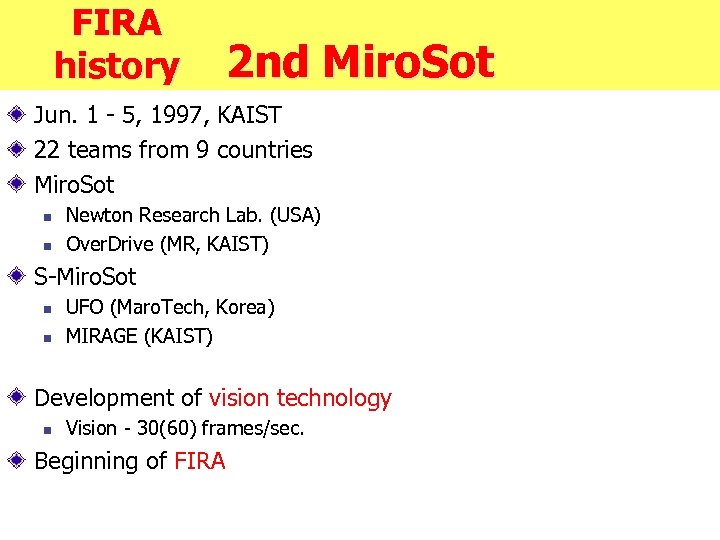
FIRA history 2 nd Miro. Sot Jun. 1 - 5, 1997, KAIST 22 teams from 9 countries Miro. Sot n n Newton Research Lab. (USA) Over. Drive (MR, KAIST) S-Miro. Sot n n UFO (Maro. Tech, Korea) MIRAGE (KAIST) Development of vision technology n Vision - 30(60) frames/sec. Beginning of FIRA
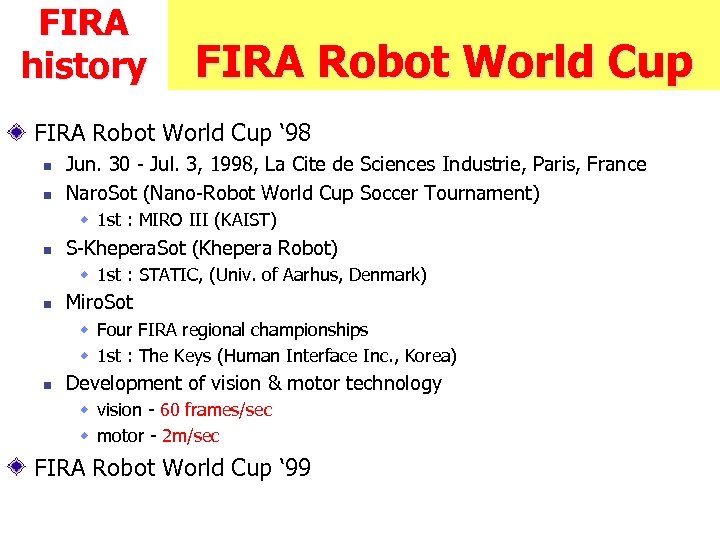
FIRA history FIRA Robot World Cup ‘ 98 n n Jun. 30 - Jul. 3, 1998, La Cite de Sciences Industrie, Paris, France Naro. Sot (Nano-Robot World Cup Soccer Tournament) w 1 st : MIRO III (KAIST) n S-Khepera. Sot (Khepera Robot) w 1 st : STATIC, (Univ. of Aarhus, Denmark) n Miro. Sot w Four FIRA regional championships w 1 st : The Keys (Human Interface Inc. , Korea) n Development of vision & motor technology w vision - 60 frames/sec w motor - 2 m/sec FIRA Robot World Cup ‘ 99
FIRA Miro. Sot Naro. Sot Khepera. Sot Raro. Sot Category
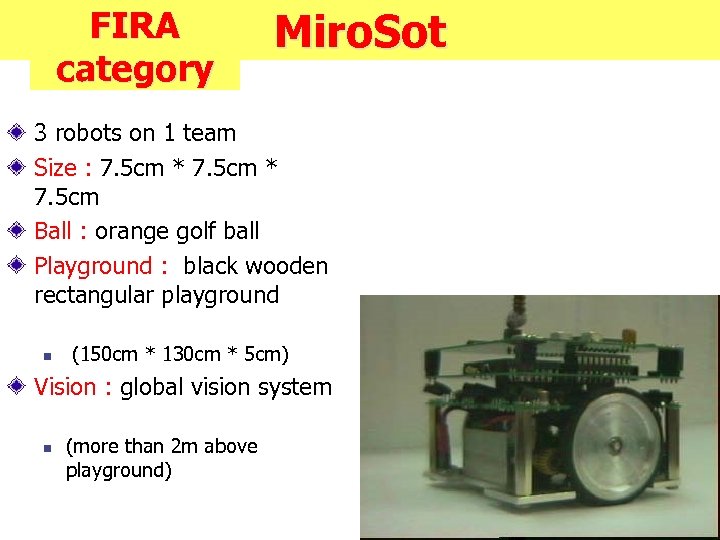
FIRA category Miro. Sot 3 robots on 1 team Size : 7. 5 cm * 7. 5 cm Ball : orange golf ball Playground : black wooden rectangular playground n (150 cm * 130 cm * 5 cm) Vision : global vision system n (more than 2 m above playground)
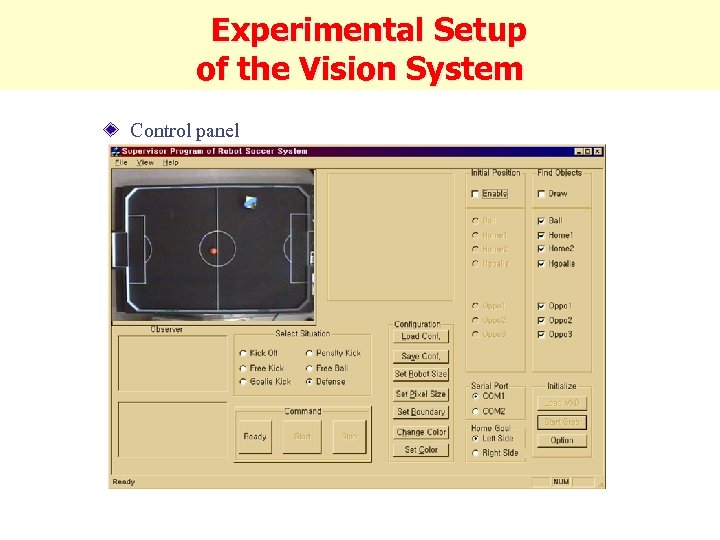
Experimental Setup of the Vision System Control panel
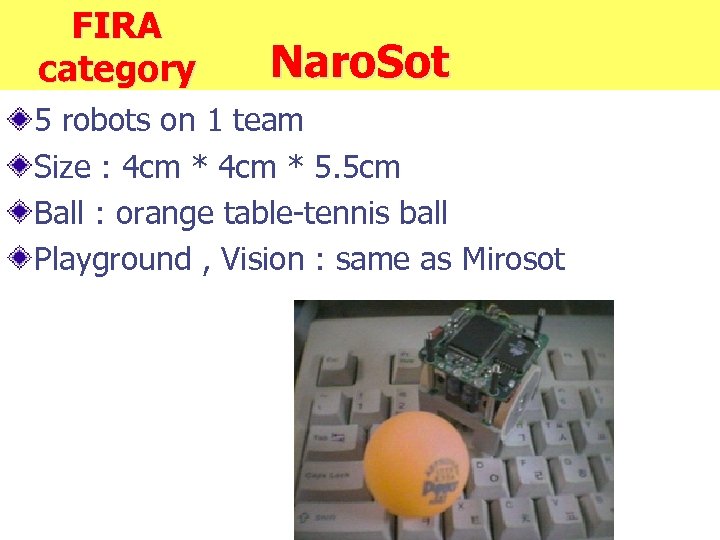
FIRA category Naro. Sot 5 robots on 1 team Size : 4 cm * 5. 5 cm Ball : orange table-tennis ball Playground , Vision : same as Mirosot
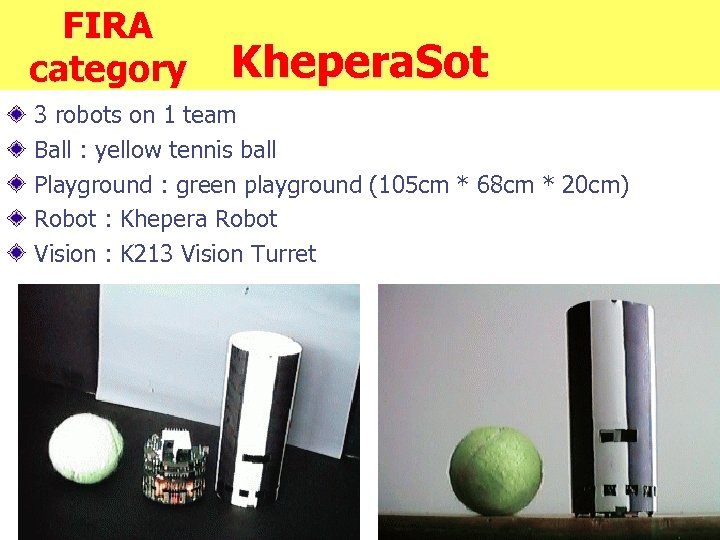
FIRA category Khepera. Sot 3 robots on 1 team Ball : yellow tennis ball Playground : green playground (105 cm * 68 cm * 20 cm) Robot : Khepera Robot Vision : K 213 Vision Turret
FIRA category Robo. Sot 3 robots on 1 team Size : 15 cm * 30 cm Ball : red roller-hockey ball Playground : black wooden rectangular playground (220 cm * 150 cm * 30 cm) Vision : on the robot Under preparation

Robo. Cup A project directed by Carnegie Mellon University (CMU) Robot World Cup Soccer Games and Conferences Robots working, playing, and competing against each other Revolution in science and entertainment Breakthrough in the fields of robotics and AI Goal: to culminate all the challenges in AI like temporal reasoning, machine learning, vision processing, obstacle avoidance, perception, cognition and motion control
Started in 1993……. In Robo. Cup 1999 there were more than 1500 researchers actively participating within the Robo. Cup initiative. … and the number is still increasing.
Leagues of Robo. Cup Simulator League Small Robot League Full Set Small Robot League, which is 11 robots per team (F-180) Middle Size Robot League (F 2000) Legged Robot Games Sony Legged Robot League (Sponsored by Sony) Humanoid League (From 2002, demonstration may take place before 2002) Tele. Operation Track (to be announced) Robo. Cup Commentator Exhibition, Related Competitions n (rescue, actors, etc).
Various levels · real robot leagues · software agent league · special skill competition
Robocup History Jun. 1993 - Robot J-League n n Minoru Asada(Osaka Univ), Yasuo Kuniyoshi, Hiroaki Kitano(SONY) Robot World Cup (Robo. Cup) Sep. 1993 - first public announcement n Minour Asada, Manuela Veloso(CMU) 1995 - first simulator for soccer games n n n Itsuki Noda(ETL) C++ version soccer server v 1. 0 IJCAI-95 : first public demonstration 1996 - Pre-Robo. Cup-96 n n Nov. 4 -8, 1996, Osaka, IROS-96 8 teams for simulation league, demonstration of middle size league
History Robo. Cup-1997 Nagoya, Japan, IJCAI 97 Robo. Cup-1998 Paris, France, MAAMAW AI*IA, Padova, Italy, September 1998 Robo. Cup-1999 Stockholm, IJCAI 99 Robo. Cup Euro 2000 Amsterdam Robo. Cup-2000 Melbourne Robo. Cup Japan Open 2001 Fukuoka Robo. Cup German Open 2001 Paderborn Robo. Cup-2001 Seattle, USA
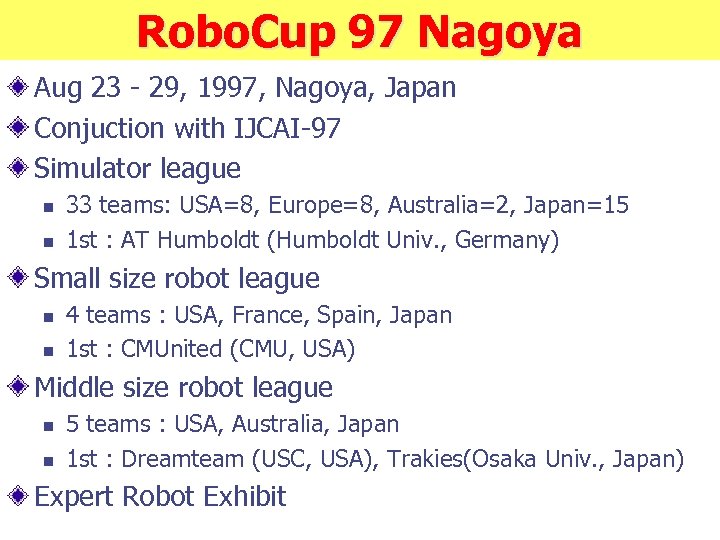
Robo. Cup 97 Nagoya Aug 23 - 29, 1997, Nagoya, Japan Conjuction with IJCAI-97 Simulator league n n 33 teams: USA=8, Europe=8, Australia=2, Japan=15 1 st : AT Humboldt (Humboldt Univ. , Germany) Small size robot league n n 4 teams : USA, France, Spain, Japan 1 st : CMUnited (CMU, USA) Middle size robot league n n 5 teams : USA, Australia, Japan 1 st : Dreamteam (USC, USA), Trakies(Osaka Univ. , Japan) Expert Robot Exhibit
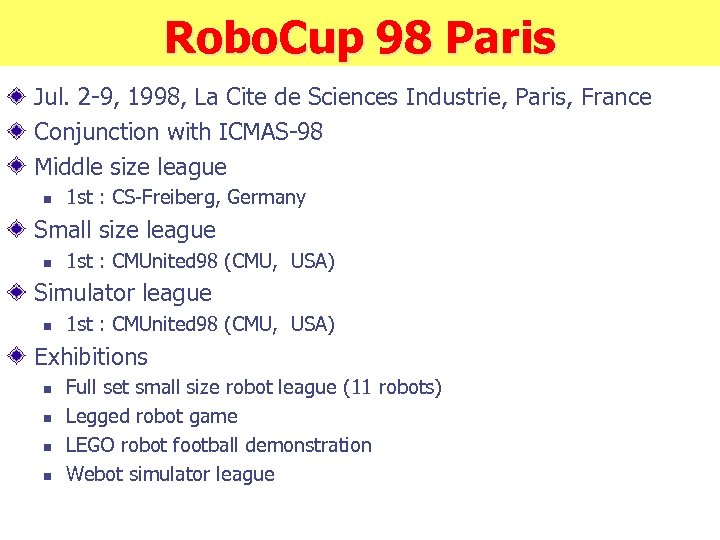
Robo. Cup 98 Paris Jul. 2 -9, 1998, La Cite de Sciences Industrie, Paris, France Conjunction with ICMAS-98 Middle size league n 1 st : CS-Freiberg, Germany Small size league n 1 st : CMUnited 98 (CMU, USA) Simulator league n 1 st : CMUnited 98 (CMU, USA) Exhibitions n n Full set small size robot league (11 robots) Legged robot game LEGO robot football demonstration Webot simulator league

Simulation League
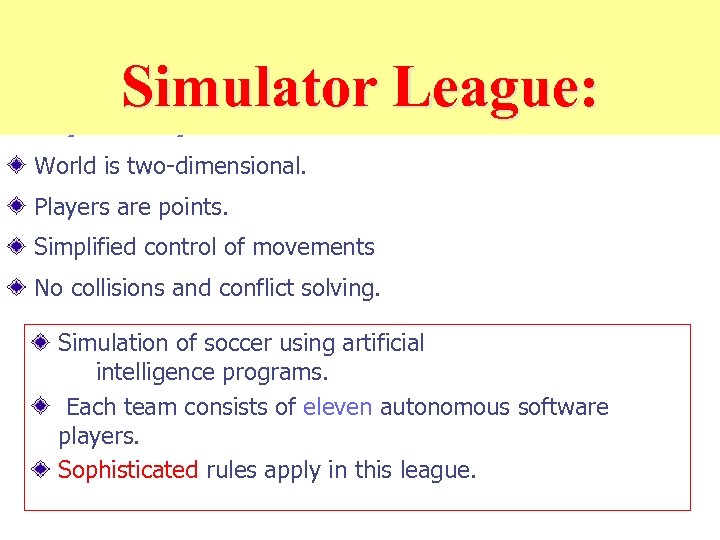
Simulator League: Simplified problem … World is two-dimensional. Players are points. Simplified control of movements No collisions and conflict solving. Simulation of soccer using artificial intelligence programs. Each team consists of eleven autonomous software players. Sophisticated rules apply in this league.
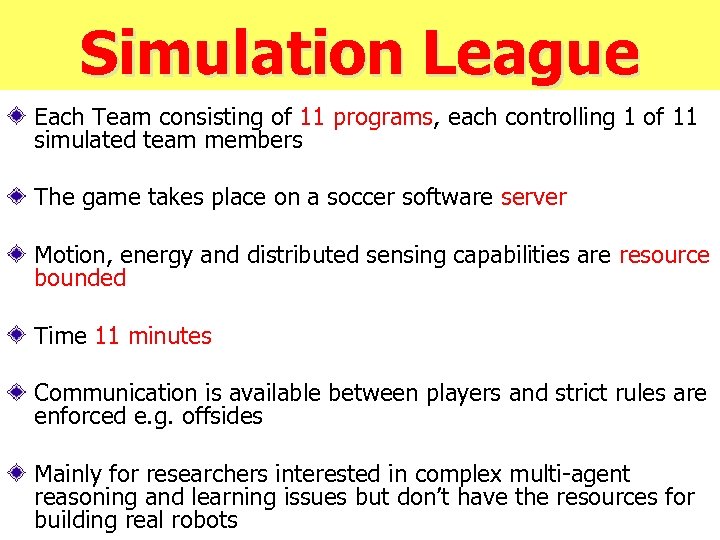
Simulation League Each Team consisting of 11 programs, each controlling 1 of 11 simulated team members The game takes place on a soccer software server Motion, energy and distributed sensing capabilities are resource bounded Time 11 minutes Communication is available between players and strict rules are enforced e. g. offsides Mainly for researchers interested in complex multi-agent reasoning and learning issues but don’t have the resources for building real robots
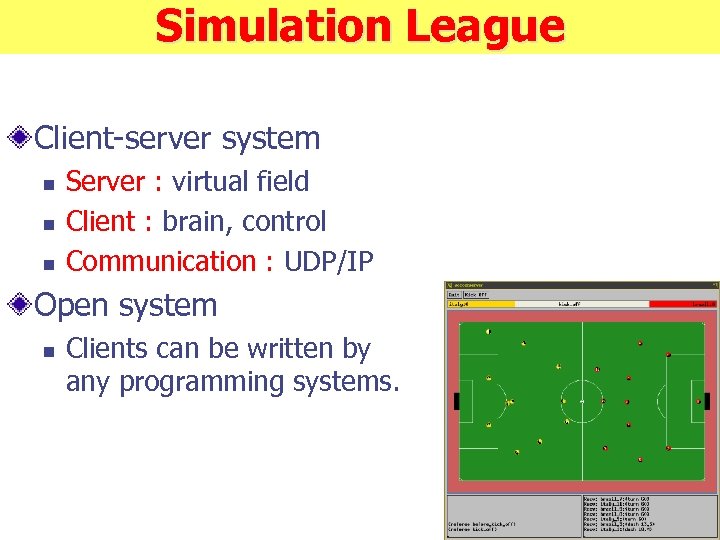
Simulation League Client-server system n n n Server : virtual field Client : brain, control Communication : UDP/IP Open system n Clients can be written by any programming systems.
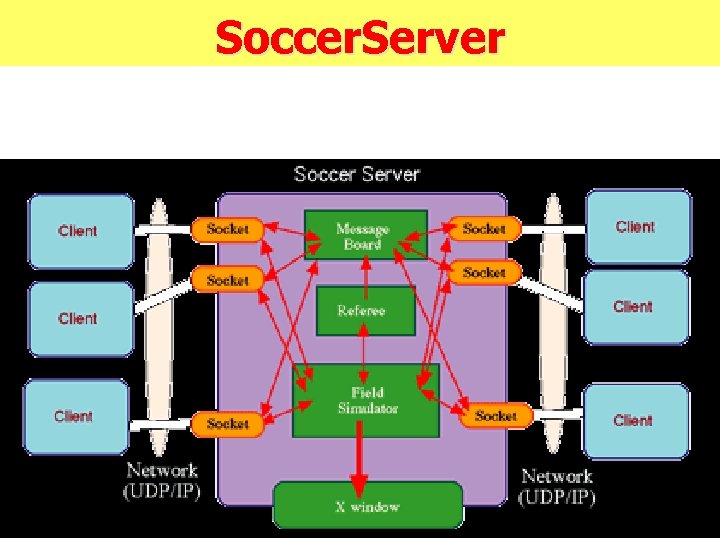
Soccer. Server
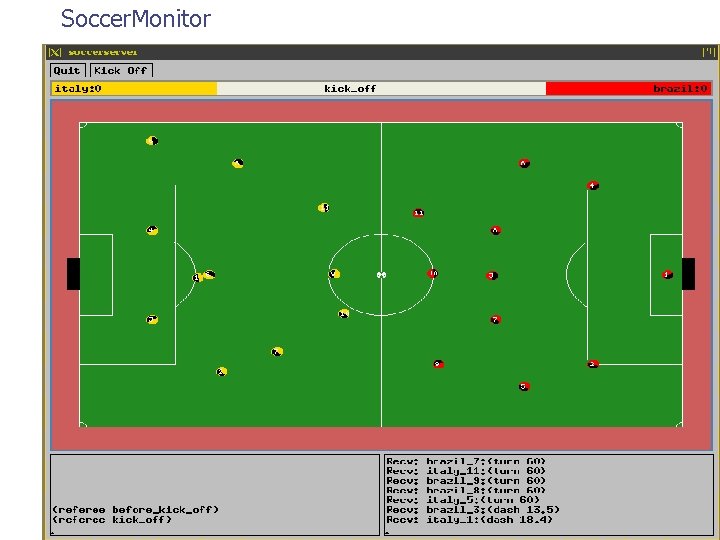
Soccer. Monitor
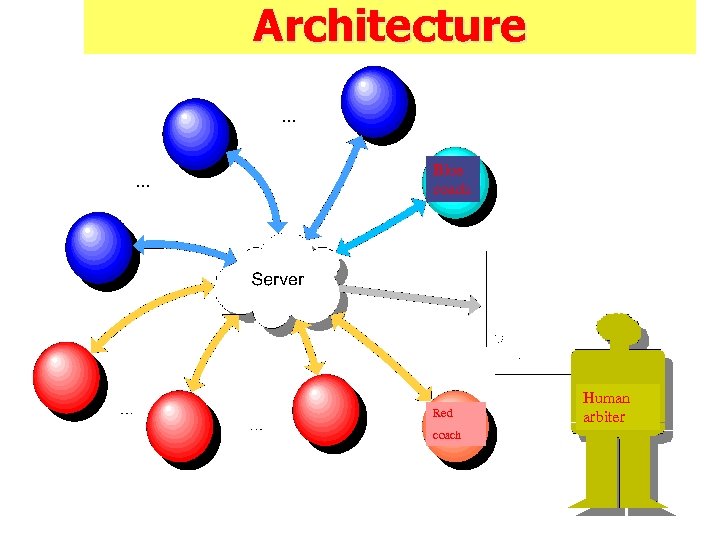
Architecture Blue coach Red coach Human arbiter
Simulator League: Example - University team Entirely written in Java. Is built upon mainly decision trees 10 -15 threads running per player… however most of the time threads is a sleep. Approx. 22 000 lines of code, and increasing! Written by 4 persons

Small. Size League
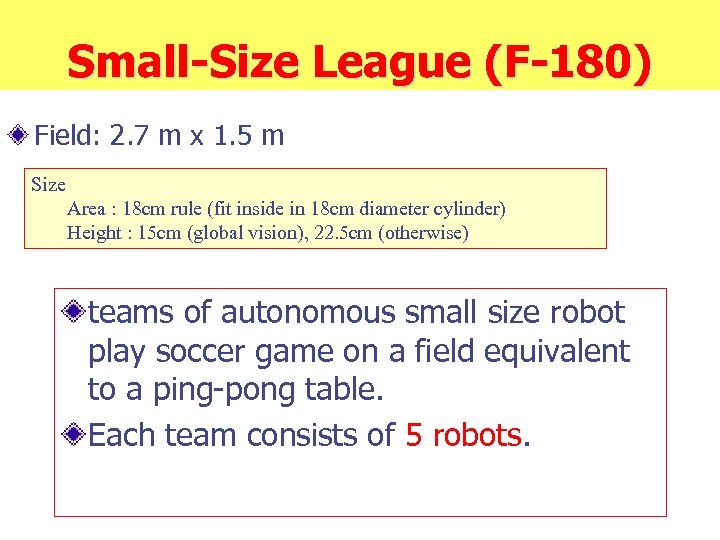
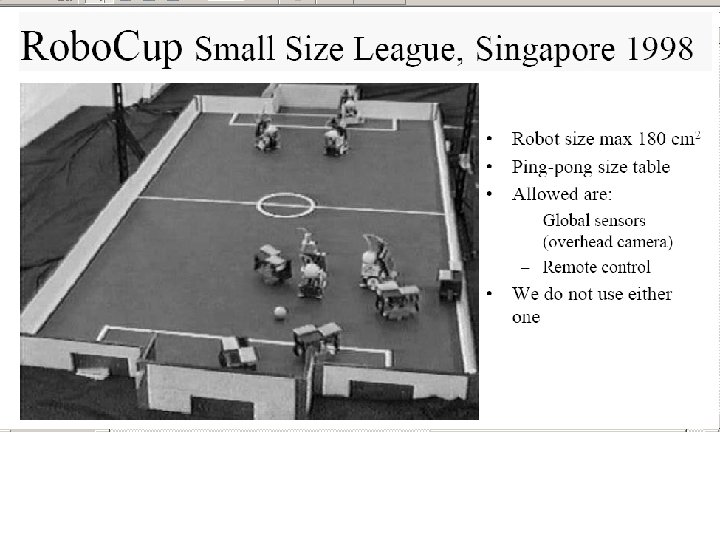
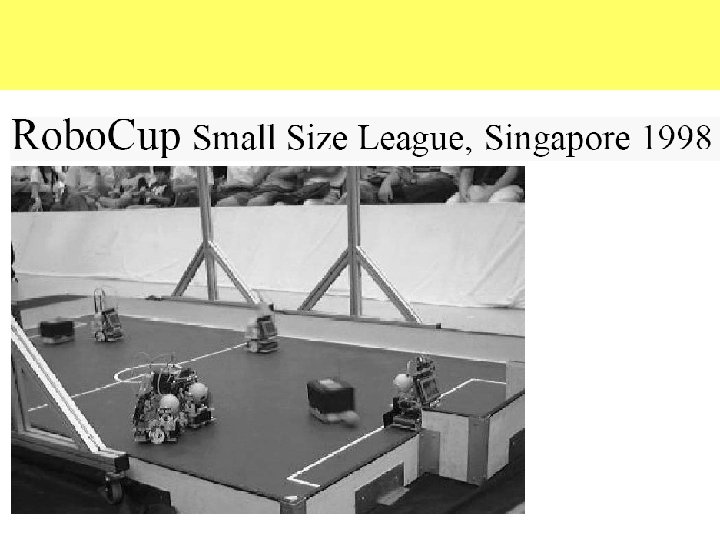
Small-Size League (F-180) Field: 2. 7 m x 1. 5 m Size Area : 18 cm rule (fit inside in 18 cm diameter cylinder) Height : 15 cm (global vision), 22. 5 cm (otherwise) teams of autonomous small size robot play soccer game on a field equivalent to a ping-pong table. Each team consists of 5 robots.
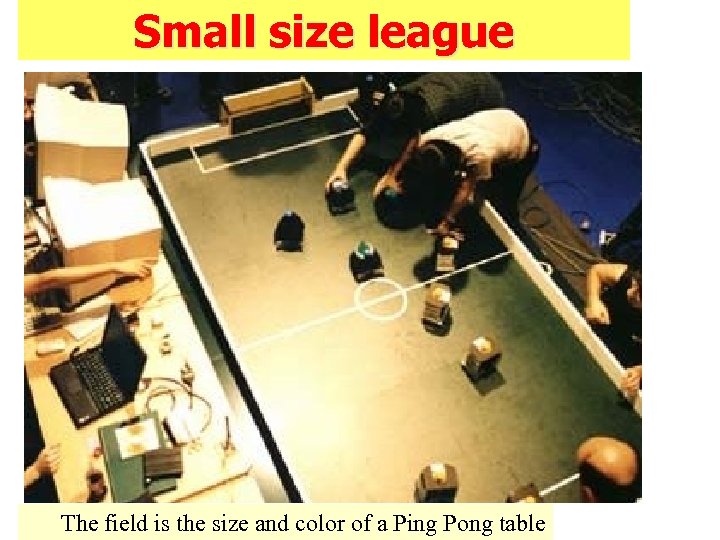
Small size league The field is the size and color of a Ping Pong table
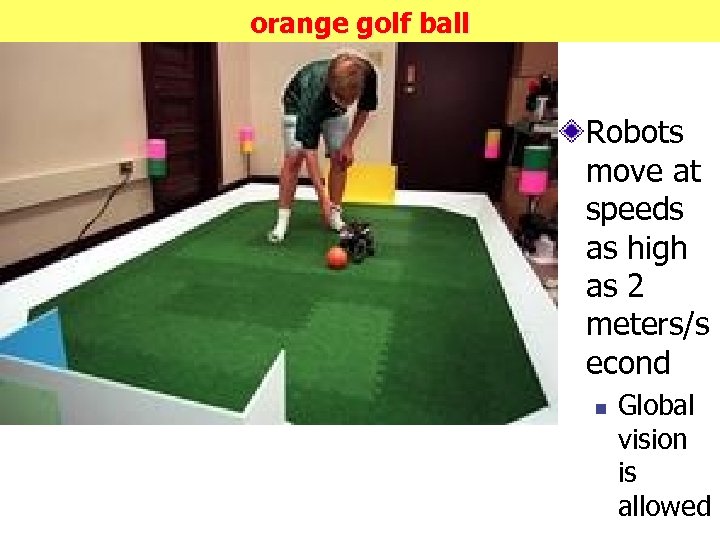
orange golf ball Robots move at speeds as high as 2 meters/s econd n Global vision is allowed
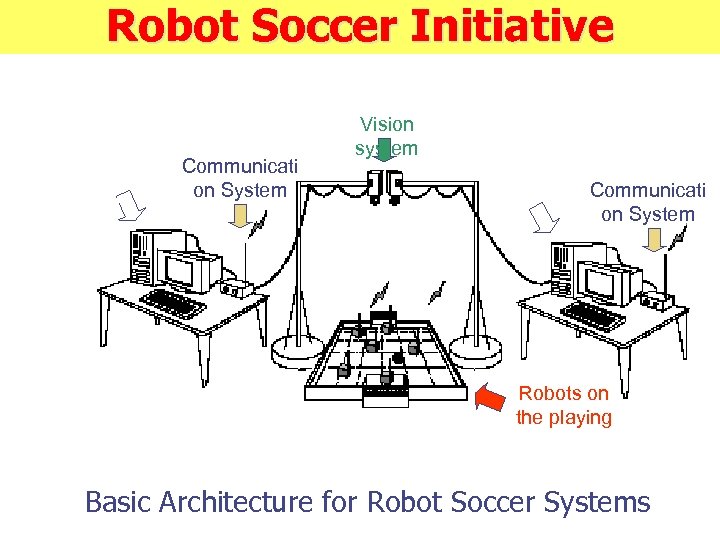
Robot Soccer Initiative Host comput er Communicati on System Vision system Host computer Communicati on System “Brainless” System Robots on the playing field Basic Architecture for Robot Soccer Systems
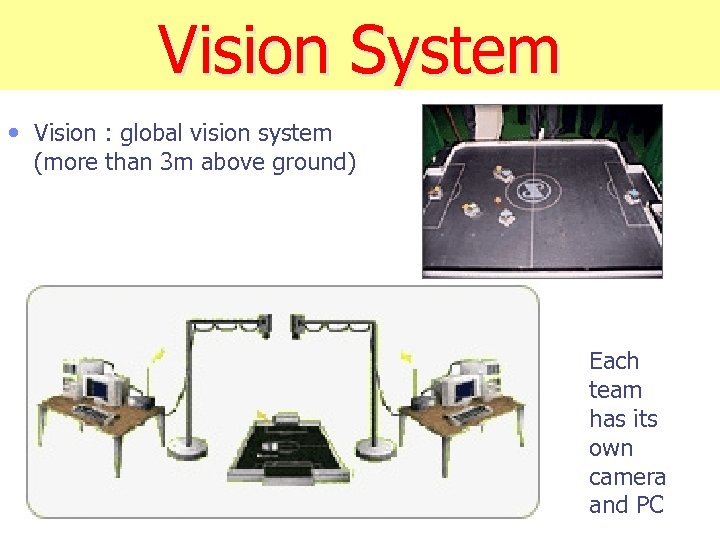
Vision System • Vision : global vision system (more than 3 m above ground) Each team has its own camera and PC
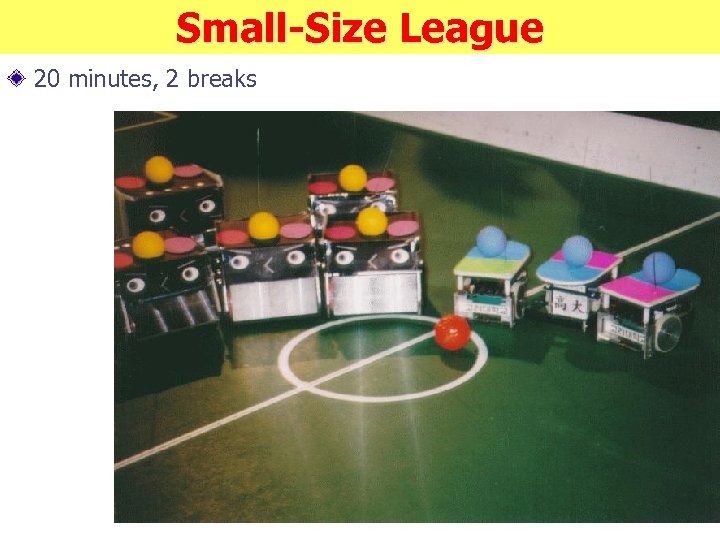
Small-Size League 20 minutes, 2 breaks
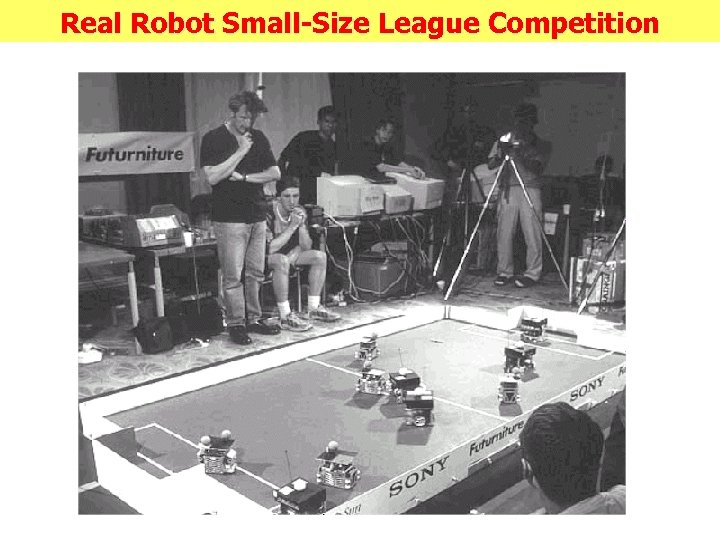
Real Robot Small-Size League Competition

Middle. Size League
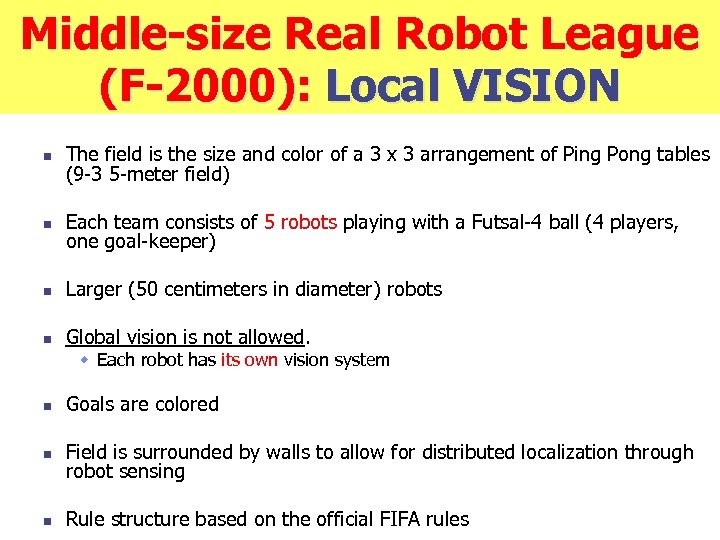
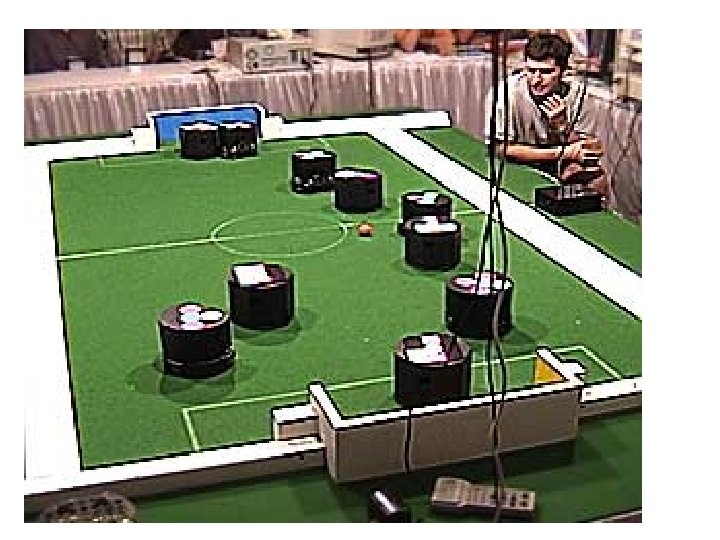
Middle-size Real Robot League (F-2000): Local VISION n The field is the size and color of a 3 x 3 arrangement of Ping Pong tables (9 -3 5 -meter field) n Each team consists of 5 robots playing with a Futsal-4 ball (4 players, one goal-keeper) n Larger (50 centimeters in diameter) robots n Global vision is not allowed. w Each robot has its own vision system n Goals are colored n Field is surrounded by walls to allow for distributed localization through robot sensing n Rule structure based on the official FIFA rules
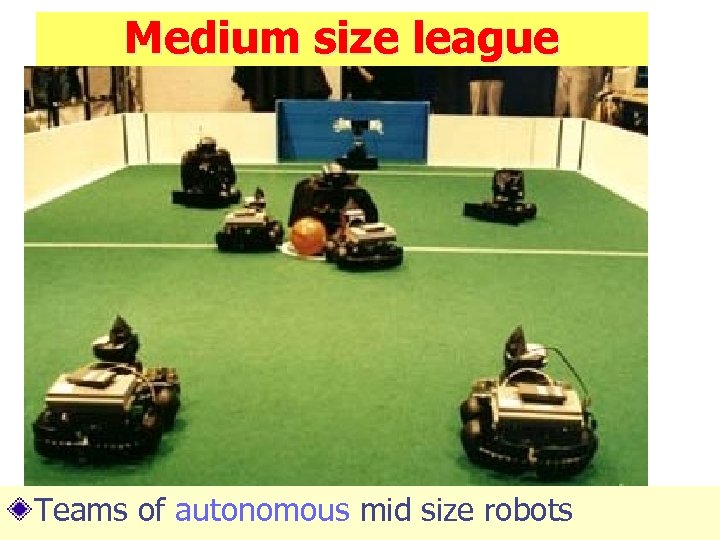
Medium size league Teams of autonomous mid size robots
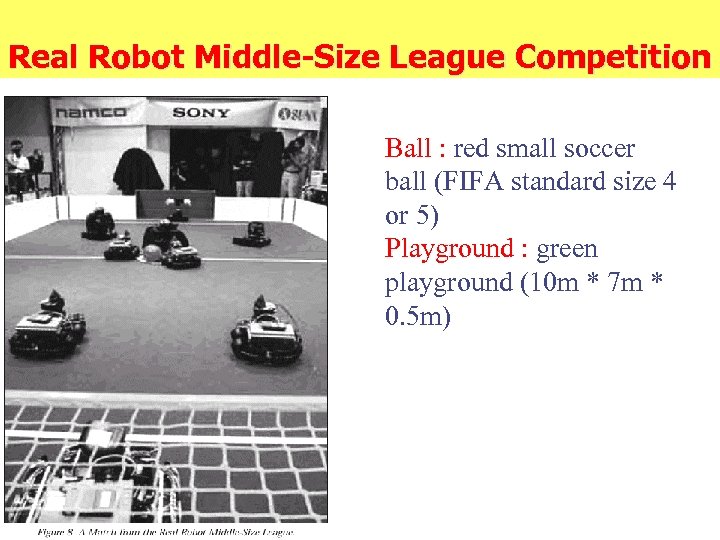
Real Robot Middle-Size League Competition Ball : red small soccer ball (FIFA standard size 4 or 5) Playground : green playground (10 m * 7 m * 0. 5 m)
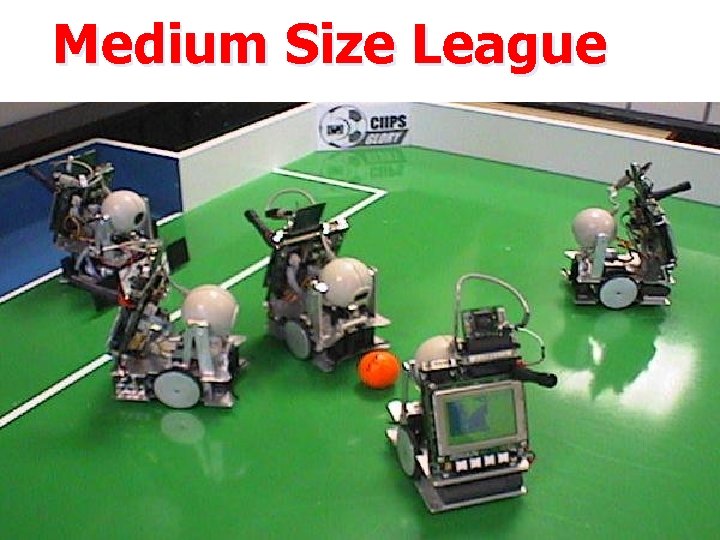
Medium Size League
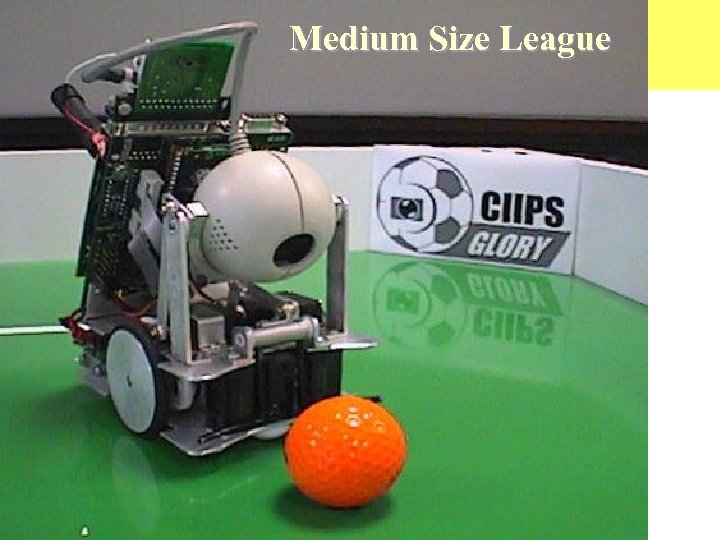
Medium Size League
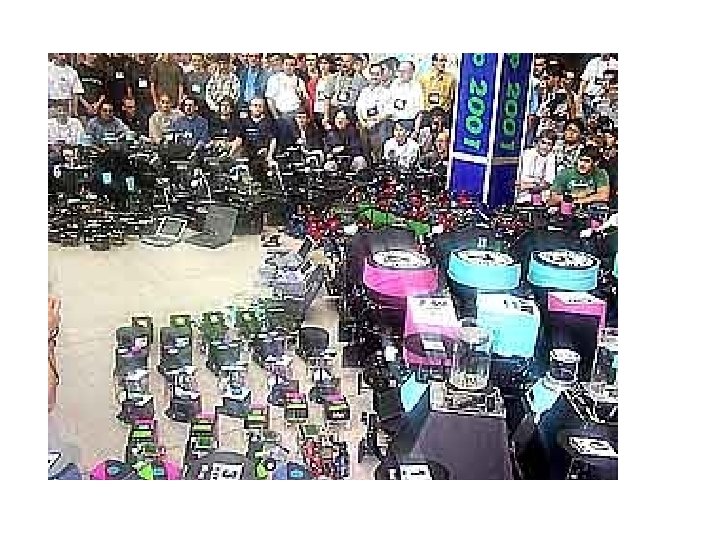
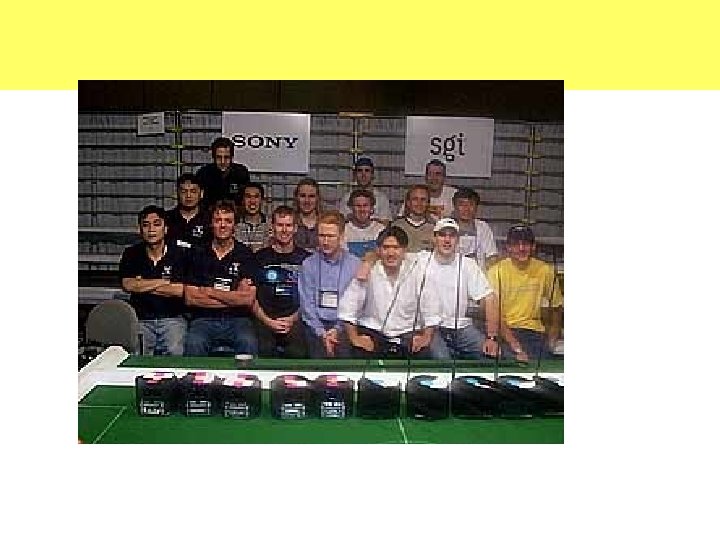
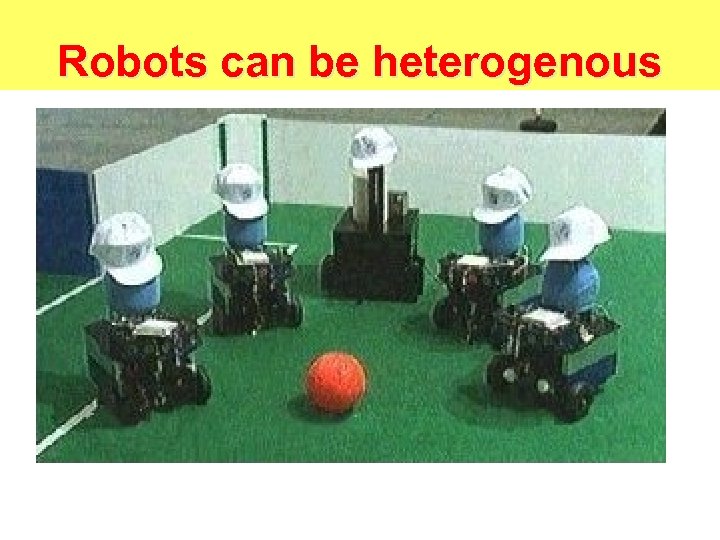
Robots can be heterogenous
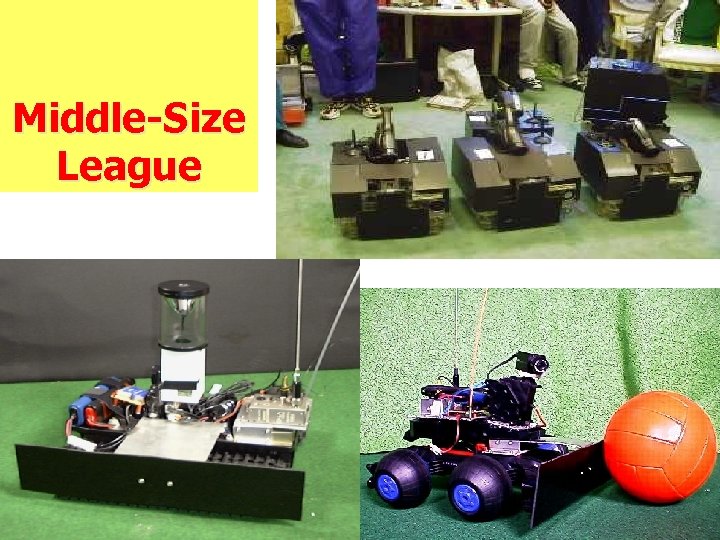
Middle-Size League
Sony Legged Robot League
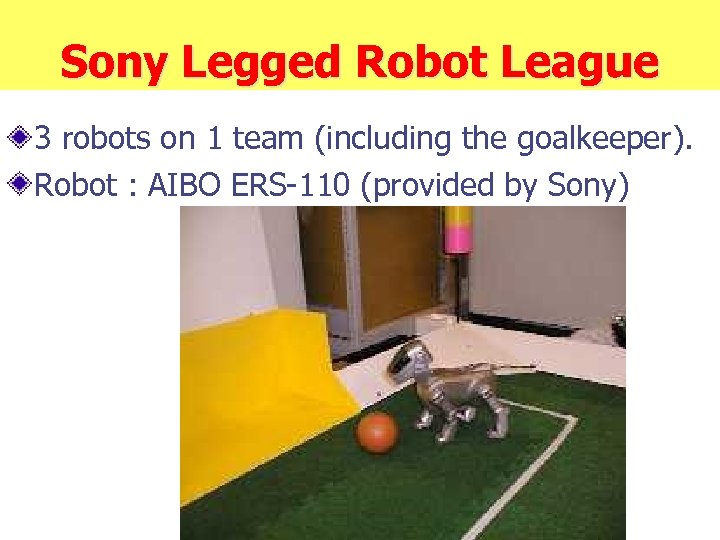
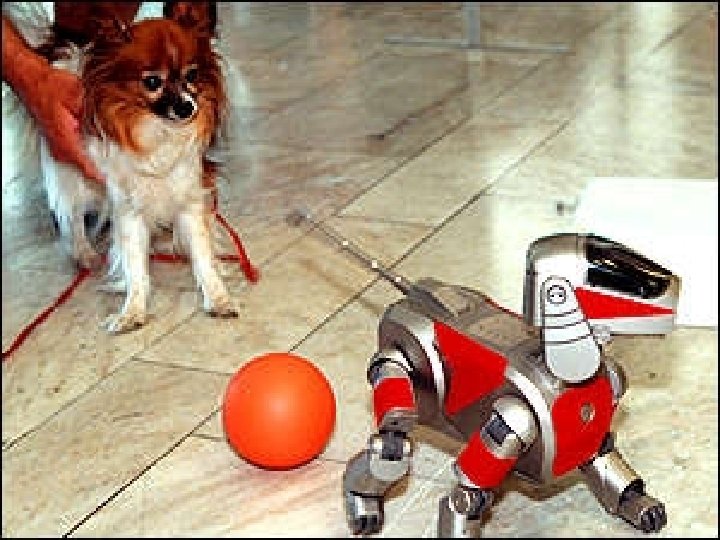
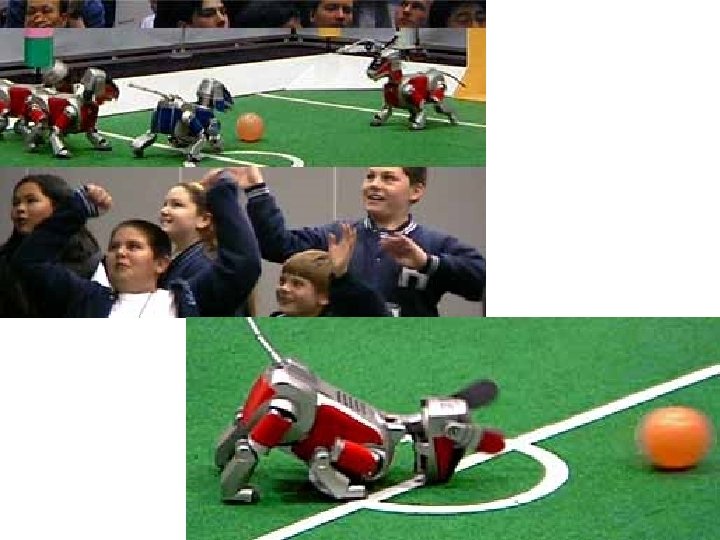
Sony Legged Robot League 3 robots on 1 team (including the goalkeeper). Robot : AIBO ERS-110 (provided by Sony)
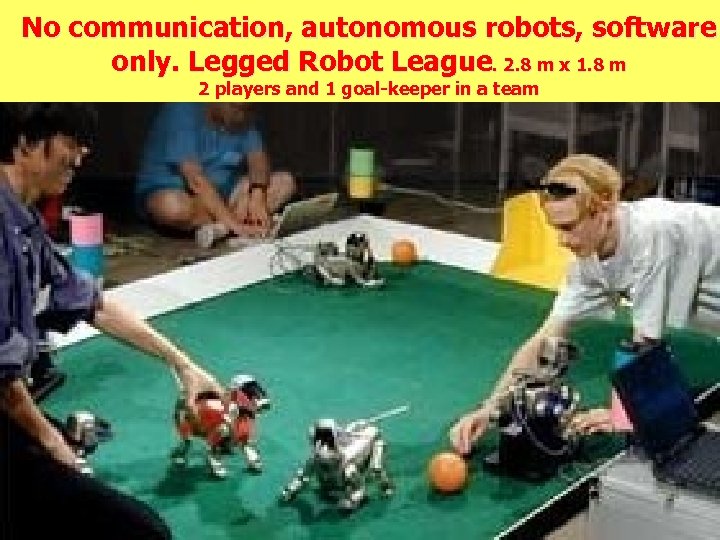
No communication, autonomous robots, software only. Legged Robot League. 2. 8 m x 1. 8 m 2 players and 1 goal-keeper in a team
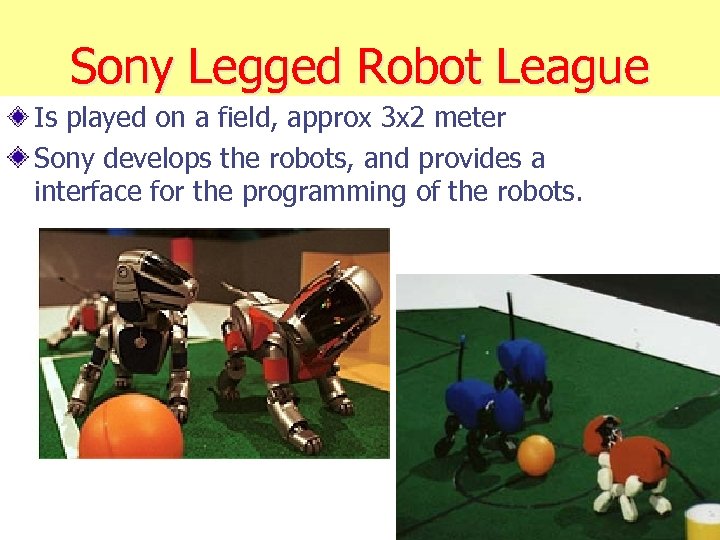
Sony Legged Robot League Is played on a field, approx 3 x 2 meter Sony develops the robots, and provides a interface for the programming of the robots.
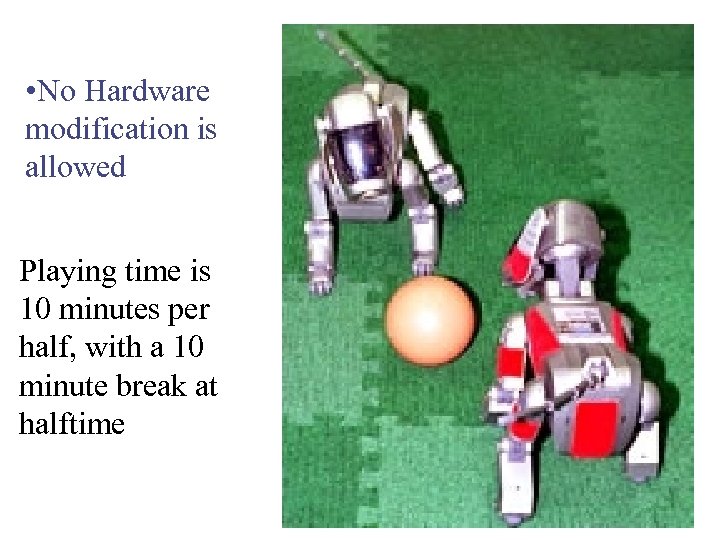
• No Hardware modification is allowed Playing time is 10 minutes per half, with a 10 minute break at halftime
Do different Robots have different personalities? Some teams have robots with very different capabilities. But it is hard to think of them as having personalities; n rather the robots have different playing styles.
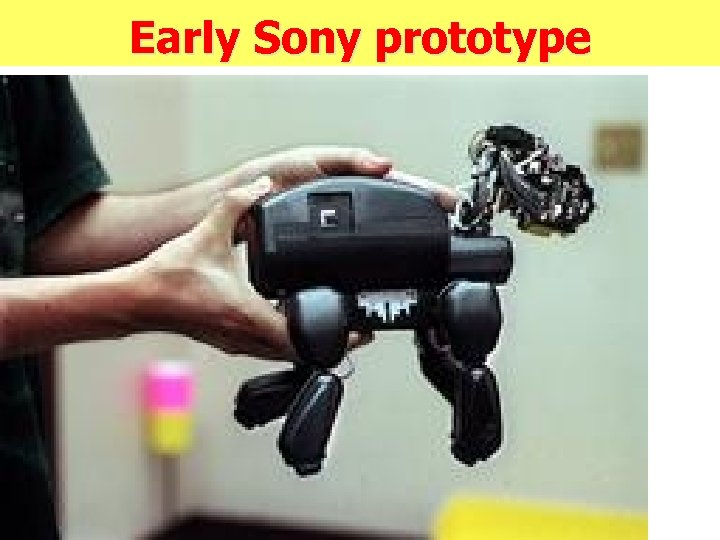
Early Sony prototype
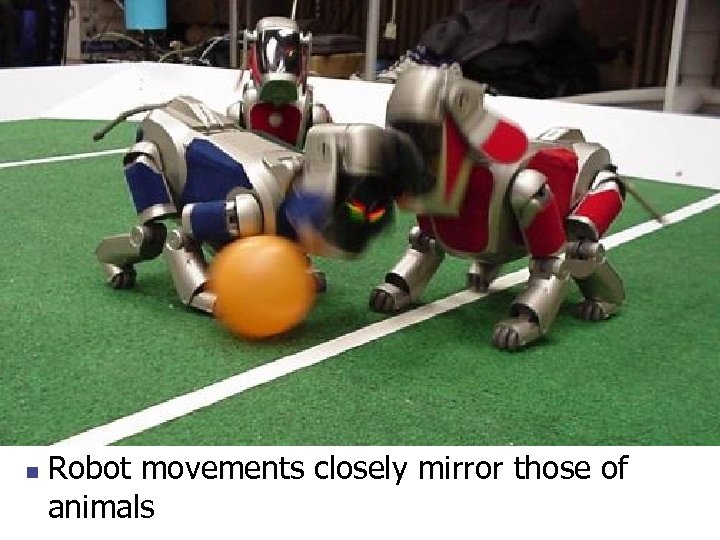
n Robot movements closely mirror those of animals
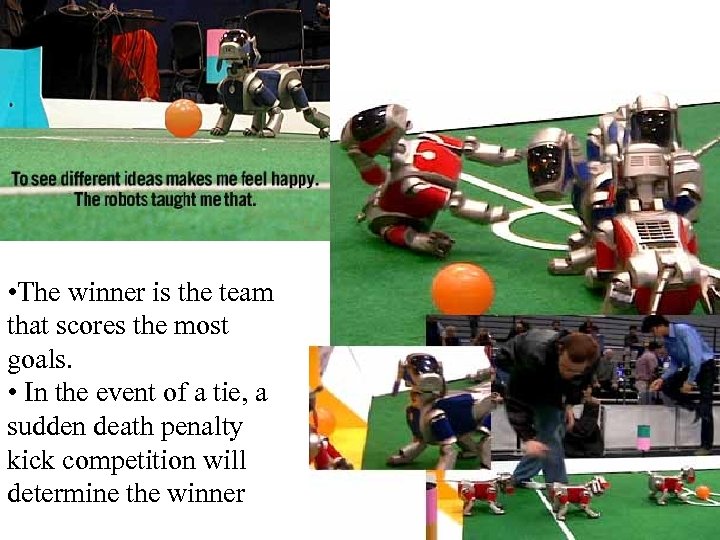
• The winner is the team that scores the most goals. • In the event of a tie, a sudden death penalty kick competition will determine the winner
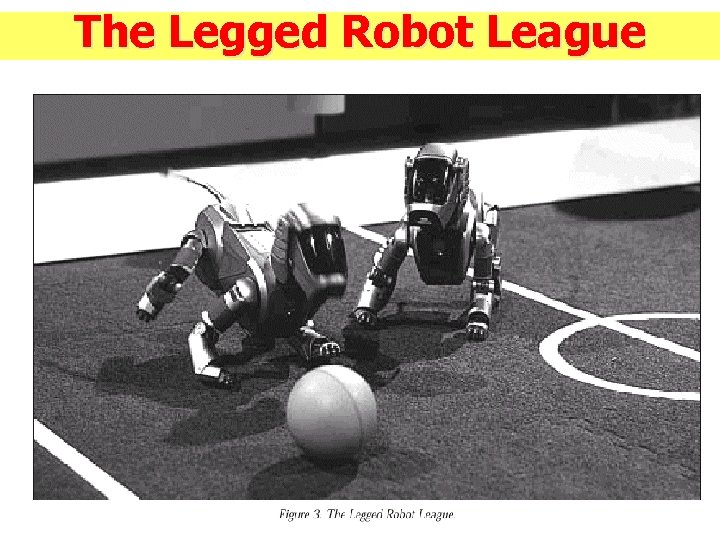
The Legged Robot League
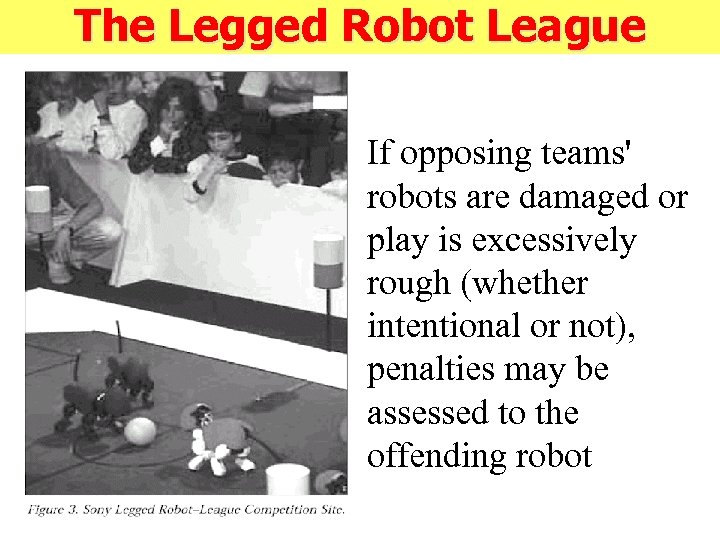
The Legged Robot League If opposing teams' robots are damaged or play is excessively rough (whether intentional or not), penalties may be assessed to the offending robot

Humanoid League
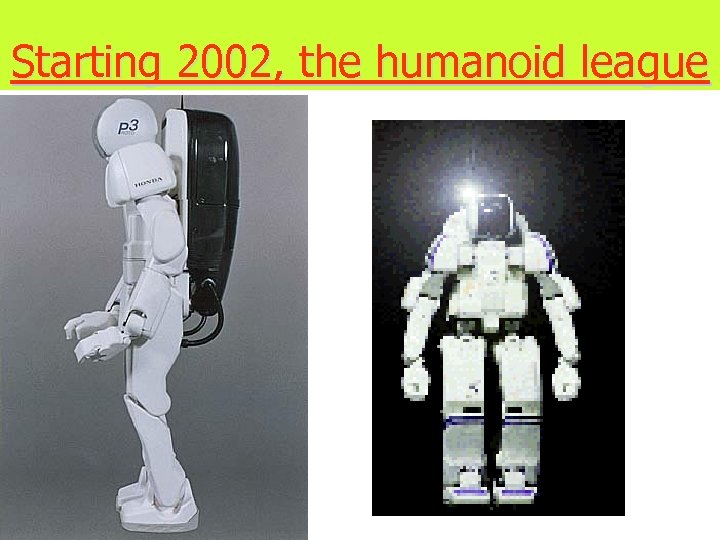
Starting 2002, the humanoid league
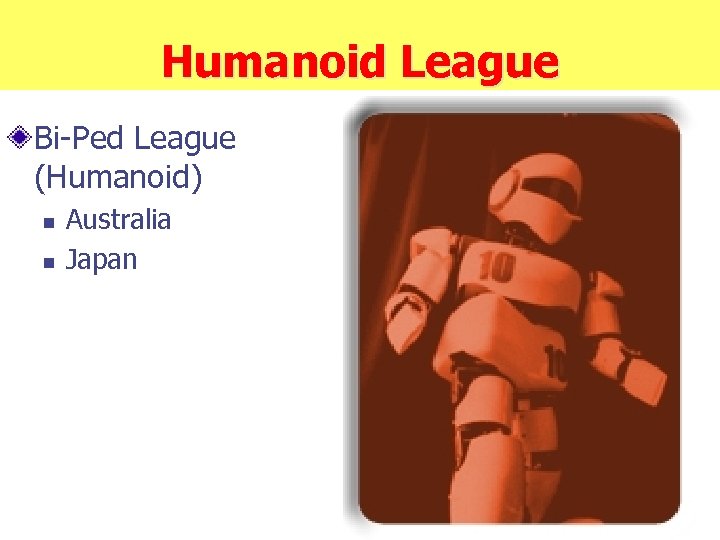
Humanoid League Bi-Ped League (Humanoid) n n Australia Japan
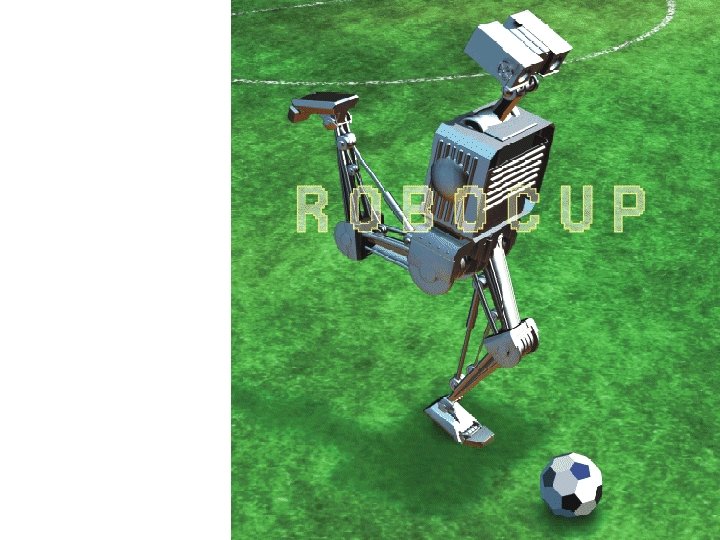
Robot. Cup-Rescue Robo. Cup-Rescue Simulation Project is a new practical domain of Robo. Cup A new initiative on search and rescue for large scale disasters A generic urban disaster simulation environment constructed on network computers Heterogeneous intelligent agents such as fire fighters, commanders, victims, volunteers, etc. conduct search and rescue activities in this virtual disaster world Goal: to enlighten citizens about accurate damage predictions, decision support in real disasters, and emergence of better disaster prevention strategies
Robocup. Junior n n n Initiative to promote educational aspects regarding Robo. Cup and advanced robotics topics children below 18 years old participate in the Robo. Cup-Junior games promotes participation by under-graduates, non-science graduates and general public, who are interested in Robo. Cup, but do not have the effort to get involved in the Robo. Cup World Cup games
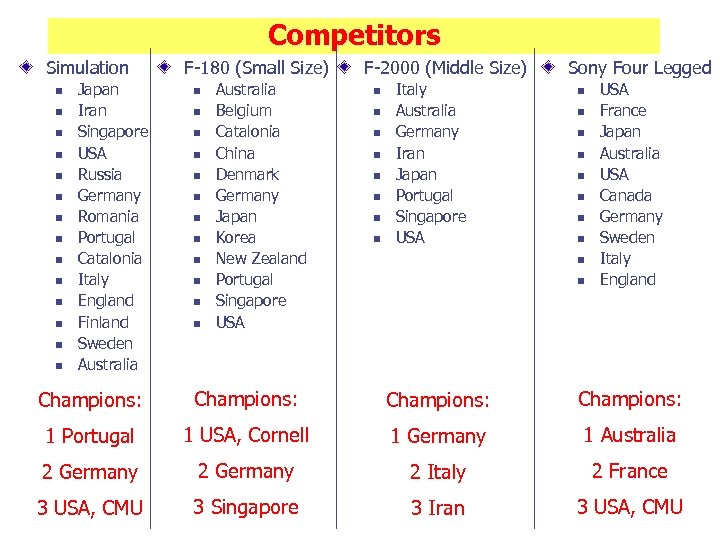
Competitors Simulation n n n Japan Iran Singapore USA Russia Germany Romania Portugal Catalonia Italy England Finland Sweden Australia F-180 (Small Size) n n n Australia Belgium Catalonia China Denmark Germany Japan Korea New Zealand Portugal Singapore USA F-2000 (Middle Size) n n n n Italy Australia Germany Iran Japan Portugal Singapore USA Sony Four Legged n n n n n USA France Japan Australia USA Canada Germany Sweden Italy England Champions: 1 Portugal 1 USA, Cornell 1 Germany 1 Australia 2 Germany 2 Italy 2 France 3 USA, CMU 3 Singapore 3 Iran 3 USA, CMU
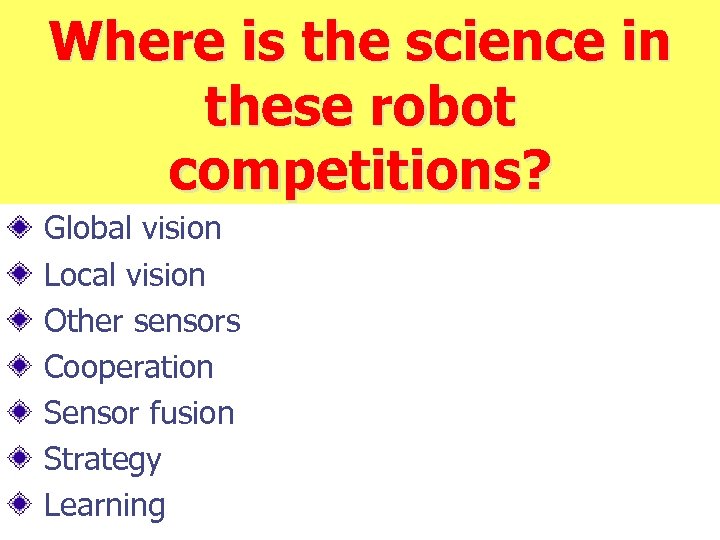
Where is the science in these robot competitions? Global vision Local vision Other sensors Cooperation Sensor fusion Strategy Learning
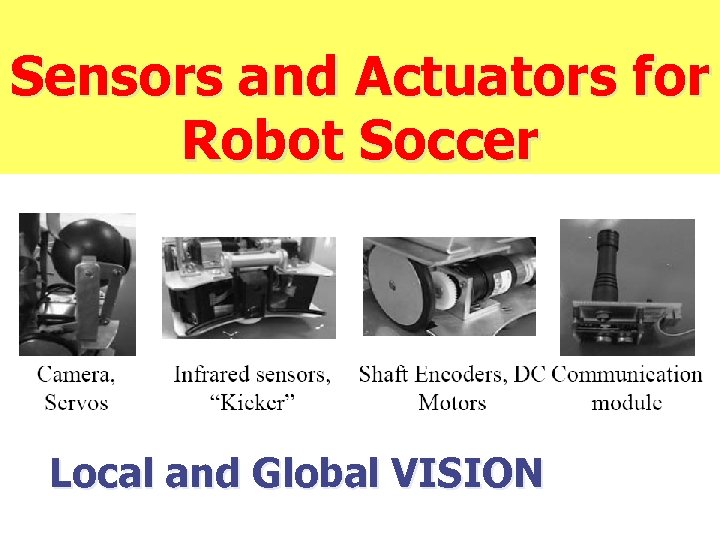
Sensors and Actuators for Robot Soccer Local and Global VISION
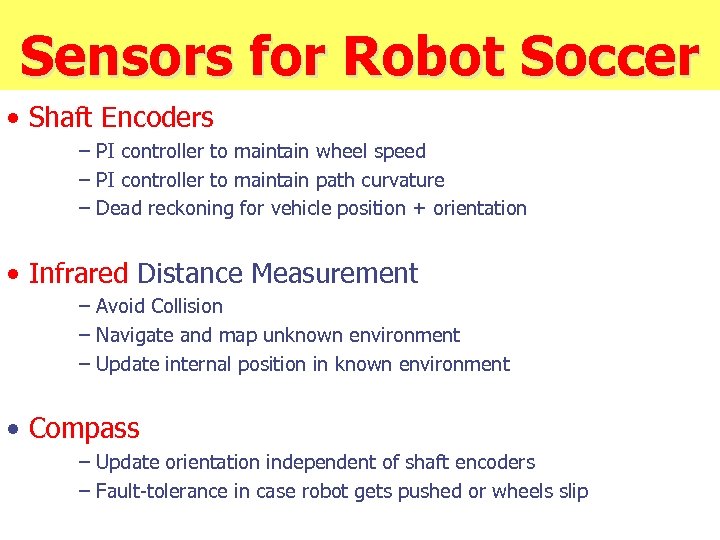
Sensors for Robot Soccer • Shaft Encoders – PI controller to maintain wheel speed – PI controller to maintain path curvature – Dead reckoning for vehicle position + orientation • Infrared Distance Measurement – Avoid Collision – Navigate and map unknown environment – Update internal position in known environment • Compass – Update orientation independent of shaft encoders – Fault-tolerance in case robot gets pushed or wheels slip
Sensors for Robot Soccer • Digital Camera – Low resolution, 60 x 80 pixels, 24 bit color (Braunl) – Color or shape recognition • Communication – Sharing information among robots – Receiving commands from human operator
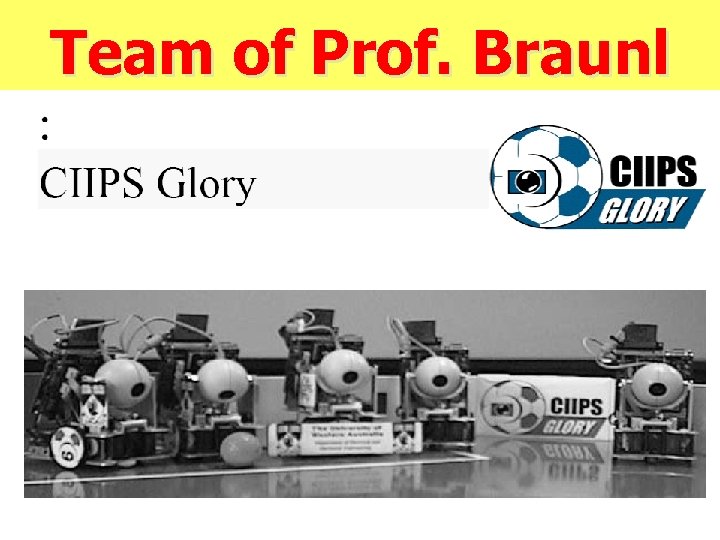
Team of Prof. Braunl
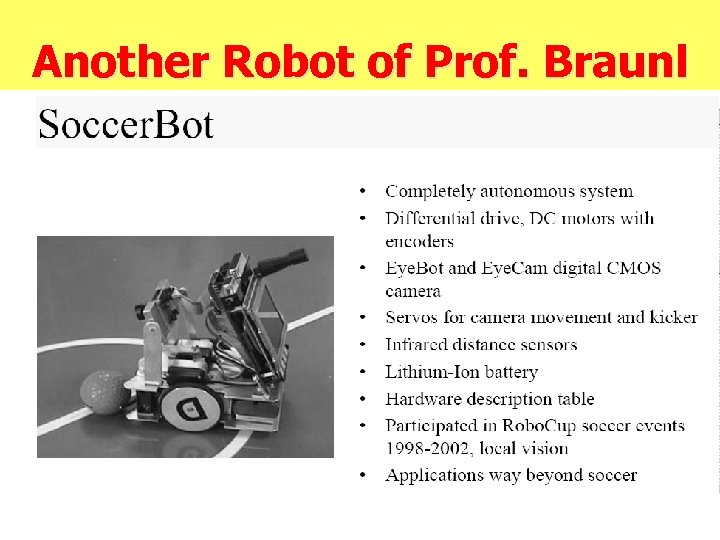
Another Robot of Prof. Braunl
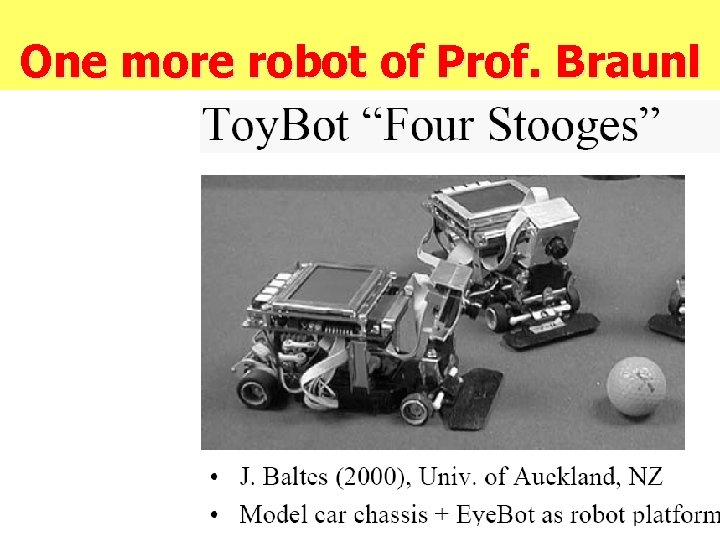
One more robot of Prof. Braunl
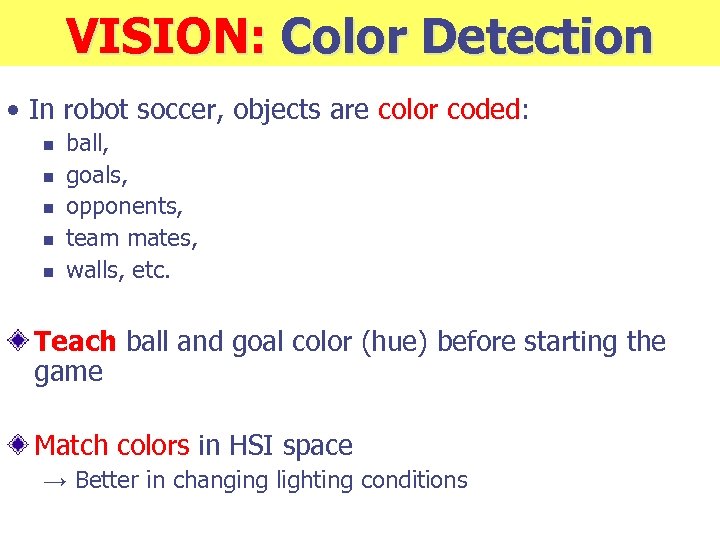
VISION: Color Detection • In robot soccer, objects are color coded: n n n ball, goals, opponents, team mates, walls, etc. Teach ball and goal color (hue) before starting the game Match colors in HSI space → Better in changing lighting conditions
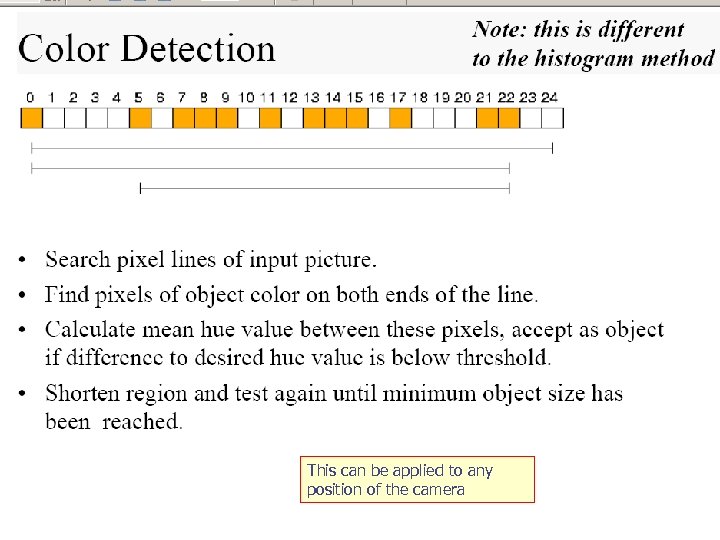
This can be applied to any position of the camera
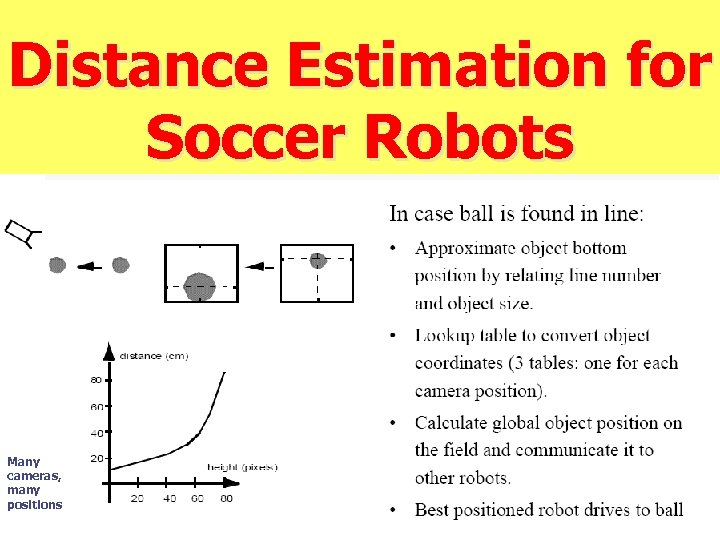
Distance Estimation for Soccer Robots Many cameras, many positions
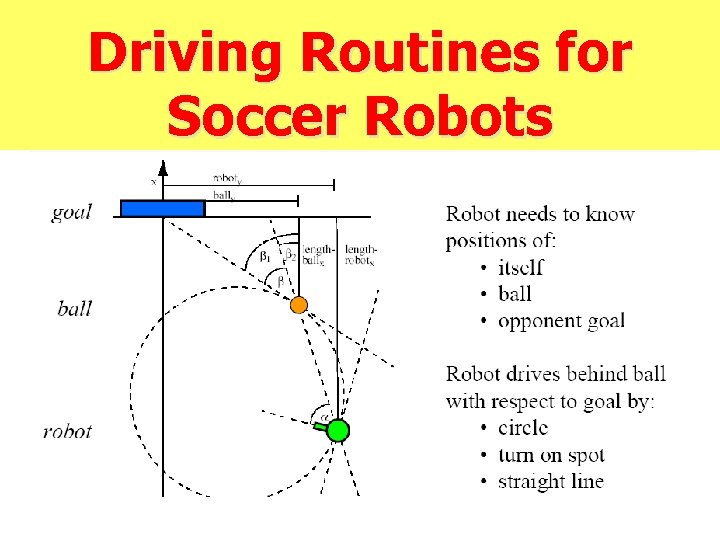
Driving Routines for Soccer Robots
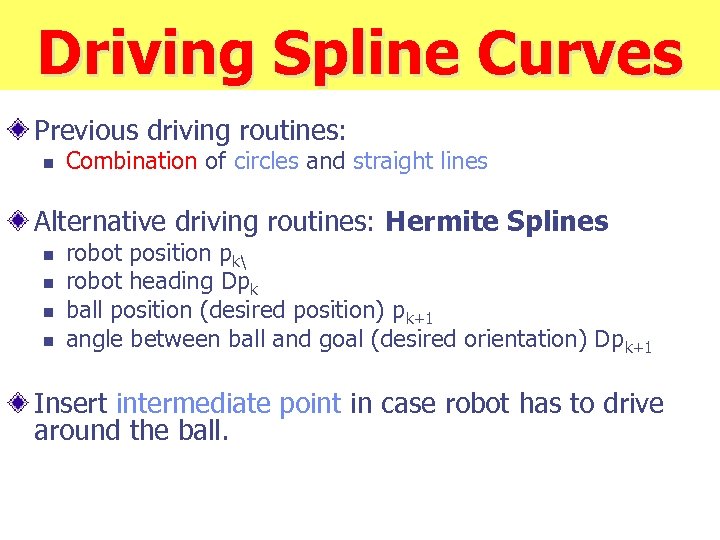
Driving Spline Curves Previous driving routines: n Combination of circles and straight lines Alternative driving routines: Hermite Splines n n robot position pk robot heading Dpk ball position (desired position) pk+1 angle between ball and goal (desired orientation) Dpk+1 Insert intermediate point in case robot has to drive around the ball.
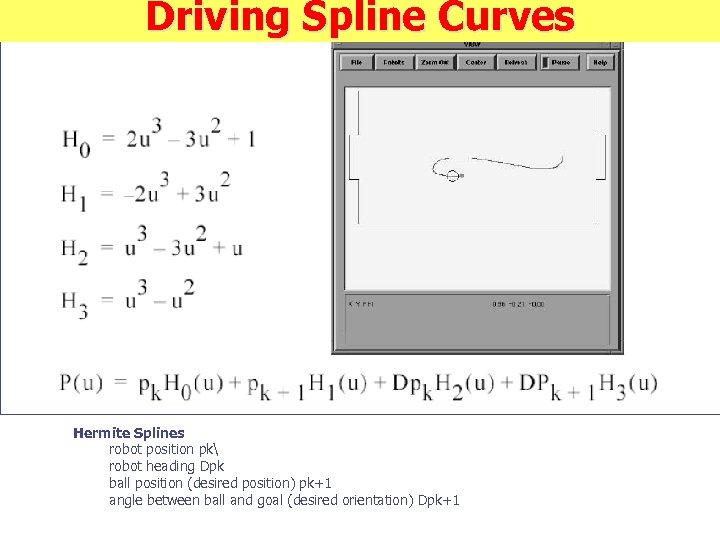
Driving Spline Curves Alternative driving routines: Hermite Splines n n robot position pk robot heading Dpk ball position (desired position) pk+1 angle between ball and goal (desired orientation) Dpk+1 Hermite Splines robot position pk robot heading Dpk ball position (desired position) pk+1 angle between ball and goal (desired orientation) Dpk+1
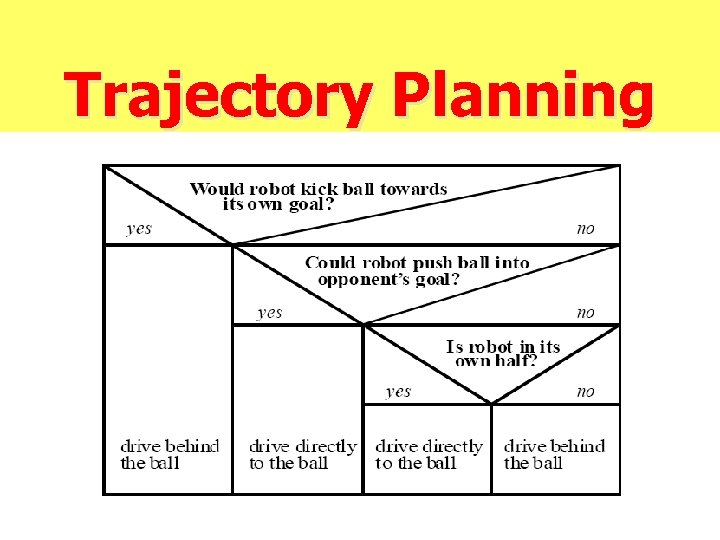
Trajectory Planning
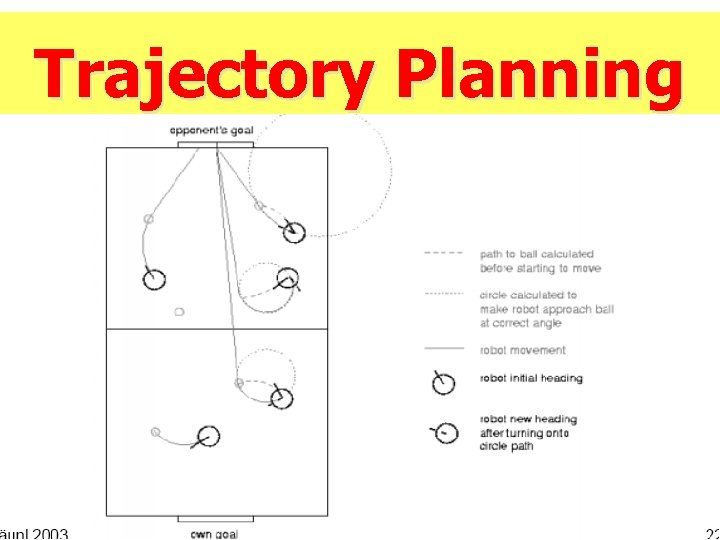
Trajectory Planning
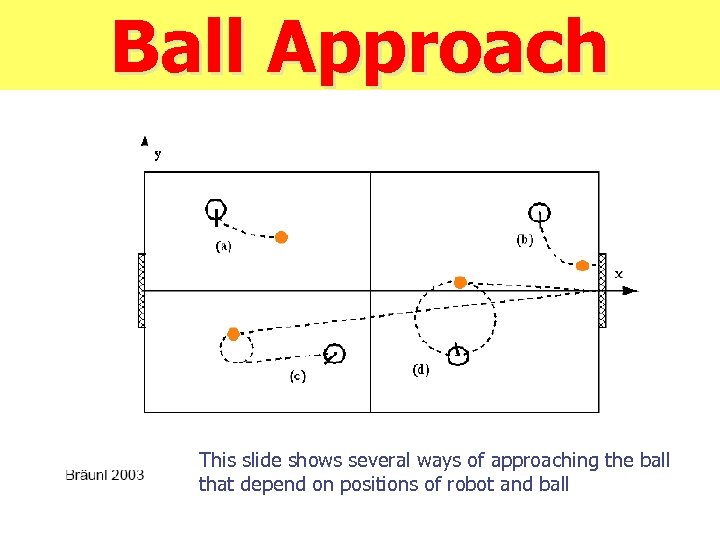
Ball Approach This slide shows several ways of approaching the ball that depend on positions of robot and ball
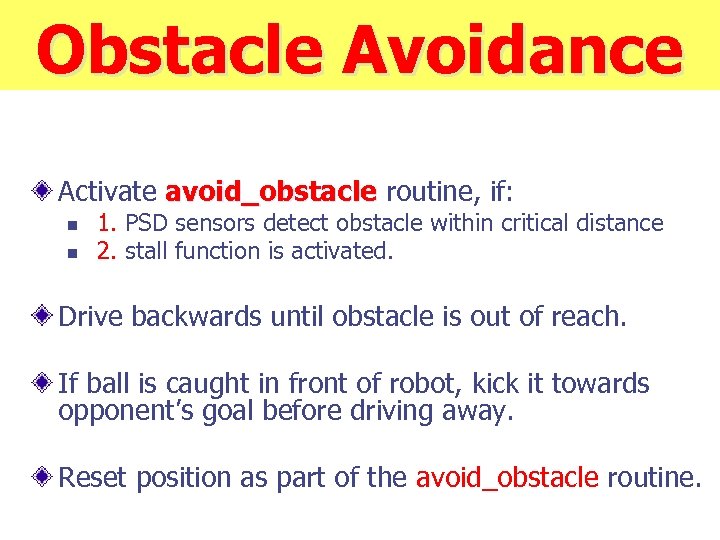
Obstacle Avoidance Activate avoid_obstacle routine, if: n n 1. PSD sensors detect obstacle within critical distance 2. stall function is activated. Drive backwards until obstacle is out of reach. If ball is caught in front of robot, kick it towards opponent’s goal before driving away. Reset position as part of the avoid_obstacle routine.
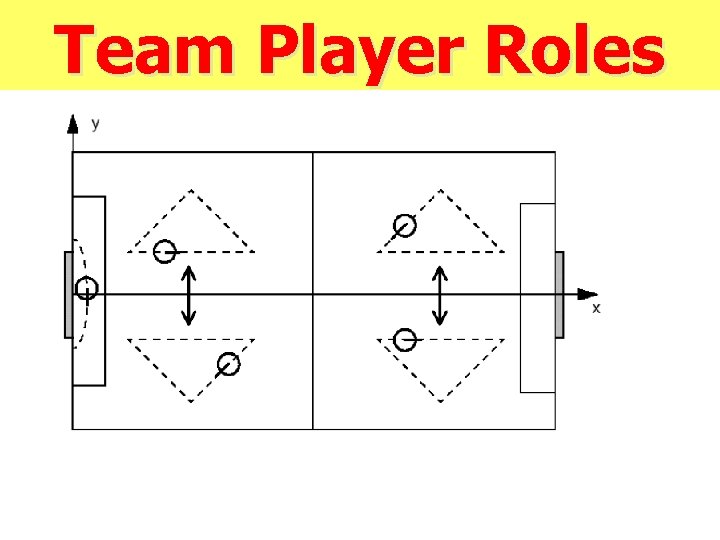
Team Player Roles
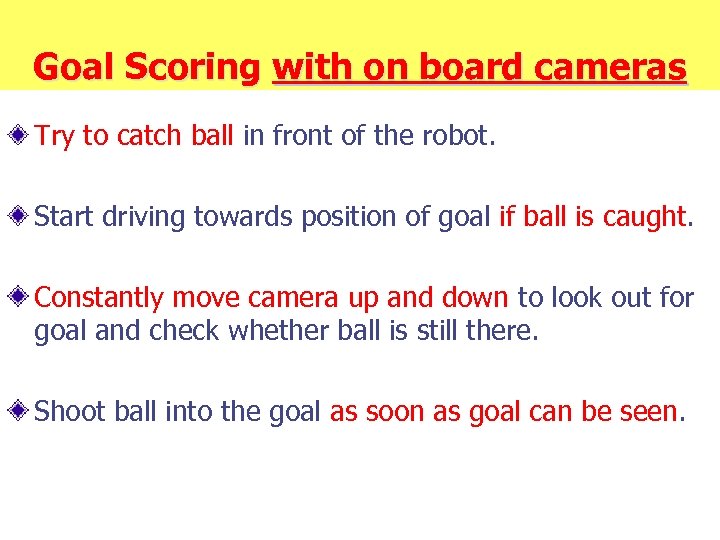
Goal Scoring with on board cameras Try to catch ball in front of the robot. Start driving towards position of goal if ball is caught. Constantly move camera up and down to look out for goal and check whether ball is still there. Shoot ball into the goal as soon as goal can be seen.
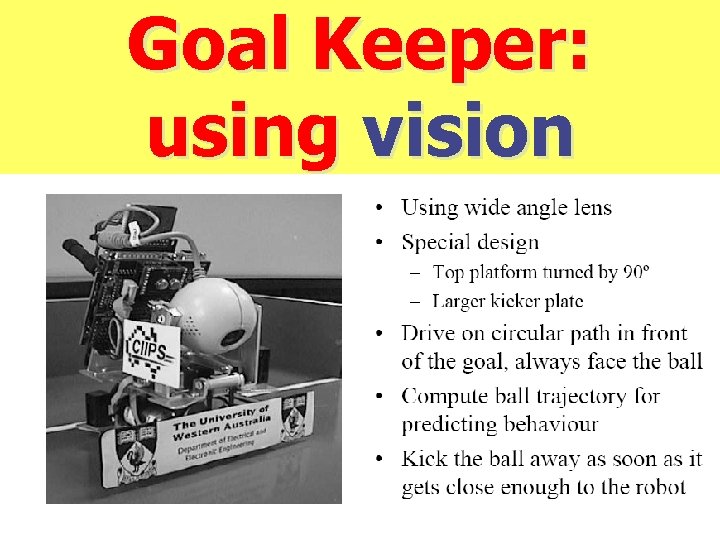
Goal Keeper: using vision
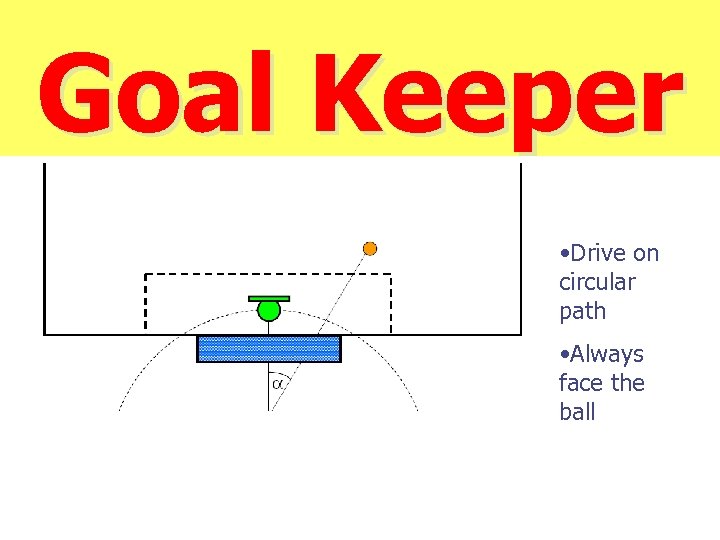
Goal Keeper • Drive on circular path • Always face the ball
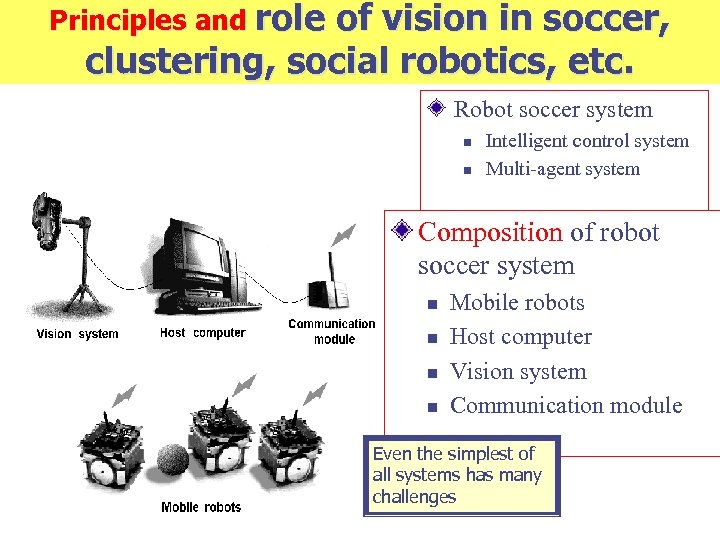
Principles and role of vision in soccer, clustering, social robotics, etc. Robot soccer system n n Intelligent control system Multi-agent system Composition of robot soccer system n n Mobile robots Host computer Vision system Communication module Even the simplest of all systems has many challenges
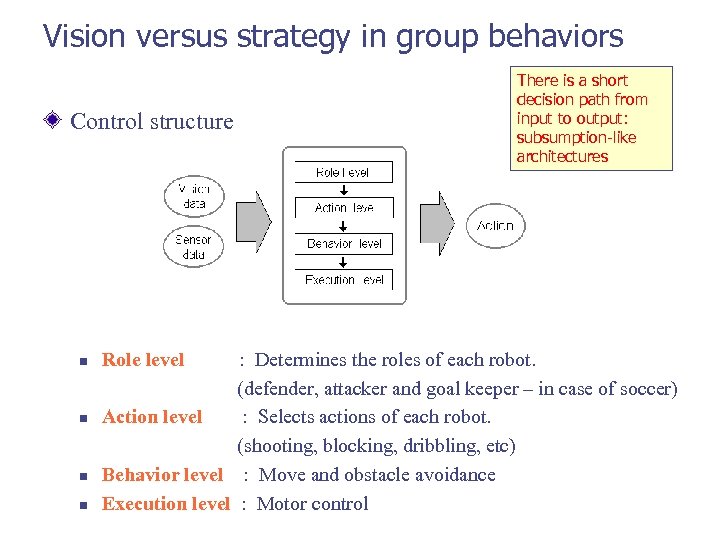
Vision versus strategy in group behaviors Control structure n n Role level There is a short decision path from input to output: subsumption-like architectures : Determines the roles of each robot. (defender, attacker and goal keeper – in case of soccer) Action level : Selects actions of each robot. (shooting, blocking, dribbling, etc) Behavior level : Move and obstacle avoidance Execution level : Motor control
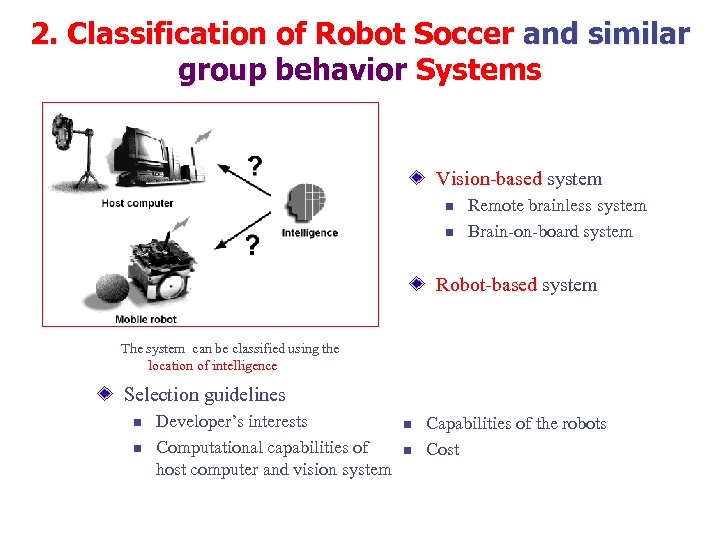
2. Classification of Robot Soccer and similar group behavior Systems Vision-based system n n Remote brainless system Brain-on-board system Robot-based system The system can be classified using the location of intelligence Selection guidelines n n Developer’s interests Computational capabilities of host computer and vision system n n Capabilities of the robots Cost
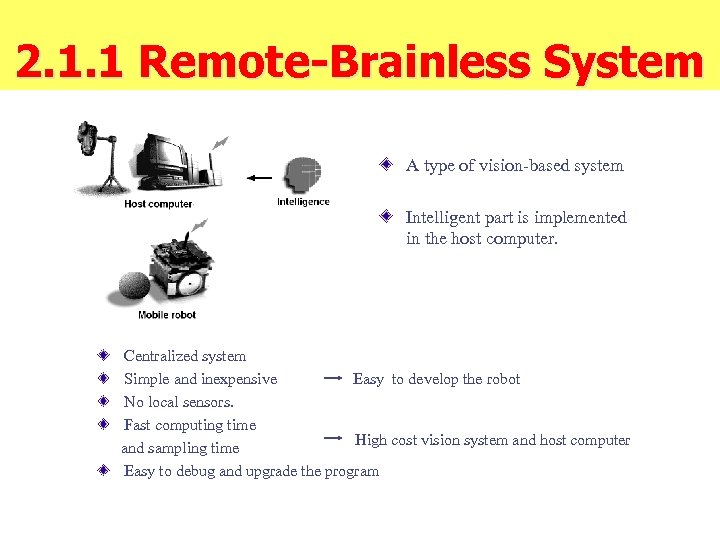
2. 1. 1 Remote-Brainless System A type of vision-based system Intelligent part is implemented in the host computer. Centralized system Simple and inexpensive Easy to develop the robot No local sensors. Fast computing time High cost vision system and host computer and sampling time Easy to debug and upgrade the program
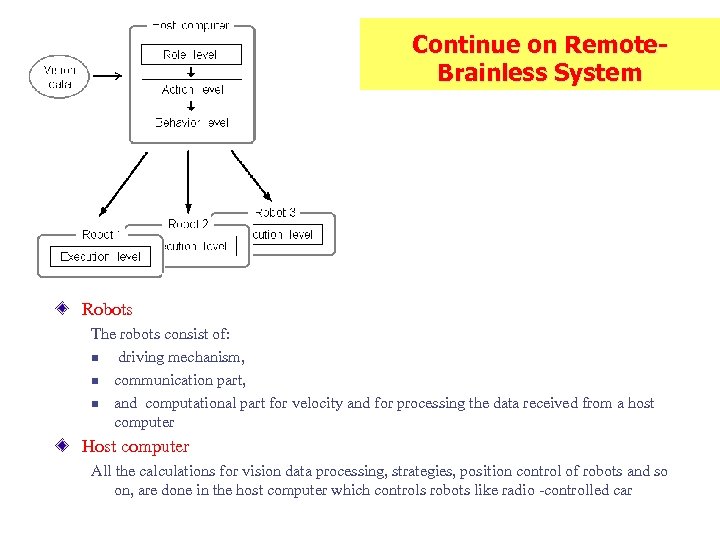
Continue on Remote. Brainless System Robots The robots consist of: n driving mechanism, n communication part, n and computational part for velocity and for processing the data received from a host computer Host computer All the calculations for vision data processing, strategies, position control of robots and so on, are done in the host computer which controls robots like radio -controlled car
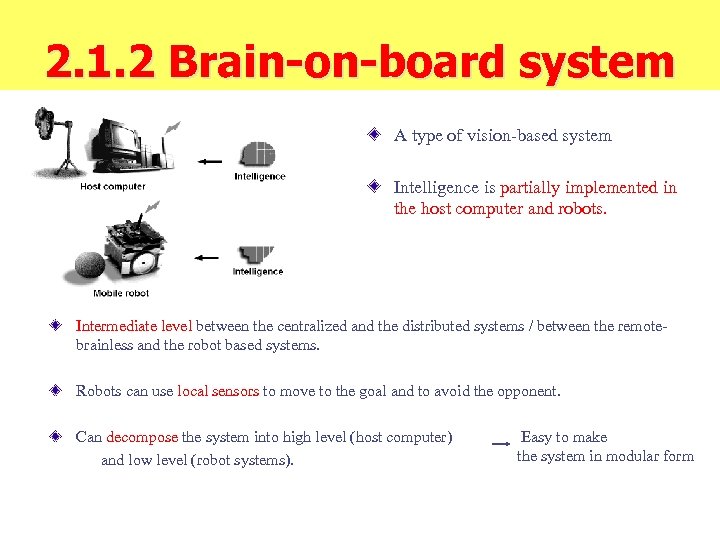
2. 1. 2 Brain-on-board system A type of vision-based system Intelligence is partially implemented in the host computer and robots. Intermediate level between the centralized and the distributed systems / between the remotebrainless and the robot based systems. Robots can use local sensors to move to the goal and to avoid the opponent. Can decompose the system into high level (host computer) and low level (robot systems). Easy to make the system in modular form
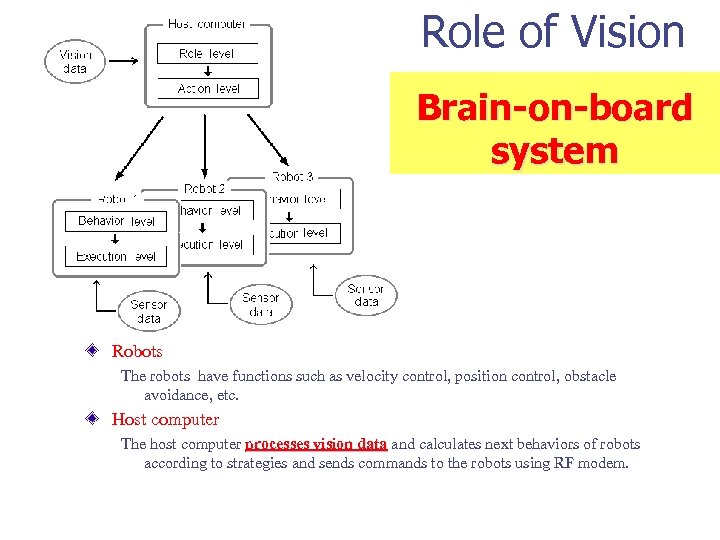
Role of Vision Brain-on-board system Robots The robots have functions such as velocity control, position control, obstacle avoidance, etc. Host computer The host computer processes vision data and calculates next behaviors of robots according to strategies and sends commands to the robots using RF modem.
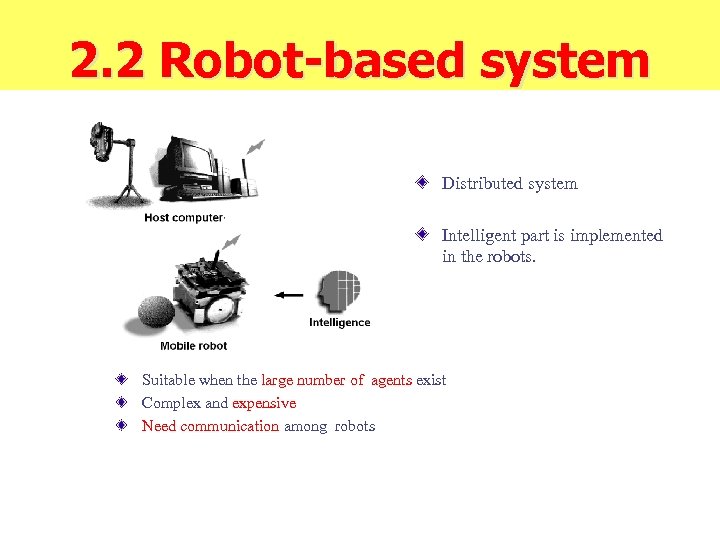
2. 2 Robot-based system Distributed system Intelligent part is implemented in the robots. Suitable when the large number of agents exist Complex and expensive Need communication among robots
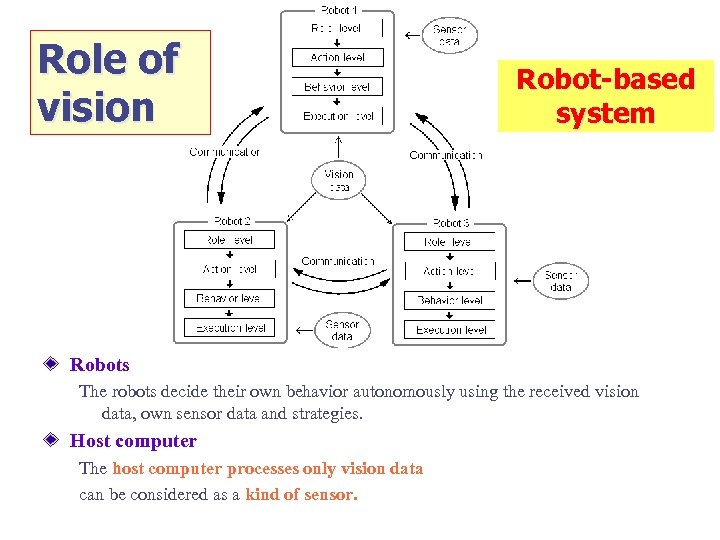
Role of vision Robot-based system Robots The robots decide their own behavior autonomously using the received vision data, own sensor data and strategies. Host computer The host computer processes only vision data can be considered as a kind of sensor.
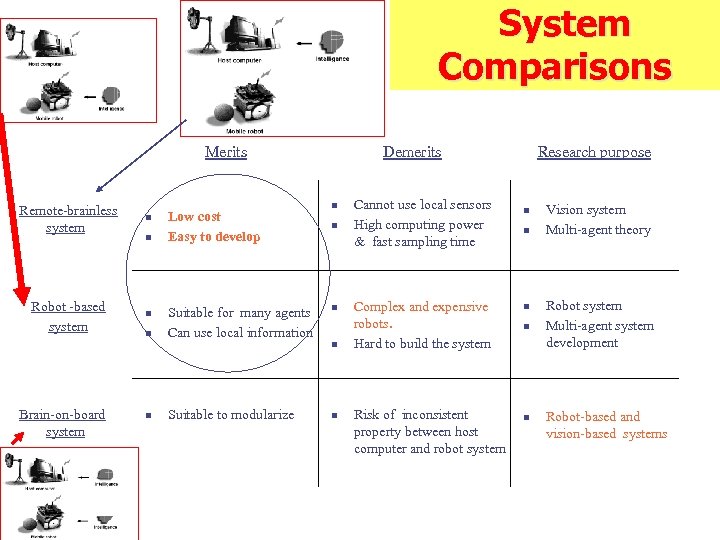
System Comparisons Merits Remote-brainless system n Robot -based system n Brain-on-board system n n n Low cost Easy to develop Suitable for many agents Can use local information Suitable to modularize Demerits n n n Cannot use local sensors High computing power & fast sampling time Complex and expensive robots. Hard to build the system Risk of inconsistent property between host computer and robot system Research purpose n n n Vision system Multi-agent theory Robot system Multi-agent system development Robot-based and vision-based systems
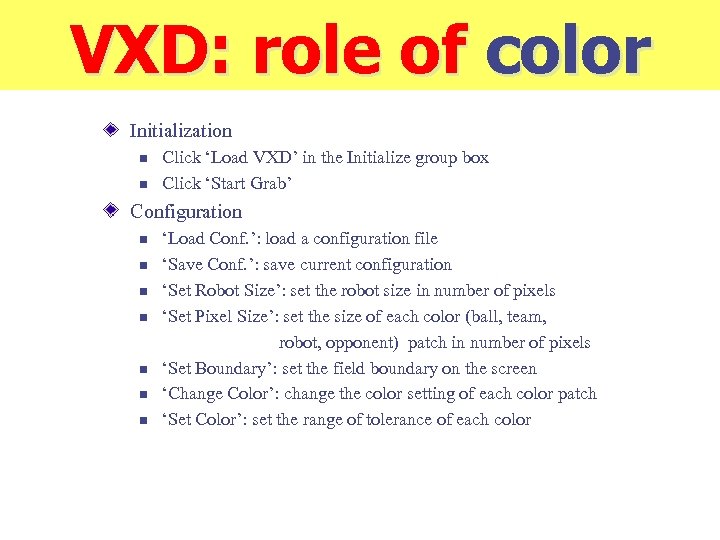
VXD: role of color Initialization n n Click ‘Load VXD’ in the Initialize group box Click ‘Start Grab’ Configuration n n n ‘Load Conf. ’: load a configuration file ‘Save Conf. ’: save current configuration ‘Set Robot Size’: set the robot size in number of pixels ‘Set Pixel Size’: set the size of each color (ball, team, robot, opponent) patch in number of pixels ‘Set Boundary’: set the field boundary on the screen ‘Change Color’: change the color setting of each color patch ‘Set Color’: set the range of tolerance of each color
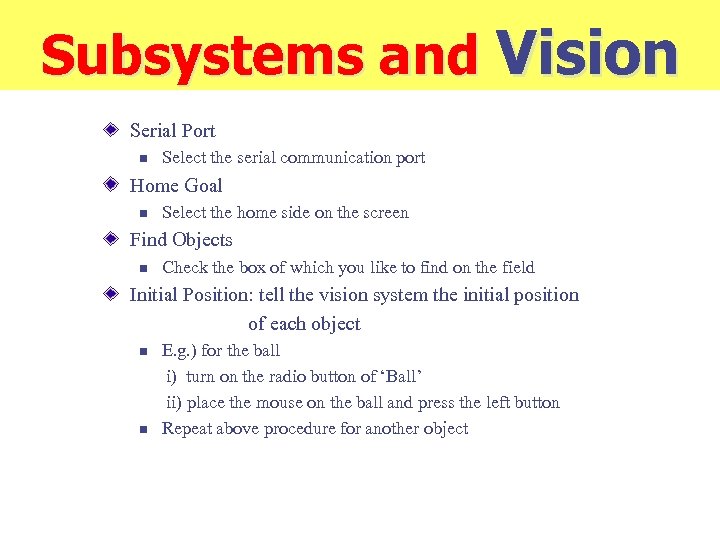
Subsystems and Vision Serial Port n Select the serial communication port Home Goal n Select the home side on the screen Find Objects n Check the box of which you like to find on the field Initial Position: tell the vision system the initial position of each object n n E. g. ) for the ball i) turn on the radio button of ‘Ball’ ii) place the mouse on the ball and press the left button Repeat above procedure for another object
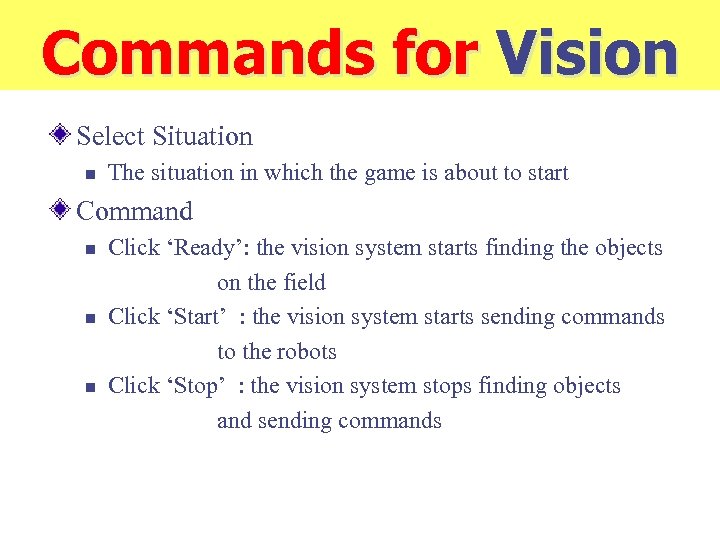
Commands for Vision Select Situation n The situation in which the game is about to start Command n n n Click ‘Ready’: the vision system starts finding the objects on the field Click ‘Start’ : the vision system starts sending commands to the robots Click ‘Stop’ : the vision system stops finding objects and sending commands
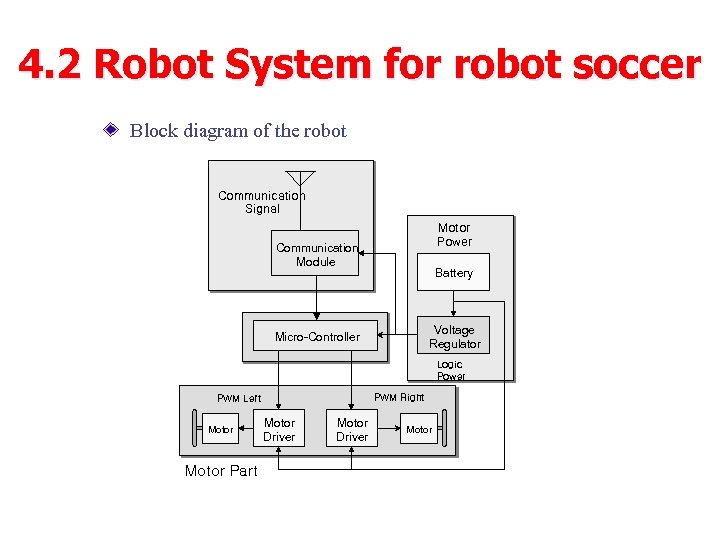
4. 2 Robot System for robot soccer Block diagram of the robot Communication Signal Motor Power Communication Module Battery Voltage Regulator Micro-Controller Logic Power PWM Right PWM Left Motor Part Motor Driver Motor
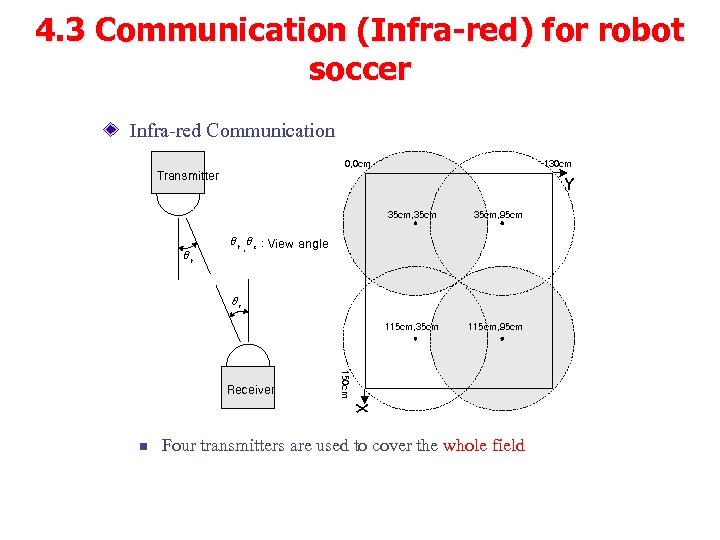
4. 3 Communication (Infra-red) for robot soccer Infra-red Communication 130 cm 0, 0 cm Transmitter Y 35 cm, 35 cm 115 cm, 35 cm qt 35 cm, 95 cm 115 cm, 95 cm q t , q r : View angle qr 150 cm Receiver X n Four transmitters are used to cover the whole field
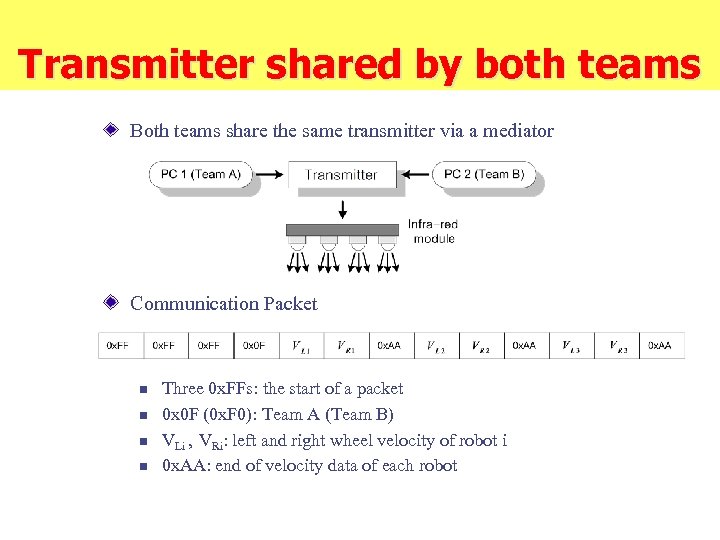
Transmitter shared by both teams Both teams share the same transmitter via a mediator Communication Packet n n Three 0 x. FFs: the start of a packet 0 x 0 F (0 x. F 0): Team A (Team B) VLi , VRi: left and right wheel velocity of robot i 0 x. AA: end of velocity data of each robot
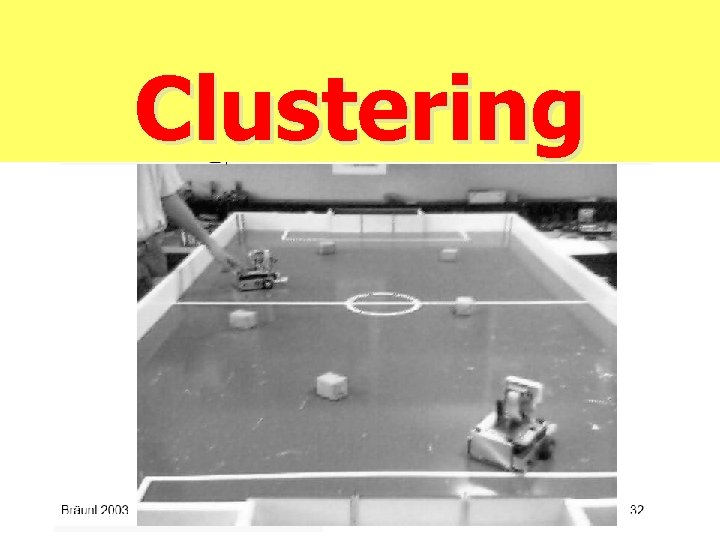
3. 2 Foraging and Clustering There are many similar robot applications to robot soccer: A number of objects are scattered in the driving area n n objects can be colored or otherwise marked for detection e. g. colored cubes or cans The robot’s task is to collect all objects n n either by bringing them all to a certain location e. g. home location → foraging or by moving it to the position that already has the largest object density → clustering Role of Vision
Clustering phenomenon Can be observed in nature: Termites Good example for “emergent behavior” n n simple local behavior complex results Can be executed by single or multiple robots Has been used in simulation as well as in real robot demonstrations
Clustering
Online References http: //www. robocup. org http: //www. robocup 2000. org http: //world. sony. com/dream/robocup 2000/ http: //robomec. cs. kobe-u. ac. jp/robocup-rescue/ http: //www. artificialia. com/Robo. Cup. Jr/ http: //www. namultimedia. com/robocup/ http: //parrotfish. coral. cs. cmu. edu/robocup-small/ http: //owl. informatik. uni-ulm. de/ROBOCUP/
Problems 1. Propose other robot sports in addition to soccer and sumo. Wrestling? Volleyball? Fencing? Write the rules and design a robot to play them. What will be technical and what will be the scientific challenge. 2. Design the rules for walking robots playing soccer. Design the field. How to control the camera. Do we need sensors and for what? Where are they located? 3. Explain the differences between various types of vision systems used in robot soccer.
Problems 1. Propose other robot sports in addition to soccer and sumo. Wrestling? Volleyball? Fencing? Write the rules and design a robot to play them. What will be technical and what will be the scientific challenge. 2. Design the rules for walking robots playing soccer. Design the field. How to control the camera. Do we need sensors and for what? Where are they located? 3. Explain the differences between various types of vision systems used in robot soccer.
Problems 4. What are the scientific goals of robot soccer? What 5. 6. 7. 8. 9. robot soccer contributed already to robotics? What is AI? What is Turing Test? Invent variants of Turing Test to test other robot’s abilities than leading a meaningful conversation. Give example of robot foraging. Give example of robot clustering. How to use agents to implement robot foraging and clustering. Sensors used in robot soccer.
Problems 10. Present the line-based color detection scheme for soccer robots. 11. Distance Estimation for Soccer Robots 12. Driving Routines for Soccer Robots 13. Splines and other methods for driving 14. Trajectory planning for soccer robots. 15. Vision system for a mobile robot playing soccer. 16. Communication system for a soccer robot. 17. Obstacle avoidance for robot soccer 18. Team playing strategies for robot soccer.
Скачать презентацию The idea of Robot Soccer 3 Robot
b82821645f9fd608ca243041abb7684a.ppt