 Скачать презентацию The Hydrologic Budget of Wetlands Jason Hall Robert
54b44b971ea8eb6e1a7602a1b090b28d.ppt
- Количество слайдов: 93



The Hydrologic Budget of Wetlands Jason Hall Robert Lomax Lisa Thatcher November 4, 2003
Overview Ø Information on hydrology budgets of wetlands Ø Case study of hydrology in a Carolina bay wetland Ø Jason - watershed hydrology of coastal forested wetland of the southern US Ø Lisa - hydrology of a constructed wetland in south Florida, peatland in Wisconsin, and conclusion
Hydrology Budget Ø Hydrology is probably the single most important determinant of the establishment and maintenance of specific types of wetlands and wetland processes. (Mitsch and Gosselink 1993) Ø Hydrology describes all inflows and outflows of water, soil contours of the wetland, and subsurface conditions
Hydrology Budget Ø Hydrologic conditions directly modify or change chemical and physical properties such as nutrient availability, degree of soil anoxia, soil salinity, sediment properties, and p. H. Ø These are major factors in the ultimate classification of the wetland itself as well as the selection of biota. Ø Small changes in hydrology can result in significant biotic changes.
Hydrology Budget Ø Three main characteristics: (1) the balance btwn inflows and outflows. (2) surface contours of landscape. (3) subsurface soil, geology, and groundwater conditions Ø Budget usually described in terms of depth per unit time, e. g. , cm/yr or in volume per unit time, e. g. , m³/day Ø animation
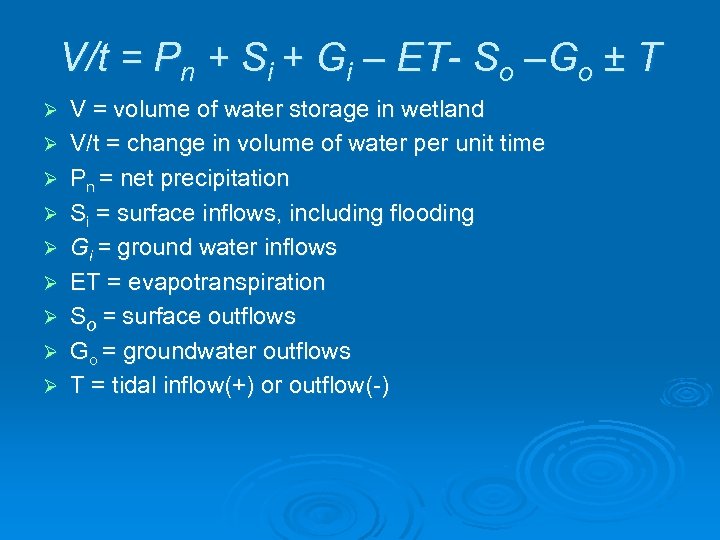
V/t = Pn + Si + Gi – ET- So –Go ± T Ø Ø Ø Ø Ø V = volume of water storage in wetland V/t = change in volume of water per unit time Pn = net precipitation Si = surface inflows, including flooding Gi = ground water inflows ET = evapotranspiration So = surface outflows Go = groundwater outflows T = tidal inflow(+) or outflow(-)
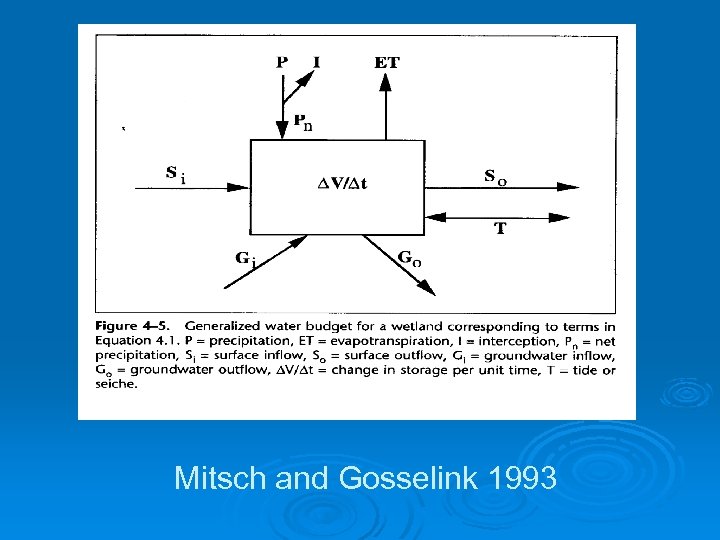
Mitsch and Gosselink 1993
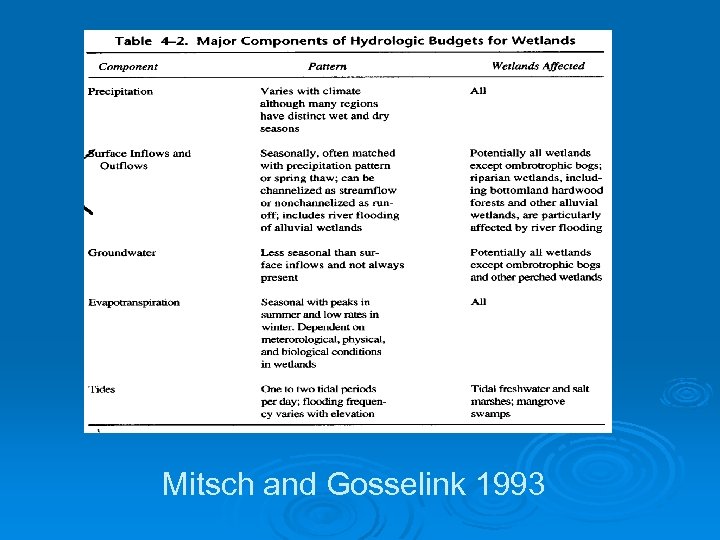
Mitsch and Gosselink 1993
Precipitation Ø Wetlands favor areas where precipitation rates typically exceed evapotranspiration rates Ø Pn = TF + SF
Surface Inflows Ø Overland flow: nonchannelized sheet flow, occurs during and immediately following rainfall, spring thaw, or as tides rise. Ø Stream flow: channelized flow from drainage basin, difficult to determine, often the most important source of water in hydrology budget
Surface Outflows Ø Either channelized or overland sheet flow
Groundwater inflows and outflows occur when surface water level of wetland is lower hydrologically than the water table of the surrounding land Ø Different ways this occurs Ø Described by Darcy’s Law G = k · a · s Ø G = flow rate of groundwater Ø K = hydraulic conductivity or permeability Ø A = groundwater cross-sectional area perpendicular to flow Ø S = hydraulic gradient ( peizometeric surface ) Ø
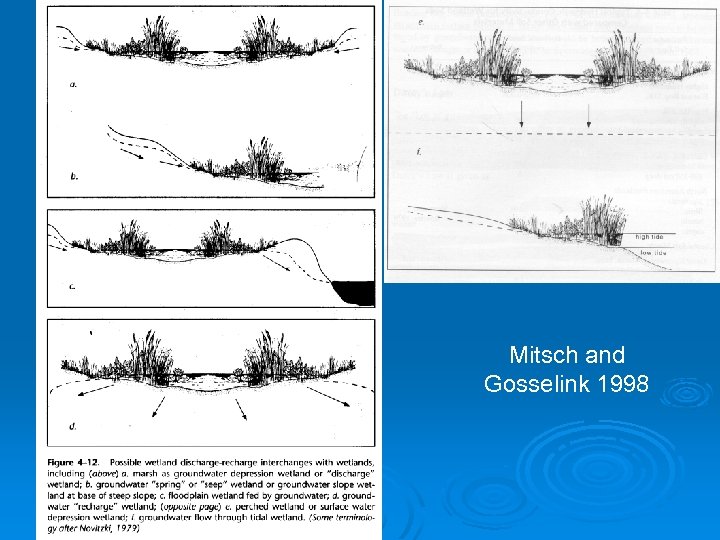
Mitsch and Gosselink 1998
Groundwater Ø Groundwater flows are important source of nutrients and dissolved minerals. Ø Partly responsible for species diversity and richness Ø Groundwater hydraulics, despite their obvious importance, are still poorly understood
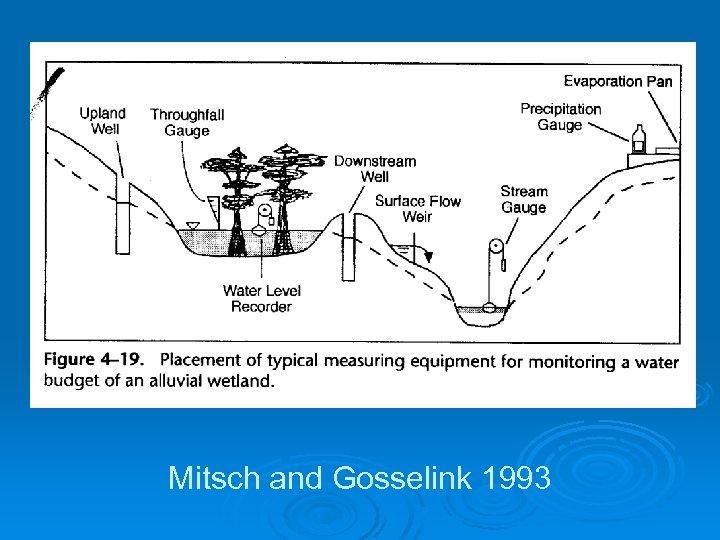
Mitsch and Gosselink 1993
Evapotranspiration Ø Water that vaporizes from water or soil in wetlands (evaporation), combined with moisture that passes through vascular plants to the atmosphere (transpiration). Ø Rate of evapotranspiration is proportional to the difference btwn vapor pressure at water surface (or leaf surface) and vapor pressure in overlying air
Evapotranspiration Ø Enhanced by solar radiation and surface temperature which increase value of vapor pressure at evaporative surface or by reduced humidity and increased wind speed which decrease vapor pressure. Ø If water is limited, evapotranspiration limited Ø Transpiration can be limited physiologically by certain plants
Evapotranspiration Ø Four equations used to describe the rate of evapotranspiration although none entirely satisfactory. Ø Mainly because climatic conditions as well as vegetation vary btwn wetlands
Tides Ø Predictable and periodic tidal inundations of coastal salt marshes, mangroves, and freshwater tidal marshes are major hydrologic feature of these wetlands Ø Salinity, duration and flooding frequency in part determine the abiotic and biotic components of the system
Principles underscoring the importance of hydrology in wetlands Hydrology leads to unique vegetation composition but can limit or enhance species richness Ø Primary productivity and other functions enhanced by flowing conditions and pulsing hydroperiods Ø Accumulation of organic material controlled by hydrology through influence on primary productivity, decomposition, and export of POM Ø Nutrient cycling and availability are both significantly influenced by hydrologic conditions. Ø
Hydrologic conditions Ø Used by scientists to classify these ecosystems Ø Classification and mapping of wetlands based on biotic features (dominant vegetation) often matches the hydrologic conditions of different wetlands
HYDROLOGY, COMMUNITY STRUCTURE, AND PRODUCTIVITY PATTERNS OF A DYSTROPHIC CAROLINA BAY WETLAND
Thunder Bay Ø Upper coastal plane in SE corner of the 750 - km² Savannah River Plant in Barnwell County, South Carolina. Ø US Dept. of Energy radioisotope production facility. Ø Occurs in Lower Three Runs Creek watershed, tributary of Savannah River
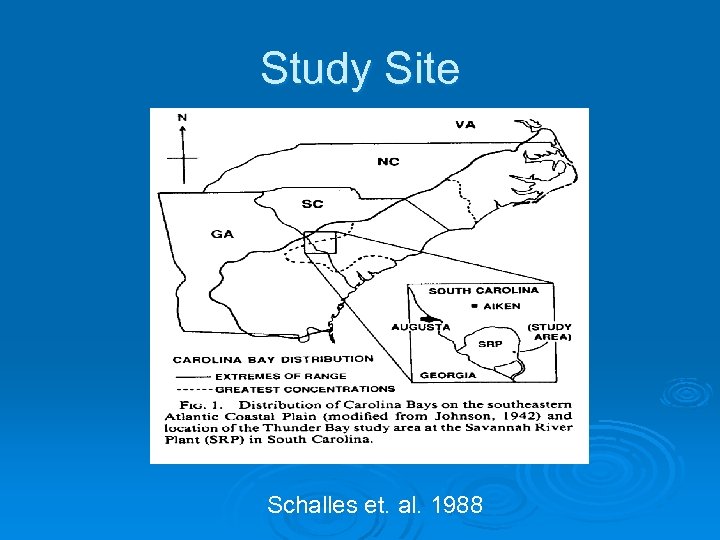
Study Site Schalles et. al. 1988
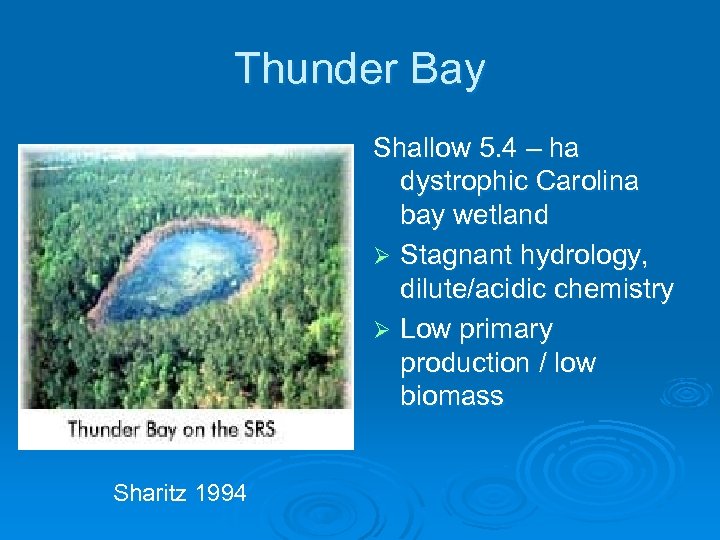
Thunder Bay Shallow 5. 4 – ha dystrophic Carolina bay wetland Ø Stagnant hydrology, dilute/acidic chemistry Ø Low primary production / low biomass Sharitz 1994
Thunder Bay Ø Average rainfall over the four year study period was 122. 25 cm Ø Air temperature averaged 18. 3°C (8. 8°C in Jan. and 27. 5°C in Jul) Ø Growing season is approx. 245 d. Ø At intermediate water stage, surface elevation was 61 m NGVD (National Geodetic Vertical Datum) Ø Little to no surface inflows or outflows
Thunder Bay Ø Soil – dark sandy loam Ø Underlying clay lens Ø Surface water extremely dilute (16. 7 µS)
Thunder Bay Hydrology Ø Staff gauge used to take water levels Ø Surface water level taken with Stevens Type F recorder Ø Behavior of adjacent, near-surface aquifer monitored with four wells using Type F recorders Ø Wells CB-1 and CB-3 on south and northeast sides respectively, just outside of bay margin
Hydrology Ø CB-2 located 360 m southwest and downslope of CB-1 Ø CB-4 located 270 m northeast and upslope of CB-3
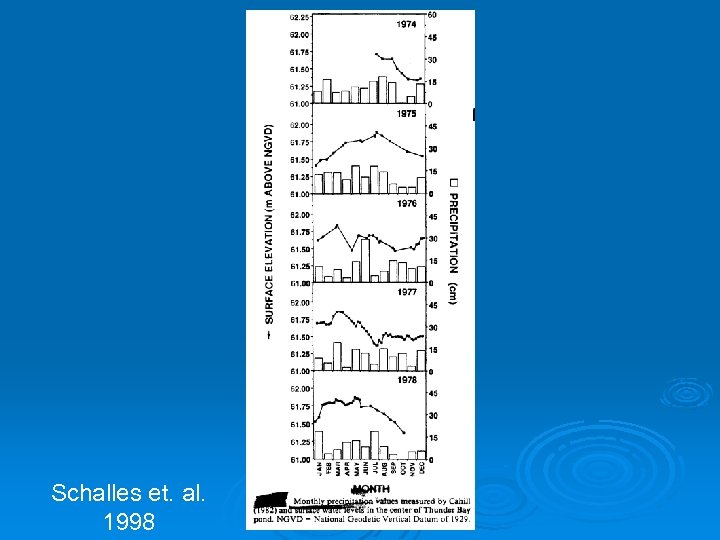
Results Ø Water levels dynamic and responsive Ø General absence of peat, periodic pond drawdown and oxidation of exposed soil Ø Surface water levels varied from 61. 30 to 61. 85 m NGVD largely due to rainfall. Ø Avg. surface rate loss varied from 0. 12 cm/d in Jan. to 0. 76 cm/d in July. Ø Monthly water loss and surface water temp. had a strong correlation(r = 0. 93)
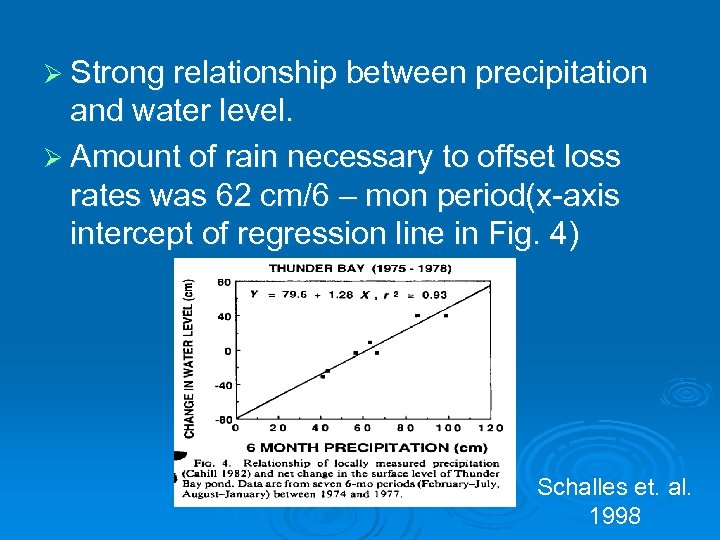
Ø Strong relationship between precipitation and water level. Ø Amount of rain necessary to offset loss rates was 62 cm/6 – mon period(x-axis intercept of regression line in Fig. 4) Schalles et. al. 1998
Ø This strong correlation btwn surface water levels and precipitation and net water-loss rates and temperature suggests a perched condition Ø Dilute chemistry of Thunder Bay suggests subsurface hydrologic exchange must exist to maintain long-term chemical equilibrium
Schalles et. al. 1998
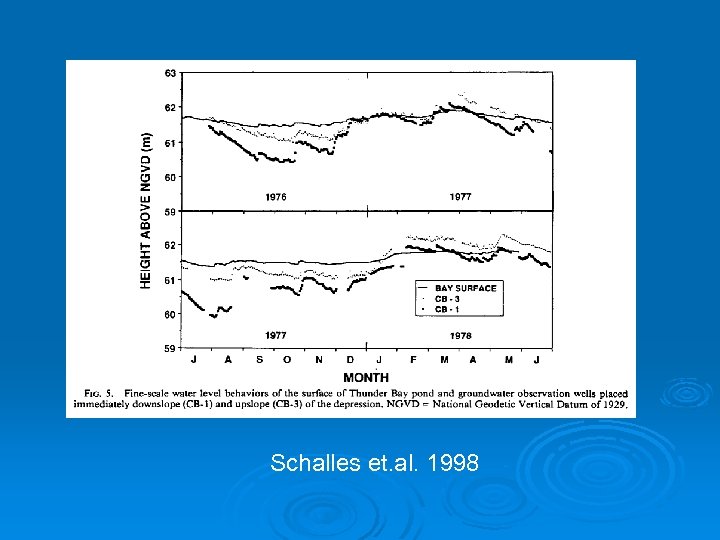
Ø Thunder Bay occurs within a persistent groundwater gradient Ø Upslope CB-4 always had higher water levels than the pond (63. 0 – 64. 1 m NGVD) and downslope CB-2 lower water levels than the pond(55. 7 – 57. 7 m NGVD) Ø Comparisons surface – groundwater levels exhibit connections shown in Fig. 5 Ø Elevated ground-water levels in winter and spring resulted from increased rain and decreased evapotranspiration.
Schalles et. al. 1998
Groundwater exchange primarily lateral as opposed to vertical due to a clay lens below the wetland Ø Lateral exchanges may be lost as subsurface and surface levels decline below the contact zone Ø Total system surface water loss from the Y-axis intercept from Fig. 4 is 80 cm net loss for a precipitation-free, 6 -mon period. Ø Thus total system loss (160 cm/yr) – equilibrium precipitation (124 cm/yr) yields 36 cm/yr which may represent net surface gain from groundwater Ø
References Mitsch W. J. , and Gosselink J. G. , “Wetlands 2 nd ed. ”, 1993, pp 67113. Ø Schalles J. F. , and Shure D. J. , “Hydrology, Community Structure, and Productivity Patterns of a Dystrophic Carolina Bay Wetland. ” Ecological Monographs, 59(4), 1989, pp 365 -385. Ø Sharitz A. B. , 1994, University of Georgia. , www. uga. edu/srel/ESSite/Sharitz. htm. Ø
A comparison of the watershed hydrology of coastal forested wetlands and the mountainous uplands in the Southern US CASE STUDY AREAS: BRADFORD FOREST WATERSHED OF NORTHERN FLORIDA Ø CARTERET 7 WATERSHED OF SE NORTH CAROLINA Ø COWEETA 14 WATERSHED OF WESTERN NORTH CAROLINA Ø
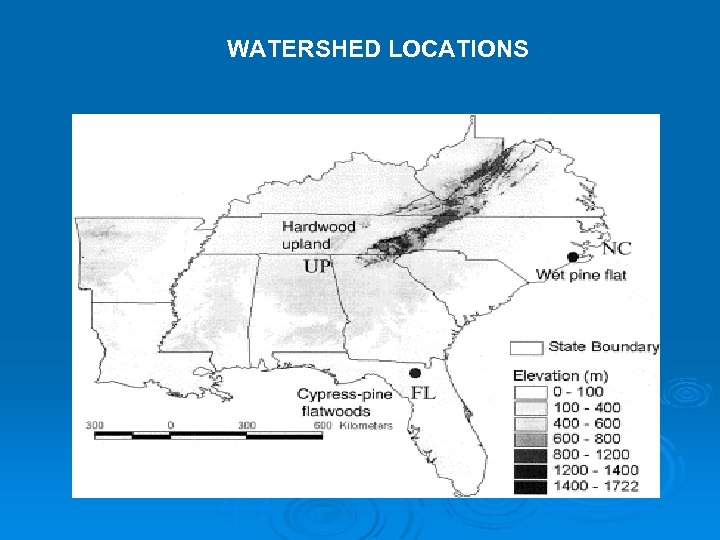
WATERSHED LOCATIONS
SITE DESCRIPTIONS BRADFORD FOREST WATERSHED REPRESENTS A MIXTURE OF ECOSYSTEMS: CYPRESS WETLANDS & SLASH PINE UPLANDS Ø UPLANDS ARE FLAT & CLOSE IN ELEVATION TO ADJACENT WETLANDS (>1 M DIFFERENCE) Ø UPLANDS: RELATIVELY DRY DUE TO WELL DRAINED SANDY SOILS Ø CYPRESS WETLANDS: SURFACE WATER IS PRESENT 9 MONTH OF THE YEAR, UNDERLINED BY IMPERMEABLE CLAY LAYERS 3 M BELOW GROUND SURFACE Ø
CARTERET 7 WATERSHED Ø ARTIFICIALLY DELINATED WITH ROADS AND PARALLEL DITCHES Ø Ø LOW ELEVATION AND TOPOGRAPHY CLASSIFIED AS POORLY DRAINED WITH HYDRIC SOILS DOMINATED BY FINE SANDY LOAM
WATERSHED 14 AT COWEETA REPRESENTS AN UPLAND WATERSHED Ø CLEAR CUT IN 1962 Ø LOCATED IN SOUTHERN APPALACHIAN MOUNTAINS WHICH ARE DOMINATED NATIVE HARDWOODS Ø *** THESE THREE WATERSHEDS HAVE THE LONGEST CONTINUOUS RECORDS OF HYDRLOGIC RESEARCH IN THE S. E. UNITED STATES
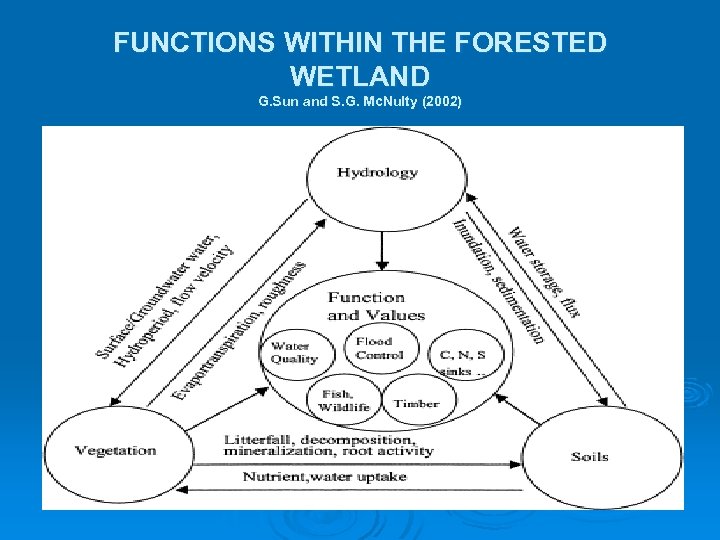
FUNCTIONS WITHIN THE FORESTED WETLAND G. Sun and S. G. Mc. Nulty (2002)
KEY FACTORS EFFECTING HYDROLOGIC BUDGET • EVAPOTRANSPIRATION • GROUNDWATER INFLOWS AND OUTFLOWS • VOLUME OF WATER STORAGE • SURFACE INFLOWS & OUTFLOWS • NET PRECIPITATION • TIDAL INFLOW & OUTFLOW
QUESTIONS ADDRESSED BY THIS STUDY 1. Is actual evapotranspiration (AET) from pine flatwoods close or equal to potential forest evapotranspiration (PET) in the long-term? And, is upland forest AET is far less than PET? 2. In the long-term, what caused the hydrologic differences (streamflow/precipitation ratio) among the wetland upland watersheds, topographical features or climate?
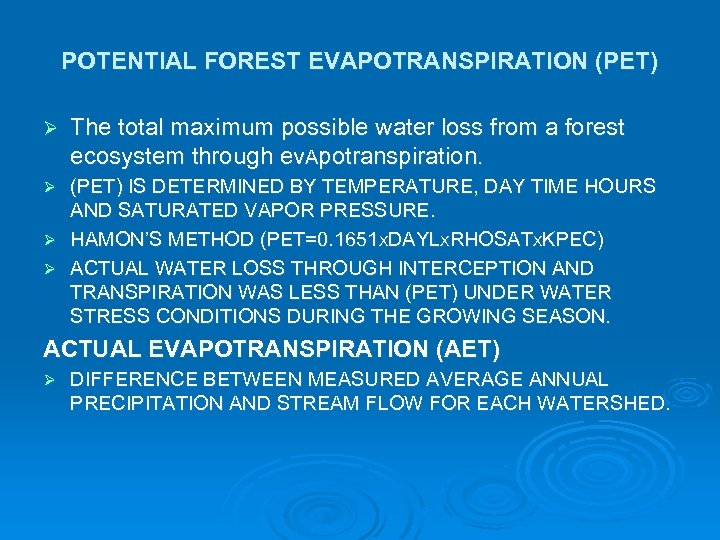
POTENTIAL FOREST EVAPOTRANSPIRATION (PET) Ø The total maximum possible water loss from a forest ecosystem through ev. Apotranspiration. (PET) IS DETERMINED BY TEMPERATURE, DAY TIME HOURS AND SATURATED VAPOR PRESSURE. Ø HAMON’S METHOD (PET=0. 1651 XDAYLXRHOSATXKPEC) Ø ACTUAL WATER LOSS THROUGH INTERCEPTION AND TRANSPIRATION WAS LESS THAN (PET) UNDER WATER STRESS CONDITIONS DURING THE GROWING SEASON. Ø ACTUAL EVAPOTRANSPIRATION (AET) Ø DIFFERENCE BETWEEN MEASURED AVERAGE ANNUAL PRECIPITATION AND STREAM FLOW FOR EACH WATERSHED.
DATA COLLECTION Ø Ø DAILY STREAM FLOW TEMPERATURE RAINFALL DATA USED TO DETERMINE FLOW PATTERNS, PET AND ANNUAL WATER BUDGET.
FLOW PATTERNS Ø Ø Ø OUTFLOW FROM BRADFORD FOREST WATERSHED (FL) AND CARTERET WATERSHED(NC) STOPPED DURING SPRING AND SUMMER MONTHS WHEN PET AND AET INCREASED. WETLAND STREAM FLOW PATTERNS WERE CONTROLLED BY GROUND WATER STORAGE THAT WAS THE NET RESULT OF RAINFALL AND AET. HIGH RAINFALL INPUT AND LOW PET AT CARTERET WATERSHED SUSTAINED BASE FLOW DURING NON –RAIN EVENTS. DEEP SOILS AT COWEETA STORED LARGE VOLUMES OF WATER WHICH MAINTAINED A CONSTANT WATER RELEASE THROUGHOUT THE YEAR. OVER 75 % OF THE ANNUAL PRECEPITATION RETURNED TO THE ATMOSPHERE AS ET, WHILE STREAM FLOW DECREASED IN THE DRY SEASON AND FLOODED THE ENTIRE WATERSHED DURING THE WET SEASON.
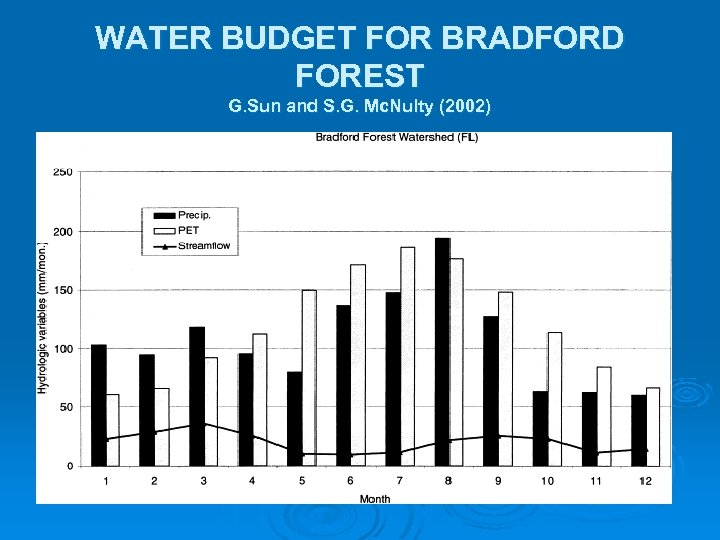
WATER BUDGET FOR BRADFORD FOREST G. Sun and S. G. Mc. Nulty (2002)
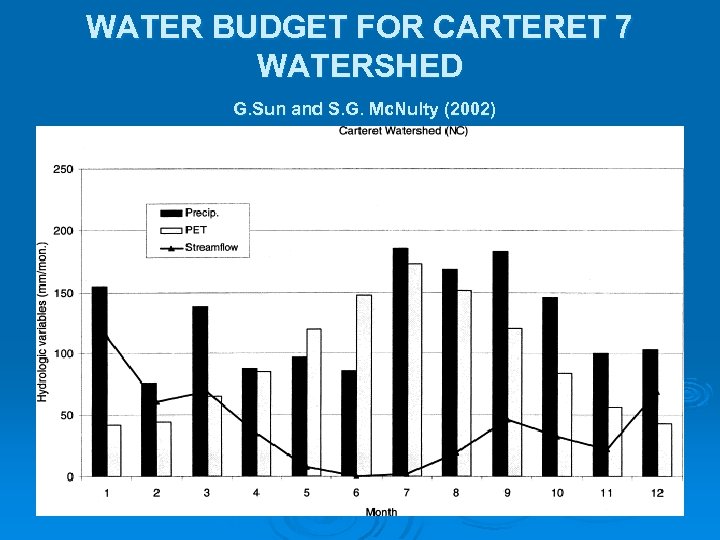
WATER BUDGET FOR CARTERET 7 WATERSHED G. Sun and S. G. Mc. Nulty (2002)
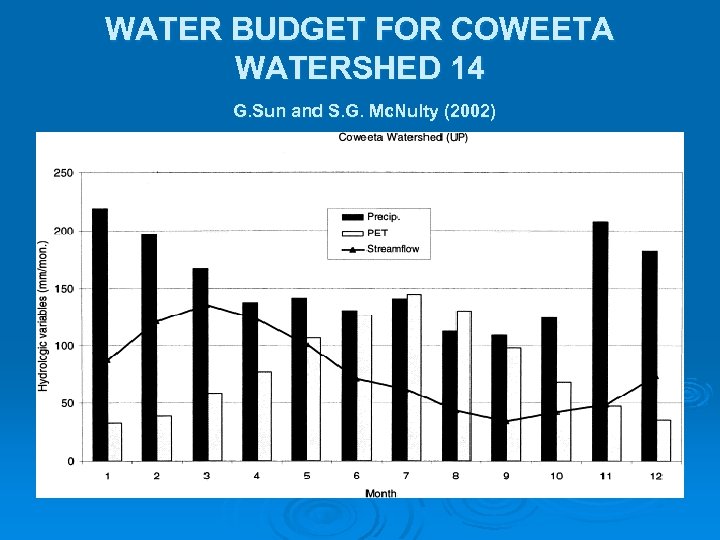
WATER BUDGET FOR COWEETA WATERSHED 14 G. Sun and S. G. Mc. Nulty (2002)
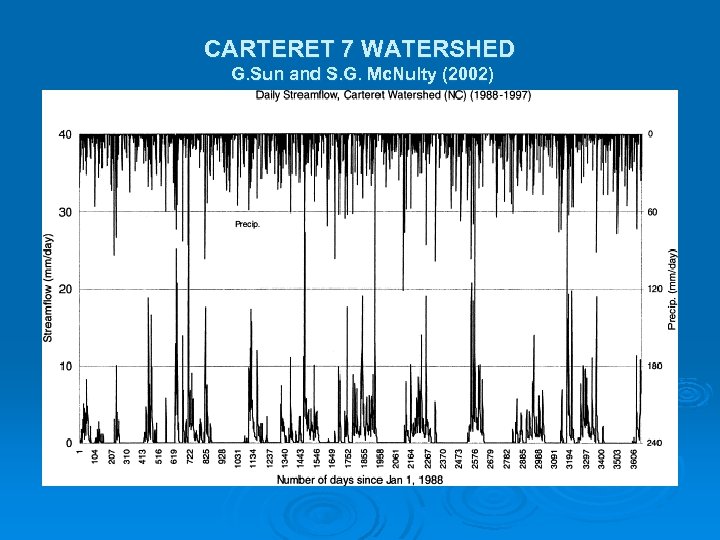
CARTERET 7 WATERSHED G. Sun and S. G. Mc. Nulty (2002)
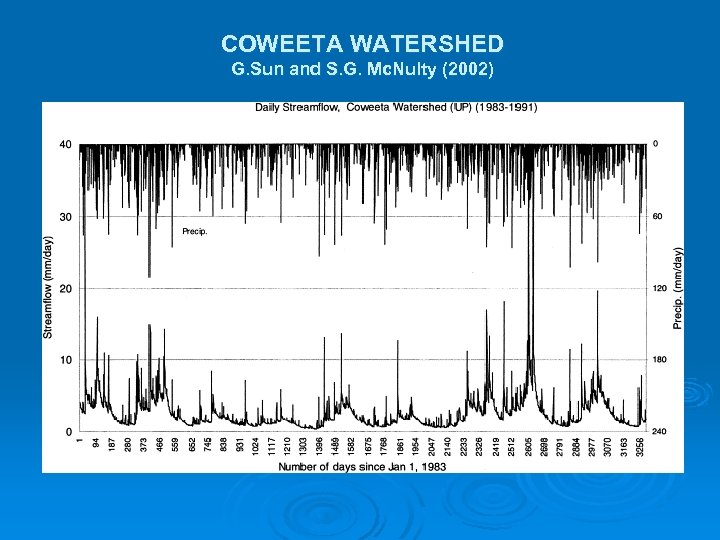
COWEETA WATERSHED G. Sun and S. G. Mc. Nulty (2002)
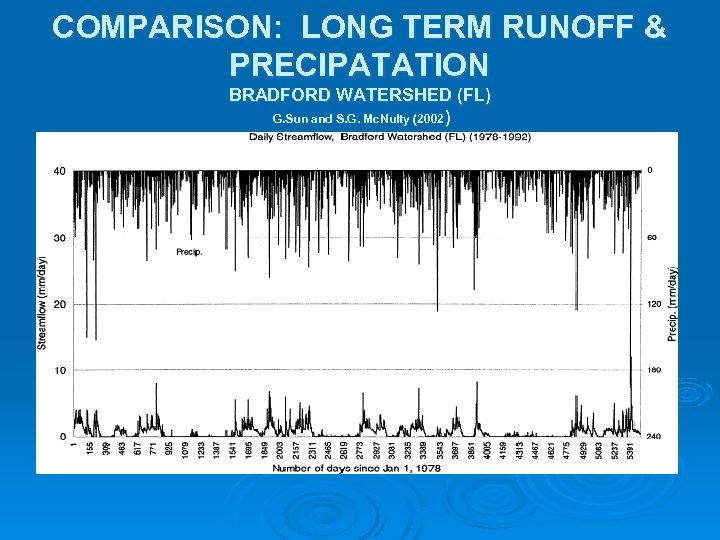
COMPARISON: LONG TERM RUNOFF & PRECIPATATION BRADFORD WATERSHED (FL) G. Sun and S. G. Mc. Nulty (2002 )
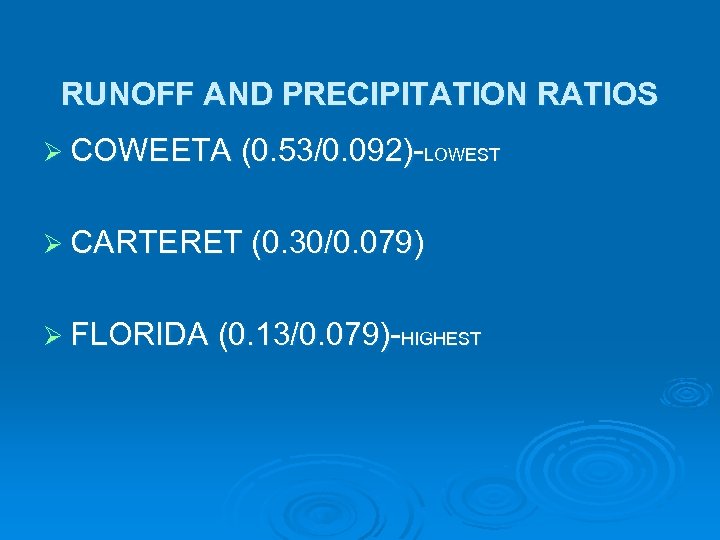
RUNOFF AND PRECIPITATION RATIOS Ø COWEETA (0. 53/0. 092)-LOWEST Ø CARTERET (0. 30/0. 079) Ø FLORIDA (0. 13/0. 079)-HIGHEST
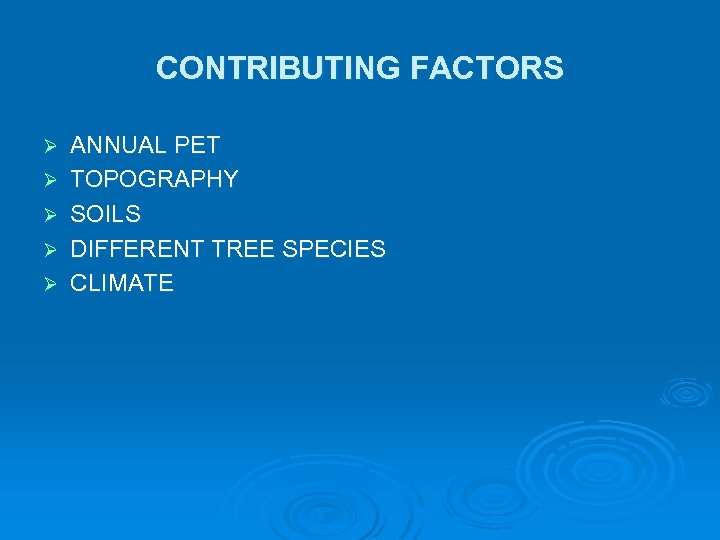
CONTRIBUTING FACTORS Ø Ø Ø ANNUAL PET TOPOGRAPHY SOILS DIFFERENT TREE SPECIES CLIMATE
BRADFORD WATERSHED (FL) AET/PET RATIO (0. 75) Ø Ø Ø LOW AET/PET RATIO IS DUE TO HIGH PET VALUES WELL DRAINED WATER SHED (SANDY SOILS & LOW WATER HOLDING CAPACITY) SEASONAL SHIFTS SPRING & SUMMER EVAPOTRANSPIRATION DEFECITS OCCUR (PET >P) FALL & WINTER PRECIPITATION EXCEEDS PET & AET
BRADFORD WATERSHED (FL) AET/PET (CONT. ) ANNUAL PET>ANNUAL PRECEPITATION Ø RESULTING IN EXCESS WATER Ø PROMOTING CYPRESS WETLAND DEVELOPMENT Ø COMPARED TO THE OTHER SITES Ø LOW P/PET RATIO IS RESPONSIBLE FOR A LOW AET/PET Ø
COWEETA WATERSHED (NC) AET/PET RATIO (0. 84) DECIDUOUS FOREST USE 20% LESS WATER THAN CONIFERS DUE TO LOWER CANOPY INTERCEPTION LOSS Ø AET/PET WAS RATIO MODERATE DUE TO THE LOWER PET IN THE MOUTAINS WITH LOWER AIR TEMPERATURES. Ø
CARTERET WATERSHED (NC) AET/PET RATIO (0. 92) P>PET>AET Ø NOT A WATER LIMITED SYSTEM MOST OF THE YEAR. Ø POORLY DRAINED DUE TO FLAT TOPOGRAPHY. Ø LOW HYDRAULIC CONDUCTIVITY OF FINE SANDY LOAM SOILS PROVIDING SOIL MOISTURE FOR TREE USE. Ø
RESULTS UPLAND WATERSHED COWEETA WATERSHED HAD THE HIGHEST PRECIPITATION AND P/PET RATIO, WITH A MODERATE AET/PET RATIO. THESE FACTORS ARE RESPONSIBLE FOR A HIGHER WATER YIELD INSTEAD OF STEEP TERRAIN. Ø WETLAND WATERSHEDS R/P RATIO FOR BRADFORD IS LESS THAN HALF THAT OF CARTERET EVEN THOUGH BRADFORD IS ON A HIGHER TOPOGRAPHIC RELIEF WITH BETTER DRAINAGE. Ø
RESULTS(CONT. ) HIGHER P/PET RATIO AT THE CARTERET SITE IS RESPONSIBLE FOR THE HIGHER FLOW RATES. Ø THIS SUGGEST TOPOGRAPHY IS NOT FULLY RESPONSIBLE FOR THE LONG TERM HYDROLOGIC BALANCE OF THE TWO WATERSHEDS. Ø THIS ANALSIS SUGGESTS THAT CLIMATE DICTATES WATER YIELD FROM THE THREE WATER SHEDS. Ø
CONCLUSION Ø Ø Ø LONG-TERM ANNUAL WATER BALANCES FOR THREE WATER SHEDS IN THE SOUTHERN US WERE CONSTRUTED. THE WATERSHEDS CONSISTED OF SLASH PINECYPRESS WETLAND, LOBOLLY PINE PLANTATION, AND SOUTHERN HARDWOODS. DATA CONCLUDED CLIMATE IS THE MOST IMPORTANT FACTOR IN DETERMINING LONG TERM WATER BALANCE OF A FORESTED WATERSHED. TOPOGRAPY IS THE KEY FACTOR IN CONTROLLING WETLAND FORMATION, DEVELOPMENT AND FUNCTION. LONG TERM WETLAND WATERSHED AET MAY BE LESS THAN PET.
CONCLUSION (CONT. ) HIGHER HYDROLOGIC RESPONSES IN UPLANDS ARE DUE TO HIGHER P/PET AND STREAMFLOW/P RATIOS. Ø FOR WETLAND WATERSHEDS REDUCTION OF TRANSPIRATION OF TRESS MAY COMPENSATED BY AN INCREASE IN SOIL EVAPORATION. Ø OVER 75 % OF THE ANNUAL PRECEPITATION RETURNED TO THE ATMOSPHERE AS ET, WHILE STREAM FLOW DECREASED IN THE DRY SEASON AND FLOODED THE ENTIRE WATERSHED DURING THE WET SEASON. Ø
REFERENCES G. SUN et al. , 2002 G. Sun, S. G. Mc. Nulty, D. M. Amatya, R. W. Skaggs, L. W. Swift, Jr. , J. P. Shepard and H. Rieker. K, Ø A comparison of the watershed hydrology of coastal forested wetlands and the mountainous uplands in the Southern US. J. Hydrol. 263(2002), PP. 92 -104. Ø Mitsch and Goselink, 1986. W. J. Mitsch and J. G. Goselink Wetlands, Van Nostrand Reinhold Co, New York (1986) Ø
Overview Ø Introduction to hydrologic budget Ø Wisconsin site l l Pollution in the watershed Wisconsin natural urban wetland budget Ø Everglades site l l Pollution in the watershed Everglades constructed wetland budget Ø Summary
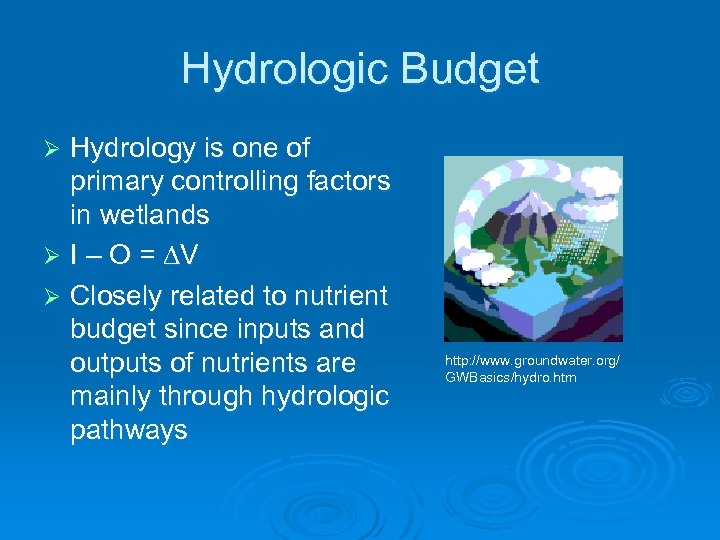
Hydrologic Budget Hydrology is one of primary controlling factors in wetlands Ø I – O = ∆V Ø Closely related to nutrient budget since inputs and outputs of nutrients are mainly through hydrologic pathways Ø http: //www. groundwater. org/ GWBasics/hydro. htm
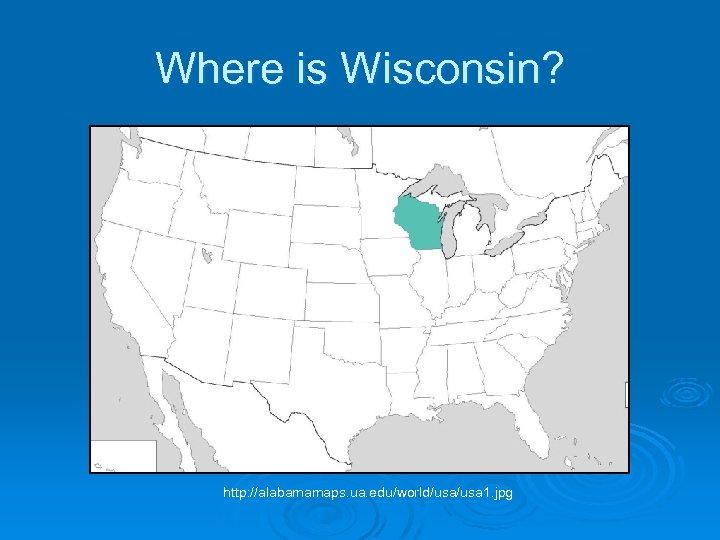
Where is Wisconsin? http: //alabamamaps. ua. edu/world/usa 1. jpg
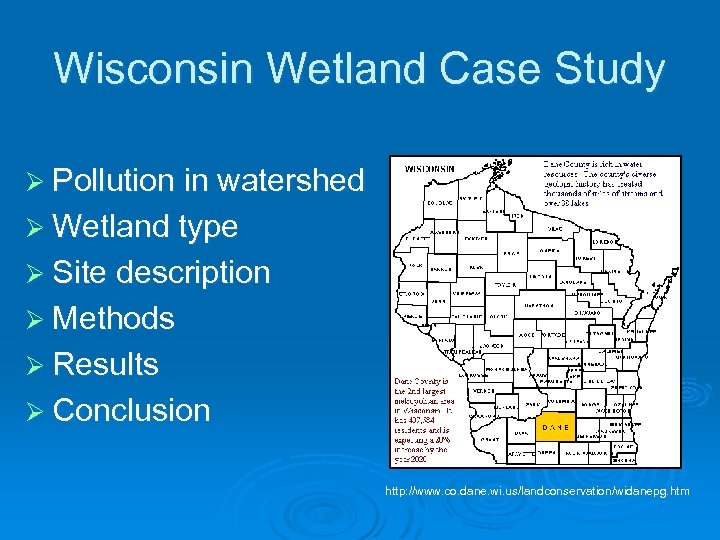
Wisconsin Wetland Case Study Ø Pollution in watershed Ø Wetland type Ø Site description Ø Methods Ø Results Ø Conclusion http: //www. co. dane. wi. us/landconservation/widanepg. htm
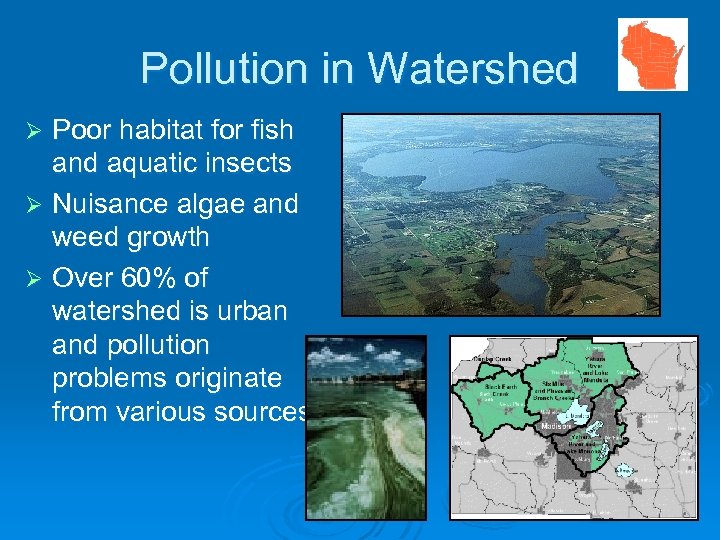
Pollution in Watershed Poor habitat for fish and aquatic insects Ø Nuisance algae and weed growth Ø Over 60% of watershed is urban and pollution problems originate from various sources Ø
Case Study Ø Title: “Water budget and flow patterns in an urban wetland” by Catherine R. Owen Ø Goal of project: Quantify relationships of wetland to groundwater and surface water, particularly as are affected by human activities in watershed
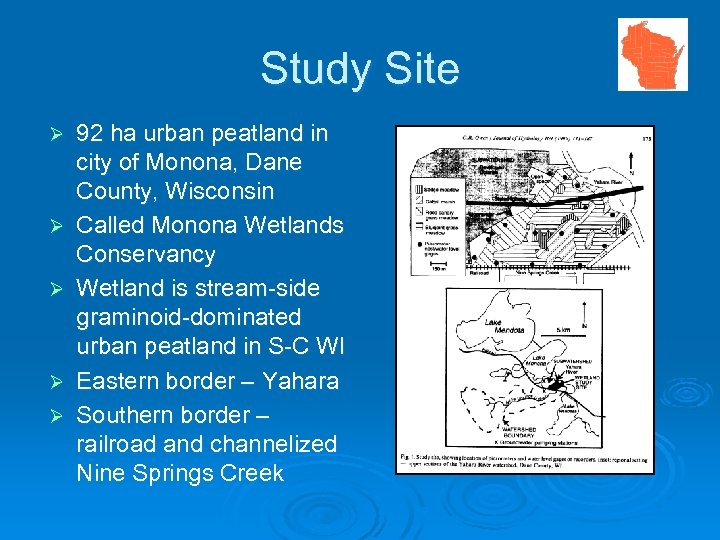
Study Site Ø Ø Ø 92 ha urban peatland in city of Monona, Dane County, Wisconsin Called Monona Wetlands Conservancy Wetland is stream-side graminoid-dominated urban peatland in S-C WI Eastern border – Yahara Southern border – railroad and channelized Nine Springs Creek
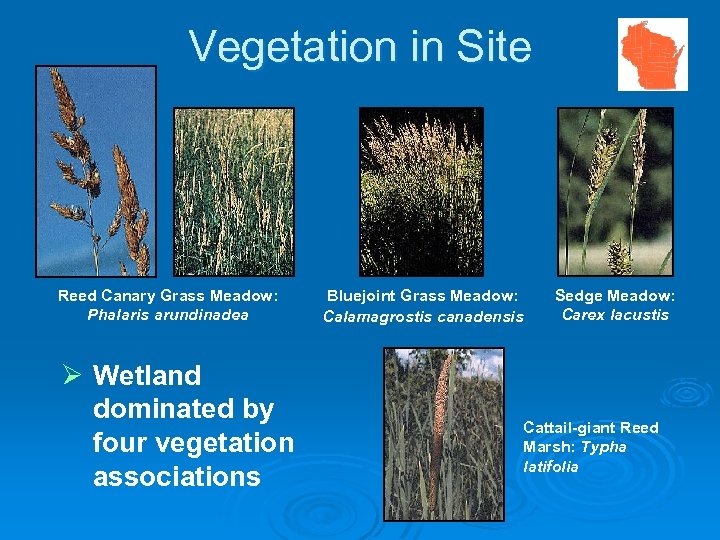
Vegetation in Site Reed Canary Grass Meadow: Phalaris arundinadea Ø Wetland dominated by four vegetation associations Bluejoint Grass Meadow: Calamagrostis canadensis Sedge Meadow: Carex lacustis Cattail-giant Reed Marsh: Typha latifolia
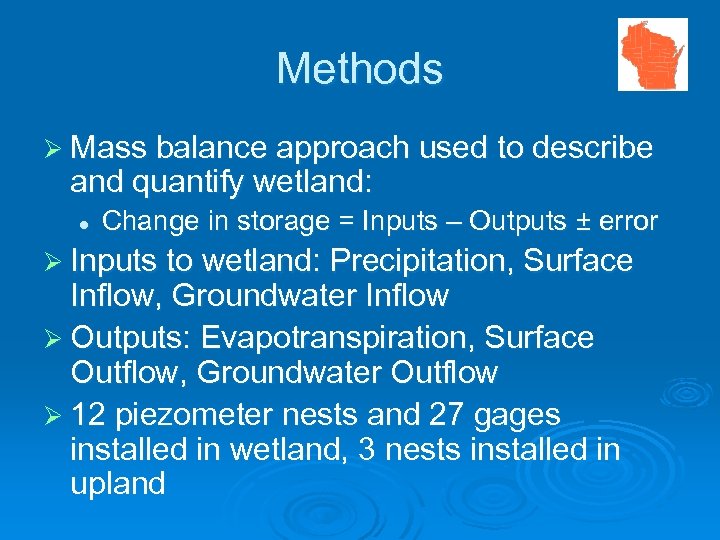
Methods Ø Mass balance approach used to describe and quantify wetland: l Change in storage = Inputs – Outputs ± error Ø Inputs to wetland: Precipitation, Surface Inflow, Groundwater Inflow Ø Outputs: Evapotranspiration, Surface Outflow, Groundwater Outflow Ø 12 piezometer nests and 27 gages installed in wetland, 3 nests installed in upland
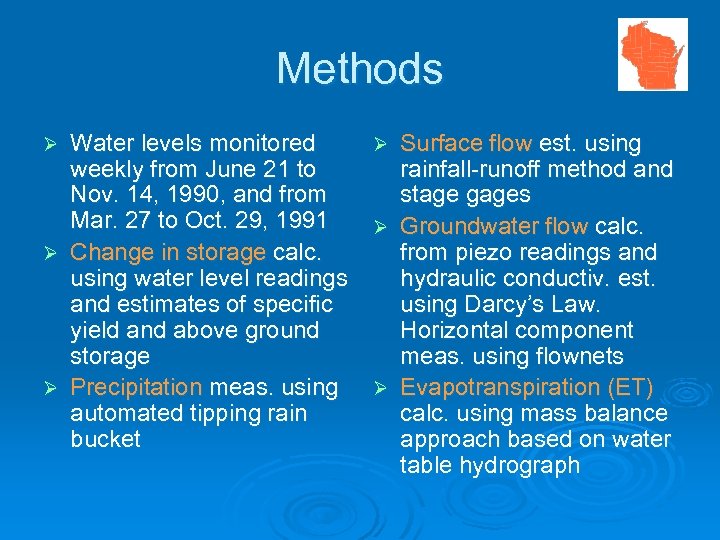
Methods Water levels monitored weekly from June 21 to Nov. 14, 1990, and from Mar. 27 to Oct. 29, 1991 Ø Change in storage calc. using water level readings and estimates of specific yield and above ground storage Ø Precipitation meas. using automated tipping rain bucket Ø Surface flow est. using rainfall-runoff method and stage gages Ø Groundwater flow calc. from piezo readings and hydraulic conductiv. est. using Darcy’s Law. Horizontal component meas. using flownets Ø Evapotranspiration (ET) calc. using mass balance approach based on water table hydrograph Ø
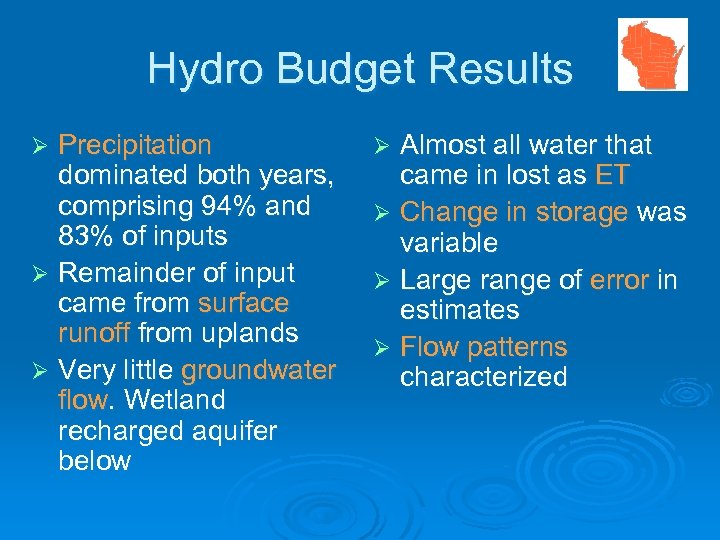
Hydro Budget Results Precipitation dominated both years, comprising 94% and 83% of inputs Ø Remainder of input came from surface runoff from uplands Ø Very little groundwater flow. Wetland recharged aquifer below Ø Almost all water that came in lost as ET Ø Change in storage was variable Ø Large range of error in estimates Ø Flow patterns characterized Ø
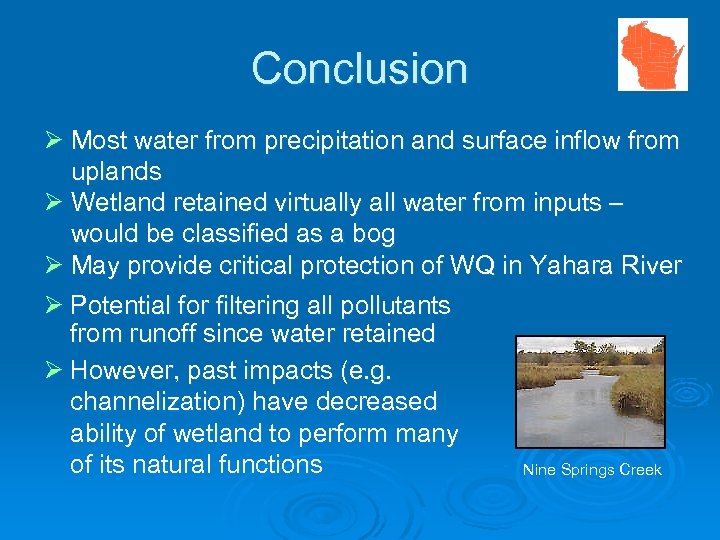
Conclusion Ø Most water from precipitation and surface inflow from uplands Ø Wetland retained virtually all water from inputs – would be classified as a bog Ø May provide critical protection of WQ in Yahara River Ø Potential for filtering all pollutants from runoff since water retained Ø However, past impacts (e. g. channelization) have decreased ability of wetland to perform many of its natural functions Nine Springs Creek
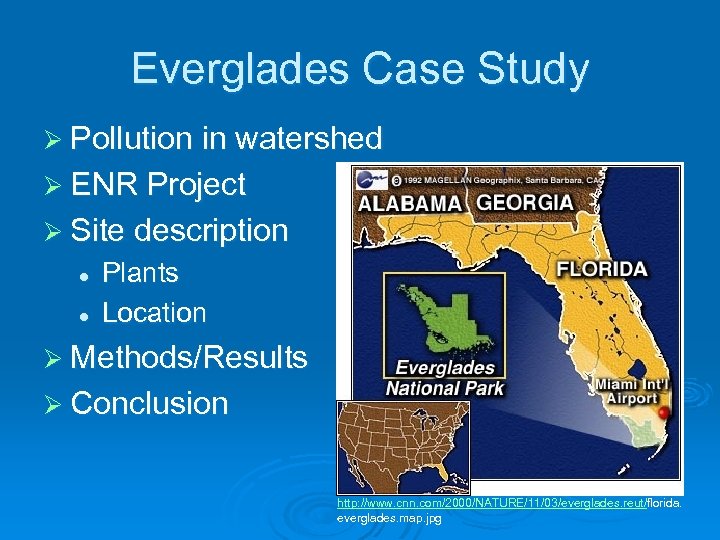
Everglades Case Study Ø Pollution in watershed Ø ENR Project Ø Site description l l Plants Location Ø Methods/Results Ø Conclusion http: //www. cnn. com/2000/NATURE/11/03/everglades. reut/florida. everglades. map. jpg
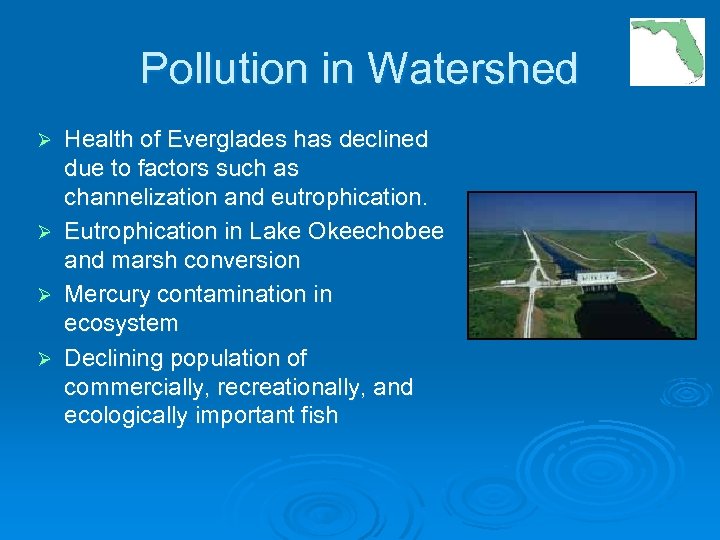
Pollution in Watershed Health of Everglades has declined due to factors such as channelization and eutrophication. Ø Eutrophication in Lake Okeechobee and marsh conversion Ø Mercury contamination in ecosystem Ø Declining population of commercially, recreationally, and ecologically important fish Ø
ENR Project Ø Implementation of the Everglades Program Ø Major component is Everglades Construction Project Ø Has 6 stormwater treatment areas (STA) – constructed wetlands that receive runoff from Everglades Agricultural Area Ø First STA is Everglades Nutrient Removal Project
ENR Project Ø To assess how the ENR was working, a hydrologic budget had to be constructed. Ø Case study: “Hydrologic balance for a subtropical treatment wetland constructed for nutrient removal” by Mariano Guardo (SFWMD)
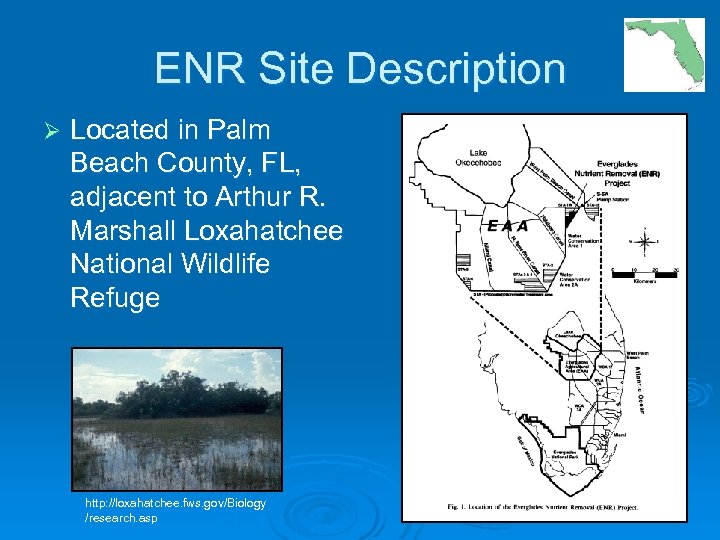
ENR Site Description Ø Located in Palm Beach County, FL, adjacent to Arthur R. Marshall Loxahatchee National Wildlife Refuge http: //loxahatchee. fws. gov/Biology /research. asp
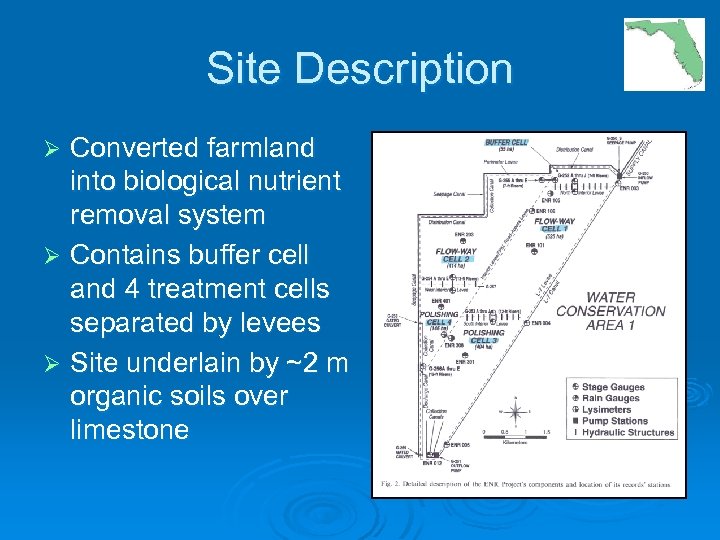
Site Description Converted farmland into biological nutrient removal system Ø Contains buffer cell and 4 treatment cells separated by levees Ø Site underlain by ~2 m organic soils over limestone Ø
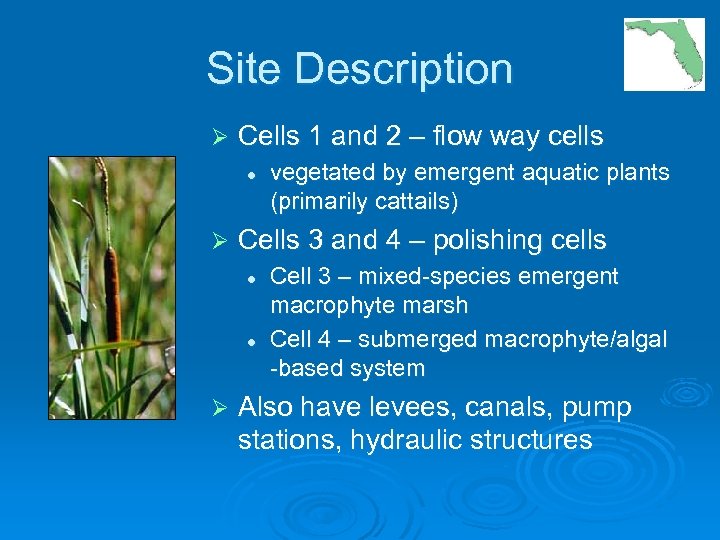
Site Description Ø Cells 1 and 2 – flow way cells l Ø Cells 3 and 4 – polishing cells l l Ø vegetated by emergent aquatic plants (primarily cattails) Cell 3 – mixed-species emergent macrophyte marsh Cell 4 – submerged macrophyte/algal -based system Also have levees, canals, pump stations, hydraulic structures
Methods Ø Water budget: l l Positive inflow sources pumped water, precipitation, groundwater inflow, seepage Negative outflow sources pumped water, evapotranspiration, seepage, aquifer recharge Ø Difficult to measure some parameters
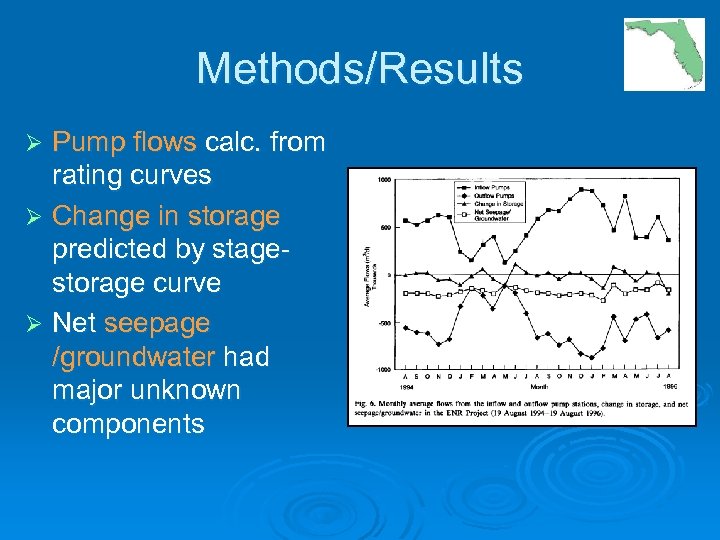
Methods/Results Pump flows calc. from rating curves Ø Change in storage predicted by stagestorage curve Ø Net seepage /groundwater had major unknown components Ø
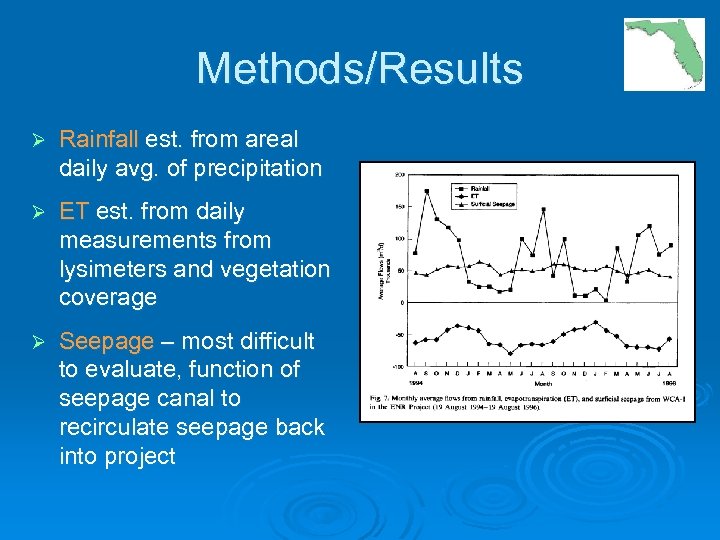
Methods/Results Ø Rainfall est. from areal daily avg. of precipitation Ø ET est. from daily measurements from lysimeters and vegetation coverage Ø Seepage – most difficult to evaluate, function of seepage canal to recirculate seepage back into project
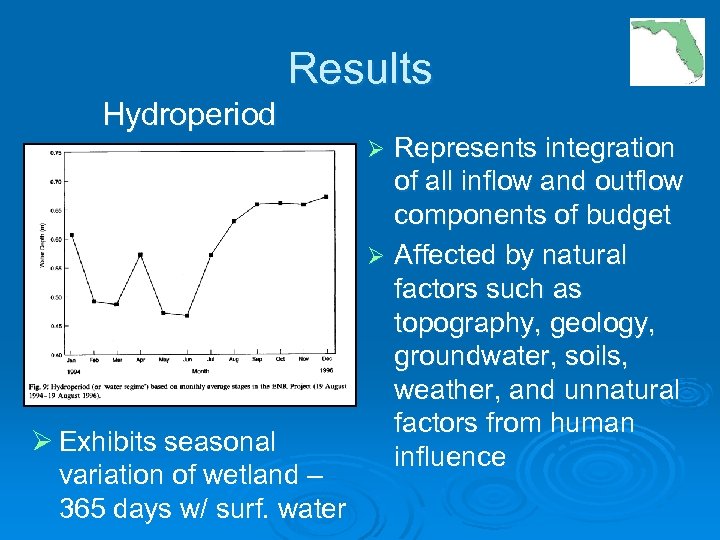
Results Hydroperiod Represents integration of all inflow and outflow components of budget Ø Affected by natural factors such as topography, geology, groundwater, soils, weather, and unnatural factors from human influence Ø Ø Exhibits seasonal variation of wetland – 365 days w/ surf. water
Results Ø Average water inputs: l l l 86. 2% from inflow pumps 11. 2% from rainfall – 2 yr period was relatively wet compared to historic flow 2. 6% from emerging seepage Ø Average outputs: l l l 85. 1% from outflow pumps 8. 9% from ET 6. 0% from seepage/groundwater Ø Stage- and depth-duration curves developed also
Conclusion Ø Study considered ENR Project as a whole Ø Necessary to analyze each cell independently in future (each has different treatment characteristics) Ø ENR produced excellent results in removal of phosphorus from the system
Summary Ø What is hydrologic budget Ø Wisconsin site Ø Everglades site Ø Importance of hydrologic budget http: //imnh. isu. edu/digitalatlas/hydr/ basics/main/imgs/1 comp. jpg
References Ø Ø Ø Ø Department of Environmental Protection. 2003. Available: http: //www. dep. state. fl. us/secretary/everglades/about. htm. Digital Atlas of Idaho. 2003. http: //imnh. isu. edu/digitalatlas/hydr/basics/main/imgs/1 comp. jpg Groundwater Foundation. 2003. Available: http: //www. groundwater. org/GWBasics/hydro. htm Guardo, M. 1999. Hydrologic balance for a subtropical treatment wetland constructed for nutrient removal. Ecological Engineering 12: 315 -337. Land Conservation Department (Dane County, WI). 2003. Available: http: //www. co. dane. wi. us/landconservation/programpg. htm. Mitsch, W. J. and J. G. Gosselink. 1986. Wetlands. Van Nostrand Reinhold: New York. Owen, C. R. 1995. Water budget and flow patterns in an urban wetland. Journal of Hydrology 169: 171 -187. www. wi-mall. com/images/wisconsin-links-map. jpg
 Скачать презентацию The Hydrologic Budget of Wetlands Jason Hall Robert
54b44b971ea8eb6e1a7602a1b090b28d.ppt