


 Скачать презентацию The Human Geography of Southwest Asia Central Asia
4115cf09ab65ec92baefa4e21a83da3d.ppt
- Количество слайдов: 41
 The Human Geography of Southwest Asia, Central Asia, and North Africa
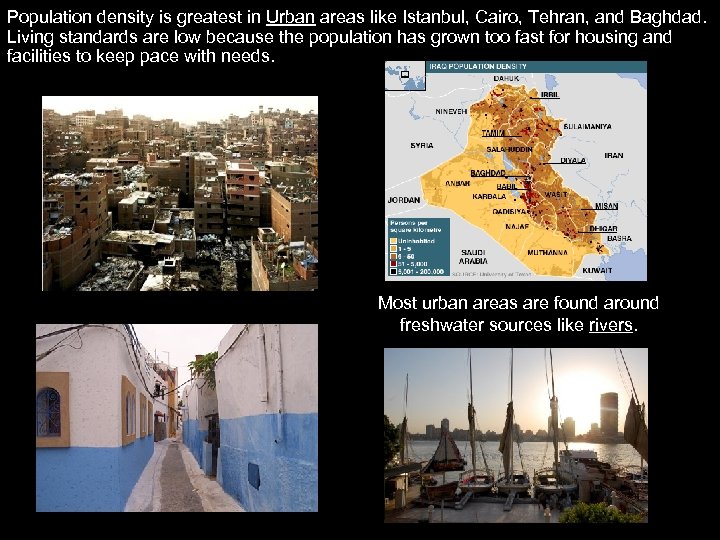 Population density is greatest in Urban areas like Istanbul, Cairo, Tehran, and Baghdad. Living standards are low because the population has grown too fast for housing and facilities to keep pace with needs. Most urban areas are found around freshwater sources like rivers.
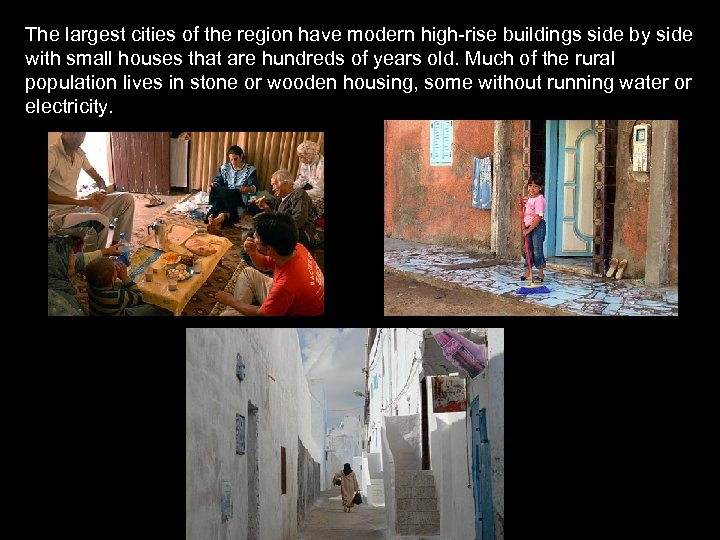 The largest cities of the region have modern high-rise buildings side by side with small houses that are hundreds of years old. Much of the rural population lives in stone or wooden housing, some without running water or electricity.
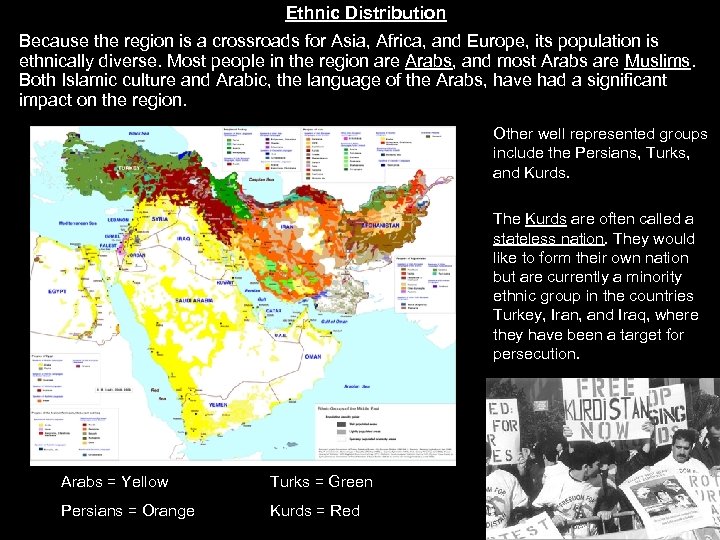 Ethnic Distribution Because the region is a crossroads for Asia, Africa, and Europe, its population is ethnically diverse. Most people in the region are Arabs, and most Arabs are Muslims. Both Islamic culture and Arabic, the language of the Arabs, have had a significant impact on the region. Other well represented groups include the Persians, Turks, and Kurds. The Kurds are often called a stateless nation. They would like to form their own nation but are currently a minority ethnic group in the countries Turkey, Iran, and Iraq, where they have been a target for persecution. Arabs = Yellow Turks = Green Persians = Orange Kurds = Red
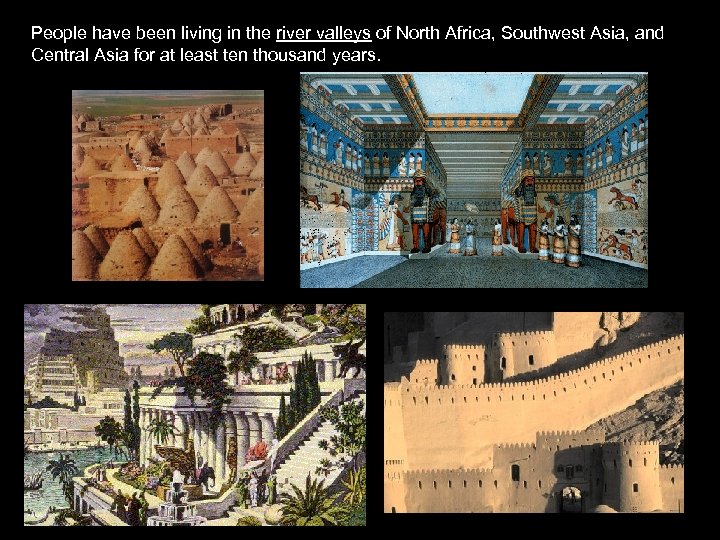 People have been living in the river valleys of North Africa, Southwest Asia, and Central Asia for at least ten thousand years.
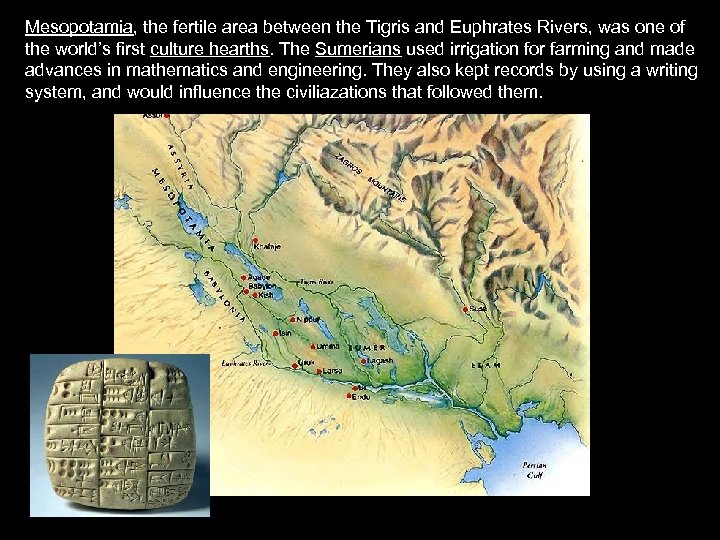 Mesopotamia, the fertile area between the Tigris and Euphrates Rivers, was one of the world’s first culture hearths. The Sumerians used irrigation for farming and made advances in mathematics and engineering. They also kept records by using a writing system, and would influence the civiliazations that followed them.
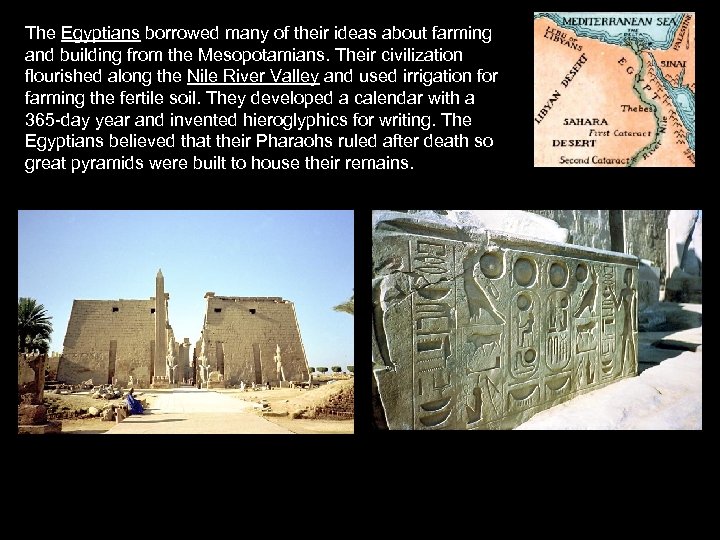 The Egyptians borrowed many of their ideas about farming and building from the Mesopotamians. Their civilization flourished along the Nile River Valley and used irrigation for farming the fertile soil. They developed a calendar with a 365 -day year and invented hieroglyphics for writing. The Egyptians believed that their Pharaohs ruled after death so great pyramids were built to house their remains.
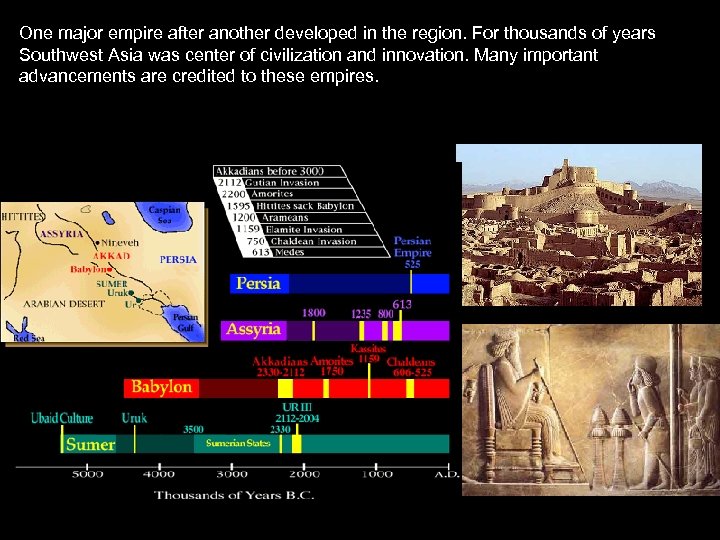 One major empire after another developed in the region. For thousands of years Southwest Asia was center of civilization and innovation. Many important advancements are credited to these empires.
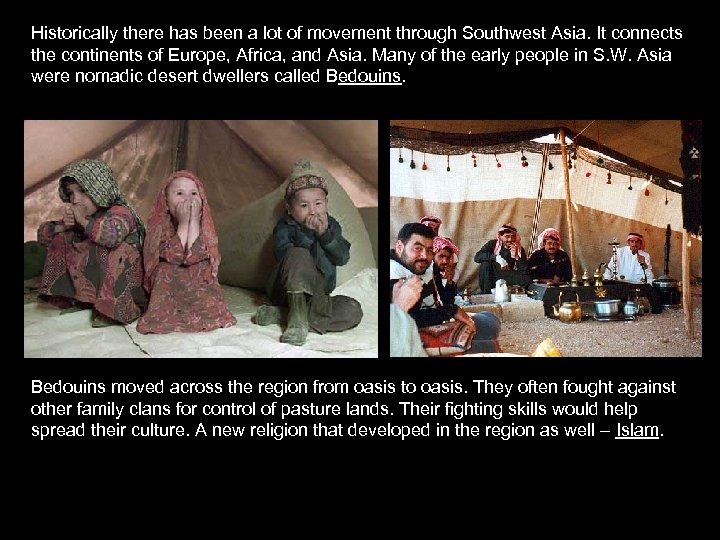 Historically there has been a lot of movement through Southwest Asia. It connects the continents of Europe, Africa, and Asia. Many of the early people in S. W. Asia were nomadic desert dwellers called Bedouins moved across the region from oasis to oasis. They often fought against other family clans for control of pasture lands. Their fighting skills would help spread their culture. A new religion that developed in the region as well – Islam.
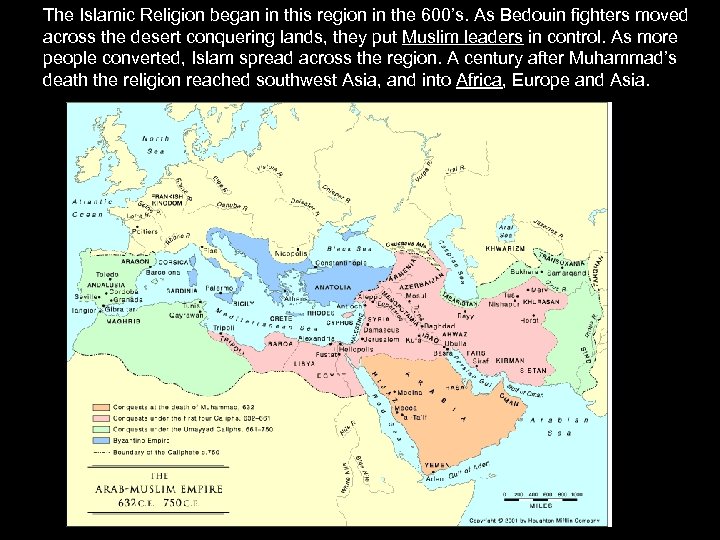 The Islamic Religion began in this region in the 600’s. As Bedouin fighters moved across the desert conquering lands, they put Muslim leaders in control. As more people converted, Islam spread across the region. A century after Muhammad’s death the religion reached southwest Asia, and into Africa, Europe and Asia.
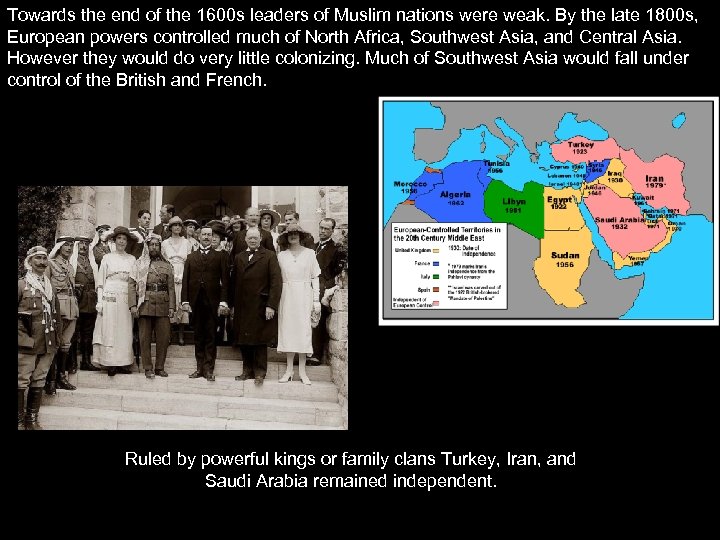 Towards the end of the 1600 s leaders of Muslim nations were weak. By the late 1800 s, European powers controlled much of North Africa, Southwest Asia, and Central Asia. However they would do very little colonizing. Much of Southwest Asia would fall under control of the British and French. Ruled by powerful kings or family clans Turkey, Iran, and Saudi Arabia remained independent.
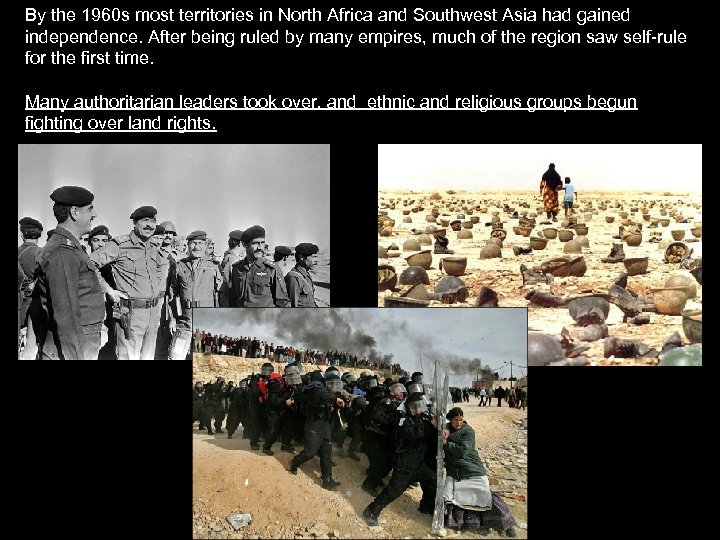 By the 1960 s most territories in North Africa and Southwest Asia had gained independence. After being ruled by many empires, much of the region saw self-rule for the first time. Many authoritarian leaders took over, and ethnic and religious groups begun fighting over land rights.
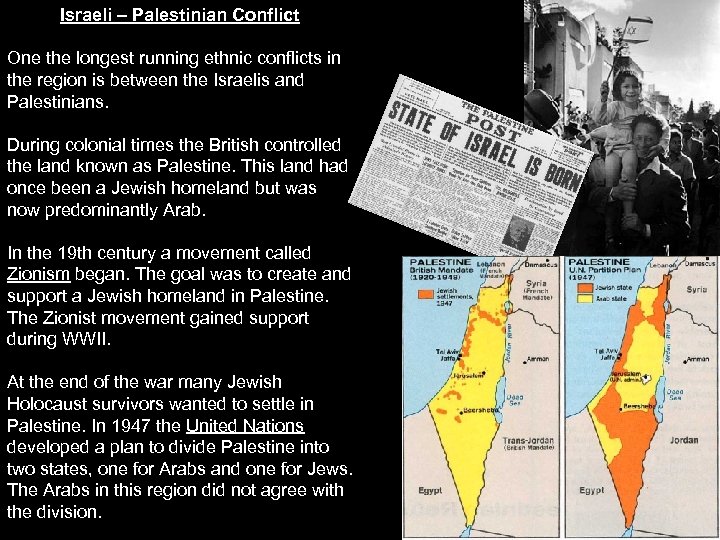 Israeli – Palestinian Conflict One the longest running ethnic conflicts in the region is between the Israelis and Palestinians. During colonial times the British controlled the land known as Palestine. This land had once been a Jewish homeland but was now predominantly Arab. In the 19 th century a movement called Zionism began. The goal was to create and support a Jewish homeland in Palestine. The Zionist movement gained support during WWII. At the end of the war many Jewish Holocaust survivors wanted to settle in Palestine. In 1947 the United Nations developed a plan to divide Palestine into two states, one for Arabs and one for Jews. The Arabs in this region did not agree with the division.
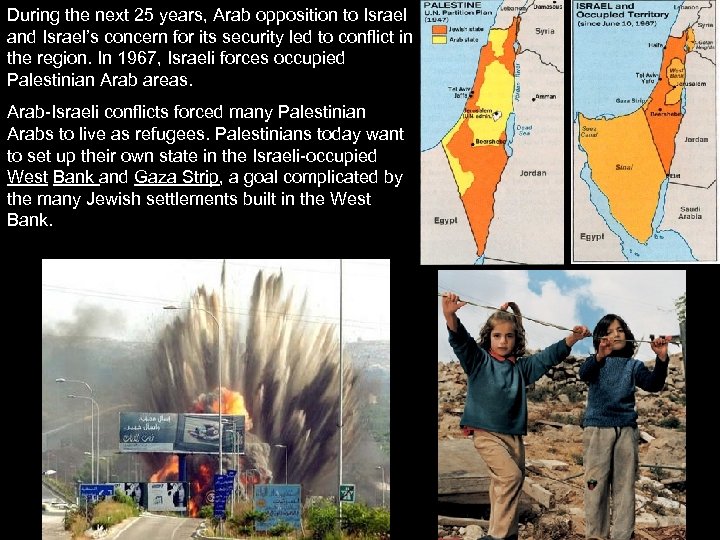 During the next 25 years, Arab opposition to Israel and Israel’s concern for its security led to conflict in the region. In 1967, Israeli forces occupied Palestinian Arab areas. Arab-Israeli conflicts forced many Palestinian Arabs to live as refugees. Palestinians today want to set up their own state in the Israeli-occupied West Bank and Gaza Strip, a goal complicated by the many Jewish settlements built in the West Bank.
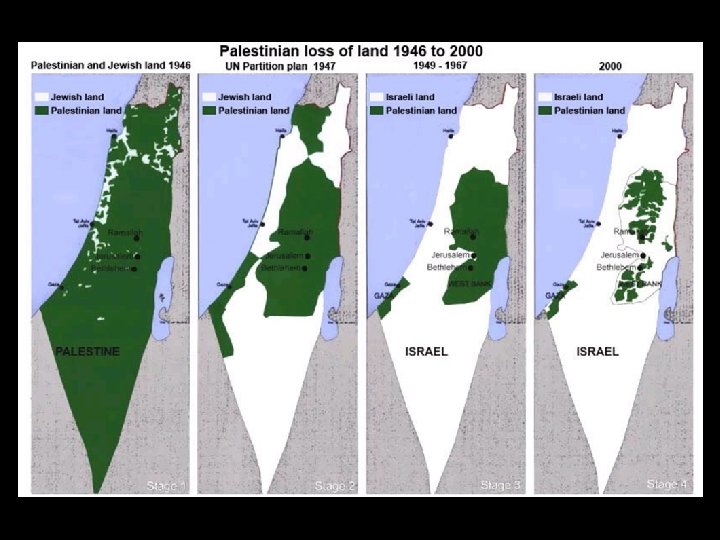
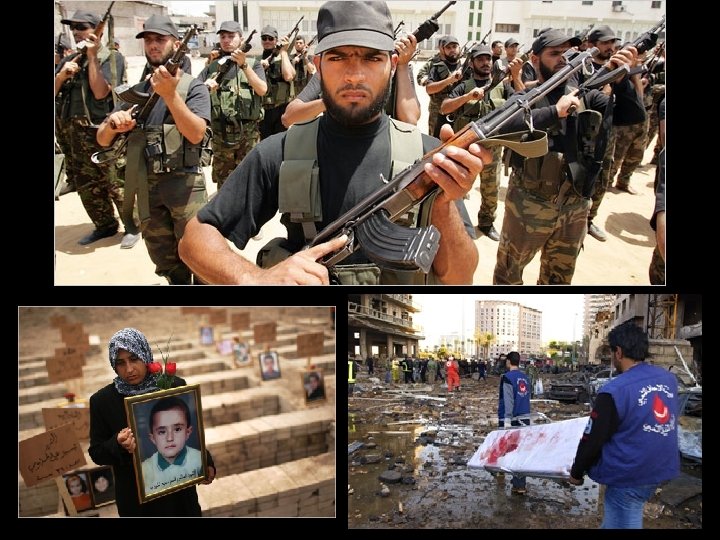
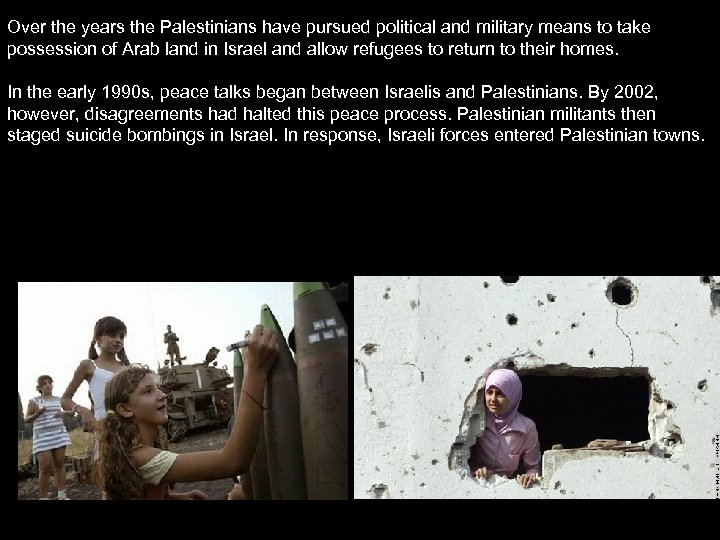 Over the years the Palestinians have pursued political and military means to take possession of Arab land in Israel and allow refugees to return to their homes. In the early 1990 s, peace talks began between Israelis and Palestinians. By 2002, however, disagreements had halted this peace process. Palestinian militants then staged suicide bombings in Israel. In response, Israeli forces entered Palestinian towns.
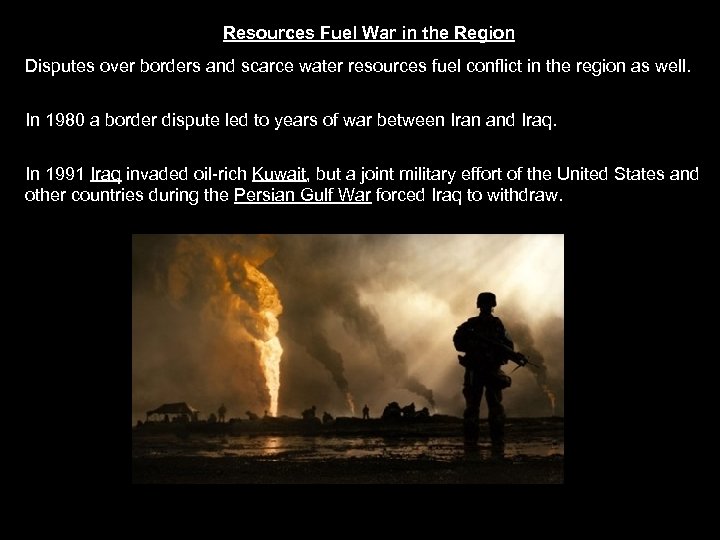 Resources Fuel War in the Region Disputes over borders and scarce water resources fuel conflict in the region as well. In 1980 a border dispute led to years of war between Iran and Iraq. In 1991 Iraq invaded oil-rich Kuwait, but a joint military effort of the United States and other countries during the Persian Gulf War forced Iraq to withdraw.
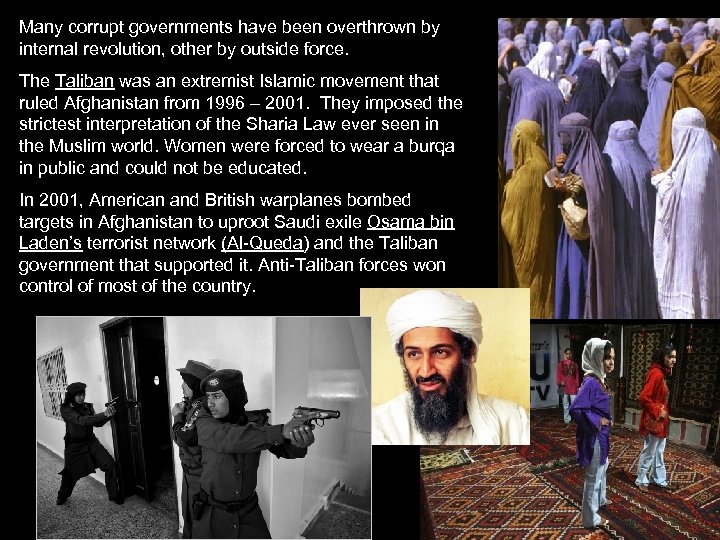 Many corrupt governments have been overthrown by internal revolution, other by outside force. The Taliban was an extremist Islamic movement that ruled Afghanistan from 1996 – 2001. They imposed the strictest interpretation of the Sharia Law ever seen in the Muslim world. Women were forced to wear a burqa in public and could not be educated. In 2001, American and British warplanes bombed targets in Afghanistan to uproot Saudi exile Osama bin Laden’s terrorist network (Al-Queda) and the Taliban government that supported it. Anti-Taliban forces won control of most of the country.
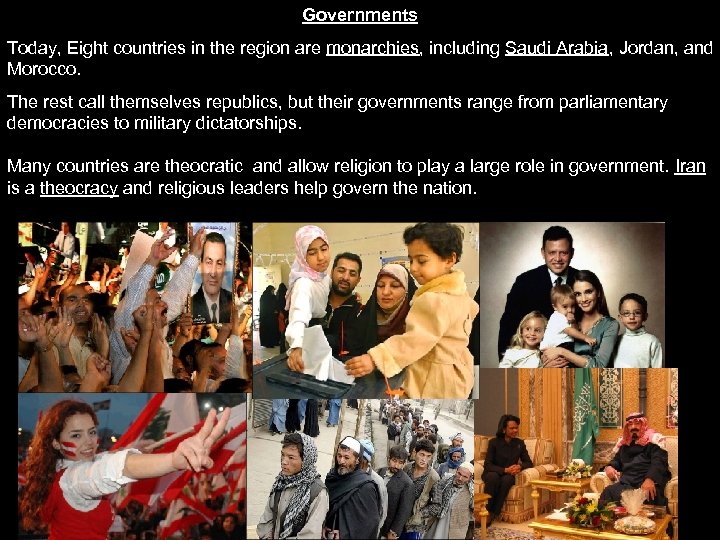 Governments Today, Eight countries in the region are monarchies, including Saudi Arabia, Jordan, and Morocco. The rest call themselves republics, but their governments range from parliamentary democracies to military dictatorships. Many countries are theocratic and allow religion to play a large role in government. Iran is a theocracy and religious leaders help govern the nation.
 Culture
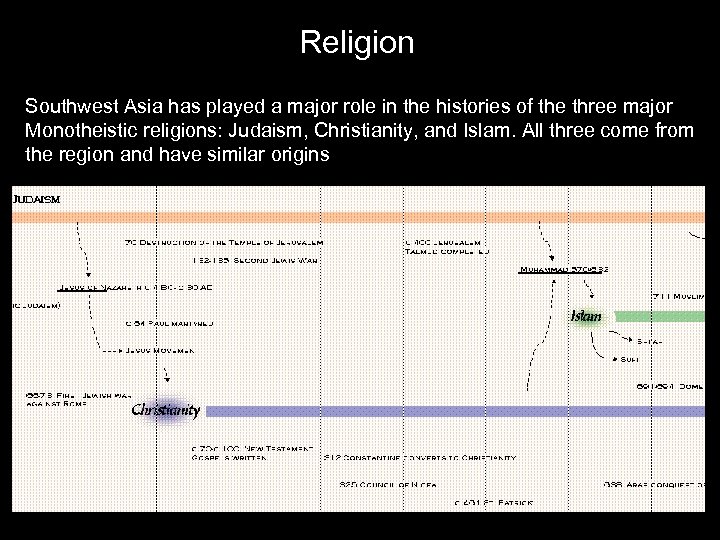 Religion Southwest Asia has played a major role in the histories of the three major Monotheistic religions: Judaism, Christianity, and Islam. All three come from the region and have similar origins
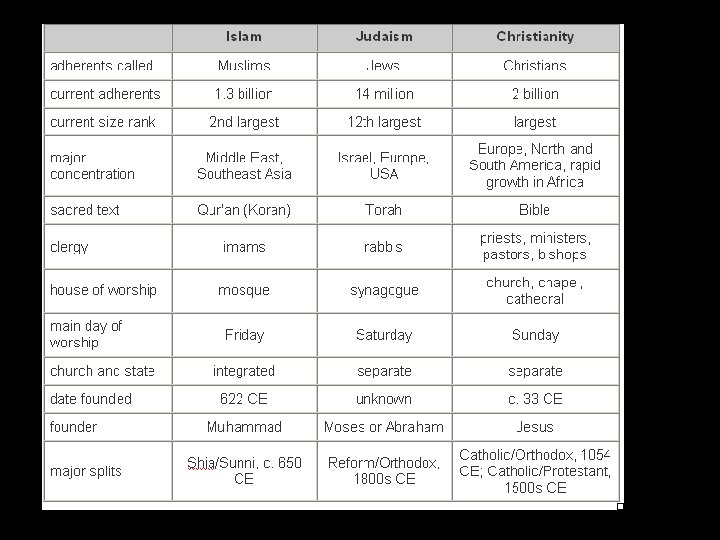
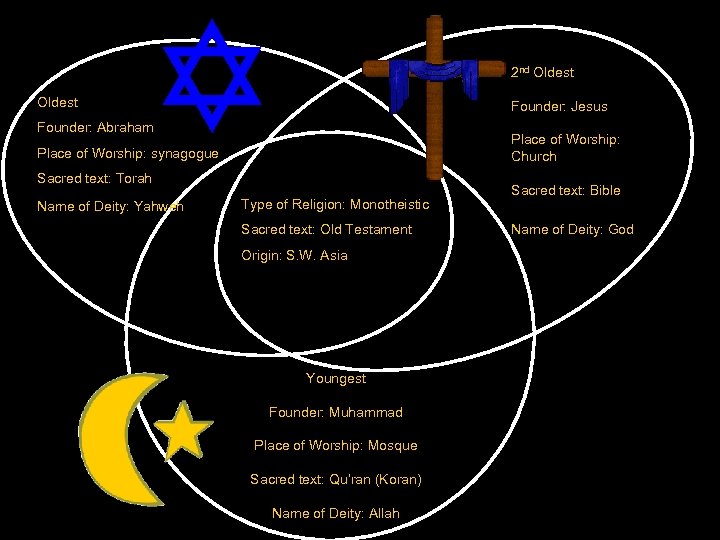 2 nd Oldest Founder: Jesus Founder: Abraham Place of Worship: Church Place of Worship: synagogue Sacred text: Torah Name of Deity: Yahweh Type of Religion: Monotheistic Sacred text: Old Testament Origin: S. W. Asia Youngest Founder: Muhammad Place of Worship: Mosque Sacred text: Qu’ran (Koran) Name of Deity: Allah Sacred text: Bible Name of Deity: God
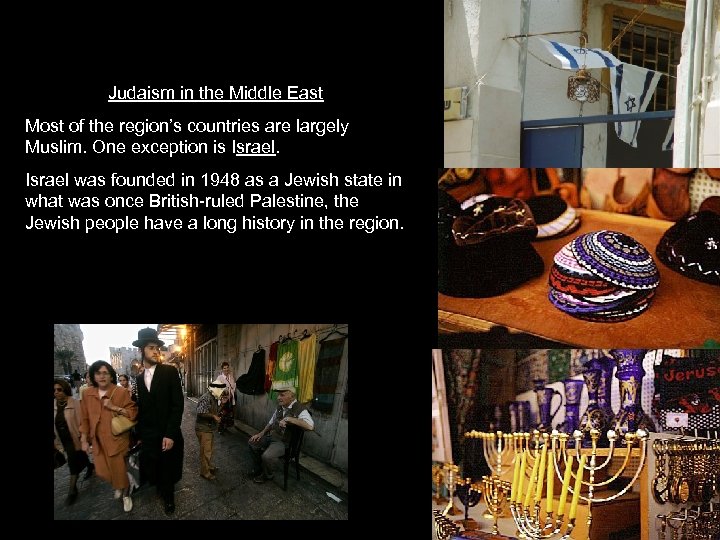 Judaism in the Middle East Most of the region’s countries are largely Muslim. One exception is Israel was founded in 1948 as a Jewish state in what was once British-ruled Palestine, the Jewish people have a long history in the region.
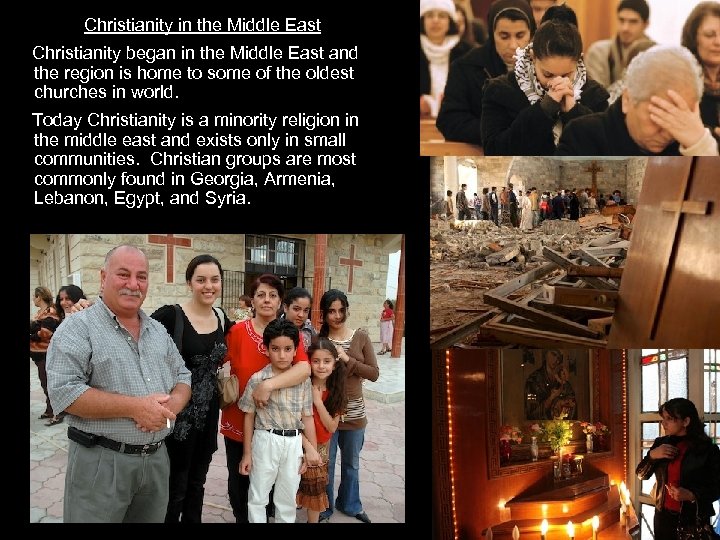 Christianity in the Middle East Christianity began in the Middle East and the region is home to some of the oldest churches in world. Today Christianity is a minority religion in the middle east and exists only in small communities. Christian groups are most commonly found in Georgia, Armenia, Lebanon, Egypt, and Syria.
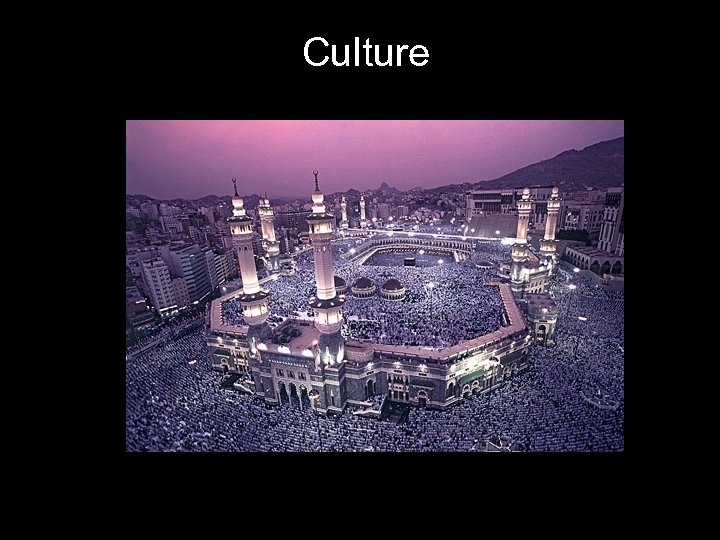
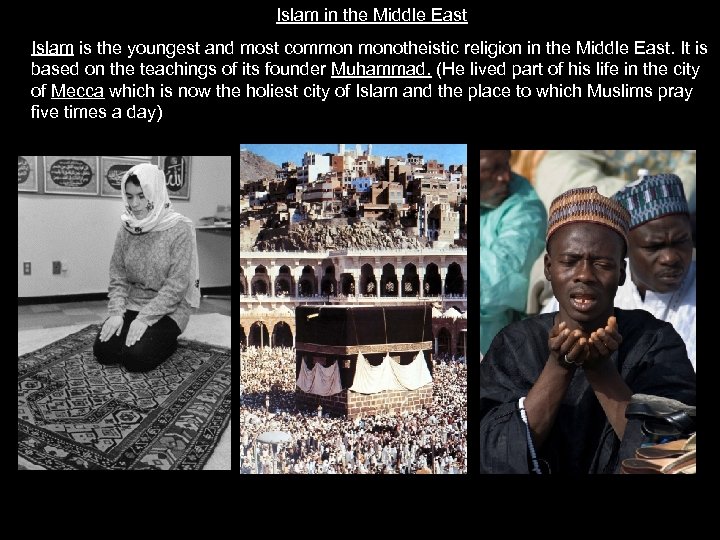 Islam in the Middle East Islam is the youngest and most common monotheistic religion in the Middle East. It is based on the teachings of its founder Muhammad. (He lived part of his life in the city of Mecca which is now the holiest city of Islam and the place to which Muslims pray five times a day)
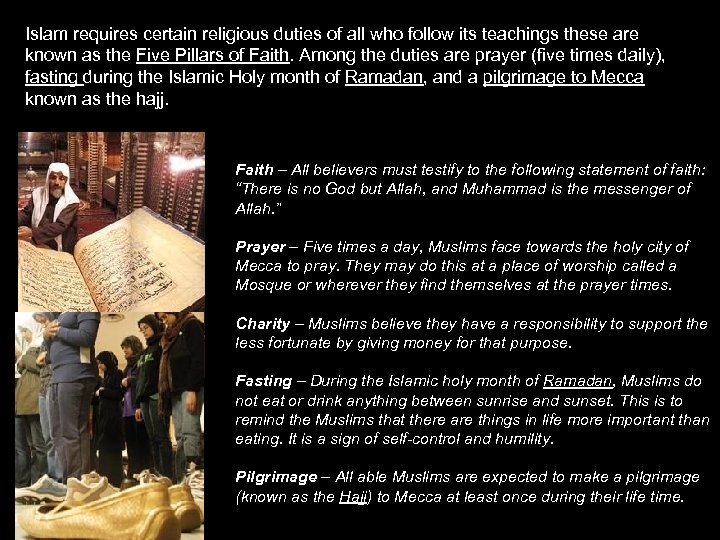 Islam requires certain religious duties of all who follow its teachings these are known as the Five Pillars of Faith. Among the duties are prayer (five times daily), fasting during the Islamic Holy month of Ramadan, and a pilgrimage to Mecca known as the hajj. Faith – All believers must testify to the following statement of faith: “There is no God but Allah, and Muhammad is the messenger of Allah. ” Prayer – Five times a day, Muslims face towards the holy city of Mecca to pray. They may do this at a place of worship called a Mosque or wherever they find themselves at the prayer times. Charity – Muslims believe they have a responsibility to support the less fortunate by giving money for that purpose. Fasting – During the Islamic holy month of Ramadan, Muslims do not eat or drink anything between sunrise and sunset. This is to remind the Muslims that there are things in life more important than eating. It is a sign of self-control and humility. Pilgrimage – All able Muslims are expected to make a pilgrimage (known as the Hajj) to Mecca at least once during their life time.
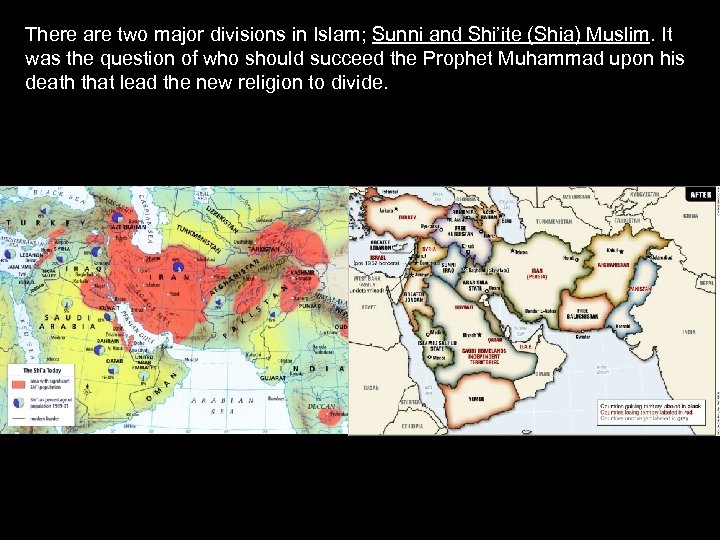 There are two major divisions in Islam; Sunni and Shi’ite (Shia) Muslim. It was the question of who should succeed the Prophet Muhammad upon his death that lead the new religion to divide.
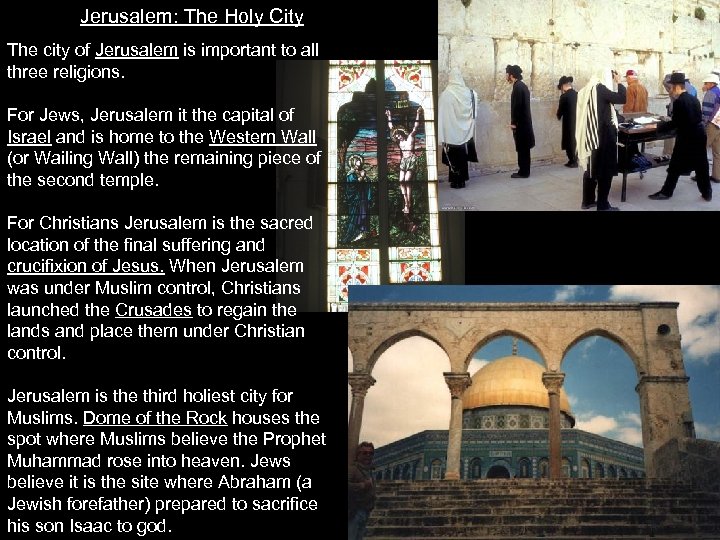 Jerusalem: The Holy City The city of Jerusalem is important to all three religions. For Jews, Jerusalem it the capital of Israel and is home to the Western Wall (or Wailing Wall) the remaining piece of the second temple. For Christians Jerusalem is the sacred location of the final suffering and crucifixion of Jesus. When Jerusalem was under Muslim control, Christians launched the Crusades to regain the lands and place them under Christian control. Jerusalem is the third holiest city for Muslims. Dome of the Rock houses the spot where Muslims believe the Prophet Muhammad rose into heaven. Jews believe it is the site where Abraham (a Jewish forefather) prepared to sacrifice his son Isaac to god.
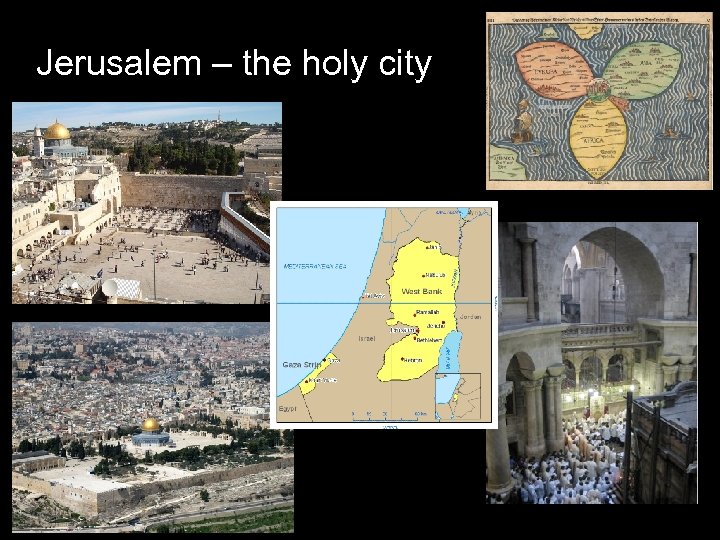 Jerusalem – the holy city
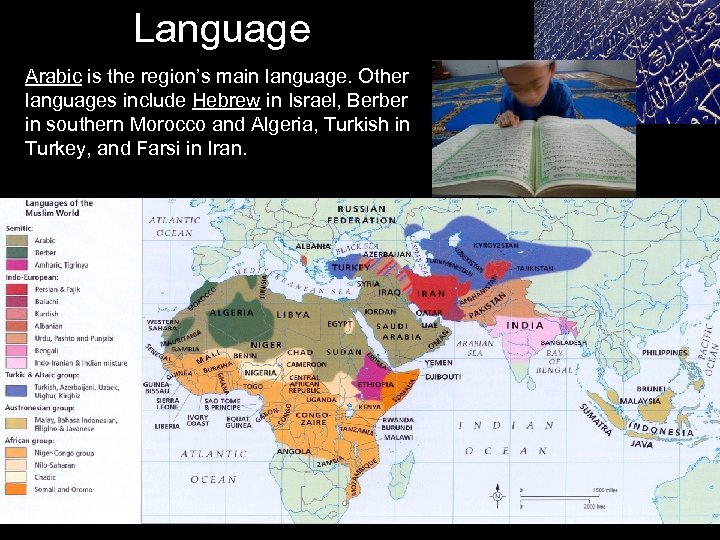 Language Arabic is the region’s main language. Other languages include Hebrew in Israel, Berber in southern Morocco and Algeria, Turkish in Turkey, and Farsi in Iran.
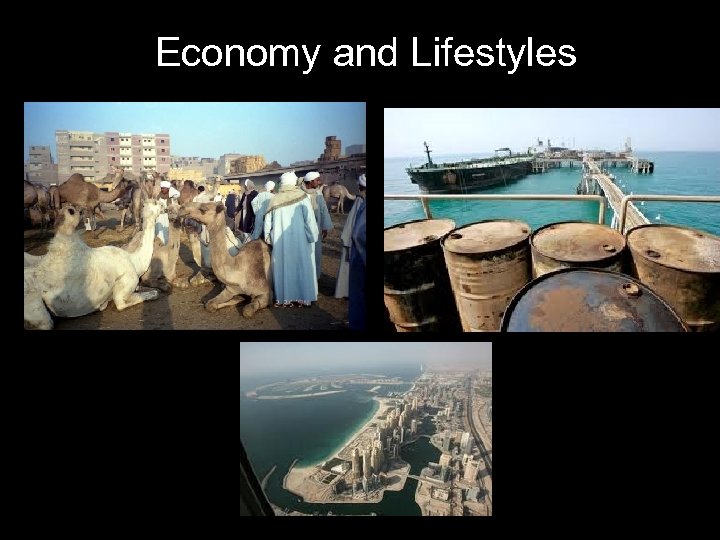 Economy and Lifestyles
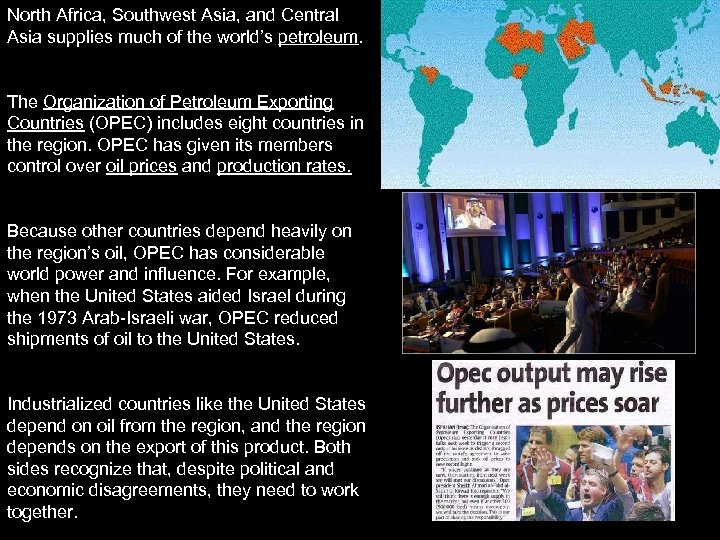 North Africa, Southwest Asia, and Central Asia supplies much of the world’s petroleum. The Organization of Petroleum Exporting Countries (OPEC) includes eight countries in the region. OPEC has given its members control over oil prices and production rates. Because other countries depend heavily on the region’s oil, OPEC has considerable world power and influence. For example, when the United States aided Israel during the 1973 Arab-Israeli war, OPEC reduced shipments of oil to the United States. Industrialized countries like the United States depend on oil from the region, and the region depends on the export of this product. Both sides recognize that, despite political and economic disagreements, they need to work together.
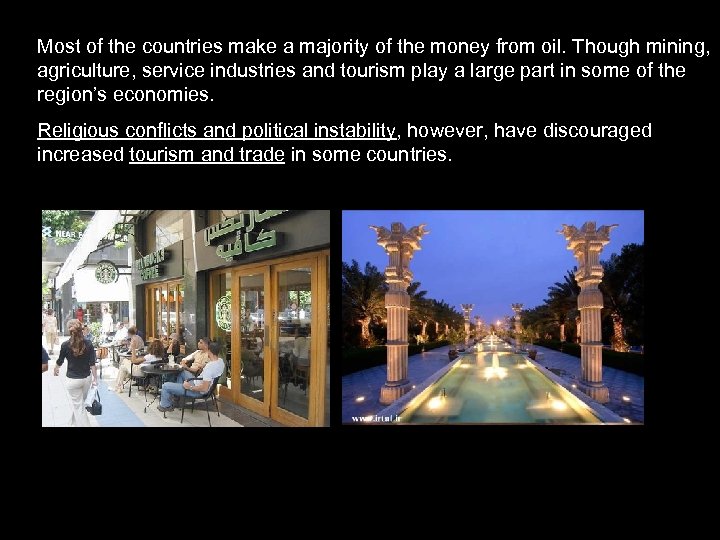 Most of the countries make a majority of the money from oil. Though mining, agriculture, service industries and tourism play a large part in some of the region’s economies. Religious conflicts and political instability, however, have discouraged increased tourism and trade in some countries.
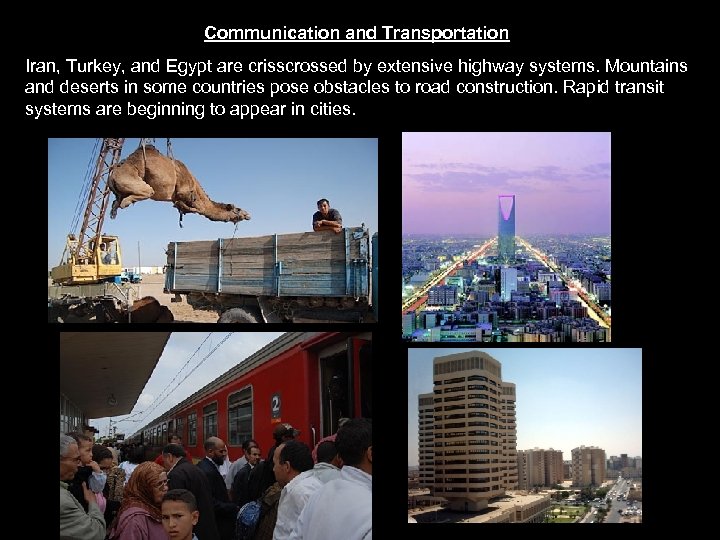 Communication and Transportation Iran, Turkey, and Egypt are crisscrossed by extensive highway systems. Mountains and deserts in some countries pose obstacles to road construction. Rapid transit systems are beginning to appear in cities.
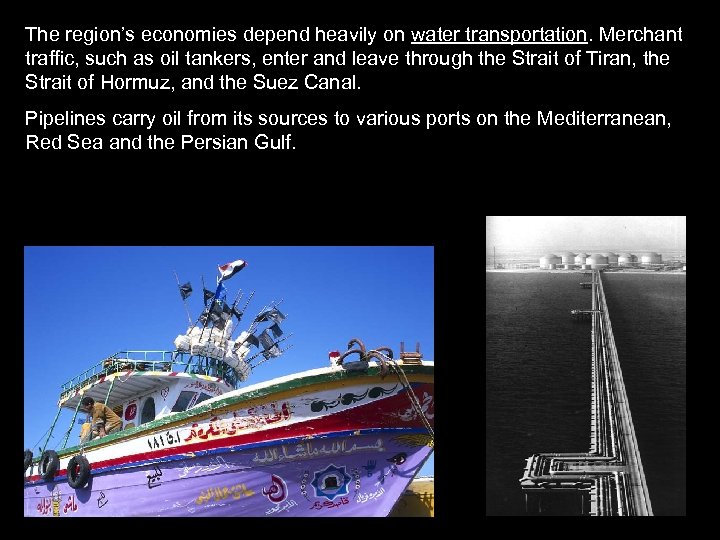 The region’s economies depend heavily on water transportation. Merchant traffic, such as oil tankers, enter and leave through the Strait of Tiran, the Strait of Hormuz, and the Suez Canal. Pipelines carry oil from its sources to various ports on the Mediterranean, Red Sea and the Persian Gulf.
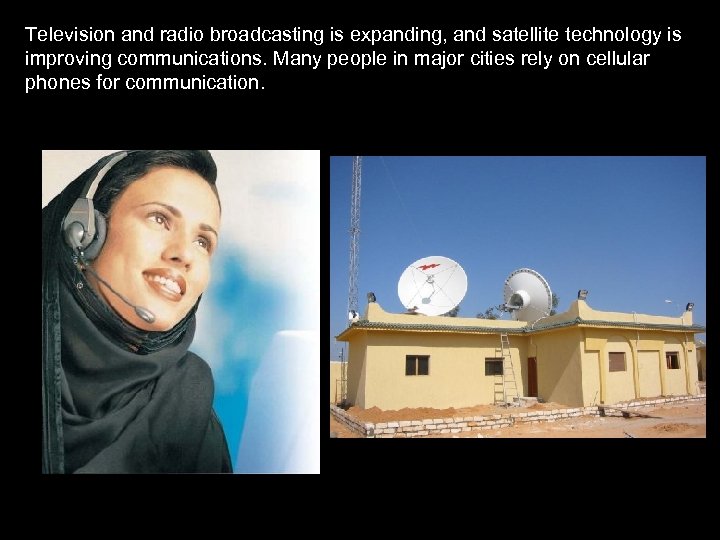 Television and radio broadcasting is expanding, and satellite technology is improving communications. Many people in major cities rely on cellular phones for communication.
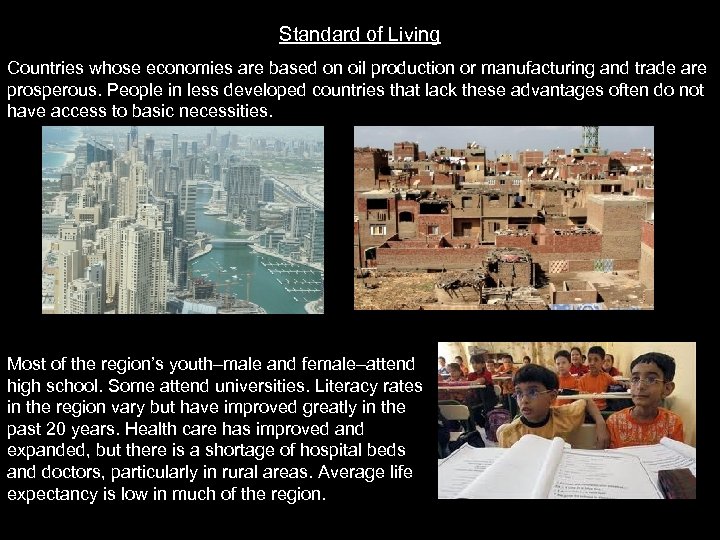 Standard of Living Countries whose economies are based on oil production or manufacturing and trade are prosperous. People in less developed countries that lack these advantages often do not have access to basic necessities. Most of the region’s youth–male and female–attend high school. Some attend universities. Literacy rates in the region vary but have improved greatly in the past 20 years. Health care has improved and expanded, but there is a shortage of hospital beds and doctors, particularly in rural areas. Average life expectancy is low in much of the region.