


 Скачать презентацию The House as a System 1 Air
771641030850c72d7264a1d8e226bb84.ppt
- Количество слайдов: 29
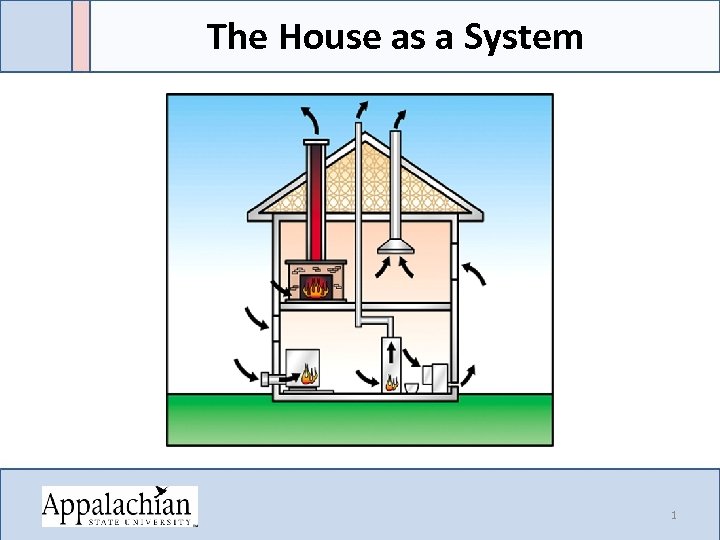 The House as a System 1
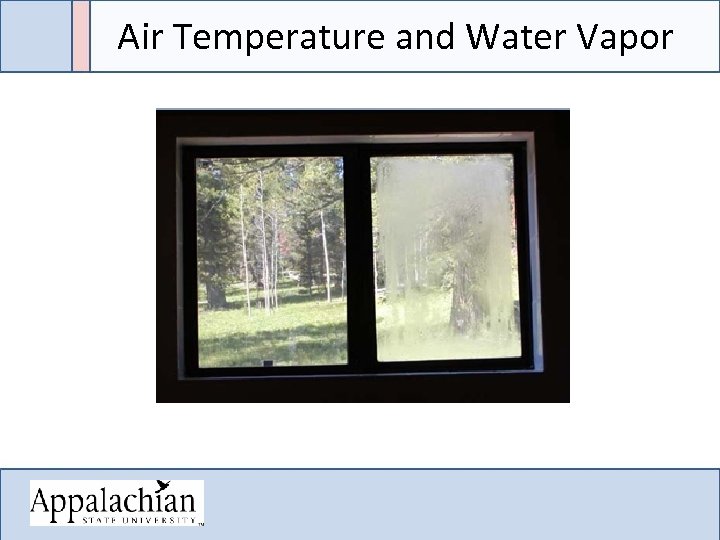 Air Temperature and Water Vapor
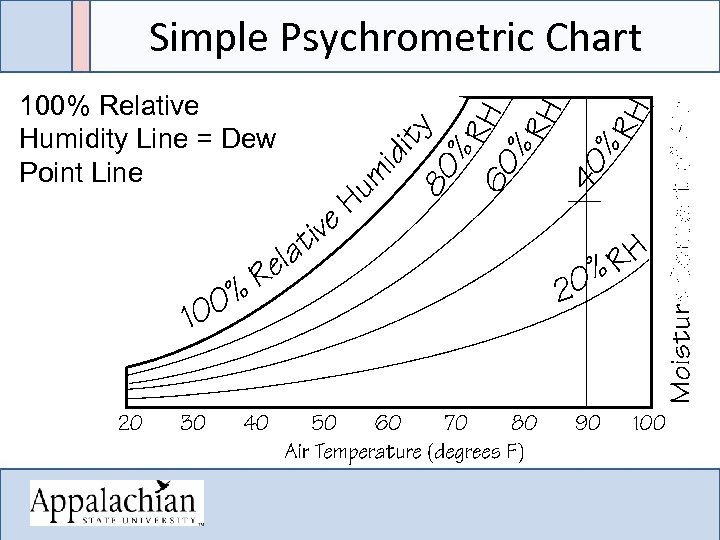 Simple Psychrometric Chart 100% Relative Humidity Line = Dew Point Line
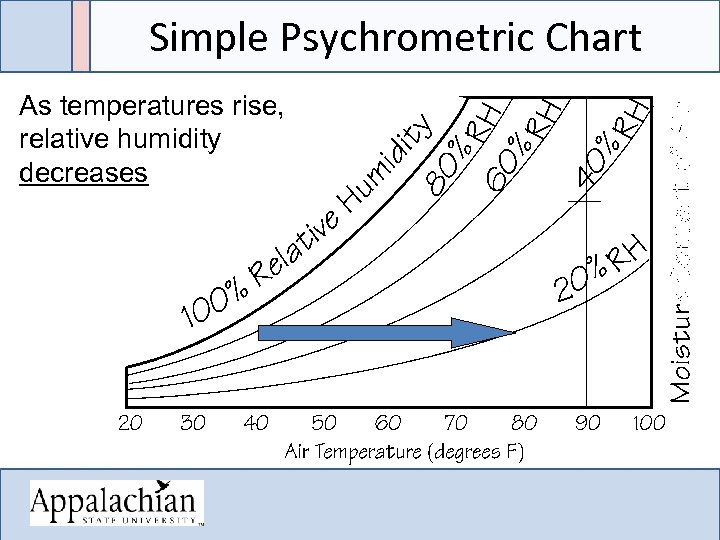 Simple Psychrometric Chart As temperatures rise, relative humidity decreases
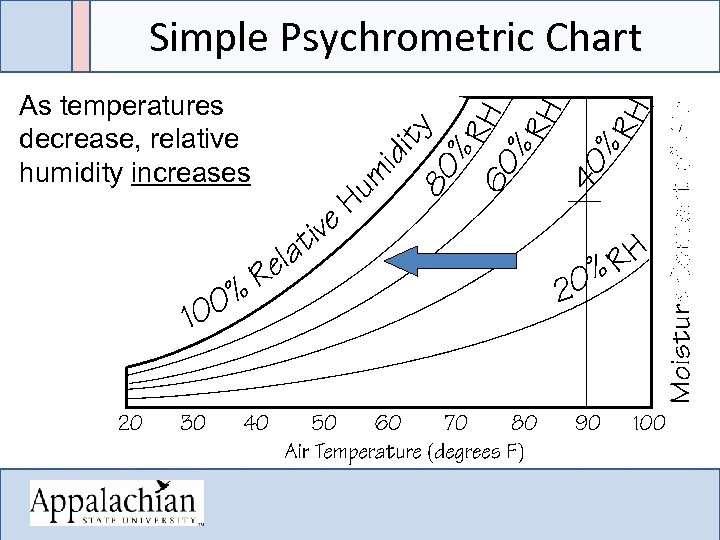 Simple Psychrometric Chart As temperatures decrease, relative humidity increases
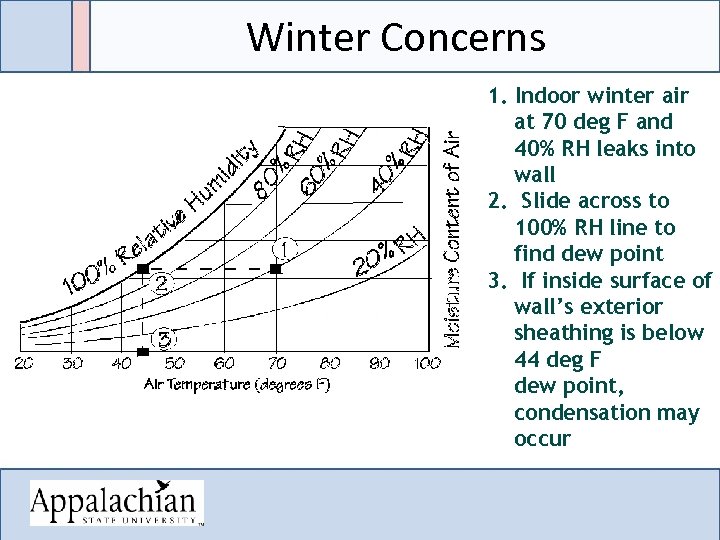 Winter Concerns 1. Indoor winter air at 70 deg F and 40% RH leaks into wall 2. Slide across to 100% RH line to find dew point 3. If inside surface of wall’s exterior sheathing is below 44 deg F dew point, condensation may occur
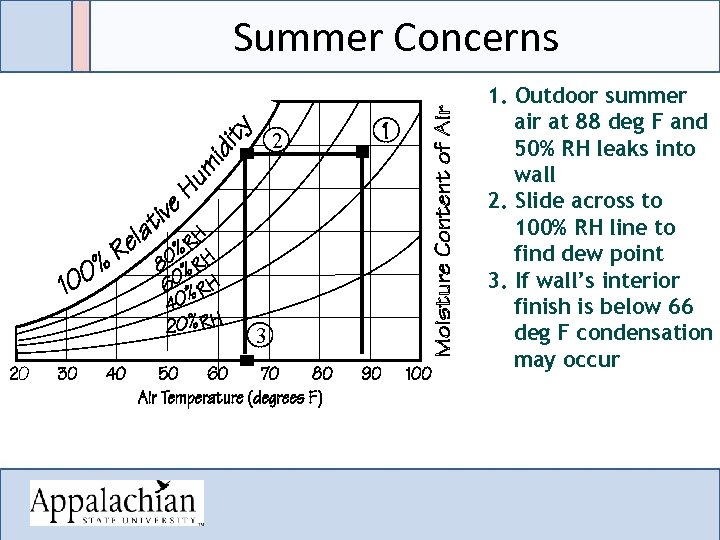 Summer Concerns 2 3 1. Outdoor summer air at 88 deg F and 50% RH leaks into wall 2. Slide across to 100% RH line to find dew point 3. If wall’s interior finish is below 66 deg F condensation may occur
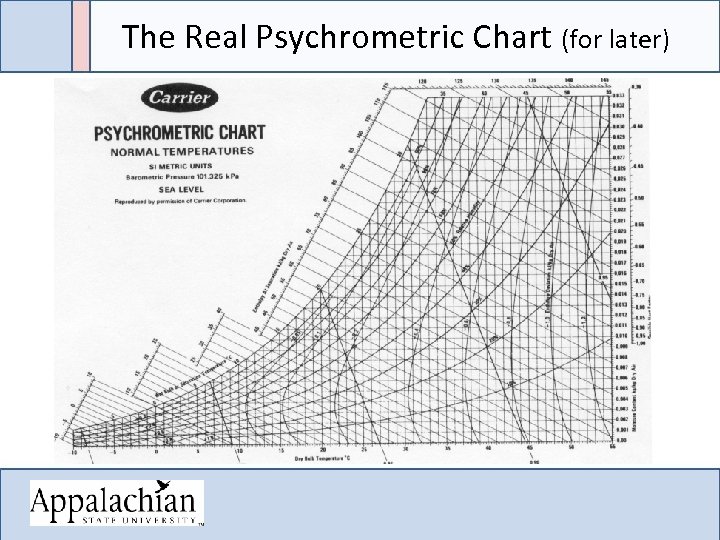 The Real Psychrometric Chart (for later)
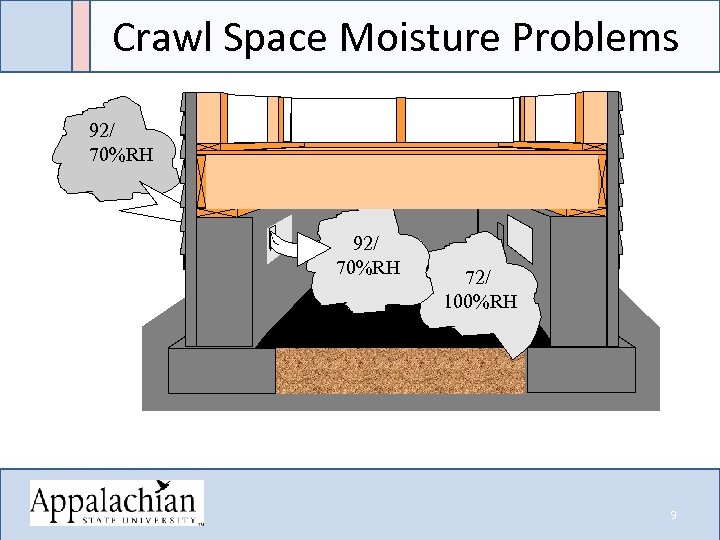 Crawl Space Moisture Problems 92/ 70%RH 72/ 100%RH 9
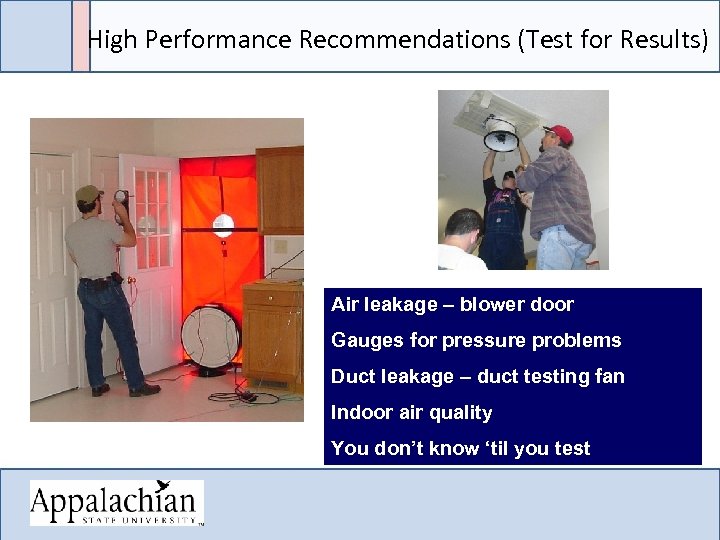 High Performance Recommendations (Test for Results) Air leakage – blower door Gauges for pressure problems Duct leakage – duct testing fan Indoor air quality You don’t know ‘til you test
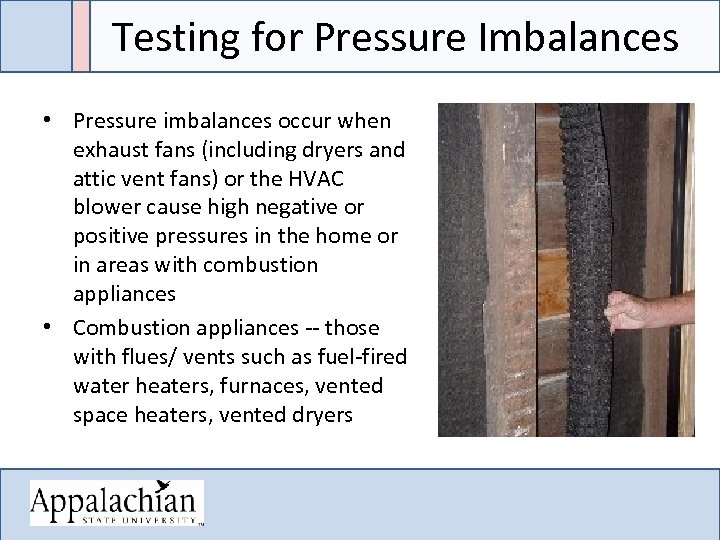 Testing for Pressure Imbalances • Pressure imbalances occur when exhaust fans (including dryers and attic vent fans) or the HVAC blower cause high negative or positive pressures in the home or in areas with combustion appliances • Combustion appliances -- those with flues/ vents such as fuel-fired water heaters, furnaces, vented space heaters, vented dryers
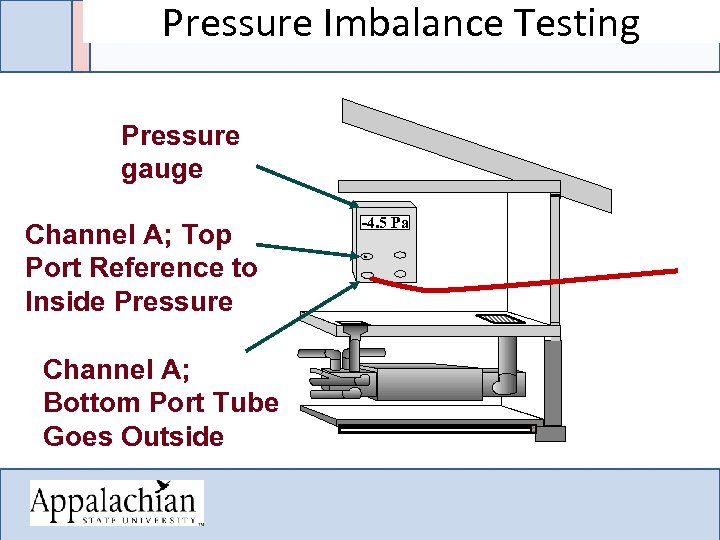 Pressure Imbalance Testing Pressure gauge Channel A; Top Port Reference to Inside Pressure Channel A; Bottom Port Tube Goes Outside -4. 5 Pa
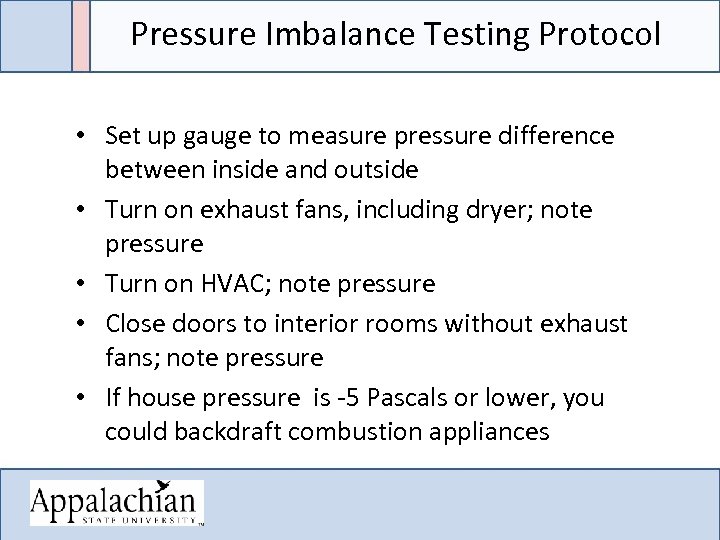 Pressure Imbalance Testing Protocol • Set up gauge to measure pressure difference between inside and outside • Turn on exhaust fans, including dryer; note pressure • Turn on HVAC; note pressure • Close doors to interior rooms without exhaust fans; note pressure • If house pressure is -5 Pascals or lower, you could backdraft combustion appliances
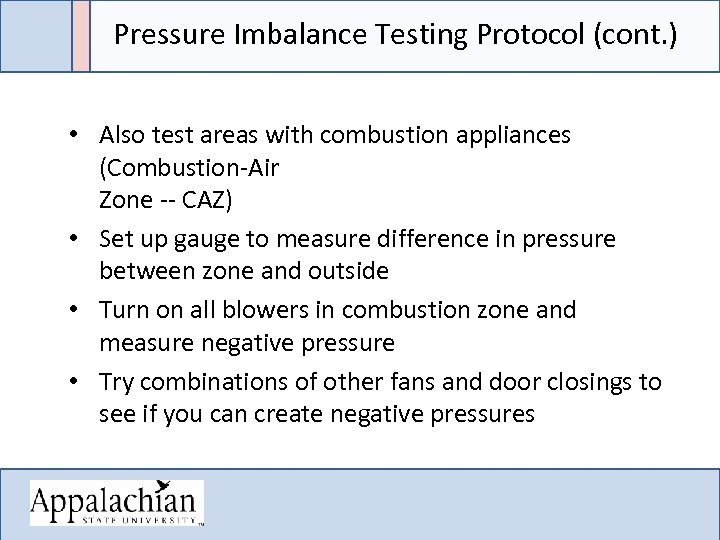 Pressure Imbalance Testing Protocol (cont. ) • Also test areas with combustion appliances (Combustion-Air Zone -- CAZ) • Set up gauge to measure difference in pressure between zone and outside • Turn on all blowers in combustion zone and measure negative pressure • Try combinations of other fans and door closings to see if you can create negative pressures
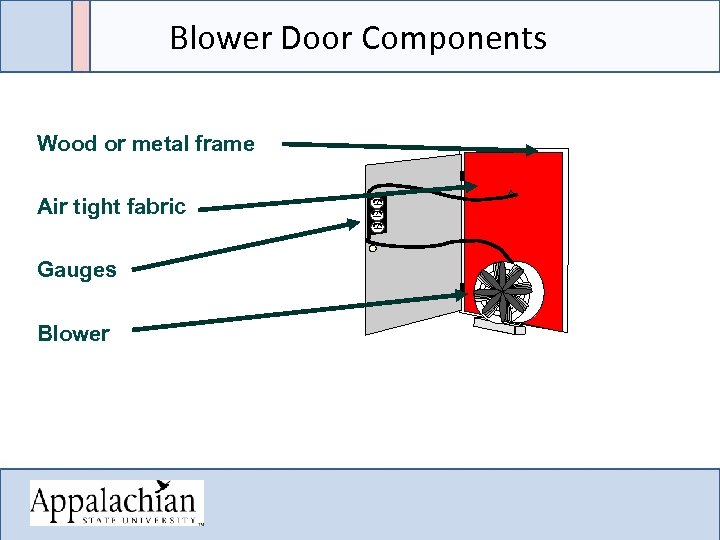 Blower Door Components Wood or metal frame Air tight fabric Gauges Blower
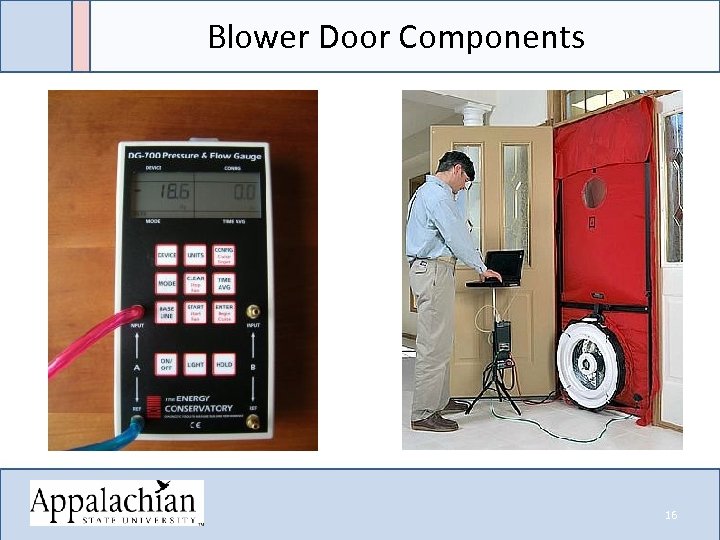 Blower Door Components 16
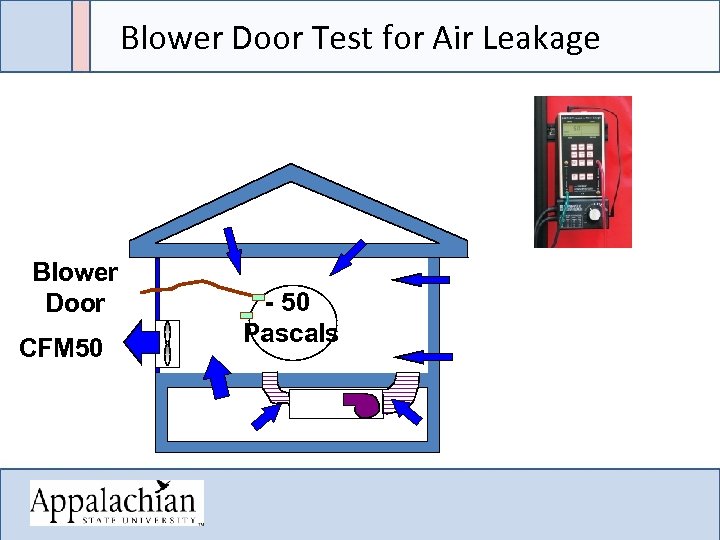 Blower Door Test for Air Leakage Blower Door CFM 50 - 50 Pascals
 Purposes of Finding ACH 50 (air changes per hour at 50 Pascals) • To compare homes • To check for compliance with ASHRAE indoor air quality guidelines • To find ACH 50, use CFM 50 from blower door test • Find volume of building • Find ACH 50 = CFM 50 x 60/ House Volume • Many feel a better measure is CFM 50/ square foot of exterior envelope
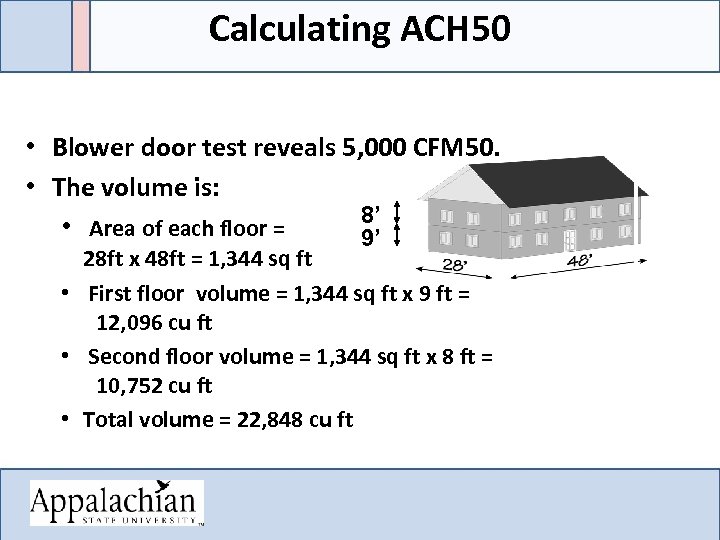 Calculating ACH 50 • Blower door test reveals 5, 000 CFM 50. • The volume is: 8’ • Area of each floor = 9’ 28 ft x 48 ft = 1, 344 sq ft • First floor volume = 1, 344 sq ft x 9 ft = 12, 096 cu ft • Second floor volume = 1, 344 sq ft x 8 ft = 10, 752 cu ft • Total volume = 22, 848 cu ft
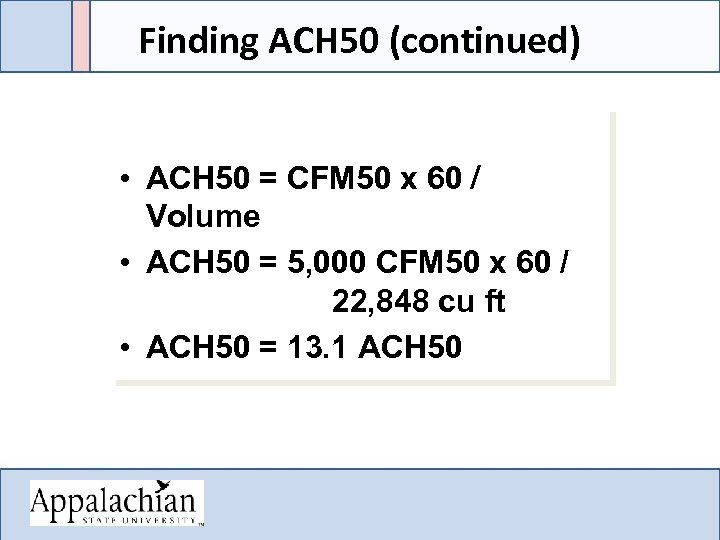 Finding ACH 50 (continued) • ACH 50 = CFM 50 x 60 / Volume • ACH 50 = 5, 000 CFM 50 x 60 / 22, 848 cu ft • ACH 50 = 13. 1 ACH 50
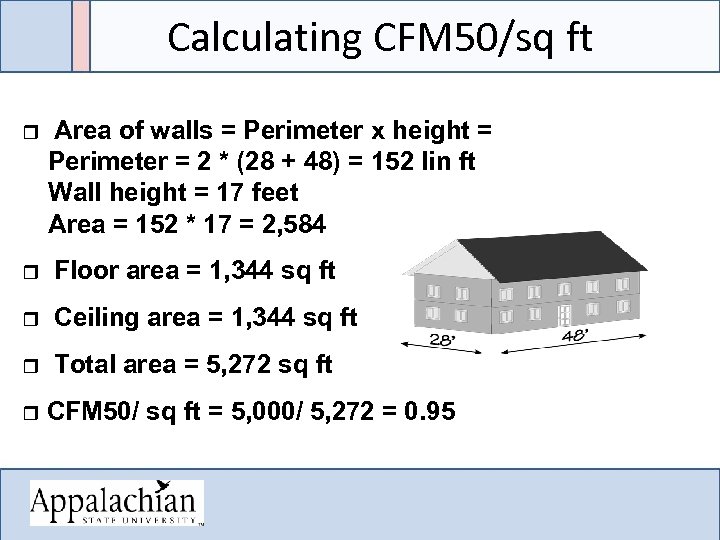 Calculating CFM 50/sq ft r Area of walls = Perimeter x height = Perimeter = 2 * (28 + 48) = 152 lin ft Wall height = 17 feet Area = 152 * 17 = 2, 584 r Floor area = 1, 344 sq ft r Ceiling area = 1, 344 sq ft r Total area = 5, 272 sq ft r CFM 50/ sq ft = 5, 000/ 5, 272 = 0. 95
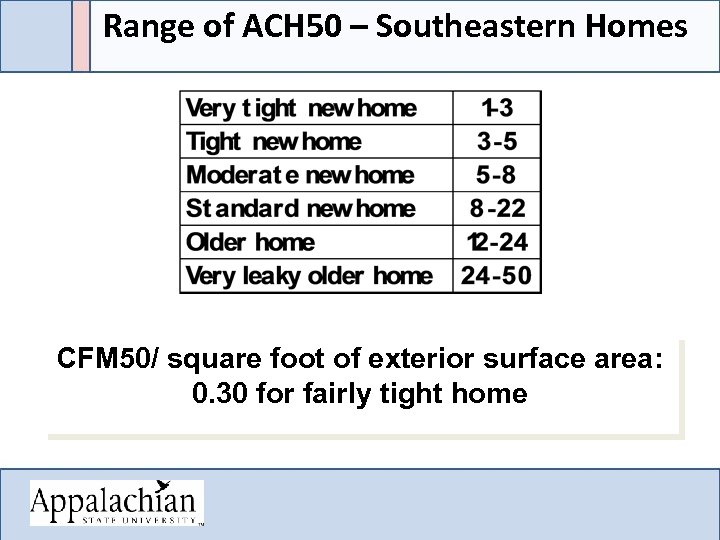 Range of ACH 50 – Southeastern Homes CFM 50/ square foot of exterior surface area: 0. 30 for fairly tight home
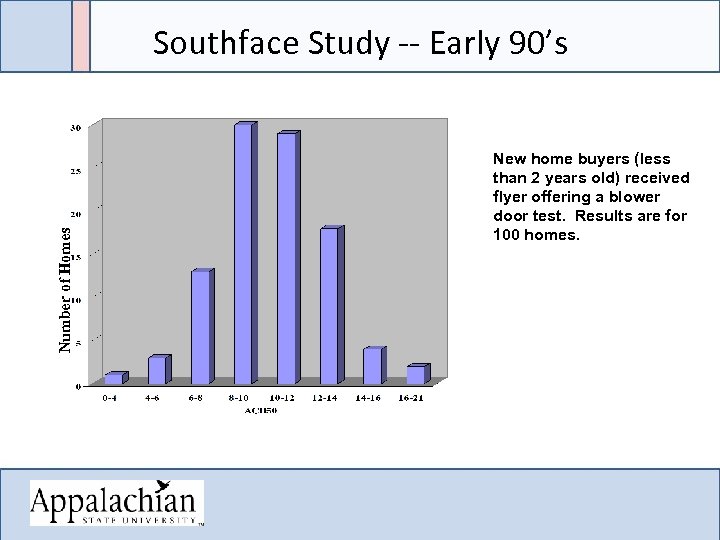 Number of Homes Southface Study -- Early 90’s New home buyers (less than 2 years old) received flyer offering a blower door test. Results are for 100 homes.
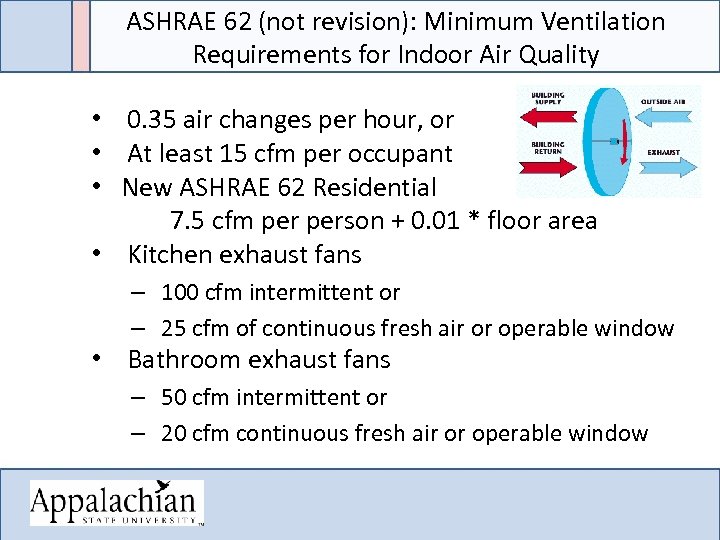 ASHRAE 62 (not revision): Minimum Ventilation Requirements for Indoor Air Quality • 0. 35 air changes per hour, or • At least 15 cfm per occupant • New ASHRAE 62 Residential 7. 5 cfm person + 0. 01 * floor area • Kitchen exhaust fans – 100 cfm intermittent or – 25 cfm of continuous fresh air or operable window • Bathroom exhaust fans – 50 cfm intermittent or – 20 cfm continuous fresh air or operable window
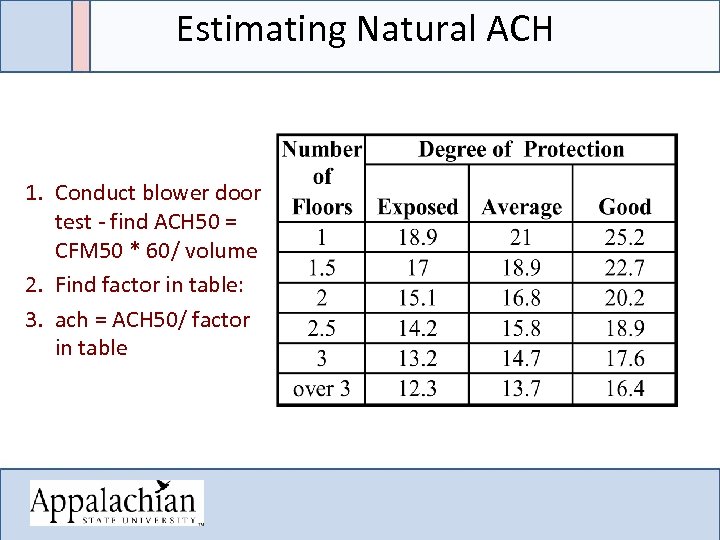 Estimating Natural ACH 1. Conduct blower door test - find ACH 50 = CFM 50 * 60/ volume 2. Find factor in table: 3. ach = ACH 50/ factor in table
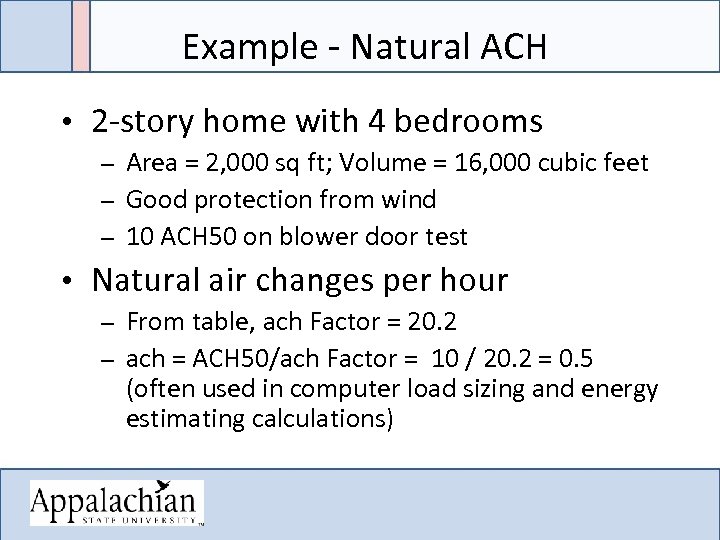 Example - Natural ACH • 2 -story home with 4 bedrooms – Area = 2, 000 sq ft; Volume = 16, 000 cubic feet – Good protection from wind – 10 ACH 50 on blower door test • Natural air changes per hour – From table, ach Factor = 20. 2 – ach = ACH 50/ach Factor = 10 / 20. 2 = 0. 5 (often used in computer load sizing and energy estimating calculations)
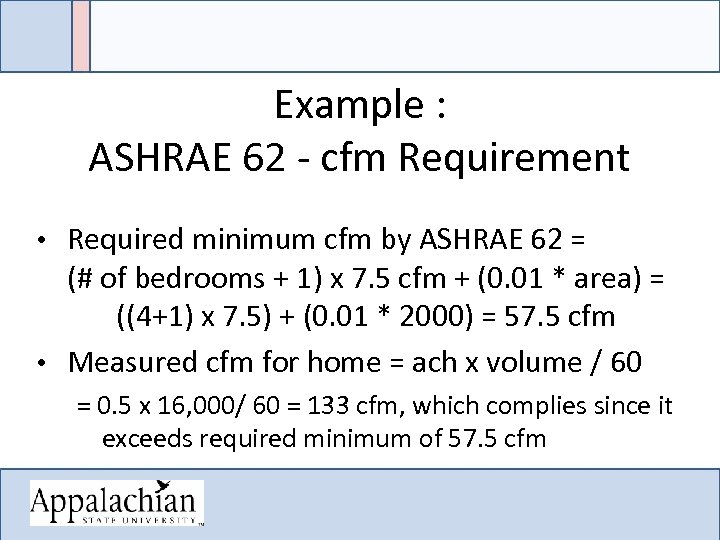 Example : ASHRAE 62 - cfm Requirement • Required minimum cfm by ASHRAE 62 = (# of bedrooms + 1) x 7. 5 cfm + (0. 01 * area) = ((4+1) x 7. 5) + (0. 01 * 2000) = 57. 5 cfm • Measured cfm for home = ach x volume / 60 = 0. 5 x 16, 000/ 60 = 133 cfm, which complies since it exceeds required minimum of 57. 5 cfm
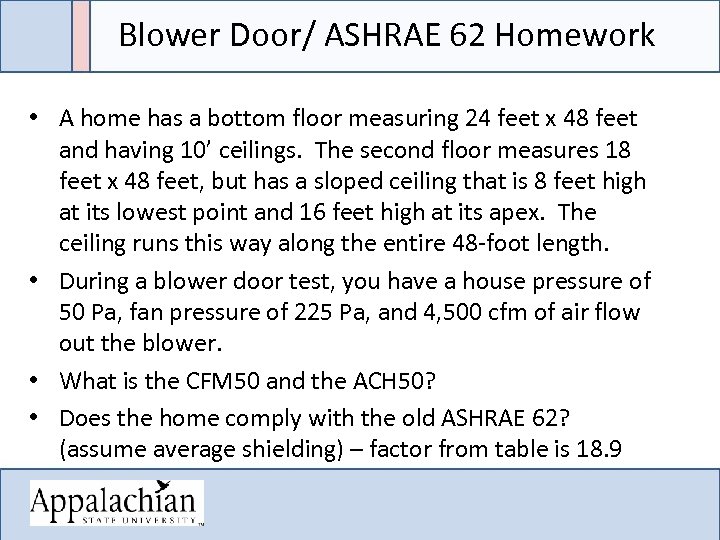 Blower Door/ ASHRAE 62 Homework • A home has a bottom floor measuring 24 feet x 48 feet and having 10’ ceilings. The second floor measures 18 feet x 48 feet, but has a sloped ceiling that is 8 feet high at its lowest point and 16 feet high at its apex. The ceiling runs this way along the entire 48 -foot length. • During a blower door test, you have a house pressure of 50 Pa, fan pressure of 225 Pa, and 4, 500 cfm of air flow out the blower. • What is the CFM 50 and the ACH 50? • Does the home comply with the old ASHRAE 62? (assume average shielding) – factor from table is 18. 9
 Air Leakage Summary • Sealing air leaks is important: • Saves energy • Can reduce moisture problems • Increases comfort • Blower door measures leakage rates: ACH 50 or CFM 50/sq ft • Most important leaks are to attic and crawl space -- usually larger and air is undesirable • Select durable sealants