


 Скачать презентацию The Horizon 2020 SME instrument A new understanding
705fa903dc9868da4ac4ec2a4aba4d4d.ppt
- Количество слайдов: 29
 The Horizon 2020 SME instrument A new understanding of SME innovation needs a new way to draft convincing proposals Bucharest, October 2015
 Introduction • Positioning • Facts & Figures • First analysis • Tips to assess companies with a real potential for the SME instrument • Recommendations
 SME Instrument – Positioning What are we looking for?
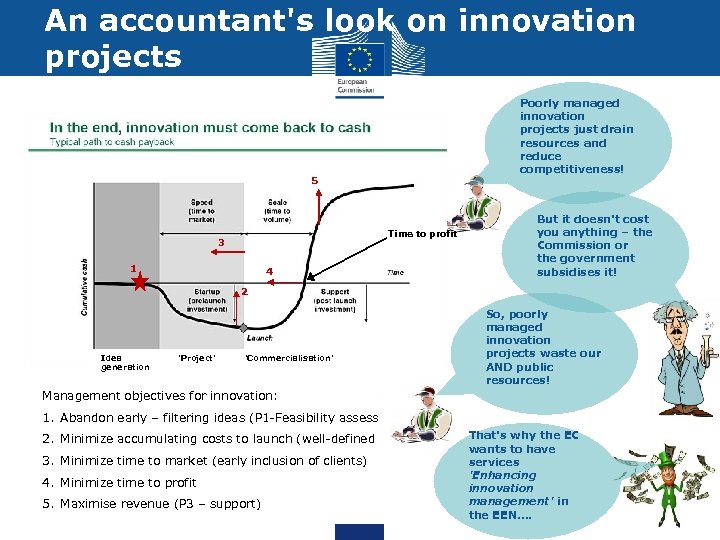 An accountant's look on innovation projects Poorly managed innovation projects just drain resources and reduce competitiveness! 5 Time to profit 3 1 4 But it doesn't cost you anything – the Commission or the government subsidises it! 2 Idea generation 'Project' 'Commercialisation' So, poorly managed innovation projects waste our AND public resources! Management objectives for innovation: 1. Abandon early – filtering ideas (P 1 -Feasibility assessment) 2. Minimize accumulating costs to launch (well-defined P 2 project) 3. Minimize time to market (early inclusion of clients) 4. Minimize time to profit 5. Maximise revenue (P 3 – support) That's why the EC wants to have services 'Enhancing innovation management' in the EEN….
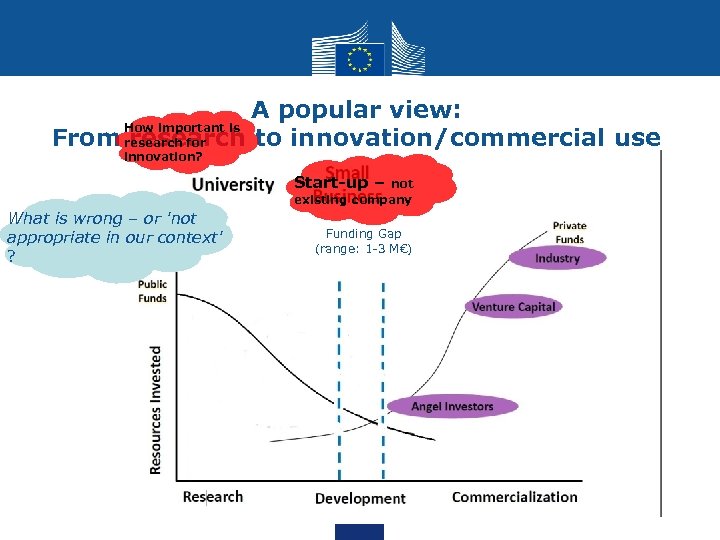 A popular view: How important is From research for research to innovation/commercial use innovation? Start-up – not existing company What is wrong – or 'not appropriate in our context' ? Funding Gap (range: 1 -3 M€)
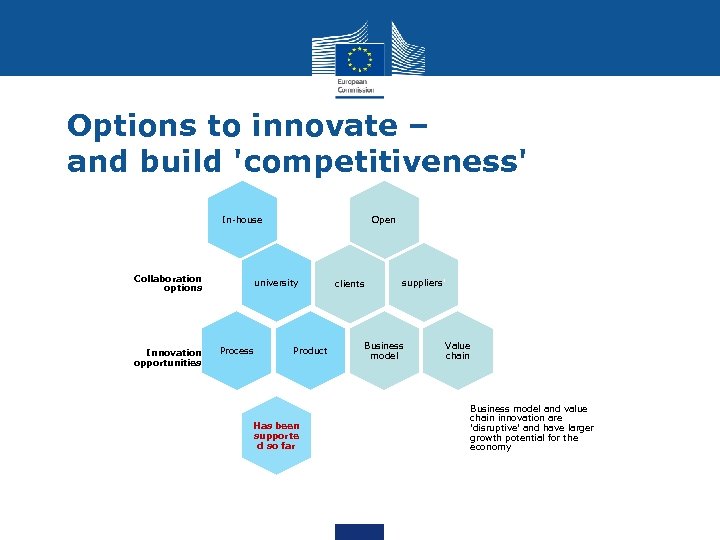 Options to innovate – and build 'competitiveness' Open In-house Collaboration options Innovation opportunities university Process Product Has been supporte d so far clients suppliers' Business model Value chain Business model and value chain innovation are 'disruptive' and have larger growth potential for the economy
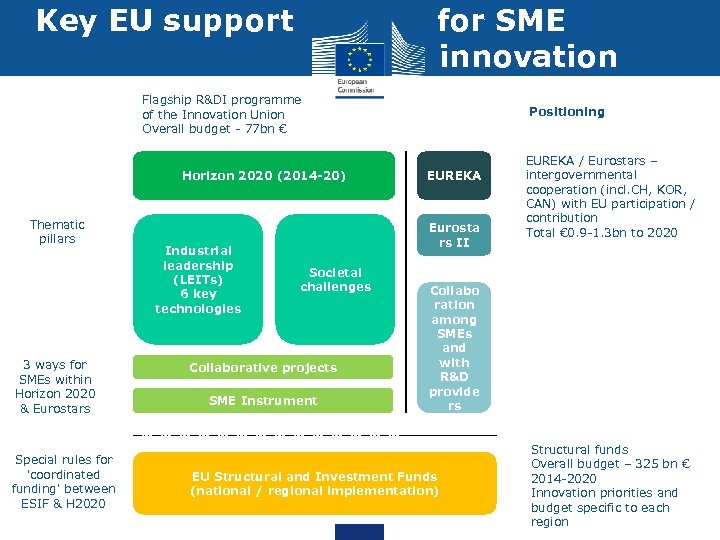 Key EU support for SME innovation Flagship R&DI programme of the Innovation Union Overall budget - 77 bn € Horizon 2020 (2014 -20) Thematic pillars 3 ways for SMEs within Horizon 2020 & Eurostars Special rules for 'coordinated funding' between ESIF & H 2020 Industrial leadership (LEITs) 6 key technologies Positioning EUREKA Eurosta rs II Societal challenges Collaborative projects SME Instrument EUREKA / Eurostars – intergovernmental cooperation (incl. CH, KOR, CAN) with EU participation / contribution Total € 0. 9 -1. 3 bn to 2020 Collabo ration among SMEs and with R&D provide rs EU Structural and Investment Funds (national / regional implementation) Structural funds Overall budget – 325 bn € 2014 -2020 Innovation priorities and budget specific to each region
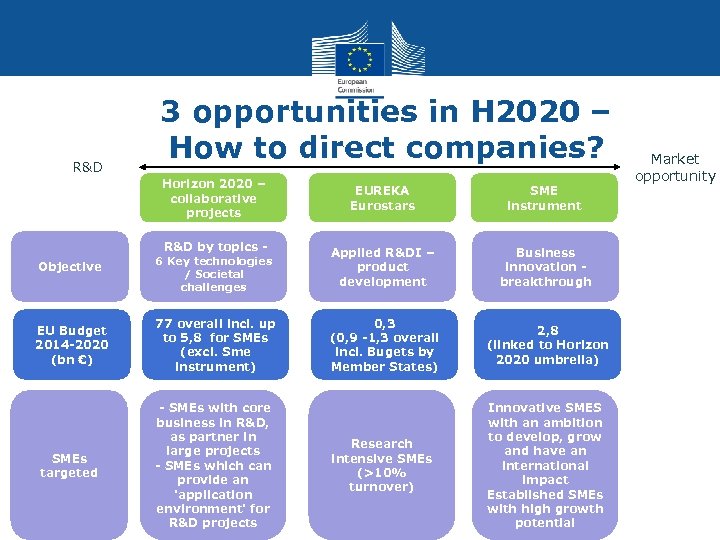 R&D 3 opportunities in H 2020 – How to direct companies? Horizon 2020 – collaborative projects EUREKA Eurostars SME instrument R&D by topics - 6 Key technologies / Societal challenges Applied R&DI – product development Business innovation breakthrough EU Budget 2014 -2020 (bn €) 77 overall incl. up to 5, 8 for SMEs (excl. Sme instrument) 0, 3 (0, 9 -1, 3 overall incl. Bugets by Member States) 2, 8 (linked to Horizon 2020 umbrella) SMEs targeted - SMEs with core business in R&D, as partner in large projects - SMEs which can provide an 'application environment' for R&D projects Research intensive SMEs (>10% turnover) Innovative SMES with an ambition to develop, grow and have an international impact Established SMEs with high growth potential Objective Market opportunity
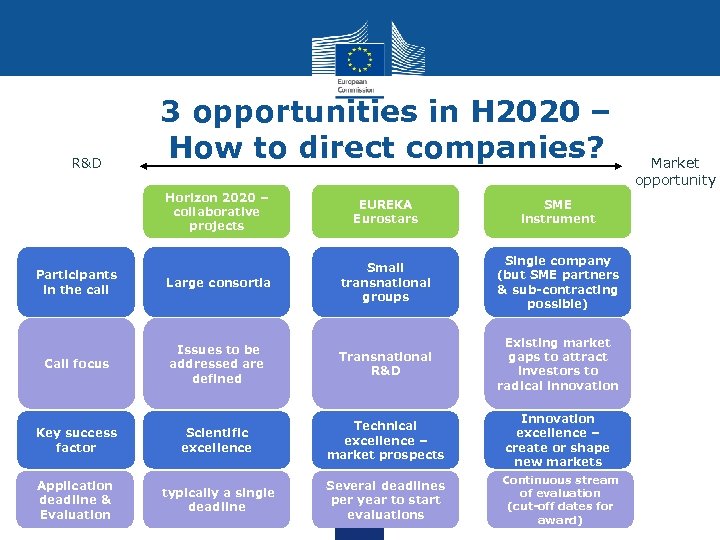 R&D 3 opportunities in H 2020 – How to direct companies? Horizon 2020 – collaborative projects EUREKA Eurostars SME instrument Participants in the call Large consortia Small transnational groups Single company (but SME partners & sub-contracting possible) Call focus Issues to be addressed are defined Transnational R&D Existing market gaps to attract investors to radical innovation Key success factor Scientific excellence Technical excellence – market prospects Innovation excellence – create or shape new markets Application deadline & Evaluation typically a single deadline Several deadlines per year to start evaluations Continuous stream of evaluation (cut-off dates for award) Market opportunity
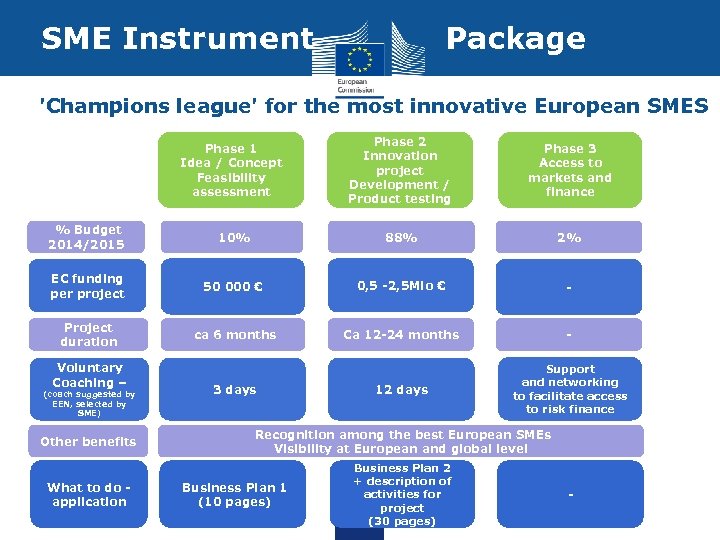 SME Instrument Package 'Champions league' for the most innovative European SMES Phase 1 Idea / Concept Feasibility assessment Phase 2 Innovation project Development / Product testing Phase 3 Access to markets and finance % Budget 2014/2015 10% 88% 2% EC funding per project 50 000 € 0, 5 -2, 5 Mio € - Project duration ca 6 months Ca 12 -24 months - 12 days Support and networking to facilitate access to risk finance Voluntary Coaching – (coach suggested by EEN, selected by SME) 3 days Other benefits Recognition among the best European SMEs Visibility at European and global level What to do application Business Plan 2 + description of activities for project (30 pages) Business Plan 1 (10 pages) -
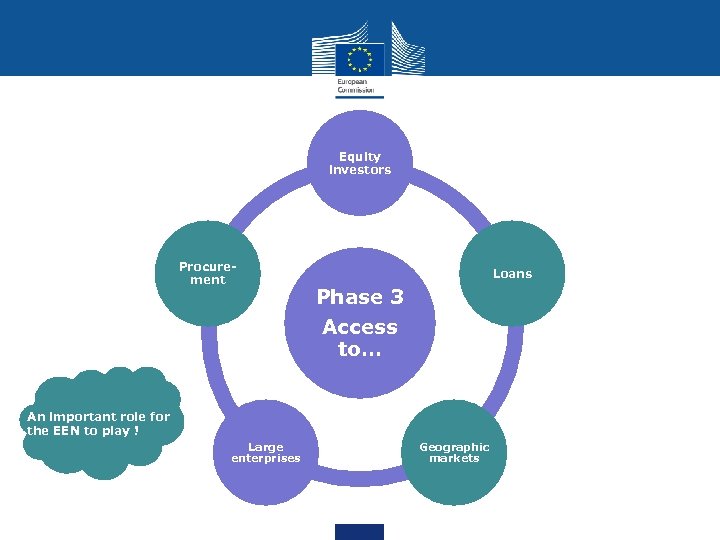 Equity investors Procurement Loans Phase 3 Access to… An important role for the EEN to play ! Large enterprises Geographic markets
 SME instrument looks for Enterprises Ideas Companies with high growth ambition and potential Companies already on the market Ø More convincing if they have a record of successful innovation Ideas that relate to a published topic Ideas that 'shape new markets' Business ideas that develop into an ambitious business plan AND Start-ups ! Ø Specific issue to finance phase 2 without steady revenues NOT: 'ideas for technology projects to enhance an existing product to be sold to the same customers'
 Facts & Figures
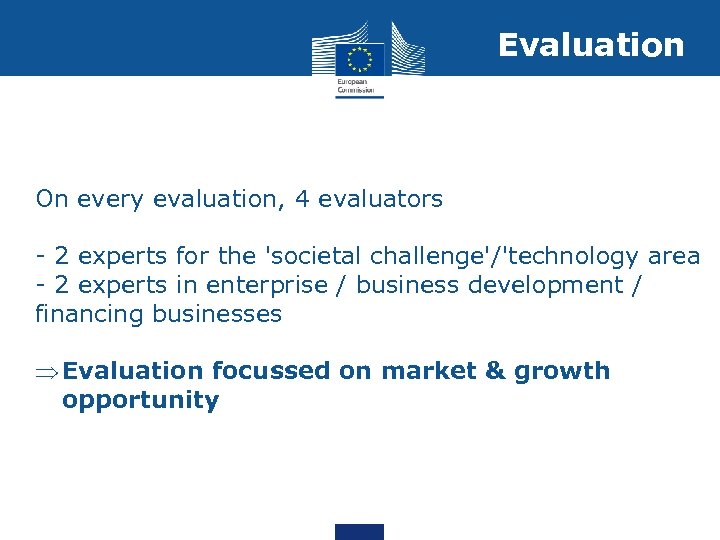 Evaluation On every evaluation, 4 evaluators - 2 experts for the 'societal challenge'/'technology area - 2 experts in enterprise / business development / financing businesses Þ Evaluation focussed on market & growth opportunity
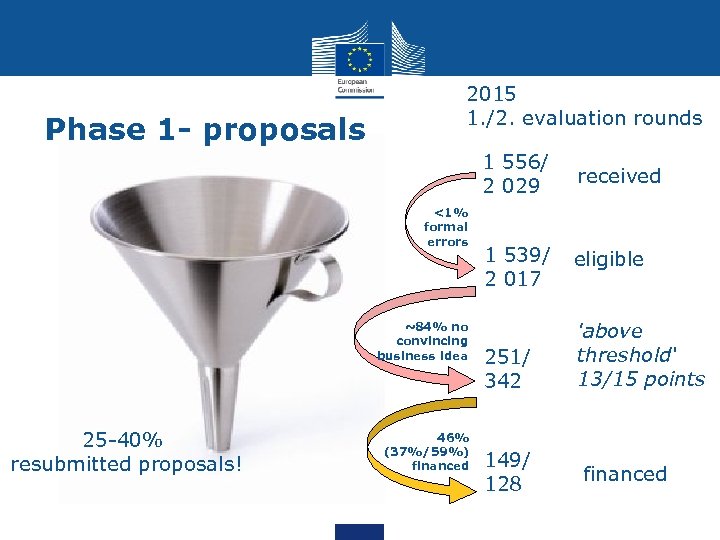 Phase 1 - proposals 2015 1. /2. evaluation rounds 1 556/ 2 029 <1% formal errors ~84% no convincing business idea 25 -40% resubmitted proposals! 46% (37%/59%) financed received 1 539/ 2 017 eligible 251/ 342 149/ 128 'above threshold' 13/15 points financed
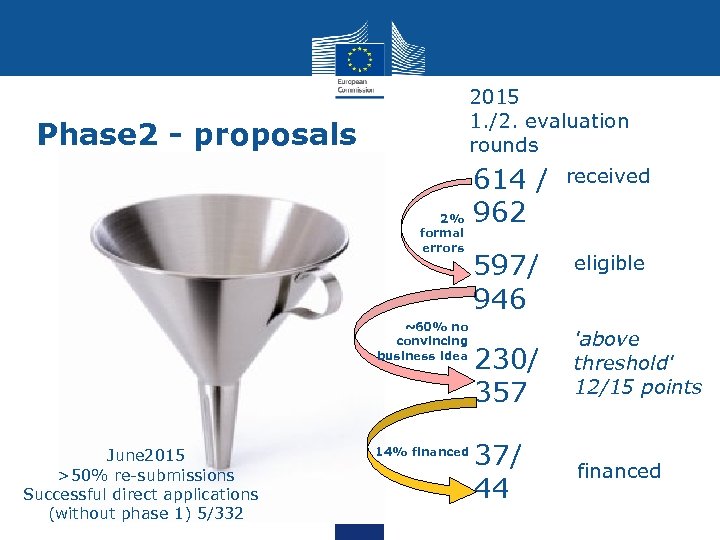 2015 1. /2. evaluation rounds Phase 2 - proposals 2% formal errors ~60% no convincing business idea June 2015 >50% re-submissions Successful direct applications (without phase 1) 5/332 14% financed 614 / 962 received 597/ 946 eligible 230/ 357 37/ 44 'above threshold' 12/15 points financed
 Accessing phase 2 directly? Ø Is possible Ø But success rate is extremely low (in June 2015 below 2%) Ø Seal of excellence
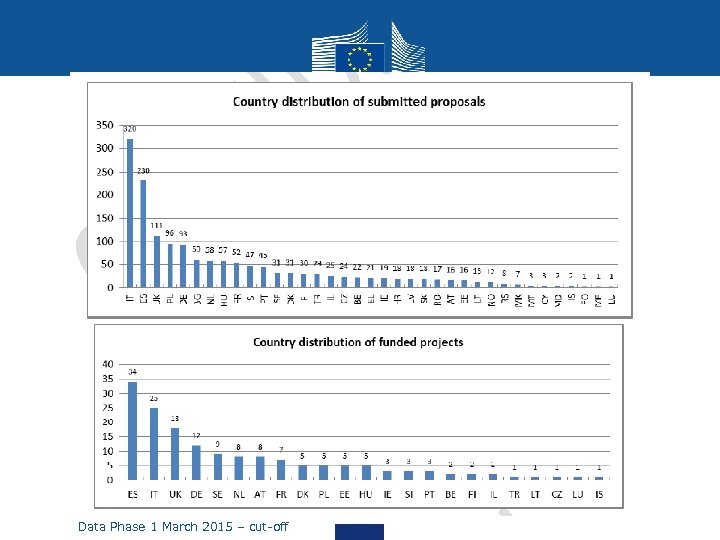 only countries with submissions are shown Data Phase 1 March 2015 – cut-off
 Romanian participation 2015 Proposals / above quality mark / 'partners' above quality mark' Phase 1 1 2 2 March 2015: 18 / 0 June 2015: 23 / 1 March 2015: 7 / 0 / 2 June 2015: 5 / 0 Mobilisation ok – but the wrong companies
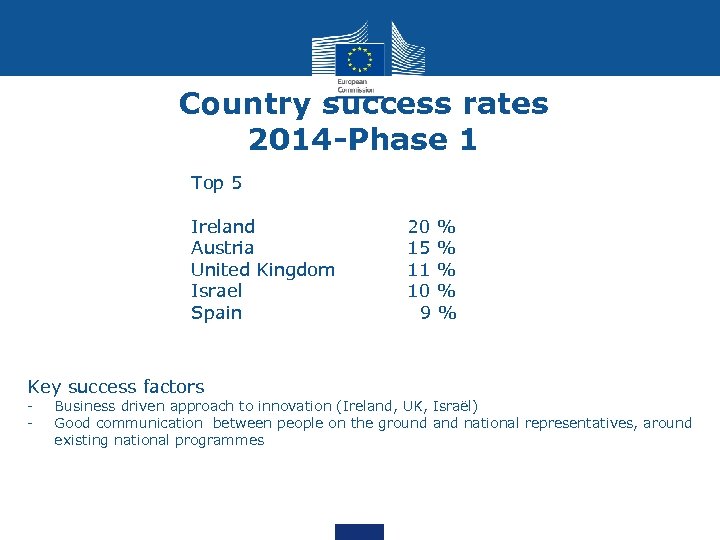 Country success rates 2014 -Phase 1 Top 5 Ireland Austria United Kingdom Israel Spain Key success factors - 20 % 15 % 11 % 10 % 9% Business driven approach to innovation (Ireland, UK, Israël) Good communication between people on the ground and national representatives, around existing national programmes
 Tips to assess companies with a real potential for the SME Instrument
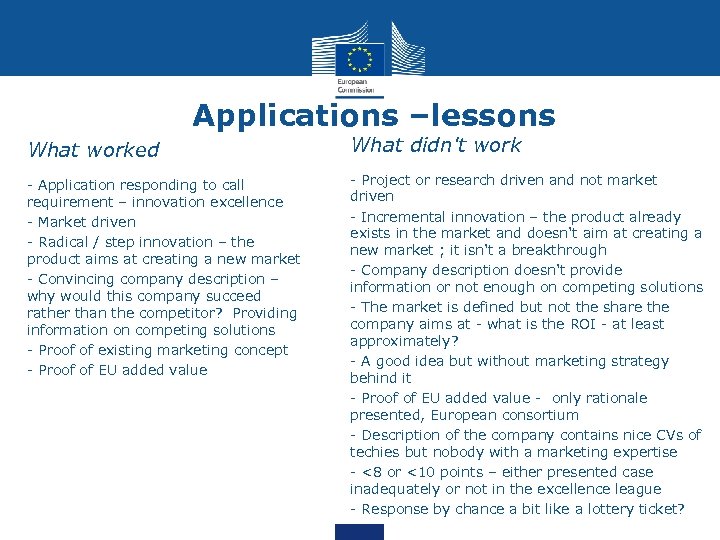 Applications –lessons What worked What didn't work - Application responding to call requirement – innovation excellence - Market driven - Radical / step innovation – the product aims at creating a new market - Convincing company description – why would this company succeed rather than the competitor? Providing information on competing solutions - Proof of existing marketing concept - Proof of EU added value - Project or research driven and not market driven - Incremental innovation – the product already exists in the market and doesn't aim at creating a new market ; it isn't a breakthrough - Company description doesn't provide information or not enough on competing solutions - The market is defined but not the share the company aims at - what is the ROI - at least approximately? - A good idea but without marketing strategy behind it - Proof of EU added value - only rationale presented, European consortium - Description of the company contains nice CVs of techies but nobody with a marketing expertise - <8 or <10 points – either presented case inadequately or not in the excellence league - Response by chance a bit like a lottery ticket?
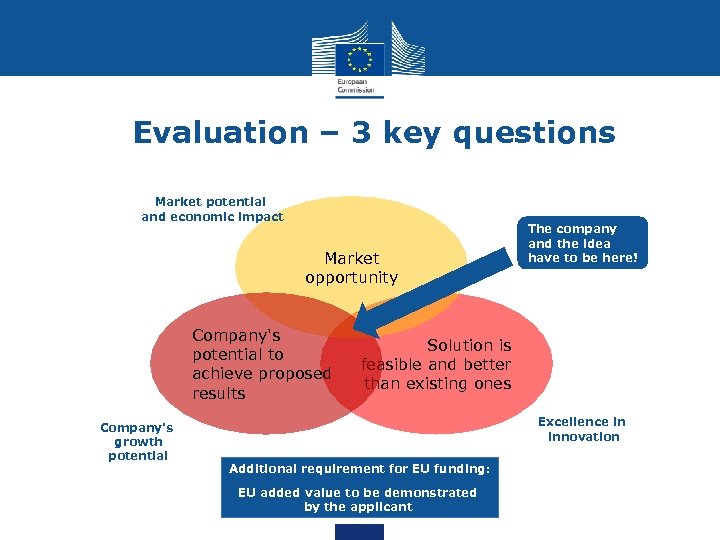 Evaluation – 3 key questions Market potential and economic impact Market opportunity Company's potential to achieve proposed results Company's growth potential The company and the idea have to be here! Solution is feasible and better than existing ones Excellence in innovation Additional requirement for EU funding: EU added value to be demonstrated by the applicant
 Phase 1 - 10 pages to convince the jury • As the competition is high, a good presentation is essential and can make potentially the difference between good and excellent application • The successful described in 10 pages not only what their business opportunity was all about, their solution versus their competitors' solutions, their ability to achieve it • The questions to be addressed by the feasibility assessment should be clearly outlined • It has to be logical, coherent and easy to read by people who are not technical experts in the sector Assessment question- How clear is it? Does the content come out clearly as an evidence?
 Market opportunity • The market opportunity should be described from a marketing viewpoint and not only from a technological/technical point of view Assessment Question - Can these questions be responded– "How big is the market? Where is it geographically? In which value chains ? Is the company already present in these markets? How good is the estimate of market size? " • Often competitors and solutions already existing in the market are not mentioned Assessment Question - "Why would customers prefer this solution above the existing ones and even pay for? "
 Excellence in Innovation • Innovation in this programme is about breakthrough (radical) innovation, to shape new markets in priority areas of Horizon 2020 Assessment Question – How radical is this innovation? Is it changing radically an existing market? Or creating a brand new market? If the company aims at incremental innovation (a gradually better product with limited growth potential) => Direct this company to alternative funding programmes that may encourage cooperation with a 'R&D provider' to enhance the technical features. • Essential for Phase 2 – Demonstrate 'Freedom to operate' regarding Intellectual Property Rights (IPR) : I. e SME has the rights needed and is not blocked by thrisparty's rights Assessment Question – Is another IPR blocking the proposed development? By the end of Phase 2, will they have developed or acquired all IP to put the product/ service on the market?
 Company's growth potential • Growth potential and ambition have to be described in a clear and understandable way Assessment Question – Can the enterprise demonstrate: its ability to carryout the project? its management and financial ability to address the proposed market opportunity and create jobs and growth? • In case of a start-up – Assessment question – How ambitious are they? Are they able to co-finance the Phase 2 project (for example with the help of early stage investors)? • If they are already on the market – Assessment question – How ambitious are they? What track record have they got to drive successfully innovation projects? How aware they of their own weaknesses and how ready are they to address them through coaching & consulting services provided in phase 2? NB: The funded companies were in general larger and older than the overall population of applying companies
 Phase 2 The outcome of phase 1: a better substantiated business plan no obligation for a phase 1 – but useful An assessment of strategic weaknesses & a coaching plan
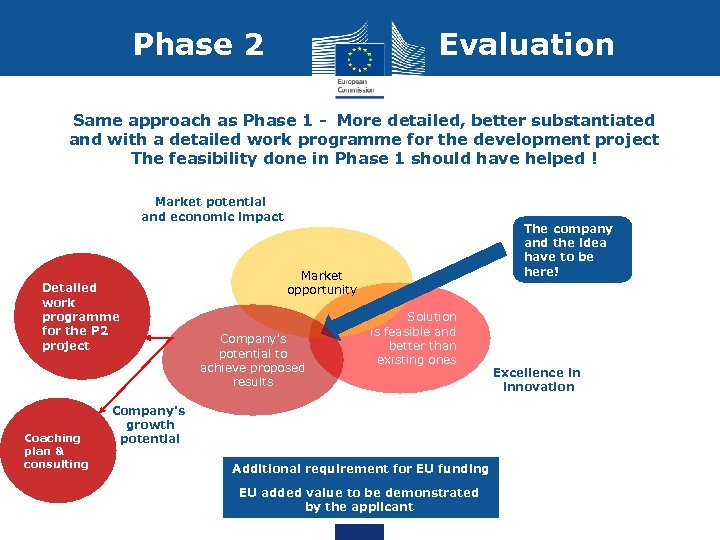 Phase 2 Evaluation Same approach as Phase 1 - More detailed, better substantiated and with a detailed work programme for the development project The feasibility done in Phase 1 should have helped ! Market potential and economic impact Detailed work programme for the P 2 project Coaching plan & consulting The company and the idea have to be here! Market opportunity Company's potential to achieve proposed results Solution is feasible and better than existing ones Company's growth potential Additional requirement for EU funding EU added value to be demonstrated by the applicant Excellence in innovation