


 Скачать презентацию THE HONG KONG POLYTECHNIC UNIVERSITY Department of Electronic
0971251872fd85af835680e5d1d291f8.ppt
- Количество слайдов: 28
 THE HONG KONG POLYTECHNIC UNIVERSITY Department of Electronic and Information Engineering EIE 424 Distributed Systems and Network Programming Part-II Case Study: Web Services Lecturer: Room: E-Mail: Web page: 1 Dr. Daniel Pak-Kong LUN DE 637 Tel: 27666255 enpklun@polyu. edu. hk www. eie. polyu. edu. hk/~enpklun/EIE 424/ EIE 424. html
 THE HONG KONG POLYTECHNIC UNIVERSITY Department of Electronic and Information Engineering Contents l l l 2 Introduction to Web Services XML-RPC SOAP WSDL UDDI Security issues in Web Services
 EIE 424 Distributed Systems and Networking Programming –Part II 1. Introduction to Web Services References Ethan Cerami, Web Services Essentials, O’Reilly, 2002. U. Wahli, G. G. Ochoa, S. Cocasse and M. Muetschard, Web. Sphere Version 5. 1 Web Services Handbook, IBM Redbooks, 2 nd Ed, 2004 3
 EIE 424 Distributed Systems and Networking Programming –Part II 1. Introduction to Web Services Introduction to Distributed Systems l l Distributed systems have been the development trend of current computer systems A distributed system consists of a collection of autonomous computers – – l Offer many advantages comparing with a centralized multi-user system – – 4 linked by a computer network equipped with distributed software – Better price / performance ratio Fault tolerance Modular expandability
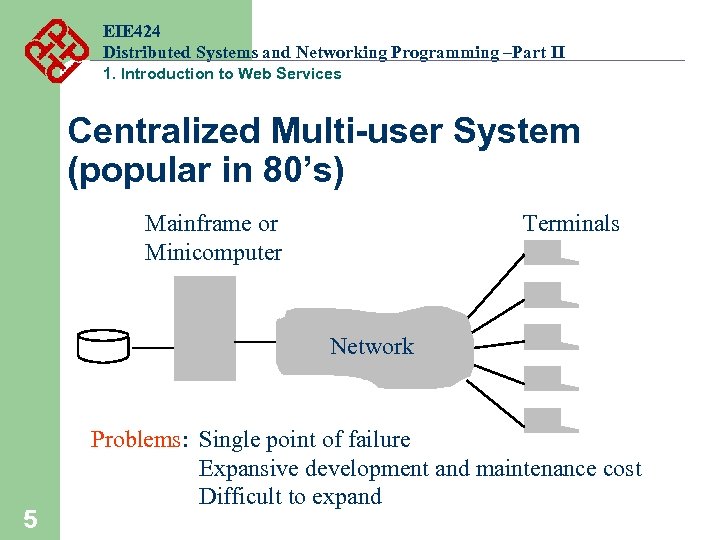 EIE 424 Distributed Systems and Networking Programming –Part II 1. Introduction to Web Services Centralized Multi-user System (popular in 80’s) Mainframe or Minicomputer Terminals Network 5 Problems: Single point of failure Expansive development and maintenance cost Difficult to expand
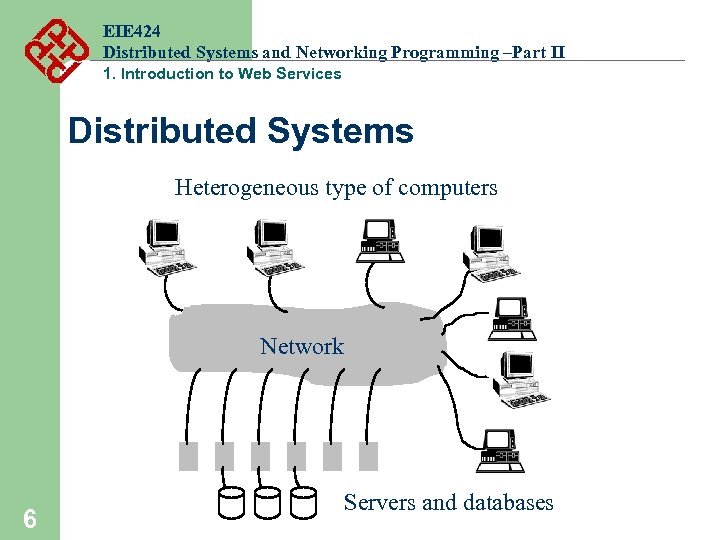 EIE 424 Distributed Systems and Networking Programming –Part II 1. Introduction to Web Services Distributed Systems Heterogeneous type of computers Network 6 Servers and databases
 EIE 424 Distributed Systems and Networking Programming –Part II 1. Introduction to Web Services Difficulties of Developing a Distributed System l l For a distributed system to function correctly, application components (e. g. objects) executing on different computers throughout a network must be able to communicate In 80’s, no formal way was provided to allow communication between application components running in different computing platforms – 7 E. g. a Unix application could never talk with a DOS application
 EIE 424 Distributed Systems and Networking Programming –Part II 1. Introduction to Web Services l l Start to be aware of the problem in early 90’s Many companies and organizations began developing technologies to enable communication between distributed components, e. g. – – l 8 OMG’s CORBA Microsoft’s DCOM Sun Microsystem’s RMI IBM’s DSOM Businesses could use these technologies to integrate applications with business partners’ computer systems
 EIE 424 Distributed Systems and Networking Programming –Part II 1. Introduction to Web Services l l l 9 Problem: Interoperability among these technologies was still limited E. g. DCOM and CORBA cannot communicate easily May need a DCOM/CORBA bridge to allow communication If DCOM’s or CORBA’s underlying protocols change, programmers must modify the bridge to reflect the change Hence not transparent to programmers
 EIE 424 Distributed Systems and Networking Programming –Part II 1. Introduction to Web Services Emergence of Web Services l l 10 Web Services improve distributed computing capabilities by addressing the issue of limited interoperability Unlike DCOM and CORBA, use open standards (nonproprietary) In 1999, HP first introduces the concept of Web Services in their product e-Speak, however the underlying technologies is still proprietary In June 2000, Microsoft coined the actual term “Web Services” as a key component of its. Net
 EIE 424 Distributed Systems and Networking Programming –Part II 1. Introduction to Web Services l l Currently many competing frameworks and proposals for Web Services Three main contenders: – – – l l 11 Microsoft’s. NET IBM Web Services SUN’s Java System (or formerly Open Net Environment (ONE)) They all share the basic Web Services definition and vision All of the frameworks share a common set of technologies, mainly SOAP, WSDL, and UDDI
 EIE 424 Distributed Systems and Networking Programming –Part II 1. Introduction to Web Services Advantages of Web Services l Use open standards – l Use modular approach – l Use the Web Can be implemented incrementally – 12 The same Web Services can be used for different applications and different companies Comparatively inexpensive to implement – l Enable components written in different languages and for different platforms to communicate Allow easier startup
 EIE 424 Distributed Systems and Networking Programming –Part II 1. Introduction to Web Services What exactly is a Web Service? l A Web Service is a service on the Internet that – – l Optional features – – 13 Use a standardized XML messaging system Not tied to any one operating system or programming language Self-describing: provide public interface to the service via a common XML grammer Discoverable: Interested parties can find a service and locate its interface
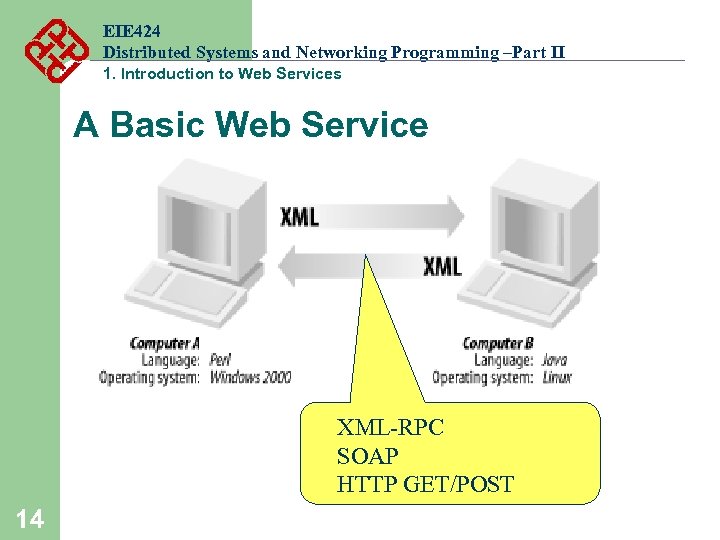 EIE 424 Distributed Systems and Networking Programming –Part II 1. Introduction to Web Services A Basic Web Service XML-RPC SOAP HTTP GET/POST 14
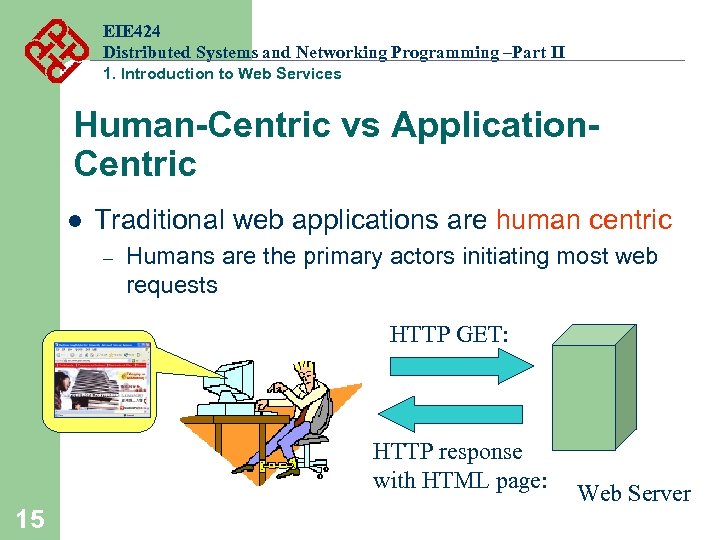 EIE 424 Distributed Systems and Networking Programming –Part II 1. Introduction to Web Services Human-Centric vs Application. Centric l Traditional web applications are human centric – Humans are the primary actors initiating most web requests HTTP GET: HTTP response with HTML page: 15 Web Server
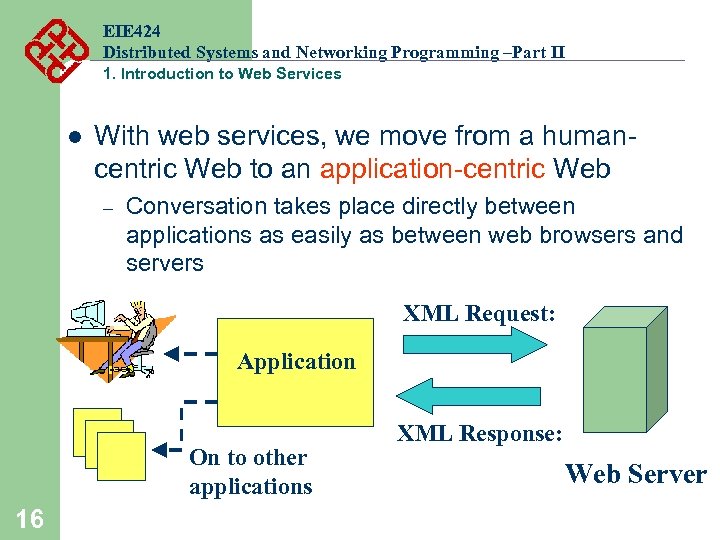 EIE 424 Distributed Systems and Networking Programming –Part II 1. Introduction to Web Services l With web services, we move from a humancentric Web to an application-centric Web – Conversation takes place directly between applications as easily as between web browsers and servers XML Request: Application On to other applications 16 XML Response: Web Server
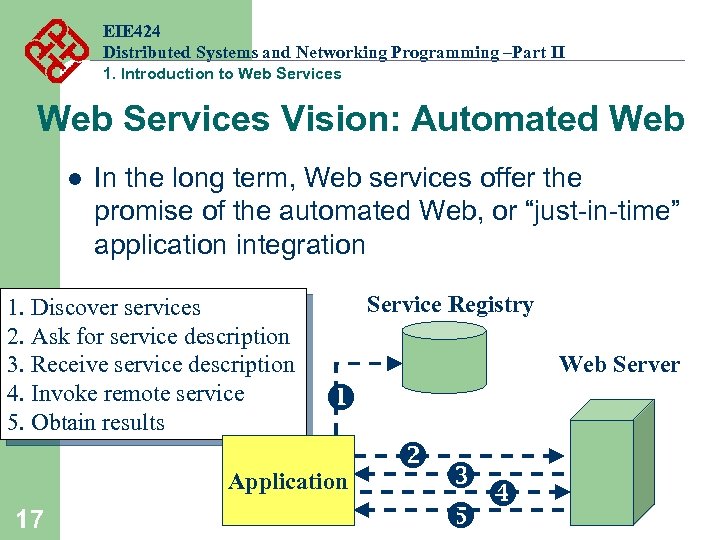 EIE 424 Distributed Systems and Networking Programming –Part II 1. Introduction to Web Services Vision: Automated Web l In the long term, Web services offer the promise of the automated Web, or “just-in-time” application integration 1. Discover services 2. Ask for service description 3. Receive service description 4. Invoke remote service 5. Obtain results Service Registry Web Server Application 17
 EIE 424 Distributed Systems and Networking Programming –Part II 1. Introduction to Web Services Automated Web: Example l l 18 Travel agencies have been making use of Web Services to automate the ticket booking services A customer can make on a Web site various bookings such as flight ticket, car rental, hotel room, etc. at one shot Based on Web Services, business data can be passed from one party to another A final plan will be devised that meets the schedule and budget of the customer
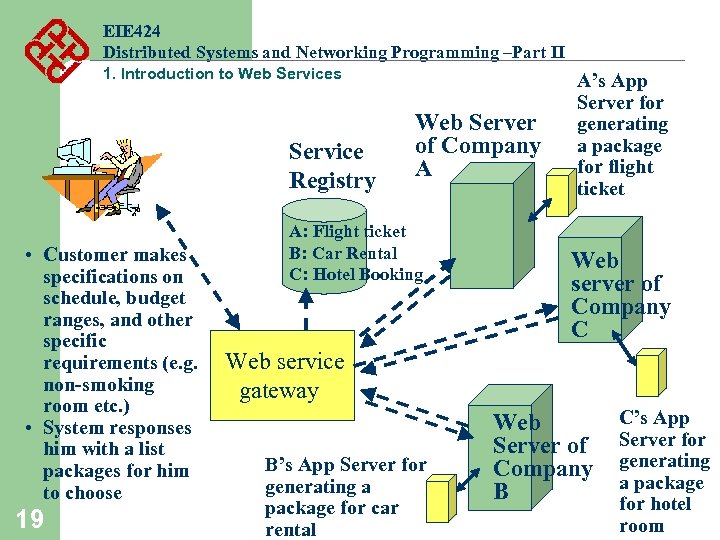 EIE 424 Distributed Systems and Networking Programming –Part II 1. Introduction to Web Services Service Registry • Customer makes specifications on schedule, budget ranges, and other specific requirements (e. g. non-smoking room etc. ) • System responses him with a list packages for him to choose 19 Web Server of Company A A: Flight ticket B: Car Rental C: Hotel Booking A’s App Server for generating a package for flight ticket Web server of Company C Web service gateway B’s App Server for generating a package for car rental Web Server of Company B C’s App Server for generating a package for hotel room
 EIE 424 Distributed Systems and Networking Programming –Part II 1. Introduction to Web Services Real Life Example – Providence Health System l l 20 l Providence Health System - a system of hospitals, clinics and assisted-living complexes in the Northwest, USA with over 600, 000 members Launch a Web Service project for some years to make medical and other records, which are spread across disparate systems, accessible to patients and physicians The system aggregates data from 27 physician offices Those offices store their data in back-end billing, clinical laboratory and ambulatory care record systems in 10 Oracle databases Providence maintains on its network Save more than $1 million per year and lead to better patient care and potentially save lives
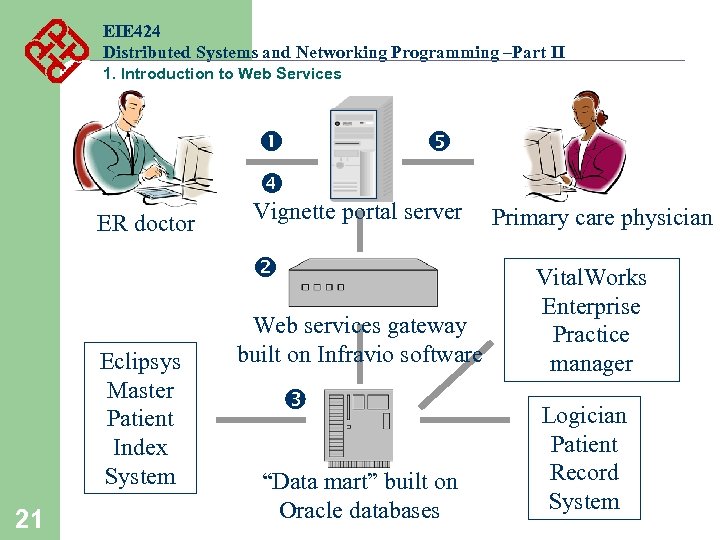 EIE 424 Distributed Systems and Networking Programming –Part II 1. Introduction to Web Services ER doctor Vignette portal server Eclipsys Master Patient Index System 21 Web services gateway built on Infravio software “Data mart” built on Oracle databases Primary care physician Vital. Works Enterprise Practice manager Logician Patient Record System
 EIE 424 Distributed Systems and Networking Programming –Part II 1. Introduction to Web Services 1. ER doctor uses portal to request info of a patient 2. Web services gateway manages connection to portal and kicks off Web service to collect info on patient from “data mart” and display them in portal 3. Behind the scenes, the “data mart” collects on 30 minute intervals the back-end physician systems that store the records 4. ER doctor is presented with a complete record from the patient’s primary care physician 5. Primary care physician can use the same portal interface and Web service to collect medical records for new or referral patients 22
 EIE 424 Distributed Systems and Networking Programming –Part II 1. Introduction to Web Services Remarks l Providence Health System is an internal system l Will have exploited the full power of Web Services when other external healthcare organizations work together to jointly provide the services l However, a more stringent security measure needs to be devised to protect patients’ data 23
 EIE 424 Distributed Systems and Networking Programming –Part II 1. Introduction to Web Services Do we have Automated Web now? l l l With Web Services, most of the above processes can be automated However, there is no mechanism for automating business relationships Human intervention is still required in – – l 24 Price bargaining Negotiation on delivery schedule Legal ramifications if deliveries are not made Interaction when the deliverable has bug! May not be easily solved hence “just-in-time” application integration may take time to achieve
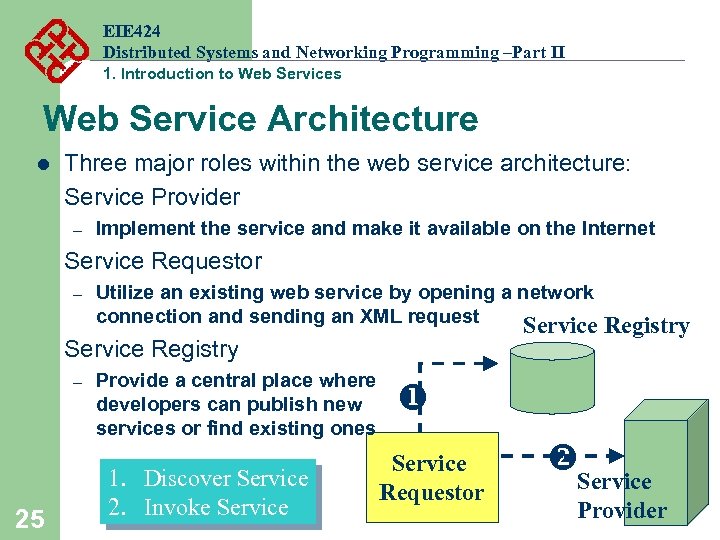 EIE 424 Distributed Systems and Networking Programming –Part II 1. Introduction to Web Services Web Service Architecture l Three major roles within the web service architecture: Service Provider – Implement the service and make it available on the Internet Service Requestor – Utilize an existing web service by opening a network connection and sending an XML request Service Registry – 25 Provide a central place where developers can publish new services or find existing ones 1. Discover Service 2. Invoke Service Requestor Service Provider
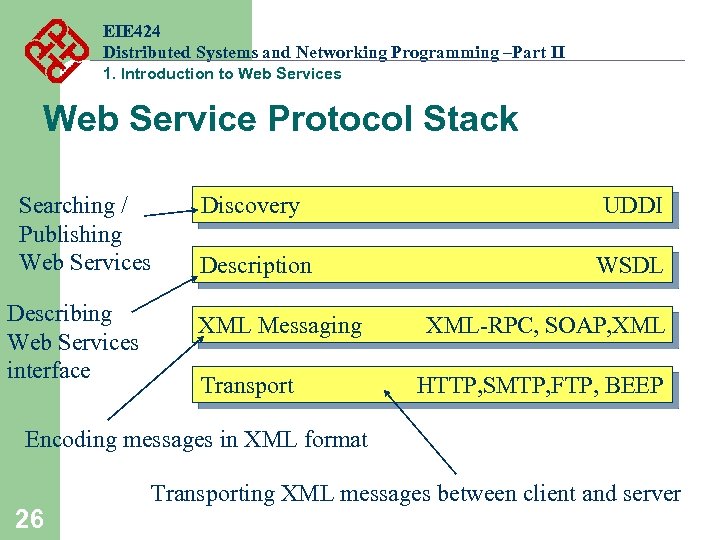 EIE 424 Distributed Systems and Networking Programming –Part II 1. Introduction to Web Services Web Service Protocol Stack Searching / Publishing Web Services Describing Web Services interface Discovery UDDI Description WSDL XML Messaging Transport XML-RPC, SOAP, XML HTTP, SMTP, FTP, BEEP Encoding messages in XML format 26 Transporting XML messages between client and server
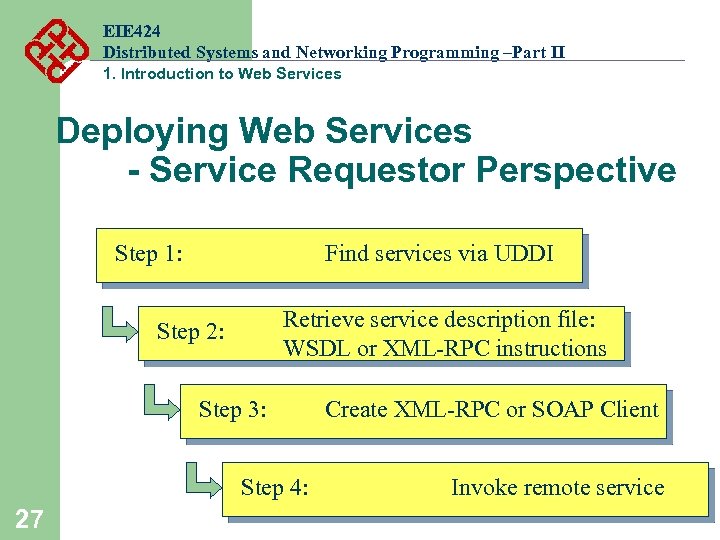 EIE 424 Distributed Systems and Networking Programming –Part II 1. Introduction to Web Services Deploying Web Services - Service Requestor Perspective Step 1: Find services via UDDI Retrieve service description file: WSDL or XML-RPC instructions Step 2: Step 3: Step 4: 27 Create XML-RPC or SOAP Client Invoke remote service
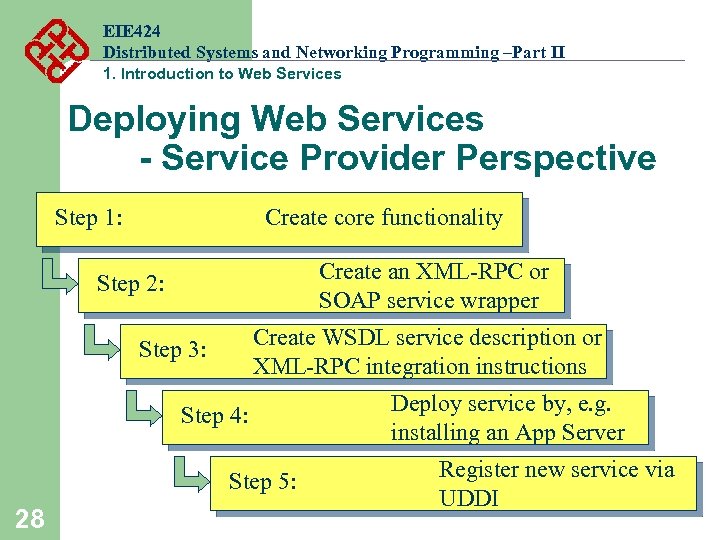 EIE 424 Distributed Systems and Networking Programming –Part II 1. Introduction to Web Services Deploying Web Services - Service Provider Perspective Step 1: Create core functionality Create an XML-RPC or SOAP service wrapper Step 2: Create WSDL service description or XML-RPC integration instructions Step 3: Step 4: Step 5: 28 Deploy service by, e. g. installing an App Server Register new service via UDDI