 Скачать презентацию The Home Mortgage Disclosure Act Michael Byrne Home
69c5a49db2c21bd2ed2b03c3c8bfa2ac.ppt
- Количество слайдов: 15




The Home Mortgage Disclosure Act Michael Byrne Home Mortgage Disclosure Act Operations Lead September 23, 2014 These are the views of the presenters and not necessarily those of the Consumer Financial Protection Bureau.
CFPB Mission and Vision OUR MISSION The CFPB is a 21 st century agency that helps consumer finance markets work by making rules more effective, by consistently and fairly enforcing those rules, and by empowering consumers to take more control over their economic lives. OUR VISION If we achieve our mission, then we will have encouraged the development of a consumer finance marketplace where customers can see prices and risks up front and where they can easily make product comparisons; in which no one can build a business model around unfair, deceptive, or abusive practices; that works for American consumers, responsible providers, and the economy as a whole. 2
SBREFA Proposals Under Consideration Newsroom, February 7, 2014 “CFPB Takes Steps to Improve Information About Access to Credit in the Mortgage Market” Fact Sheet Outline of Proposals Under Consideration More Information about the SBREFA Process http: //www. consumerfinance. gov/regulations/#notices Small Business Review Panel on HMDA SBREFA Outreach Meeting 3/6/2014 3
HMDA is a disclosure law that relies upon public scrutiny for its effectiveness. 4
HMDA provides “sunlight” to the marketplace Enacted in 1975, HMDA was passed to increase public scrutiny and access to credit Enacted in 1975, HMDA is a reporting and disclosure law. HMDA is used to evaluate compliance with other statutes (CRA, ECOA, FHA) HMDA is implemented through Regulation C and HMDA rulemaking authority transferred to the CFPB on July 21, 2011 Regulation C requires most lenders to collect, report and publicly disclose data about loan applications and home purchase, refinance and home improvement loans Variables and reporting have evolved over time Draft, Sensitive and Pre-Decisional Not for External Distribution 5
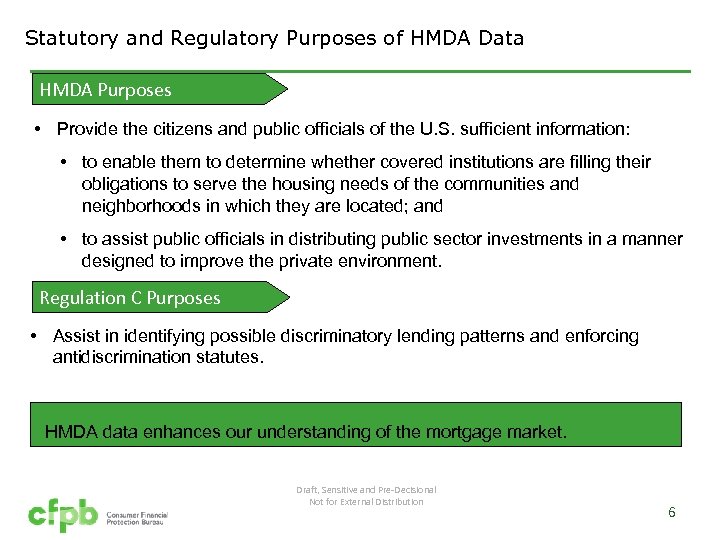
Statutory and Regulatory Purposes of HMDA Data HMDA Purposes • Provide the citizens and public officials of the U. S. sufficient information: • to enable them to determine whether covered institutions are filling their obligations to serve the housing needs of the communities and neighborhoods in which they are located; and • to assist public officials in distributing public sector investments in a manner designed to improve the private environment. Regulation C Purposes • Assist in identifying possible discriminatory lending patterns and enforcing antidiscrimination statutes. HMDA data enhances our understanding of the mortgage market. Draft, Sensitive and Pre-Decisional Not for External Distribution 6
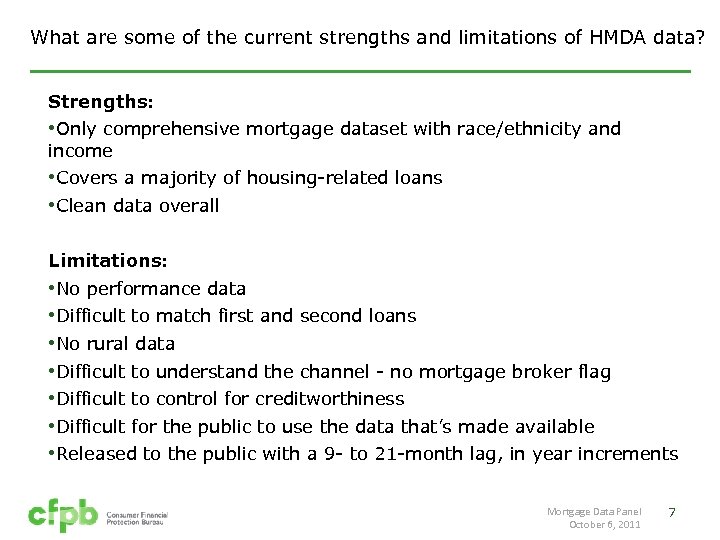
What are some of the current strengths and limitations of HMDA data? Strengths: • Only comprehensive mortgage dataset with race/ethnicity and income • Covers a majority of housing-related loans • Clean data overall Limitations: • No performance data • Difficult to match first and second loans • No rural data • Difficult to understand the channel - no mortgage broker flag • Difficult to control for creditworthiness • Difficult for the public to use the data that’s made available • Released to the public with a 9 - to 21 -month lag, in year increments Mortgage Data Panel October 6, 2011 7
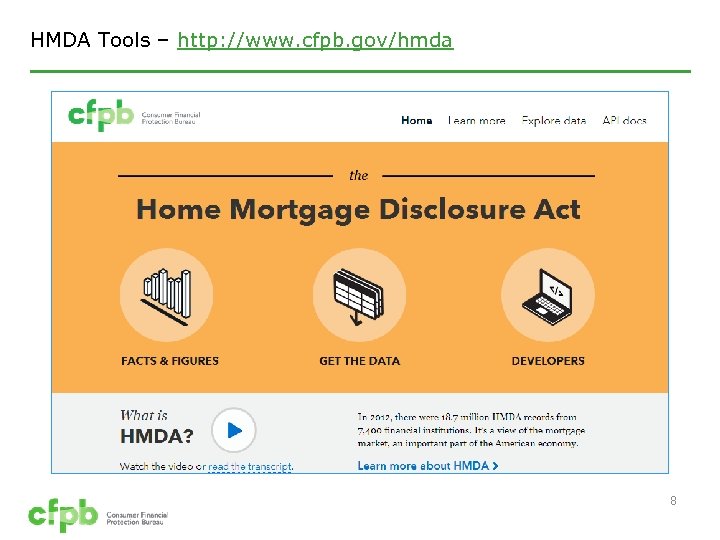
HMDA Tools – http: //www. cfpb. gov/hmda 8
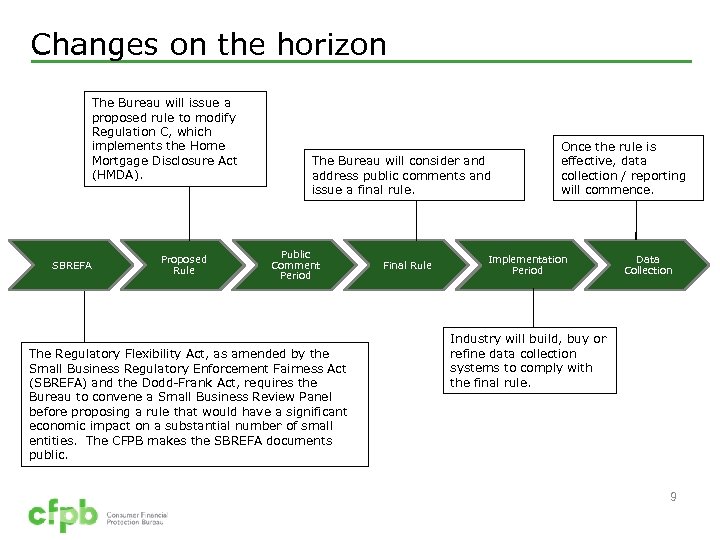
Changes on the horizon The Bureau will issue a proposed rule to modify Regulation C, which implements the Home Mortgage Disclosure Act (HMDA). SBREFA Proposed Rule The Bureau will consider and address public comments and issue a final rule. Public Comment Period The Regulatory Flexibility Act, as amended by the Small Business Regulatory Enforcement Fairness Act (SBREFA) and the Dodd-Frank Act, requires the Bureau to convene a Small Business Review Panel before proposing a rule that would have a significant economic impact on a substantial number of small entities. The CFPB makes the SBREFA documents public. Final Rule Once the rule is effective, data collection / reporting will commence. Implementation Period Data Collection Industry will build, buy or refine data collection systems to comply with the final rule. 9
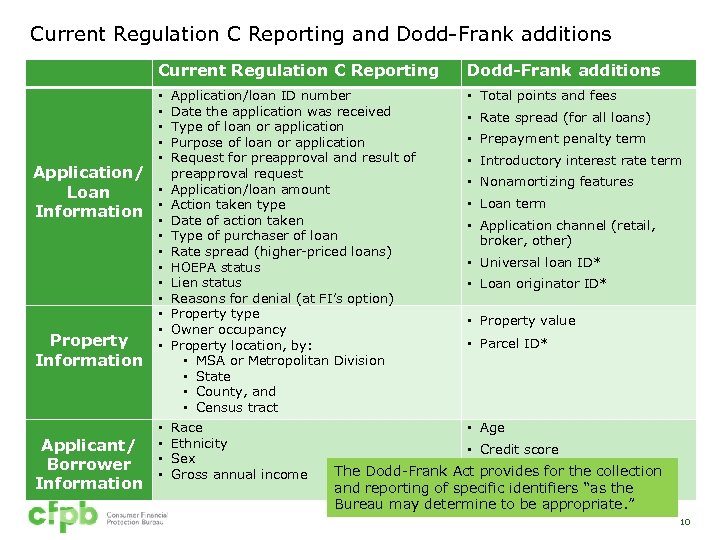
Current Regulation C Reporting and Dodd-Frank additions Current Regulation C Reporting • • • Application/ • Loan Information • • Property Information Applicant/ Borrower Information • • • Dodd-Frank additions Application/loan ID number Date the application was received Type of loan or application Purpose of loan or application Request for preapproval and result of preapproval request Application/loan amount Action taken type Date of action taken Type of purchaser of loan Rate spread (higher-priced loans) HOEPA status Lien status Reasons for denial (at FI’s option) Property type Owner occupancy Property location, by: • MSA or Metropolitan Division • State • County, and • Census tract • Total points and fees Race Ethnicity Sex Gross annual income • Age • Rate spread (for all loans) • Prepayment penalty term • Introductory interest rate term • Nonamortizing features • Loan term • Application channel (retail, broker, other) • Universal loan ID* • Loan originator ID* • Property value • Parcel ID* • Credit score The Dodd-Frank Act provides for the collection and reporting of specific identifiers “as the Bureau may determine to be appropriate. ” 10
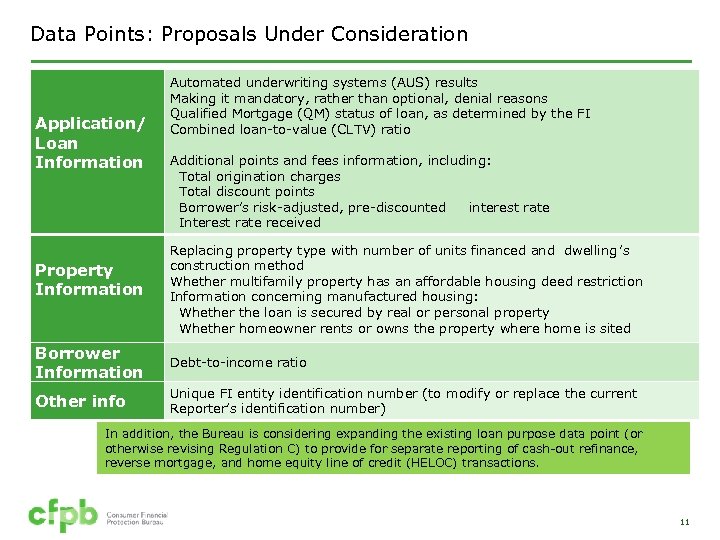
Data Points: Proposals Under Consideration Application/ Loan Information Property Information Automated underwriting systems (AUS) results Making it mandatory, rather than optional, denial reasons Qualified Mortgage (QM) status of loan, as determined by the FI Combined loan-to-value (CLTV) ratio Additional points and fees information, including: Total origination charges Total discount points Borrower’s risk-adjusted, pre-discounted interest rate Interest rate received Replacing property type with number of units financed and dwelling ’s construction method Whether multifamily property has an affordable housing deed restriction Information concerning manufactured housing: Whether the loan is secured by real or personal property Whether homeowner rents or owns the property where home is sited Borrower Information Debt-to-income ratio Other info Unique FI entity identification number (to modify or replace the current Reporter’s identification number) In addition, the Bureau is considering expanding the existing loan purpose data point (or otherwise revising Regulation C) to provide for separate reporting of cash-out refinance, reverse mortgage, and home equity line of credit (HELOC) transactions. 11
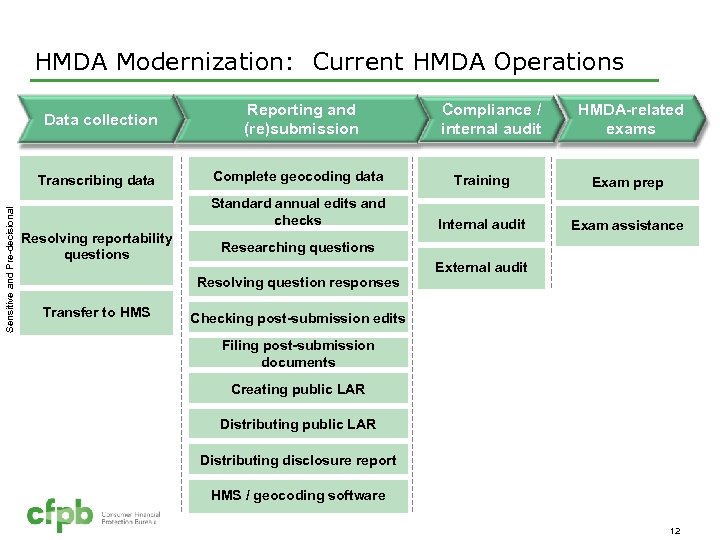
HMDA Modernization: Current HMDA Operations HMDA-related exams Reporting and (re)submission Transcribing data Sensitive and Pre-decisional Data collection Complete geocoding data Training Exam prep Standard annual edits and checks Internal audit Exam assistance Resolving reportability questions Researching questions Resolving question responses Transfer to HMS Compliance / internal audit External audit Checking post-submission edits Filing post-submission documents Creating public LAR Distributing disclosure report HMS / geocoding software 12
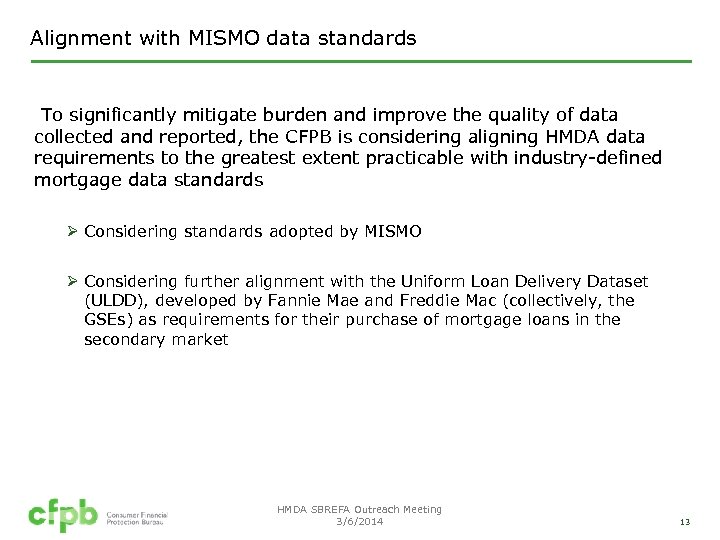
Alignment with MISMO data standards To significantly mitigate burden and improve the quality of data collected and reported, the CFPB is considering aligning HMDA data requirements to the greatest extent practicable with industry-defined mortgage data standards Ø Considering standards adopted by MISMO Ø Considering further alignment with the Uniform Loan Delivery Dataset (ULDD), developed by Fannie Mae and Freddie Mac (collectively, the GSEs) as requirements for their purchase of mortgage loans in the secondary market HMDA SBREFA Outreach Meeting 3/6/2014 13
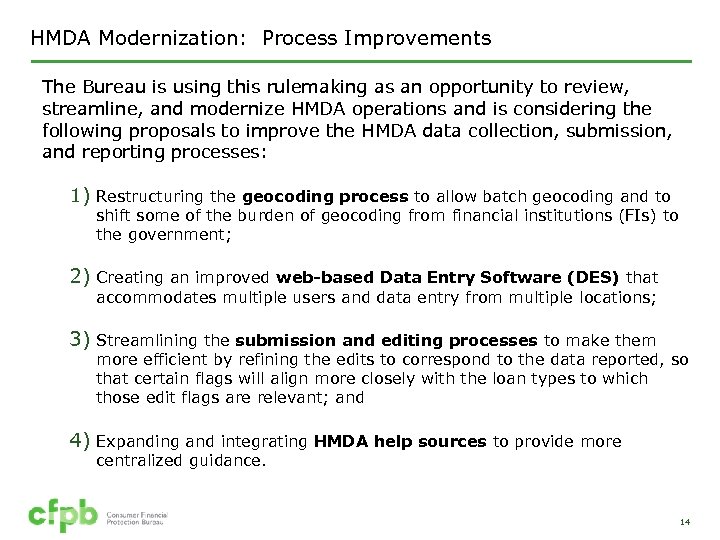
HMDA Modernization: Process Improvements The Bureau is using this rulemaking as an opportunity to review, streamline, and modernize HMDA operations and is considering the following proposals to improve the HMDA data collection, submission, and reporting processes: 1) Restructuring the geocoding process to allow batch geocoding and to shift some of the burden of geocoding from financial institutions (FIs) to the government; 2) Creating an improved web-based Data Entry Software (DES) that accommodates multiple users and data entry from multiple locations; 3) Streamlining the submission and editing processes to make them more efficient by refining the edits to correspond to the data reported, so that certain flags will align more closely with the loan types to which those edit flags are relevant; and 4) Expanding and integrating HMDA help sources to provide more centralized guidance. 14

QUESTIONS? Michael Byrne Technology and Innovation michael. byrne@cfpb. gov 15
Скачать презентацию The Home Mortgage Disclosure Act Michael Byrne Home
69c5a49db2c21bd2ed2b03c3c8bfa2ac.ppt