 Скачать презентацию The Holocaust Background WWII Background Germany was
60d7c376e963d9715034e0ad56529175.ppt
- Количество слайдов: 74



The Holocaust Background
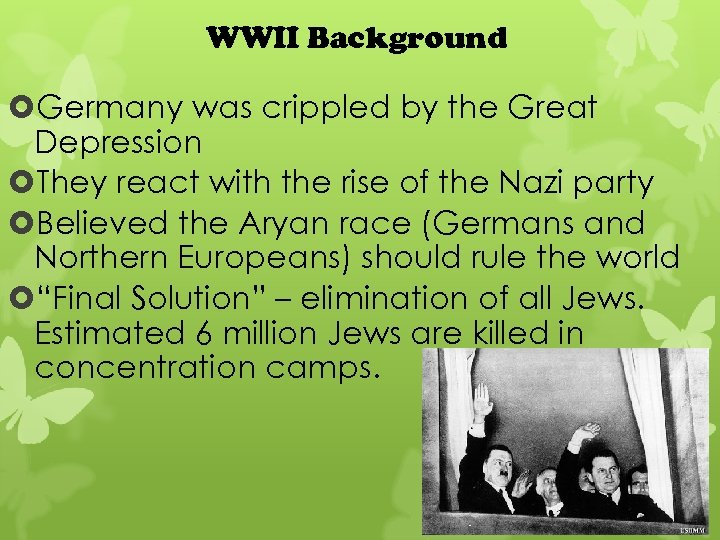
WWII Background Germany was crippled by the Great Depression They react with the rise of the Nazi party Believed the Aryan race (Germans and Northern Europeans) should rule the world “Final Solution” – elimination of all Jews. Estimated 6 million Jews are killed in concentration camps.
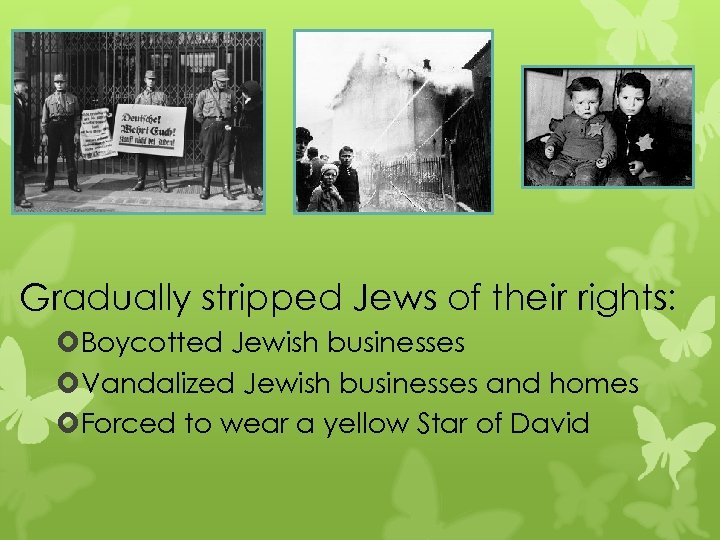
Gradually stripped Jews of their rights: Boycotted Jewish businesses Vandalized Jewish businesses and homes Forced to wear a yellow Star of David
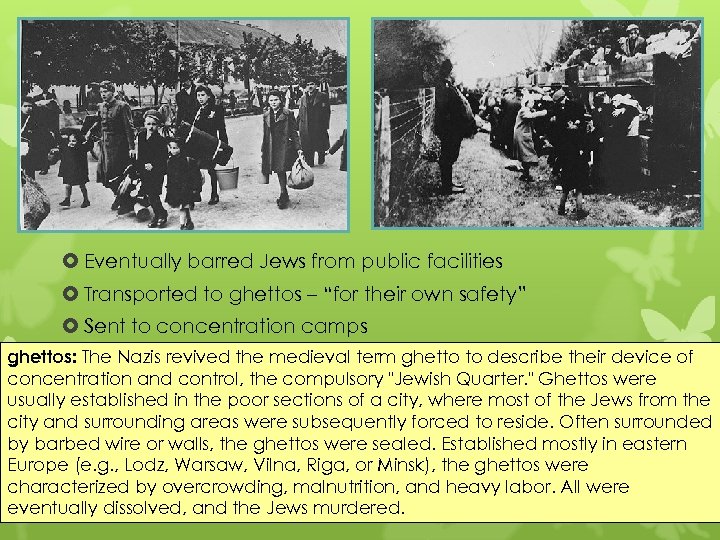
Eventually barred Jews from public facilities Transported to ghettos – “for their own safety” Sent to concentration camps ghettos: The Nazis revived the medieval term ghetto to describe their device of concentration and control, the compulsory "Jewish Quarter. " Ghettos were usually established in the poor sections of a city, where most of the Jews from the city and surrounding areas were subsequently forced to reside. Often surrounded by barbed wire or walls, the ghettos were sealed. Established mostly in eastern Europe (e. g. , Lodz, Warsaw, Vilna, Riga, or Minsk), the ghettos were characterized by overcrowding, malnutrition, and heavy labor. All were eventually dissolved, and the Jews murdered.
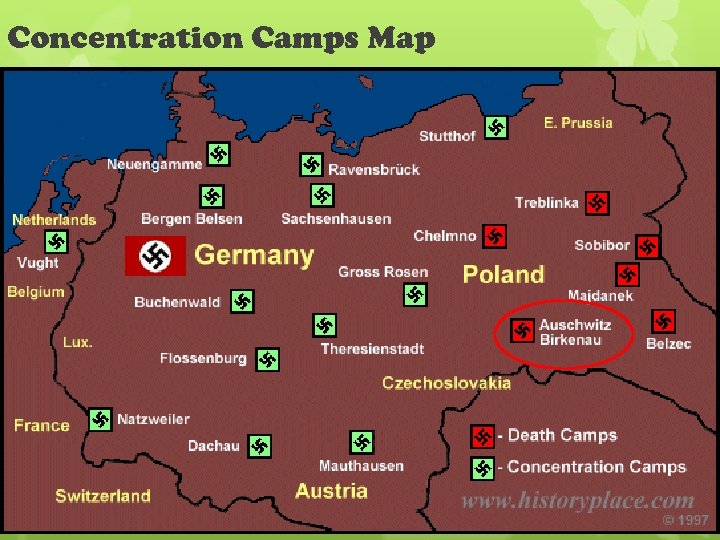
Concentration Camps Map
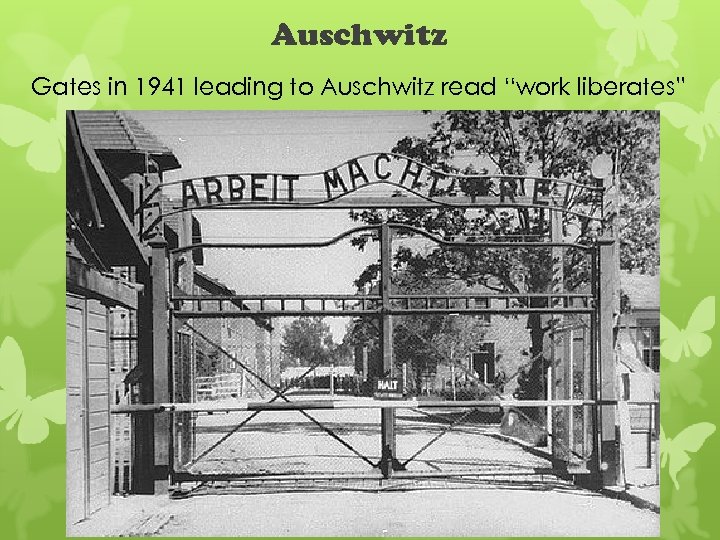
Auschwitz Gates in 1941 leading to Auschwitz read “work liberates”
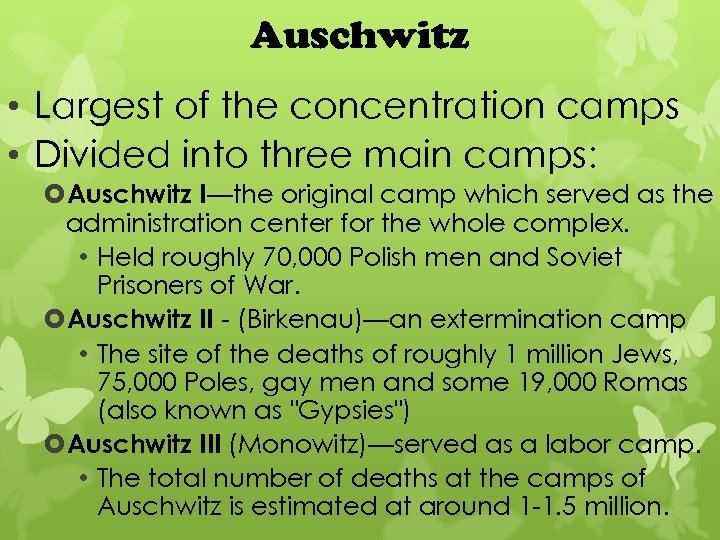
Auschwitz • Largest of the concentration camps • Divided into three main camps: Auschwitz I—the original camp which served as the administration center for the whole complex. • Held roughly 70, 000 Polish men and Soviet Prisoners of War. Auschwitz II - (Birkenau)—an extermination camp • The site of the deaths of roughly 1 million Jews, 75, 000 Poles, gay men and some 19, 000 Romas (also known as "Gypsies") Auschwitz III (Monowitz)—served as a labor camp. • The total number of deaths at the camps of Auschwitz is estimated at around 1 -1. 5 million.
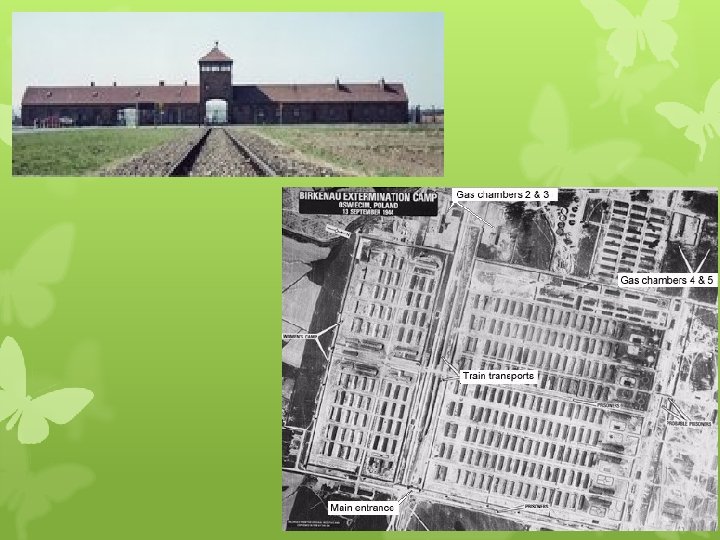
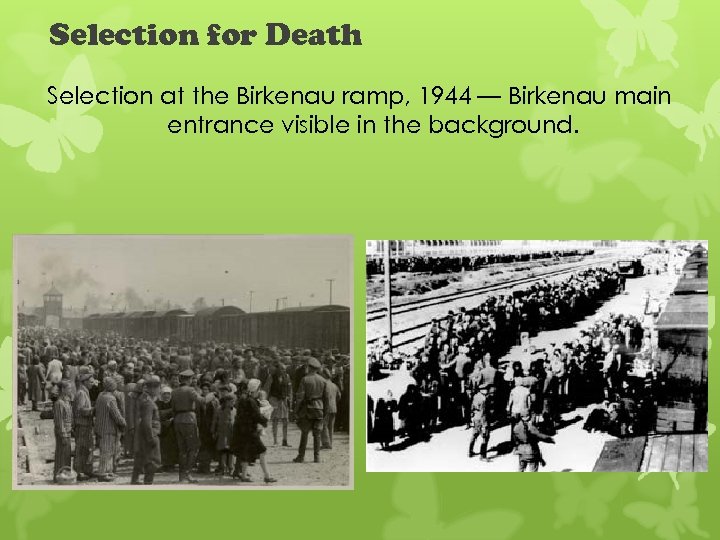
Selection for Death Selection at the Birkenau ramp, 1944 — Birkenau main entrance visible in the background.
Adolf Hitler
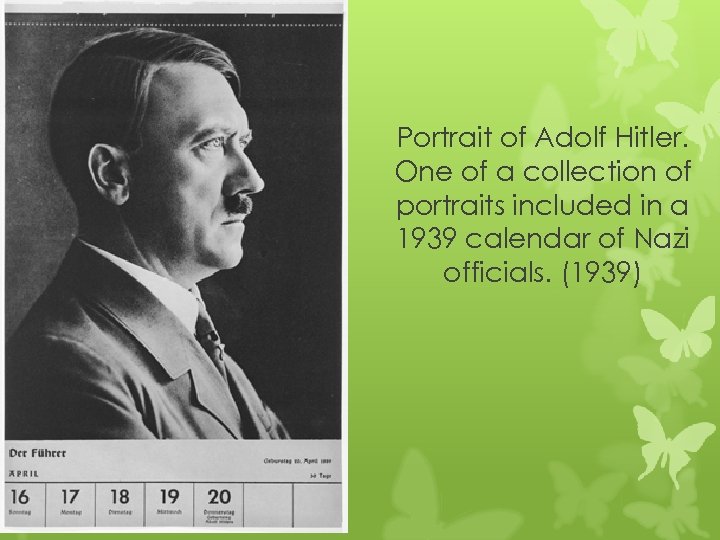
Portrait of Adolf Hitler. One of a collection of portraits included in a 1939 calendar of Nazi officials. (1939)
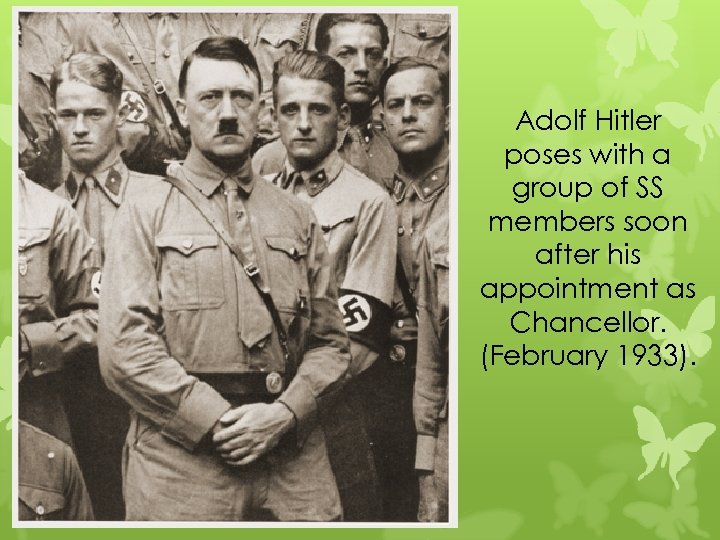
Adolf Hitler poses with a group of SS members soon after his appointment as Chancellor. (February 1933).
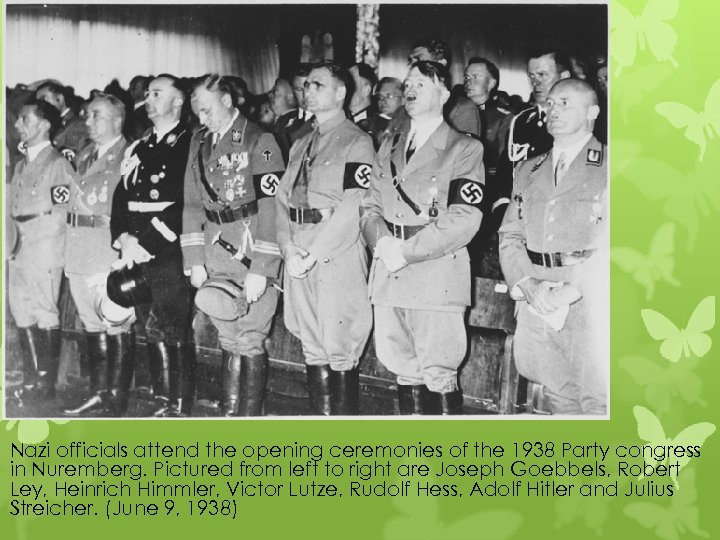
Nazi officials attend the opening ceremonies of the 1938 Party congress in Nuremberg. Pictured from left to right are Joseph Goebbels, Robert Ley, Heinrich Himmler, Victor Lutze, Rudolf Hess, Adolf Hitler and Julius Streicher. (June 9, 1938)
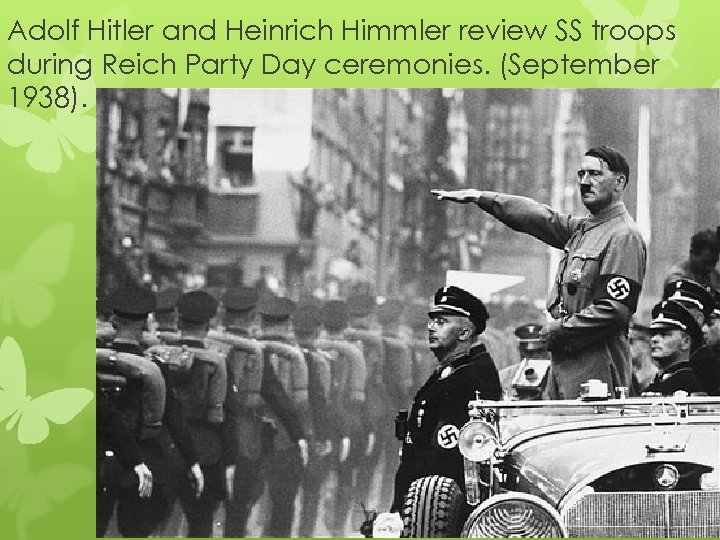
Adolf Hitler and Heinrich Himmler review SS troops during Reich Party Day ceremonies. (September 1938).
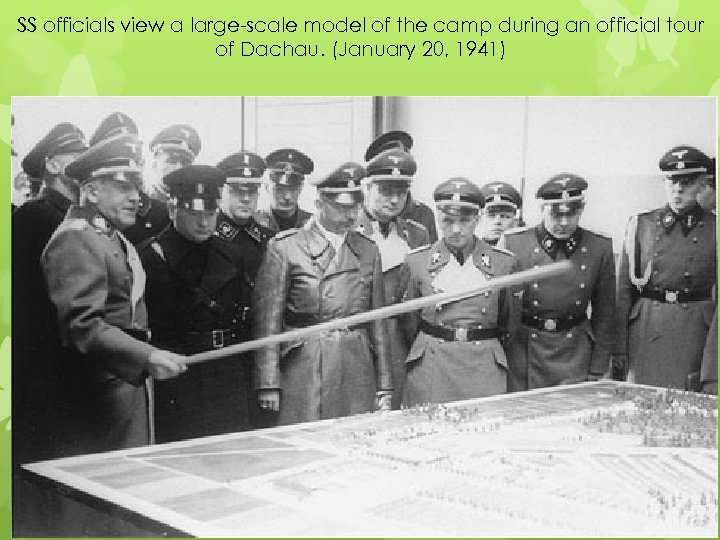
SS officials view a large-scale model of the camp during an official tour of Dachau. (January 20, 1941)
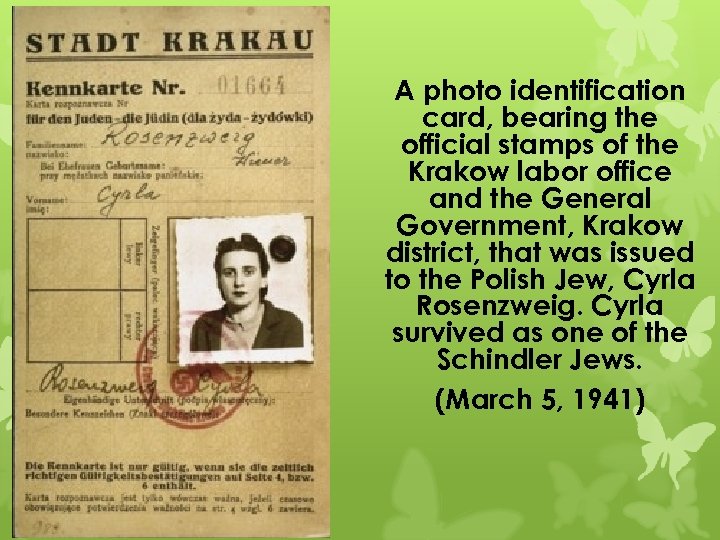
A photo identification card, bearing the official stamps of the Krakow labor office and the General Government, Krakow district, that was issued to the Polish Jew, Cyrla Rosenzweig. Cyrla survived as one of the Schindler Jews. (March 5, 1941)
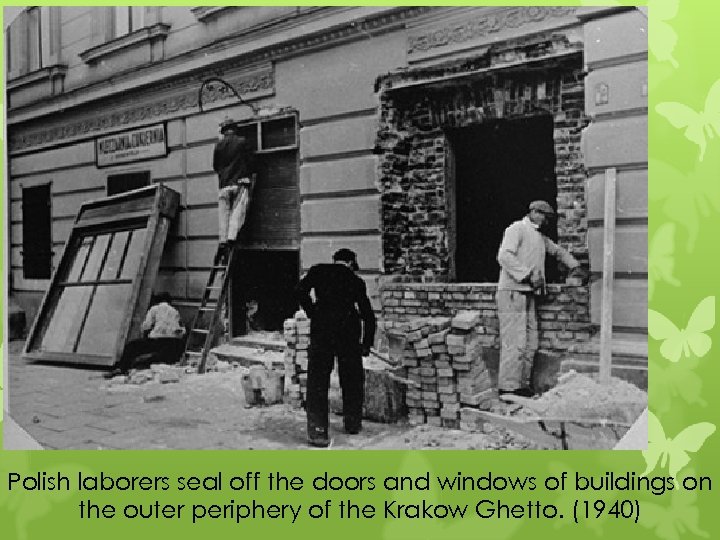
Polish laborers seal off the doors and windows of buildings on the outer periphery of the Krakow Ghetto. (1940)
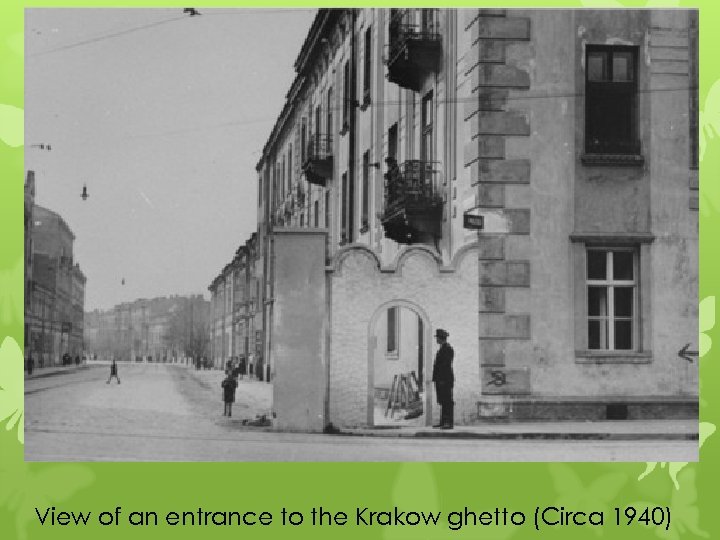
View of an entrance to the Krakow ghetto (Circa 1940)
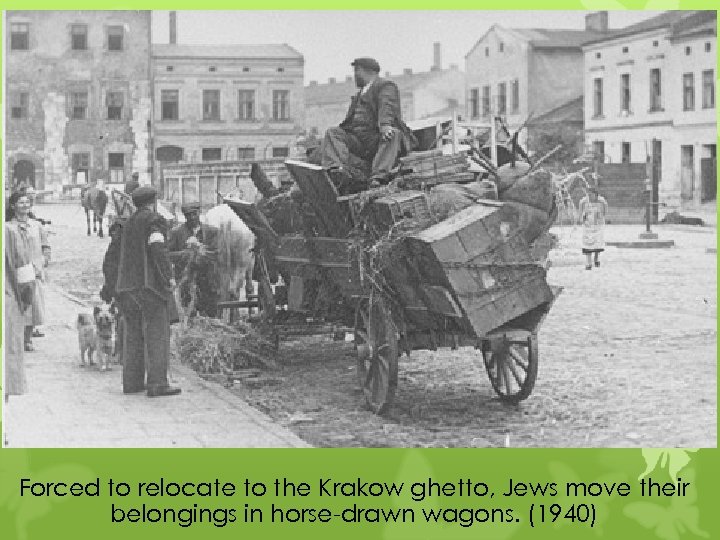
Forced to relocate to the Krakow ghetto, Jews move their belongings in horse-drawn wagons. (1940)
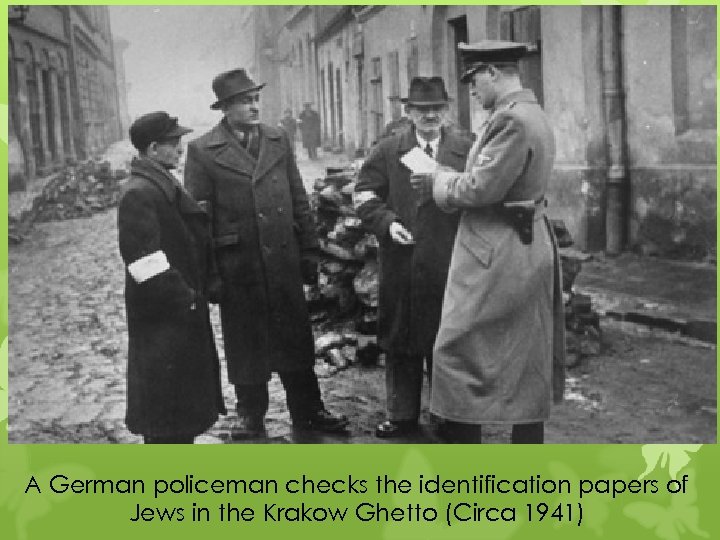
A German policeman checks the identification papers of Jews in the Krakow Ghetto (Circa 1941)
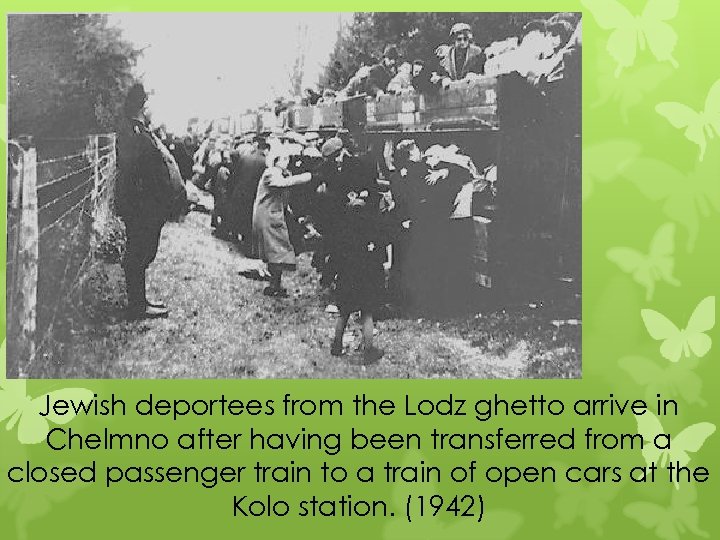
Jewish deportees from the Lodz ghetto arrive in Chelmno after having been transferred from a closed passenger train to a train of open cars at the Kolo station. (1942)
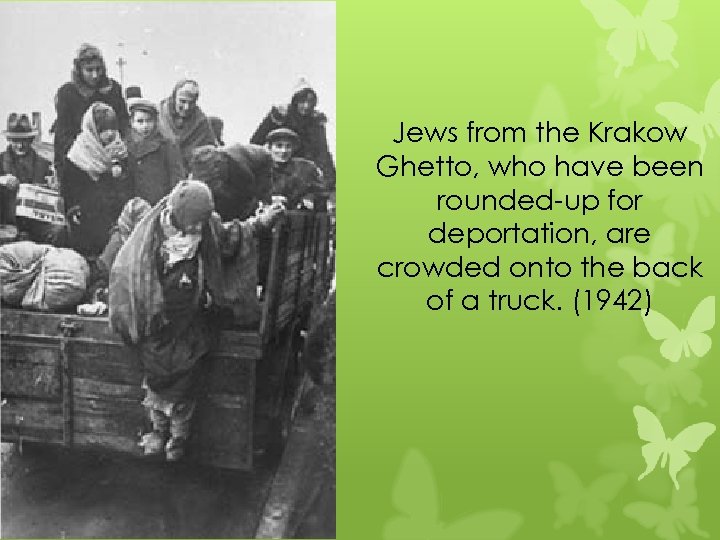
Jews from the Krakow Ghetto, who have been rounded-up for deportation, are crowded onto the back of a truck. (1942)
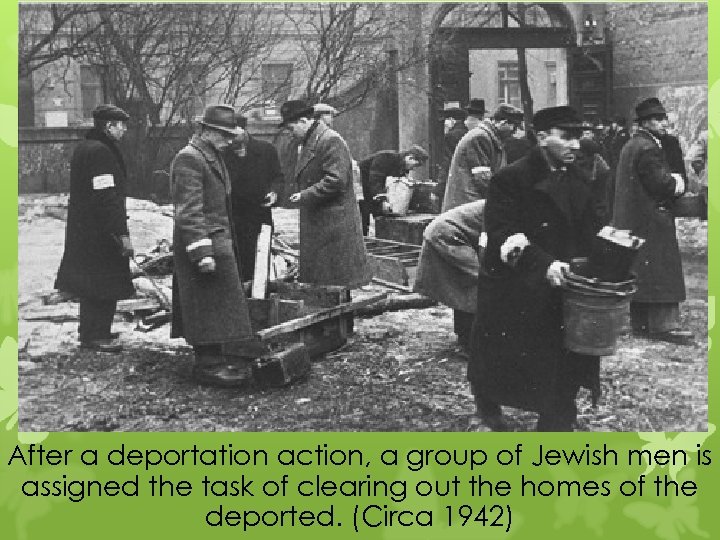
After a deportation action, a group of Jewish men is assigned the task of clearing out the homes of the deported. (Circa 1942)
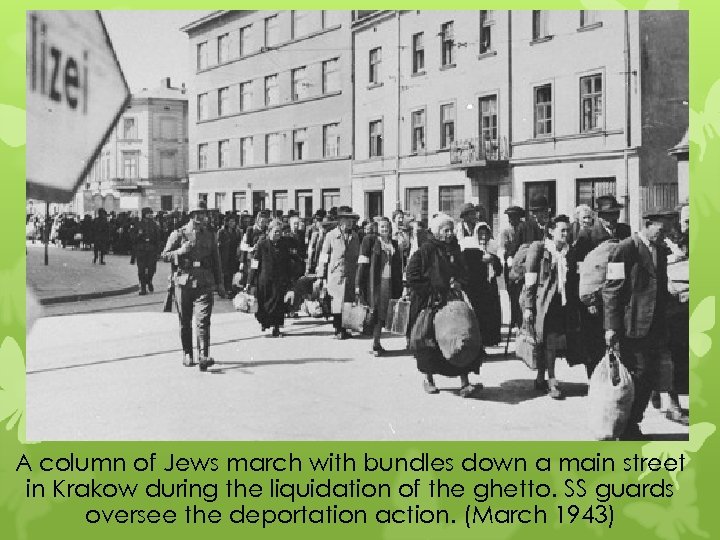
A column of Jews march with bundles down a main street in Krakow during the liquidation of the ghetto. SS guards oversee the deportation action. (March 1943)
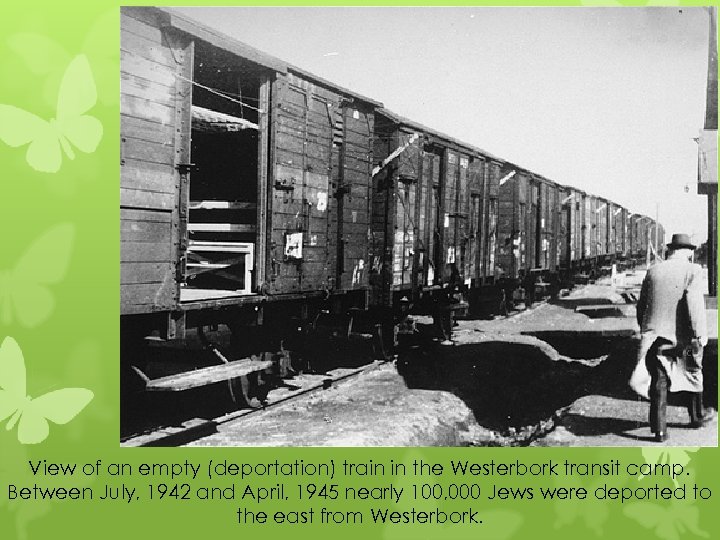
View of an empty (deportation) train in the Westerbork transit camp. Between July, 1942 and April, 1945 nearly 100, 000 Jews were deported to the east from Westerbork.
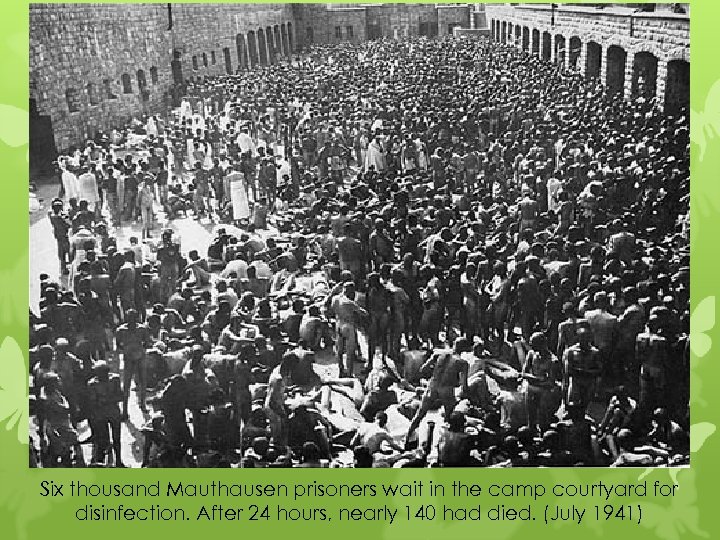
Six thousand Mauthausen prisoners wait in the camp courtyard for disinfection. After 24 hours, nearly 140 had died. (July 1941)
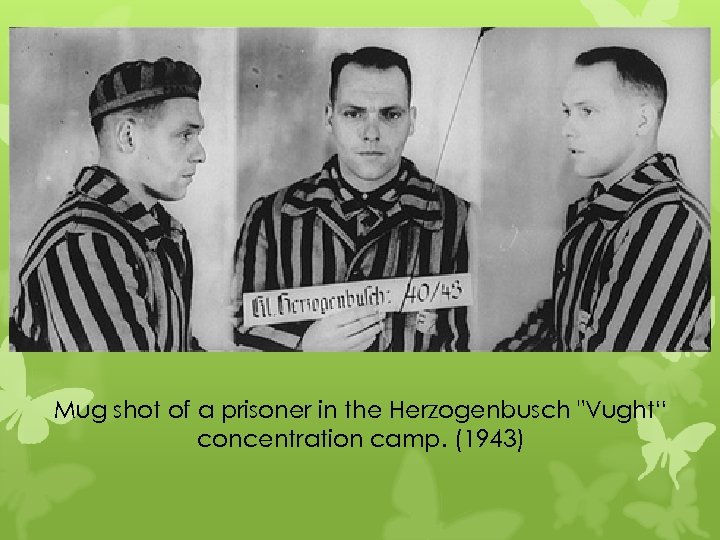
Mug shot of a prisoner in the Herzogenbusch "Vught“ concentration camp. (1943)
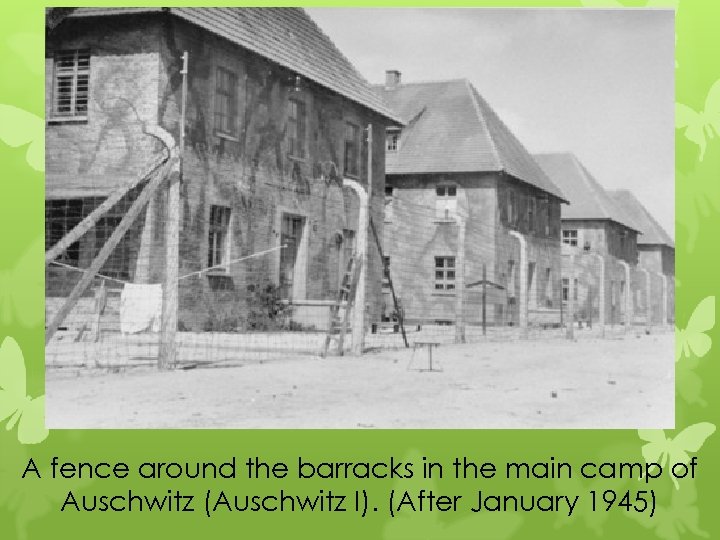
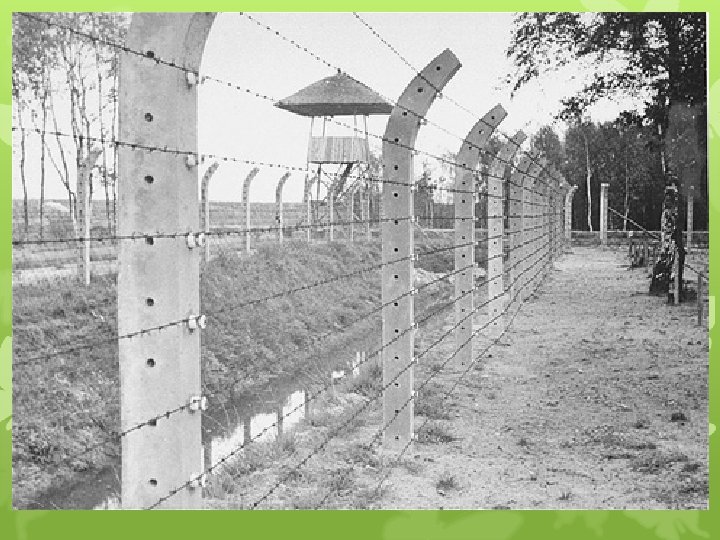
A fence around the barracks in the main camp of Auschwitz (Auschwitz I). (After January 1945)
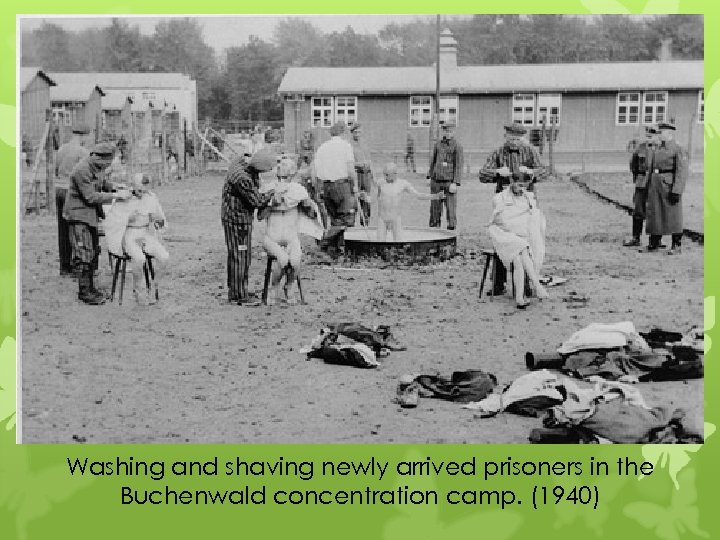
Washing and shaving newly arrived prisoners in the Buchenwald concentration camp. (1940)
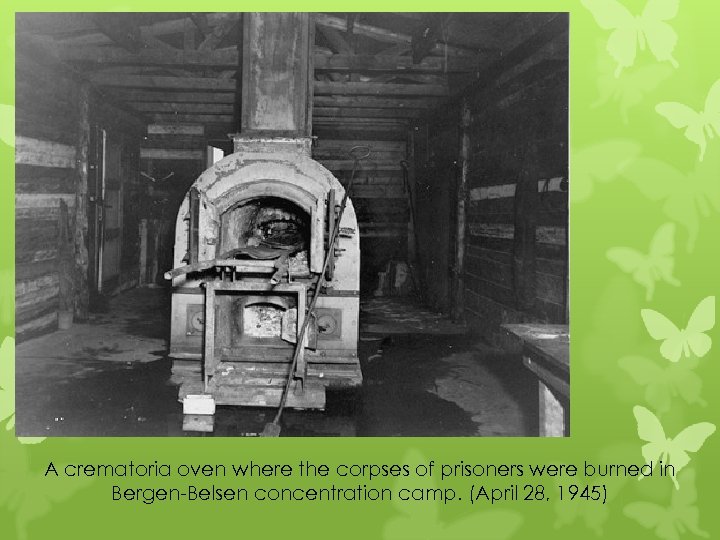
A crematoria oven where the corpses of prisoners were burned in Bergen-Belsen concentration camp. (April 28, 1945)
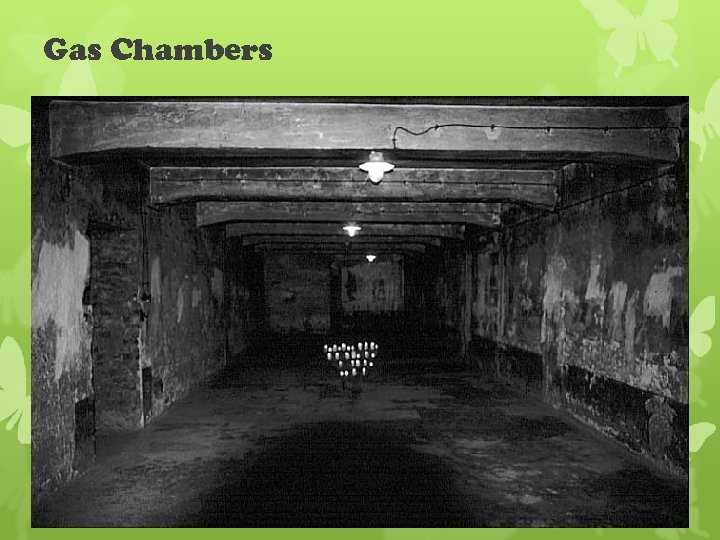
Gas Chambers
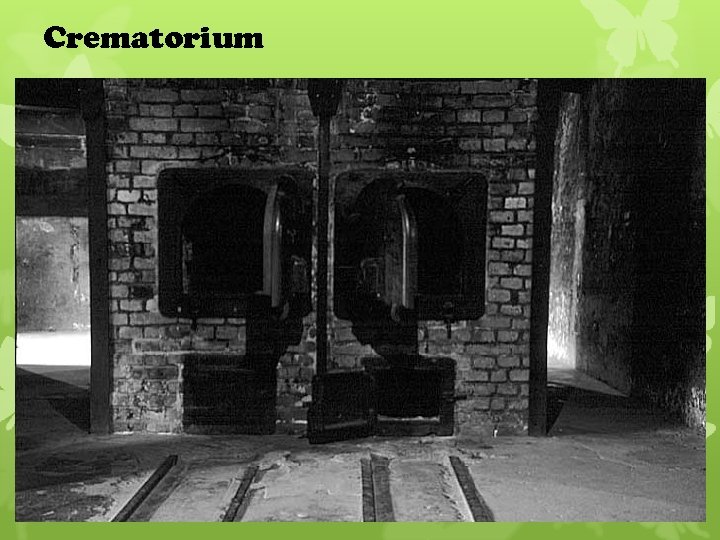
Crematorium
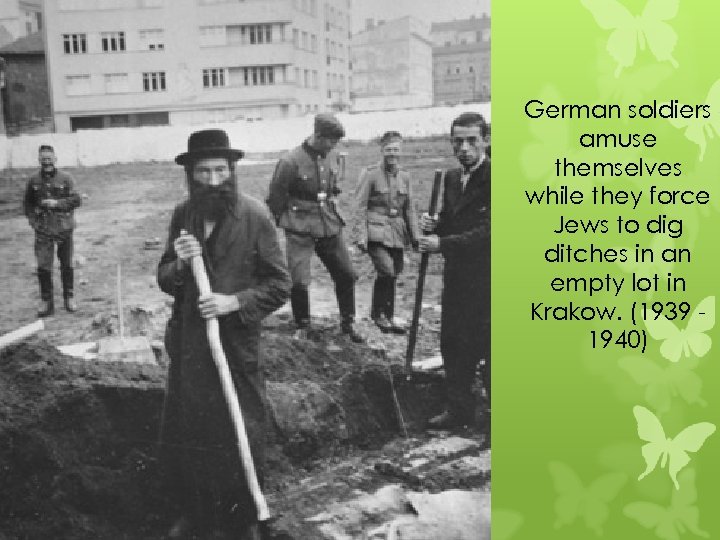
German soldiers amuse themselves while they force Jews to dig ditches in an empty lot in Krakow. (1939 1940)
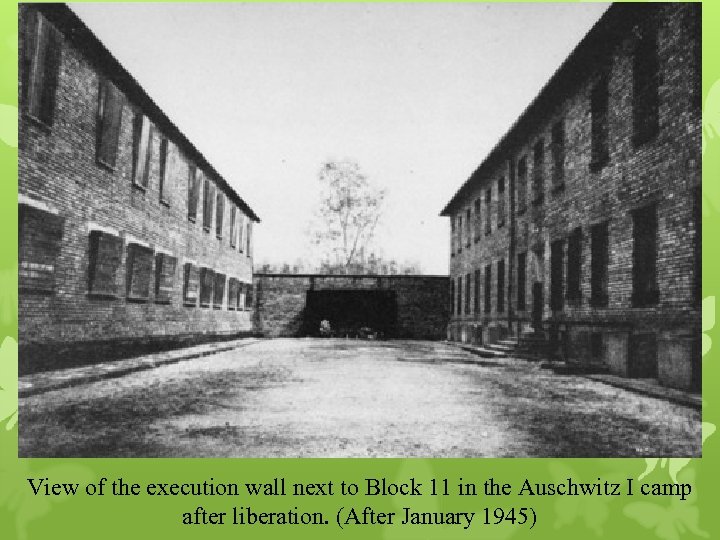
View of the execution wall next to Block 11 in the Auschwitz I camp after liberation. (After January 1945)
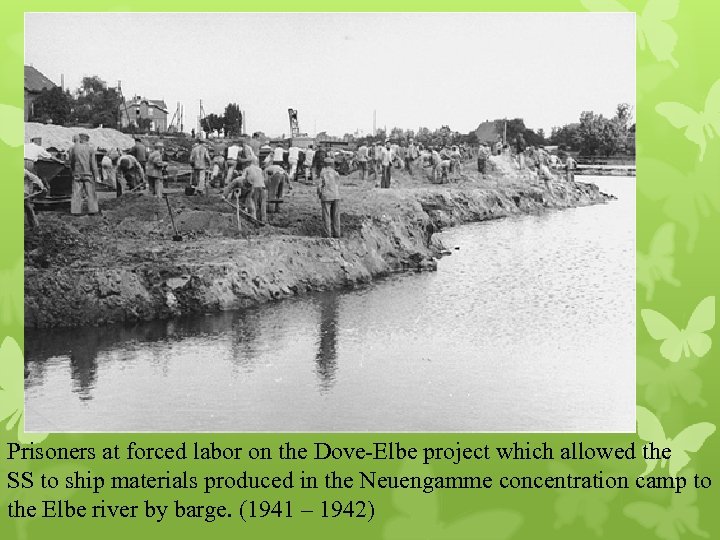
Prisoners at forced labor on the Dove-Elbe project which allowed the SS to ship materials produced in the Neuengamme concentration camp to the Elbe river by barge. (1941 – 1942)
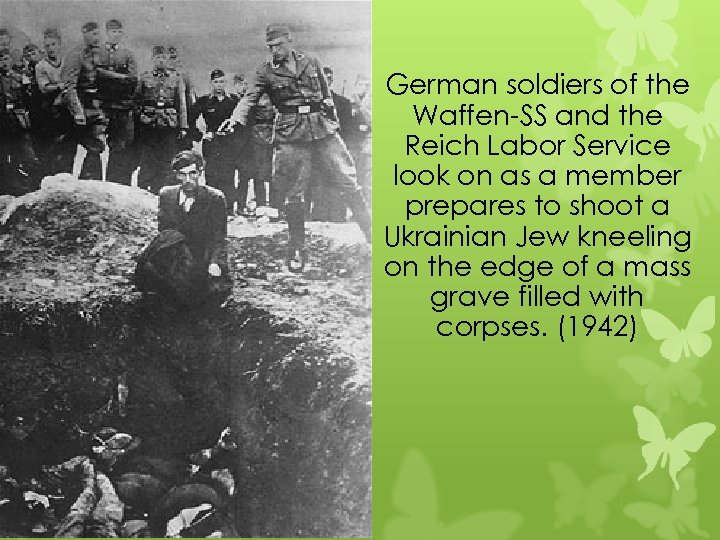
German soldiers of the Waffen-SS and the Reich Labor Service look on as a member prepares to shoot a Ukrainian Jew kneeling on the edge of a mass grave filled with corpses. (1942)
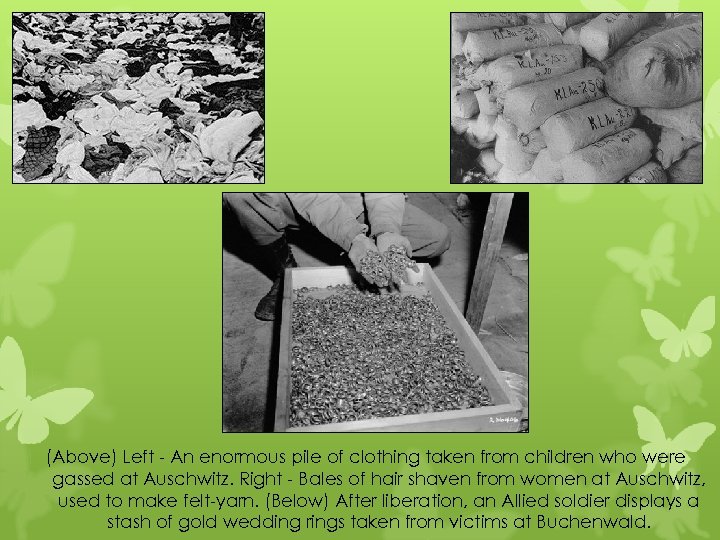
(Above) Left - An enormous pile of clothing taken from children who were gassed at Auschwitz. Right - Bales of hair shaven from women at Auschwitz, used to make felt-yarn. (Below) After liberation, an Allied soldier displays a stash of gold wedding rings taken from victims at Buchenwald.
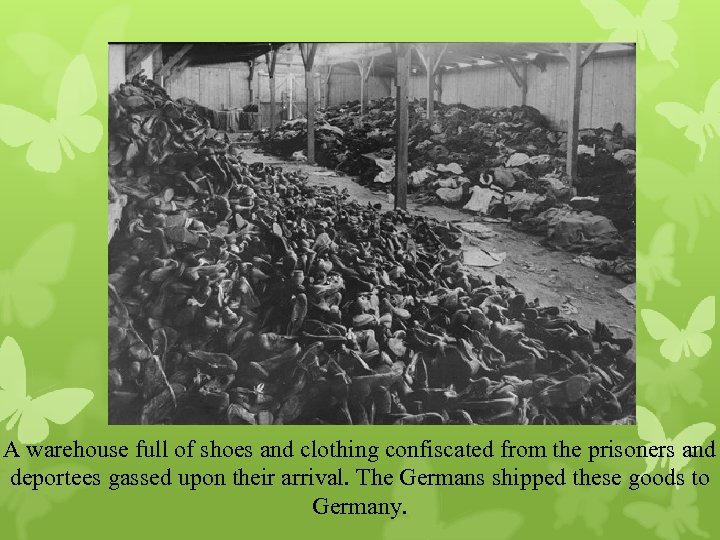
A warehouse full of shoes and clothing confiscated from the prisoners and deportees gassed upon their arrival. The Germans shipped these goods to Germany.
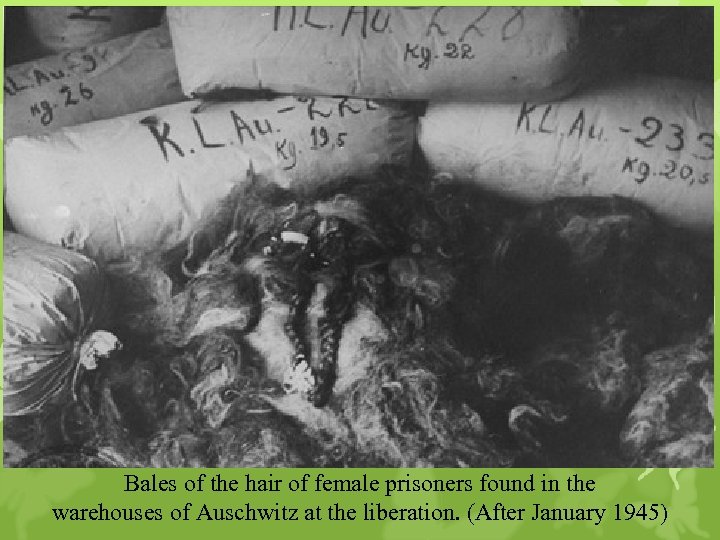
Bales of the hair of female prisoners found in the warehouses of Auschwitz at the liberation. (After January 1945)
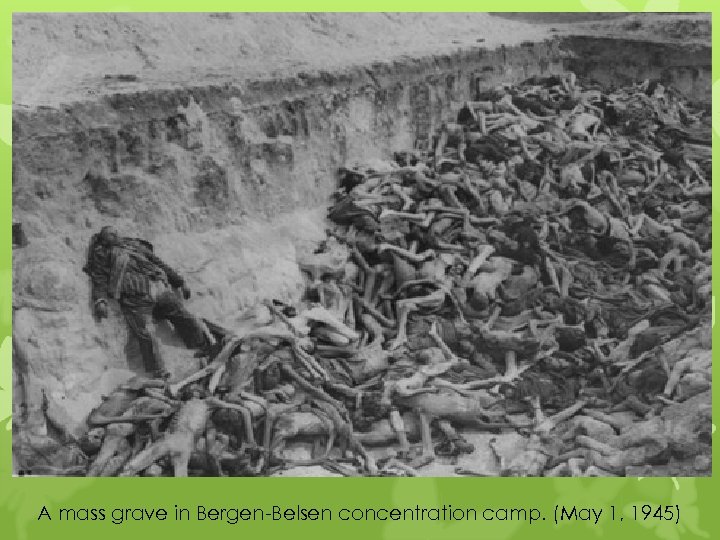
A mass grave in Bergen-Belsen concentration camp. (May 1, 1945)
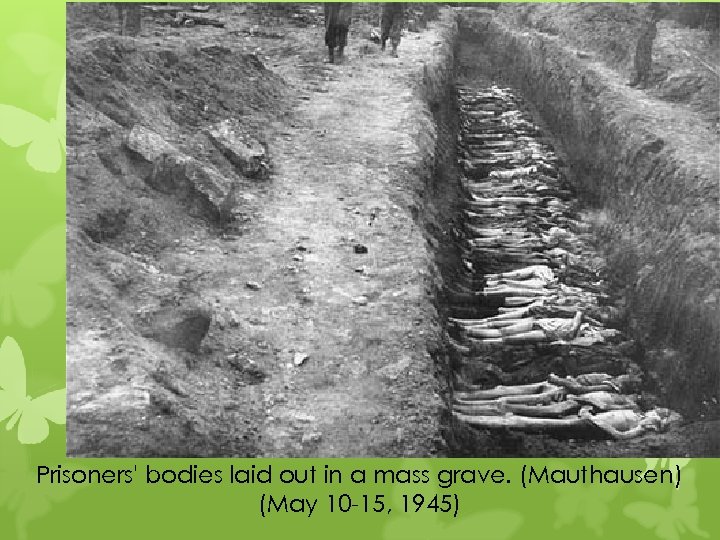
Prisoners' bodies laid out in a mass grave. (Mauthausen) (May 10 -15, 1945)
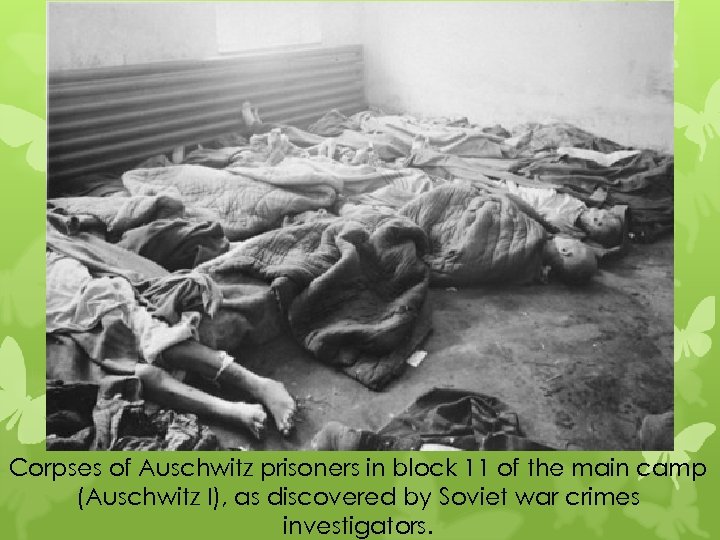
Corpses of Auschwitz prisoners in block 11 of the main camp (Auschwitz I), as discovered by Soviet war crimes investigators.
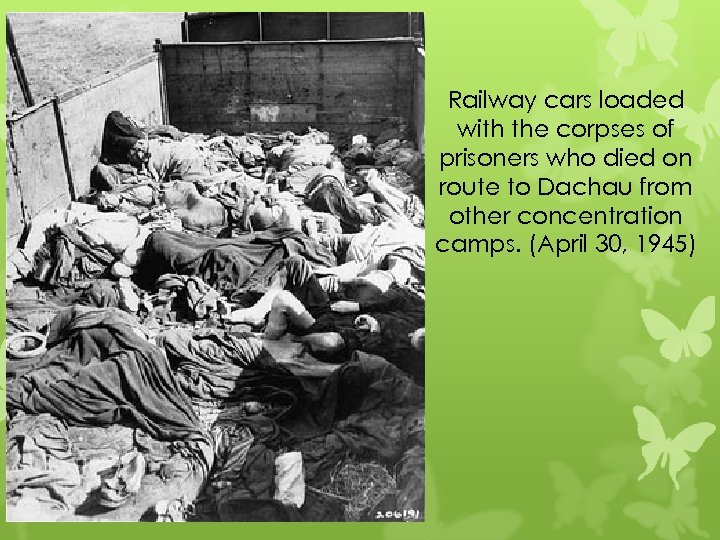
Railway cars loaded with the corpses of prisoners who died on route to Dachau from other concentration camps. (April 30, 1945)
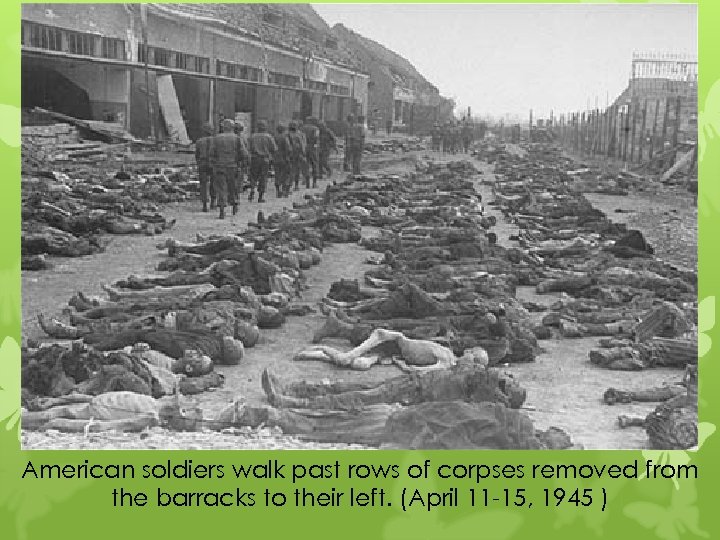
American soldiers walk past rows of corpses removed from the barracks to their left. (April 11 -15, 1945 )
After Liberation
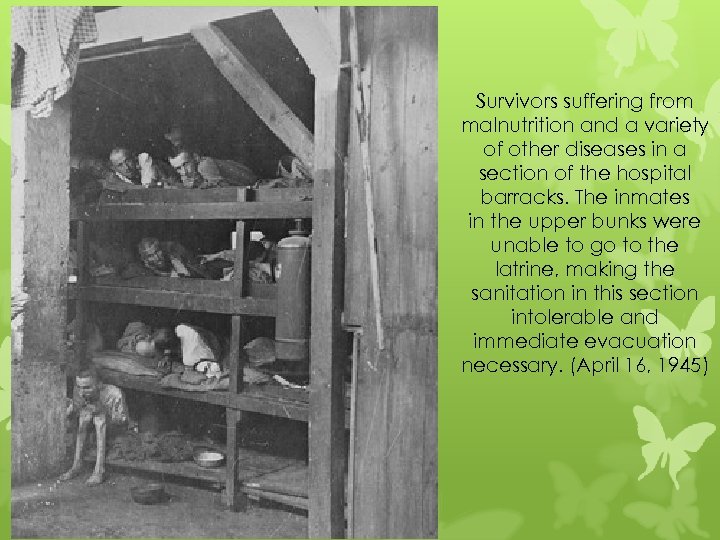
Survivors suffering from malnutrition and a variety of other diseases in a section of the hospital barracks. The inmates in the upper bunks were unable to go to the latrine, making the sanitation in this section intolerable and immediate evacuation necessary. (April 16, 1945)
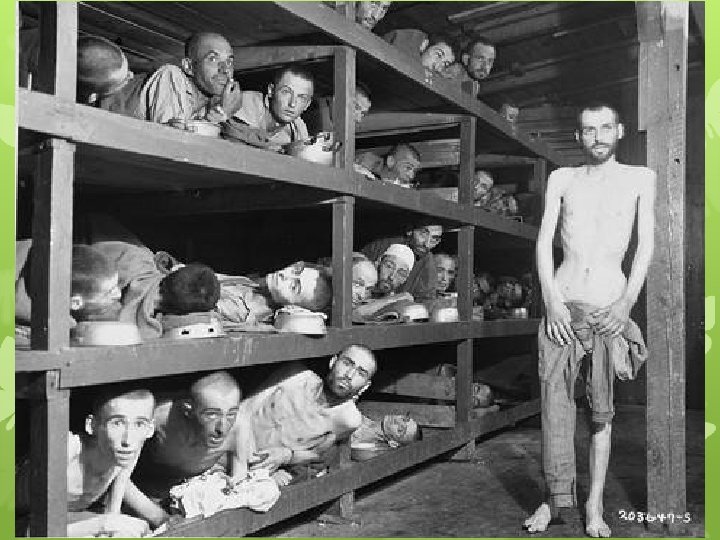
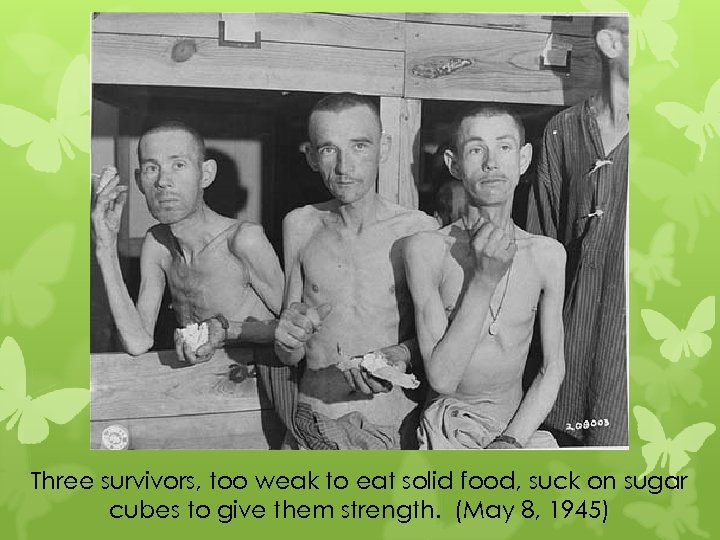
Three survivors, too weak to eat solid food, suck on sugar cubes to give them strength. (May 8, 1945)
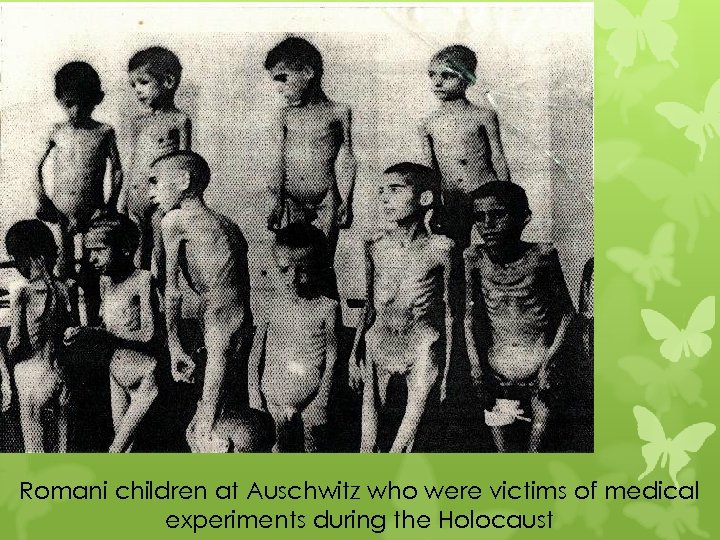
Romani children at Auschwitz who were victims of medical experiments during the Holocaust
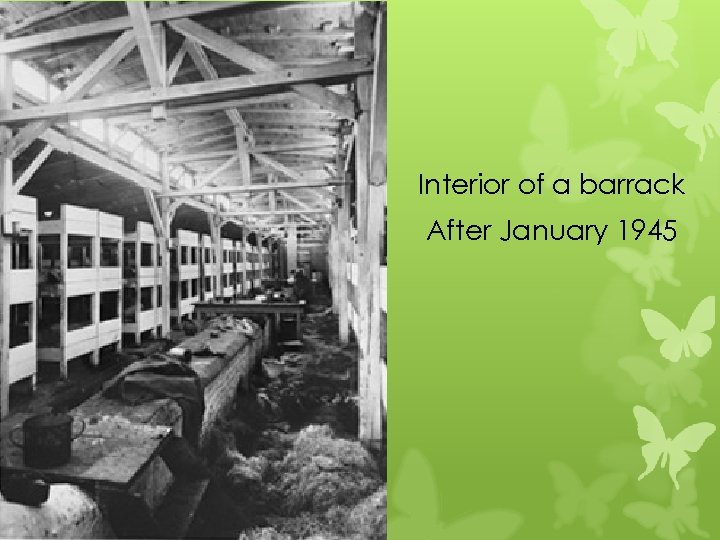
Interior of a barrack After January 1945
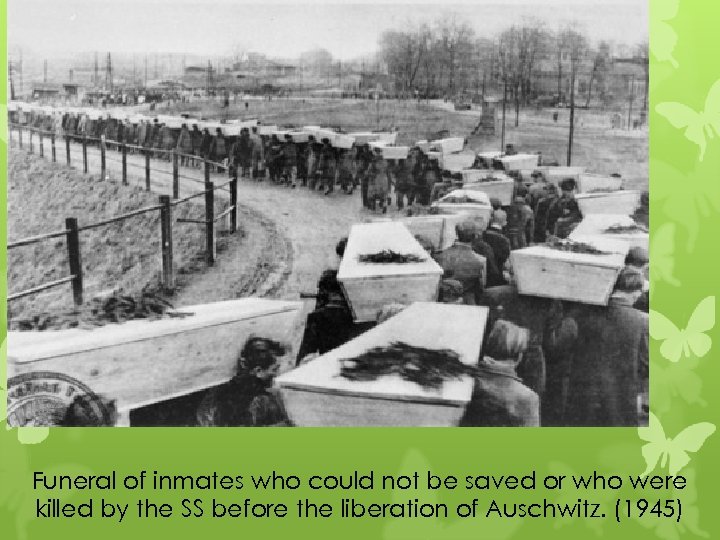
Funeral of inmates who could not be saved or who were killed by the SS before the liberation of Auschwitz. (1945)
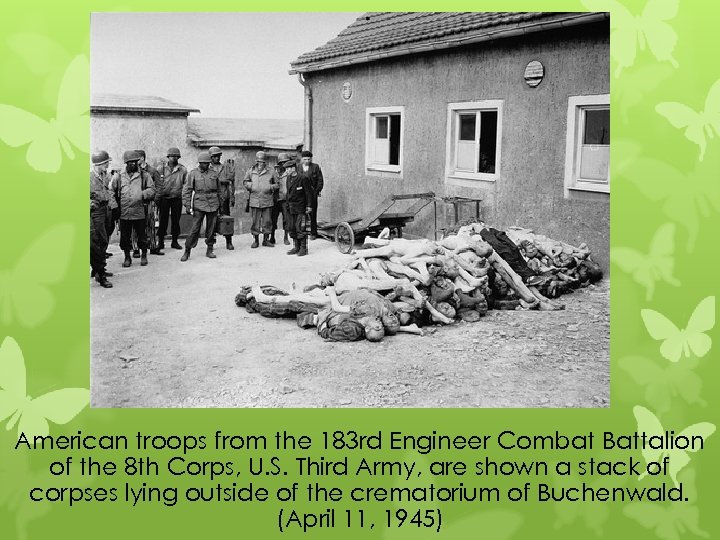
American troops from the 183 rd Engineer Combat Battalion of the 8 th Corps, U. S. Third Army, are shown a stack of corpses lying outside of the crematorium of Buchenwald. (April 11, 1945)
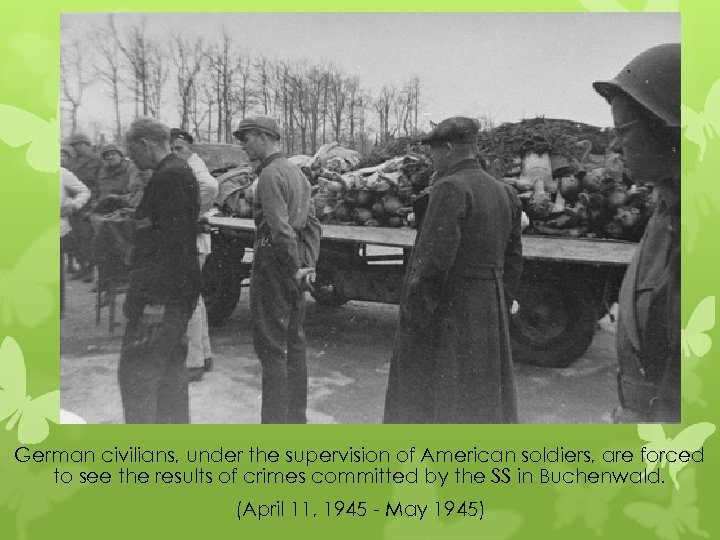
German civilians, under the supervision of American soldiers, are forced to see the results of crimes committed by the SS in Buchenwald. (April 11, 1945 - May 1945)
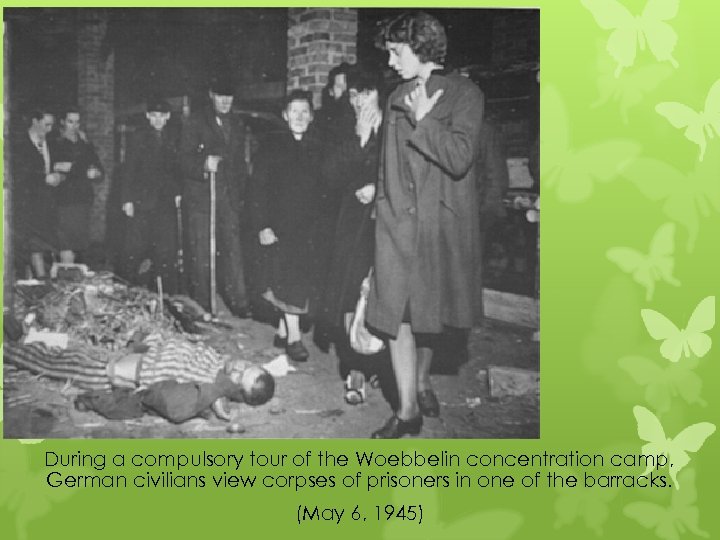
During a compulsory tour of the Woebbelin concentration camp, German civilians view corpses of prisoners in one of the barracks. (May 6, 1945)
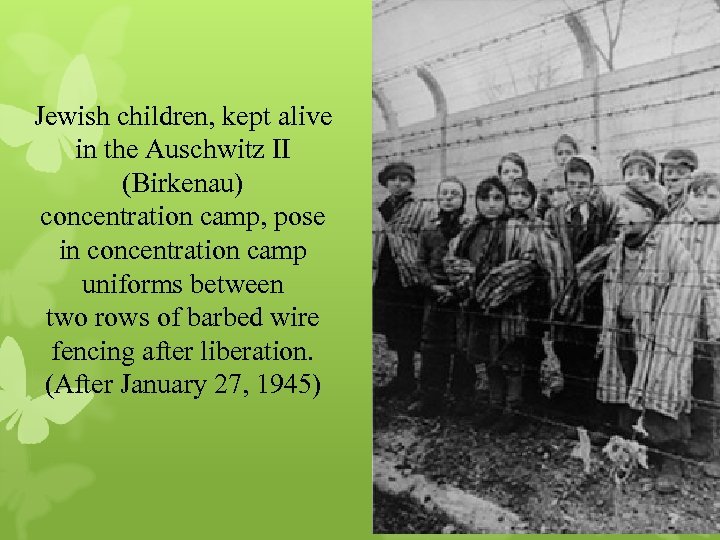
Jewish children, kept alive in the Auschwitz II (Birkenau) concentration camp, pose in concentration camp uniforms between two rows of barbed wire fencing after liberation. (After January 27, 1945)
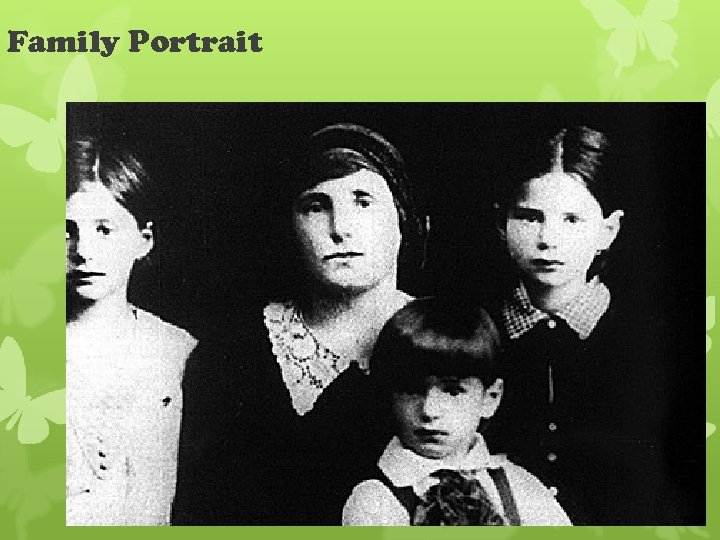
Elie Weisel & His Family
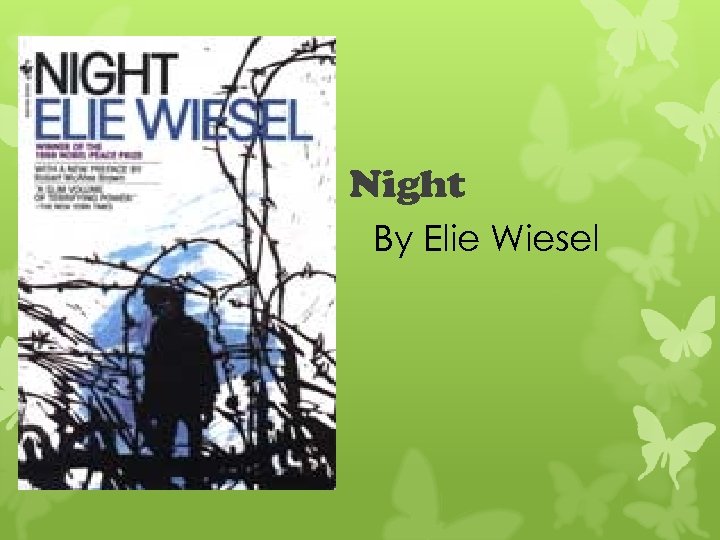
Night By Elie Wiesel
Summary of the Book The story of a young Jewish boy sent to a concentration camp during the Holocaust Story of his struggle to survive, his struggle to keep his family together, and his struggle with God
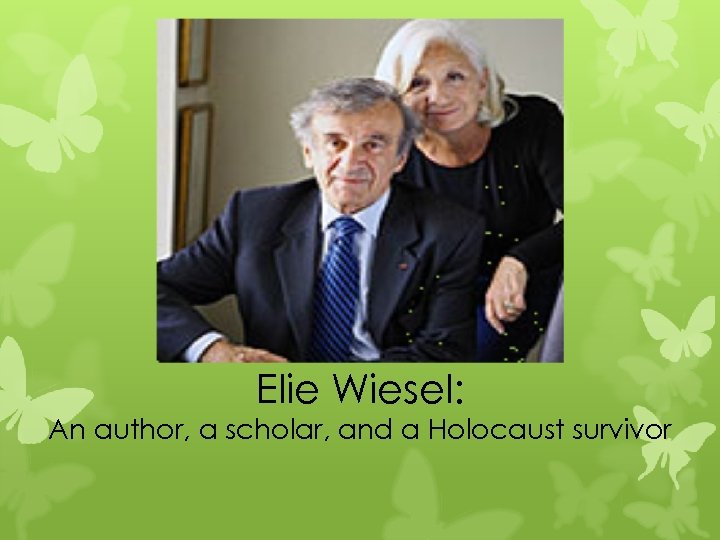
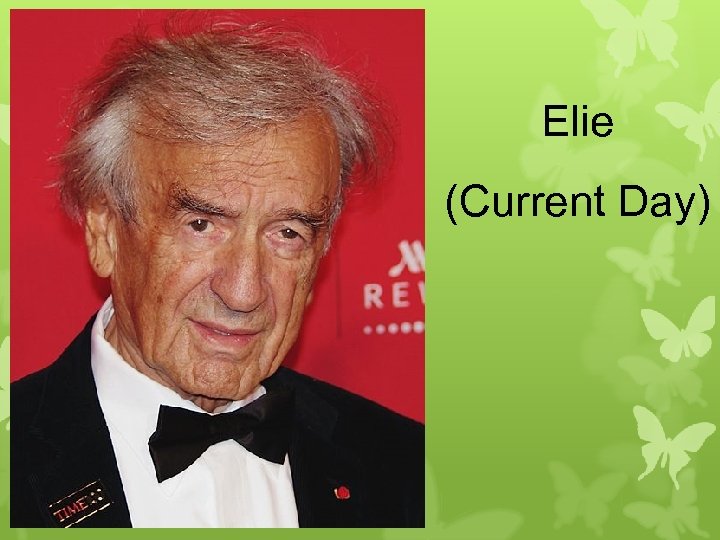
Elie Wiesel: An author, a scholar, and a Holocaust survivor
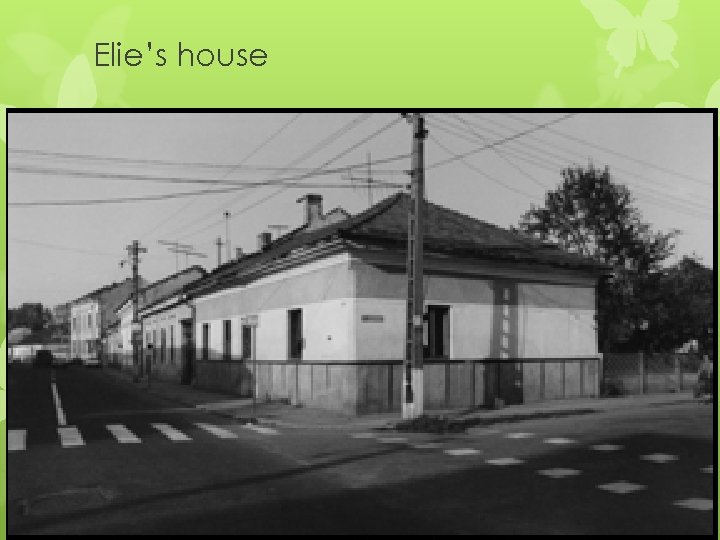
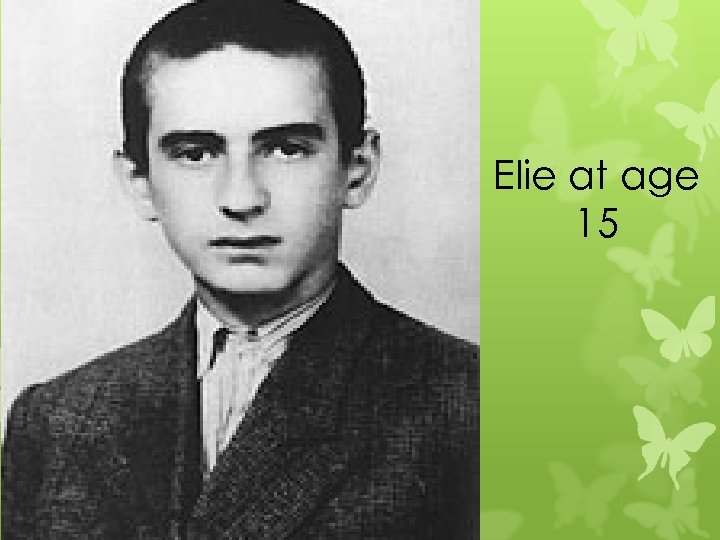
• Born on September 30, 1928, in Sighet, Transylvania • He was 15 years old when he and his family were deported by the Gestapo to Auschwitz and separated • Spent a few years in a French orphanage • Began to work for the French newspaper L'arche • Involved in journalism, Wiesel had never shared his own personal experiences during the war
§ Acquainted with the distinguished French Catholic writer and Nobel laureate Francois Mauriac, who finally inspired Wiesel to break his self-imposed vow of silence and write about surviving the Nazi concentration camps § 900 -page personal account, And the World Remained Silent, in 1956 § Two years later, a compressed, 127 -page French version called La Nuit (Night) was published § In 1960, the first English translation was published § A new 2006 edition, translated by his wife, Marion Wiesel, offers the most accurate English translation of the work to date.
• Elie Wiesel reflects on the enduring importance of Night and his lifelong, passionate dedication to ensuring that the world never forgets man's capacity for inhumanity to man. • Winner of the Nobel Peace Prize in 1986, Wiesel has dedicated his life to speaking out against hatred, bigotry and genocide • In 1978, President Jimmy Carter appointed Elie Wiesel as Chairman of the President's Commission on the Holocaust. • In 1980, he became the Founding Chairman of the United States Holocaust Memorial Council and was instrumental in the creation of the United States Holocaust Memorial Museum
He has received numerous awards including the Presidential Medal of Freedom, the U. S. Congressional Gold Medal and the Medal of Liberty Award and the rank of Grand-Croix in the French Legion of Honor In 1963, Wiesel became a U. S. citizen and he has been the Andrew W. Mellon Professor in the Humanities at Boston University since 1976. Wiesel and his wife have one son, Shlomo-Elisha, named after his father
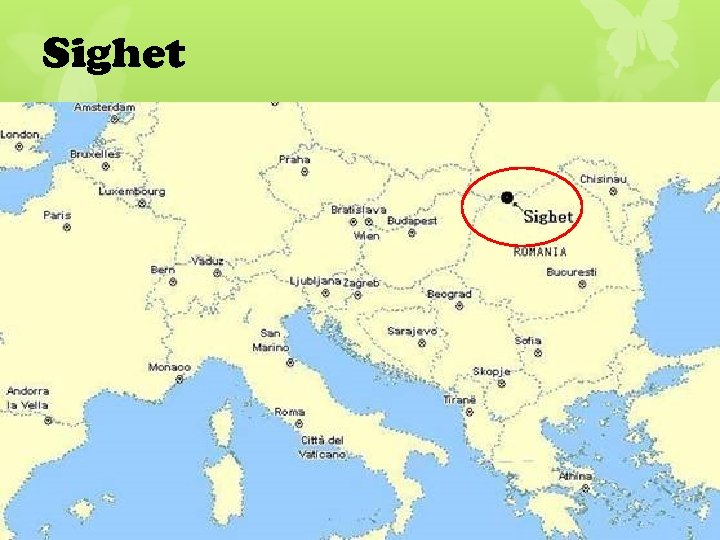
Sighet
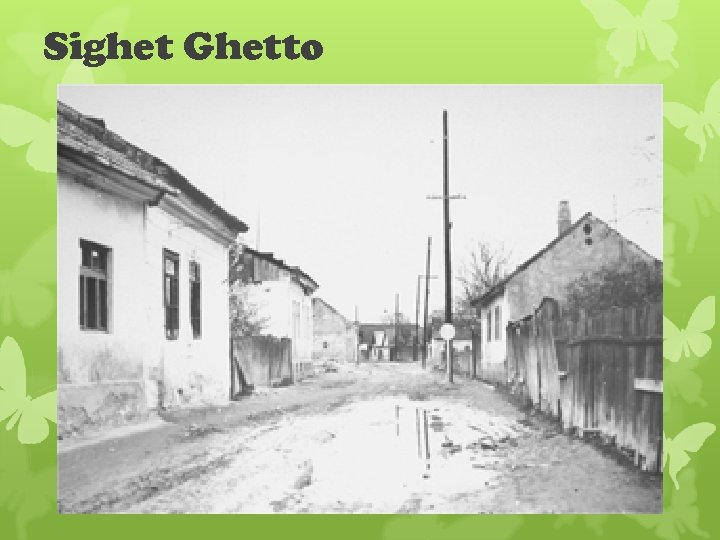
Sighet Ghetto
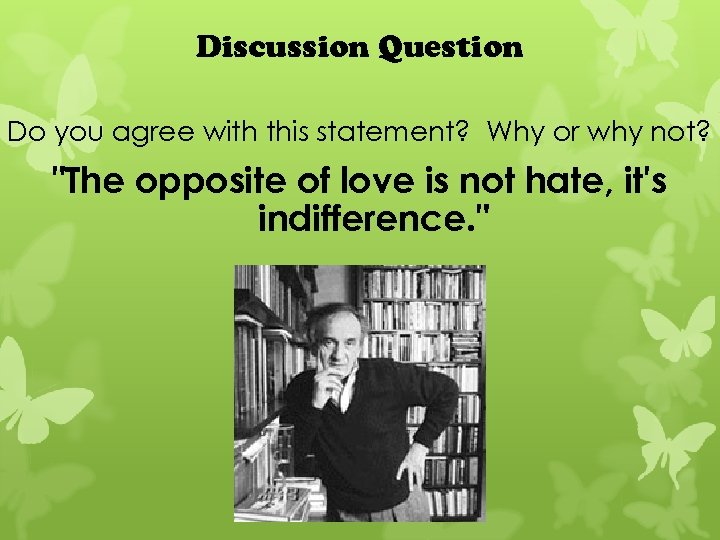
Discussion Question Do you agree with this statement? Why or why not? "The opposite of love is not hate, it's indifference. "
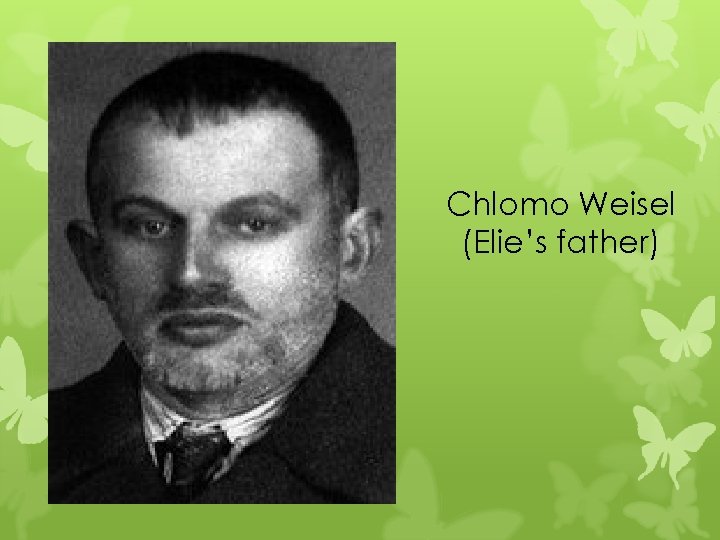
Chlomo Weisel (Elie’s father)
Elie’s house
Family Portrait
Elie at age 15
Elie (Current Day)
Discussion Questions 1. Could something like this ever happen again? 2. What would stop this from happening again? 3. How is it more or less difficult to survive a tragedy based on age? 4. What is the significance of sharing survival stories?
Background to Night—Open Notes Quiz 1. Before WWII, Germany was crippled by what event? 2. What was the “final solution” a reference to? 3. Name 3 ways that Nazi’s gradually stripped Jews of their rights. 4. True or False: Ghettos are where Jews were forced to reside. 5. What did the sign above the entrance to Auschwitz say? 6. List and explain the three divisions of Auschwitz. 7. List three facts about Elie Wiesel’s life (other than that he was a victim of the holocaust or sent to Auschwitz or wrote Night) 8. When did Wiesel become a US citizen? 9. What is Wiesel’s son’s name?
Скачать презентацию The Holocaust Background WWII Background Germany was
60d7c376e963d9715034e0ad56529175.ppt