


 Скачать презентацию The history of the United States 1492 -1877
22c98ad66a5a4bee211ce27d88b58a2d.ppt
- Количество слайдов: 17
 The history of the United States 1492 -1877 Lecture 2 The development of British North America
 Methods of colonization Joint stock companies or individuals Permission from Crown Proprietary colony Maryland Earl of Baltimore Pennsylvania, William Penn Charter colony: Plymouth, Massachusetts
 Renewal of Colonization 1607 May 6 Jamestown Established by the London Company Leading figure: Captain John Smith adventurer, amateur geographer, historian, populizer of America The History of Virginia, New England, and the Summer Isles Pocahontas episode, return to England after a gunpowder explosion
 The development of Jamestown Hard time for colonists until planting tobacco, first tobacco yield 1616 1619: Virginia House of Burgesses first legislative body Arrival of Africans as indentured workers on a Dutch man o’war 1622: March 22 Jamestown Massacre, 1624: Royal charter revoked
 Plymouth Established by Separatists in 1620 Leader: William Bradford Mayflower Compact A mission for the glory of God, for the advancement of Christian faith, and the honor of king and country 1621: Wampanoag Indians help settlers, the first Thanksgiving Main historical source: Of Plymouth Plantation 1691: Becomes part of Massachusetts
 Massachussetts 1630 Massachusetts Congregationalists John Winthrop’s sermon A Model of Christian Charity “we shall be a city upon a hill” Puritan mission concept
 The development of Massachussetts Leading body: the General Court Semi-theocracy Challenges: Roger Williams a Separatist Anne Hutchinson: against Puritan patriarchy, Rejects covenant of works: good conduct would give salvation, banished from colony
 New York 1664 New Netherlands Dutch East India company hired Henry Hudson searching for the passage to the Orient 1609: He discovered Delaware Bay, and the river named after him 1614: Dutch establish fur trading posts on Manhattan Island
 The development of New York 1626: Governor Peter Minuit purchases Manhattan from the Indians New Amsterdam will become capital of New Netherlands James, Duke of York drives out Dutch in 1664
 The influence of the Dutch Bredeweghe Broadway, Wall Street (original wall to protect against Indians) Family names: Roosevelt, Van Buren, Rensselaer Traditions, customs: Santa Claus, Rip van Winkle, Vocabulary: boss, crib, stoop
 Pennsylvania 1681 William Penn, Quaker, follower of George Fox Religious tolerance, equality of sexes, rejection of war and violence, rejection of rank Society of Friends Settlement of Non-conformists, Mennonites, Amish, Baptists, Moravians
 Georgia 1732 Settling prisoners, buffer colony 1733: Savannah founded by Oglethorpe Germans, but also Scottish Highlanders, Portuguese Jews, Welsh provide a cosmopolitan character 1753: Charter expired, colony reverted to the crown
 British North America New England: Southern N. E. Rhode Island, Connecticut, Massachusetts Northern N. E. Vermont, Maine, New Hampshire Mid-Atlantic colonies New York, New Jersey, Pennsylvania Delaware South: Virginia, Carolinas (South Carolina, North Carolina, ) Georgia,
 Reasons for successful colonization Colonies as business ventures Allowing the settlement of Non-conformists Contiguous settlement Not hostile terrain
 New England Commerce, later industry Limited agriculture Participation in triangular trade New England to Slave Coast rum, exchange for slaves Middle Passage to Bahamas, exchange for molasses Molasses to N. E. rum is made again
 Culture and society in New England Elements of Puritan perspective: Chosenness predestination Puritan work ethic Mission concept Manichean world view Good v. Evil Moderation
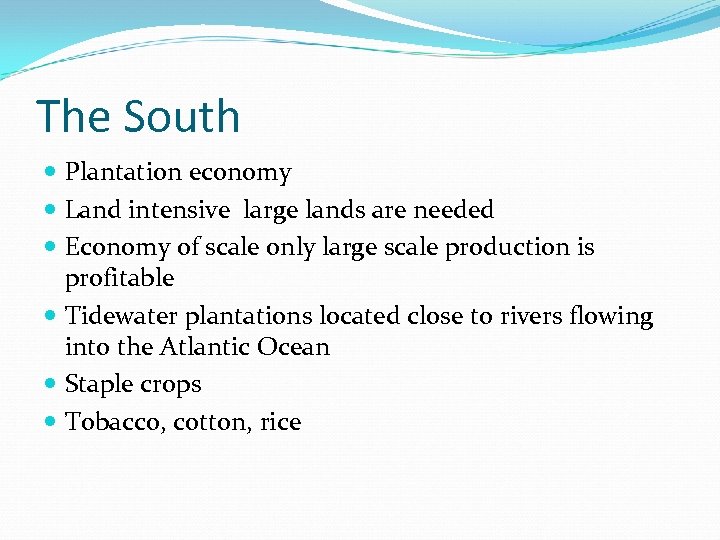 The South Plantation economy Land intensive large lands are needed Economy of scale only large scale production is profitable Tidewater plantations located close to rivers flowing into the Atlantic Ocean Staple crops Tobacco, cotton, rice