


 Скачать презентацию THE HISTORY OF LIGUISTICS The origin of
The History of Linguistics III-IV.pptx
- Количество слайдов: 27
 THE HISTORY OF LIGUISTICS
 The origin of language in philosophers' works of the 17 -18 centuries (Rousseau, Descartes, Leibniz) The period of the Renaissance and the period of Enlightment (17 th – 18 th centuries) were mostly connected with 2 main ideas: • 1) a language appeared as the result of imitation of different sounds in the natural environment (the Scottish philosopher Lord Monboddo, who lived in the 18 th century); • 2) a language could appear as a result of agreement between different people (the French philosopher Rousseau).
 René Descartes (Latinized: Renatus Cartesius; adjectival form: "Cartesian“; 31 March 1596 – 11 February 1650)
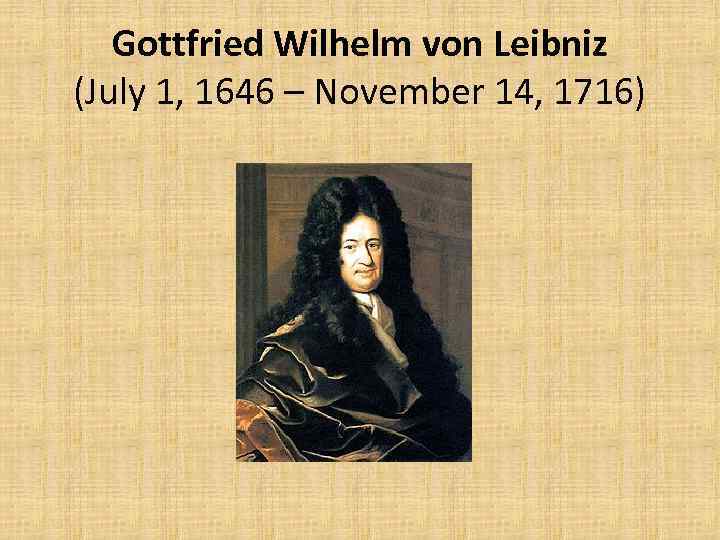 Gottfried Wilhelm von Leibniz (July 1, 1646 – November 14, 1716)
 Only in the 20 th century on the basis of this Leibniz’s language two other artificial languages were created: THE BASIC and THE PASCAL.
 The historical-comparative linguistics (a most general overview) Scholars introduced 2 main principles according to which any language should be described: • 1. the notion of history • 2. the principle of comparison
![• • Sanscrit – pitar [pi’ta: r]; bhratar Greek – patir [pa’ter]; phrater](https://present5.com/presentation/41948825_168630258/image-7.jpg "• • Sanscrit – pitar [pi’ta: r]; bhratar Greek – patir [pa’ter]; phrater") • • Sanscrit – pitar [pi’ta: r]; bhratar Greek – patir [pa’ter]; phrater Latin – [‘pa: tə]; frater Gothic – ‘fadar; brothar German – ‘Vater; Bruder English – ‘father; Brother Belarusian – бацька; брат
• • Sanscrit – pitar [pi’ta: r]; bhratar Greek – patir [pa’ter]; phrater Latin – [‘pa: tə]; frater Gothic – ‘fadar; brothar German – ‘Vater; Bruder English – ‘father; Brother Belarusian – бацька; брат
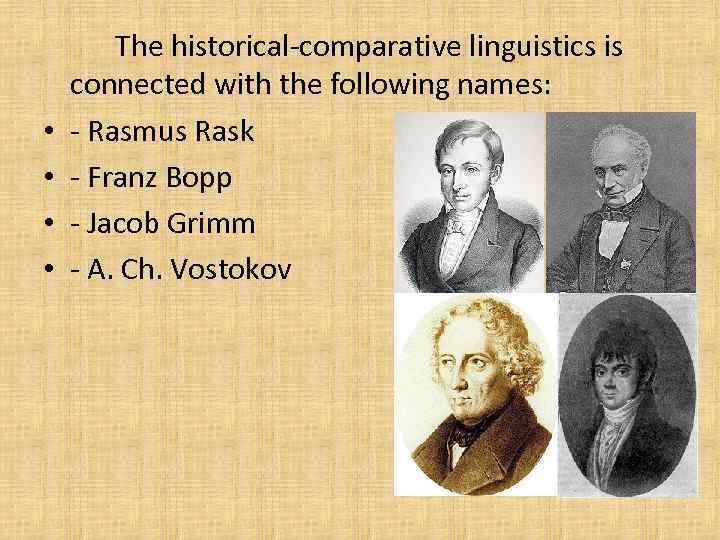 • • The historical-comparative linguistics is connected with the following names: - Rasmus Rask - Franz Bopp - Jacob Grimm - A. Ch. Vostokov
 At the end of the 19 th century we observe the rise of the Descriptive Linguistics. This kind of linguistics were opposed to Comparative studies, Descriptive Linguistics became the source of some major developments in contemporary linguistics.
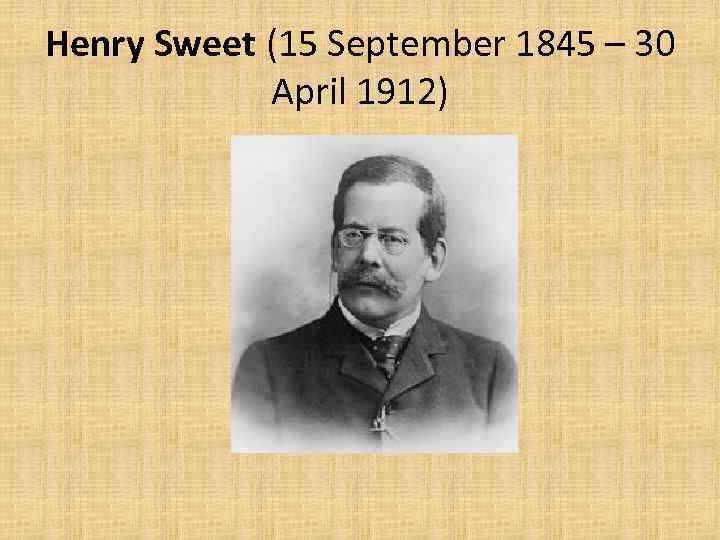 Henry Sweet (15 September 1845 – 30 April 1912)
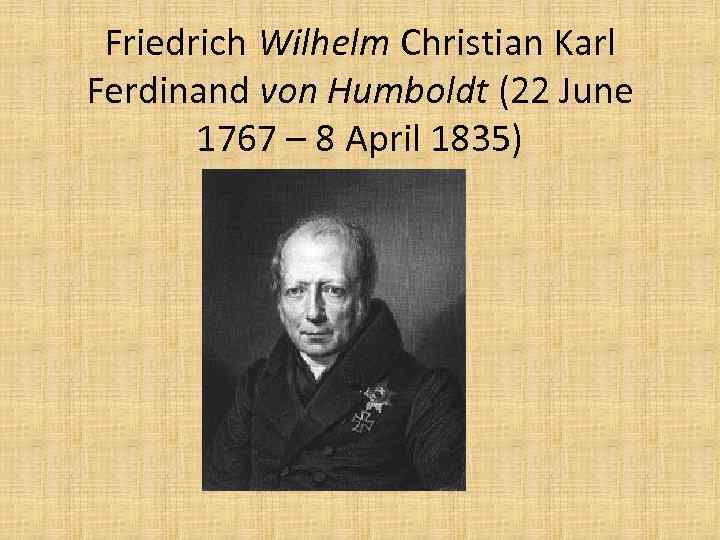 Friedrich Wilhelm Christian Karl Ferdinand von Humboldt (22 June 1767 – 8 April 1835)
 Wilhelm von Humboldt's ideas on language • Language is the organ that shapes thought (‘Die Sprache ist das bildende Organ des Gedanken’). • Moreover, in every language there is a proper world view.
 Alexander Potebnia • Language for him was primarily the means by which the mind ordered the influx of impressions and stimuli. Words carry not only a meaning, but also the past experience of the individual and the nation, through which all new experience is filtered. • Regarding language as an individual's or a nation's only possible means of perceiving the world and of thinking, Potebnia protested vehemently against denationalization in general and the Russification of the Ukrainians in particular, and equated this process with spiritual and intellectual disintegration. • Potebnia's philosophy of language is rooted in Wilhelm von Humboldt's romantic idealism.
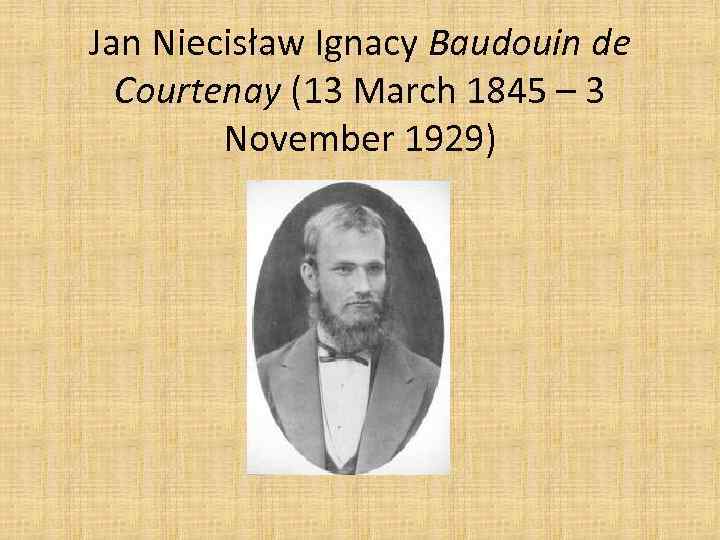 Jan Niecisław Ignacy Baudouin de Courtenay (13 March 1845 – 3 November 1929)
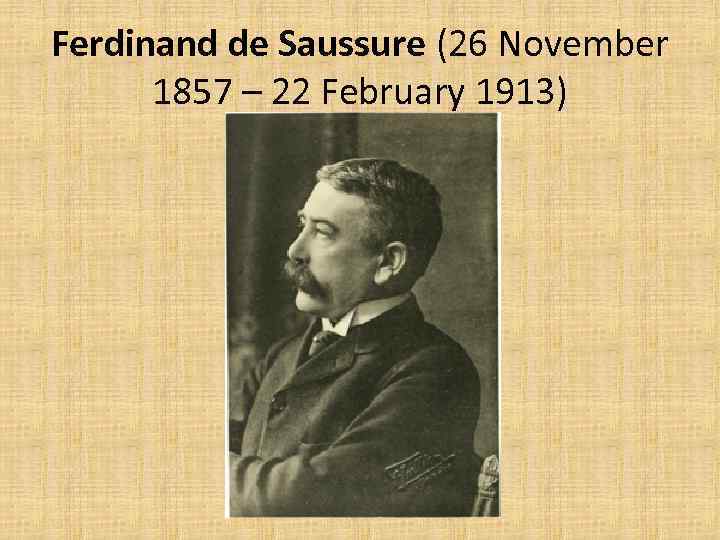 Ferdinand de Saussure (26 November 1857 – 22 February 1913)
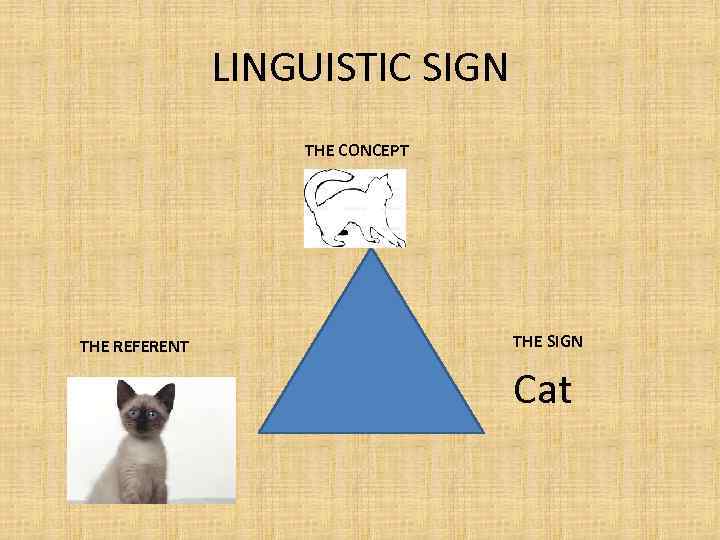 LINGUISTIC SIGN THE CONCEPT THE REFERENT THE SIGN Cat
 Neogrammarian School • The Neogrammarians (also Young Grammarians, German Junggrammatiker) were a German school of linguists, originally at the University of Leipzig. • The object of linguistic investigation is not the language system, but rather the idiolect, that is, language as it is localized in the individual, and therefore is directly observable. • The neogrammarians viewed language as an individual psychophysiological activity; they believed that changes occur and spread in language as a result of more or less accidental causes connected with peculiarities of linguistic usage. • The neogrammarians thought that there was only individual psychology and ethnopsychology was a myth. • Hermann Paul, a German linguist and lexicographer, was convinced that there were as many languages as there were individuals.
 Sociological approach in language study • Sociological approach in language study appeared as the reaction the ideas of the neogrammarians. it was represented by Humboldt, Baudouin de Courtenay, Fortunatov.
 Structural approach in language study • Structuralism, theory that uses culturally interconnected signs to reconstruct systems of relationships rather than studying isolated, material things in themselves. • This method found wide use from the early 20 th cent. in a variety of fields, especially linguistics. • Structural linguistics in Europe is generally said to have begun in 1916 with the posthumous publication of the “Course in General Linguistics” of Ferdinand de Saussure.
 • The theoretical approach offered by structuralism emphasizes that elements of culture must be understood in terms of their relationship to the entire system. This notion, that the whole is greater than the parts, appeals to the Gestalt school of psychology. • Essentially, elements of culture are not explanatory in and of themselves, but rather form part of a meaningful system. As an analytical model, structuralism assumes the universality of human thought processes in an effort to explain the “deep structure” or underlying meaning existing in cultural phenomena.
 There are several Structural schools of linguistics: • 1) The Copenhagen school (founded by Louis Hjelmslev and Viggo Brøndal) • 2) The Prague school (Vilém Mathesius, the Russian linguist Nikolay Trubetskoy and the Russian-born American linguist Roman Jakobson) • 3) American school of linguistics (Leonard Bloomfield, Franz Boas and Edward Sapir).
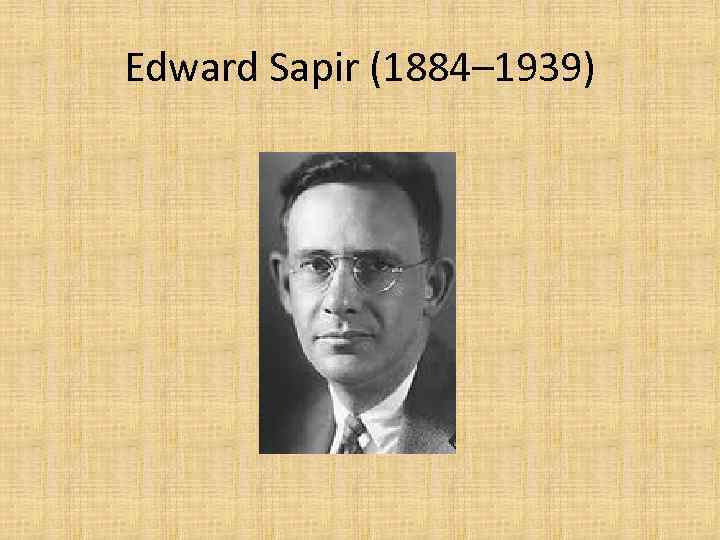 Edward Sapir (1884– 1939)
 • Edward Sapir introduced his own theory which was based on the description of American-Indian languages. He described the languages of the Canadian tribes, he paid attention to the grammatical structure of these languages and he introduced his own idea for the descriptive linguistics. • His idea is usually known as linguistic relativity. He paid attention to the difficulty in relating language to the outer world. He stated that “we see the world as if we depend on the language we use” and that “language shapes our perceptions”. Cultural behavior is closely connected with the language spoken by the peoples. • According to this ideas people categorized the objects of the surrounding reality according to their experience and the understanding of the world.
 • He stresses the situation in which language influences our experience and our perceptions are determined by our language. This idea was rather new in the 20 th century because scholars thought that the influence usually goes from the surrounding world to human understanding of it expressed in the language. • Edward Sapir suggested that a person in his mind may built up his own picture of the world. This picture may be different from other people’s models.
 • He introduced the idea of linguistic relativity associated with the well-known hypothesizes expressed by him and his pupil Benjamin Whorf. According to this hypothesis people don’t know the background of the language. A language doesn’t describe ideas but it can shape the ideas.
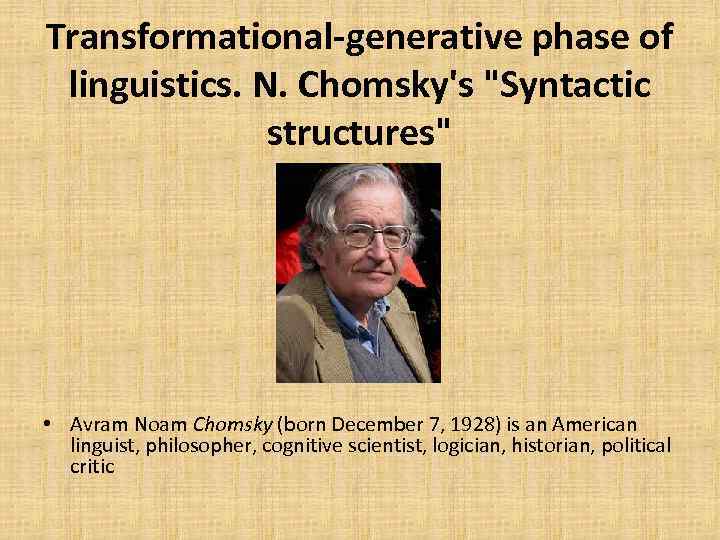 Transformational-generative phase of linguistics. N. Chomsky's "Syntactic structures" • Avram Noam Chomsky (born December 7, 1928) is an American linguist, philosopher, cognitive scientist, logician, historian, political critic
 • A linguistic theory developed by Noam Chomsky, first put forth in his book “Syntactic Structures” (1957), A central premise of Chomsky's work is that humans are innately predisposed to language abilities, and that such transformational processes are linguistic universals. • Two levels of representation of the structure of sentences: an underlying, more abstract form, termed 'deep structure', and the actual form of the sentence produced, called 'surface structure'.