


 Скачать презентацию The Hidden Injuries of State-led Gentrification Conceptualising Displacement
e25210dd447e0c4f92e00399ecbdf788.ppt
- Количество слайдов: 23
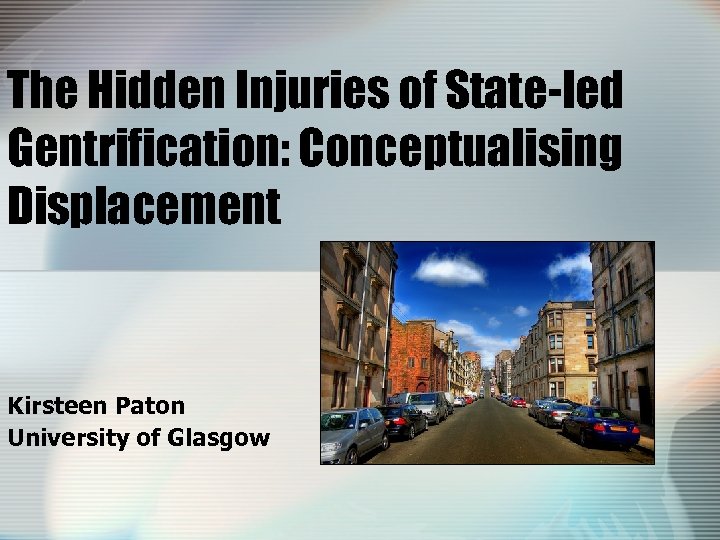 The Hidden Injuries of State-led Gentrification: Conceptualising Displacement Kirsteen Paton University of Glasgow
 The hidden injuries of state-led gentrification: Conceptualising displacement “If the pain of displacement is not a central component of what we are dealing with in studying gentrification - indeed, is not what brings us to the subject in the first place - we are not just missing one factor in a multifactorial equation; we are missing the central point that needs to be addressed. ” (Marcuse, 2010: 187) • State-led gentrification = shift in analytical focus • Require analytical shift in understanding effects: conceptualising displacement Invert dominant formula: the definition of gentrification informs how we understand the effects The effects of state-led gentrification help us better understand what this process is trying to achieve
 Displacement Orthodoxy “. . . any household is forced to move from its residence by conditions which affect the dwelling or its immediate surroundings” (US Department of Housing and Urban Development in Le Gates and Hartman, 1981: 214) “The term describes what happens where forces outside the household make living there impossible, hazardous or unaffordable” (Hartmann, 1982: 3)
 Displacement Orthodoxy Two dimensions: 1. Physical, out-migration Problems of causality and indicators = census and proxy data used ‘displacement is marked out by its near invisibility; where it has happened no indicators remain’ (Atkinson, 2000: 39) 2. Cultural, social, political aspects which marginalise (and can result in physical out-migration) Marcuse’s (1986) 4 forms: 1. 2. 3. 4. last-resident displacement chain displacement exclusionary displacement pressure.
 State-led Gentrification • State-led gentrification: • Institutionalisation of gentrification within regeneration policy • The creation of space for the progressively more affluent user, Hackworth (2002) • Involves aspects of economic and social redevelopment • Lack of consensus
 State-led gentrification “Gentrification is now thoroughly institutionalised by local and national governments as part of renewal strategies. Yet conventional explanations of gentrification do not fully explain the scope, scale, and form of the processes involved. ” (Uitermark et al. , 2007: 125) • Slater (2006): ‘eviction of critical perspectives’ in discussions of state-led gentrification
 State-led Gentrification • Study of effects conceptually weak • Focus still on quantification • Lambert and Boddy (2002: 23): No displacement takes place with state-led gentrification therefore using gentrification to describe this regeneration is ‘stretching the term and what it set out to describe too far’ • Need for different approach to study of effects
 Inverting the focus: • Dialectical exploration between cause and effect • Focus on the standpoint and experiences of working-class residents experiencing state-led gentrification • Understanding displacement elucidates how and why gentrification is used as urban policy and attends to the ‘eviction of critical perspectives’ “…gentrification is a means through which governmental organisations and their partners lure the middle classes into disadvantaged areas with the purpose of civilising and controlling these neighbourhoods. ” (Uitermark et al, 2007: 127) • Physical displacement not necessarily be the primary aim rather it is the working-class ‘subject’ that is being displaced.
 Glasgow in Context • Scotland: historical imagery as working class industrial nation • Today: post-devolution, post-industrial: ‘Smart successful Scotland’ • Glasgow, largest city in Scotland • industrial working-class history, ‘second city of the empire’ • Today: ‘it has shaken of its shroud of industrial soot and shimmied into a sparkling new designer gown’ (Lonely Planet, 2009). • ‘Scotland with Style’
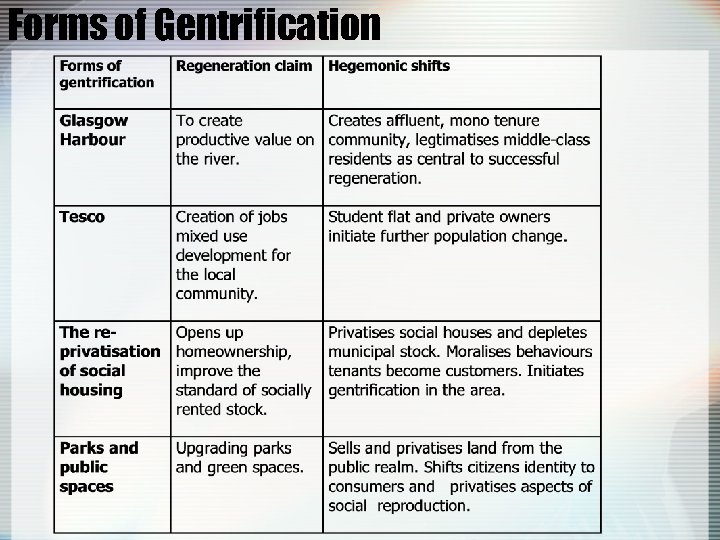
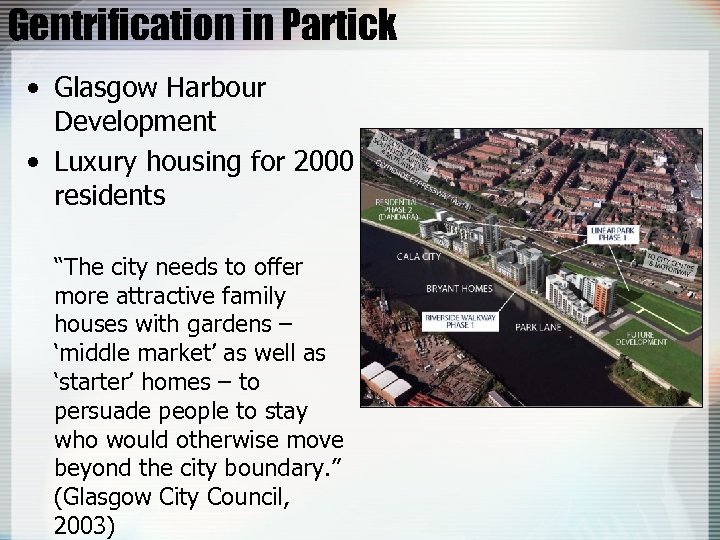 Gentrification in Partick • Glasgow Harbour Development • Luxury housing for 2000 residents “The city needs to offer more attractive family houses with gardens – ‘middle market’ as well as ‘starter’ homes – to persuade people to stay who would otherwise move beyond the city boundary. ” (Glasgow City Council, 2003)
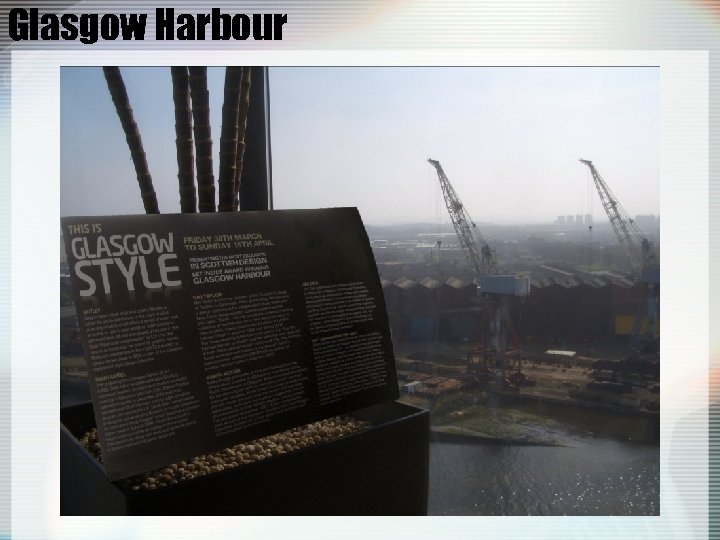 Glasgow Harbour
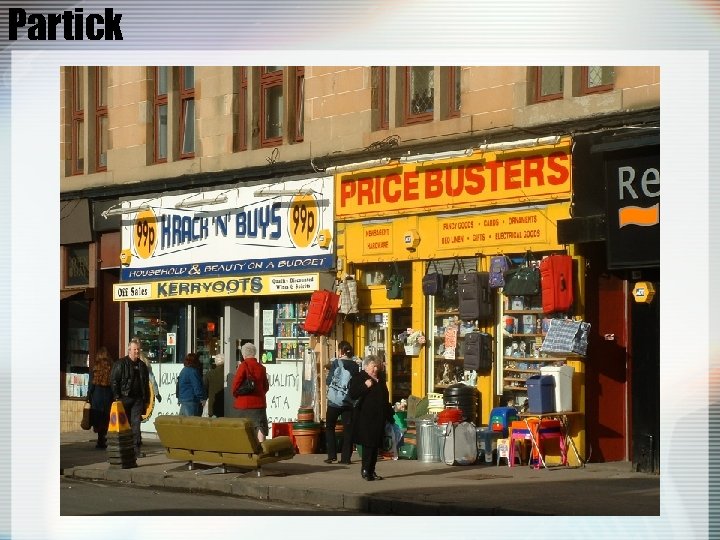
 Partick in historical context • • • Traditionally working-class neighbourhood Former site of shipyards and grain mills Site of working class social reproduction History of Glasgow Rent Strikes, 1915 Survived two cycles of displacement; development of housing association and slum clearances • Predominantly social housing • Partick Housing Association (PHA) created as social housing provider
 Partick
 Forms of Gentrification
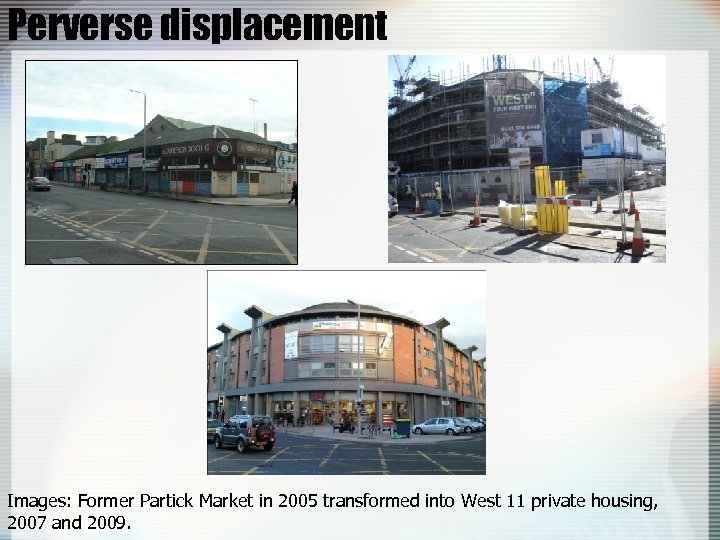 Perverse displacement Images: Former Partick Market in 2005 transformed into West 11 private housing, 2007 and 2009.
 Perverse displacement • PHA turned to property development to raise finances, contributing to gentrification within Partick • Perverse displacement occurs as social landlords are partially privatised. Shift from original social welfare goals to quest for profit. Social landlords undertake self-financing projects as residents’ – their ‘customers’ – housing opportunities are curtailed
 Latent generational displacement Young people leaving home, unable to afford to buy, rent privately or secure socially rented accommodation in their neighbourhood and have no choice but to leave the neighbourhood: latent generational displacement Gordon, 24: […] It just bothers me because you know I can’t get anywhere to stay around where I live now. I can’t afford it and that’s something that annoys me because the prices are so expensive… Fi, 63: It’s a big issue. I can’t get my son a house but other people do. A whole generation of people can’t get a house, you can’t buy. They are with their mothers.
![Fi: She’s like [mock posh accent] ‘Oh Fi its absolutely marvellous’. I said ‘Not](https://present5.com/presentation/e25210dd447e0c4f92e00399ecbdf788/image-18.jpg "Fi: She’s like [mock posh accent] ‘Oh Fi its absolutely marvellous’. I said ‘Not") Fi: She’s like [mock posh accent] ‘Oh Fi its absolutely marvellous’. I said ‘Not for working-class folk its not. Folk who just want to talk about, ‘I got the phone bill in’ or ‘my man was drunk and never gave me my money’ or your weans not having a school uniform. I mean I mind my kids didnae have a school uniform and I had to pass the one’s who was skinny to the one that was fat. Know what I mean? You’ve been there! You’ve nae choice, you have to. Because that’s real life. That’s what we used to sit and talk about. You cannae talk about that now. Well nothing’s stopping you…well you’re limited to what your conversation can be because women like that cannae relate […] Someone needs to say hold on a minute this is what we want, this is what we need I don’t want to do arts and crafts, ‘cause not everybody does. [my emphasis]
Fi: She’s like [mock posh accent] ‘Oh Fi its absolutely marvellous’. I said ‘Not for working-class folk its not. Folk who just want to talk about, ‘I got the phone bill in’ or ‘my man was drunk and never gave me my money’ or your weans not having a school uniform. I mean I mind my kids didnae have a school uniform and I had to pass the one’s who was skinny to the one that was fat. Know what I mean? You’ve been there! You’ve nae choice, you have to. Because that’s real life. That’s what we used to sit and talk about. You cannae talk about that now. Well nothing’s stopping you…well you’re limited to what your conversation can be because women like that cannae relate […] Someone needs to say hold on a minute this is what we want, this is what we need I don’t want to do arts and crafts, ‘cause not everybody does. [my emphasis]
 Strategic displacement Norma: My neighbours in the close are old Partick people, they’ve stayed here all their life […] My upstairs neighbour commented to me that Partick Housing Association policy was to get lots of new people in. So his friend couldn’t get a place to live here when he’s from Partick. I think there’s a bit of resentment in some people as their brother, cousins, what have you, couldn’t get a flat. Louise: I was told I would have to wait a while for a house but it was really, really quick. Norma: I waited three months. Louise: Well I was a few weeks. Seriously. I phoned up and it was like ‘here’s the keys’. Gareth: I agree. I found that out of all the associations I applied to PHA were more sympathetic to people’s needs. . .
 Strategic displacement Sean, 25: I’m just worried about my rent arrears. Partick Housing have threatened to take me to court a few times. I’ve got all my furniture in that flat, if I was to lose that flat I would have nowhere to put that stuff. Steve, 37: […] They do this traffic light thing; three strikes and you’re out. I'm on amber. But surely you're entitled to a couple of hundred pounds [arrears]? …I mean it’s not the greatest of wee flats I've got but it’s a roof over my head and I need it. Strategic displacement: where working-class social renters deemed morally and materially unproductive can be ‘unfixed from place’, in order for it to be more profitable.
 Spiralling gentrification: when those displaced residents contribute to the displacement of working class residents in other neigbourhoods. Gordon, 24: If you get on the waiting list and wait seven years you might get one but I wouldn’t bank on it. I’ve put my name down every year, Partick and Yorkhill as well. But I’m putting my name down for Ibrox. Apparently they’re trying to regenerate the area and they have kicked out the junkies and the troublemakers and they’re giving the houses out to people. So people who have been working in a job for two or three years have a good chance of getting a house […] Sylvie, 19: My Uncle Joe, his house is coming down in Ibrox and the only place he wants to move to is Partick. So he’s not taking money for his house, he’s not moving or anything so they won’t pull it down. He won’t move ‘til he gets Partick.

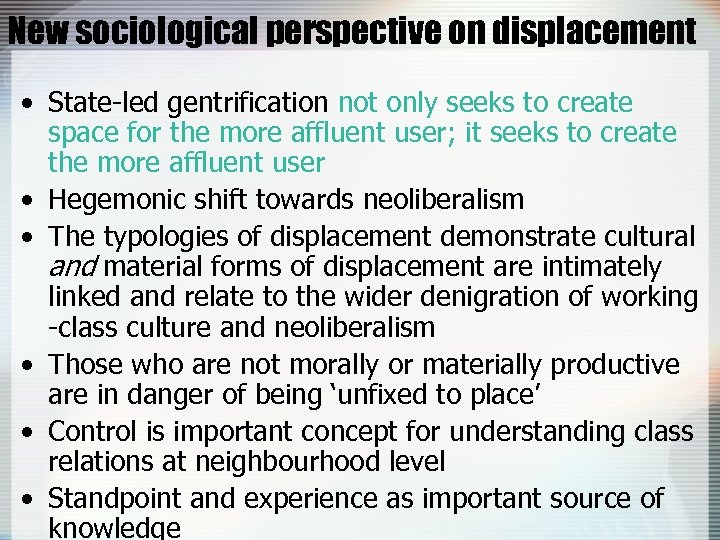 New sociological perspective on displacement • State-led gentrification not only seeks to create space for the more affluent user; it seeks to create the more affluent user • Hegemonic shift towards neoliberalism • The typologies of displacement demonstrate cultural and material forms of displacement are intimately linked and relate to the wider denigration of working -class culture and neoliberalism • Those who are not morally or materially productive are in danger of being ‘unfixed to place’ • Control is important concept for understanding class relations at neighbourhood level • Standpoint and experience as important source of knowledge