


 Скачать презентацию The Healthcare Education Industry Partnership A program
852820cf5e083f5d8095ae2da1cb6faf.ppt
- Количество слайдов: 25
 The Healthcare Education – Industry Partnership A program of Minnesota State Colleges and Universities
 Background on the Healthcare Education – Industry Partnership • Founded in 1998 by Minnesota Legislature as one of five ‘Targeted Industry Partnerships’ • Continued funding and support from grants and Minnesota State Colleges and Universities
 Mission of the Healthcare Education - Industry Partnership Working in partnership to provide innovative leadership to guide the education and training of a high quality workforce in a rapidly changing industry
 Healthcare Education – Industry Partnership • Minnesota State Colleges and Universities – educating 80% of nurses, 50% allied health • Engage healthcare providers, state agencies in strategic planning • Led by Partnership Council • Collect and analyze workforce data • Identify and implement solutions
 Initiatives • Nursing – Core Curriculum – Clinical Sites – Simulation – Articulation – Faculty • K-12 – Youth Apprenticeships – HOSA – Core Curriculum • Immigrant and Refugee – Community Health Worker – Commission on the Emerging Worker – Career Pathways
 Initiatives • Nursing – Core Curriculum – Clinical Sites – Simulation – Articulation – Faculty • K-12 – Youth Apprenticeships – HOSA – Core Curriculum • Immigrant and Refugee – Community Health Worker – Commission on the Emerging Worker – Career Pathways • Allied Health
 Why Healthcare Providers Should Care About Allied Health • Healthcare shortages/fewer schools producing healthcare professionals • Other industries want our skilled workforce • Provide most of the diagnostic data needed for our providers to make decisions • Healthcare facilities could not stay open without this skilled workforce
 Allied Health Concerns/Issues • Rad Tech – General rad tech is stable – Need for specialties – MRI, CT – Possible loss of programs? • CV Tech – Small programs; none in the Twin Cities Metro area – Incumbent training – Entry-level personnel • Dental Hygiene and Assisting – Ability to address dental shortage through expanded functions • Clinical Laboratory
 HEIP’s Clinical Laboratory Workgroup • Working together to address workforce shortages since 1999 • Comprised of laboratory managers of urban and rural hospitals, biomedical industry representatives, Minnesota Department of Health, laboratory educators, Minnesota Hospital Association • Meets monthly
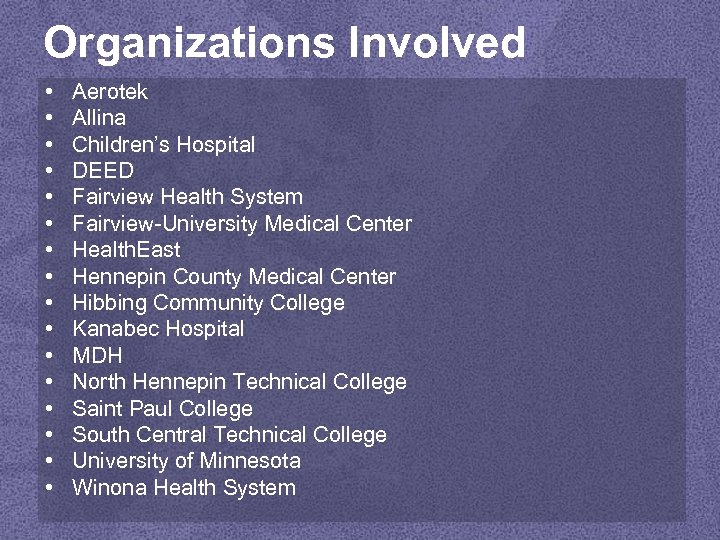 Organizations Involved • • • • Aerotek Allina Children’s Hospital DEED Fairview Health System Fairview-University Medical Center Health. East Hennepin County Medical Center Hibbing Community College Kanabec Hospital MDH North Hennepin Technical College Saint Paul College South Central Technical College University of Minnesota Winona Health System
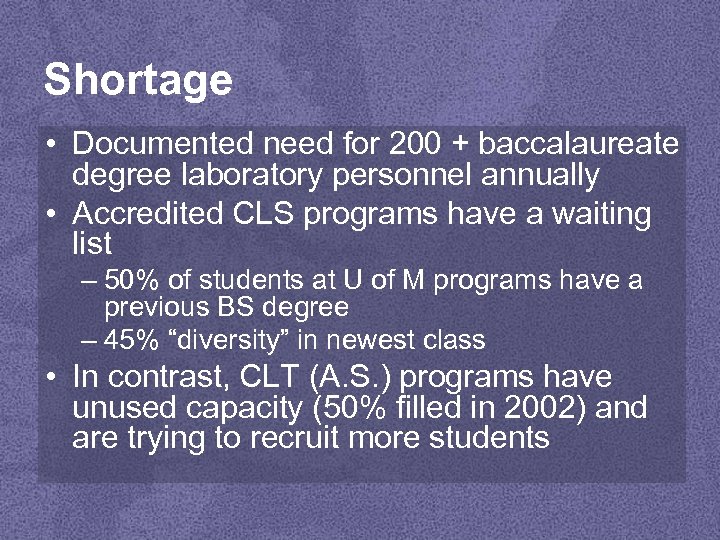 Shortage • Documented need for 200 + baccalaureate degree laboratory personnel annually • Accredited CLS programs have a waiting list – 50% of students at U of M programs have a previous BS degree – 45% “diversity” in newest class • In contrast, CLT (A. S. ) programs have unused capacity (50% filled in 2002) and are trying to recruit more students
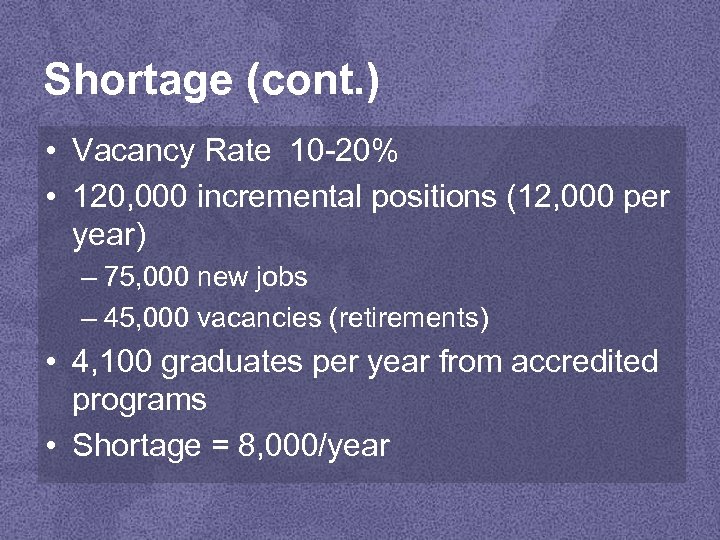 Shortage (cont. ) • Vacancy Rate 10 -20% • 120, 000 incremental positions (12, 000 per year) – 75, 000 new jobs – 45, 000 vacancies (retirements) • 4, 100 graduates per year from accredited programs • Shortage = 8, 000/year
 Reasons for Increased Demand • 70% of objective information used in diagnosis and treatment comes from the laboratory • Aging population needs care in increasing numbers • Acuity and complexity of patient population increasing • Automation improves productivity, but new technology and new tests, especially DNA based testing, maintain the demand for those with skills • Expanded roles for clinical laboratory staff, both in health care and the biotech industry • Need for laboratory capacity to respond to emerging infections, bioterrorism, emergency preparedness
 Reasons for Decreased/Stagnant Supply • Other options in healthcare and industry are more attractive – Hours – Salary – Education • “Unknown” profession • Availability of educational institutions
 Activities of HEIP Clinical Laboratory Workgroup • • • Legislative/Advocacy New Curriculum Model Biomedical Partnerships Compensation Histotech
 Legislative/Advocacy Subcommittee • Advocacy Day in April and November • Communication with others – HEIP Policy Council – Presence at public hearings – Department of Health bioterrorism committees – Hospital Association members/workforce committee
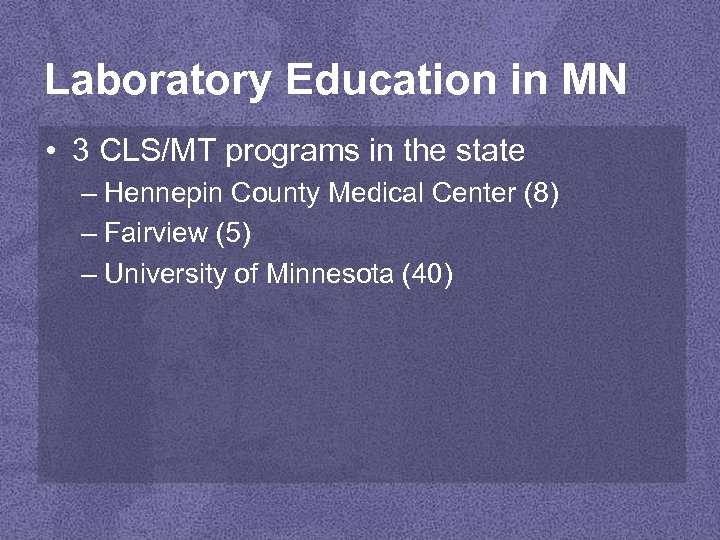 Laboratory Education in MN • 3 CLS/MT programs in the state – Hennepin County Medical Center (8) – Fairview (5) – University of Minnesota (40)
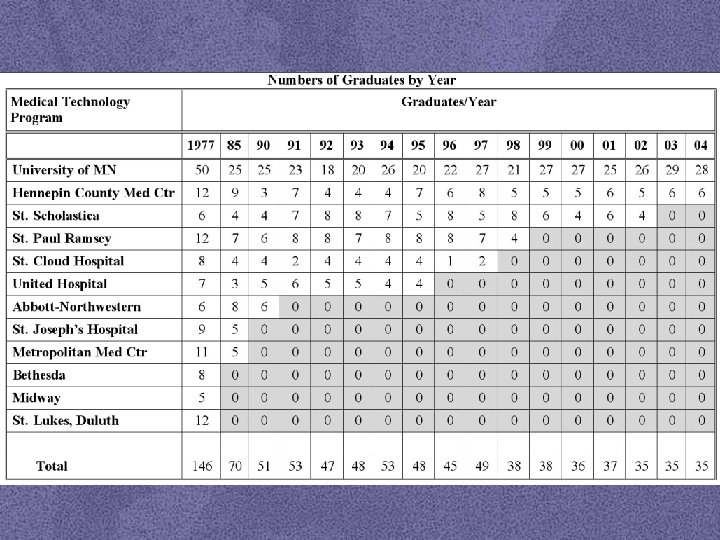
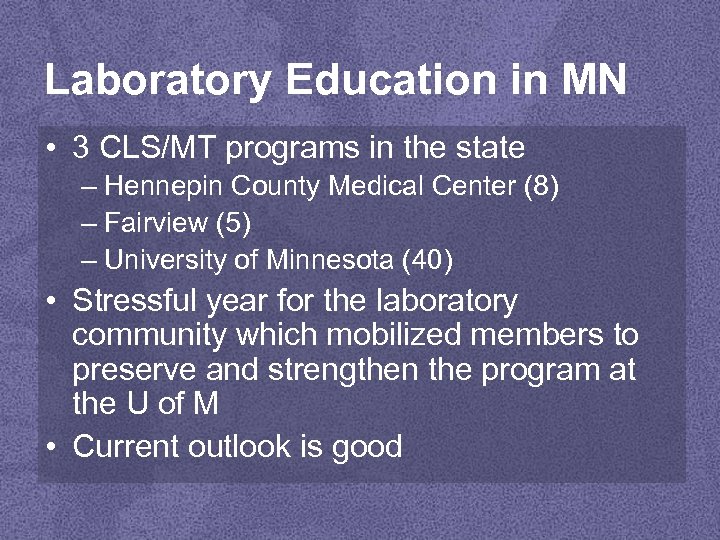 Laboratory Education in MN • 3 CLS/MT programs in the state – Hennepin County Medical Center (8) – Fairview (5) – University of Minnesota (40) • Stressful year for the laboratory community which mobilized members to preserve and strengthen the program at the U of M • Current outlook is good
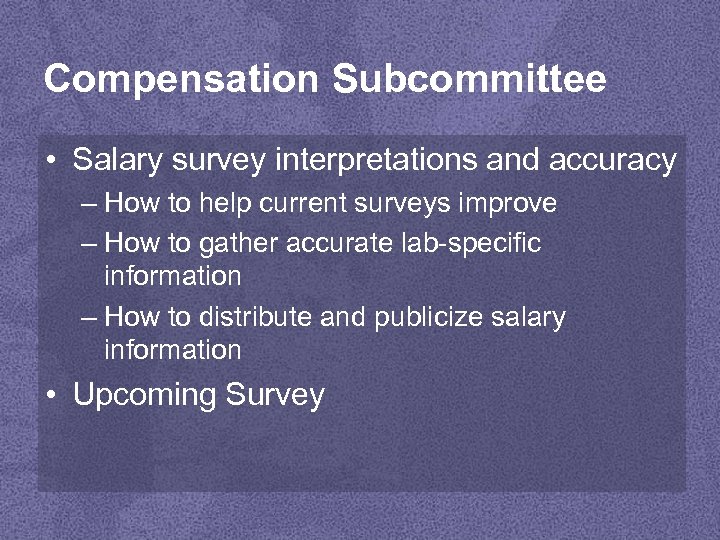 Compensation Subcommittee • Salary survey interpretations and accuracy – How to help current surveys improve – How to gather accurate lab-specific information – How to distribute and publicize salary information • Upcoming Survey
 Biotech/Biomed Partnerships • Medical Alley • U of M program working with biotech/biomed employers to meet their educational needs • Exploration of a biotech/biomed track at the U of M
 New Curriculum • Feasibility of a curriculum revision or additional curricular option for “core bench” MLT/CLTs • Survey of laboratory managers – Sent to 285 lab managers throughout the state – Collected information on lab size and use of MLT/CLTs • The use of CLT/MLTs varies considerably between urban and rural • Several competencies being taught are actually not required by rural providers but the time investment those competencies require has not been investigated
 Histotech • Newest subcommittee • Just starting to strategize solutions
 Conclusions • Shortages Require: – Expansion of programs – Metro & Greater Minnesota – Commitment to solutions – Collaboration
 Questions ? Valerie De. For Healthcare Education – Industry Partnership 124 Myers Field House Mankato, MN 56001 507/329 -2140 valerie. defor@mnsu. edu