 Скачать презентацию The GVT Story Dec 2008 Background Established
3c3bb094767fd038e767efe6459d8938.ppt
- Количество слайдов: 19



The GVT Story Dec 2008
Background Established in 1998, the GVT Group began operations in Latin America – Chile, Columbia, Peru and others. In 1999, GVT won a bid to provide wireline services initially in an area representing 1/3 of Brazil population. GVT paid for the license $60 k. The bid was part of the privatization of the local incumbent that began in 1996. Following the bid, and given Brazil’s huge potential, GVT sold all its other assets and focused on Brazil only. During 2000 the network was designed and deployment was initiated, and in January 2001, 15 months after the license was granted, GVT began to provide services. The Israeli angle – Ø GVT Brazil had 5 Israelis out of 7 employees in 1999, today there are 3 Israelis and 3, 300 Brazilian employees. Ø GVT initial shareholders were the magnum Group (67%) and the IDB Group (33%). Ø The original shareholders, together with the Swarth Group are still the controlling shareholders with more than 30% of GVT’s shares. 1
What’s Attractive in Brazil 1. A huge country: 1. 9 million km 2 – 400 times the size of Israel 2. 200 m inhabitants 3. Labor force of 102 million workers 4. Average of 28 2. The largest economy in Latin America, among the 10 largest worldwide 1. $1. 3 trillion GDP (mostly services and industry, only 5% in agriculture) 2. 2009 growth forecast of 4% 3. $220 bln export 4. $210 bln reserves held by the Central Bank 5. Investment Grade (-BBB) rating 3. Huge telecom industry: 1. $20 bln market for fix-line and LD 2. More than 100 m mobile users …and GVT is still the only viable competitor to the Fixed Line Incumbents… 2
The Incumbents Following the privatization, the ‘old’ incumbent was divided into 3 regional companies (each 5 x the size of Bezeq) with a fourth player for the long distance and international segment. Competing with the giants was expected to be tough: Ø Huge initial territory – 5 hours flight from one side to another Ø No ULL – GVT had to deploy all network from scratch Ø No number portability – subs had to lose their 20 -30 year old number Ø Market with small growth of wireline Ø Competitors with experience, deep pockets and a monopoly environment (100% market share…). Ø Local players with experience and relationship with regulators and local banks. …so other than just ‘hutzpa’, a different approach was required to in order to succeed… 3
The GVT’s Approach - Strategy Business strategy 1. Focus: 1. Unlike the USO of the Incumbents, GVT has the right to “select” cities (and neighborhoods within the cities) and select customers. 2. GVT focuses on SOHOs, small business and high class residential. 3. 100% of GVT’s customers credit is checked pre-installation. 2. The most modern network in Brazil, one of most modern worldwide – 1. Best service to customers – bundles, bandwidth, SLA 2. operational efficiency 3. The IP leader in Brazil 3. Gradual but constant expansion to new cities 4. Strong IT systems – constant monitoring of CF and performance indicators 5. Be creative, be a leader. GVT has introduced a higher number, by far, of new products and bundled services. 4
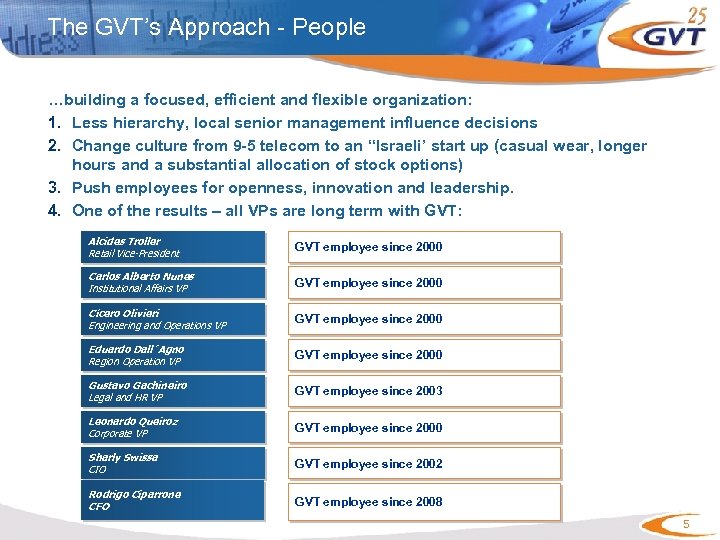
The GVT’s Approach - People …building a focused, efficient and flexible organization: 1. Less hierarchy, local senior management influence decisions 2. Change culture from 9 -5 telecom to an “Israeli’ start up (casual wear, longer hours and a substantial allocation of stock options) 3. Push employees for openness, innovation and leadership. 4. One of the results – all VPs are long term with GVT: Alcides Troller Retail Vice-President GVT employee since 2000 Carlos Alberto Nunes Institutional Affairs VP GVT employee since 2000 Cícero Olivieri Engineering and Operations VP GVT employee since 2000 Eduardo Dall´Agno Region Operation VP GVT employee since 2000 Gustavo Gachineiro Legal and HR VP GVT employee since 2003 Leonardo Queiroz Corporate VP GVT employee since 2000 Sharly Swissa CIO GVT employee since 2002 Rodrigo Ciparrone CFO GVT employee since 2008 5
The 2003 Crisis In late 2002, the local currency devaluated from 1. 75 to almost 4 to the US$. That effect on a newly established company, together with the global telecom crisis at that time, created a very tight cash flow situation. GVT decided nonetheless to continue growing at the original pace while managing the cash flow on a daily basis. In parallel GVT was able to negotiate a debt exchange that allowed to support the continuous growth and mitigate volatility risks. The shareholders of GVT, as well as the lenders to GVT at that time, made substantial returns from the debt exchange and the GVT IPO. 6
The International Experience In parallel to GVT, many international operators began operations in Brazil including Sprint, AT&T, France Telecom, Bell Canada, Bell South, Worldcom, Qualcom and others. Other than GVT, all these companies abandoned Brazil during the telecom meltdown of 2001 and lost a few billions of US$. Some are still very successful and support Part of Parent companies including TEF, TI and PT. The experience of these operators in Brazil is key to understand the “do” and “don’t” while entering emerging countries. Some of these points include – • Is the ‘cook book’ of your operation adequate to the environment of that country • Are your expats the best managers to run a local operation • Understand that EMs are likely to have a crisis once in a while – have your operations flexible and quick to adopt, mitigate exposures through hedges and make sure your business plan can absorb volatility. 7
GVT today… 8
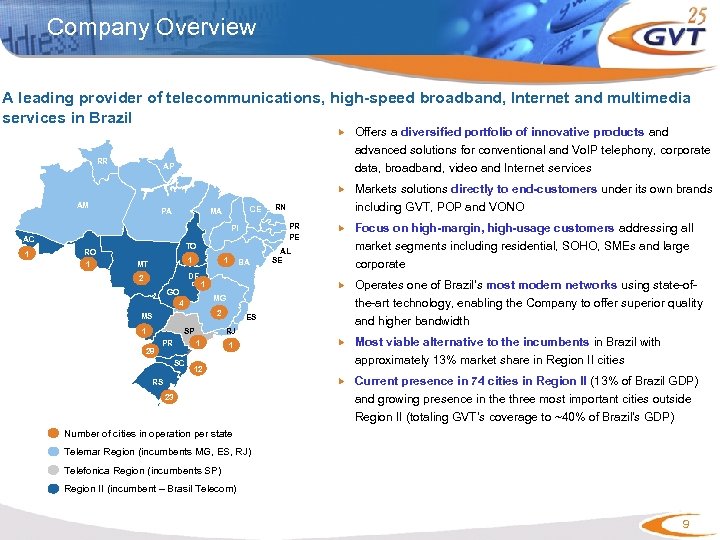
Company Overview A leading provider of telecommunications, high-speed broadband, Internet and multimedia services in Brazil Offers a diversified portfolio of innovative products and RR advanced solutions for conventional and Vo. IP telephony, corporate data, broadband, video and Internet services AP Markets solutions directly to end-customers under its own brands AM PA CE MA PR PE PI AC 1 TO RO 1 1 MT 1 DF 2 GO 4 SP SC ES RJ 1 PR AL SE Focus on high-margin, high-usage customers addressing all market segments including residential, SOHO, SMEs and large corporate Operates one of Brazil’s most modern networks using state-of- MG 2 1 28 BA 1 MS including GVT, POP and VONO RN 1 12 the-art technology, enabling the Company to offer superior quality and higher bandwidth Most viable alternative to the incumbents in Brazil with approximately 13% market share in Region II cities Current presence in 74 cities in Region II (13% of Brazil GDP) RS 23 and growing presence in the three most important cities outside Region II (totaling GVT’s coverage to ~40% of Brazil's GDP) Number of cities in operation per state Telemar Region (incumbents MG, ES, RJ) Telefonica Region (incumbents SP) Region II (incumbent – Brasil Telecom) 9
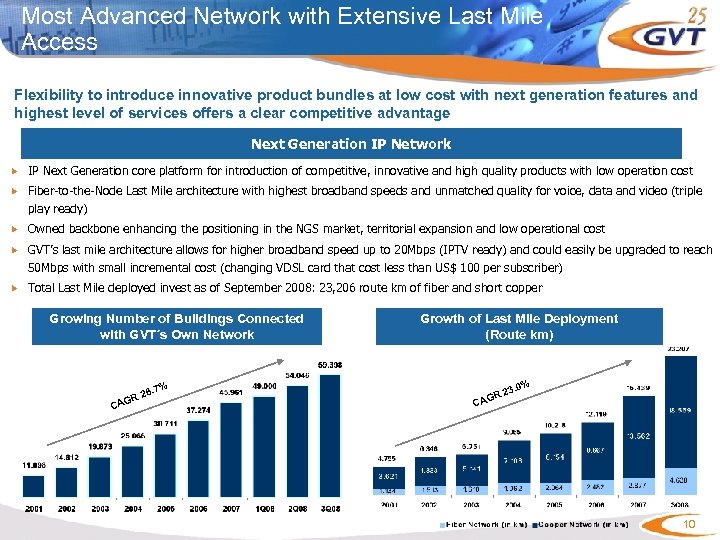
Most Advanced Network with Extensive Last Mile Access Flexibility to introduce innovative product bundles at low cost with next generation features and highest level of services offers a clear competitive advantage Next Generation IP Network IP Next Generation core platform for introduction of competitive, innovative and high quality products with low operation cost Fiber-to-the-Node Last Mile architecture with highest broadband speeds and unmatched quality for voice, data and video (triple play ready) Owned backbone enhancing the positioning in the NGS market, territorial expansion and low operational cost GVT’s last mile architecture allows for higher broadband speed up to 20 Mbps (IPTV ready) and could easily be upgraded to reach 50 Mbps with small incremental cost (changing VDSL card that cost less than US$ 100 per subscriber) Total Last Mile deployed invest as of September 2008: 23, 206 route km of fiber and short copper Growing Number of Buildings Connected with GVT´s Own Network CA 6. 7% 2 GR Growth of Last Mile Deployment (Route km) GR CA % 23. 0 10
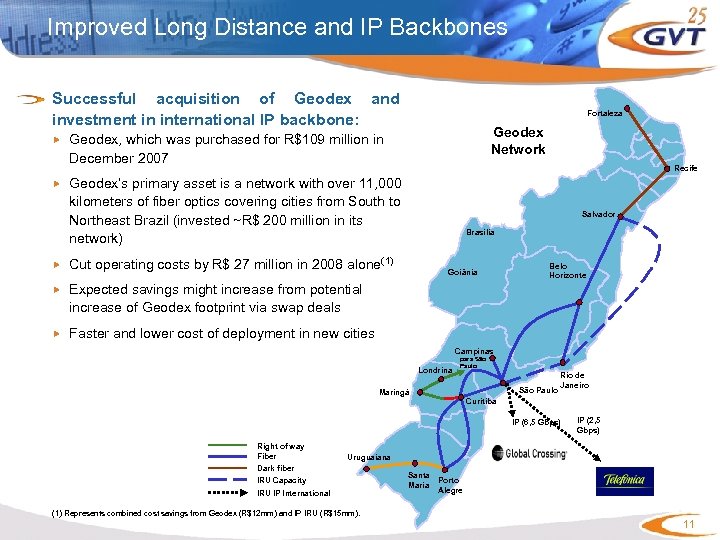
Improved Long Distance and IP Backbones Successful acquisition of Geodex and investment in international IP backbone: Fortaleza Geodex Network Geodex, which was purchased for R$109 million in December 2007 Recife Geodex’s primary asset is a network with over 11, 000 kilometers of fiber optics covering cities from South to Northeast Brazil (invested ~R$ 200 million in its network) Salvador Brasília Cut operating costs by R$ 27 million in 2008 alone(1) Goiânia Belo Horizonte Expected savings might increase from potential increase of Geodex footprint via swap deals Faster and lower cost of deployment in new cities Campinas Londrina para São Paulo Maringá Rio de Janeiro Curitiba IP (6, 5 Gbps) Right of way Fiber Dark fiber IRU Capacity IP (2, 5 Gbps) Uruguaiana IRU IP International Santa Maria Porto Alegre (1) Represents combined cost savings from Geodex (R$12 mm) and IP IRU (R$15 mm). 11
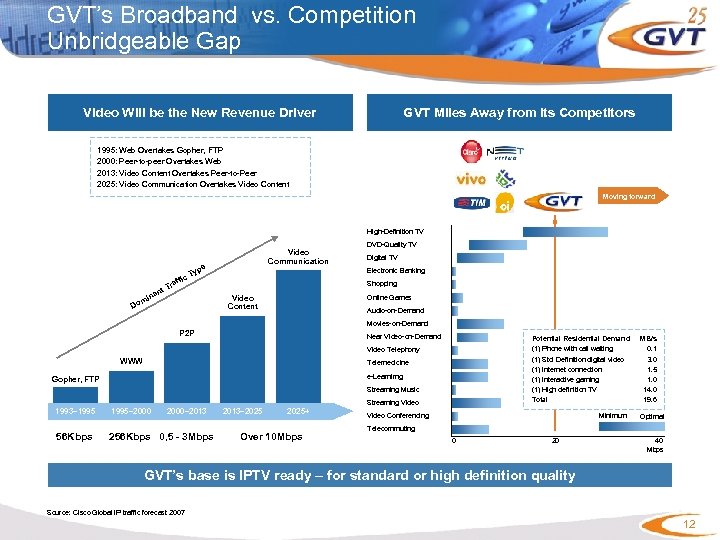
GVT’s Broadband vs. Competition Unbridgeable Gap Video Will be the New Revenue Driver GVT Miles Away from its Competitors 1995: Web Overtakes Gopher, FTP 2000: Peer-to-peer Overtakes Web 2013: Video Content Overtakes Peer-to-Peer 2025: Video Communication Overtakes Video Content Moving forward High-Definition TV nt na mi ffic Tra Video Communication e yp Digital TV Electronic Banking T Shopping Online Games Video Content Do DVD-Quality TV Audio-on-Demand Movies-on-Demand P 2 P Near Video-on-Demand Potential Residential Demand (1) Phone with call waiting (1) Std. Definition digital video (1) Internet connection (1) Interactive gaming (1) High definition TV Total Video Telephony WWW Telemedicine e-Learnirng Gopher, FTP Streaming Music Streaming Video 1993– 1995 56 Kbps 1995– 2000– 2013 256 Kbps 0, 5 - 3 Mbps 2013– 2025+ Over 10 Mbps Video Conferencing Minimum MB/s 0. 1 3. 0 1. 5 1. 0 14. 0 19. 6 Optimal Telecommuting 0 20 40 Mbps GVT’s base is IPTV ready – for standard or high definition quality Source: Cisco Global IP traffic forecast 2007 12
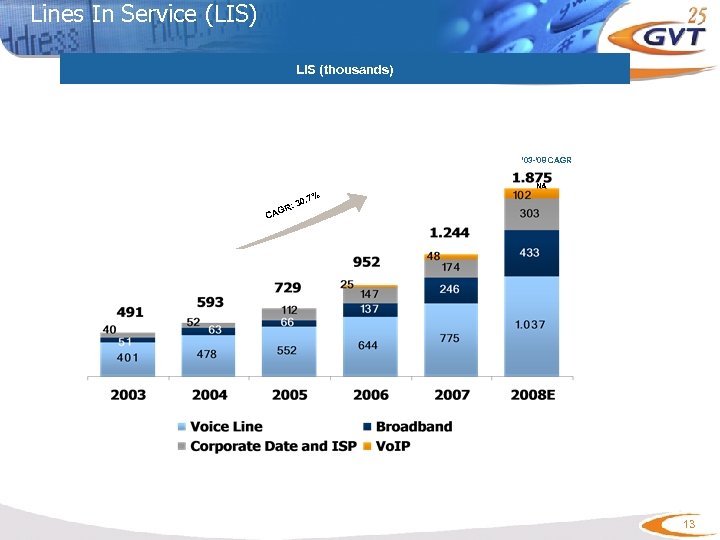
Lines In Service (LIS) LIS (thousands) ’ 03 -’ 08 CAGR NA : GR CA 7% 30. 50. 0% 53. 6% (1) Excluding (2) Breakdown not (2) available 20. 9% 13
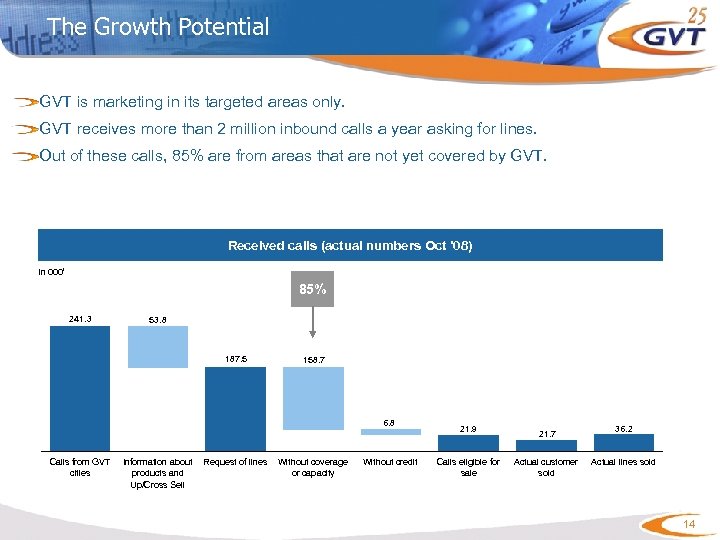
The Growth Potential GVT is marketing in its targeted areas only. GVT receives more than 2 million inbound calls a year asking for lines. Out of these calls, 85% are from areas that are not yet covered by GVT. Received calls (actual numbers Oct ’ 08) In 000’ 85% 241. 3 53. 8 187. 5 158. 7 6. 8 Calls from GVT cities Information about products and Up/Cross Sell Request of lines Without coverage or capacity Without credit 21. 9 Calls eligible for sale 21. 7 Actual customer sold 36. 2 Actual lines sold 14
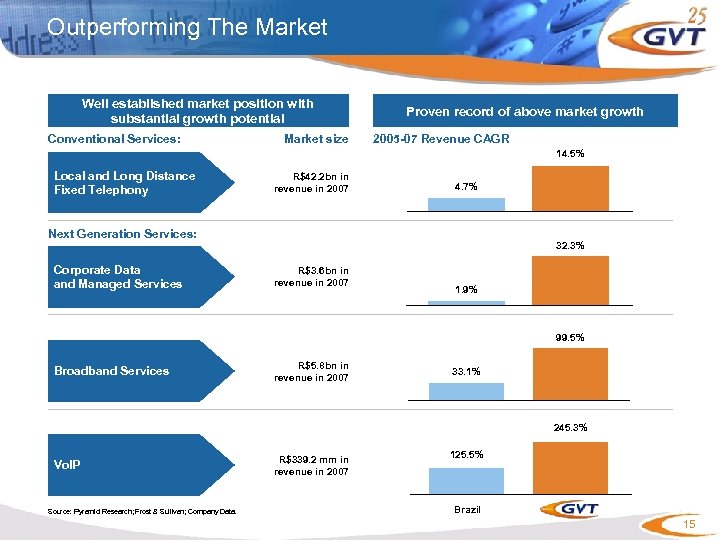
Outperforming The Market Well established market position with substantial growth potential Conventional Services: Market size Proven record of above market growth 2005 -07 Revenue CAGR 14. 5% Local and Long Distance Fixed Telephony R$42. 2 bn in revenue in 2007 4. 7% Next Generation Services: Corporate Data and Managed Services 32. 3% R$3. 6 bn in revenue in 2007 1. 9% 99. 5% Broadband Services R$5. 8 bn in revenue in 2007 33. 1% 245. 3% Vo. IP Source: Pyramid Research; Frost & Sullivan; Company Data. R$339. 2 mm in revenue in 2007 125. 5% Brazil 15
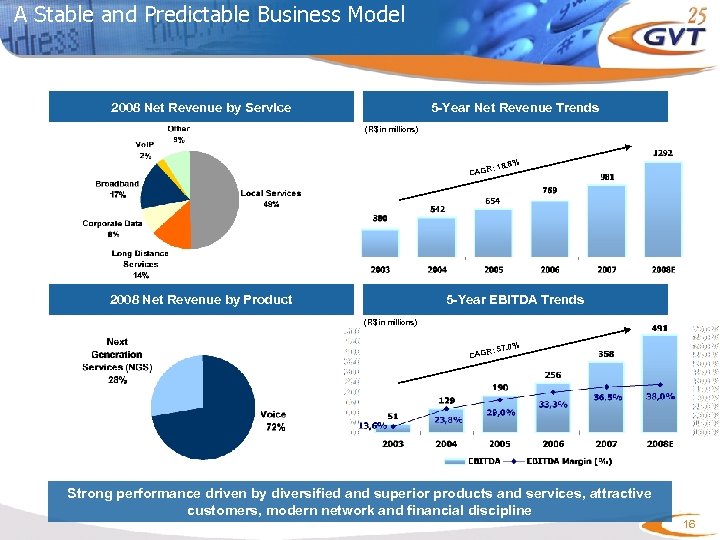
A Stable and Predictable Business Model 2008 Net Revenue by Service 5 -Year Net Revenue Trends (R$ in millions) % : 18. 8 CAGR 2008 Net Revenue by Product 5 -Year EBITDA Trends (R$ in millions) % : 57. 0 CAGR Strong performance driven by diversified and superior products and services, attractive customers, modern network and financial discipline 16
Corporate Structure Traded on the Bovespa since February 2007, under the ticker GVTT 3 Current market cap R$3. 5 billion GVT is part of the Bovespa 100 index (IBr. X) Ownership (FD): GVT Holland (Magnum & IDB) – 17% Swarth Group – 17% Free Float– 64% The Free Float includes: 99. 6% held by financial institutions 80% of these holders are European and US investors 17
Obrigado and Toda! 18
Скачать презентацию The GVT Story Dec 2008 Background Established
3c3bb094767fd038e767efe6459d8938.ppt