 Скачать презентацию The Gulf of Mexico Coastal Ocean Observing System
eeed766a6f9fe4509b351eedd6bea63c.ppt
- Количество слайдов: 33



The Gulf of Mexico Coastal Ocean Observing System (GCOOS): A Regional Component of the U. S. Integrated Ocean Observing System Worth D. Nowlin, Jr Texas A&M University Coastal Services Center National Data Buoy Center GCOOS Education and Outreach Council Formation meeting November 29, 2004
Outline • Background • Existing Capabilities • Actions to date in building the Gulf of Mexico Coastal Ocean Observing System • Next Steps

Background
The U. S. Integrated Ocean Observing System will consist of three parts: 1. U. S. contribution to a global component of GOOS focused on climate and maritime services; 2. National backbone of observations and products from our coastal ocean supported by federal agencies; and 3. Contributions of Regional Coastal Ocean Observing Systems.
Regional Coastal Ocean Observing Systems 1. 2. 3. To be eligible for federal support, each Regional Coastal Ocean Observing System must have a Regional Association that: Provides representative governance and the capability to receive and distribute funds with all approved accounting procedures; Maintains a sound business plan indicating users, requirements, costs, and sources of support; and Represents the regional system within a National Federation of Regional Associations.
Existing Capabilities
• There are many elements that can be used as the initial building blocks for a regional ocean observing system for the Gulf of Mexico. • These include continuing observations, satellite products, models, and other data products. • They are supported by local, state and federal government, private industry, NGOs, and academia. • They provide information that will have broader uses when they are integrated and enhanced.
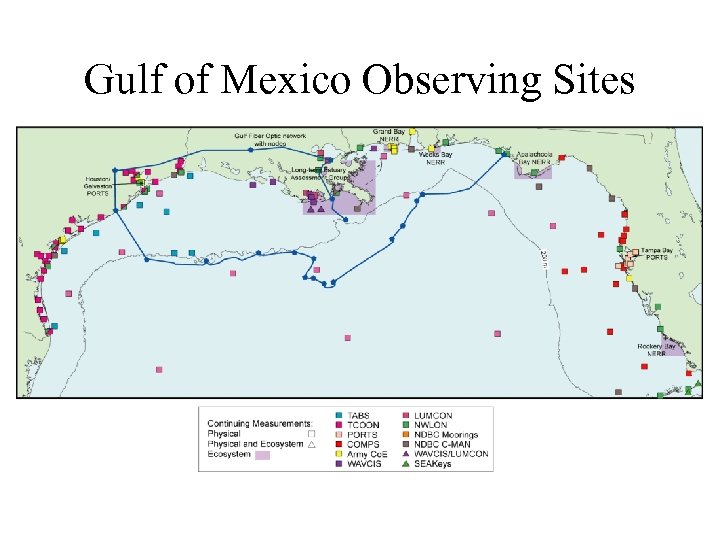
Gulf of Mexico Observing Sites
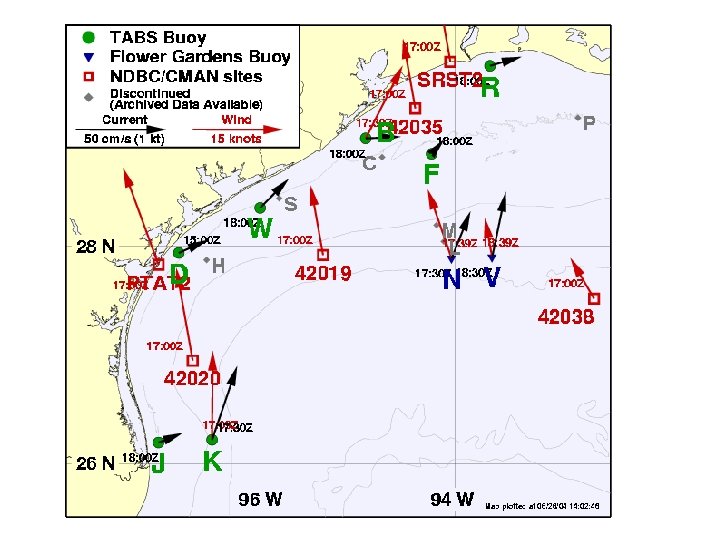
9 of 9_tabs_08262004 b. gif
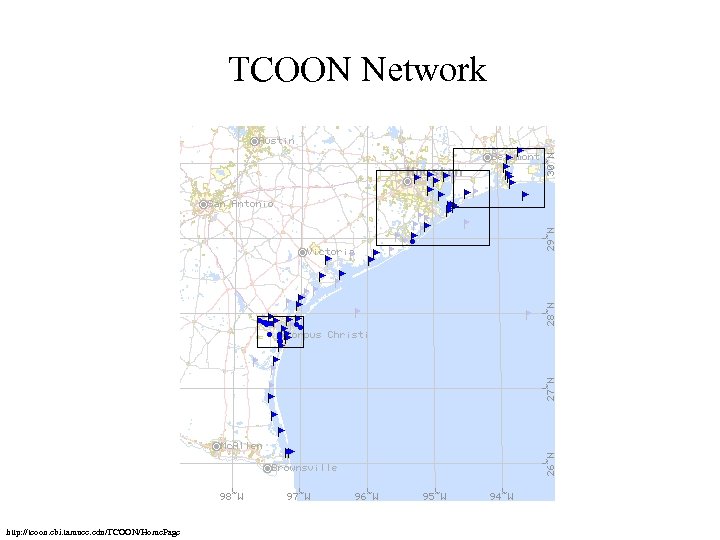
TCOON Network http: //tcoon. cbi. tamucc. edu/TCOON/Home. Page
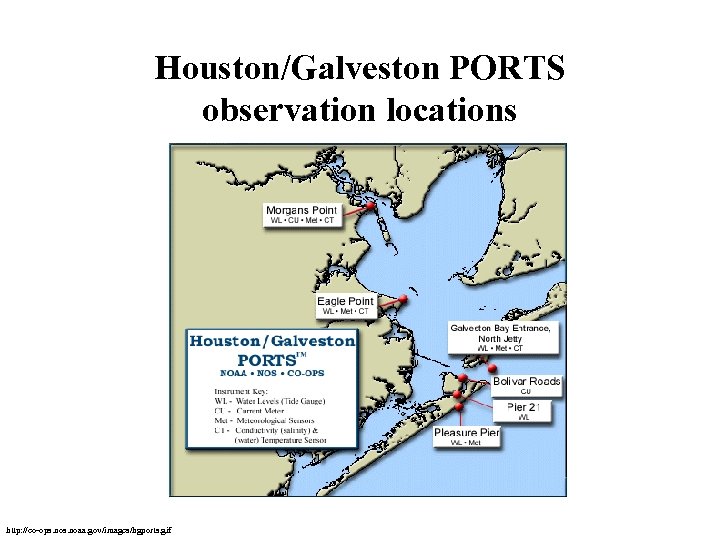
Houston/Galveston PORTS observation locations http: //co-ops. noaa. gov/images/hgports. gif
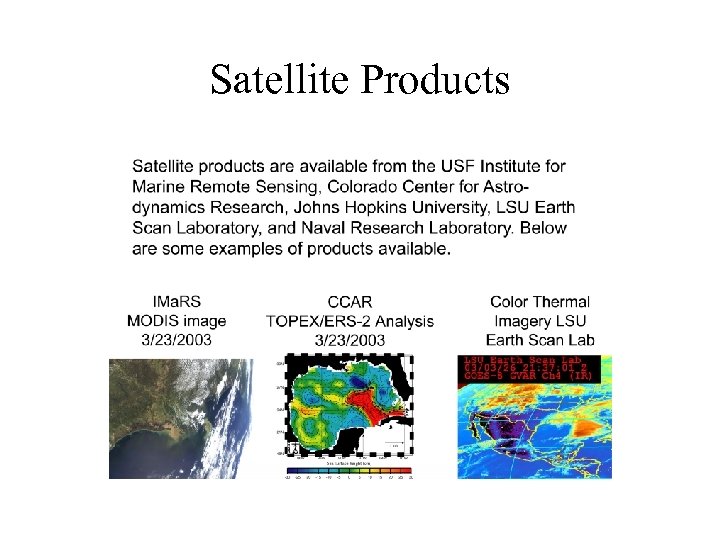
Satellite Products
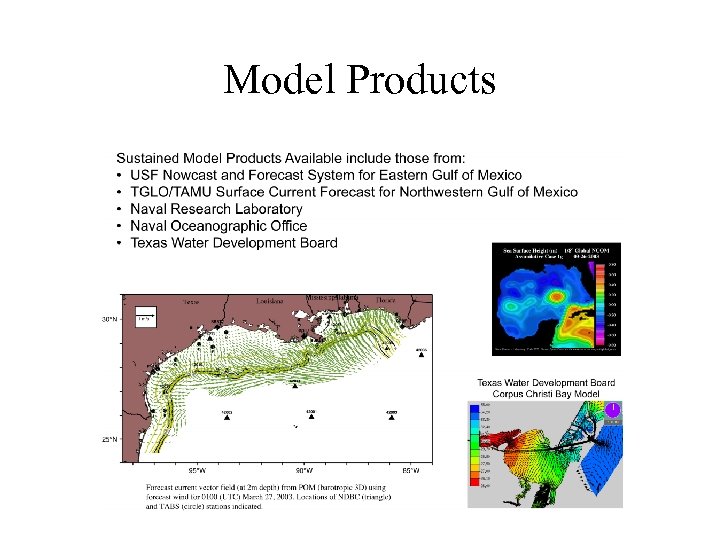
Model Products
Actions to date in building the Gulf of Mexico Coastal Ocean Observing System
Actions 1 • Five Gulf-wide meetings have been held: - First focused on academia - Second focused on state and federal agencies - Third focused on private sectors - Fourth focused on predicting, detecting and tracking Harmful Algal Blooms - Fifth focused on underpinning research
Actions 2 • A GCOOS Mission Statement has been adopted. • A Resolution to develop GCOOS, beginning with sharing of nonproprietary, non-commercial data, has been signed by some 50 individuals representing themselves or institutions.
Mission Statement: Vision We seek to establish a sustained observing system for the Gulf of Mexico to provide observations and products needed by users in this region for the purposes of • • Detecting and predicting climate variability and consequences, Preserving and restoring healthy marine ecosystems, Ensuring human health, Managing resources, Facilitating safe and efficient marine transportation, Enhancing national security, and Predicting and mitigating against coastal hazards.
Mission Statement (continued) We envision sharing of non-commercial, non-proprietary data, models, and products via the internet for the common benefit of all participants, including industry, NGOs, academia, and federal, state, regional, and local government agencies. It is understood that this Gulf of Mexico observing system will be integrated with other regional coastal ocean observing systems, in particular to create an integrated and sustained U. S. component of the ocean observing system.
Mission Statement (continued) We recognize that the system will require sustained financial support from a combination of government, private, and non-governmental organizations. That will be possible only if the system is built and remains responsive to the needs of these organizations and to the public. Thus, the system will be subject to continuing oversight by representatives of such organizations and of the public. Collaboration with other nations bordering the Gulf of Mexico is to be actively sought in the design and implementation of this regional observing system.
Resolution The implementation sections reads: The Signatories hereby resolve to work together toward establishment of a Gulf of Mexico Regional Coastal Ocean Observing System (GCOOS); to work toward development of regional governance structures and coordination; to work towards common data management standards; and to openly share non-proprietary data and metadata, non-commercial data and products, model code, and related information. ……. Signatories will actively seek collaborations with other nations bordering the Gulf of Mexico in the design and implementation of this regional observing system. The Signatories will work toward implementation of specific action items decided upon at the workshop held at Stennis Space Center, MS, January 14 -15, 2003,
Actions 3 • An inventory of existing operational and product-producing components for the Gulf of Mexico, together with descriptions, costs, out-year budgets, and users is being maintained. • A web portal to ongoing Gulf of Mexico activities has been created: http: //www. gcoos. org
Estimated Costs GCOOS Elements
Actions 4 • We are working to establish a data and information management system that is – Part of a national system; integrated with other regional coastal observing systems – Coordinated with observing system elements in Mexico and Cuba – Integrated with the global observing system module Well along in dealing with real-time physical data
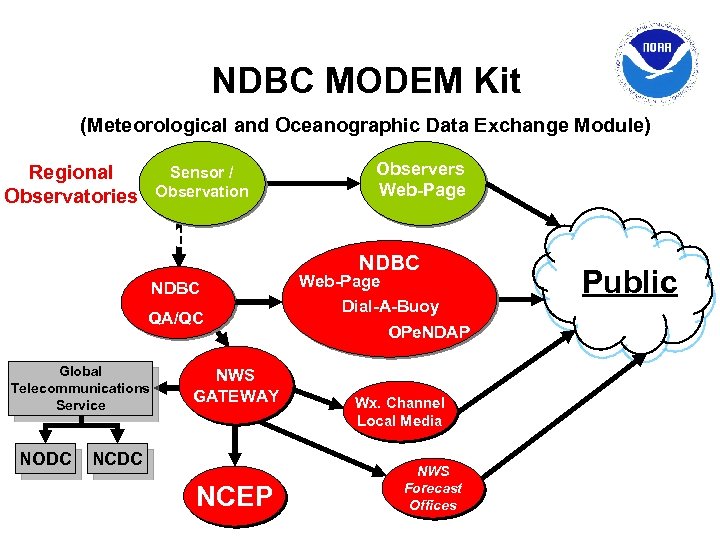
NDBC MODEM Kit (Meteorological and Oceanographic Data Exchange Module) Regional Observatories Sensor / Observation ftp NDBC QA/QC Global Telecommunications Service NODC NWS GATEWAY NCDC NCEP Observers Web-Page NDBC Web-Page Dial-A-Buoy OPe. NDAP Wx. Channel Local Media NWS Forecast Offices Public
Present Partners of NDBC in IOOS Data Sharing • Skidaway Institute of Technology • Gulf of Maine Ocean Observing System (Go. MOOS) • Coastal Ocean Monitoring and Prediction System (COMPS) • Texas Automated Buoy System (TABS) • Louisiana Universities Marine Consortium (LUMCON) • Texas Coastal Ocean Observing Network (TCOON) • University of Connecticut’s MYSOUND • Stephens Institute of Technology (New Jersey)
Future Partners of NDBC in IOOS Data Sharing • • SUNY Stony Brook (Long Island Ferry) NAVSEA Warfare Center (Dania, FL) Chesapeake Bay Observing System (CBOS) Mississippi Dept. of Marine Resources NOAA’s National Estuarine Research Reserve Program CORIE (Columbia River) MBARI (Monterey Bay) Oil and gas industry
Planned capabilities for transfer of real time data • Present: – – – – – Wind Direction, Speed, Gust Significant Wave Height, Dominant Period Sea Level Pressure Air, Dew Point, and Sea Surface Temperature Visibility Water Level (Coastal Stations, w/ respect to MLLW) Temperature Profile Salinity Profile Current Profile • Future: – Swell Direction, Period – Wave Spectrum
Actions 5 • We have a small multi-year grant from NOAA to help establish a Regional Association to manage GCOOS. We have proposed a more ambitious effort. • We have representatives from GCOOS to the National Federation of Regional Associations: Robert (Buzz) Martin, TGLO Landry Bernard, NDBC/NWS
Next Steps
Next Steps 1 • With leadership by the five Gulf Coast Sea Grant Programs, we are establishing a GCOOS Education and Outreach Council to provide guidance in these areas.
Next Steps 2 • We are preparing an interim governance plan and structure for the GCOOS Regional Association. • We are preparing a Business Plan for GCOOS.
Next Steps 3 • An initial GCOOS Stakeholders Meeting will be held 24 -26 January 2005 in New Orleans to: - Ratify the governance structure - Nominate a slate of officers and committee members - Agree on elements of a Business Plan
Thank You Please visit our web site for further information. http: //www. gcoos. org If you wish to become a signatory to the resolution, please send an email request to wnowlin@tamu. edu stating if you are signing as an individual or for an institution.
Скачать презентацию The Gulf of Mexico Coastal Ocean Observing System
eeed766a6f9fe4509b351eedd6bea63c.ppt