


 Скачать презентацию The Growth of a Young Nation 1 CH
70f596a8677d976ac2a66ea35b92c7de.ppt
- Количество слайдов: 37
 The Growth of a Young Nation 1 CH. 3
 Journal 2 Do you have a person (s) in your life who has the final say on what you are allowed to do? How do you feel about such an arrangement?
 Jefferson’s Presidency 3 Thomas Jefferson (Democratic – Republicans) vs. President John Adams (Federalist Party) 1800 Jefferson defeats Adams by 8 electoral votes Aaron Burr receives same number of votes as Jefferson House of Reps. votes for Jefferson 12 th Amendment – separate ballots for pres. + vice – pres.
 Jefferson’s Presidency 4 Jeffersonian republicanism – people should control the govt. + and a simple govt. was best Reduce taxes Decrease navy/army Marbury v. Madison (1803) Pres. Adams appoints Federalist judges to federal courts Congress’ Judiciary Act of 1789 Madison (Sec. of State) would have to deliver the documents Supreme Court declared this act unconstitutional Established principle of judicial review Supreme Court determines constitutionality of the law Legislative and executive actions can be reviewed
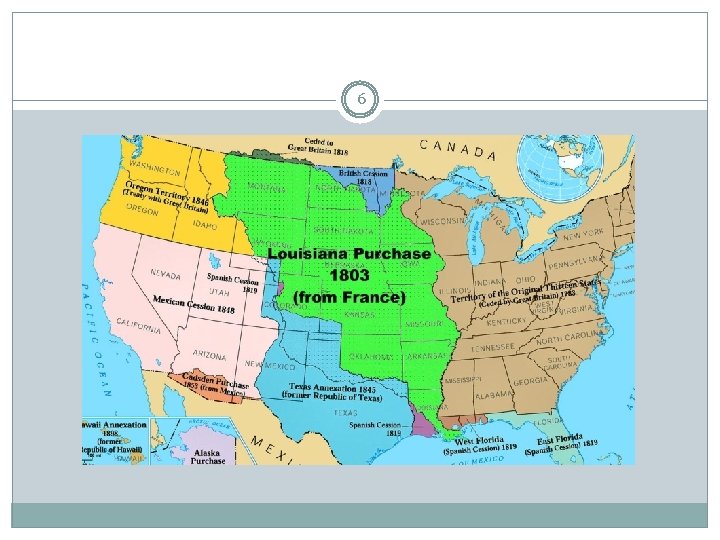
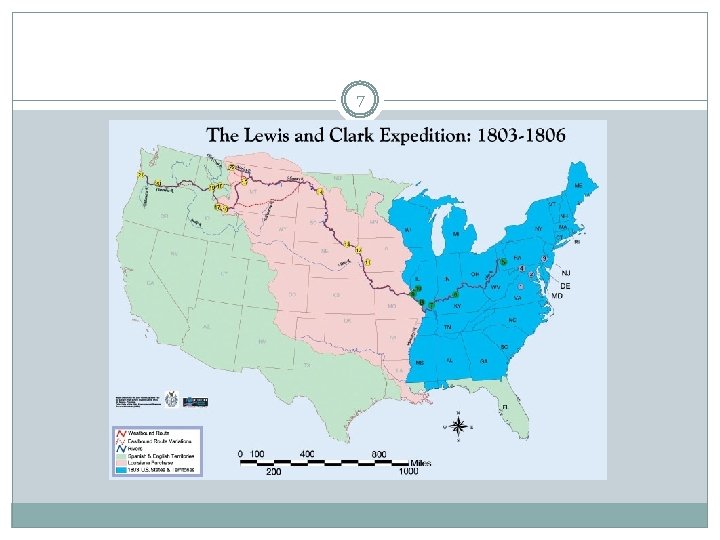
 Jefferson’s Presidency 5 Louisiana Purchase 1803 Jefferson bought 800, 000 square miles of land = $15 million Constitution did not address how territory should be added Doubled size of the U. S.
 6
6
 7
7
 Madison and the War of 1812 8 Causes 1804 -1814 – British policy of impressment Drafting men from another country’s ships for British navy Officials in British Canada supplied guns to Native Americans 1812 Congress approves Madison’s declaration of war Not much support in America British preoccupied with Napoleon 1814 British sack Washington, D. C. 1815 Andrew Jackson defeats British at Battle of New Orleans
 Madison and the War of 1812 9 End of Federalists Party Growth of American industries Confirmed status of the U. S. as an independent nation
 Nationalism Shapes Foreign Policy 10 President James Monroe Secretary of state (foreign policy) John Quincy Adams Nationalism – national interests are more important than regional concerns Joint occupation of Oregon territory with Britain Negotiated Adams – Onis Treaty with Spain Florida added to U. S.
 Nationalism Shapes Foreign Policy 11 The Monroe Doctrine Spain and Portugal move back into old colonial territories Russians in Alaska = threat to American trade with China Americans wanted Northern Mexico Monroe – Europeans should not create new colonies in western hemisphere “dangerous to our peace and saftey”
 Assignment Ch. 3 Section 1 12 1. How did Jefferson’s actions reflect his theory of government? 2. Why was the principle of judicial review important for the future of the Supreme Court? 3. Do you think the Monroe Doctrine would be a source of peace or conflict for the U. S. ? Why?
 Answers 13 1. He cut taxes, reduced expenses, simplified the govt. 2. Supreme Court could review acts of Congress Maintained the checks and balance system created by the Constitution 3. Peace – if it prevented foreign nations from intruding upon U. S. territory Conflict – if foreign nations ignored the Monroe Doctrine and were forced into armed conflict to defend its interest
 Section 2 14 THE AGE OF JACKSON
 Journal 15 1. Why was the Lewis and Clarke expedition important? 2. What was John Adams accused of doing by the Democratic-Republicans in the election of 1800? 3. What did the Supreme Court rule in Marbury v. Madison? 4. How did President Monroe respond to countries like Portugal and Spain when they tried to reclaim their former colonies in the Western Hemisphere?
 16 1. explore the new territory the U. S. had acquired 2. wanted to increase the power of the executive branch a lot (like a monarch) 3. S. Court interprets the Constitution, not the legislature 4. Issued the Monroe Doctrine 5.
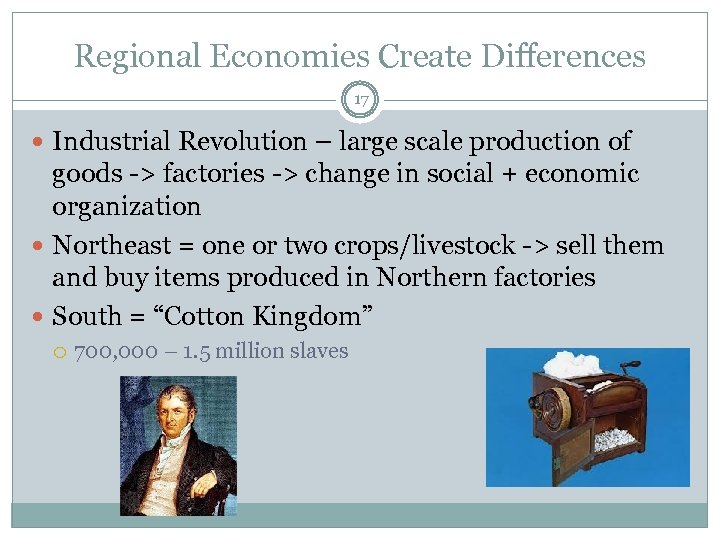 Regional Economies Create Differences 17 Industrial Revolution – large scale production of goods -> factories -> change in social + economic organization Northeast = one or two crops/livestock -> sell them and buy items produced in Northern factories South = “Cotton Kingdom” 700, 000 – 1. 5 million slaves
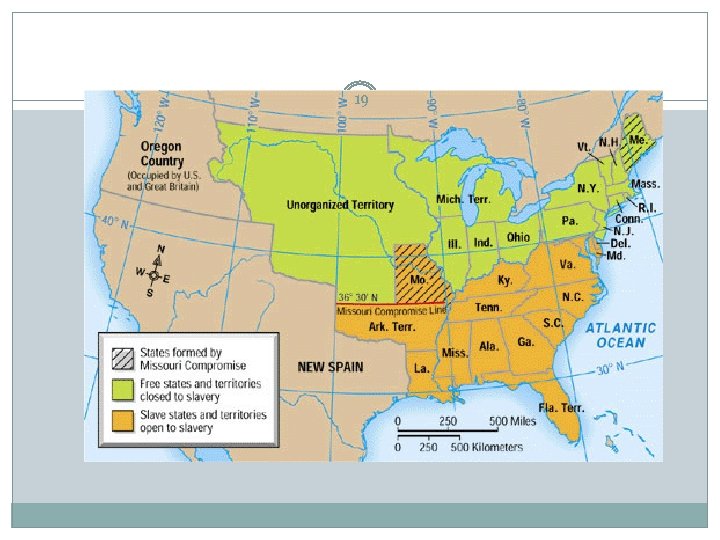
 Balancing Nationalism and Sectionalism 18 President Madison and Henry Clay promote the “American System” Recharter the national bank Make travel easier Tariff of 1816 (tax English/foreign imports) Missouri Compromise (1821) – North and South argue about Missouri being admitted as free or slave state
 19
19
 Jacksonian Democracy 20 “Man of the people” “Old hickory” 1828 – more than 1 million white males voted for president Spoils system Common people given a chance to partake in govt.
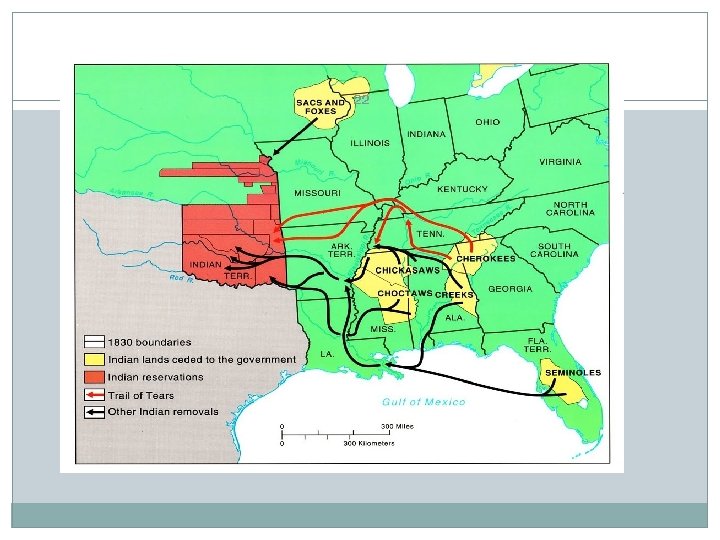
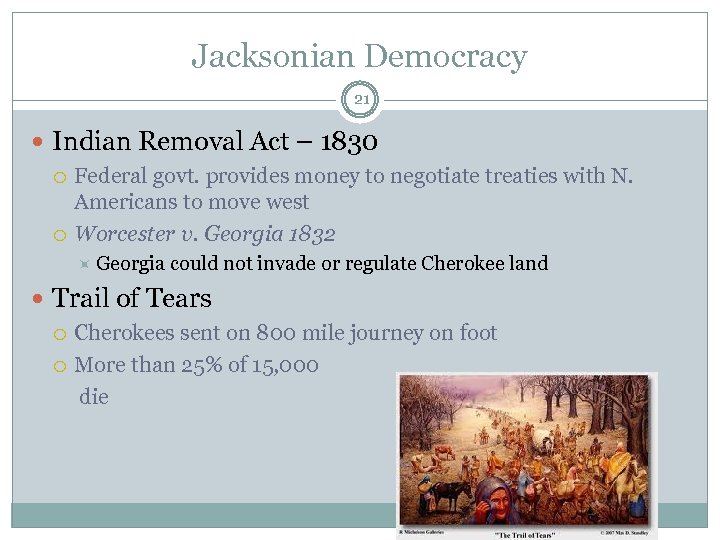 Jacksonian Democracy 21 Indian Removal Act – 1830 Federal govt. provides money to negotiate treaties with N. Americans to move west Worcester v. Georgia 1832 Georgia could not invade or regulate Cherokee land Trail of Tears Cherokees sent on 800 mile journey on foot More than 25% of 15, 000 die
 22
22
 Assignment Ch. 3 Sec. 2 23 TRUE/FALSE 1. Industry first took hold in the South because agriculture there was not highly profitable and many citizens were ready to embrace new forms of government. 2. The emergence of cotton as a major crop in the South led to the need for more field laborers and thus the growth of industry. 3. Under the Missouri Compromise the Louisiana Territory was divided into two parts – one slave, one free. 4. What were Andrew Jackson’s beliefs and actions regarding the Indian Removal Act?
 Nullification and the Bank War 24 Congress increases the Tariff of 1816 Reduced British exports to U. S. Britain bought less cotton South forced to buy Northern goods Calhoun tries to nullify (make ineffective) the treaty Each state should determine if an act of Congress was valid South Carolina threatens to secede (leave) the Union
 Chapter 3 Section 3 25 Manifest Destiny
 Settling the Frontier 26 Manifest Destiny = the belief that the United States was ordained (predestined) by God to expand to the Pacific Ocean Practical reasons Panic of 1837 Sante Fe Trail – Missouri to Sante Fe, N. Mexico Oregon Trail – Missouri to Oregon City, Oregon 1847 Mormons – NY to Salt Lake City, Utah
 Texan Independence 27 Mexican independence 1821 from Spain American and Mexican settlers move into Texas Protestant Anglos with slaves vs. Mexicans Americans move into the Alamo (a mission in San Antonio), declare independence, and all 187 of them are killed Sam Houston and Texans respond 6 weeks later “Remember the Alamo” Houston becomes president of the new Republic of Texas enters the Union in 1845
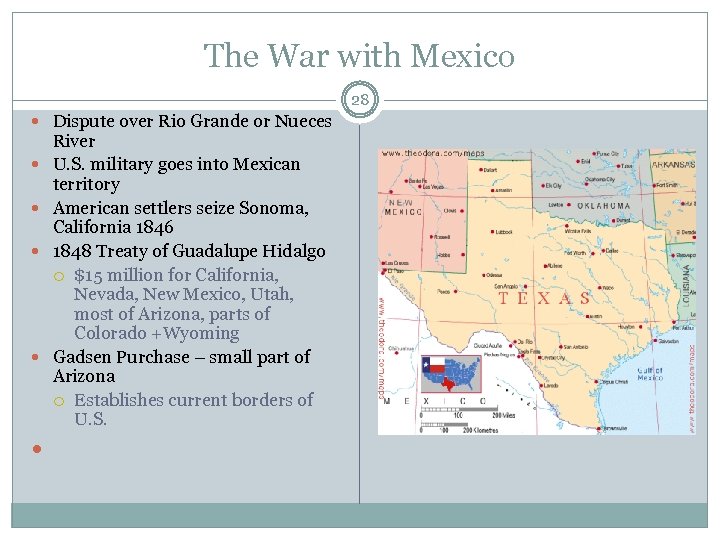 The War with Mexico 28 Dispute over Rio Grande or Nueces River U. S. military goes into Mexican territory American settlers seize Sonoma, California 1846 1848 Treaty of Guadalupe Hidalgo $15 million for California, Nevada, New Mexico, Utah, most of Arizona, parts of Colorado +Wyoming Gadsen Purchase – small part of Arizona Establishes current borders of U. S.
 California Gold Rush 29 1848 gold discovered near saw mill near San Francisco 1849 – population reaches 100, 000 (400 in 1848) Economy grows Horace Greely, editor of New York Tribune, “Go west, young man”
 Section 4 and 5 30 Market Revolution and Reforming American Society
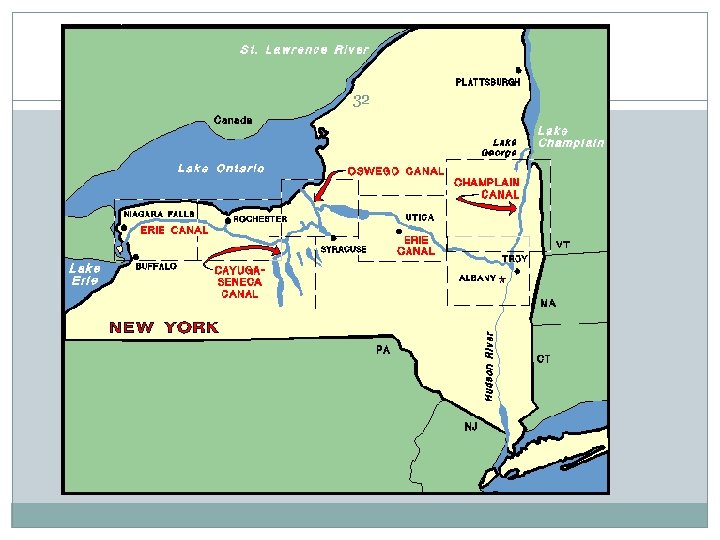
 Market Revolution 31 People increasingly bought and sold goods rather than make them for themselves Free enterprise – the freedom of private businesses to operate competitively for profit with little govt. regulation Entrepreneurs – businessman invest their own money in new industries 1837 Samuel F. B. Morse invests telegraph Steam boats, canals, steam-powered trains
 32
32
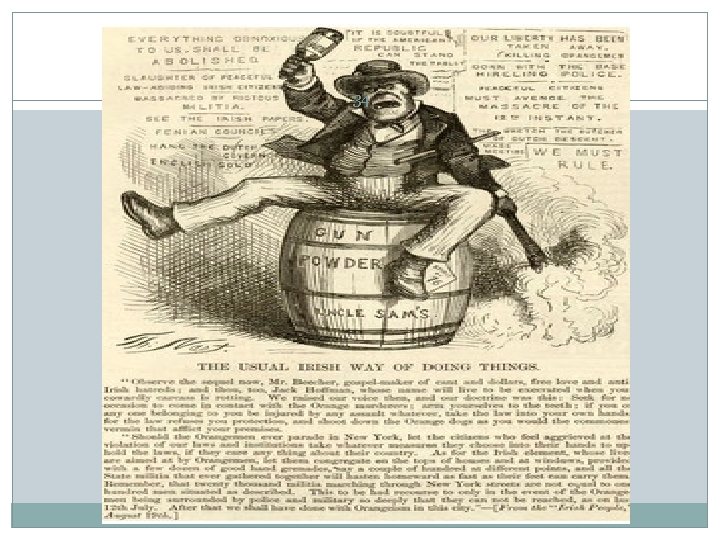
 Market Revolution 33 More manufacturing jobs -> better goods, more supply-> lower prices Travel between regions is easier Northeast becomes industrialized Lowell textile mills 12 hour work days for women Strikes were unsuccessful National Trades’ Union 1834 Commonwealth v. Hunt – workers right to strike 1842 3 million immigrants 1845 -1854 1 million Irish immigrants Catholic + poor
 34
34
 Reforming American Society 35 The Second Great Awakening Christian movement to awaken religious sentiments (1790 s 1830 s) Revival meetings Unitarians – emphasized reason Ralph Waldo Emerson Transcendentalism – truth -> discovered by relating it to one’s own emotional and spiritual experience The African American Church
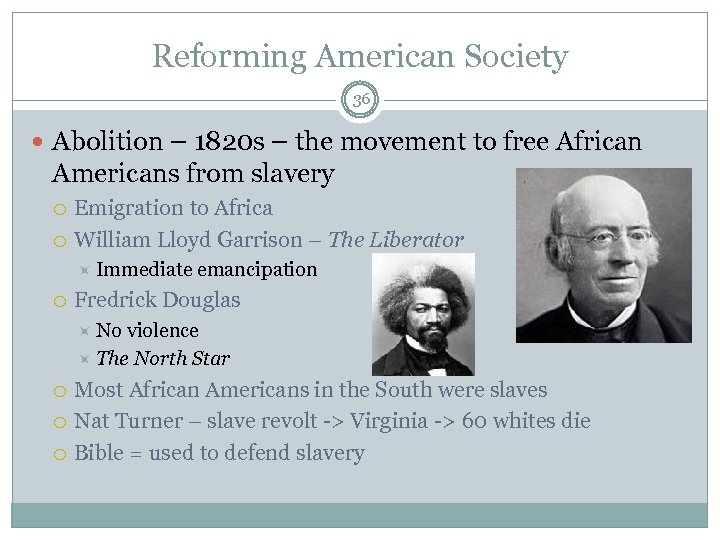 Reforming American Society 36 Abolition – 1820 s – the movement to free African Americans from slavery Emigration to Africa William Lloyd Garrison – The Liberator Immediate emancipation Fredrick Douglas No violence The North Star Most African Americans in the South were slaves Nat Turner – slave revolt -> Virginia -> 60 whites die Bible = used to defend slavery
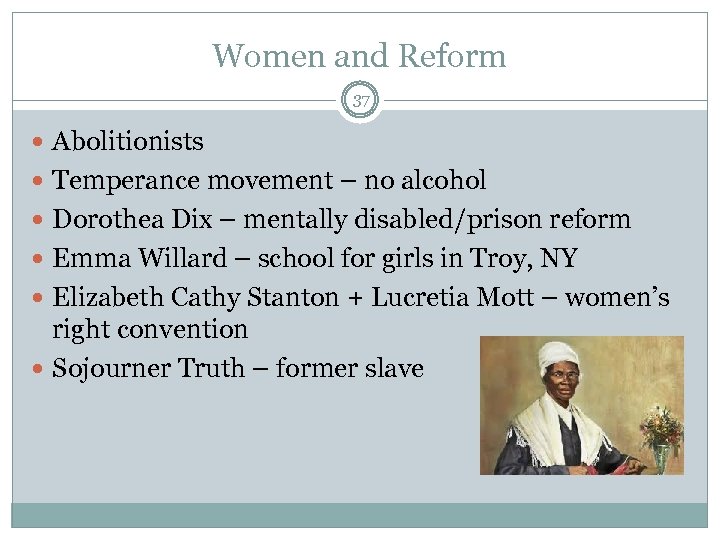 Women and Reform 37 Abolitionists Temperance movement – no alcohol Dorothea Dix – mentally disabled/prison reform Emma Willard – school for girls in Troy, NY Elizabeth Cathy Stanton + Lucretia Mott – women’s right convention Sojourner Truth – former slave