


 Скачать презентацию The Grid Virtual Organisations and their support via
103cf57214d99a9cc57c627b4834d27e.ppt
- Количество слайдов: 56
 The Grid Virtual Organisations and their support via federations David Groep EUGrid. PMA Physics Data Processing group NIKHEF Informatics Institute University of Amsterdam 2006 -10 -05 Euro. CAMP: The Grid - Virtual organisations and their support via Federations
 Outline • The grid – what is it, what are specific use cases? – grid AA and the separation of Authentication and Authorisation • A global authentication trust fabric – – federation origins growth of the global Auth. N trust fabric authentication profiles and minimum requirements levels of assurance • Authorisation in grids – virtual organisation models and implementations – multiple assertion sources • Towards an integrated AAI – leveraging home organisation attributes – towards a multi-authority world in a single decision point 2006 -10 -05 Euro. CAMP: The Grid - Virtual organisations and their support via Federations 2
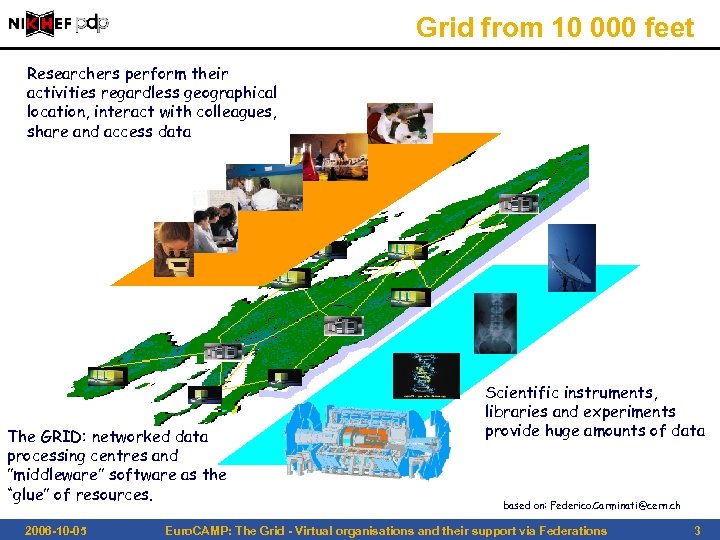 Grid from 10 000 feet Researchers perform their activities regardless geographical location, interact with colleagues, share and access data The GRID: networked data processing centres and ”middleware” software as the “glue” of resources. 2006 -10 -05 Scientific instruments, libraries and experiments provide huge amounts of data based on: Federico. Carminati@cern. ch Euro. CAMP: The Grid - Virtual organisations and their support via Federations 3
 What is Grid? The word ‘grid’ has been used in many ways – – cluster computing cycle scavenging cross-domain resource sharing … A clear definition for the grid? • Coordinates resources not subject to centralised control • Using standard, open and generic protocols & interfaces – fostered by the Open Grid Forum • Provides non-trivial qualities of collective service www. ogf. org Definition source: Ian Foster in Grid Today, July 22, 2002; Vol. 1 No. 6, see http: //www-fp. mcs. anl. gov/~foster/Articles/What. Isthe. Grid. pdf 2006 -10 -05 Euro. CAMP: The Grid - Virtual organisations and their support via Federations 4
 Grid characteristics Some things that may make a grid a bit ‘special’ compared to other distributed efforts • collaboration of individuals from different organisations – most of the scientific grid communities today consist of people literally ‘scattered’ over many home organisations … internationally • delegation – programs and services acting on your behalf – are an integral part of the architecture – unattended operation – resource brokering – integrating compute, data access, and databases in the same task 2006 -10 -05 Euro. CAMP: The Grid - Virtual organisations and their support via Federations 5
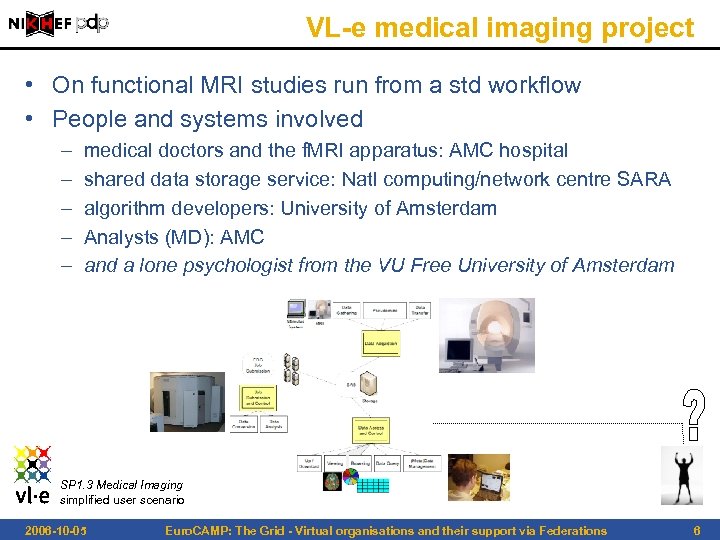 VL-e medical imaging project • On functional MRI studies run from a std workflow • People and systems involved – – – medical doctors and the f. MRI apparatus: AMC hospital shared data storage service: Natl computing/network centre SARA algorithm developers: University of Amsterdam Analysts (MD): AMC and a lone psychologist from the VU Free University of Amsterdam SP 1. 3 Medical Imaging simplified user scenario 2006 -10 -05 Euro. CAMP: The Grid - Virtual organisations and their support via Federations 6
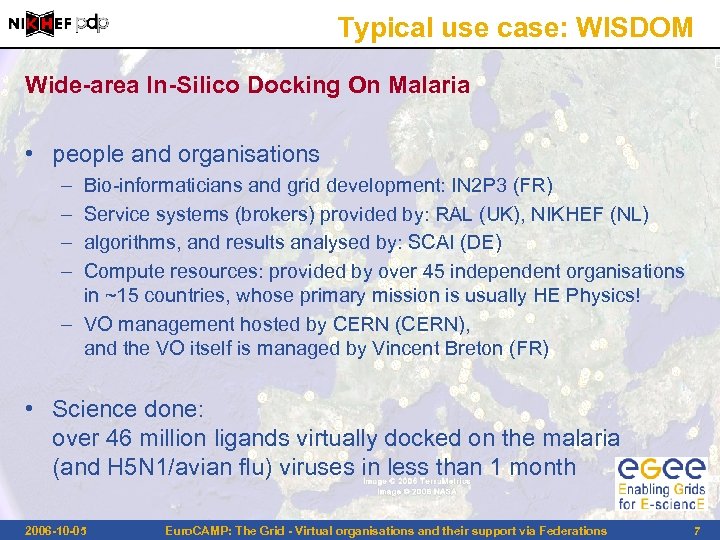 Typical use case: WISDOM Wide-area In-Silico Docking On Malaria • people and organisations – – Bio-informaticians and grid development: IN 2 P 3 (FR) Service systems (brokers) provided by: RAL (UK), NIKHEF (NL) algorithms, and results analysed by: SCAI (DE) Compute resources: provided by over 45 independent organisations in ~15 countries, whose primary mission is usually HE Physics! – VO management hosted by CERN (CERN), and the VO itself is managed by Vincent Breton (FR) • Science done: over 46 million ligands virtually docked on the malaria (and H 5 N 1/avian flu) viruses in less than 1 month 2006 -10 -05 Euro. CAMP: The Grid - Virtual organisations and their support via Federations 7
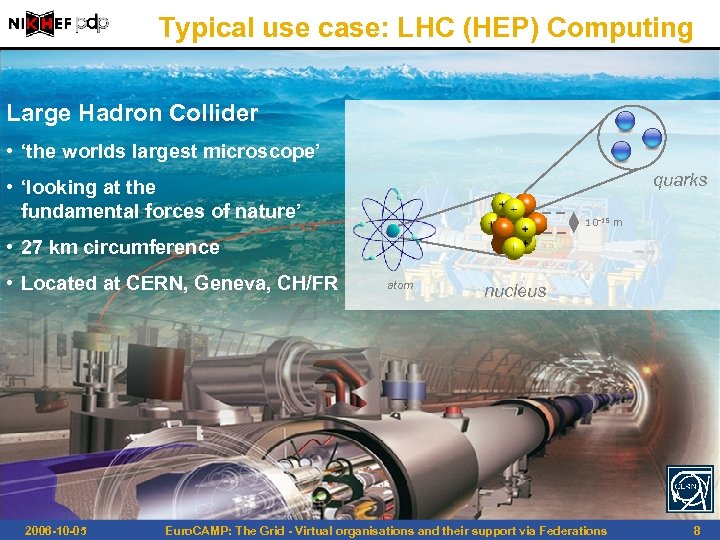 Typical use case: LHC (HEP) Computing Large Hadron Collider • ‘the worlds largest microscope’ quarks • ‘looking at the fundamental forces of nature’ 10 -15 m • 27 km circumference • Located at CERN, Geneva, CH/FR 2006 -10 -05 atom nucleus Euro. CAMP: The Grid - Virtual organisations and their support via Federations 8
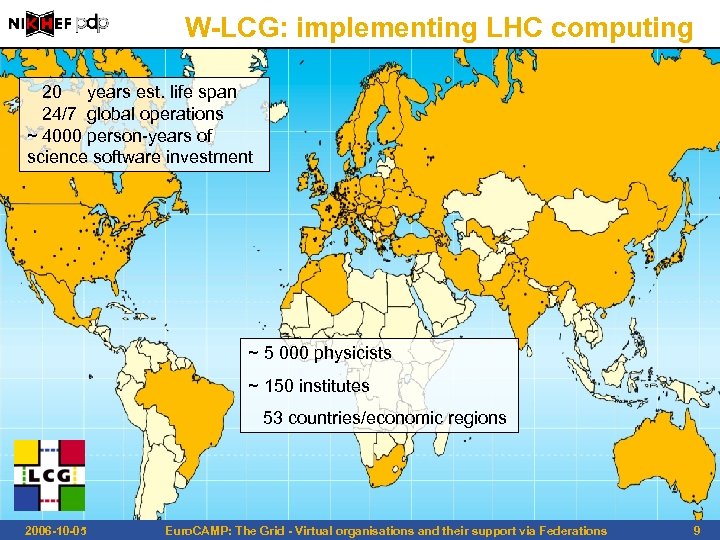 W-LCG: implementing LHC computing 20 years est. life span 24/7 global operations ~ 4000 person-years of science software investment ~ 5 000 physicists ~ 150 institutes 53 countries/economic regions 2006 -10 -05 Euro. CAMP: The Grid - Virtual organisations and their support via Federations 9
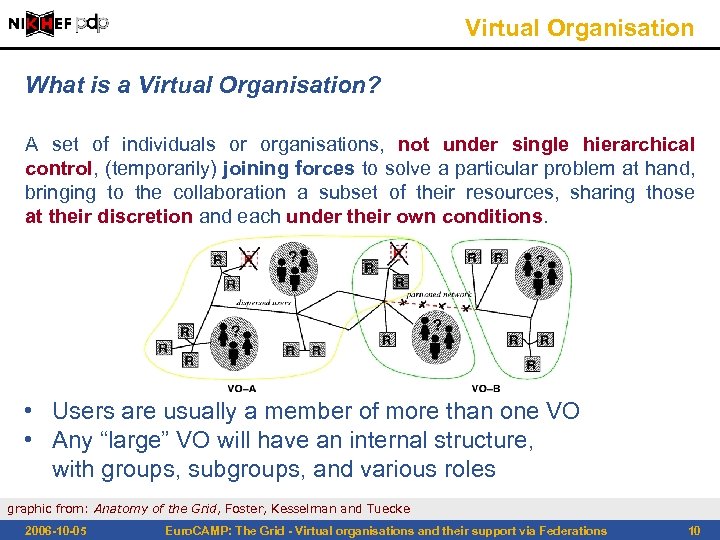 Virtual Organisation What is a Virtual Organisation? A set of individuals or organisations, not under single hierarchical control, (temporarily) joining forces to solve a particular problem at hand, bringing to the collaboration a subset of their resources, sharing those at their discretion and each under their own conditions. • Users are usually a member of more than one VO • Any “large” VO will have an internal structure, with groups, subgroups, and various roles graphic from: Anatomy of the Grid, Foster, Kesselman and Tuecke 2006 -10 -05 Euro. CAMP: The Grid - Virtual organisations and their support via Federations 10
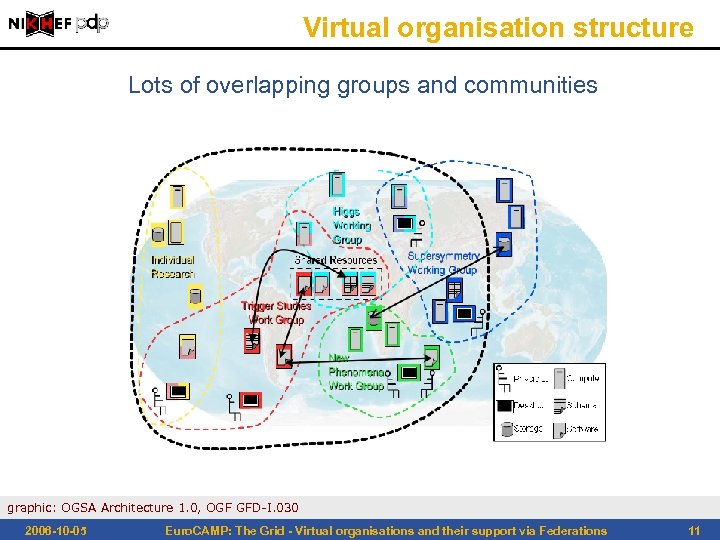 Virtual organisation structure Lots of overlapping groups and communities graphic: OGSA Architecture 1. 0, OGF GFD-I. 030 2006 -10 -05 Euro. CAMP: The Grid - Virtual organisations and their support via Federations 11
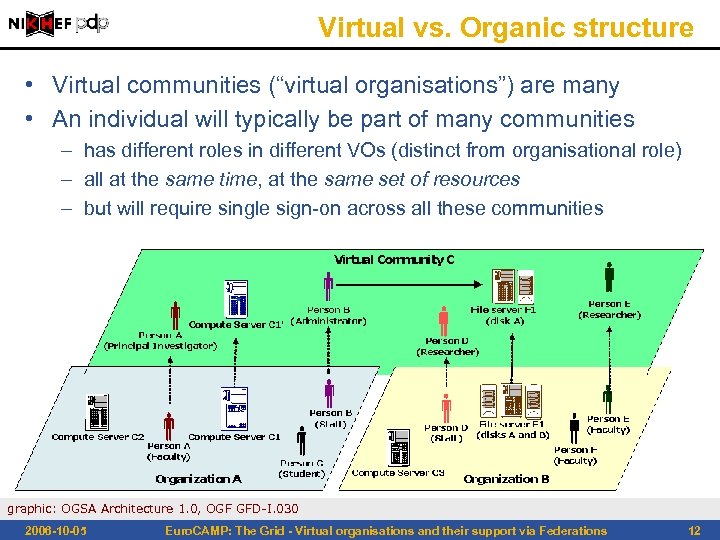 Virtual vs. Organic structure • Virtual communities (“virtual organisations”) are many • An individual will typically be part of many communities – has different roles in different VOs (distinct from organisational role) – all at the same time, at the same set of resources – but will require single sign-on across all these communities graphic: OGSA Architecture 1. 0, OGF GFD-I. 030 2006 -10 -05 Euro. CAMP: The Grid - Virtual organisations and their support via Federations 12
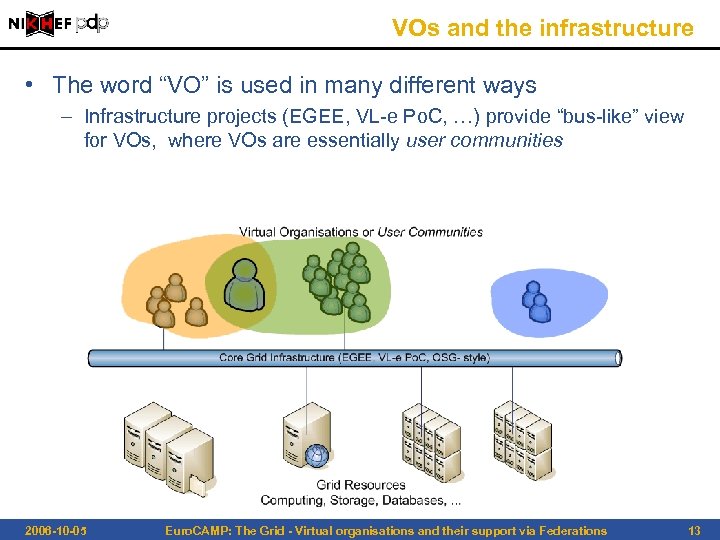 VOs and the infrastructure • The word “VO” is used in many different ways – Infrastructure projects (EGEE, VL-e Po. C, …) provide “bus-like” view for VOs, where VOs are essentially user communities 2006 -10 -05 Euro. CAMP: The Grid - Virtual organisations and their support via Federations 13
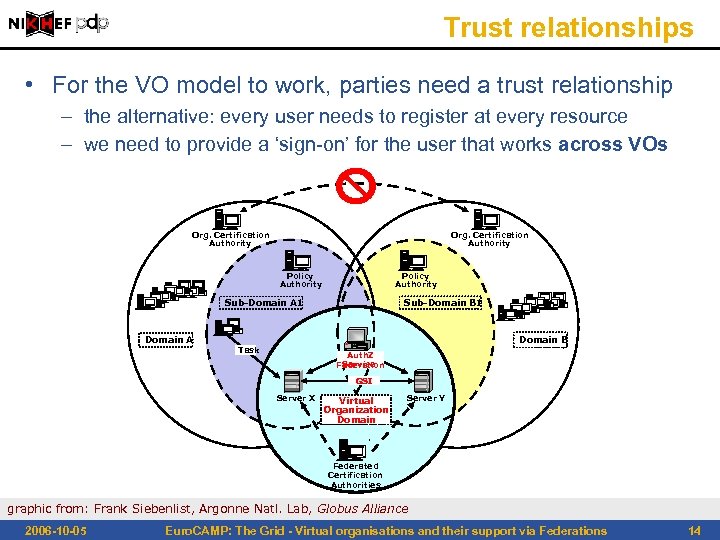 Trust relationships • For the VO model to work, parties need a trust relationship – the alternative: every user needs to register at every resource – we need to provide a ‘sign-on’ for the user that works across VOs Org. Certification Authority Policy Authority Sub-Domain B 1 Sub-Domain A 1 Domain A Domain B Task Auth. Z Service Federation GSI Server X Virtual Organization Domain Server Y Federated Certification Authorities graphic from: Frank Siebenlist, Argonne Natl. Lab, Globus Alliance 2006 -10 -05 Euro. CAMP: The Grid - Virtual organisations and their support via Federations 14
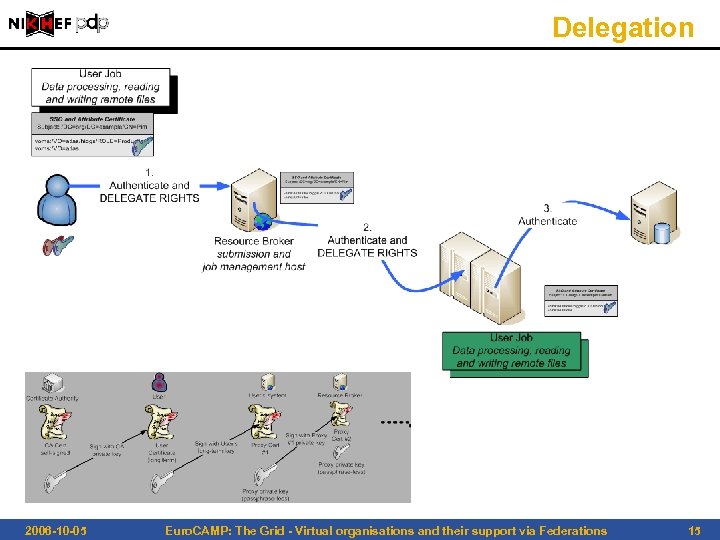 Delegation 2006 -10 -05 Euro. CAMP: The Grid - Virtual organisations and their support via Federations 15
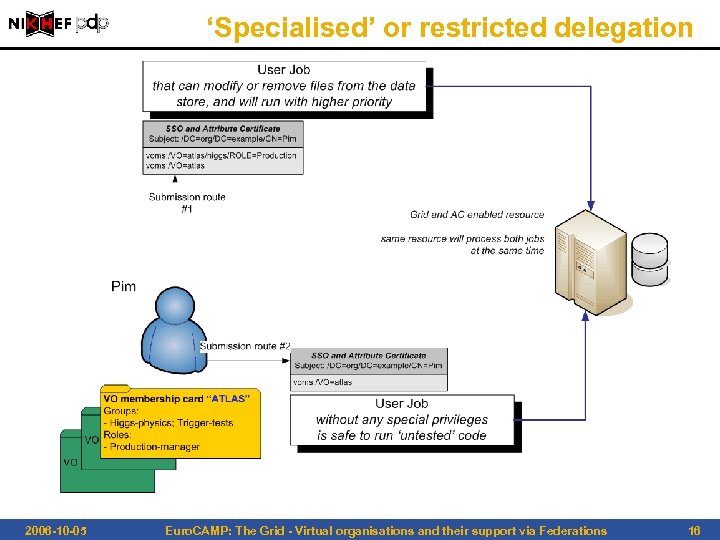 ‘Specialised’ or restricted delegation 2006 -10 -05 Euro. CAMP: The Grid - Virtual organisations and their support via Federations 16
 Separating responsibilities • Single Authentication token (“passport”) – – – key issue: provide a persistent, trusted identifier issued by a party trusted by all, recognised by many resource providers, users, and VOs satisfy traceability and persistency requirement in itself does not grant any access, but provides a unique binding between an identifier and the subject • Per-VO Authorisations (“visa”) – granted to a person/service via a virtual organisation – based on the identifier – acknowledged by the resource owners – today largely role-based access control • but providers can also obtain lists of authorised users per VO, – can still ban individual users – most of the real liability and responsibility goes here 2006 -10 -05 Euro. CAMP: The Grid - Virtual organisations and their support via Federations 17
 Authentication The EUGrid. PMA and the IGTF solving ‘stable’ issues first 2006 -10 -05 Euro. CAMP: The Grid - Virtual organisations and their support via Federations 18
 Authentication model Design and implementation choices made with the emergence of production-oriented grids in 2000: urgent need and focus was on providing cross-national trust initially, in the context of the EU FP 5 ‘Data. Grid’ and ‘Cross. Grid’ projects • National PKI – in general uptake of 1999/93/EC and e-Identification is slow – where available a national PKI could be leveraged • Various commercial providers – – Main commercial drive: secure web servers based on PKI Entrust, Global Sign, Thawte, Verisign, Swiss. Sign, … primary market is server authentication, not end-user identities use of commercial CAs solves the ‘pop-up’ problem. . . so for (web) servers a pop-up free service is actually needed • Grass-roots CAs – usually project specific, and without any documented policies – unsuitable for the ‘production’ infrastructure envisioned in 2000 2006 -10 -05 Euro. CAMP: The Grid - Virtual organisations and their support via Federations 19
 The first grid authentication infrastructures • Grid (academic) PKIs – – started off with pre-existing CAs, and some new ones, late 2000 ‘reasonable’ assurance level based on ‘acceptable’ procedures a single assurance level inspired by grid-relying party** requirements using a threshold model: minimum requirements • The first Grid CA coordination was driven by the actual and current need to solve some cross-national authentication issues right now around ~ 2000 – separation of Auth. N and Auth. Z allowed progress in the area – the policies convinced enough resource providers to ‘trust’ the Auth. N assertions – there were and are individuals all over Europe (and the world) that need access to these resource providers – started with 6 authorities (NL, CZ, FR, UK, IT, CERN) 2006 -10 -05 Euro. CAMP: The Grid - Virtual organisations and their support via Federations 20
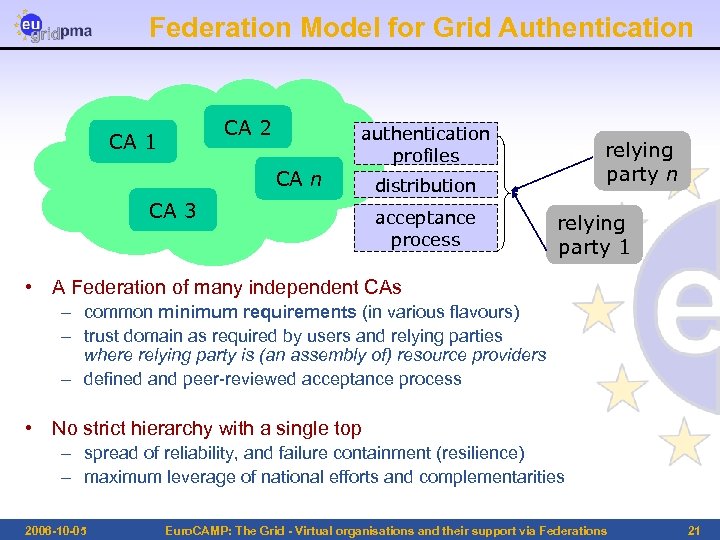 Federation Model for Grid Authentication CA 2 CA 1 authentication profiles CA n CA 3 relying party n distribution acceptance process relying party 1 • A Federation of many independent CAs – common minimum requirements (in various flavours) – trust domain as required by users and relying parties where relying party is (an assembly of) resource providers – defined and peer-reviewed acceptance process • No strict hierarchy with a single top – spread of reliability, and failure containment (resilience) – maximum leverage of national efforts and complementarities 2006 -10 -05 Euro. CAMP: The Grid - Virtual organisations and their support via Federations 21
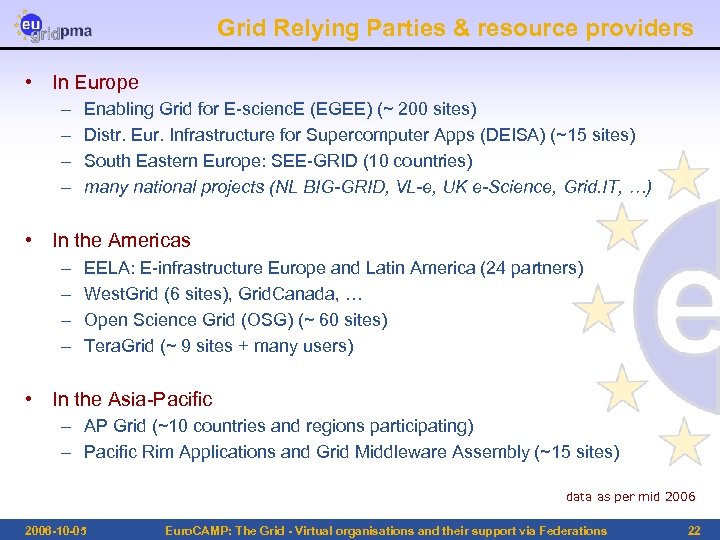 Grid Relying Parties & resource providers • In Europe – – Enabling Grid for E-scienc. E (EGEE) (~ 200 sites) Distr. Eur. Infrastructure for Supercomputer Apps (DEISA) (~15 sites) South Eastern Europe: SEE-GRID (10 countries) many national projects (NL BIG-GRID, VL-e, UK e-Science, Grid. IT, …) • In the Americas – – EELA: E-infrastructure Europe and Latin America (24 partners) West. Grid (6 sites), Grid. Canada, … Open Science Grid (OSG) (~ 60 sites) Tera. Grid (~ 9 sites + many users) • In the Asia-Pacific – AP Grid (~10 countries and regions participating) – Pacific Rim Applications and Grid Middleware Assembly (~15 sites) data as per mid 2006 -10 -05 Euro. CAMP: The Grid - Virtual organisations and their support via Federations 22
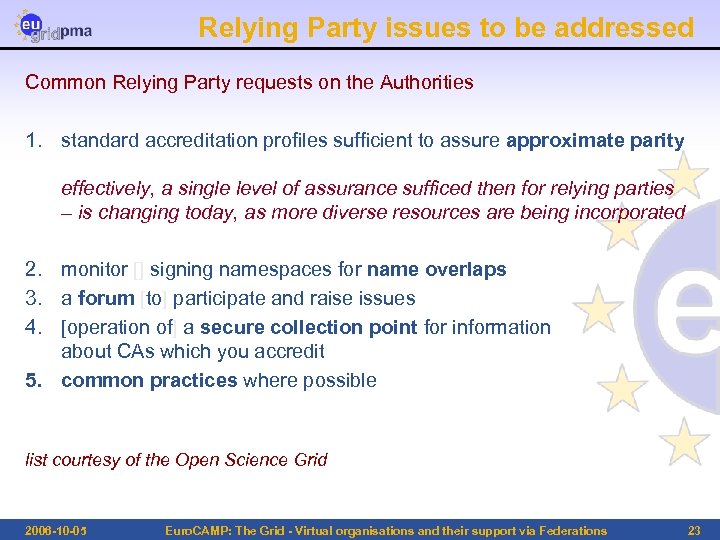 Relying Party issues to be addressed Common Relying Party requests on the Authorities 1. standard accreditation profiles sufficient to assure approximate parity effectively, a single level of assurance sufficed then for relying parties – is changing today, as more diverse resources are being incorporated 2. monitor [] signing namespaces for name overlaps 3. a forum [to] participate and raise issues 4. [operation of] a secure collection point for information about CAs which you accredit 5. common practices where possible list courtesy of the Open Science Grid 2006 -10 -05 Euro. CAMP: The Grid - Virtual organisations and their support via Federations 23
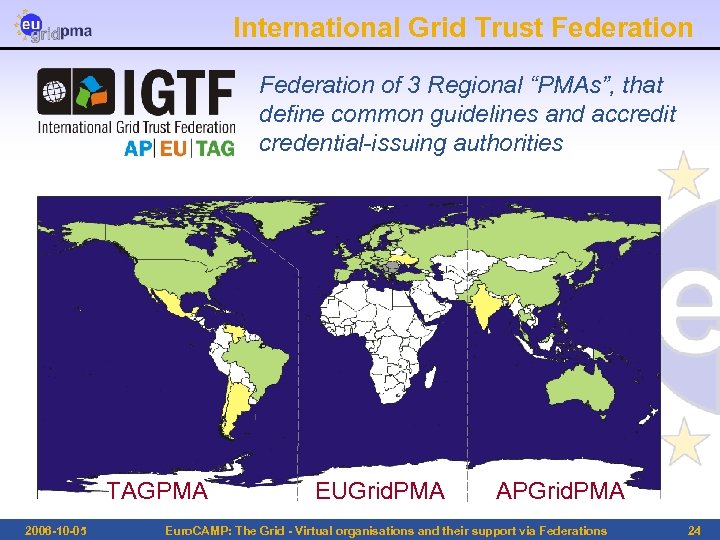 International Grid Trust Federation of 3 Regional “PMAs”, that define common guidelines and accredit credential-issuing authorities TAGPMA 2006 -10 -05 EUGrid. PMA APGrid. PMA Euro. CAMP: The Grid - Virtual organisations and their support via Federations 24
 The EUGrid. PMA The European Policy Management Authority for Grid Authentication in e-Science (EUGrid. PMA) is a body • to establish requirements and best practices for grid identity providers • to enable a common trust domain applicable to authentication of end-entities in inter-organisational access to distributed resources. The EUGrid. PMA itself does not provide identity assertions, but instead asserts that - within the scope of this charter – the certificates issued by the Accredited Authorities meet or exceed the relevant guidelines. 2006 -10 -05 Euro. CAMP: The Grid - Virtual organisations and their support via Federations 25
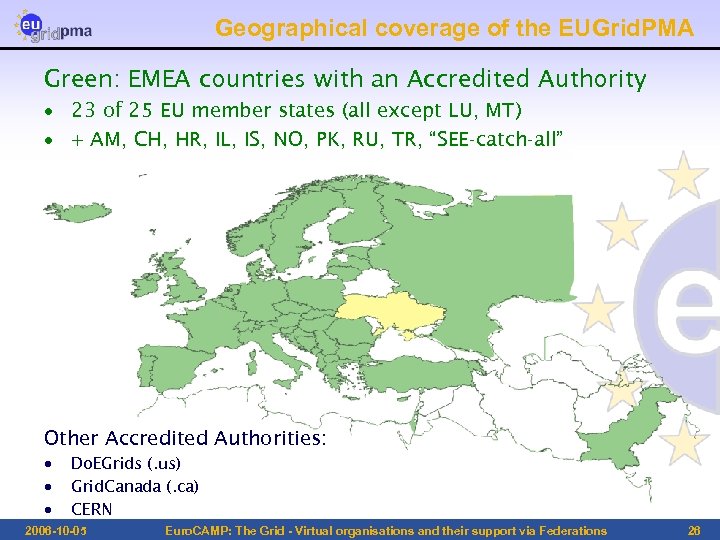 Geographical coverage of the EUGrid. PMA Green: EMEA countries with an Accredited Authority · 23 of 25 EU member states (all except LU, MT) · + AM, CH, HR, IL, IS, NO, PK, RU, TR, “SEE-catch-all” Other Accredited Authorities: · · · Do. EGrids (. us) Grid. Canada (. ca) CERN 2006 -10 -05 Euro. CAMP: The Grid - Virtual organisations and their support via Federations 26
 EUGrid. PMA Membership EUGrid. PMA membership for Authorities (the European policy, needed to maintain a manageable trust fabric) • single Authority per – country, – large region (e. g. the Nordic Countries), or – international treaty organization • ‘serve the largest possible community with a small number of stable authorities’ (needed for both management and technical reasons today) • ‘operated as a long-term commitment’ – many CAs are operated by the (national) NREN (CESNET, ESnet, Belnet, NIIF, EEnet, SWITCH, DFN, … ) – or by the e-Science programme/science foundation (UK e. Science, VL-e, CNRS, … ) Other members: DEISA, EGEE, SEE-GRID projects, OSG, TERENA, … 2006 -10 -05 Euro. CAMP: The Grid - Virtual organisations and their support via Federations 27
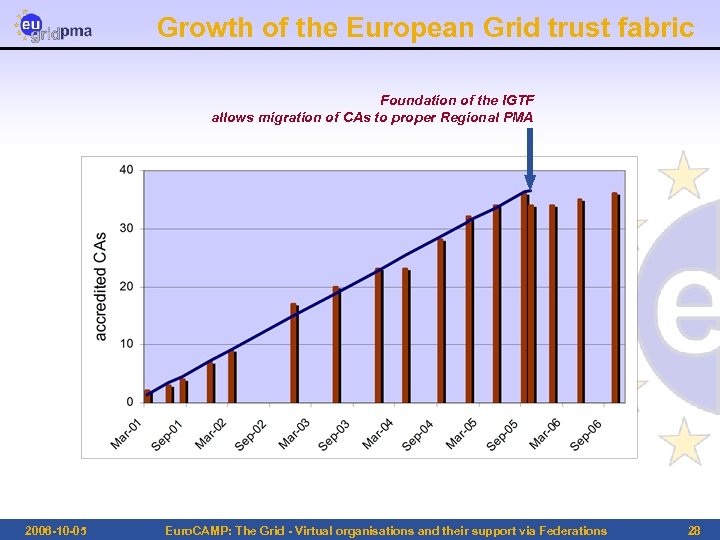 Growth of the European Grid trust fabric Foundation of the IGTF allows migration of CAs to proper Regional PMA 2006 -10 -05 Euro. CAMP: The Grid - Virtual organisations and their support via Federations 28
 Building the federation • Trust providers (‘CAs’) and relying parties (‘sites’) together shape the common requirements – Several profiles for different identity management models – Authorities demonstrate compliance with profile guidelines – Peer-review process within the federation to (re-) evaluate members on entry & periodically – reduces effort on the relying parties • single document to review and assess for all CAs under a profile – reduces cost for the authorities • but participation does come at a cost of involved participation … • Ultimate trust decision always remains with the RP • An authority is not necessarily limited to just ‘grid’ use 2006 -10 -05 Euro. CAMP: The Grid - Virtual organisations and their support via Federations 29
 Guidelines: common elements in the IGTF • Coordinated namespace – Subject names refer to a unique entity (person, host) – Usable as a basis for authorization decisions – This name uniqueness is essential for all authentication profiles! • Common Naming – Coordinated distribution for all trust anchors in the federation – Trusted, redundant, sources for download, verifiable via TACAR • Concerns and ‘incident’ handling – Guaranteed point of contact – Forum to raise issues and concerns • Requirement for documentation of processes – Detailed policy and practice statement – Auditing by federation peers 2006 -10 -05 Euro. CAMP: The Grid - Virtual organisations and their support via Federations 30
 Guidelines: secured X. 509 CAs Aimed at long-lived identity assertions, the ‘traditional PKI’ world • Identity vetting procedures – Based on (national) photo ID’s – Face-to-face verification of applicants via a network of distributed Registration Authorities – Periodic renewal (once every year) – revocation and CRL issuing required and we have all RPs actually downloading the CRLs several times a day – subject naming must be a reasonable representation of the entity name • Secure operation – off-line signing key or HSM-backed on-line secured systems • Audit requirements – data retention and audit trail requirements, traceability of certified entities • Technical implementation – need to limit the number of issuing authorities for technical reasons (most software and browsers cannot support O(1000) issuers) – certificate profile and interoperability 2006 -10 -05 Euro. CAMP: The Grid - Virtual organisations and their support via Federations 31
 Short-lived or member integrated services Aimed at short-lived ‘translations’, that are organisation/federation bound • Identity vetting procedures – based on an existing ID Management system of sufficient quality – Original identity vetting must be of sufficient quality to trace the individual for as long as name is in active use – If documented traceability is lost, the subject name can never be re-used – revocation and CRL issuing not required for assertion lifetimes << 1 Ms – subject naming must be a reasonable representation of the entity name • Secure operation – HSM-backed on-line secured systems • Audit requirements – data retention and audit trail requirements, traceability of certified entities • Technical implementation – scaling of this model still needs to be demonstrated, and needs higher-level coordination – most software and browsers cannot support O(1000) issuers – and a peer-review based trust fabric cannot do that either … – certificate profile and interoperability 2006 -10 -05 Euro. CAMP: The Grid - Virtual organisations and their support via Federations 32
 MICS ID management system requirements Technical and IT security requirements The identity management (Id. M) system containing the identity information used to issue the assertions must meet the following conditions • • Re-usable private information used to authenticate end-entities to the Id. M system must only ever be sent encrypted over the network when authenticating to any system (including any non-CA systems) that are allowed to use the Id. M for authentication. A not-published second authentication factor must be used to authenticate the end-entity for certificate issuance The end-entities must be notified of any certificate issuance, using contact information previously registered in the Id. M (for example by electronic mail) From the information stored in the Id. M it must be possible to determine if the requestor’s identity has originally been validated using a face-to-face meeting as described above 2006 -10 -05 Euro. CAMP: The Grid - Virtual organisations and their support via Federations 33
 MICS ID management system requirements Identity vetting requirements convincing the world that you’re OK Documentation of how the Id. M is populated, maintained and cleaned MUST be documented and agreed to by the PMA. Two modes By example: The Id. M used by the CA should be a system that is also used to protect access to critical resources, e. g. payroll systems, for use in financial transactions, granting access to highly-valuable resources, and be regularly tries to ‘catch’ the quality of the system without having to report to formal audits maintained. By review: Alternatively, equivalent security mechanisms must be provided, described in detail and presented to the PMA and are subject to PMA agreement. and again the data for those entities in the Id. M that qualify for ‘MICS’ assertions must be of a quality that allows unique tracing, name uniqueness and persistency – and a mechanism to clean ‘stale’ entries must be defined. Example: the Uv. Amsterdam does not trust its own system even for grading! 2006 -10 -05 Euro. CAMP: The Grid - Virtual organisations and their support via Federations 34
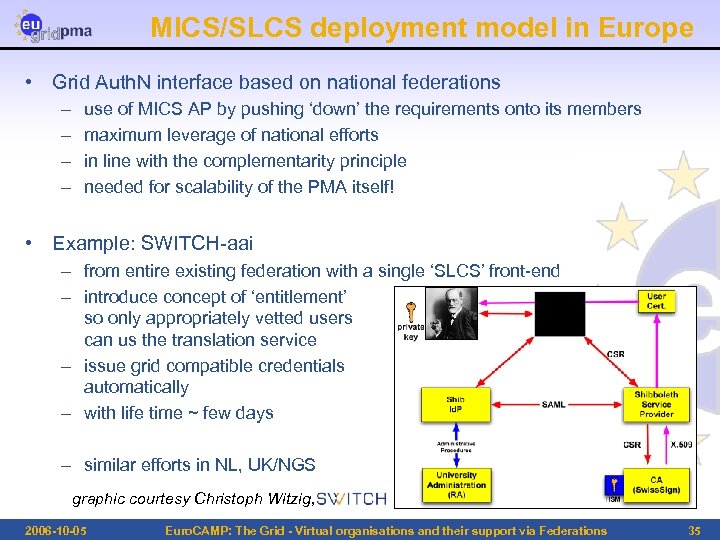 MICS/SLCS deployment model in Europe • Grid Auth. N interface based on national federations – – use of MICS AP by pushing ‘down’ the requirements onto its members maximum leverage of national efforts in line with the complementarity principle needed for scalability of the PMA itself! • Example: SWITCH-aai – from entire existing federation with a single ‘SLCS’ front-end – introduce concept of ‘entitlement’ so only appropriately vetted users can us the translation service – issue grid compatible credentials automatically – with life time ~ few days – similar efforts in NL, UK/NGS graphic courtesy Christoph Witzig, 2006 -10 -05 Euro. CAMP: The Grid - Virtual organisations and their support via Federations 35
 Profile matrix: towards multiple Lo. As • All grid technical security mechanisms meet the technical protocol requirements of level 3 (but even soft tokens meet level 3 …) • Identity vetting requirements for Classic and MICS meet ~ level ‘ 2 –’ – only in-person allowed (remote option is not allowed, Authorities cannot check financial records &c) – except that address and Do. B are not necessarily retained by the RA to ease data protection issues, and copies not always retained – but the ID number (and issuing country) is recorded, so ‘relevant’ agencies can get to the applicant – VOs need to collect this information and more anyway for incident response • Both more stringent and looser Lo. As needed for other resource classes – but e-Auth level 1 is too low, and NIST doesn’t define anything in between… 2006 -10 -05 Euro. CAMP: The Grid - Virtual organisations and their support via Federations 36
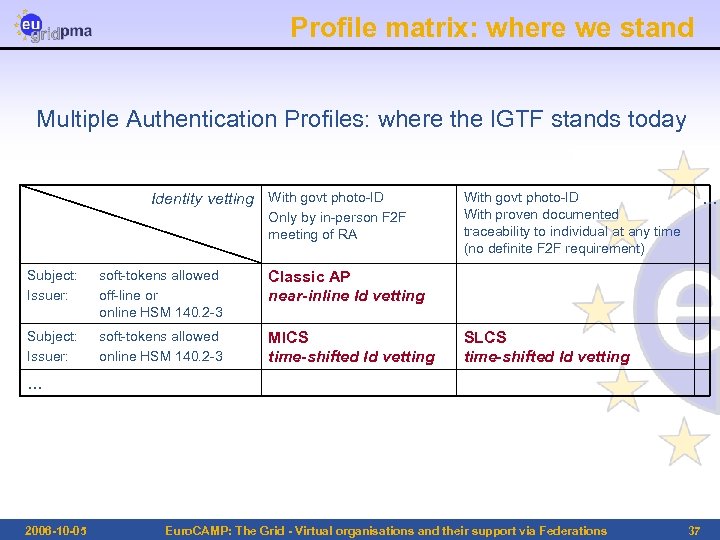 Profile matrix: where we stand Multiple Authentication Profiles: where the IGTF stands today Identity vetting With govt photo-ID Only by in-person F 2 F meeting of RA Subject: Issuer: soft-tokens allowed off-line or online HSM 140. 2 -3 soft-tokens allowed online HSM 140. 2 -3 MICS time-shifted Id vetting … Classic AP near-inline Id vetting Subject: Issuer: With govt photo-ID With proven documented traceability to individual at any time (no definite F 2 F requirement) SLCS time-shifted Id vetting … 2006 -10 -05 Euro. CAMP: The Grid - Virtual organisations and their support via Federations 37
 Authorization A brief look at the prevalent models today 2006 -10 -05 Euro. CAMP: The Grid - Virtual organisations and their support via Federations
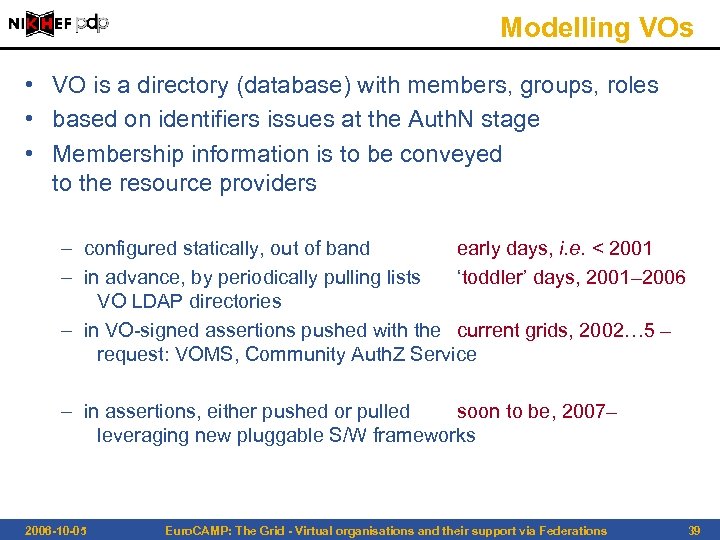 Modelling VOs • VO is a directory (database) with members, groups, roles • based on identifiers issues at the Auth. N stage • Membership information is to be conveyed to the resource providers – configured statically, out of band early days, i. e. < 2001 – in advance, by periodically pulling lists ‘toddler’ days, 2001– 2006 VO LDAP directories – in VO-signed assertions pushed with the current grids, 2002… 5 – request: VOMS, Community Auth. Z Service – in assertions, either pushed or pulled soon to be, 2007– leveraging new pluggable S/W frameworks 2006 -10 -05 Euro. CAMP: The Grid - Virtual organisations and their support via Federations 39
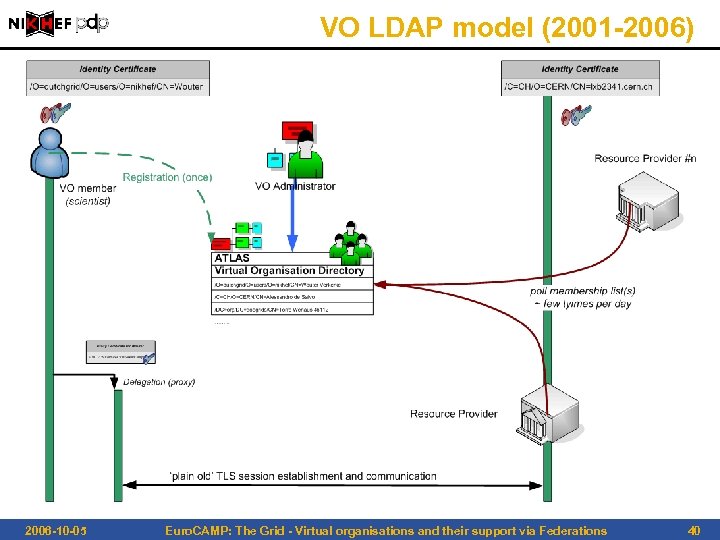 VO LDAP model (2001 -2006) 2006 -10 -05 Euro. CAMP: The Grid - Virtual organisations and their support via Federations 40
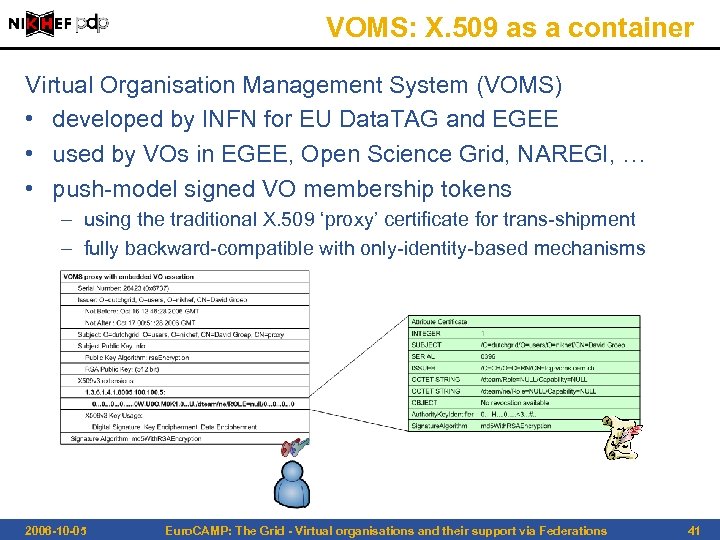 VOMS: X. 509 as a container Virtual Organisation Management System (VOMS) • developed by INFN for EU Data. TAG and EGEE • used by VOs in EGEE, Open Science Grid, NAREGI, … • push-model signed VO membership tokens – using the traditional X. 509 ‘proxy’ certificate for trans-shipment – fully backward-compatible with only-identity-based mechanisms 2006 -10 -05 Euro. CAMP: The Grid - Virtual organisations and their support via Federations 41
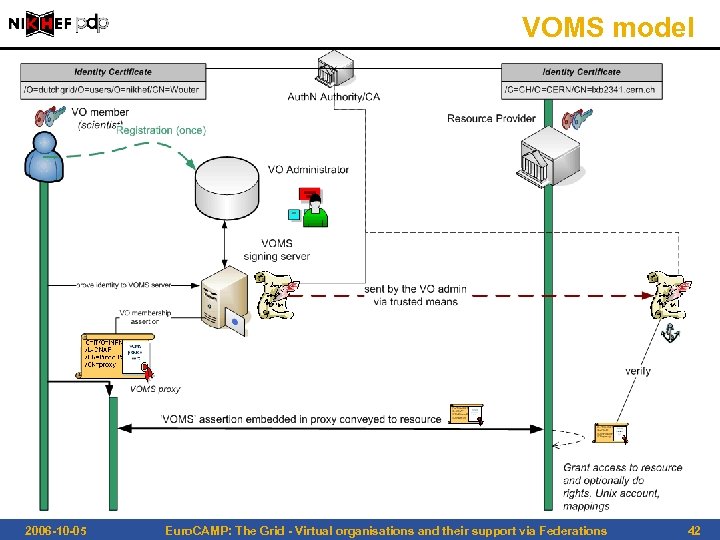 VOMS model 2006 -10 -05 Euro. CAMP: The Grid - Virtual organisations and their support via Federations 42
 Technical interoperation Software has become flexible over the past few years supports push and pull of attributes and assertions becoming syntax-agnostic acknowledges multiple sources of policy 2006 -10 -05 Euro. CAMP: The Grid - Virtual organisations and their support via Federations
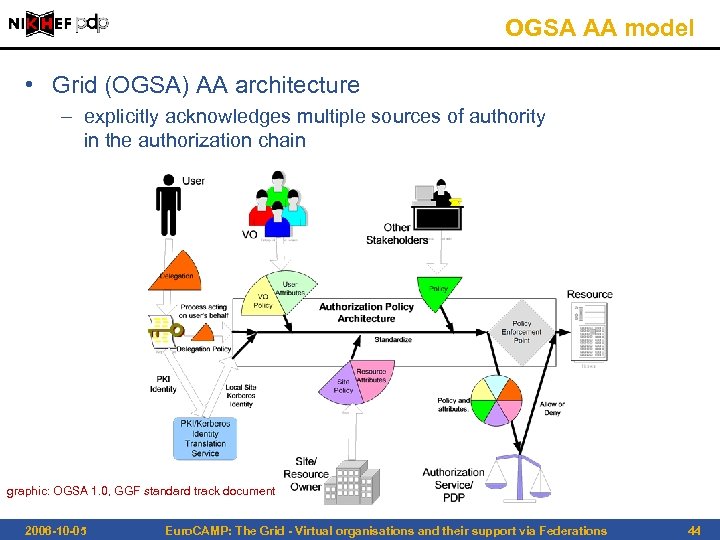 OGSA AA model • Grid (OGSA) AA architecture – explicitly acknowledges multiple sources of authority in the authorization chain graphic: OGSA 1. 0, GGF standard track document 2006 -10 -05 Euro. CAMP: The Grid - Virtual organisations and their support via Federations 44
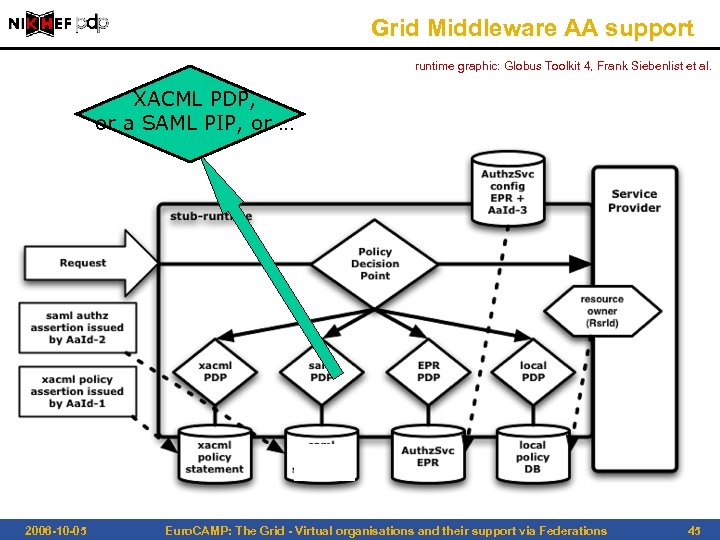 Grid Middleware AA support runtime graphic: Globus Toolkit 4, Frank Siebenlist et al. XACML PDP, or a SAML PIP, or … 2006 -10 -05 Euro. CAMP: The Grid - Virtual organisations and their support via Federations 45
 Maybe software (soon) no longer the issue? • middleware support for both push/pull • SAML/X. 509 AC side by side for conveying assertions • best model depends on application • is largely orthogonal to the trust and policy issues – if you do it ‘right’, and all assertions are actually signed, by the proper So. A, etc. • keeping in mind that support is needed – for rights delegation (typically to processes) – rights/role selection based on the ‘session’, and not the target resource per se – ‘on-demand’ creation of new sources of authority (VOs) • and ‘grid’ communities cut through organisations 2006 -10 -05 Euro. CAMP: The Grid - Virtual organisations and their support via Federations 46
 Towards an integrated AAI? 2006 -10 -05 Euro. CAMP: The Grid - Virtual organisations and their support via Federations
 Integration scenarios with other AAIs Interlinking of technologies can be cone at various points 1. Authentication: linking (federations of) identity providers to the existing grid Auth. N systems – ‘Short-Lived Credential Services’ translation bridges 2. 3. 4. 5. • Populate VO databases with UHO Attributes Equip resource providers to also inspect UHO attributes Expressing VO attributes as function of UHO attributes Make VO appear as (sub-) organisation in a federation and most probably many other options as well … Leads to assertions with multiple Lo. As in the same decision – thus all assertions should carry their Lo. A – expressed in a way that’s recognisable – and the Lo. A attested to by ‘third parties’ (i. e. the federation) 2006 -10 -05 Euro. CAMP: The Grid - Virtual organisations and their support via Federations 48
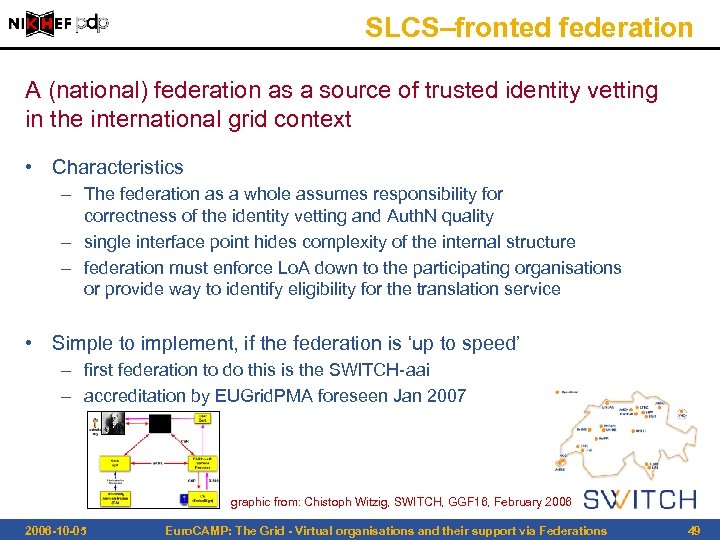 SLCS–fronted federation A (national) federation as a source of trusted identity vetting in the international grid context • Characteristics – The federation as a whole assumes responsibility for correctness of the identity vetting and Auth. N quality – single interface point hides complexity of the internal structure – federation must enforce Lo. A down to the participating organisations or provide way to identify eligibility for the translation service • Simple to implement, if the federation is ‘up to speed’ – first federation to do this is the SWITCH-aai – accreditation by EUGrid. PMA foreseen Jan 2007 graphic from: Chistoph Witzig, SWITCH, GGF 16, February 2006 -10 -05 Euro. CAMP: The Grid - Virtual organisations and their support via Federations 49
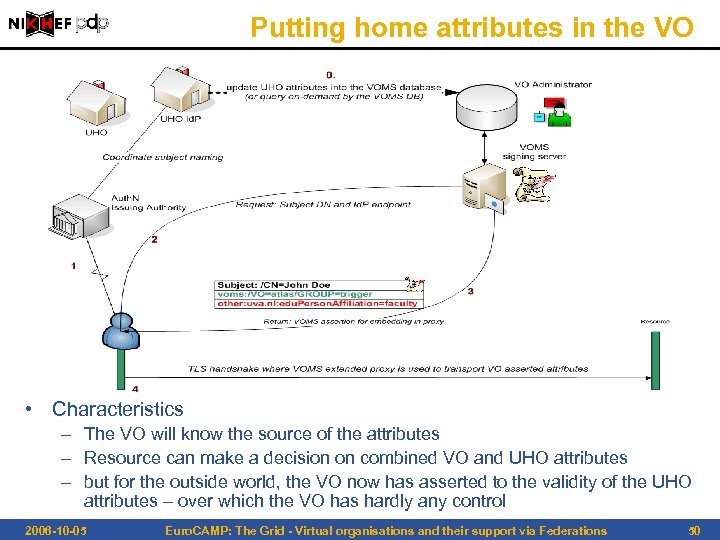 Putting home attributes in the VO • Characteristics – The VO will know the source of the attributes – Resource can make a decision on combined VO and UHO attributes – but for the outside world, the VO now has asserted to the validity of the UHO attributes – over which the VO has hardly any control 2006 -10 -05 Euro. CAMP: The Grid - Virtual organisations and their support via Federations 50
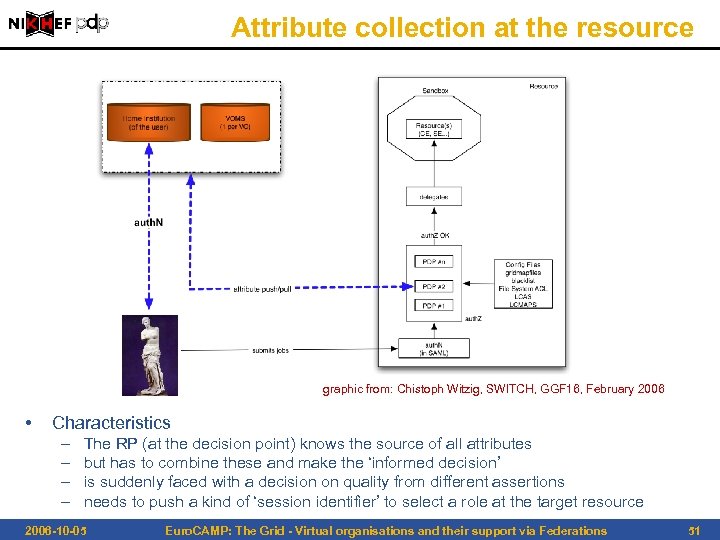 Attribute collection at the resource graphic from: Chistoph Witzig, SWITCH, GGF 16, February 2006 • Characteristics – – The RP (at the decision point) knows the source of all attributes but has to combine these and make the ‘informed decision’ is suddenly faced with a decision on quality from different assertions needs to push a kind of ‘session identifier’ to select a role at the target resource 2006 -10 -05 Euro. CAMP: The Grid - Virtual organisations and their support via Federations 51
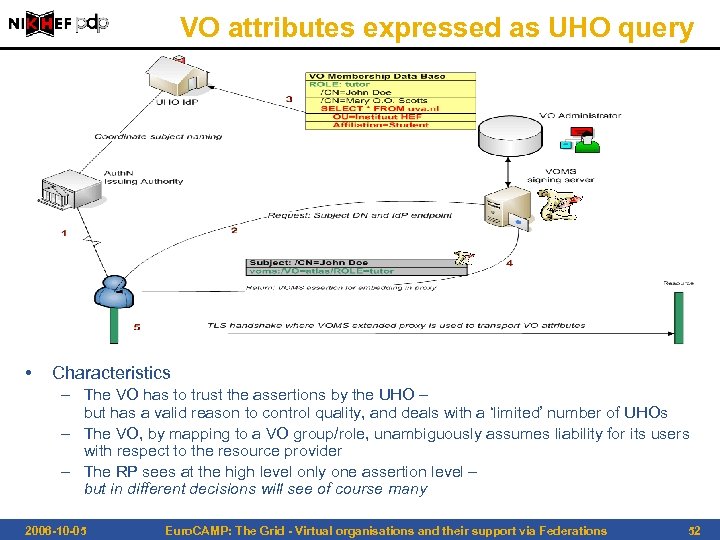 VO attributes expressed as UHO query • Characteristics – The VO has to trust the assertions by the UHO – but has a valid reason to control quality, and deals with a ‘limited’ number of UHOs – The VO, by mapping to a VO group/role, unambiguously assumes liability for its users with respect to the resource provider – The RP sees at the high level only one assertion level – but in different decisions will see of course many 2006 -10 -05 Euro. CAMP: The Grid - Virtual organisations and their support via Federations 52
 Adopting a VO as part of a UHO By equipping the VO – with an interface that talks your favourite federation language – agreeing on a mapping of the VO roles & groups to your federation – agreeing on the assurance level in the VO VO can • join any federation directly • or the VO can be ‘sponsored into’ any federation by an existing (physical) organisation – example: grant LHC collaborators access via the CERN library directly, instead of through a VPN link … – model will again depend mainly on policy issues and licensing • In reality, this may be quite a long way away 2006 -10 -05 Euro. CAMP: The Grid - Virtual organisations and their support via Federations 53
 Many interesting issues to be addressed Technical issues solvable – policy harmonisation is non-trivial • first example of eduroam access using IGTF certs was technically easy to do – but as a test only, no policies yet • far wider range of qualities in the attributes • different incentives for keeping information current • responsibility for attributes resides with different parties – VO to manage community membership – but can small VOs maintain such an infrastructure? a task for an (independent) ‘e-Infrastructure’ providers – home organisation to manage organic attributes – but not attributes are usually considered ‘equally valuable’, and there is lots of variety between the UHOs – access rights may suddenly depend on attributes with different quality 2006 -10 -05 Euro. CAMP: The Grid - Virtual organisations and their support via Federations 54
 Outlook • Confederation is a must for grids – the user scenarios require it, as the user community is international – national federations, leveraging home organisation identity vetting or e. Gov IDs, are a ‘must’ for scalability • e-Infrastructure needs the campus–and your researchers need e-Infra … – with a need for defined and verifiable Lo. As (at high and low levels) – the ’homeless’ will be a permanent feature • IGTF today provides an international trust fabric for Auth. N – a source for ‘trusted’ identifiers – definition of multiple Lo. As is starting, and we want to reach out and co -leverage other efforts as much as possible – by structure, we are geared towards catering for the ‘homeless’ – we continue to have pressing urgent needs for federation today – but we are a long way from the O(10 M+) users mark 2006 -10 -05 Euro. CAMP: The Grid - Virtual organisations and their support via Federations 55
![Realising the roadmap together [The e-IRG] encourages work towards a common federation for academia](https://present5.com/presentation/103cf57214d99a9cc57c627b4834d27e/image-56.jpg "Realising the roadmap together [The e-IRG] encourages work towards a common federation for academia") Realising the roadmap together [The e-IRG] encourages work towards a common federation for academia and research institutes that ensures mutual recognition of the strength and validity of their authorization assertions. e-IRG Recommendation Dutch EU Presidency 2004 Trans-disciplinary (Grid projects, NRENs, other user communities) and trans-continental forums that move towards the establishment of a global, seamless AA infrastructure for e-Science applications should be encouraged. The e-IRG wishes to acknowledge the efforts made in this direction by the IGTF and the open information exchange point provided by TERENA task forces. Recommendation to the e-IRG Austrian EU Presidency 2006 -10 -05 Euro. CAMP: The Grid - Virtual organisations and their support via Federations 56
Realising the roadmap together [The e-IRG] encourages work towards a common federation for academia and research institutes that ensures mutual recognition of the strength and validity of their authorization assertions. e-IRG Recommendation Dutch EU Presidency 2004 Trans-disciplinary (Grid projects, NRENs, other user communities) and trans-continental forums that move towards the establishment of a global, seamless AA infrastructure for e-Science applications should be encouraged. The e-IRG wishes to acknowledge the efforts made in this direction by the IGTF and the open information exchange point provided by TERENA task forces. Recommendation to the e-IRG Austrian EU Presidency 2006 -10 -05 Euro. CAMP: The Grid - Virtual organisations and their support via Federations 56