


 Скачать презентацию The Greenhouse Effect on Earth s atmosphere is slightly
b237a0c2cf1379c4e39ce9311a60f4d3.ppt
- Количество слайдов: 29
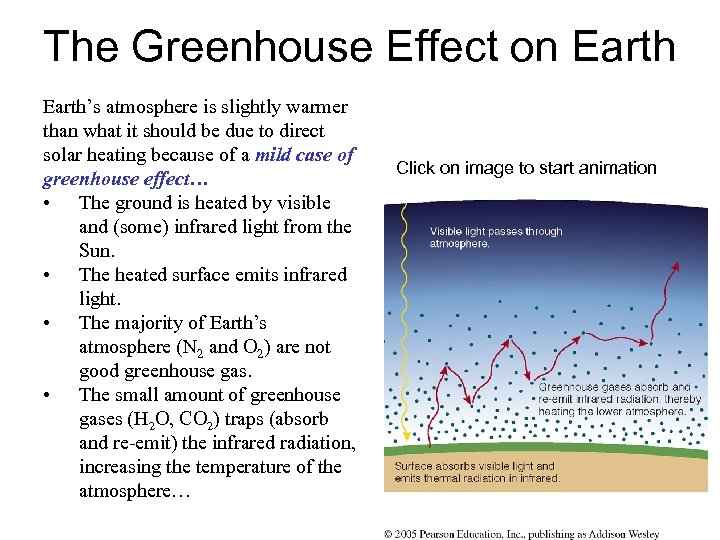 The Greenhouse Effect on Earth’s atmosphere is slightly warmer than what it should be due to direct solar heating because of a mild case of greenhouse effect… • The ground is heated by visible and (some) infrared light from the Sun. • The heated surface emits infrared light. • The majority of Earth’s atmosphere (N 2 and O 2) are not good greenhouse gas. • The small amount of greenhouse gases (H 2 O, CO 2) traps (absorb and re-emit) the infrared radiation, increasing the temperature of the atmosphere… Click on image to start animation
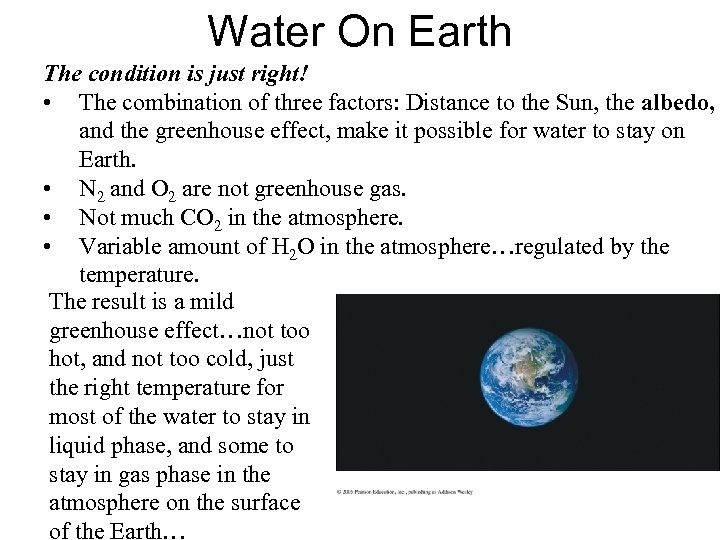 Water On Earth The condition is just right! • The combination of three factors: Distance to the Sun, the albedo, and the greenhouse effect, make it possible for water to stay on Earth. • N 2 and O 2 are not greenhouse gas. • Not much CO 2 in the atmosphere. • Variable amount of H 2 O in the atmosphere…regulated by the temperature. The result is a mild greenhouse effect…not too hot, and not too cold, just the right temperature for most of the water to stay in liquid phase, and some to stay in gas phase in the atmosphere on the surface of the Earth…
 Greenhouse Gases • The primary components of Earth’s atmosphere, N 2 and O 2 do not have absorption in the IR wavelength range (don’t absorb energy) • Greenhouse gas are efficient in absorbing IR light… The most important greenhouse gases are: – H 2 O – Water vapor. – CO 2 – Carbon Dioxide – CH 4 – methane The most abundant greenhouse gas in Earth’s atmosphere is water vapor.
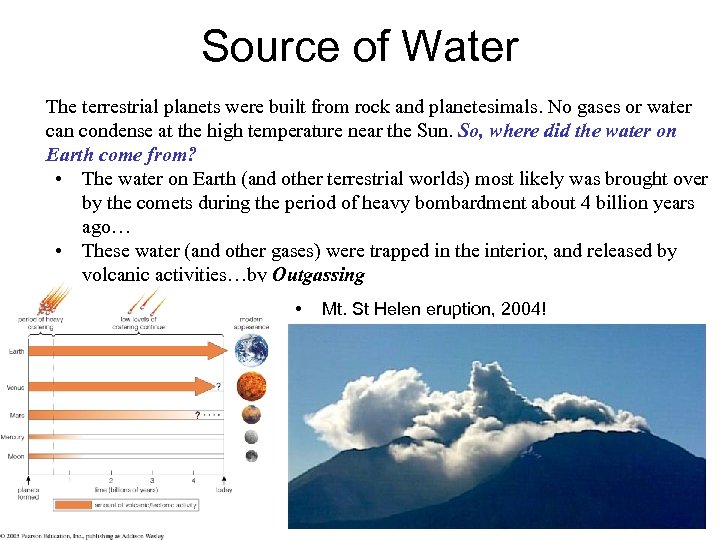 Source of Water The terrestrial planets were built from rock and planetesimals. No gases or water can condense at the high temperature near the Sun. So, where did the water on Earth come from? • The water on Earth (and other terrestrial worlds) most likely was brought over by the comets during the period of heavy bombardment about 4 billion years ago… • These water (and other gases) were trapped in the interior, and released by volcanic activities…by Outgassing • Mt. St Helen eruption, 2004!
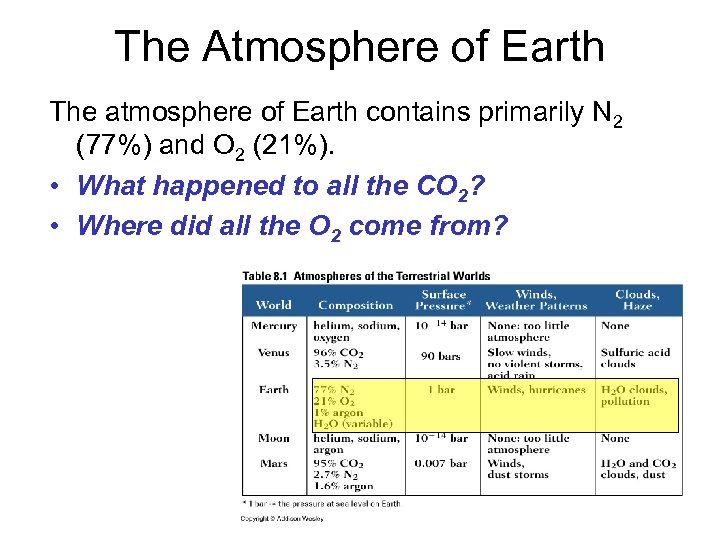 The Atmosphere of Earth The atmosphere of Earth contains primarily N 2 (77%) and O 2 (21%). • What happened to all the CO 2? • Where did all the O 2 come from?
 CO 2 is a colorless gas… Atmospheric CO 2 is derived from (The sources…) • Volcanic outgassing • burning of organic matter • Respiration of living organisms • … CO 2 can be stored in (The Sinks…) • Highly soluble in water: forms H 2 CO 3 • Dissolved CO 2 in water can interact with silicate minerals to form carbonated minerals…
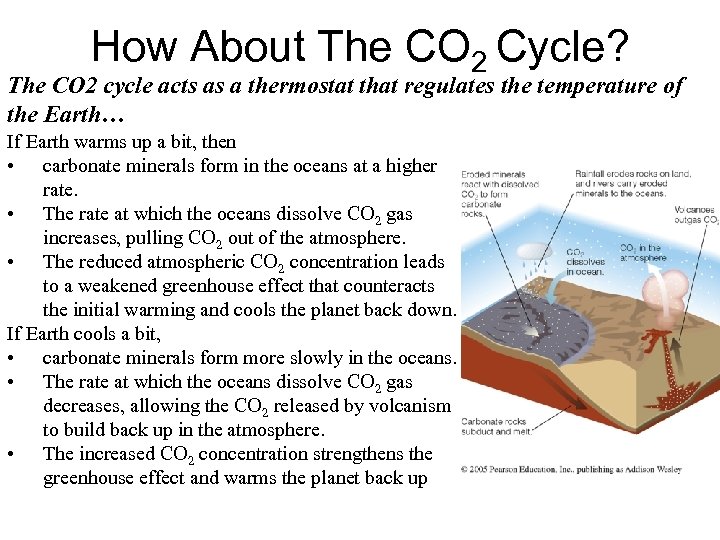
 Carbon Dioxide Cycle The mechanism by which Earth self-regulates its temperature is called the carbon dioxide cycle, or the CO 2 cycle for short. Starting with the carbon dioxide in the atmosphere: • Volcanoes outgas CO 2 into the atmosphere. • Atmospheric carbon dioxide dissolves in the oceans. • At the same time, rainfall erodes rocks on Earth’s continents and rivers carry the eroded minerals to the oceans. • In the oceans, the eroded minerals combine with dissolved carbon dioxide and fall to the ocean floor, making carbonate rocks such as limestone. • Over millions of years, the conveyor belt of plate tectonics carries the carbonate rocks to subduction zones, and subduction carries them down into the mantle. • As they are pushed deeper into the mantle, some of the subducted carbonate rock melts and releases its carbon dioxide, which then outgasses back into the atmosphere through volcanoes.
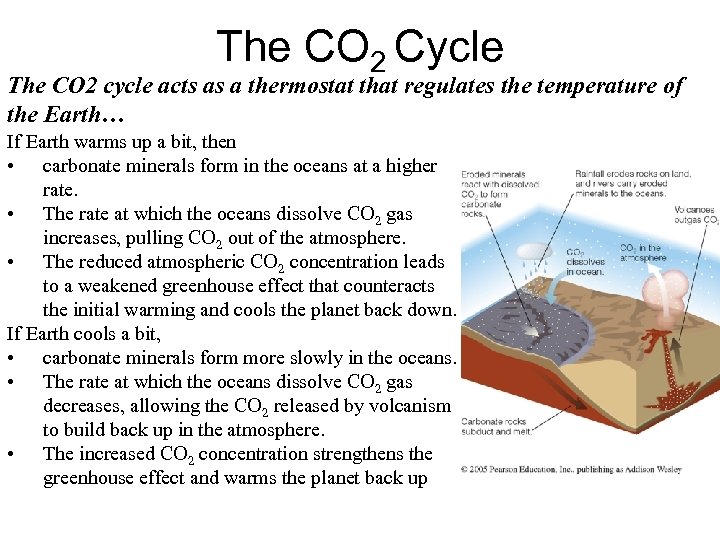 The CO 2 Cycle The CO 2 cycle acts as a thermostat that regulates the temperature of the Earth… If Earth warms up a bit, then • carbonate minerals form in the oceans at a higher rate. • The rate at which the oceans dissolve CO 2 gas increases, pulling CO 2 out of the atmosphere. • The reduced atmospheric CO 2 concentration leads to a weakened greenhouse effect that counteracts the initial warming and cools the planet back down. If Earth cools a bit, • carbonate minerals form more slowly in the oceans. • The rate at which the oceans dissolve CO 2 gas decreases, allowing the CO 2 released by volcanism to build back up in the atmosphere. • The increased CO 2 concentration strengthens the greenhouse effect and warms the planet back up
 Feedback Loop • Positive Feedback – Mechanisms that make things worse… – e. g. , Increasing CO 2 in the atmosphere leading to the release of more CO 2 • Negative Feedback – Mechanisms that are self-correcting… – e. g. , Increasing CO 2 in the atmosphere leading to higher rate of CO 2 removal, such as our CO 2 cycle.
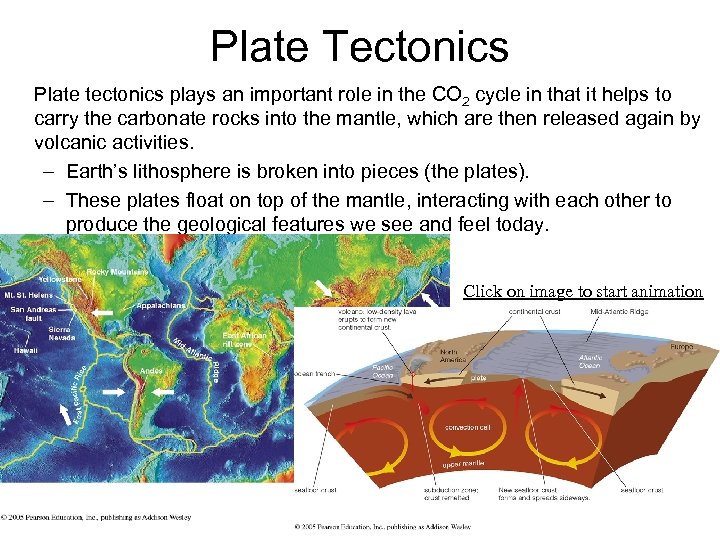 Plate Tectonics Plate tectonics plays an important role in the CO 2 cycle in that it helps to carry the carbonate rocks into the mantle, which are then released again by volcanic activities. – Earth’s lithosphere is broken into pieces (the plates). – These plates float on top of the mantle, interacting with each other to produce the geological features we see and feel today. Click on image to start animation
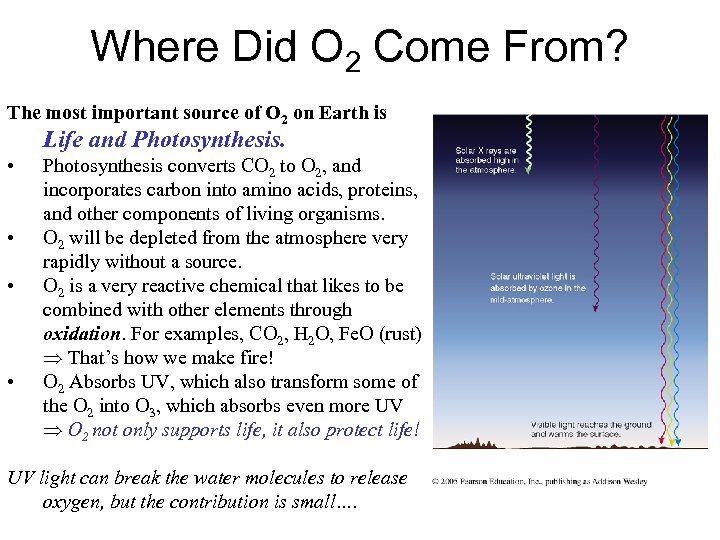 Where Did O 2 Come From? The most important source of O 2 on Earth is Life and Photosynthesis. • • Photosynthesis converts CO 2 to O 2, and incorporates carbon into amino acids, proteins, and other components of living organisms. O 2 will be depleted from the atmosphere very rapidly without a source. O 2 is a very reactive chemical that likes to be combined with other elements through oxidation. For examples, CO 2, H 2 O, Fe. O (rust) That’s how we make fire! O 2 Absorbs UV, which also transform some of the O 2 into O 3, which absorbs even more UV O 2 not only supports life, it also protect life! UV light can break the water molecules to release oxygen, but the contribution is small….
 Water On Earth in the Past Was it always like this on Earth? • Yes. Water was plentiful throughout most of Earth’s history, for about three billion years. • No! Geological evidences suggest that Earth used to be covered by ice about 600 -700 million years ago Snowball Phase. How did Earth recover from the snowball phase? • Once the water was frozen, CO 2 can no longer be removed from the atmosphere by dissolving in water interruption of the CO 2 cycle. • Increased CO 2 level in the atmosphere leads to stronger greenhouse effect, which warms the atmosphere. • Higher temperature melt the ice restoration of the CO 2 cycle.
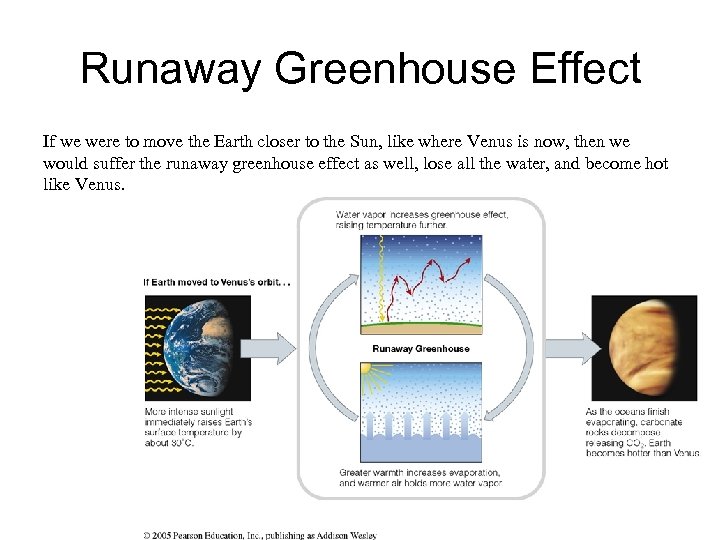 Runaway Greenhouse Effect If we were to move the Earth closer to the Sun, like where Venus is now, then we would suffer the runaway greenhouse effect as well, lose all the water, and become hot like Venus.
 • • Internal Structure Surface Features Atmosphere What makes the Earth hospitable to life? • Global Warming?
 Global Warming, A Quick Poll Is global warming real? a) Yes b) No How much has the average temperature of the Earth risen in the last 100 years? a) ~ 0. 5°C b) ~ 1. 0°C c) ~ 5. 0°C d) ~ 10. 0°C This is the highest temperature ever recorded in Earth’s history. a) Yes. b) No. Who is to blame? a) Human activities b) Nature causes c) ET d) No. Can. Tell! What is to blame? a) Ozone b) CO 2 c) H 2 O d) O 2
 Global Warming, A Quick Poll Is global warming real? a) Yes b) No How much has the average temperature of the Earth risen in the last 100 years? a) ~ 0. 5°C b) ~ 1. 0°C c) ~ 5. 0°C d) ~ 10. 0°C As far as we know, this is the highest temperature ever recorded in Earth’s history. a) Yes. b) No. Who is to blame? a) Human activities b) Nature causes c) ET d) No. Can. Tell! What is to blame? a) Ozone b) CO 2 c) H 2 O d) O 2 e) No. Can. Tell. It is real complicated!
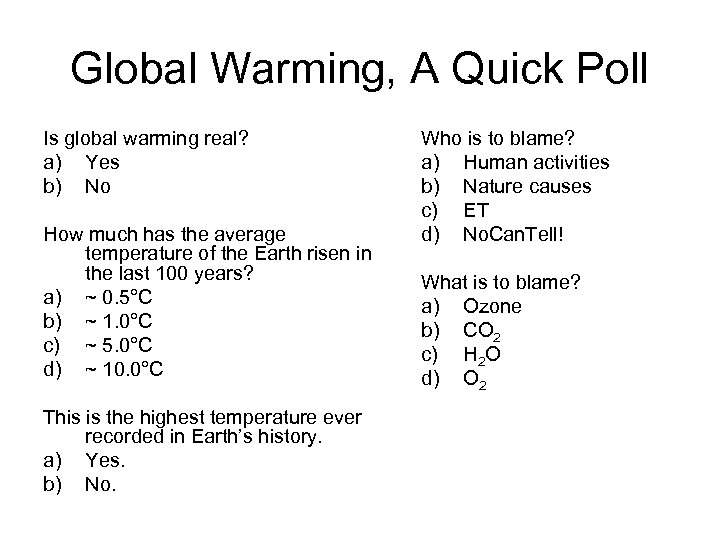
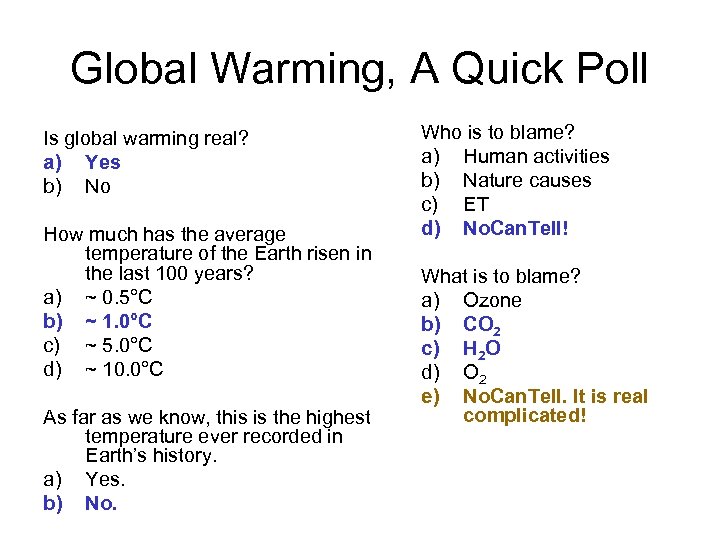
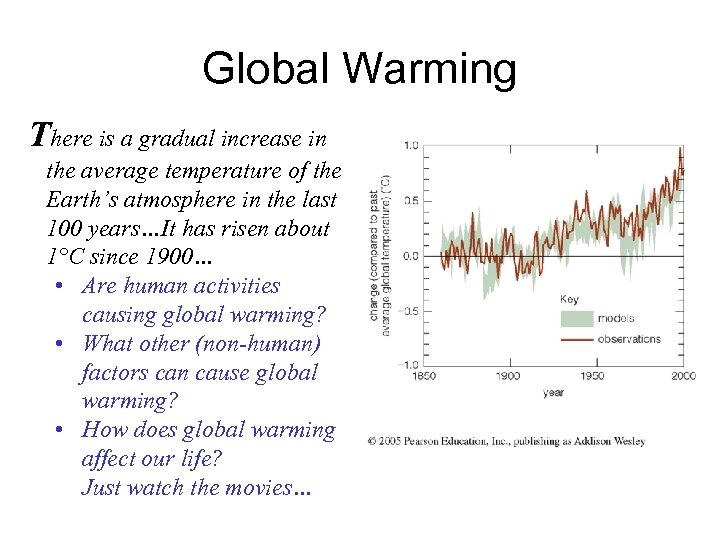 Global Warming There is a gradual increase in the average temperature of the Earth’s atmosphere in the last 100 years…It has risen about 1°C since 1900… • Are human activities causing global warming? • What other (non-human) factors can cause global warming? • How does global warming affect our life? Just watch the movies…
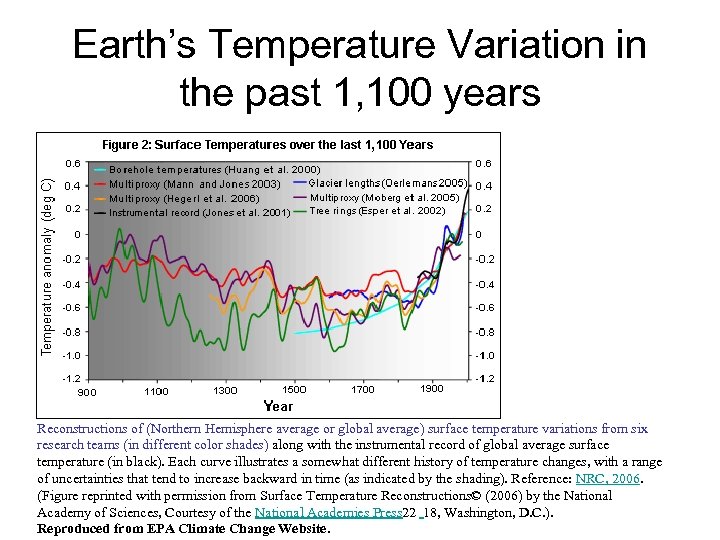 Earth’s Temperature Variation in the past 1, 100 years Reconstructions of (Northern Hemisphere average or global average) surface temperature variations from six research teams (in different color shades) along with the instrumental record of global average surface temperature (in black). Each curve illustrates a somewhat different history of temperature changes, with a range of uncertainties that tend to increase backward in time (as indicated by the shading). Reference: NRC, 2006. (Figure reprinted with permission from Surface Temperature Reconstructions© (2006) by the National Academy of Sciences, Courtesy of the National Academies Press 22 18, Washington, D. C. ). Reproduced from EPA Climate Change Website.
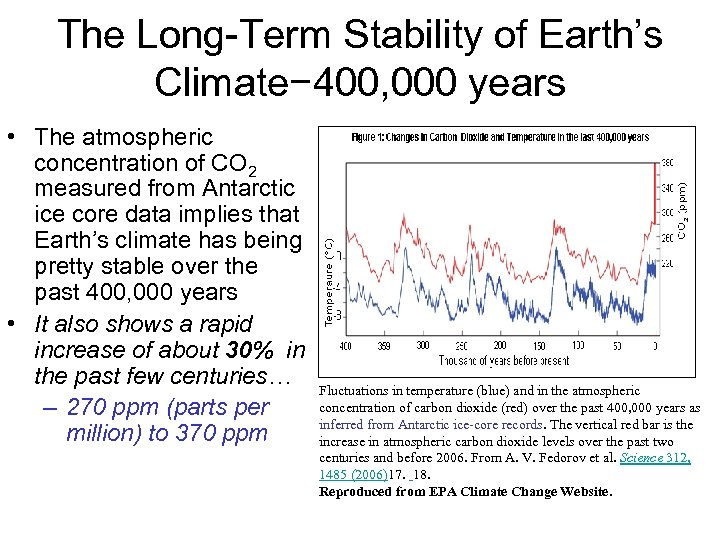 The Long-Term Stability of Earth’s Climate− 400, 000 years • The atmospheric concentration of CO 2 measured from Antarctic ice core data implies that Earth’s climate has being pretty stable over the past 400, 000 years • It also shows a rapid increase of about 30% in the past few centuries… – 270 ppm (parts per million) to 370 ppm Fluctuations in temperature (blue) and in the atmospheric concentration of carbon dioxide (red) over the past 400, 000 years as inferred from Antarctic ice-core records. The vertical red bar is the increase in atmospheric carbon dioxide levels over the past two centuries and before 2006. From A. V. Fedorov et al. Science 312, 1485 (2006)17. 18. Reproduced from EPA Climate Change Website.
 How do we measure atmospheric CO 2 concentration in the past? • • Precise measurements of atmospheric CO 2 concentration is available only in the last few decades… Information about atmospheric CO 2 concentration and temperatures in the past can be inferred by several different methods, such as – Tree-ring – Deep ocean sediment – Ice core records – Coral – … Link to NOAA Paleoclimatology Website Paleoclimatology is the study of climate prior to the widespread availability of records of temperature, precipitation and other instrumental data.
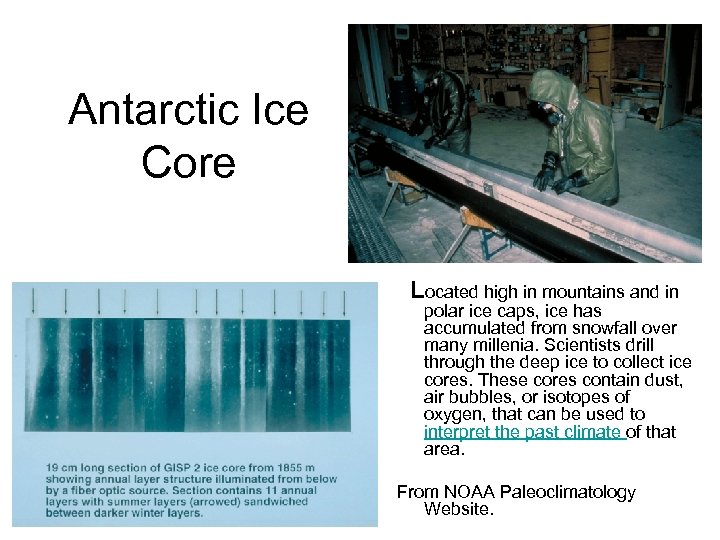 Antarctic Ice Core Located high in mountains and in polar ice caps, ice has accumulated from snowfall over many millenia. Scientists drill through the deep ice to collect ice cores. These cores contain dust, air bubbles, or isotopes of oxygen, that can be used to interpret the past climate of that area. From NOAA Paleoclimatology Website.
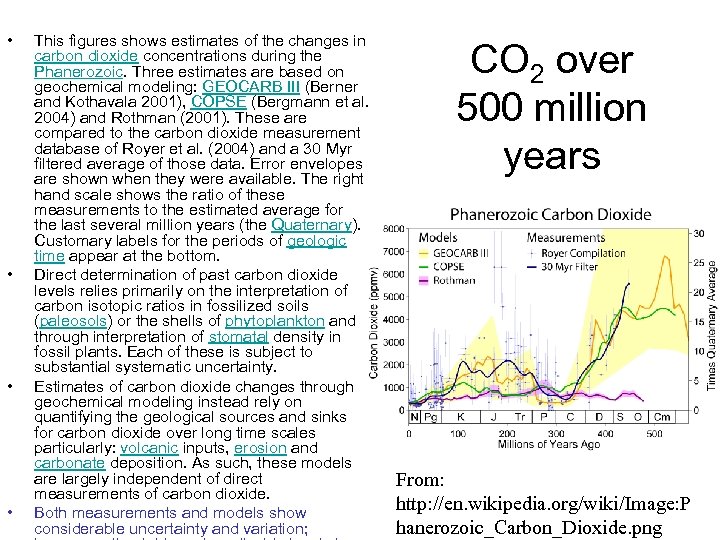 • • This figures shows estimates of the changes in carbon dioxide concentrations during the Phanerozoic. Three estimates are based on geochemical modeling: GEOCARB III (Berner and Kothavala 2001), COPSE (Bergmann et al. 2004) and Rothman (2001). These are compared to the carbon dioxide measurement database of Royer et al. (2004) and a 30 Myr filtered average of those data. Error envelopes are shown when they were available. The right hand scale shows the ratio of these measurements to the estimated average for the last several million years (the Quaternary). Customary labels for the periods of geologic time appear at the bottom. Direct determination of past carbon dioxide levels relies primarily on the interpretation of carbon isotopic ratios in fossilized soils (paleosols) or the shells of phytoplankton and through interpretation of stomatal density in fossil plants. Each of these is subject to substantial systematic uncertainty. Estimates of carbon dioxide changes through geochemical modeling instead rely on quantifying the geological sources and sinks for carbon dioxide over long time scales particularly: volcanic inputs, erosion and carbonate deposition. As such, these models are largely independent of direct measurements of carbon dioxide. Both measurements and models show considerable uncertainty and variation; CO 2 over 500 million years From: http: //en. wikipedia. org/wiki/Image: P hanerozoic_Carbon_Dioxide. png
 Which gas is keeping the Earth warm? A. B. C. D. N 2? O 2? CO 2? H 2 O? The major natural greenhouse gases are • water vapor, which causes about 36 -70% of the greenhouse effect on Earth (not including clouds); • carbon dioxide, which causes 9 -26%; • methane, which causes 4 -9%, and • ozone, which causes 3 -7%. Note that it is not really possible to assert that a certain gas causes a certain percentage of the greenhouse effect, because the influences of the various gases are not additive. (The higher ends of the ranges quoted are for the gas alone; the lower ends, for the gas counting overlaps. )[3] [4] From http: //en. wikipedia. org/wiki/Greenhouse_gas
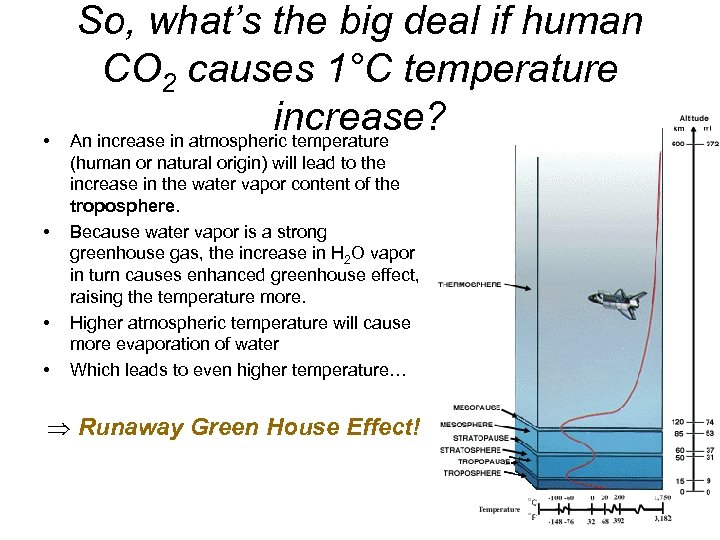 • • So, what’s the big deal if human CO 2 causes 1°C temperature increase? An increase in atmospheric temperature (human or natural origin) will lead to the increase in the water vapor content of the troposphere. Because water vapor is a strong greenhouse gas, the increase in H 2 O vapor in turn causes enhanced greenhouse effect, raising the temperature more. Higher atmospheric temperature will cause more evaporation of water Which leads to even higher temperature… Runaway Green House Effect!
 How about Clouds and Ice? Water vapor (water in gaseous phase) is one of the most potent and abundant greenhouse gas…but • Clouds (water in liquid form) reflect sunlight, decreasing the solar energy input into Earth’s atmosphere during the day, but they trap IR radiation from the Earth during the night. It’s net effect is not well know so far… – Albedo of clouds range from close to 0 to 70%. – Testing climate impact of clouds after Sept. 11, 2001… • Ice has a very high albedo, ~ 80 to 90%. – Thus, reduction of the polar ice cap can cause more heating…
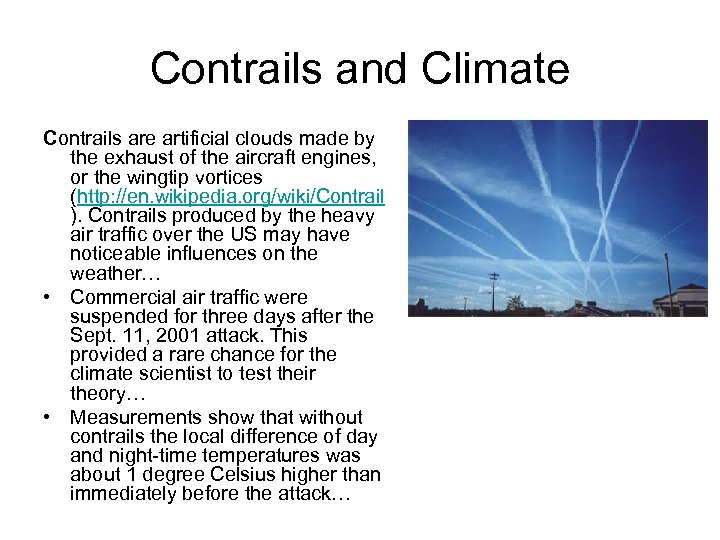 Contrails and Climate Contrails are artificial clouds made by the exhaust of the aircraft engines, or the wingtip vortices (http: //en. wikipedia. org/wiki/Contrail ). Contrails produced by the heavy air traffic over the US may have noticeable influences on the weather… • Commercial air traffic were suspended for three days after the Sept. 11, 2001 attack. This provided a rare chance for the climate scientist to test their theory… • Measurements show that without contrails the local difference of day and night-time temperatures was about 1 degree Celsius higher than immediately before the attack…
 How About The CO 2 Cycle? The CO 2 cycle acts as a thermostat that regulates the temperature of the Earth… If Earth warms up a bit, then • carbonate minerals form in the oceans at a higher rate. • The rate at which the oceans dissolve CO 2 gas increases, pulling CO 2 out of the atmosphere. • The reduced atmospheric CO 2 concentration leads to a weakened greenhouse effect that counteracts the initial warming and cools the planet back down. If Earth cools a bit, • carbonate minerals form more slowly in the oceans. • The rate at which the oceans dissolve CO 2 gas decreases, allowing the CO 2 released by volcanism to build back up in the atmosphere. • The increased CO 2 concentration strengthens the greenhouse effect and warms the planet back up
 Feedback Loop • Positive Feedback – Mechanisms that make things worse… – e. g. , Increasing CO 2 in the atmosphere leading to the release of more CO 2 • Negative Feedback – Mechanisms that are self-correcting… – e. g. , Increasing CO 2 in the atmosphere leading to higher rate of CO 2 removal, such as our CO 2 cycle.
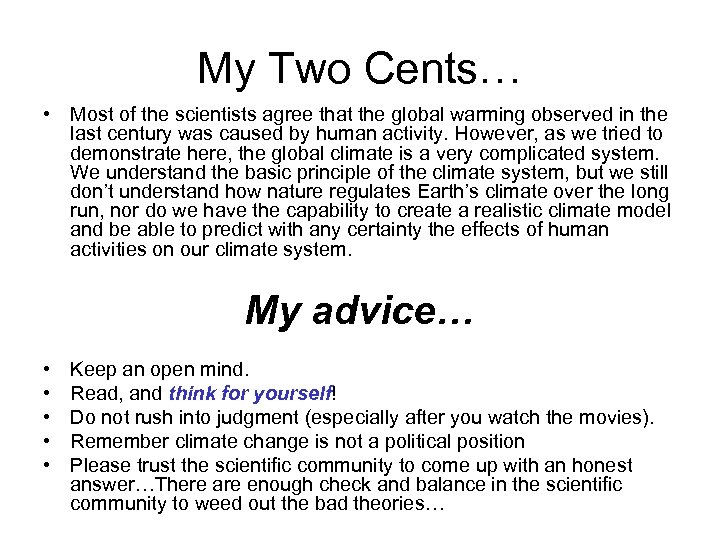 My Two Cents… • Most of the scientists agree that the global warming observed in the last century was caused by human activity. However, as we tried to demonstrate here, the global climate is a very complicated system. We understand the basic principle of the climate system, but we still don’t understand how nature regulates Earth’s climate over the long run, nor do we have the capability to create a realistic climate model and be able to predict with any certainty the effects of human activities on our climate system. My advice… • • • Keep an open mind. Read, and think for yourself! Do not rush into judgment (especially after you watch the movies). Remember climate change is not a political position Please trust the scientific community to come up with an honest answer…There are enough check and balance in the scientific community to weed out the bad theories…