


 Скачать презентацию The Graphplan Planner Searching the Planning Graph The
9315e241871eaafb24dc92d9ea443426.ppt
- Количество слайдов: 77
 The Graphplan Planner Searching the Planning Graph The Graphplan Planner
 Literature l Malik Ghallab, Dana Nau, and Paolo Traverso. Automated Planning – Theory and Practice, chapter 6. Elsevier/Morgan Kaufmann, 2004. The Graphplan Planner 2
 Neoclassical Planning l l l concerned with restricted state-transition systems representation is usually restricted to propositional STRIPS neoclassical vs. classical planning • classical planning: search space consists of nodes containing partial plans • neoclassical planning: nodes can be seen as sets of partial plans l resulted in significant speed-up and revival of planning research The Graphplan Planner 3
 Overview l l The Propositional Representation The Planning-Graph Structure The Graphplan Algorithm The Graphplan Planner 4
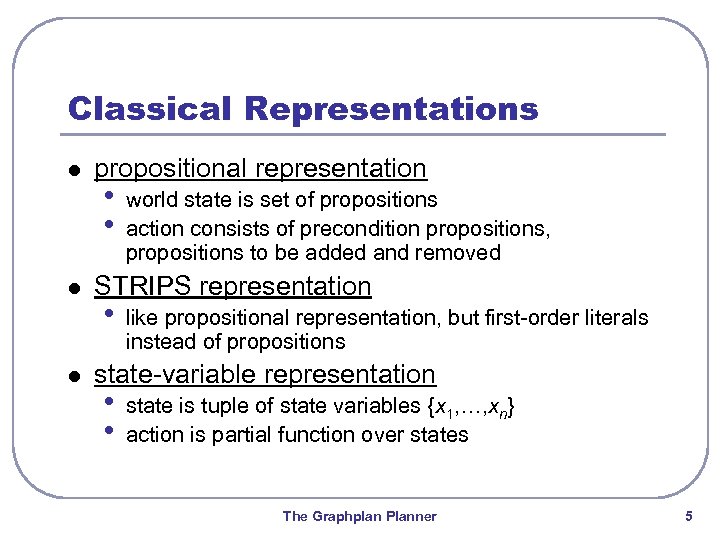 Classical Representations l l l propositional representation • • world state is set of propositions action consists of precondition propositions, propositions to be added and removed STRIPS representation • like propositional representation, but first-order literals instead of propositions state-variable representation • • state is tuple of state variables {x 1, …, xn} action is partial function over states The Graphplan Planner 5
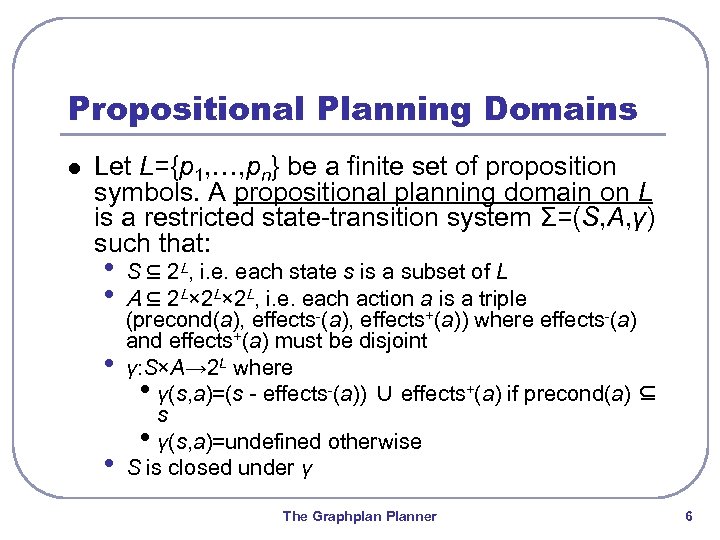 Propositional Planning Domains l Let L={p 1, …, pn} be a finite set of proposition symbols. A propositional planning domain on L is a restricted state-transition system Σ=(S, A, γ) such that: • • S ⊆ 2 L, i. e. each state s is a subset of L A ⊆ 2 L× 2 L, i. e. each action a is a triple (precond(a), effects-(a), effects+(a)) where effects-(a) and effects+(a) must be disjoint γ: S×A→ 2 L where • γ(s, a)=(s - effects-(a)) ∪ effects+(a) if precond(a) ⊆ s • γ(s, a)=undefined otherwise S is closed under γ The Graphplan Planner 6
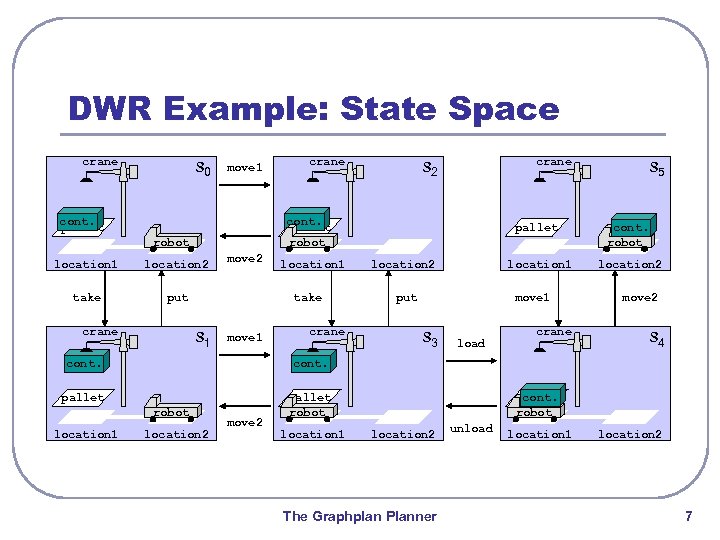 DWR Example: State Space crane s 0 move 1 cont. pallet location 1 location 2 take move 2 put location 1 take s 1 move 1 cont. crane s 5 pallet location 1 location 2 put cont. robot location 2 move 1 s 3 load crane move 2 s 4 cont. pallet robot location 1 crane s 2 cont. pallet robot crane location 2 move 2 pallet robot location 1 pallet cont. robot location 2 The Graphplan Planner unload location 1 location 2 7
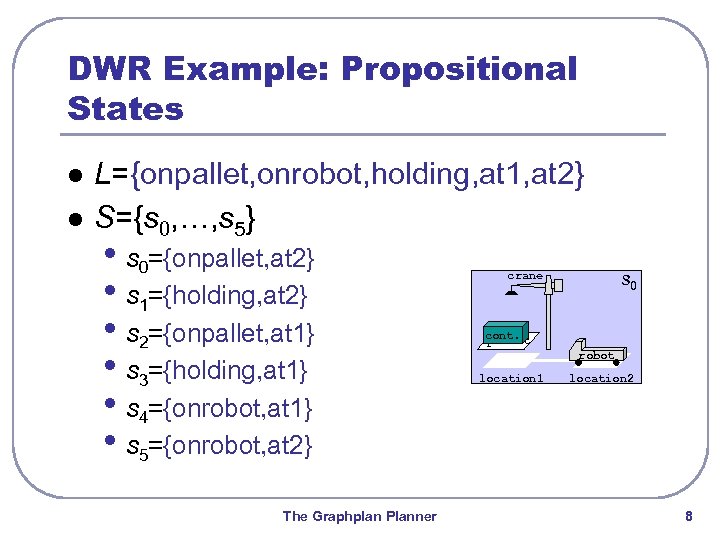 DWR Example: Propositional States l l L={onpallet, onrobot, holding, at 1, at 2} S={s 0, …, s 5} • s 0={onpallet, at 2} • s 1={holding, at 2} • s 2={onpallet, at 1} • s 3={holding, at 1} • s 4={onrobot, at 1} • s 5={onrobot, at 2} The Graphplan Planner crane s 0 cont. pallet robot location 1 location 2 8
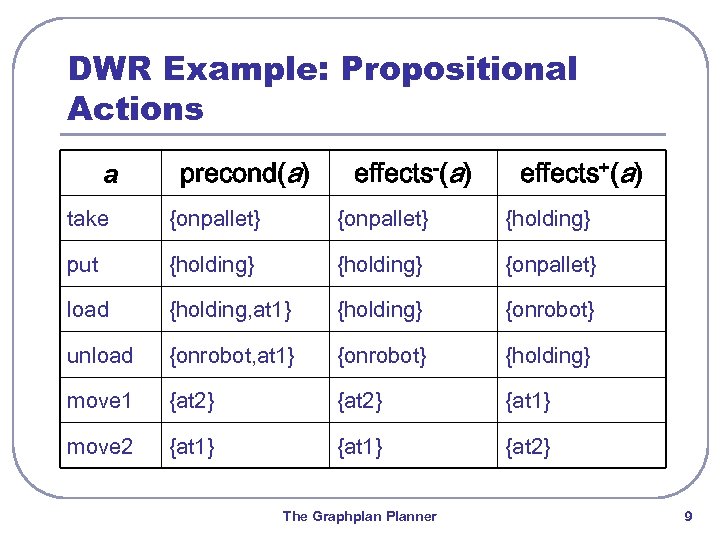 DWR Example: Propositional Actions a precond(a) effects-(a) effects+(a) take {onpallet} {holding} put {holding} {onpallet} load {holding, at 1} {holding} {onrobot} unload {onrobot, at 1} {onrobot} {holding} move 1 {at 2} {at 1} move 2 {at 1} {at 2} The Graphplan Planner 9
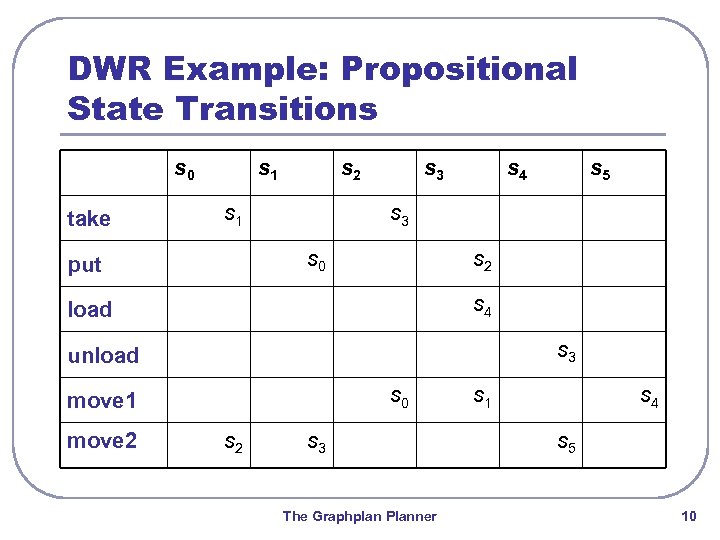 DWR Example: Propositional State Transitions s 0 take s 1 s 2 s 1 s 3 s 2 s 4 load s 3 unload s 0 move 1 move 2 s 5 s 3 s 0 put s 4 s 2 s 3 The Graphplan Planner s 1 s 4 s 5 10
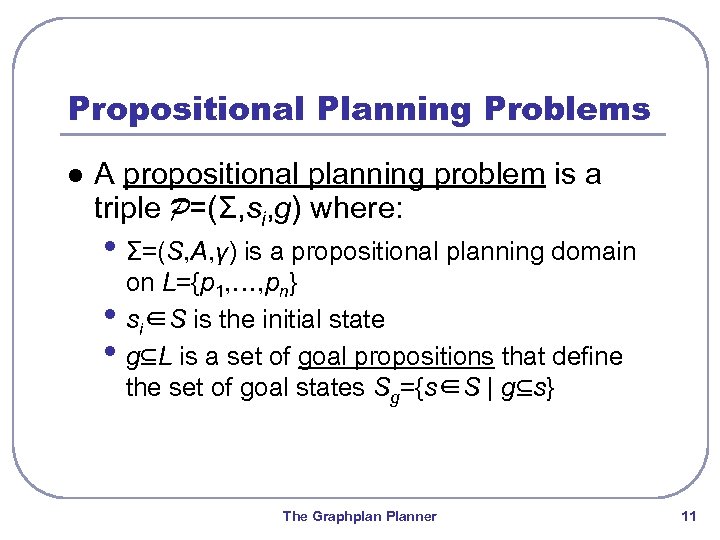 Propositional Planning Problems l A propositional planning problem is a triple P=(Σ, si, g) where: • Σ=(S, A, γ) is a propositional planning domain • • on L={p 1, …, pn} si∈S is the initial state g⊆L is a set of goal propositions that define the set of goal states Sg={s∈S | g⊆s} The Graphplan Planner 11
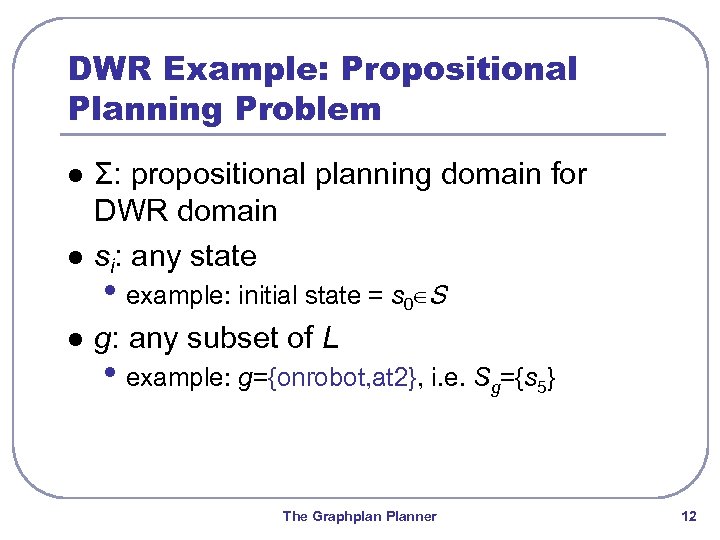 DWR Example: Propositional Planning Problem l Σ: propositional planning domain for DWR domain si: any state l g: any subset of L l • example: initial state = s 0∈S • example: g={onrobot, at 2}, i. e. Sg={s 5} The Graphplan Planner 12
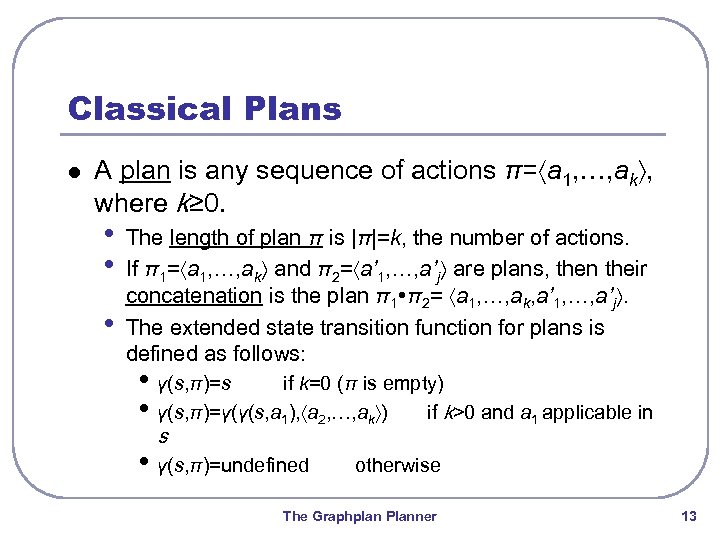 Classical Plans l A plan is any sequence of actions π=〈a 1, …, ak〉, where k≥ 0. • • • The length of plan π is |π|=k, the number of actions. If π1=〈a 1, …, ak〉 and π2=〈a’ 1, …, a’j〉 are plans, then their concatenation is the plan π1∙π2= 〈a 1, …, ak, a’ 1, …, a’j〉. The extended state transition function for plans is defined as follows: • γ(s, π)=s if k=0 (π is empty) • γ(s, π)=γ(γ(s, a 1), 〈a 2, …, ak〉) if k>0 and a 1 applicable in s • γ(s, π)=undefined otherwise The Graphplan Planner 13
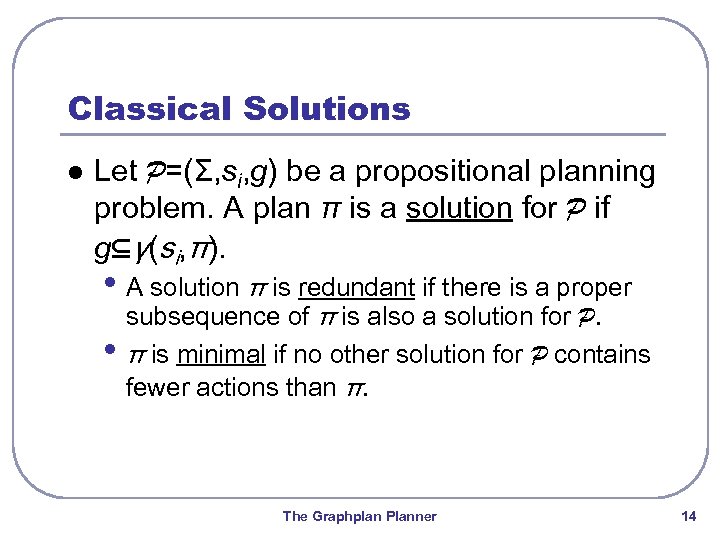 Classical Solutions l Let P=(Σ, si, g) be a propositional planning problem. A plan π is a solution for P if g⊆γ(si, π). • A solution π is redundant if there is a proper • subsequence of π is also a solution for P. π is minimal if no other solution for P contains fewer actions than π. The Graphplan Planner 14
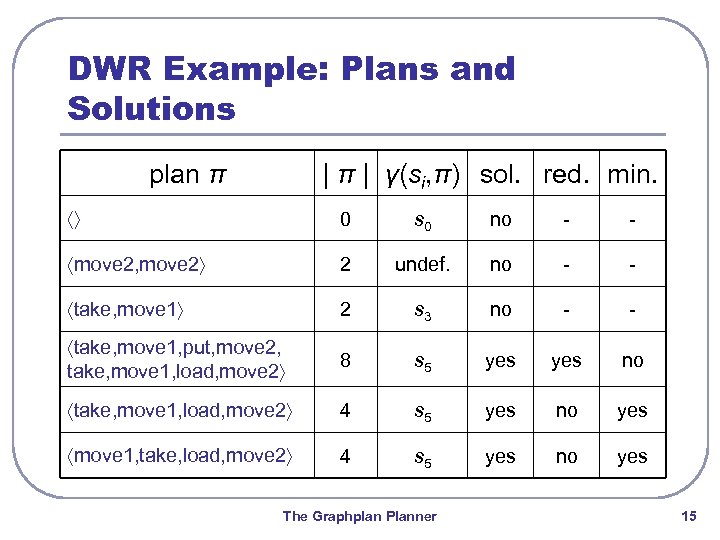 DWR Example: Plans and Solutions plan π | γ(si, π) sol. red. min. 〈〉 0 s 0 no - - 〈move 2, move 2〉 2 undef. no - - 〈take, move 1〉 2 s 3 no - - 〈take, move 1, put, move 2, take, move 1, load, move 2〉 8 s 5 yes no 〈take, move 1, load, move 2〉 4 s 5 yes no yes 〈move 1, take, load, move 2〉 4 s 5 yes no yes The Graphplan Planner 15
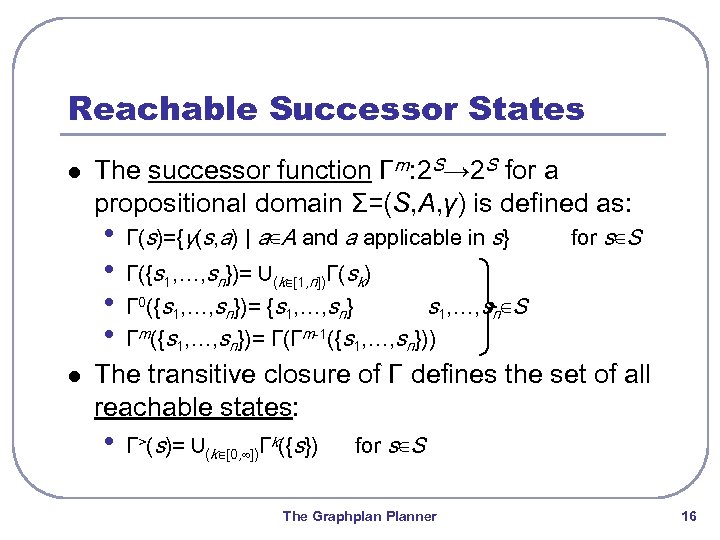 Reachable Successor States l The successor function Γm: 2 S→ 2 S for a propositional domain Σ=(S, A, γ) is defined as: • • l Γ(s)={γ(s, a) | a∈A and a applicable in s} for s∈S Γ({s 1, …, sn})= ∪(k∈[1, n])Γ(sk) Γ 0({s 1, …, sn})= {s 1, …, sn} s 1, …, sn∈S Γm({s 1, …, sn})= Γ(Γm-1({s 1, …, sn})) The transitive closure of Γ defines the set of all reachable states: • Γ>(s)= ∪(k∈[0, ∞])Γk({s}) for s∈S The Graphplan Planner 16
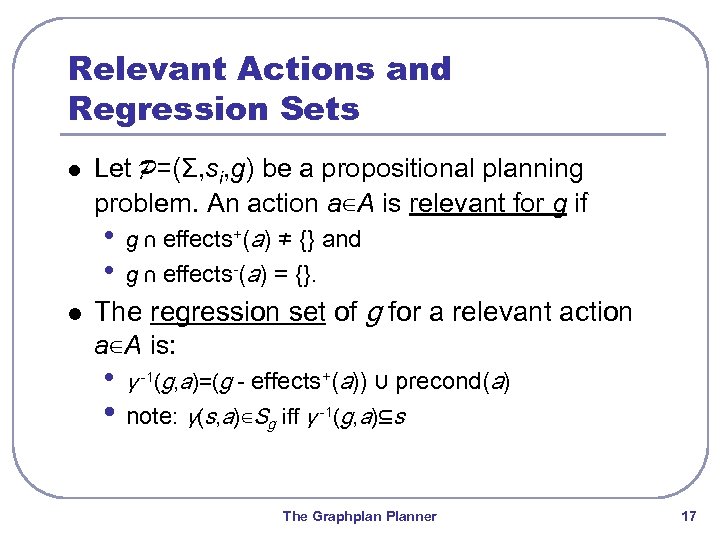 Relevant Actions and Regression Sets l Let P=(Σ, si, g) be a propositional planning problem. An action a∈A is relevant for g if • • l g ⋂ effects+(a) ≠ {} and g ⋂ effects-(a) = {}. The regression set of g for a relevant action a∈A is: • • γ -1(g, a)=(g - effects+(a)) ∪ precond(a) note: γ(s, a)∈Sg iff γ -1(g, a)⊆s The Graphplan Planner 17
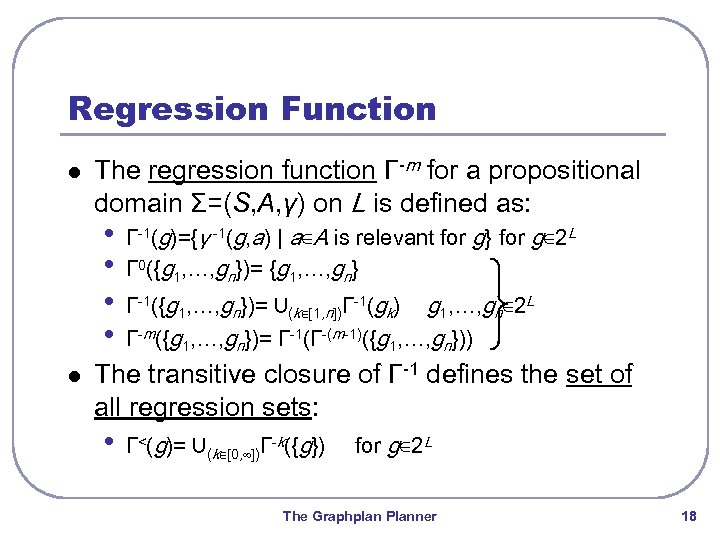 Regression Function l The regression function Γ-m for a propositional domain Σ=(S, A, γ) on L is defined as: • • l Γ-1(g)={γ -1(g, a) | a∈A is relevant for g} for g∈2 L Γ 0({g 1, …, gn})= {g 1, …, gn} Γ-1({g 1, …, gn})= ∪(k∈[1, n])Γ-1(gk) g 1, …, gn∈2 L Γ-m({g 1, …, gn})= Γ-1(Γ-(m-1)({g 1, …, gn})) The transitive closure of Γ-1 defines the set of all regression sets: • Γ<(g)= ∪(k∈[0, ∞])Γ-k({g}) for g∈2 L The Graphplan Planner 18
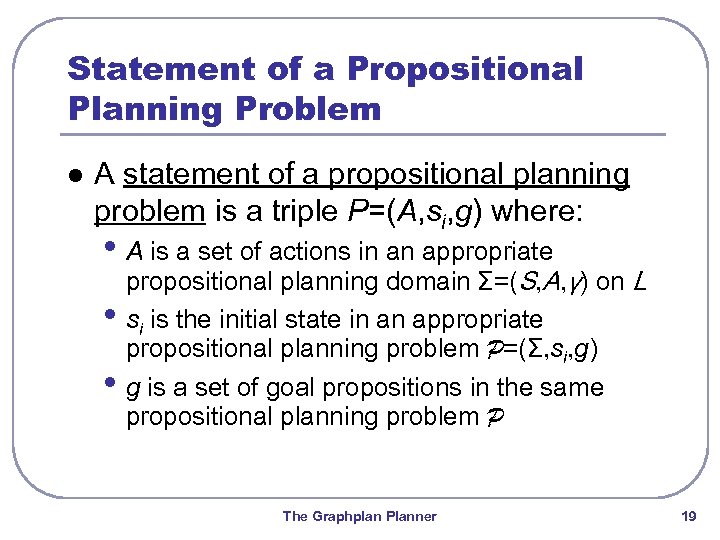 Statement of a Propositional Planning Problem l A statement of a propositional planning problem is a triple P=(A, si, g) where: • A is a set of actions in an appropriate • propositional planning domain Σ=(S, A, γ) on L si is the initial state in an appropriate propositional planning problem P=(Σ, si, g) • g is a set of goal propositions in the same propositional planning problem P The Graphplan Planner 19
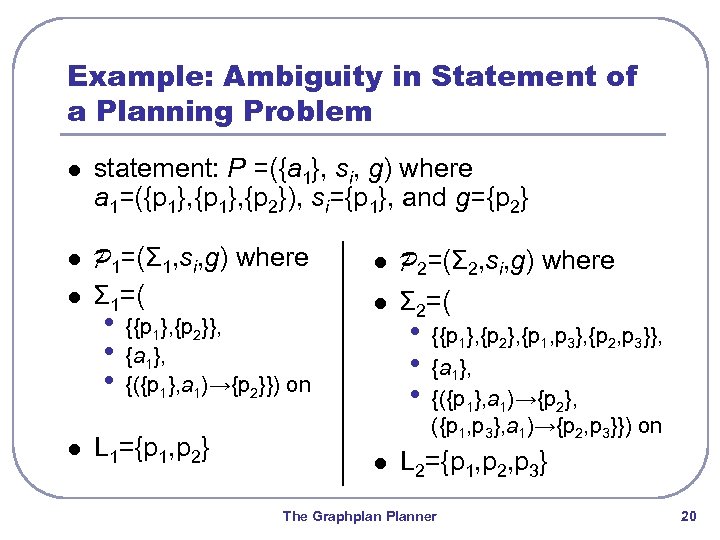 Example: Ambiguity in Statement of a Planning Problem l statement: P =({a 1}, si, g) where a 1=({p 1}, {p 2}), si={p 1}, and g={p 2} l P 1=(Σ 1, si, g) where Σ 1=( l l • • • {{p 1}, {p 2}}, {a 1}, {({p 1}, a 1)→{p 2}}) on L 1={p 1, p 2} l P 2=(Σ 2, si, g) where l Σ 2=( l • • • {{p 1}, {p 2}, {p 1, p 3}, {p 2, p 3}}, {a 1}, {({p 1}, a 1)→{p 2}, ({p 1, p 3}, a 1)→{p 2, p 3}}) on L 2={p 1, p 2, p 3} The Graphplan Planner 20
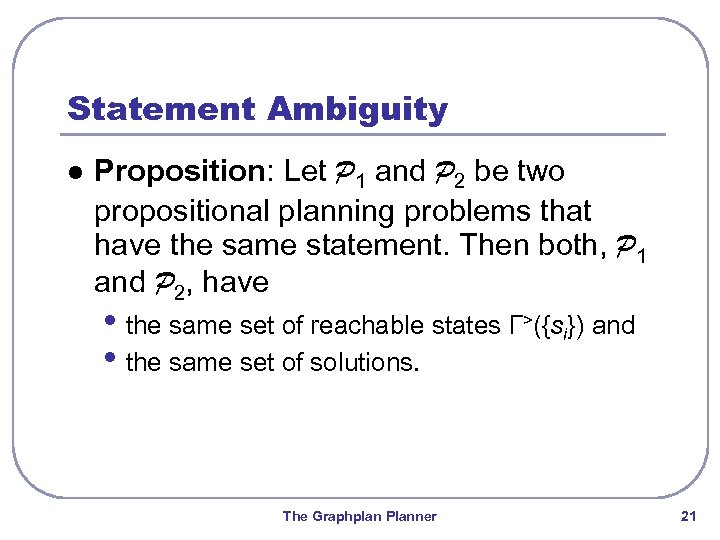 Statement Ambiguity l Proposition: Let P 1 and P 2 be two propositional planning problems that have the same statement. Then both, P 1 and P 2, have • the same set of reachable states Γ>({si}) and • the same set of solutions. The Graphplan Planner 21
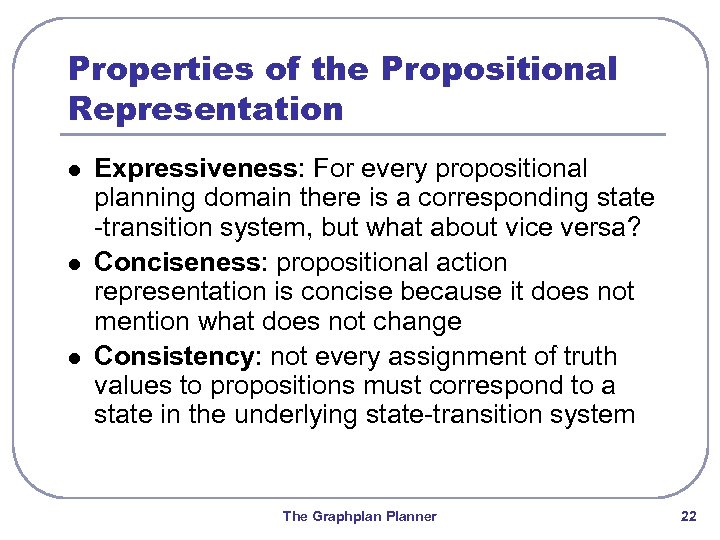 Properties of the Propositional Representation l l l Expressiveness: For every propositional planning domain there is a corresponding state -transition system, but what about vice versa? Conciseness: propositional action representation is concise because it does not mention what does not change Consistency: not every assignment of truth values to propositions must correspond to a state in the underlying state-transition system The Graphplan Planner 22
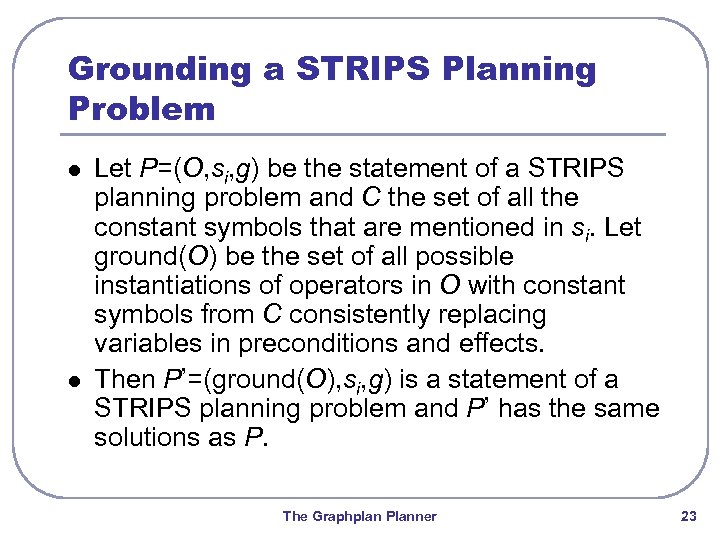 Grounding a STRIPS Planning Problem l l Let P=(O, si, g) be the statement of a STRIPS planning problem and C the set of all the constant symbols that are mentioned in si. Let ground(O) be the set of all possible instantiations of operators in O with constant symbols from C consistently replacing variables in preconditions and effects. Then P’=(ground(O), si, g) is a statement of a STRIPS planning problem and P’ has the same solutions as P. The Graphplan Planner 23
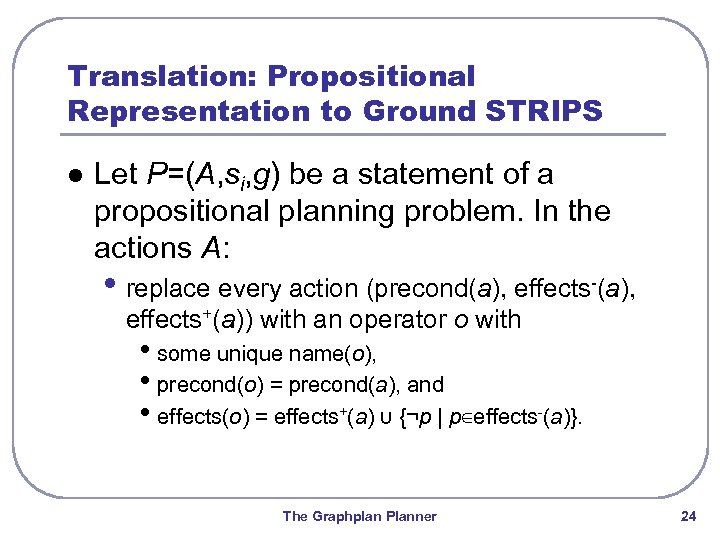 Translation: Propositional Representation to Ground STRIPS l Let P=(A, si, g) be a statement of a propositional planning problem. In the actions A: • replace every action (precond(a), effects-(a), effects+(a)) with an operator o with • some unique name(o), • precond(o) = precond(a), and • effects(o) = effects+(a) ∪ {¬p | p∈effects-(a)}. The Graphplan Planner 24
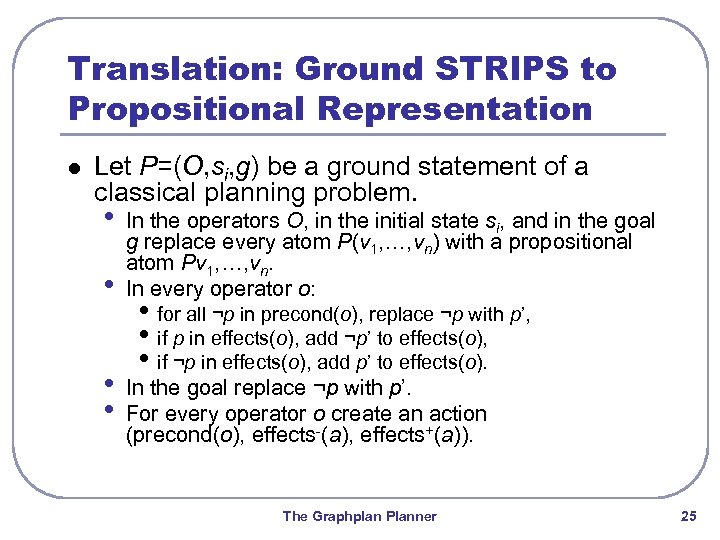 Translation: Ground STRIPS to Propositional Representation l Let P=(O, si, g) be a ground statement of a classical planning problem. • • In the operators O, in the initial state si, and in the goal g replace every atom P(v 1, …, vn) with a propositional atom Pv 1, …, vn. In every operator o: • for all ¬p in precond(o), replace ¬p with p’, • if p in effects(o), add ¬p’ to effects(o), • if ¬p in effects(o), add p’ to effects(o). In the goal replace ¬p with p’. For every operator o create an action (precond(o), effects-(a), effects+(a)). The Graphplan Planner 25
 Overview l l The Propositional Representation The Planning-Graph Structure The Graphplan Algorithm The Graphplan Planner 26
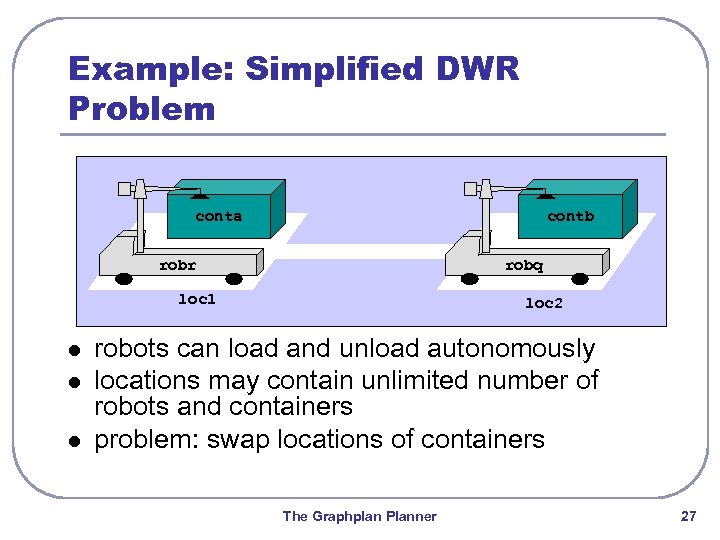 Example: Simplified DWR Problem conta contb robr robq loc 1 l loc 2 robots can load and unload autonomously locations may contain unlimited number of robots and containers problem: swap locations of containers The Graphplan Planner 27
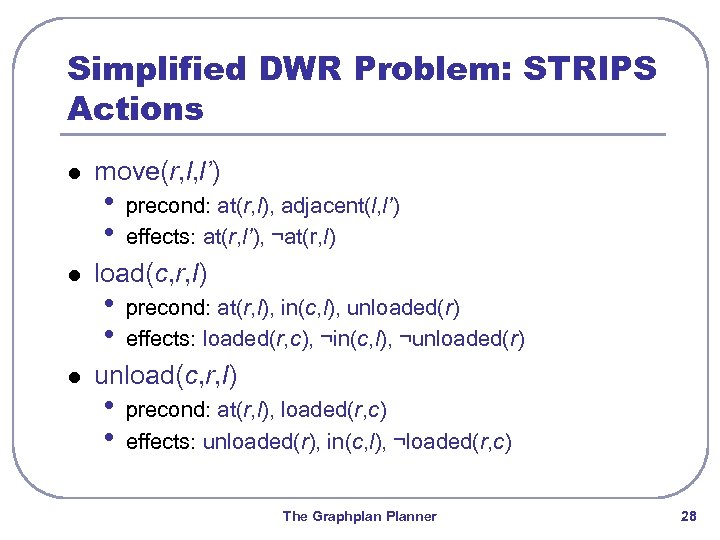 Simplified DWR Problem: STRIPS Actions l l l move(r, l, l’) • • precond: at(r, l), adjacent(l, l’) effects: at(r, l’), ¬at(r, l) load(c, r, l) • • precond: at(r, l), in(c, l), unloaded(r) effects: loaded(r, c), ¬in(c, l), ¬unloaded(r) unload(c, r, l) • • precond: at(r, l), loaded(r, c) effects: unloaded(r), in(c, l), ¬loaded(r, c) The Graphplan Planner 28
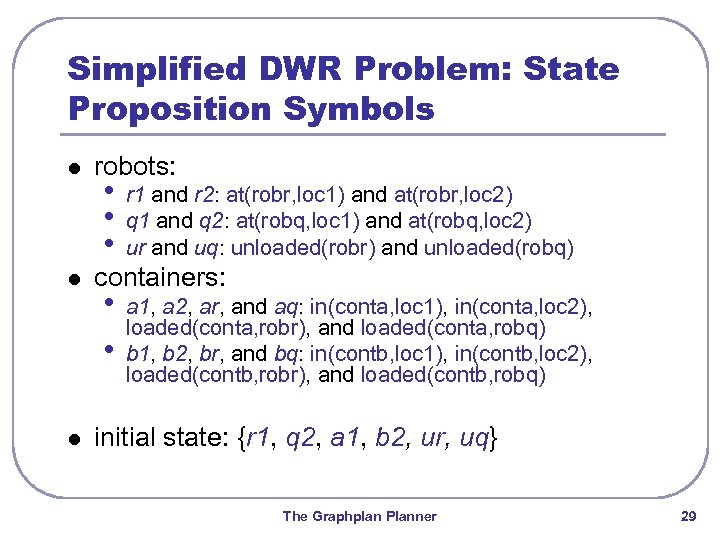 Simplified DWR Problem: State Proposition Symbols l l l robots: • • • r 1 and r 2: at(robr, loc 1) and at(robr, loc 2) q 1 and q 2: at(robq, loc 1) and at(robq, loc 2) ur and uq: unloaded(robr) and unloaded(robq) • • a 1, a 2, ar, and aq: in(conta, loc 1), in(conta, loc 2), loaded(conta, robr), and loaded(conta, robq) b 1, b 2, br, and bq: in(contb, loc 1), in(contb, loc 2), loaded(contb, robr), and loaded(contb, robq) containers: initial state: {r 1, q 2, a 1, b 2, ur, uq} The Graphplan Planner 29
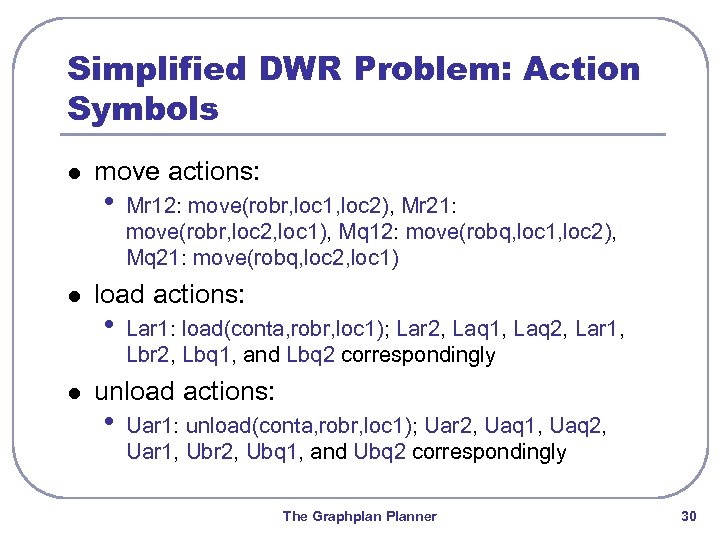 Simplified DWR Problem: Action Symbols l l l move actions: • Mr 12: move(robr, loc 1, loc 2), Mr 21: move(robr, loc 2, loc 1), Mq 12: move(robq, loc 1, loc 2), Mq 21: move(robq, loc 2, loc 1) load actions: • Lar 1: load(conta, robr, loc 1); Lar 2, Laq 1, Laq 2, Lar 1, Lbr 2, Lbq 1, and Lbq 2 correspondingly unload actions: • Uar 1: unload(conta, robr, loc 1); Uar 2, Uaq 1, Uaq 2, Uar 1, Ubr 2, Ubq 1, and Ubq 2 correspondingly The Graphplan Planner 30
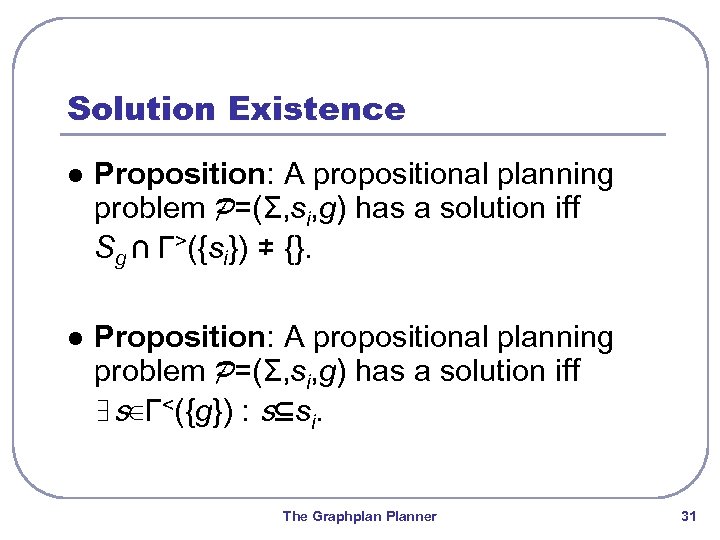 Solution Existence l Proposition: A propositional planning problem P=(Σ, si, g) has a solution iff Sg ⋂ Γ>({si}) ≠ {}. l Proposition: A propositional planning problem P=(Σ, si, g) has a solution iff ∃s∈Γ<({g}) : s⊆si. The Graphplan Planner 31
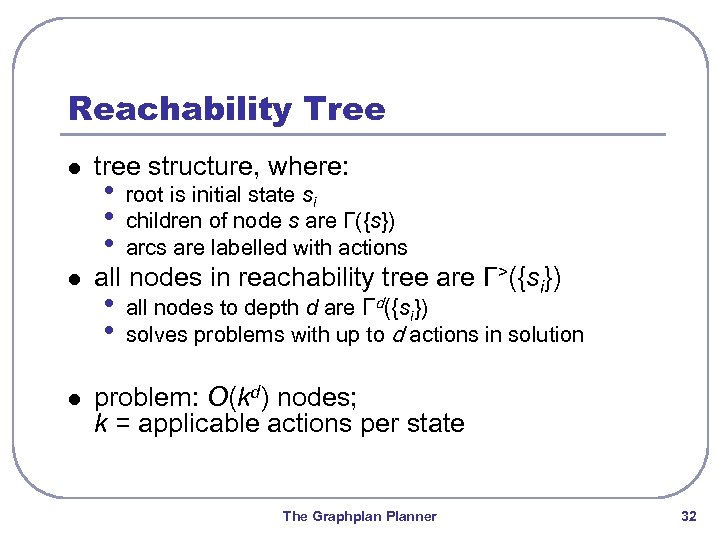 Reachability Tree l l l tree structure, where: • • • root is initial state si children of node s are Γ({s}) arcs are labelled with actions • • all nodes to depth d are Γd({si}) solves problems with up to d actions in solution all nodes in reachability tree are Γ>({si}) problem: O(kd) nodes; k = applicable actions per state The Graphplan Planner 32
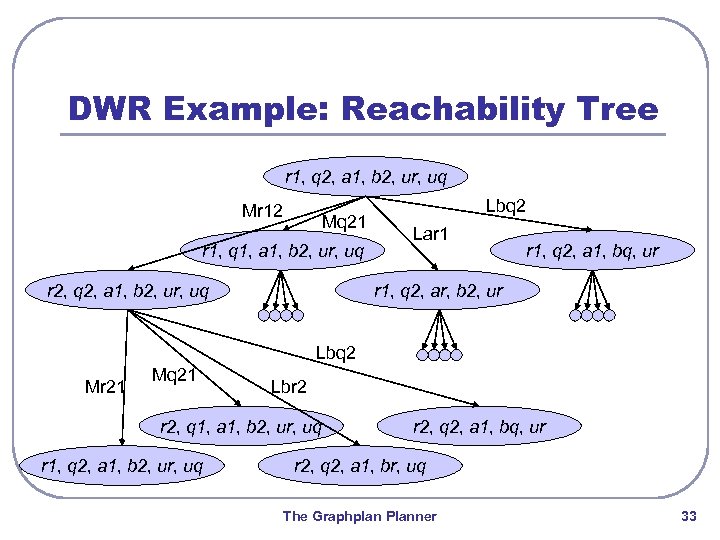 DWR Example: Reachability Tree r 1, q 2, a 1, b 2, ur, uq Mr 12 Mq 21 r 1, q 1, a 1, b 2, ur, uq r 2, q 2, a 1, b 2, ur, uq Lbq 2 Lar 1 r 1, q 2, a 1, bq, ur r 1, q 2, ar, b 2, ur Lbq 2 Mr 21 Mq 21 Lbr 2 r 2, q 1, a 1, b 2, ur, uq r 1, q 2, a 1, b 2, ur, uq r 2, q 2, a 1, bq, ur r 2, q 2, a 1, br, uq The Graphplan Planner 33
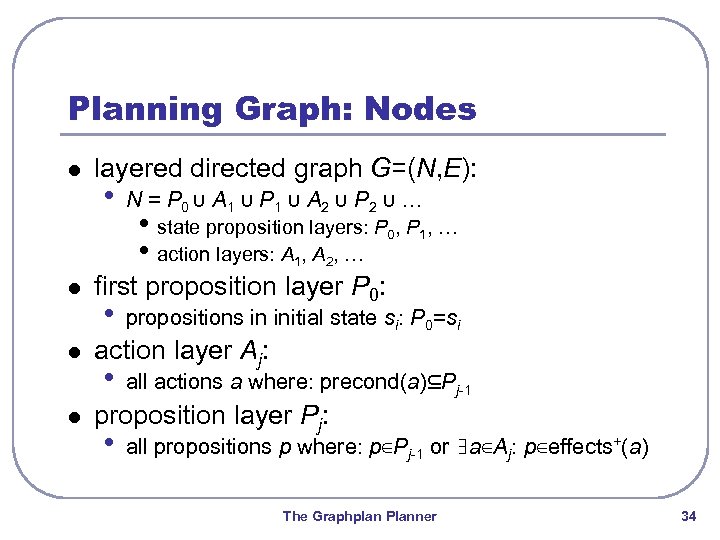 Planning Graph: Nodes l l layered directed graph G=(N, E): • N = P 0 ∪ A 1 ∪ P 1 ∪ A 2 ∪ P 2 ∪ … • state proposition layers: P 0, P 1, … • action layers: A 1, A 2, … first proposition layer P 0: • propositions in initial state si: P 0=si action layer Aj: • all actions a where: precond(a)⊆Pj-1 proposition layer Pj: • all propositions p where: p∈Pj-1 or ∃a∈Aj: p∈effects+(a) The Graphplan Planner 34
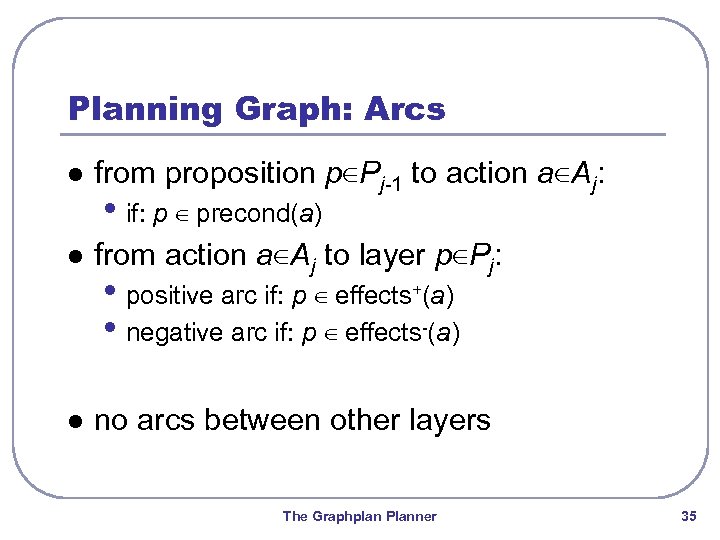 Planning Graph: Arcs l from proposition p∈Pj-1 to action a∈Aj: l from action a∈Aj to layer p∈Pj: l no arcs between other layers • if: p ∈ precond(a) • positive arc if: p ∈ effects+(a) • negative arc if: p ∈ effects-(a) The Graphplan Planner 35
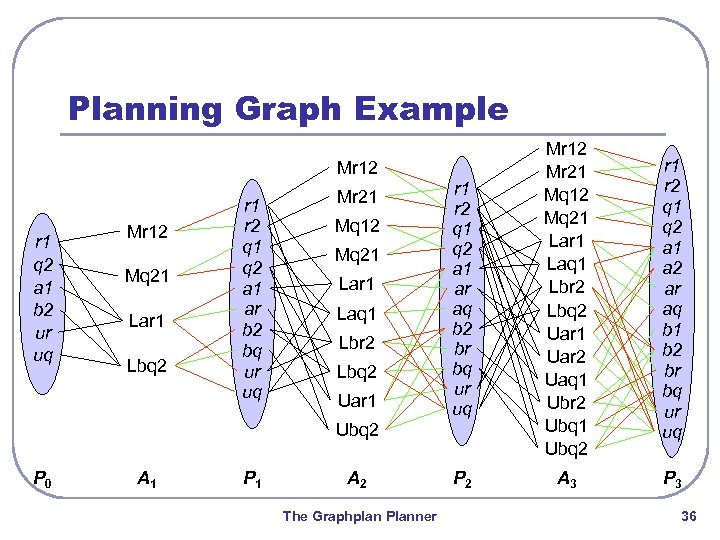 Planning Graph Example r 1 r 2 q 1 q 2 a 1 ar aq b 2 br bq ur uq Mr 12 Mr 21 Mq 12 Mq 21 Lar 1 Laq 1 Lbr 2 Lbq 2 Uar 1 Uar 2 Uaq 1 Ubr 2 Ubq 1 Ubq 2 r 1 r 2 q 1 q 2 a 1 a 2 ar aq b 1 b 2 br bq ur uq P 2 A 3 P 3 Mr 12 r 1 q 2 a 1 b 2 ur uq Mr 12 Mq 21 Lar 1 Lbq 2 r 1 r 2 q 1 q 2 a 1 ar b 2 bq ur uq Mr 21 Mq 12 Mq 21 Lar 1 Laq 1 Lbr 2 Lbq 2 Uar 1 Ubq 2 P 0 A 1 P 1 A 2 The Graphplan Planner 36
 Reachability in the Planning Graph l l l reachability analysis: • • if a goal g is reachable from initial state si then there will be a proposition layer Pg in the planning graph such that g⊆Pg necessary condition, but not sufficient low complexity: • • planning graph is of polynomial size and can be computed in polynomial time The Graphplan Planner 37
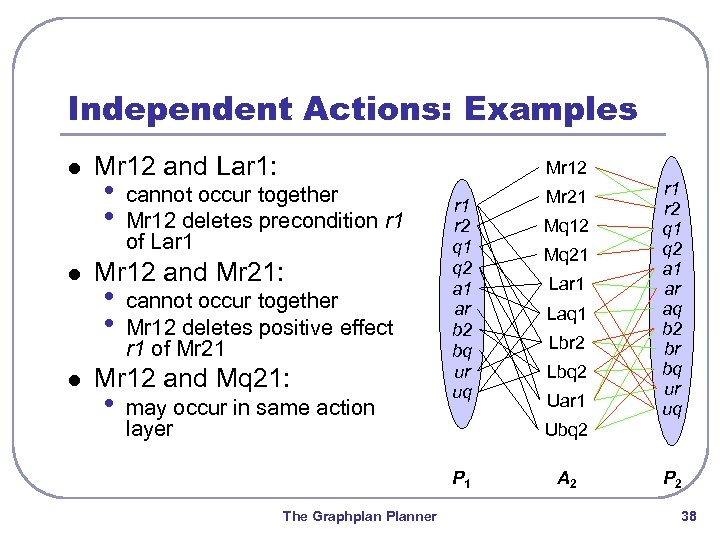 Independent Actions: Examples l l l Mr 12 and Lar 1: • • Mr 12 cannot occur together Mr 12 deletes precondition r 1 of Lar 1 Mr 12 and Mr 21: • • cannot occur together Mr 12 deletes positive effect r 1 of Mr 21 Mr 12 and Mq 21: • may occur in same action layer r 1 r 2 q 1 q 2 a 1 ar b 2 bq ur uq Mq 12 Mq 21 Lar 1 Laq 1 Lbr 2 Lbq 2 Uar 1 r 2 q 1 q 2 a 1 ar aq b 2 br bq ur uq Ubq 2 P 1 The Graphplan Planner Mr 21 A 2 P 2 38
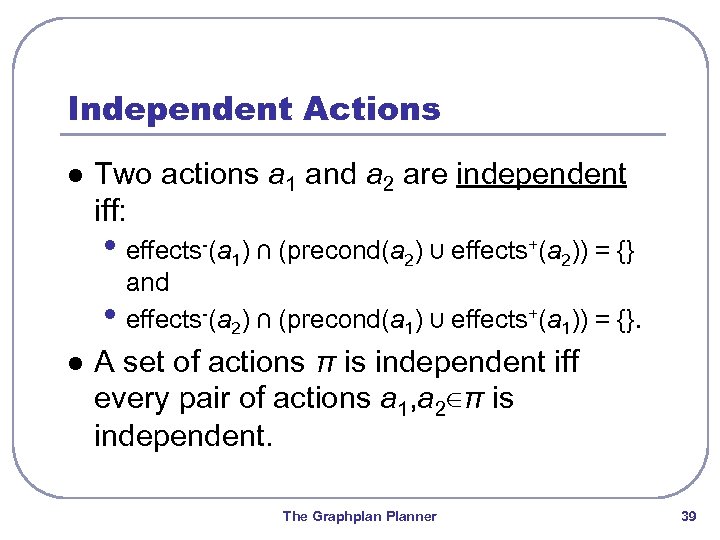 Independent Actions l Two actions a 1 and a 2 are independent iff: • effects-(a 1) ∩ (precond(a 2) ∪ effects+(a 2)) = {} • l and effects-(a 2) ∩ (precond(a 1) ∪ effects+(a 1)) = {}. A set of actions π is independent iff every pair of actions a 1, a 2∈π is independent. The Graphplan Planner 39
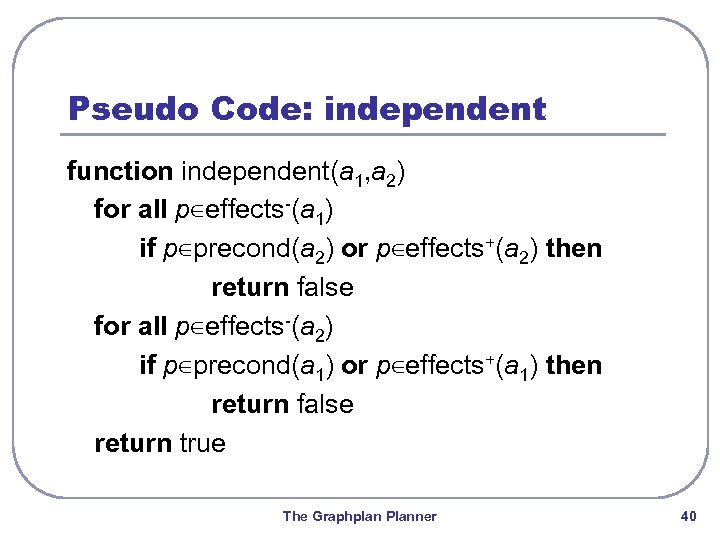 Pseudo Code: independent function independent(a 1, a 2) for all p∈effects-(a 1) if p∈precond(a 2) or p∈effects+(a 2) then return false for all p∈effects-(a 2) if p∈precond(a 1) or p∈effects+(a 1) then return false return true The Graphplan Planner 40
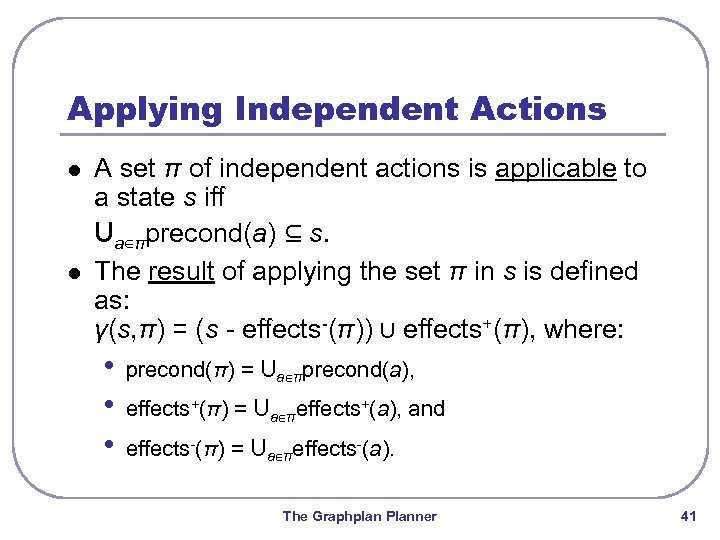 Applying Independent Actions l l A set π of independent actions is applicable to a state s iff ∪a∈πprecond(a) ⊆ s. The result of applying the set π in s is defined as: γ(s, π) = (s - effects-(π)) ∪ effects+(π), where: • • • precond(π) = ∪a∈πprecond(a), effects+(π) = ∪a∈πeffects+(a), and effects-(π) = ∪a∈πeffects-(a). The Graphplan Planner 41
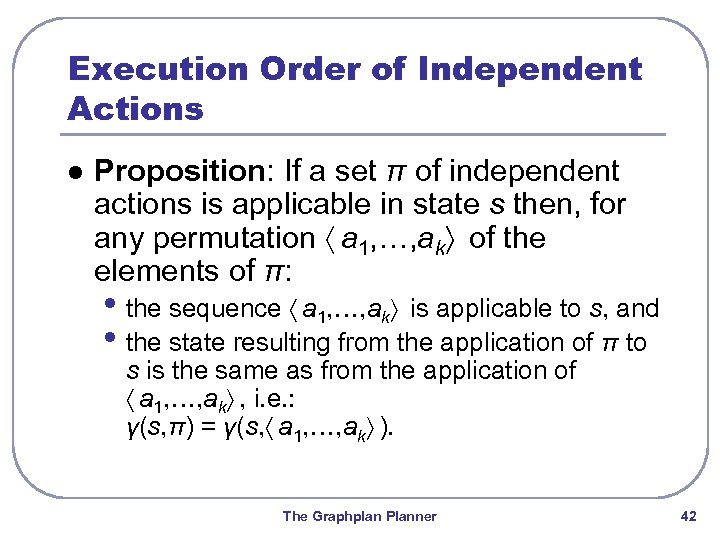 Execution Order of Independent Actions l Proposition: If a set π of independent actions is applicable in state s then, for any permutation 〈 a 1, …, ak〉 of the elements of π: • the sequence 〈 a 1, …, ak〉 is applicable to s, and • the state resulting from the application of π to s is the same as from the application of 〈 a 1, …, ak〉 , i. e. : γ(s, π) = γ(s, 〈 a 1, …, ak〉 ). The Graphplan Planner 42
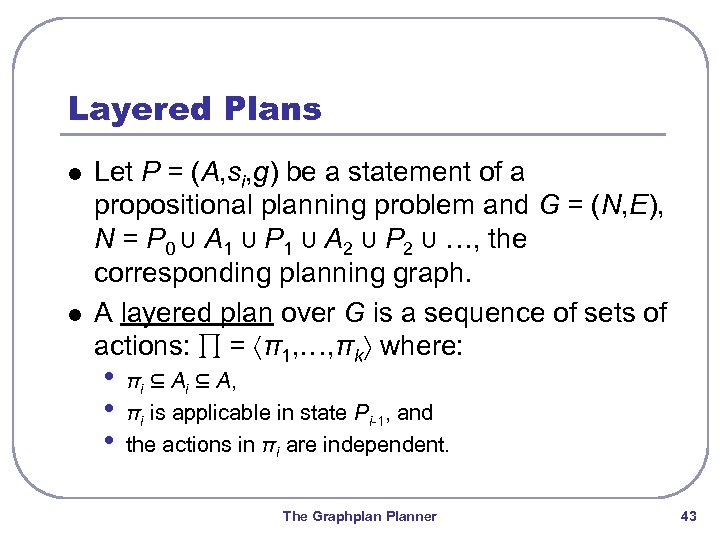 Layered Plans l l Let P = (A, si, g) be a statement of a propositional planning problem and G = (N, E), N = P 0 ∪ A 1 ∪ P 1 ∪ A 2 ∪ P 2 ∪ …, the corresponding planning graph. A layered plan over G is a sequence of sets of actions: ∏ = 〈π1, …, πk〉 where: • • • πi ⊆ A, πi is applicable in state Pi-1, and the actions in πi are independent. The Graphplan Planner 43
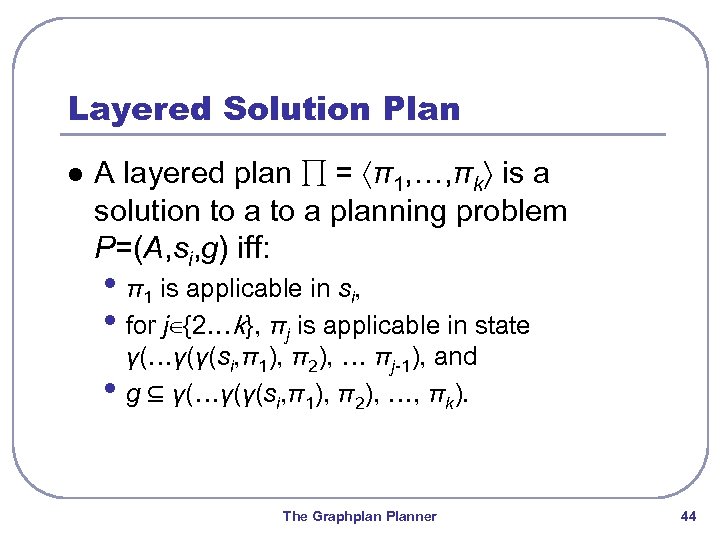 Layered Solution Plan l A layered plan ∏ = 〈π1, …, πk〉 is a solution to a planning problem P=(A, si, g) iff: • π1 is applicable in si, • for j∈{2…k}, πj is applicable in state • γ(…γ(γ(si, π1), π2), … πj-1), and g ⊆ γ(…γ(γ(si, π1), π2), …, πk). The Graphplan Planner 44
 Execution Order in Layered Solution Plans l Proposition: If ∏ = 〈π1, …, πk〉 is a solution to a planning problem P=(A, si, g), then: • • a sequence of actions corresponding to any permutation of the elements of π1, followed by a sequence of actions corresponding to any permutation of the elements of π2, … followed by a sequence of actions corresponding to any permutation of the elements of πk is a path from si to a goal state. The Graphplan Planner 45
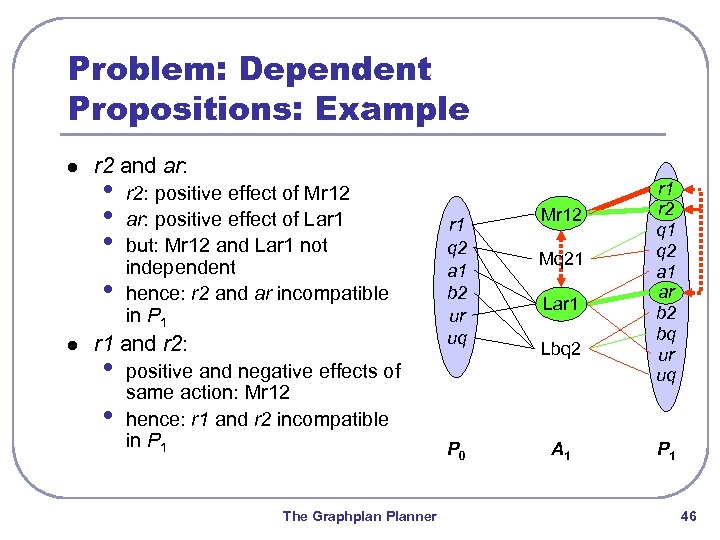 Problem: Dependent Propositions: Example l r 2 and ar: • • l r 2: positive effect of Mr 12 ar: positive effect of Lar 1 but: Mr 12 and Lar 1 not independent hence: r 2 and ar incompatible in P 1 r 1 and r 2: • • positive and negative effects of same action: Mr 12 hence: r 1 and r 2 incompatible in P 1 The Graphplan Planner r 1 q 2 a 1 b 2 ur uq P 0 Mr 12 Mq 21 Lar 1 Lbq 2 A 1 r 2 q 1 q 2 a 1 ar b 2 bq ur uq P 1 46
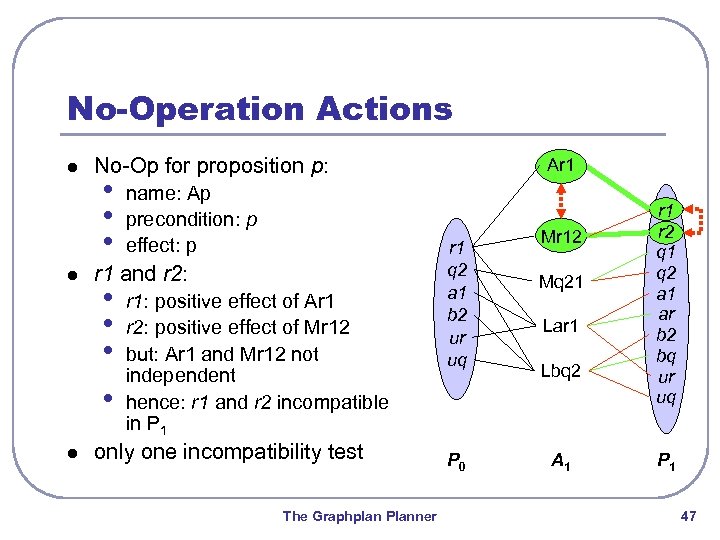 No-Operation Actions l l No-Op for proposition p: • • • r 1 and r 2: • • l name: Ap precondition: p effect: p r 1: positive effect of Ar 1 r 2: positive effect of Mr 12 but: Ar 1 and Mr 12 not independent hence: r 1 and r 2 incompatible in P 1 only one incompatibility test The Graphplan Planner Ar 1 q 2 a 1 b 2 ur uq P 0 Mr 12 Mq 21 Lar 1 Lbq 2 A 1 r 2 q 1 q 2 a 1 ar b 2 bq ur uq P 1 47
 Mutex Propositions l Two propositions p and q in proposition layer Pj are mutex (mutually exclusive) if: • every action in the preceding action layer Aj • l that has p as a positive effect (incl. no-op actions) is mutex with every action in Aj that has q as a positive effect, and there is no single action in Aj that has both, p and q, as positive effects. notation: μPj = { (p, q) | p, q∈Pj are mutex} The Graphplan Planner 48
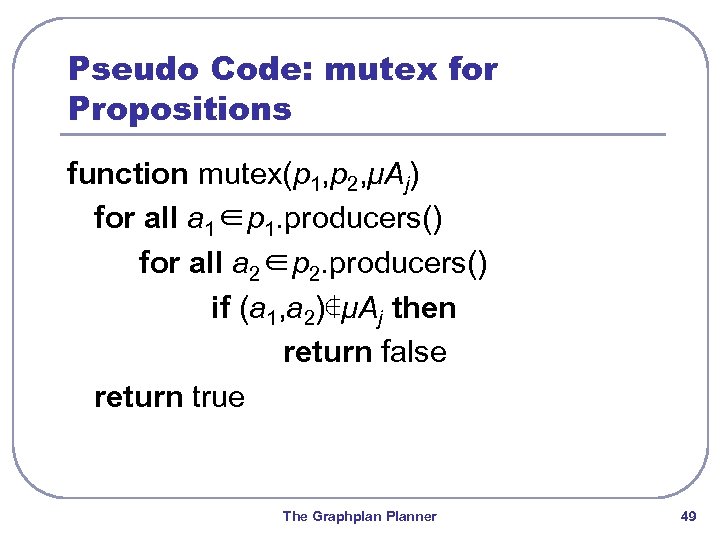 Pseudo Code: mutex for Propositions function mutex(p 1, p 2, μAj) for all a 1∈p 1. producers() for all a 2∈p 2. producers() if (a 1, a 2)∉μAj then return false return true The Graphplan Planner 49
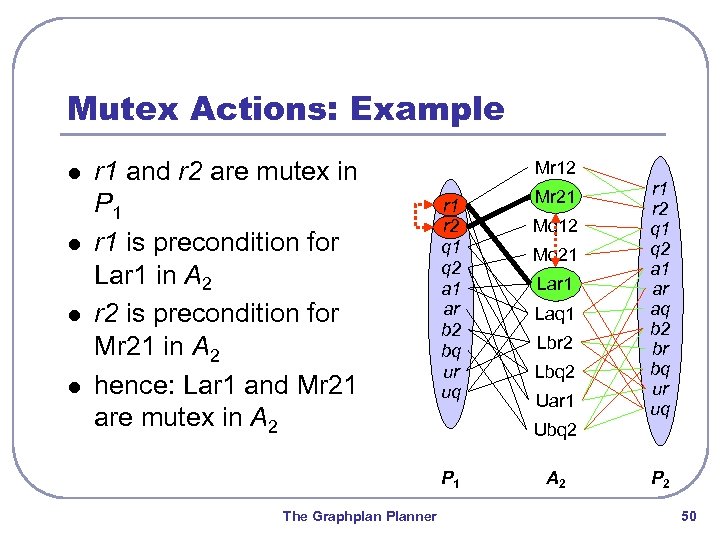 Mutex Actions: Example l l r 1 and r 2 are mutex in P 1 r 1 is precondition for Lar 1 in A 2 r 2 is precondition for Mr 21 in A 2 hence: Lar 1 and Mr 21 are mutex in A 2 Mr 12 r 1 r 2 q 1 q 2 a 1 ar b 2 bq ur uq Mq 12 Mq 21 Lar 1 Laq 1 Lbr 2 Lbq 2 Uar 1 r 2 q 1 q 2 a 1 ar aq b 2 br bq ur uq Ubq 2 P 1 The Graphplan Planner Mr 21 A 2 P 2 50
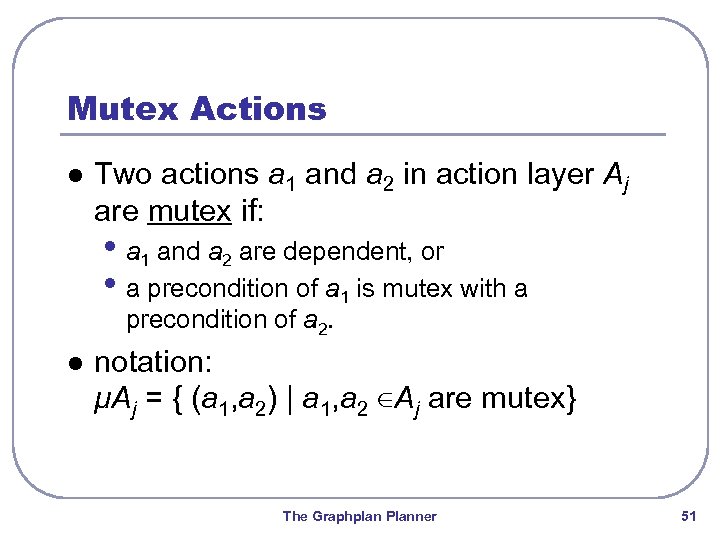 Mutex Actions l Two actions a 1 and a 2 in action layer Aj are mutex if: • a 1 and a 2 are dependent, or • a precondition of a 1 is mutex with a precondition of a 2. l notation: μAj = { (a 1, a 2) | a 1, a 2 ∈Aj are mutex} The Graphplan Planner 51
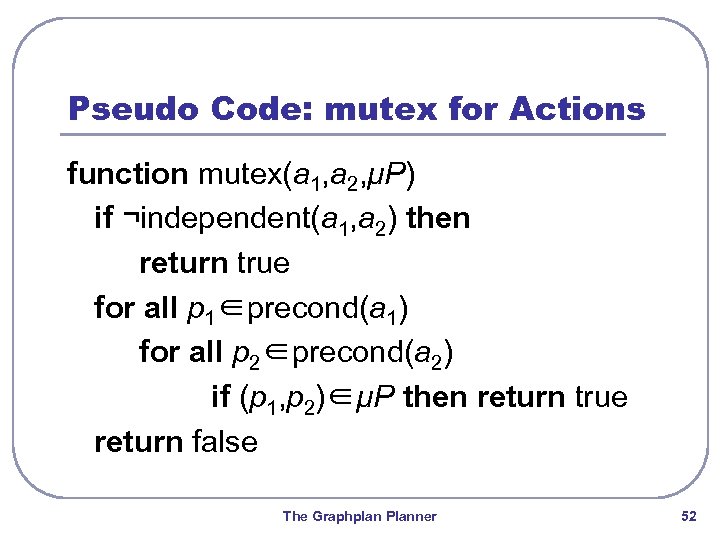 Pseudo Code: mutex for Actions function mutex(a 1, a 2, μP) if ¬independent(a 1, a 2) then return true for all p 1∈precond(a 1) for all p 2∈precond(a 2) if (p 1, p 2)∈μP then return true return false The Graphplan Planner 52
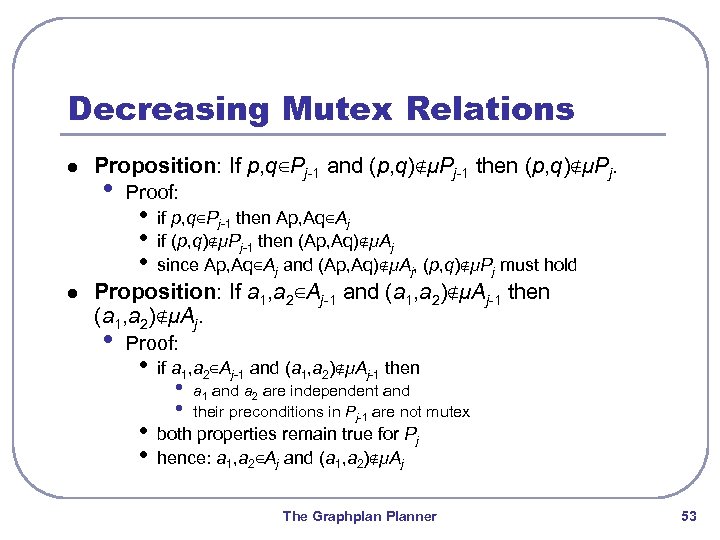 Decreasing Mutex Relations l l Proposition: If p, q∈Pj-1 and (p, q)∉μPj-1 then (p, q)∉μPj. • Proof: • • • if p, q∈Pj-1 then Ap, Aq∈Aj if (p, q)∉μPj-1 then (Ap, Aq)∉μAj since Ap, Aq∈Aj and (Ap, Aq)∉μAj, (p, q)∉μPj must hold Proposition: If a 1, a 2∈Aj-1 and (a 1, a 2)∉μAj-1 then (a 1, a 2)∉μAj. • Proof: • • • if a 1, a 2∈Aj-1 and (a 1, a 2)∉μAj-1 then • • a 1 and a 2 are independent and their preconditions in Pj-1 are not mutex both properties remain true for Pj hence: a 1, a 2∈Aj and (a 1, a 2)∉μAj The Graphplan Planner 53
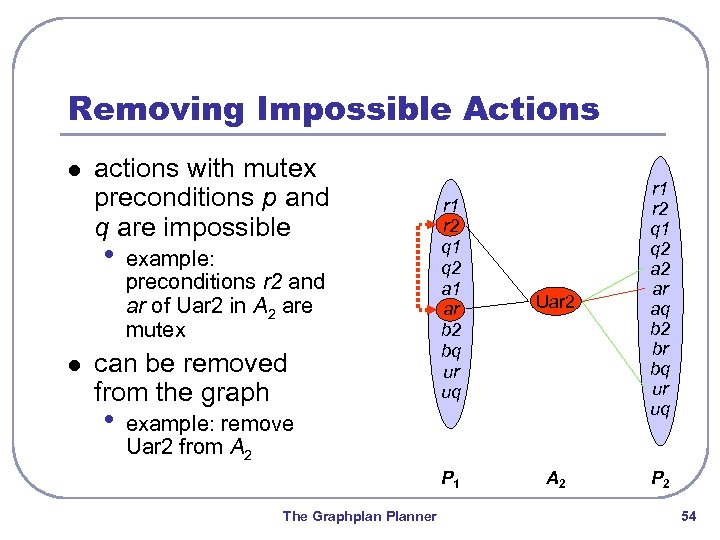 Removing Impossible Actions l actions with mutex preconditions p and q are impossible • l can be removed from the graph • Uar 2 P 1 example: preconditions r 2 and ar of Uar 2 in A 2 are mutex r 1 r 2 q 1 q 2 a 1 ar b 2 bq ur uq r 1 r 2 q 1 q 2 ar aq b 2 br bq ur uq A 2 P 2 example: remove Uar 2 from A 2 The Graphplan Planner 54
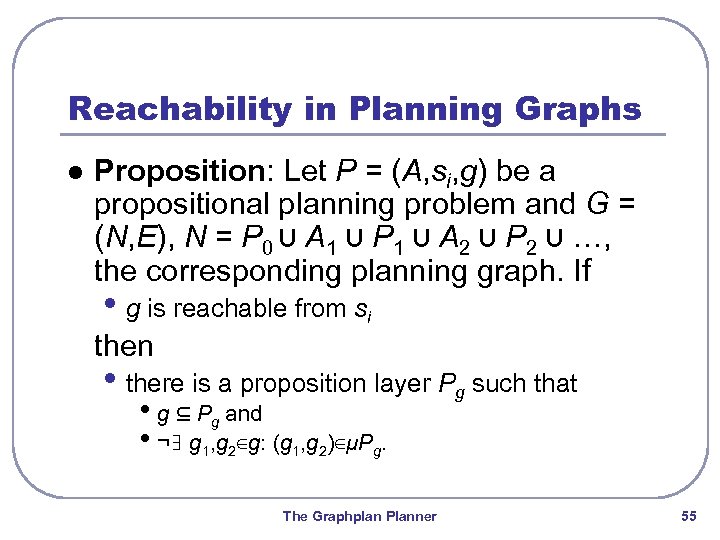 Reachability in Planning Graphs l Proposition: Let P = (A, si, g) be a propositional planning problem and G = (N, E), N = P 0 ∪ A 1 ∪ P 1 ∪ A 2 ∪ P 2 ∪ …, the corresponding planning graph. If • g is reachable from si then • there is a proposition layer Pg such that • g ⊆ Pg and • ¬∃ g 1, g 2∈g: (g 1, g 2)∈μPg. The Graphplan Planner 55
 Overview l l The Propositional Representation The Planning-Graph Structure The Graphplan Algorithm The Graphplan Planner 56
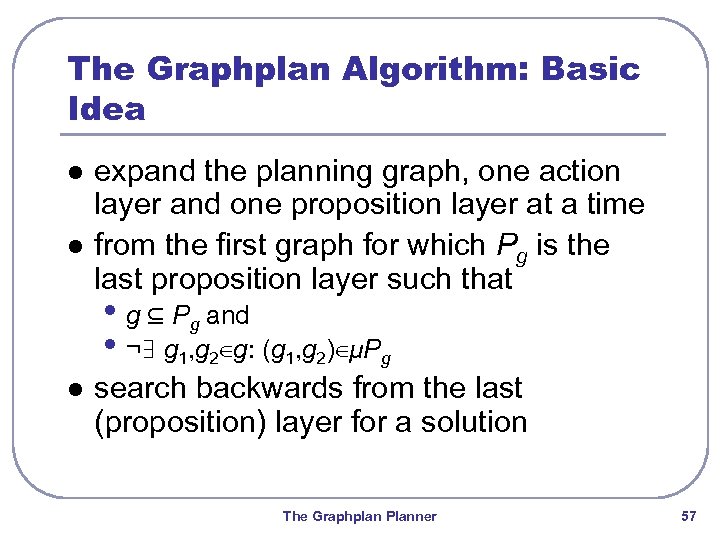 The Graphplan Algorithm: Basic Idea l l expand the planning graph, one action layer and one proposition layer at a time from the first graph for which Pg is the last proposition layer such that • g ⊆ Pg and • ¬∃ g 1, g 2∈g: (g 1, g 2)∈μPg l search backwards from the last (proposition) layer for a solution The Graphplan Planner 57
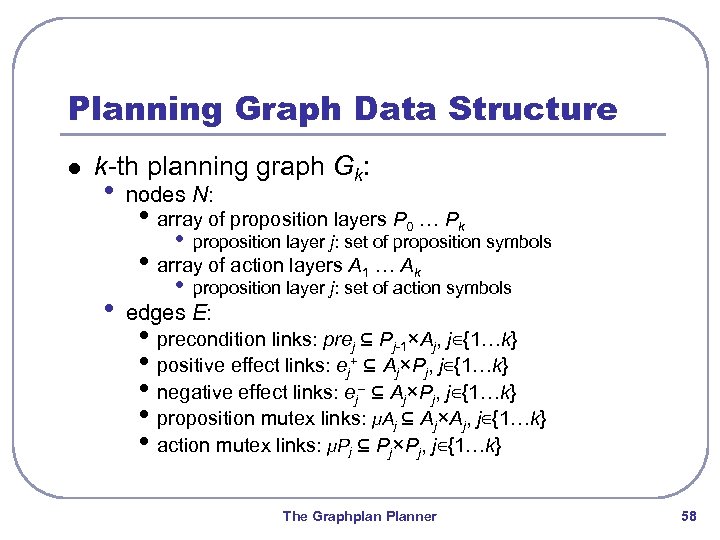 Planning Graph Data Structure l k-th planning graph Gk: • • nodes N: • array of proposition layers P 0 … Pk • proposition layer j: set of proposition symbols • array of action layers A 1 … Ak • proposition layer j: set of action symbols edges E: • precondition links: prej ⊆ Pj-1×Aj, j∈{1…k} • positive effect links: ej+ ⊆ Aj×Pj, j∈{1…k} • negative effect links: ej– ⊆ Aj×Pj, j∈{1…k} • proposition mutex links: μA ⊆ Aj×Aj, j∈{1…k} • action mutex links: μP ⊆ Pj×Pj, j∈{1…k} j j The Graphplan Planner 58
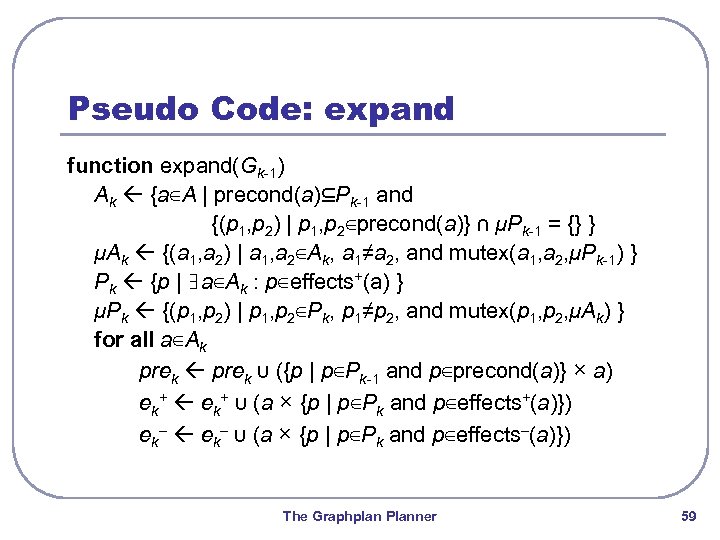 Pseudo Code: expand function expand(Gk-1) Ak {a∈A | precond(a)⊆Pk-1 and {(p 1, p 2) | p 1, p 2∈precond(a)} ∩ μPk-1 = {} } μAk {(a 1, a 2) | a 1, a 2∈Ak, a 1≠a 2, and mutex(a 1, a 2, μPk-1) } Pk {p | ∃a∈Ak : p∈effects+(a) } μPk {(p 1, p 2) | p 1, p 2∈Pk, p 1≠p 2, and mutex(p 1, p 2, μAk) } for all a∈Ak prek ∪ ({p | p∈Pk-1 and p∈precond(a)} × a) ek+ ∪ (a × {p | p∈Pk and p∈effects+(a)}) ek– ∪ (a × {p | p∈Pk and p∈effects–(a)}) The Graphplan Planner 59
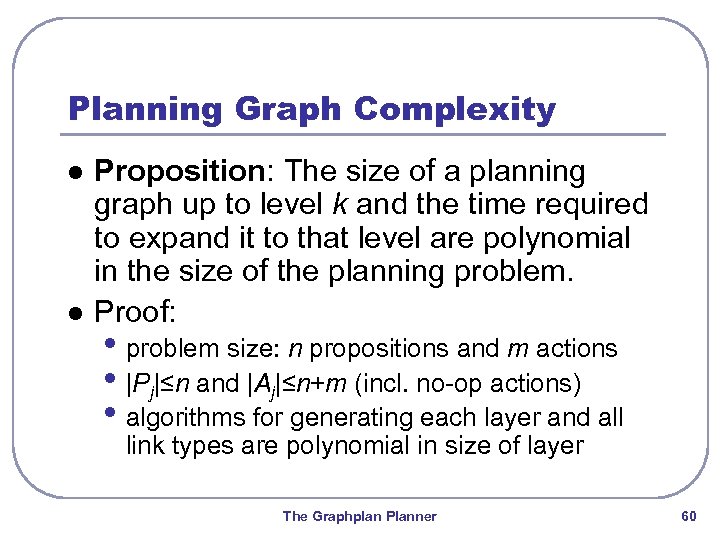 Planning Graph Complexity l l Proposition: The size of a planning graph up to level k and the time required to expand it to that level are polynomial in the size of the planning problem. Proof: • problem size: n propositions and m actions • |Pj|≤n and |Aj|≤n+m (incl. no-op actions) • algorithms for generating each layer and all link types are polynomial in size of layer The Graphplan Planner 60
 Fixed-Point Levels l A fixed-point level in a planning graph G is a level κ such that for all i, i>κ, level i of G is identical to level κ, i. e. Pi=Pκ, μPi=μPκ, Ai=Aκ, and μAi=μAκ. l Proposition: Every planning graph G has a fixed-point level κ, which is the smallest k such that |Pk|=|Pk+1| and |μPk|=|μPk+1|. Proof: l • • Pi grows monotonically and μPi shrinks monotonically Ai and Pi only depend on Pi-1 and μPi-1 The Graphplan Planner 61
 Searching the Planning Graph l general idea: • • search backwards from the last proposition layer Pk in the current graph let g be the set of goal propositions that need to be achieved at a given proposition layer Pj (initially the last layer) find a set of actions πj⊆Aj such that these actions are not mutex and together achieve g take the union of the preconditions of πj as the new goal set to be achieved in proposition layer Pj-1 The Graphplan Planner 62
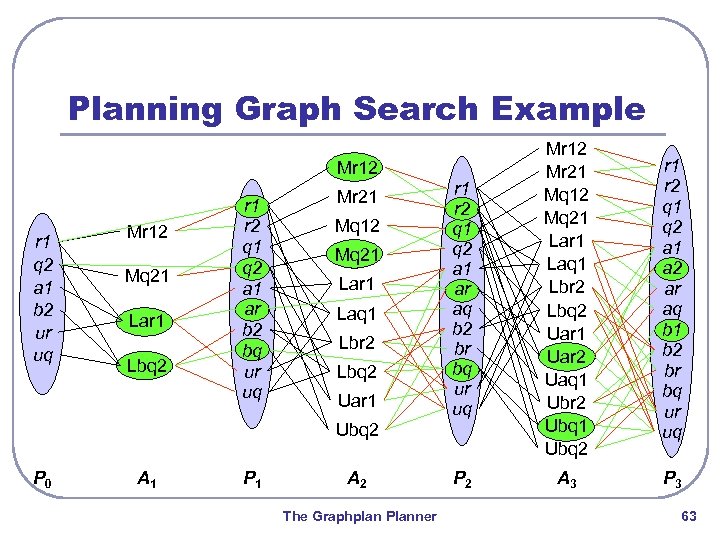 Planning Graph Search Example r 1 r 2 q 1 q 2 a 1 ar aq b 2 br bq ur uq Mr 12 Mr 21 Mq 12 Mq 21 Lar 1 Laq 1 Lbr 2 Lbq 2 Uar 1 Uar 2 Uaq 1 Ubr 2 Ubq 1 Ubq 2 r 1 r 2 q 1 q 2 a 1 a 2 ar aq b 1 b 2 br bq ur uq P 2 A 3 P 3 Mr 12 r 1 q 2 a 1 b 2 ur uq Mr 12 Mq 21 Lar 1 Lbq 2 r 1 r 2 q 1 q 2 a 1 ar b 2 bq ur uq Mr 21 Mq 12 Mq 21 Lar 1 Laq 1 Lbr 2 Lbq 2 Uar 1 Ubq 2 P 0 A 1 P 1 A 2 The Graphplan Planner 63
 Planning Graph as AND/ORGraph l l l OR-nodes: • • nodes in proposition layers links to actions that support the propositions AND-nodes: • • nodes in action layers k-connectors all preconditions of the action search: • AO* not best algorithm because it does not exploit layered structure The Graphplan Planner 64
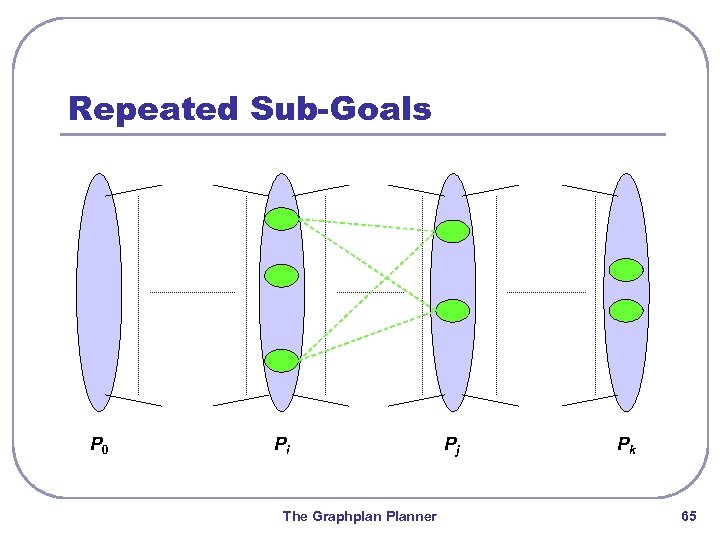 Repeated Sub-Goals P 0 Pi The Graphplan Planner Pj Pk 65
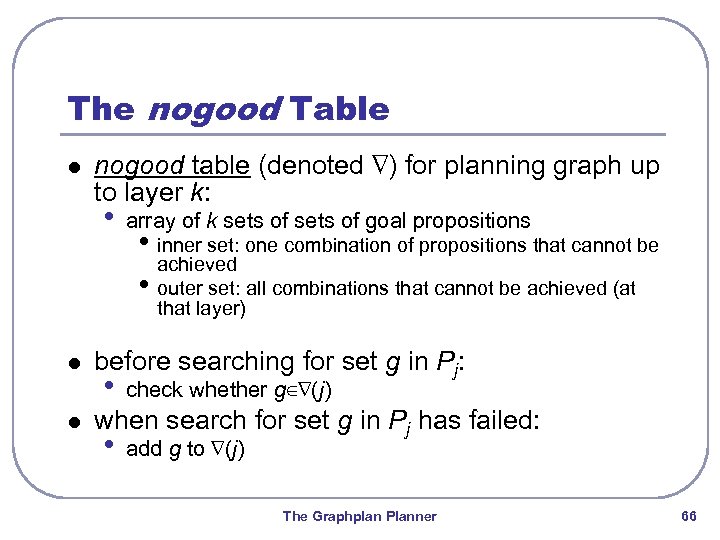 The nogood Table l nogood table (denoted ∇) for planning graph up to layer k: • array of k sets of goal propositions • inner set: one combination of propositions that cannot be achieved • outer set: all combinations that cannot be achieved (at that layer) l l before searching for set g in Pj: • check whether g∈∇(j) when search for set g in Pj has failed: • add g to ∇(j) The Graphplan Planner 66
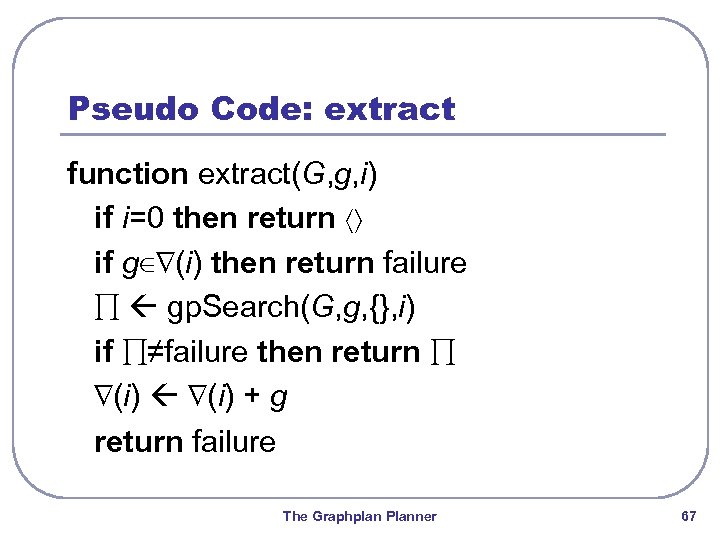 Pseudo Code: extract function extract(G, g, i) if i=0 then return 〈〉 if g∈∇(i) then return failure ∏ gp. Search(G, g, {}, i) if ∏≠failure then return ∏ ∇(i) + g return failure The Graphplan Planner 67
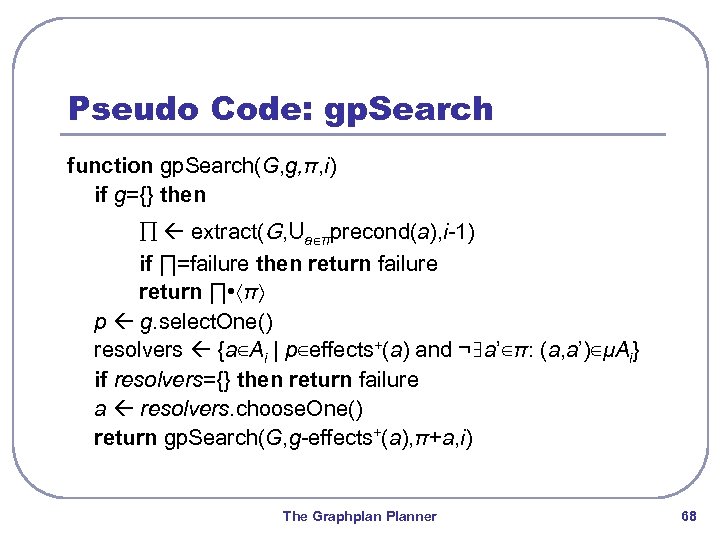 Pseudo Code: gp. Search function gp. Search(G, g, π, i) if g={} then ∏ extract(G, ∪a∈πprecond(a), i-1) if ∏=failure then return failure return ∏∙〈π〉 p g. select. One() resolvers {a∈Ai | p∈effects+(a) and ¬∃a’∈π: (a, a’)∈μAi} if resolvers={} then return failure a resolvers. choose. One() return gp. Search(G, g-effects+(a), π+a, i) The Graphplan Planner 68
![Pseudo Code: graphplan function graphplan(A, si, g) i 0; ∇ []; P 0 si;](https://present5.com/presentation/9315e241871eaafb24dc92d9ea443426/image-69.jpg "Pseudo Code: graphplan function graphplan(A, si, g) i 0; ∇ []; P 0 si;") Pseudo Code: graphplan function graphplan(A, si, g) i 0; ∇ []; P 0 si; G (P 0, {}) while (g⊈Pi or g 2∩μPi≠{}) and ¬fixed. Point(G) do i i+1; expand(G) if g⊈Pi or g 2∩μPi≠{} then return failure η fixed. Point(G) ? |∇(κ)| : 0 ∏ extract(G, g, i) while ∏=failure do i i+1; expand(G) ∏ extract(G, g, i) if ∏=failure and fixed. Point(G) then if η=|∇(κ)| then return failure η |∇(κ)| return ∏ The Graphplan Planner 69
Pseudo Code: graphplan function graphplan(A, si, g) i 0; ∇ []; P 0 si; G (P 0, {}) while (g⊈Pi or g 2∩μPi≠{}) and ¬fixed. Point(G) do i i+1; expand(G) if g⊈Pi or g 2∩μPi≠{} then return failure η fixed. Point(G) ? |∇(κ)| : 0 ∏ extract(G, g, i) while ∏=failure do i i+1; expand(G) ∏ extract(G, g, i) if ∏=failure and fixed. Point(G) then if η=|∇(κ)| then return failure η |∇(κ)| return ∏ The Graphplan Planner 69
 Graphplan Properties l Proposition: The Graphplan algorithm is sound, complete, and always terminates. • It returns failure iff the given planning problem • l has no solution; otherwise, it returns a layered plan ∏ that is a solution to the given planning problem. Graphplan is orders of magnitude faster than previous techniques! The Graphplan Planner 70
 Overview l l The Propositional Representation The Planning-Graph Structure The Graphplan Algorithm Planning-Graph Heuristics The Graphplan Planner 71
 Forward State-Space Search l idea: apply standard search algorithms (breadth-first, depth-first, A*, etc. ) to planning problem: • search space is subset of state space • nodes correspond to world states • arcs correspond to state transitions • path in the search space corresponds to plan The Graphplan Planner 72
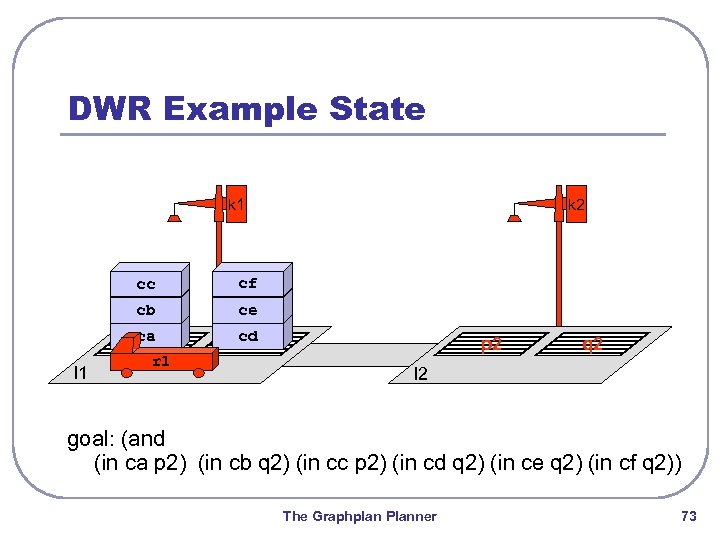 DWR Example State k 1 cc ce ca l 1 cf cb k 2 cd r 1 p 2 q 2 l 2 goal: (and (in ca p 2) (in cb q 2) (in cc p 2) (in cd q 2) (in ce q 2) (in cf q 2)) The Graphplan Planner 73
 Heuristics l estimate distance to nearest goal state • number of unachieved goals (not admissible) • number of unachieved goals / max. number of positive effects per operator (admissible) l example state (prev. slide): • actual goal distance: 35 actions • h(s) = 6 / 4 The Graphplan Planner 74
 Finding Better Heuristics l l solve “relaxed” problem and use solution as heuristic planning heuristic: • • planning problem: P=(O, si, g) for p ∈ g: min-layer(p) = index of first proposition layer in planning graph that contains p admissible heuristic: max(p ∈ g): min-layer(p) not admissible: sum(p ∈ g): min-layer(p) no need to compute mutex relations no need to re-compute planning graph for ground backward search The Graphplan Planner 75
 The FF Planner (Basics) l heuristic • based on planning graph without negative • l effects backward search possible in polynomial time search strategy • enforced hill-climbing: commit to first state with better f-value The Graphplan Planner 76
 Overview l l The Propositional Representation The Planning-Graph Structure The Graphplan Algorithm Planning-Graph Heuristics The Graphplan Planner 77