 Скачать презентацию The Global Heliophysics Observatory for IPY IHY
5c19f132f75fc7b6ee02fe15bc00a103.ppt
- Количество слайдов: 22



The Global Heliophysics Observatory for IPY – IHY, 2007 - 2009 John F. Cooper Chief Scientist, Space Physics Data Facility Heliospheric Physics Laboratory NASA Goddard Space Flight Center Greenbelt, Maryland, U. S. A.
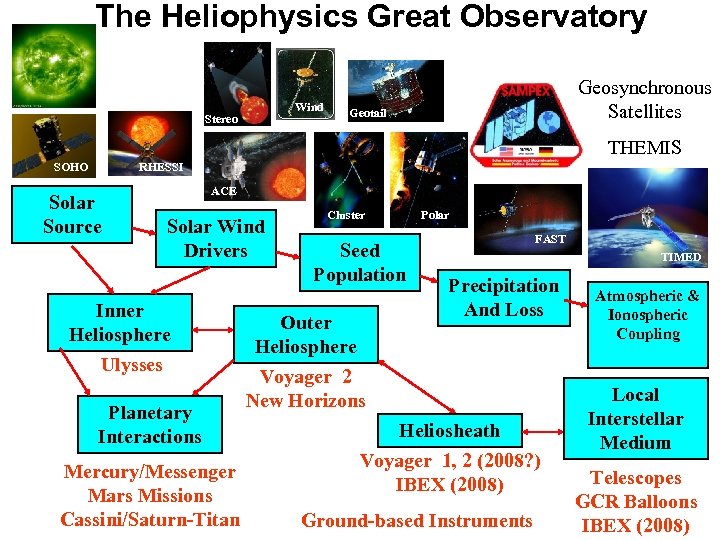
The Heliophysics Great Observatory Wind Stereo Geosynchronous Satellites Geotail IMAGE SOHO THEMIS RHESSI Solar Source ACE Solar Wind Drivers Inner Heliosphere Ulysses Planetary Interactions Mercury/Messenger Mars Missions Cassini/Saturn-Titan Cluster Seed Population Outer Heliosphere Voyager 2 New Horizons Polar FAST TIMED Precipitation And Loss Heliosheath Voyager 1, 2 (2008? ) IBEX (2008) Ground-based Instruments Atmospheric & Ionospheric Coupling Local Interstellar Medium Telescopes GCR Balloons IBEX (2008)
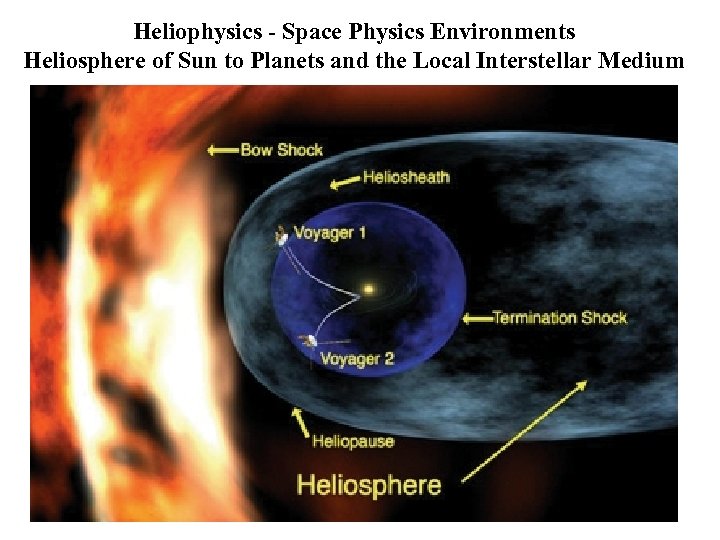
Heliophysics - Space Physics Environments Heliosphere of Sun to Planets and the Local Interstellar Medium
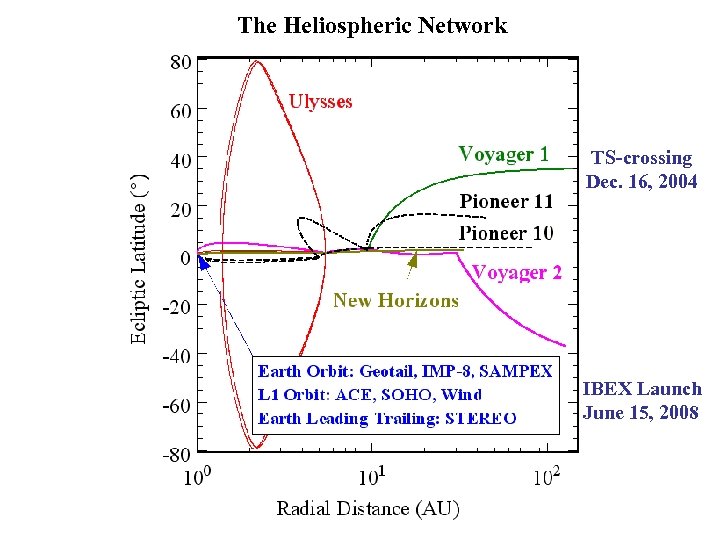
The Heliospheric Network TS-crossing Dec. 16, 2004 IBEX Launch June 15, 2008
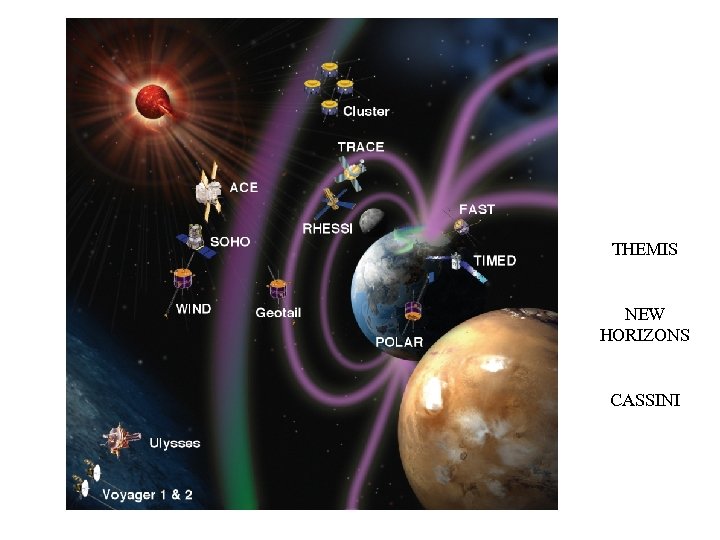
THEMIS NEW HORIZONS CASSINI
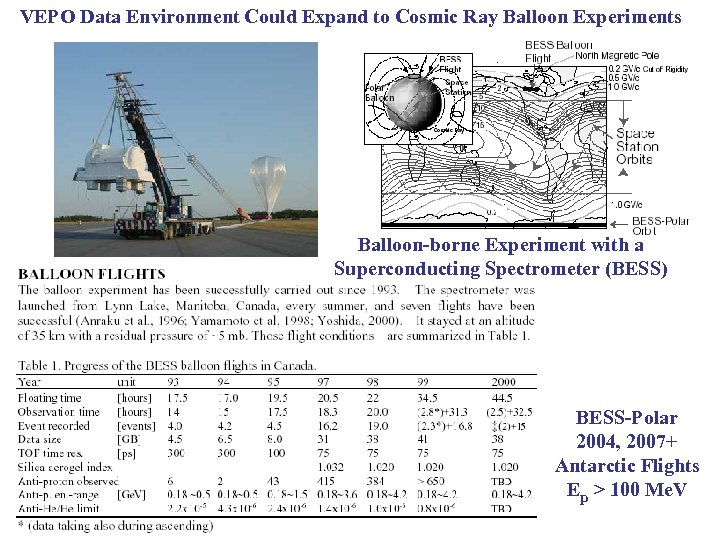
VEPO Data Environment Could Expand to Cosmic Ray Balloon Experiments Balloon-borne Experiment with a Superconducting Spectrometer (BESS) BESS-Polar 2004, 2007+ Antarctic Flights Ep > 100 Me. V
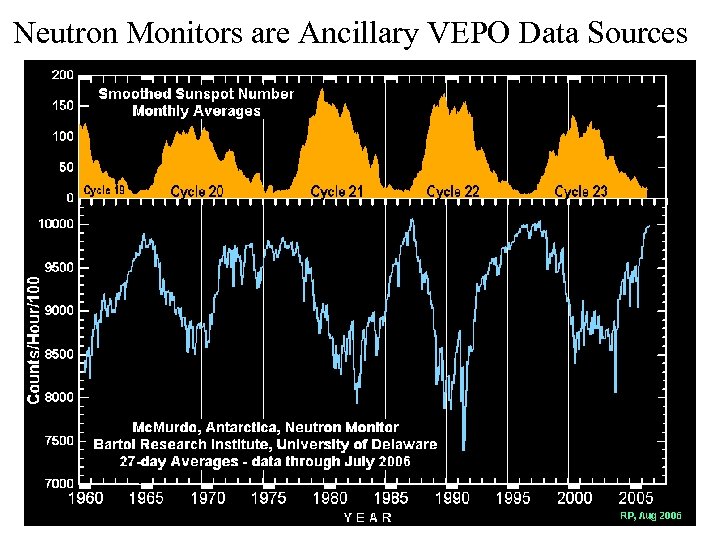
Neutron Monitors are Ancillary VEPO Data Sources
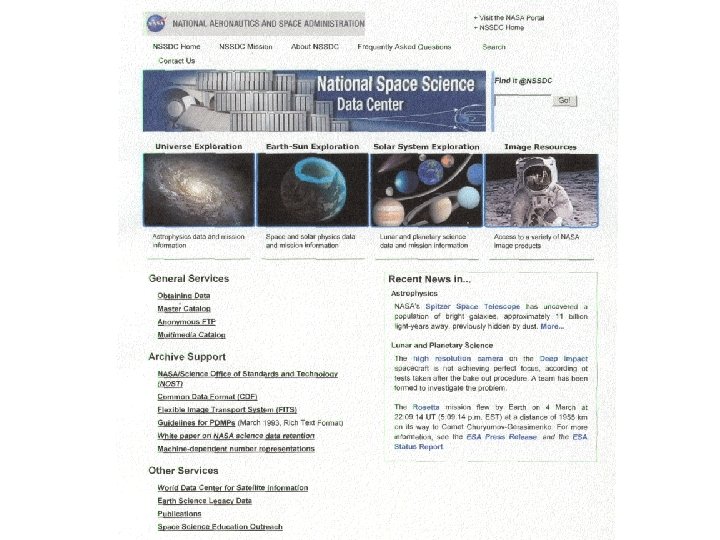
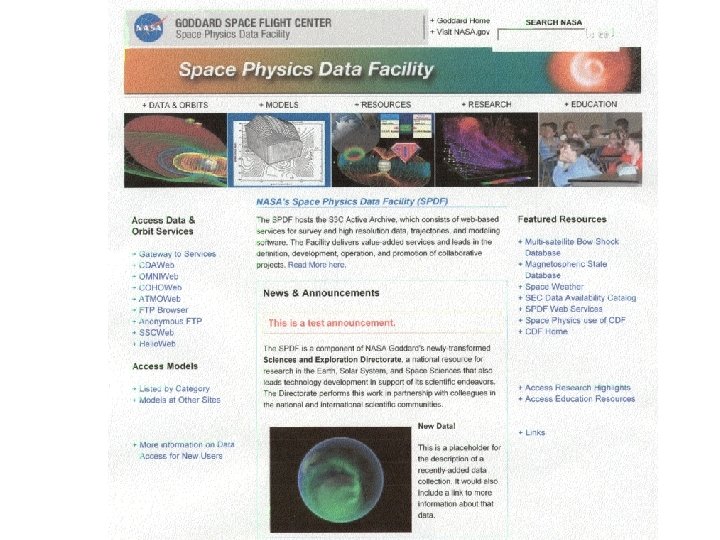
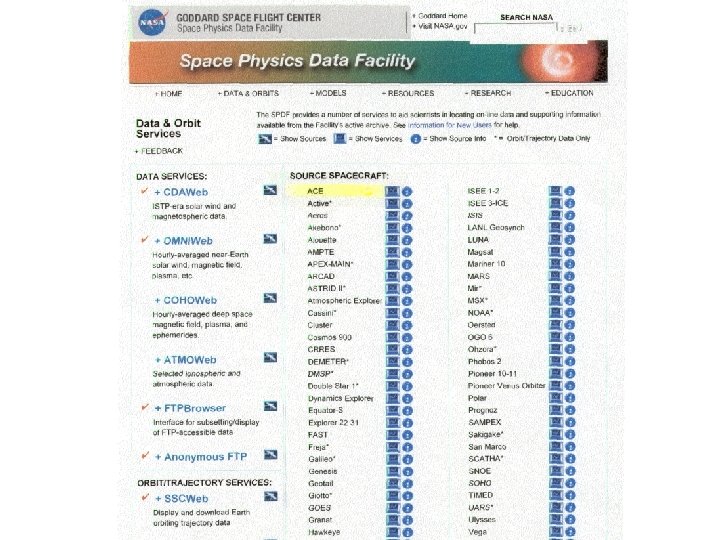
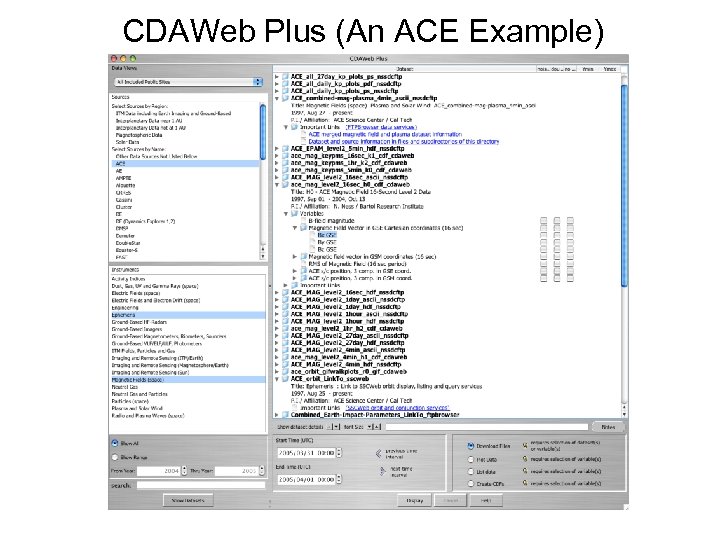
CDAWeb Plus (An ACE Example)
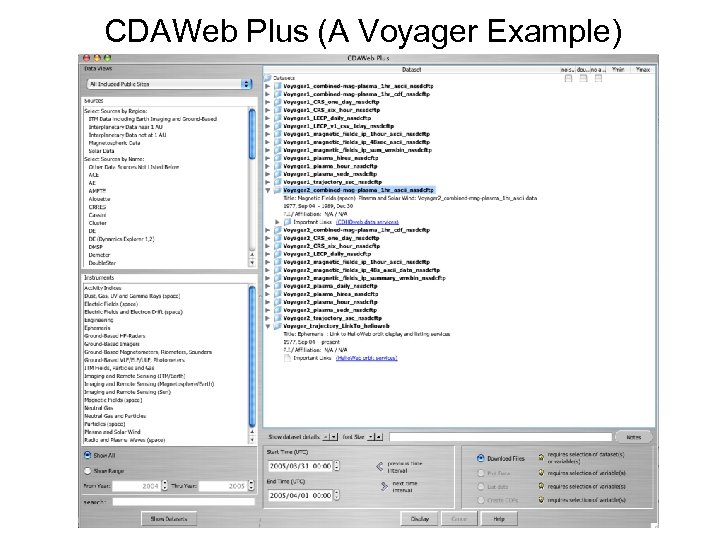
CDAWeb Plus (A Voyager Example)
NNH 06 ZDA 001 N-VOBS: Virtual Observatories for Heliophysics Data Virtual Energetic Particle Observatory (VEPO) In Search of Dragon Fire John F. Cooper, Robert E. Mc. Guire, Nand Lal, Adam Szabo, Thomas W. Narock NASA Goddard Space Flight Center, Greenbelt, Maryland Matthew E. Hill Applied Physics Laboratory, Johns Hopkins University, Laurel, Maryand Thomas P. Armstrong, Jerry W. Manweiler Fundamental Technologies, Lawrence, Kansas Robert B. Mc. Kibben, Clifford Lopate University of New Hampshire, Durham, New Hampshire Contact: Dr. John F. Cooper, Heliospheric Physics Laboratory, Code 672, NASA Goddard Space Flight Center, Greenbelt, MD 20771 E-mail: John. F. Cooper@nasa. gov; Phone: +1 -301 -286 -1193
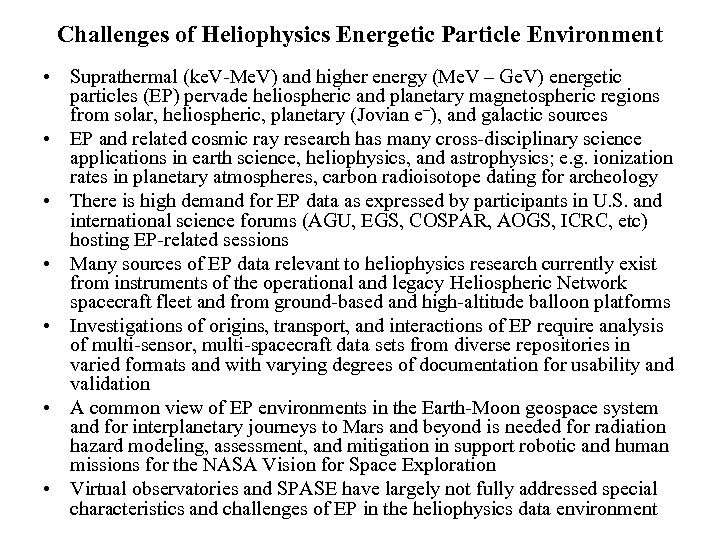
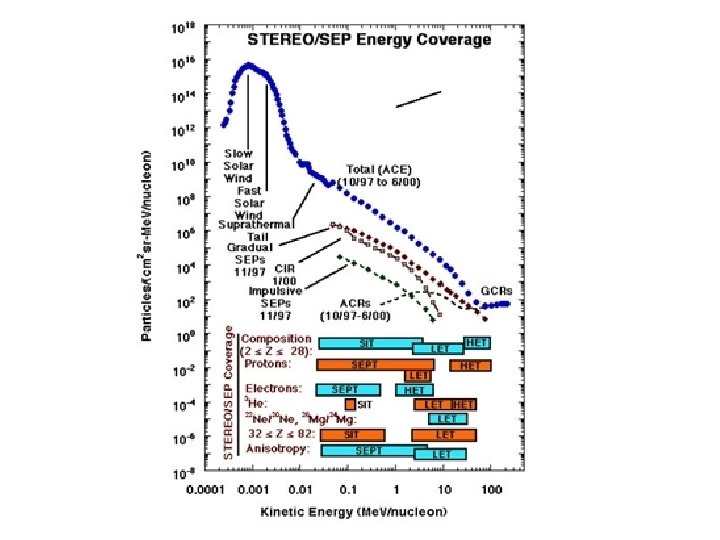
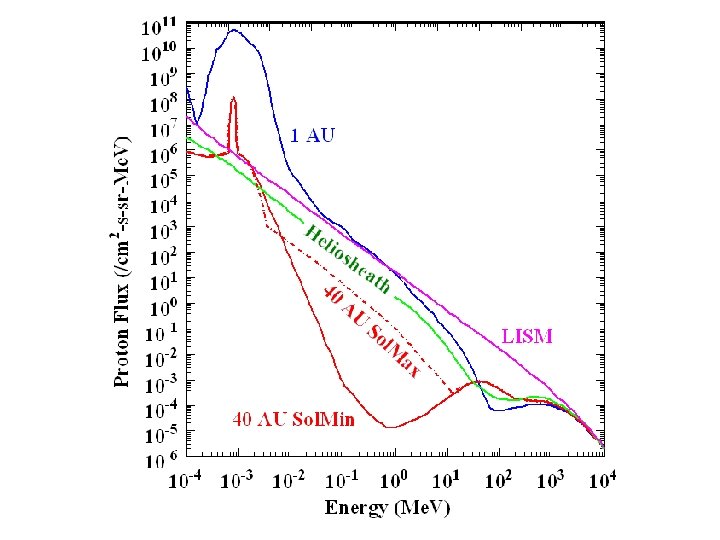
Challenges of Heliophysics Energetic Particle Environment • Suprathermal (ke. V-Me. V) and higher energy (Me. V – Ge. V) energetic particles (EP) pervade heliospheric and planetary magnetospheric regions from solar, heliospheric, planetary (Jovian e−), and galactic sources • EP and related cosmic ray research has many cross-disciplinary science applications in earth science, heliophysics, and astrophysics; e. g. ionization rates in planetary atmospheres, carbon radioisotope dating for archeology • There is high demand for EP data as expressed by participants in U. S. and international science forums (AGU, EGS, COSPAR, AOGS, ICRC, etc) hosting EP-related sessions • Many sources of EP data relevant to heliophysics research currently exist from instruments of the operational and legacy Heliospheric Network spacecraft fleet and from ground-based and high-altitude balloon platforms • Investigations of origins, transport, and interactions of EP require analysis of multi-sensor, multi-spacecraft data sets from diverse repositories in varied formats and with varying degrees of documentation for usability and validation • A common view of EP environments in the Earth-Moon geospace system and for interplanetary journeys to Mars and beyond is needed for radiation hazard modeling, assessment, and mitigation in support robotic and human missions for the NASA Vision for Space Exploration • Virtual observatories and SPASE have largely not fully addressed special characteristics and challenges of EP in the heliophysics data environment
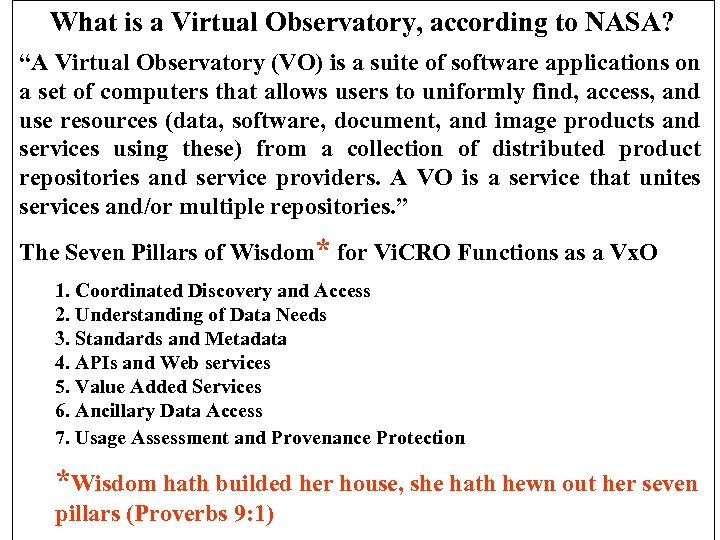
What is a Virtual Observatory, according to NASA? “A Virtual Observatory (VO) is a suite of software applications on a set of computers that allows users to uniformly find, access, and use resources (data, software, document, and image products and services using these) from a collection of distributed product repositories and service providers. A VO is a service that unites services and/or multiple repositories. ” The Seven Pillars of Wisdom* for Vi. CRO Functions as a Vx. O 1. Coordinated Discovery and Access 2. Understanding of Data Needs 3. Standards and Metadata 4. APIs and Web services 5. Value Added Services 6. Ancillary Data Access 7. Usage Assessment and Provenance Protection *Wisdom hath builded her house, she hath hewn out her seven pillars (Proverbs 9: 1)
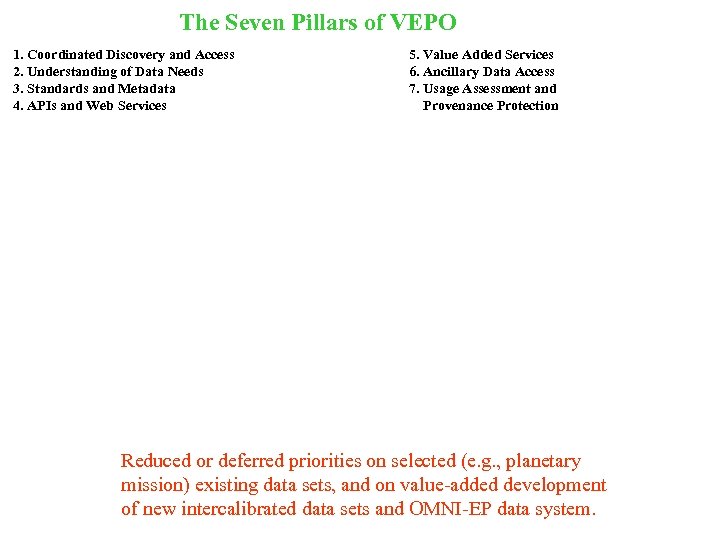
The Seven Pillars of VEPO 1. Coordinated Discovery and Access 2. Understanding of Data Needs 3. Standards and Metadata 4. APIs and Web Services 5. Value Added Services 6. Ancillary Data Access 7. Usage Assessment and Provenance Protection Wadi Rum, Jordan Reduced or deferred priorities on selected (e. g. , planetary mission) existing data sets, and on value-added development of new intercalibrated data sets and OMNI-EP data system.
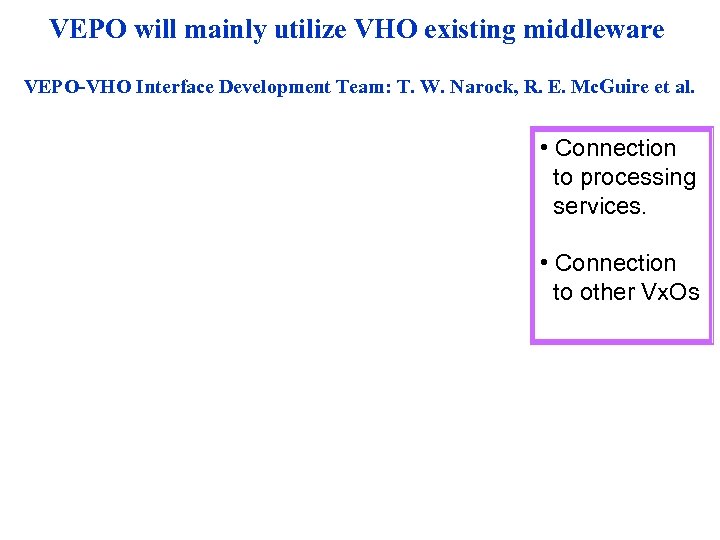
VEPO will mainly utilize VHO existing middleware VEPO-VHO Interface Development Team: T. W. Narock, R. E. Mc. Guire et al. • Connection to processing services. • Connection to other Vx. Os
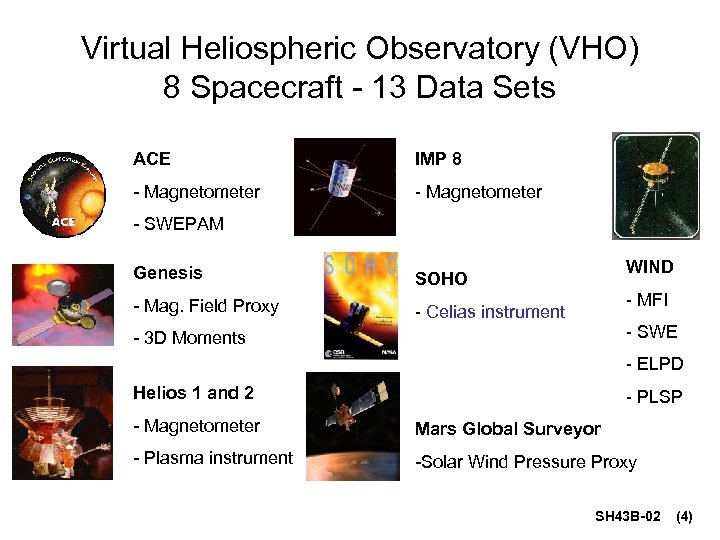
Virtual Heliospheric Observatory (VHO) 8 Spacecraft - 13 Data Sets ACE IMP 8 - Magnetometer - SWEPAM Genesis - Mag. Field Proxy WIND SOHO - Celias instrument - MFI - SWE - 3 D Moments - ELPD Helios 1 and 2 - PLSP - Magnetometer Mars Global Surveyor - Plasma instrument -Solar Wind Pressure Proxy SH 43 B-02 (4)
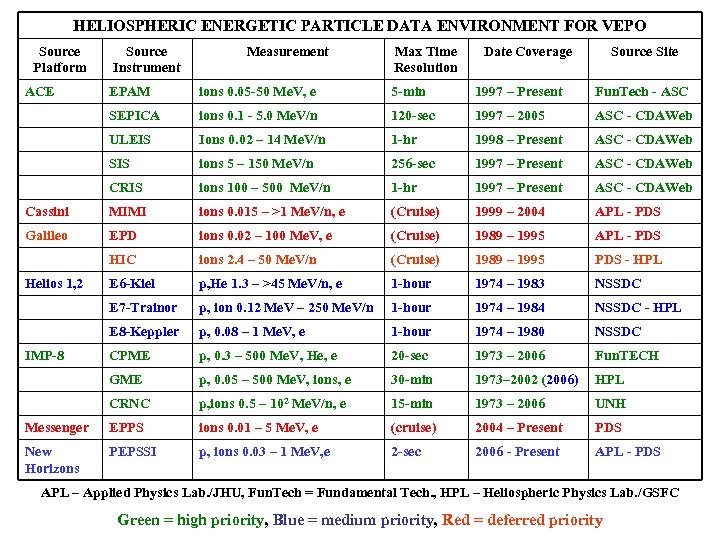
HELIOSPHERIC ENERGETIC PARTICLE DATA ENVIRONMENT FOR VEPO Source Platform ACE Source Instrument Measurement Max Time Resolution Date Coverage Source Site EPAM ions 0. 05 -50 Me. V, e 5 -min 1997 – Present Fun. Tech - ASC SEPICA ions 0. 1 - 5. 0 Me. V/n 120 -sec 1997 – 2005 ASC - CDAWeb ULEIS Ions 0. 02 – 14 Me. V/n 1 -hr 1998 – Present ASC - CDAWeb SIS ions 5 – 150 Me. V/n 256 -sec 1997 – Present ASC - CDAWeb CRIS ions 100 – 500 Me. V/n 1 -hr 1997 – Present ASC - CDAWeb Cassini MIMI ions 0. 015 – >1 Me. V/n, e (Cruise) 1999 – 2004 APL - PDS Galileo EPD ions 0. 02 – 100 Me. V, e (Cruise) 1989 – 1995 APL - PDS HIC ions 2. 4 – 50 Me. V/n (Cruise) 1989 – 1995 PDS - HPL E 6 -Kiel p, He 1. 3 – >45 Me. V/n, e 1 -hour 1974 – 1983 NSSDC E 7 -Trainor p, ion 0. 12 Me. V – 250 Me. V/n 1 -hour 1974 – 1984 NSSDC - HPL E 8 -Keppler p, 0. 08 – 1 Me. V, e 1 -hour 1974 – 1980 NSSDC CPME p, 0. 3 – 500 Me. V, He, e 20 -sec 1973 – 2006 Fun. TECH GME p, 0. 05 – 500 Me. V, ions, e 30 -min 1973– 2002 (2006) HPL CRNC p, ions 0. 5 – 102 Me. V/n, e 15 -min 1973 – 2006 UNH Messenger EPPS ions 0. 01 – 5 Me. V, e (cruise) 2004 – Present PDS New Horizons PEPSSI p, ions 0. 03 – 1 Me. V, e 2 -sec 2006 - Present APL - PDS Helios 1, 2 IMP-8 APL – Applied Physics Lab. /JHU, Fun. Tech = Fundamental Tech. , HPL – Heliospheric Physics Lab. /GSFC Green = high priority, Blue = medium priority, Red = deferred priority
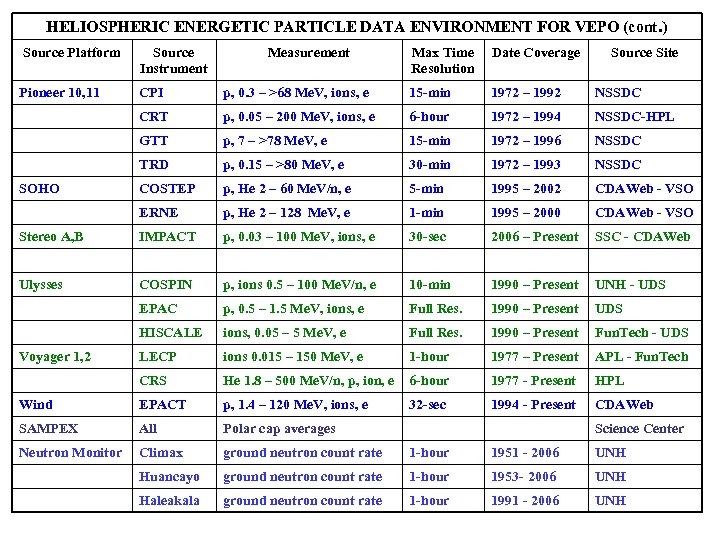
HELIOSPHERIC ENERGETIC PARTICLE DATA ENVIRONMENT FOR VEPO (cont. ) Source Platform Source Instrument Pioneer 10, 11 CPI Max Time Resolution Date Coverage p, 0. 3 – >68 Me. V, ions, e 15 -min 1972 – 1992 NSSDC CRT p, 0. 05 – 200 Me. V, ions, e 6 -hour 1972 – 1994 NSSDC-HPL GTT p, 7 – >78 Me. V, e 15 -min 1972 – 1996 NSSDC TRD p, 0. 15 – >80 Me. V, e 30 -min 1972 – 1993 NSSDC COSTEP p, He 2 – 60 Me. V/n, e 5 -min 1995 – 2002 CDAWeb - VSO ERNE p, He 2 – 128 Me. V, e 1 -min 1995 – 2000 CDAWeb - VSO Stereo A, B IMPACT p, 0. 03 – 100 Me. V, ions, e 30 -sec 2006 – Present SSC - CDAWeb Ulysses COSPIN p, ions 0. 5 – 100 Me. V/n, e 10 -min 1990 – Present UNH - UDS EPAC p, 0. 5 – 1. 5 Me. V, ions, e Full Res. 1990 – Present UDS HISCALE ions, 0. 05 – 5 Me. V, e Full Res. 1990 – Present Fun. Tech - UDS LECP ions 0. 015 – 150 Me. V, e 1 -hour 1977 – Present APL - Fun. Tech CRS He 1. 8 – 500 Me. V/n, p, ion, e 6 -hour 1977 - Present HPL Wind EPACT p, 1. 4 – 120 Me. V, ions, e 32 -sec 1994 - Present CDAWeb SAMPEX All Polar cap averages Neutron Monitor Climax ground neutron count rate 1 -hour 1951 - 2006 UNH Huancayo ground neutron count rate 1 -hour 1953 - 2006 UNH Haleakala ground neutron count rate 1 -hour 1991 - 2006 UNH SOHO Voyager 1, 2 Measurement Source Site Science Center
Скачать презентацию The Global Heliophysics Observatory for IPY IHY
5c19f132f75fc7b6ee02fe15bc00a103.ppt