 Скачать презентацию The Global Financial Crisis and Trans-Siberian Railway Transportation
8217a610062df0ee753b337a04091cb4.ppt
- Количество слайдов: 33



The Global Financial Crisis and Trans-Siberian Railway Transportation Hisako Tsuji Economic Research Institute for Northeast Asia (ERINA) November, 2009 禁無断転載 © 2009 ERINA 1
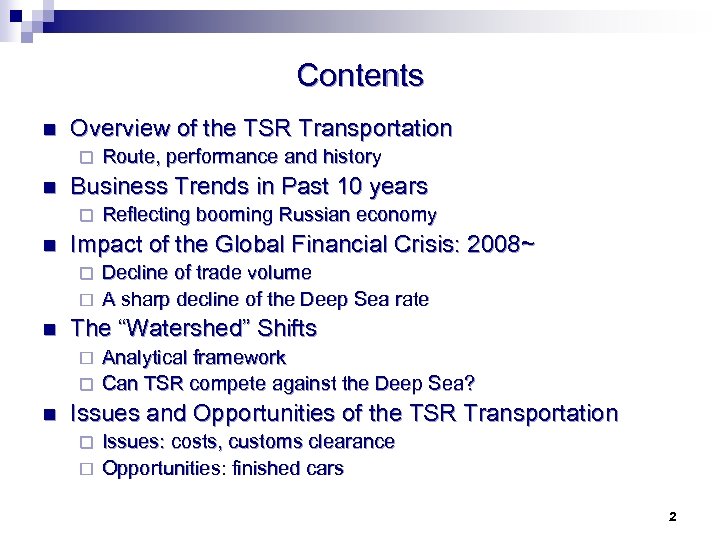
Contents n Overview of the TSR Transportation ¨ n Business Trends in Past 10 years ¨ n Route, performance and history Reflecting booming Russian economy Impact of the Global Financial Crisis: 2008~ Decline of trade volume ¨ A sharp decline of the Deep Sea rate ¨ n The “Watershed” Shifts Analytical framework ¨ Can TSR compete against the Deep Sea? ¨ n Issues and Opportunities of the TSR Transportation Issues: costs, customs clearance ¨ Opportunities: finished cars ¨ 2
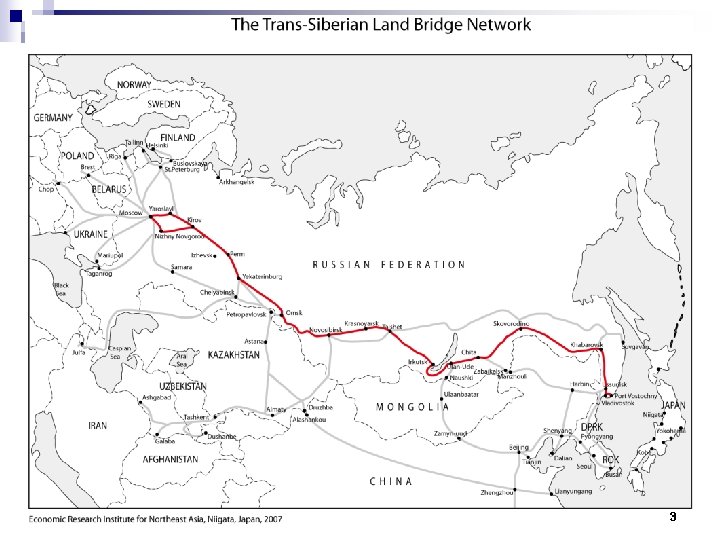
3
International Container Transport on the Trans. Siberian Railway n International Multimodal Transport System Marine transport + Russian ports + Russian railways + railways in various countries ¨ Numerous players: forwarders are in charge of control and combine various charges ¨ n Shorter distance compared to the Deep Sea route ¨ n Japan/ROK–Moscow: ½ of Deep Sea route Faster services using block trains Faster than the Deep Sea route for transport from Japan/ROK to Finland, Eastern Europe and destinations in Russia/CIS ¨ Japan/ROK–Moscow: 20– 25 days by the TSR, 40– 45 days by the Deep Sea ¨ n Economic competitiveness versus Deep Sea route ¨ ¨ ¨ The ‘Watershed’ floats The Deep Sea rate fluctuates drastically Frequent rise of RZD rate 4
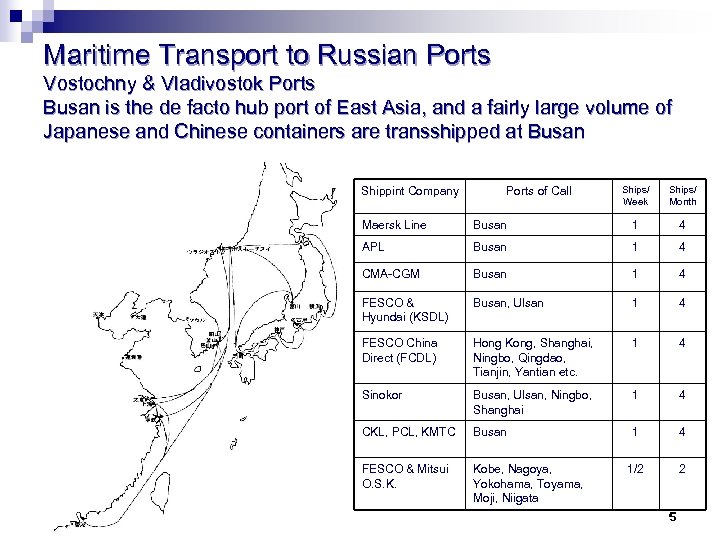
Maritime Transport to Russian Ports Vostochny & Vladivostok Ports Busan is the de facto hub port of East Asia, and a fairly large volume of Japanese and Chinese containers are transshipped at Busan Shippint Company Ports of Call Ships/ Week Ships/ Month Maersk Line Busan 1 4 APL Busan 1 4 CMA-CGM Busan 1 4 FESCO & Hyundai (KSDL) Busan, Ulsan 1 4 FESCO China Direct (FCDL) Hong Kong, Shanghai, Ningbo, Qingdao, Tianjin, Yantian etc. 1 4 Sinokor Busan, Ulsan, Ningbo, Shanghai 1 4 CKL, PCL, KMTC Busan 1 4 FESCO & Mitsui O. S. K. Kobe, Nagoya, Yokohama, Toyama, Moji, Niigata 1/2 2 5
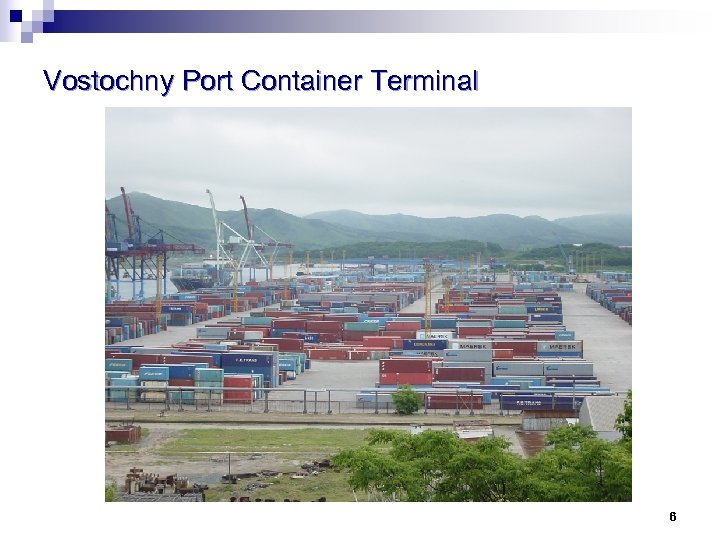
Vostochny Port Container Terminal 6
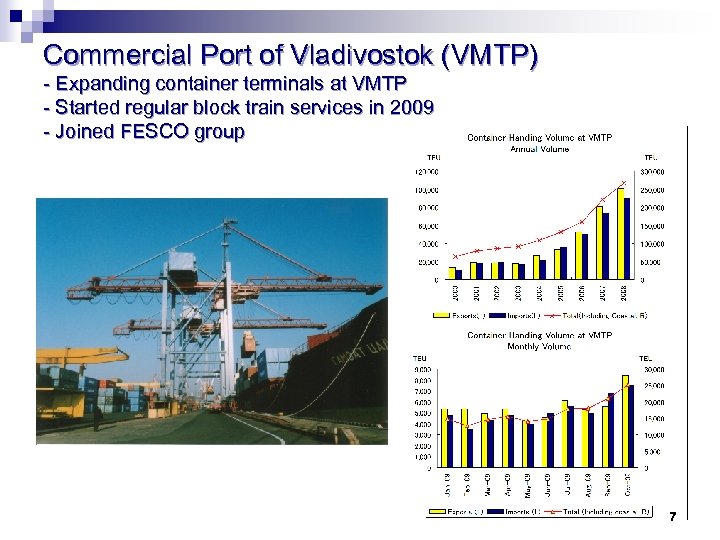
Commercial Port of Vladivostok (VMTP) - Expanding container terminals at VMTP - Started regular block train services in 2009 - Joined FESCO group 7
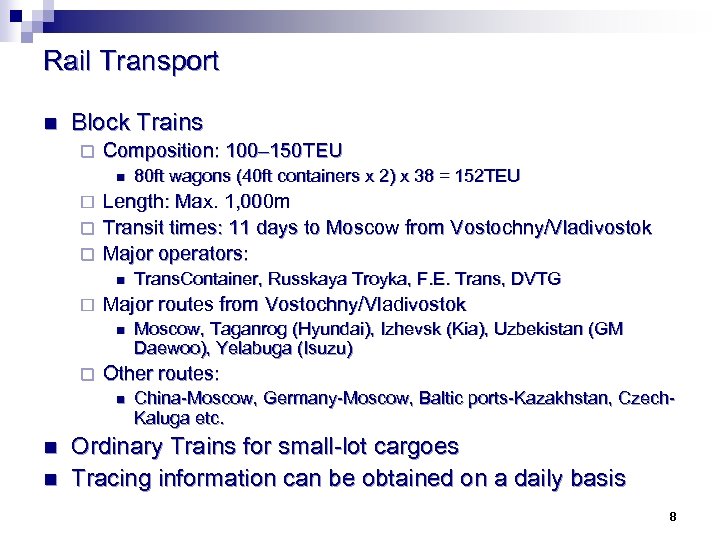
Rail Transport n Block Trains ¨ Composition: 100– 150 TEU n 80 ft wagons (40 ft containers x 2) x 38 = 152 TEU Length: Max. 1, 000 m ¨ Transit times: 11 days to Moscow from Vostochny/Vladivostok ¨ Major operators: ¨ n ¨ Major routes from Vostochny/Vladivostok n ¨ n Moscow, Taganrog (Hyundai), Izhevsk (Kia), Uzbekistan (GM Daewoo), Yelabuga (Isuzu) Other routes: n n Trans. Container, Russkaya Troyka, F. E. Trans, DVTG China-Moscow, Germany-Moscow, Baltic ports-Kazakhstan, Czech. Kaluga etc. Ordinary Trains for small-lot cargoes Tracing information can be obtained on a daily basis 8
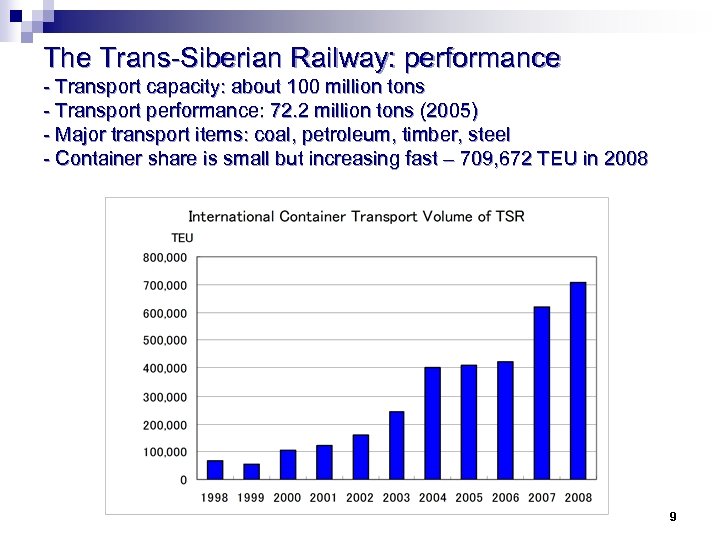
The Trans-Siberian Railway: performance - Transport capacity: about 100 million tons - Transport performance: 72. 2 million tons (2005) - Major transport items: coal, petroleum, timber, steel - Container share is small but increasing fast – 709, 672 TEU in 2008 9
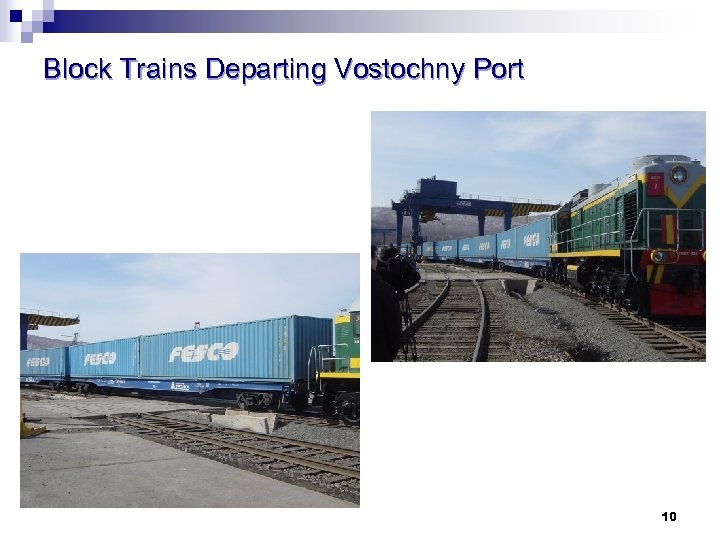
Block Trains Departing Vostochny Port 10
The Four Periods in the History of TSR International Container Transport: (1) & (2) (1) Land Bridge era: 1970 s– 1980 s Transit cargo from Japan to Europe and the Middle East, established in 1971 ¨ Soviet Union set low transit charges in order to secure foreign currency; about 30% lower than the Deep Sea ¨ Benefited from the unstable political situation in the Middle East ¨ 1983: Container volume reached 110, 683 TEU (filled only) ¨ (2) Period of chaos: 1990 s ¨ ¨ Service deteriorated after the collapse of the Soviet Union The route lost its economic competitiveness versus the Deep Sea route n The Deep Sea rate decreased due to technological progress and market competition 11
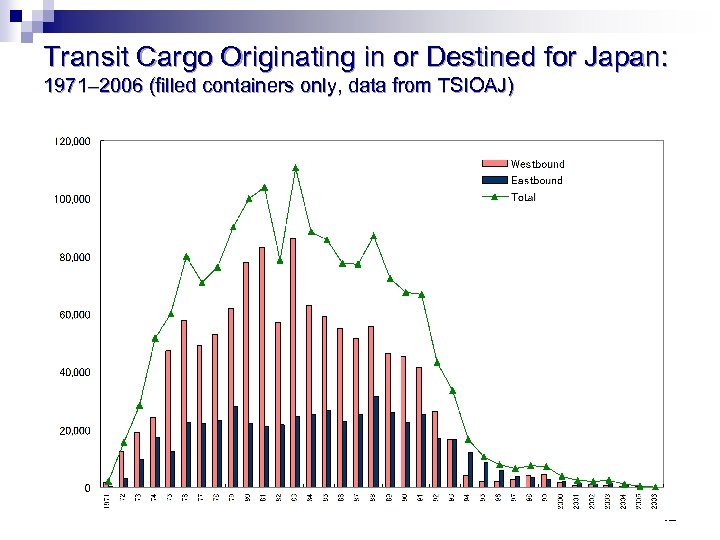
Transit Cargo Originating in or Destined for Japan: 1971– 2006 (filled containers only, data from TSIOAJ) 12
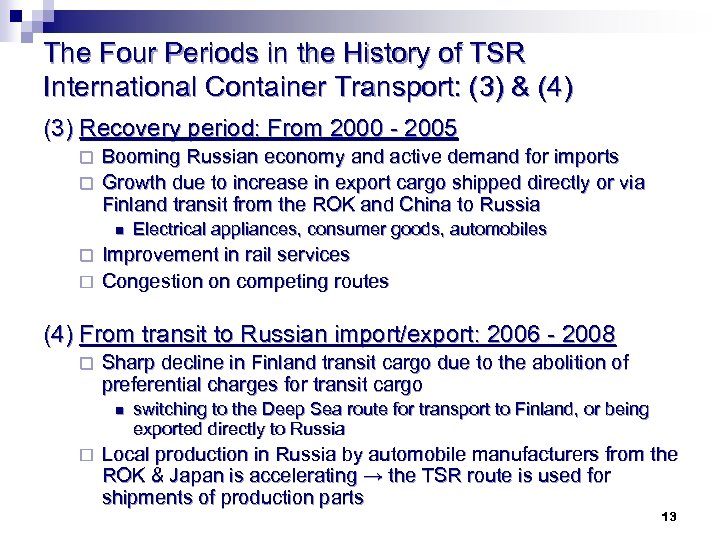
The Four Periods in the History of TSR International Container Transport: (3) & (4) (3) Recovery period: From 2000 - 2005 Booming Russian economy and active demand for imports ¨ Growth due to increase in export cargo shipped directly or via Finland transit from the ROK and China to Russia ¨ n Electrical appliances, consumer goods, automobiles Improvement in rail services ¨ Congestion on competing routes ¨ (4) From transit to Russian import/export: 2006 - 2008 ¨ Sharp decline in Finland transit cargo due to the abolition of preferential charges for transit cargo n ¨ switching to the Deep Sea route for transport to Finland, or being exported directly to Russia Local production in Russia by automobile manufacturers from the ROK & Japan is accelerating → the TSR route is used for shipments of production parts 13
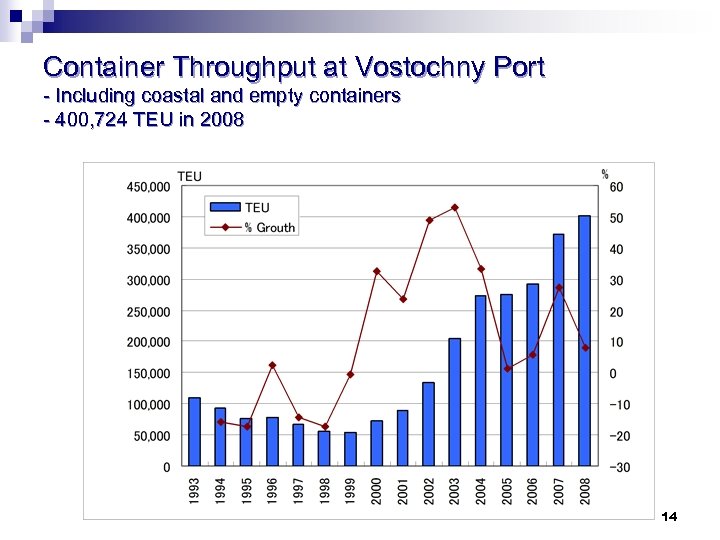
Container Throughput at Vostochny Port - Including coastal and empty containers - 400, 724 TEU in 2008 14
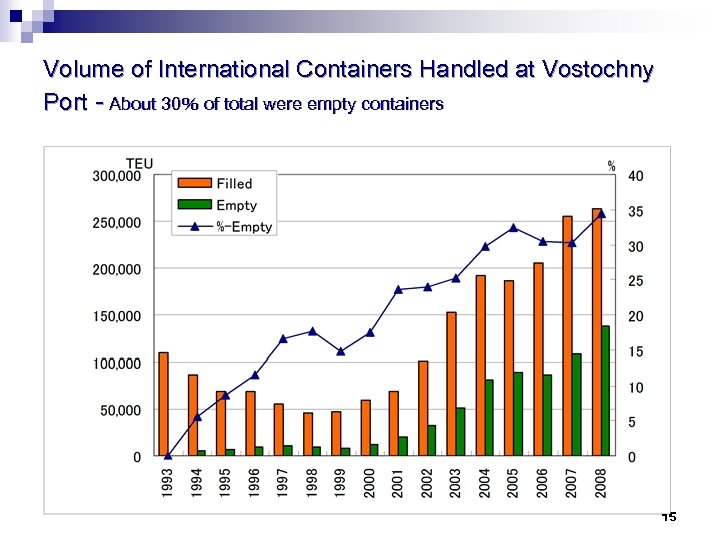
Volume of International Containers Handled at Vostochny Port - About 30% of total were empty containers 15
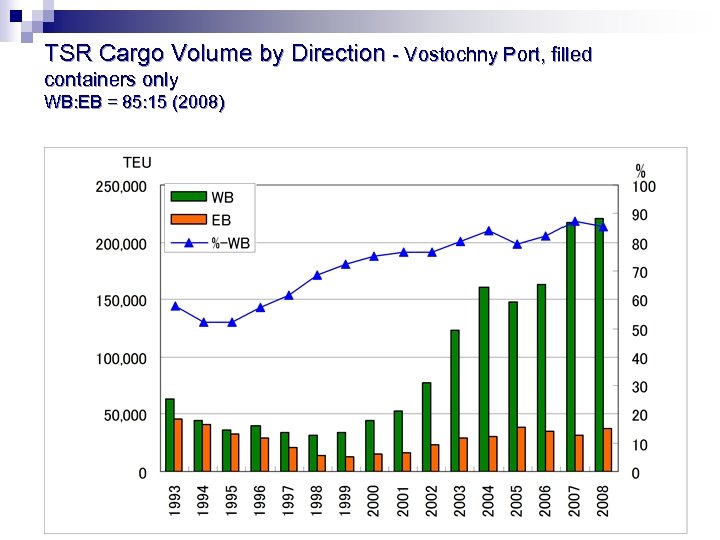
TSR Cargo Volume by Direction - Vostochny Port, filled containers only WB: EB = 85: 15 (2008) 16
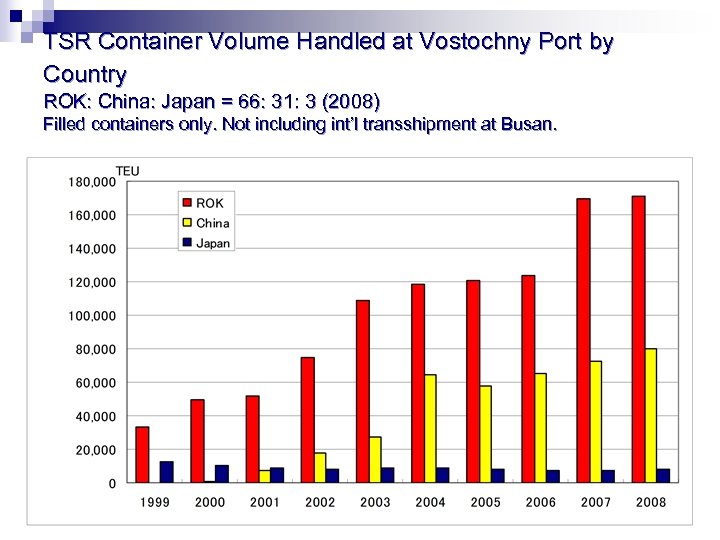
TSR Container Volume Handled at Vostochny Port by Country ROK: China: Japan = 66: 31: 3 (2008) Filled containers only. Not including int’l transshipment at Busan. 17
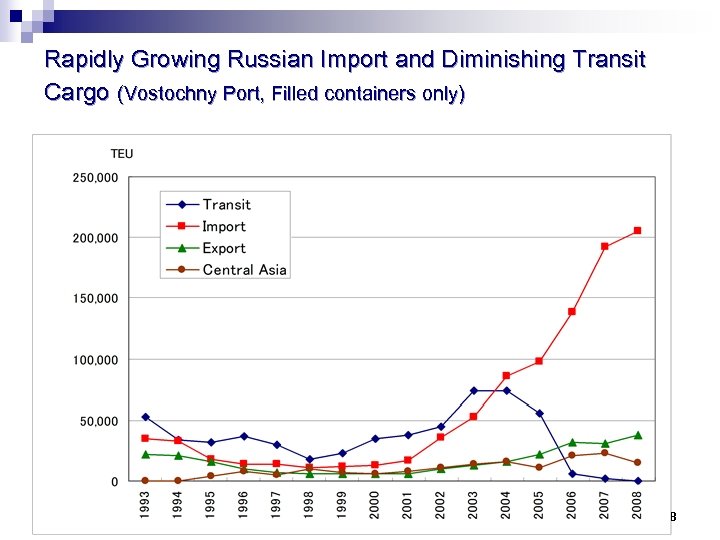
Rapidly Growing Russian Import and Diminishing Transit Cargo (Vostochny Port, Filled containers only) 18
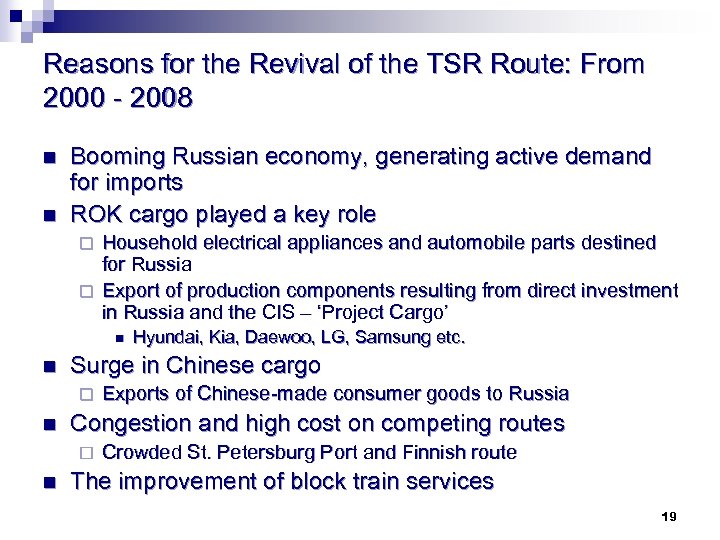
Reasons for the Revival of the TSR Route: From 2000 - 2008 n n Booming Russian economy, generating active demand for imports ROK cargo played a key role Household electrical appliances and automobile parts destined for Russia ¨ Export of production components resulting from direct investment in Russia and the CIS – ‘Project Cargo’ ¨ n n Surge in Chinese cargo ¨ n Exports of Chinese-made consumer goods to Russia Congestion and high cost on competing routes ¨ n Hyundai, Kia, Daewoo, LG, Samsung etc. Crowded St. Petersburg Port and Finnish route The improvement of block train services 19
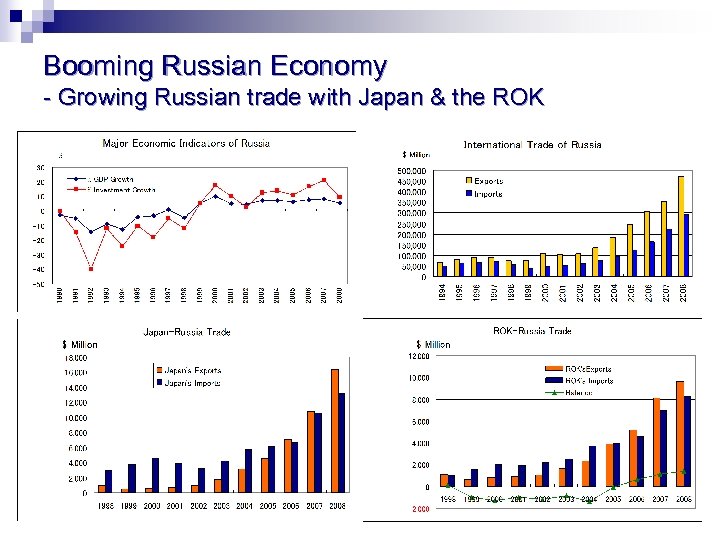
Booming Russian Economy - Growing Russian trade with Japan & the ROK 20
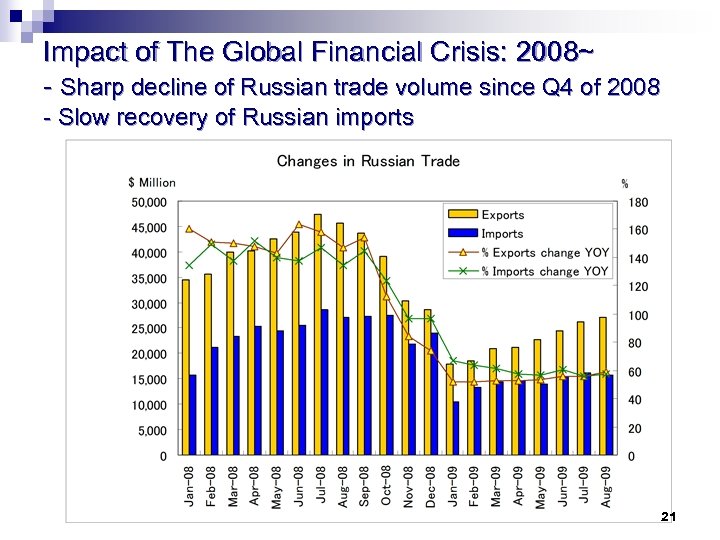
Impact of The Global Financial Crisis: 2008~ - Sharp decline of Russian trade volume since Q 4 of 2008 - Slow recovery of Russian imports 21
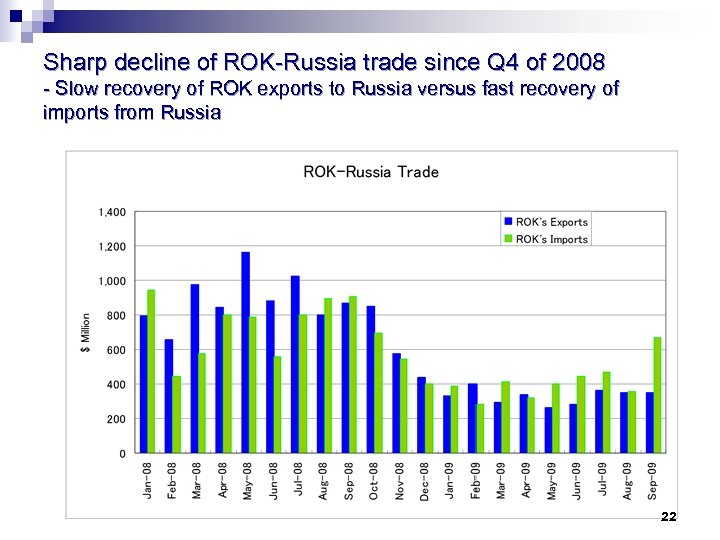
Sharp decline of ROK-Russia trade since Q 4 of 2008 - Slow recovery of ROK exports to Russia versus fast recovery of imports from Russia 22
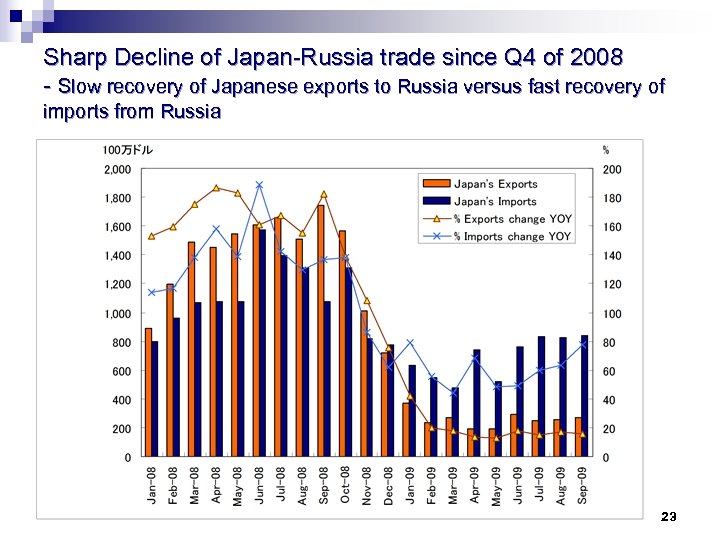
Sharp Decline of Japan-Russia trade since Q 4 of 2008 - Slow recovery of Japanese exports to Russia versus fast recovery of imports from Russia 23
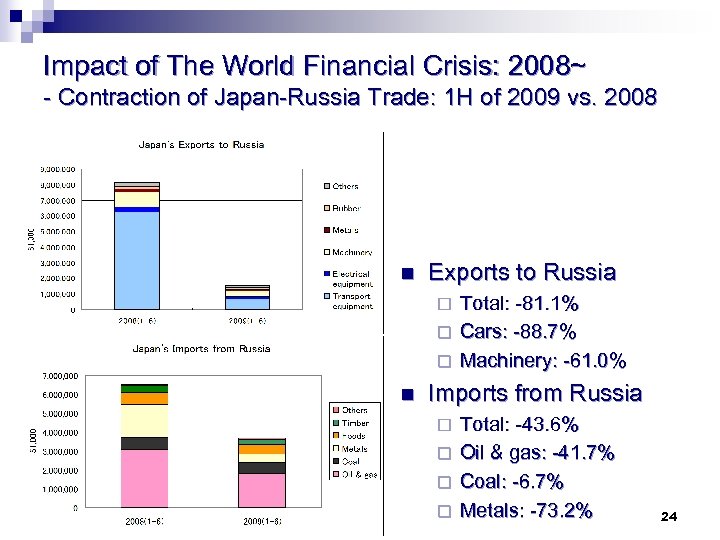
Impact of The World Financial Crisis: 2008~ - Contraction of Japan-Russia Trade: 1 H of 2009 vs. 2008 n Exports to Russia Total: -81. 1% ¨ Cars: -88. 7% ¨ Machinery: -61. 0% ¨ n Imports from Russia ¨ ¨ Total: -43. 6% Oil & gas: -41. 7% Coal: -6. 7% Metals: -73. 2% 24
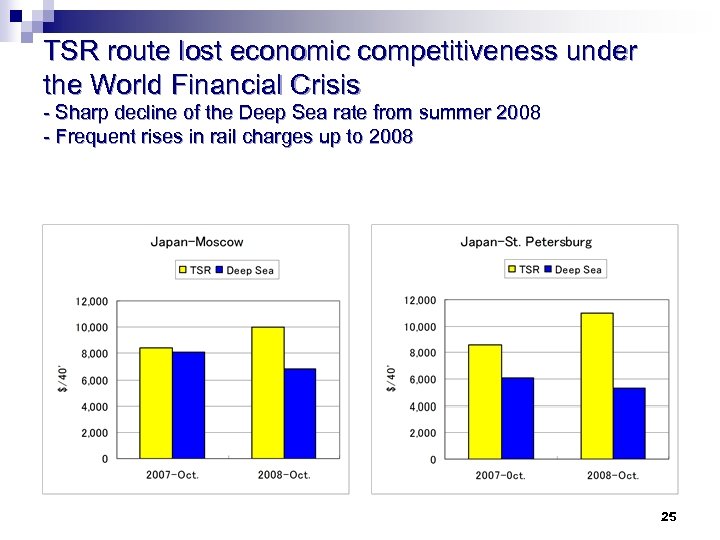
TSR route lost economic competitiveness under the World Financial Crisis - Sharp decline of the Deep Sea rate from summer 2008 - Frequent rises in rail charges up to 2008 25
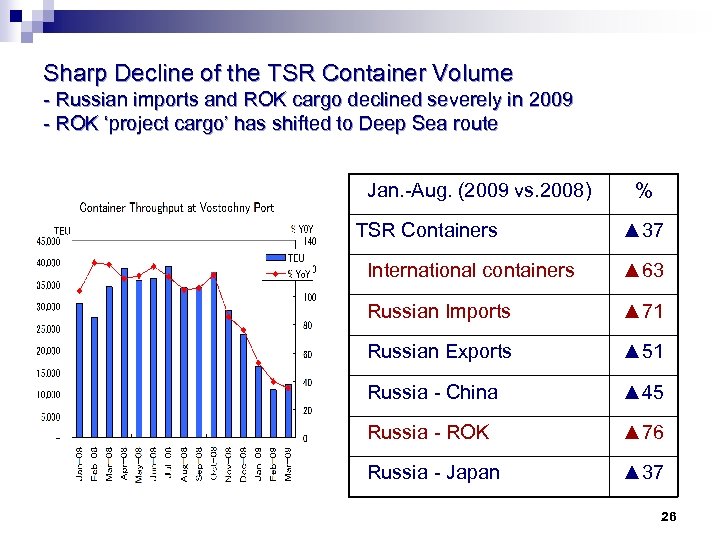
Sharp Decline of the TSR Container Volume - Russian imports and ROK cargo declined severely in 2009 - ROK ‘project cargo’ has shifted to Deep Sea route Jan. -Aug. (2009 vs. 2008) TSR Containers % ▲ 37 International containers ▲ 63 Russian Imports ▲ 71 Russian Exports ▲ 51 Russia - China ▲ 45 Russia - ROK ▲ 76 Russia - Japan ▲ 37 26
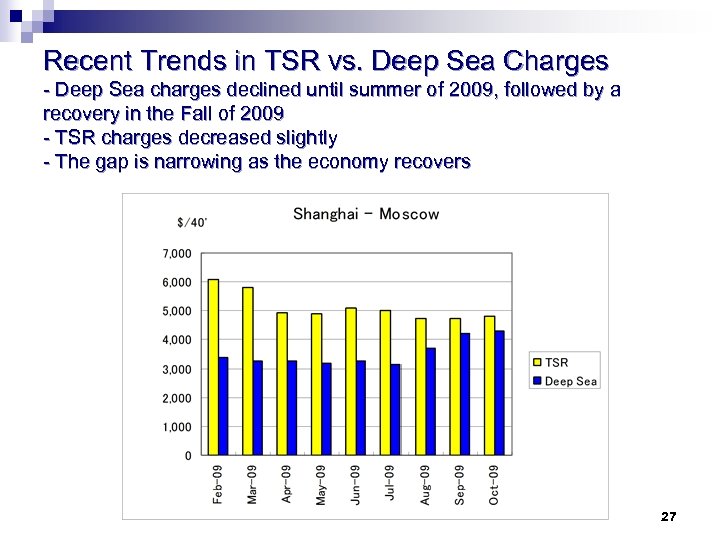
Recent Trends in TSR vs. Deep Sea Charges - Deep Sea charges declined until summer of 2009, followed by a recovery in the Fall of 2009 - TSR charges decreased slightly - The gap is narrowing as the economy recovers 27
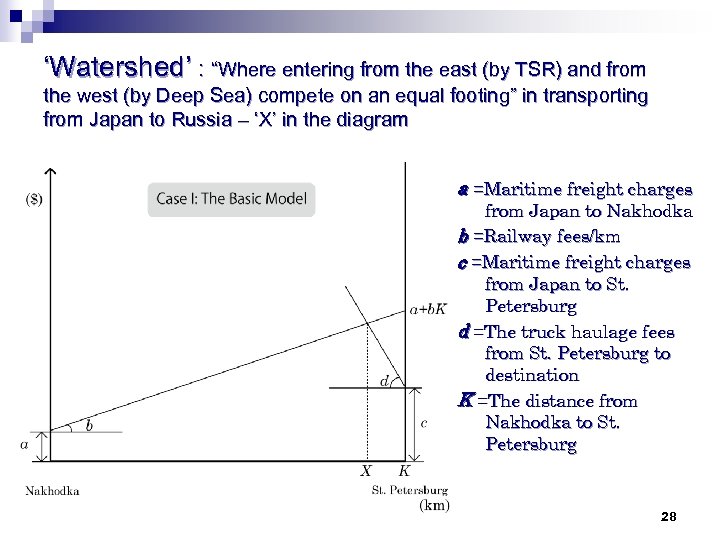
‘Watershed’ : “Where entering from the east (by TSR) and from the west (by Deep Sea) compete on an equal footing” in transporting from Japan to Russia – ‘X’ in the diagram a =Maritime freight charges from Japan to Nakhodka b =Railway fees/km c =Maritime freight charges from Japan to St. Petersburg d =The truck haulage fees from St. Petersburg to destination K =The distance from Nakhodka to St. Petersburg 28
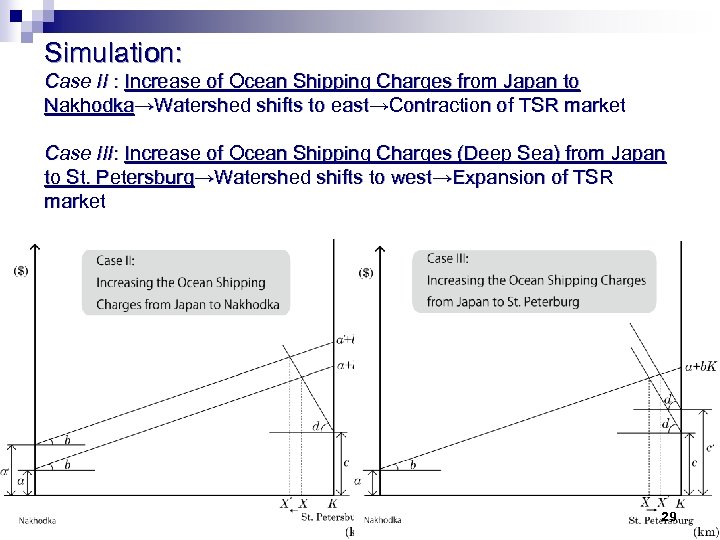
Simulation: Case II : Increase of Ocean Shipping Charges from Japan to Nakhodka→Watershed shifts to east→Contraction of TSR market Case III: Increase of Ocean Shipping Charges (Deep Sea) from Japan to St. Petersburg→Watershed shifts to west→Expansion of TSR market 29
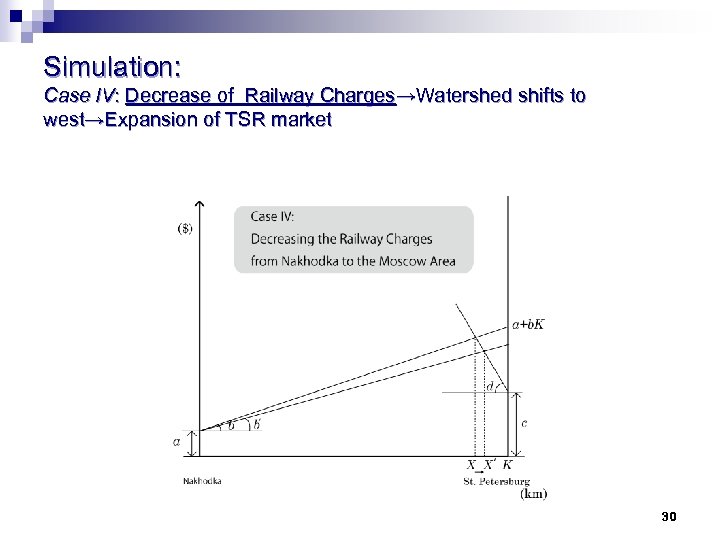
Simulation: Case IV: Decrease of Railway Charges→Watershed shifts to west→Expansion of TSR market 30
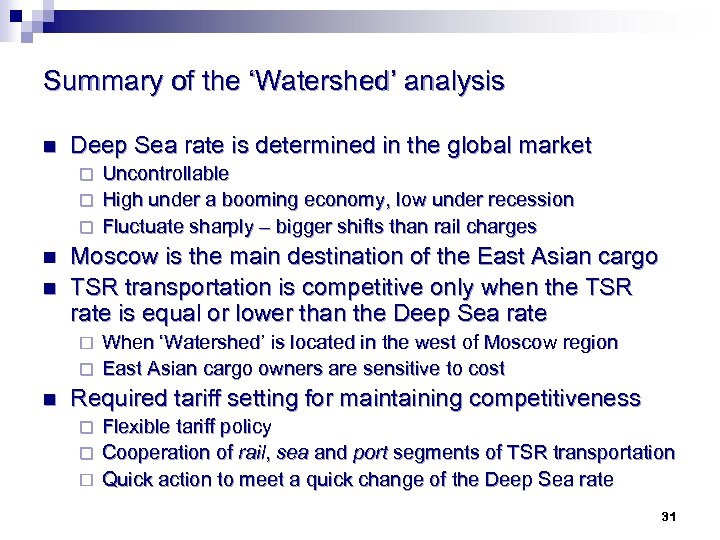
Summary of the ‘Watershed’ analysis n Deep Sea rate is determined in the global market Uncontrollable ¨ High under a booming economy, low under recession ¨ Fluctuate sharply – bigger shifts than rail charges ¨ n n Moscow is the main destination of the East Asian cargo TSR transportation is competitive only when the TSR rate is equal or lower than the Deep Sea rate When ‘Watershed’ is located in the west of Moscow region ¨ East Asian cargo owners are sensitive to cost ¨ n Required tariff setting for maintaining competitiveness Flexible tariff policy ¨ Cooperation of rail, sea and port segments of TSR transportation ¨ Quick action to meet a quick change of the Deep Sea rate ¨ 31
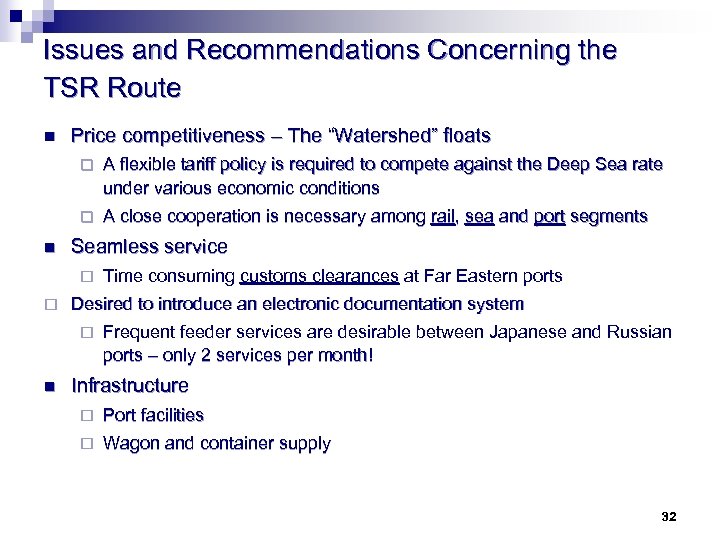
Issues and Recommendations Concerning the TSR Route n Price competitiveness – The “Watershed” floats ¨ ¨ n A flexible tariff policy is required to compete against the Deep Sea rate under various economic conditions A close cooperation is necessary among rail, sea and port segments Seamless service ¨ ¨ Desired to introduce an electronic documentation system ¨ n Time consuming customs clearances at Far Eastern ports Frequent feeder services are desirable between Japanese and Russian ports – only 2 services per month! Infrastructure ¨ Port facilities ¨ Wagon and container supply 32
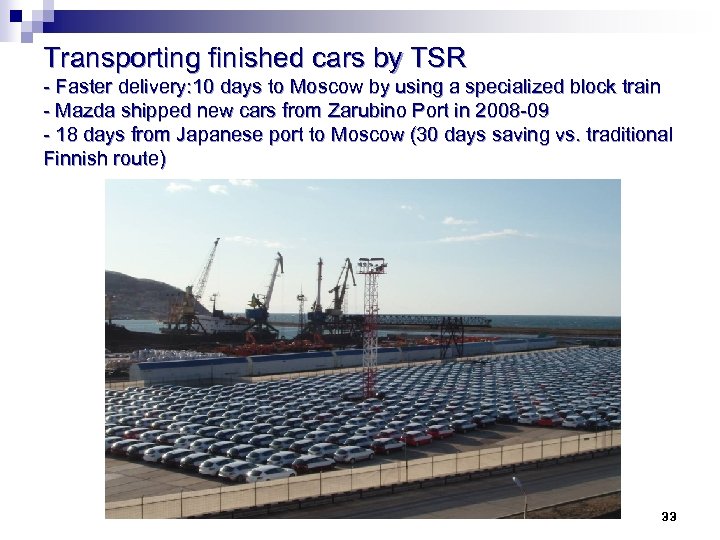
Transporting finished cars by TSR - Faster delivery: 10 days to Moscow by using a specialized block train - Mazda shipped new cars from Zarubino Port in 2008 -09 - 18 days from Japanese port to Moscow (30 days saving vs. traditional Finnish route) 33
Скачать презентацию The Global Financial Crisis and Trans-Siberian Railway Transportation
8217a610062df0ee753b337a04091cb4.ppt