 Скачать презентацию The Global Education Market The Nordic Challenge Reykjavik
25ce2e4c7729a0d5c9e4a848e7e955bc.ppt
- Количество слайдов: 34



The Global Education Market: The Nordic Challenge Reykjavik, Iceland, September 23 -24, 2004 Defining e. Learning Challenges: A Perspective from the USA Norman Peterson, Ph. D. Vice Provost for International Education Montana State University
The Challenges of the Topic • “Policies and instruments” not most productive way to analyze e. Learning trends in USA • Constitutional limit on federal control of education • De-centralized policy environment • More than 4, 000 recognized, degree granting 2 and 4 year institutions • Market-driven educational environment • System built around self-regulation • Policy largely used to address problems, not direct program development
Overview of Presentation • Demographics of e. Learning in the USA • Some trends in e. Learning in the USA • Major policy issues facing institutions and policy-makers in the USA
I. Demographics
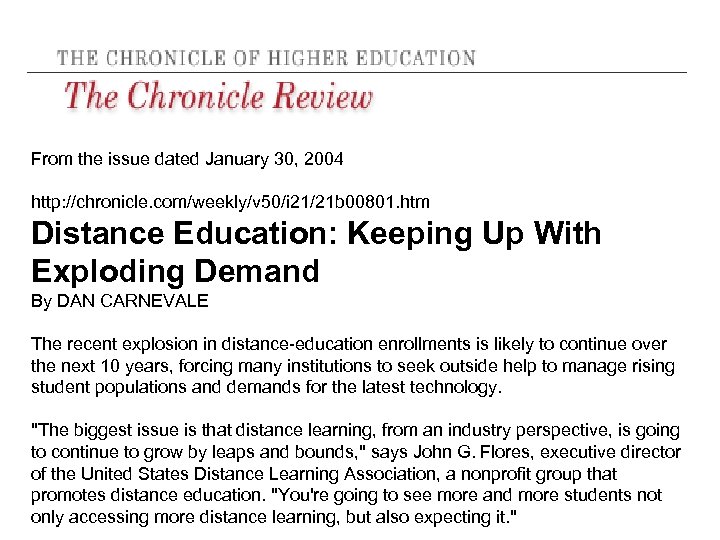
From the issue dated January 30, 2004 http: //chronicle. com/weekly/v 50/i 21/21 b 00801. htm Distance Education: Keeping Up With Exploding Demand By DAN CARNEVALE The recent explosion in distance-education enrollments is likely to continue over the next 10 years, forcing many institutions to seek outside help to manage rising student populations and demands for the latest technology. "The biggest issue is that distance learning, from an industry perspective, is going to continue to grow by leaps and bounds, " says John G. Flores, executive director of the United States Distance Learning Association, a nonprofit group that promotes distance education. "You're going to see more and more students not only accessing more distance learning, but also expecting it. "
Data on Distance Education in General Distance Education at Degree-Granting Postsecondary Institutions: 2000 -2001 National Center for Education Statistics U. S. Department of Education July 2003
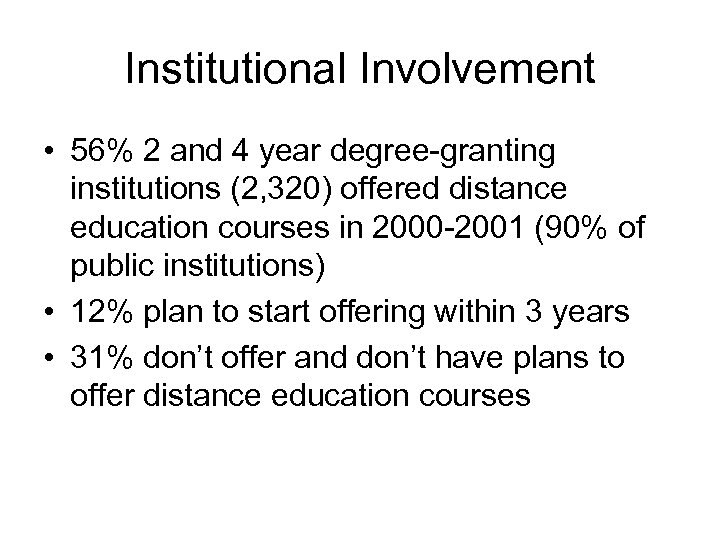
Institutional Involvement • 56% 2 and 4 year degree-granting institutions (2, 320) offered distance education courses in 2000 -2001 (90% of public institutions) • 12% plan to start offering within 3 years • 31% don’t offer and don’t have plans to offer distance education courses
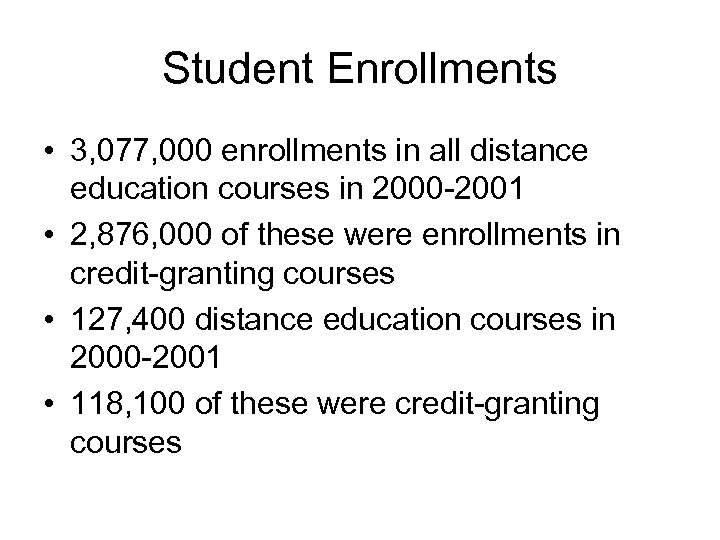
Student Enrollments • 3, 077, 000 enrollments in all distance education courses in 2000 -2001 • 2, 876, 000 of these were enrollments in credit-granting courses • 127, 400 distance education courses in 2000 -2001 • 118, 100 of these were credit-granting courses
Degree and Certificate Programs • 19% of 2 and 4 year institutions offered degree or certificate programs to be completed entirely through distance education
Technologies Utilized • 90% of institutions offered asynchronous Internet based courses • 43% offered synchronous Internet based courses • 51% offered 2 -way interactive video/audio courses • 41% offered 1 -way pre-recorded video courses • 29% offered CD-ROM courses • 19% offered multi-mode courses
Data on Online Education Sizing the Opportunity: the Quality and Extent of Online Education in the United States, 2002 and 2003 The Sloan Consortium September 2003
Student Participation • 1. 6 million students took at least 1 on-line course during Fall 2002 • 11% of all U. S. higher education students (578, 000) took at least 1 on-line course in Fall 2002 • Projected growth between Fall 2002 and Fall 2003 is 19. 8% to 1. 9 million students
Institutional Participation • 81% U. S. higher education institutions offered at least one on-line course (97% of public institutions) • 34% U. S. higher education institutions offered complete on-line degrees (49% of public institutions) • 67% believe that online education is a critical long-term strategy for their institution
Attitudes • 57% academic leaders believe the learning outcomes for online education are equal or superior to traditional instruction • 1/3 of them believe learning outcomes will be superior in three years
II. Trends
1. The Rush to the Internet • 88% institutions plan to expand asynchronous Internet courses • 62% plan to expand synchronous Internet courses • 40% plan to expand 2 -way audio/2 -way video courses • 39% plan to expand CD-ROM courses • 31% plan to expand multi-mode courses • 23% plan to expand pre-recorded video
2. The Importance of Partnerships • 60% of institutions offering distance education courses participated in some form of distance education consortium
3. The Move to the Hybrid
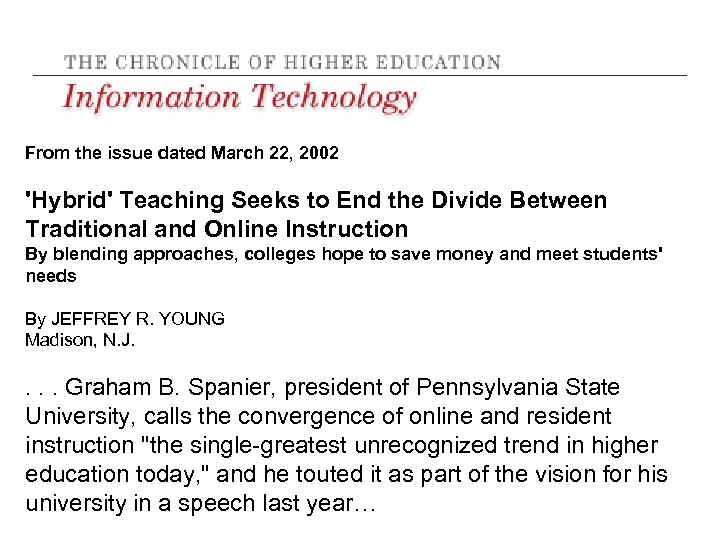
From the issue dated March 22, 2002 'Hybrid' Teaching Seeks to End the Divide Between Traditional and Online Instruction By blending approaches, colleges hope to save money and meet students' needs By JEFFREY R. YOUNG Madison, N. J. . Graham B. Spanier, president of Pennsylvania State University, calls the convergence of online and resident instruction "the single-greatest unrecognized trend in higher education today, " and he touted it as part of the vision for his university in a speech last year…
Examples of Hybridization • Traditional classes incorporate online components within a class • Distance technology based classes and programs incorporate traditional instruction • Students in traditional campus-based degree programs fulfill parts of their degrees online
The University of Phoenix • “At University of Phoenix, you can earn your bachelor’s, master’s or doctoral degree any way you want to – on campus, online, or in certain areas using a combination of both, which we call Flex. Net®” • Only 40% instruction offered online
A Case Study: The U. S. Arabic Distance Learning Network • Combines interactive video, asynchronous Internet, traditional classroom, and study abroad to build Arabic proficiency • Goal: offer affordable, quality Arabic instruction at institutions across the U. S. • Less-commonly-taught languages are not affordable for most institutions and therefore not accessible for most students
U. S. Arabic Distance Learning Network (continued) • Instructional program – Lecturer remotely located teaches 2 hours per week to 4 -5 classes via 2 -way audio/video connected through Internet II – Native Arabic-speaking student Teaching Assistants located at each institution supplement instruction 2 -3 hours per week – Asynchronous Internet software connects Lecturer to students and TAs – Integrated study abroad program in Morocco provides further instruction in Arabic language environment
U. S. Arabic Distance Learning Network (continued) • Reduce institutional cost from $75 -100 k per year to approximately $15 k • Operating on 7 university campuses this year and plan to expand to 25 next year • Apply e. Learning technologies, in combination with traditional instruction, to lower costs and make curriculum available to students

III. The Issues
1. Quality Assurance • Accreditation – Regional Accrediting Associations • • Included in self-study and peer evaluations Programs congruent with institutional mission Faculty responsible and exercise oversight Technology appropriate Faculty support and training services provided Students access to library resources Etc. • Associations promote best practices
2. Academic Issues • Congruence of academic calendar among partners • Transcripting of credit (specify online? ) • Course admission requirements • Curriculum approval/review processes • Credit transfer to traditional programs
3. Fiscal Issues • In-state and out-state tuition rates apply? • Policies for sharing expenses and income • Financial issues of receiving institutions
4. Governance Issues • In consortia who controls and governs?
5. Labor-Management & Legal Issues • Operate under existing labor-management policies or develop new guidelines? • Re-balancing faculty, student, and administrative needs • Class size, compensation, development incentives, copyright, intellectual property, faculty training and workload, etc.
6. Student Support Services • Maintaining student centered focus of campus programs • Technical support, text book access, library resources, advisement, test proctoring, etc.
7. International Regulation
From the issue dated January 18, 2002 Colleges, Fighting U. S. Trade Proposal, Say It Favors For. Profit Distance Education Outcome could affect many institutions' plans to go after lucrative foreign markets By ANDREA FOSTER Washington A little-known proposal by U. S. officials to remove international trade barriers to higher education has infuriated many college leaders, who say federal policy is being unfairly set by for-profit-education providers, including distance-education institutions. The college officials say the proposal could end up undermining many institutions' independence.
IV. Summary • e. Learning in the USA is experiencing enormous growth • Gaining acceptance as providing learning outcomes equal to traditional instruction • Momentum is moving heavily to the use of asynchronous Internet • Hybridization and integration with traditional learning is also a major trend • e. Learning promotes unprecedented levels of partnership between institutions • e. Learning raises unique issues for academic policymakers – quality, academic, fiscal, governance, labormanagement, legal, student support, and international
Скачать презентацию The Global Education Market The Nordic Challenge Reykjavik
25ce2e4c7729a0d5c9e4a848e7e955bc.ppt